
Life, 1928-09-14 · page 26 of 40
Life — September 14, 1928 — page 26: what you’re looking at
What you’re looking at
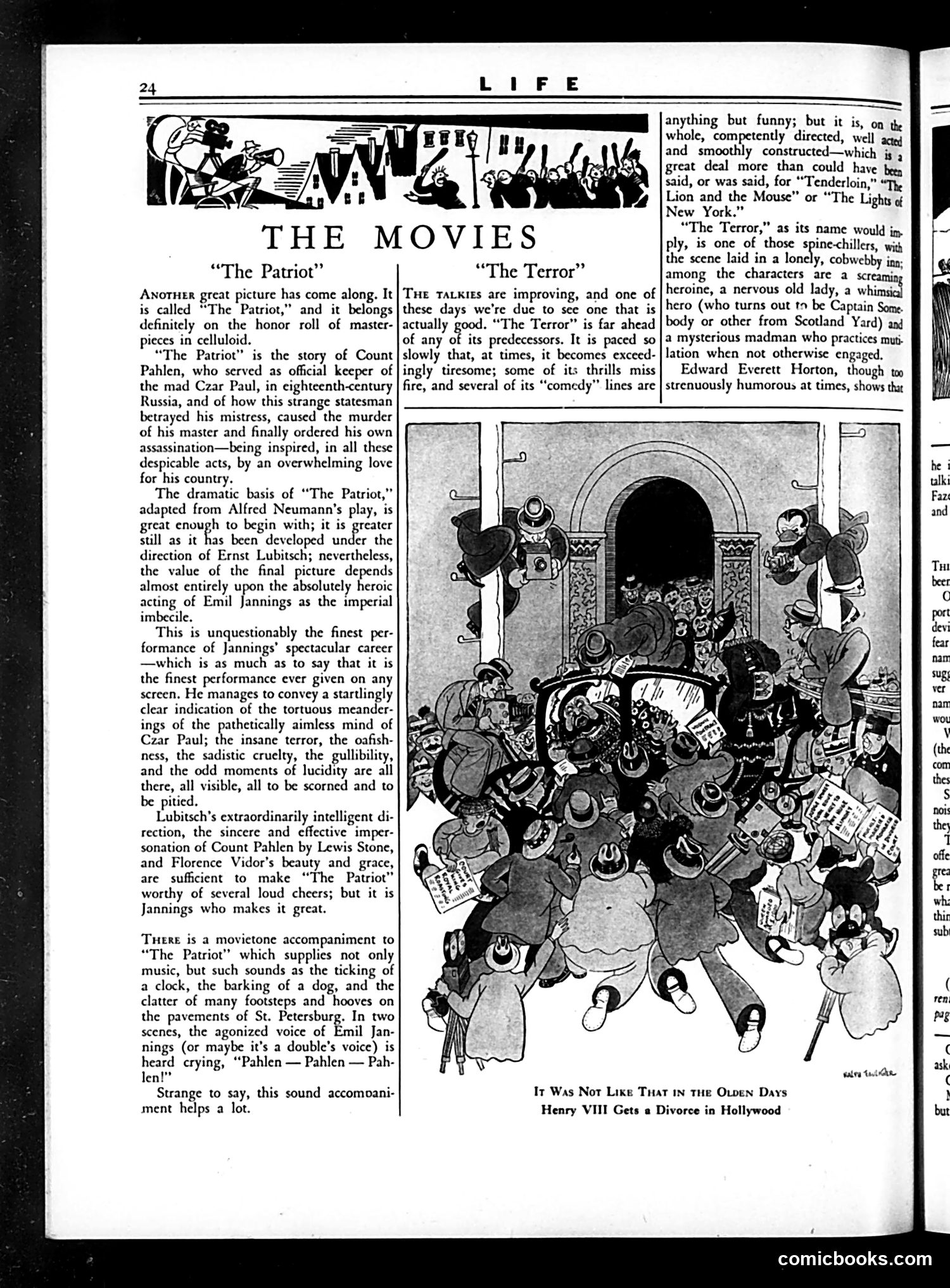
This page reviews two early sound films. "The Patriot" is praised as a masterpiece about an 18th-century Russian Count who betrays his mistress and orders his ruler's murder—all supposedly for patriotic reasons. The review credits Emil Jannings's acting as exceptional for conveying Czar Paul's mental deterioration and cruelty. "The Terror" is a "talkies" (sound film) thriller set in a haunted inn, featuring standard horror-genre characters: a screaming heroine, nervous old lady, mysterious hero, and a murderous madman. The review notes the film is competently made but slow-paced, with some failed attempts at comedy. The caption references "Henry VIII Gets a Divorce in Hollywood," suggesting Hollywood is treating historical material with irreverent modernization. The cartoon (not fully visible) likely satirizes this anachronistic approach to serious subjects.
📄 Transcribed text from this page (OCR, searchable)
Machine-transcribed from the original scan — historical spelling and the odd misread are preserved.
‘THE MOVIES “The Patriot” Anoruer great picture has come along. It is called “The Patriot,” and it belongs definitely on the honor roll of master- pieces in celluloid. “The Patriot” is the story of Count Pahlen, who served as official keeper of the mad Czar Paul, in eighteenth-century Russia, and of how this strange statesman betrayed his mistress, caused the murder of his master and finally ordered his own assassination—being inspired, in all these despicable acts, by an overwhelming love for his country. The dramatic basis of ‘The Patriot,” adapted from Alfred Neumann's play, is great enough to begin with; it is greater still as it has been developed under the direction of Ernst Lubitsch; nevertheless, the value of the final picture depends almost entirely upon the absolutely heroic acting of Emil Jannings as the imperial imbecile. This is unquestionably the finest per- formance of Jannings’ spectacular career —which is as much as to say that it is the finest performance ever given on any screen, He manages to convey a startlingly clear indication of the tortuous meander- ings of the pathetically aimless mind of Czar Paul; the insane terror, the oafish- ness, the sadistic cruelty, the gullibility, and the odd moments of lucidity are all there, all visible, all to be scorned and to be pitied. Lubitsch’s extraordinarily intelligent di- rection, the sincere and effective imper- sonation of Count Pahlen by Lewis Stone, and Florence Vidor’s beauty and grace, are sufficient to make “The Patriot” worthy of several loud cheers; but it is Jannings who makes it great. Tuere is a movictone accompaniment to “The Patriot’ which supplies not only music, but such sounds as the ticking of a clock, the barking of a dog, and the clatter of many footsteps and hooves on the pavements of St. Petersburg. In two scenes, the agonized voice of Emil Jan- nings (or maybe it’s a double’s voice) is heard crying, ‘‘Pahlen — Pahlen — Pah- len!" Strange to say, this sound accompani- ment helps a lot. “The Terror” THE TALKIES are improving, and one of these days we're due to see one that is actually good. “The Terror” is far ahead of any P its predecessors. It is paced so slowly that, at times, it becomes exceed- ingly tiresome; some of its thrills miss fire, and several of its “comedy” lines are anything but funny; but it is, on the whole, competently directed, well acted and smoothly constructed—which js 3 great deal more than could have bees said, or was said, for “Tenderloin,” “The Lion and the Mouse” or “The Lights of New York.” “The Terror,” as its name would im. ply, is one of those spine-chillers, with the scene laid in a lonely, cobwebby inn; among the characters are a screaming heroine, a nervous old lady, a whims: hero (who turns out to be Captain Some. body or other from Scotland Yard) and a mysterious madman who practices mut- lation when not otherwise engaged, Edward Everett Horton, though too strenuously humorous at times, shows tht It Was Not Like Tat in tHe Ovven Days Henry VIII Gets a Divorce in Hollywood comicbooks.com