
Life, 1928-09-14 · page 11 of 40
Life — September 14, 1928 — page 11: what you’re looking at
What you’re looking at
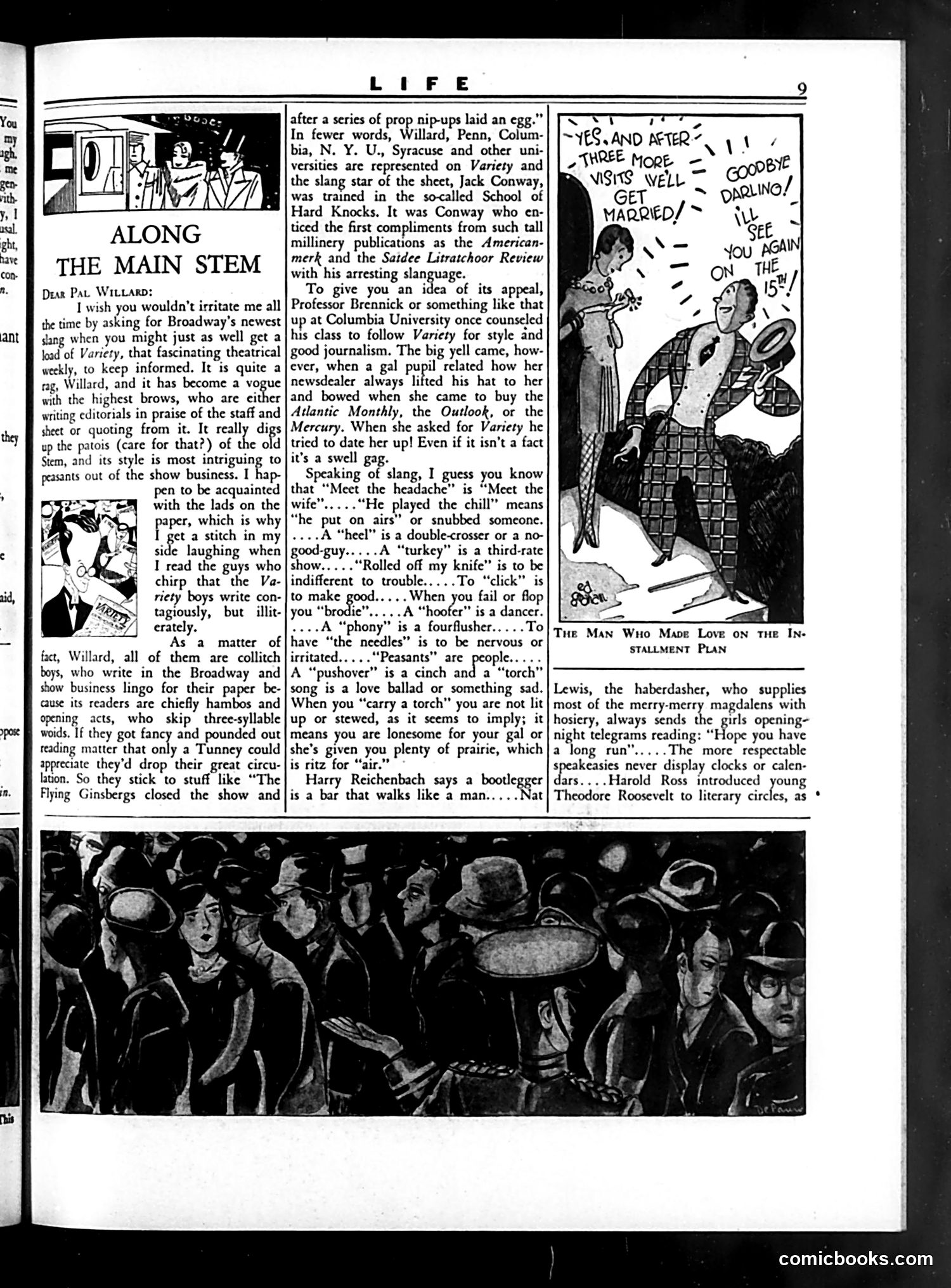
This page contains a theater column titled "Along the Main Stem" by columnist Willard, discussing Broadway and theatrical slang. The main cartoon depicts a man saying goodbye to a woman at a doorway, with the caption "The Man Who Made Love on the Installment Plan." The joke plays on financial terminology—the man's romantic departure ("see you on the 15th") suggests he's pursuing courtship in scheduled payments rather than all at once, treating romance like a debt repayment plan. This satirizes both commercialism creeping into personal relationships and perhaps the casual dating habits of the era. The column discusses theatrical vernacular and reviews of Broadway productions, providing contemporary entertainment industry context.
📄 Transcribed text from this page (OCR, searchable)
Machine-transcribed from the original scan — historical spelling and the odd misread are preserved.
LiFe THE MAIN STEM Dean Pac WiLLaRp: I wish you wouldn’t irritate me all the time by asking for Broadway's newest sang when you might just as well get a load of Variety, that fascinating theatrical weekly, to keep informed. It is quite a rag, Willard, and it has become a vogue with the highest brows, who are cither writing editorials in praise of the staff and sheet or quoting from it. It really digs up the patois (care for that?) of the old Stem, and its style is most intriguing to peasants out of the show business. I hap- pen to be acquainted with the lads on the paper, which is why I get a stitch in my side laughing when I read the guys who chirp that the Va-|i riety boys write con- tagiously, but illit- erately. As a matter of fact, Willard, all of them are collitch boys, who write in the Broadway and show business lingo for their paper be- cause its readers are chiefly hambos and opening acts, who skip three-syllable woids. If they got fancy and pounded out reading matter that only a Tunney could appreciate they’d drop their great circu- lauon. So they stick to stuff like “The Flying Ginsbergs closed the show and after a series of prop nip-ups laid an egg.” In fewer wordt Willard Penn, Cohan: bia, N. Y. U., Syracuse and other uni- versities are represented on Variety and the slang star of the sheet, Jack Conway, was trained in the so-called School of Hard Knocks. It was Conway who en- ticed the first compliments from such tall millinery publications as the American- merk and the Satdee Litratchoor Review with his arresting slanguage. To give you an idea of its appeal, Professor Brennick or something like that up at Columbia University once counseled his class to follow Variety for style and good journalism. The big yell came, how- ever, when a gal pupil related how her newsdealer always lifted his hat to her and bowed when she came to buy the Atlantic Monthly, the Outlook, or the Mercury. When she asked for Variety he tried to date her up! Even if it isn’t a fact it’s a swell gag. Speaking of slang, I guess you know that “Meet the headache” is Meet the wife”’.....“He played the chill” means “he put on airs” or snubbed someone. ..+.A “heel” is a double-crosser or a no- -A “turkey” is a third-rate -“Rolled off my knife” is to be nt to trouble. To “click” is to make good..... When fail or flop you “brodie’’. “hoofer" is a dancer. ..+-A “phony” is a fourflusher.....To have “the needles” is to be nervous or irritated.....‘Peasants” are people..... A “pushover” is a cinch and a “torch” song is a love ballad or something sad. When you “carry a torch” you are not lit up or stewed, as it seems to imply; it means you are lonesome for your gal or she’s given you plenty of prairie, which is ritz for “air.” Harry Reichenbach says a bootlegger is a bar that walks like a man.....Nat ~ ‘ 7 > ~YES.AND AFTER”. 4 2 THREE Mope => NS vel . MARRIED/ ~ G — Tue Man Wuo Mave Love STALLMENT PLAN ON THE IN- Lewis, the haberdasher, who supplies most of the merry-merry magdalens with hosiery, always sends the girls opening- night telegrams reading: “Hope you have a long run”.....The more respectable apace never display clocks or calen- jar: s....Harold Ross introduced young Theodore Roosevelt to literary circles, as comicbooks.com