
Life, 1928-09-14 · page 28 of 40
Life — September 14, 1928 — page 28: what you’re looking at
What you’re looking at
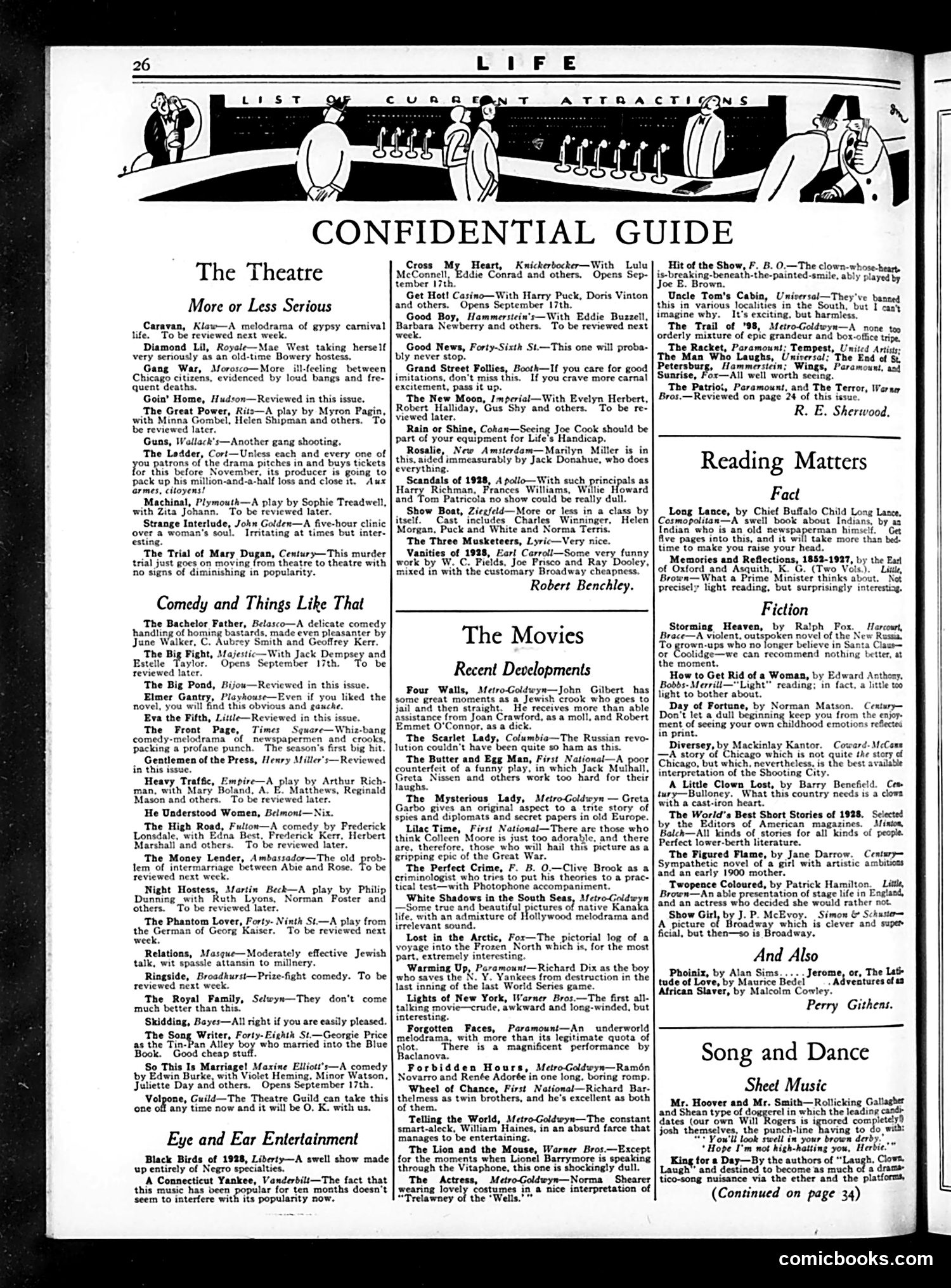
This is not a political cartoon but rather a **theater and entertainment listings page** from Life magazine's "Confidential Guide" section. The header illustration depicts various theatrical and entertainment figures in a decorative banner, but these are generic representations rather than caricatures of specific people. The content consists of **brief, sardonic reviews** of Broadway shows and movies then running, written in Life's characteristic witty, irreverent style. Examples of the satire include mocking descriptions like "Diamond Lil"—noting Mae West taking herself "very seriously as an old-time Bowery hostess"—and "Gang War," described simply as showing "ill-feeling between Chicago citizens, evidenced by loud bangs and frequent deaths." The tone is gossipy and dismissive toward popular entertainment, reflecting 1920s cultural commentary. This page serves as a contemporary guide for readers seeking entertainment recommendations with satirical commentary rather than straightforward reviews.
📄 Transcribed text from this page (OCR, searchable)
Machine-transcribed from the original scan — historical spelling and the odd misread are preserved.
CONFIDENTIAL GUIDE The Theatre More or Less Serious Caravan, Klow—A melodrama of gypsy carnival life, To be reviewed next week. Diamond Lil, Royale—Mac West taking herself very senously as an old-time Bowery hostess. Gang War, Morosco—More ill-fecling between Chicago citizens, evidenced by loud bangs and fre- quent deaths. Goin’ Home, Hudson—Reviewed in this issue. The Great Power, Rits—A play by Myron Pagin, with Minna Gombel, Helen Shipman and others. To be reviewed later. Guns, Wallack's—Another gang shooting. The Ladder, Cort—Uniess each and every one of ou patrons of the drama pitches in and buys tickets lor this before November, its producer is going to pack up his million-and-a-half loss and close it. Aux armes, citoyens! Machinal, Plymouth—A play by Sophie Treadwell, with Zita Johann. To be reviewed later. Strange Interlude, John Golden—A five-hour clinic over a woman's soul. Irritating at times but inter- esting. The Trial of Mary Dugan, Century—This murder trial just goes on moving from theatre to theatre with no signs of diminishing in popularity. Comedy and Things Like That ‘The Bachelor Fathe: handling of homing bas June Walker, C. Au Belasco—A delicate comedy rds, made even pleasanter by y Smith and Geoffrey Kerr. The Big Fight, Majestic—With Jack Dempsey and Estelle Taylor.’ Opens September 17th. To be reviewed later. The Big Pond, Bijou—Reviewed in this issue. Elmer Gantry, Playkouse—Even if you liked the novel, you will find this obvious and gauche. Eva the Fifth, Littl—Reviewed in this issue. The Front Page, Times Square—Whiz-bang comedy-melodrama of newspapermen and crooks, packing a profane p The season's first big hit. Gentlemen of the Press, Henry Miller’s—Reviewed in this issue. Heavy Traffic, Empire—A play by Arthur Rich- man, with Mary Boland, A. E. Matthews, Reginald Mason and others. To be reviewed later. He Understood Women, Belmont—Nix. ‘The High Road, Fultow—A comedy by Prederick Lonsdale, with Edna Best, Frederick Kerr, Herbert Marshall and others. To be reviewed later. The Money Lender, Ambassador—The old prob- lem of intermarriage between Abie and Rose. To be reviewed next week. Night Hostess, Martin Beck—A play by Philip Dunning with Ruth Lyons, Norman Foster and others. To be reviewed later. The Phantom Lover, Forty- Ninth St—A play from the German of Georg ‘Kaiser. To be reviewed next week. Relations, Masgue—Moderately effective Jewish talk, wit spassle attansin to millnery. Ringside, Broadhurst—Prize-fight comedy. To be reviewed next week. The Royal Family, Selwyn—They don't come much better than this. Skidding, Boyes—All right if you are easily pleased. The Song Writer, Forty-Eighth St—Georgie Price as the Tin-Pan Alley boy who married into the Blue Book. Good cheap stuff. So This Is Marriage! Maxine Elliott's—A comedy by Edwin Burke, with Violet Heming, Minor Watson, Juliette Day and others. Opens September 17th. Volpone, Guild—The Theatre Guild can take this one of any time now and it will be O. K. with us. Eye and Ear Entertainment Black Birds of 1928, Liberty—A swell show made up entirely of Negro specialties. A Connecticut Yankee, Vanderbil!—The fact that this music has been popiilar for ten months doesn’t seem to interfere with its populanty now. Cross My Hearty Knickerbocker—With Lulu McConnell, Eddie Conrad and others. Opens Sep- tember 17th. Get Hot! Casino—With Harry Puck, Doris Vinton and others. Opens September 17th. Good Boy, Hammerstein's—With Eddie Buszell, Barbara Newberry and others. To be reviewed next week. Good News, Forty-Sixth St.—This one will proba- bly never stop. Grand Street Follies, Booth—If you care for good imitations, don't miss this. If you crave more carnal excitement, pass it up. The New Moon, Imperial—With Evelyn Herbert, Robert Halliday, Gus Shy and others. To be re- viewed later. Rain or Shine, Cokan—Secing Joe Cook should be part of your equipment for Life's Handicap. Rosalie, New Amsterdam—Marilyn Miller is in this, aided immeasurably by Jack Donahue, who does everything. Scandals of 1928, A pollo—With such principals as Harry Richman, Frances Williams, Willie Howard and Tom Patricola no show could be really dull. Show Boat, Zieefeld—More or less in a class by itself. Cast’ includes Charles Winninger, Helen Morgan, Puck and White and Norma Terris. The Three Musketeers, Lyric—Very nice. Vanities of 1928, Earl Corroll—Some very funny work by W. C. Pields, Joe Prisco and Ray Dooley, mixed in with the customary Broadway cheapness. Robert Benchley. The Movies Recent Developments Four Walls, MetroGoldwyn—John Gilbert has some great moments as a Jewish crook who goes to jail and then straight, He receives more than able assistance from Joan Crawford, as a moll, and Robert Emmet O'Connor, as a dick. The Scarlet Lady, Columbia—The Russian revo- lution couldn't have been quite so ham as this. The Butter and Egg Man, First National—A peer counterfeit of a funny play, in which Jack Muthall, Greta Nissen and others work too hard for their laughs. The Mysterious Lady, MetroGoldwyn — Greta Garbo gives an original aspect to a trite story of spies and diplomats and secret papers in old Europe. Lilac Time, First National—There are those who think Colleen Moore is just too adorable, and there are, therefore, those who will hail this picture asa gripping epic of the Great War. The Perfect Crime, F. B. O.—Clive Brook as a criminologist, who tries to put his theories to a prac- tical test—with Photophone accompaniment. White Shadows in the South Seas, Metro-Goldwyn e true and beautiful pictures of native Kanaka ith an admixture of Hollywood melodrama and irrelevant sound. Lost in the Arctic, For—The pictorial log of a voyage into the Frozen North which is, for the most part, extremely inter ra ‘Warming Up, Poramount—Richard Dix as the boy who saves the N. Y. Yankees from destruction in the last inning of the last World Series game. Lights of New York, Warner Bros.—The first all- talking movie—crude, awkward and long-winded, but interesting. Forgotten Faces, Paramount—An underworld melodrama, with more than its legitimate quota of lot. There is a magnificent performance by jaclanova. Forbidden Hours, MetroGoldwyn—Ramén Novarro and Renée Adorée in one long. boring romp. Wheel of Chance, First National—Richard Bar- thelmess as twin brothers, and he’s excellent as both of them. Telling the World, MetroGoldwyn—The constant smart-aleck, William’ Haines, in an absurd farce that manages to be entertainin, The Lion and the Mouse, Warner Bros.—Except for the moments when Lionel Barrymore is speaking through the Vitaphone, this one is shockingly dull. The Actress, MetroGoldwyn—Norma Shearer wearing lovely costumes in a nice interpretation of “Trelawney of the ‘Wells.’ _. Hit of the Sho is-breaking-beneat Joe E. Brown. Uncle Tom's Cabin, Universal—They'y this in various localities in the South. but yas imagine why. It's exciting, but harmless. The Trail of '98, MetroGoldwyn—A none too orderly mixture of epic grandeur and box-office tripe, The Racket, Paramount: Tempest, United Artists: The Man Who Laughs, Universal; The End of St, Petersburg, Hammerstein; Wings, Paramount, and Sunrise, Fox—All well worth seeing. The Patriot, Paramount, and The Terror, Warne Bros.—Reviewed on page 24 of this issue. R. E. Sherwood. F. B. 0.—The clown-wh the-painted-smile, ably Reading Matters Fact Long Lance, by Chief Buffalo Child Long Lance, Cosmopolitan—A swell book about Indians, by as Indian who is an old newspaperman him: Get five pages into this, and it will take more than bed- time to make you raise your head, Memories and Reflections, 1852-1927, by the Bazi of Oxford and Asquith, K. G. (Two Vots.). Lisle, Brow: What a Prime Minister thinks about. Not precisely light reading, but surprisingly interesting. Fiction Storming Heaven, by Ralph Pox Brace—A violent, outspoken novel of the To grown-ups who no longer believe in Sant or Coolidge—we can recommend nothing tetter, a the moment. How to Get Rid of a Woman, by Edward Anthony, Bodbs-Merrill—"Light™ reading; in fact, a little too light to bother about. Day of Fortune, by Norman Matson. Century Don't let a dull beginning keep you from the enjoy. ment of seeing your own childhood emotions reflectes in print. Diversey, by Mackinlay Kantor. Coward: McCons A story of Chicago which is not quite the story of Chicago, but which, nevertheless, is the best available interpretation of the Shooting City. A Little Clown Lost, by Barry Benefield. Cem tury—Bulloney. What this country needs is a clows with a cast-iron heart. The World’s Best Short Stories of 1928, Selected by the Editors of American magazines. Mintos, Balch—All kinds of ‘stories for all kinds of people Perfect lower-berth literature. The Figured Flame, by Jane Darrow. Centwry= Sympathetic novel of'a girl with artistic ambitioss and an early 1900 mother. Twopence Coloured, by Patrick Hamilton. Little, Brown—An able presentation of stage life in England, and an actress who decided she would rather not. Show Girl, by J. P. McEvoy. Simon & Sc A picture of Broadway which is clever and supe ficial, but then—so is Broadway. And Also Phoiniz, by Alan Sims..... Jerome, or, The Late tude of Love, by Maurice Bedel . Adventures of a3 African Slaver, by Malcolm Cowley. Perry Githens. Song and Dance Sheet Music Mr, Hoover and Mr. Smith—Rollicking Gallagher and Shean type of doggerel in which the leading Gates (our own Will Rogers is ignored completely) josh themselves, the punch-line having to do, wi: SV ow'll look swell im your brown derby.” ‘Hope I'm not high-hatting you, Herbie. King for « Day—By the authors of “Laugh. Clos. Laugh and destined to become as much of a dram tico-song nuisance via the ether and the platform, (Continued on page 34) comicbooks.com