
A complete issue · 43 pages · 1928
Life — March 8, 1928
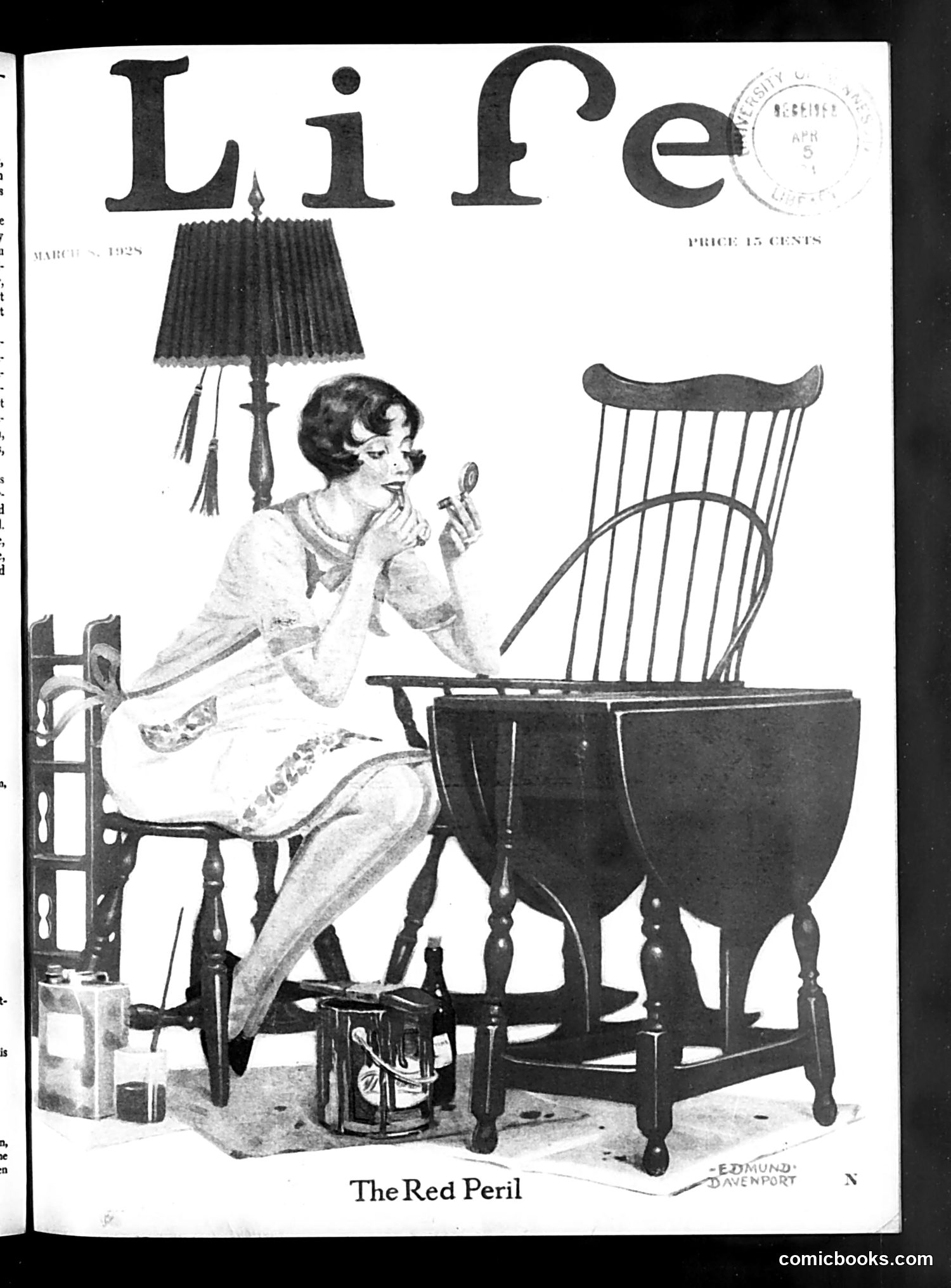
This illustration depicts a woman applying makeup while seated in an elegant chair, surrounded by vanity items. The title "The Red Peril" appears to be satirizing contemporary anxieties about cosmetics and women's appearance in the 1920s. The "red peril" likely refers to red lipstick or rouge—cosmetic products that were controversial during this era, associated with modern, independent "flapper" culture. Conservative critics viewed heavy makeup as scandalous and morally questionable. Life magazine, satirizing these concerns, presents the woman's beauty routine as a humorous "threat" to traditional values. The artwork is credited to Edmund Davenport. The piece mocks both excessive cosmetic use and the moral panic surrounding women's changing social roles and fashion in the Jazz Age.
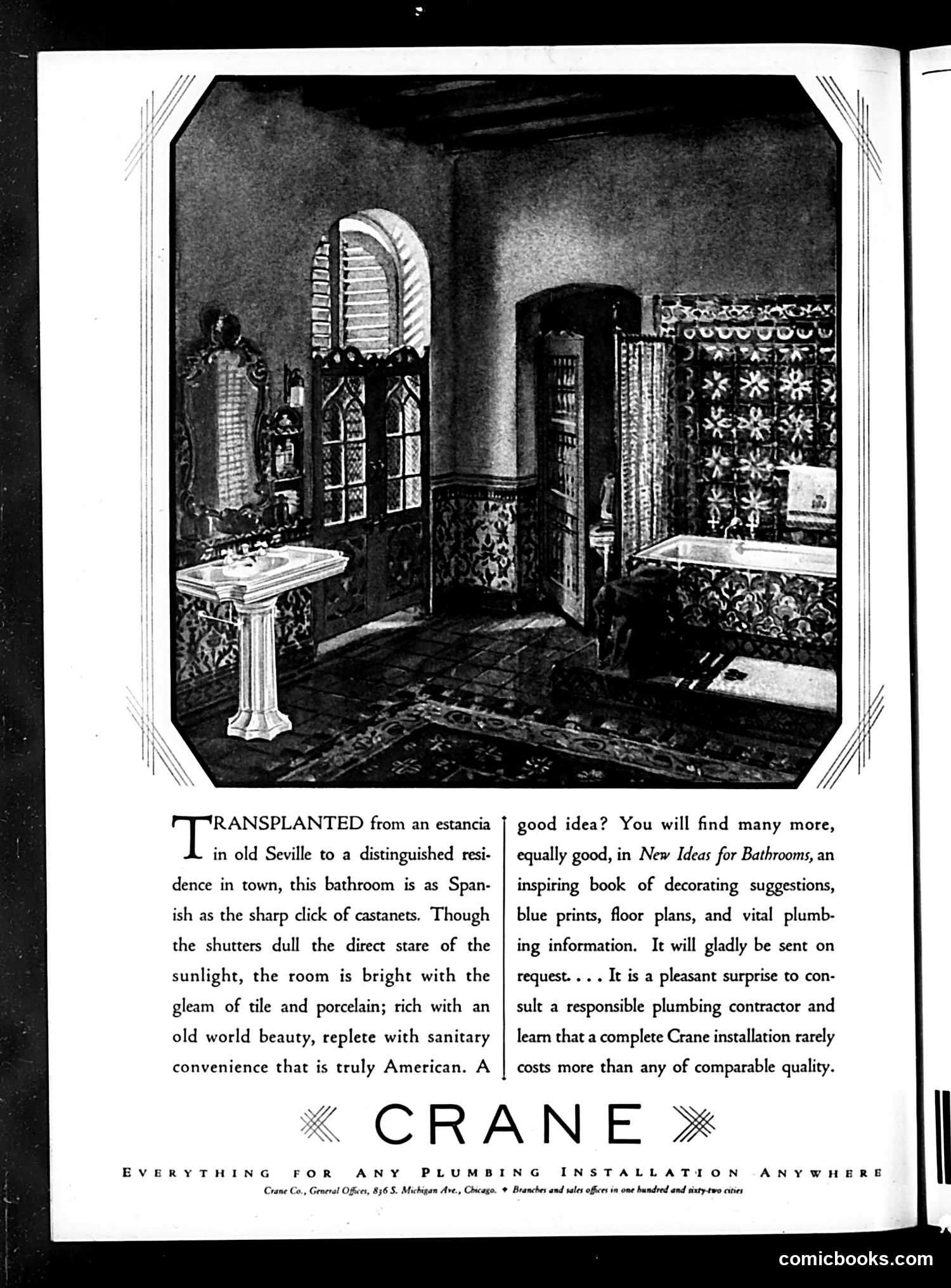
This page is **primarily an advertisement**, not satire or editorial content. It's a Crane plumbing company ad from an early 20th-century *Life* magazine. The ad showcases a luxury bathroom supposedly "transplanted from an estancia in old Seville to a distinguished residence in town." The image displays ornate Spanish Colonial design—decorative tile work, shuttered windows, a pedestal sink, and a bathtub—positioning Crane plumbing as offering both aesthetic sophistication and American sanitary convenience. The copy's humor is subtle: it presents this Old World Spanish bathroom as desirably exotic while emphasizing that Crane provides "sanitary convenience that is truly American"—a marketing appeal to early 1900s American affluence and aspirations. The ad promotes their book *New Ideas for Bathrooms* and emphasizes Crane's affordability.
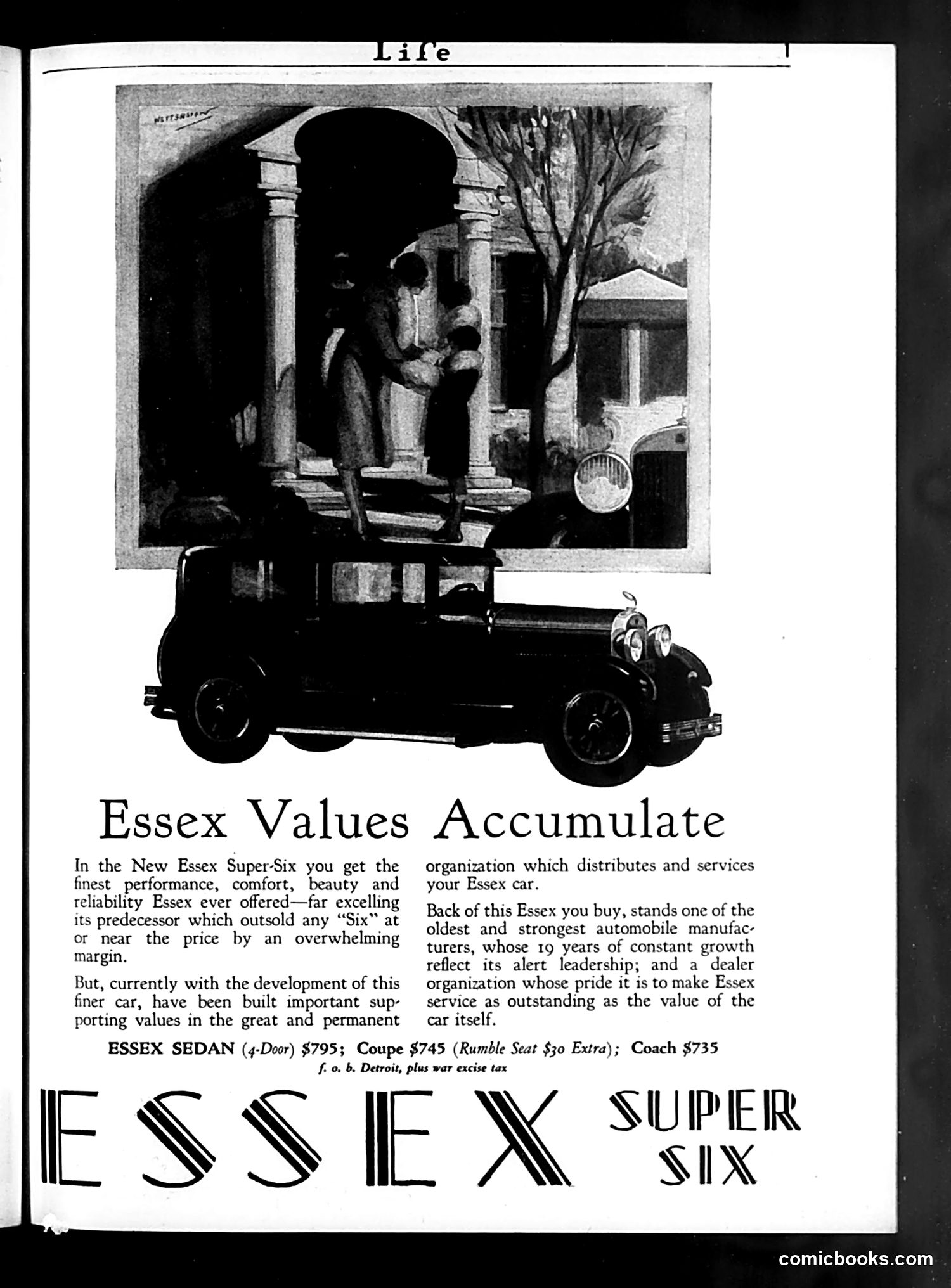
This page is primarily a **car advertisement**, not political satire. It promotes the Essex Super-Six automobile, marketed as offering superior "performance, comfort, beauty and reliability" at an attractive price point. The upper illustration depicts classical Greek or Roman architecture—likely meant to evoke timeless values and permanence. This visual metaphor suggests that Essex automobiles represent enduring quality and established craftsmanship. The ad emphasizes the manufacturer's long history ("one of the oldest and strongest automobile manufacturers") and robust dealer network as reasons for consumer confidence. The pricing information (Sedan $795, Coupe $745, Coach $735) indicates this was positioned as an affordable, value-oriented vehicle for middle-class buyers—a significant market segment in the 1920s automobile industry.
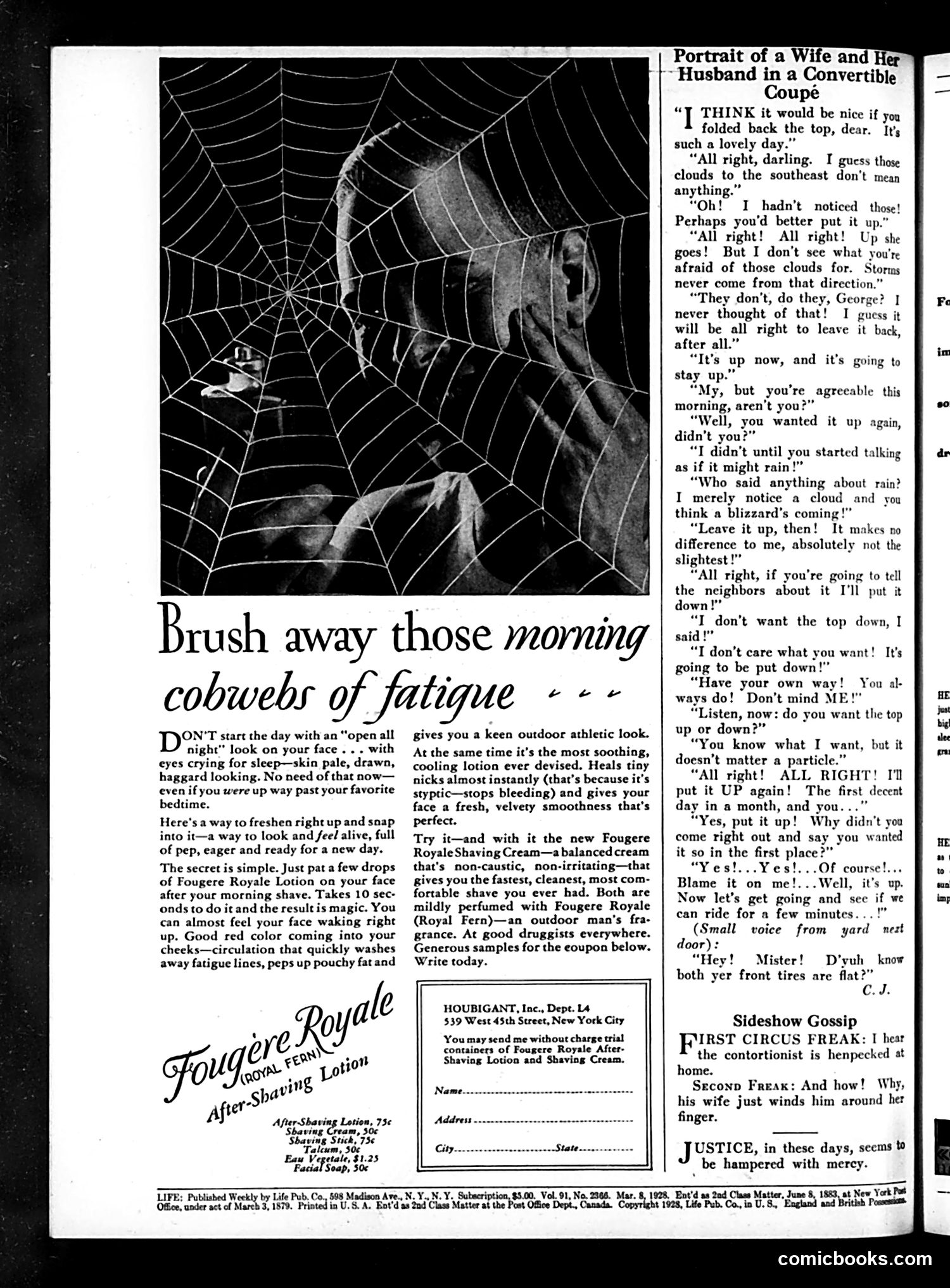
This page is primarily **advertising, not political satire**. The main content is a Fougère Royale after-shaving lotion advertisement featuring a photograph of a man's face emerging from a spider web. The accompanying dialogue—"Portrait of a Wife and Her Husband in a Convertible Coupé"—depicts a married couple's banter about whether to raise the car's convertible top due to approaching clouds. The wife worries about rain; the husband dismisses her concerns. The couple eventually argues about leaving the top up or down. This humorous domestic scene serves as the advertisement's framing device, meant to appeal to readers through relatable marital comedy rather than through political or social commentary. The sidebar gossip items are minor society observations unrelated to current events.
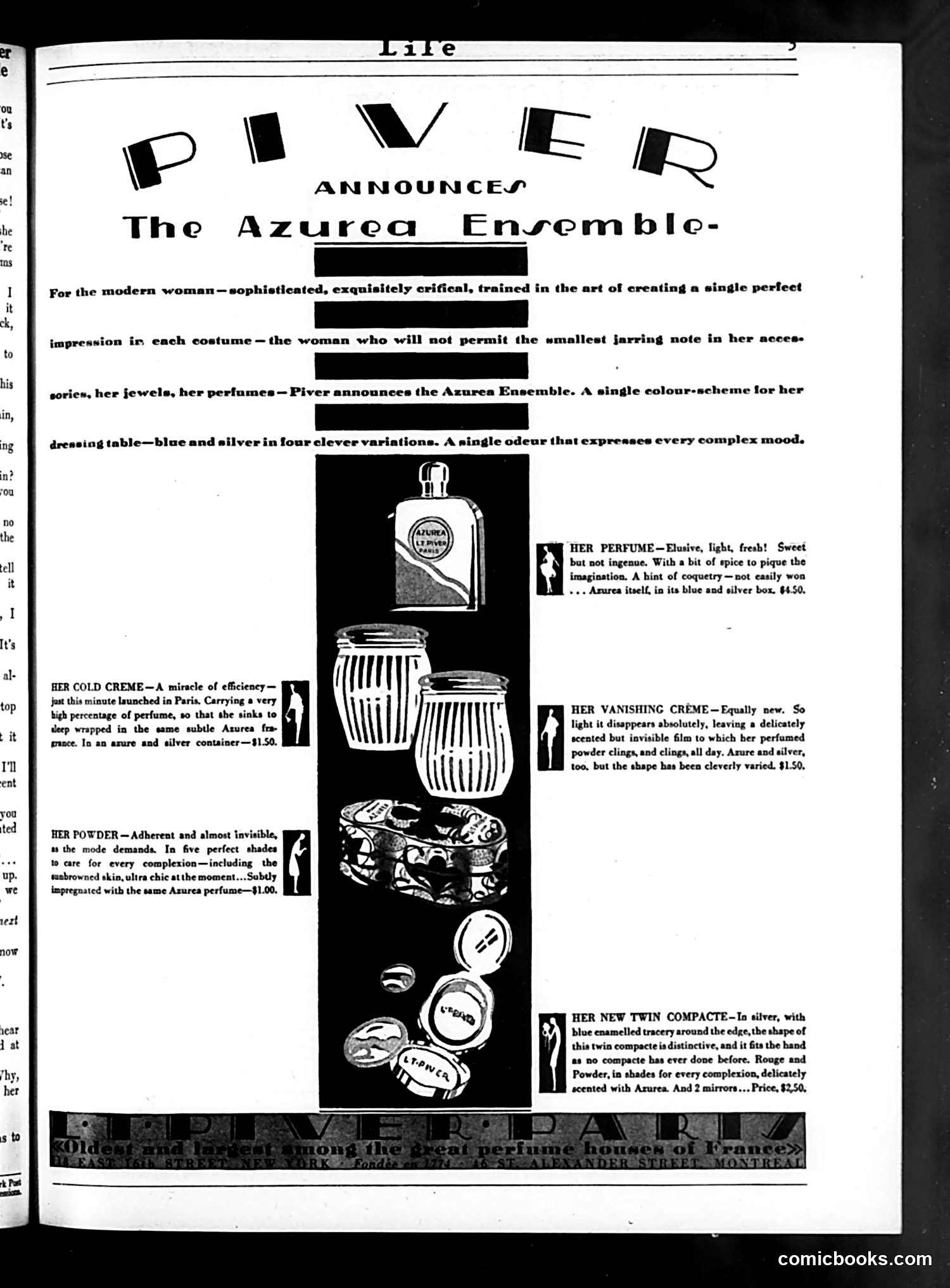
This page is **not a political cartoon but a cosmetics advertisement** for the "Azurea Ensemble" by Fiver, a luxury French beauty brand. The ad targets "the modern woman—sophisticated, exquisitely critical" with a coordinated beauty line featuring blue and silver coloring. Products include perfume ($4.50), cold cream ($1.50), powder ($1.00), vanishing cream ($1.50), and a twin compact ($2.50). The satire is subtle and embedded in the copywriting rather than visual caricature. It gently mocks the "modern woman" as someone obsessively concerned with perfect grooming and matching accessories—a critique of emerging 1920s consumer culture and feminine beauty standards. The humor lies in the exhaustive product coordination presented as necessary for the discerning woman.
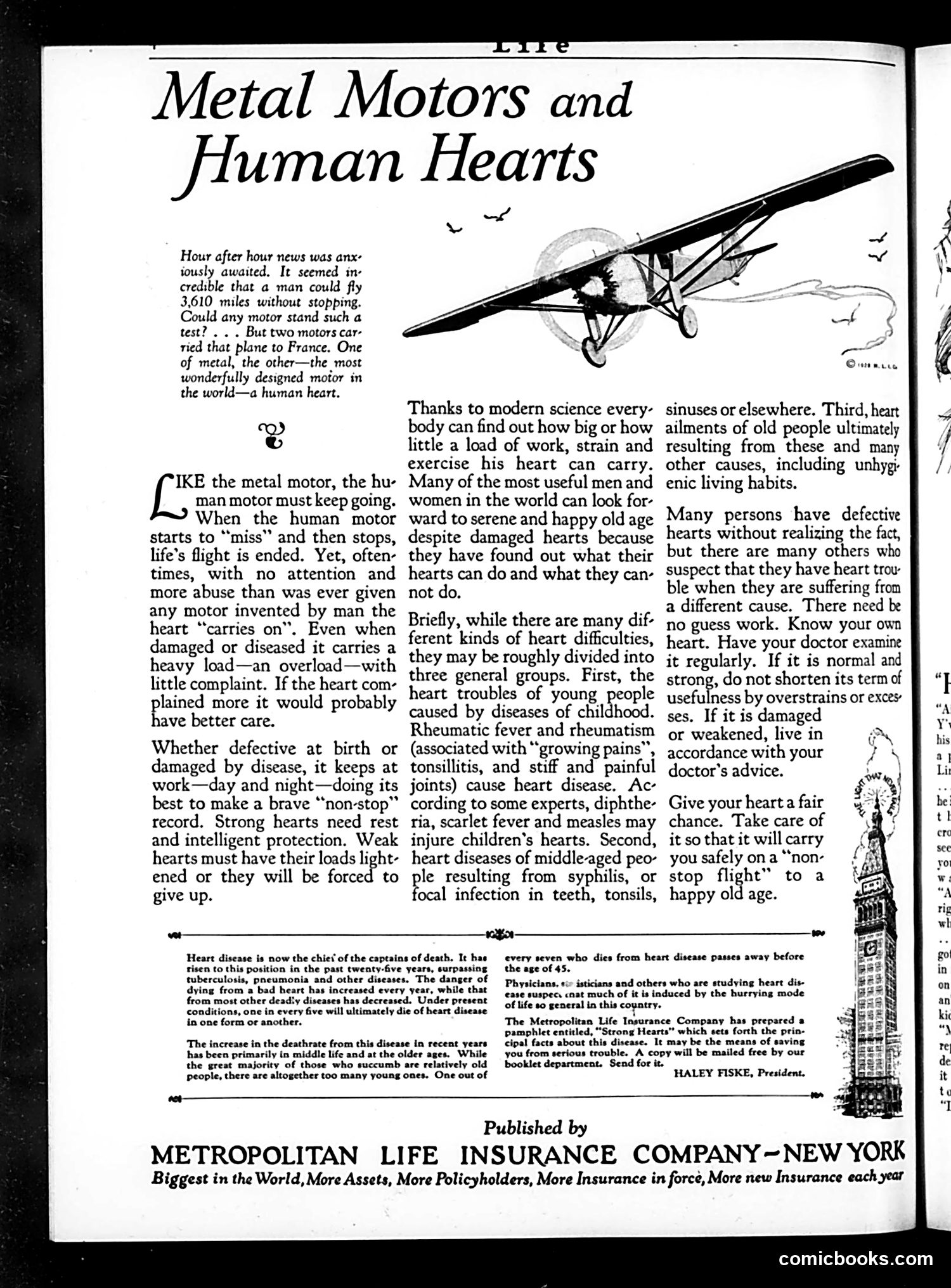
This is primarily **educational/promotional content** rather than satire or political commentary. It's a health article by the Metropolitan Life Insurance Company comparing the human heart to a metal motor—both require constant operation and careful maintenance. The article discusses heart disease classifications, emphasizing that many people have undiagnosed heart problems. It advocates for regular doctor examinations and lifestyle management to preserve heart function, using the motor analogy to explain why the heart, like machinery, needs protection from overwork and strain. The airplane illustration at top represents the opening hook about a trans-Atlantic flight, establishing the "motor" comparison theme. This is essentially **health advocacy disguised as insurance marketing**—encouraging preventive care benefits the company by keeping policyholders alive and healthy.
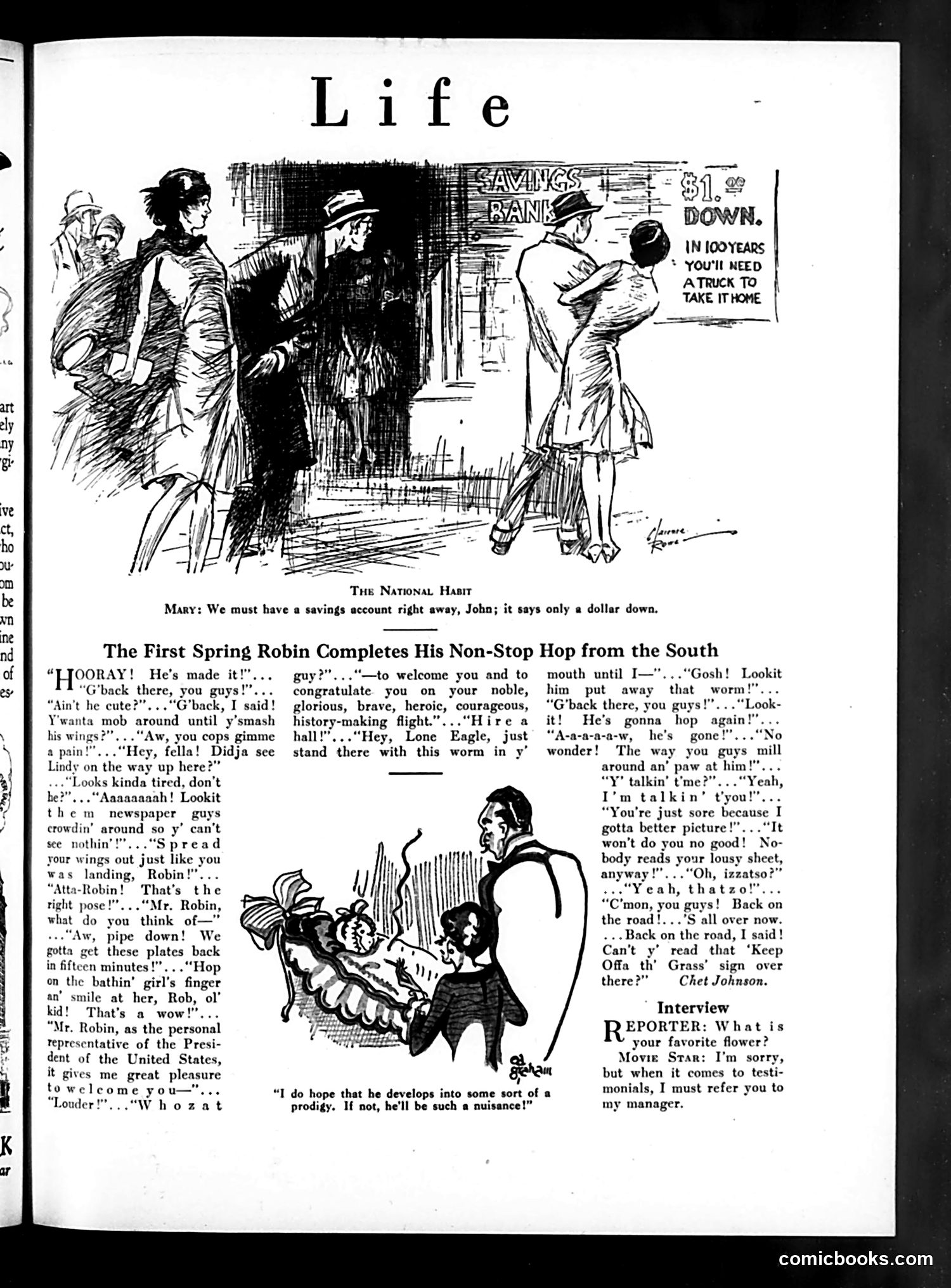
**Top Cartoon - "The National Habit":** This cartoon satirizes American savings habits. A woman (Mary) urges a man (John) to open a savings account at a bank, noting it requires only "a dollar down." The humor targets the era's widespread assumption that ordinary Americans could accumulate wealth through modest savings—a common financial aspiration of the period, likely early 20th century. **Bottom Article - "The First Spring Robin Completes His Non-Stop Hop from the South":** This is a humorous narrative celebrating the robin's arrival as a seasonal herald. The lengthy quoted dialogue presents exaggerated, enthusiastic greetings from various characters welcoming the bird back, capturing period colloquialisms and the whimsical tone Life magazine was known for. An interview segment about favorite flowers follows.
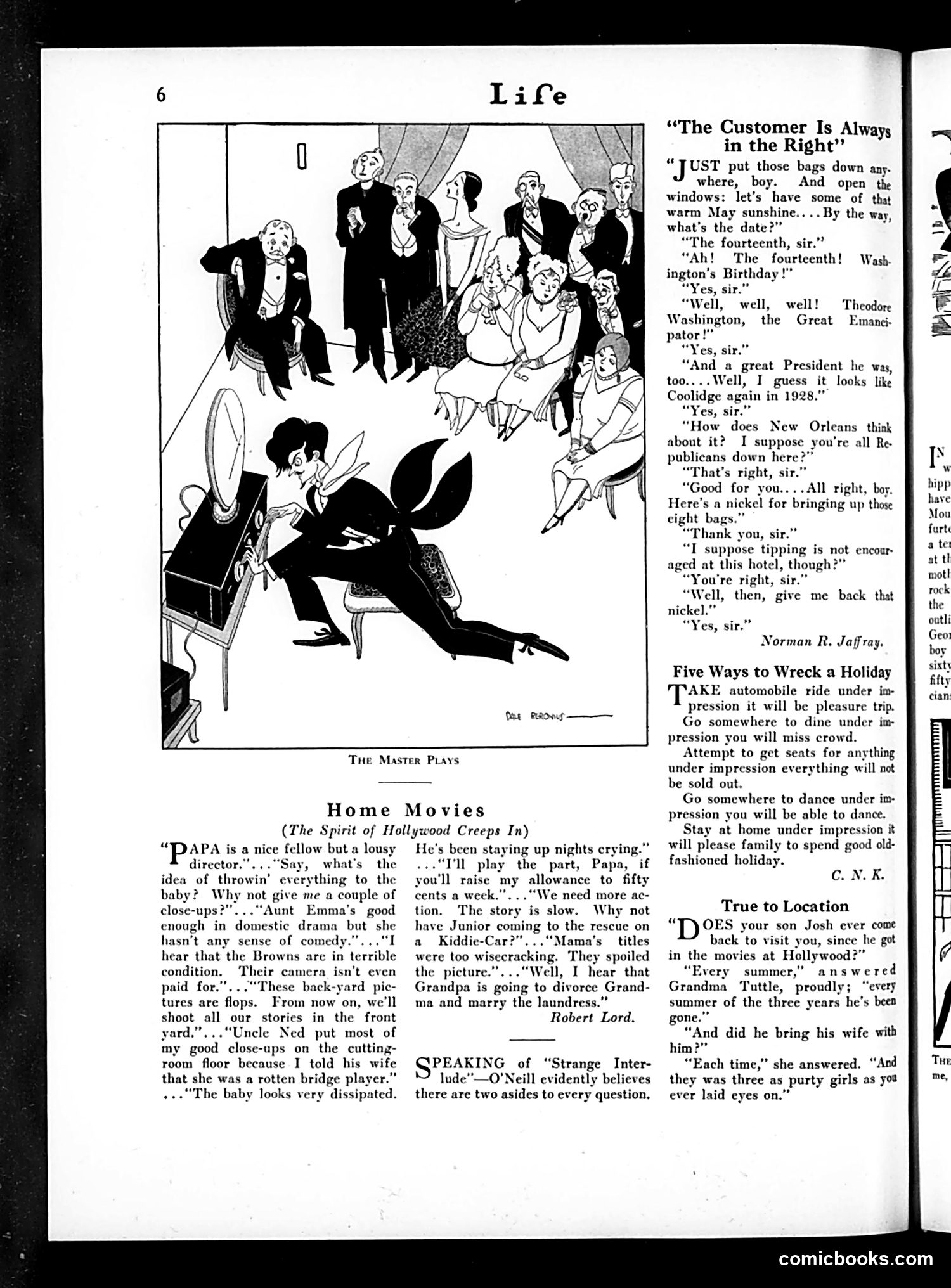
The main cartoon "The Master Plays" depicts a bell-hop or porter struggling with multiple large bags while hotel guests look on. The accompanying anecdote "The Customer is Always Right" satirizes service-industry dynamics of the era: a porter brings bags to a room, and a guest tips him a nickel after extracting free labor (opening windows). The joke critiques how customers exploit workers under the guise of politeness—the guest demands service while begrudging fair compensation. The page also contains brief humorous pieces about domestic life and cinema. These short satirical vignettes mock common social situations: poor parenting decisions, bad movie plots, and marital complications. The satire targets middle-class American life and entertainment culture of the period.
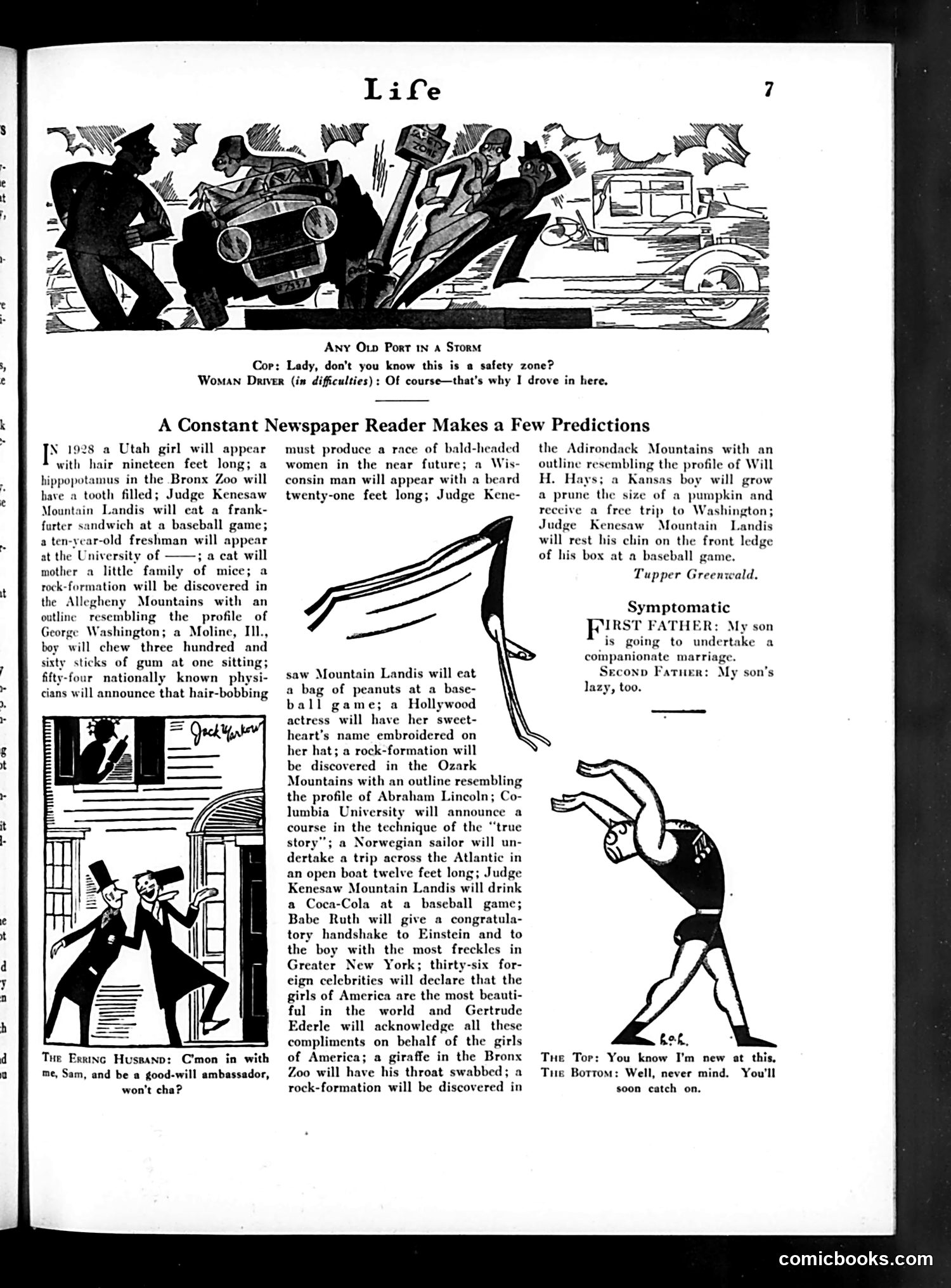
**Top Cartoon ("Any Old Port in a Storm"):** A woman driver seeks refuge in a "safety zone" during a storm. A cop sarcastically notes she drove into it because women drivers are inherently bad—a common 1920s stereotype mocking female motorists. **Main Article ("A Constant Newspaper Reader Makes a Few Predictions"):** This satirizes how newspaper readers extrapolate wild predictions from current events. It humorously lists absurd future scenarios (a Utah girl with nine feet, a Wisconsin man with a twenty-one-foot beard, etc.)—mocking people who read newspapers too literally and draw ridiculous conclusions from mundane news stories. **"Symptomatic" Comic:** Two fathers commiserate that their sons are "lazy," suggesting shared parental concerns about youth.
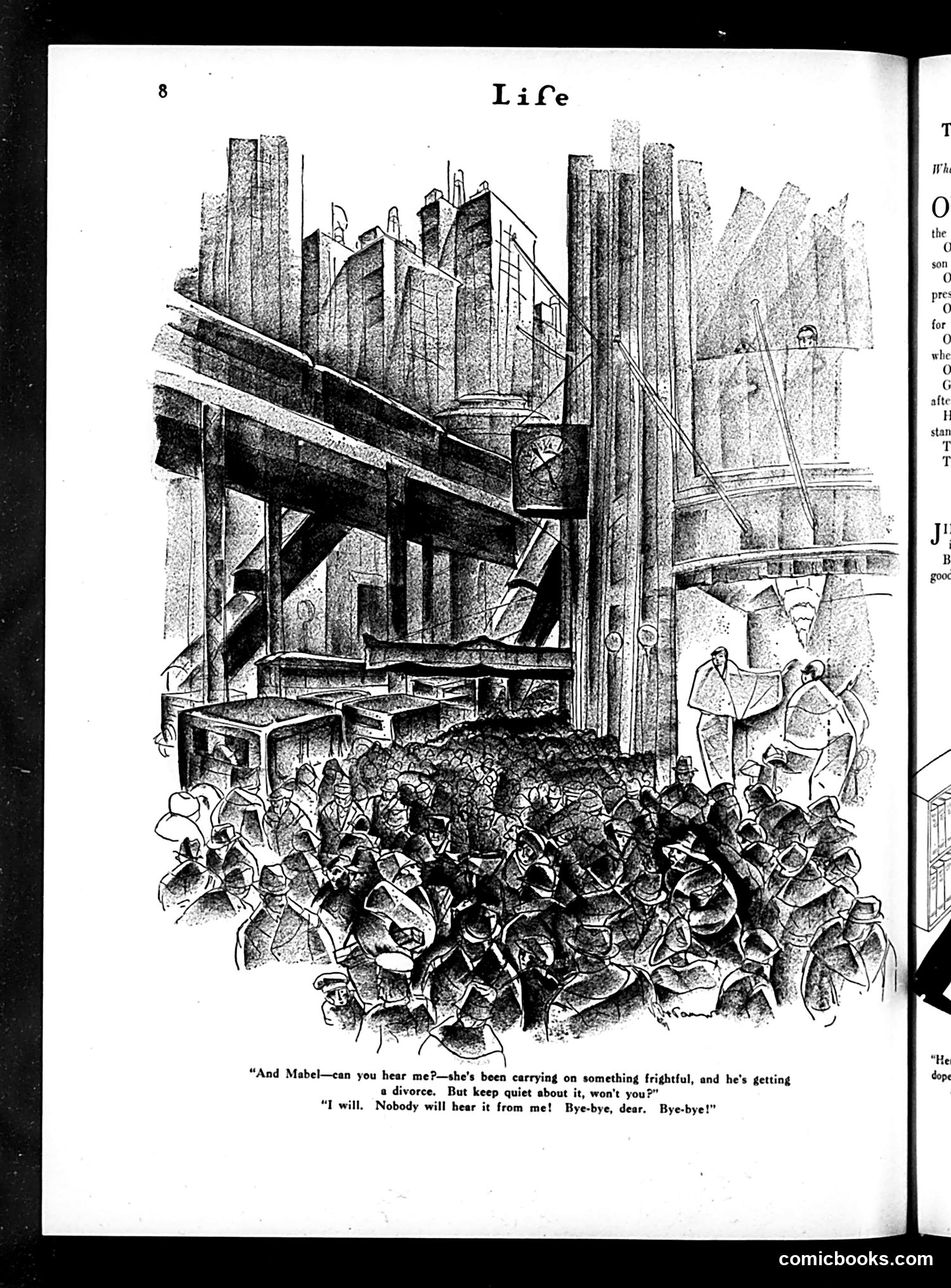
This cartoon depicts a crowded urban street scene beneath towering buildings and industrial structures. The caption shows a woman (Mabel) secretly telling someone about another woman's impending divorce while asking them to keep it confidential—then immediately contradicting herself by saying "Nobody will hear it from me! Bye-bye, dear. Bye-bye!" The satire targets **gossiping hypocrisy**: the speaker claims discretion while clearly broadcasting the scandal to a crowd. The humor relies on the gap between professed confidentiality and actual behavior—a common social criticism in early 20th-century satirical magazines. The urban setting and crowd emphasize how quickly such "secrets" spread through city life, mocking both the gossiper's self-deception and society's appetite for scandalous information.
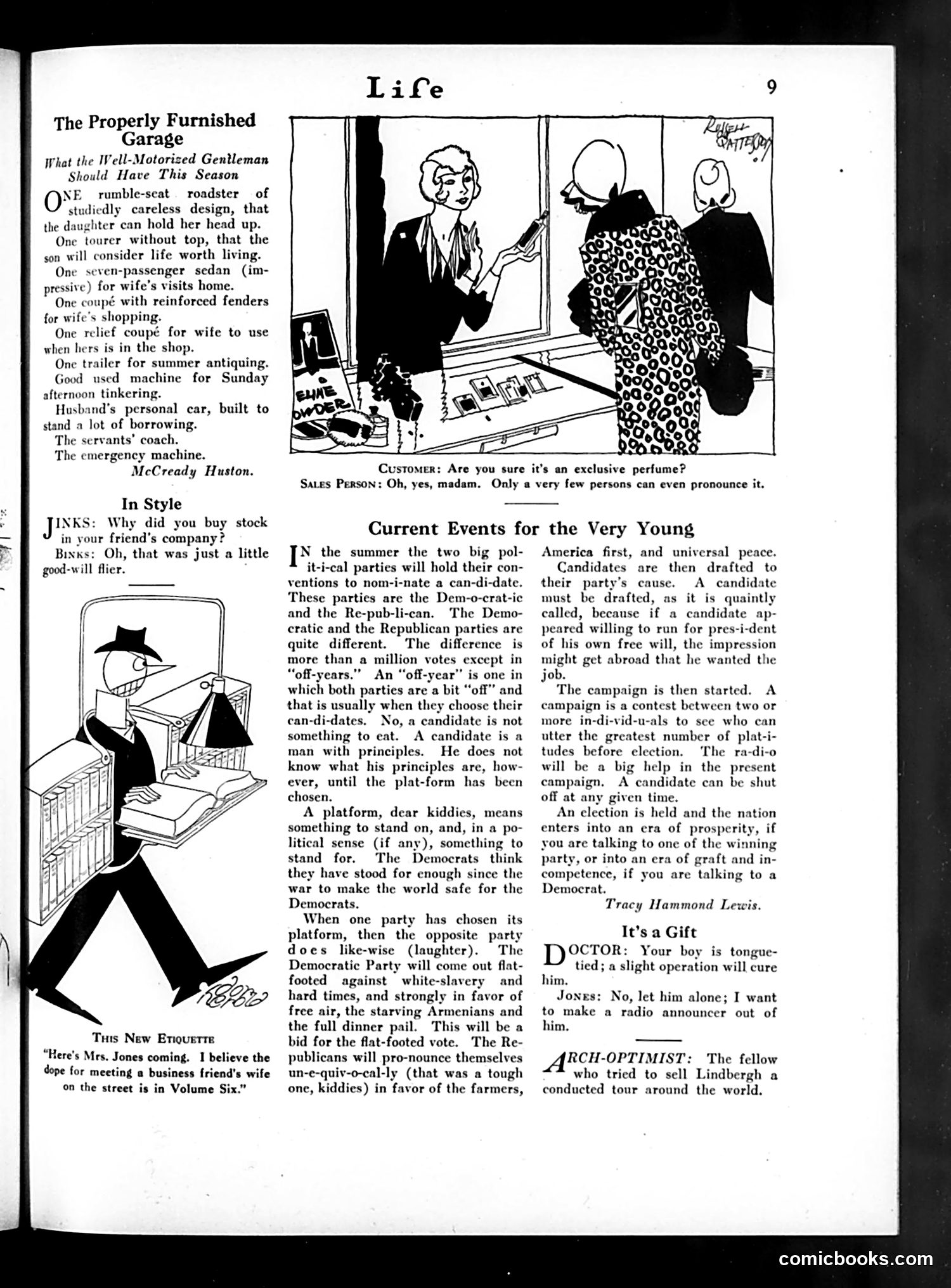
This page satirizes 1920s-era American politics and social etiquette. **"The Properly Furnished Garage"** cartoon mocks wealthy motorists' excessive needs, listing absurd items like a "rumble-seat roaster" and "husband's personal car" as status symbols. **"Current Events for the Very Young"** explains political concepts (platforms, candidates, elections) to children using simple language. It references the Democratic and Republican parties' contrasting positions on issues like slavery, free trade, and tariffs—suggesting fundamental ideological differences that persist across generations. **"In Style"** jokes about social conformity, showing someone buying stock merely because friends do. **"It's a Gift"** presents brief comedic dialogues about absurd situations. The overall tone reflects Life magazine's signature blend of social commentary, political education, and gentle mockery of American pretensions during the 1920s.
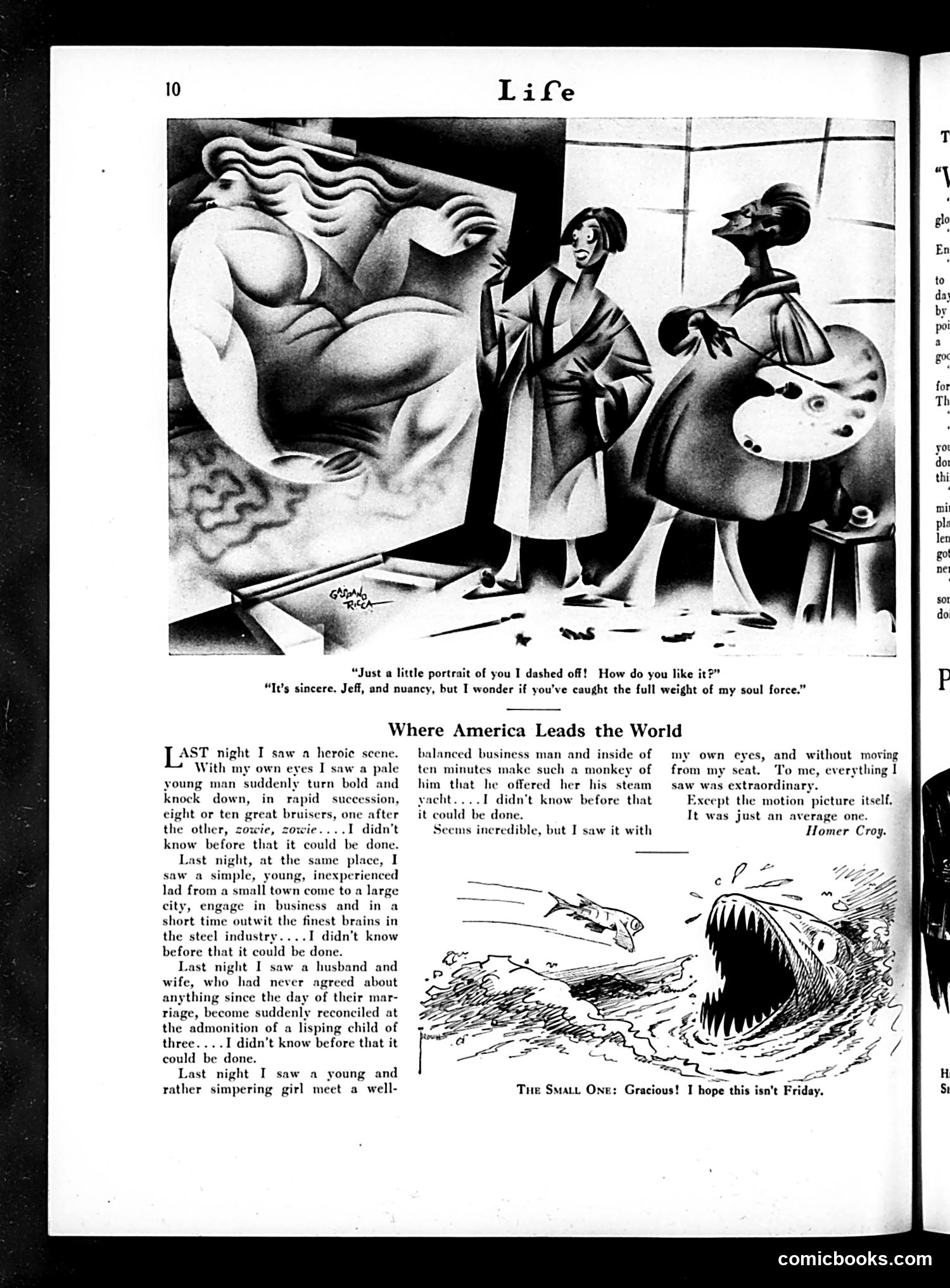
The top cartoon satirizes modern art. Two conventionally-dressed observers view an abstract sculptural work with exaggerated, voluptuous forms. The caption mocks the pretentiousness of artistic interpretation: one figure dismisses it as merely "a little portrait" while wondering if they've "caught the full weight of my soul force"—poking fun at artists' grandiose claims about their abstract work and collectors' willingness to accept vague spiritual justifications for incomprehensible art. The article below, "Where America Leads the World," celebrates American business achievement through personal anecdotes of rapid success—a young man becoming an industrial leader, a couple reconciling through business deals. The accompanying fish cartoon appears unrelated to the text, likely serving as filler. The overall page reflects 1920s-era American pride in capitalist dynamism and satirical skepticism toward modern artistic movements.
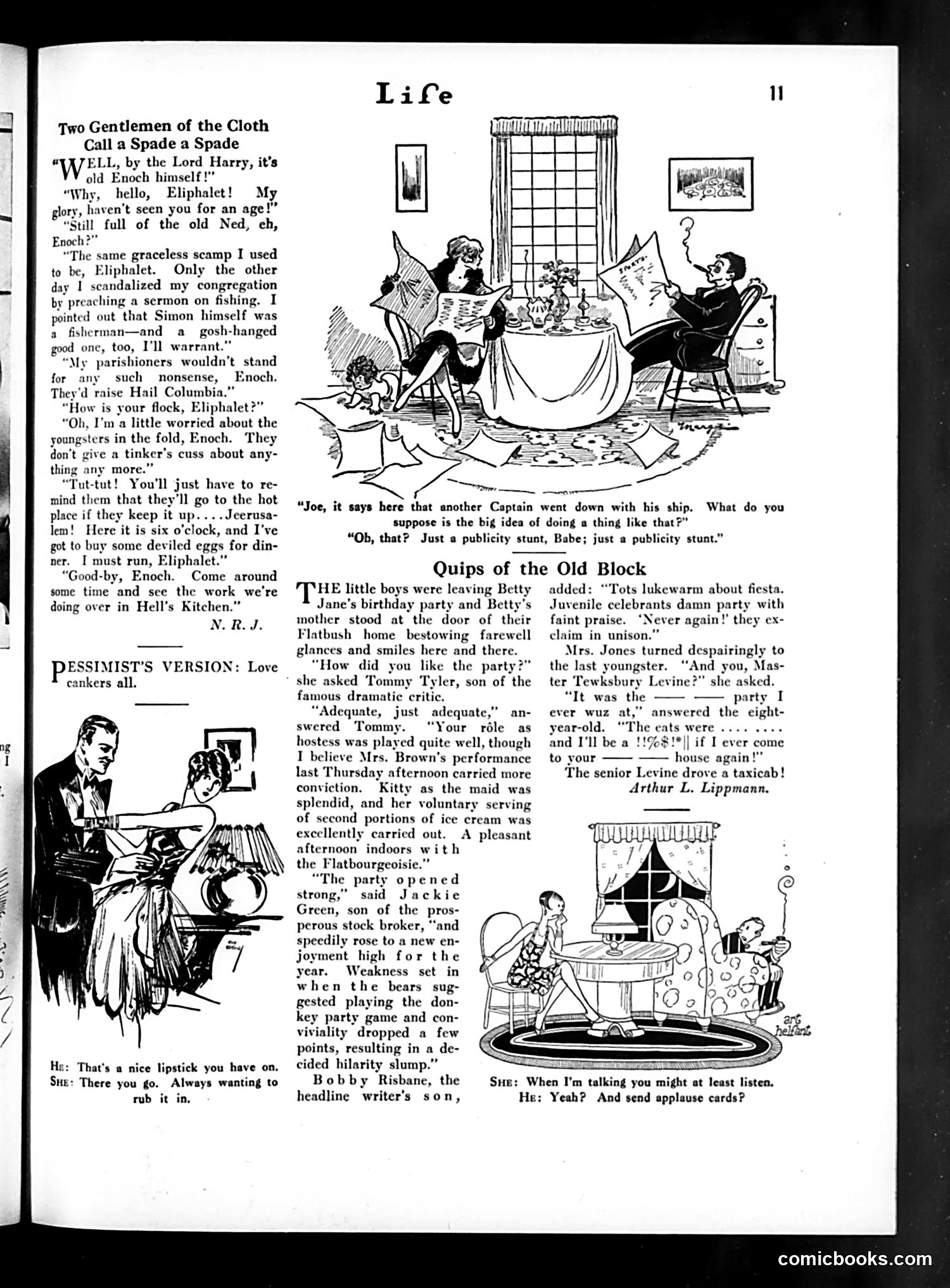
This page contains three separate humor pieces typical of early-20th-century Life magazine's satirical style. **"Two Gentlemen of the Cloth Call a Spade a Spade"** depicts two clergymen gossiping about their congregations and scandals—a satire on hypocritical clergy who preach virtue while engaging in worldly criticism. **"Pessimist's Version"** shows a romantic couple where the woman warns the man to "rub it in"—a cynical joke about inevitably difficult relationships. **"Quips of the Old Block"** describes children's birthday party mishaps, satirizing young people's awkward behavior and social failures, with lines like "Never again!" suggesting childhood embarrassment. The humor relies on observational social comedy about human weakness, hypocrisy, and social awkwardness—themes central to Life's satirical mission.
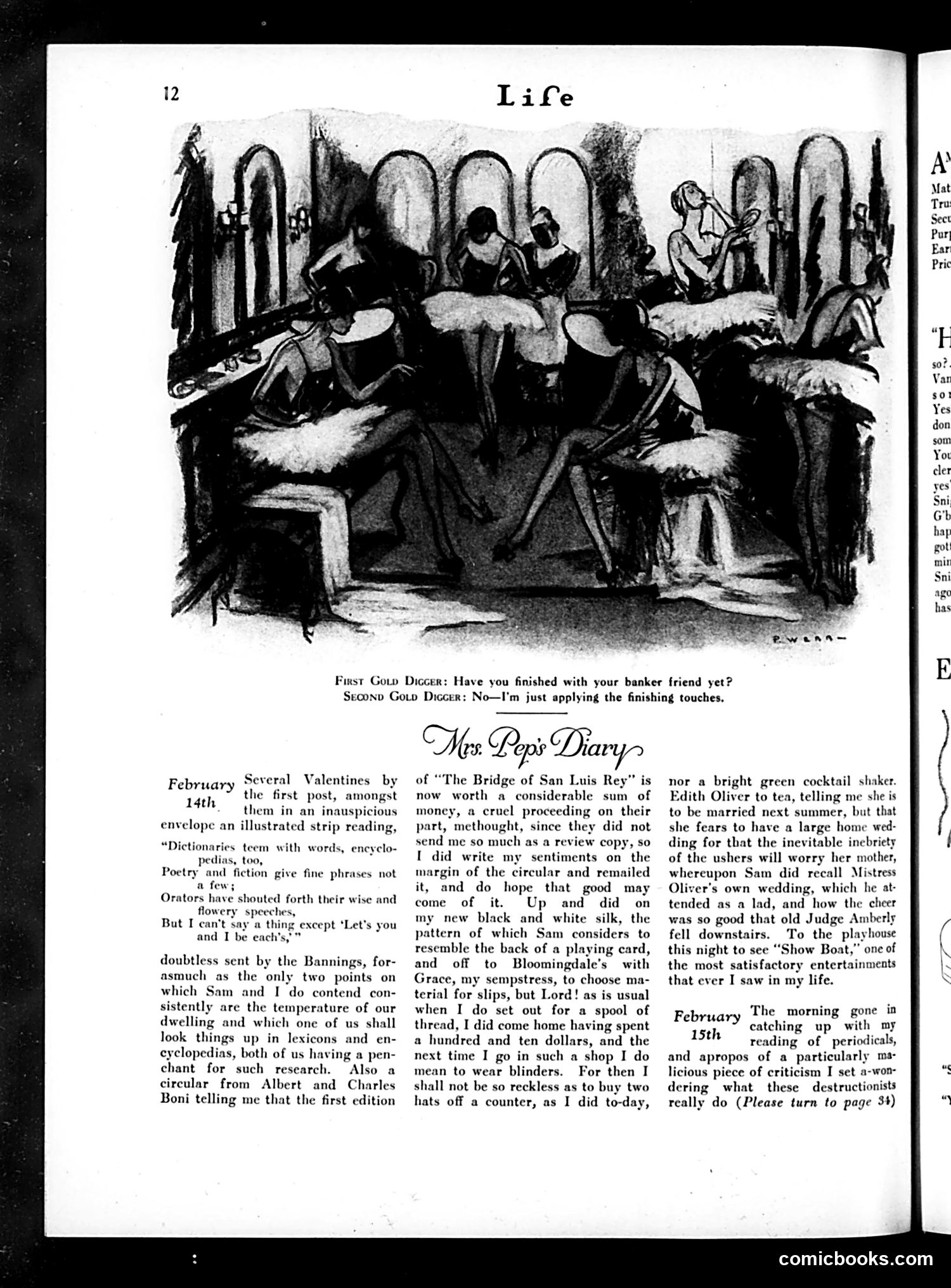
This page features a cartoon titled "Mrs. Pep's Diary" dated February 14th, depicting two figures in what appears to be a restaurant or social setting. The caption reads: "**First Gold Digger:** Have you finished with your banker friend yet? **Second Gold Digger:** No—I'm just applying the finishing touches." The satire targets "gold diggers"—a 1920s term for women who pursued wealthy men for financial gain rather than love. The joke depicts two such women casually discussing their romantic schemes, treating wealthy men as objects to be "finished" like projects. This reflects period anxieties about women's economic independence and changing social dynamics post-WWI, mocking both the women's mercenary attitudes and implicitly critiquing male vulnerability to such manipulation.
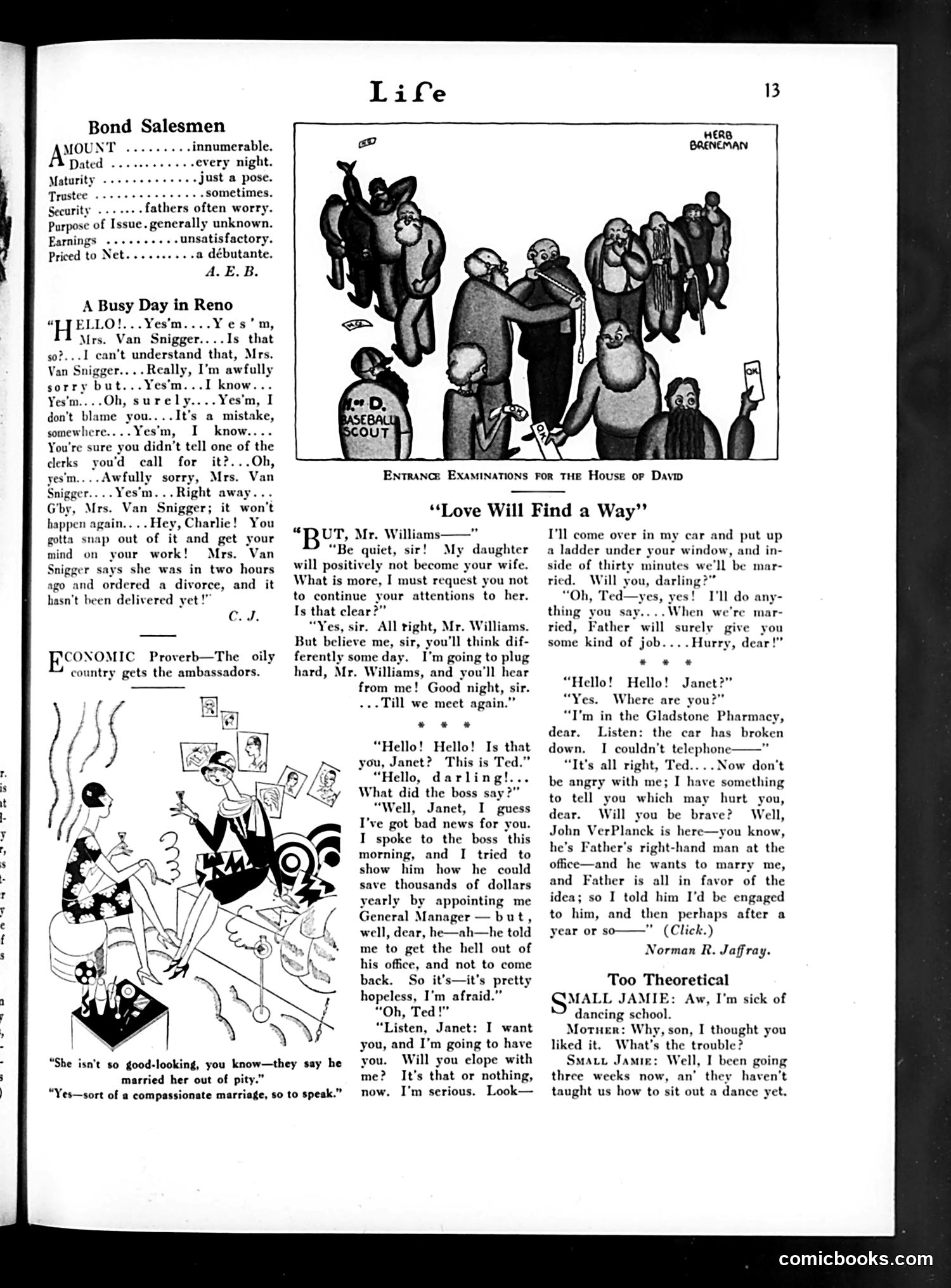
This page from *Life* magazine contains three distinct pieces: 1. **"Bond Salesmen"** (top left): A satirical list mocking bond salesmen's characteristics—their promises are "innumerable," maturity is "just a pose," and they're "priced to Net...a debutante." This targets post-WWI financial speculation and the aggressive marketing tactics of bond sellers during economic instability. 2. **"A Busy Day in Reno"** (middle): A dialogue satirizing Reno's reputation as America's divorce capital. Mrs. Van Snigger discusses obtaining a quick divorce while ordering one from her husband—mocking both the ease of Nevada divorces and casual attitudes toward marriage among the wealthy. 3. **Comic stories** (right side): Romantic comedies about courtship and marriage expectations, typical *Life* magazine fare offering light social commentary on relationships and class dynamics.
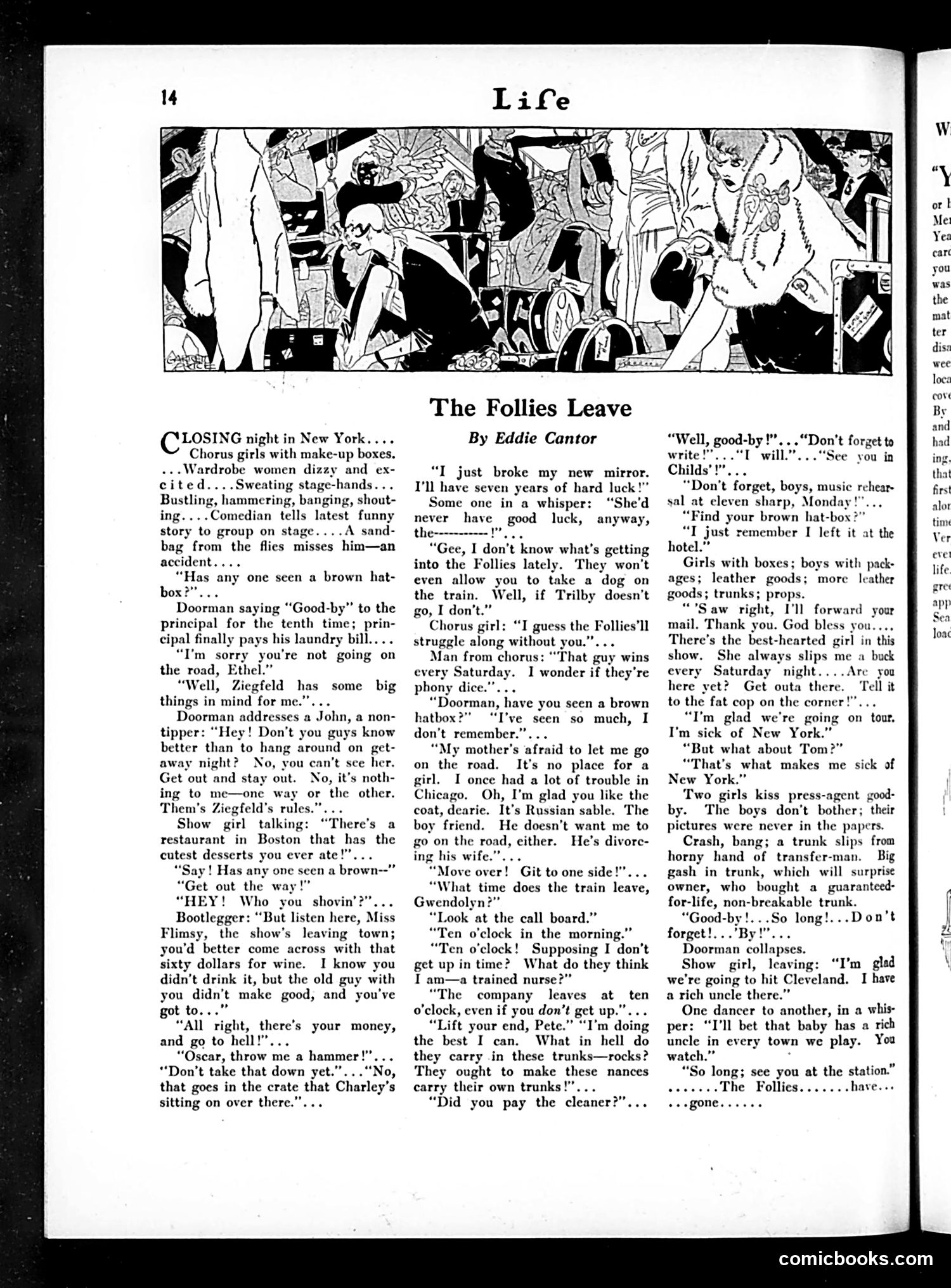
This page depicts the closing night of a Broadway theatrical revue called "The Follies," likely the Ziegfeld Follies, a famous variety show. The satirical piece captures the chaotic backstage scene through dialogue between chorus girls, comedians, and stage personnel. The humor centers on theatrical stereotypes: romantic farewells ("Don't forget to write!"), practical concerns about traveling ("trunks," "props"), homesickness, and romantic entanglements. References to cities like New York, Boston, and Chicago suggest the touring circuit. The tone mocks both the theatrical lifestyle's instability and the performers' melodramatic departures. The piece appears to celebrate the show's conclusion while gently ridiculing show-business culture and its transient relationships.
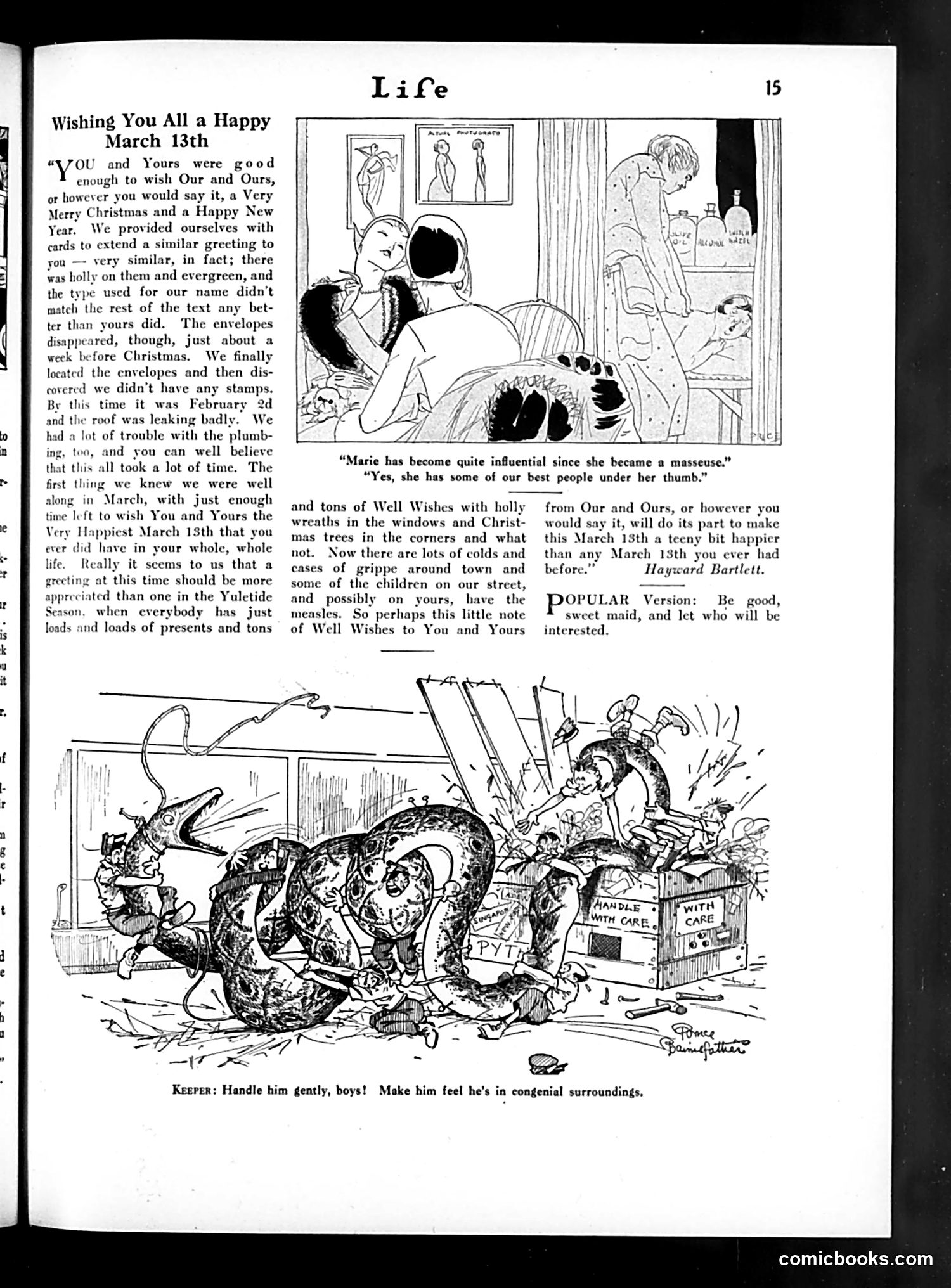
This page contains two distinct cartoons from Life magazine's satirical humor section. The **upper cartoon** depicts a woman named Marie who has become influential as a "masseuse"—likely a euphemistic reference to a profession of questionable respectability. The joke plays on double meanings: her social influence has grown through this work, with the caption suggesting she has "some of our best people under her thumb." The **lower cartoon** features a large snake or serpent being carefully handled by workers, with the keeper instructing them to "Handle him gently, boys! Make him feel he's in congenial surroundings." The snake appears to represent something dangerous yet requiring delicate treatment—possibly a political figure or threat that must be carefully managed rather than directly confronted. Both cartoons use exaggeration and innuendo typical of early 20th-century American satirical humor.
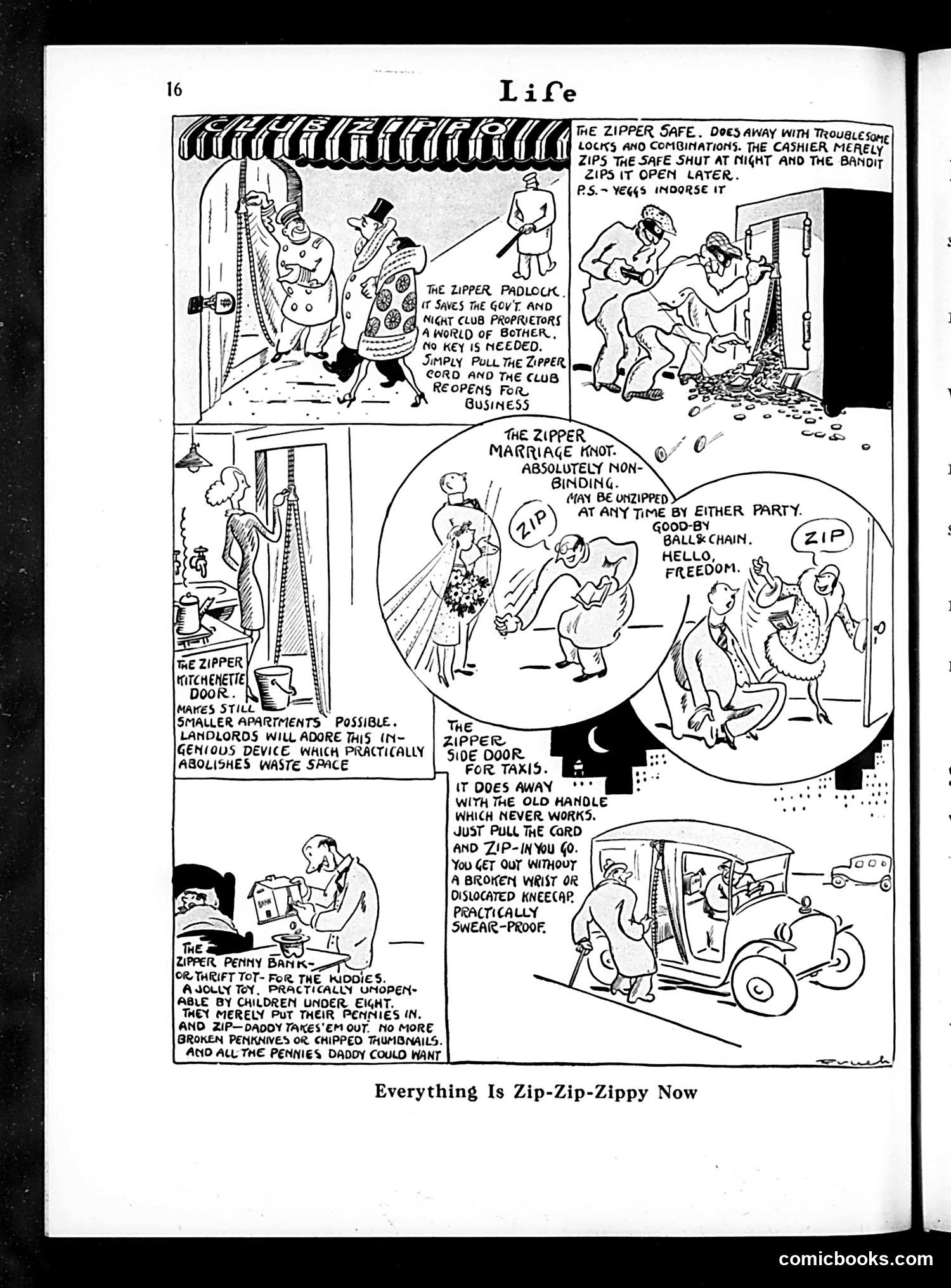
This satirical page celebrates the zipper as a revolutionary modern invention. Through six comic panels, the artist highlights supposed zipper applications across society: - **The Zipper Safe**: A banker promotes a zipper-locked safe as trouble-free - **The Zipper Padlock**: For golf club security without traditional locks - **The Zipper Marriage Knot**: Humorously suggests marriages can be "unzipped" by either party for instant divorce - **The Zipper Kitchenette**: Makes small apartments more practical - **The Zipper Penny Bank**: A toy for children eliminating broken pennies - **The Zipper Side Door for Taxis**: Replaces unreliable handles The satire mocks the era's enthusiasm for zippers as a universal solution to everyday problems—treating a practical fastener as a panacea for modern life's inconveniences.
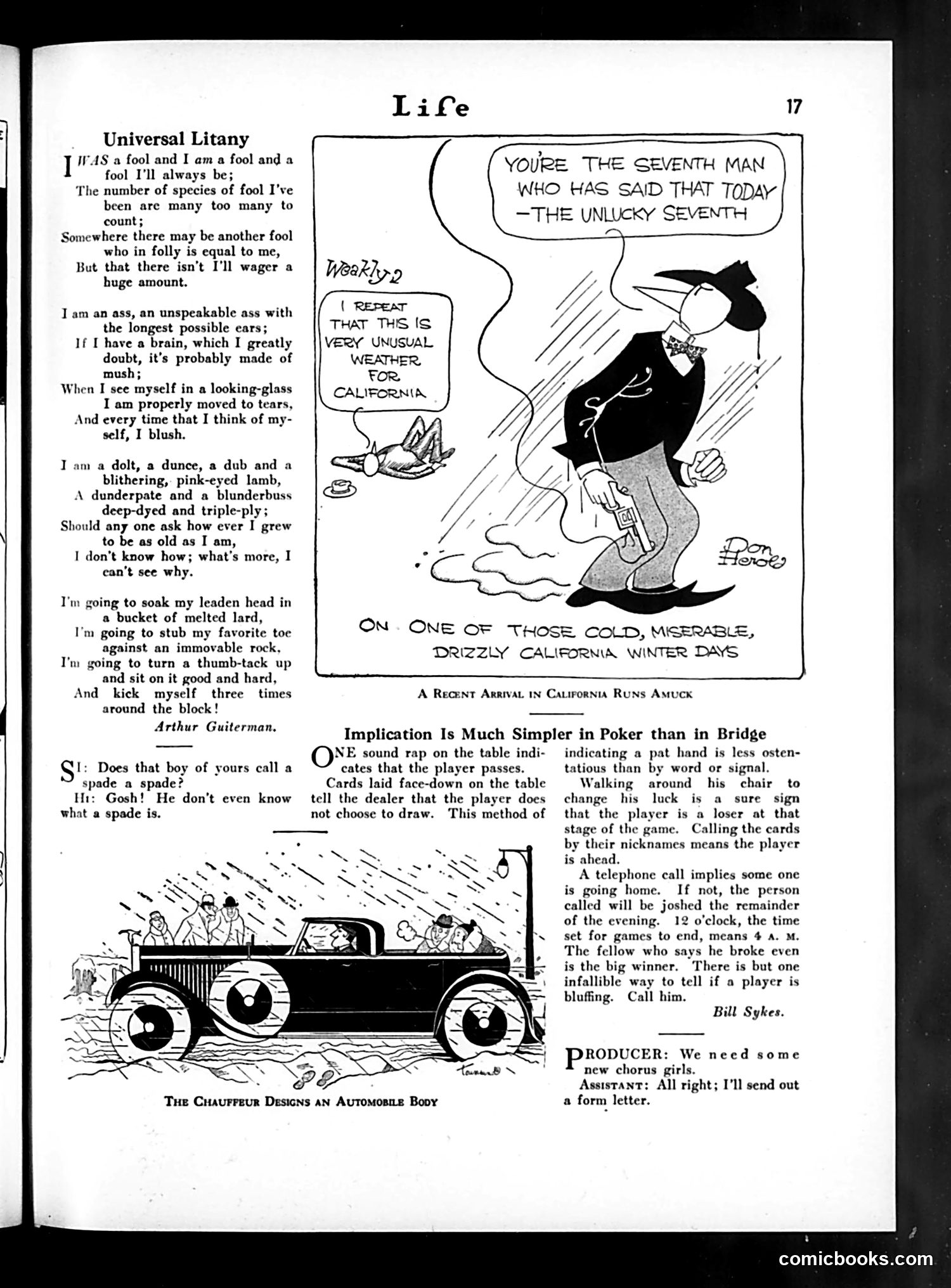
This page contains three distinct items: 1. **"Universal Litany"** by Arthur Guiterman: A humorous self-deprecating poem where the speaker catalogs their foolishness and physical awkwardness. 2. **"A Recent Arrival in California Runs Amuck"**: A cartoon showing a formally-dressed man (top hat and coat) struggling in unusual rainy weather, remarking this is "very unusual weather for California." The joke satirizes California's reputation for consistently pleasant weather—an actual rainstorm is treated as shocking. 3. **"Implication Is Much Simpler in Poker than in Bridge"** by Bill Sykes: A brief article explaining poker tells and bluffing detection, contrasting with bridge's complexity. 4. **"The Chauffeur Designs an Automobile Body"**: A cartoon showing a car with enormous wheel designs, humorously suggesting a working-class person's impractical automotive vision.
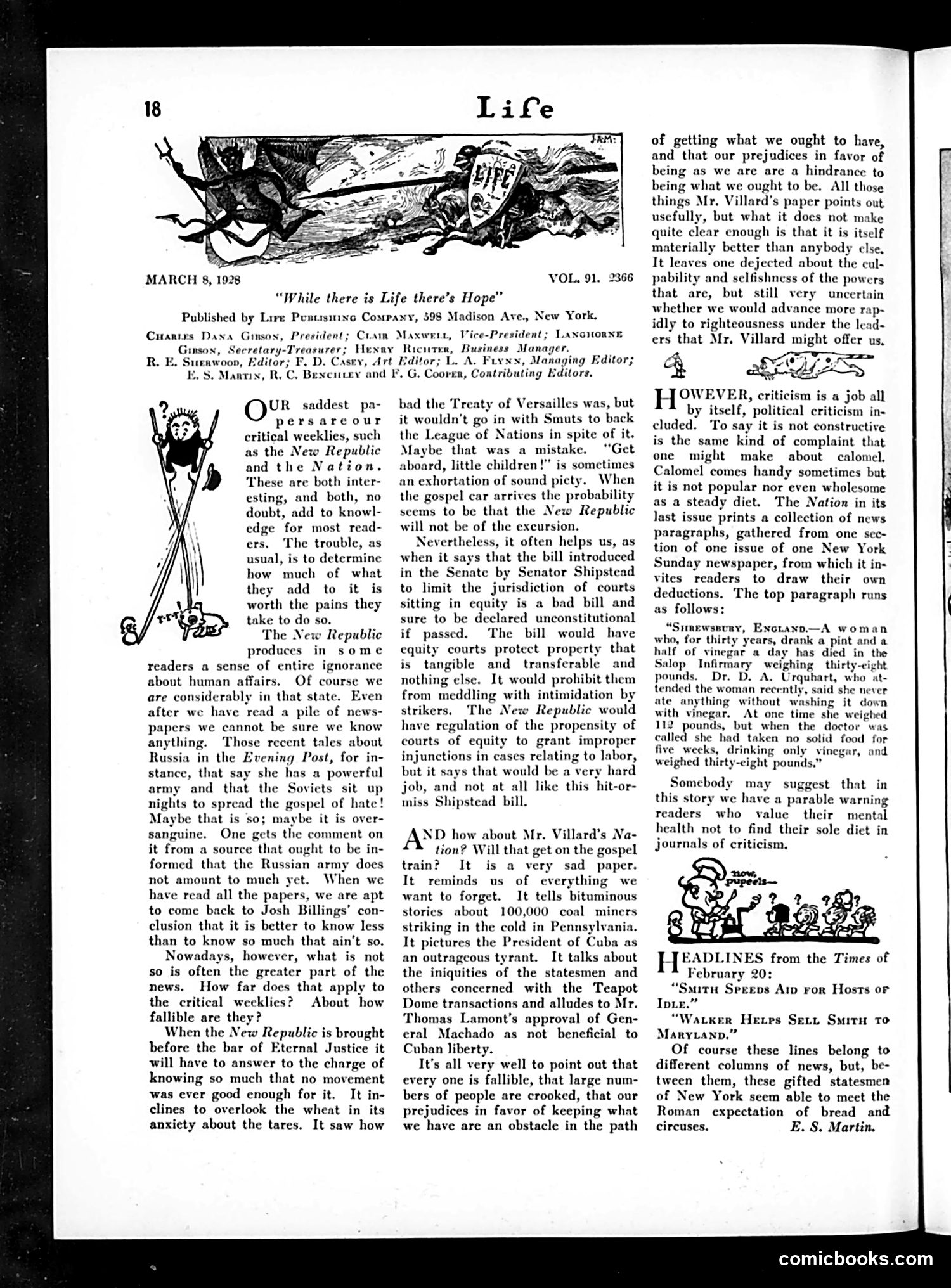
This editorial critiques two prominent American political weeklies: *The New Republic* and *The Nation* (edited by Oswald Garrison Villard). The author argues *The New Republic* is so perfectionist and critical that it opposes virtually every movement, finding fault even with worthy causes like the League of Nations. It obsesses over minor flaws ("tares") while ignoring genuine merits ("wheat"). *The Nation* is described as depressingly focused on chronicling injustices—coal miners' strikes, Cuban tyranny under Machado, the Teapot Dome scandal—reminding readers of everything they'd rather forget. The central point: both magazines, despite offering valuable criticism, suffer from excessive skepticism and pessimism that paralyzes rather than inspires action. The author suggests readers cannot trust either publication entirely, yet acknowledges their occasional usefulness in exposing real problems. The cartoon imagery (not clearly visible in this transcription) likely reinforces this theme of cynical opposition.
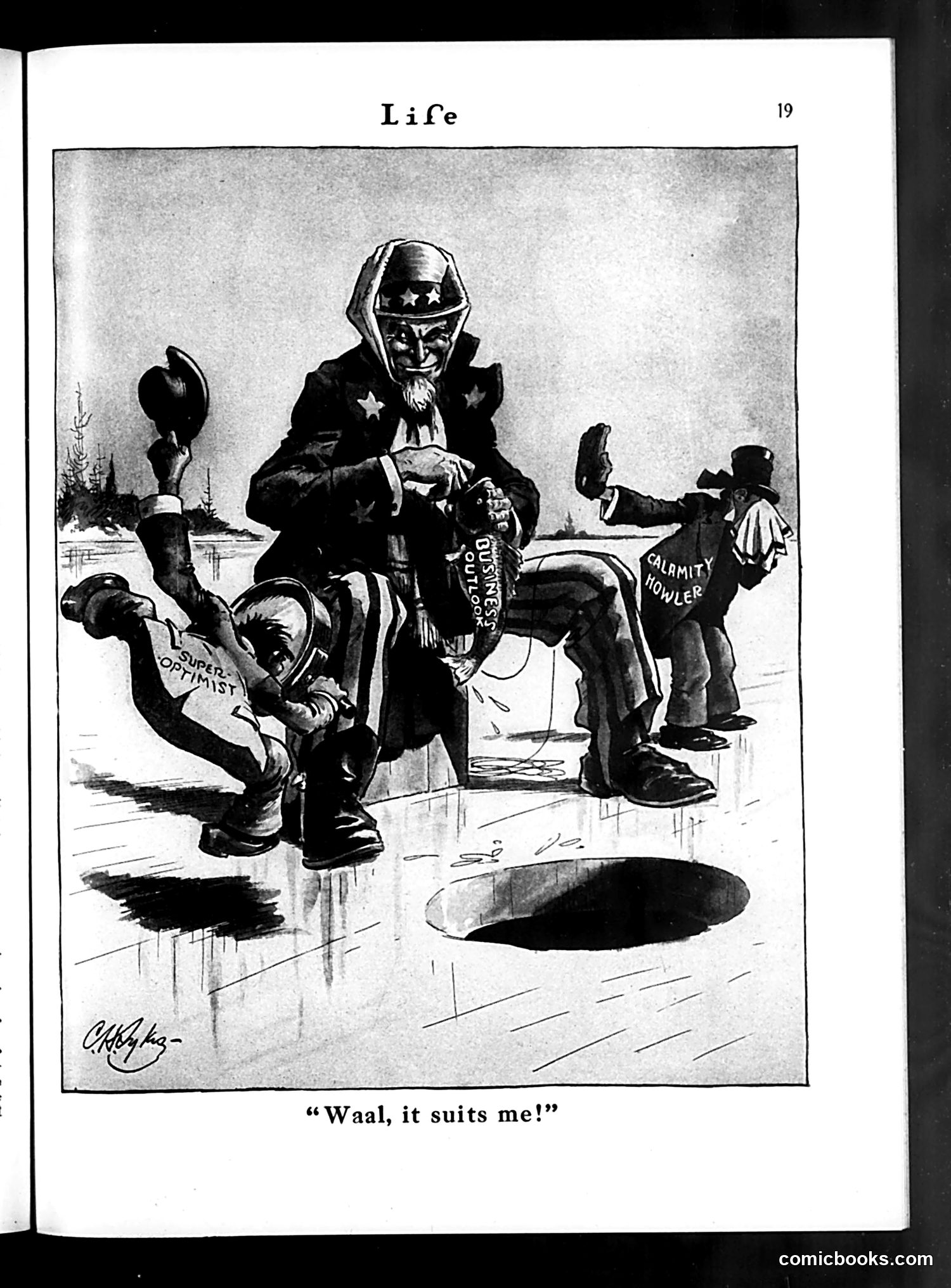
This is a satirical cartoon from *Life* magazine featuring Uncle Sam (identifiable by his distinctive star-spangled top hat and goatee) trying on what appears to be military or wartime garments labeled with various terms. Small figures around him—labeled "Optimist," "Calamity Howler," and others—represent different public perspectives or attitudes. The caption "Waal, it suits me!" suggests Uncle Sam is adopting a new role or policy despite contrary opinions from those around him. The cartoon likely critiques American military expansion, isolationist debate, or wartime preparations, showing how different segments of the public react differently to government decisions. The satire centers on Uncle Sam proceeding with his choice regardless of dissenting voices.
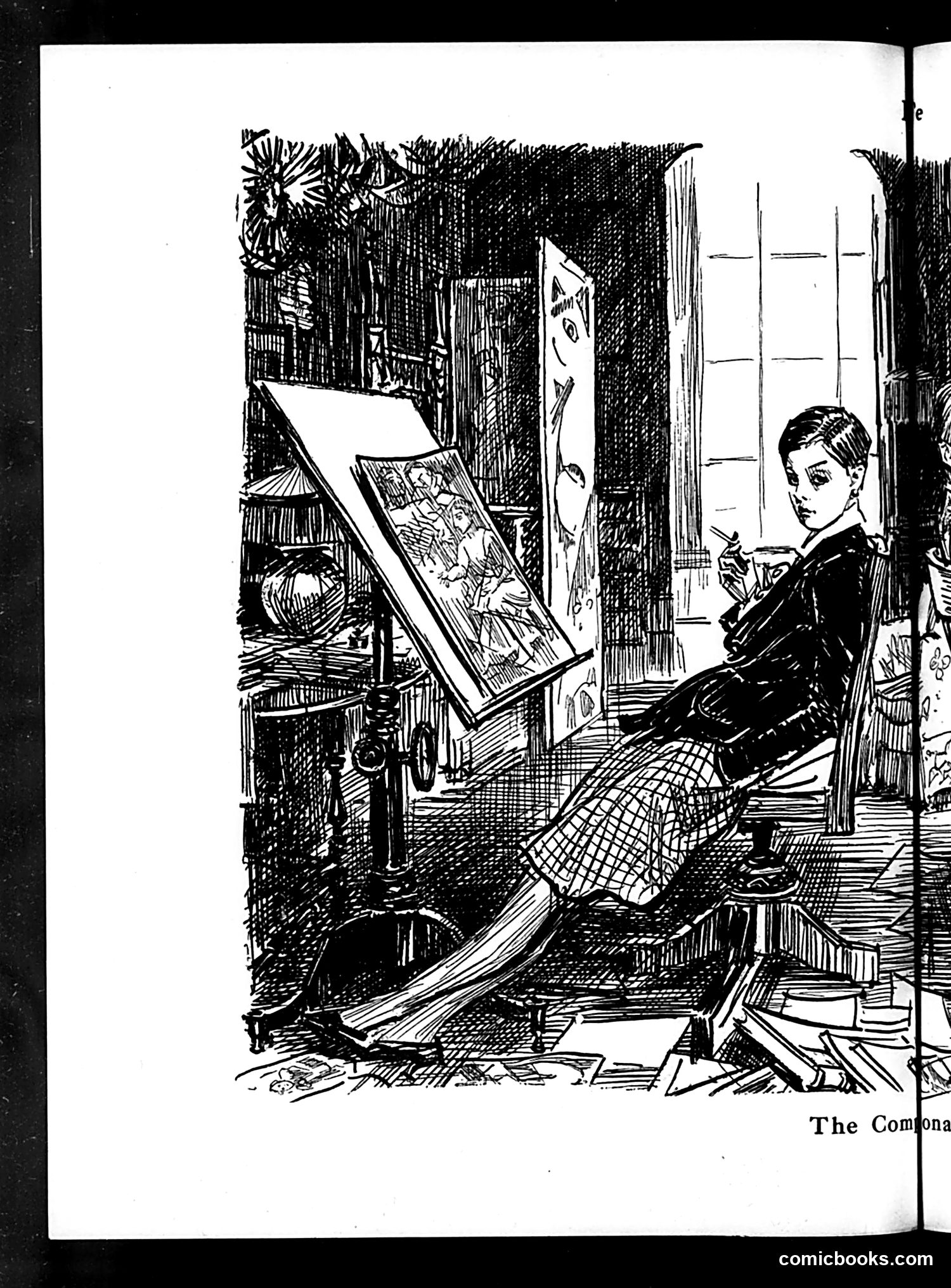
This appears to be an illustration from *Life* magazine showing an artist or designer at work in a studio. The figure is seated, sketching or drawing at an easel, surrounded by artistic materials and studio props—including what appears to be decorative objects on shelves, a globe, and various papers scattered about. The partial caption reads "The Com[pana]" (text is cut off), making the specific satirical target unclear. Without the complete caption or accompanying article text, I cannot definitively identify whom this caricatures or what social/political commentary it intends. The image itself simply depicts a creative professional at work, rendered in the magazine's characteristic pen-and-ink style.
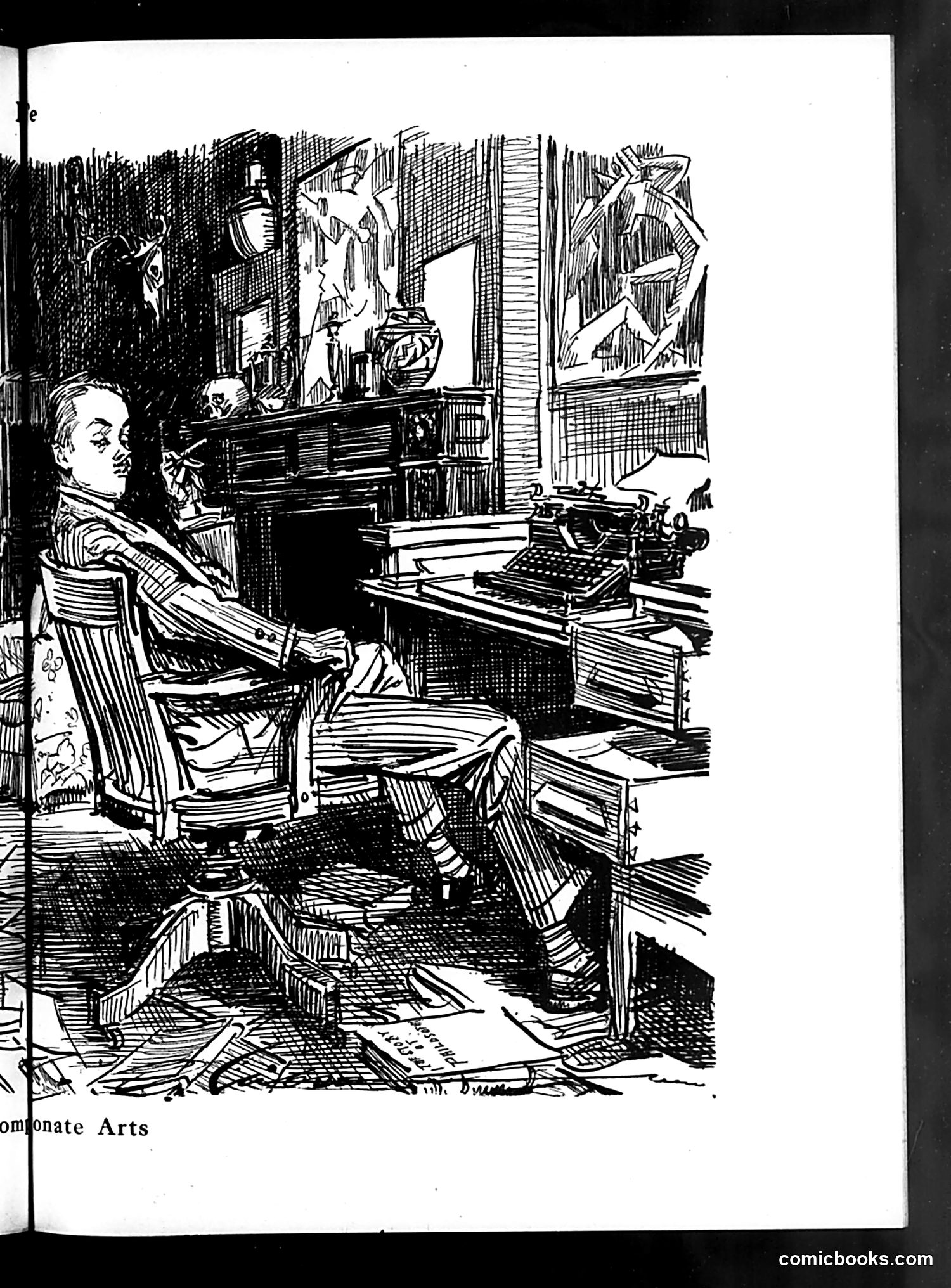
This is a pen-and-ink illustration showing a man seated at a desk in what appears to be an artist's or writer's studio. The workspace is cluttered with papers, books, and a typewriter. Behind him are sketches or artwork pinned to the wall, suggesting creative work in progress. The partial text "omionate Arts" (likely "Immoderate Arts" or similar) appears at the bottom, though it's cut off. Without additional context from the full page caption or article text, I cannot definitively identify the specific figure or the satirical target. The scene suggests commentary on artistic or intellectual work, but the precise political or social reference remains unclear from the image alone. The comicbooks.com watermark indicates this is from their archival collection.
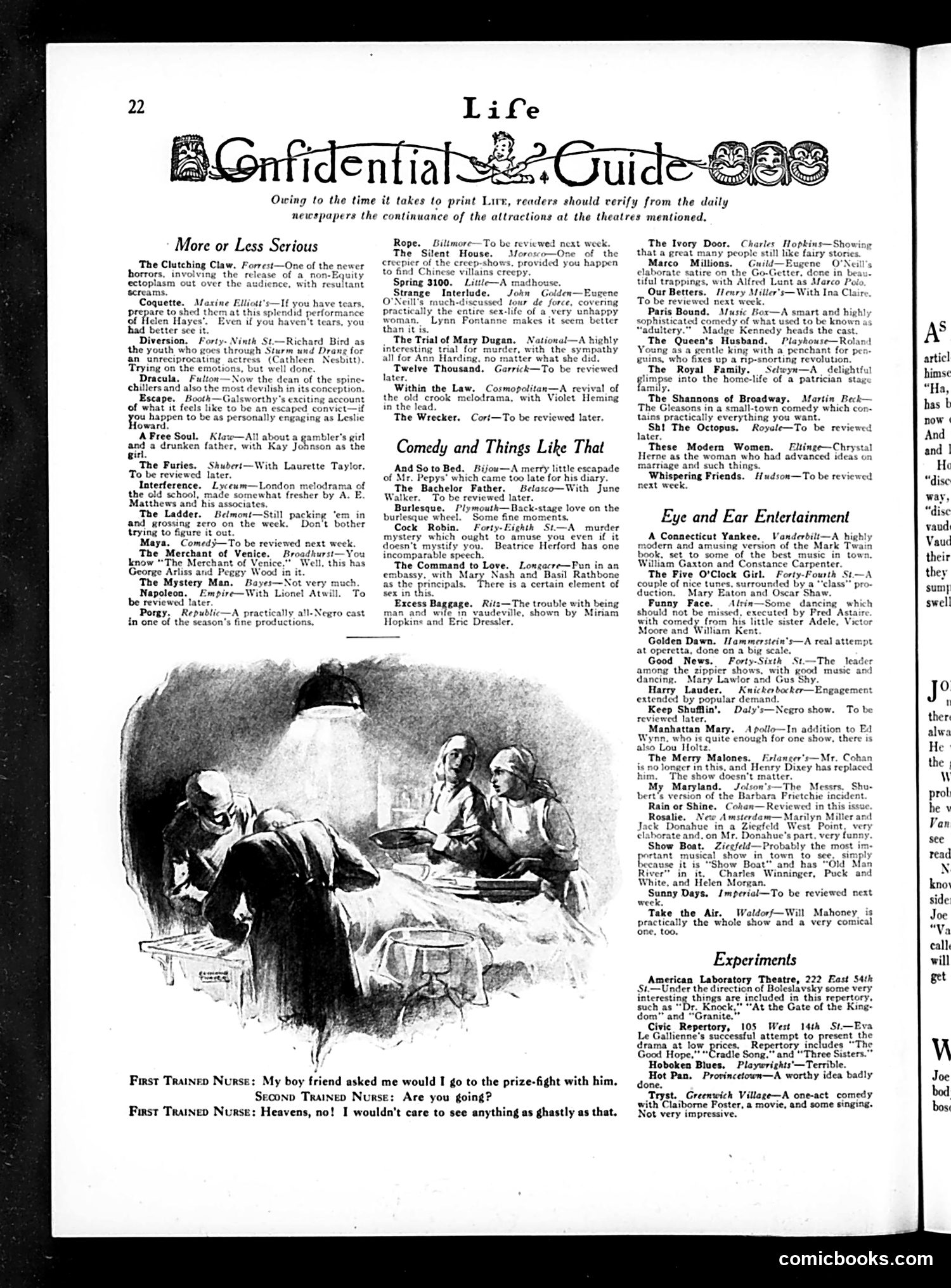
This page is primarily a **theater listings and reviews guide** for Broadway shows, with brief synopses and performance details. The reviews range from serious dramas (*Dracula*, *Porgy*) to comedies and musicals. The only cartoon present is at the bottom—a brief **joke between two trained nurses** about attending a prize fight. The humor is a period-appropriate play on propriety: one nurse refuses to attend because she finds boxing "ghastly," despite her profession presumably exposing her to graphic injuries and suffering. The joke mocks the selective prudishness of the era—the nurse finds theatrical violence unacceptable while her actual job involves witnessing medical horrors. Notable shows listed reflect 1920s Broadway interests: adaptations of classics (*Merchant of Venice* with George Arliss), experimental drama (*Marco Millions* by Eugene O'Neill), and the racially significant all-Black production *Porgy*.
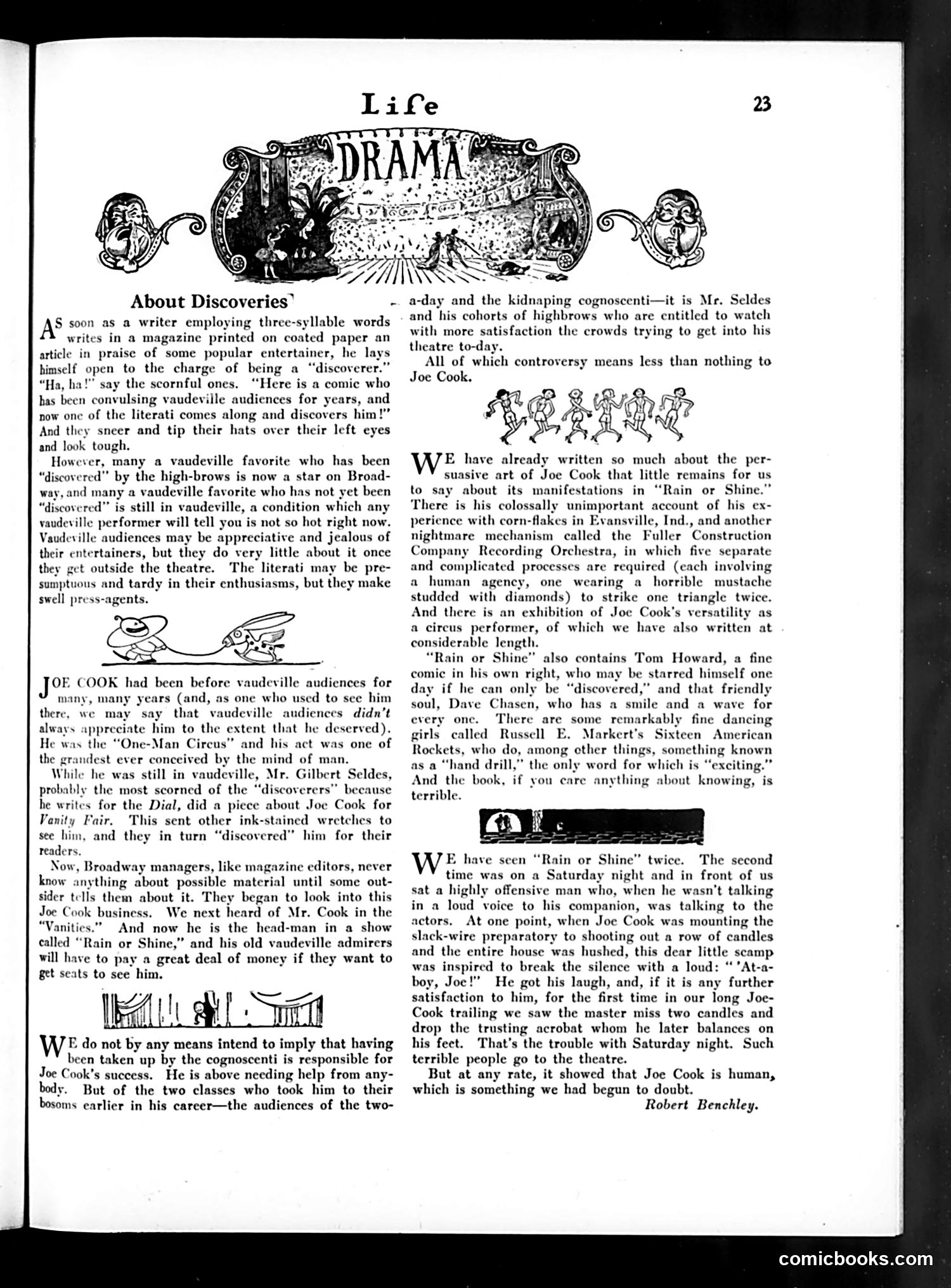
This article by Robert Benchley satirizes the literary establishment's role in promoting entertainers. The piece centers on vaudeville performer **Joe Cook**, a long-established "One-Man Circus" act whom highbrow critics, particularly **Gilbert Seldes** (writing for *The Dial* magazine), "discovered" and championed to a wider audience through *Vanity Fair*. Benchley's satire targets the paradox that while vaudeville audiences appreciated Cook for years, Broadway producers ignored him until intellectuals validated his talent. The joke: critics claim discovery credit, yet their "press agent" function actually matters—Cook's success depends partly on their endorsement, not just his undeniable talent. The small illustrations show dancing figures, emphasizing vaudeville's physical comedy. Benchley argues that both working-class vaudeville crowds and educated "cognoscenti" deserve credit for Cook's rise, though the highbrows earned more satisfaction from his current Broadway success in "Rain or Shine."
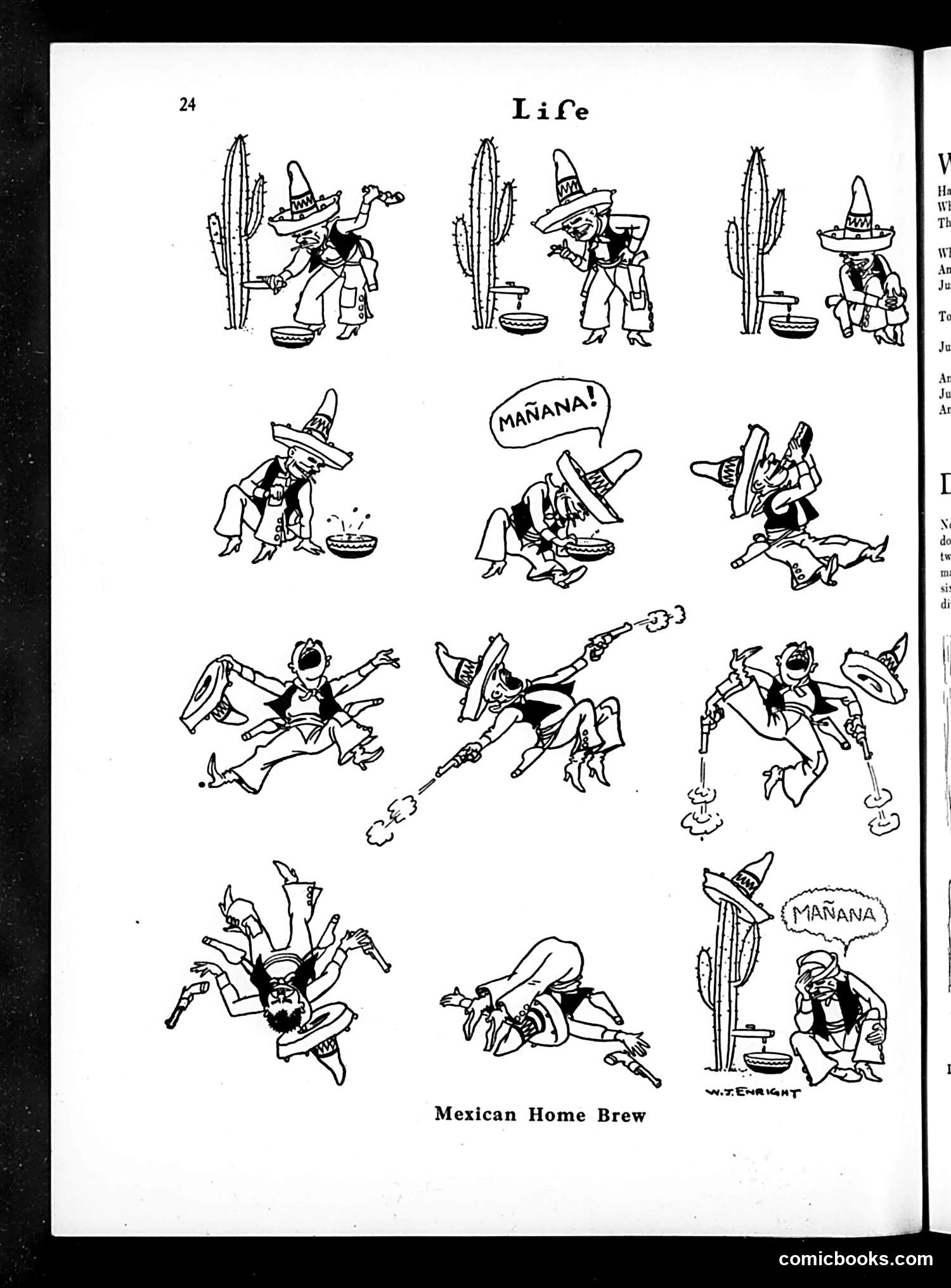
This comic strip satirizes Mexican stereotypes popular in early-to-mid 20th century American humor. It depicts a Mexican character (identifiable by the sombrero and stereotypical features) engaging in increasingly chaotic antics around a cactus and bowl, frequently saying "Mañana" (Spanish for "tomorrow"). The joke relies on the racist stereotype that Mexican people are lazy, procrastinating, and prone to drunken tomfoolery. The escalating physical comedy—from simple posing to acrobatic chaos—exaggerates this characterization for comedic effect. The title "Mexican Home Brew" suggests the character is drunk on homemade alcohol, reinforcing period stereotypes linking Mexican identity with excessive drinking. This reflects the dated, offensive humor conventions of *Life* magazine's historical era.
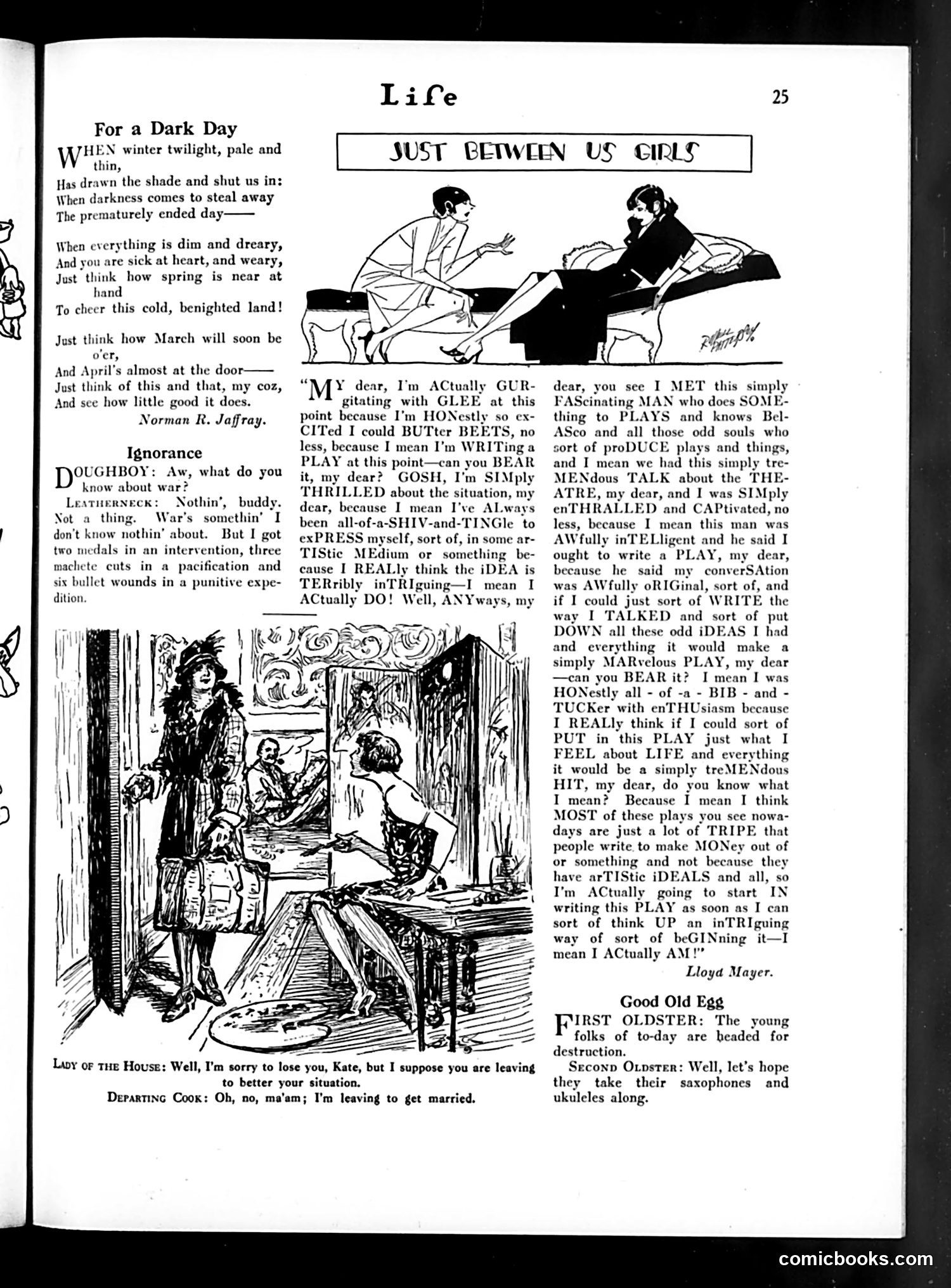
This page contains three satirical pieces mocking early 1920s American social pretensions and attitudes. **"Just Between Us Girls"** (top cartoon and text): Mocks affected, verbose young women aspiring to artistic careers. The character speaks in exaggerated, capitalized words, breathlessly describing meeting a theatrical producer and suddenly deciding to write a play. The satire targets the affected speech patterns and shallow artistic ambitions of young women seeking cultural legitimacy—likely inspired by post-WWI women's increasing social freedom and participation in arts/theater. **"Ignorance"** (middle): A brief dialogue joke contrasting claimed ignorance with actual military experience. A "leatherneck" (Marine) claims to know nothing about war while listing combat wounds and military actions, satirizing false modesty or the disconnect between experience and admission. **"Good Old Egg"** (bottom): Two elderly men discuss youth "headed for destruction," but the second optimistically hopes they'll take their saxophones and ukuleles—mocking older generations' moral panics about jazz-age youth culture while gently suggesting the concern is overblown.
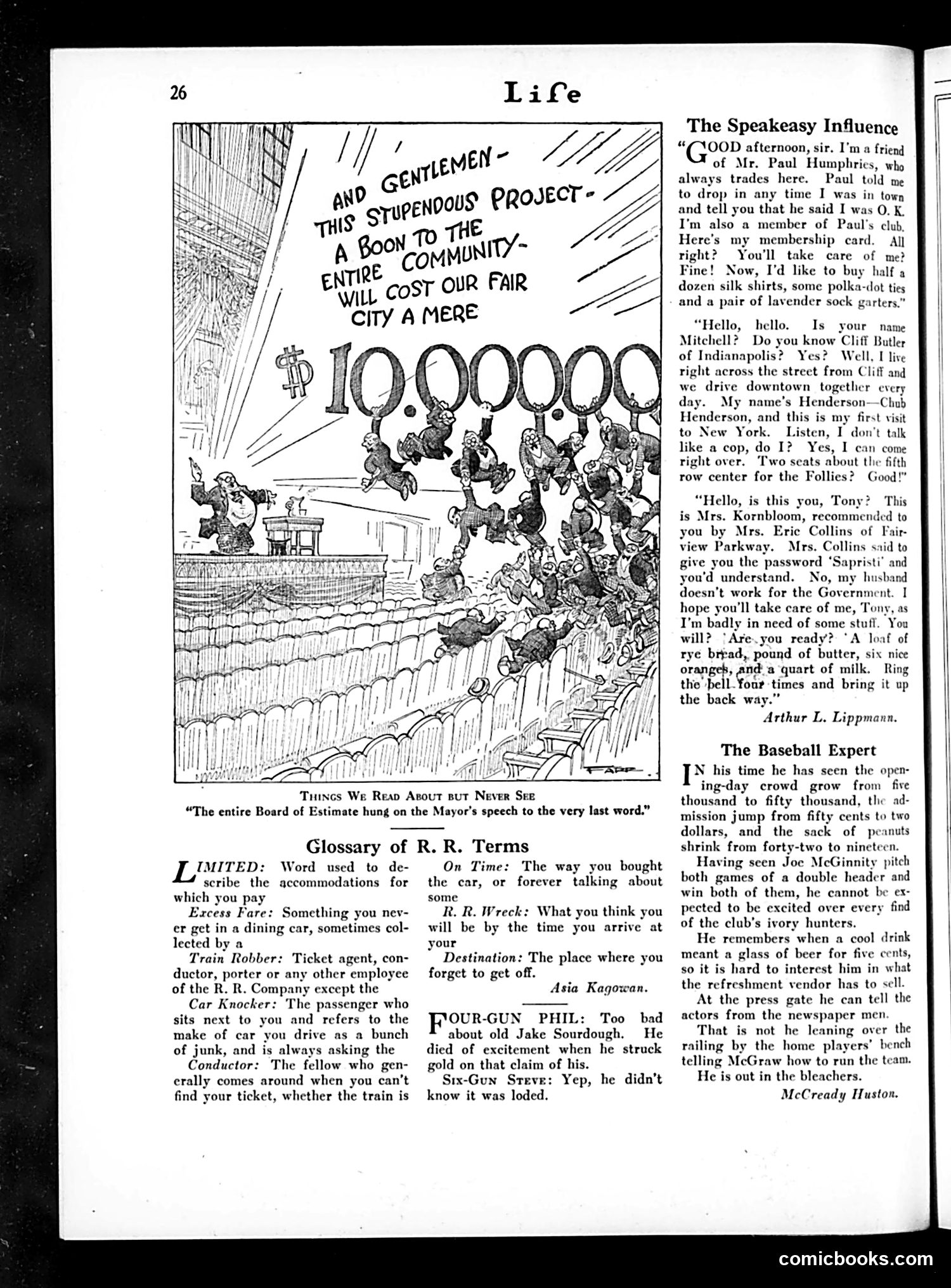
The page contains three satirical pieces mocking contemporary American society during Prohibition: **Main Cartoon**: "The entire Board of Estimate hung on the Mayor's speech to the very last word" depicts a crowded board meeting, sarcastically suggesting politicians were unusually attentive—likely a jab at municipal corruption or incompetence. **"The Speakeasy Influence"**: Three vignettes show people using connections and passwords to access illegal alcohol and goods during Prohibition. They drop names, reference club memberships, and use coded language ("Sapristi") to gain access to speakeasies and black-market suppliers. The satire exposes how Prohibition bred a culture of bootlegging, bribery, and social networks built on lawbreaking. **Supporting Content**: A railroad terminology glossary and baseball commentary provide additional humor about travel inconveniences and long-suffering sports fans. The overall theme mocks how Prohibition corrupted normal commerce and social interactions, forcing ordinary citizens to become criminals through elaborate password systems and favor-trading.
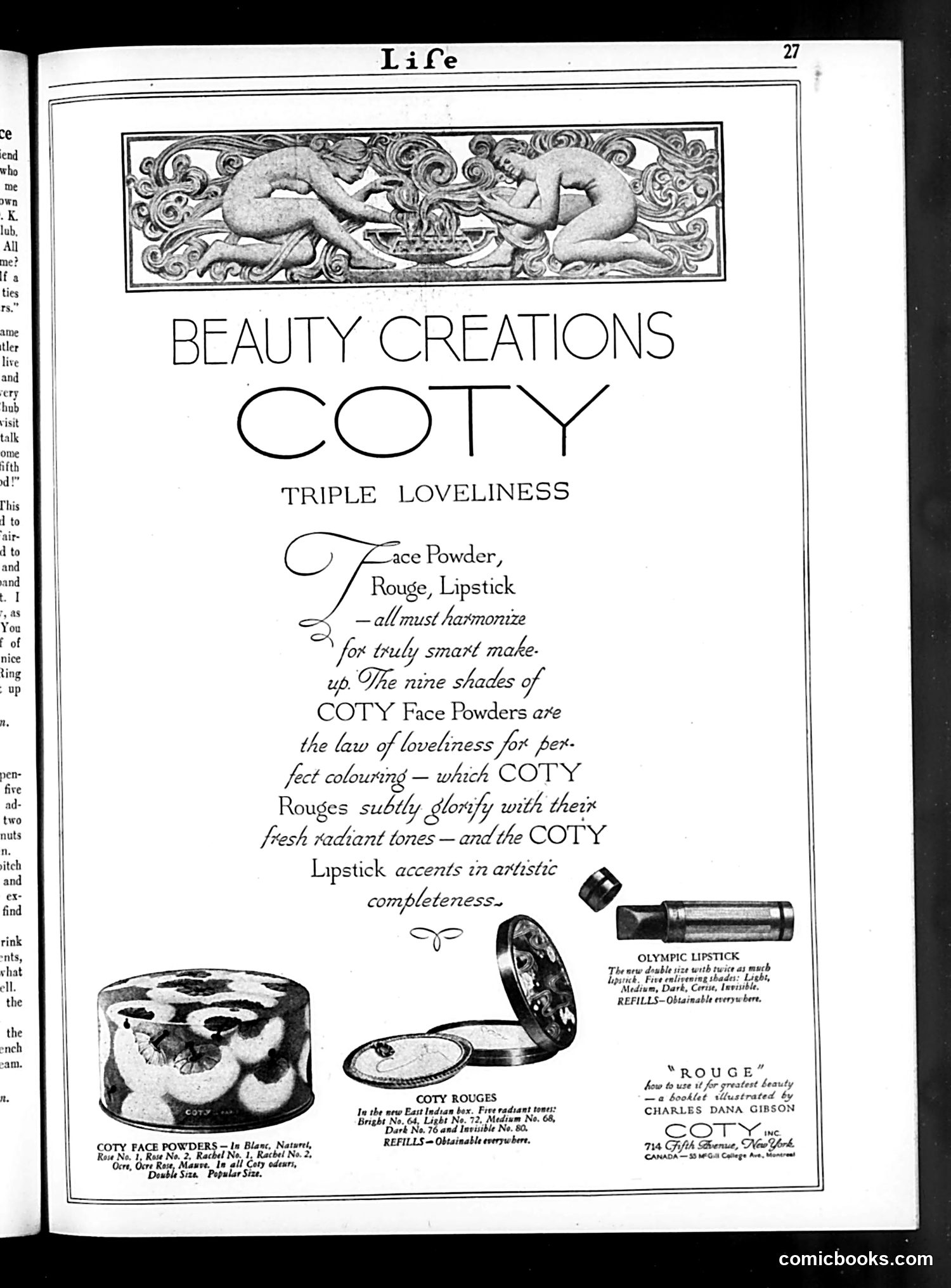
This is **not a cartoon or satire page**—it is a full-page advertisement for Coty beauty products (face powder, rouge, and lipstick), appearing in *Life* magazine. The decorative header features classical cherubs in an ornamental frame, establishing an elegant tone. The ad emphasizes the concept of "Triple Loveliness," promoting the idea that face powder, rouge, and lipstick must harmonize together for proper makeup application. It highlights Coty's nine powder shades and coordinating rouge and lipstick products, framing cosmetics as essential to feminine beauty. The illustration shows product packaging and an Olympic Lipstick variant. Charles Dana Gibson's illustrated rouge guide booklet is mentioned as promotional material. **Context for modern readers:** This reflects early 20th-century beauty marketing that normalized cosmetics as beauty necessities rather than luxuries, targeting middle-class women seeking "smart" appearance standards.
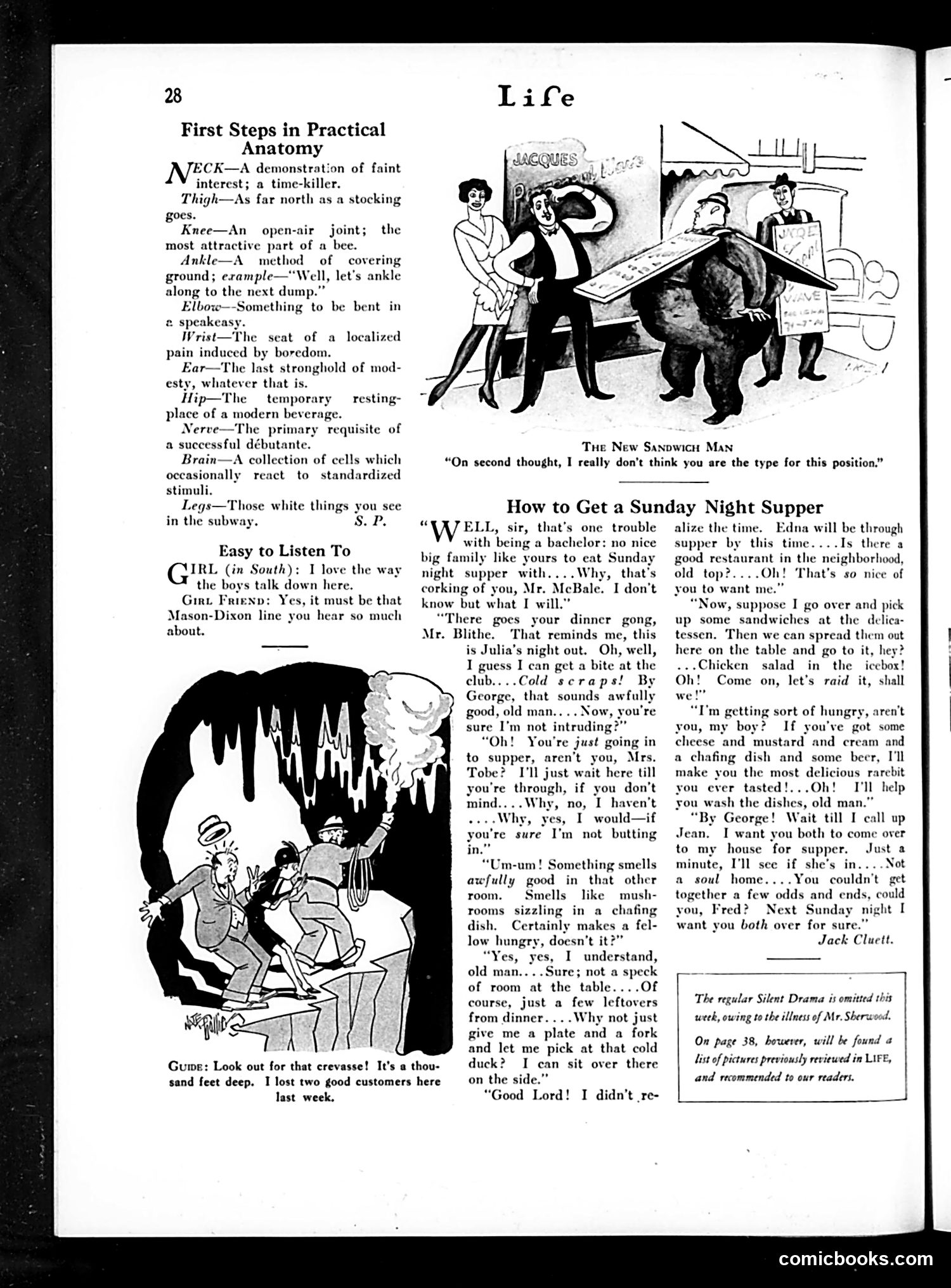
This page contains satirical humor typical of 1920s Life magazine, targeting contemporary social anxieties and behaviors. **"First Steps in Practical Anatomy"** is a comedic glossary redefining body parts through modern social lens—"legs" are "those white things you see in the subway" (referencing women's exposed legs, scandalous by pre-1920s standards), "hip" refers to "the temporary resting-place of a modern beverage" (alluding to Prohibition-era drinking), and "nerve" is required for "a successful débutante." **"The New Sandwich Man"** cartoon mocks job interviews, with the caption suggesting the applicant lacks proper demeanor for employment. **"How to Get a Sunday Night Supper"** satirizes bachelor social mooching—a single man repeatedly invites himself to dinner through transparent hints and flattery, ultimately triggering an invitation. The humor targets both the bachelor's shameless manipulation and the host's social weakness in resisting. The page reflects 1920s preoccupations: Prohibition, changing gender norms (visible legs), and bachelor life among unmarried men—common anxieties in post-WWI urban society.
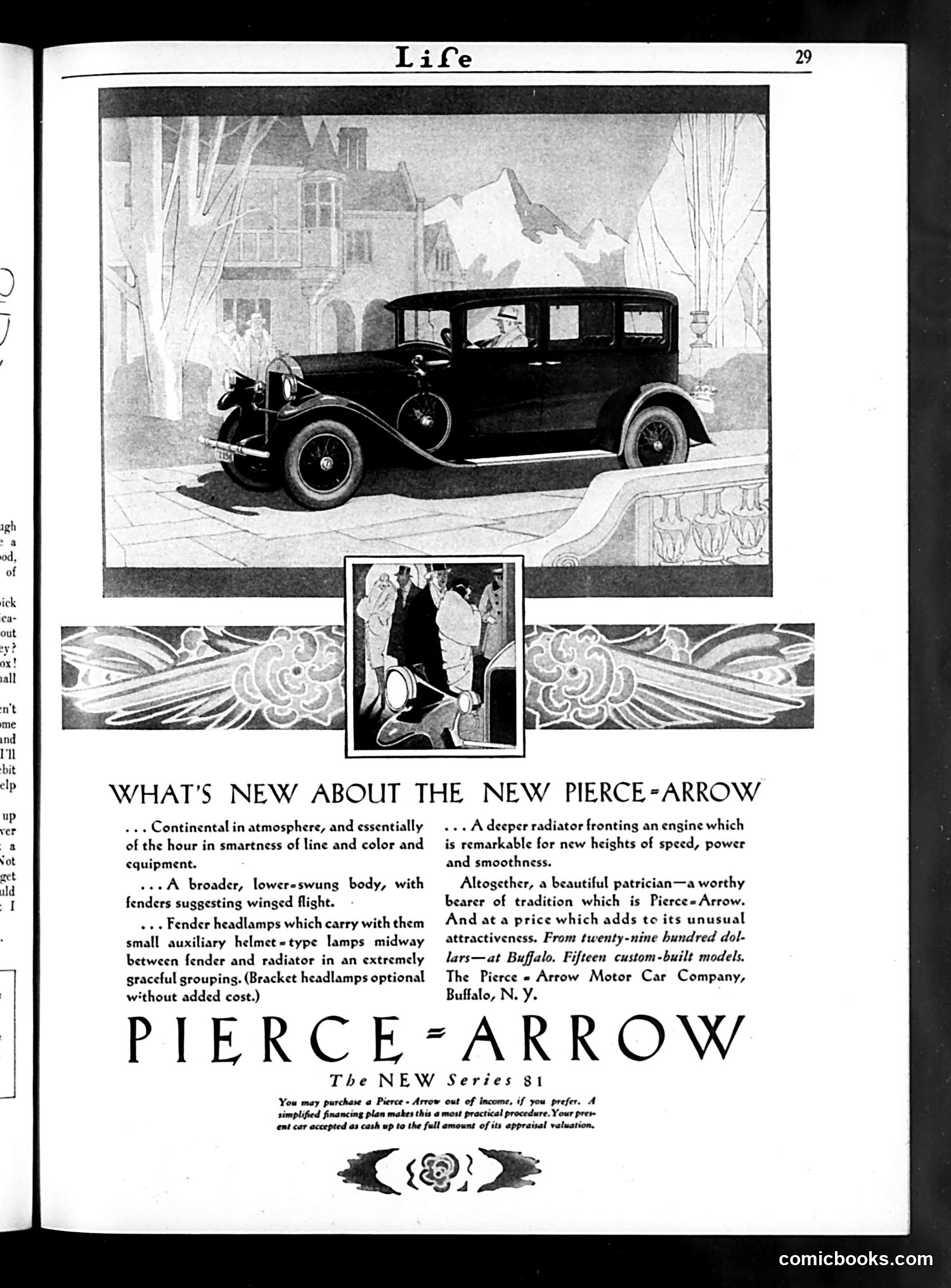
This is a **Pierce-Arrow automobile advertisement**, not a political cartoon. The page promotes the luxury car manufacturer's new Series 81 model. The advertisement uses aspirational imagery: a sleek sedan parked before an elegant mansion with mountains beyond, suggesting wealth and sophistication. A smaller inset photo shows well-dressed passengers, reinforcing the car's appeal to the affluent. The copy emphasizes design features ("winged flight" fenders, elegant headlamps, powerful engine) and positions the Pierce-Arrow as a "beautiful patrician"—language appealing to old money and tradition. The price point ("from twenty-nine hundred dollars") targets the wealthy, though the financing option ("out of income") represents an early marketing strategy to broaden appeal. This reflects 1920s-era luxury car advertising that conflated automobile ownership with social status and refined taste.
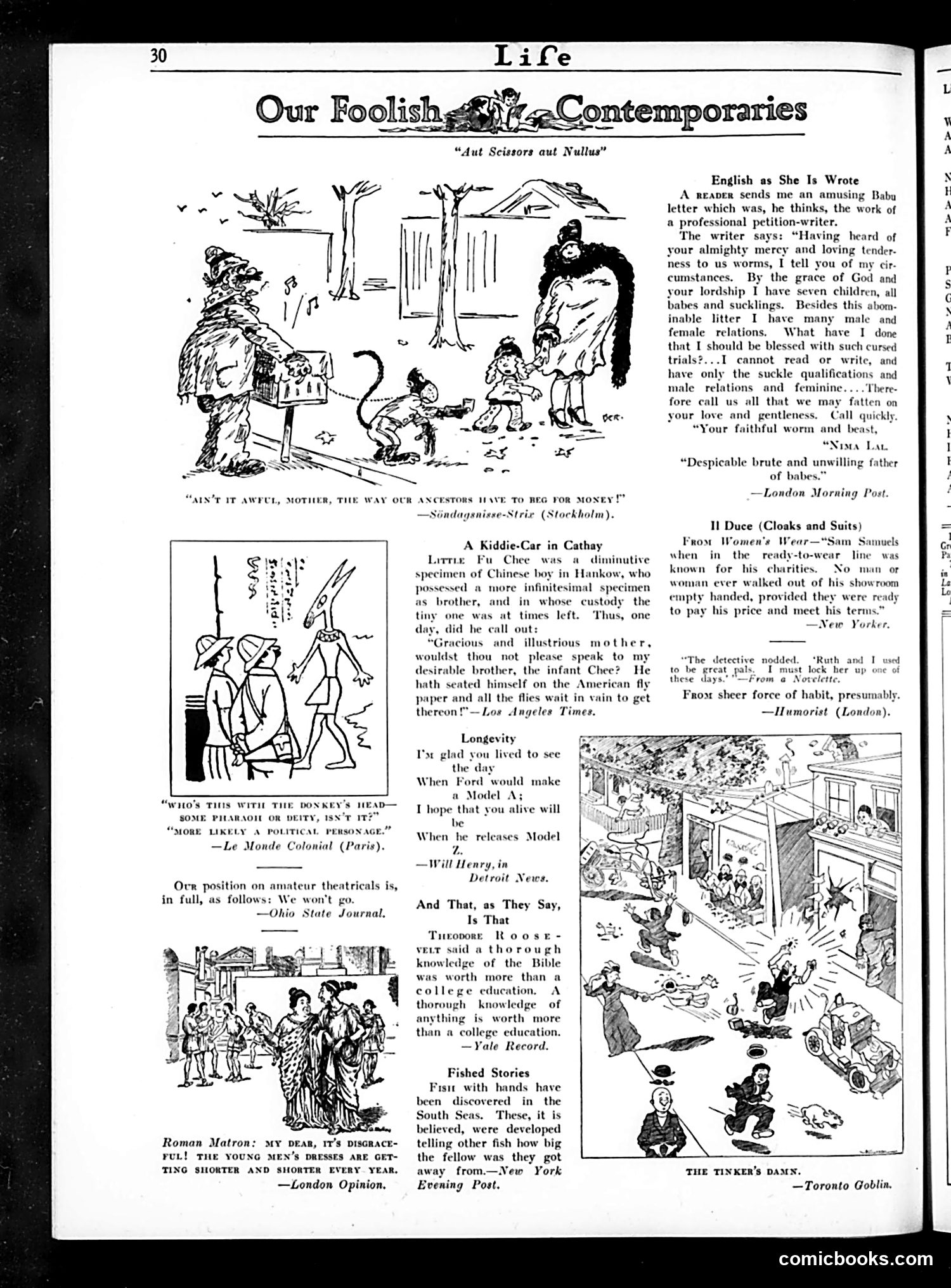
This page collects brief humorous items and cartoons mocking contemporary absurdities. Key sections include: **Top cartoon**: A Scandinavian publication's joke about ancestors begging for money—a satirical dig at genealogy claims. **"A Kiddie-Car in Cathay"**: Mocks pidgin English through a Chinese boy's malapropism about flies on flypaper—typical early 20th-century ethnic humor reflecting Western stereotypes of Asian speech patterns. **"English as She Is Wrote"**: Ridicules Indian "Babu" English in a petition letter, again using non-native English as comedy fodder. **Other items**: Various one-liners about theatrical fashion, shorter men's clothing, Ford Model A automobiles, and Roosevelt's Bible knowledge versus college education. **The bottom illustration "The Tinker's Dam"**: Shows chaotic domestic life—its exact meaning unclear from the image alone. The page's humor relies heavily on ethnic caricature and linguistic mockery—attitudes considered deeply offensive today but standard in 1920s-era satire magazines.
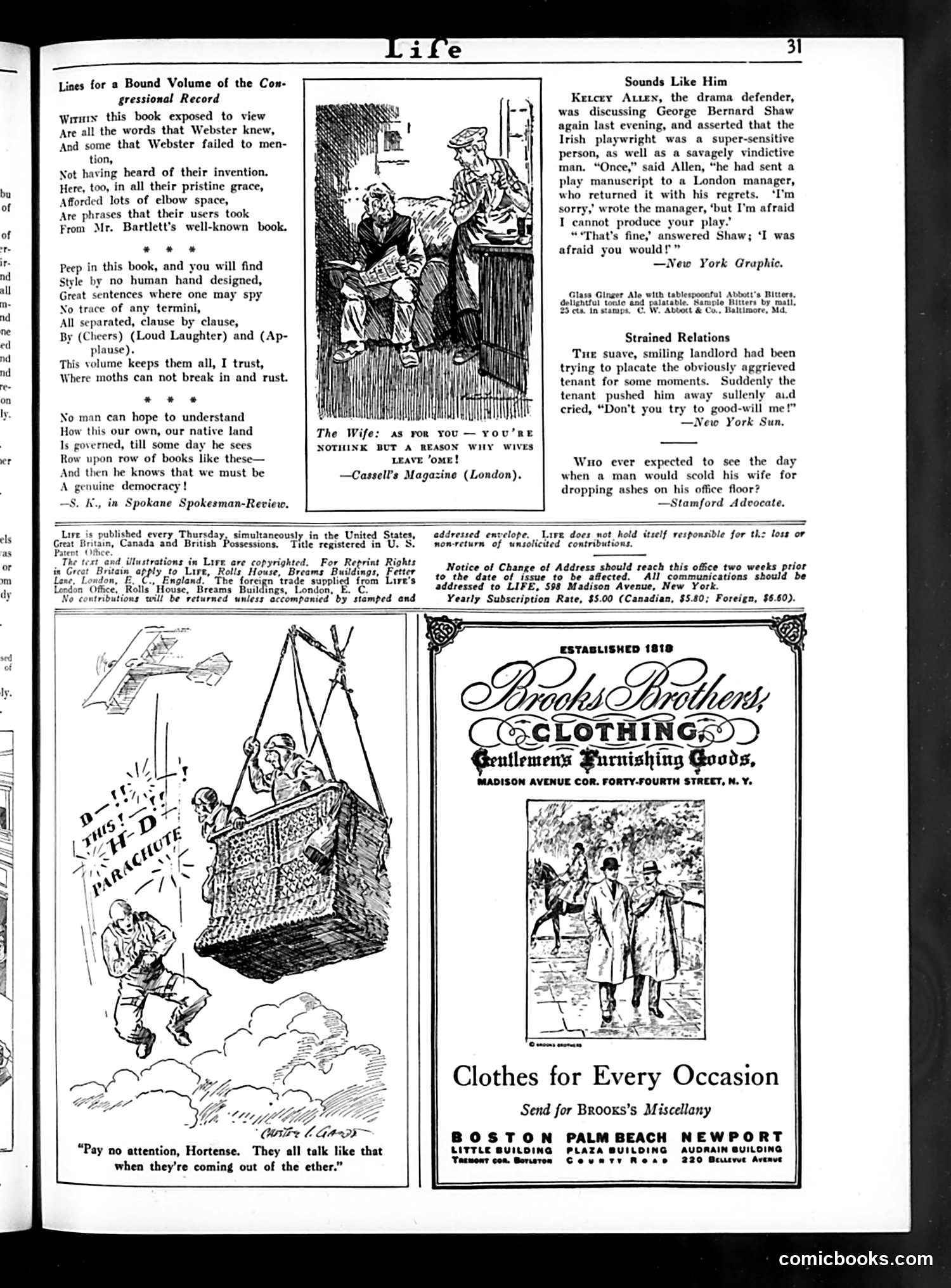
This page comprises satirical poetry and humor pieces typical of Life's early 20th-century format. **"Lines for a Bound Volume of the Congressional Record"** mocks Congress itself—the poem ridicules politicians' verbose, poorly-constructed speeches filled with stage directions like "(Cheers)" and "(Applause)." The reference to Webster suggests Daniel Webster, the famous orator, implying modern congressmen lack eloquence. The satire suggests American democracy is undermined by unintelligible legislative language and borrowed rhetoric from Bartlett's Quotations. **"Sounds Like Him"** is a brief anecdote about playwright George Bernard Shaw, known for being thin-skinned and vindictive. The joke illustrates his contradictory personality—he simultaneously fears rejection yet welcomes it as validation of his superiority. **"Strained Relations"** depicts a landlord-tenant conflict where the tenant rejects the landlord's attempted reconciliation, suggesting marital discord parallels class friction. **"The Wife"** presents domestic tension over ashes on office floors—presumably cigarette ash—reflecting changing gender roles and domestic expectations of the era.
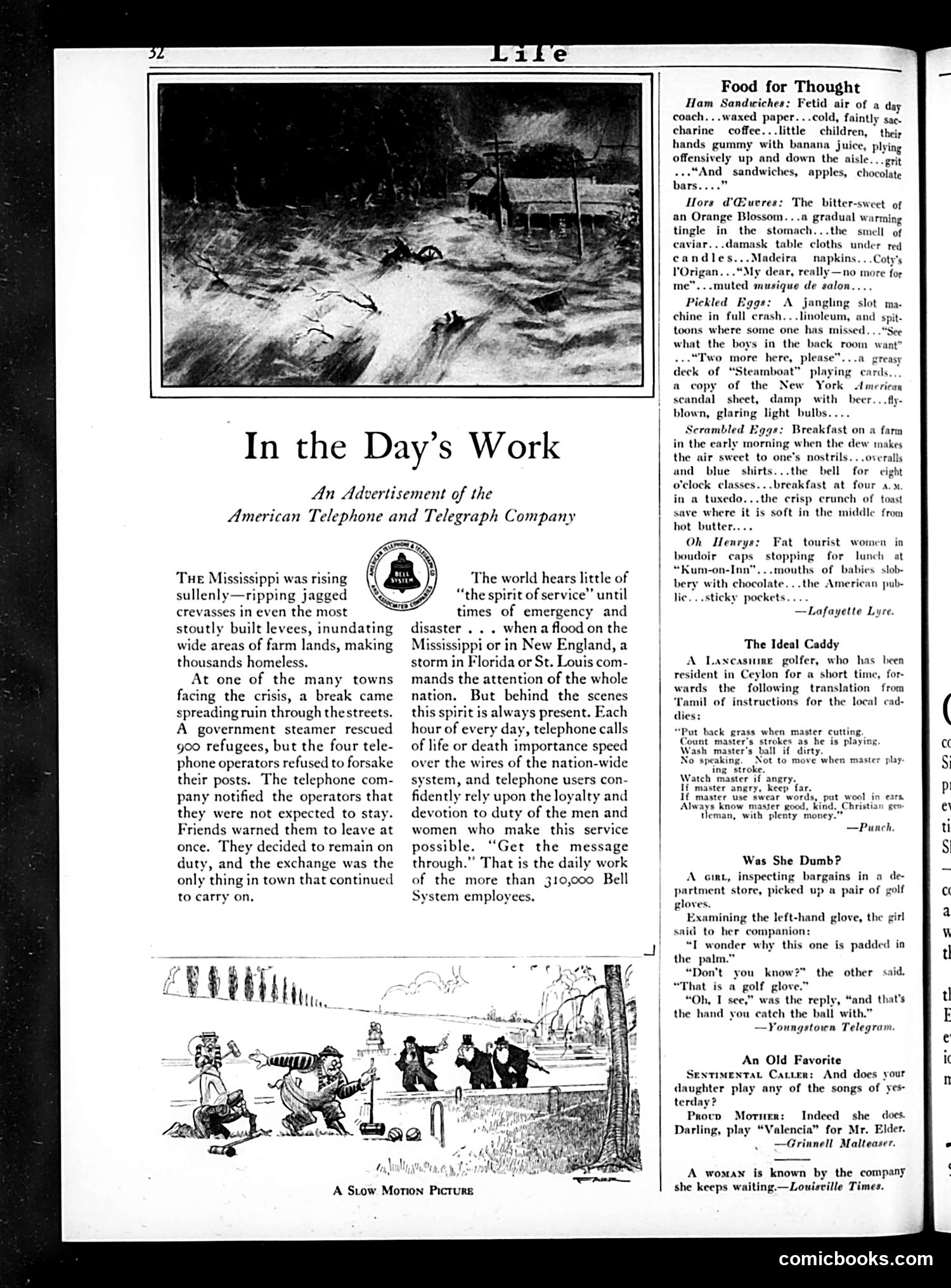
This page contains an **advertisement for the American Telephone and Telegraph Company** disguised as editorial content. The main article, "In the Day's Work," describes telephone operators during a Mississippi River flood who refused to abandon their posts despite danger and official permission to leave. The text emphasizes their selfless "spirit of service" and loyalty, noting that 310,000 Bell System employees perform such duties daily. The accompanying illustration shows a flood rescue scene, visualizing the heroic narrative. This is corporate propaganda—presenting the telephone company's workers as essential, dedicated servants during crisis to build public trust and justify the company's importance to national infrastructure. The page also includes lighter "Food for Thought" humor pieces and anecdotes about caddies and golf gloves. These filler items were typical of Life's satirical format, offsetting the serious advertising content.
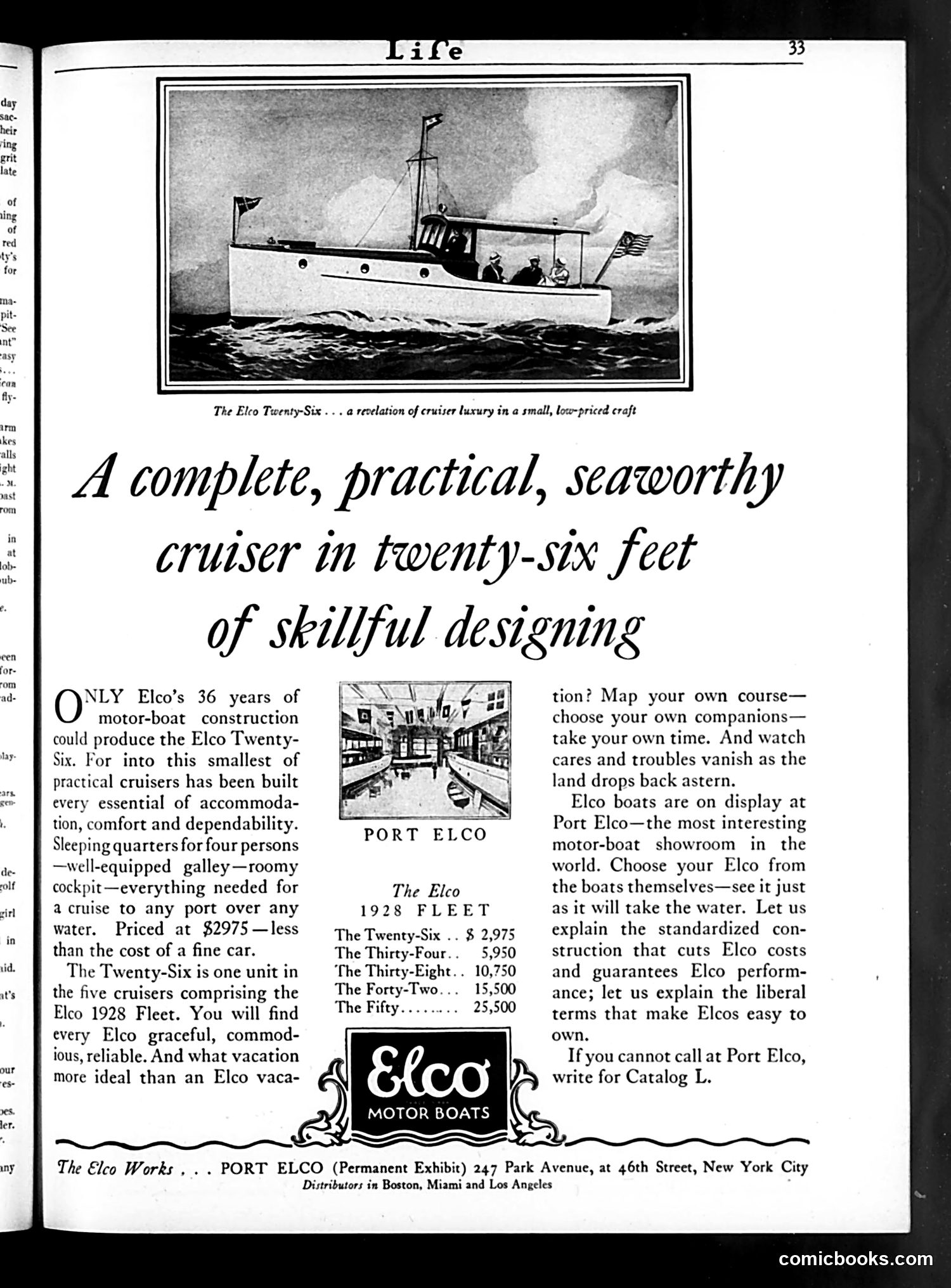
This page is **not a cartoon or satire**—it's a straightforward advertisement for Elco motor boats, appearing in Life magazine circa 1928. The ad promotes the "Elco Twenty-Six," a 26-foot luxury cruiser priced at $2,975 (comparable to a fine automobile). The photograph shows the vessel underway with passengers and flags. The copy emphasizes practical features: sleeping quarters for four, galley, roomy cockpit, and seaworthiness for independent cruising. The ad situates itself within Elco's 1928 fleet lineup, ranging from the Twenty-Six to the Fifty (priced at $25,500). It invites potential buyers to Port Elco's showroom at 247 Park Avenue in Manhattan, where customers could inspect boats before purchase. For modern readers: this reflects 1920s leisure culture and the aspirational appeal of motorboating as accessible luxury—positioning a $2,975 boat as affordable compared to automobiles.
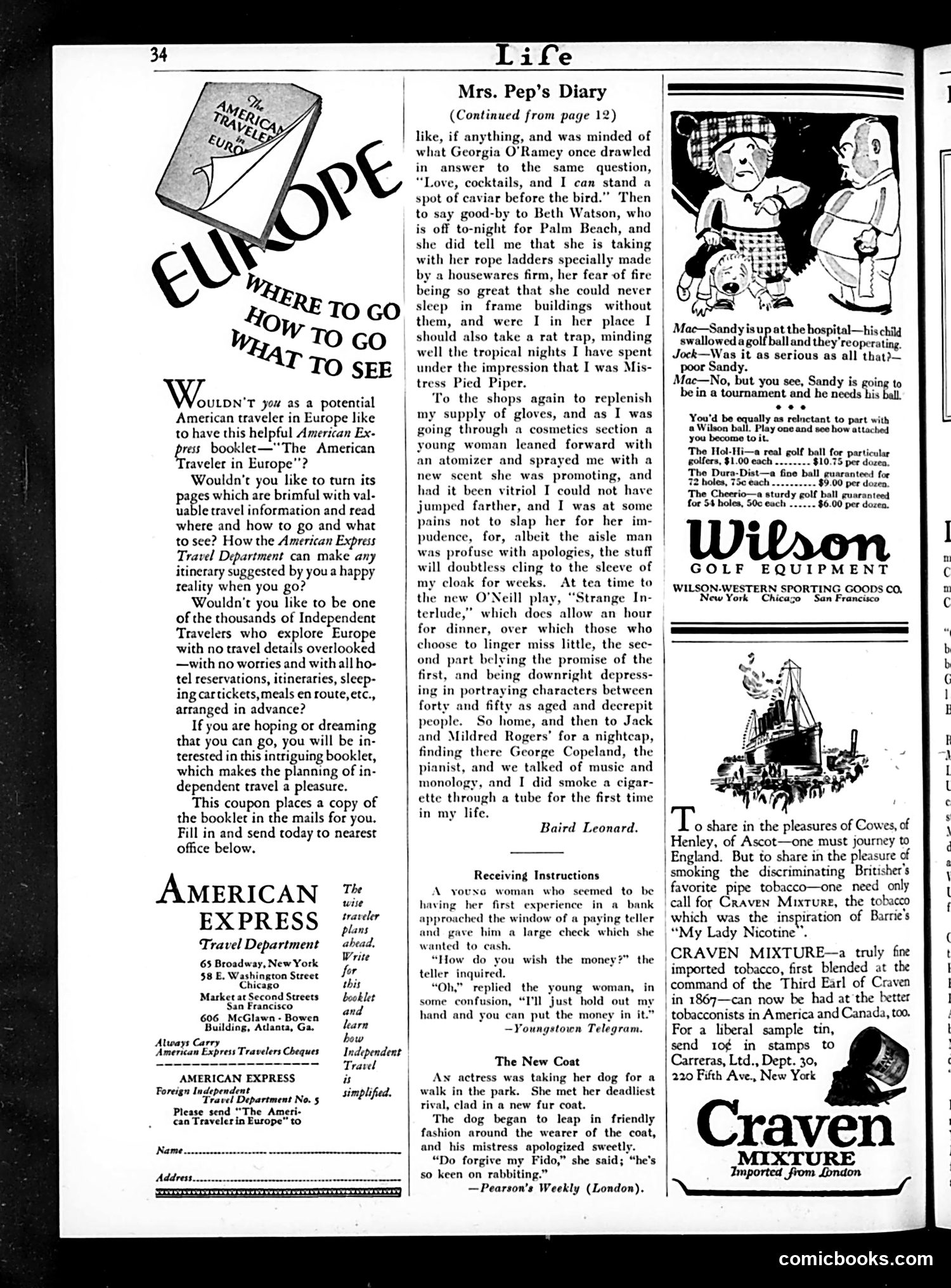
This page is primarily **advertising and society column content**, not political cartoons. The main features are: 1. **American Express Travel Advertisement** (left): A straightforward pitch for their European travel planning booklet, targeting independent travelers wanting hassle-free trips. 2. **Mrs. Pep's Diary** (center): A society gossip column documenting the author's social activities—shopping, theater attendance (seeing Eugene O'Neill's "Strange Interlude"), and evening socializing with friends. It's lighthearted social commentary on upper-class life. 3. **Three brief humorous anecdotes** (right): Short jokes about everyday situations—a bank customer confused about receiving money, and an actress's dog greeting a rival's new fur coat. 4. **Wilson Golf Equipment** and **Craven Mixture Tobacco** advertisements. The "humor" is gentle, focused on social etiquette confusion and everyday absurdities rather than political satire. This reflects Life magazine's 1920s-30s character as a genteel publication for affluent readers.
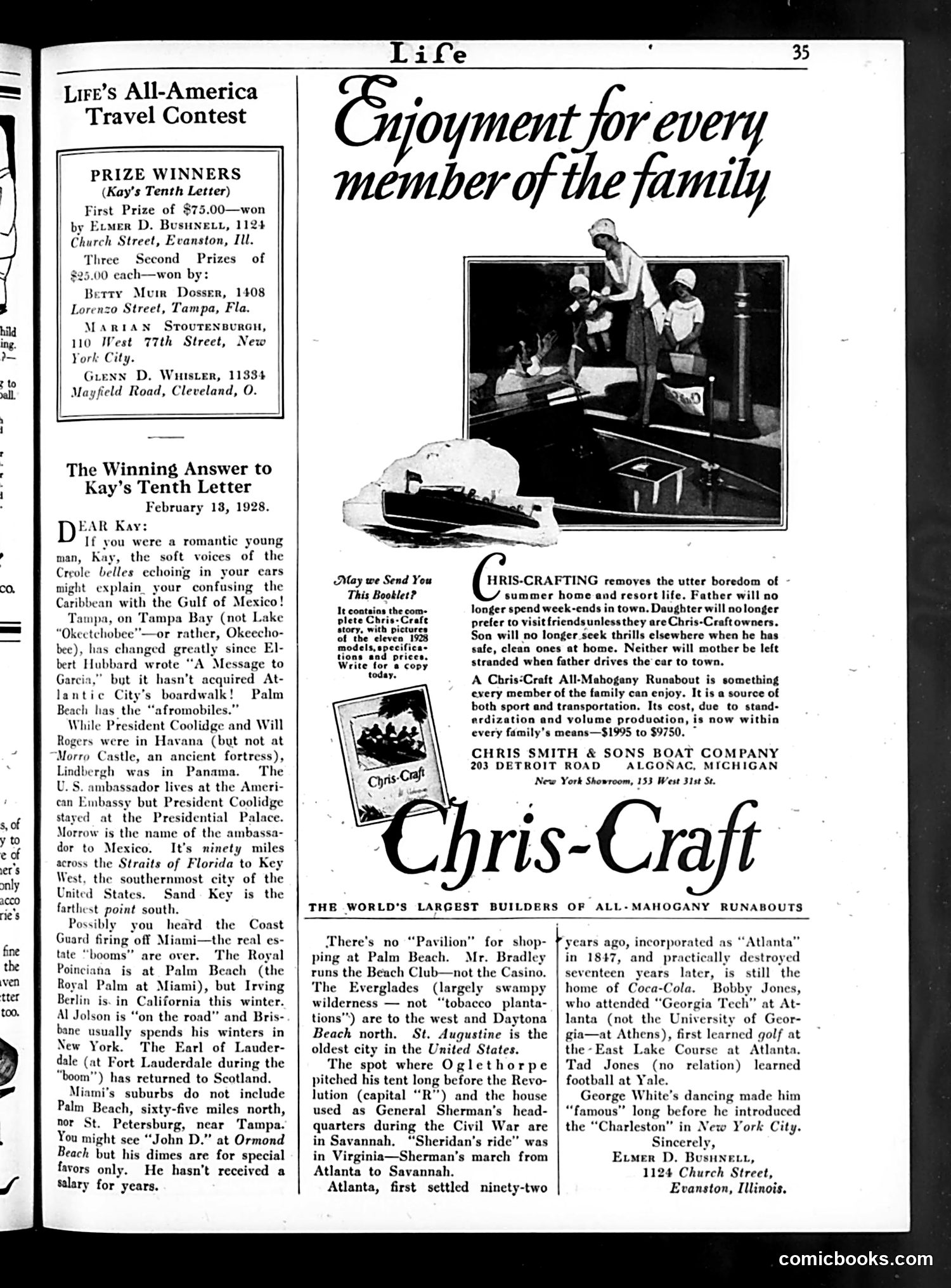
This is primarily **advertising and contest material**, not political satire. The page contains: 1. **Travel Contest Results**: Life magazine's "All-America Travel Contest" winners are announced, with prize money ($75 and $25). 2. **"Kay's Tenth Letter"**: A humorous geography lesson correcting a contestant's confused answer about Florida locations. The winning response sarcastically corrects mixing up Tampa with Caribbean locations, confusing Okechobee with other places, and misidentifying landmarks. It references contemporary figures (Coolidge, Lindbergh, Al Jolson, Irving Berlin) to establish correct geography. 3. **Chris-Craft Advertisement**: The bulk of the page advertises mahogany speedboats, emphasizing family leisure and the solution to summer boredom—notably that fathers won't stay in town and daughters won't visit friends unless they own one. The humor is gentle geographical pedantry rather than political commentary. This reflects 1920s consumer culture and the marketing of recreational boating to affluent families.
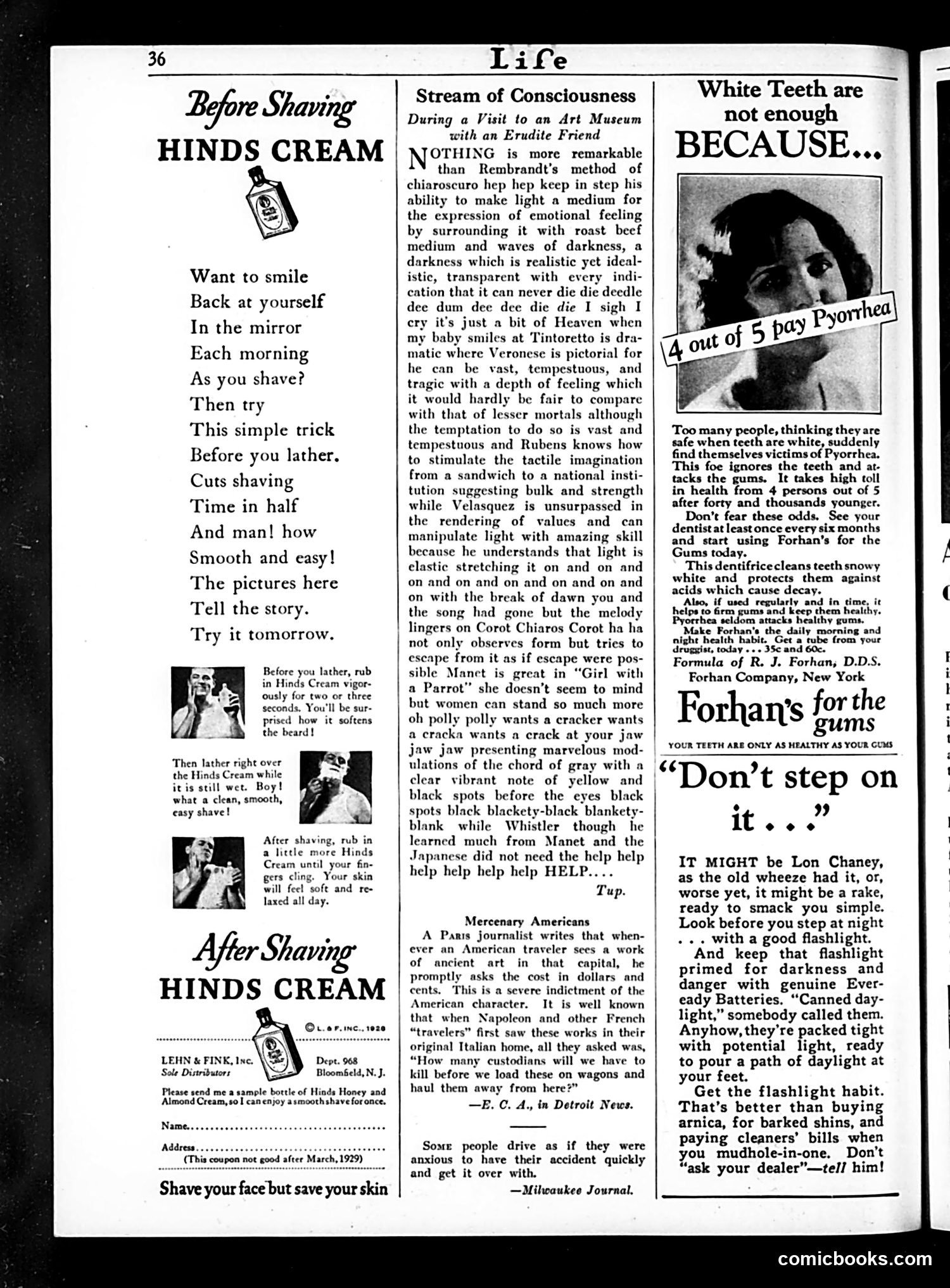
This page contains three distinct elements: **Left side:** A Hinds Cream shaving product advertisement with instructional photos showing the application process before and after shaving. **Center:** A satirical piece titled "Stream of Consciousness" mocking pretentious art appreciation. The text parodies an educated museum visitor who interjects highbrow art criticism (discussing Rembrandt's chiaroscuro, Velasquez's light technique) with random intrusions of popular songs, nonsense syllables, and trivial thoughts ("my baby smiles," "polly polly wants a cracker"). The humor lies in exposing the gap between intellectual posturing and actual wandering attention—suggesting cultured people discussing art aren't as focused or sophisticated as they pretend. **Right side:** A Forhan's toothpaste advertisement warning that white teeth alone don't prevent pyorrhea (gum disease), claiming 4 of 5 people over forty suffer from it. **Bottom:** Two brief satirical quips: one criticizing Americans abroad as mercenary (only asking art prices), another about reckless drivers.
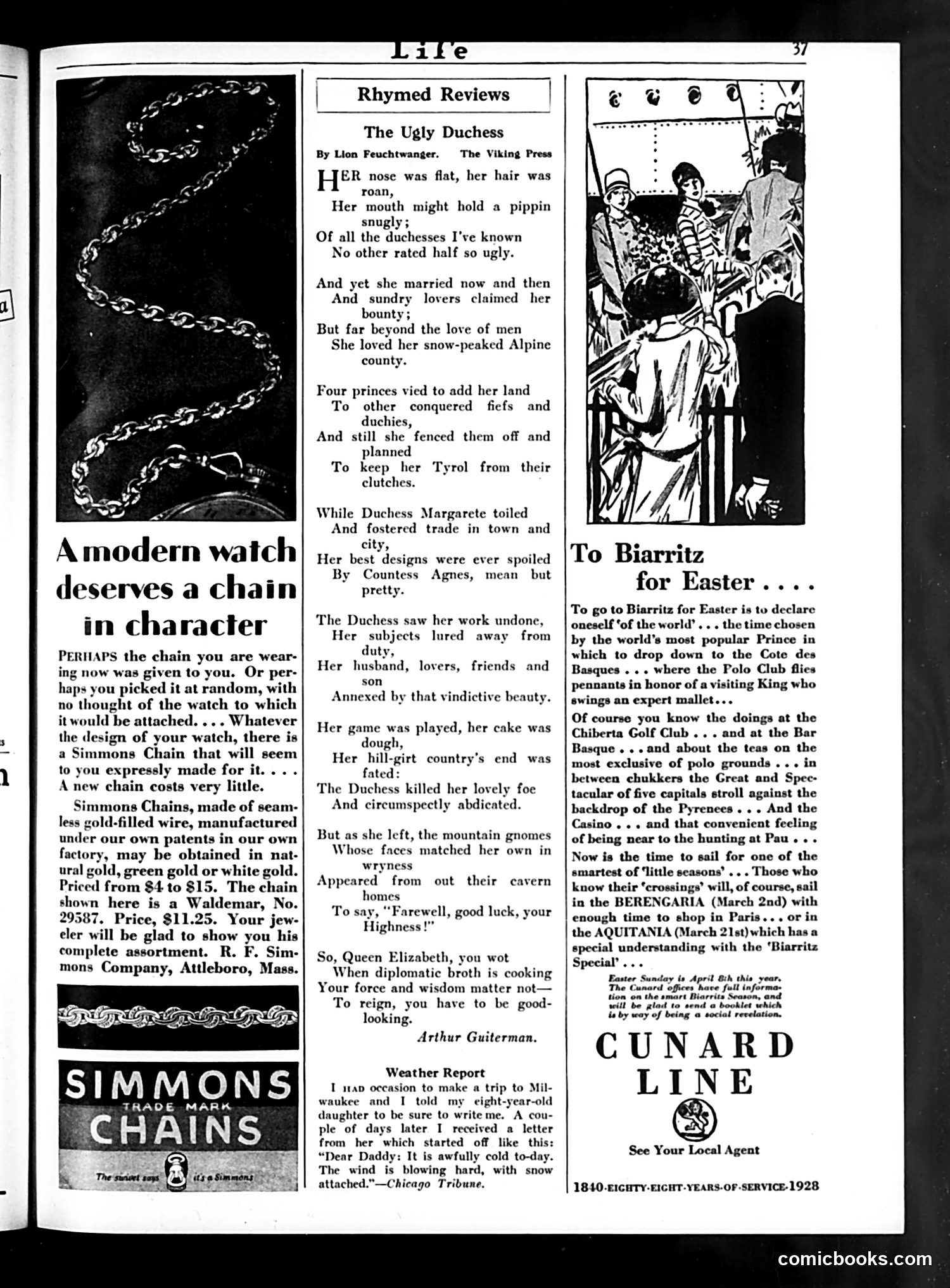
This page contains three distinct elements: **Left Side - Simmons Chains Advertisement:** A straightforward product ad for watch chains, emphasizing quality craftsmanship and affordable pricing ($4-$15). No satire. **Center - "The Ugly Duchess" Book Review:** Arthur Guiterman's rhymed review of Lion Feuchtwanger's novel about Duchess Margarete of Tyrol. The poem describes an physically unattractive noblewoman who nonetheless wields political power through intelligence and determination—until undone by a rival's beauty. The final couplet delivers the satire: despite her competence, a female ruler's appearance matters more than her "force and wisdom." This mocks society's fixation on women's looks over their capabilities. **Right Side - Cunard Line Advertisement:** Luxury travel promotion for Easter trips to Biarritz, emphasizing exclusivity and high society. **Overall Point:** The book review's satire—that female power is ultimately undermined by beauty politics—contrasts sharply with the surrounding advertisements celebrating consumption and leisure for the wealthy.
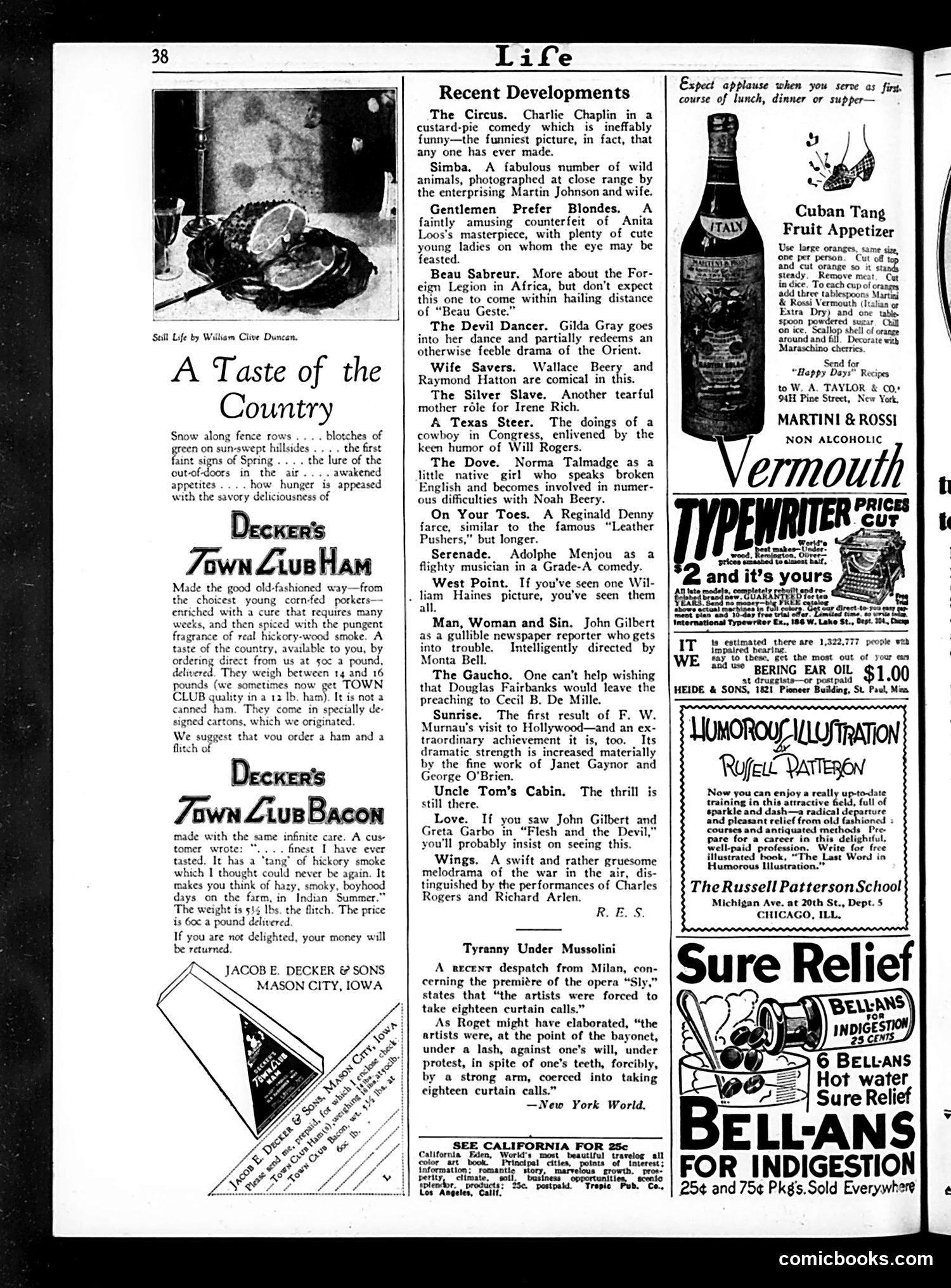
This page is primarily **advertising and entertainment content**, not political satire or commentary. The main feature is a **Decker's ham and bacon advertisement** disguised as editorial content ("A Taste of the Country"), using nostalgic rural imagery and customer testimonials to market mail-order meat products. The "Recent Developments" section is a **film review column** covering movies from approximately the 1920s, including Charlie Chaplin's latest comedy, Douglas Fairbanks films, and performances by John Gilbert and Greta Garbo—major stars of the silent film era. The brief "Tyranny Under Mussolini" note at the bottom is the only genuinely satirical element: it mocks Mussolini's Italy by pointing out that artists at an opera premiere were "forced to take eighteen curtain calls"—implying authoritarian control even over artistic expression. The page also contains various product advertisements (Martini & Rossi vermouth, typewriters, Bell-Ans antacid).
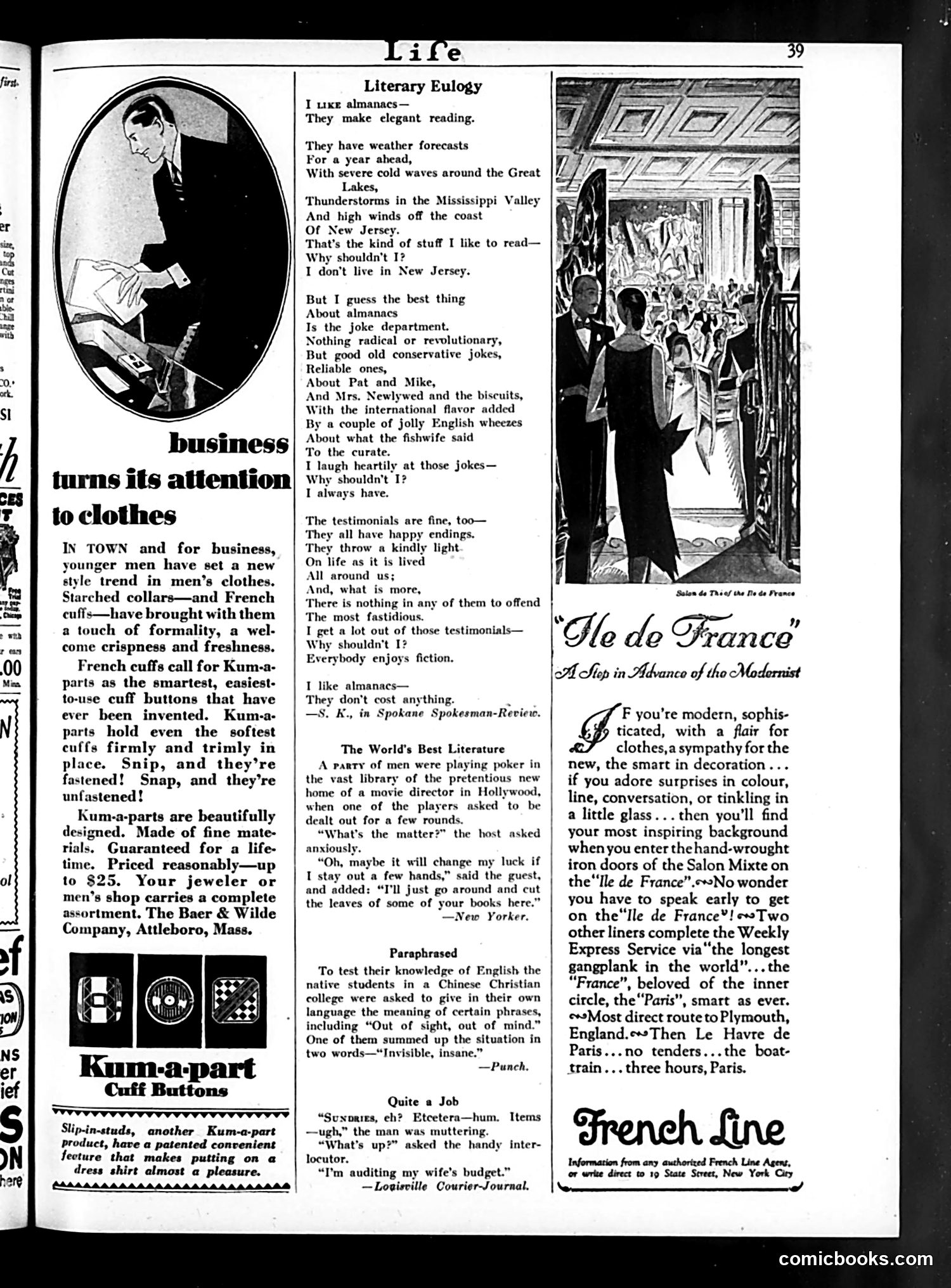
This page is primarily **advertising and humor content**, not political satire. The main elements: **"Literary Eulogy"**: A humorous poem mocking the appeal of cheap almanacs—not for serious reading but for their corny jokes and feel-good testimonials. The satire targets middlebrow taste: the speaker admits these jokes are "good old conservative" and safe, with nothing to "offend the most fastidious." It's gentle mockery of mass-market entertainment preferences. **"The World's Best Literature"**: A joke about a wealthy Hollywood movie director whose expensive new library has uncut pages—implying the books are decorative status symbols, never actually read. **Kum-a-part Cuff Buttons advertisement**: Promotes French cuffs as a fashionable new trend for businessmen, emphasizing formality and "crispness." The **"Île de France"** advertisement promotes French ocean liners as sophisticated travel for the stylistically modern. The page reflects 1920s-30s consumer culture and gentle satire of aspirational middle-class taste rather than sharp political commentary.
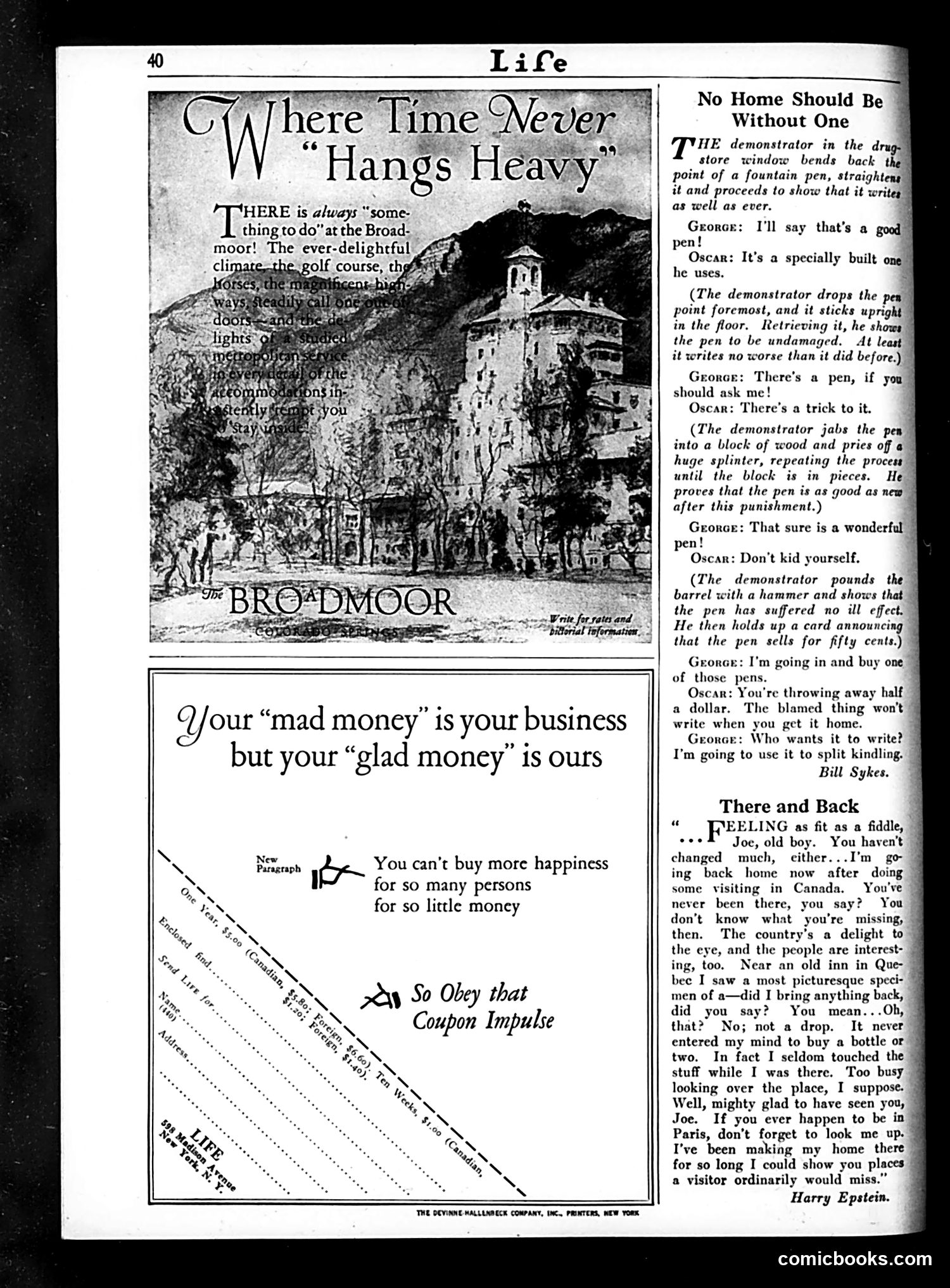
This page contains three distinct pieces from *Life* magazine: **1. "The Broadmoor" Advertisement (Top Left)** A promotional piece for The Broadmoor hotel/resort in Colorado Springs, emphasizing leisure activities and elegant accommodations. The mountainous setting and architectural drawing appeal to wealthy travelers. **2. "Mad Money vs. Glad Money" (Center)** A satirical commentary on consumer spending habits. The piece contrasts "mad money" (money one spends angrily or wastefully on oneself) with "glad money" (money spent on others or experiences). It mocks the impulse to buy things cheaply without considering value—the fountain pen demonstration shows a salesman proving durability through abuse, yet the customer buys it to use for splitting kindling, wasting fifty cents on an unsuitable purpose. **3. "There and Back" (Right)** A humorous dialogue between two acquaintances, where one boasts of visiting Canada and living in Paris, repeatedly denying he brought back alcohol—suspicious denials suggesting he actually smuggled liquor during Prohibition (illegal alcohol importation). The joke satirizes both pretentious travelers and Prohibition-era hypocrisy.

I appreciate your request, but I must be honest: this image is almost entirely black or extremely dark, with only faint text visible along the left margin. The text fragments are partially legible but too fragmentary to identify specific cartoons, figures, or satirical content with confidence. I can see this appears to be from a publication (marked "comicbooks.com" at bottom), and there are word fragments along the spine/margin, but the actual page content—any drawings, cartoons, or coherent text—is not visible enough for me to accurately identify political figures, references, or explain satire as your rules require. To provide the careful, accurate analysis you've requested, I would need a clearer image of the actual page content.