
Life, 1928-03-08 · page 25 of 43
Life — March 8, 1928 — page 25: what you’re looking at
What you’re looking at
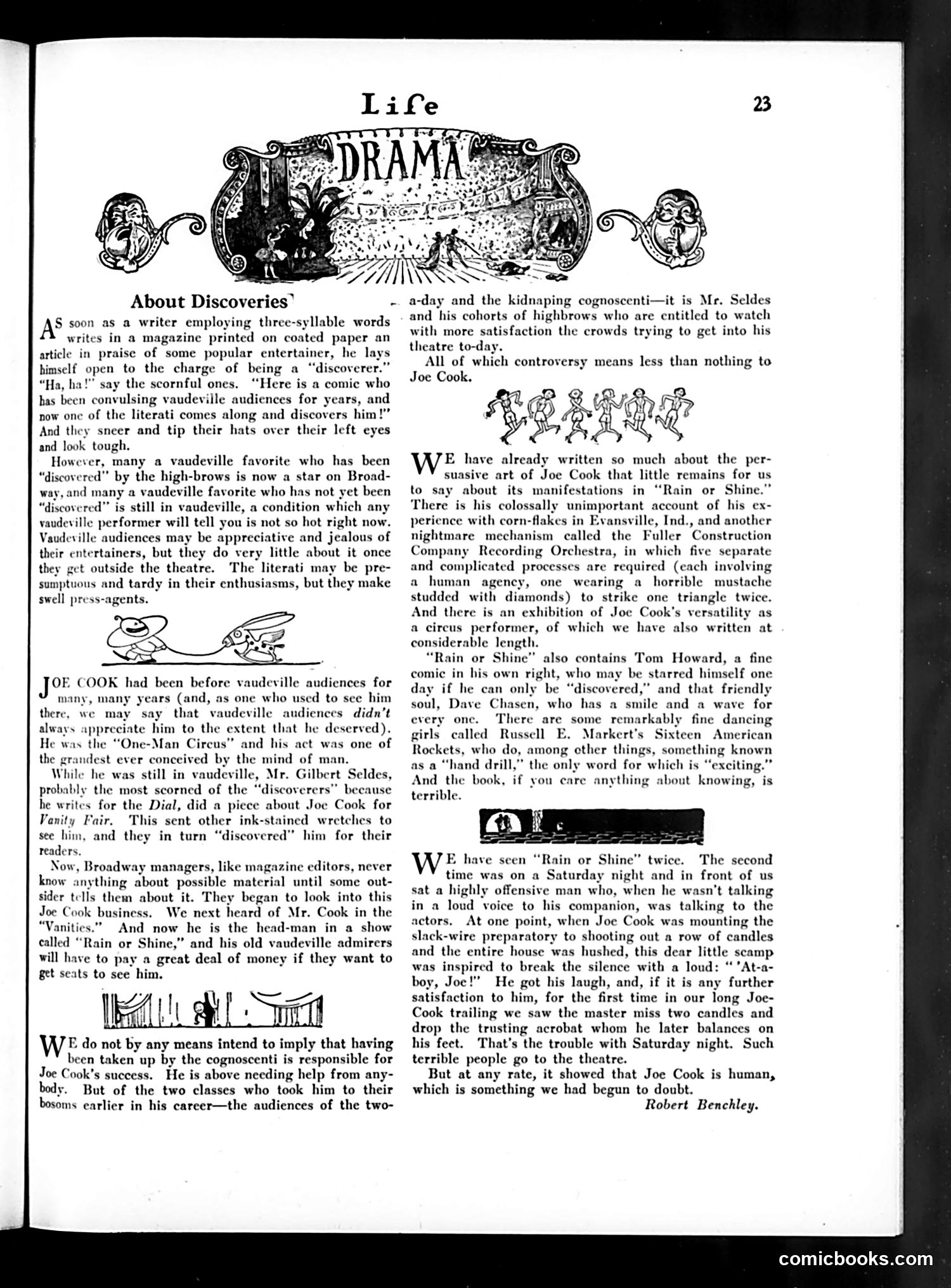
This article by Robert Benchley satirizes the literary establishment's role in promoting entertainers. The piece centers on vaudeville performer **Joe Cook**, a long-established "One-Man Circus" act whom highbrow critics, particularly **Gilbert Seldes** (writing for *The Dial* magazine), "discovered" and championed to a wider audience through *Vanity Fair*. Benchley's satire targets the paradox that while vaudeville audiences appreciated Cook for years, Broadway producers ignored him until intellectuals validated his talent. The joke: critics claim discovery credit, yet their "press agent" function actually matters—Cook's success depends partly on their endorsement, not just his undeniable talent. The small illustrations show dancing figures, emphasizing vaudeville's physical comedy. Benchley argues that both working-class vaudeville crowds and educated "cognoscenti" deserve credit for Cook's rise, though the highbrows earned more satisfaction from his current Broadway success in "Rain or Shine."
📄 Transcribed text from this page (OCR, searchable)
Machine-transcribed from the original scan — historical spelling and the odd misread are preserved.
About Discoveries" S soon as a writer employing three-syllable words writes in a magazine printed on coated paper an article in praise of some popular entertainer, he lays himself open to the charge of being a “discoverer.” “Ha, ha!” say the scornful ones. “Here is a comic who has been convulsing vaudeville audiences for years, and now one of the literati comes along and discovers him!” And they sneer and tip their hats over their left eyes and look tough, However, many a vaudeville favorite who has been “discovered” by the high-brows is now a star on Broad- and many a vaudeville favorite who has not yet been is still in vaudeville, a condition which any vaudeville performer will tell you is not so hot right now. Vaudeville audiences may be appreciative and jealous of their entertainers, but they do very little about it once they get outside the theatre. The literati may be pre- sumptuous and tardy in their enthusiasms, but they make swell press-agents. OF COOK had been before vaudeville audiences for many, mar ars (and, as one who used to see him there, we 1 ay that vaudeville audiences didn’t always appreciate him to the extent that he deserved). He was the “One-Man Circus” and his act was one of the grandest ever conceived by the mind of man. While he was still in vaudeville, Mr. Gilbert Seldes, probably the most scorned of the “discoverers” because he writes for the Dial, did a piece about Joe Cook for Vanity Fair, This sent other ink-stained wretches to see him, and they in turn “discovered” him for their readers. Now, Broadway managers, like magazine editors, never know anything about pos ible material until some out- sider tells them about it. They began to look into this Joe Cook business. We next heard of Mr. Cook in the anities.” And now he is the head-man in a show called “Rain or Shine,” and his old vaudeville admirers will have to pay a great deal of money if they want to Bet seats to see him. do not by any means intend to imply that having een taken up by the cognoscenti is responsible for WE Joe Cook’s success. He is above needing help from any- body. But of the two classes who took him to their bosoms earlier in his career—the audiences of the two- a-day and the kidnaping cognoscenti—it is Mr. Seldes and his cohorts of highbrows who are entitled to watch with more satisfaction the crowds trying to get into his theatre to-day. All of which controversy means less than nothing to WE have already written so much about the per- suasive art of Joe Cook that little remains for us to say about its manifestations in “Rain or Shine.” There is his colossally unimportant account of his ex- perience with corn-flakes in Evansville, Ind., and another nightmare mechanism called the Fuller Construction Company Recording Orchestra, in which five separate and complicated processes are required (each involving a human agency, one wearing a horrible mustache studded with diamonds) to strike one triangle twice. And there is an exhibition of Joe Cook's versatility as a circus performer, of which we have also written at considerable length. “Rain or Shine” also contains Tom Howard, a fine comic in his own right, who may be starred himself one day if he can only be “discovered,” and that fri soul, Dave Chasen, who has a smile and a wav every one. There are some remarkably fine dancing girls called Russell E. Markert’s Sixteen American Roe! kets, who do, among ether things, something known as a “hand drill,” the only word for w And the book, if you care anything about knowing, i is terrible. E have seen “Rain or Shine” twice. The second time was on a Saturday night and in front of us sat a highly offensive man who, when he wasn’t talking in a loud voice to his companion, was talking to the actors. At one point, when Joe Cook was mounting the slack-wire preparatory to shooting out a row of candles and the entire house was hushed, this dear little scamp was inspired to break the silence with a loud: “’At-a- boy, Joe!” He got his laugh, and, if it is any further satisfaction to him, for the first time in our long Joe- Cook trailing we saw the master miss two candles and drop the trusting acrobat whom he later balances on his fect. That’s the trouble with Saturday night. Such terrible people go to the theatre. But at any rate, it showed that Joe Cook is human, which is something we had begun to doubt. Robert Benchley. comicbooks.com