
Life, 1928-03-08 · page 6 of 43
Life — March 8, 1928 — page 6: what you’re looking at
What you’re looking at
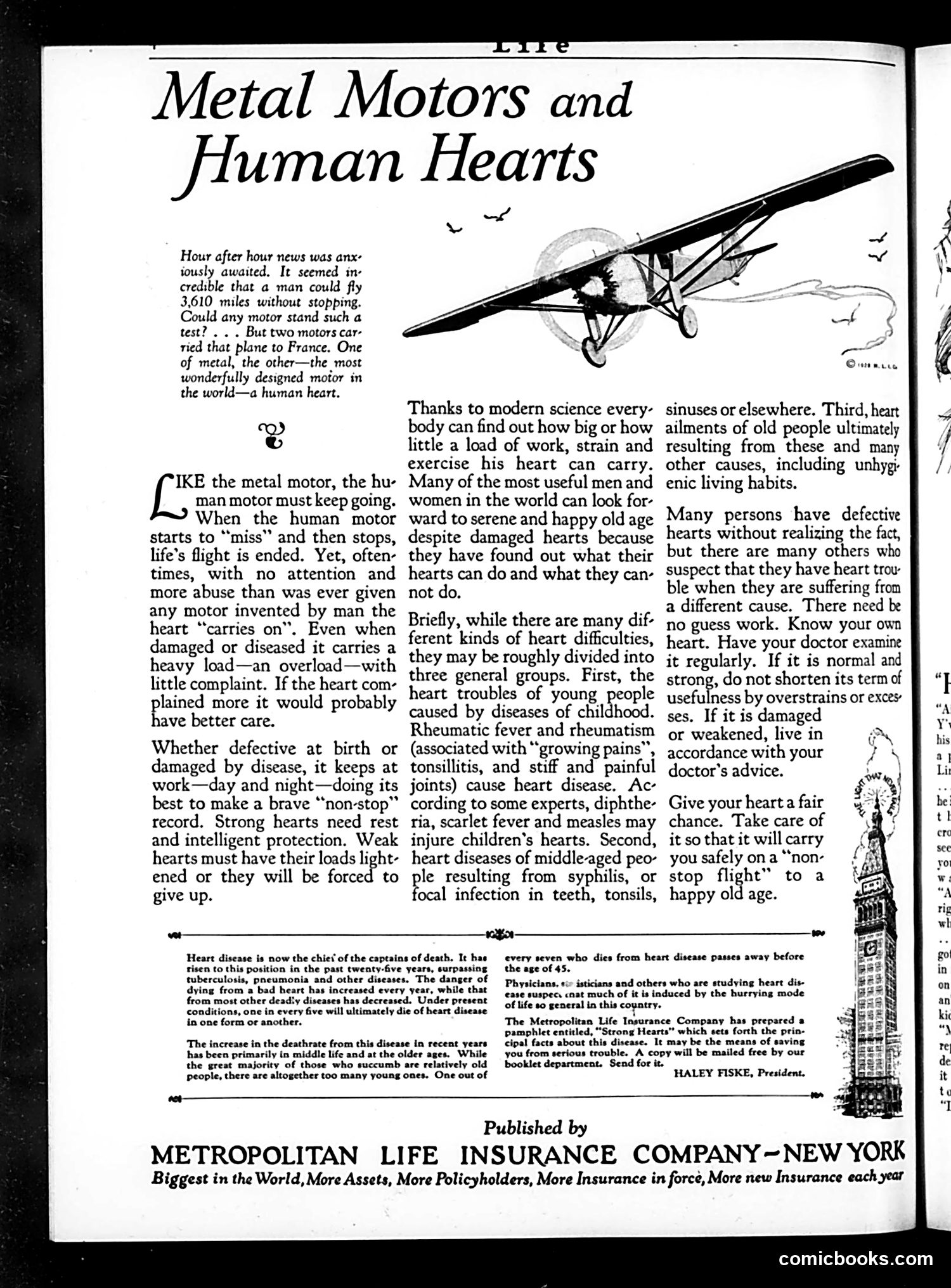
This is primarily **educational/promotional content** rather than satire or political commentary. It's a health article by the Metropolitan Life Insurance Company comparing the human heart to a metal motor—both require constant operation and careful maintenance. The article discusses heart disease classifications, emphasizing that many people have undiagnosed heart problems. It advocates for regular doctor examinations and lifestyle management to preserve heart function, using the motor analogy to explain why the heart, like machinery, needs protection from overwork and strain. The airplane illustration at top represents the opening hook about a trans-Atlantic flight, establishing the "motor" comparison theme. This is essentially **health advocacy disguised as insurance marketing**—encouraging preventive care benefits the company by keeping policyholders alive and healthy.
📄 Transcribed text from this page (OCR, searchable)
Machine-transcribed from the original scan — historical spelling and the odd misread are preserved.
Metal Motors and Human Hearts Hour after hour news was anx- tously awaited. It seemed in- credible that a man could fly 3,610 miles without stopping. Could any motor stand such a test? . . . But two motors car- ried that plane to France. One of metal, the other—the most wonderfully designed motor in the world—a human heart. e IKE the metal motor, the hu- man motor must keep going. When the human motor starts to “miss” and then stops, life’s flight is ended. Yet, often- times, with no attention and more abuse than was ever given any motor invented by man the heart “carries on”. Even when damaged or diseased it carries a heavy load—an overload—with little complaint. If the heart com- pained more it would probably ave better care. Whether defective at birth or damaged by disease, it keeps at work—day and night—doing its best to make a brave “non-stop” record. Strong hearts need rest and intelligent protection. Weak hearts must have their loads light- ened or they will be forced to give up. 8 rin Heart disease is now the chiet of the captains of death. It has risen to this position in the past twenty-five years, surpassing tuberculosis, pneumonia and other diseases. The danger of dying from a bad heart has increased every year, while that from most other deadiy diseases has decreased. Under present conditions, one in every five will ultimately die of heart disease in one form or another. The increase in the deathrate from this disease in recent years has been primarily in middle life and at the older ages. While the great majority of those who succumb are relatively old Thanks to modern science every- body can find out how big or how little a load of work, strain and exercise his heart can carry. Many of the most useful men and women in the world can look for- ward to serene and happy old age despite damaged hearts because they have found out what their hearts can do and what they can- not do. Briefly, while there are many dif- ferent kinds of heart difficulties, they may be roughly divided into three general groups. First, the heart troubles of young people caused by diseases of childhood. Rheumatic fever and rheumatism (associated with “growing pains”, tonsillitis, and stiff and painful joints) cause heart disease. Ac- cording to some experts, diphthe- ria, scarlet fever and measles may injure children's hearts. Second, heart diseases of middle-aged peo- le resulting from syphilis, or ‘ocal infection in teeth, tonsils, Ovvmmrcee sinuses or elsewhere. Third, heart ailments of old people ultimately resulting from these and many other causes, including unhyg- enic living habits. Many persons have defective hearts without realizing the fact, but there are many others who suspect that they have heart trou ble when they are suffering from a different cause. There need be no guess work. Know your own heart. Have your doctor examine it regularly. If it is normal and strong, do not shorten its term of usefulness by overstrains or excey ses. If it is damaged or weakened, live in OS accordance with your ZN doctor's advice. Soe il Give your heart a fair chance. Take care of it so that it will carry you safely ona “non- stop flight” to a happy aid age. the age of 45. every seven who dies from heart disease passes away before isticians and others who are studying heart dis- ease suspec, cnat much of it is induced by the hurrying mode of life 00 general in this country. The Metropolitan Life Insurance Company has prepared a pamphlet entitled, “Strong Hearts” which sets forth the prin- people, there are altogether too many young ones. One out of cipal facts about this disease. It may be the means of saving you from serious trouble. A copy will be mailed free by our booklet department. Send for it. HALEY FISKE, President. Published by METROPOLITAN LIFE INSURANCE COMPANY~NEW YORK Biggest in the World, More Assets, More Policyholders, More Insurance in force, More new Insurance each year comicbooks.com