
Life, 1928-03-08 · page 20 of 43
Life — March 8, 1928 — page 20: what you’re looking at
What you’re looking at
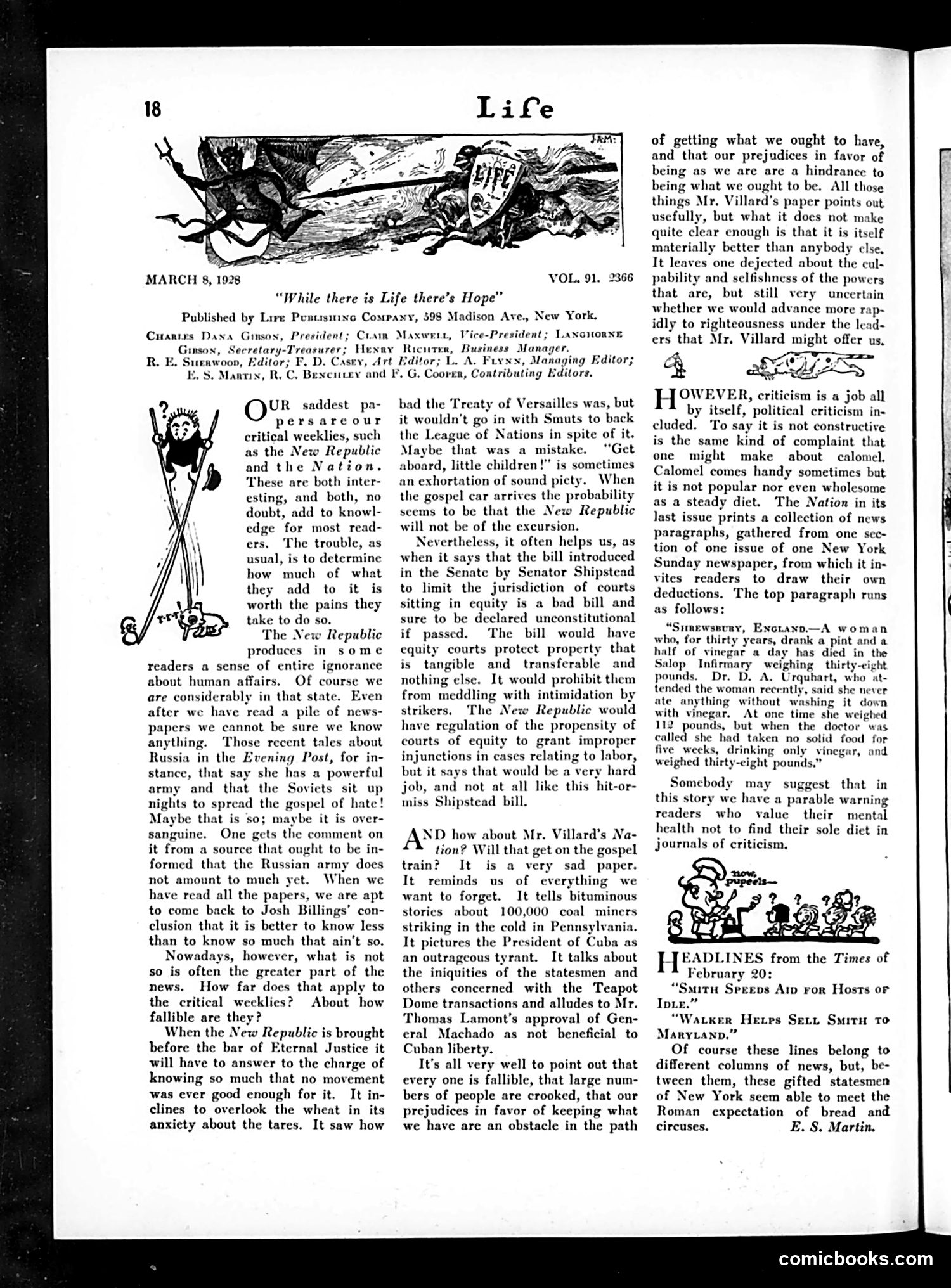
This editorial critiques two prominent American political weeklies: *The New Republic* and *The Nation* (edited by Oswald Garrison Villard). The author argues *The New Republic* is so perfectionist and critical that it opposes virtually every movement, finding fault even with worthy causes like the League of Nations. It obsesses over minor flaws ("tares") while ignoring genuine merits ("wheat"). *The Nation* is described as depressingly focused on chronicling injustices—coal miners' strikes, Cuban tyranny under Machado, the Teapot Dome scandal—reminding readers of everything they'd rather forget. The central point: both magazines, despite offering valuable criticism, suffer from excessive skepticism and pessimism that paralyzes rather than inspires action. The author suggests readers cannot trust either publication entirely, yet acknowledges their occasional usefulness in exposing real problems. The cartoon imagery (not clearly visible in this transcription) likely reinforces this theme of cynical opposition.
📄 Transcribed text from this page (OCR, searchable)
Machine-transcribed from the original scan — historical spelling and the odd misread are preserved.
ly =. ‘s Mua re VOL, 91. 2366 “While there is Life there’s Hope” Published by Lire Pvntisiixe Company, 598 Madison Ave., New York. Cuartrs Daxa Ginsox, President; Cram Maxweit, Vice-President; Lancione Ginsox, See enwoon, Editor; F, D. Cast 3. Mannix, R, C, Benne UR saddest pa- persarecour critical weeklies, such as the New Republic and the Nation. These are both inter- esting, and both, no doubt, add to knowl- edge for most read- ers. The trouble, as usual, is to determine how much of what they add to it is worth the pains they take to do so. The New Republic produces in some readers a sense of entire ignorance about human affairs. Of course we are considerably in that state. Even after we have read a pile of news- papers we cannot be sure we know anything. Those recent tales about Russia in the Evening Post, for in- stance, that say she has a powerful army and that the Soviets sit up nights to spread the gospel of hate! Maybe that is so; maybe it is over- sanguine. One gets the comment on it from a source that ought to be in- formed that the Russian army does not amount to much yet. When we have read all the papers, we are apt to come back to Josh Billings’ con- clusion that it is better to know less than to know so much that ain’t so. Nowadays, however, what is not so is often the greater part of the news. How far docs that apply to the critical weeklies? About how fallible are they? When the New Republic is brought before the bar of Eternal Justice it will have to answer to the charge of knowing so much that no movement was ever good enough for it. It in- clines to overlook the wheat in its anxiety about the tares. It saw how tary-Treasurer; Hexey Ricurer Art Editor; Business: Manager. bad the Treaty of Versailles was, but it wouldn't go in with Smuts to back the League of Nations in spite of it. Maybe that was a mistake. “Get aboard, little children!” is sometimes an exhortation of sound picty. When the gospel car arrives the probability seems to be that the New Republic will not be of the excursion. Nevertheless, it often helps us, as when it says that the bill introduced in the Senate by Senator Shipstead to limit the jurisdiction of courts sitting in equity is a bad bill and sure to be declared unconstitutional if passed. The bill would have equity courts protect property that is tangible and transferable and nothing else. It would prohibit them from meddling with intimidation by strikers. The New Republic would have regulation of the propensity of courts of equity to grant improper injunctions in cases relating to labor, but it says that would be a very hard job, and not at all like this hit-or- miss Shipstead bill. ND how about Mr. Villard’s Na- tion? Will that get on the gospel train? It is a very sad _ paper. It reminds us of everything we want to forget. It tells bituminous stories about 100,000 coal miners striking in the cold in Pennsylvani It pictures the President of Cuba as an outrageous tyrant. It talks about the iniquities of the statesmen and others concerned with the Teapot Dome transactions and alludes to Mr. Thomas Lamont’s approval of Gen- eral Machado as not beneficial to Cuban liberty. It’s all very well to point out that every one is fallible, that large num- bers of people are crooked, that our prejudices in favor of keeping what we have are an obstacle in the path of getting what we ought to have, and that our prejudices in favor of being as we are are a hindrance to being what we ought to be. All those things Mr. Villard’s paper points out usefully, but what it does not make quite clear enough is that it is itself materially better than anybody else, It leaves one dejected about the cul- pability and selfishness of the powers that are, but still very uncertain whether we would advance more rap- idly to righteousness under the lead- ers that Mr. Villard might offer us, A SES OWEVER, criticism is a job all by itself, political criticism in- cluded. To say it is not constructive is the same kind of complaint that one might make about calomel. Calomel comes handy sometimes but it is not popular nor even wholesome as a steady dict. The Nation in its last issue prints a collection of news paragraphs, gathered from one sec- tion of one issue of one New York Sunday newspaper, from which it in- vites readers to draw their own deductions. The top paragraph runs Enotann.—A woman y years, drank a pint and a half of vinegar a day has died in the Salop Infirmary weighing thirty-cight pounds. Dr. D. A. Urquhart, who at- tended the woman recentl: d she never ate anything without washing it down with vinegar, At one time she weighed 112 pounds, but when the doctor was called she had taken no solid food for five weeks, drinking only vinegar, and weighed thirty-eight pounds.” Somebody y suggest that in this story we have a parable warning readers who value their mental health not to find their sole diet in journals of criticism, I EADLINES from the Times of February 20: “Ssurn Speevs Arp ror Hosts oF Iptr.” “Warker Hers Seri Situ To Maryann.” Of course these lines belong to different columns of news, but, be- tween them, these gifted statesmen of New York seem able to meet the Roman expectation of bread and circuses. E. S. Martin. comicbooks.com