
A complete issue · 38 pages · 1928
Life — January 19, 1928
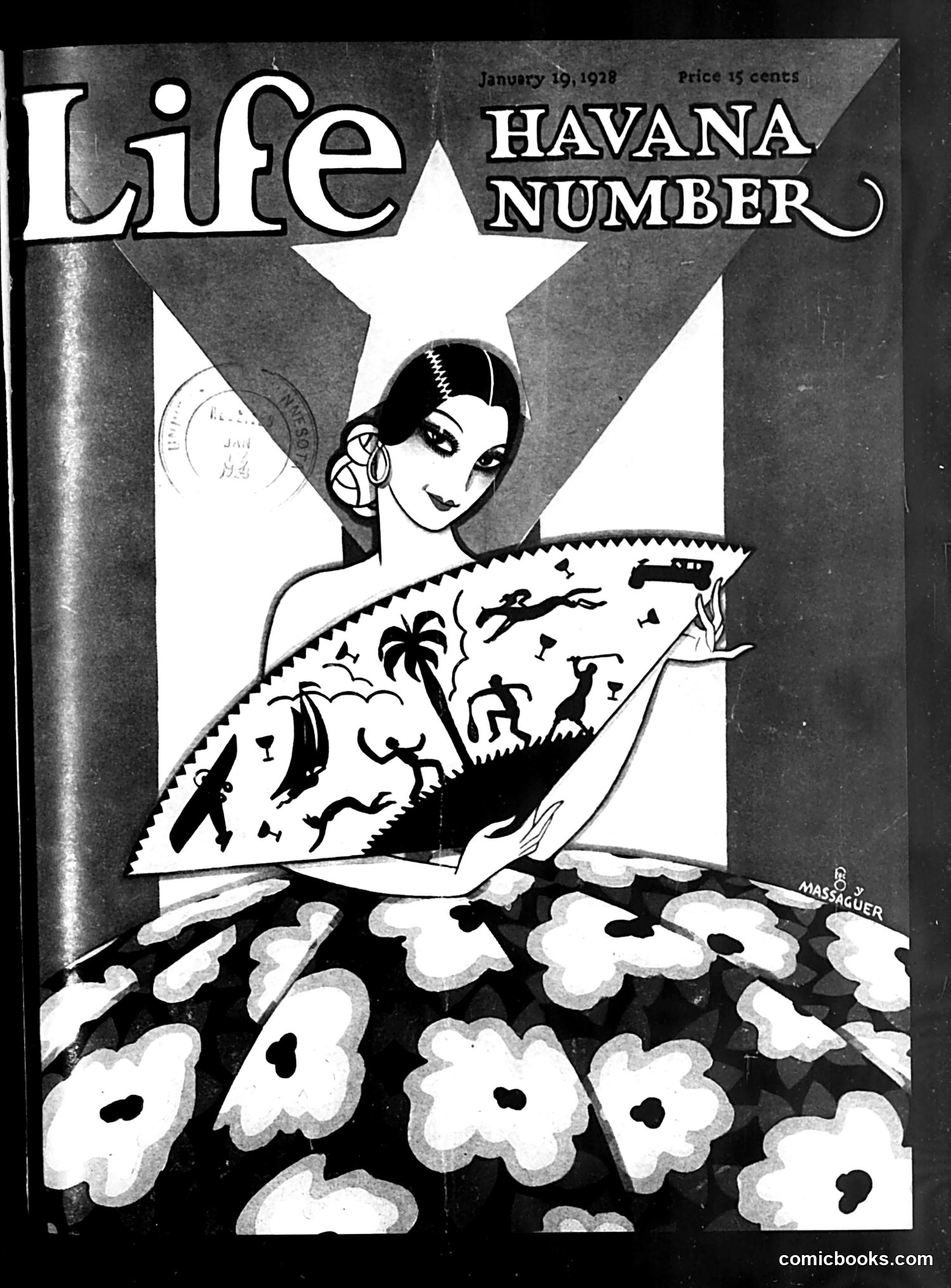
This is the cover of Life's special "Havana Number" issue, priced at 15 cents. The illustration by Massaguer depicts a stylized woman in 1920s fashion holding a decorative fan displaying Havana scenes—palm trees, buildings, and local activities. She's surrounded by white flowers with dark centers. The cover celebrates Cuba's capital as an exotic, glamorous destination during the Jazz Age. The imagery reflects American fascination with Havana as a tourist paradise and nightlife destination, particularly significant during Prohibition (1920-1933), when Americans traveled to Cuba to drink legally. The "Havana Number" was a marketing appeal to affluent readers interested in Caribbean travel and culture as symbols of sophistication and leisure.
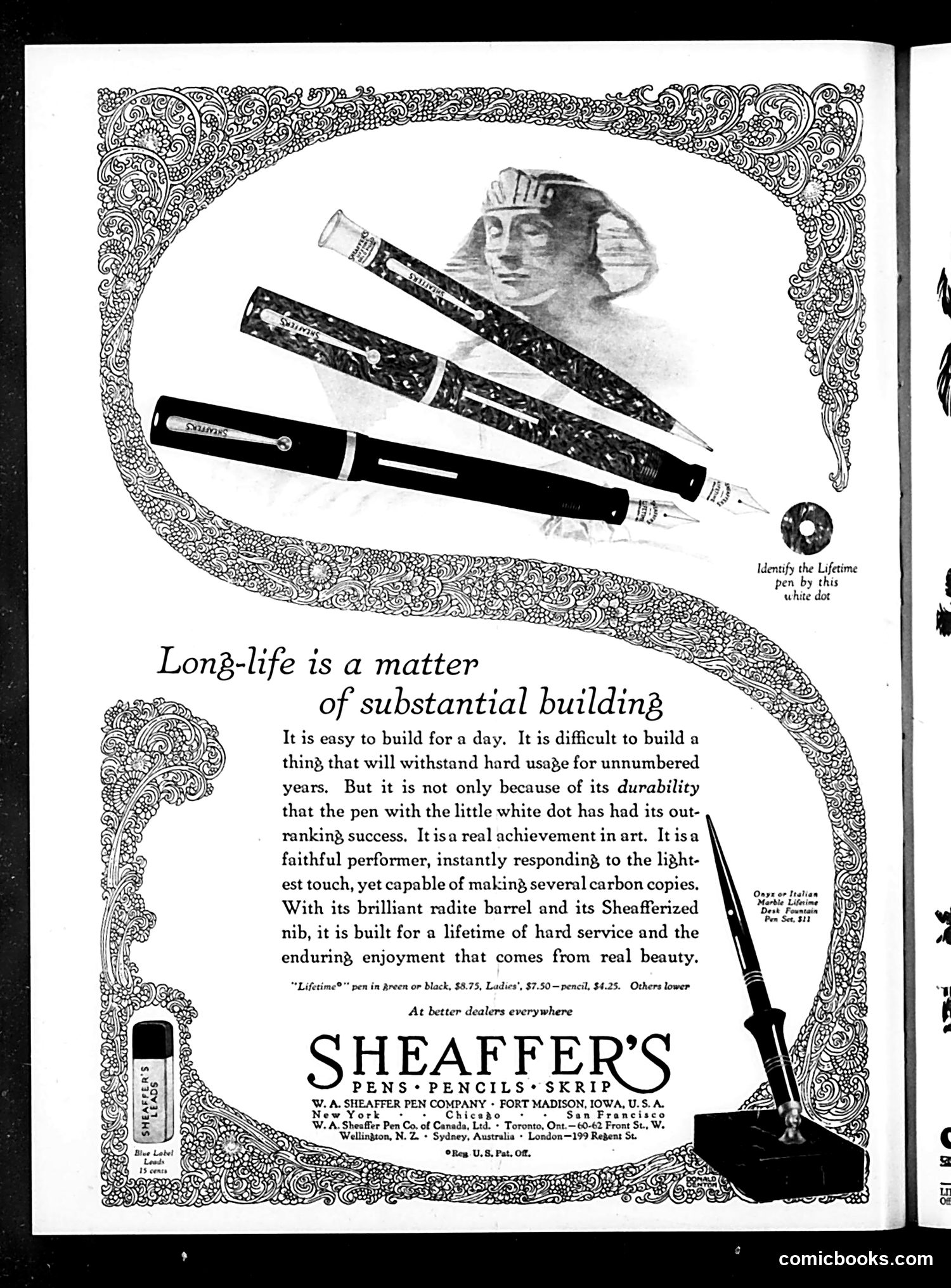
This is a **Sheaffer pen advertisement**, not political satire. The page promotes Sheaffer's "Lifetime" pens through a full-page ad in *Life* magazine. The imagery shows: - Three decorative fountain pens arranged diagonally - An Egyptian pharaoh head (likely referencing timelessness and enduring value) - Ornate Art Deco borders framing the composition The advertisement's theme—"Long-life is a matter of substantial building"—emphasizes the pen's durability and quality craftsmanship. It contrasts easy, temporary production with difficult, lasting construction. The text highlights the pen's "Sheafferized nib" and "radite barrel," positioning it as a luxury writing instrument worthy of lifetime use and aesthetic appreciation rather than mere utility. The small white dot serves as a brand identifier for the Lifetime pen series.
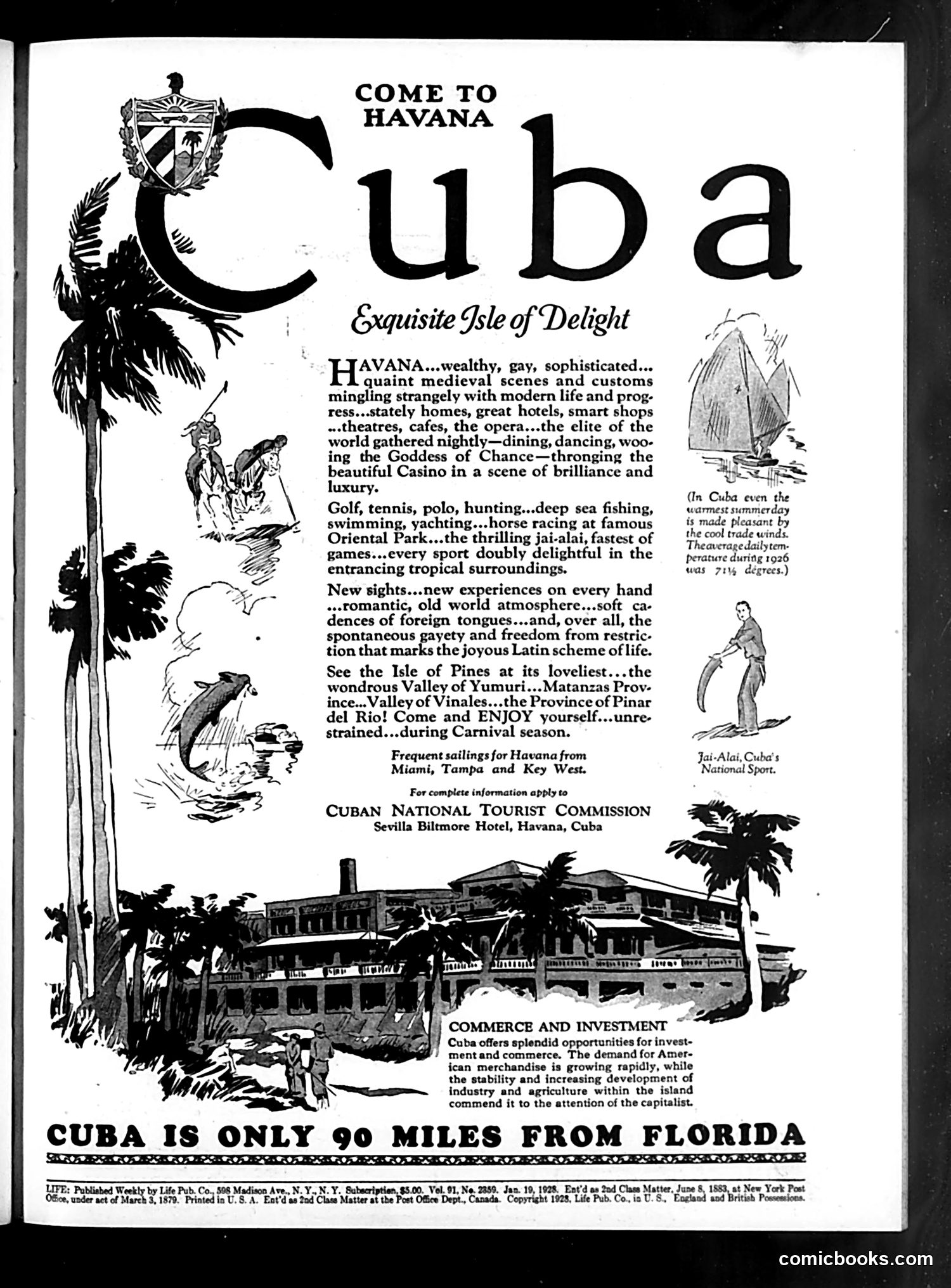
This is primarily a **tourism advertisement**, not political satire. The Cuban National Tourist Commission is promoting Havana as a vacation destination to American readers in 1928. The page emphasizes Havana's appeal: wealthy sophistication, modern amenities (hotels, theaters, casinos), and sporting activities (golf, polo, jai-alai). It highlights the contrast between "quaint medieval scenes" and "modern life," suggesting exotic Old World charm accessible to American tourists. The decorative illustrations show tropical elements (palm trees, sailing ships, jai-alai player) and a grand colonial building. The tagline "Cuba is only 90 miles from Florida" emphasizes accessibility. The "Commerce and Investment" section targets American business interests, promoting commercial opportunities on the island. This reflects pre-Revolution Cuba's economic integration with the United States.
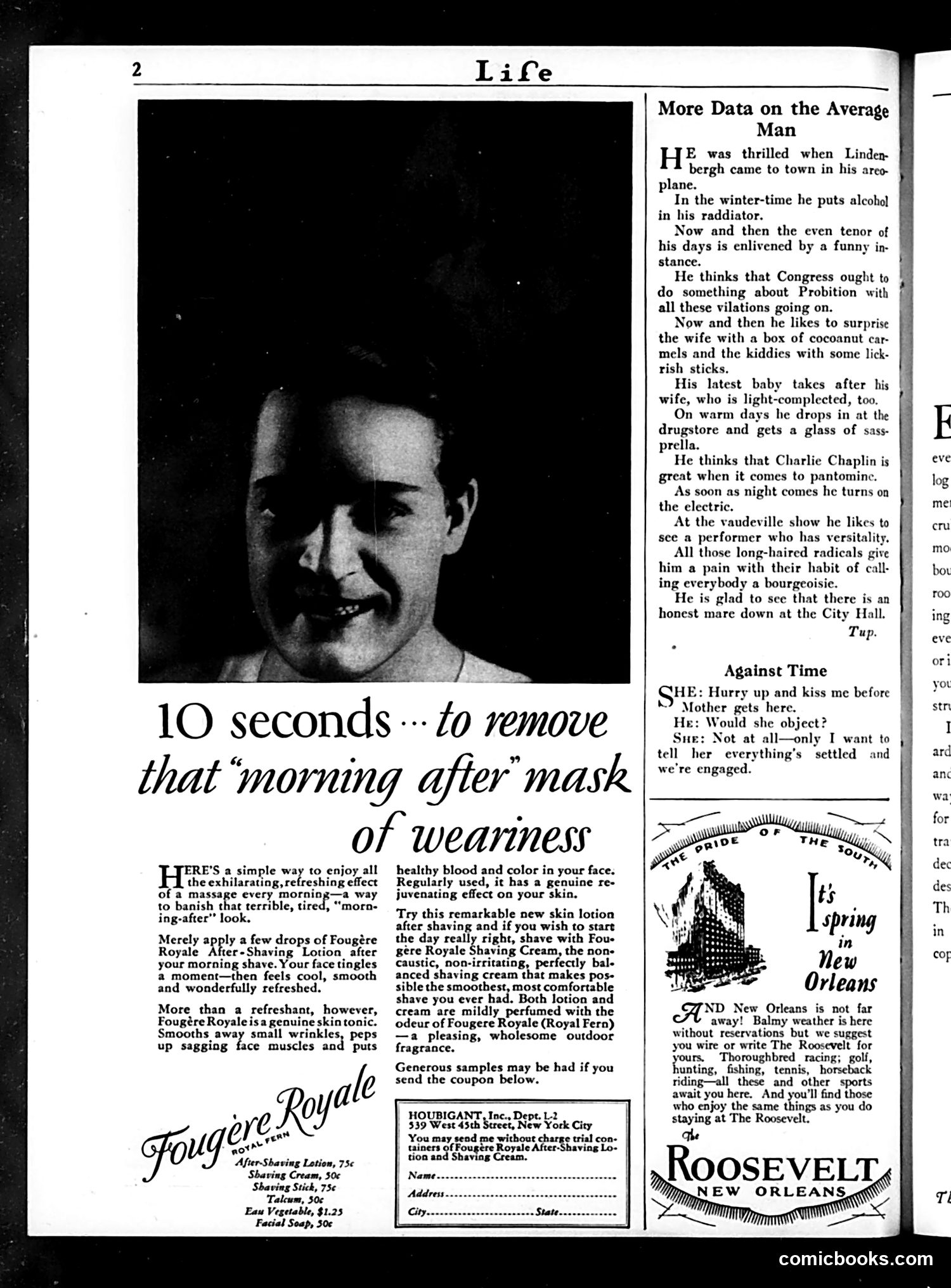
This page is primarily **advertising**, not political satire. The main content features a grooming product advertisement for Fougère Royale after-shaving lotion. The large photograph shows a man's face promoting "10 seconds to remove that 'morning after' mask of weariness"—referring to looking tired upon waking, not anything political. The right column contains lighter lifestyle content: "More Data on the Average Man" (humorous observations about an ordinary person's habits), "Against Time" (a brief comedic dialogue), and a travel advertisement for The Roosevelt hotel in New Orleans. This is a typical 1920s-30s Life magazine page mixing consumer goods advertising with gentle humor and tourism promotions—entertainment for middle-class readers rather than political commentary.
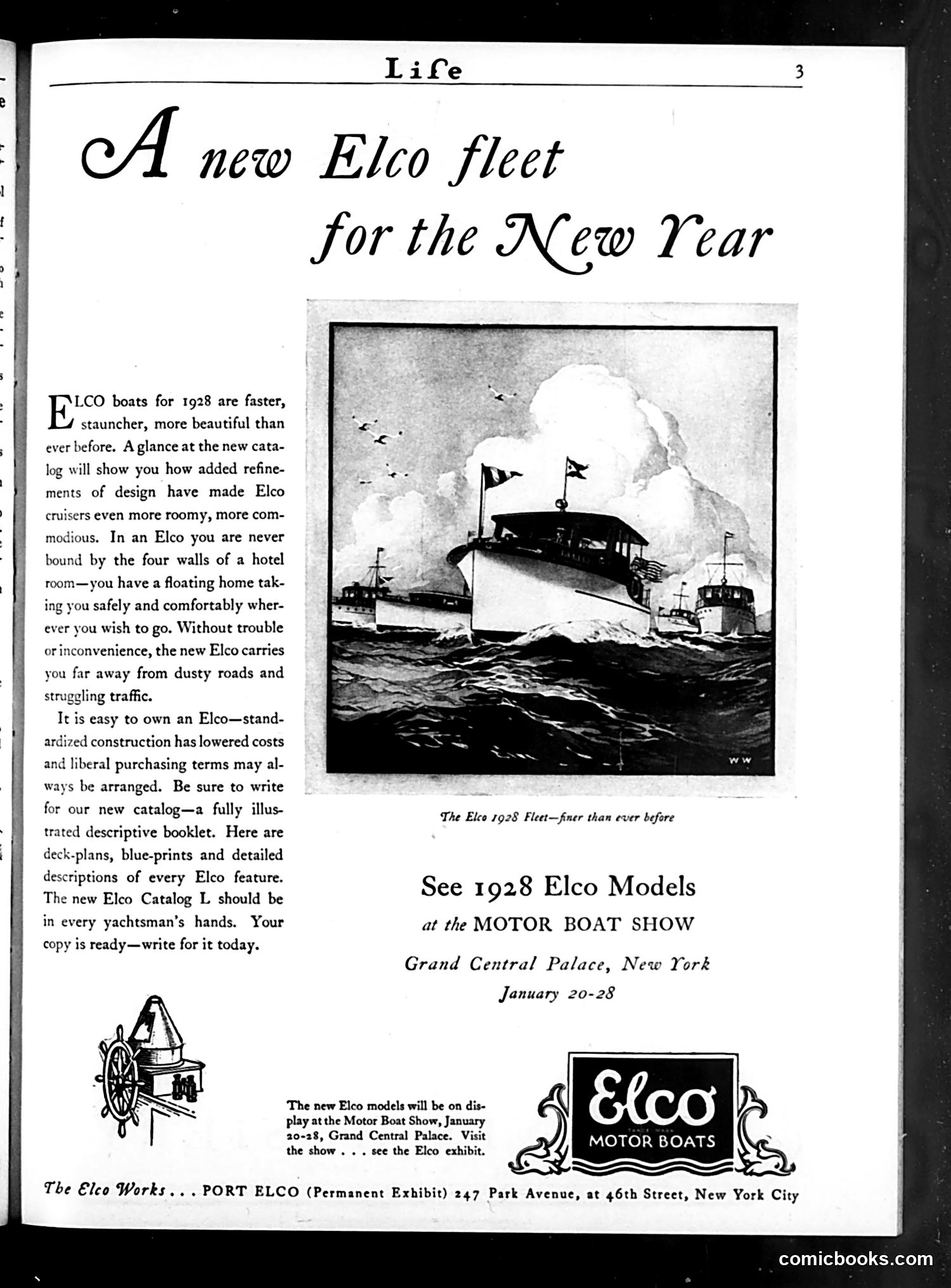
This page is primarily **advertising rather than satire or editorial content**. It's a full-page advertisement for Elco motor boats, promoting their 1928 fleet. The ad features: - A photograph of an Elco boat on the water - Marketing copy emphasizing the boats' speed, beauty, and comfort - An invitation to view 1928 Elco models at the Motor Boat Show at Grand Central Palace, New York (January 20-28) - Company branding and contact information There is **no political cartoon or satirical content** on this page. The decorative ship's wheel illustration is merely ornamental. This represents typical 1920s luxury goods advertising targeting affluent consumers interested in recreational boating during the pre-Depression prosperity era.
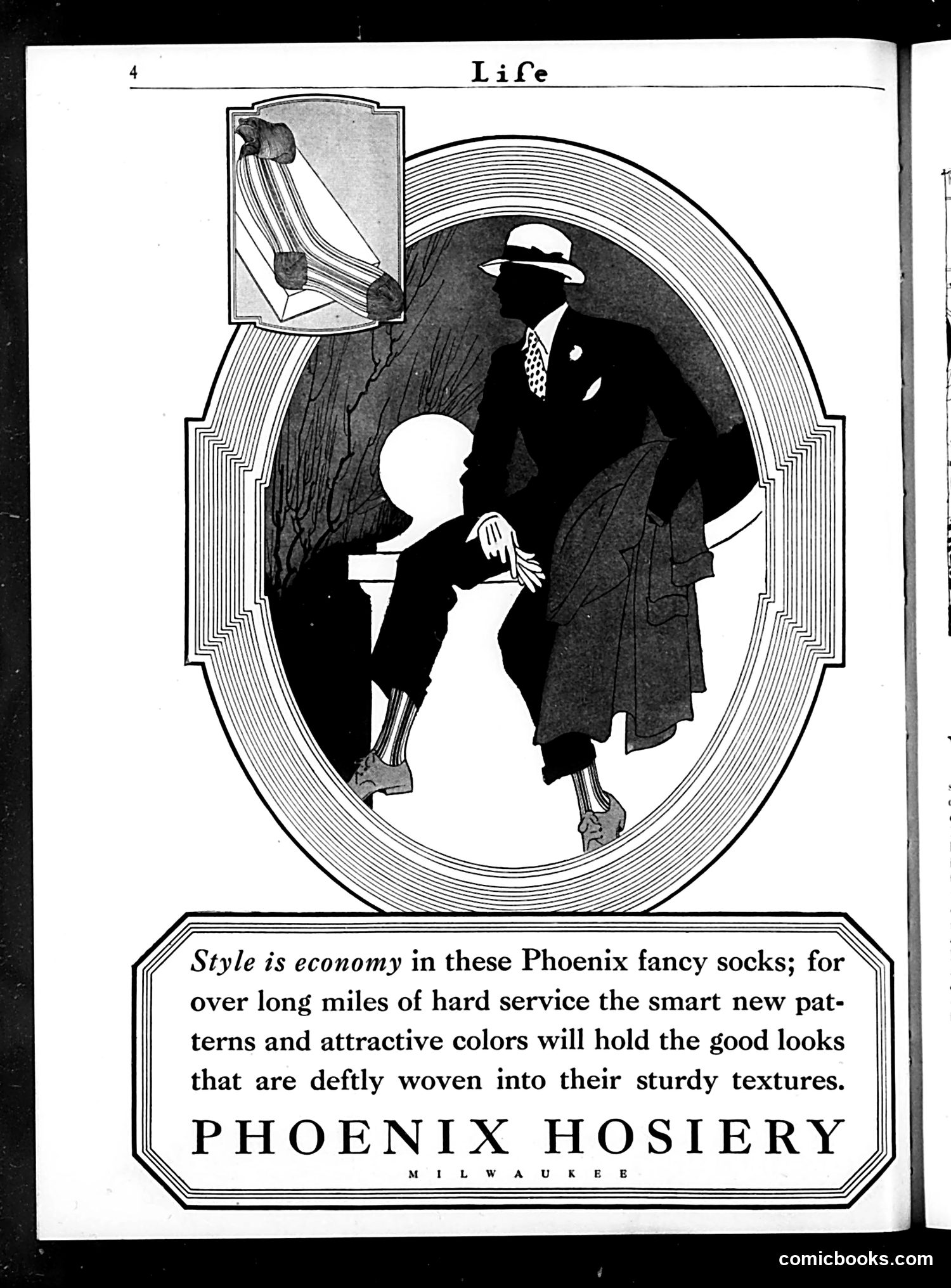
This page is primarily **advertising, not satire or political commentary**. The main image shows two silhouetted figures—a woman seated and a man standing beside her—in an elegant Art Deco style frame. A smaller inset image in the upper left appears to show close-up detail of sock fabric or weaving. The text advertises Phoenix Hosiery from Milwaukee, emphasizing that their fancy socks combine "style" with "economy" and promise durability ("over long miles of hard service"). The ad highlights "smart new patterns and attractive colors" that will maintain appearance through extended wear. This represents typical early-20th-century magazine advertising using sophisticated graphic design and fashionable imagery to market everyday consumer goods to middle-class readers.
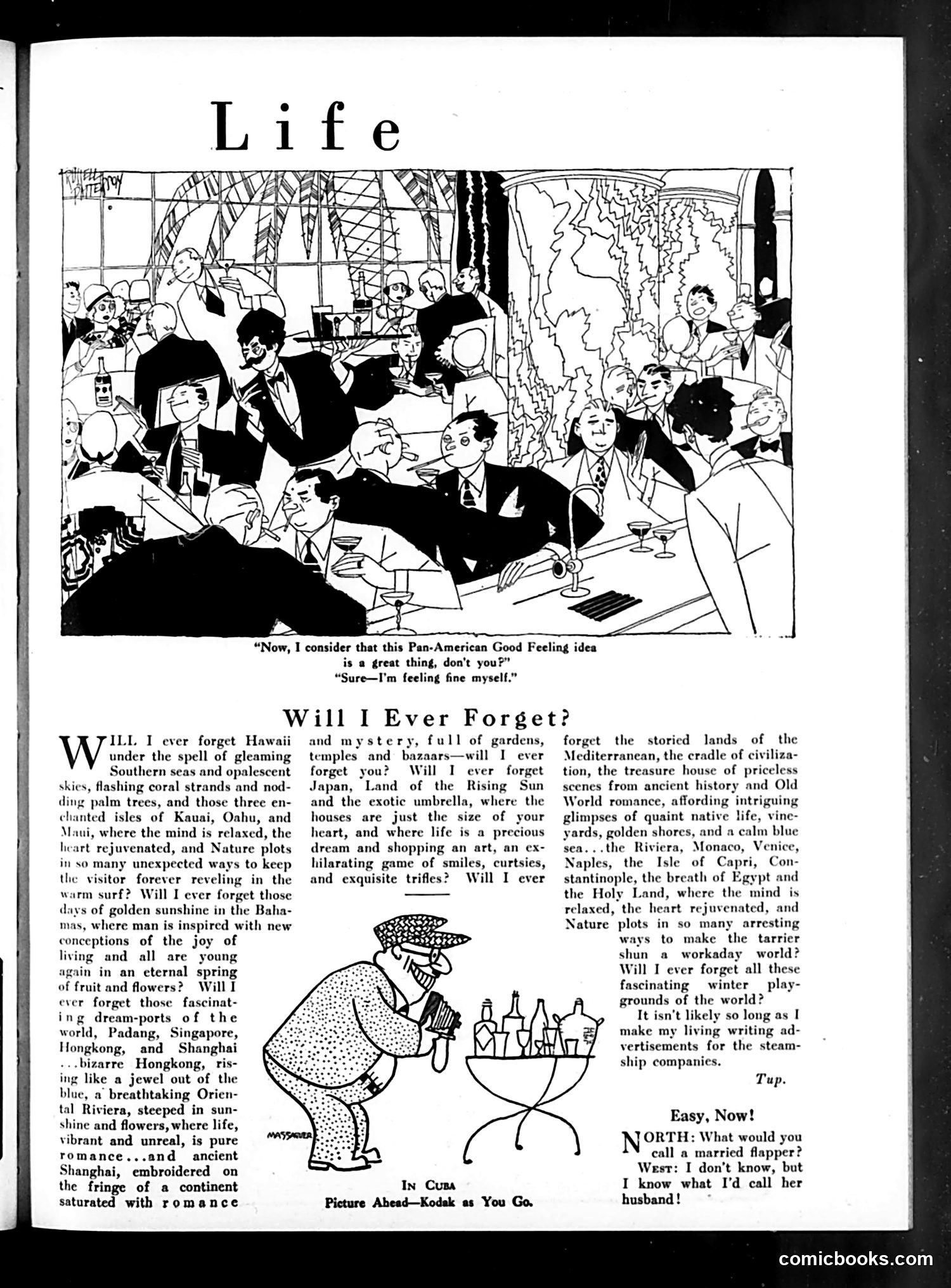
This is a **Life magazine page** featuring travel and leisure content rather than political satire. **Top cartoon:** Shows a cocktail party scene with the caption discussing "Pan-American Good Feeling"—likely referencing diplomatic relations or goodwill initiatives between American nations. The joke centers on someone feeling good at a social gathering. **Main article:** "Will I Ever Forget?" is a nostalgic travel piece romanticizing exotic destinations (Hawaii, Japan, Mediterranean locales, Egypt). It adopts the perspective of a traveler reminiscing about glamorous, culturally-distinct places. **Bottom cartoon:** Titled "In Cuba," depicts a portly man with bottles, illustrating Cuba as a destination associated with alcohol and tourism. **"Easy, Now!" joke:** A mild gender humor aside about married women and flapper culture. The page emphasizes **leisure travel and tourism** as aspirational lifestyle content for affluent American readers.
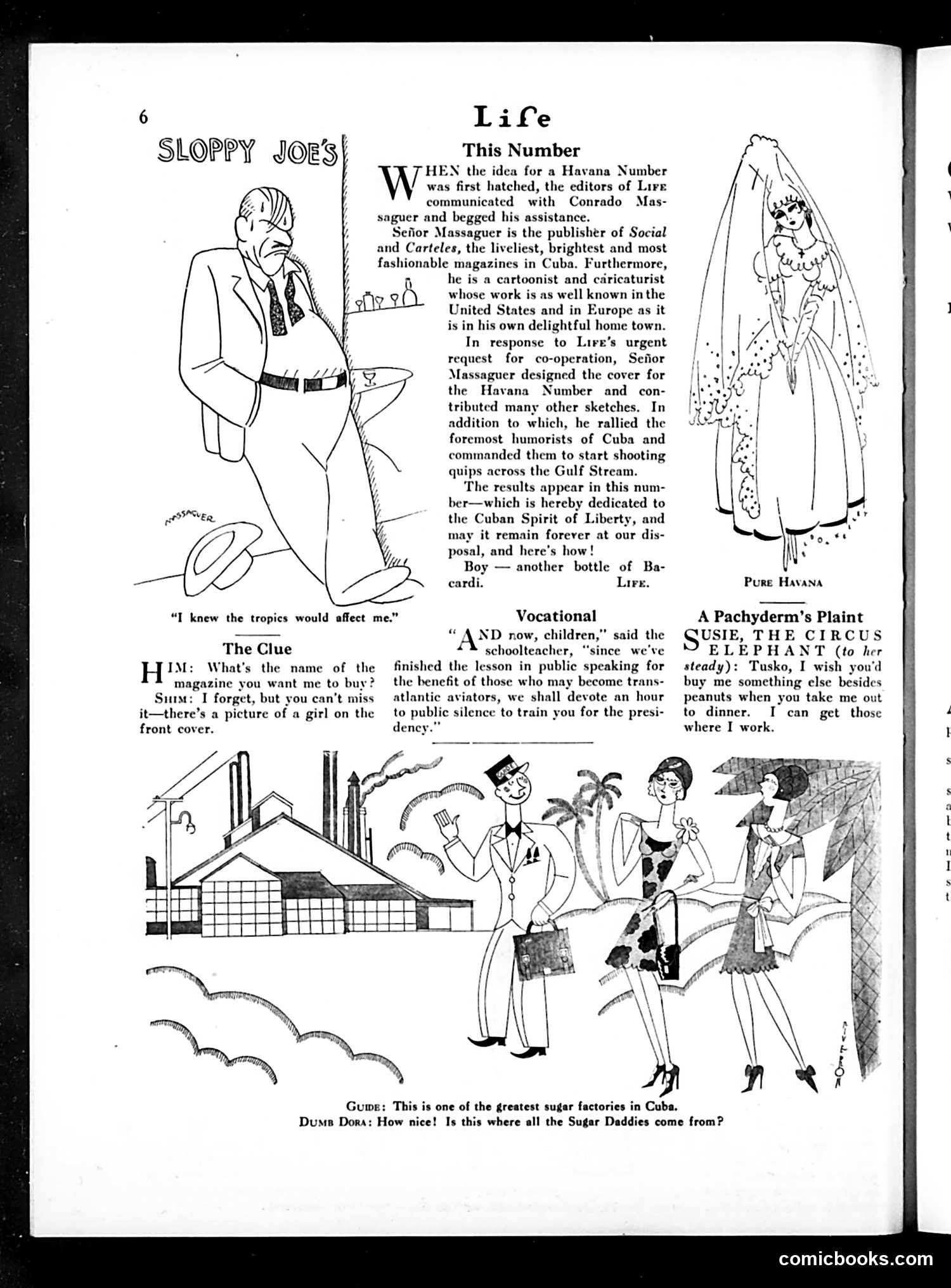
This page celebrates a "Havana Number" dedicated to Cuba, designed with assistance from Conrado Massaguer, a prominent Cuban cartoonist and publisher of *Social* magazine. **"Sloppy Joe's"** depicts a disheveled man—likely referencing the famous Havana bar of that name—with the caption "I knew the tropics would affect me," a joke about how Caribbean living supposedly causes moral or physical decline. **"The Clue"** is a brief joke about forgetting what magazine one wanted to buy, solved by "a picture of a girl on the front cover"—typical period humor about male magazine readership. **"Vocational,"** "Pure Havana," and **"A Pachyderm's Plaint"** appear to be lighter humor pieces celebrating Cuban culture and tourism, reflecting 1920s American fascination with Cuba as an exotic destination.
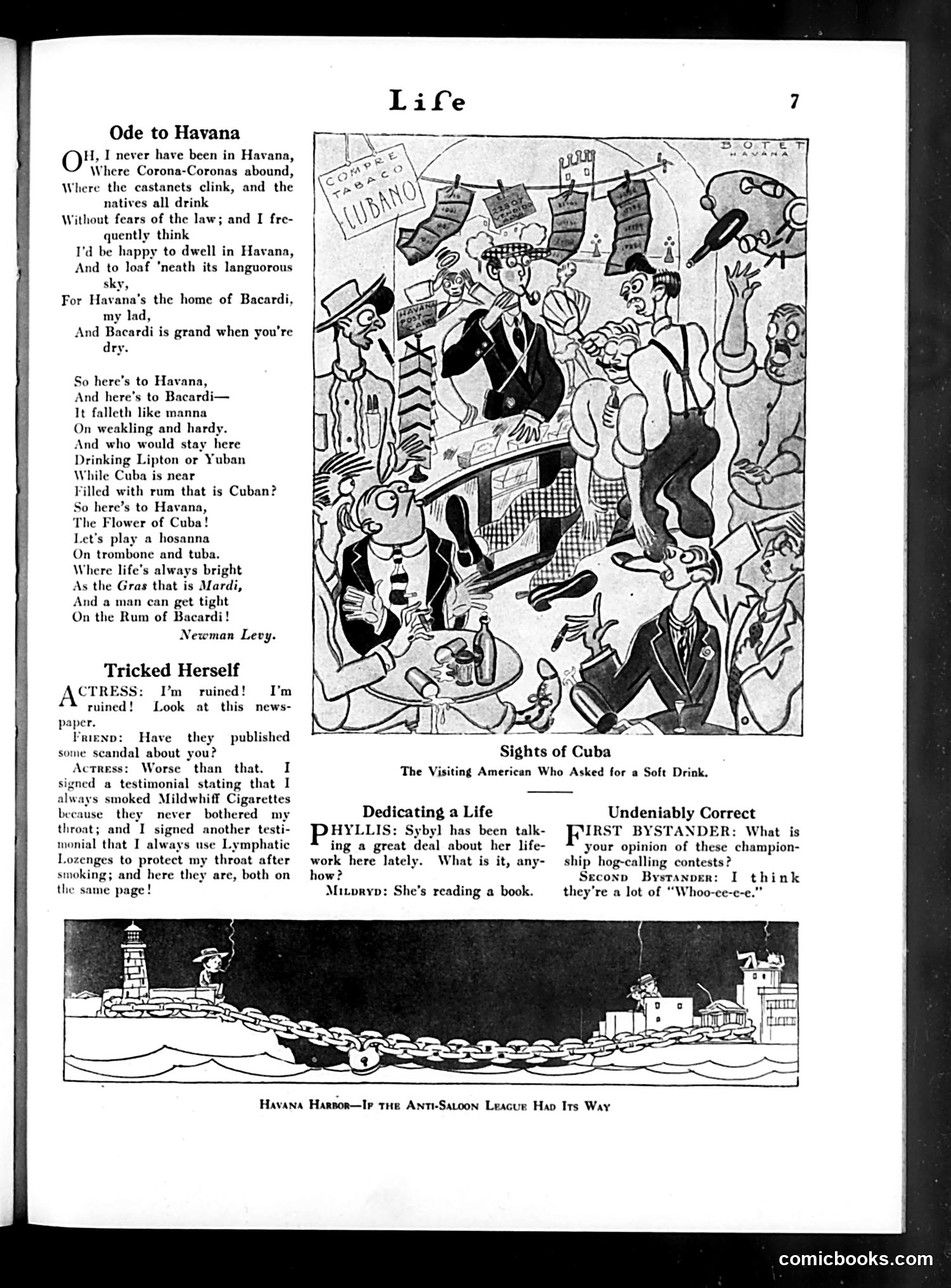
This Life magazine page satirizes American attitudes toward Cuba and Havana, particularly around alcohol and leisure. The main poem celebrates Havana as a destination for drinking rum and Bacardi rum specifically—appealing to Americans during what appears to be Prohibition era (references to "Lipton or Yuban" suggest smuggling alternatives). The cartoon "Sights of Cuba" depicts a chaotic Havana nightlife scene, with an American tourist surrounded by dancers, musicians, and servers. The illustration mocks both Cuban stereotypes (exuberant nightlife culture) and American tourists seeking vice and hedonism abroad. The lower sections include humor pieces like "Tricked Herself" and "Undeniably Correct," employing typical Life magazine comedic formats. The harbor cartoon appears to reference anti-saloon sentiment. Overall, the page reflects early-20th-century American leisure culture and Prohibition-era attitudes toward Cuba as an escape destination.
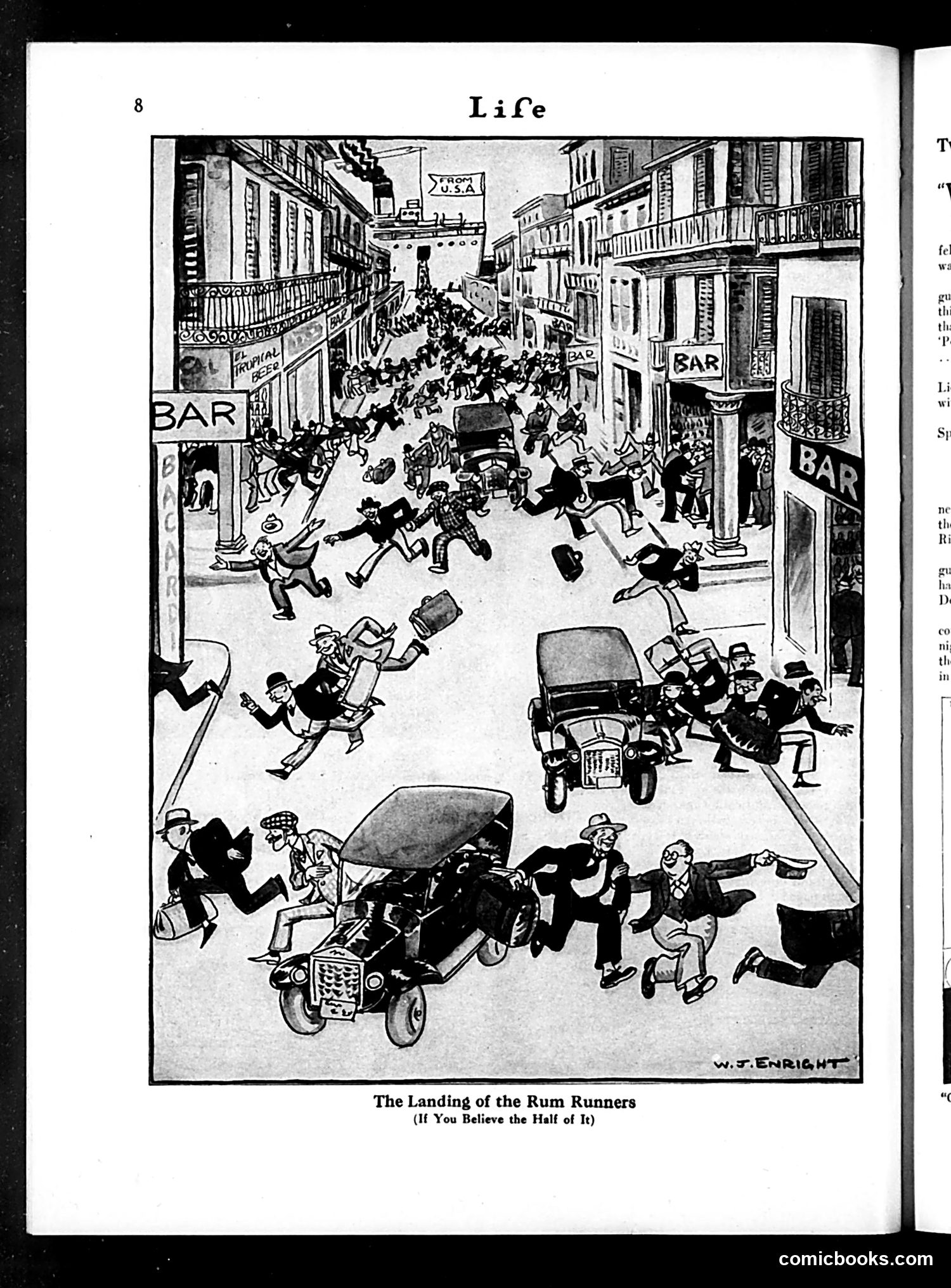
This cartoon by W.F. Enright satirizes Prohibition-era smuggling. The chaotic street scene depicts what appears to be bootleggers unloading alcohol in a crowded urban street, with vehicles, crates, and figures in apparent disarray. Multiple "BAR" signs visible in the buildings suggest speakeasies. The subtitle's skeptical tone—"If You Believe the Hall of It"—mocks exaggerated claims about smuggling operations. The cartoon likely comments on both the prevalence of illegal alcohol distribution during Prohibition and the sensational or dubious reporting about such activities. The dense, frantic composition emphasizes the scale and brazenness of the operation, satirizing how openly bootlegging apparently occurred despite federal law enforcement.
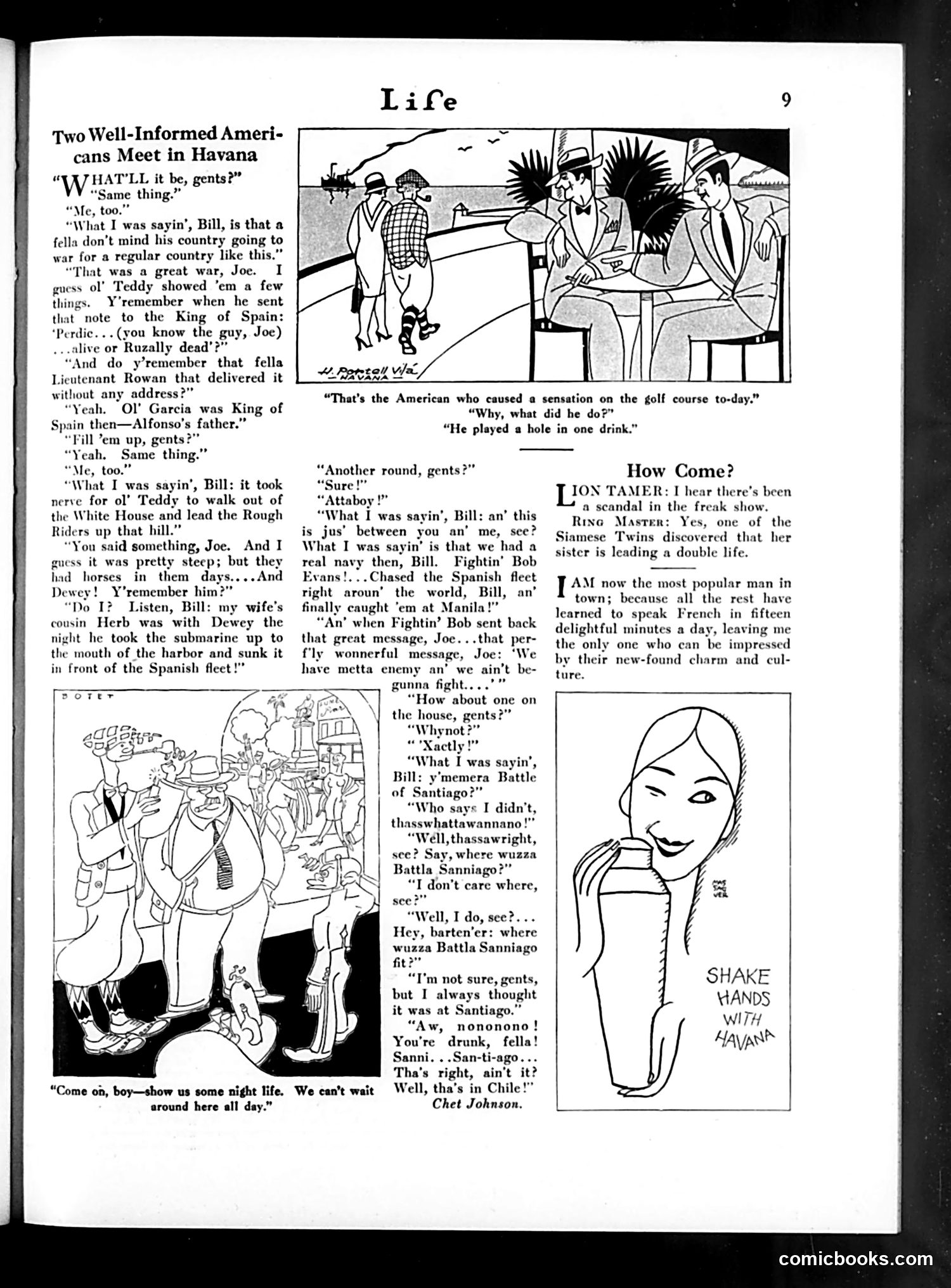
This page contains humorous dialogue between two Americans in Havana, joking about U.S. naval history. The speakers reference Theodore Roosevelt's "Great White Fleet," Admiral Dewey's Manila Bay victory (1898), and the Spanish-American War—early 20th-century American military exploits. The jokes play on malapropisms and dialectal speech ("thassawhatawannao"), poking fun at working-class American soldiers/sailors discussing their country's imperial adventures with casual ignorance. One cartoon depicts rowdy American servicemen in a bar. The right panel shows a woman captioned "Shake Hands with Havana"—likely referring to Cuba's status as an American sphere of influence post-Spanish-American War. The satire mocks both American military braggadocio and the cultural gap between educated readers and ordinary soldiers abroad.
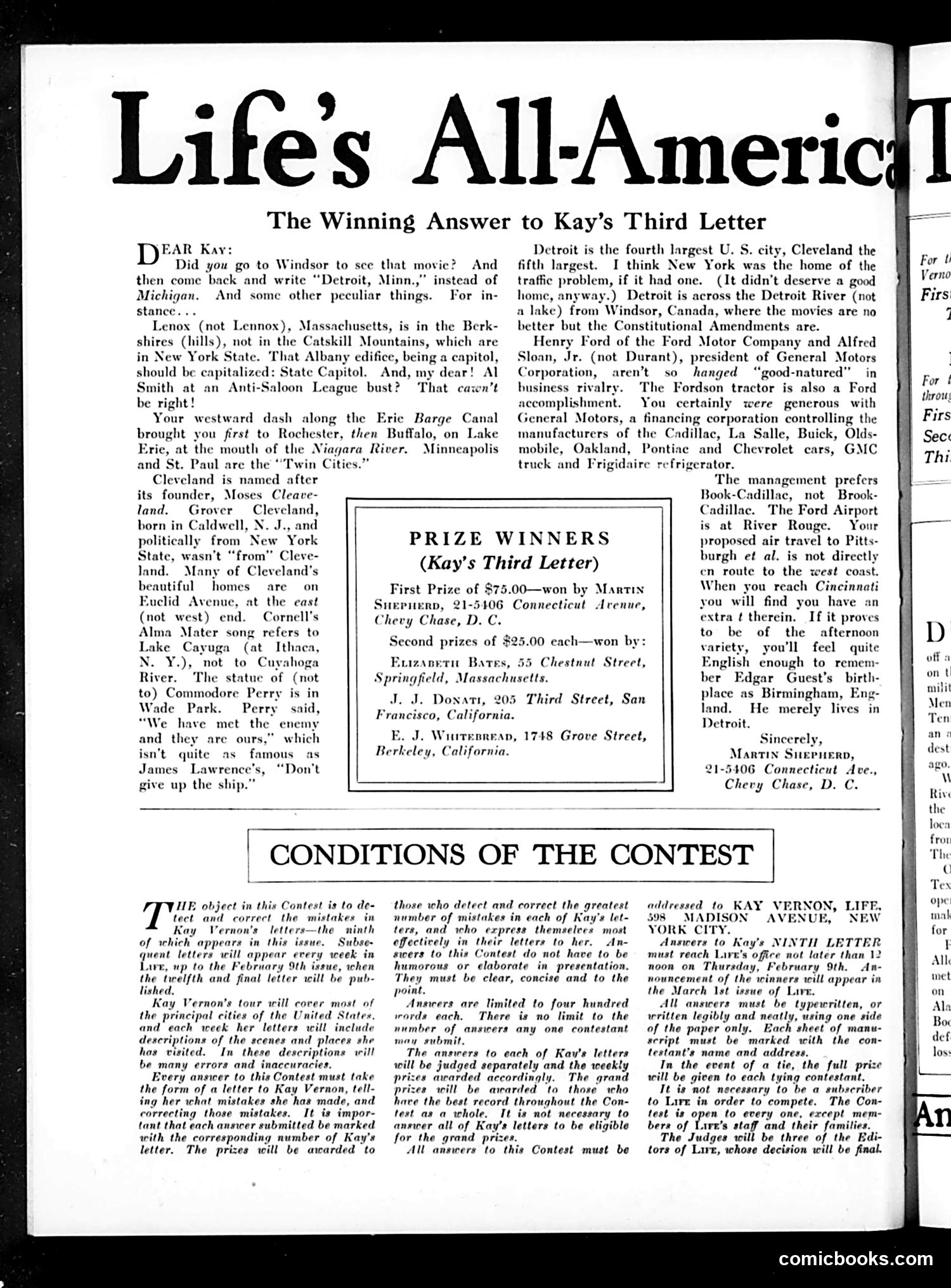
This page announces a contest called "Life's All-American," responding to reader "Kay's Third Letter." The content is largely administrative rather than satirical. The winning answer addresses Kay's question about American geography and culture—specifically correcting misconceptions about Detroit, Michigan (described as the fourth-largest U.S. city), and providing information about Cleveland's naming and landmarks. The page includes prize-winners' names and addresses, and detailed contest rules for readers submitting answers to Kay Vernon's letters. The tone is instructional rather than comedic. This appears to be an early 20th-century interactive feature where *Life* magazine engaged readers through geography trivia and letter-writing contests, reflecting the publication's educational entertainment format alongside its satirical content.
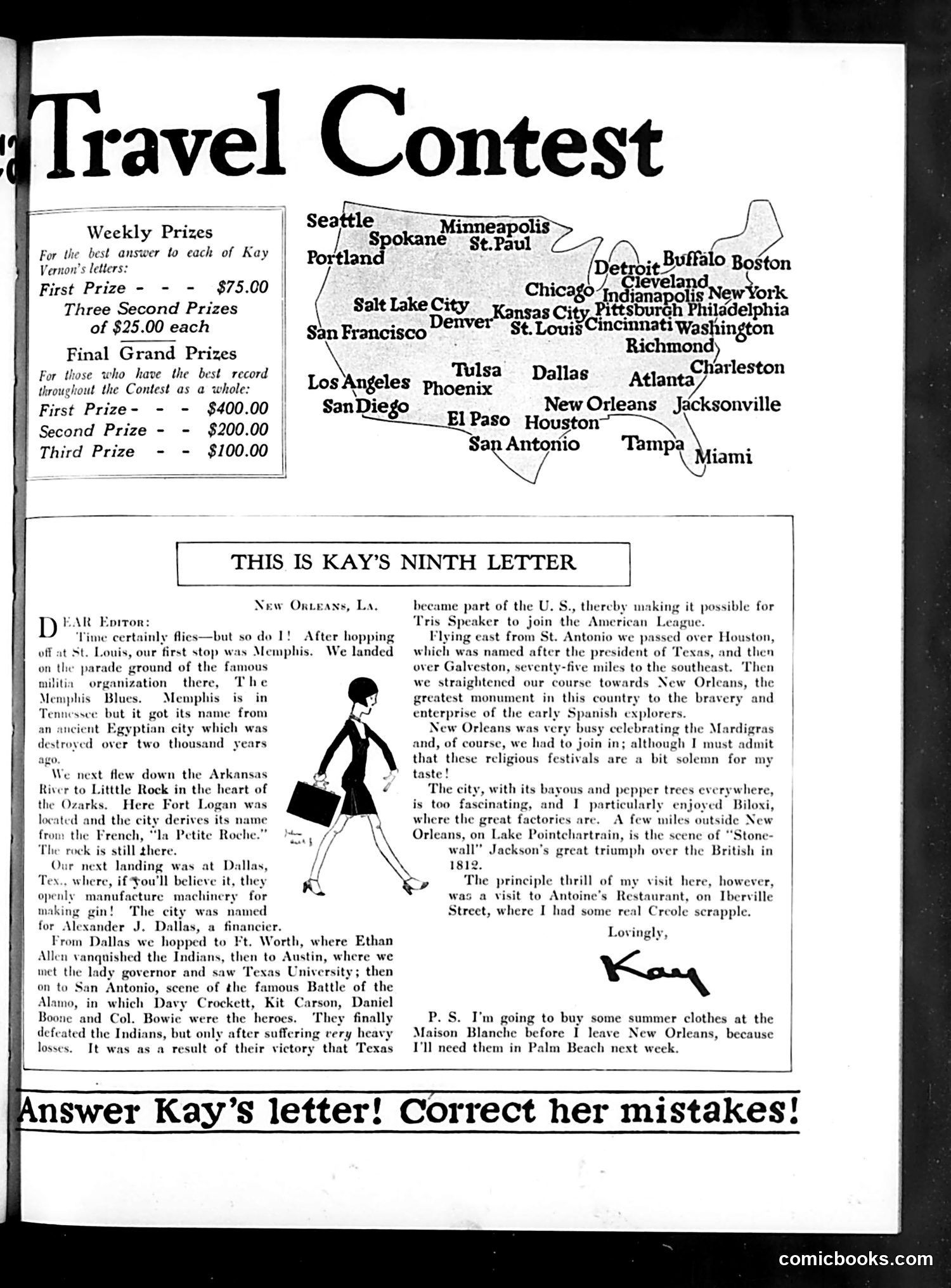
This page is primarily a **contest promotion**, not political satire. Life magazine is running a "Travel Contest" with cash prizes ($75-$400) for readers who answer questions about Kay's letters describing American cities. The content shows **Kay's ninth letter** from her travels, describing New Orleans. She mentions visiting Memphis, Little Rock, Dallas, San Antonio, Houston, and finally New Orleans—touching on local history (the Alamo, Civil War references, Native American conflicts) and tourist attractions (bayous, Mardi Gras, Jackson's triumph, Antoine's Restaurant). The illustration shows a stylized woman traveler with luggage, representing Kay as she journeys across America. This appears to be an **educational travel feature** disguised as an interactive contest, encouraging readers to engage with geography and American history through a feminine, lighthearted travel narrative.
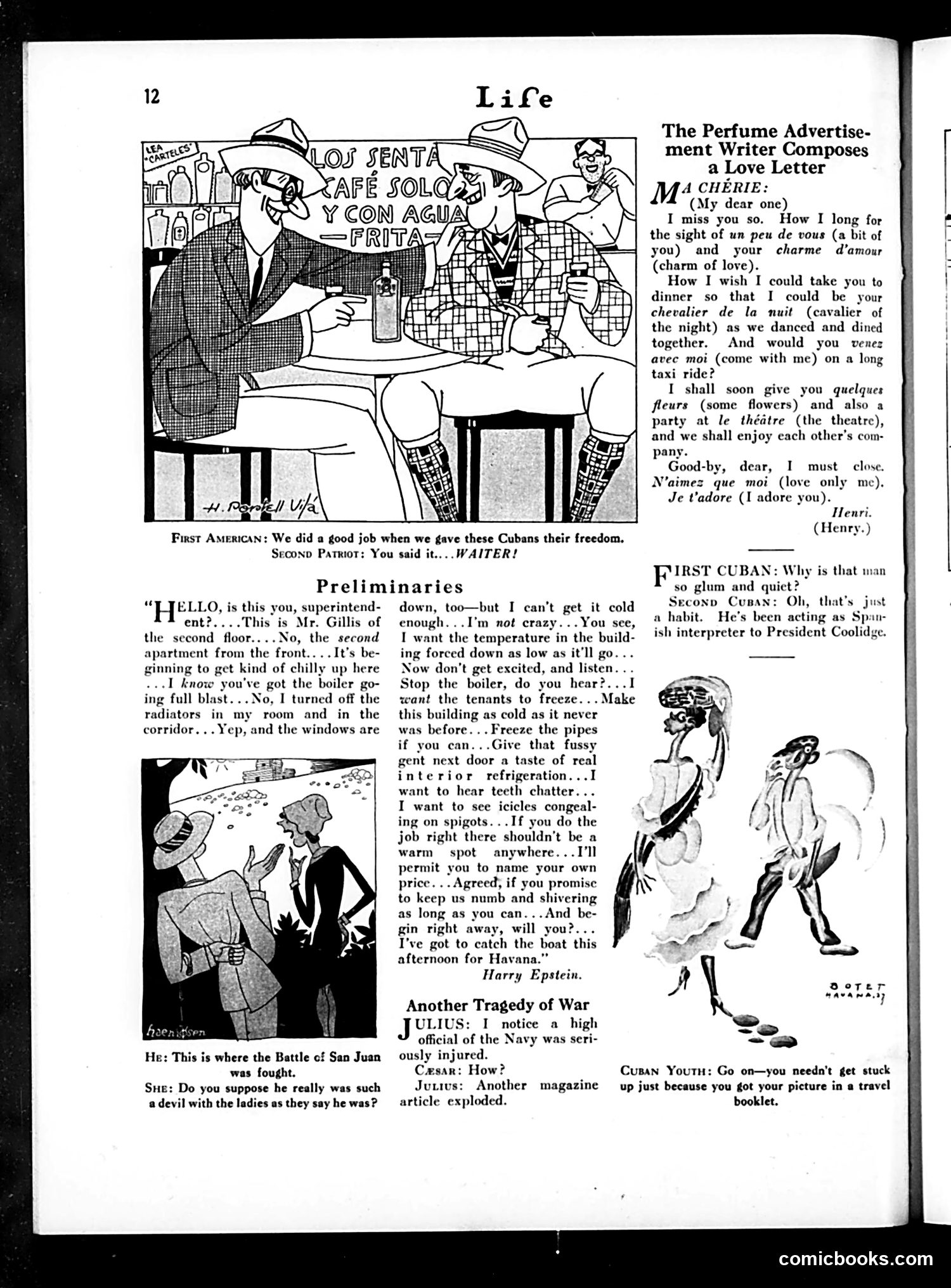
This page contains three satirical pieces mocking early 20th-century American attitudes: **"Los Senta Café Solo" cartoon**: Shows Americans in Cuba after the Spanish-American War, speaking confidently about giving Cubans "freedom." The caption reveals the hypocrisy—the second patron says "You said it... WAITER!"—suggesting Americans claimed to liberate Cuba while still treating Cubans as servants. **"Preliminaries" dialogue**: A landlord aggressively demands a tenant freeze his apartment to near-lethal temperatures, threatening to make the building "as cold as it never was before." This satirizes excessive cost-cutting during what appears to be a heating fuel shortage. **"Another Tragedy of War"**: A brief joke about a Navy official injured by an exploding magazine article—wordplay on "magazine" (publication vs. ammunition storage). The page satirizes American imperialism, landlord exploitation, and military bureaucracy.
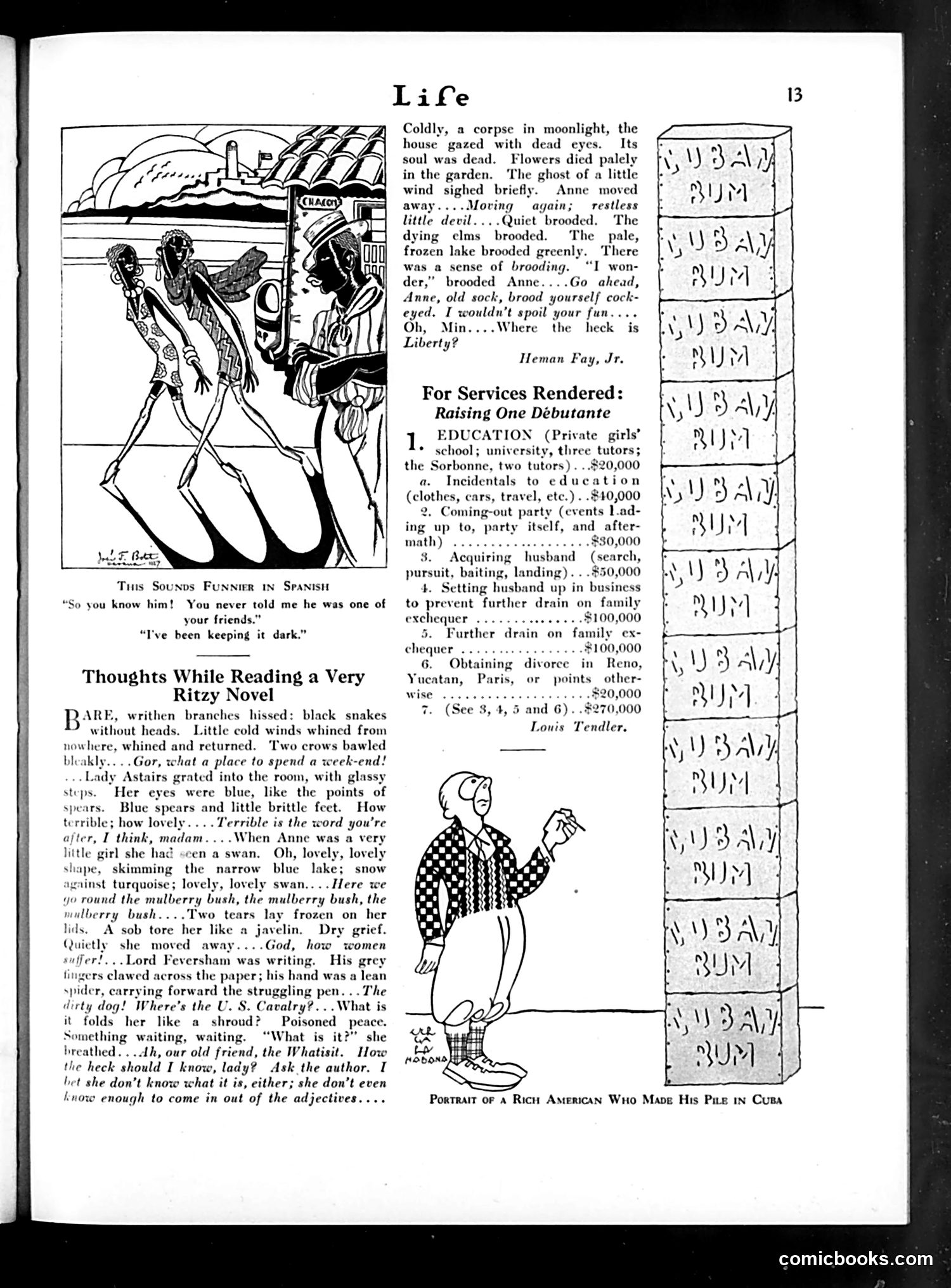
The top-left cartoon, captioned "This Sounds Funnier in Spanish," depicts skeletal figures in a satirical scene. The accompanying text suggests mockery of romantic or social pretense—the caption "So you know him! You never told me he was one of your friends" and the character's response "I've been keeping it dark" implies social embarrassment or hidden relationships. The right side features "Portrait of a Rich American Who Made His Pile in Cuba"—showing a man standing atop stacked rum bottles labeled "CUBAN RUM." This satirizes American wealth accumulated through Cuban trade, likely referencing early 20th-century business exploitation of Cuba. The center text "Thoughts While Reading a Very Ritzy Novel" contains literary criticism through stream-of-consciousness commentary on descriptions in contemporary fiction.
This page contains the "Letters from Heywood Broun" column—a satirical advice section rather than a political cartoon. The content discusses diet and health philosophy through the persona of Dr. Logan Clendening, a real physician known for popular health writings in the 1920s-30s. The satire targets diet fads and health obsession. The column mocks readers obsessing over calorie-counting and raw vegetables while praising Dr. Clendening's relaxed approach to blood pressure and moderate drinking/tobacco use. The joke is that this "enlightened" doctor dismisses health anxiety as unnecessary worry—the satire being that such cavalier attitudes toward health were presented as sophisticated wisdom in that era. The letter-writer humorously positions himself as intellectually superior for avoiding health faddism.
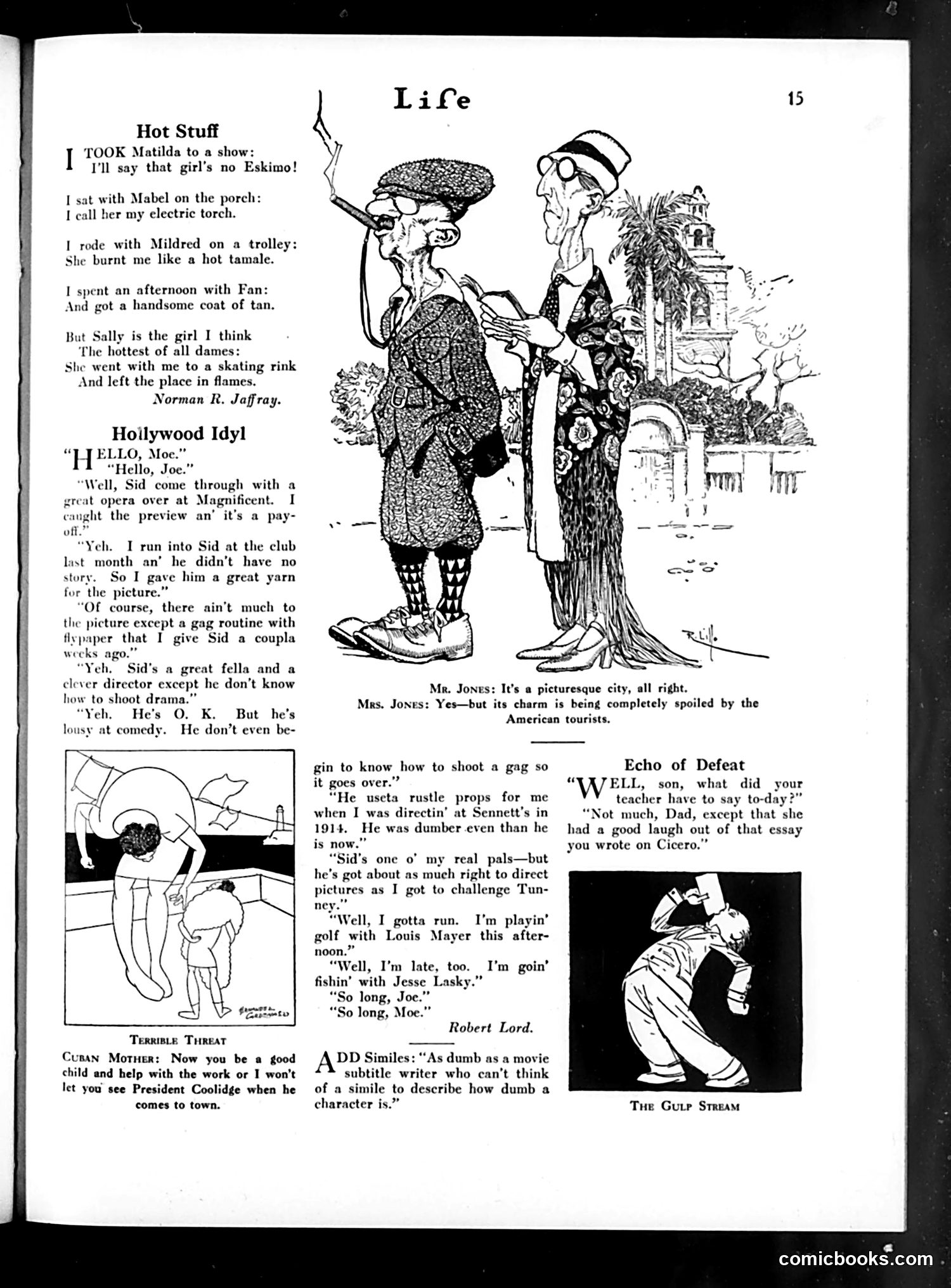
The main cartoon depicts two caricatured men examining a scenic location. Mr. Jones praises it as "picturesque," while Mrs. Jones laments that "its charm is being completely spoiled by the American tourists." This satirizes early 20th-century tourism's impact on historic or scenic destinations. The exaggerated caricatures of the tourists themselves underscore the irony: wealthy Americans traveling abroad were seen as uncultured visitors who damaged the very places they visited. The joke critiques American tourists' obliviousness to their own role in degrading cultural sites through mass tourism. The page also contains humor sections like "Hot Stuff," "Hollywood Idyl," and "Terrible Threat"—typical Life magazine satirical commentary on contemporary social situations, though specific references remain unclear without additional context.
This page contains editorial commentary on youth criminality and social disorder. The main cartoon (center-left) depicts a disheveled figure labeled "PIPE," apparently personifying corruption or criminal influence. The editorials criticize young people engaged in crime, robbery, and violence, attributing blame to Prohibition's effects, inadequate schooling, and lax punishment. The text suggests these youth are products of systemic failure rather than inherent depravity. A secondary reference mentions the "Pyramid prophecy of the Great Tribulation" beginning May 28, 1928—apparently a contemporary doomsday prediction the magazine treats with skepticism. The final item by E.S. Martin sardonically questions the value of advertising ("Why advertise?"), suggesting skepticism about commercial culture. Overall, the page reflects 1920s anxieties about crime, generational decline, and social control during Prohibition.
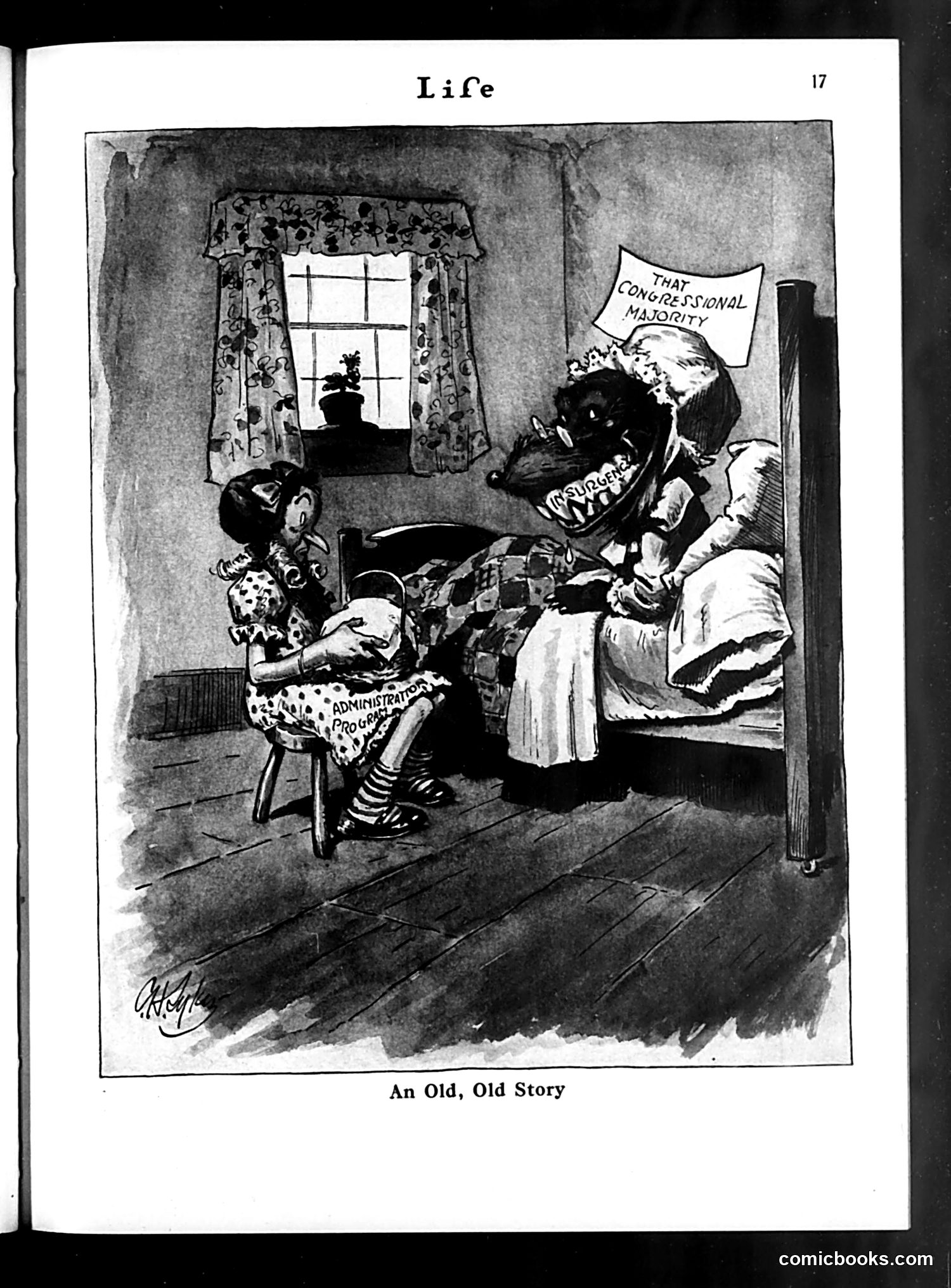
This political cartoon satirizes the relationship between the Administration and a Congressional majority. The figure labeled "Administration" sits in a chair while another labeled "That Congressional Majority" holds a banner reading "Surrogacy" (or similar). The cartoon appears to comment on the Administration's dependence on or control by the Congressional majority—depicting it as a kind of puppet arrangement or false autonomy. The intimate domestic setting (bedroom with window) suggests the hidden nature of these political dealings. The satirical point: despite appearing independent, the Administration is actually controlled by or beholden to Congress, an arrangement presented as a familiar, recurring political pattern (hence "an old, old story"). The specific legislative conflict referenced is unclear from the image alone.
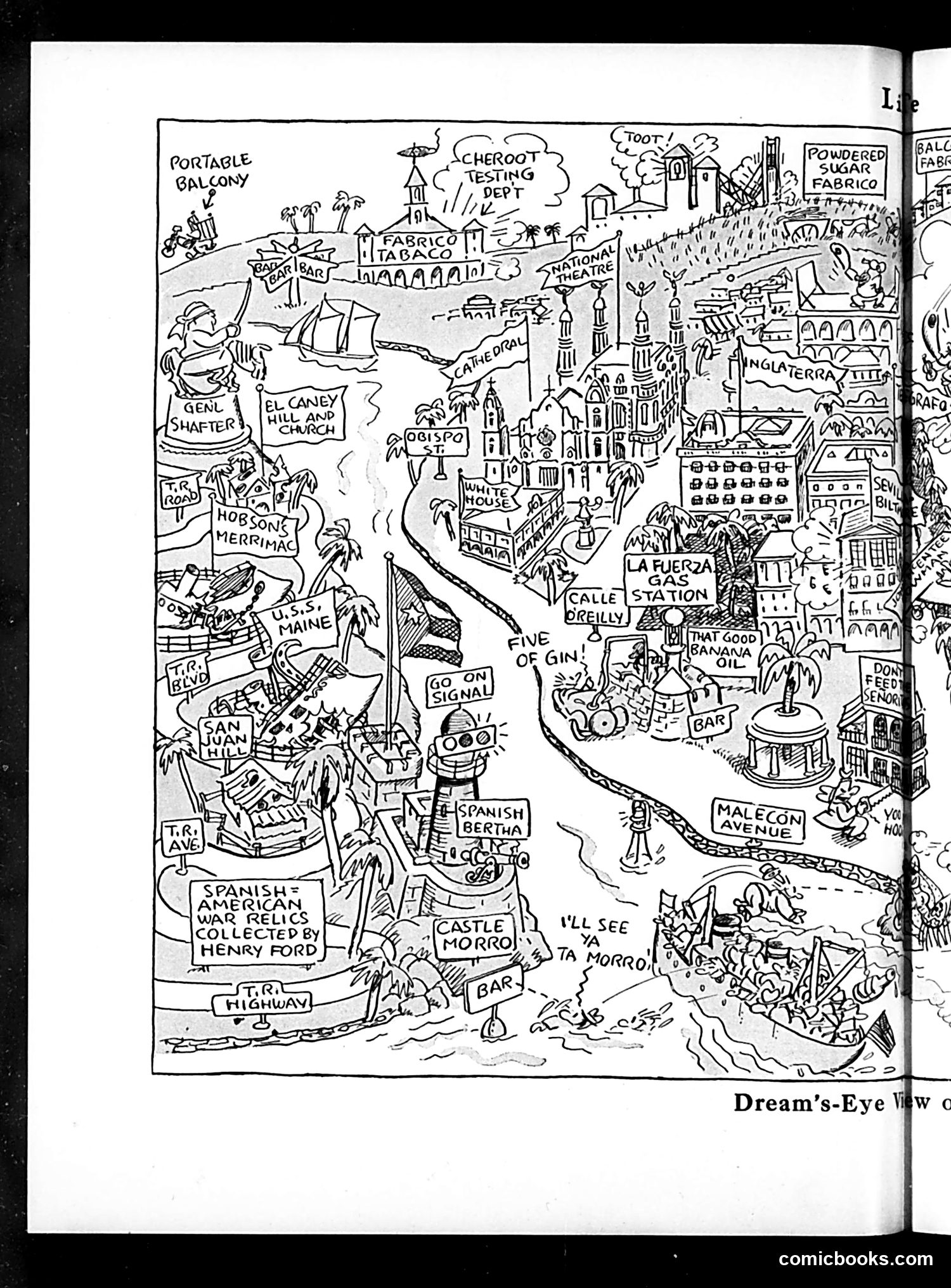
This is a satirical map of Cuba presented as a tourist destination and industrial showcase. The cartoon mocks American imperial ambitions following the Spanish-American War (1898), depicting Cuba as already absorbed into American commercial and cultural interests. Key references include: - **Henry Ford's war relics collection**: A jab at American industrialists acquiring Spanish-American War memorabilia as trophy collecting - **Industrial facilities**: Tobacco factories, sugar plantations, and gas stations labeled throughout, suggesting American economic exploitation - **Tourist attractions**: Churches, theaters, and leisure spots positioned as American entertainment destinations - **The tone**: Satirizes how Americans viewed Cuba post-1898—not as an independent nation but as a resource to extract and territory to colonize The cartoon critiques American imperialism by presenting Cuba as already carved up and commodified for American profit and tourism, rather than as a sovereign nation.
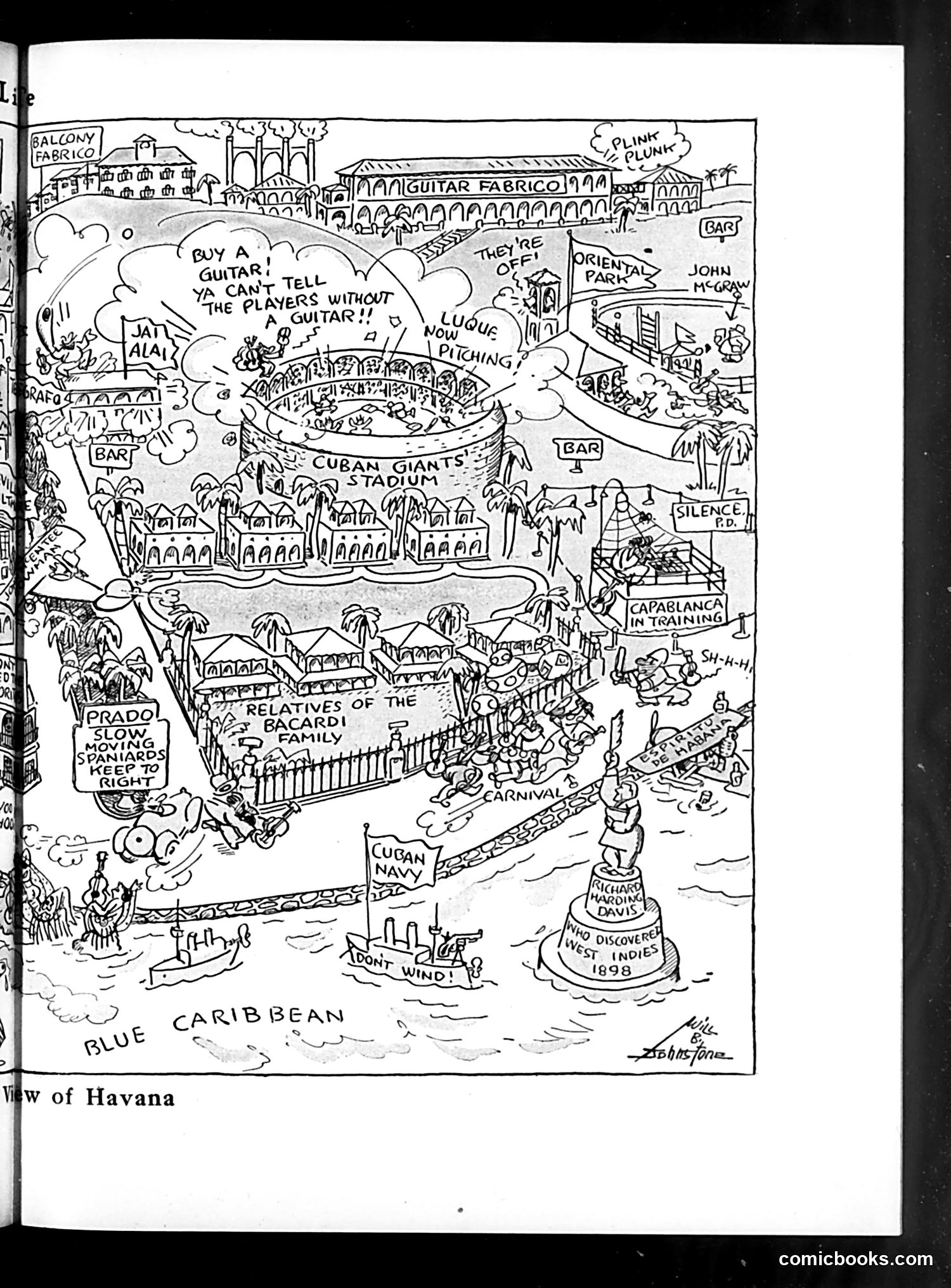
This is a humorous illustrated map of Havana, Cuba, labeled as a "Life" magazine feature. The cartoon depicts various Cuban stereotypes and tourist attractions of the era through exaggerated scenes: the Guitar Fabrico factory, Cuban Giants baseball stadium, Oriental Park, bars, a carnival, and the Prado with "slow Spaniards." The satire mocks both Cuban culture and American tourists' superficial engagement with it. Speech bubbles emphasize crude stereotypes—one character insists "You can't tell the players without a guitar," reducing Cuban identity to romanticized musical tourism. Historical references include the "Cuban Navy" ships and a monument to Richard Harding Davis (noted journalist who covered the 1898 Spanish-American War, suggesting this cartoon dates to the early 1900s when American interest in Cuba was high). The overall tone is typical of Life magazine's irreverent approach: poking fun at American attitudes toward foreign cultures while depicting Cuba as an exotic, somewhat absurd destination for leisure and entertainment.
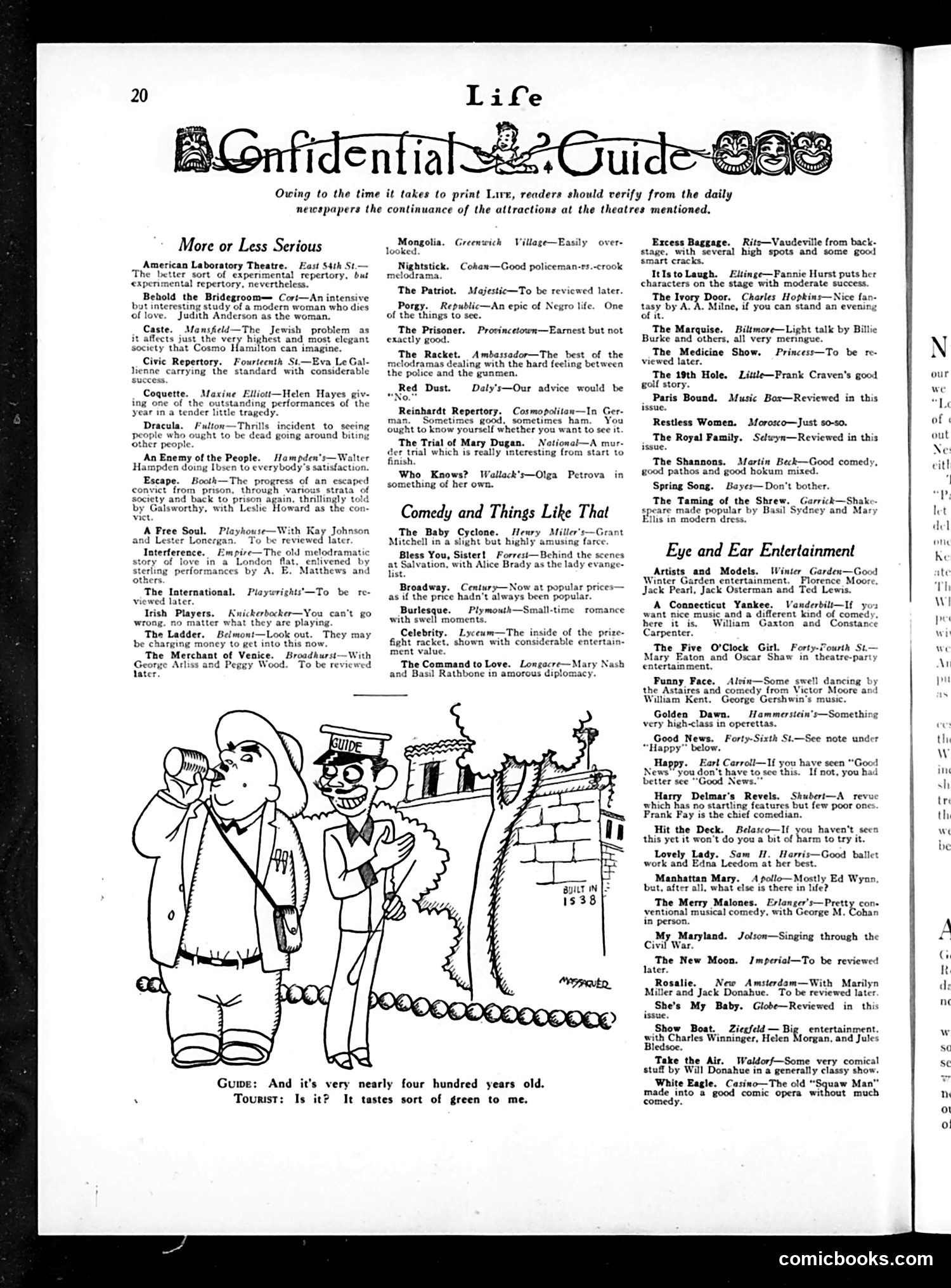
This page is a theater review section from Life magazine, listing current Broadway productions with brief critiques. The cartoon at the bottom depicts a tourist and guide examining what appears to be an old structure (marked "Built in 1535"). The joke is straightforward: The guide boasts the building is "very nearly four hundred years old," but the tourist responds it "tastes sort of green to me"—a pun suggesting the structure looks or feels too new, or that he's skeptical of the claim. This satirizes the common tourist-trap practice of exaggerating a building's age for commercial appeal, a familiar problem in 1935 tourism. The bulk of the page provides capsule reviews of plays, musicals, and comedies then running on Broadway. Reviews range from brief praise ("outstanding performances") to dismissive ("Earnest but not exactly good"). The tone is characteristic of Life's satirical, irreverent theater criticism of the era.
This page reviews four Broadway theatrical productions in the "Drama" section. The text discusses: **"Paris Bound"** by Philip Barry—praised as witty, sophisticated comedy about marriage perils, starring Madge Kennedy. The reviewer approves of Barry's ability to write natural dialogue. **"The Royal Family"** by Edna Ferber and George Kaufman—described as comedy about theatrical family life, featuring performers like Haidee Wright and Otto Kruger. The reviewer notes insider theatrical humor may escape general audiences. **"She's My Baby"**—criticized for having a weak libretto despite star Beatrice Lillie's talents. The reviewer sympathetically notes that dialogue that should be funny often falls flat on stage. The small cartoon illustrations depict theatrical masks and performers, typical of Life's drama section decoration. This is essentially a theater critic's column praising successful plays while good-naturedly ribbing weaker productions—standard entertainment journalism of the 1920s.
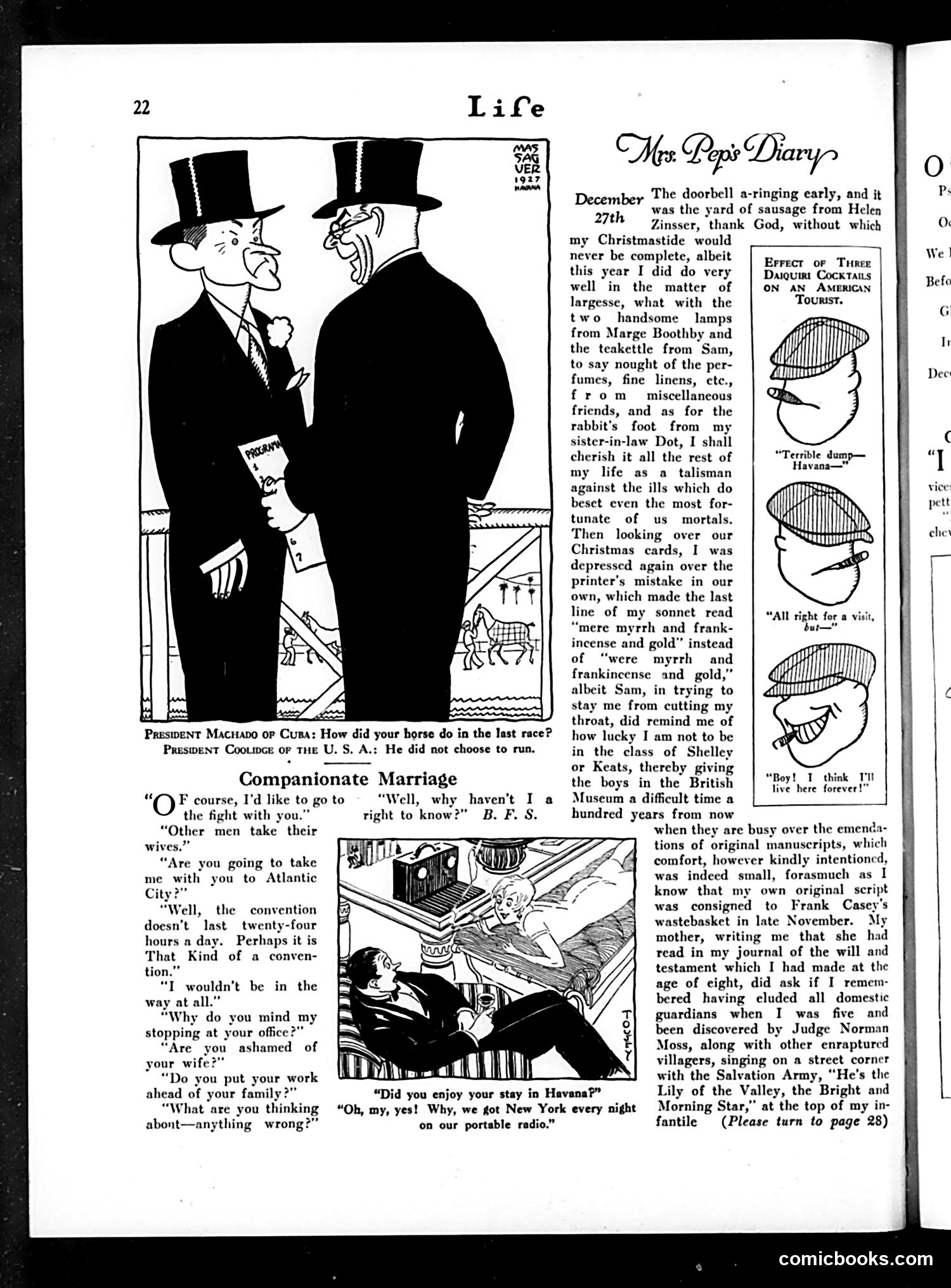
**Top Cartoon:** Depicts President Machado of Cuba and President Coolidge of the U.S.A. The joke relies on Coolidge's famous taciturn reputation—when asked how his horse performed in a race, Coolidge replies the horse "did not choose to run," a characteristic non-answer. Machado asks why he has no right to know, satirizing diplomatic evasiveness. **"Companionate Marriage" Section:** This satirizes the emerging 1920s concept of "companionate marriage" (a more equal, companionable partnership versus traditional marriage). The dialogue shows a husband reluctant to include his wife in his activities—refusing her company at fights, conventions, and his office—while questioning *her* commitment to family. The satire mocks men who claim modern marriage ideology while maintaining traditional male independence and control. **Right sidebar:** "Mrs. Pops Diary" and comic illustrations about tourist experiences complete the page's light social commentary.
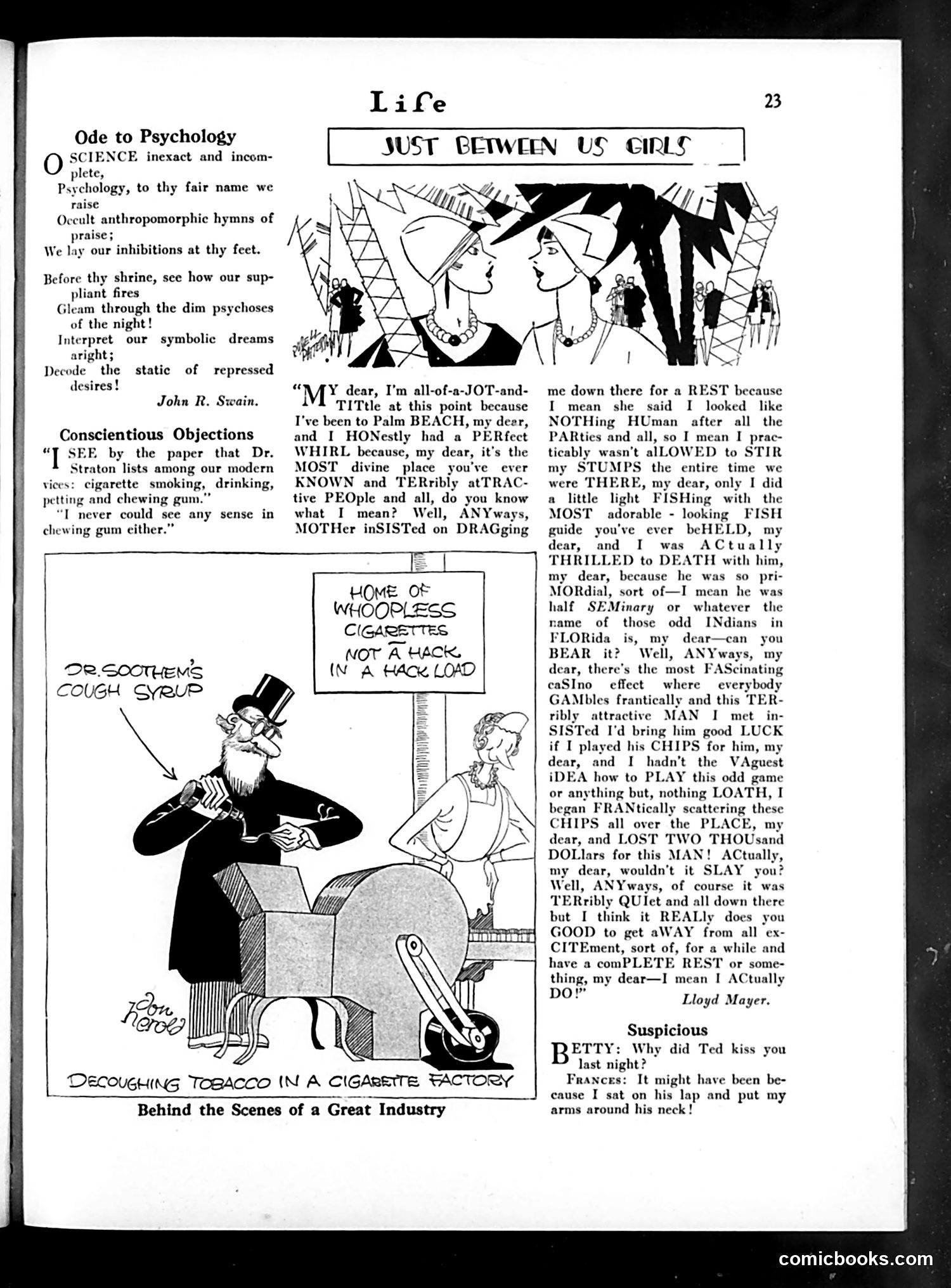
This 1920s Life magazine page satirizes contemporary social trends and emerging psychological discourse: **"Ode to Psychology"** mocks the era's fascination with Freudian psychology and psychoanalysis—treating the pseudoscience with mock-reverence while poking fun at concepts like "repressed desires" and "symbolic dreams" that were becoming popular. **"Conscientious Objections"** features a Dr. Straton (a real anti-vice crusader of the period) condemning modern vices: smoking, drinking, petting, and gum-chewing. The joke is that even gum-chewing earns moral disapproval. **"Just Between Us Girls"** satirizes upper-class women's affected speech patterns—excessive capitalization mimics their breathless, affected manner—boasting about Palm Beach socializing, gambling losses, and romantic encounters. **The cartoon** shows a man promoting "Whoopless Cigarettes" in a tobacco factory—ironic advertising claiming health benefits while depicting tobacco processing, likely mocking fraudulent health claims common in cigarette marketing of the era.
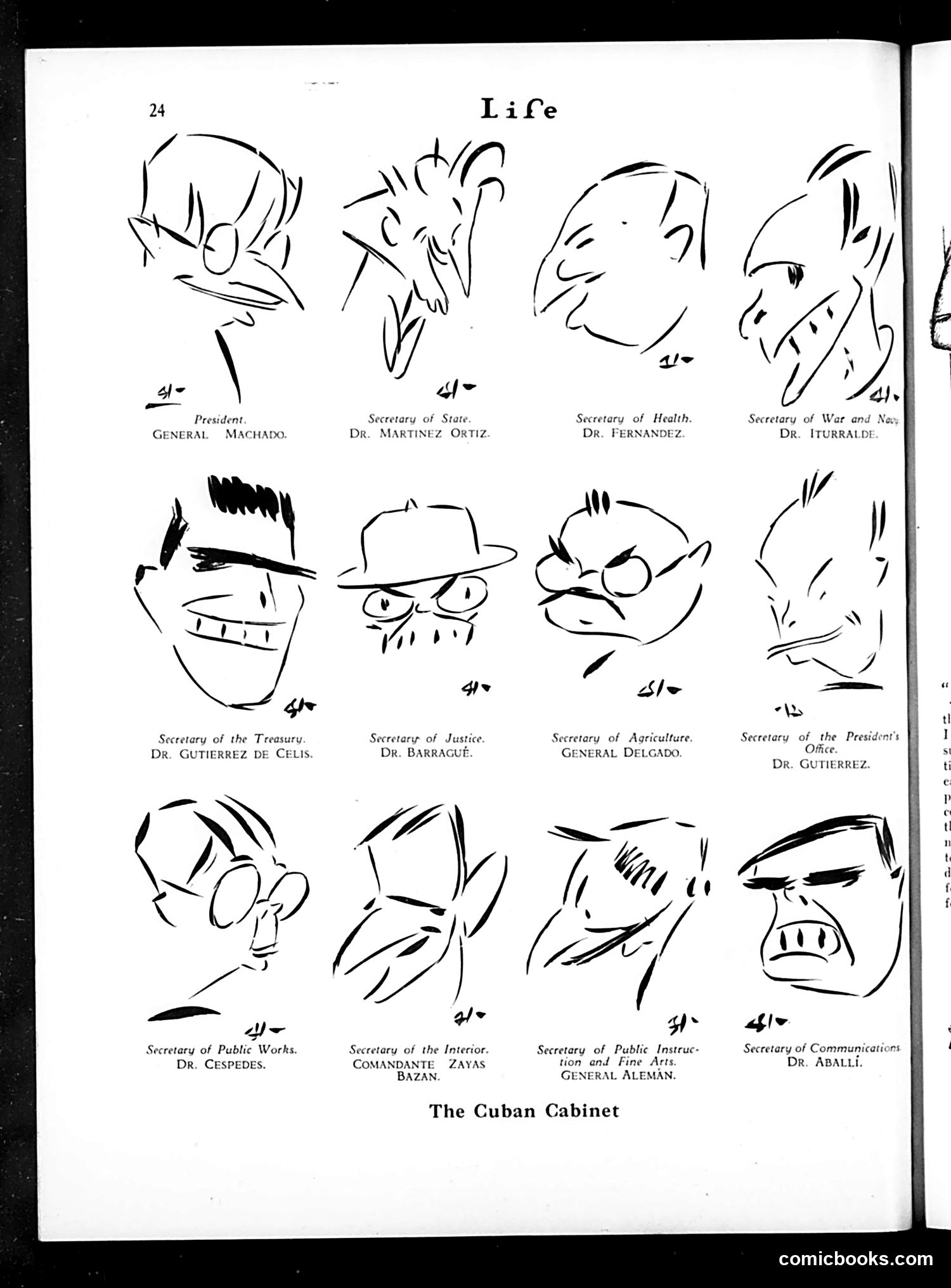
This Life magazine page presents caricatures of Cuba's government officials under President General Machado. The artist uses exaggerated facial features—grotesque expressions, distorted proportions, and crude line work—to mock and demean each cabinet member, including the Secretary of State, Treasury, Justice, Agriculture, War and Navy, Public Works, Interior, Public Instruction, and Communications. The satire's intent appears to be ridiculing the competence and character of Machado's administration. By reducing these officials to ugly, foolish-looking caricatures, the cartoonist suggests they are unfit for office. This reflects American attitudes toward Caribbean governments of the era, often depicted with racial and ethnic mockery. The visual dehumanization served propaganda purposes, justifying American interventionism or dismissal of Cuban sovereignty.
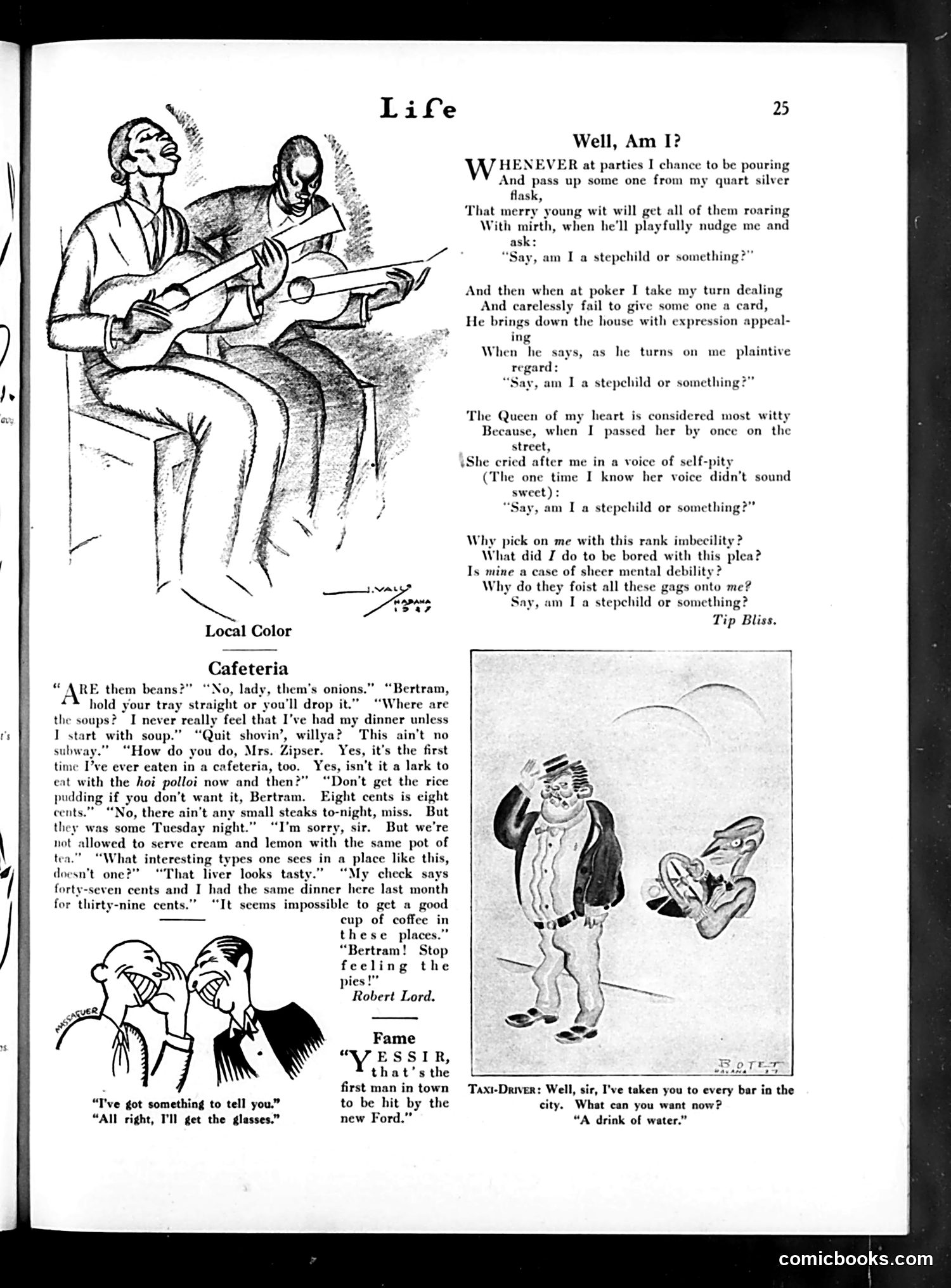
This page contains three satirical pieces from early 20th-century American humor: **"Cafeteria"** by Robert Lord mocks the social awkwardness of a newly-popular self-service dining format. The overlapping dialogue captures pretension (references to "hoi polloi"), complaints about pricing and quality, and parental exasperation—satirizing how different classes and personalities collide in this democratic eating space. **"Well, Am I?"** by Tip Bliss depicts a running joke where the narrator is repeatedly pestered with the phrase "am I a stepchild or something?"—apparently a period catchphrase suggesting unfair treatment. The humor comes from the narrator's exasperation at this worn-out gag being deployed endlessly by acquaintances, friends, and even a romantic interest. **"Fame"** is a single-panel joke: a taxi driver has exhausted every bar in the city trying to satisfy a drunk passenger, who finally asks for water—an anticlimactic and humorous ending to the bar crawl. The accompanying illustrations are simple pen sketches typical of the era's magazine humor.
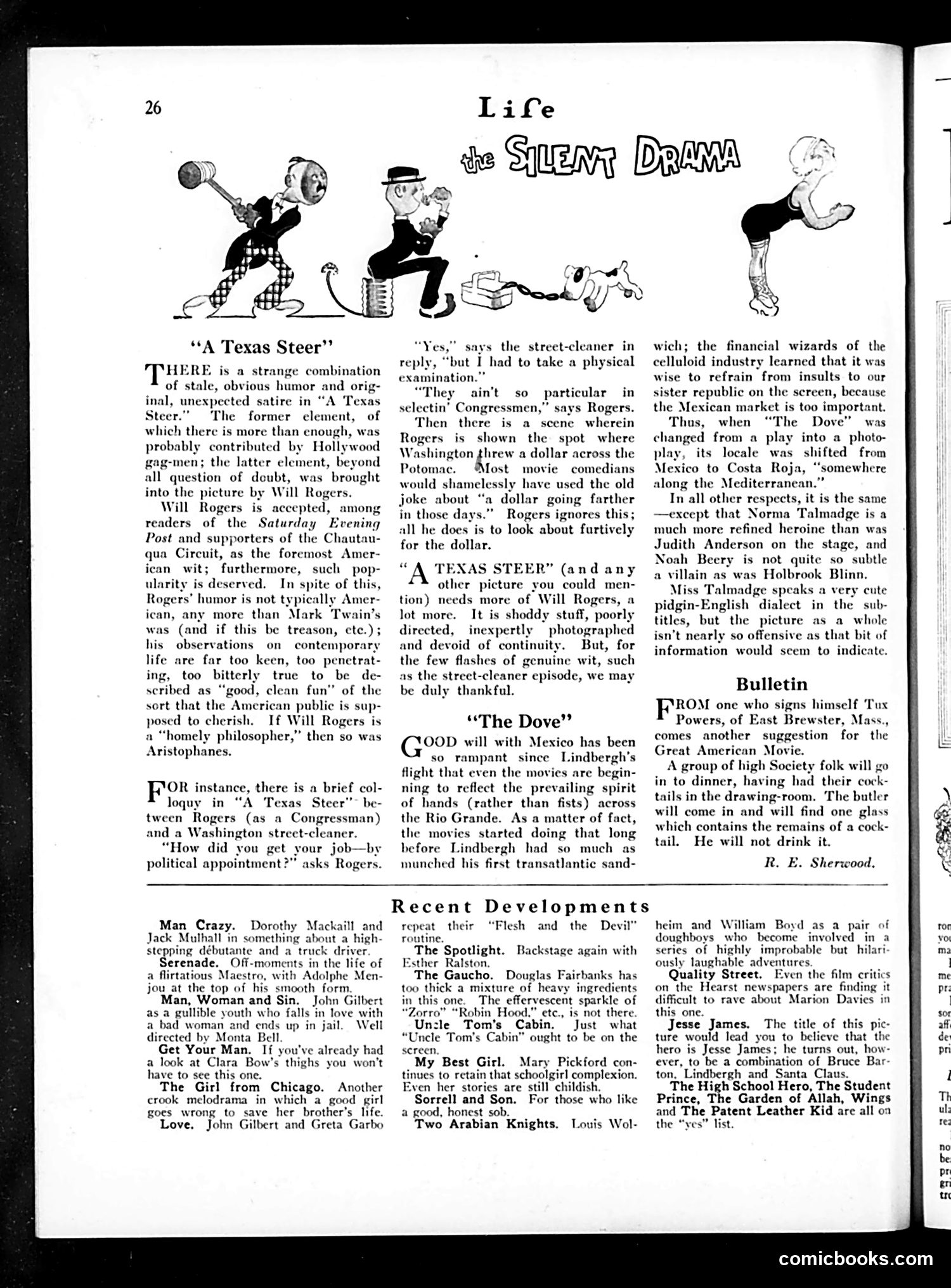
This page reviews two silent films. **"A Texas Steer"** stars Will Rogers as a Congressman. The satire praises Rogers's genuinely sharp wit—exemplified by a scene mocking political patronage where a street-cleaner quips that Congress doesn't require "physical examination." The reviewer contrasts Rogers's "bitterly true" observations with typical Hollywood "good, clean fun," comparing him favorably to Mark Twain and Aristophanes. **"The Dove"** is discussed as part of a broader Hollywood trend toward U.S.-Mexico goodwill since Lindbergh's 1927 transatlantic flight. The film was relocated from Mexico to Costa Rica for its screen adaptation (likely to avoid offending the lucrative Mexican market). Norma Talmadge stars as a "refined heroine" who speaks "pidgin-English" in the intertitles—a detail the reviewer finds less offensive than expected. Both reviews reflect 1920s film criticism and the industry's sensitivity to international markets.
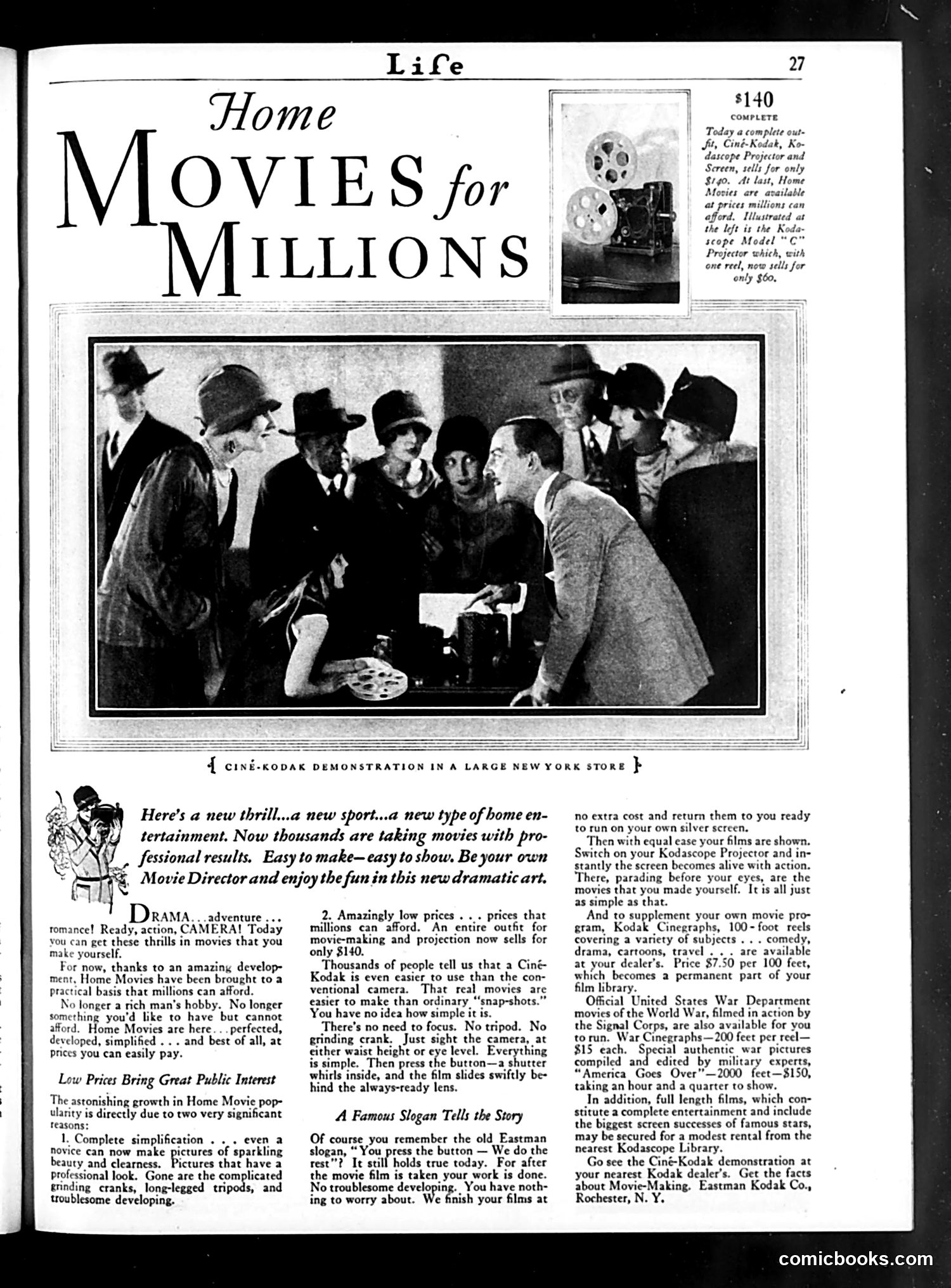
This is primarily a **Kodak advertisement**, not a political cartoon. The page promotes home movie-making technology—specifically the Ciné-Kodak camera and Kodascope projector—to a mass audience. The main image shows a **Cine-Kodak demonstration in a New York department store**, with crowds of ordinary people (wearing 1920s attire) gathered to watch the technology in action. The satire is gentle: the ad celebrates how democratized filmmaking has become. What was once expensive hobby equipment for the wealthy is now affordable ($140 complete outfit) for "millions." The key selling point: simplicity. Following Eastman's famous slogan ("You press the button—We do the rest"), users need only film; Kodak handles processing. The ad emphasizes this repeatedly to overcome consumer anxiety about technical complexity. The cultural moment: this reflects 1920s enthusiasm for consumer technology and participatory entertainment—the idea that ordinary families could become "movie directors" themselves, mirroring Hollywood's glamour at home.
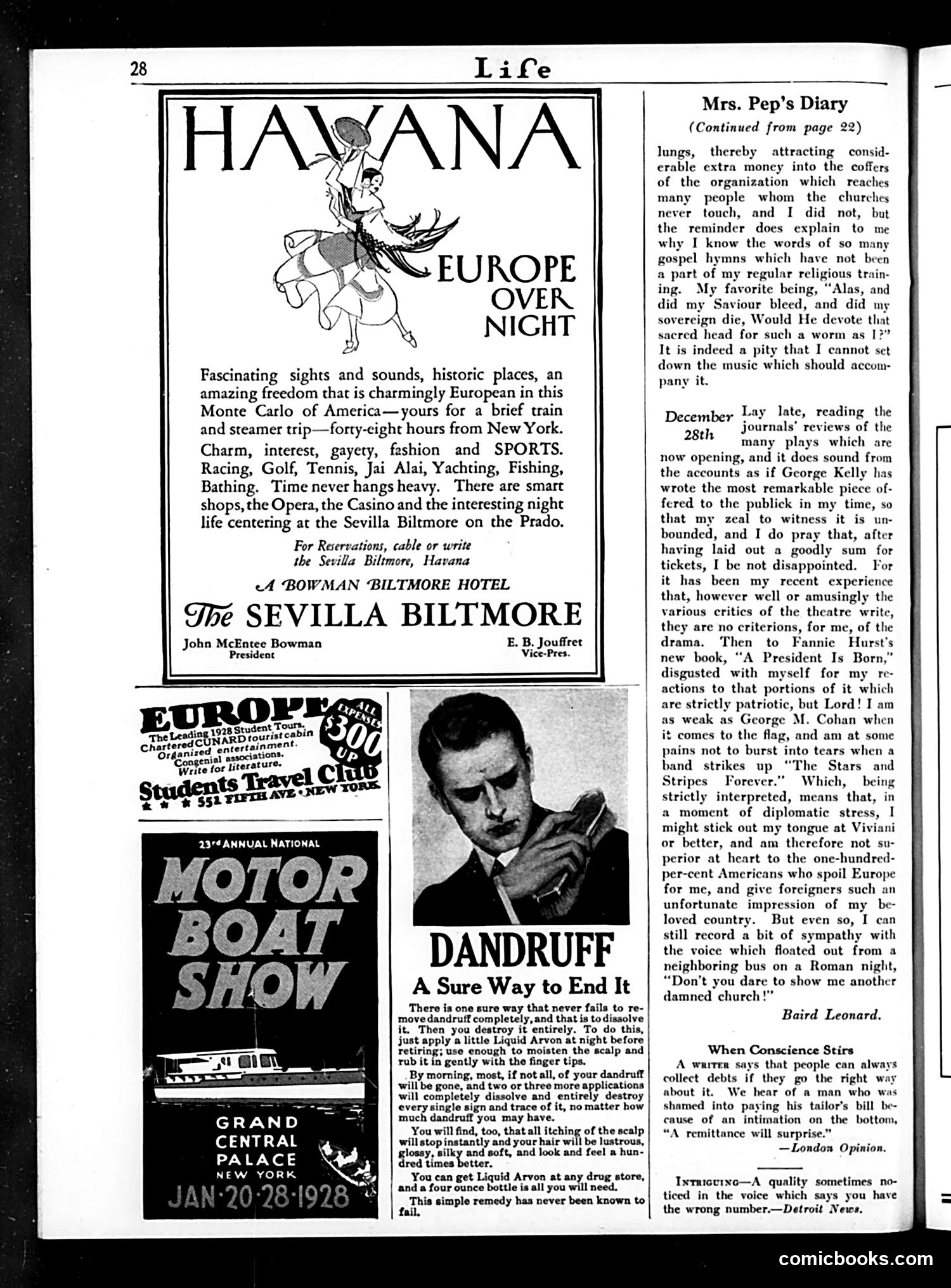
This page from *Life* magazine contains primarily **advertisements and a diary column**, not political cartoons. The main content includes: 1. **Havana travel advertisement** (top) promoting the Sevilla Biltmore hotel, positioning Cuba as an exotic, accessible leisure destination for Americans—typical 1920s luxury tourism marketing. 2. **Dandruff remedy ad** (bottom left) for "Liquid Arvon," using pseudo-scientific language common to patent medicine advertising of the era. 3. **Mrs. Pep's Diary** (right column)—a satirical personal essay where the author reflects on attending plays and her conflicted patriotic emotions, including embarrassment at fellow Americans' behavior abroad. She critiques both overly patriotic theater and her own susceptibility to nationalist sentiment. The diary's humor lies in its self-aware mockery of middle-class American cultural pretensions and emotional contradictions—a typical *Life* magazine satirical feature of the period.
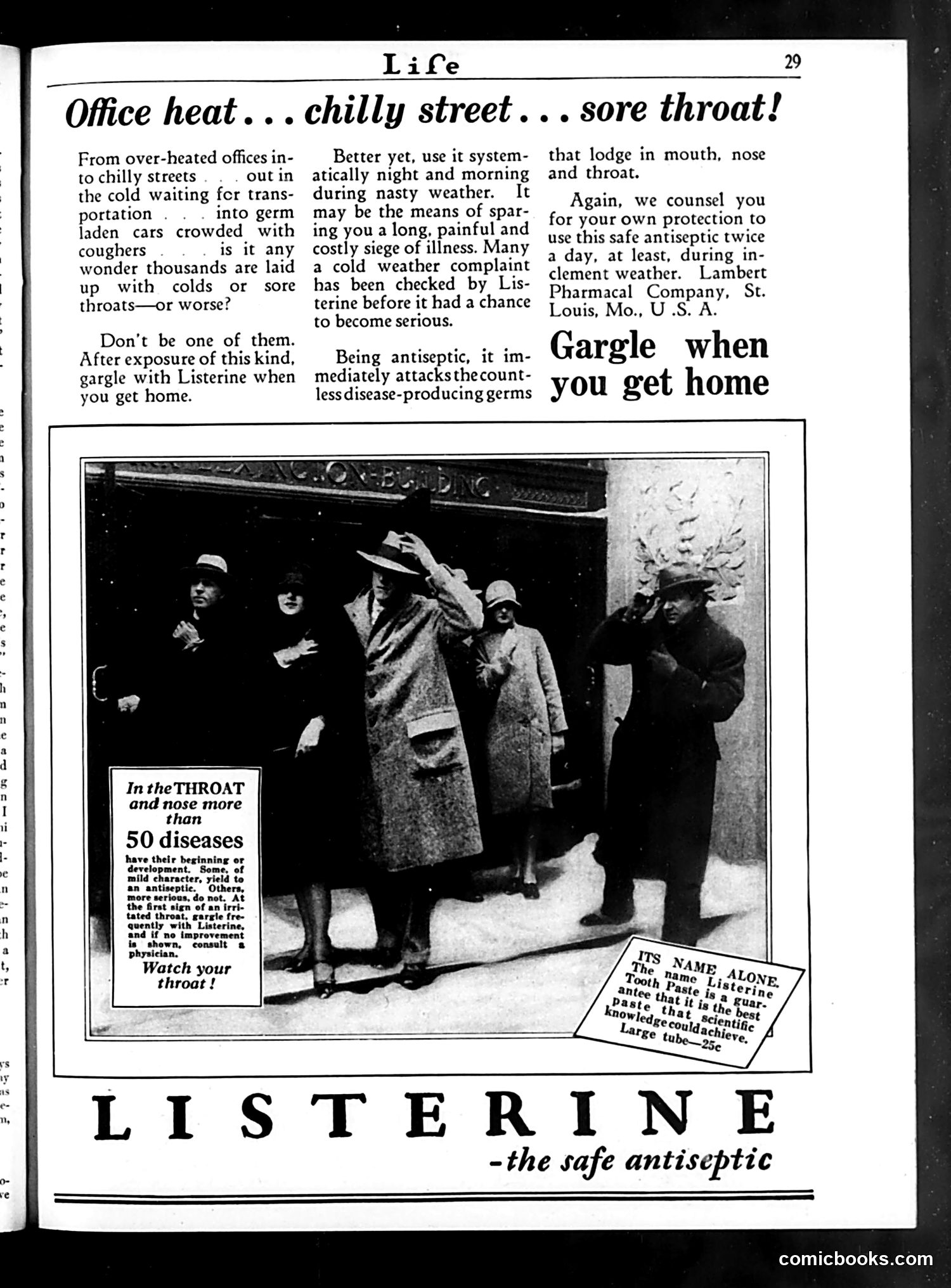
This is a **Listerine advertisement**, not a political cartoon. It uses a common early-20th-century public health scenario to sell mouthwash. The scenario depicts the problem: people move from overheated offices into cold streets, crowd into germ-laden public transportation, then wonder why they catch colds and sore throats. The photograph shows people in period coats waiting outdoors, presumably for transit. The "solution" is to gargle with Listerine twice daily, especially during bad weather. The ad claims the antiseptic attacks "disease-producing germs" in the mouth, nose, and throat—claiming over 50 diseases begin there. This reflects early-20th-century **germ theory marketing**: before antibiotics, antiseptics were heavily promoted for preventing infectious disease. The Lambert Pharmacal Company (Listerine's maker) used health anxiety and pseudo-scientific claims to drive sales, a common advertising tactic of the era that would later face regulatory scrutiny.
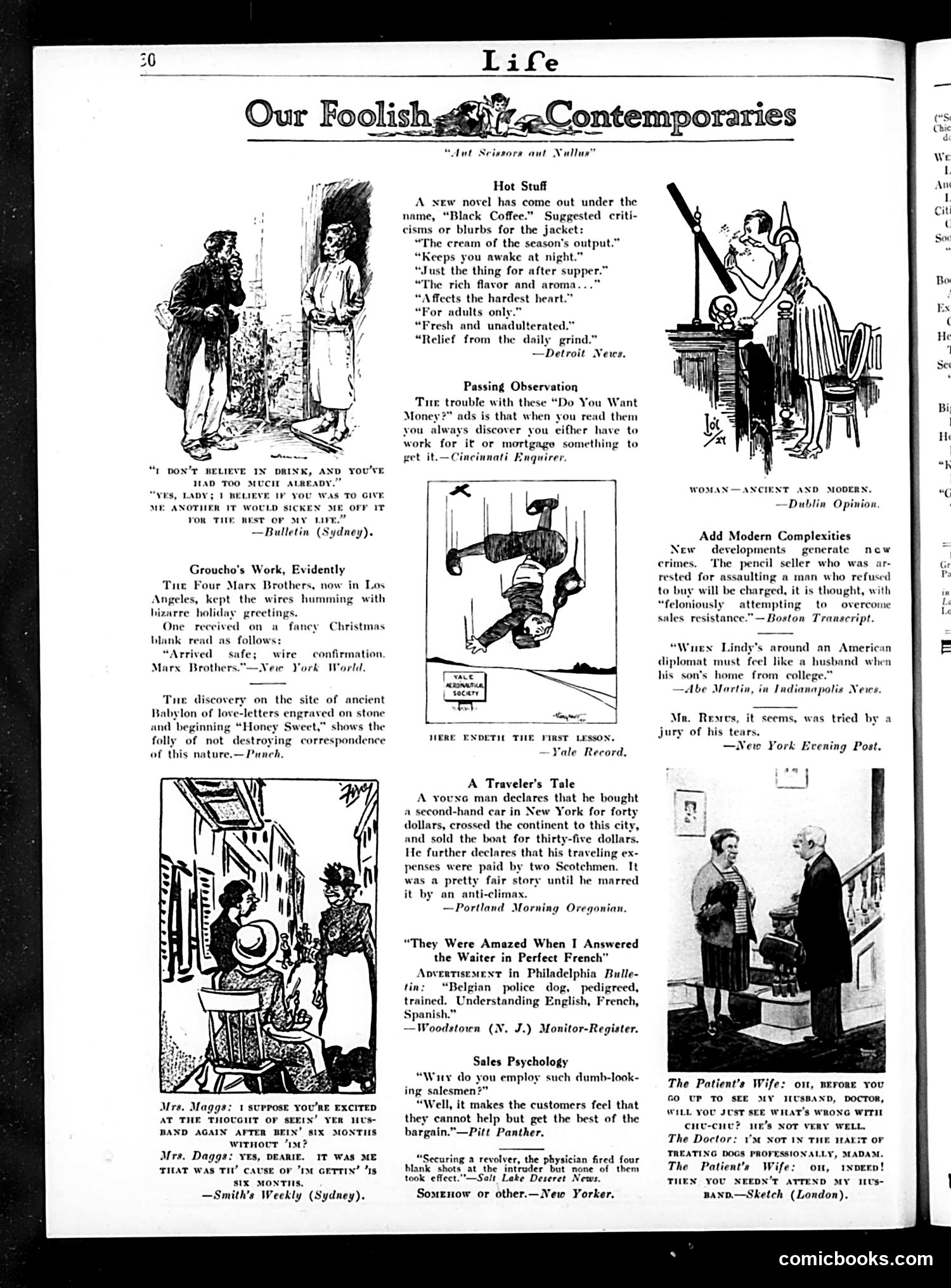
This page collects humorous anecdotes and jokes from newspapers worldwide, mocking contemporary society's follies. **Key content:** - **Marx Brothers telegraph**: A joke about Groucho Marx's group sending a holiday wire reading "Arrived safe; wire confirmation"—absurdist humor about their famous comedic style. - **Irish drunk dialogue**: Two working-class figures debate alcohol consumption, with one claiming sobriety while clearly intoxicated. - **Wife's revenge**: A woman admits imprisoning her husband for six months, satirizing domestic discord. - **"Do You Want Money?" ads**: Mocking advertisement promises that always require mortgaging something to claim the offer. - **Salesman psychology**: A businessman explains hiring "dumb-looking" salesmen so customers feel they're getting a bargain. - **Doctor/pet joke**: A woman insists a physician treat her dog because he won't attend her husband otherwise—absurdist domestic humor. The page satirizes common social pretenses, advertising manipulation, working-class life, and domestic relationships through collected newspaper clippings from the era.
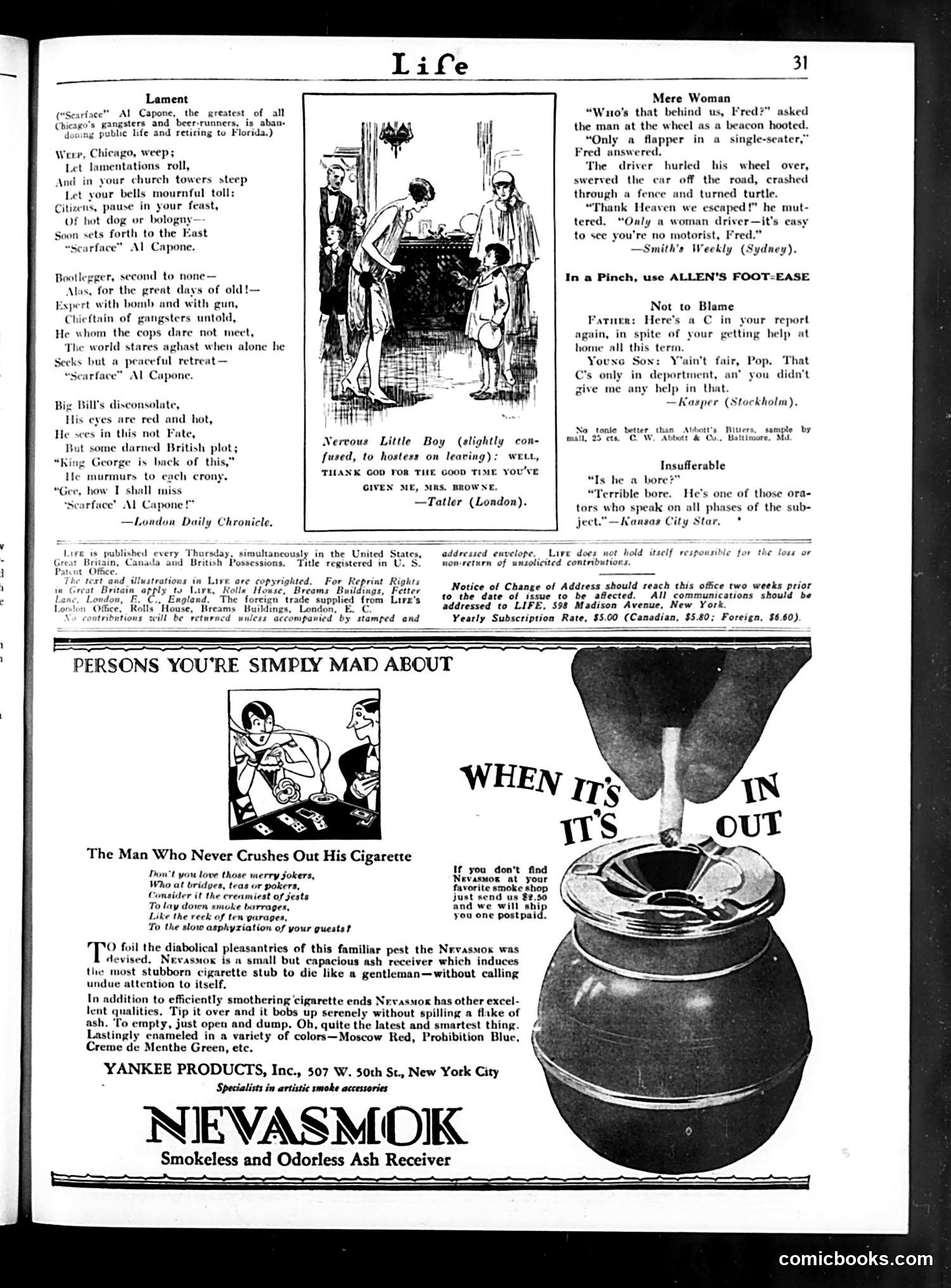
This page contains satirical pieces and advertisements reflecting 1920s American concerns. **"Lament" (top left):** A mock-elegiac poem mourning Al Capone's retirement from Chicago's criminal underworld to Florida. The satire treats the notorious gangster as a departing civic institution, complete with exaggerated lamentation. This references Capone's actual 1931 imprisonment, treating his absence as a genuine loss to the city. **"Mere Woman" and "Not to Blame":** Brief humorous anecdotes mocking women drivers and a student's poor deportment grades—reflecting period stereotypes about female incompetence and youth irresponsibility. **"Insufferable":** A short joke about tedious public speakers. **Nevasmok Advertisement (lower half):** The main visual content—a large ashtray advertisement. The accompanying poem ridicules inconsiderate smokers who create "smoke barrages" at social gatherings, positioning Nevasmok as the solution for the gentleman who doesn't annoy guests. This reflects 1920s social anxieties about indoor smoking etiquette.
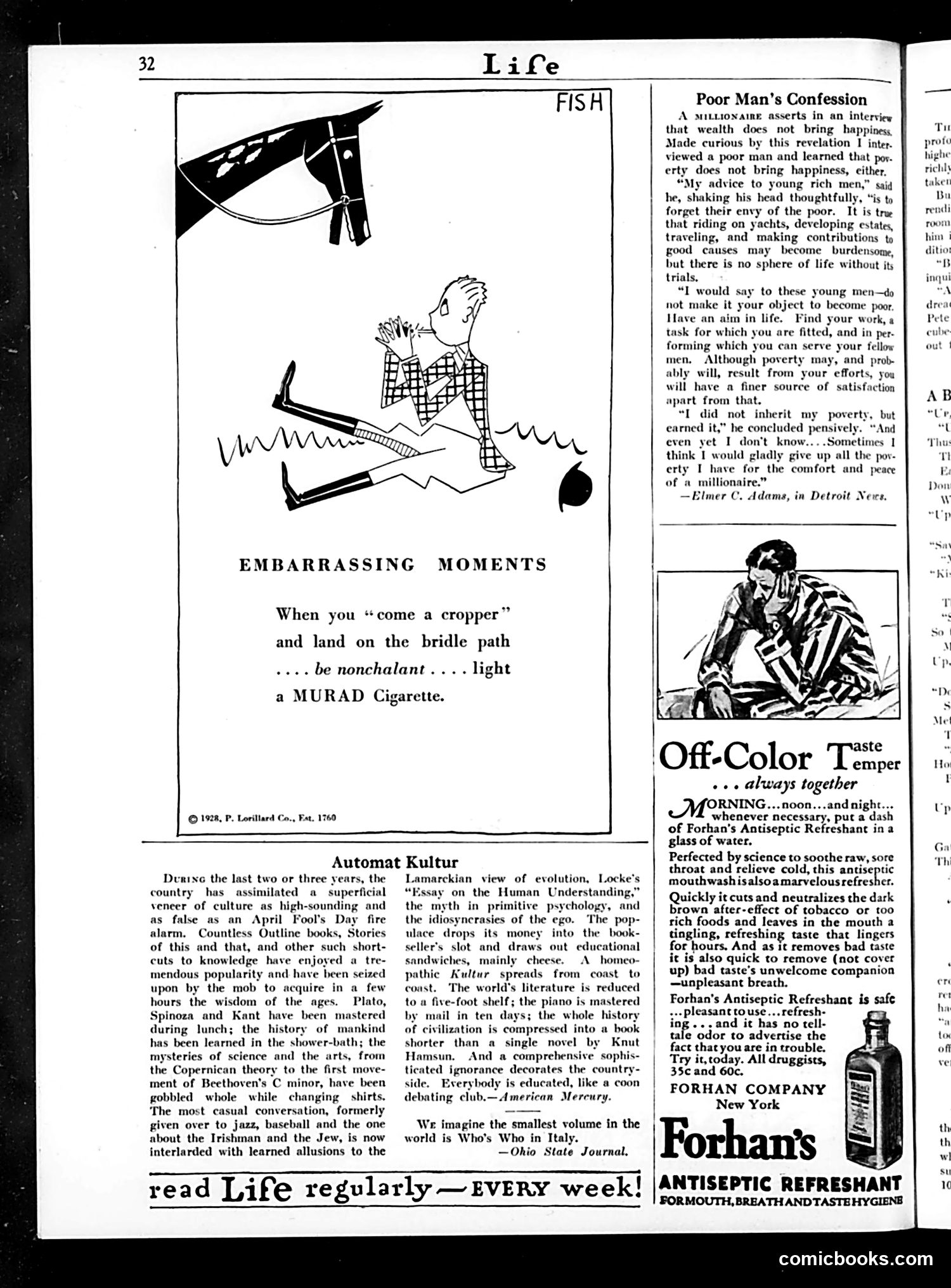
This 1928 Life magazine page contains three distinct sections: **"Embarrassing Moments" cartoon:** A humorous advertisement showing a man who has fallen from a horse onto a bridle path. The joke is that if you're caught in such an awkward, undignified situation, smoking a MURAD cigarette will make you appear calm and sophisticated—the cigarette serving as a prop for composure. **"Automat Kultur" essay:** Satirizes 1920s American self-improvement culture. The piece mocks people using "outline books" and condensed summaries to quickly absorb high philosophy (Plato, Spinoza, Kant) during lunch breaks or showers. The term "Automat" references automatic vending machines, suggesting knowledge is being consumed like fast food. It critiques superficial intellectual pretension spreading across society. **"Poor Man's Confession":** A tongue-in-cheek article where a poor man ironically advises wealthy young men not to envy the poor, claiming poverty brings unhappiness too. The humor lies in the poor man's resigned acceptance—he "earned" rather than inherited his poverty—and his wry admission he'd trade places with a millionaire.
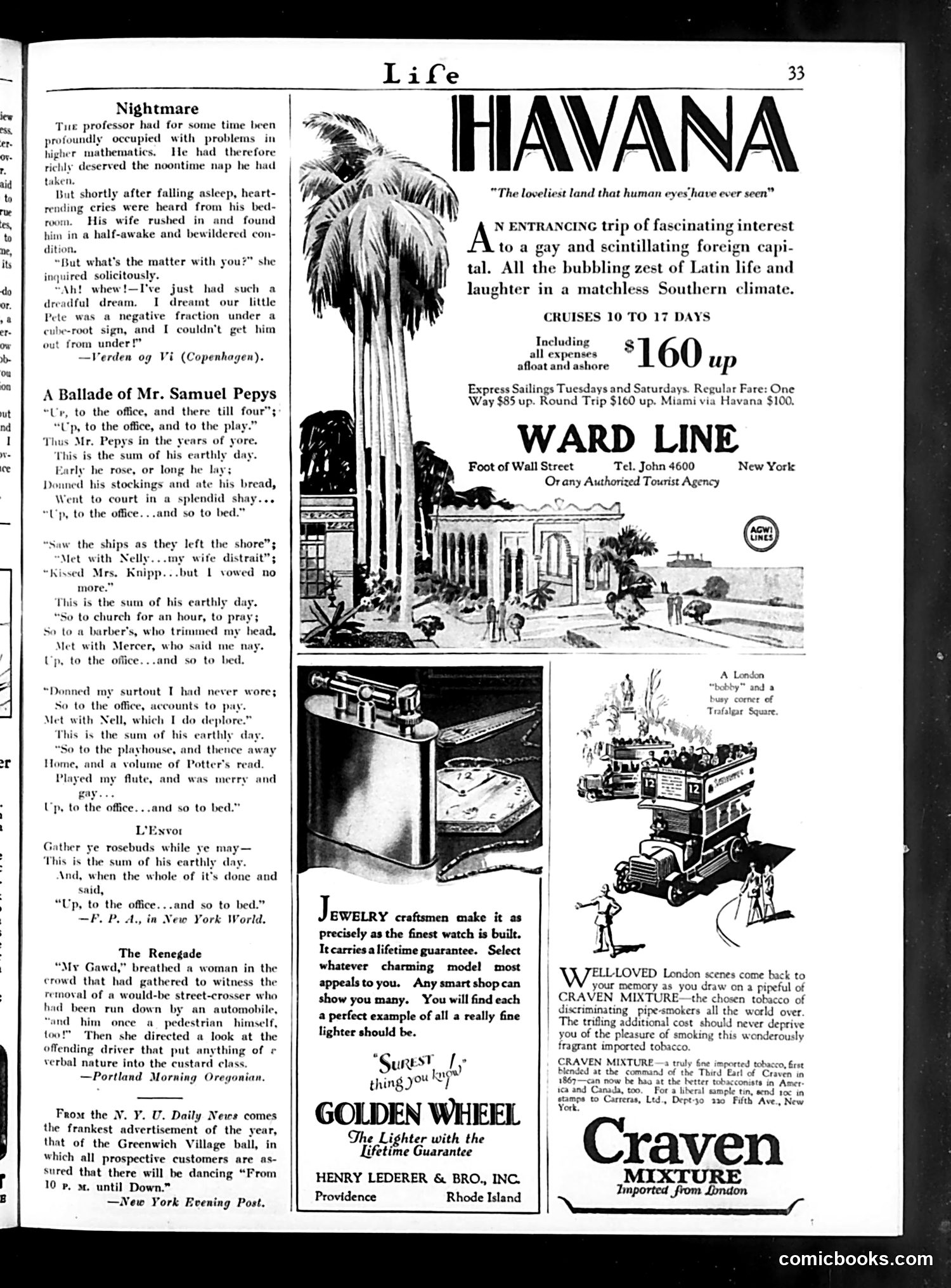
This page is primarily **advertising and light humor** rather than political satire. The short humorous pieces—"Nightmare," "A Ballade of Mr. Samuel Pepys," "The Renegade," and the Greenwich Village ball advertisement—are gentle social observations typical of 1920s American humor magazines. They mock academic absent-mindedness, the repetitive routines of daily life, pedestrian safety concerns (a timely joke about automobile accidents), and bohemian culture. The advertisements dominate: Ward Line cruise promotions to Havana, Golden Wheel lighters, Craven Mixture tobacco, and Jewelry craftsmanship. These reflect period consumer culture and leisure travel. **No significant political content is present.** The page represents Life magazine's standard format: mixing satirical vignettes with commercial advertisements aimed at affluent readers interested in travel, luxury goods, and witty commentary on contemporary manners and modern life.
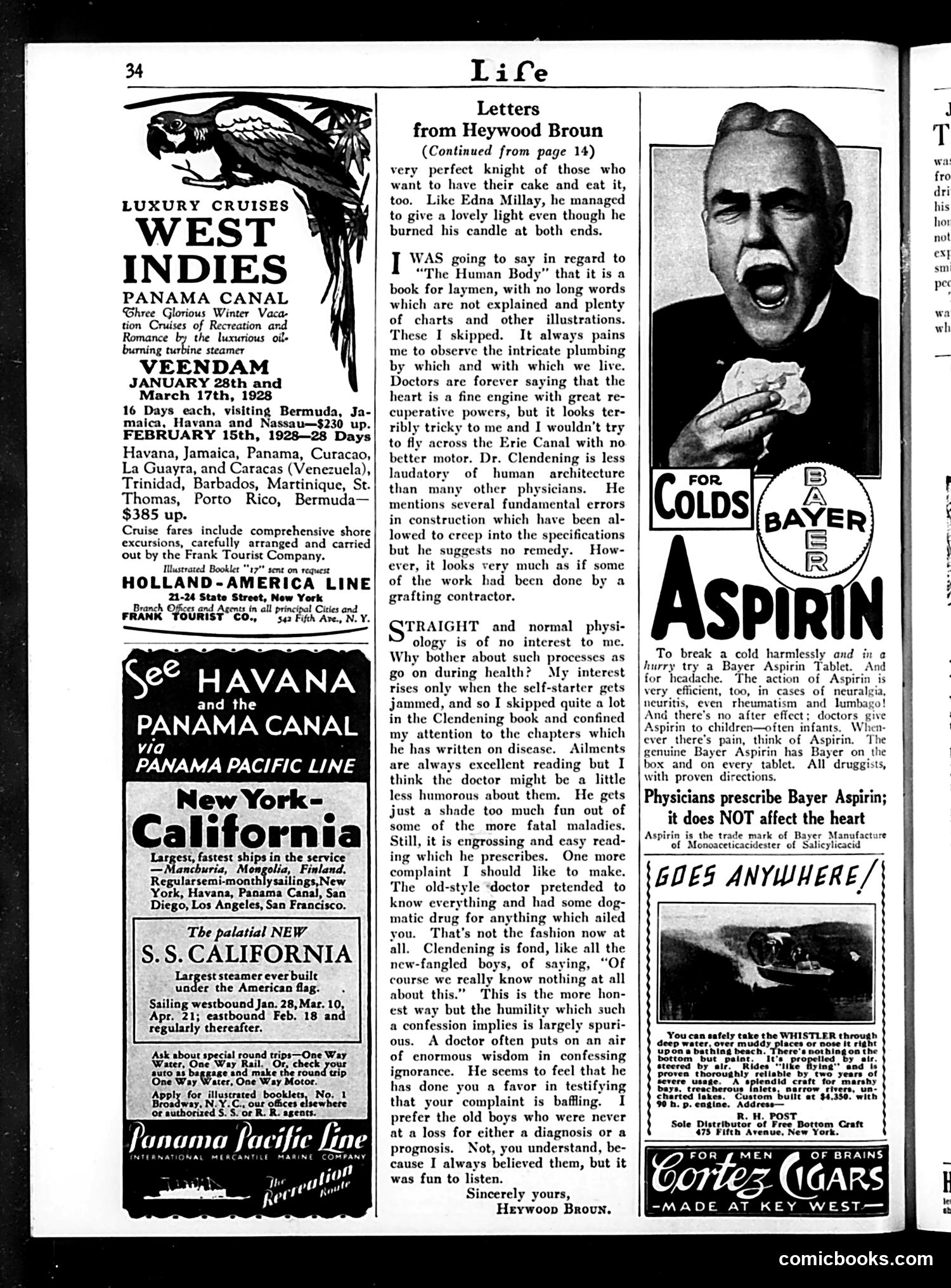
This page combines cruise ship advertisements with a letter column from Heywood Broun, a prominent American critic and writer. **The Advertisements:** Multiple shipping lines (Holland-America, Panama Pacific Line) promote luxury Caribbean and Panama Canal cruises for 1928, targeting affluent travelers seeking winter vacations. **Broun's Letter:** He reviews "The Human Body," a medical book for general readers. Broun humorously complains about medical writing—criticizing both old-fashioned doctors who claimed to know everything with "dogmatic drugs" and modern physicians who affect humble ignorance while implying superior knowledge. His tone is satirical and self-aware; he admits preferring the confident charlatan to the confessing ignoramus, "not because I always believed them, but it was fun to listen." The letter showcases Broun's characteristic wit about human nature and professional pretense rather than attacking specific political figures.
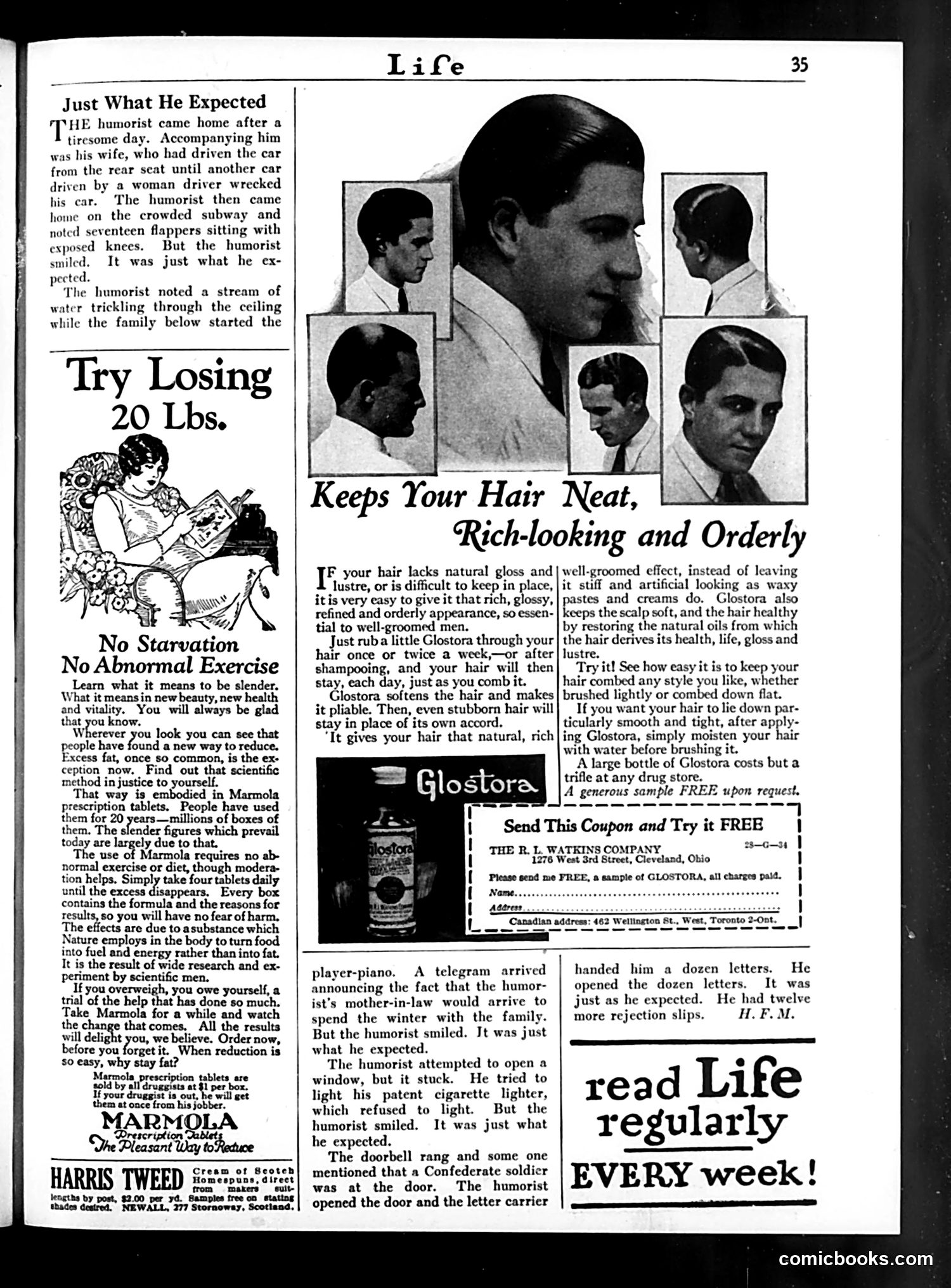
This page combines a humorous short story with period product advertisements. **"Just What He Expected"** satirizes a man's resigned fatalism. The humorist encounters a series of domestic disasters—his car wrecked by a female driver, subway crowded with "flappers" (young women showing their knees, then scandalous), water leaking through the ceiling, his mother-in-law arriving for an extended visit, a stuck window, a broken lighter. Rather than reacting with frustration, he smiles at each mishap, expecting exactly this chaos. The joke reflects 1920s anxiety about modern life's unpredictability: women drivers, changing social mores (exposed legs), domestic incompetence, and family obligations all represent contemporary sources of male exasperation. **The advertisements** promote weight-loss tablets (Marmola) and hair product (Glostora)—typical early-20th-century consumer goods marketed with pseudoscientific claims about "natural" appearance and health, targeting masculine vanity and anxiety about physical presentation.
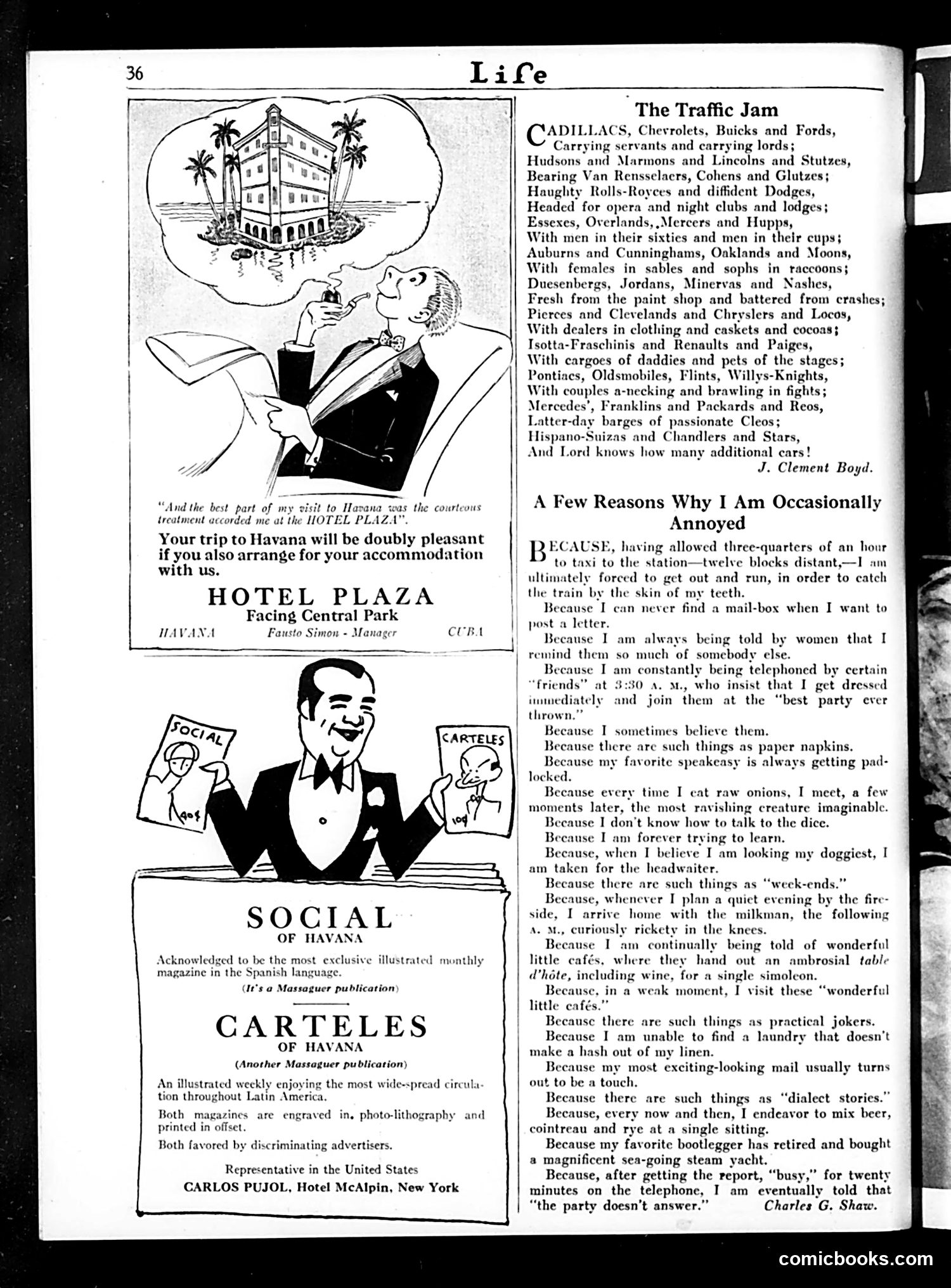
This Life magazine page (page 36) contains satirical poetry and advertisements aimed at upper-class readers during the Prohibition era (1920s-30s). **"The Traffic Jam"** by J. Clement Boyd is a humorous poem cataloging the excessive automobiles clogging city streets. It satirizes wealthy New Yorkers by listing luxurious car makes (Cadillacs, Rolls-Royces, Duesenbergs) alongside their ostentatious passengers: society figures with "servants," women in furs, people "a-necking and brawling," and the intoxicated ("men in their cups"). The joke targets conspicuous consumption and the traffic congestion caused by this wealth. **"A Few Reasons Why I Am Occasionally Annoyed"** by Charles G. Shaw complains humorously about modern inconveniences: missed trains, speakeasy raids (referencing Prohibition enforcement), practical jokers, bootleggers, and failed romantic encounters. These complaints depict a sophisticated but frustrated wealthy social life. The advertisements promote Havana tourism and Spanish-language publications, suggesting the page targets affluent Americans seeking escape and leisure.