
Life, 1928-01-19 · page 23 of 38
Life — January 19, 1928 — page 23: what you’re looking at
What you’re looking at
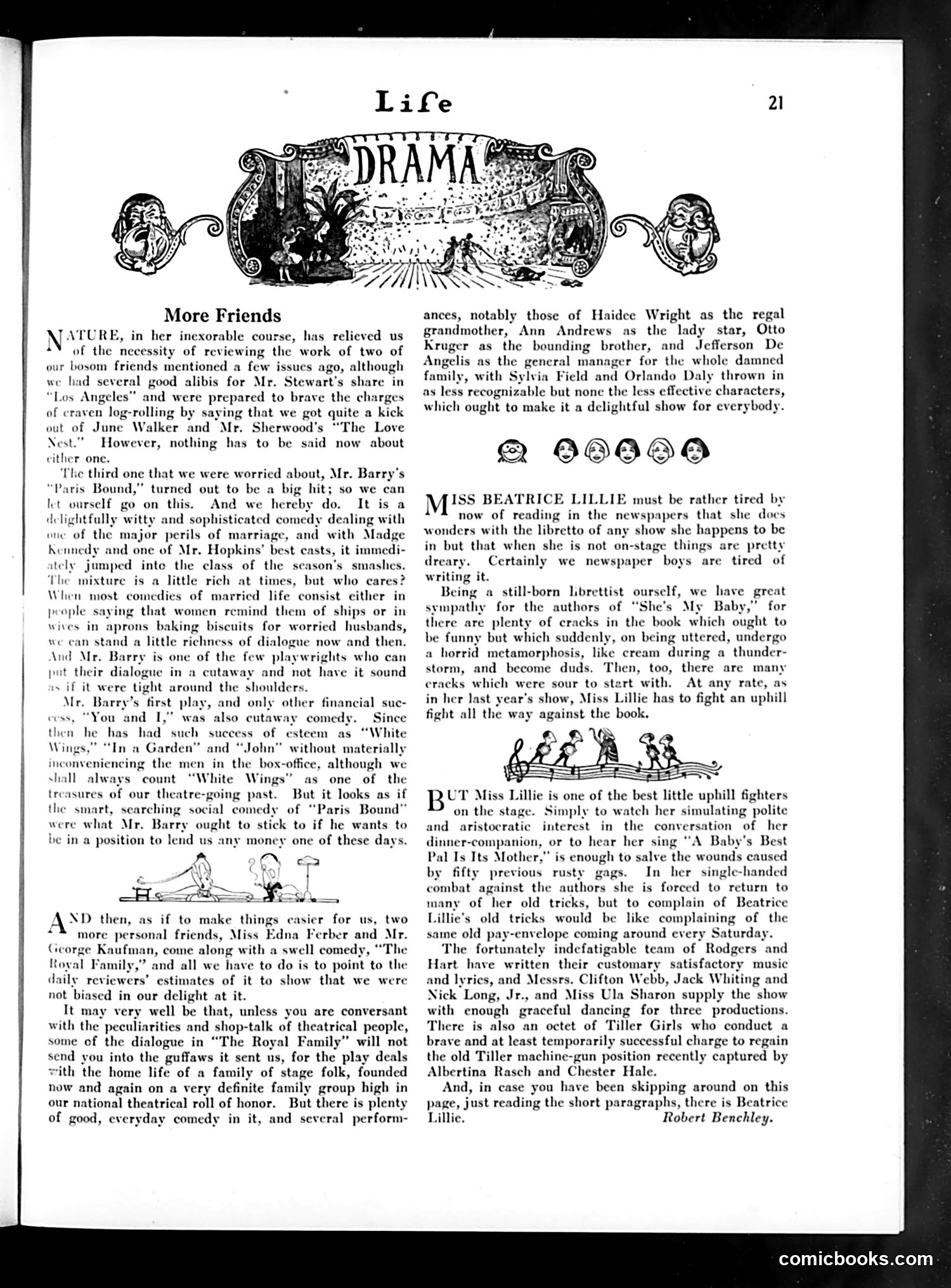
This page reviews four Broadway theatrical productions in the "Drama" section. The text discusses: **"Paris Bound"** by Philip Barry—praised as witty, sophisticated comedy about marriage perils, starring Madge Kennedy. The reviewer approves of Barry's ability to write natural dialogue. **"The Royal Family"** by Edna Ferber and George Kaufman—described as comedy about theatrical family life, featuring performers like Haidee Wright and Otto Kruger. The reviewer notes insider theatrical humor may escape general audiences. **"She's My Baby"**—criticized for having a weak libretto despite star Beatrice Lillie's talents. The reviewer sympathetically notes that dialogue that should be funny often falls flat on stage. The small cartoon illustrations depict theatrical masks and performers, typical of Life's drama section decoration. This is essentially a theater critic's column praising successful plays while good-naturedly ribbing weaker productions—standard entertainment journalism of the 1920s.
📄 Transcribed text from this page (OCR, searchable)
Machine-transcribed from the original scan — historical spelling and the odd misread are preserved.
More Friends ATURE, in her inexorable course, has relieved us of the necessity of reviewing the work of two of our bosom friends mentioned a few issues ago, although we had several good alibis for Mr. Stewart's share in “Los Angeles” and were prepared to brave the charges of craven log-rolling by saying that we got quite a kick out of June Walker and Mr. Sherwood's “The Love Nest.” However, nothing has to be said now about cither one. The third one that we were worried about, Mr. Barry's “Paris Bound,” turned out to be a big hit; so we can let ourself go on this. And we hereby do. It is a delightfully witty and sophisticated comedy dealing with one of the major perils of marriage, and with Madge Kennedy and one of Mr. Hopkins’ best casts, it imme ately jumped inte the class of the season's smashes. ‘The mixture is a little rich at times, but who cares? When most comedies of marricd life consist either in people saying that women remind them of ships or in wives in aprons baking biscuits for worried husbands, we can stand a little richness of dialogue now and then. And Mr. Barry is one of the few playwrights who can pat their dialogue in a cutaway and not have it sound ts if it were tight around the shoulders. Mr. Barry’s first play, and only other financial suc- cess, “You and I,” was also cutaway comedy. Since then he has had such success of esteem as “White Wings,” “In a Garden” and “John” without materially inconveniencing the men in the box-office, although we shall always count “White Wings’ as one of the treasures of our theatre-going past. But it looks as if the smart, searching social comedy of “Paris Bound” were what Mr. Barry ought to stick to if he wants to be in a position to lend us any money one of these days. ND then, as if to make things easier for us, two more personal friends, Miss Edna Ferber and Mr. George Kaufman, come along with a swell comedy, “The a ly,” and all we have to do is to point to the daily wers’ estimates of it to show that we were not biased in our delight at it. It may very well be that, unless you are conversant with the peculiarities and shop-talk of theatrical people, some of the dialogue in “The Royal Family” will not send you into the guffaws it sent us, for the play deals with the home life of a family of stage folk, founded now and again on a very definite family group high in our national theatrical roll of honor. But there is plenty of good, everyday comedy in it, and several perform- ances, notably those of Haidee Wright as the regal grandmother, Ann Andrews as the lady star, Otto Kruger as the bounding brother, and Jefferson De Angelis as the general manager for the whole damned family, with Sylvia Field and Orlando Daly thrown in as less recognizable but none the less effective characters, which ought to make it a delightful show for everybody. Q 9HO886 ] ISS BEATRICE LILLIE must be rather tired by now of reading in the newspapers that she docs wonders with the libretto of any show she happens to be in but that when she is not on-stage things are pretty dreary. Certainly we newspaper boys are tired of writing it. Being a still-born librettist ourself, we have great sympathy for the authors of “She's My Baby,’ for there are plenty of cracks in the book which ought to be funny but which suddenly, on being uttered, undergo a horrid metamorphosis, like cream during a thunder- storm, and become duds. Then, too, there are many cracks which were sour to stert with. At any rate, as in her last year’s show, Miss Lillie has to fight an uphill fight all the way against the book. © UT Miss Lillie is one of the best little uphill fighters on the sta Simply to ch her simulating polite and aristocratic interest in the conversation of her dinner-companion, or to hear her sing “A Baby's Best Pal Is Its Mother,” is enough to salve the wounds caused by fifty previous rusty gags. In her single-handed combat against the authors she is forced to return to many of her old tricks, but to complain of Beatrice Lillie’s old tricks would be like complaining of the same old pay-envelope coming around every Saturday. The fortunately indefatigable team of Rodgers and Hart have written their customary satisfactory music and lyrics, and Messrs. Clifton Webb, Jack Whiting and Nick Long, Jr., and Miss Ula Sharon supply the show with enough graceful dancing for three productions. TI also an octet of Tiller Girls who conduct a brave and at least temporarily successful charge to regain the old Tiller machine-gun position recently captured by Albertina Rasch and Chester Hale. And, in case you have been skipping around on this page, just reading the short paragraphs, there is Beatrice Lillie. Robert Benchley. comicbooks.com