
Life, 1928-01-19 · page 16 of 38
Life — January 19, 1928 — page 16: what you’re looking at
What you’re looking at
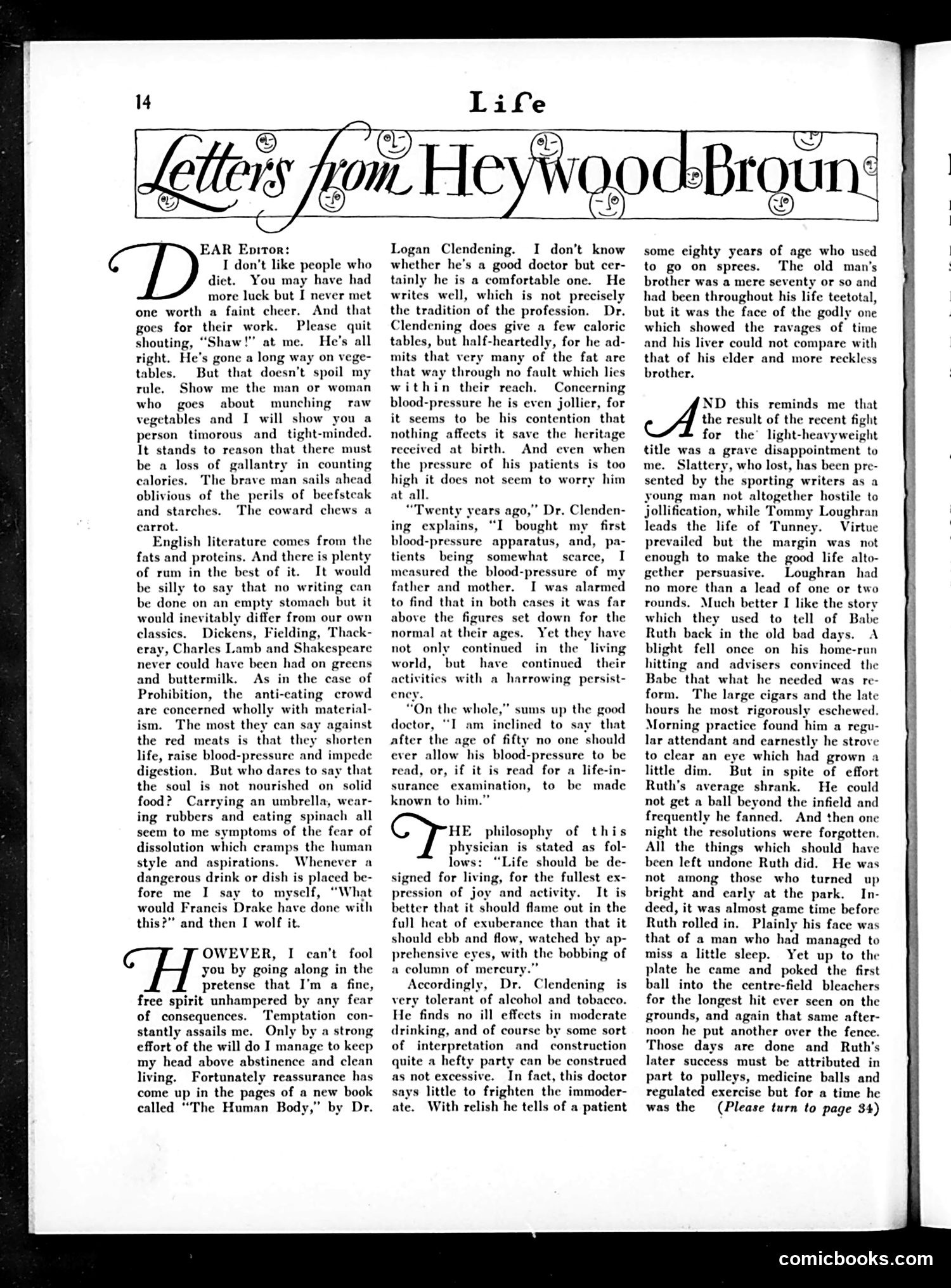
This page contains the "Letters from Heywood Broun" column—a satirical advice section rather than a political cartoon. The content discusses diet and health philosophy through the persona of Dr. Logan Clendening, a real physician known for popular health writings in the 1920s-30s. The satire targets diet fads and health obsession. The column mocks readers obsessing over calorie-counting and raw vegetables while praising Dr. Clendening's relaxed approach to blood pressure and moderate drinking/tobacco use. The joke is that this "enlightened" doctor dismisses health anxiety as unnecessary worry—the satire being that such cavalier attitudes toward health were presented as sophisticated wisdom in that era. The letter-writer humorously positions himself as intellectually superior for avoiding health faddism.
📄 Transcribed text from this page (OCR, searchable)
Machine-transcribed from the original scan — historical spelling and the odd misread are preserved.
EAR Epitor: I don't like people who diet. You may have had more luck but I never met one worth a faint cheer. And that goes for their work. Please quit shouting, “Shaw!” at me. He's all right. He's gone a long way on vege- tables. But that doesn’t spoil my rule. Show me the man or woman who goes about munching raw vegetables and I will show you a person timorous and_ tight- minded. It stands to reason that there must be a loss of gallantry in counting calories. The brave man sails ahead oblivious of the perils of beefsteak and starches. The coward chews a carrot. English literature comes from the fats and proteins. And there is plenty of rum in the best of it. It would be silly to say that no writing can be done on an empty stomach but it would inevitably differ from our own classics. Dickens, Fielding, Thack- eray, Charles Lamb and Shakespeare never could have been had on greens and buttermilk. As in the case of Prohibition, the anti-cating crowd are concerned wholly with material- ism. The most they can say against the red meats is that they shorten life, raise blood-pressure and impede digestion. But who dares to say that the soul is not nourished on solid food? Carrying an umbrella, wes ing rubbers and eating spinach all seem to me symptoms of the fear of dissolution which cramps the human style and aspirations. Whenever a dangerous drink or dish is placed be- fore me I say to myself, “What would Francis Drake have done with this?” and then I wolf it. OWEVER, I can't fool you by going along in the pretense that I’m a fine, free spirit unhampered by any fear of consequences. ‘Temptation con- stantly assails me. Only by a strong effort of the will do I manage to keep my head above abstinence and clean living. Fortunately reassurance has come up in the pages of a new book called ‘The Human Body,” by Dr. Logan Clendening. I don’t know whether he’s a good doctor but cer- tainly he is a comfortable one. He s well, which is not precisely the tradition of the profession. Dr. Clendening does give a few caloric tables, but half-heartedly, for he ad- mits that very many of the fat are that way through no fault which lies within their reach, Concerning blood-pressure he is even jollier, for it seems to be his contention that nothing affects it save the heritage received at birth. And even when the pressure of his patients is too high it does not seem to worry him at all. “Twenty years ago,” Dr. Clenden- ing explains, “I bought my first blood-pressure apparatus, and, pa- tients being somewhat scarce, I measured the blood-pressure of my father and mother. I was alarmed to find that in both cases it was far above the figures set down for the normal at their ages. Yet they ha’ not only continued in the living world, but have continued — their activitics with a harrowing persist- ency. “On the whole,” sums up the good doctor, “I am inclined to say that after the age of fifty no one should ever allow his blood-pressure to be read, or, if it is read for a life-in- surance examination, to be made known to him.” HE philosophy of this physician is stated as fol- lows: “Life should be de- signed for living, for the fullest ex- pression of joy and activity. It is better that it should flame out in the full heat of exuberance than that it should ebb and flow, watched by ap- prehensive eyes, with the bobbing of a column of mercury. Accordingly, Dr. Clendening is very tolerant of alcohol and tobacco. He finds no ill effects in modcrate drinking, and of course by some sort of interpretation and construction quite a hefty party can be construed as not excessive. In fact, this doctor says little to frighten the immoder- ate. With relish he tells of a patient some eighty years of age who used to go on sprees. The old man’s brother was a mere seventy or so and had been throughout his life teetotal, but it was the face of the godly one which showed the ravages of time and his liver could not compare with that of his elder and more reckless brother. ND this reminds me that the result of the recent fight for the’ light-heavyweight title was a grave disappointment to me. Slattery, who lost, has been pre- sented by the sporting writers as a young man not altogether hostile to jollification, while Tommy Loughran leads the life of Tunney. Virtue prevailed but the margin was not enough to make the good life alto- gether persuasive. Loughran had no more than a lead of one or two rounds. Much better I like the story which they used to tell of Babe Ruth back in the old bad days. A blight fell once on his home-run hitting and advisers convinced the Babe that what he needed was re- form. The large cigars and the late hours he most rigorously eschewed. Morning practice found him a regu- lar attendant and earnestly he strove to clear an eye which had grown a little dim. But in spite of effort Ruth’s average shrank. He could not get a ball beyond the infield and frequently he fanned. And then one night the resolutions were forgotten. All the things which should have been left undone Ruth did. He was not among those who turned up bright and early at the park. In- deed, it was almost game time before Ruth rolled in. Plainly his face was that of a man who had managed to miss a little sleep. Yet up to the plate he came and poked the first ball into the centre-field bleachers for the longest hit ever seen on the grounds, and again that same after- noon he put another over the fence. Those days are done and Ruth's later success must be attributed in part to pulleys, medicine balls and regulated exercise but for a time he was the (Please turn to page $4) comicbooks.com