
Life, 1928-01-19 · page 28 of 38
Life — January 19, 1928 — page 28: what you’re looking at
What you’re looking at
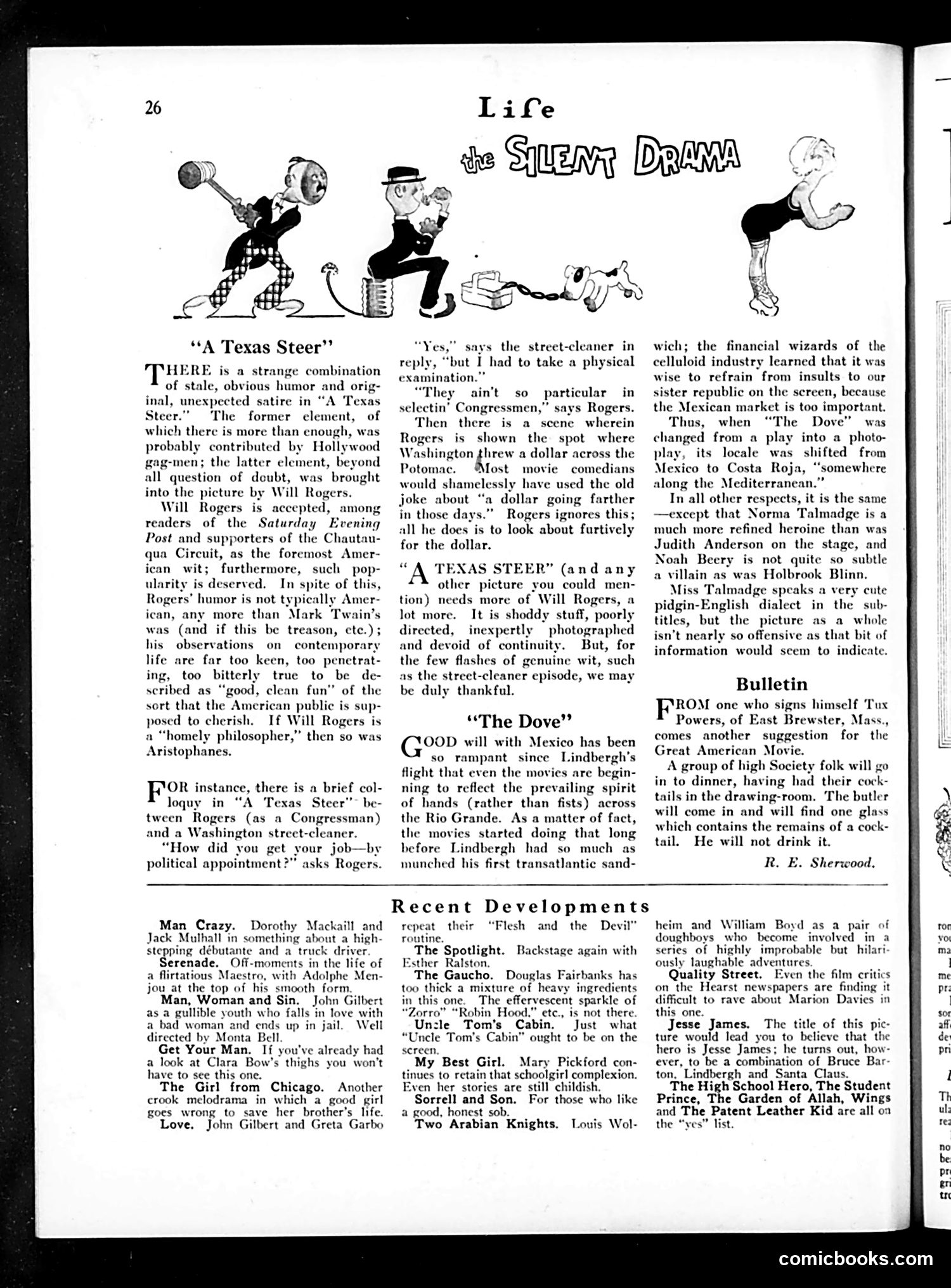
This page reviews two silent films. **"A Texas Steer"** stars Will Rogers as a Congressman. The satire praises Rogers's genuinely sharp wit—exemplified by a scene mocking political patronage where a street-cleaner quips that Congress doesn't require "physical examination." The reviewer contrasts Rogers's "bitterly true" observations with typical Hollywood "good, clean fun," comparing him favorably to Mark Twain and Aristophanes. **"The Dove"** is discussed as part of a broader Hollywood trend toward U.S.-Mexico goodwill since Lindbergh's 1927 transatlantic flight. The film was relocated from Mexico to Costa Rica for its screen adaptation (likely to avoid offending the lucrative Mexican market). Norma Talmadge stars as a "refined heroine" who speaks "pidgin-English" in the intertitles—a detail the reviewer finds less offensive than expected. Both reviews reflect 1920s film criticism and the industry's sensitivity to international markets.
📄 Transcribed text from this page (OCR, searchable)
Machine-transcribed from the original scan — historical spelling and the odd misread are preserved.
““A Texas Steer”’ HERE is a strange combination of stale, obvious humor and orig- inal, unexpected satire in “A Texas Steer.” The former clement, of which there is more than enough, was probably contributed by Hollywood gag-men; the latter element, beyond all question of doubt, was brought into the picture by Will Rogers. Will Rogers accepted, among readers of the Saturday Evening Post and supporters of the Chautau- qua Circuit, as the foremost Amer- ican wit; furthermore, such pop- ularity is deserved. In spite of thi Rogers’ humor is not typic: ican, any more than Mark Twain’s was (and if this be treason, ete.) ; his observations on contemporary life are far too keen, too penctrat- ing, too bitterly true to be de- scribed as “good, clean fun” of the sort that the American public is sup- posed to cherish. If Will Rogers i a “homely philosopher,” then so was Aristophanes. OR instance, there is a brief col- loquy in “A Texas Steer” be- tween Rogers (as a Congressman) and a Washington strect-cleaner. “How did you get your job—by political appointment?” asks Rogers. * says the street-cleaner in but I had to take a physical “They ain't. so particular in selectin’ Congressmen,” says Rogers. Then there is a scene wherein Rogers is shown the spot where Washington threw a dollar across the Potomac. Most movie comedians would shamelessly have used the old joke about “a dollar going farther in those dé Rogers ignores this; all he does is to look about furtively for the dollar. “A TEXAS STEER” (and any other picture you could men- tion) needs more of Will Rogers, a lot more. It is shoddy stuff, poorly directed, inexpertly photographed and devoid of continuity. But, for the few flashes of genuine wit, such as the street-cleaner episode, we may be duly thankful. “The Dove” OOD will with Mexico has been so rampant since Lindbergh's flight that even the movies are begin- ning to reflect the prevailing spirit of hands (rather than fists) across the Rio Grande. As a matter of fact, the movies started doing that long before Lindbergh had so much as munched his first transatlantic sand- wich; the financial wizards of the celluloid industry learned that it was wise to refrain from insults to our sister republic on the screen, because the Mexican market is too important. Thus, when “The Dove” was changed from a play into a_photo- its locale was shifted from somewhere play, Mexico to Costa Roja, along the Mediterranean. In all other respects is the same —except that Norma Talmadge is a much more refined heroine than was Judith Anderson on the stage, and Noah Beery is not quite so subtle a villain as was Holbrook Blinn. Miss Talmadge speaks a very cute pidgin-English dialect in the sub- titles, but the picture as a whole isn’t nearly so offensive as that bit of information would scem to indicate. Bulletin ROM one who signs himself Tux Powers, of East Brewster, Mass., comes another suggestion for the Great American Movie. A group of high Society folk will go in to dinner, having had their cock- tails in the drawing-room. The butler will come in and will find one glass which contains the remains of a cock- tail. He will not drink it. R. E. Sherwood. Man Crazy. Dorothy Mackaill and Jack Mulhall in something about a high- stepping débutante and a truck driver. erenade. Off-moments in the life of a flirtatious Maestro, with Adolphe Men- jou at the top of his smooth form. Man, Woman and Sin. John Gilbert as a gullible youth who falls in love with a_bad woman and ends up in jail. Well directed by Monta Bell Get Your Man. If you've already had a look at Clara Bow's thighs you won't have to see this one. The Girl from Chicago. Another crook melodrama in which a good girl goes wrong to save her brother's life. Love. John Gilbert and Greta Garbo Recent Developments repeat their “Flesh and the Devi routine. The Spotlight. Esther Ralston. The Gaucho. Douglas Fairbanks has too thick a mixture of heavy ingredients in this sone. The effervescent parkle of “Robin Hood,” ete., is not there. Tom's Cabin. Just what “Uncle Tom's Cabin” ought to be on the screen, My Best Girl. Mary Pickford con- tinues to retain that schoolgirl complexion. Even her stories are still childish. Sorrell and Son. For those who like a good, honest sob. Two Arabian Knights. Backstage again with Louis Wol- heim and William Boyd as a pair of doughboys who become involved in a series of highly improbable but hilari- ously laughable adventures. Quality Street. Even the film critics on the Hearst newspapers are finding it difficult to rave about Marion Davies in this one. Jesse James. The title of this pic- ture would lead you to believe that the hero is Jesse James; he turns out, how- ever, to be a combination of Bruce Bar- ton, Lindbergh and Santa Claus. The High School Hero, The Student Prince, The Garden of Allah, Wings and The Patent Leather Kid are all on the “yes” list. comicbooks.com