
A complete issue · 48 pages · 1927
Life — November 17, 1927
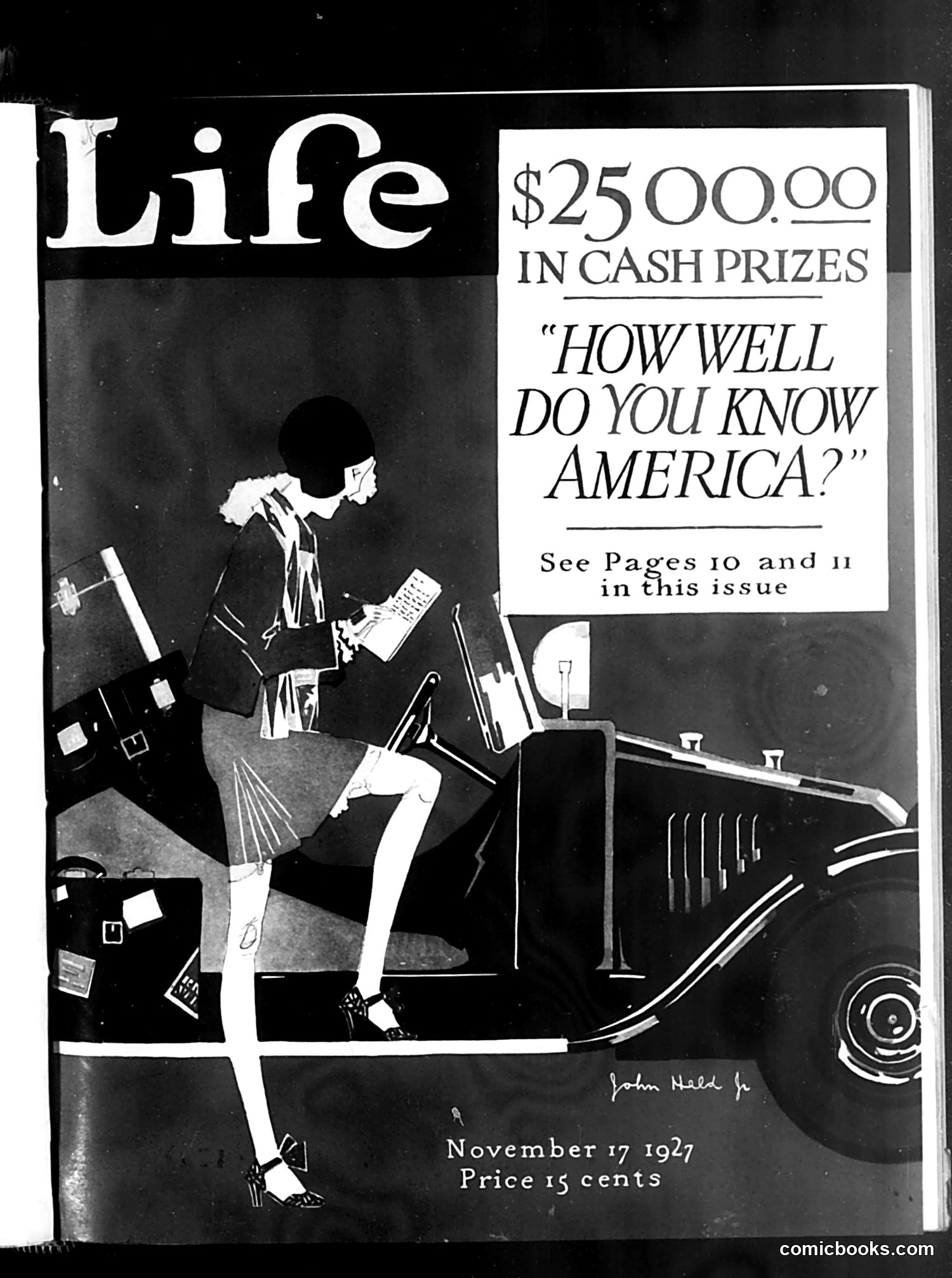
This is a **magazine cover**, not a political cartoon. It advertises a contest titled "How Well Do You Know America?" offering $2,500 in cash prizes (see pages 10-11). The illustration depicts a stylish 1920s woman in a car, surrounded by American symbols and artifacts—flags, maps, and travel items. She appears to be a tourist or traveler preparing for an American road trip, embodying the Jazz Age aesthetic with her fashionable dress and modern automobile. The cover uses this glamorous image to entice readers to participate in the knowledge contest about American geography, culture, or trivia. At 15 cents, this issue capitalized on growing American prosperity and automobile culture of the era.
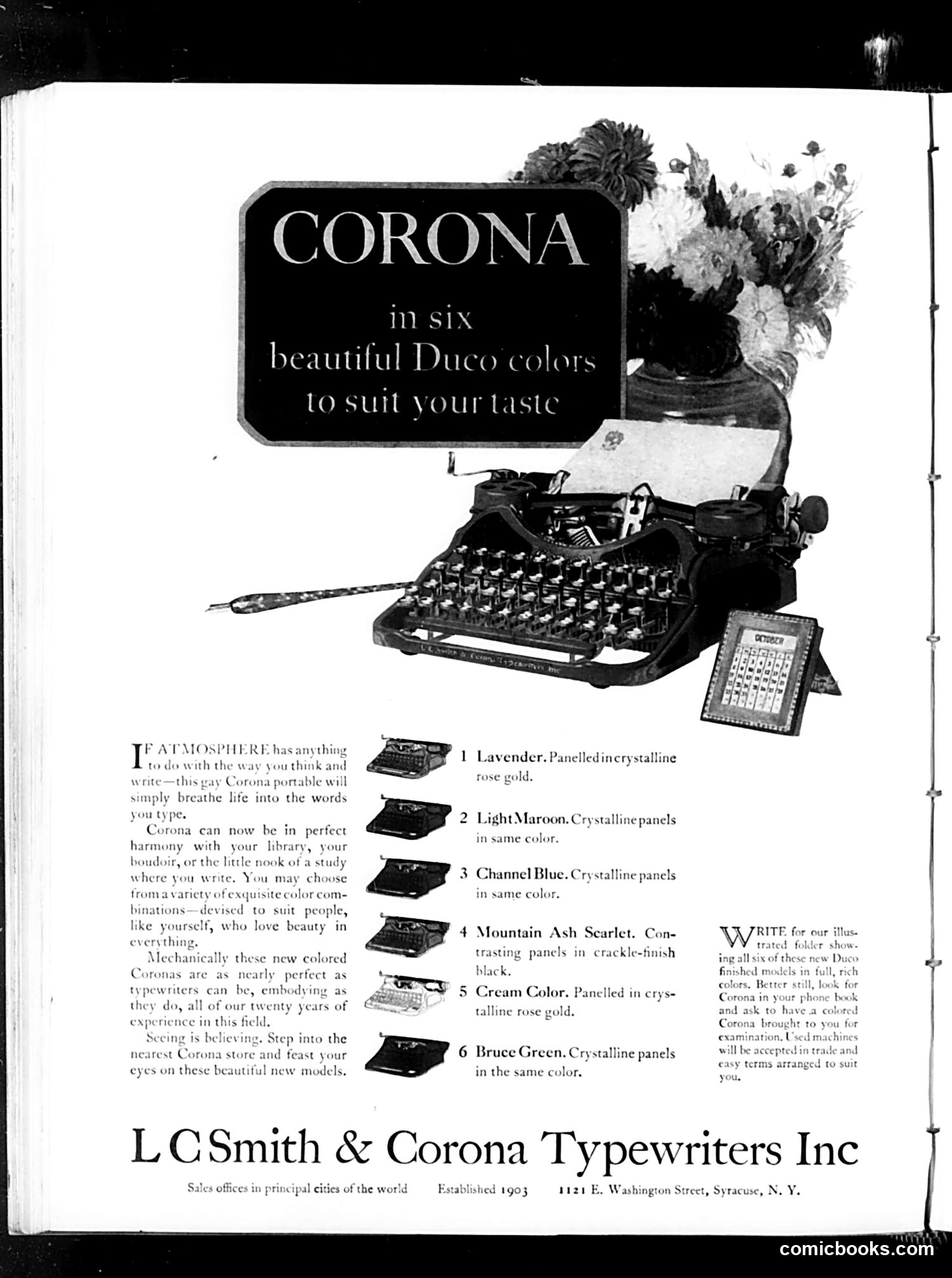
This is **not a political cartoon or satire** — it's a straightforward **advertisement for Corona typewriters**, placed in Life magazine. The page promotes Corona's new portable typewriter line available in six decorative "Duco colors" (a DuPont lacquer finish popular in the 1920s-30s). The ad emphasizes how the colored machines could complement home décor while maintaining typewriter functionality. The flower arrangement atop the typewriter and the text about "atmosphere" and "harmony with your library" reflect period marketing that positioned typewriters as stylish household furnishings, not just office equipment—appealing to writers, students, and affluent home users. The company name and Syracuse address confirm this as authentic period advertising rather than satirical content.
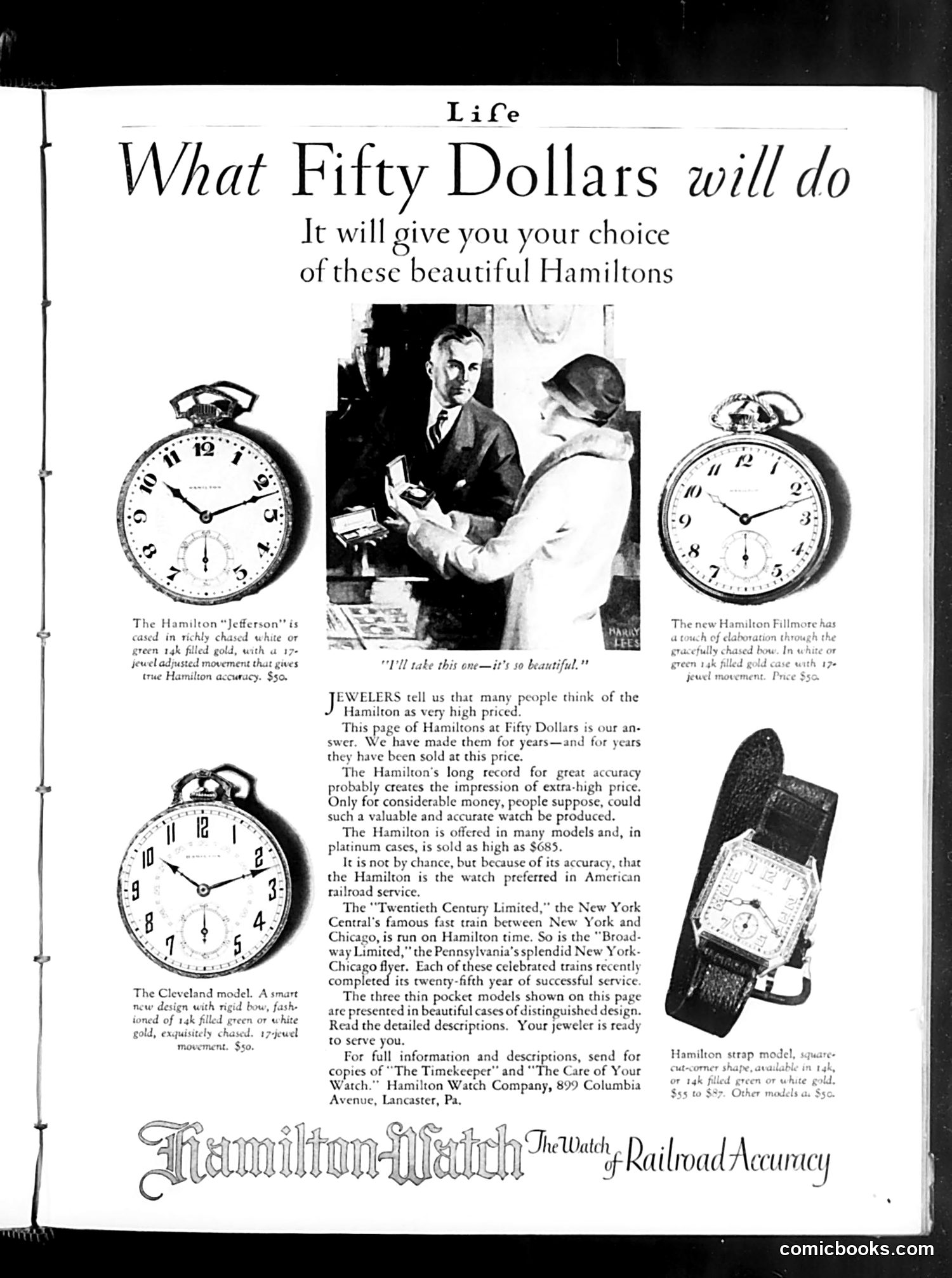
This is primarily a **Hamilton Watch Company advertisement**, not a political cartoon. The page promotes "$50 Hamilton pocket watches" across three models: the Jefferson, Fillmore, and Cleveland. The "satire" is subtle: the ad addresses a common perception that Hamilton watches are "very high priced" by positioning these three specific models as affordable alternatives at exactly $50. The accompanying photograph shows a jeweler presenting a watch to a customer, emphasizing accessibility. The ad leverages Hamilton's reputation for railroad precision—mentioning famous trains like the "Twentieth Century Limited" to reinforce reliability. There's no political commentary about the historical figures named (Jefferson, Fillmore, Cleveland); their names simply appear to be marketing labels for watch models, likely reflecting early-20th-century naming conventions for products.
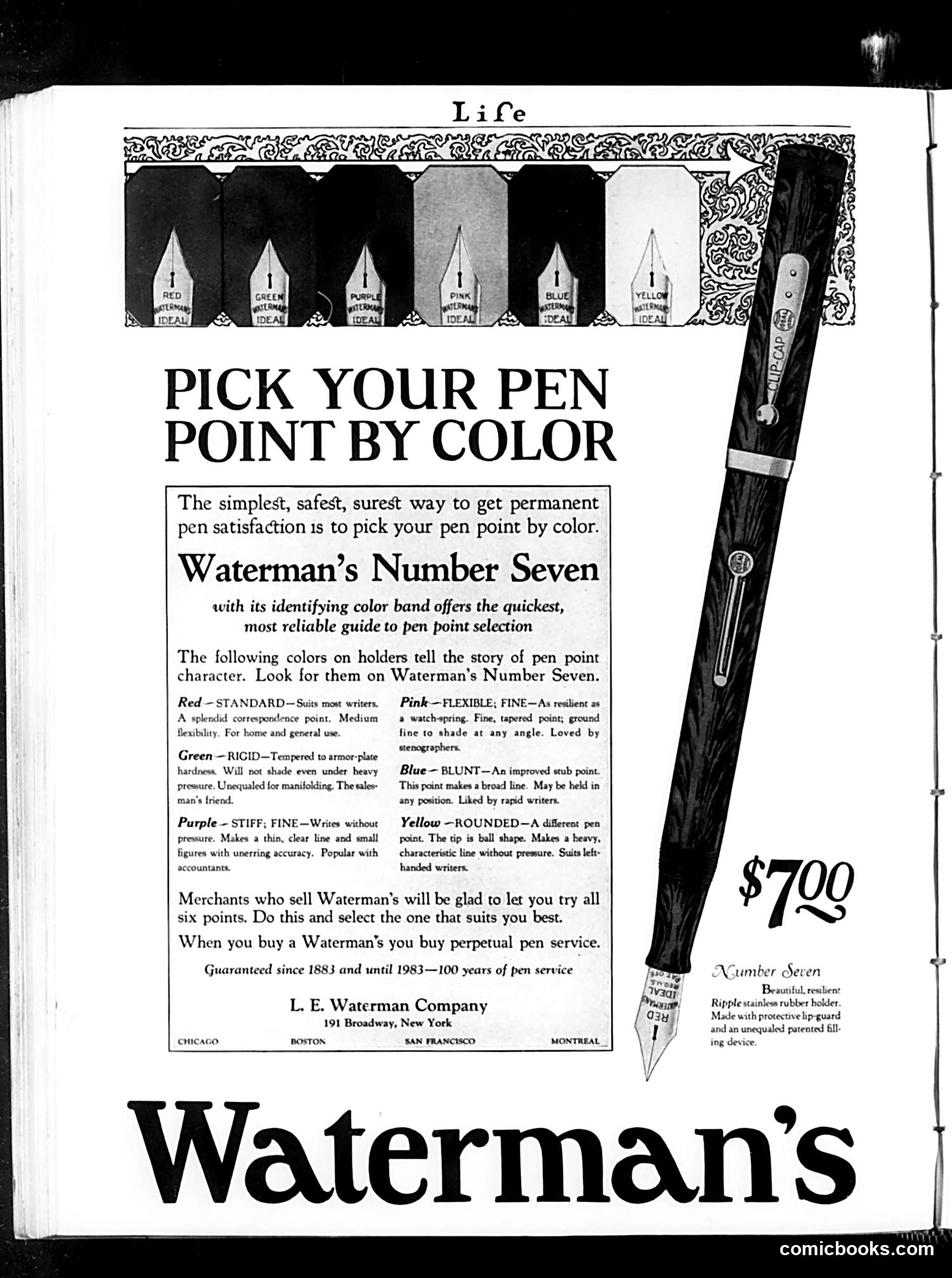
This page is **primarily an advertisement**, not satirical content. It promotes Waterman's Number Seven fountain pen, priced at $7.00. The ad's main feature is a color-coding system for pen points (red, green, purple, pink, blue, yellow), allowing customers to select based on writing style and purpose. Each color corresponds to specific characteristics—for example, red is "standard" for general use, while blue is a "blunt" point for rapid writers. The ad emphasizes reliability and longevity, guaranteeing "100 years of pen service" since 1883. The accompanying pen illustration shows the product's design with its distinctive rippled rubber holder. There is no political satire here—it's straightforward commercial marketing typical of early 20th-century *Life* magazine advertising.
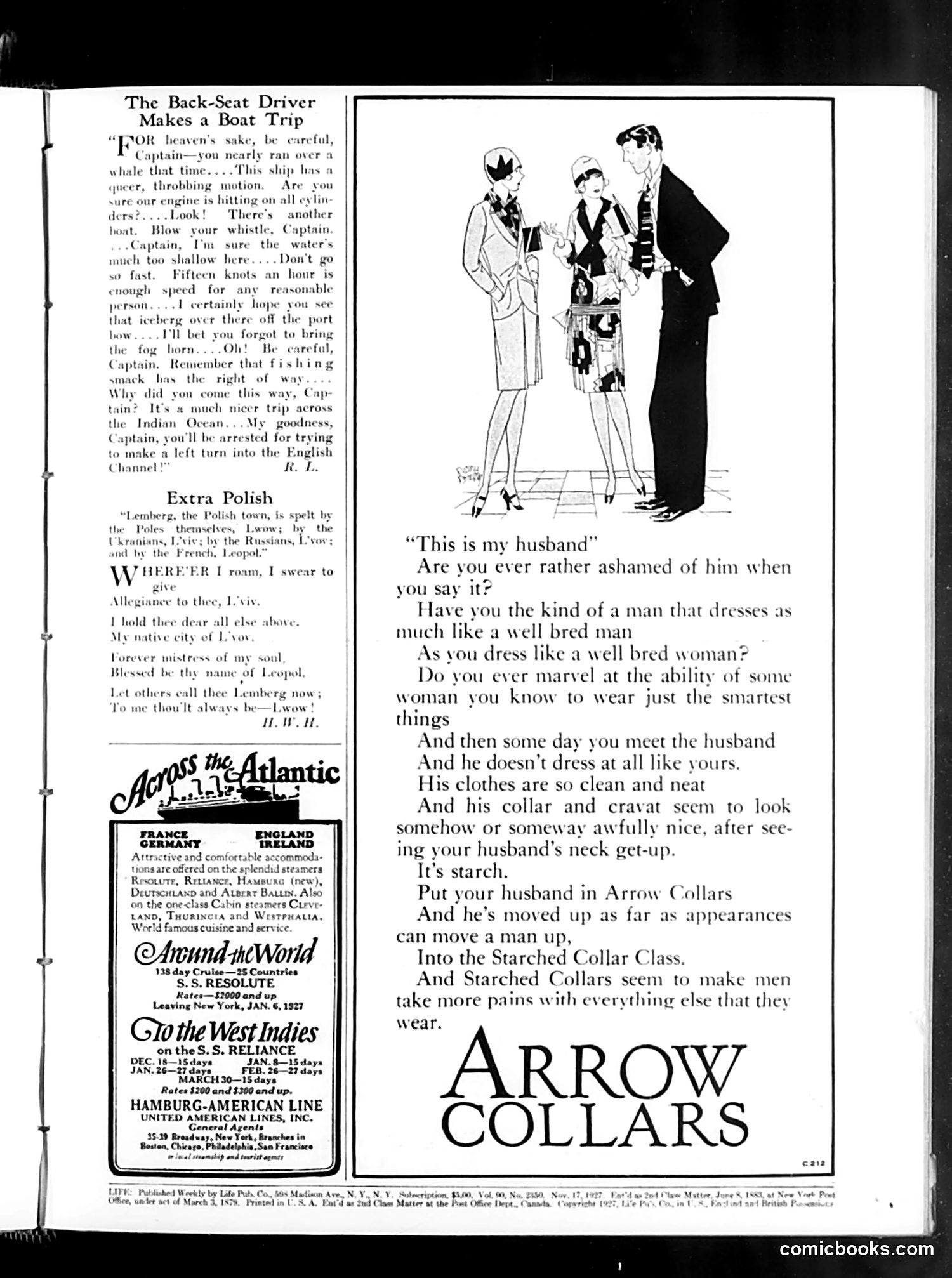
This page is primarily **advertising**, not satire. The main content is an Arrow Collars advertisement featuring a humorous poem about husbands' clothing and appearance. The **illustration** shows a well-dressed couple with a man in formal attire, apparently the husband being introduced. The **accompanying verse** humorously contrasts a wife's fashionable appearance with her husband's potentially shabby dress, then argues that Arrow Collars can elevate a man's status and respectability through proper grooming—specifically starched collars that place him in the "Starched Collar Class." The joke targets **gender expectations and class anxiety** in 1920s America: women invested heavily in fashion, but husbands' appearance reflected on family standing. Arrow Collars positioned themselves as an affordable way for ordinary men to appear refined and well-bred. This is **consumer advertising disguised as humor**, exploiting social insecurity.
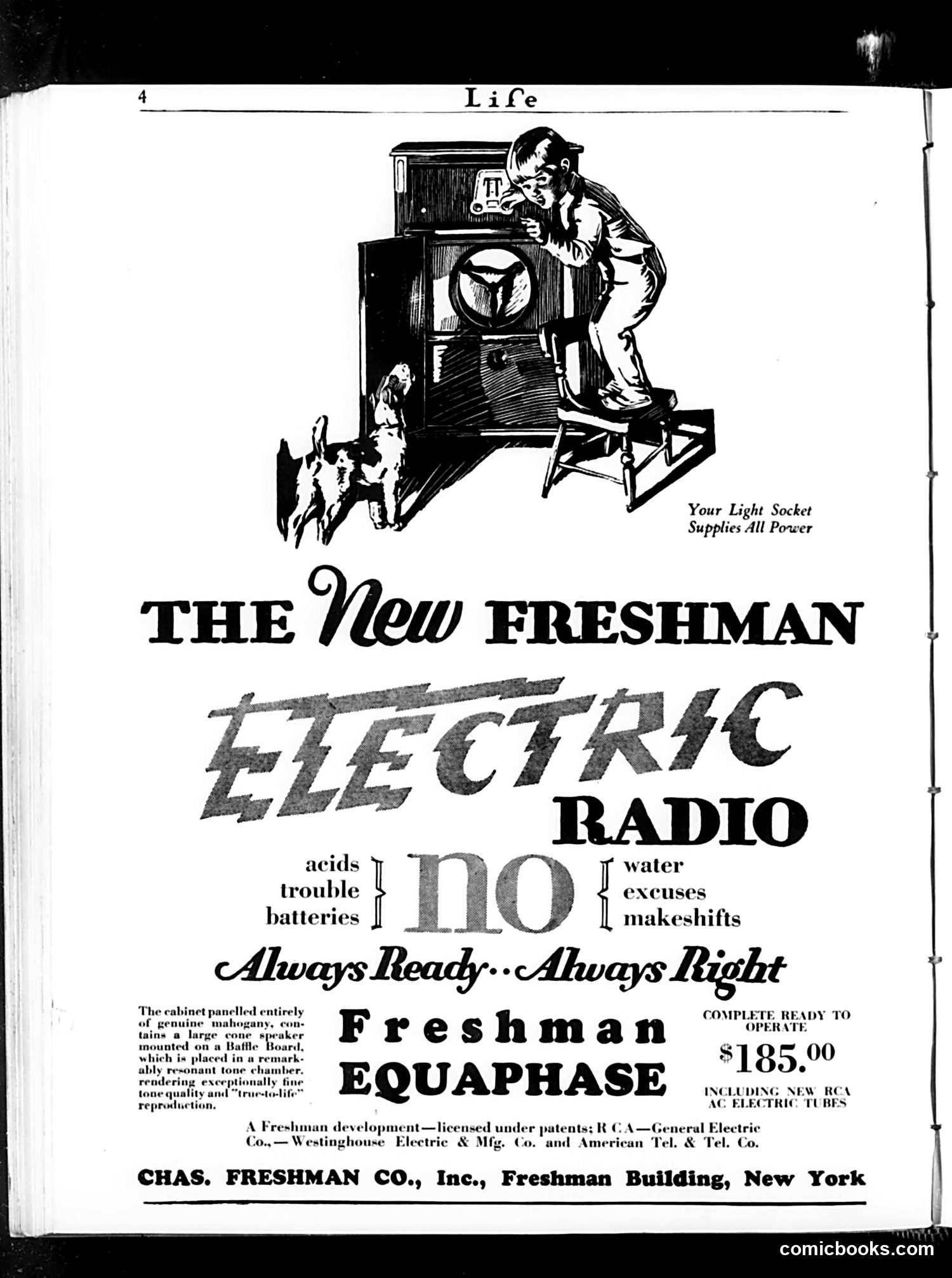
This page is **primarily an advertisement**, not political satire. It promotes the "Freshman Electric Radio," a consumer product from the 1920s era. The illustration shows a child operating an early radio set while a dog watches—a domestic scene emphasizing the product's accessibility and ease of use. The tagline "Your Light Socket Supplies All Power" highlights a key selling point: no batteries required, as the radio plugs into household electricity. The advertised benefits—"NO acids, trouble, batteries, water, excuses, makeshift"—address common frustrations with earlier battery-powered radios. The phrase "Always Ready...Always Right" reinforces reliability. At $185 (substantial money in the 1920s), this targets middle-class consumers. The manufacturer, Chas. Freshman Co., Inc., of New York, was a legitimate electronics firm of that period.
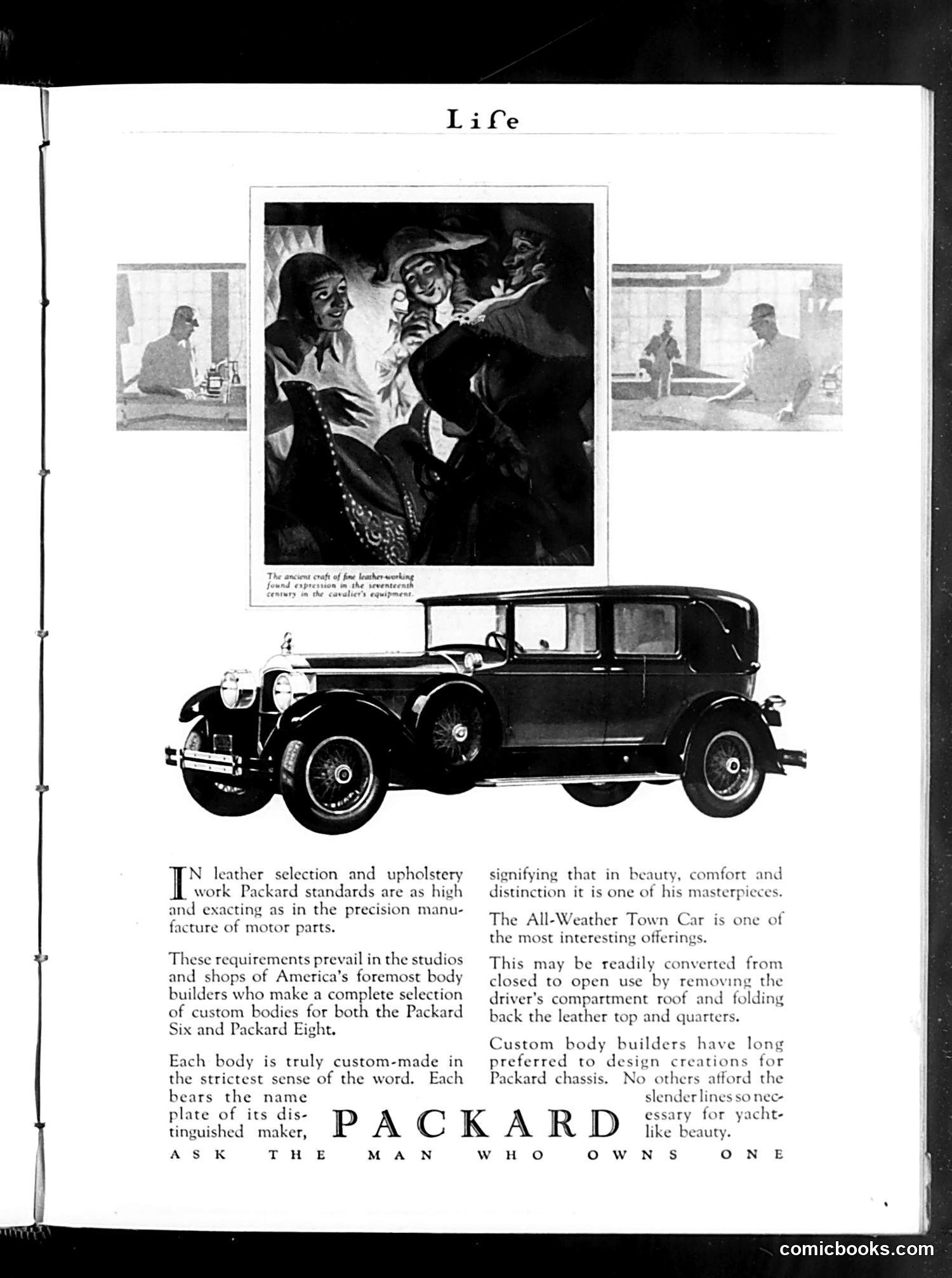
This is primarily a **Packard automobile advertisement**, not a political cartoon. The page is titled "Life" and features luxury car marketing rather than satire. The central image shows what appears to be **theatrical or comedic figures** (likely from a period film or sketch) examining something with exaggerated expressions—possibly meant to evoke sophistication or entertainment to sell aspirational lifestyle products. The text emphasizes **Packard's craftsmanship** in leather selection, upholstery, and custom body-building, positioning the vehicle as a luxury good comparable to fine art. The "All-Weather Town Car" is presented as convertible and customizable. The tagline "Ask the man who owns one" was Packard's actual advertising slogan. This reflects 1920s-era marketing: using entertainment imagery and claims of precision manufacturing to appeal to wealthy consumers.
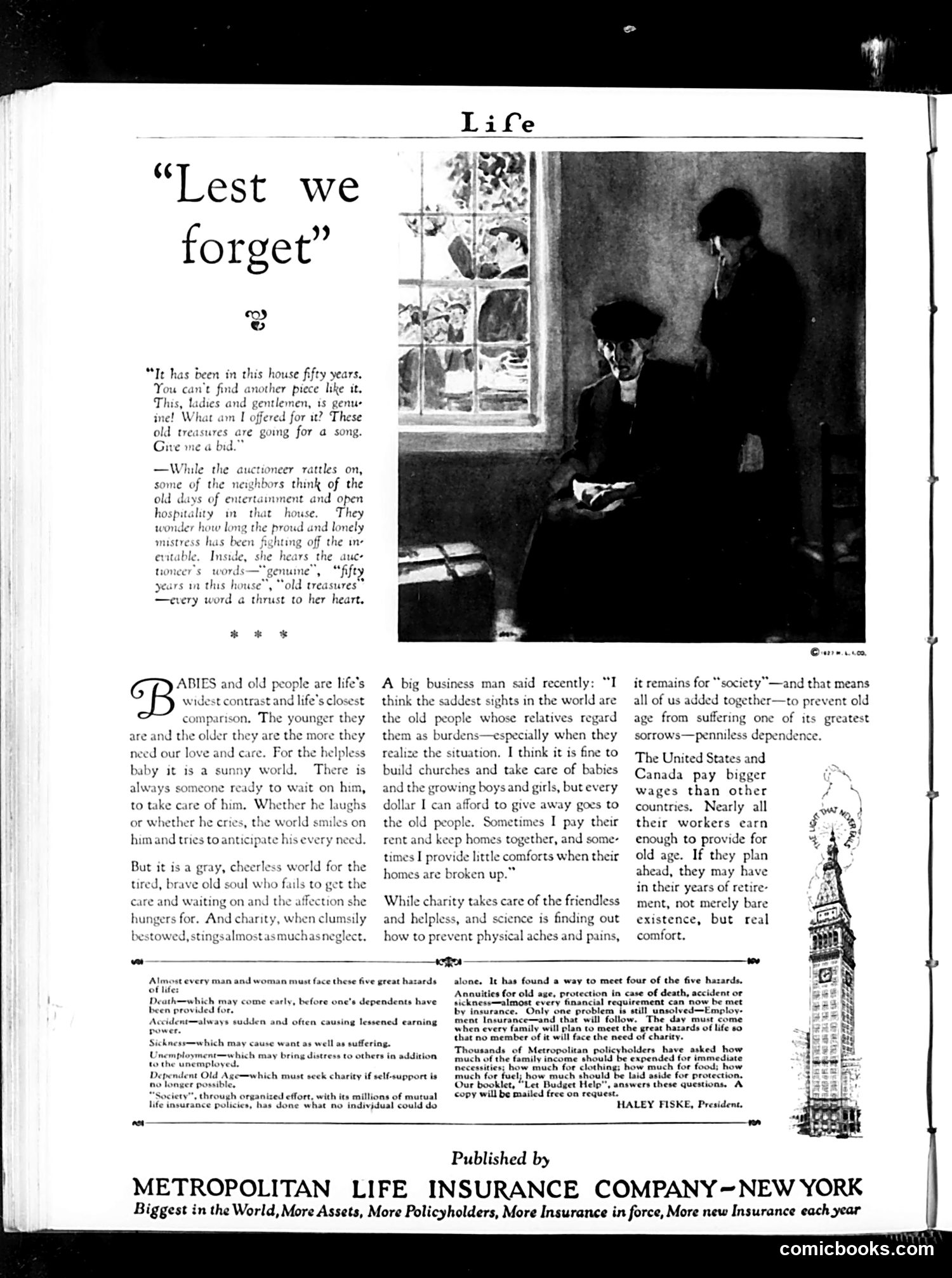
This page combines social commentary with insurance advertising. The headline "Lest we forget" and accompanying photograph show two figures examining what appears to be household items or antiques, likely representing the theme of preserving old family treasures and memories. The text discusses the contrast between youth and age, emphasizing society's obligation to care for elderly people and babies—"life's widest contrast and life's closest comparison." It critiques those who view elderly relatives as "burdens" rather than deserving of dignity and care. The piece advocates for organized charity and social support systems rather than individual neglect, ultimately promoting Metropolitan Life Insurance as a solution for securing financial protection and dignity in old age—a form of social safety net through commercial insurance rather than pure charity.
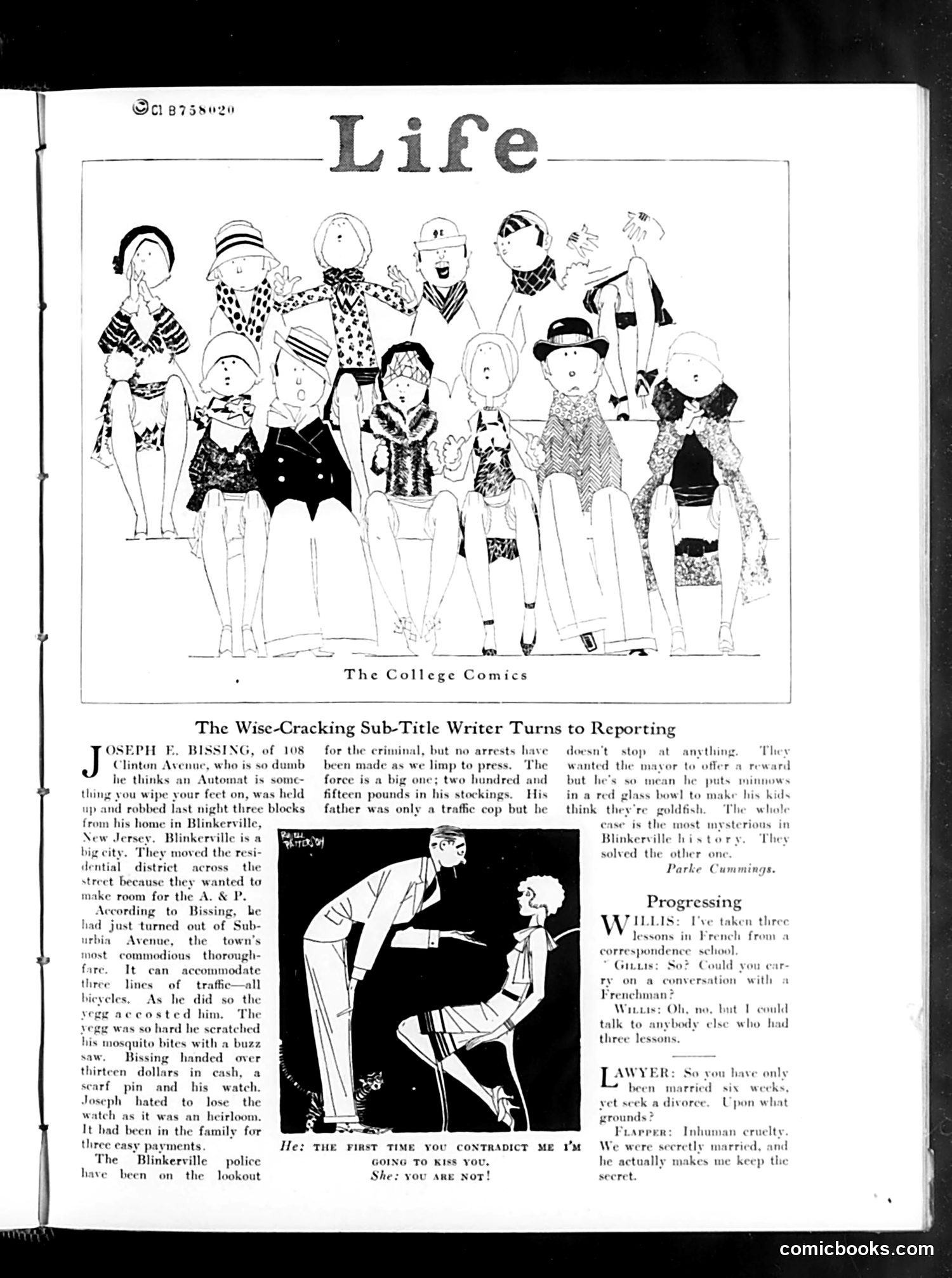
This page features "The College Comics," a section satirizing young people's romantic and social situations. The main cartoon shows a man contradicting his romantic advances to a woman, with the caption "He: THE FIRST TIME YOU CONTRADICT ME I'M GOING TO KISS YOU. / She: YOU ARE NOT!" Below are three brief comic dialogues mocking dating conventions and marriage. "The Wise-Cracking Sub-Title Writer" column discusses Joseph E. Bussell, a reporter from Blinkerville, New Jersey, whose verbose police reports filled three lines of text. The humor derives from the contrast between his detailed accounts and the mundane subject matter—a stolen bicycle and recovered watch. The satire targets verbose writing styles and young people's courtship rituals typical of 1920s-30s American social life.
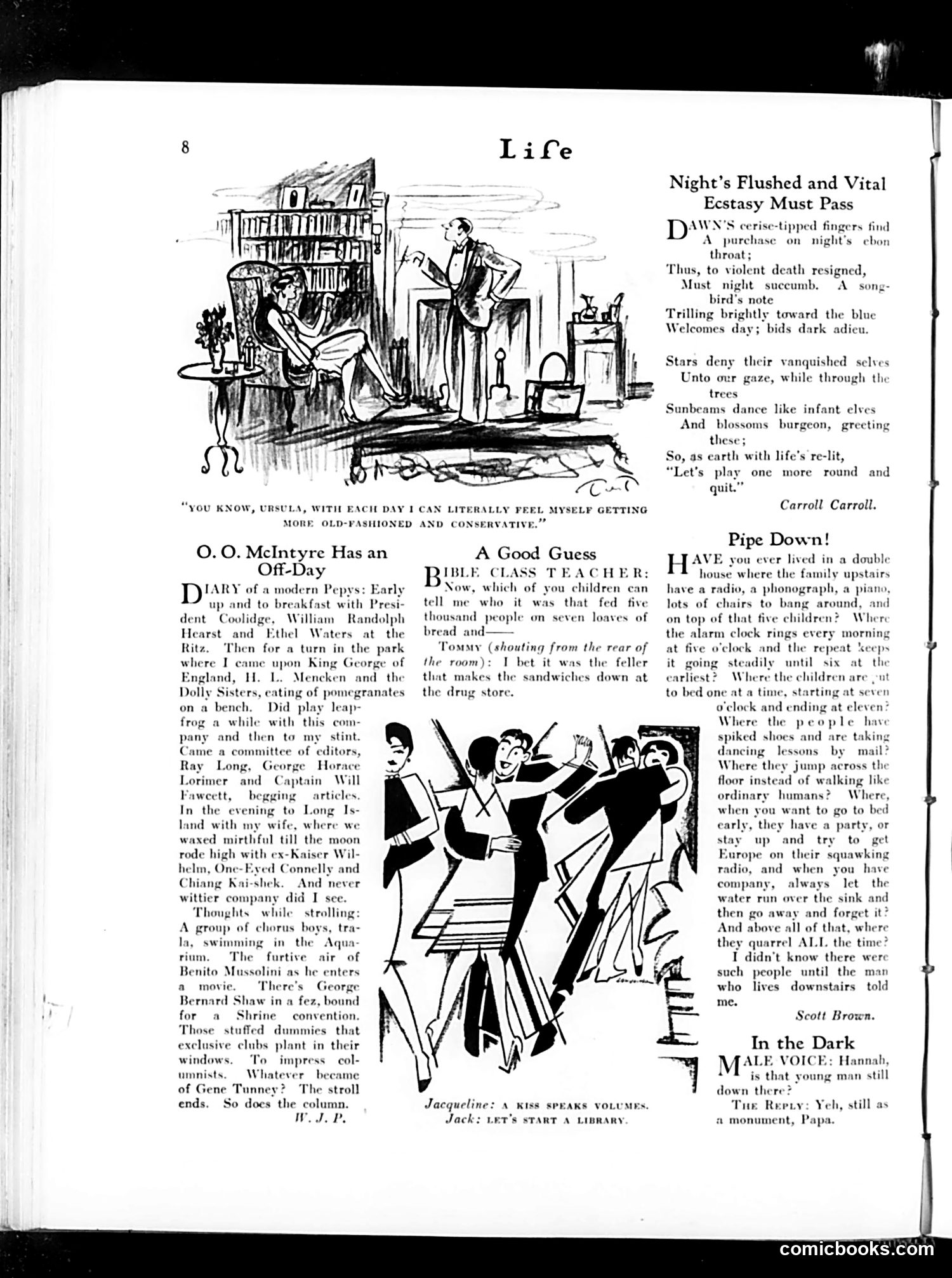
This page contains three separate pieces of light humor rather than political satire. **"O.O. McIntyre Has an Off-Day"** describes a socialite's outing to King George V's England with various celebrities (Ray Long, George Horace Lorimer, Captain Will Fawcett). The joke appears to be that despite mingling with famous people, the day was somehow disappointing—the humor is in the mundane contrast. **"A Good Guess"** features a Bible class teacher asking children about the loaves and fishes. Tommy jokes that a sandwich-maker at a drugstore performs the miracle by making sandwiches from few loaves. The cartoon shows children's literal, silly logic. **"Pipe Down!"** and **"In the Dark"** are brief household humor pieces about noisy families and domestic life. The page represents Life's typical early 20th-century mix of society gossip, gentle domestic comedy, and light satirical observations rather than hard-hitting political commentary.
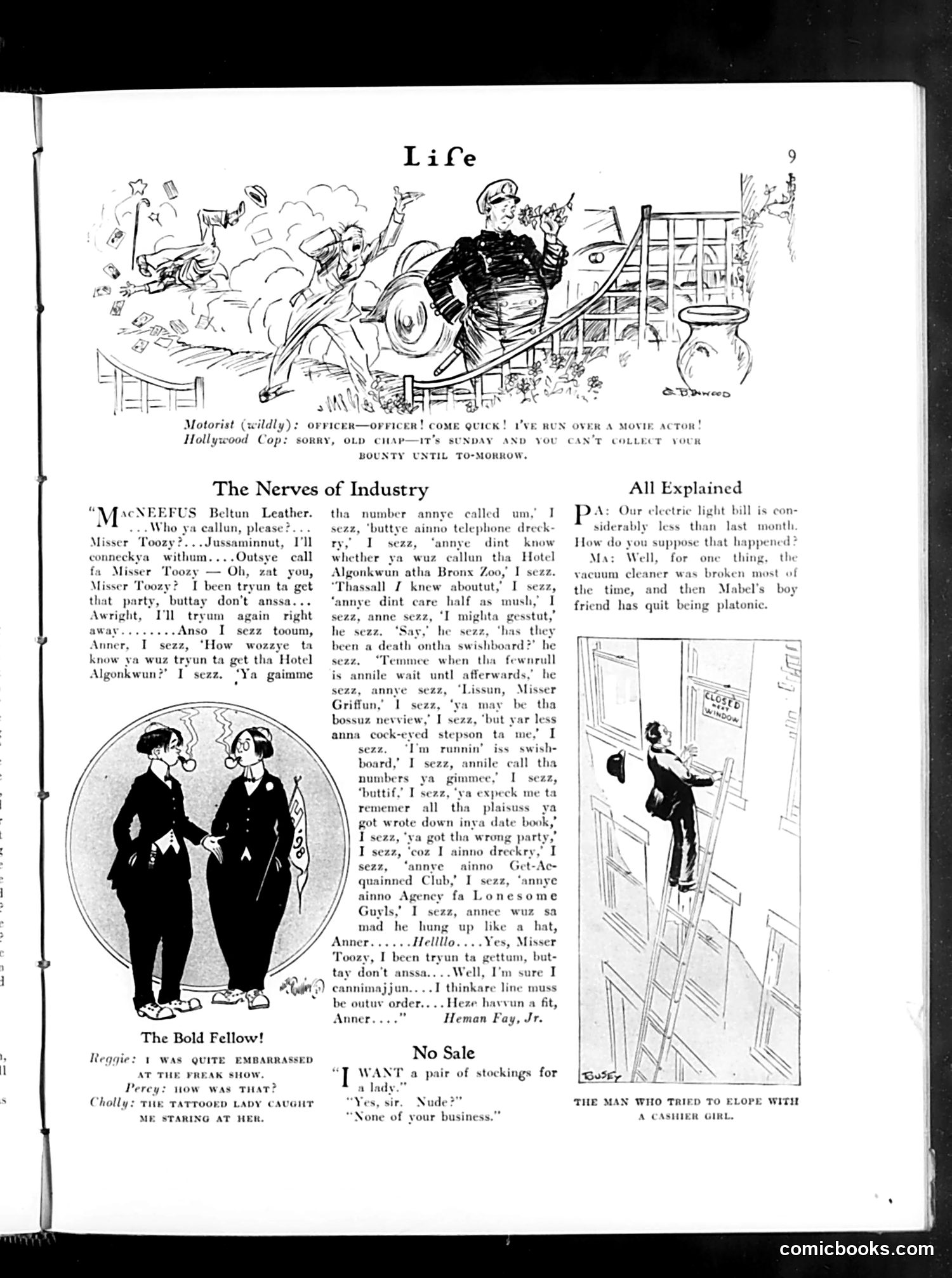
**Top Cartoon**: A motorist has hit a movie actor. The officer tells the motorist he can't collect bounty until tomorrow—satirizing Hollywood actors as so worthless that hitting one might warrant a reward. This reflects early 20th-century dismissal of film actors as low-status performers. **"The Nerves of Industry"**: A dialogue in heavy dialect between two workers complaining about their jobs, using exaggerated immigrant speech patterns typical of period humor that relied on ethnic caricature. **"The Bold Fellow!"**: A brief joke about someone embarrassed at a freak show, caught staring at a tattooed woman. **"No Sale" and "All Explained"**: Separate short humorous vignettes about everyday situations. The page reflects early 1900s comedic conventions: slapstick, ethnic humor, and social commentary through working-class characters.
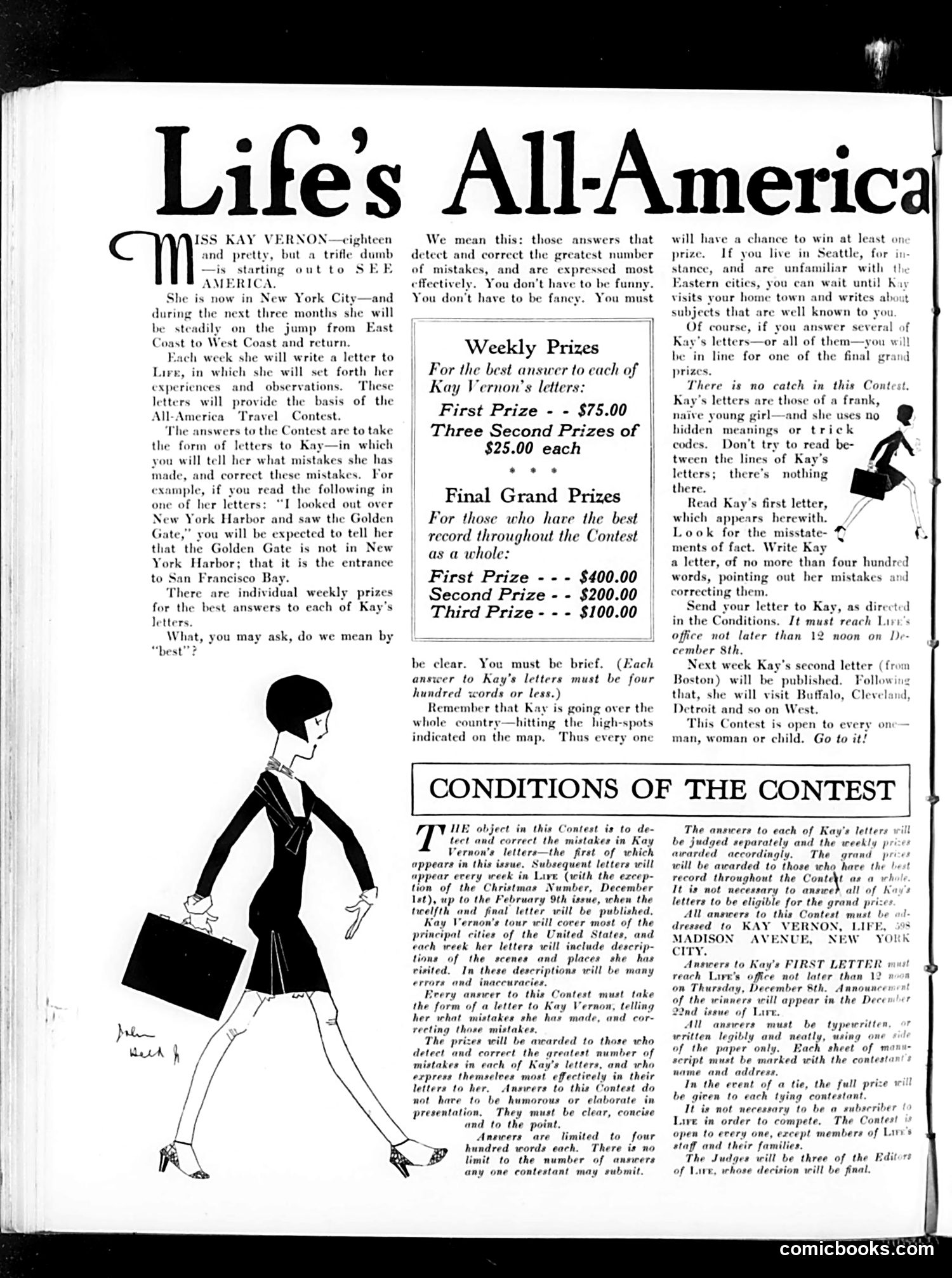
This is not a political cartoon but rather a **contest announcement page**. The content announces "Life's All-America" contest featuring Miss Kay Vernon, described as "eighteen and pretty, but a trifle dumb" — a setup for satire about her intelligence. The contest invites readers to identify and correct mistakes in Kay's letters describing her travels across America. Contestants win weekly prizes ($75 first prize) and grand prizes up to $400. The accompanying illustration shows a stylized young woman in 1920s fashion, matching the period aesthetic. The humor relies on the conceit that readers will catch Kay's errors, playing into era-typical stereotypes about women's intelligence while engaging readers in an interactive contest — a marketing strategy common to this satirical magazine.
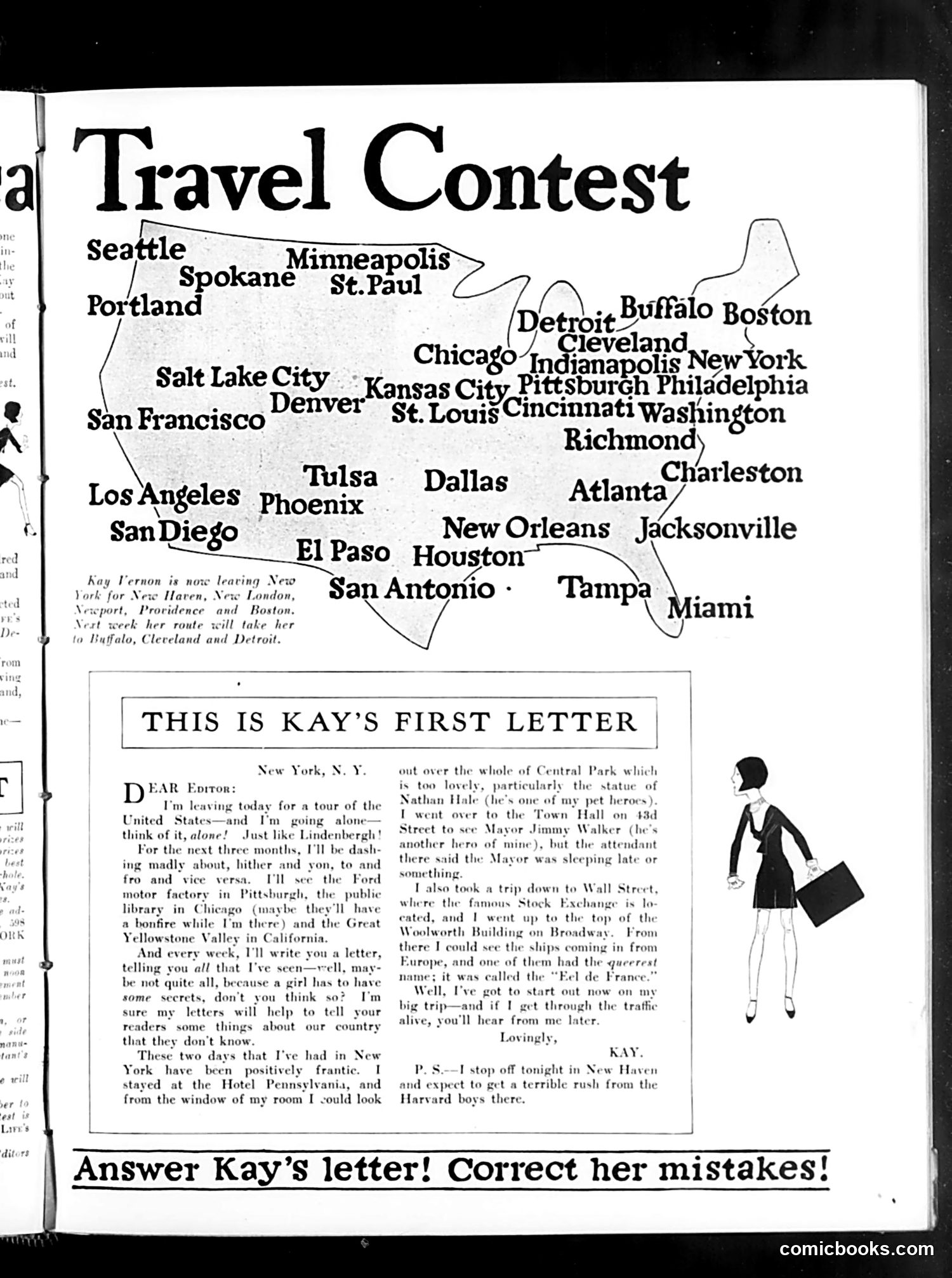
This page features a "Travel Contest" encouraging readers to identify geographical errors in a letter from a character named Kay, who is embarking on a cross-country American tour. Kay describes visiting New York landmarks (Central Park, Town Hall, Wall Street, Woolworth Building) and mentions traveling to New Haven and Harvard. The map shows major U.S. cities with their locations marked. The satirical element: readers are challenged to "correct her mistakes"—implying Kay has made geographical or factual errors in her travelogue that observant readers should spot. This was likely an interactive game for Life magazine's audience, combining geography knowledge with humor about a traveling woman's observations. The illustration shows a fashionable woman with luggage, typical of 1920s-30s style depictions of independent female travelers.
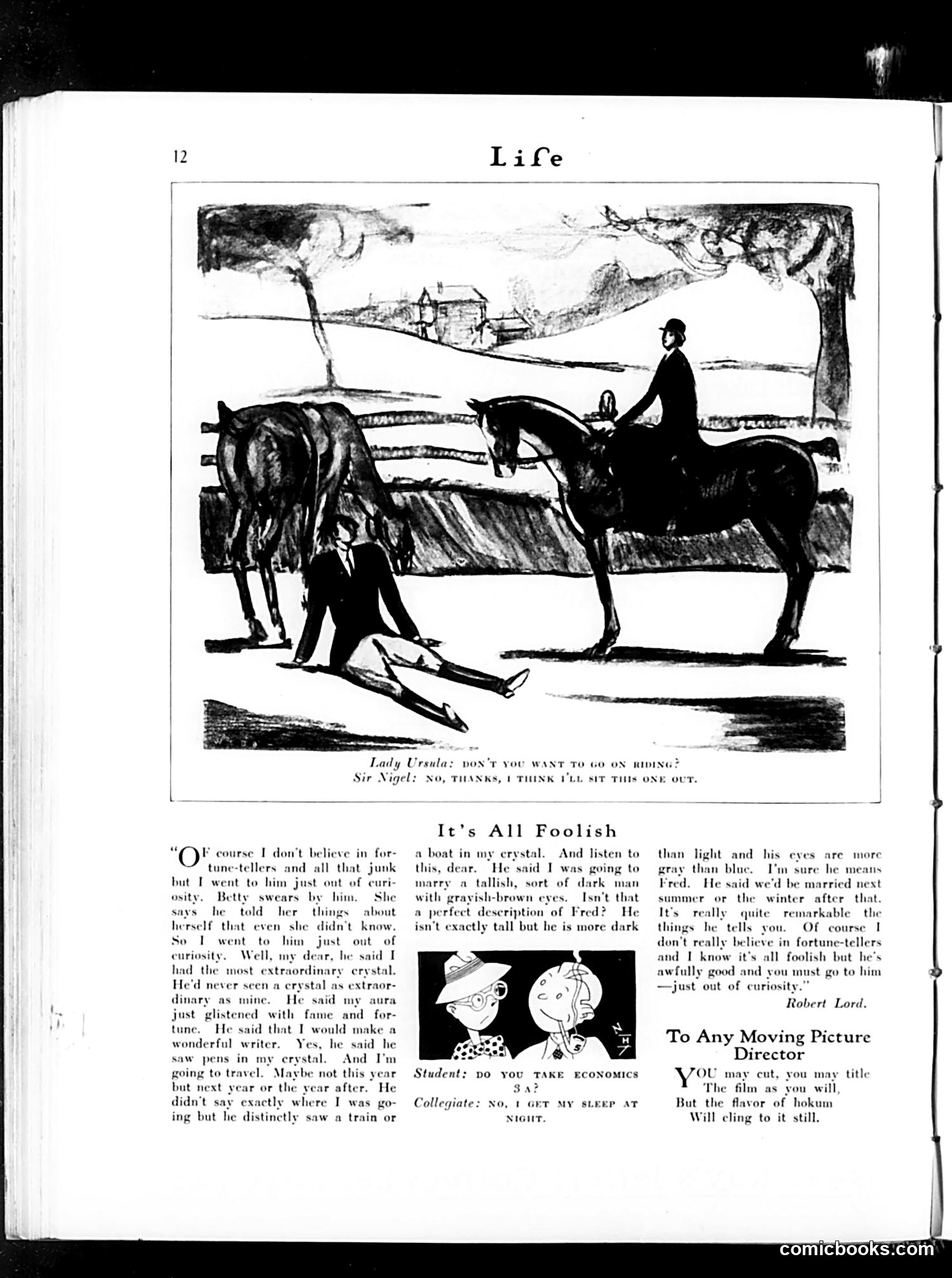
The main illustration depicts a riding accident: a woman (Lady Ursula) has fallen from her horse while a man (Sir Nigel) remains mounted. The caption records their exchange—she asks if he wants to go riding; he declines, saying he'll "sit this one out." The satire is straightforward physical comedy: Sir Nigel is humorously refusing to ride after witnessing Lady Ursula's mishap, using the euphemistic phrase "sit this one out" with dark irony. Below, two separate pieces appear: "It's All Foolish" is a narrative about fortune-telling skepticism, and "To Any Moving Picture Director" is a brief poem about artistic integrity in film editing. These are typical early 20th-century *Life* magazine fare—light, society-oriented humor and commentary.
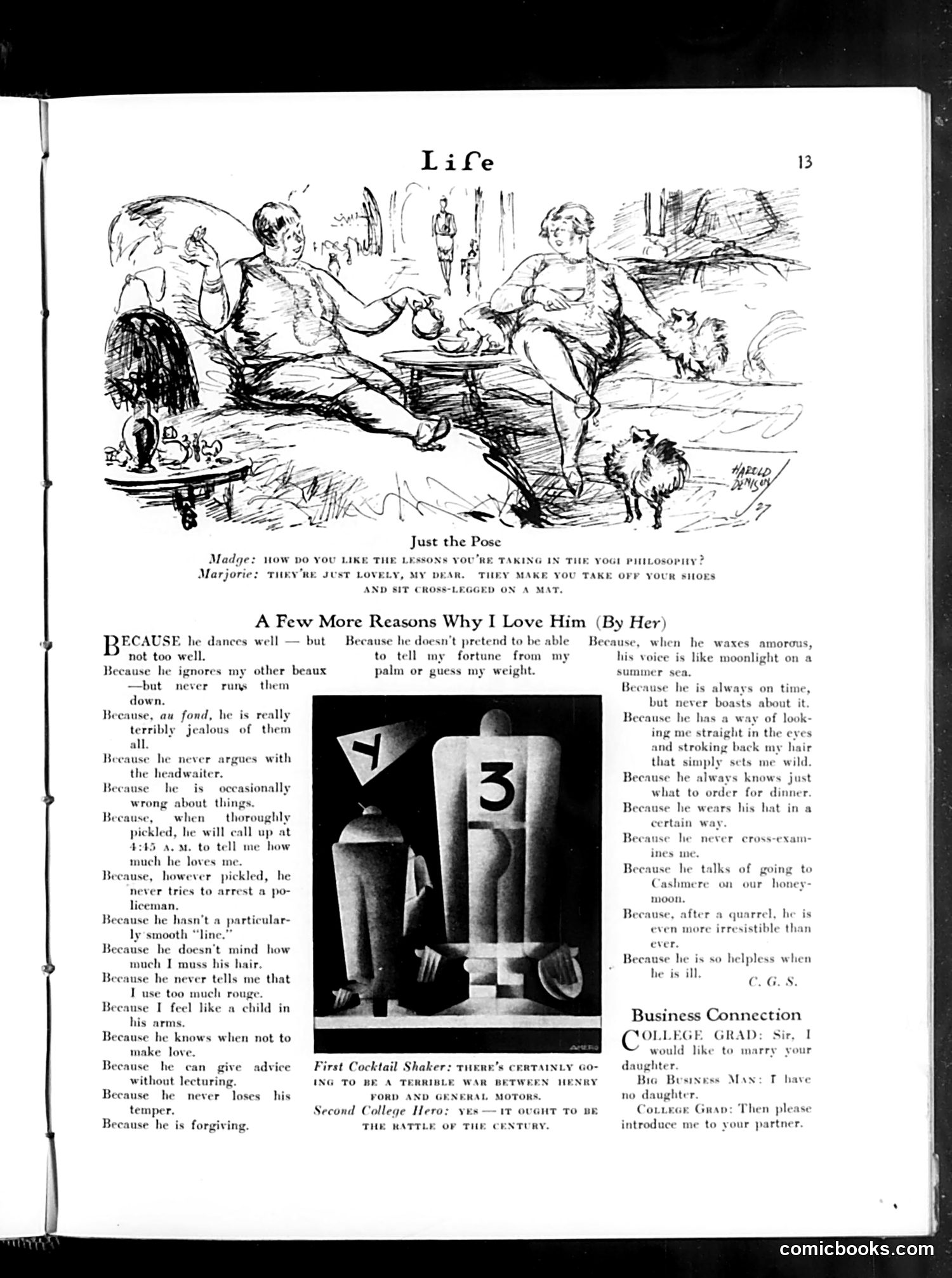
This page contains satirical humor typical of Life magazine's social commentary. The top cartoon, "Just the Pose," mocks yoga philosophy becoming fashionable among wealthy women. The dialogue shows "Madge" dismissing yoga lessons as merely requiring one to remove shoes and sit cross-legged—suggesting the practice was superficial fashion rather than genuine spiritual discipline. Below, "A Few More Reasons Why I Love Him (By Her)" humorously lists a woman's appreciation for her romantic partner, using gentle satire about gender relations and marriage expectations of the era. The "Business Connection" section is a brief joke about social matchmaking between a college graduate and a businessman. The central image appears to be an advertisement for a cocktail shaker, referencing the "battle" between Henry Ford and General Motors—topical corporate rivalry of the period.
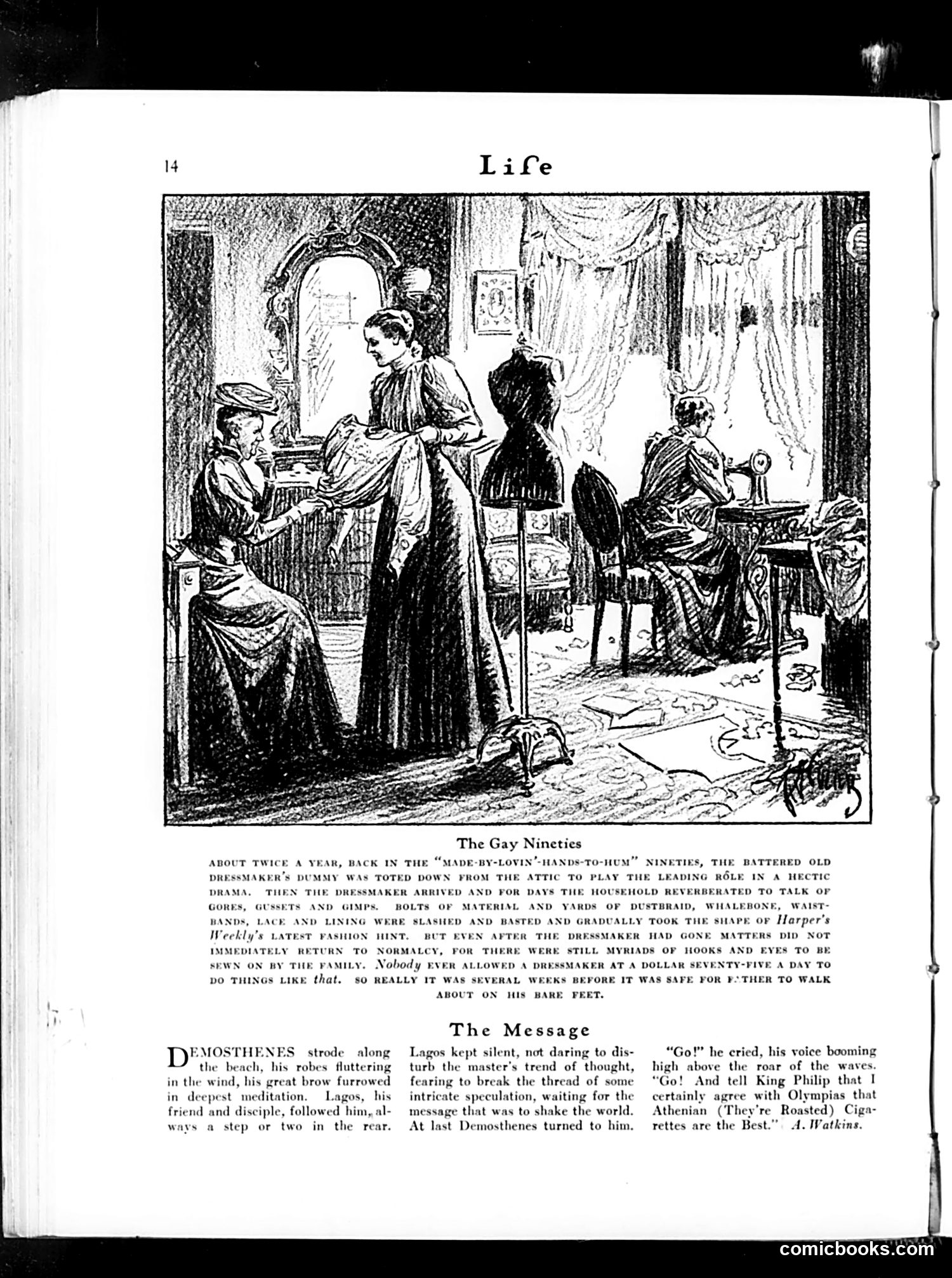
This page from *Life* magazine contains two unrelated pieces: **"The Gay Nineties"** (top): A satirical illustration mocking theatrical melodrama of the 1890s. The caption describes how a battered dressmaker's dummy was repeatedly repurposed as a prop in amateur home theatricals—used for "hectic drama" with costumes, bolts of material, and theatrical excess. The joke targets the overwrought sentimentality and recycled props of period amateur theater productions. The humor lies in the dummy's degraded condition after such repeated abuse. **"The Message"** (bottom): A classical scene depicting Demosthenes and Lagos, with Demosthenes receiving what appears to be an urgent message. This appears to be a literary or historical narrative piece rather than satire.
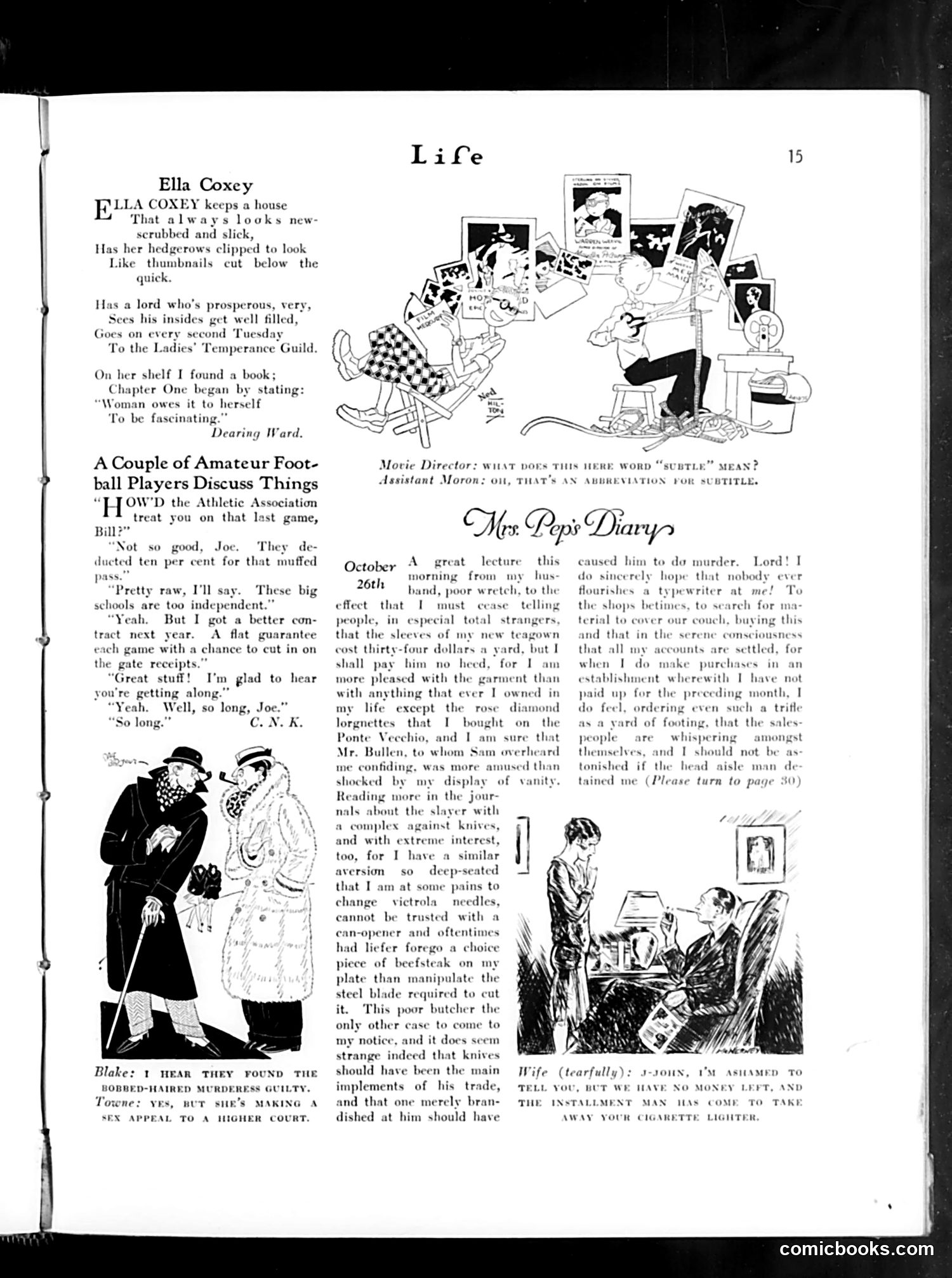
This page contains three distinct pieces: 1. **"Ella Coxey"** - A poem mocking a woman who keeps an obsessively clean house, with "thumbs cut below to the quick" from scrubbing. It satirizes excessive domestic perfectionism. 2. **"A Couple of Amateur Football Players"** - A dialogue between Bill and Joe about the Athletic Association's poor treatment of players ("ten per cent for that muffled pass"). This critiques exploitation of amateur athletes. 3. **"Mrs Pep's Diary"** - An entry from October 26th where a woman complains about her husband's new teagown (a smoking jacket), costing $34/yard, and his obsession with a "rose diamond lorgnette." She sarcastically notes he bought it from "Mr. Hulen" and mentions keeping accounts. This appears to mock frivolous male fashion spending and marital financial conflicts. The illustrations feature period clothing and drawing styles typical of early 20th-century satire.
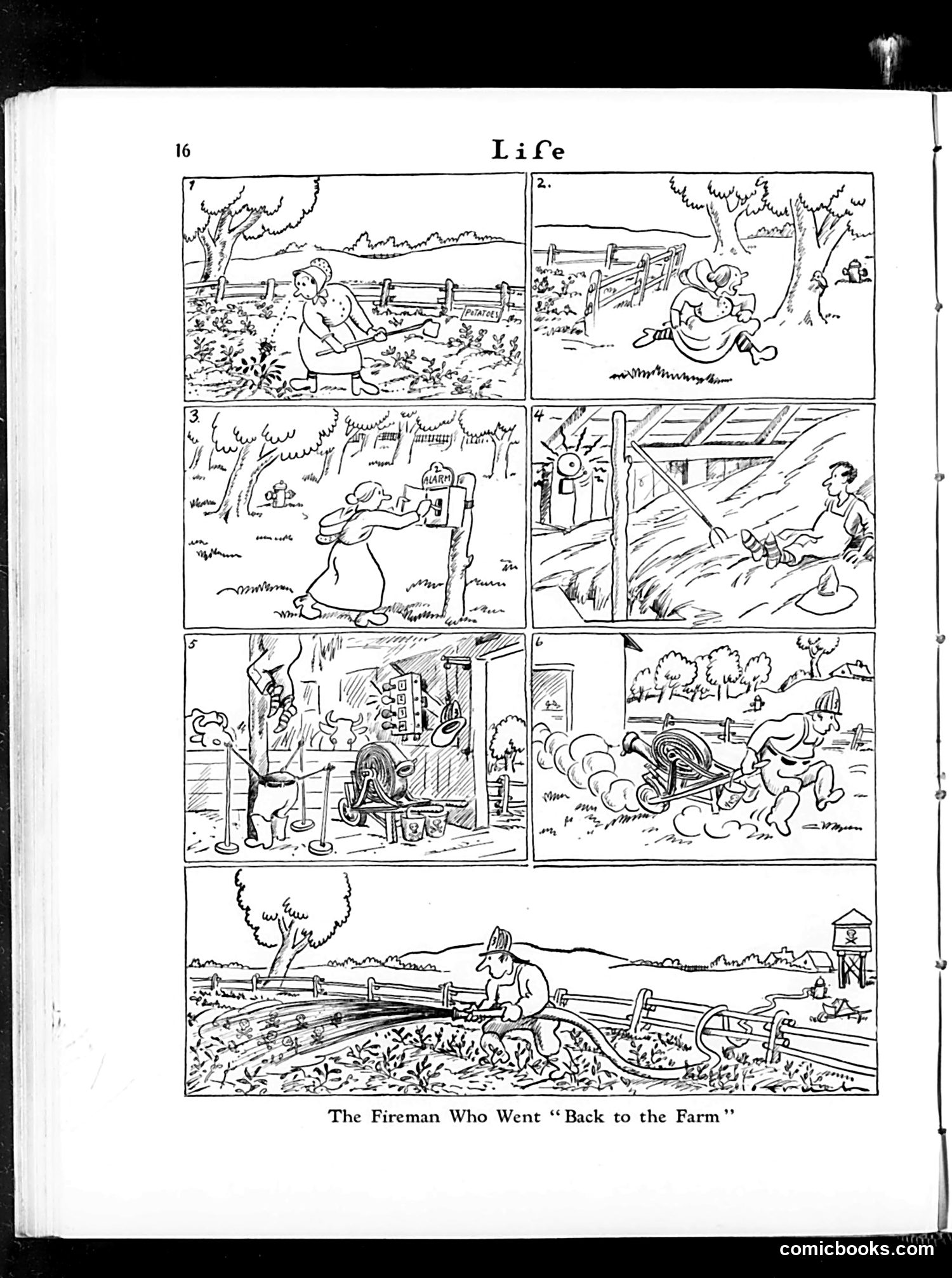
This six-panel comic strip satirizes a cultural trend of early 20th-century America: idealization of rural farm life versus urban occupations. The narrative follows a fireman who abandons city work to pursue farming, expecting pastoral simplicity. The satire emerges through panels showing his progressive disillusionment: he begins confidently working the land, then encounters the messy realities of farm labor—mud, livestock chaos, and backbreaking work. The final panels contrast his fantasized bucolic dreams with actual farm drudgery. The joke critiques both romanticization of farm life and the ironic discovery that "returning to the land" involves considerably more hardship than the stable, regimented firehouse he abandoned. It reflects contemporary anxieties about urbanization and nostalgia for agrarian lifestyles.
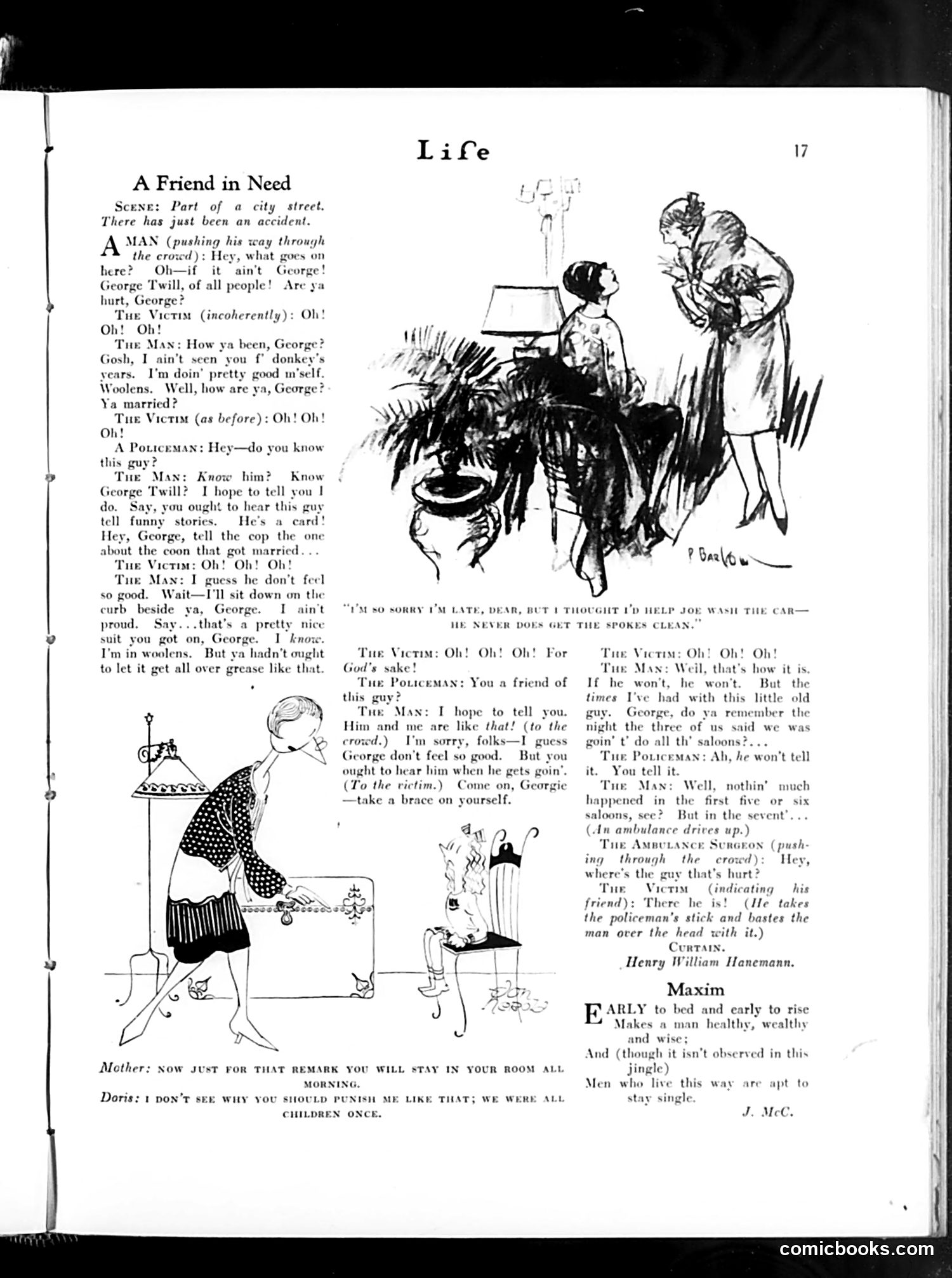
This page presents a comedic sketch about a street accident and its aftermath. A man named George Twill has been hit by a car. Various characters—a sympathetic bystander, a policeman, and an ambulance surgeon—interact with George and his injured friend. The humor relies on George's casual dismissal of serious injury ("I ain't proud") and his focus on mundane complaints (greasy clothes, not feeling good). The final joke shows George beating the policeman with his stick—suggesting the victim becomes unexpectedly aggressive once helped. The bottom illustrations show a mother and daughter (Doris) in domestic conflict, establishing the page's theme of everyday social friction. The "Maxim" section offers pithy observations about unmarried men, providing light philosophical commentary typical of Life's satirical format.
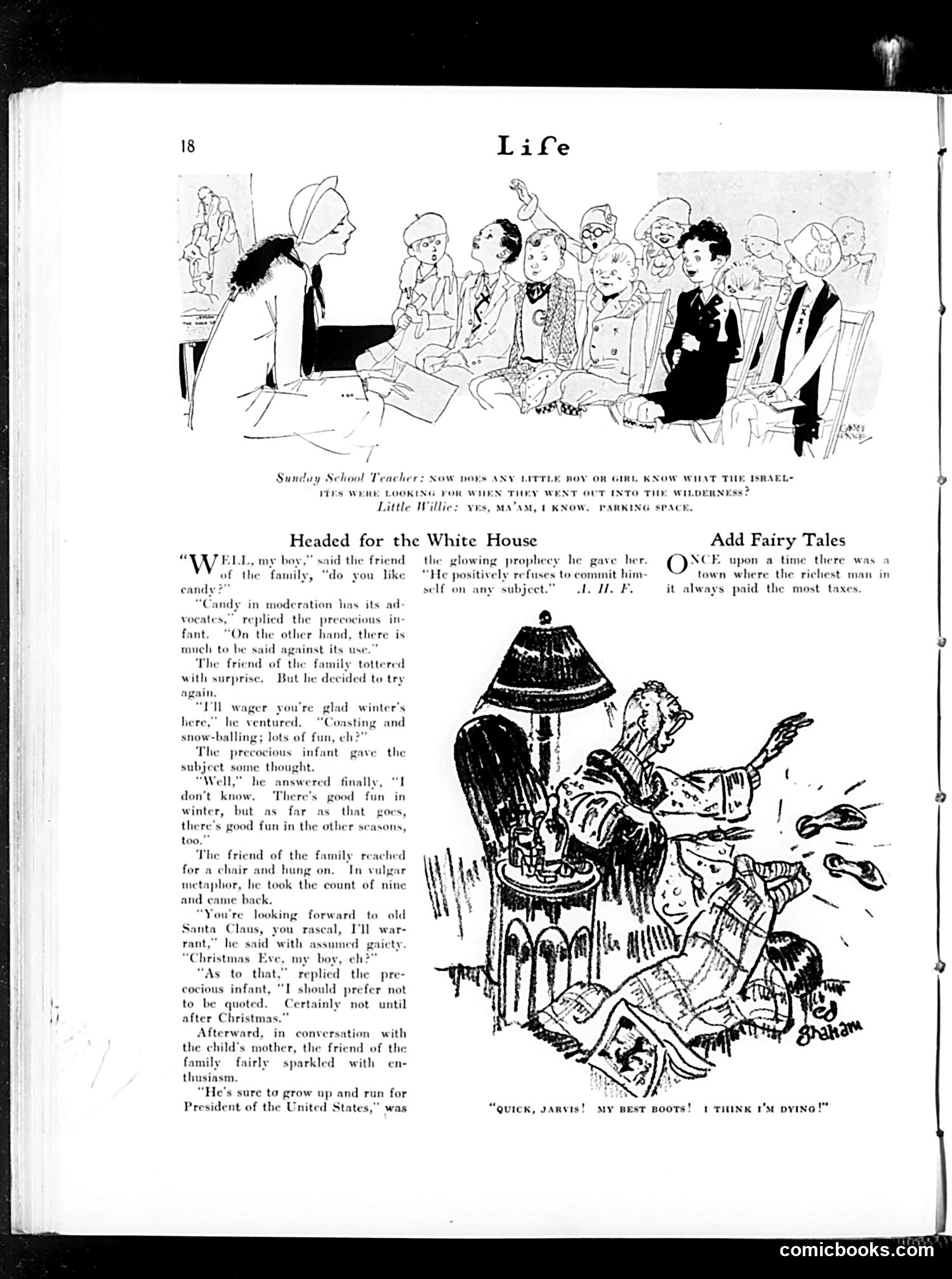
This page contains three separate humorous pieces satirizing American society: **"Sunday School Teacher"** (top): A joke mocking non-committal political rhetoric. "Little Willie" responds to a question about Israelites in the wilderness with "parking space"—a modern urban concern. The satire targets evasive politicians who dodge direct answers, suggesting that contemporary leaders are as elusive as biblical wanderers. **"Headed for the White House"** (left): This piece ridicules overly precocious children and their parents' ambitions. A child responds to every conversational opener with affected, equivocal language ("moderation has advocates," "I should prefer not to be quoted"). The humor suggests the child will become president precisely *because* he commits to nothing—a jab at political non-commitment. **"Add Fairy Tales"** (right): A short satirical fable stating "the richest man in town always paid the most taxes"—clearly presented as pure fantasy. This mocks either wealthy tax-avoiders or naive assumptions about fair taxation. All three pieces target American political evasion and hypocrisy with gentle, witty humor typical of Life's satirical approach.
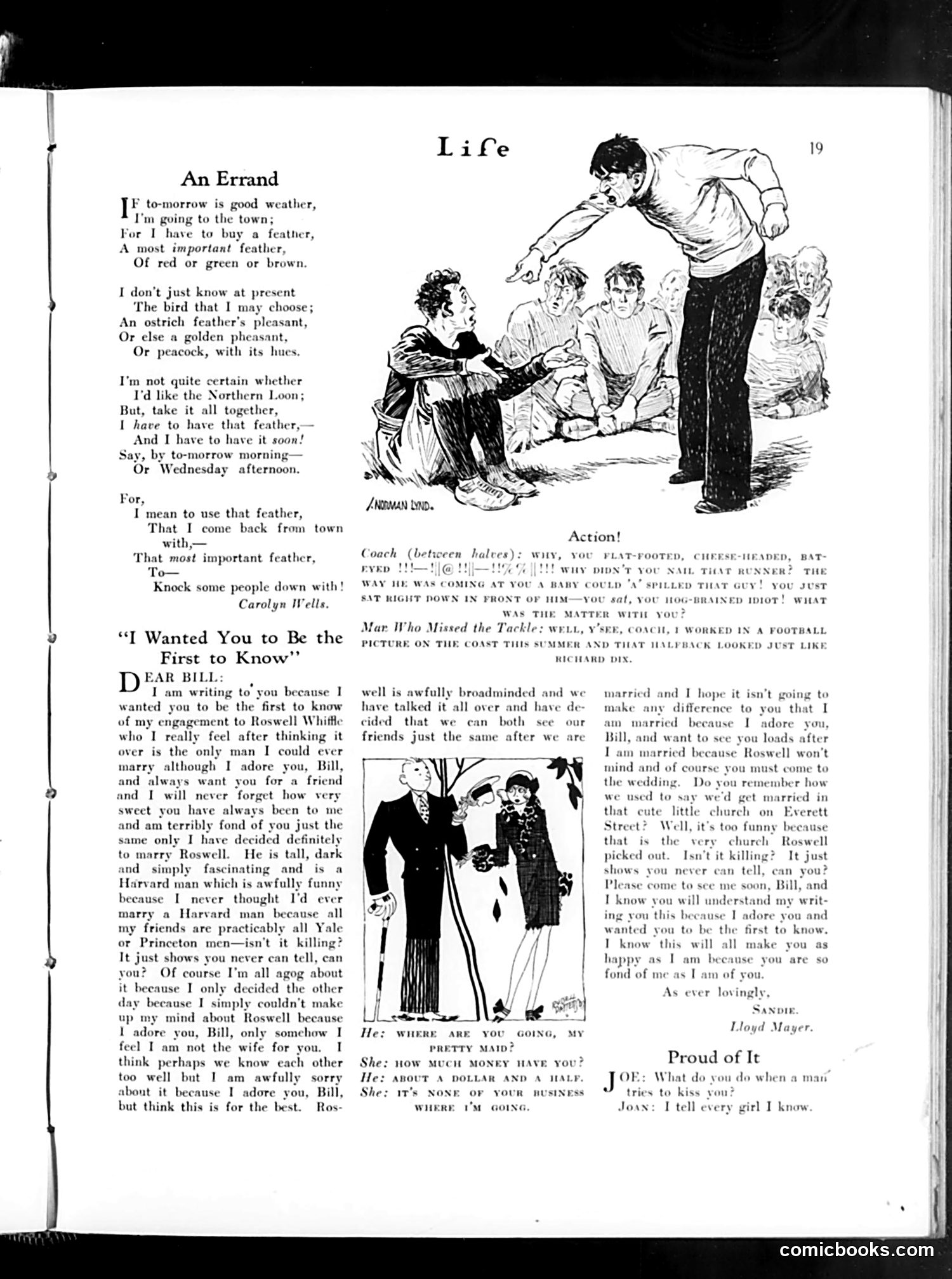
This page from *Life* magazine contains three satirical pieces typical of early 20th-century American humor: **"An Errand"** by Carolyn Wells is a humorous poem about a woman obsessed with buying a feather for a seemingly trivial purpose—to knock people down with it. The satire mocks the frivolous priorities of society women. **"I Wanted You to Be the First to Know"** is a letter from a woman (Sandie) breaking her engagement to Bill to marry Roswell. The satire lies in her self-centered, contradictory rambling: she claims to adore Bill while explaining why she's leaving him, repeatedly saying "it's killing" and "you never can tell," capturing the shallow sentimentality and poor logic of careless romantic declarations. **"Action!"** and **"Proud of It"** are brief joke exchanges. The first mocks a football player who missed a tackle because he was distracted by recognizing an actor (Richard Dix) from a film. The second is a flirtatious exchange where a maid refuses a man's advances then brags about rebuffing him to other women. The overall theme: satirizing vanity, thoughtlessness, and performative social behavior.
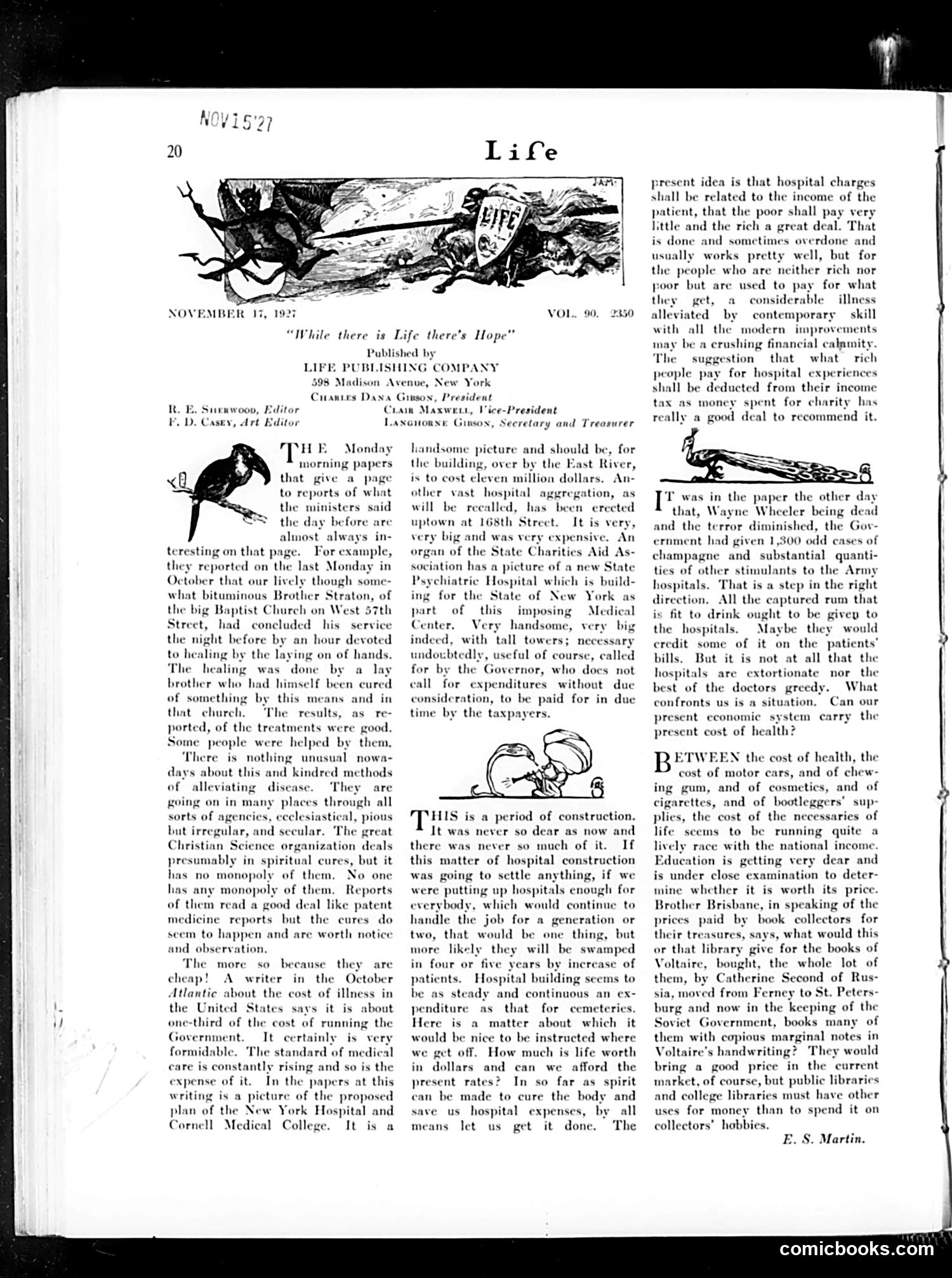
This editorial page discusses the massive expense of hospital construction in 1920s New York, featuring a new State Psychiatric Hospital and the proposed New York Hospital-Cornell Medical College complex (costing eleven million dollars—enormous for the era). The author critiques what appears to be endless hospital expansion without solving underlying problems. He notes that hospital charges theoretically scale with patient income: the poor pay little, the wealthy pay substantially more. However, he identifies a gap: the middle class—neither rich nor poor—bears considerable burden when paying out-of-pocket. The piece questions whether perpetual hospital construction meaningfully addresses healthcare access or if facilities simply become overwhelmed within years. The satirical tone suggests skepticism about whether architectural grandeur solves systemic healthcare affordability problems. The author mentions "spiritual cures" and faith healing as cheaper alternatives, with apparent irony given the massive capital expenditures being undertaken.
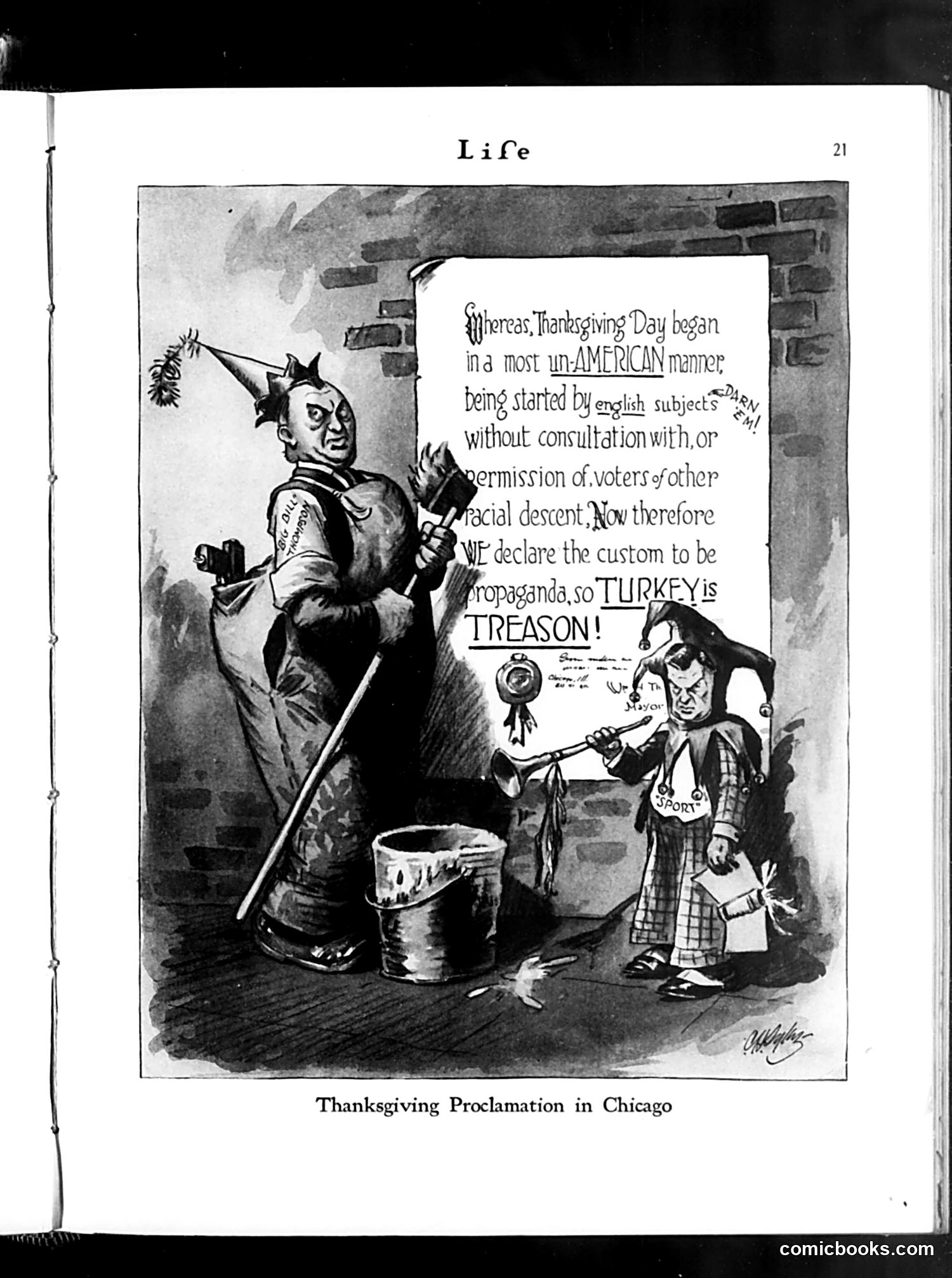
This satirical cartoon mocks nativist and xenophobic attitudes in early 20th-century America. The central figure appears to be a caricatured "English subject" or representative of old-stock Americans, proclaiming that Thanksgiving—begun by English colonists—is "propaganda" and therefore "treason" because it excluded consultation with voters "of other racial descent." The cartoon satirizes restrictive immigration politics and the exclusion of non-Anglo immigrants from American civic participation. The small figures on the right appear to represent marginalized immigrant groups. The absurd proclamation that a traditional American holiday constitutes "treason" highlights the hypocrisy and xenophobic logic of those seeking to limit immigrant rights and cultural inclusion during this period of intense nativist sentiment in America.
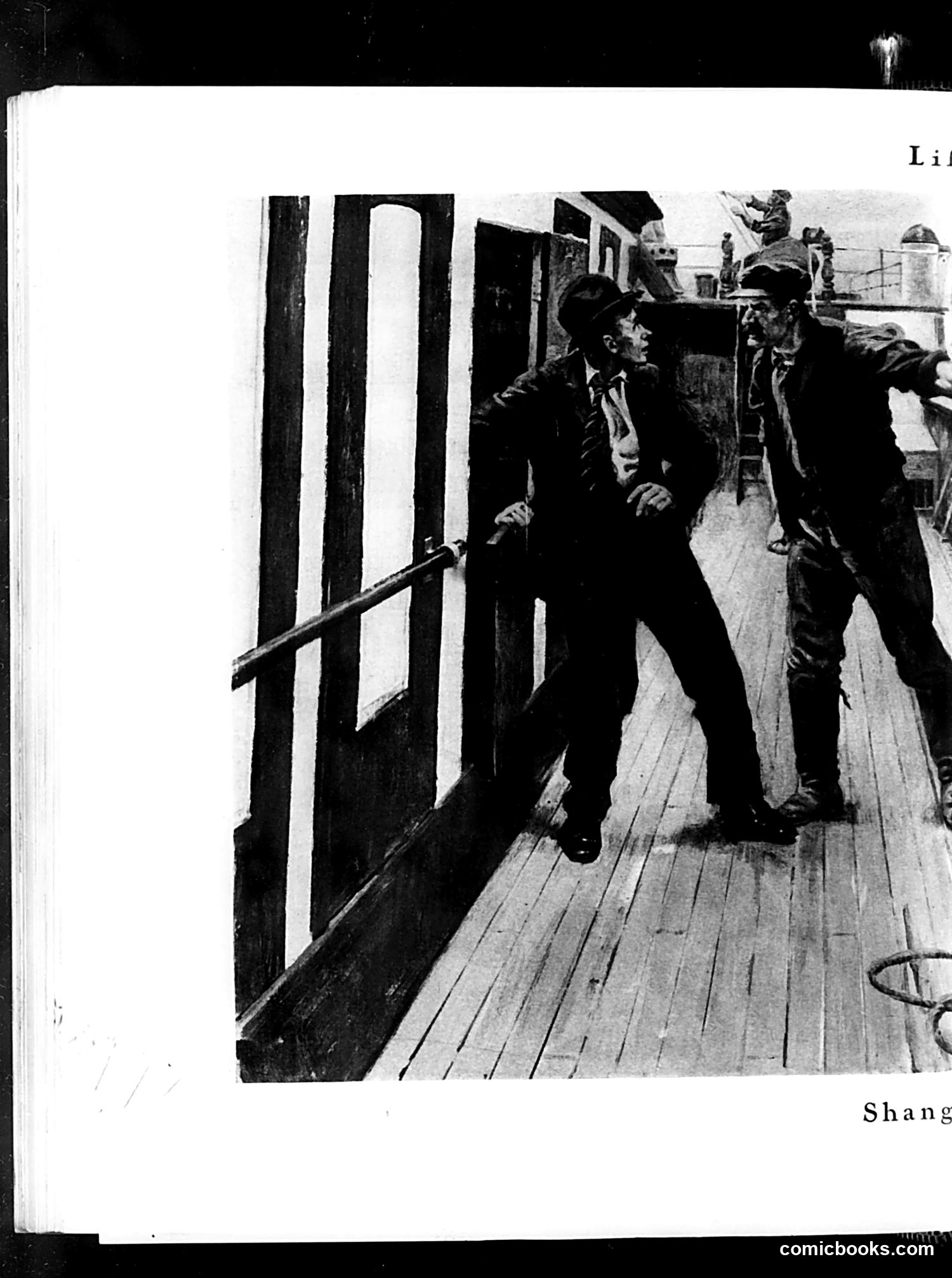
This black-and-white photograph shows men in formal attire (suits and hats) on what appears to be a ship's wooden deck, with a railing visible. The men seem to be in conversation or confrontation near a doorway or gate. The caption reads "Shang," which likely references Shanghai, China. Given this is from *Life* magazine's satirical tradition, this appears to document a diplomatic or political incident involving Western officials and Chinese affairs, possibly during early-to-mid 20th century tensions. However, without additional visible text identifying specific individuals or dating information on this page, I cannot definitively identify the figures or the exact historical event being satirized. The formal dress and ship setting suggest international diplomatic activity.
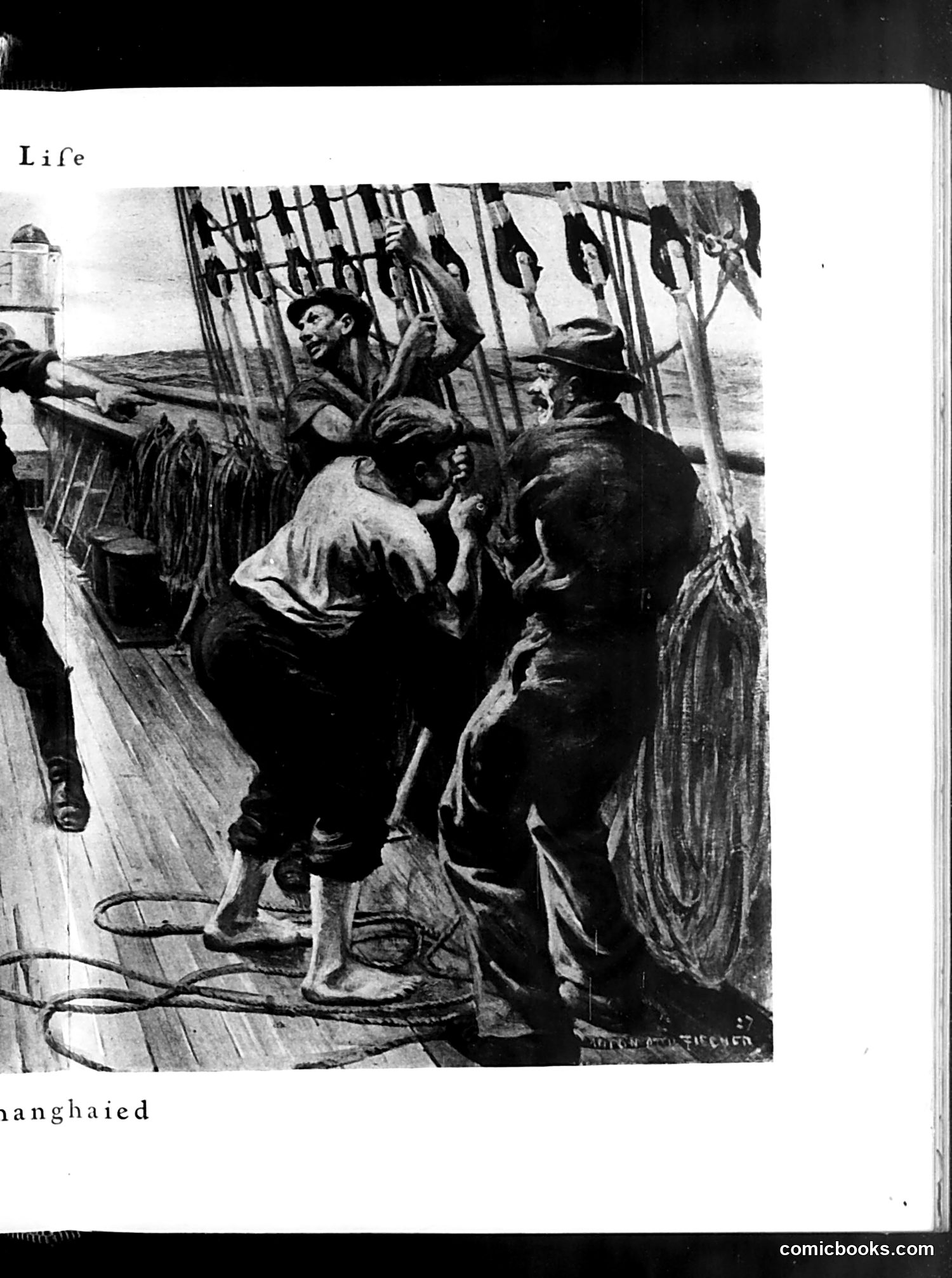
This page depicts a maritime scene showing sailors on a ship's deck with hanging fish or game. The title "Life" appears at top, and partial text at bottom reads "anghaied" (likely "shanghaied"). "Shanghaied" refers to the historical practice of forcibly kidnapping men to serve as sailors on ships, often through deception or coercion. The image appears to illustrate this concept—showing what seems to be unwilling crew members aboard vessel, surrounded by maritime equipment and hanging catches. The satire likely comments on exploitative labor practices or coercive recruitment methods in maritime industries during the era when Life magazine published satirical commentary on social conditions. Without clearer text, the specific political target remains unclear, but the visual emphasizes the grimness and powerlessness of those involved.
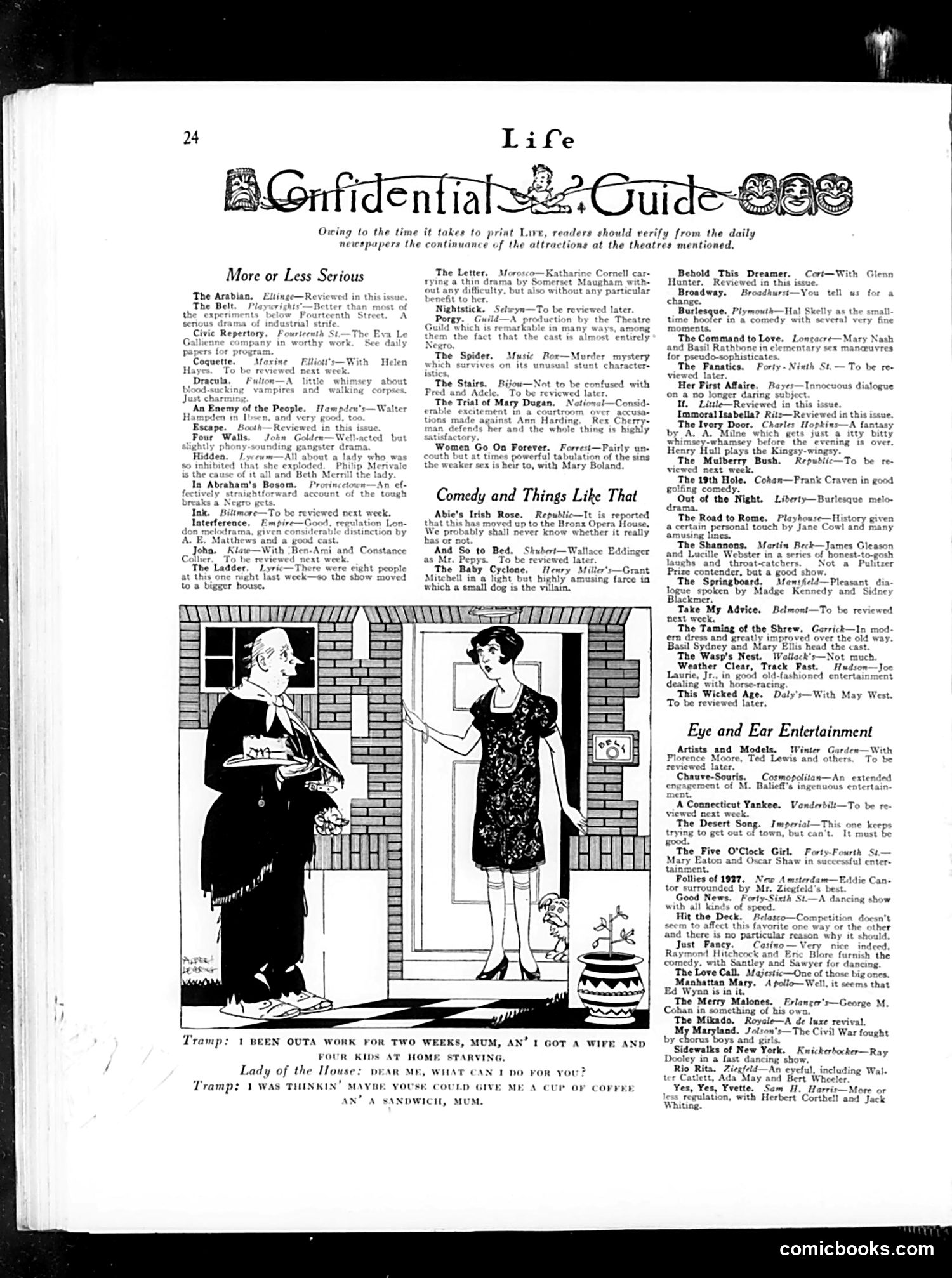
This single-panel cartoon depicts a common social scenario from the economically struggling 1920s-early 1930s era. A shabby, unemployed tramp approaches a well-dressed middle-class housewife at her doorstep, asking for work or sustenance. He states he's "been outa work for two weeks" and has "a wife and four kids at home starving." The housewife's response—offering only a cup of coffee and sandwich rather than actual employment or substantial aid—satirizes the inadequate charitable response to widespread unemployment and poverty of the period. The cartoon critiques the disconnect between the working poor's genuine desperation and the minimal, sometimes condescending relief offered by the more fortunate classes. The page itself is primarily a theater/entertainment guide rather than a political commentary vehicle, but this cartoon uses domestic humor to highlight economic inequality and social indifference during a period of significant labor unrest and poverty.
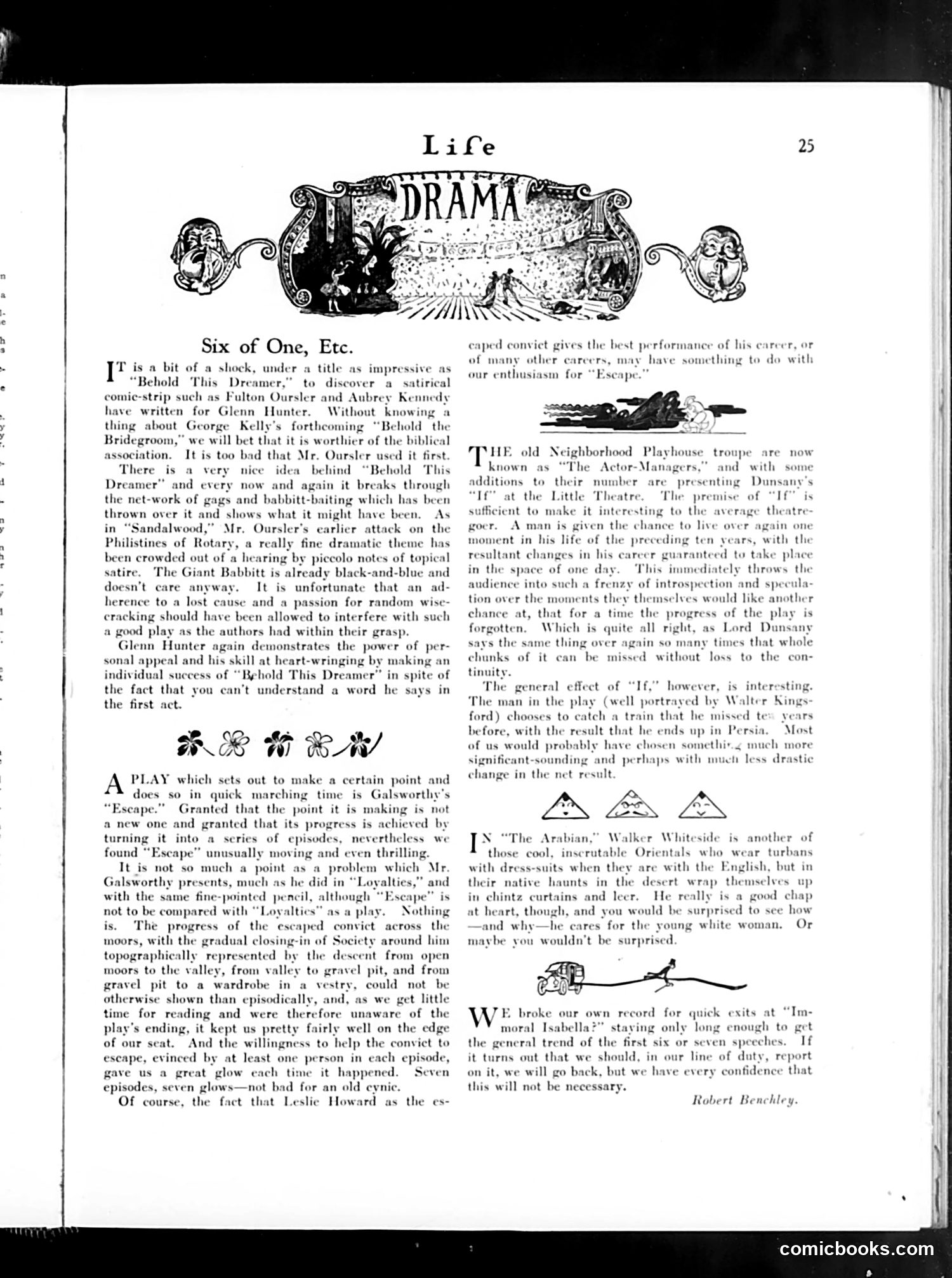
This page contains theater reviews from Life magazine's drama section. The critic evaluates several stage productions: **"Behold This Dreamer"** — A play starring Glenn Hunter, written by Fulton Oursler and Aubrey Kennedy. The reviewer criticizes it for sacrificing dramatic substance with topical satire attacking "Babbitt" (a reference to Sinclair Lewis's 1922 novel about American conformity and materialism). Though the play has merit, it's buried under wisecracks. **"Escape"** by Galsworthy — A play about a convict's escape shown episodically across changing landscapes (moors to valleys to gravel pits). The reviewer praises it as "unusually moving," crediting Leslie Howard's performance. **"If"** by Lord Dunsany — A Neighborhood Playhouse production where a man relives one day from his past decade. The concept intrigues audiences into self-reflection, though some plot details get missed. The reviews use "Babbitt" as shorthand for small-minded American materialism—a cultural reference contemporary readers would instantly recognize from popular literature.
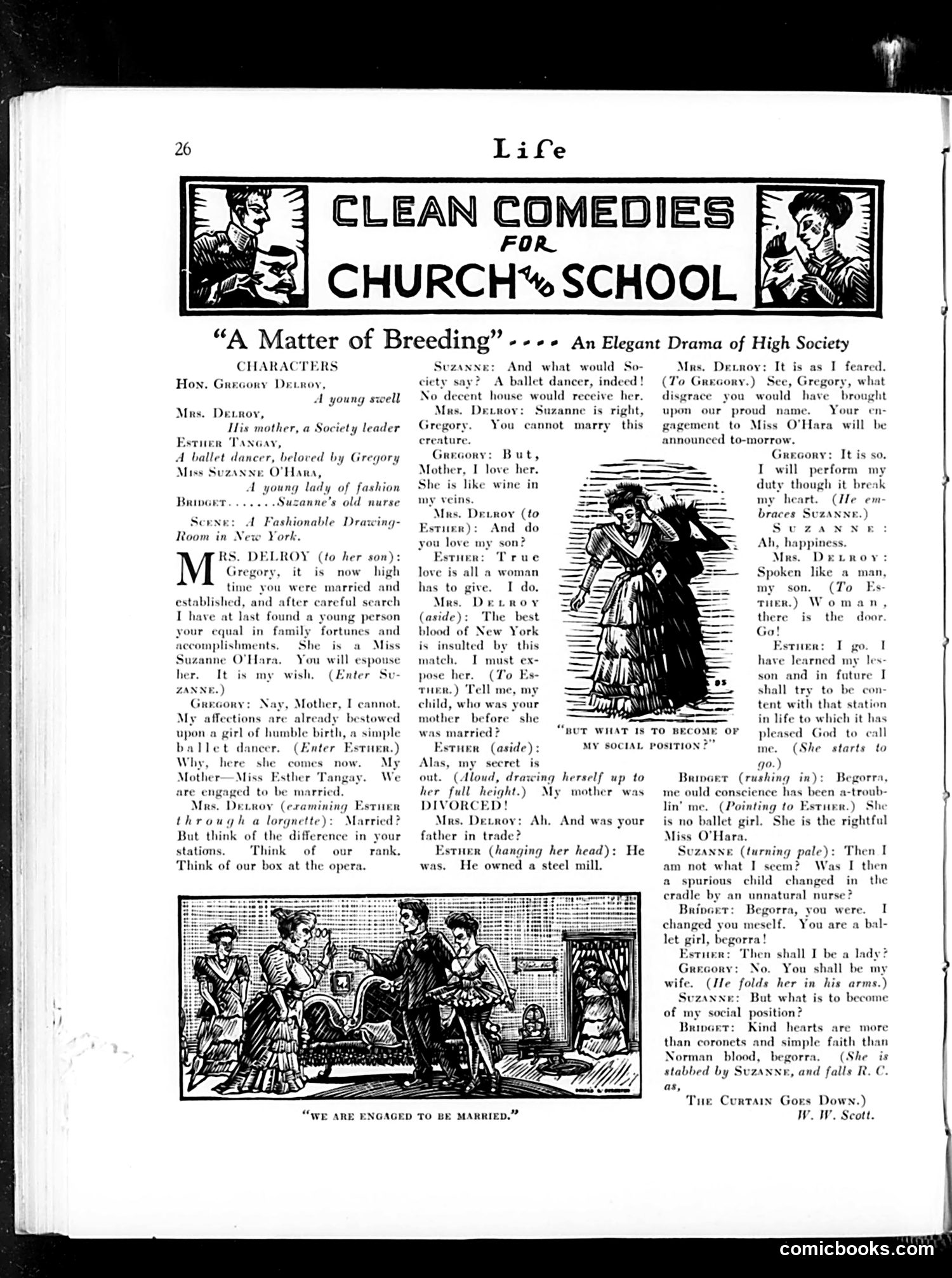
This one-act play parodies the rigid class anxieties of early 20th-century American high society. The plot mocks upper-class obsession with social rank: a wealthy mother forbids her son Gregory from marrying a ballet dancer (Esther) of "humble birth," insisting he marry the socially appropriate Miss O'Hara instead. The satire's twist: Esther is revealed to be the *true* Miss O'Hara—switched in infancy by a nurse—while Suzanne is actually the ballet girl. This reversal ridicules the notion that breeding and worthiness depend on birth rather than character. The nurse's Irish brogue ("Begorra") and final stabbing add melodramatic absurdity. The page's title—"Clean Comedies for Church and School"—is itself ironic, as the play gently critiques the vanity and moral blindness of the society matrons who would approve such material for wholesome audiences. It's educational satire about the foolishness of class prejudice.
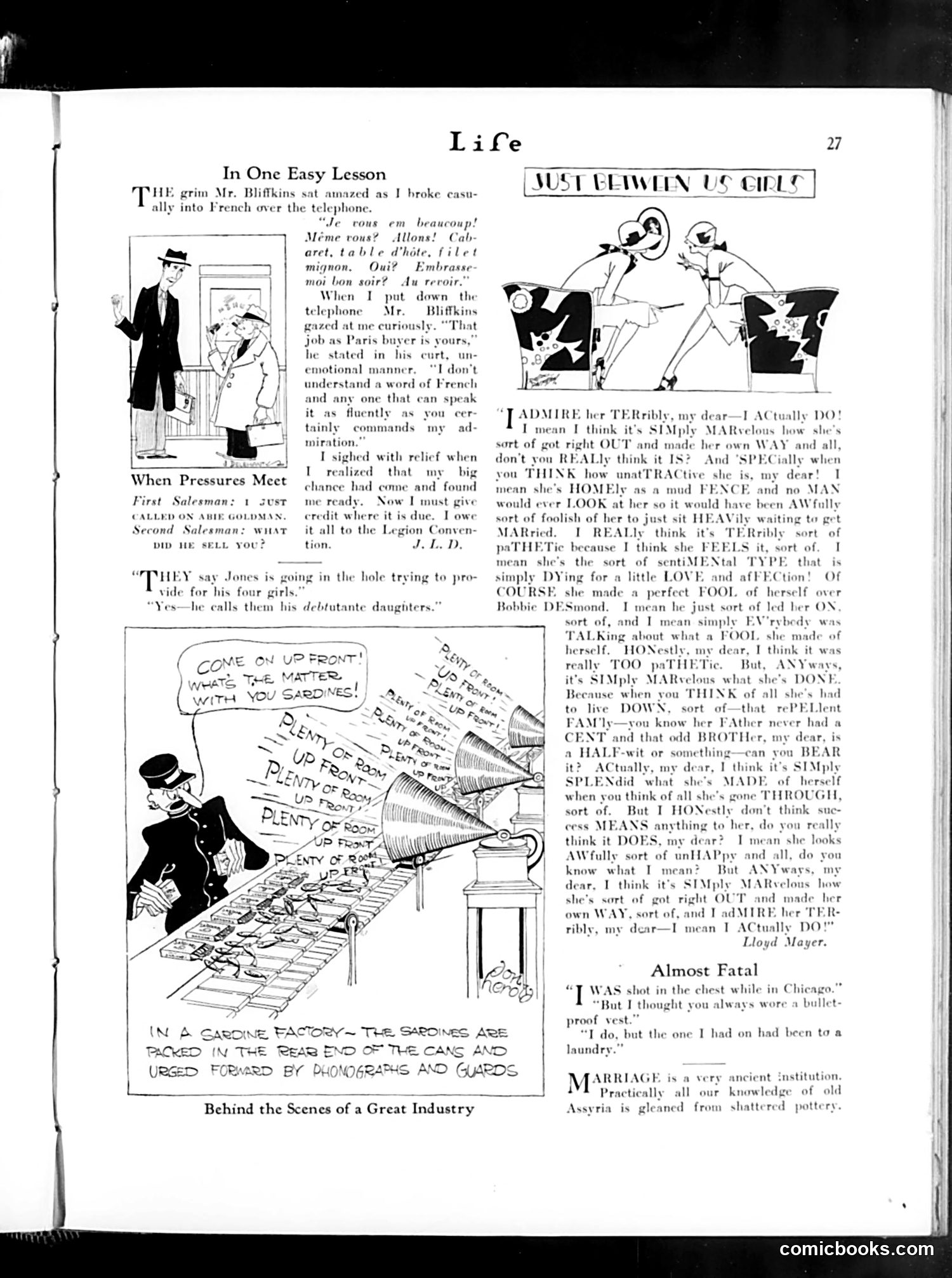
This page contains three satirical pieces typical of 1920s-era Life magazine humor: **"In One Easy Lesson"** mocks social climbing through language. A man impresses his boss by speaking French over the telephone, instantly securing a Paris buyer job. The joke: superficial competence—mere accent and a few phrases—replaces actual qualification. **"When Pressures Meet"** is a brief dialogue joke about salesmen's desperation. One sold sardines to a man with four daughters (financial burden), the other to someone in deeper debt. The dark humor centers on economic hardship during the era. **"Must Between Us Girls"** satirizes women's gossip culture through exaggerated capitalization emphasizing breathless, affected speech patterns. A woman gushes about an "unattractive" but industrious girl who "made her own way"—praising her while simultaneously insulting her appearance and family, revealing hypocrisy in female social commentary. The bottom cartoon depicts sardine factory workers packed dangerously tight, captioned as industry "behind the scenes," with a dark joke about a shooting victim's laundry-ruined bulletproof vest.
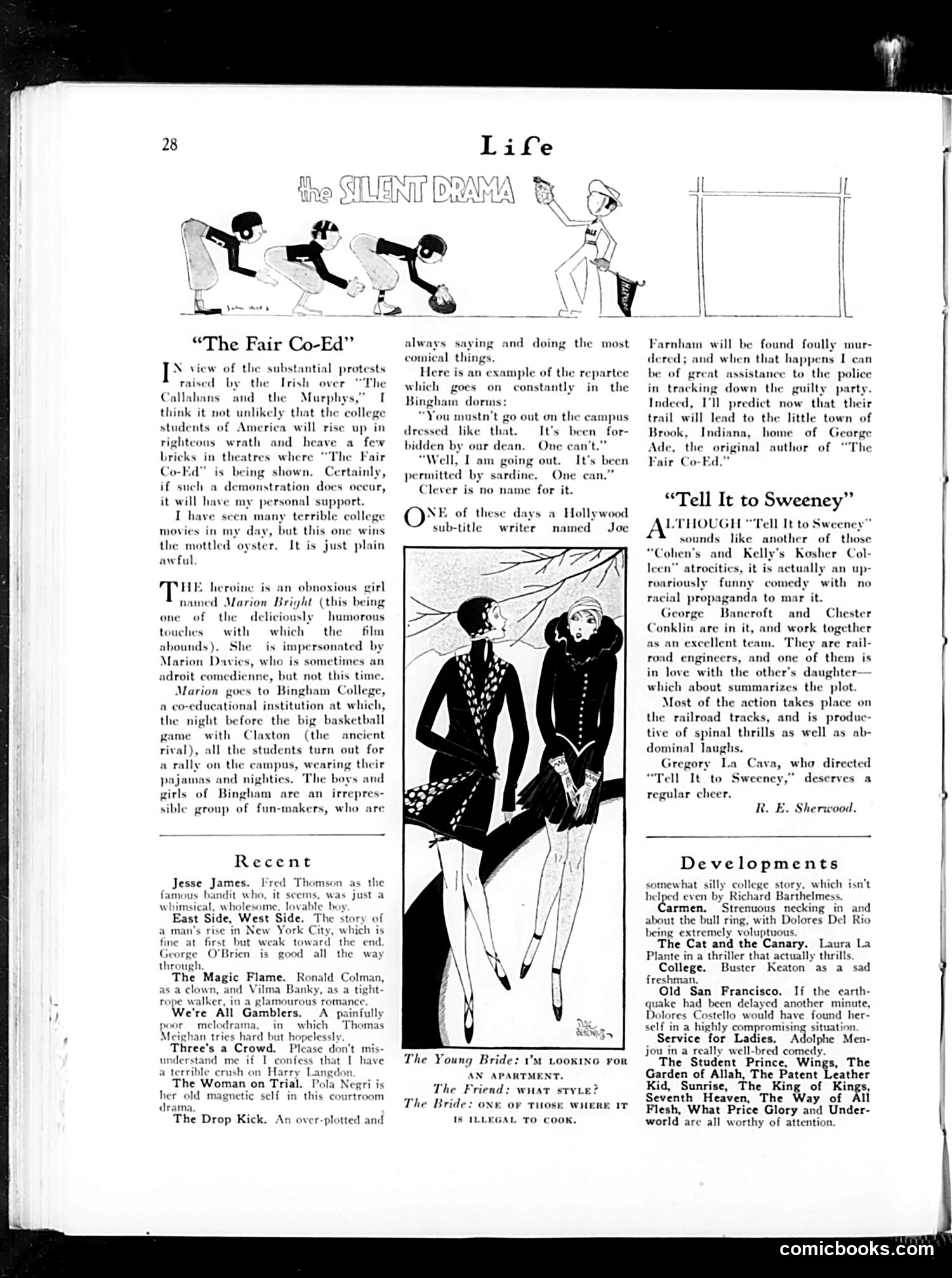
This page critiques contemporary films, particularly **"The Fair Co-Ed"** starring Marion Davies. The reviewer savagely attacks the movie as terrible, jokingly predicting college students will protest it in theaters (referencing actual Irish-American protests over "The Callahans and the Murphys," a film perceived as anti-Irish). The humor targets the film's contrived dialogue—exemplified by an absurd dorm conversation about campus dress codes where characters pun on "sardine" instead of proper authority. The reviewer sarcastically suggests tracking down the film's original author to implicate them in a hypothetical murder. The cartoon at top illustrates "the Silent Drama"—showing someone attempting increasingly desperate physical comedy to entertain an unimpressed audience, likely mocking how silent films relied on exaggerated slapstick. The page also reviews other current releases, including positive notes on "Tell It to Sweeney" (praised for avoiding ethnic stereotype humor common in 1920s cinema). The overall tone is typical 1920s film criticism: acerbic, witty, and dismissive of mediocre studio productions.
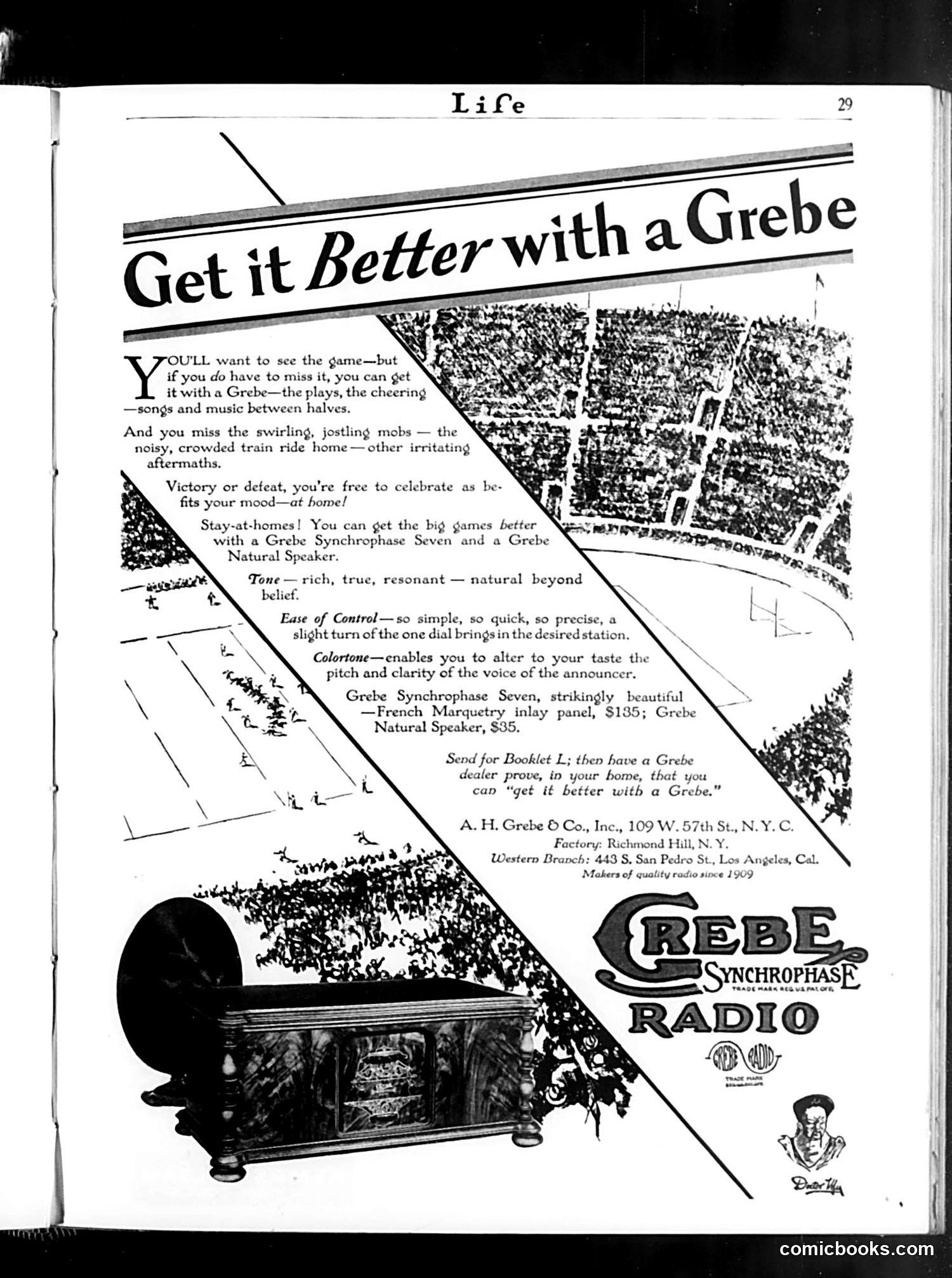
This is a **radio advertisement**, not a political cartoon. It's a 1920s commercial for Grebe Synchrophase Seven radios, positioned as a Life magazine ad (page 29). The pitch targets affluent stay-at-home audiences: instead of attending football games in person—enduring crowds, noise, and uncomfortable train rides—listeners could enjoy broadcasts via Grebe radios in comfort. The ad emphasizes technical features: rich tone, easy single-dial tuning, and "Colortone" pitch adjustment. The aerial photograph showing stadium crowds and the radio console image illustrate the contrast between outdoor mass attendance versus private domestic listening—a novel selling point when radio broadcasting was still relatively new (Grebe claimed "makers of quality radio since 1909"). Pricing is significant: $185 for the furniture model, $35 for the speaker—expensive luxury items suggesting this targets wealthy consumers.
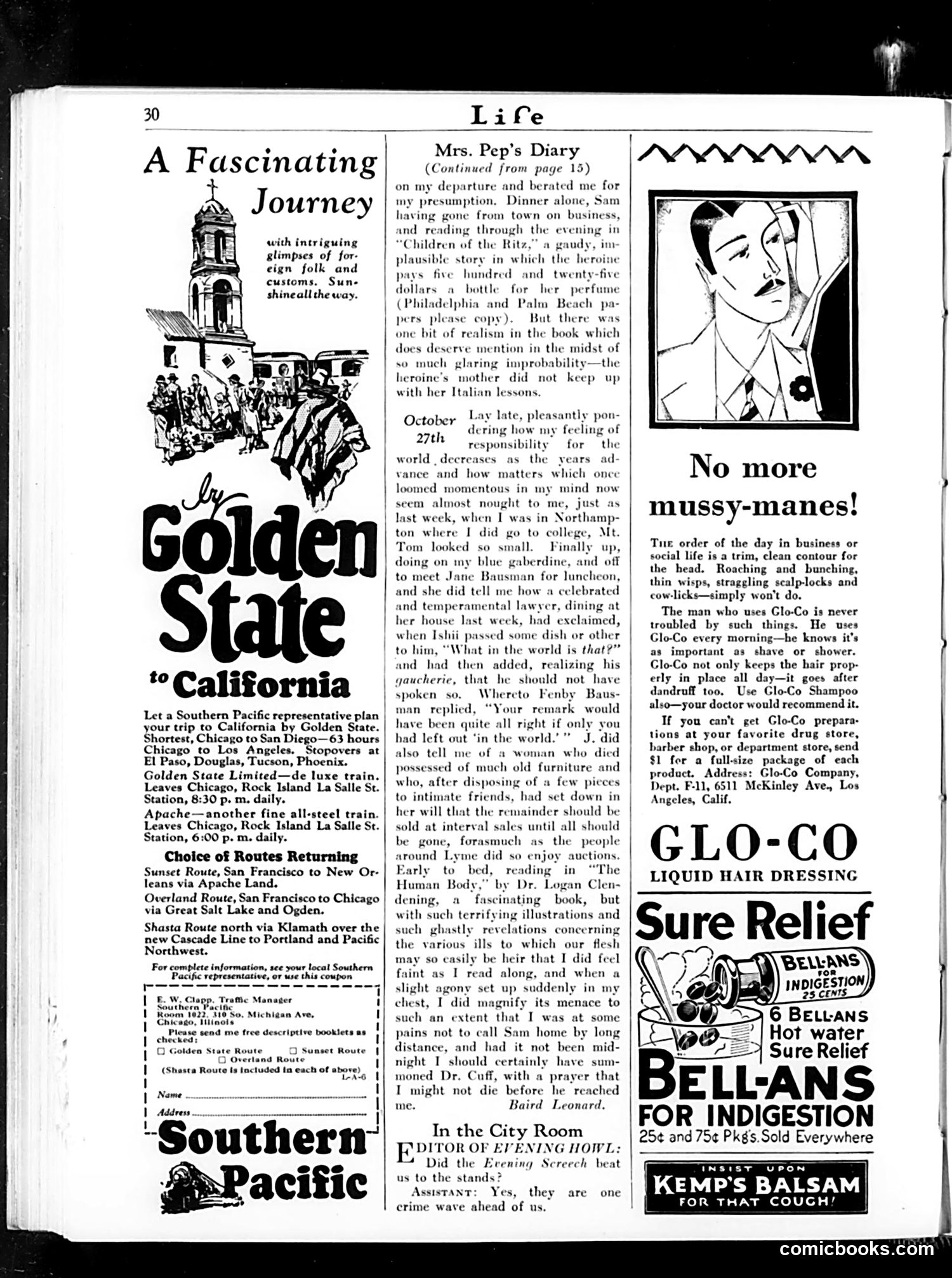
This page is primarily **advertising and lifestyle content**, not political satire. The main elements are: **"Golden State" Railroad Advertisement**: The large left-side ad promotes Southern Pacific's luxury train service to California, featuring an illustrated mission tower and travelers. It offers multiple route options from Chicago. **"Mrs. Pep's Diary"**: A society column continuing from page 15, featuring an upper-class woman's mundane observations—reading frivolous novels, lunching with friends, hypochondriacal worries after reading medical books. It gently satirizes wealthy women's self-absorption and trivial concerns, typical of 1920s Life magazine's humor. **"In the City Room"**: A brief humorous exchange between newspaper staff about competitive journalism ("crime wave"). **Right-side advertisements**: For Glo-Co hair dressing, Bellans indigestion remedy, and Kemp's cough balsam—typical period remedies. The page reflects 1920s consumer culture and social commentary on privileged leisure-class life, rather than political satire.
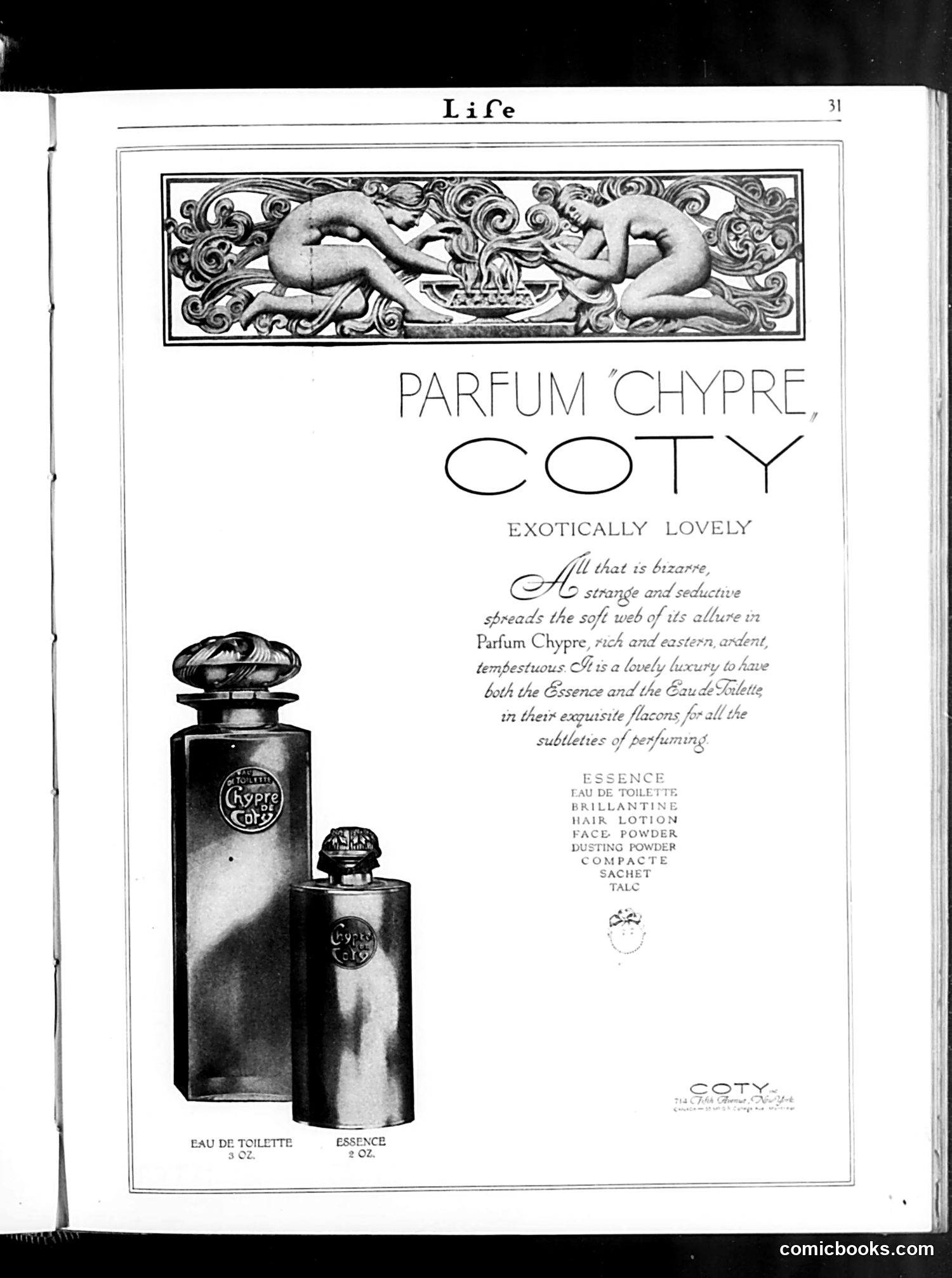
This is a **perfume advertisement**, not satirical content. It promotes "Parfum Chypre" by Coty, a real fragrance brand popular in the early 20th century. The decorative header features classical cherubs in ornamental scrollwork—typical Art Deco design flourishes. The ad emphasizes the product's exotic, sensual appeal ("bizarre, strange and seductive"). Two bottle sizes are displayed (Eau de Toilette and Essence), along with a list of related products (hair lotion, face powder, talc, etc.). There is no political cartoon, caricature, or satire here. This page demonstrates how *Life* magazine—despite its satirical reputation—contained substantial advertising revenue. The ornate design and languorous copy reflect 1920s luxury marketing aesthetics targeting women consumers.
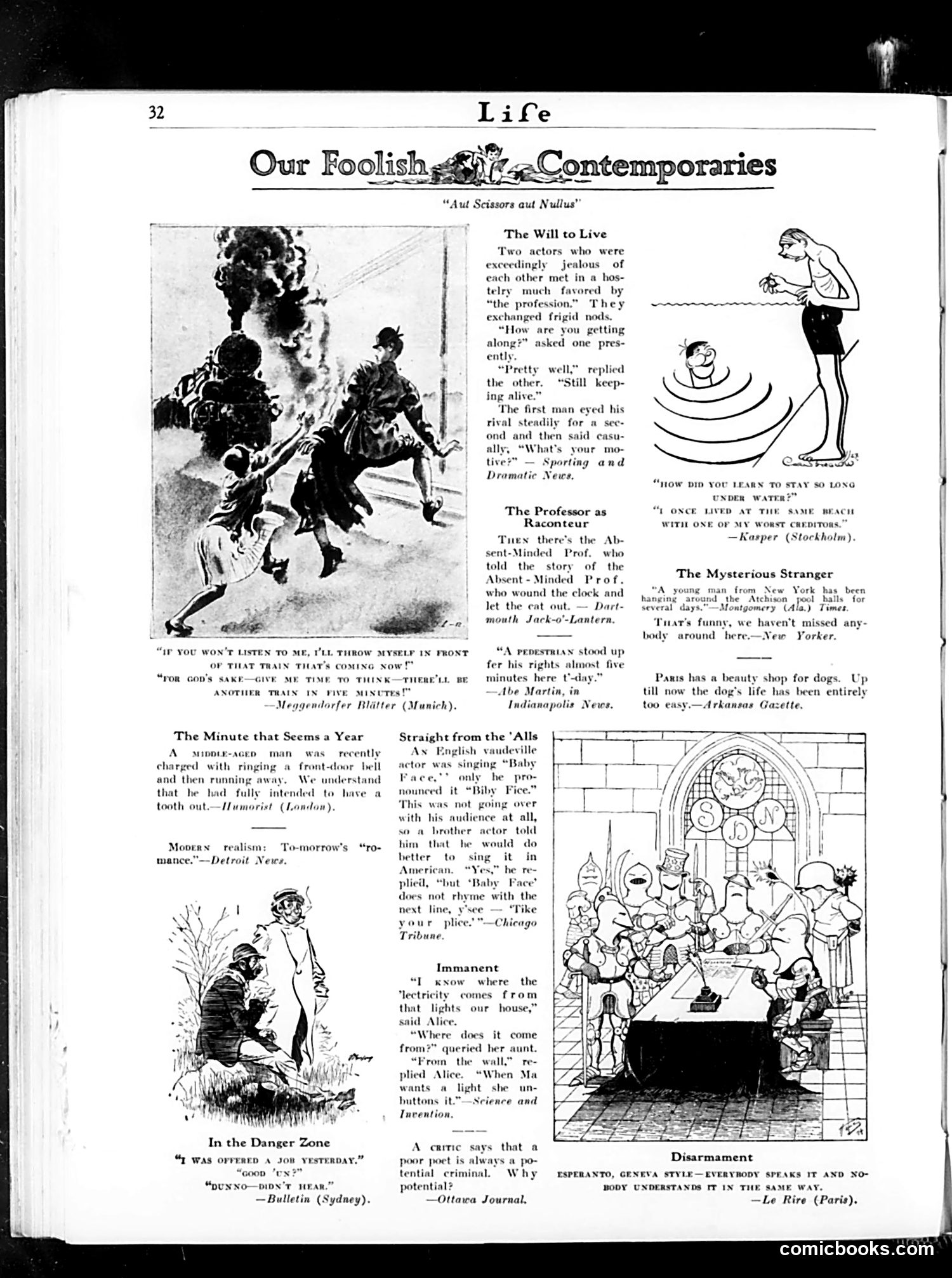
This page collects brief humorous anecdotes from newspapers and magazines, mocking everyday human folly. Key items: **"The Will to Live"**: Two jealous actors meet and exchange cold pleasantries—satire on professional rivalry and forced civility. **"The Professor as Raconteur"**: Jokes about an absent-minded professor telling stories about absent-mindedness—absurdist humor about circular logic. **"In the Danger Zone"**: A woman threatens suicide by train; the punchline (a man's response) dismisses her threat—dark humor about melodrama. **"Disarmament"**: The cartoon criticizes international peace conferences (likely post-WWI League of Nations efforts), joking that delegates speak Esperanto but cannot understand each other anyway—mocking the futility of diplomatic language barriers. The overall theme: satirizing human pretension, professional vanity, melodrama, and international political naivety through brief, witty anecdotes.
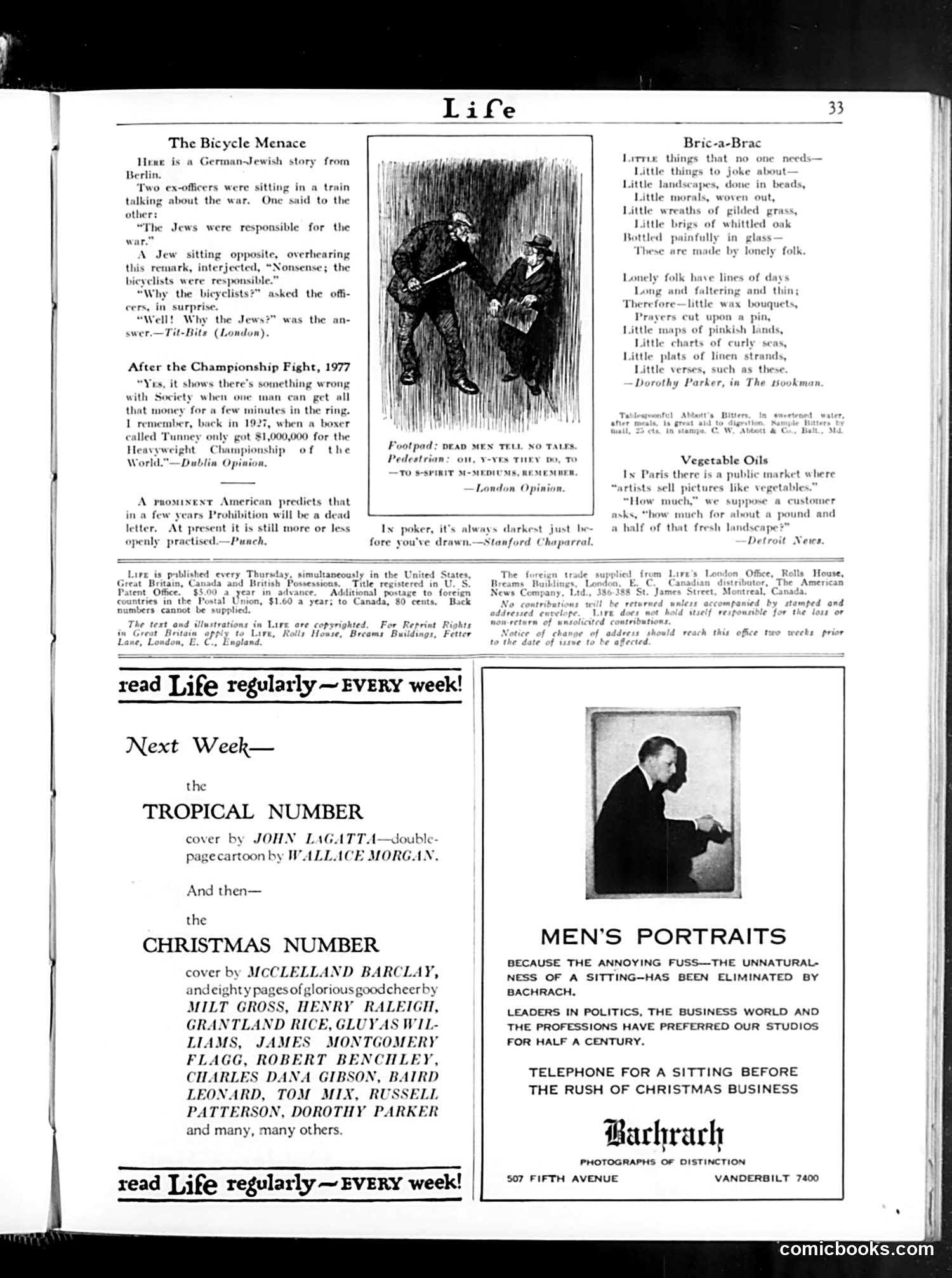
This page contains three satirical items from Life magazine: **"The Bicycle Menace"** presents an anti-Semitic joke from Berlin where two ex-officers blame Jews for WWI, and a Jewish passenger interjects that bicyclists were responsible—deflecting blame absurdly. The satire appears to mock prejudiced scapegoating. **"After the Championship Fight, 1977"** references boxer Gene Tunney's 1927 million-dollar purse, predicting that by 1977, boxers will earn so much that "dead men tell no tales" becomes relevant—apparently satirizing wage inflation and suggesting boxers might literally die in the ring for such money. **The pedestrian cartoon** shows someone claiming that spiritualists contact dead mediums, playing on confusion between spiritualism and mediums themselves. The page is primarily filler material—advertisements for *Life*'s upcoming tropical and Christmas issues, plus a Bachrach portrait photography studio ad. The content relies on period-specific references (1920s boxing economics, spiritualism fads) that require historical context for modern readers.
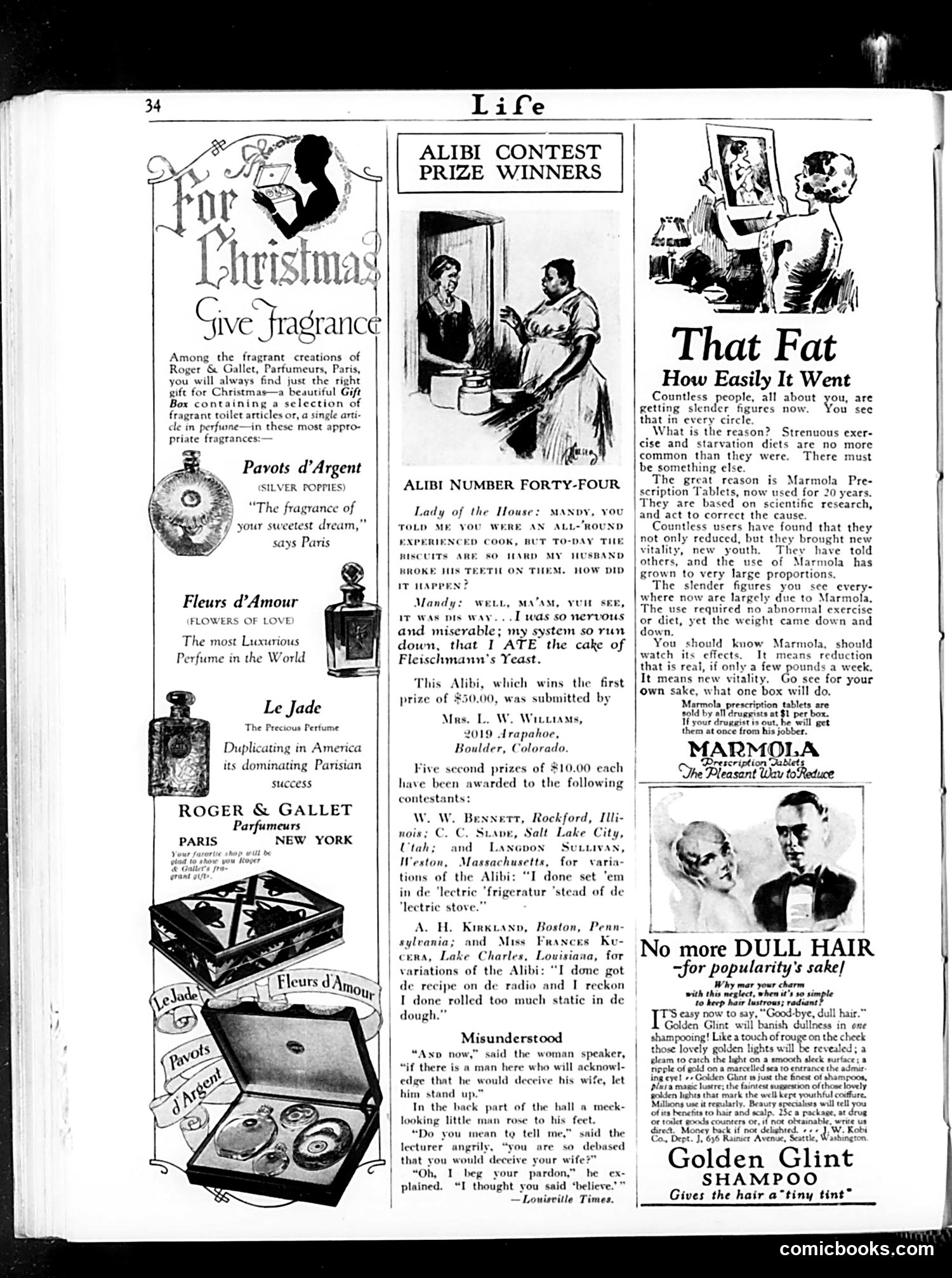
This page from Life magazine (circa 1920s) contains mostly **advertisements and humorous contest content**, not political satire. The main feature is an "Alibi Contest" showcasing winning excuses. The featured first-prize alibi (worth $50) depicts a domestic comedy scenario: a Black servant named Mandy explains ruined biscuits by claiming she ate Fleischmann's Yeast cake because she was nervous—her "system so run down." The humor relies on period racial stereotypes and the absurdity of eating raw yeast as an excuse. Secondary prize-winning alibis follow similar comedic patterns with vernacular-heavy speech, playing on working-class dialect humor typical of 1920s publications. The remaining content is advertising: perfumes (Roger & Gallet), Marmola weight-loss tablets, and Golden Glint shampoo. These ads reflect era-specific beauty standards emphasizing slenderness and glamorous appearance. The "Misunderstood" cartoon at bottom offers mild domestic humor about miscommunication between spouses—entirely unrelated to the surrounding content.
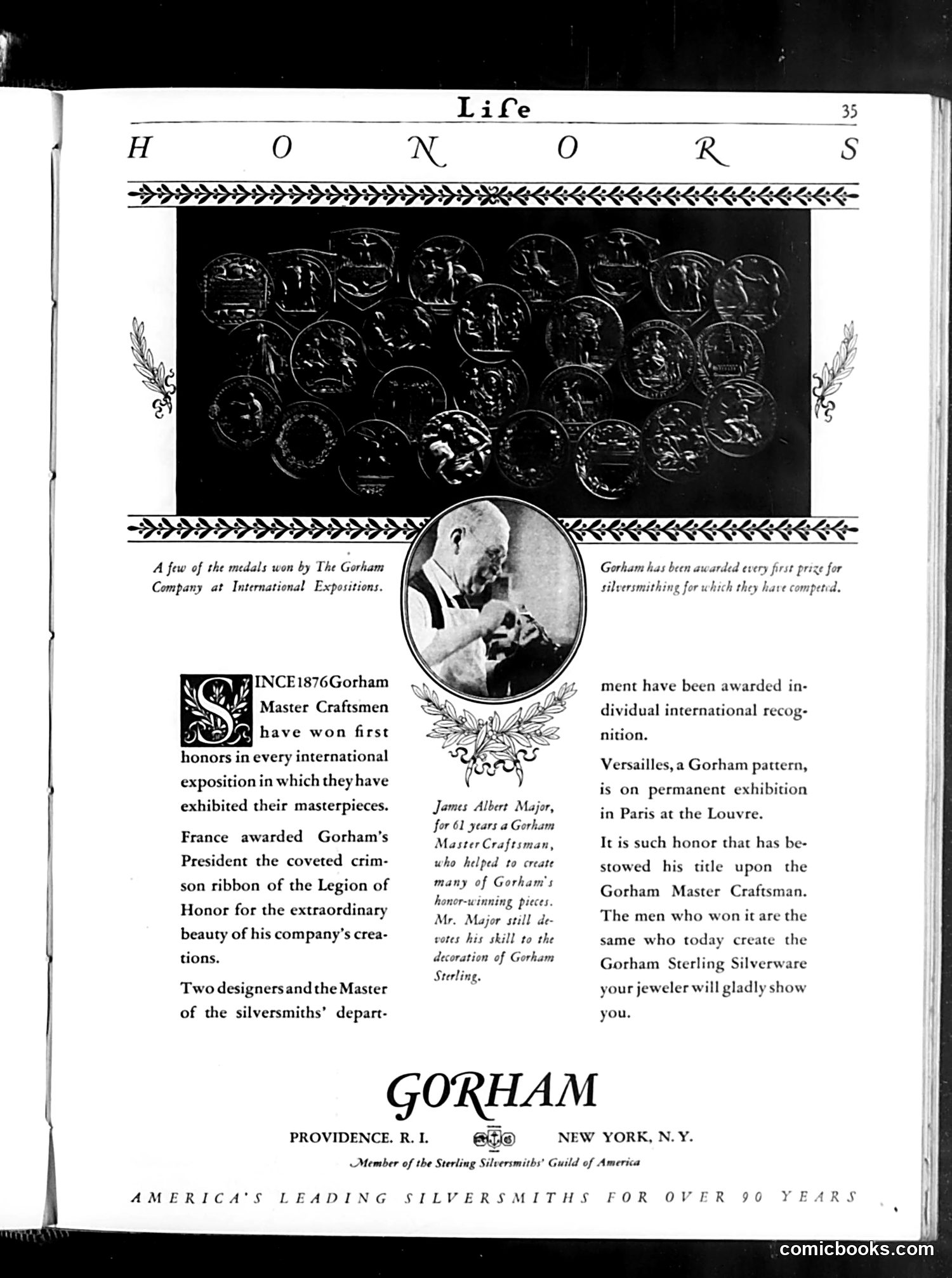
This is not a cartoon or satire—it's a **straightforward advertisement** for Gorham silverware, a luxury brand. The page features: **Image content:** Photographs of medals won at international expositions and a portrait of James Albert Major, a master craftsman employed by Gorham for 61 years. **The message:** Gorham uses awards and human expertise to establish prestige. France awarded their president the Legion of Honor ribbon for "extraordinary beauty" of creations. Major's decades of skilled work symbolize the company's commitment to craftsmanship. One Gorham pattern is permanently displayed at the Louvre in Paris. **Purpose:** This is corporate image-building during the early 20th century, targeting wealthy consumers by associating the brand with French cultural authority, international recognition, and master artisans. There is no satire or political content—it's pure commercial promotion emphasizing heritage and excellence.
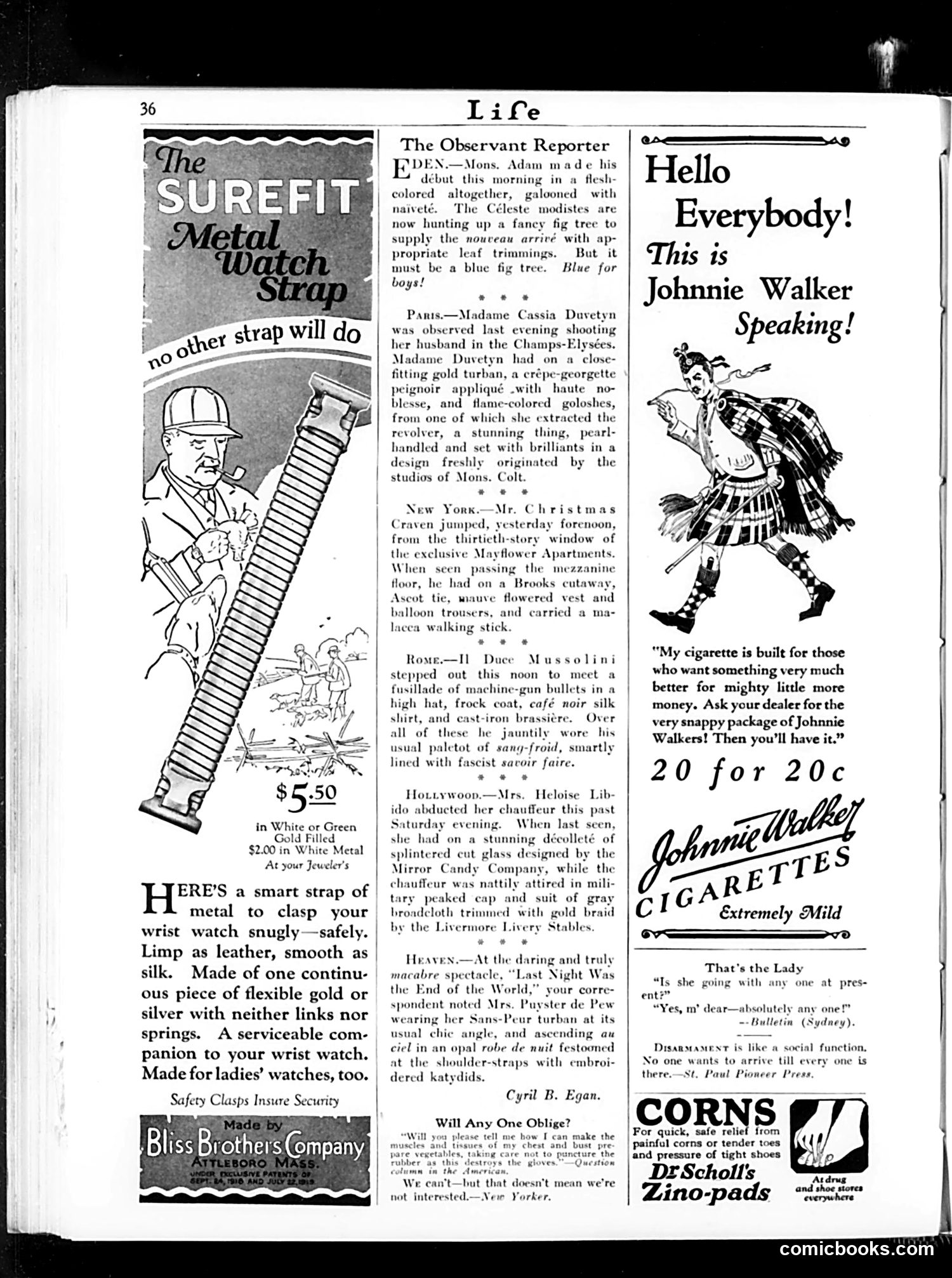
This column mocks high-fashion society and contemporary political figures through absurdist "fashion reporting" from various cities. Each brief entry describes someone in an outrageous outfit while committing a dramatic act, satirizing both pretentious fashion journalism and current events. Key targets appear to include: - **Paris**: A nude performance artist, mocking avant-garde theater and fashion obsession - **Rome**: Il Duce Mussolini meeting gunfire while fashionably dressed—dark satire on fascism and militarism - **New York**: A suicide victim described only by his impeccable clothing—skewering shallow society's priorities - **Hollywood**: A woman abducting her chauffeur in elaborate dress—mocking scandal journalism and celebrity excess The humor relies on the grotesque contrast between haute couture descriptions and serious or tragic events. By treating violent or absurd acts as mere backdrops to fashion commentary, the satire exposes how superficial society pages trivialize human drama and how fashion culture enables moral numbness.
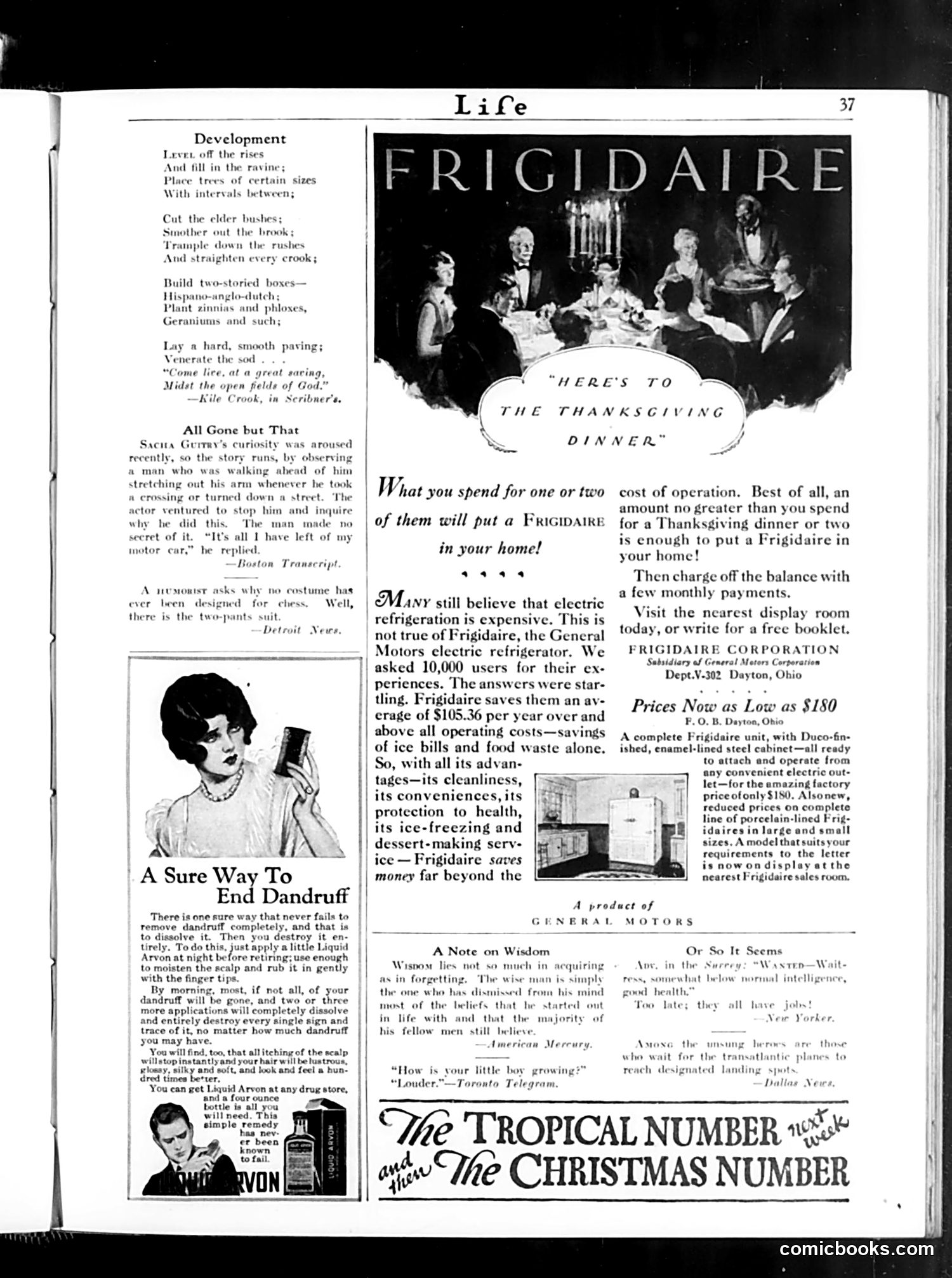
This page contains **mostly advertising** for Frigidaire refrigerators, interspersed with short humorous items typical of Life's satirical format. **Main Advertisement**: Frigidaire promotes electric refrigerators as affordable (starting at $180), countering the common belief that electric refrigeration was expensive. The ad cites a survey of 10,000 users claiming savings of $105.36 yearly on ice and food waste—framing the appliance as financially practical even for middle-class households. **Humorous Filler Content**: - "A Sure Way to End Dandruff" advertises Arvon hair product - "All Gone but That" jokes about a man whose only remaining souvenir of his car is the gesture of hailing taxis - Brief quips from publications like the *American Mercury*, *Toronto Telegram*, and *The New Yorker* **Historical Context**: This reflects 1920s consumer culture when modern electrical appliances were novel luxury items being marketed to mainstream Americans. The page demonstrates how Life blended satire with advertising—a common magazine format of the era.
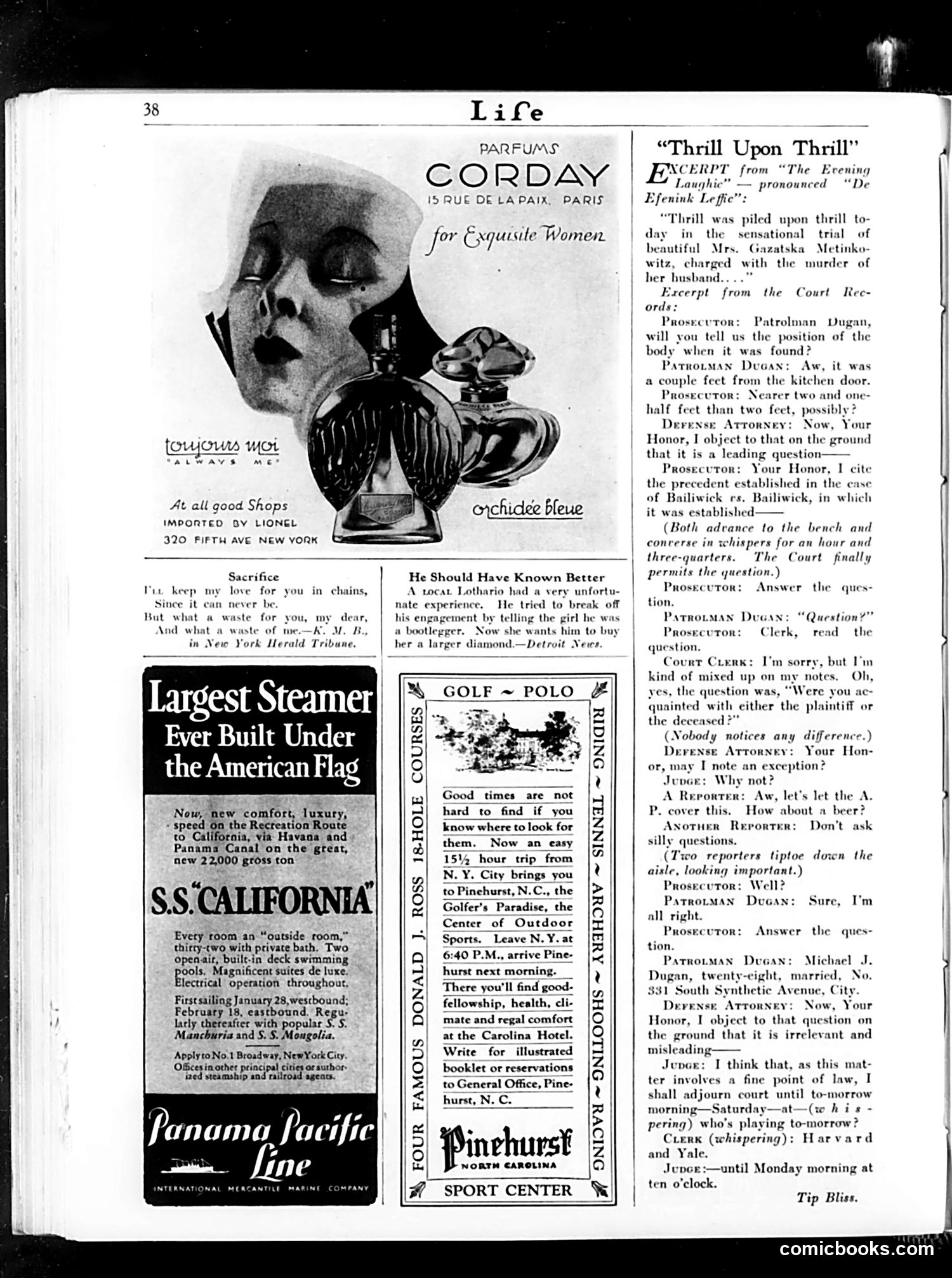
This is a satirical excerpt mocking the sensationalism and inefficiency of criminal trials, particularly those receiving lurid newspaper coverage. The piece parodies "The Evening Laughie" (a play on tabloid-style journalism) covering a murder trial of "beautiful Mrs. Gazatska Metinkowitz." The satire targets: 1. **Legal incompetence**: A seemingly simple question about the body's position becomes absurdly complicated through objections and precedent-citing, consuming "an hour and three-quarters." 2. **Courtroom theater**: The judge and attorneys engage in whispered conferences while reporters "tiptoe" dramatically, treating proceedings as spectacle. 3. **Press sensationalism**: The trial is framed as thrilling entertainment rather than justice. 4. **Judicial distraction**: The judge casually adjourns court to discuss college football (Harvard-Yale), suggesting trials are secondary to entertainment. The humor depends on understanding 1920s courtroom procedure and tabloid excess—this Life piece critiques how sensational press coverage and theatrical legal maneuvering undermine serious criminal proceedings.
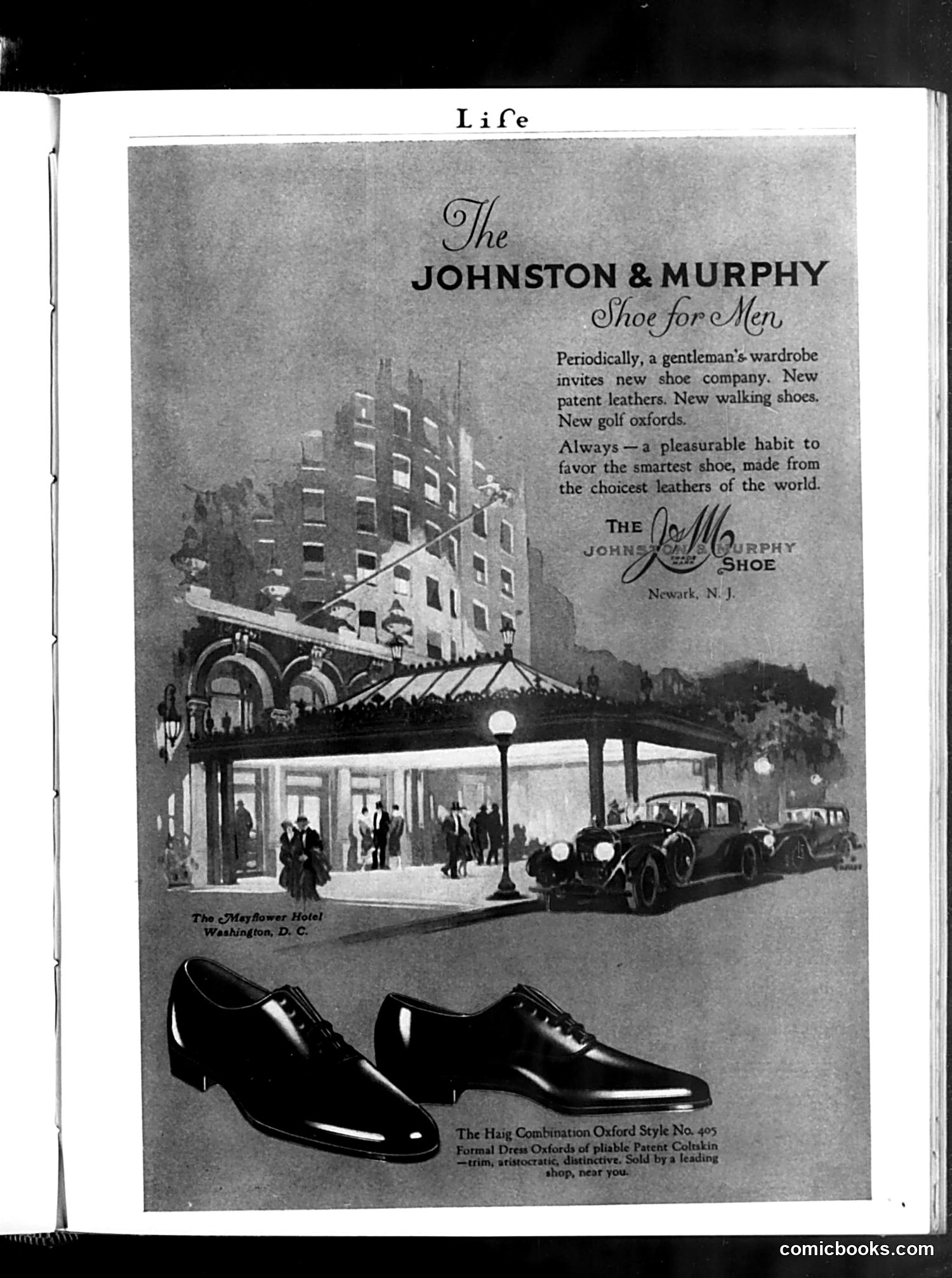
This is **not a cartoon or satire**, but rather a **straight advertisement** for Johnston & Murphy shoes, a men's footwear company based in Newark, New Jersey. The ad uses aspirational imagery typical of the era: a glamorous hotel (The Mayflower in Washington, D.C.) with well-dressed patrons and automobiles to signal sophistication and status. The copy emphasizes quality materials and fashionable styles ("patent leathers," "golf oxfords"). Two formal dress shoes are pictured below, labeled as "Hair Combination Oxford Style No. 405"—described as formal footwear made from pliable patent leather with trim details. This represents standard early-to-mid 20th century advertising strategy: associating a product with elegance, wealth, and refined taste to appeal to gentlemen consumers.
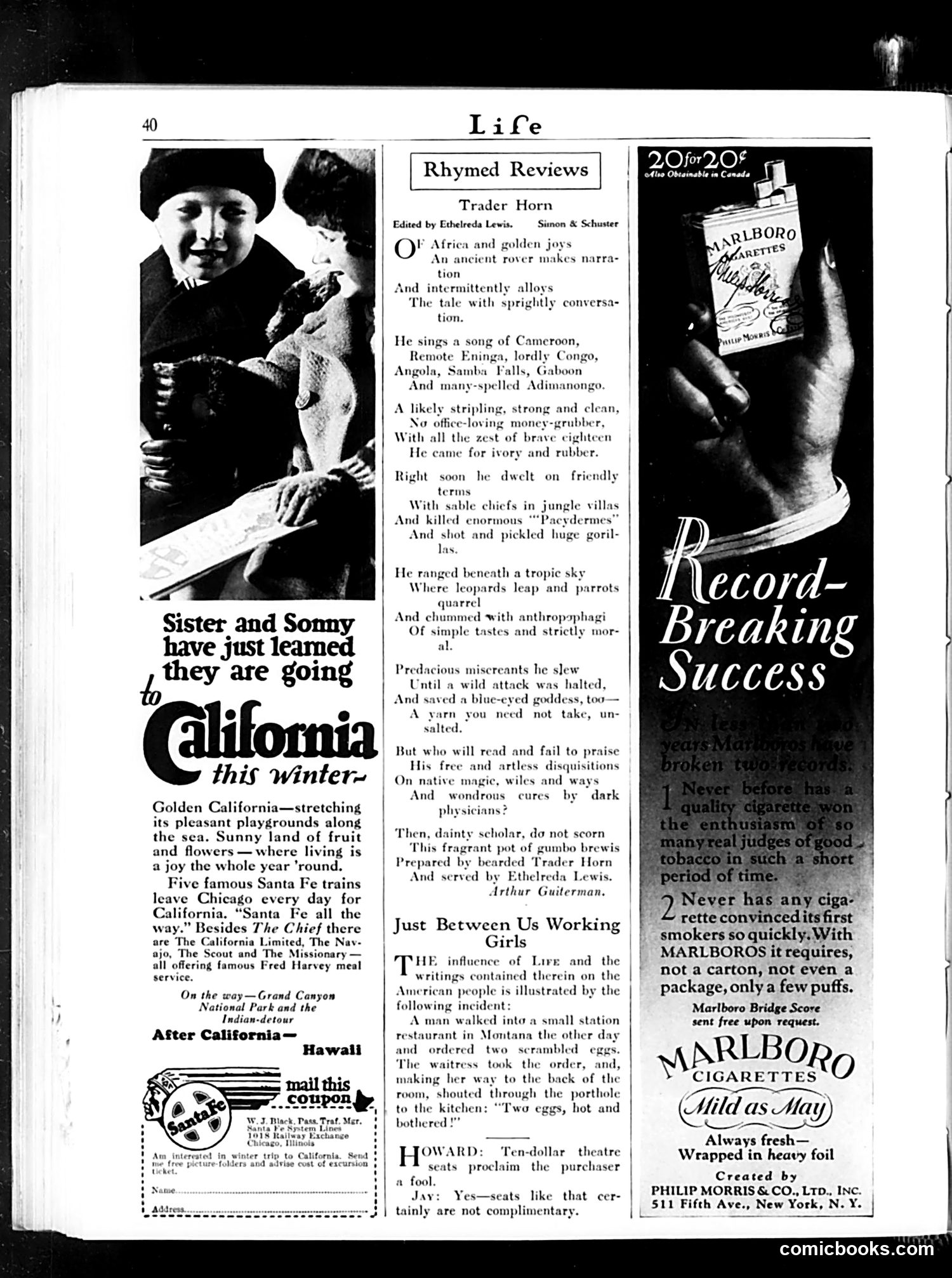
This page contains **travel advertising, a book review, and humor pieces**—not political cartoons. The main content advertises **California train travel** via the Santa Fe Railway, targeting families ("Sister and Sonny") with promises of sunshine and leisure. The "After California—Hawaii" extension suggests aspirational tourism for affluent readers. The **"Trader Horn" review** is a rhymed critique of a book (edited by Ethelreda Lewis) about an African trader's adventures—hunting ivory, rubber, and exotic wildlife while encountering local chiefs and wildlife. The satirical tone gently mocks both the adventure narrative's exoticism and its moralistic framing. **"Just Between Us Working Girls"** is a short joke: a Montana waitress, apparently influenced by *Life* magazine's witty language, orders eggs "hot and bothered" instead of "scrambled"—suggesting the magazine's cultural influence reaches even remote diners. The page also includes a **Marlboro cigarette advertisement** touting the brand's success in winning smokers. The overall page reflects 1920s-30s American consumer culture, travel aspirations, and mass media's perceived influence.
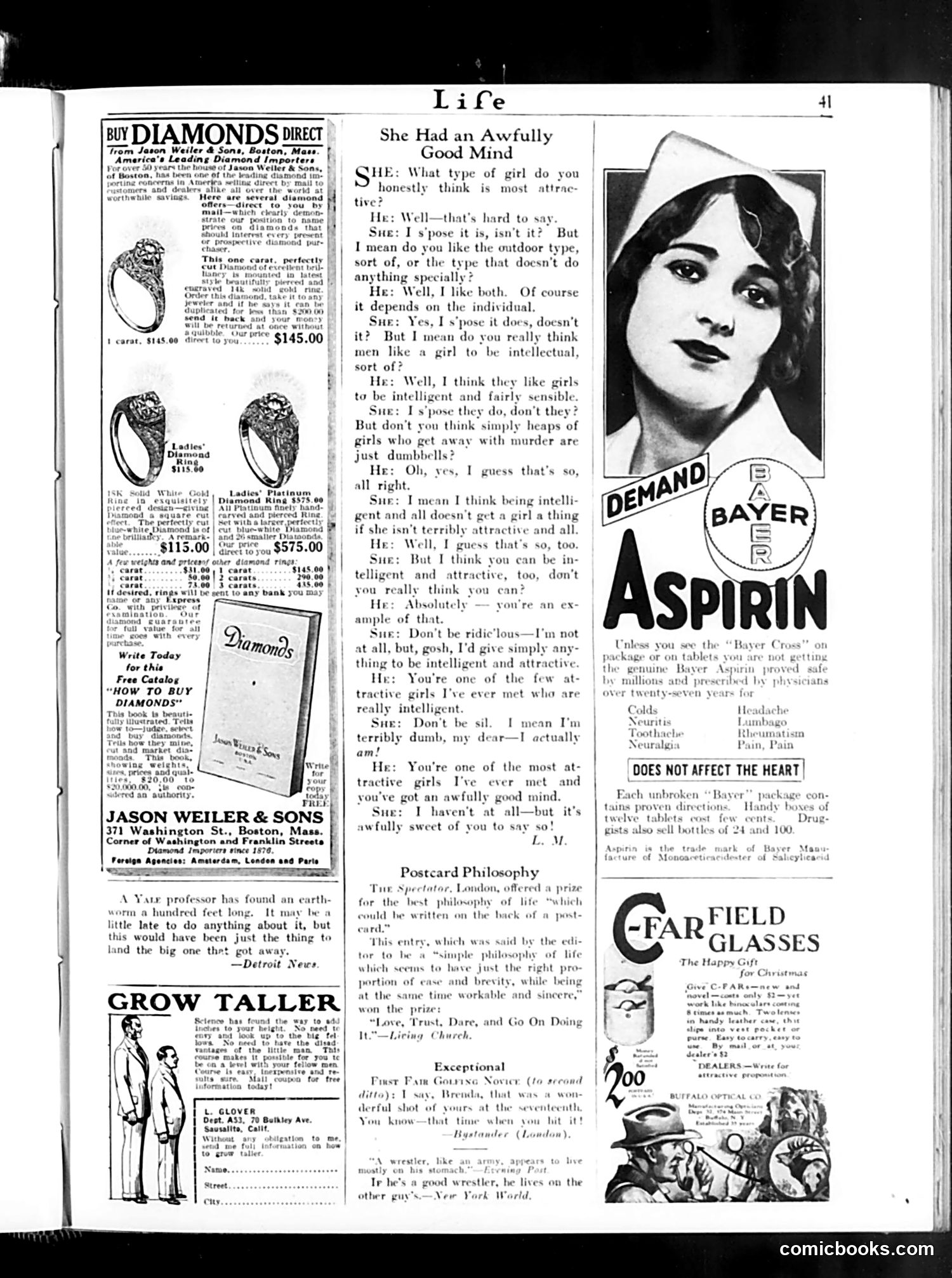
This page is primarily **advertising and humor columns** rather than political cartoons. The main content includes: **"She Had an Awfully Good Mind"** — A satirical dialogue between a man and woman. The joke targets early 20th-century dating dynamics: the woman repeatedly self-deprecates ("I'm terribly dumb") while fishing for compliments, while the man diplomatically praises her intelligence and attractiveness. The satire mocks both her false modesty and his transparent flattery—depicting the artificial social performance of courtship conversation. **Other brief humor items** include jokes about an unusually large earthworm and golf anecdotes. **The advertisements** dominate: Jason Weiler & Sons sells diamonds directly, emphasizing savings; C-FAR Field Glasses promotes gift-giving; and Bayer Aspirin advertises its pain-relief properties while claiming it "does not affect the heart." The page reflects 1920s-era concerns: consumer goods, dating etiquette, and emerging pharmaceutical marketing.
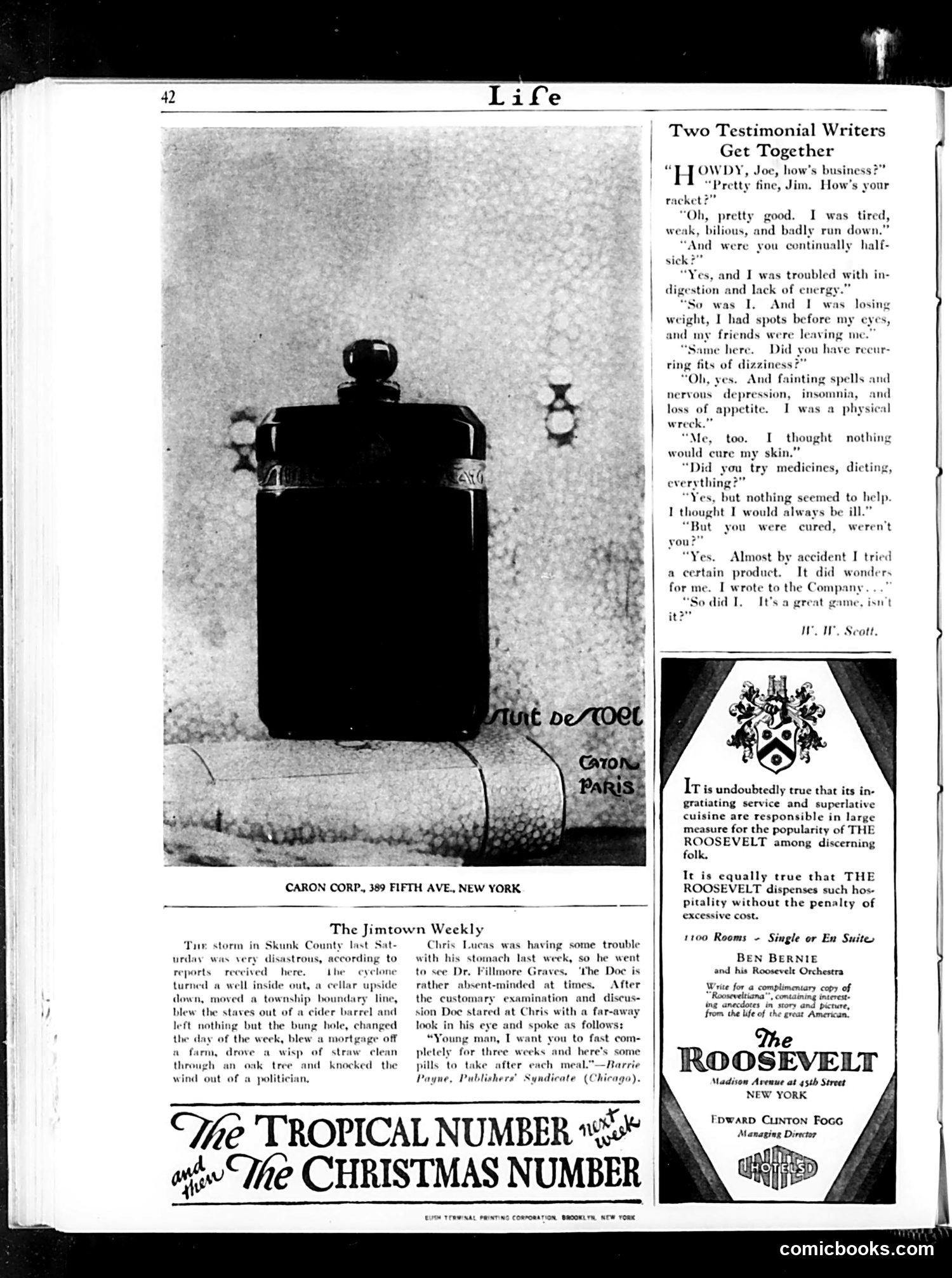
This page contains satirical humor and period advertising rather than political cartoons. **"Two Testimonial Writers Get Together"**: This is satire mocking the ubiquitous patent medicine advertisements of the era. Two men swap identical health complaints (weakness, indigestion, spots before eyes, insomnia, etc.)—the standard ailments advertised in early-1900s magazines—then discover they were both mysteriously "cured" by the same unnamed "product." The joke exposes how these testimonials were formulaic and suspiciously identical, suggesting they were fabricated marketing copy rather than genuine accounts. Patent medicines were largely unregulated snake oil at this time. **Other content**: "The Jimtown Weekly" appears to be rural humor; advertisements promote *Life* magazine's upcoming issues and The Roosevelt Hotel's amenities. The satire targets the advertising industry's deceptive practices and consumers' gullibility regarding bogus health cures.
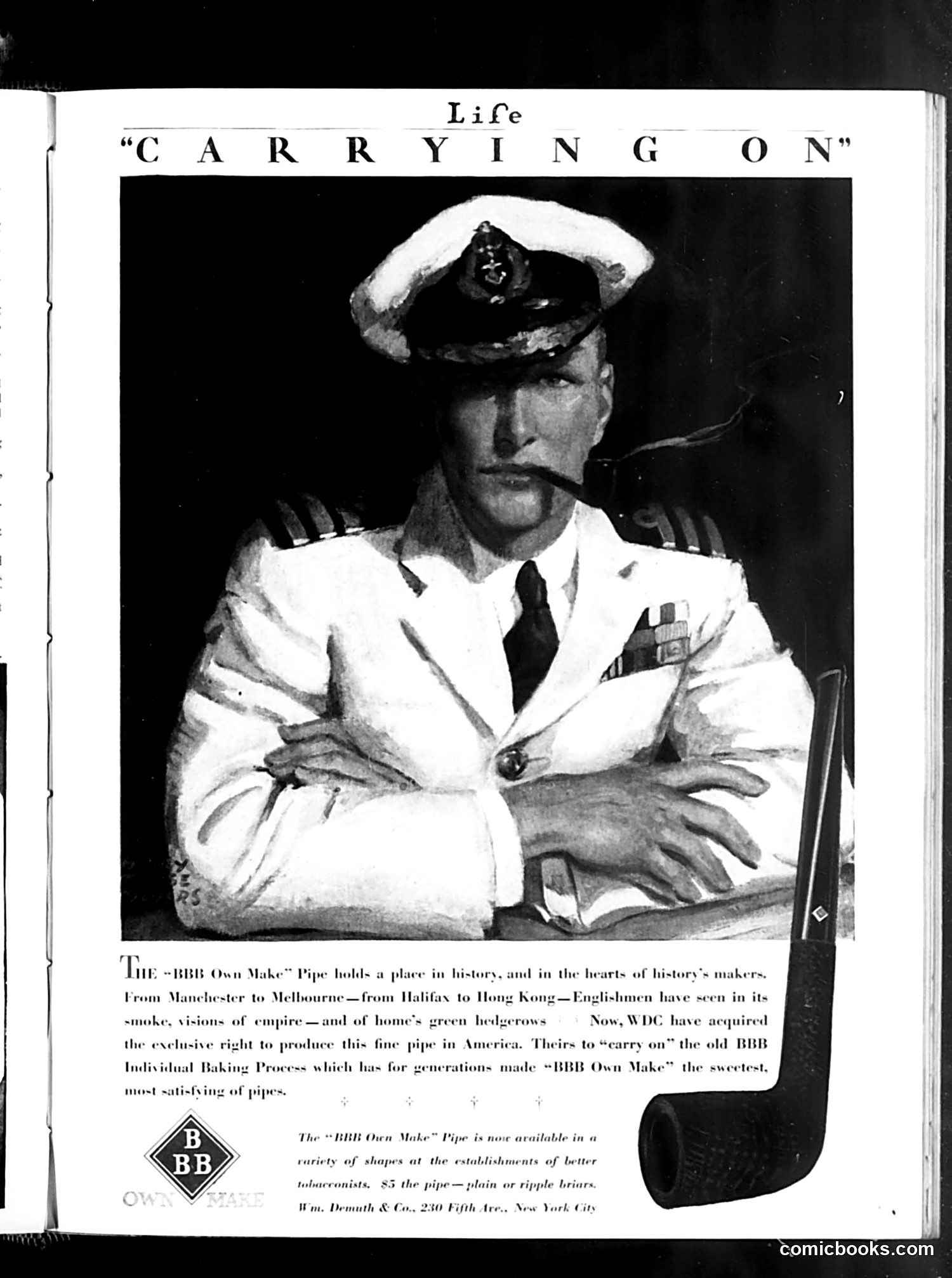
This is a **cigarette/pipe advertisement**, not a political cartoon. The page features a dignified military officer in white dress uniform with captain's insignia, posed formally while smoking. The ad celebrates the "BBB Own Make" pipe as an iconic British product associated with empire and tradition ("visions of empire"). The appeal is to masculine sophistication and imperial heritage—English gentlemen from Manchester to Hong Kong have smoked these pipes. The key commercial message: WDC (likely Wm. Demuth & Co., a New York tobacconist) has acquired American distribution rights and will continue the traditional "Individual Baking Process" that supposedly makes BBB pipes superior. The $3 price point targets affluent buyers. The military officer serves as a status symbol—associating the product with authority, tradition, and refined taste during what appears to be the interwar period.
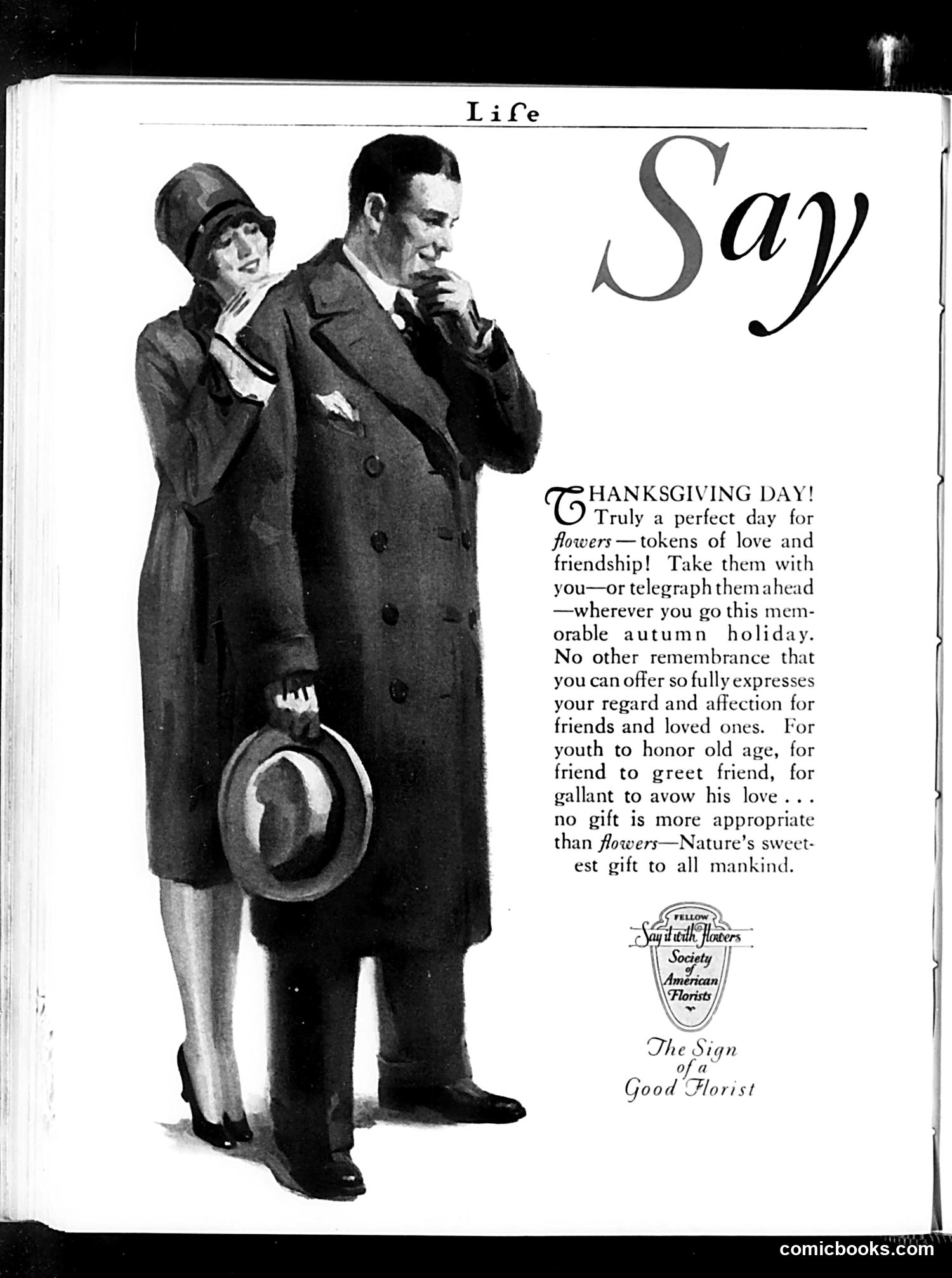
This is **not a political cartoon but a Thanksgiving advertisement** for the Society of American Florists, promoting flowers as holiday gifts. The page shows an elegantly dressed couple in 1920s attire—a woman in a cloche hat and coat, a man in a suit—holding a hat, presumably arriving for a visit. The text argues that flowers represent the ideal gift for Thanksgiving, suitable for all relationships: honoring elders, greeting friends, and declaring romantic love. The advertisement uses sentimental language about flowers as "Nature's sweetest gift to all mankind" to encourage readers to send or deliver flowers during the holiday season. The branding at bottom identifies this as content from "The Sign of a Good Florist," a trade organization promoting flower-giving as a commercial practice during an important gifting occasion.
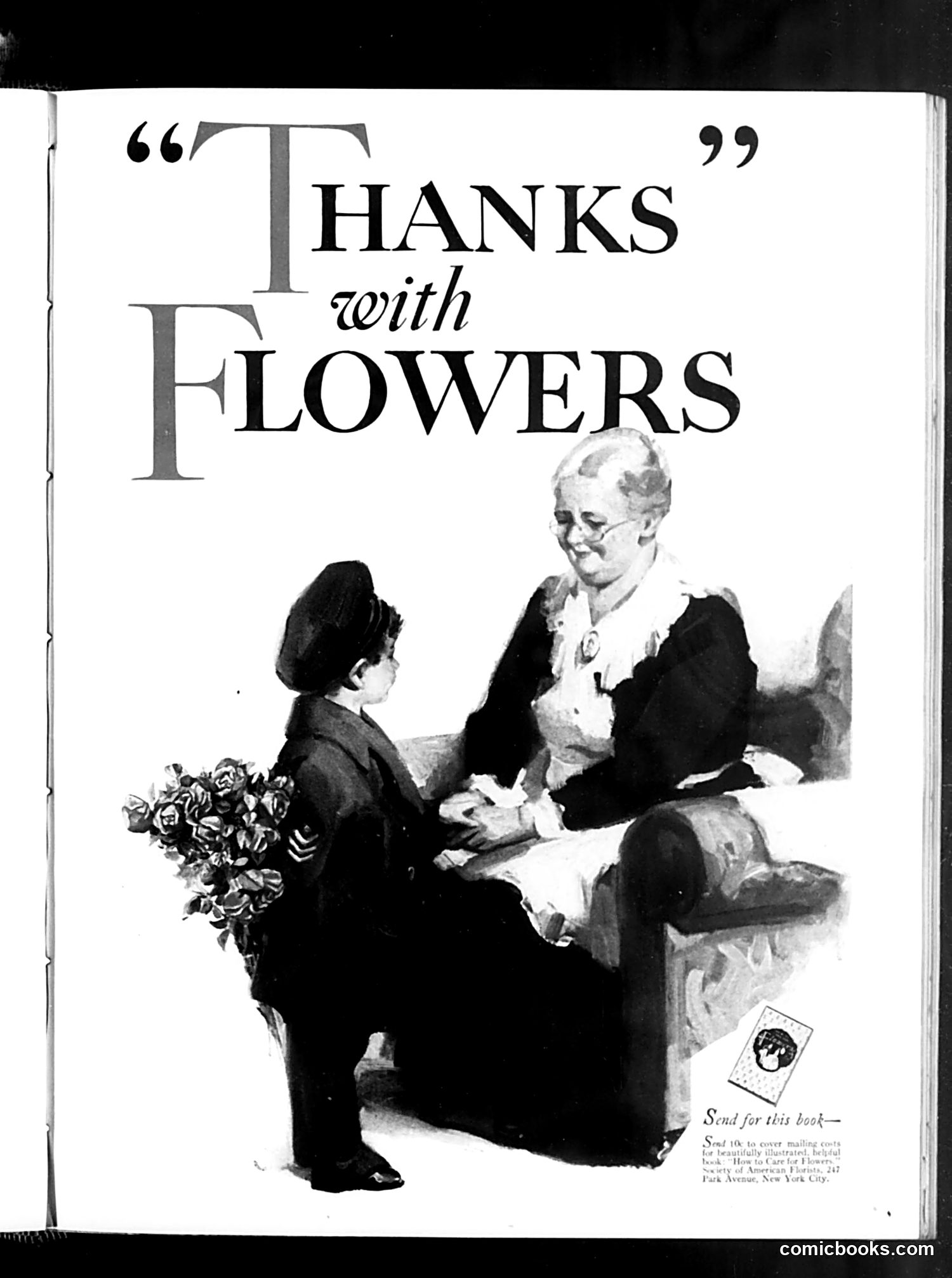
This appears to be a **book advertisement** rather than political satire. The page promotes a guide titled "Thanks with Flowers: How to Care for Flowers," published by someone at Park Avenue, New York City. The illustration shows an **elderly woman receiving flowers from a younger visitor** — likely depicting a social courtesy scenario the book addresses. The accompanying text invites readers to "Send for this book" by mailing costs for what's described as a "beautifully illustrated, bridal book." This is straightforward **commercial advertising** aimed at early 20th-century readers interested in proper etiquette around flower-giving and floral care — reflecting period concerns with genteel social practices and domestic skills.
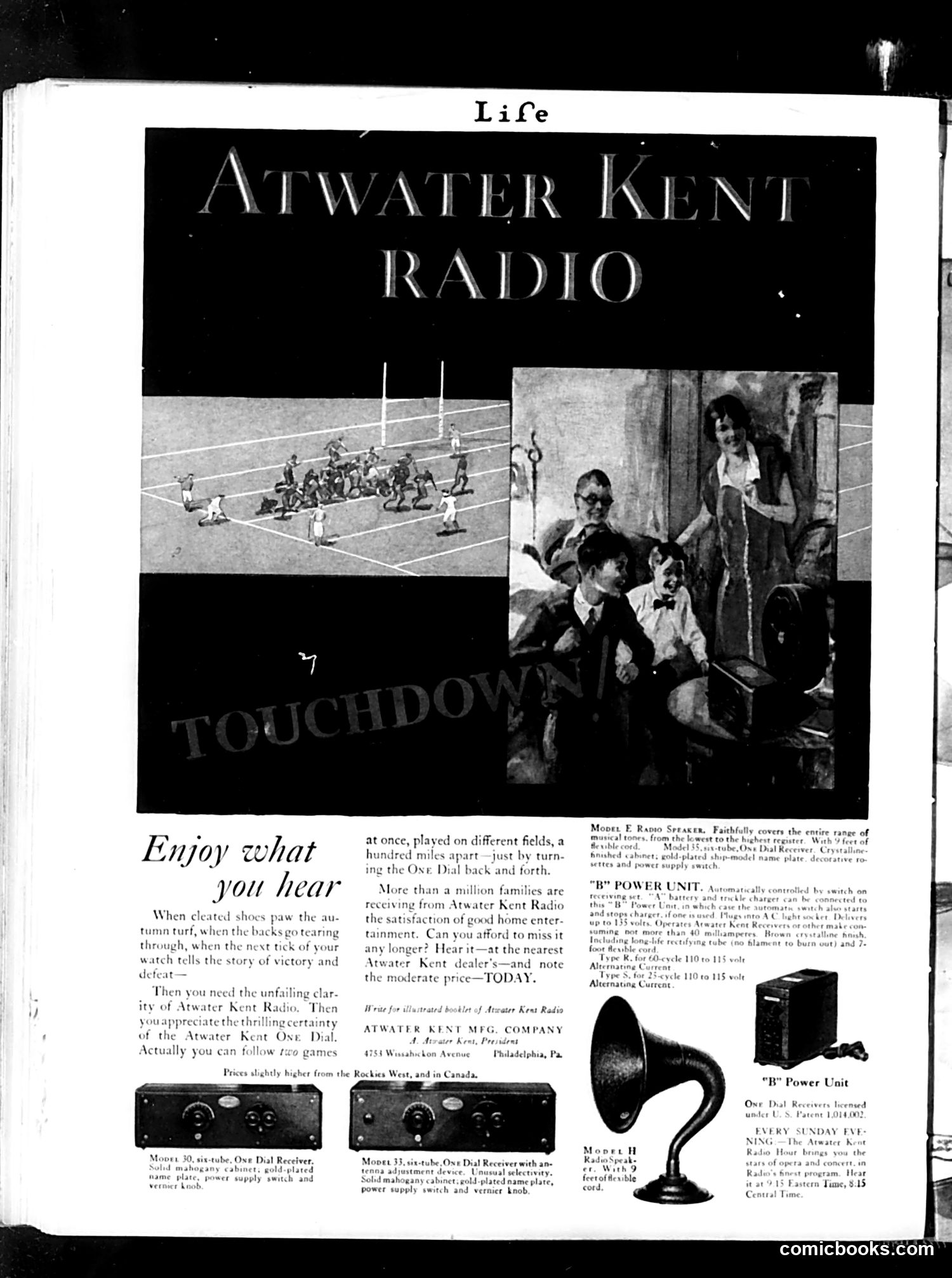
This is primarily a **radio advertisement**, not a political cartoon. It promotes Atwater Kent Radio receivers to early 1920s consumers. The page features two photographs illustrating radio's appeal: a football game (top left) and a family gathered around a radio set (top right). The text emphasizes radio's ability to bring entertainment into homes—specifically mentioning football games and the "Atwater Kent Radio Hour," a popular Sunday evening program. The satirical element is gentle: the headline "Enjoy what you hear" speaks to radio's novelty and the cultural shift it represents. For modern readers, this captures a moment when **radio broadcasting was new technology that unified families and brought distant events (like sports) into living rooms**—comparable to how television or streaming functions today. The advertisement includes technical specifications for radio receivers and a "B" Power Unit, reflecting the era when radio required external power sources. This is essentially early consumer electronics marketing masquerading as lifestyle editorial content.