
A complete issue · 44 pages · 1927
Life — November 10, 1927
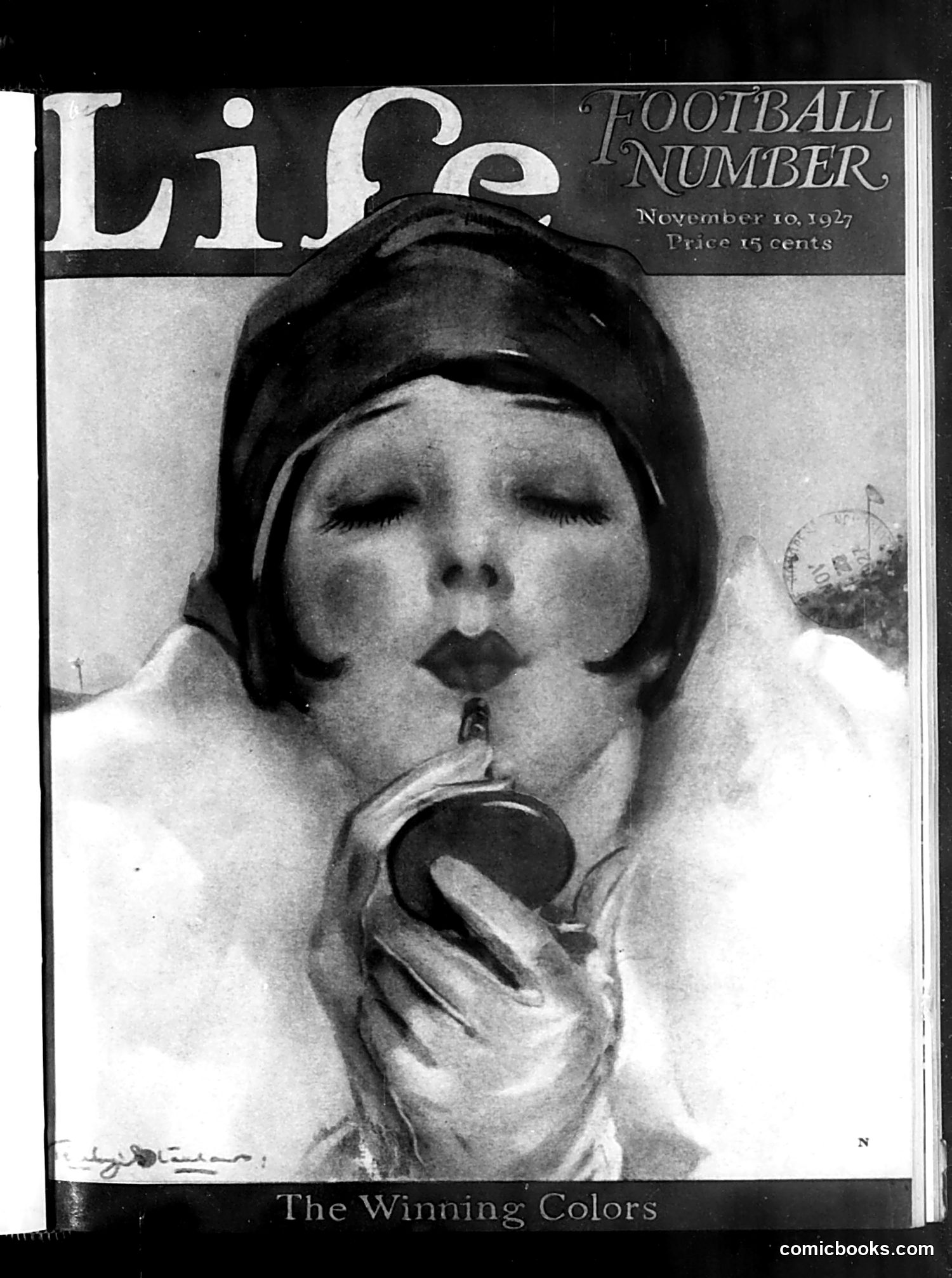
This is the cover of Life's "Football Number" issue from 1927. The image shows a person with closed eyes blowing a whistle, wearing a headband and white shirt. The caption reads "The Winning Colors." The satire likely comments on college football fever during the 1920s, a period when American football became a major cultural phenomenon. The figure appears to represent either a referee or coach whose whistle determines outcomes—suggesting that winning depends on officials' decisions rather than pure athletic merit. The closed-eyed referee could satirize concerns about bias, favoritism, or the arbitrary nature of officiating in determining "winning colors" (team victory). This reflects 1920s anxieties about the growing commercialization and questionable integrity of collegiate sports.
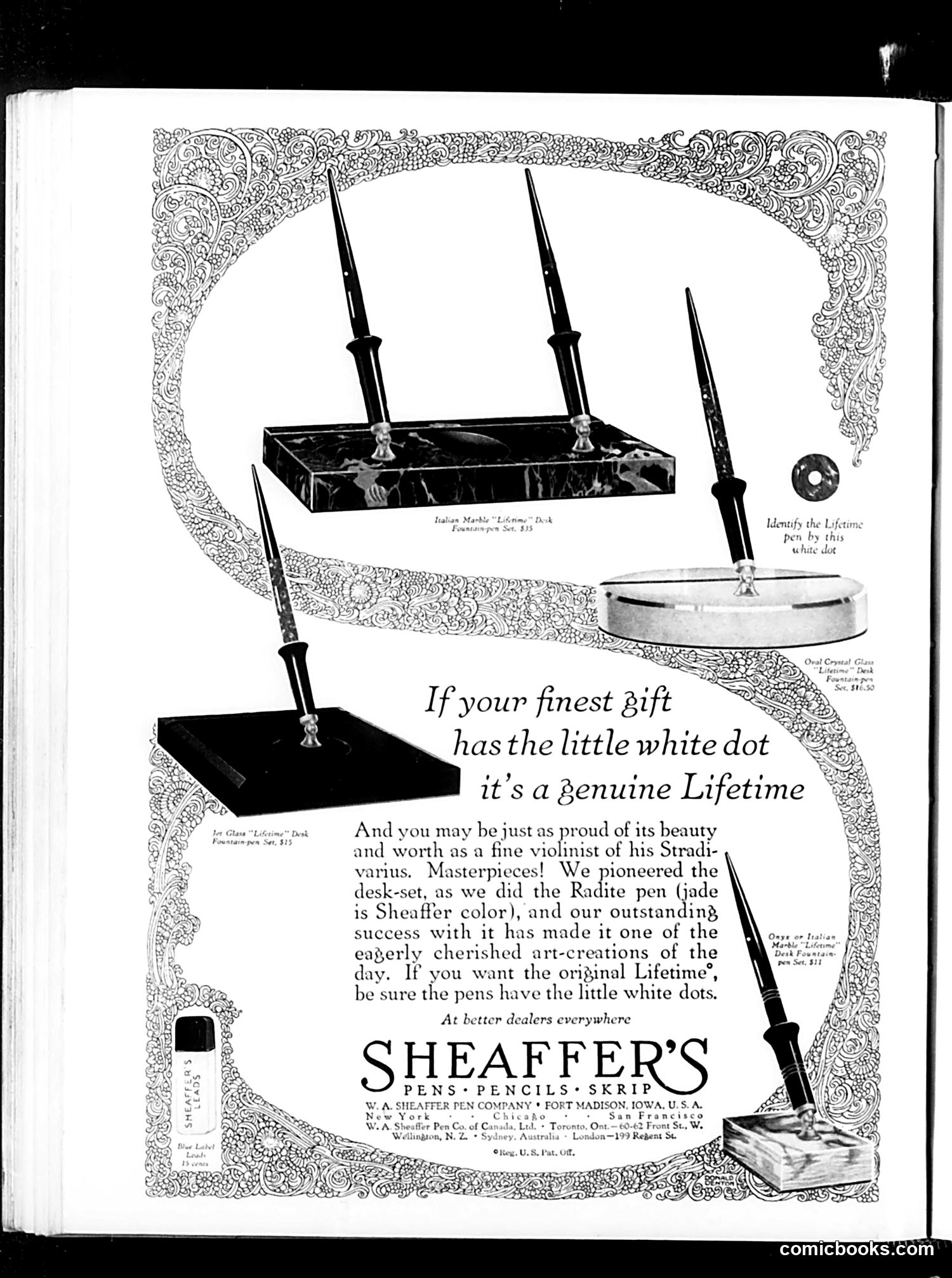
This is **primarily an advertisement**, not a political cartoon. It's a Sheaffer's Pens advertisement from the early 20th century promoting their "Lifetime" pen line. The page showcases luxury desk accessories—marble inkwells, pen stands, and crystal desk sets—displaying ornate black pens with the distinctive "little white dot" mark that authenticated genuine Lifetime pens. The ad emphasizes exclusivity and craftsmanship, comparing ownership to possessing fine violins or masterpieces. The elaborate decorative border is typical of Life magazine's aesthetic style. The headline plays on gift-giving anxiety: if your gift has Sheaffer's white dot, you've given something genuinely valuable and beautiful. This appeals to affluent readers concerned with displaying social status through refined writing instruments—a significant luxury purchase in that era.
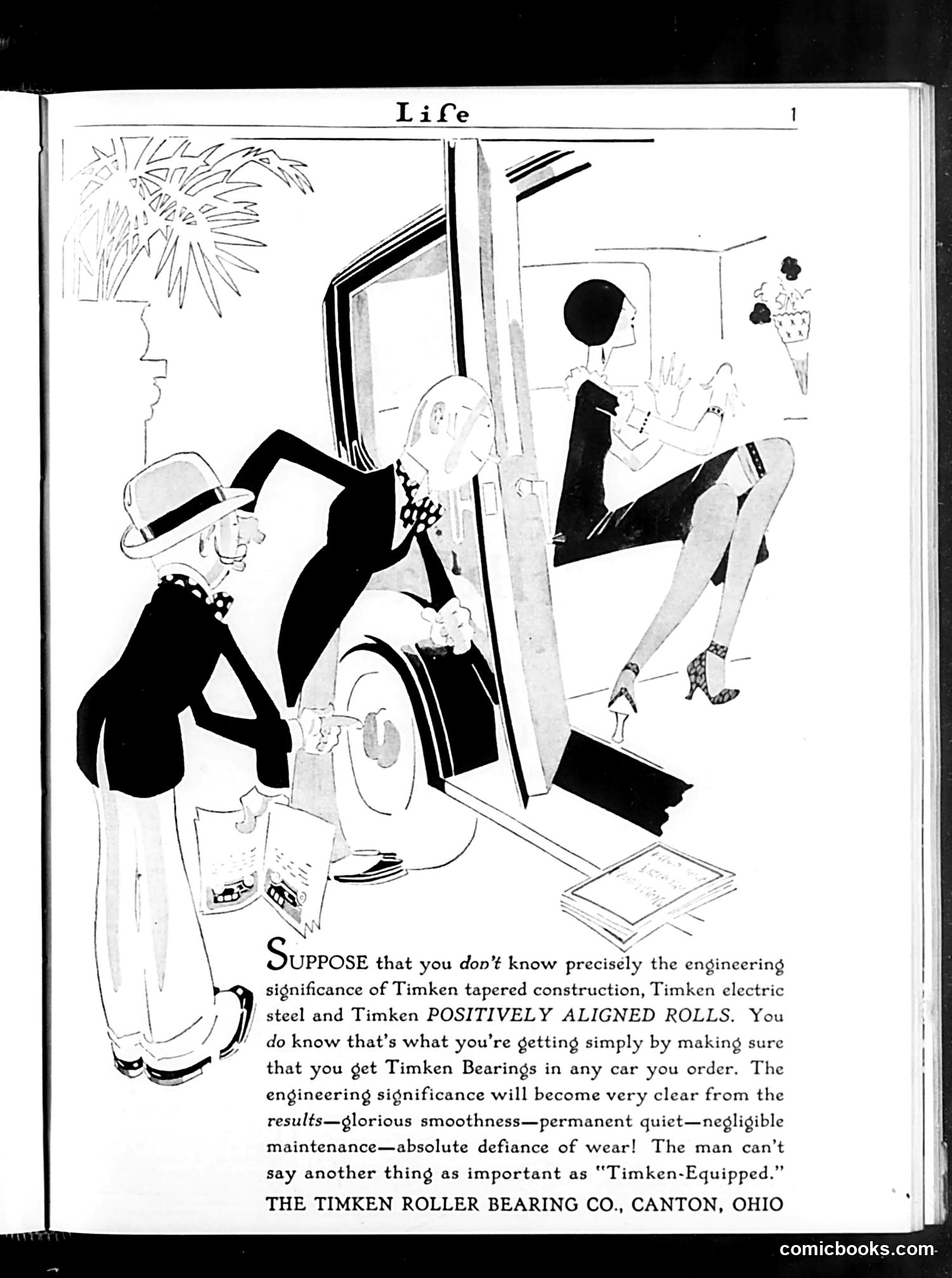
This page is primarily **advertising, not satire or political commentary**. The illustration depicts a stylized 1920s social scene—fashionable people around an automobile—but serves as a backdrop for a Timken Roller Bearing Company advertisement. The ad copy encourages car buyers to insist on Timken bearings, emphasizing technical benefits (smoothness, durability, low maintenance) presented to laypeople unfamiliar with bearing engineering. The cartoon style and "Life" magazine context suggest this targets the aspirational middle class. The well-dressed figures and automobile convey modernity and status, while the text reassures consumers they needn't understand complex engineering—just trust the Timken name. This represents early 20th-century advertising strategy: using attractive imagery and accessible language to market technical products to non-expert consumers.
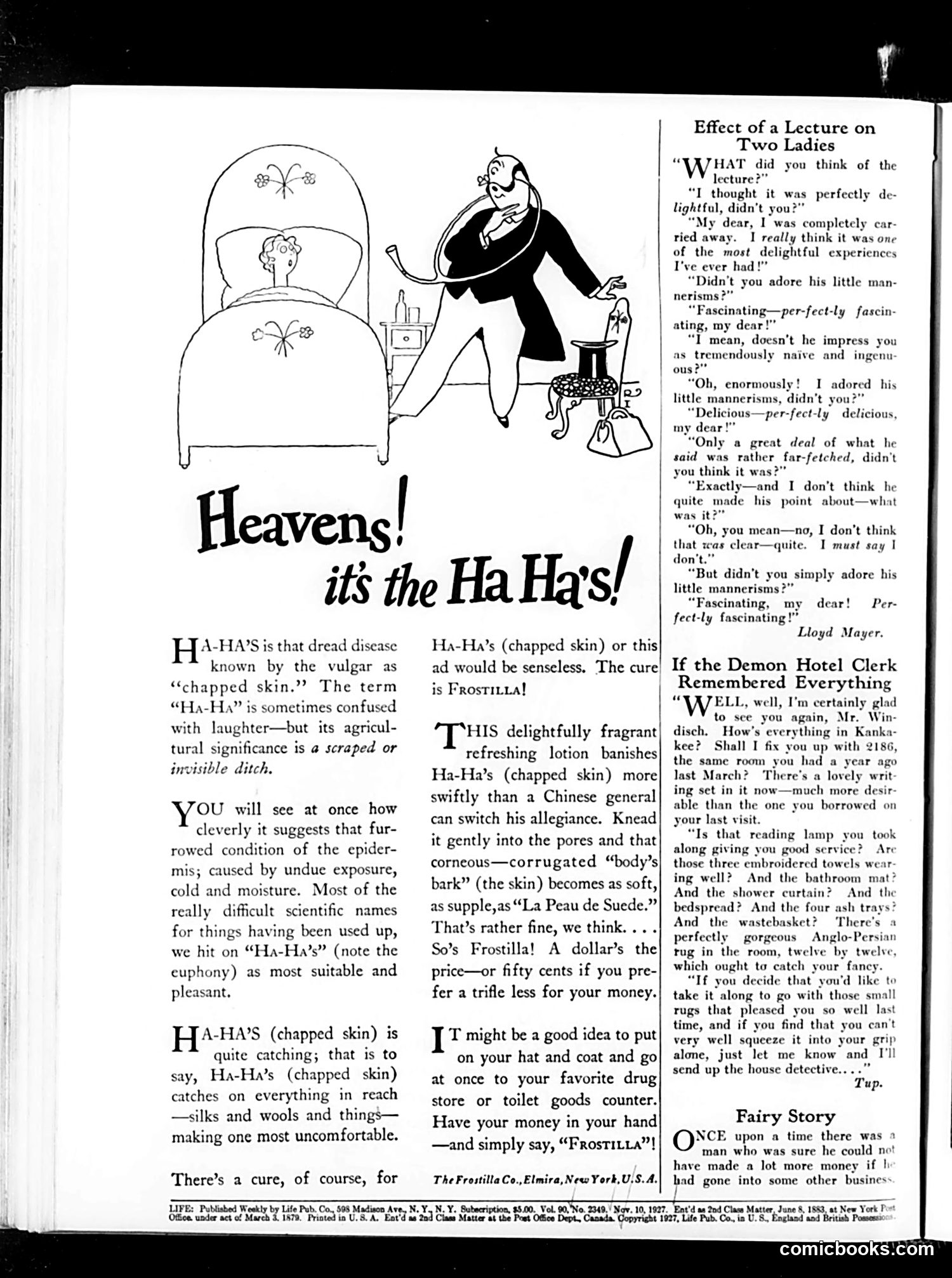
This page is primarily **advertising and humor content**, not political commentary. The main cartoon "Heavens! it's the Ha Ha's!" advertises **Frostilla lotion**, a skin treatment for chapped skin (then called "Ha-Ha's"). The humor derives from the product name's similarity to laughter ("ha-ha"), with the joke playing on how the disease was "caught" like laughter spreads. A man enthusiastically applies the product while a woman sleeps. The page includes three distinct pieces: the Frostilla ad, a separate humor section titled "Effect of a Lecture on Two Ladies" (satirizing affected conversation), and a brief fairy tale section. The content reflects 1920s advertising humor and social satire targeting middle-class pretension and vanity—common themes in *Life* magazine's satirical approach.
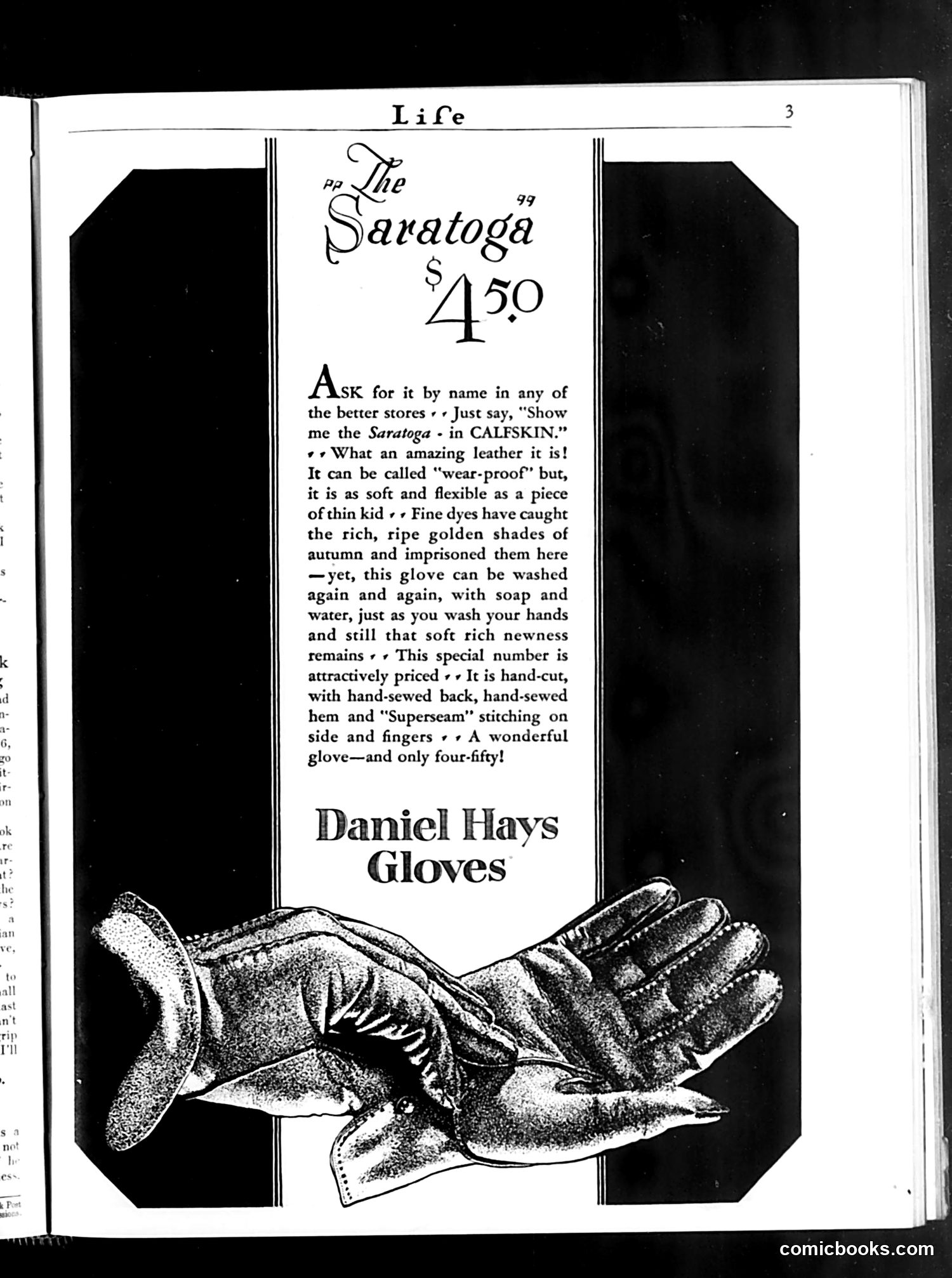
This is **not a political cartoon or satire**—it's a straightforward **advertisement for Daniel Hays Gloves**, specifically their "Saratoga" model priced at $4.50. The page promotes a calfskin glove with these selling points: durable yet soft leather, rich golden autumn coloring, washable without losing quality, hand-crafted construction with "Superseam" stitching, and an attractive price point described as "only four-fifty" (presumably expensive for the era). The illustration shows hands modeling the gloves to display their quality and fit. The ad ran in *Life* magazine, which carried both satirical content and advertisements. This represents typical early-20th-century luxury goods marketing targeting affluent readers of the publication.
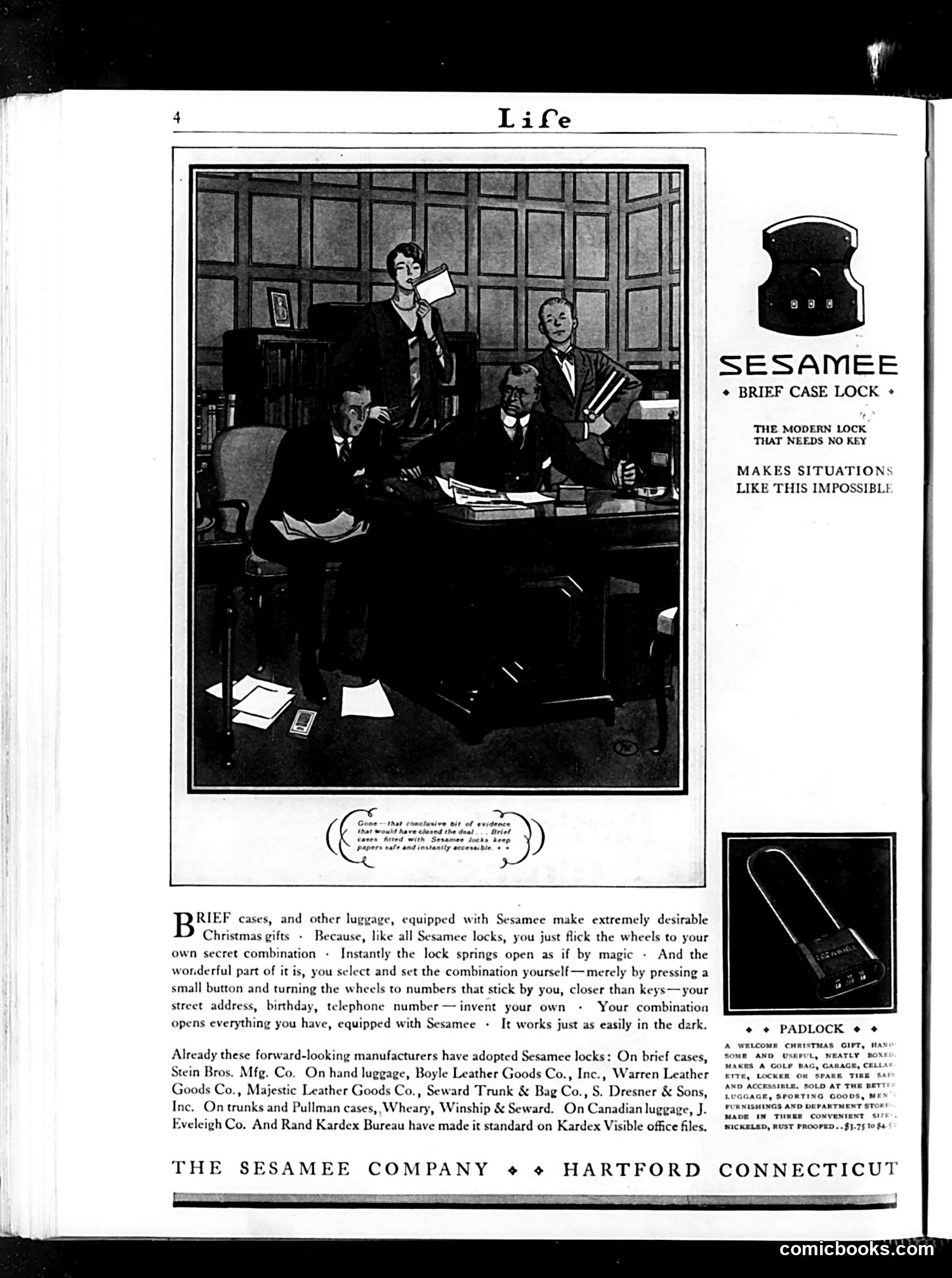
This page is primarily an **advertisement for Sesamee Brief Case Locks**, a keyless combination lock system, published in *Life* magazine. The cartoon depicts a office scene where documents are scattered on the floor, illustrating a humorous scenario of lost or compromised briefcase contents. The ad's caption suggests that without Sesamee locks, important documents could be exposed—"makes situations like this impossible." The advertisement emphasizes the lock's modern convenience: users set their own secret combination (address, birthday, phone number) by pressing a button and turning wheels. No key is needed. The pitch targets business professionals and gift-givers, listing major luggage and leather goods manufacturers who had adopted Sesamee locks as standard equipment. This is fundamentally a **product advertisement**, not political satire.
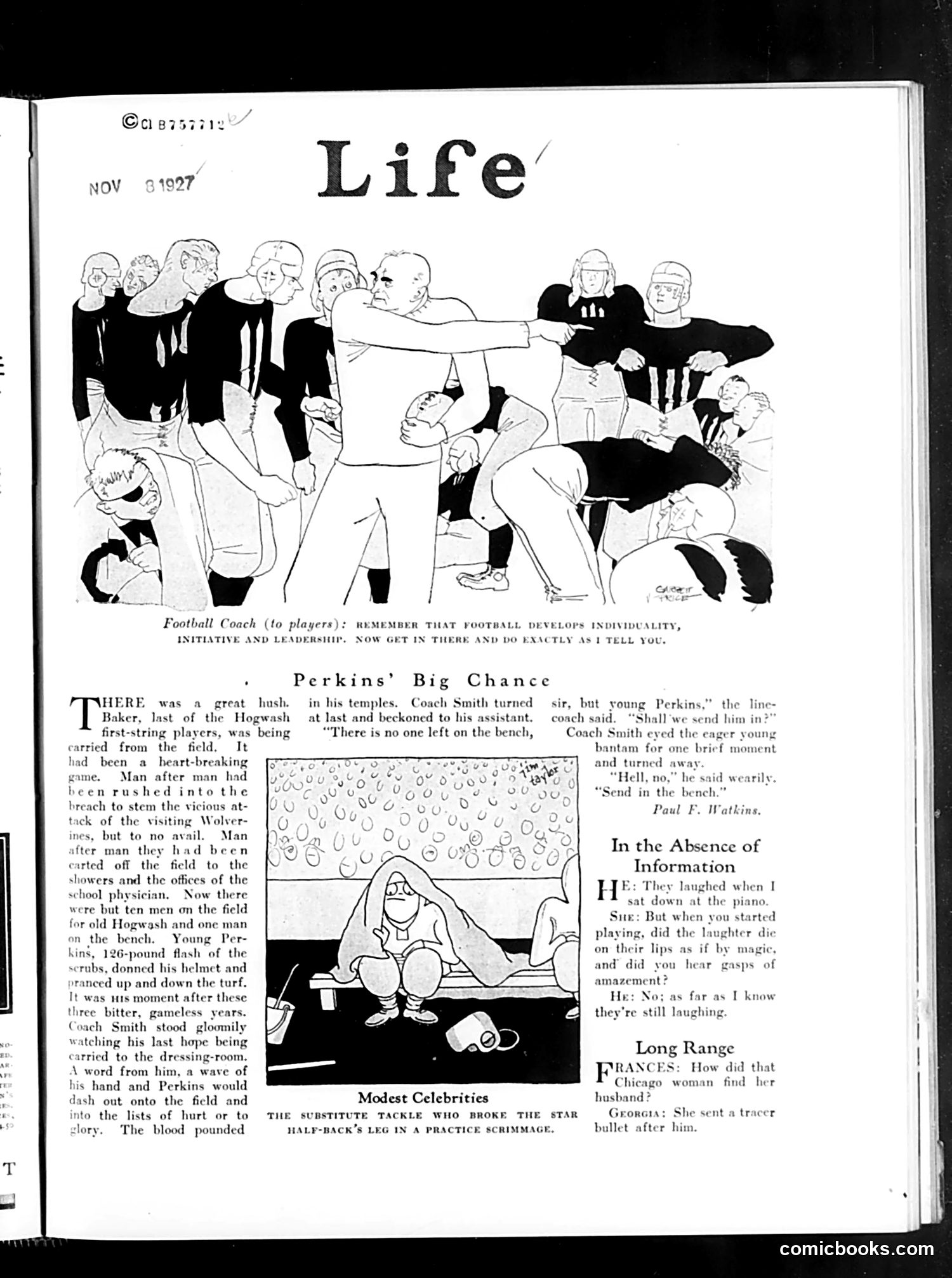
**Top Cartoon: "Football Coach"** A coach addresses his team with the caption emphasizing that "football develops individuality, initiative and leadership." The satire is straightforward: the coach is physically pushing and directing his players into uniform positions, contradicting the stated goal of developing individuality. This mocks the gap between what coaches *claim* to teach versus the actual regimentation required in organized sports. **Short Stories Below:** The page contains three brief humorous anecdotes: "Perkins' Big Chance" (about a substitute football player), "In the Absence of Information" (a joke about a woman's laughter), and "Long Range" (a quip about a woman sending a tracer bullet after her husband). These are typical of Life's light, satirical humor content from this era.
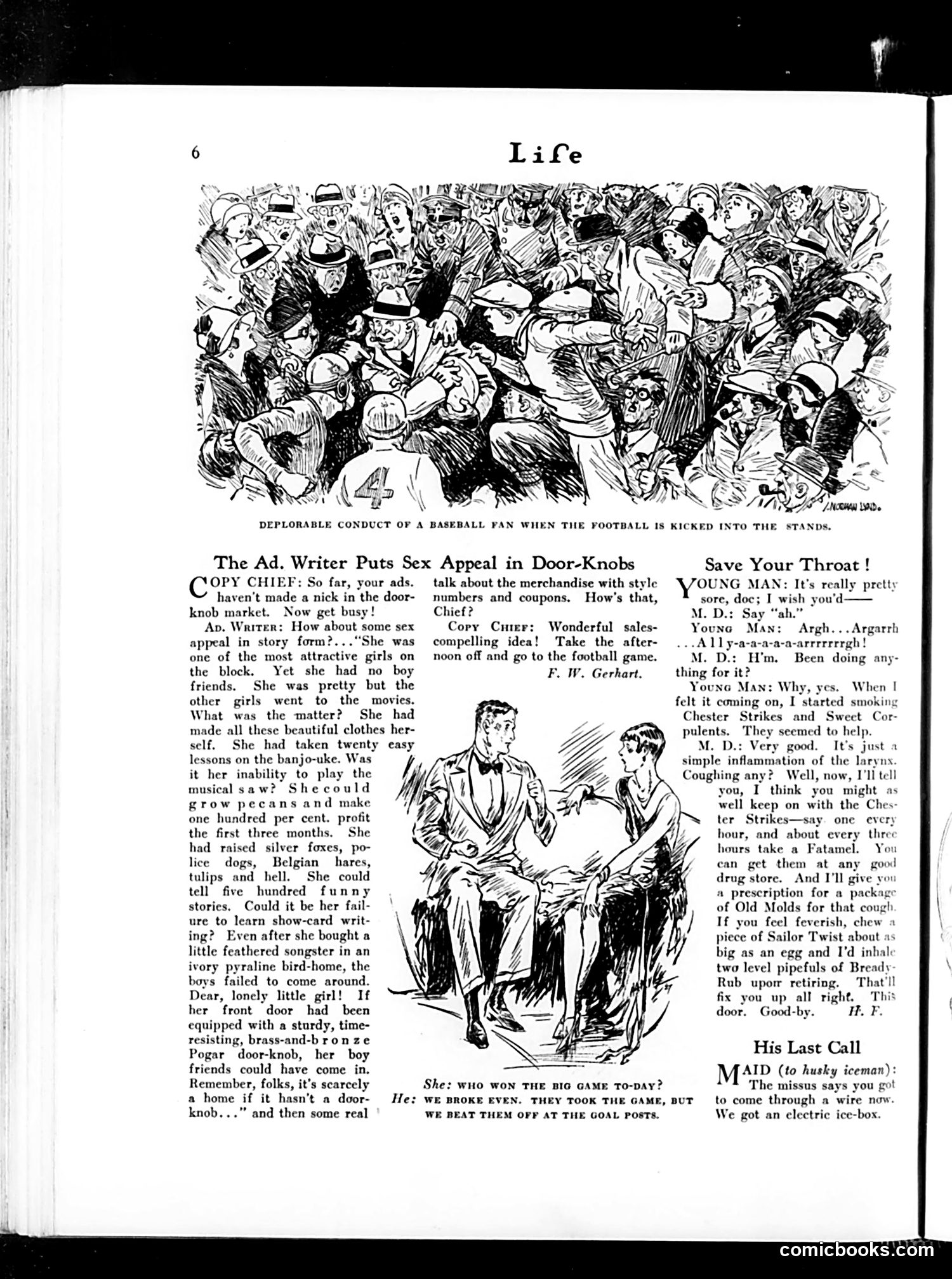
The top illustration satirizes crowd behavior at a baseball game, captioned "DEPLORABLE CONDUCT OF A BASEBALL FAN WHEN THE FOOTBALL IS KICKED INTO THE STANDS." The joke plays on the absurdity of intense, chaotic fan reactions—the densely packed crowd of exaggerated figures suggests that spectators lose all civility and decorum when competing for a loose ball. Below are three separate humorous advice columns ("Copy Chief," "Save Your Throat," and "His Last Call"), typical of Life magazine's satirical format. These mock various everyday situations through fictional dialogues. The illustrated vignette shows two men discussing a sporting event, with caption text about winning and scoring. This represents early 20th-century American humor focused on social behavior and sports culture.
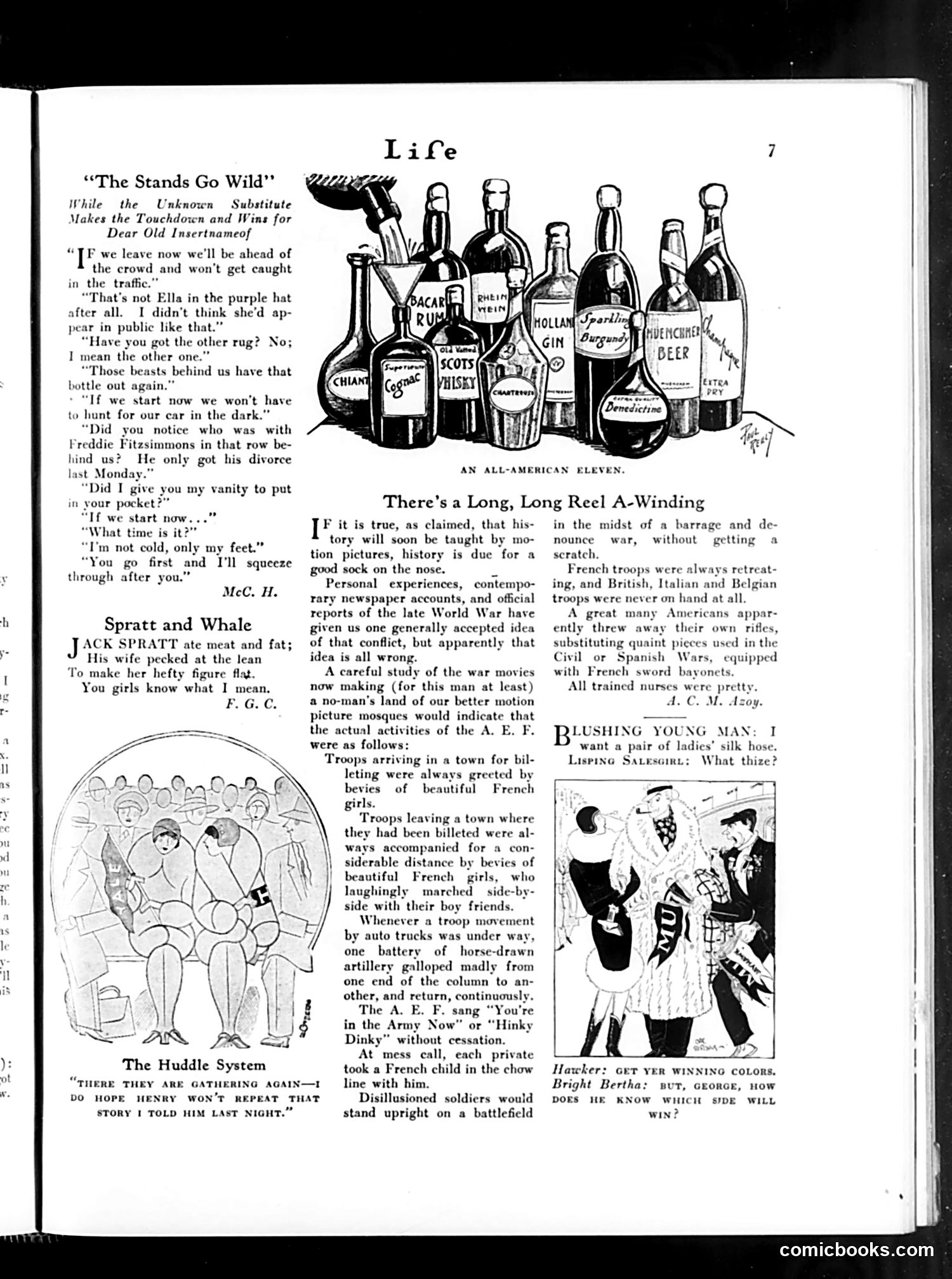
This page contains WWI-era satirical humor. The top cartoon, "An All-American Eleven," depicts bottles of various alcoholic beverages (whiskey, gin, rum, beer) anthropomorphized as a sports team, satirizing American drinking culture and likely Prohibition debates of the era. "There's a Long, Long Reel A-Winding" discusses WWI movie depictions, criticizing how films misrepresented actual combat experiences—particularly regarding French troops and American Expeditionary Forces activities. "Spratt and Whale," "The Huddle System," and "Blushing Young Man" are brief humorous anecdotes typical of Life's satirical format, using wordplay and social observation rather than topical reference. The overall tone reflects American civilian perspectives on WWI, alcohol availability, and entertainment during the war period.
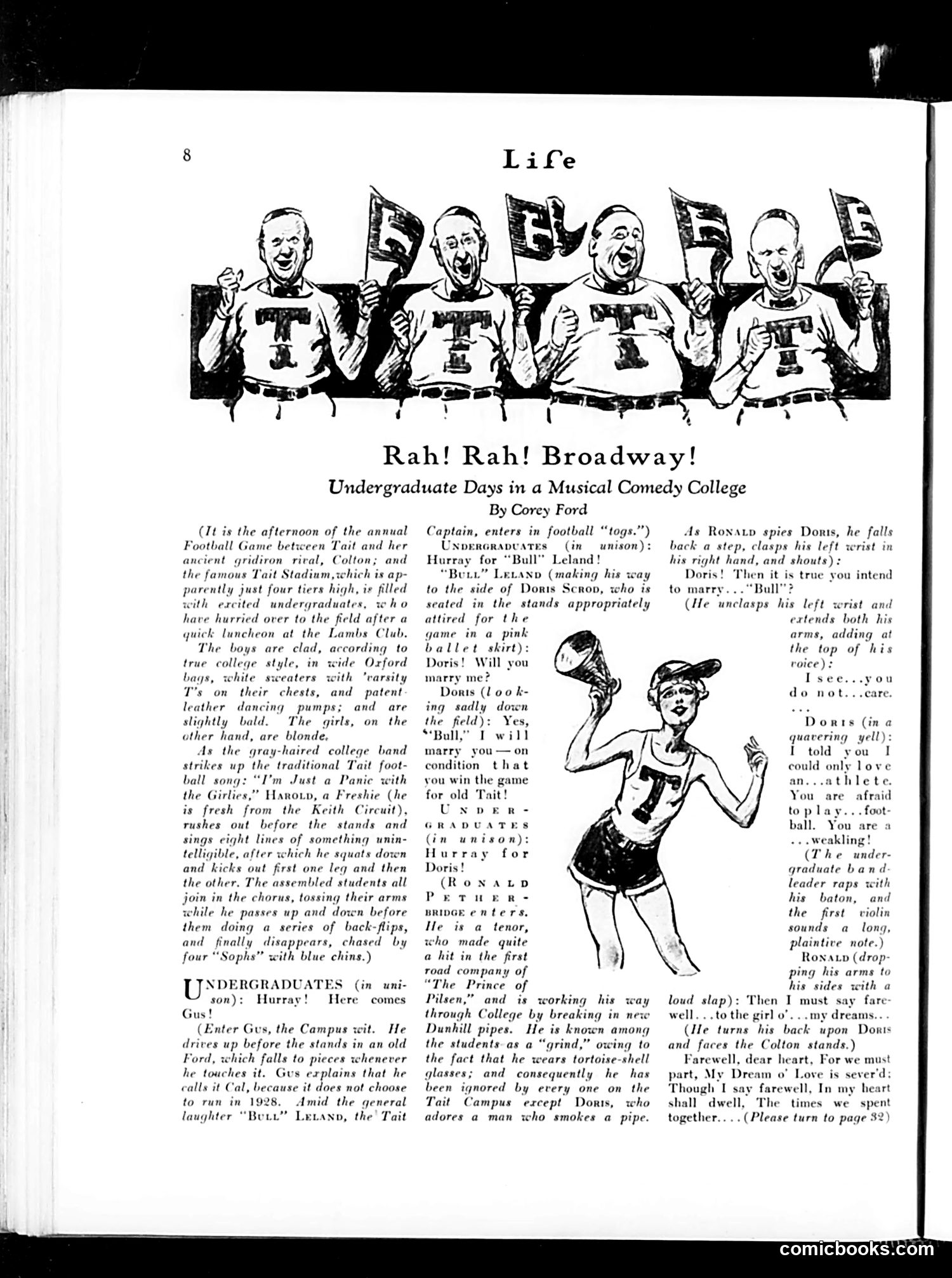
This page from *Life* magazine satirizes undergraduate life at what appears to be a college with a "Tait" football team. The illustration shows four cheerleaders in "T" uniforms holding flags, celebrating "Broadway" style—suggesting theatrical excess invading campus culture. The accompanying story by Corey Ford humorously depicts college romance and football culture, featuring characters like "Bull" Leland (a football captain), Ronald, and Donis competing for romantic attention while performing in an elaborate college musical production. The satire mocks how undergraduates blend theatrical performance with athletics and courtship, presenting college life as an overly dramatic spectacle influenced by contemporary Broadway entertainment. The humor derives from treating routine college activities as dramatic stage productions.
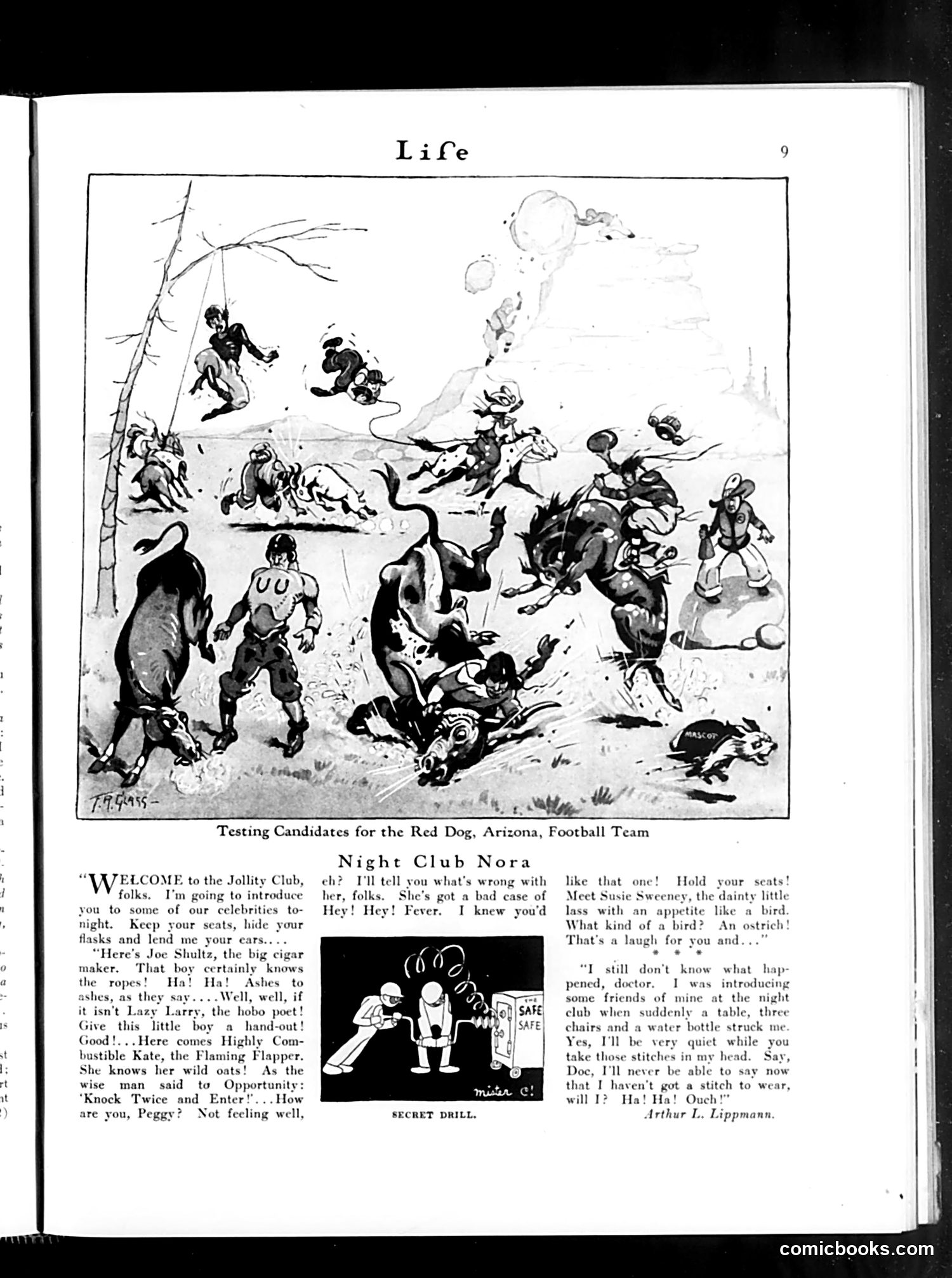
**Top Image:** A satirical cartoon titled "Testing Candidates for the Red Dog, Arizona, Football Team" shows chaos—people and animals in disarray, apparently being evaluated for a football squad. The humor lies in the absurd "tryout" conditions: candidates are being attacked by dogs, bucked by animals, and generally subjected to mayhem rather than standard athletic tests. **Bottom Section:** "Night Club Nora" is a humorous dialogue piece. A club host introduces various acts/performers with punny names ("Highbly Combustible Kate, the Flaming Flapper," "Knock Twice and Enter"). The humor involves wordplay and stereotypical Jazz Age entertainment personas. A small "Secret Drill" cartoon shows figures at what appears to be a safe, likely another joke about 1920s speakeasy culture during Prohibition. The page captures early 1920s American satirical humor targeting popular entertainment and sports.
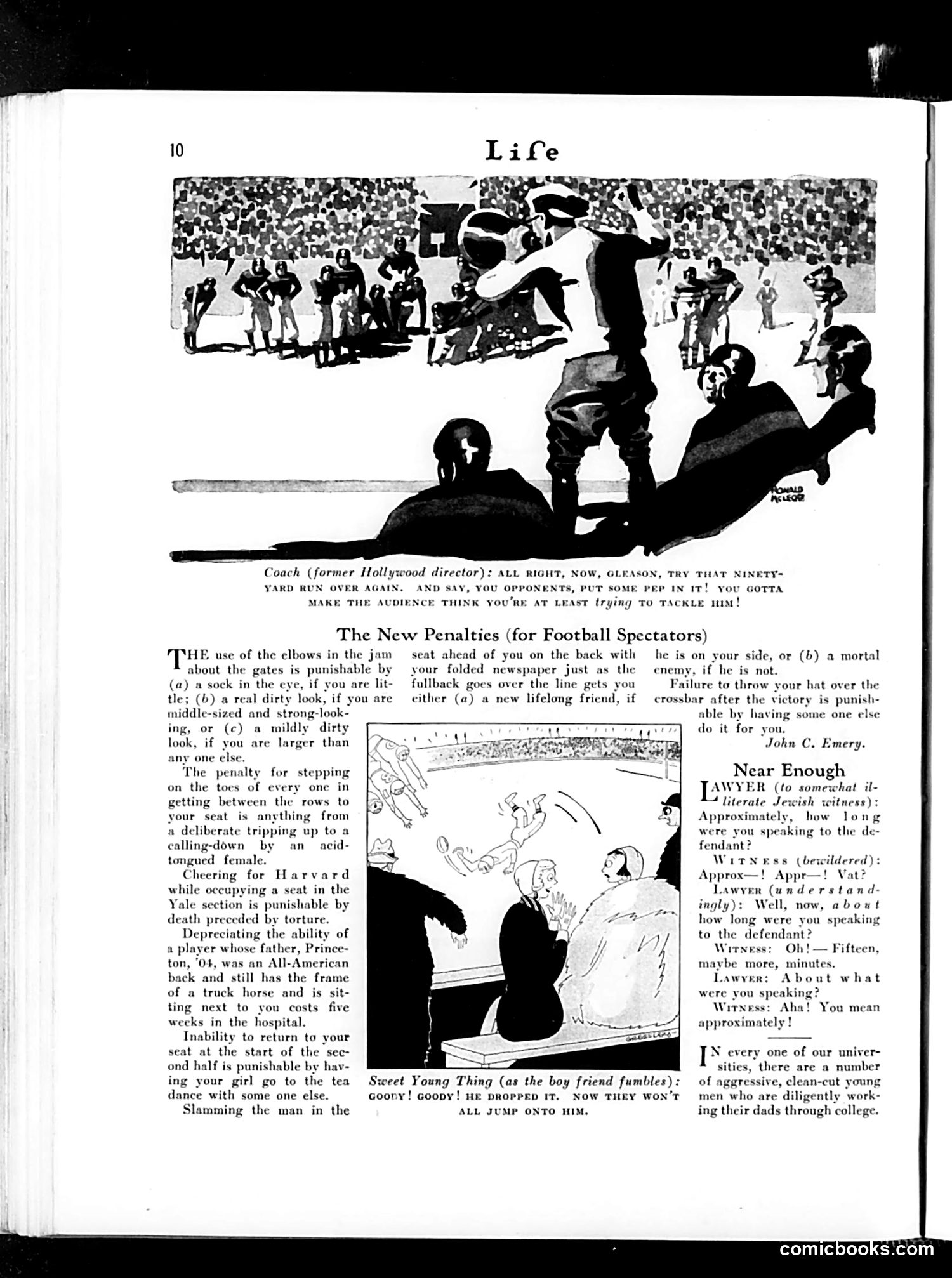
This page presents satirical commentary on football spectator behavior. The top illustration shows a coach (noted as "former Hollywood director") instructing players, with the caption mocking enthusiastic but uninformed fan encouragement. The main content, "The New Penalties (for Football Spectators)," humorously proposes punishments for annoying stadium behaviors: using elbows in cramped seating, dirty looks, stepping on neighbors' toes, and cheering too loudly for Harvard or Yale. The penalties range from "death preceded by torture" to hospitalization. Below is a courtroom sketch titled "Near Enough," depicting a witness in a legal proceeding, illustrating the magazine's recurring theme of satirizing American social institutions and etiquette. The humor targets class pretension and the absurdities of spectator culture during what appears to be the 1920s collegiate sports era.
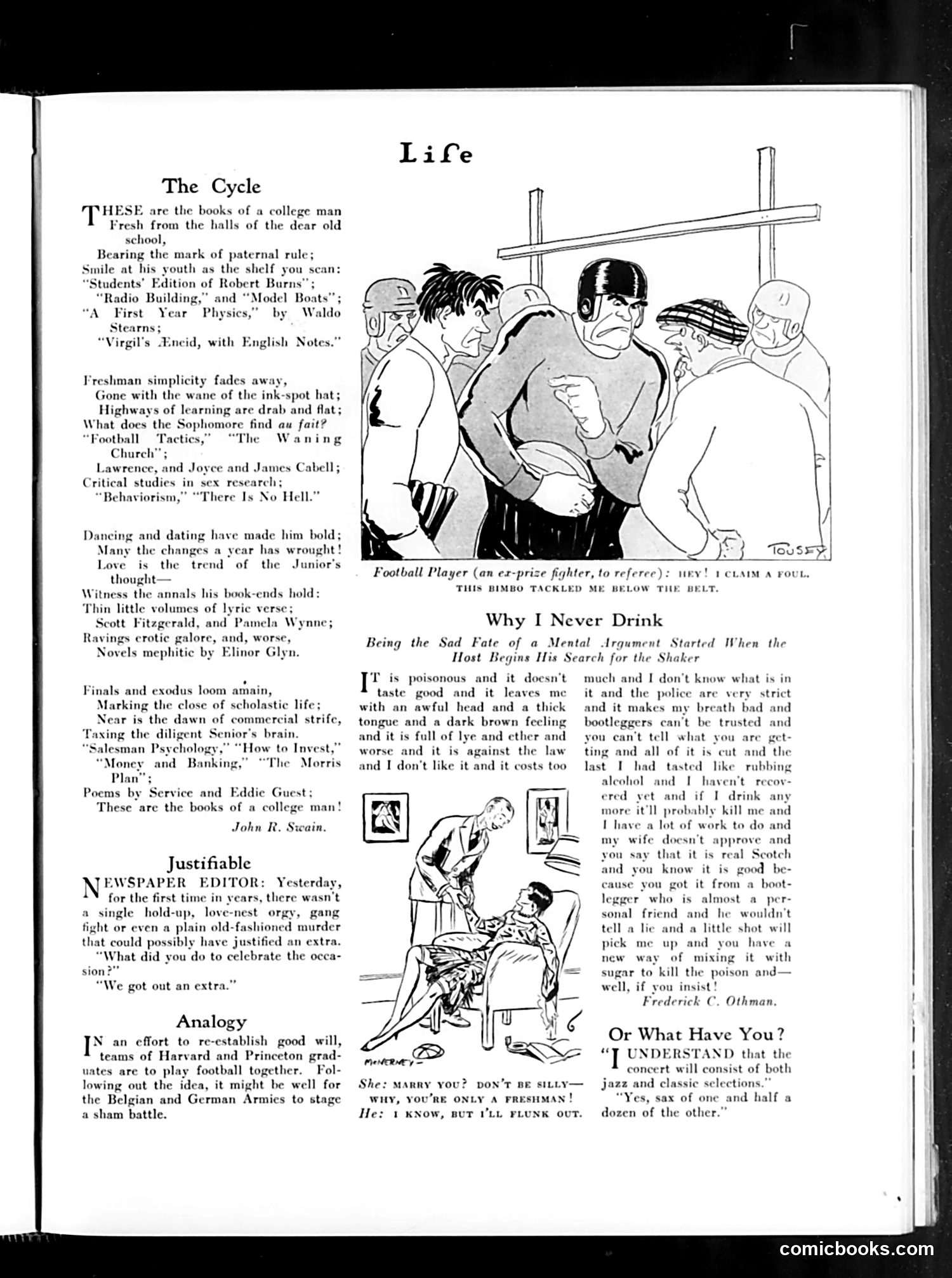
This page from *Life* magazine satirizes college life through poetry and illustrations. "The Cycle" traces a student's journey from freshman to senior, mocking the books assigned (Burns, Virgil's *Aeneid*) and changing interests—from serious studies to dating, dancing, and reading modern literature like Joyce and Fitzgerald. The football cartoon depicts a player claiming a foul was committed "below the belt," satirizing both aggressive sports behavior and excuse-making. "Why I Never Drink" humorously catalogs alcohol's negative effects—headaches, foul taste, legal issues, marital disapproval—with the author claiming personal reasons rather than moral conviction. The final cartoon shows a couple discussing a jazz concert's composition, with the man patronizingly suggesting the woman shouldn't expect to understand as a "freshman." Overall, the page mocks collegiate pretension and changing social values of the 1920s era.
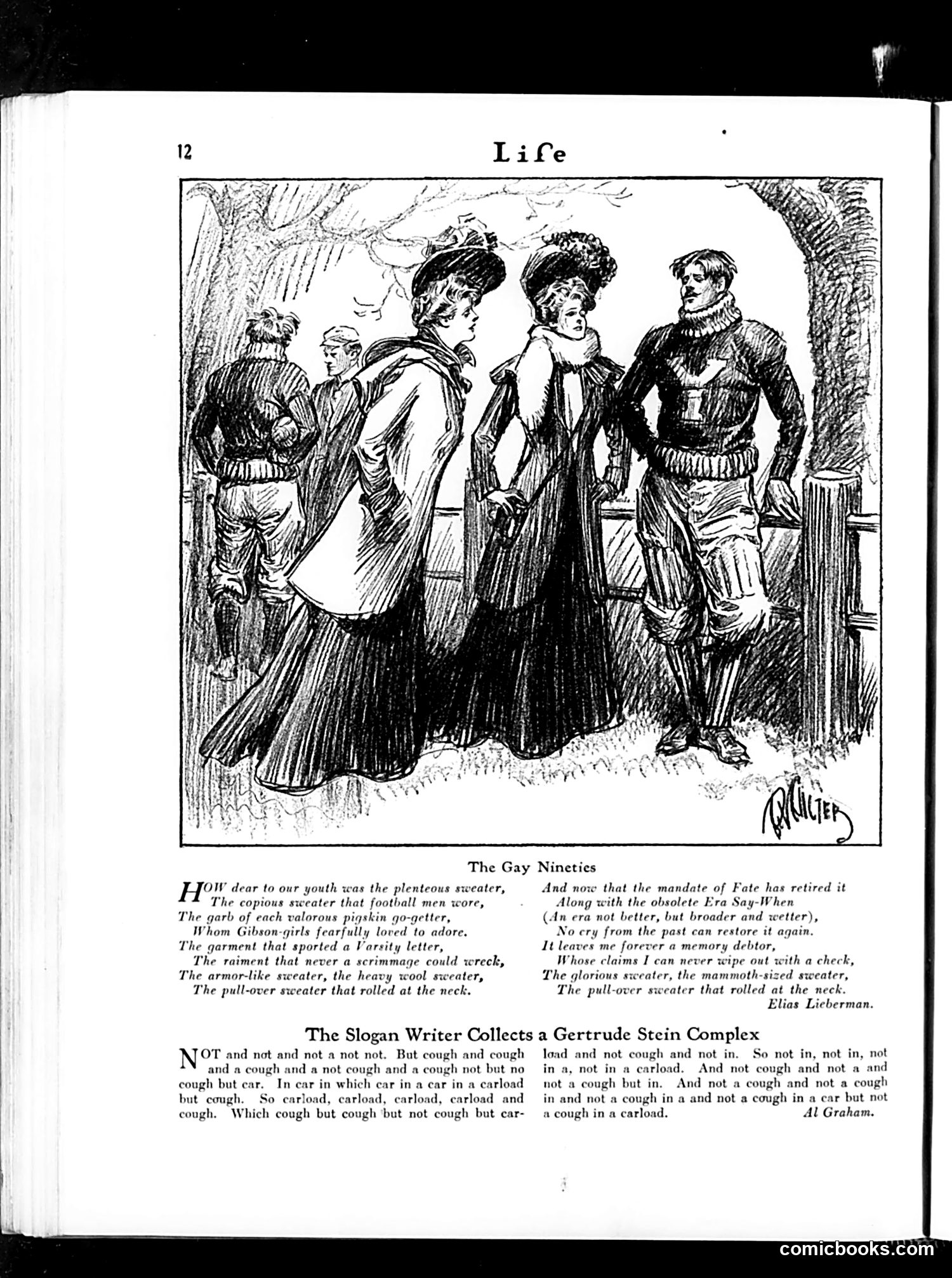
**The Main Cartoon: "The Gay Nineties"** This nostalgic illustration depicts fashionably dressed figures from the 1890s era, accompanied by Elias Lieberman's poem lamenting the loss of that period's iconic garment—the "copious sweater" or "pull-over sweater that rolled at the neck." The satire mocks the fashion trends of Lieberman's contemporary moment (likely early 1900s-1910s) by romanticizing 1890s aesthetics. The poem's repeated references to the sweater rolling at the neck suggest this was a defining feature no longer fashionable, making the nostalgia humorous. **"The Slogan Writer Collects a Gertrude Stein Complex"** Below is a tongue-twister credited to Al Graham, playing on Gertrude Stein's famously repetitive, experimental prose style. This appears to mock both Stein's literary technique and copywriters imitating her verbose, circular language patterns—a contemporary satirical jab at modernist literary fashions.
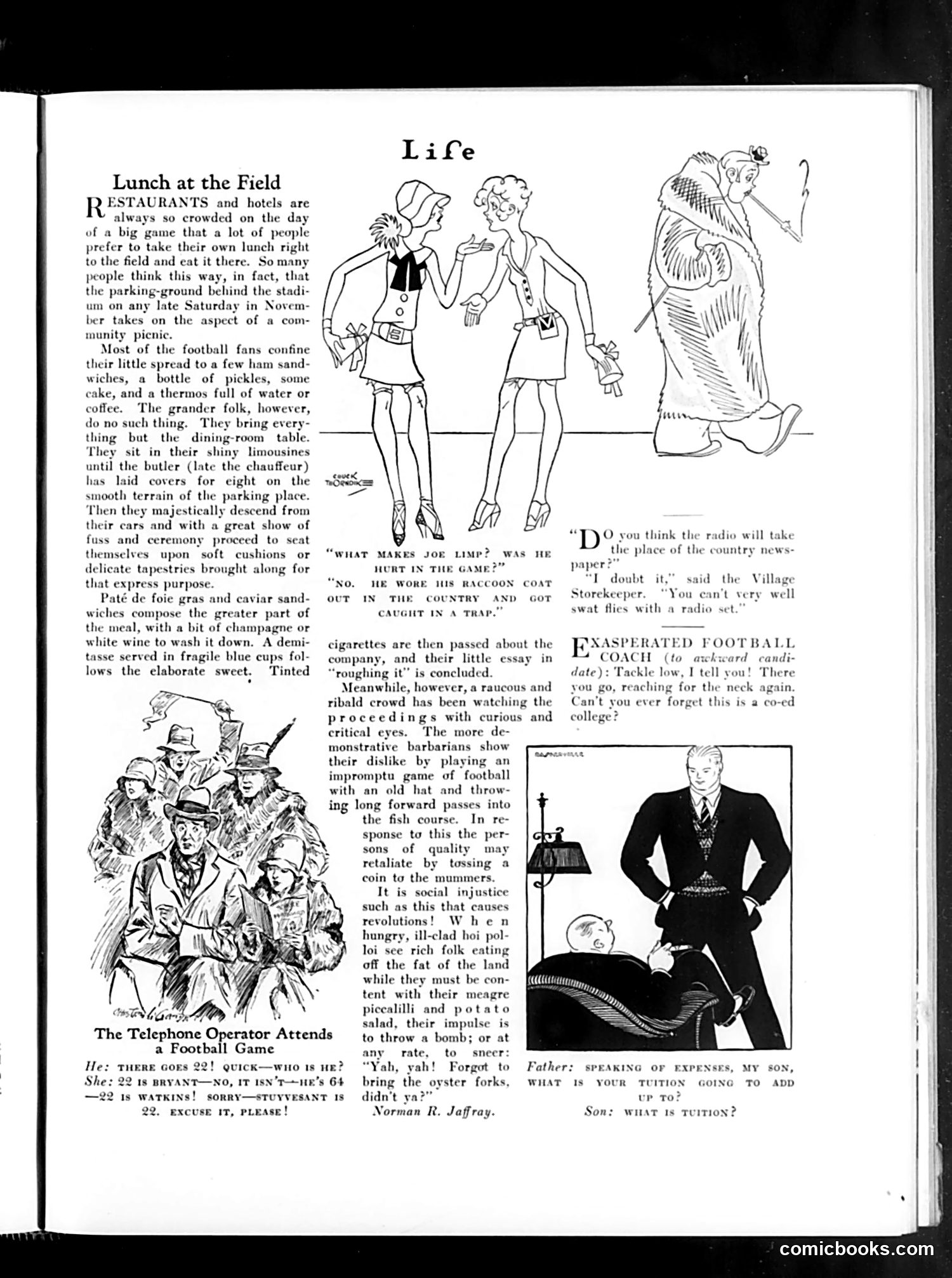
This page satirizes class distinctions in 1920s American leisure. The main article mocks wealthy spectators at football games who bring elaborate picnics—champagne, caviar, foie gras—while ordinary fans eat simple ham sandwiches. The humor lies in the contrast between the wealthy's pretentious display ("great show of fuss and ceremony") and their disconnect from actual game-going. The cartoons below mock both working-class rowdiness (the "Telephone Operator" attending a game, making crude jokes) and upper-class anxiety about expenses. The father-son dialogue about tuition costs represents generational concerns about education affordability. The satire targets both extremes: the ostentatiously wealthy and the struggling middle class, reflecting 1920s anxieties about social mobility and economic inequality.
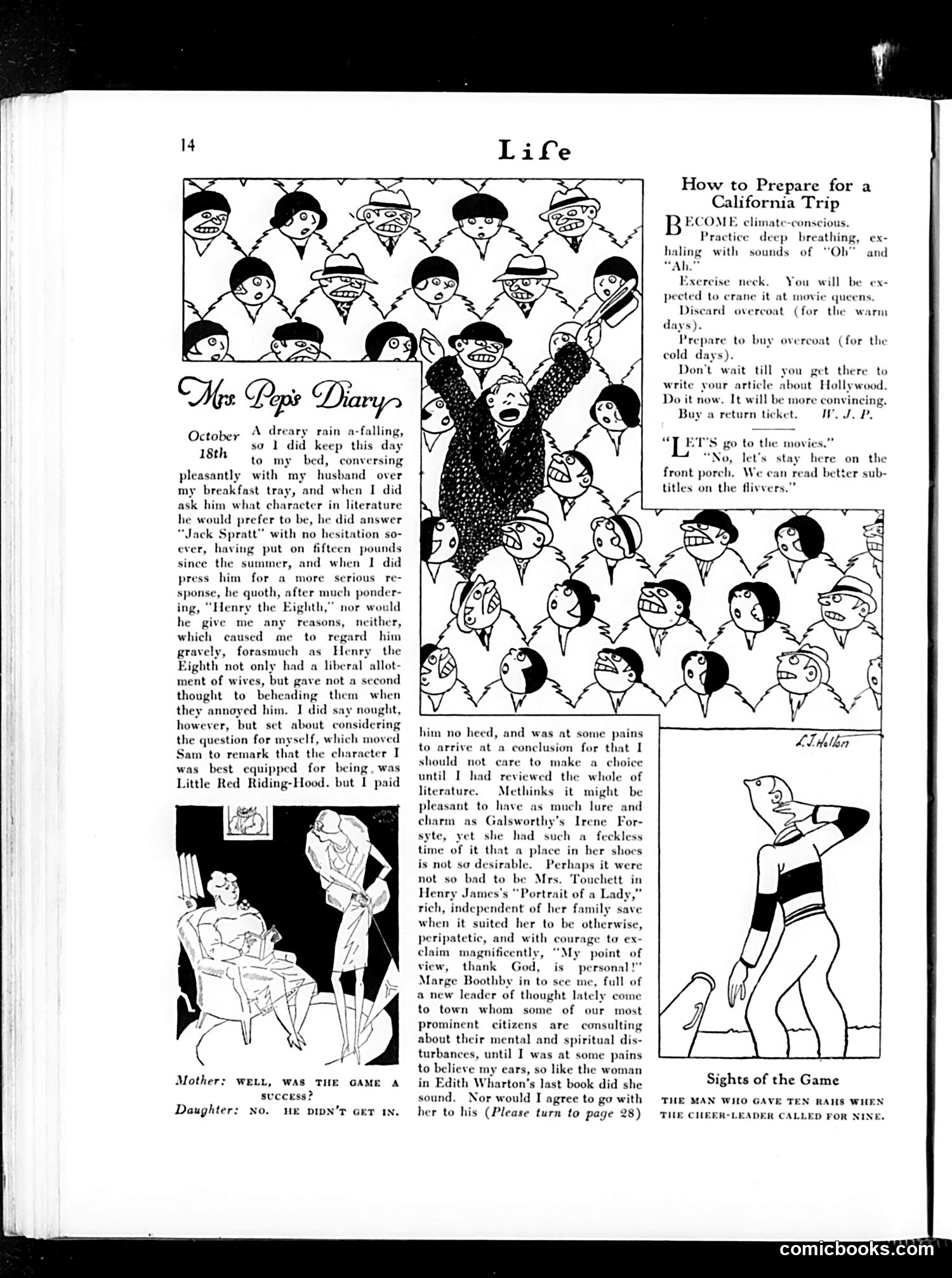
This page contains **Mrs. Peps's Diary** (October 18th entry) and unrelated satirical content about preparing for California trips. The diary entry humorously describes the author's domestic debate with her husband about which literary character he'd prefer to be. When asked, he chooses "Jack Spratt"—a nursery rhyme character known for eating no fat while his wife ate no lean. The satirical point: the husband refuses to engage seriously, giving evasive non-answers. The wife sarcastically concludes he's "best equipped for being" Little Red Riding Hood, mocking his avoidance. The page also includes cartoons about California travel tips (overcoats for temperature variation) and "Sights of the Game"—a baseball joke about a cheerleader calling for nine when only ten runs were scored, illustrating miscounting or confusion.
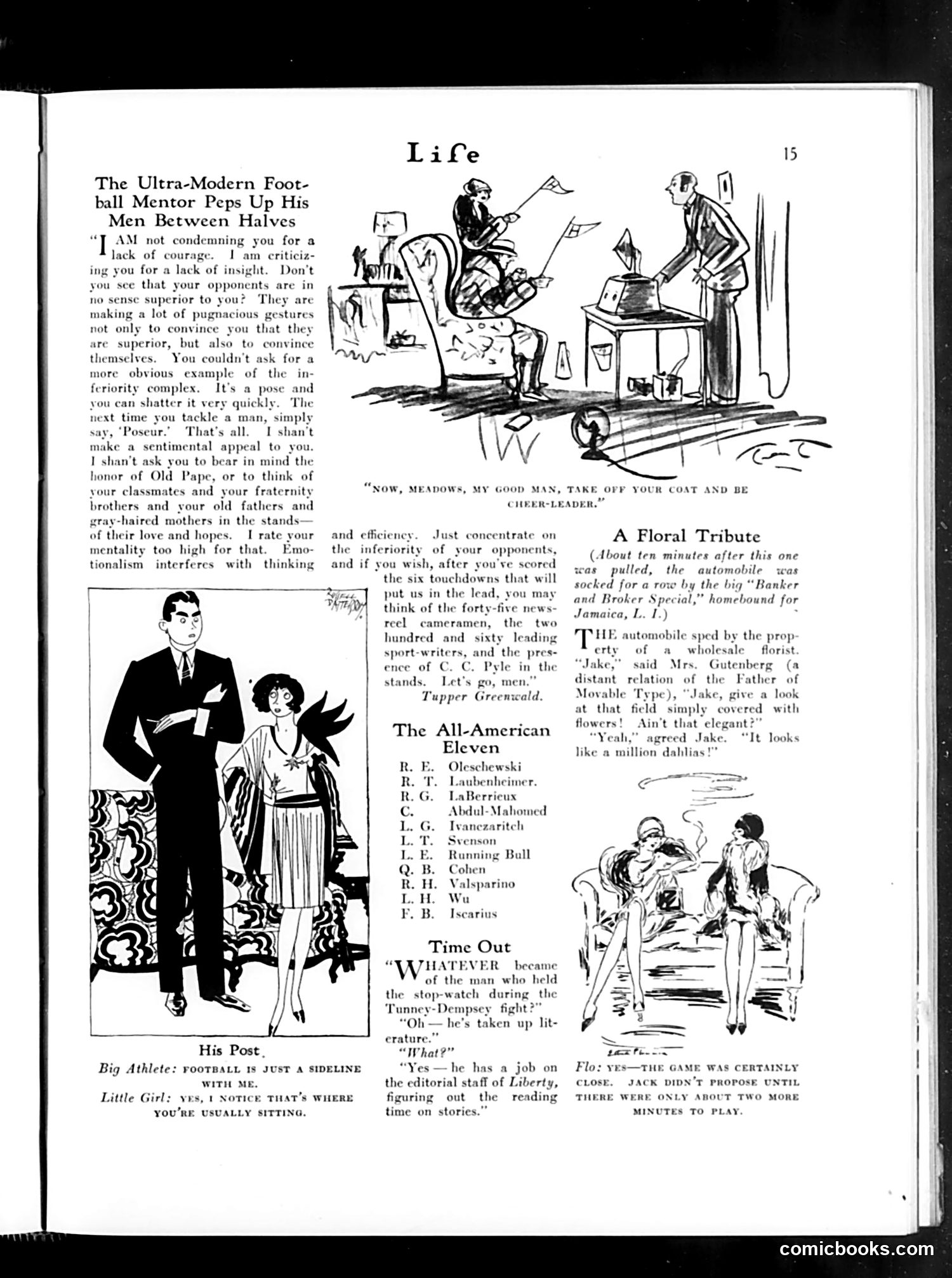
This page contains several humorous pieces satirizing 1920s American life: **"The Ultra-Modern Football Mentor"** (top): A coach instructs players using psychological manipulation rather than traditional coaching—telling them their opponents are merely making "pugnacious gestures" to distract. The satire mocks emerging "modern" coaching philosophies that emphasized mental psychology over physical discipline, a novel approach at the time. **"A Floral Tribute"** (right): A joke about a florist's assistant named Jake who covers an automobile at a funeral with flowers—the humor relies on the absurdity and the pun on "Jake" as a casual name for an undertaking. **"The All-American Eleven"** lists football players, while **"Time Out"** and **"His Post"** contain brief comedic vignettes about sports and relationships, typical of Life's satirical format.
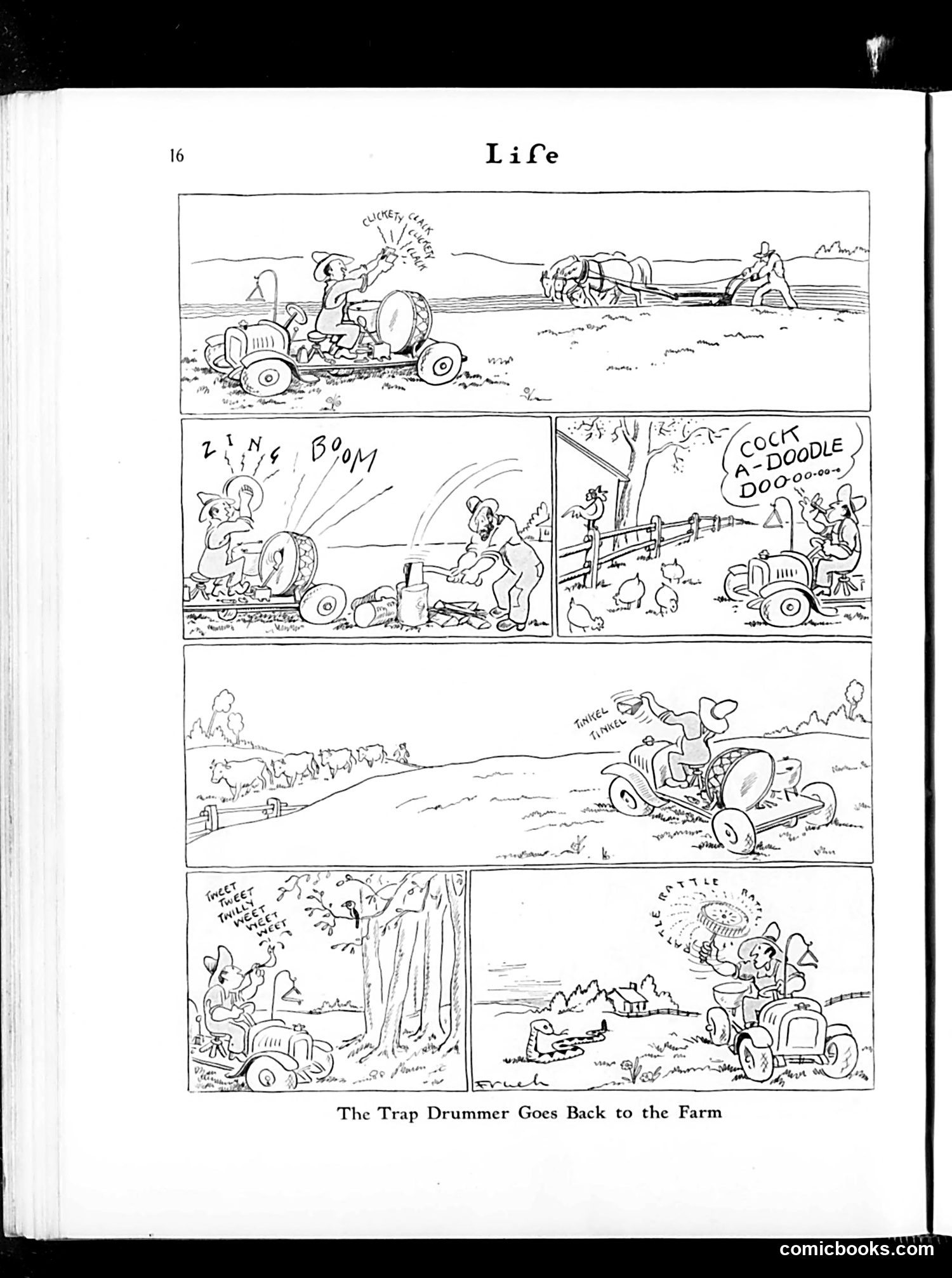
This comic strip satirizes the post-World War I phenomenon of soldiers returning to civilian life, specifically depicting a jazz musician (the "trap drummer") attempting to readjust to farm work. The humor contrasts the energetic, chaotic percussion performance (emphasized by "ZING! BOOM" sound effects and the rooster's "COCK-DOODLE-DOO") with the quiet, orderly life of farming. The drummer treats farm equipment like musical instruments—his tractor becomes his drum kit. The satire likely mocks both the difficulty of veterans reintegrating into rural life and the Jazz Age's incompatibility with traditional agricultural society. The strip captures 1920s anxieties about modernization, urbanization, and returning soldiers struggling to resume pre-war routines.
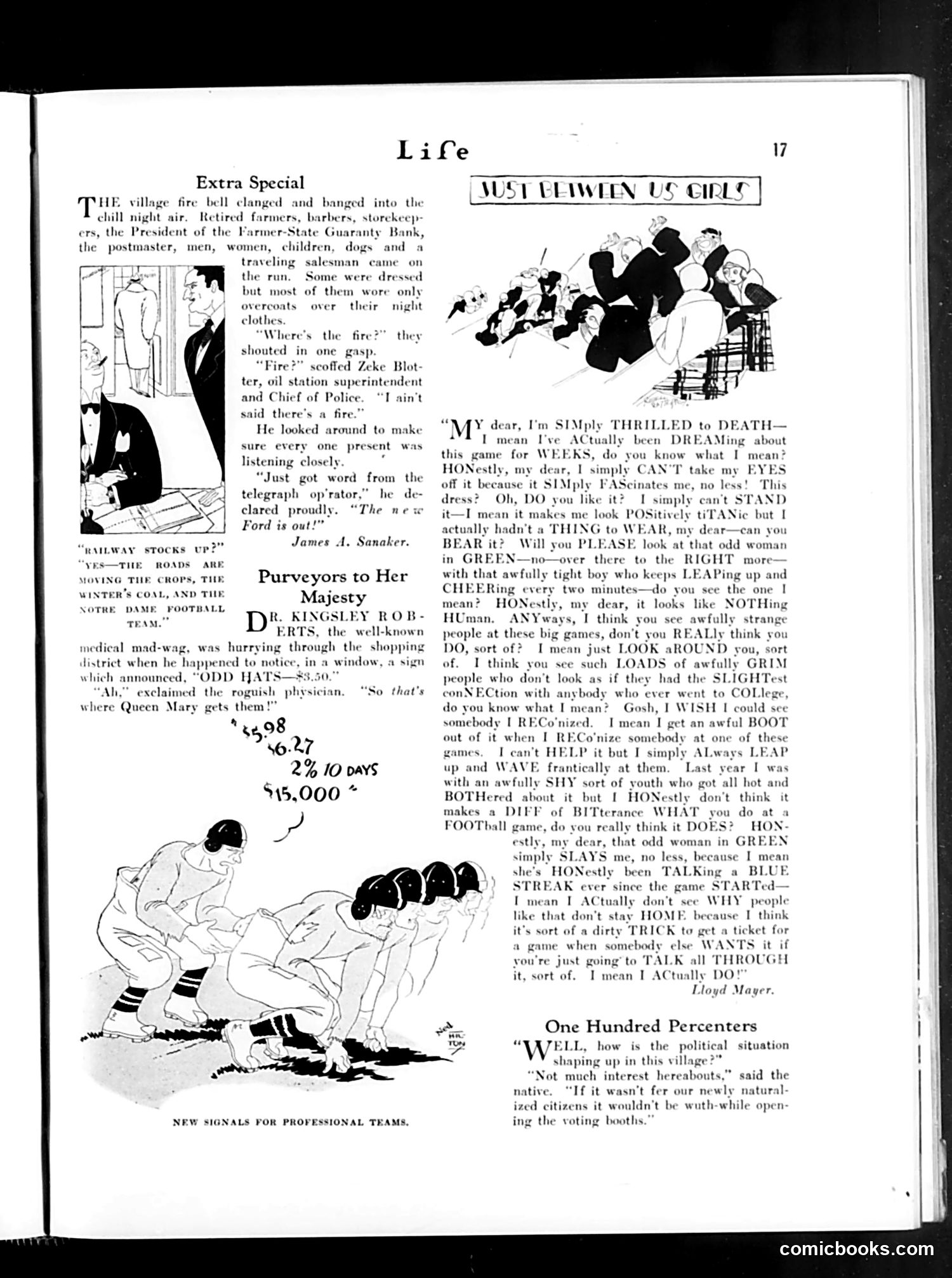
This page contains three separate satirical pieces from Life magazine's humor section: 1. **"Extra Special"** (top left): A brief comic about a village fire alarm. The joke plays on miscommunication—when asked "Where's the fire?" the oil station superintendent responds "I ain't said there's a fire," suggesting the alarm was a false alarm or misunderstanding. 2. **"Must Between Us Girls"** (top right): A cartoon mocking upper-class women at what appears to be a social gathering. The lengthy monologue satirizes vapid socialite behavior—excessive name-dropping, obsession with social status, and shallow concerns about appearances and games. It's social satire targeting wealthy women's superficiality. 3. **"One Hundred Percenters"** (bottom): Political commentary on nativism and voting restrictions, referencing newly naturalized citizens and concerns about "foreign" voters influencing elections.
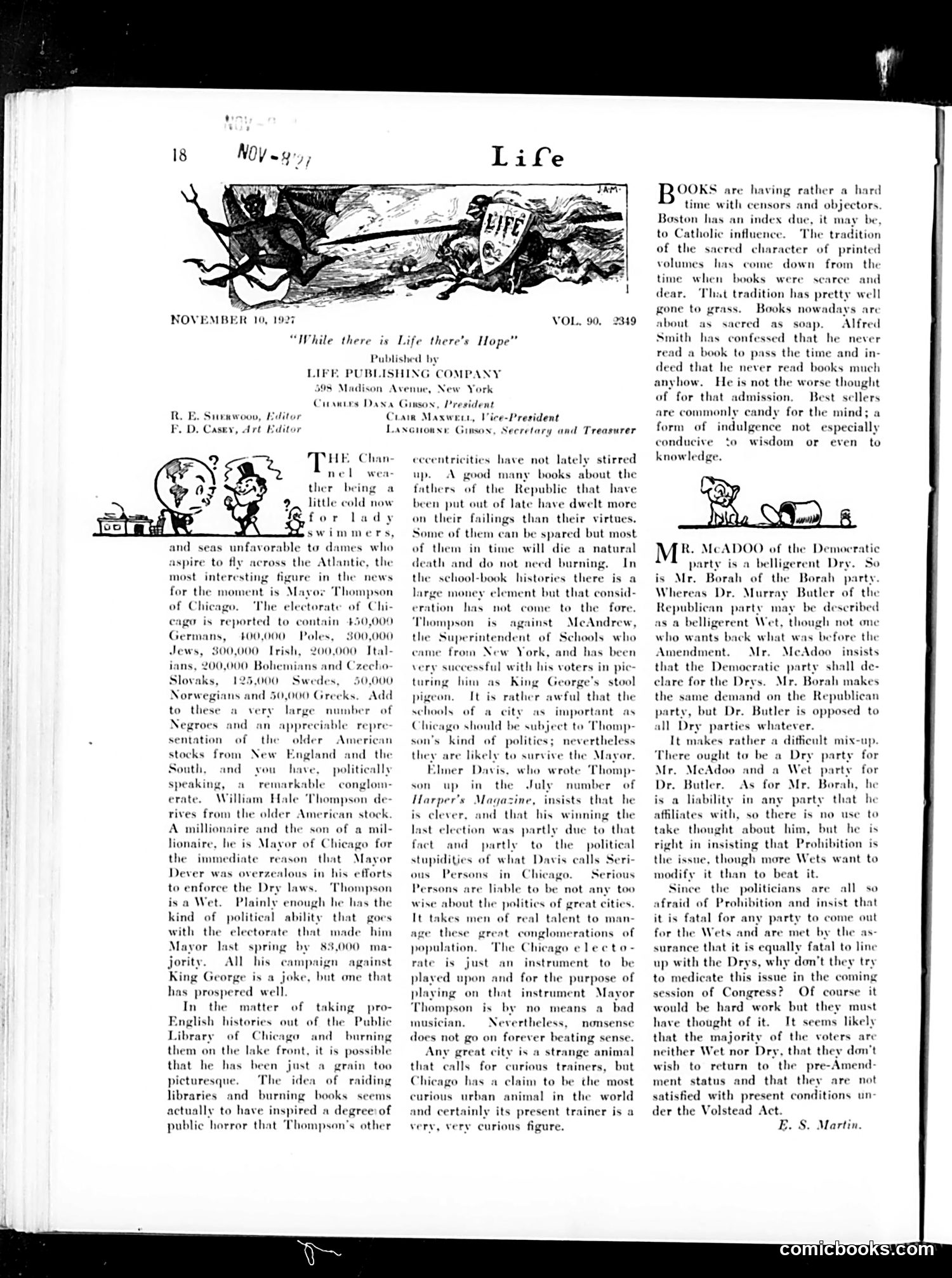
This page's main cartoon and article satirize **Mayor William Hale Thompson of Chicago**, depicted as an eccentric political operator. Thompson, a wealthy Republican and "Wet" (anti-Prohibition), won reelection by appealing to Chicago's diverse immigrant populations—Germans, Irish, Italians, Bohemians, Poles, and others—through skilled political manipulation rather than substantive policy. The article notes he won by 83,000 votes against the more reform-minded Mayor Dever. The satire focuses on Thompson's theatrical gestures, particularly his controversial plan to burn English history books from Chicago's public library because they portrayed America's founding fathers unfavorably. The author E.S. Martin characterizes this as performative extremism that paradoxically generated public outrage over book-burning. The broader critique: Thompson is a talented "musician" playing the diverse Chicago electorate as an "instrument." He represents cynical urban politics—winning through ethnic appeal and spectacle rather than genuine leadership, likened to a "curious trainer" of the "strange animal" that is Chicago itself.
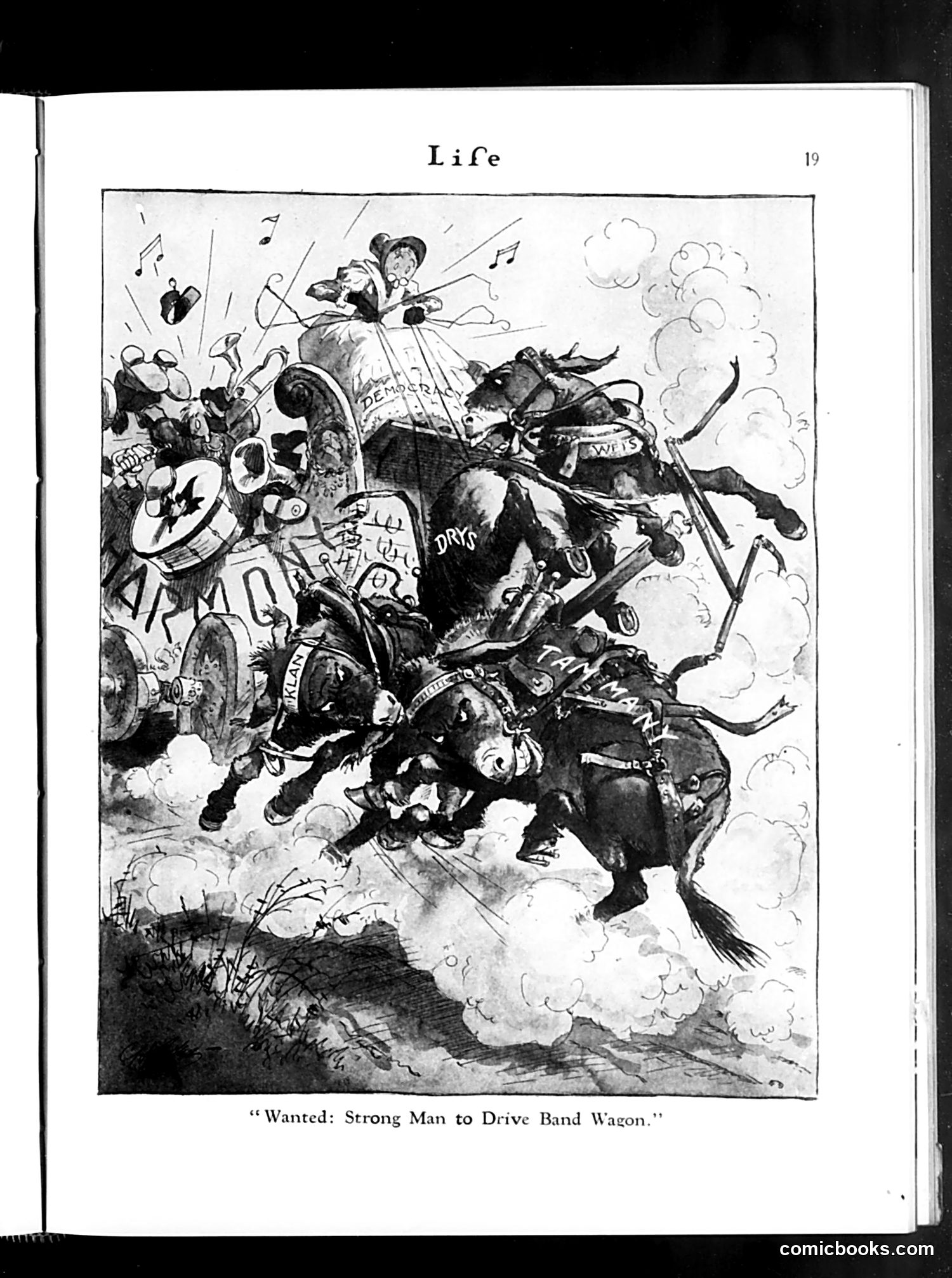
This satirical cartoon depicts a chaotic "band wagon"—a metaphor for a political movement or campaign—spiraling out of control. Multiple wild horses pull the wagon in different directions while musicians play discordantly and a figure struggles to maintain control from atop. The caption's job posting for a "strong man" to drive the wagon suggests the political movement lacks unified leadership and direction. Various labeled elements on the wagon (partially legible) likely represent competing political factions or interests pulling the movement apart. This appears to critique early 20th-century American political instability—possibly addressing a major party's internal divisions or a third-party movement's inability to maintain coherent direction. The visual chaos emphasizes how without strong centralized leadership, political movements become unwieldy and self-defeating.
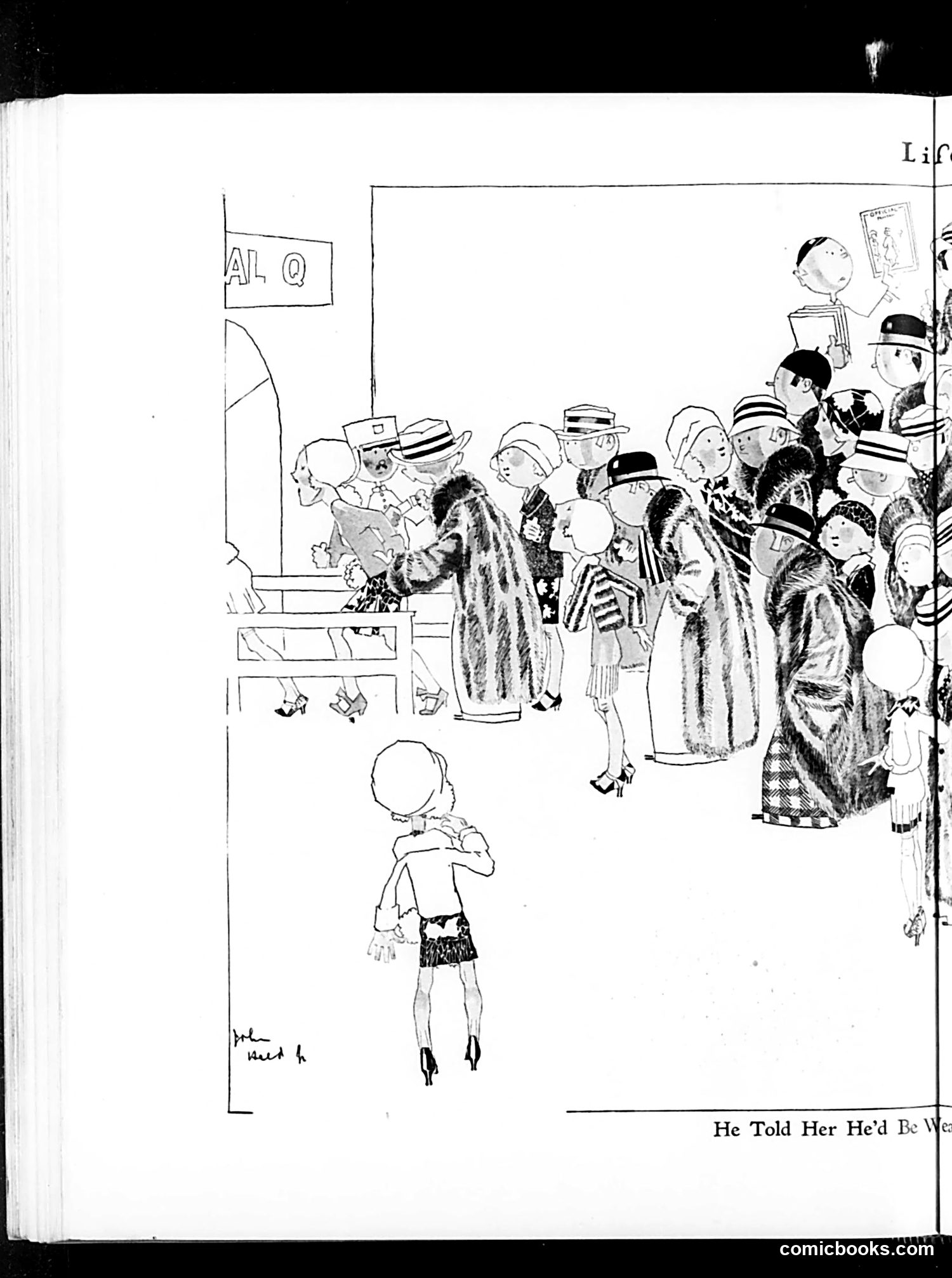
This appears to be a satirical illustration from *Life* magazine depicting a fashionable woman entering what's labeled "AL Q" (likely a nightclub or speakeasy). A large crowd of well-dressed patrons in 1920s attire—including men in hats and women in fur coats—surrounds her. The incomplete caption "He Told Her He'd Be We[...]" suggests a romantic or social setup. The "AL Q" reference likely alludes to Prohibition-era speakeasies, which operated illegally during the 1920s-1930s. The satire appears to mock high society's hypocrisy regarding illegal alcohol consumption—wealthy, fashionably-dressed individuals openly patronizing underground bars. The cartoon mocks both the flouting of Prohibition laws and the pretentiousness of elite social circles that publicly condemned vice while privately participating in it.
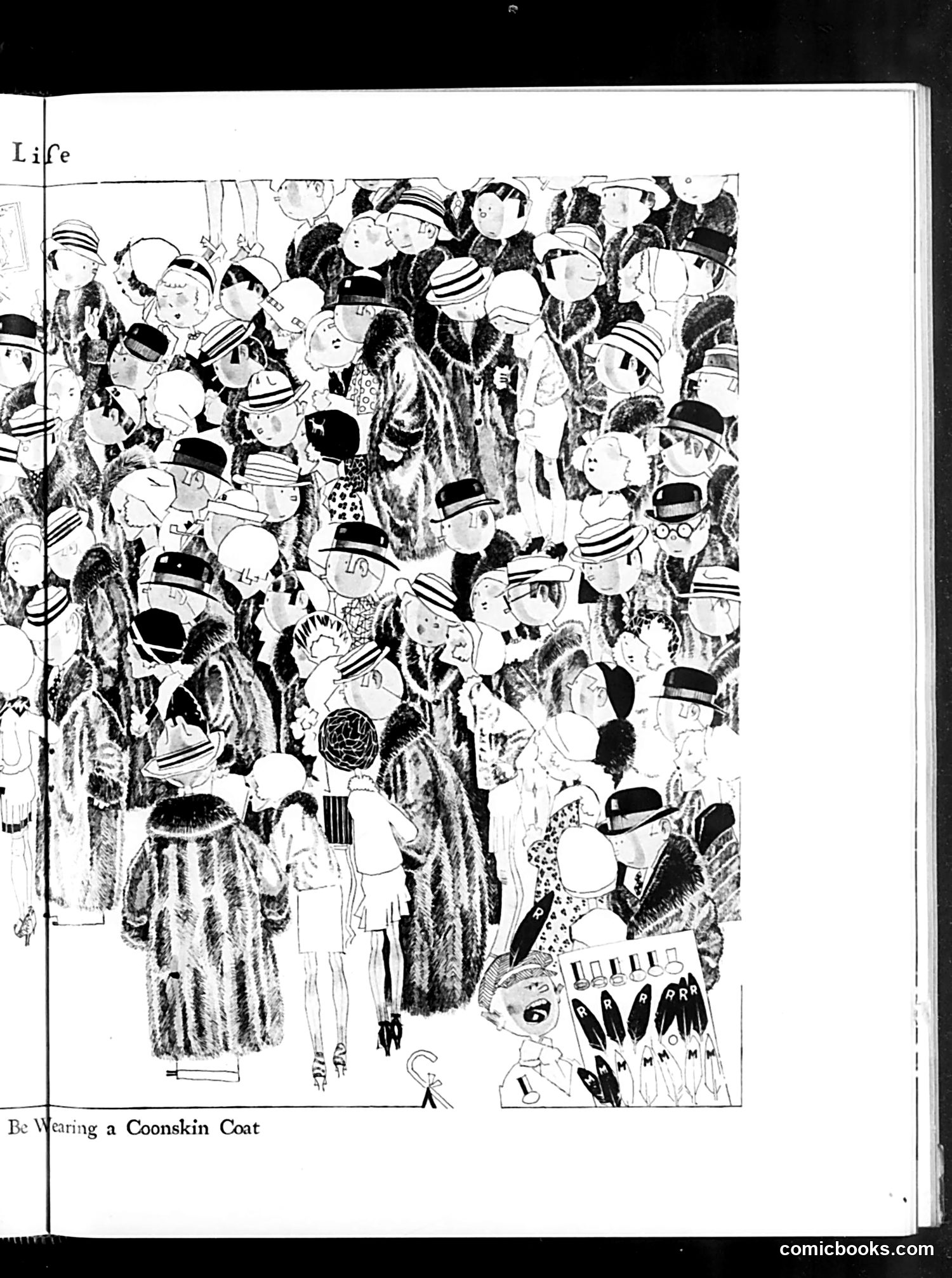
This satirical cartoon from *Life* magazine depicts a densely packed crowd of fashionable people wearing coonskin coats—a luxury fur garment that was a status symbol among the wealthy during the early 20th century. The joke targets conspicuous consumption and status anxiety: the image suggests that coonskin coats became so fashionable among the affluent that everyone rushed to wear them, creating an absurd uniformity despite the garments' expense and exclusivity. The crowded composition emphasizes herd mentality—people blindly following fashion trends to appear wealthy and fashionable. The cartoon likely satirizes both upper-class pretension and the American obsession with material goods and social signaling through fashion.
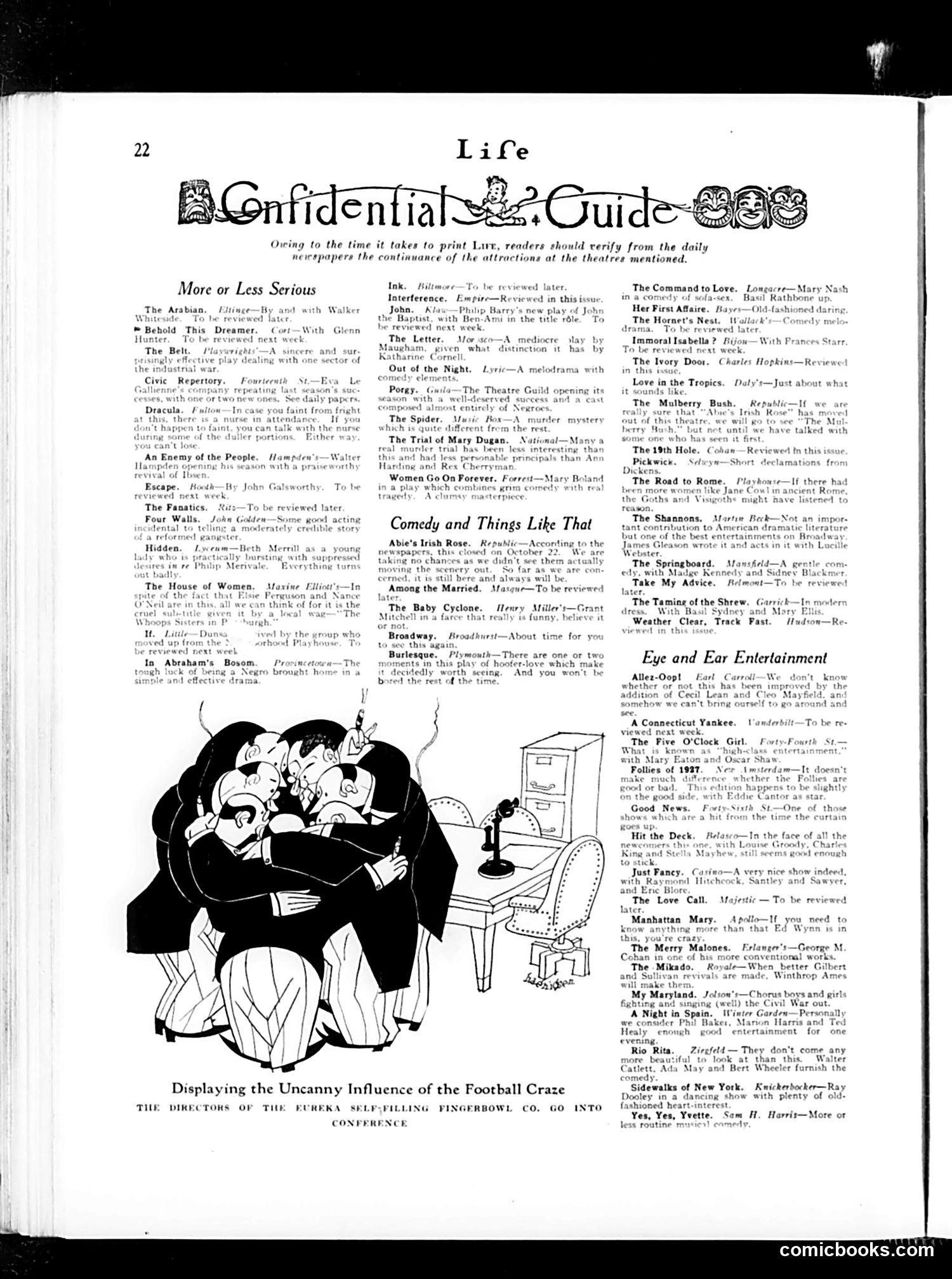
This page from Life magazine features entertainment reviews and a satirical cartoon about the "Football Craze" affecting American culture in the 1920s. **The Main Cartoon:** The illustration shows what appears to be business or political directors engaged in frenzied, chaotic behavior—huddling together in an exaggerated, almost animalistic pose. The caption reads: "Displaying the Uncanny Influence of the Football Craze: THE DIRECTORS OF THE EUREKA SELF-FILLING FINGERBOWL CO. GO INTO CONFERENCE." **The Satire:** The joke mocks how football enthusiasm had permeated American professional life so thoroughly that even corporate executives conducting serious business meetings were supposedly affected by "football fever." The cartoon suggests respectable businessmen had abandoned decorum, adopting the frenzied energy and physical aggression of football players during what should be calm boardroom discussions. This reflects 1920s anxieties about how sports culture was influencing (or corrupting) American institutions and professionalism.
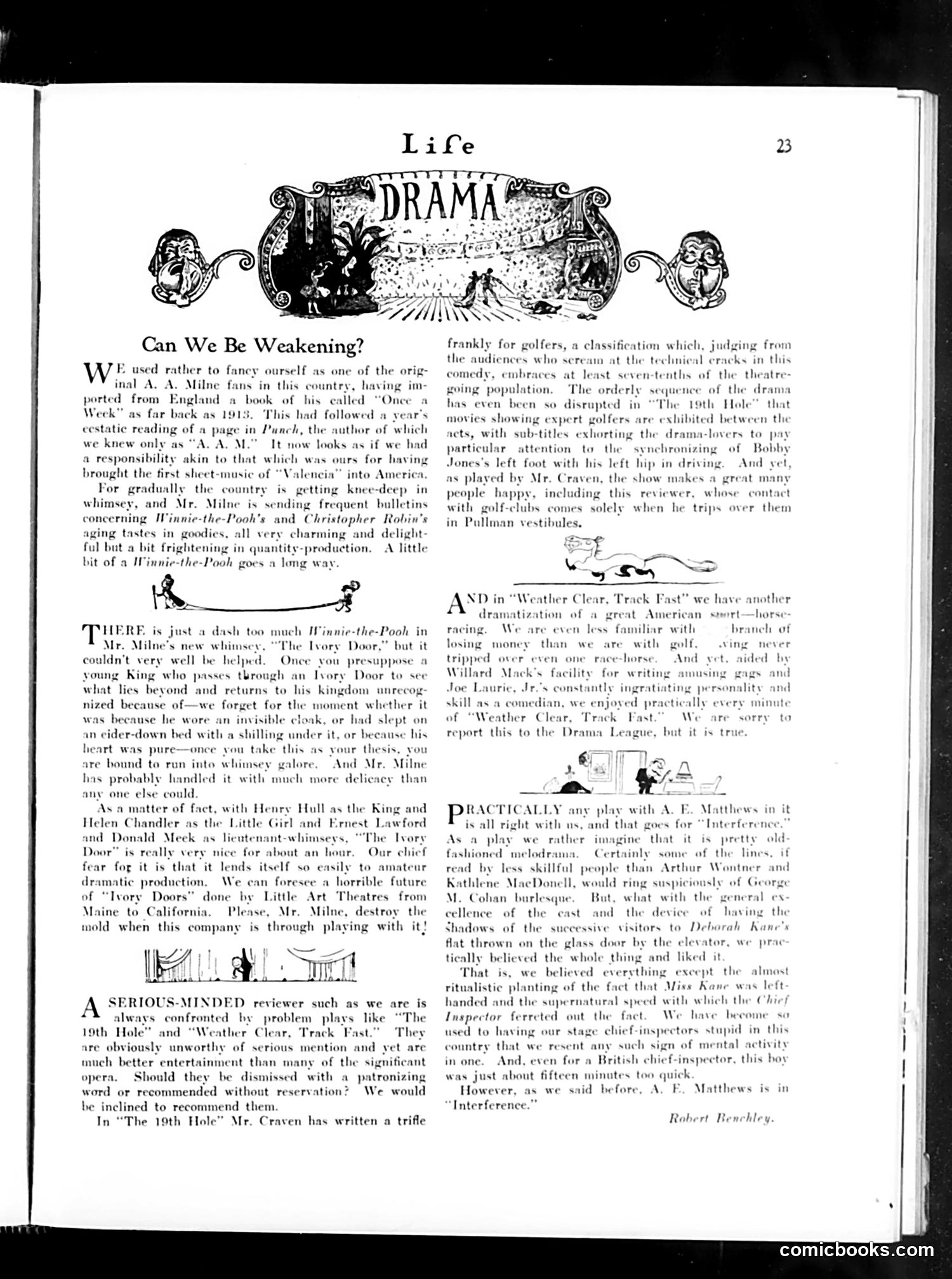
This page reviews three theatrical productions, criticizing the cultural trend toward whimsy while acknowledging audience enjoyment. **Main Critique**: The author warns that A.A. Milne's whimsical style—popularized through *Winnie-the-Pooh* and *Christopher Robin*—is becoming overused. While praising Milne's original work imported from England around 1913, the reviewer suggests the American theater is now saturated with cutesy, whimsical productions. *The Ivory Door*, featuring Henry Hull and Helen Chandler, is competent but represents this concerning trend. **The Paradox**: The reviewer admits that lighter entertainment like *The 19th Hole* and *Weather Clear, Track Fast*—specialized comedies about golf and horse-racing—are more enjoyable than pretentious serious drama, despite being "unworthy of serious mention." **The Point**: This satirizes the tension between highbrow theatrical standards and popular taste, suggesting critics should acknowledge that accessible, entertaining plays serve audiences better than self-important artistic failures.
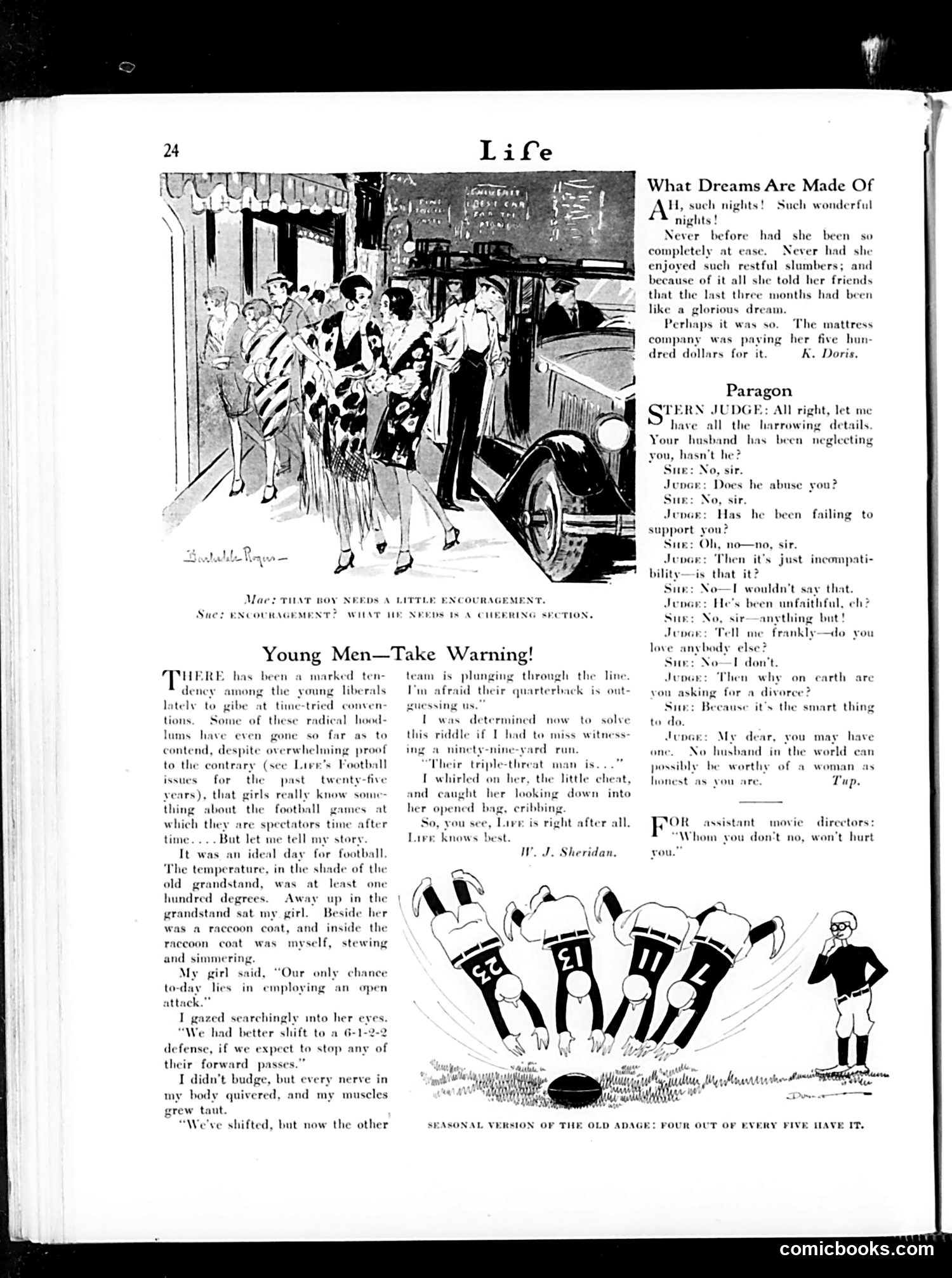
This page contains three satirical pieces targeting early 1920s social attitudes: **"Young Men—Take Warning!"** mocks young women's newfound confidence about football knowledge. A man at a game is flustered when his date corrects his football strategy, challenging the conventional idea that women know nothing about sports. The satire targets both progressive women entering male domains and conservative men threatened by this shift. **"What Dreams Are Made Of"** advertises mattresses through a woman's testimonial, satirizing commercial manipulation—she attributes her happiness to the product while being paid $500 by the mattress company to say so. **"Paragon"** (a court dialogue) satirizes divorce proceedings where a judge is baffled: a wife wants divorce despite her husband being faithful, supportive, and non-abusive. She simply considers it "the smart thing to do." The satire targets both frivolous divorce and the judge's assumption that only abuse/neglect justifies separation. The bottom cartoon jokes that "four out of every five have it"—likely referencing a common advertising trope of the era claiming most people suffer some ailment.
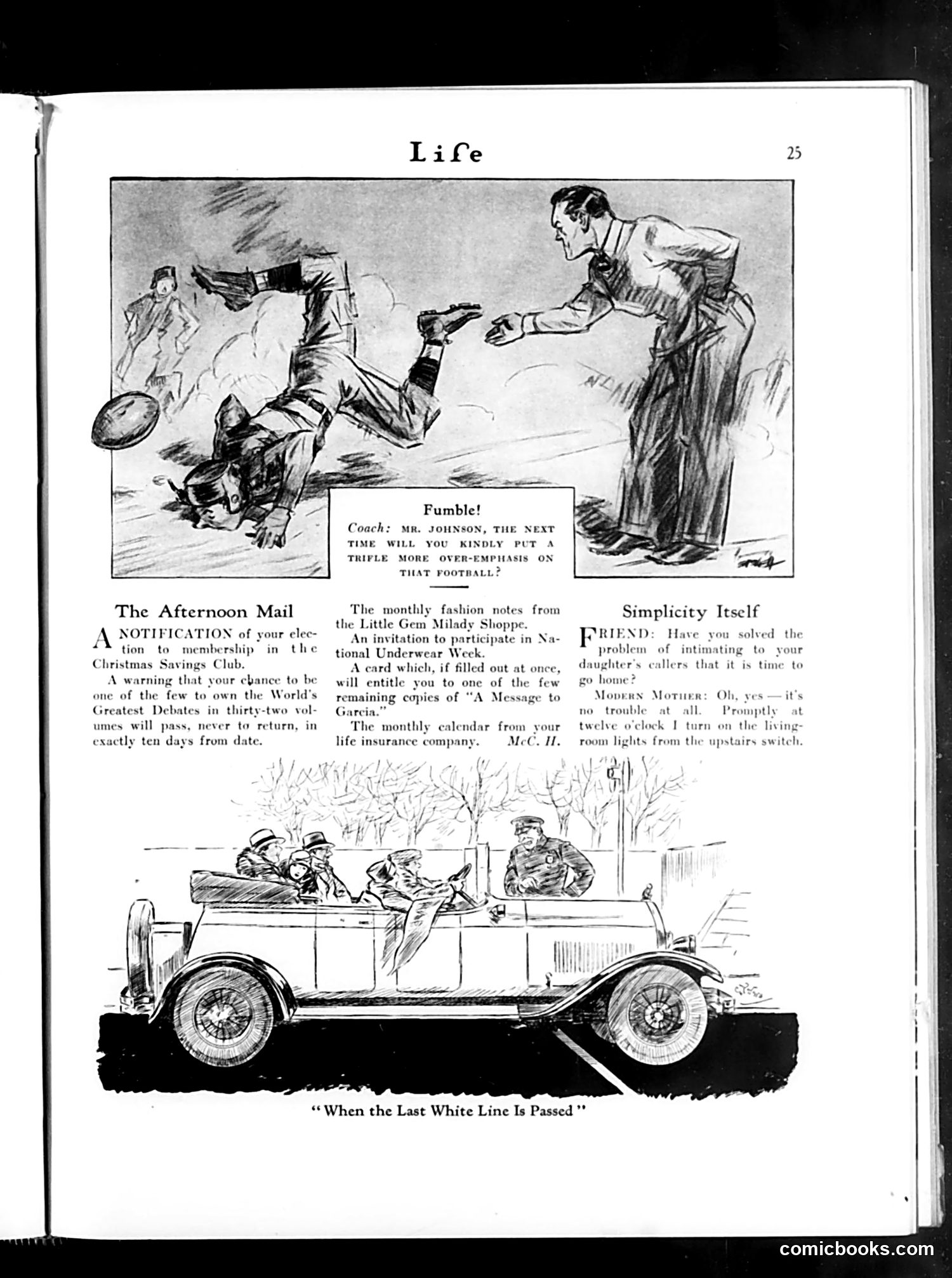
This page from *Life* magazine contains two satirical pieces: **"The Afternoon Mail"** mocks the typical unwanted mail of the era—membership solicitations, time-limited book offers, fashion notes, and insurance calendars—all presented as annoying clutter that clutters daily life. **"Fumble!"** (top cartoon) shows a football coach criticizing a player for dropping the ball, sarcastically asking him to emphasize the "trifle" more—a joke about how coaches obsess over minor details of form while players fail at basic execution. **"Simplicity Itself"** (right column) is a domestic humor piece where a mother explains her subtle hint to get her daughter's male visitors to leave: she turns on the upstairs lights at midnight, signaling bedtime. It's gentle satire on courtship etiquette and parental control over young women's social lives. **"When the Last White Line Is Passed"** (bottom) appears to be an automobile advertisement or caption, though its exact meaning is unclear without additional context. All reflect early-to-mid 20th-century American domestic and social anxieties presented as light humor.
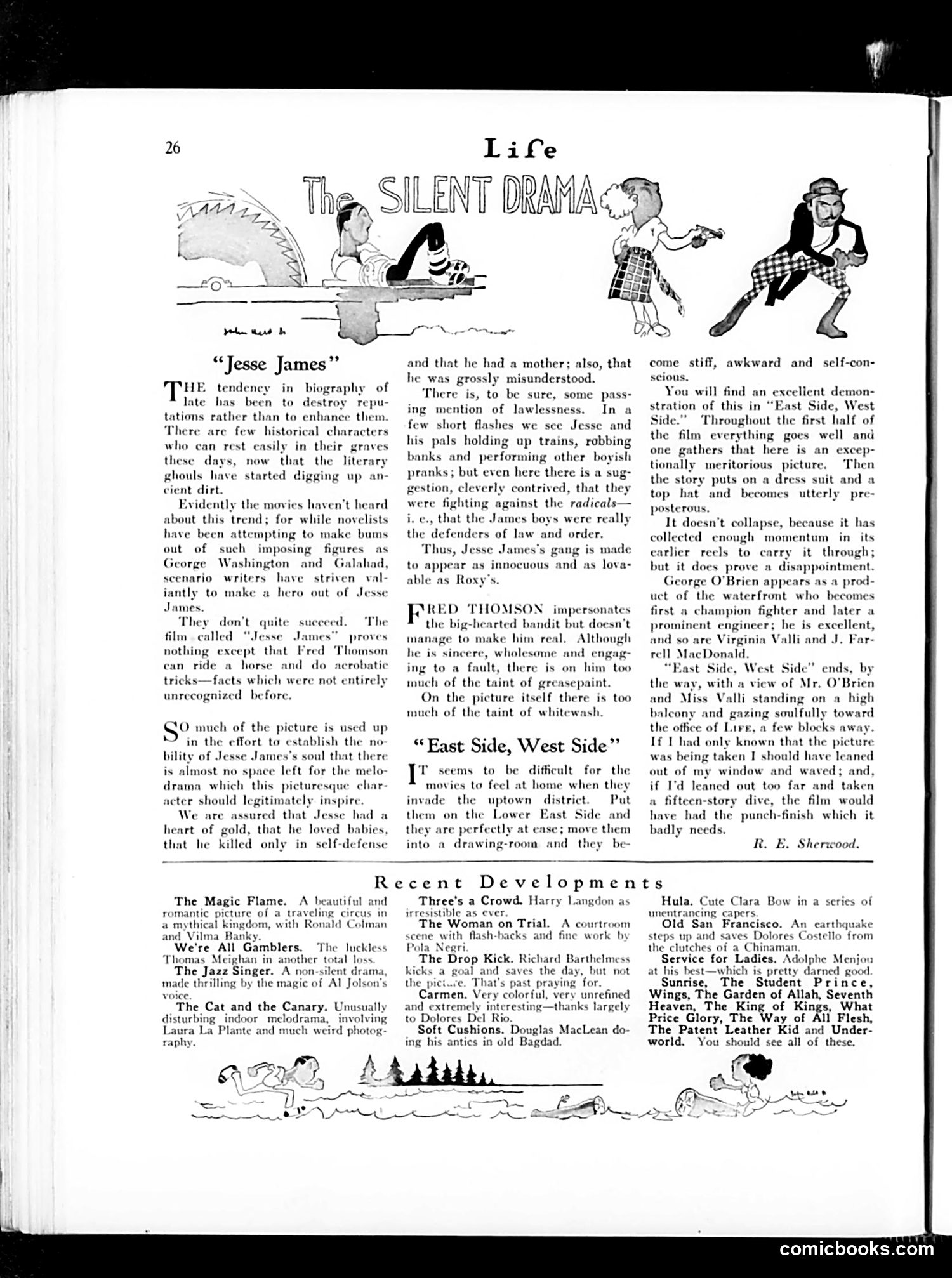
This page contains film reviews critiquing 1920s silent movies. The main pieces review "Jesse James" (starring Fred Thomson) and "East Side, West Side" (starring George O'Brien and Virginia Valli). The **Jesse James review** satirizes Hollywood's sanitization of the outlaw: the film portrays him as misunderstood and noble rather than criminal, depicting his gang as defenders against "radicals" rather than genuine lawbreakers. The critic mocks this whitewashing, noting Thomson performs acrobatics competently but the film drowns real drama in sentimentality about Jesse's "heart of gold" and his mother. The **East Side, West Side review** argues the film excels in Lower East Side scenes but becomes "stiff, awkward and self-conscious" when moved to wealthy uptown settings—suggesting movies of this era struggled authentically portraying upper-class life. The critic even jokes he'd leap from his window to improve the ending's "punch." A "Recent Developments" section briefly lists other current films.
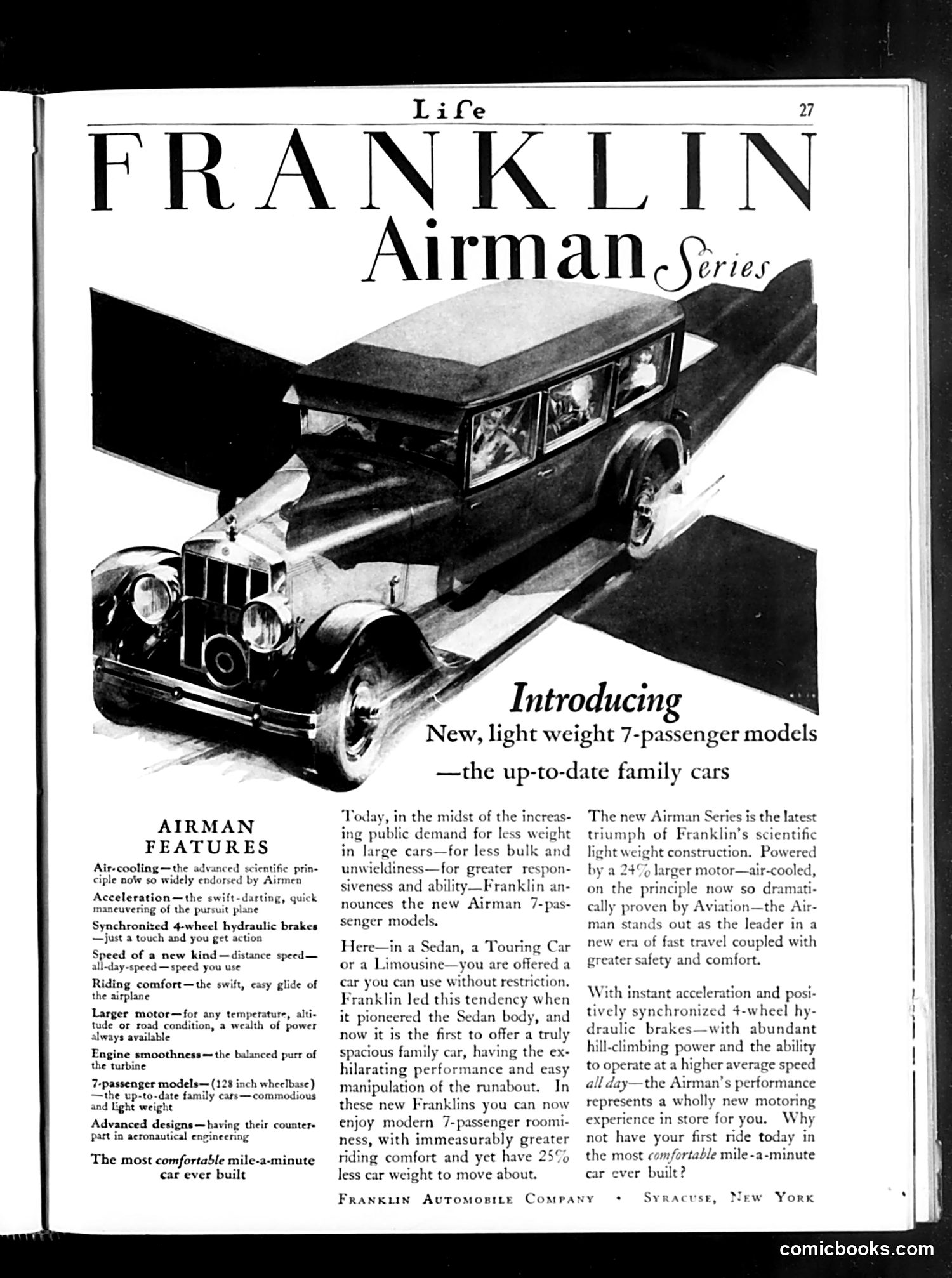
This is not a cartoon or satire—it's a straightforward automobile advertisement from Life magazine. Franklin Automobile Company is promoting their new "Airman" series of 7-passenger cars. The ad emphasizes the vehicle's airplane-inspired engineering: air-cooling, lightweight construction, and advanced hydraulic brakes. The visual shows a Franklin sedan alongside an airplane, physically juxtaposing the two to suggest the car incorporates aviation technology. The sales pitch targets early 20th-century buyers seeking modern, efficient family vehicles. Key selling points include 25% less weight than competitors, greater comfort, and reliable hill-climbing power—practical concerns for the era's primitive road infrastructure. The "mile-a-minute" claim (60 mph) represented genuinely impressive performance for the period. This reflects the 1920s-30s fascination with aviation as the cutting edge of technology, with automakers leveraging aviation prestige to sell cars.
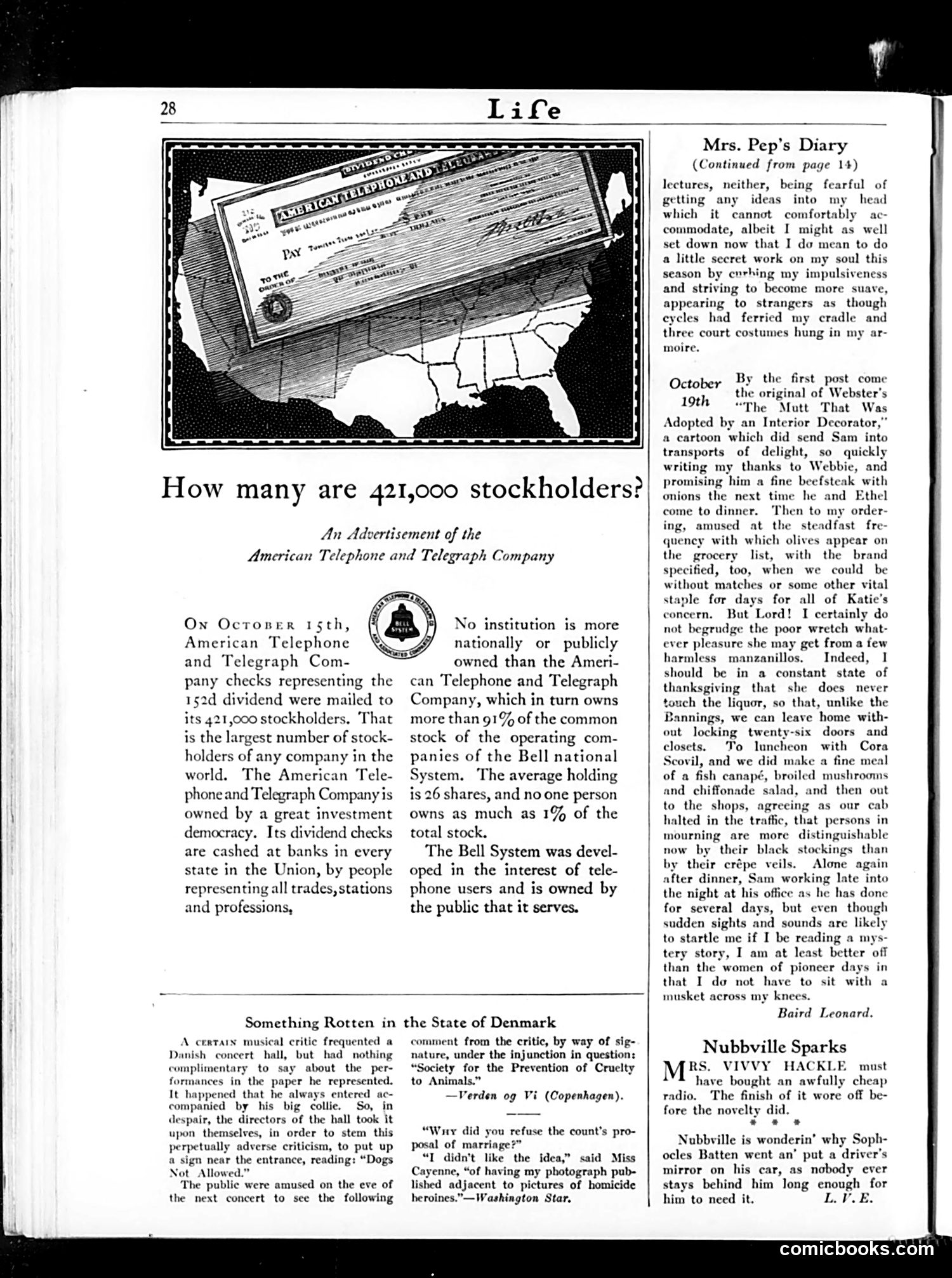
This page contains three distinct items: **Main Advertisement (Top):** A full-page ad for American Telephone and Telegraph Company, celebrating that 421,000 stockholders received dividend checks—claimed as the largest shareholder base of any company worldwide. The ad emphasizes AT&T's democratic ownership structure, with average holdings of 26 shares and no single person owning more than 1% of stock. The accompanying map illustration shows AT&T's reach across the United States. This is corporate promotional messaging emphasizing broad public investment and trust. **Two Humor Pieces (Bottom):** Short, unrelated satirical anecdotes—one about a Danish music critic and a concert hall's "No Dogs" policy (mocking overly sensitive institutions), and another brief joke about a woman refusing a count's marriage proposal. **"Mrs. Pep's Diary" (Right Column):** Continued personal diary entries from a society woman discussing social life, servants, shopping, and domestic matters—typical of Life's satirical society columns mocking upper-class concerns. The page is primarily advertisement with supporting light humor content typical of Life magazine's format.
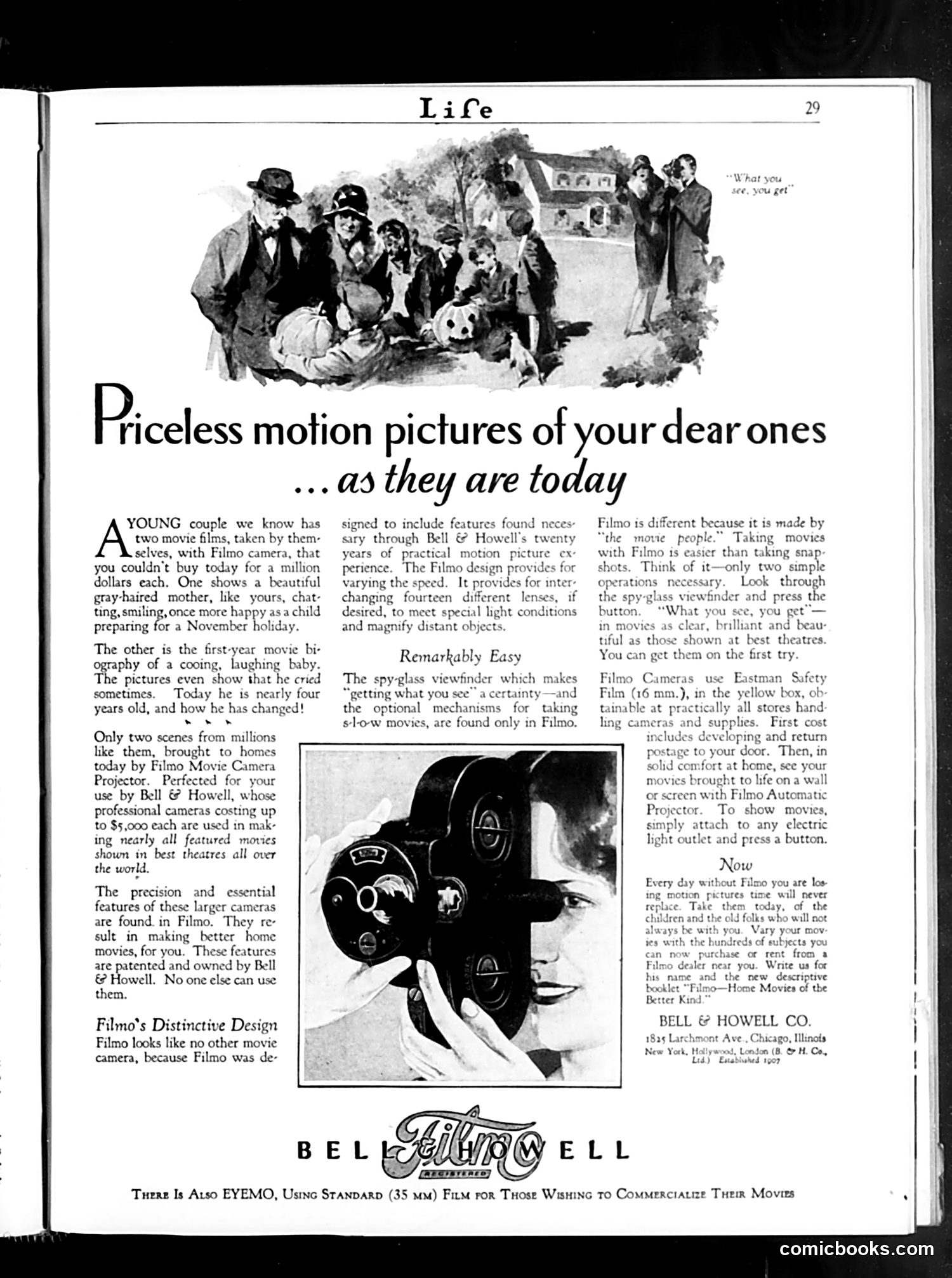
This is **advertising, not satire or political commentary**. The page promotes Filmo movie cameras by Bell & Howell, a real manufacturer of motion picture equipment. The content appeals to middle-class consumers by emphasizing that professional-quality filmmaking—previously restricted to Hollywood studios—is now accessible to ordinary families. The opening narrative about a young couple preserving memories of their mother and infant son establishes emotional stakes: these cameras let you document precious moments. The image shows a woman operating a Filmo camera, positioned as both user-friendly and technologically sophisticated. The text stresses Filmo's "distinctive design," precision engineering (borrowed from professional studio cameras), and ease of use—key selling points for consumer technology. A secondary pitch mentions Eyemo cameras for those wanting to commercialize their films, suggesting an entrepreneurial angle. The advertisement reflects 1920s-30s optimism about consumer technology democratizing professional capabilities.
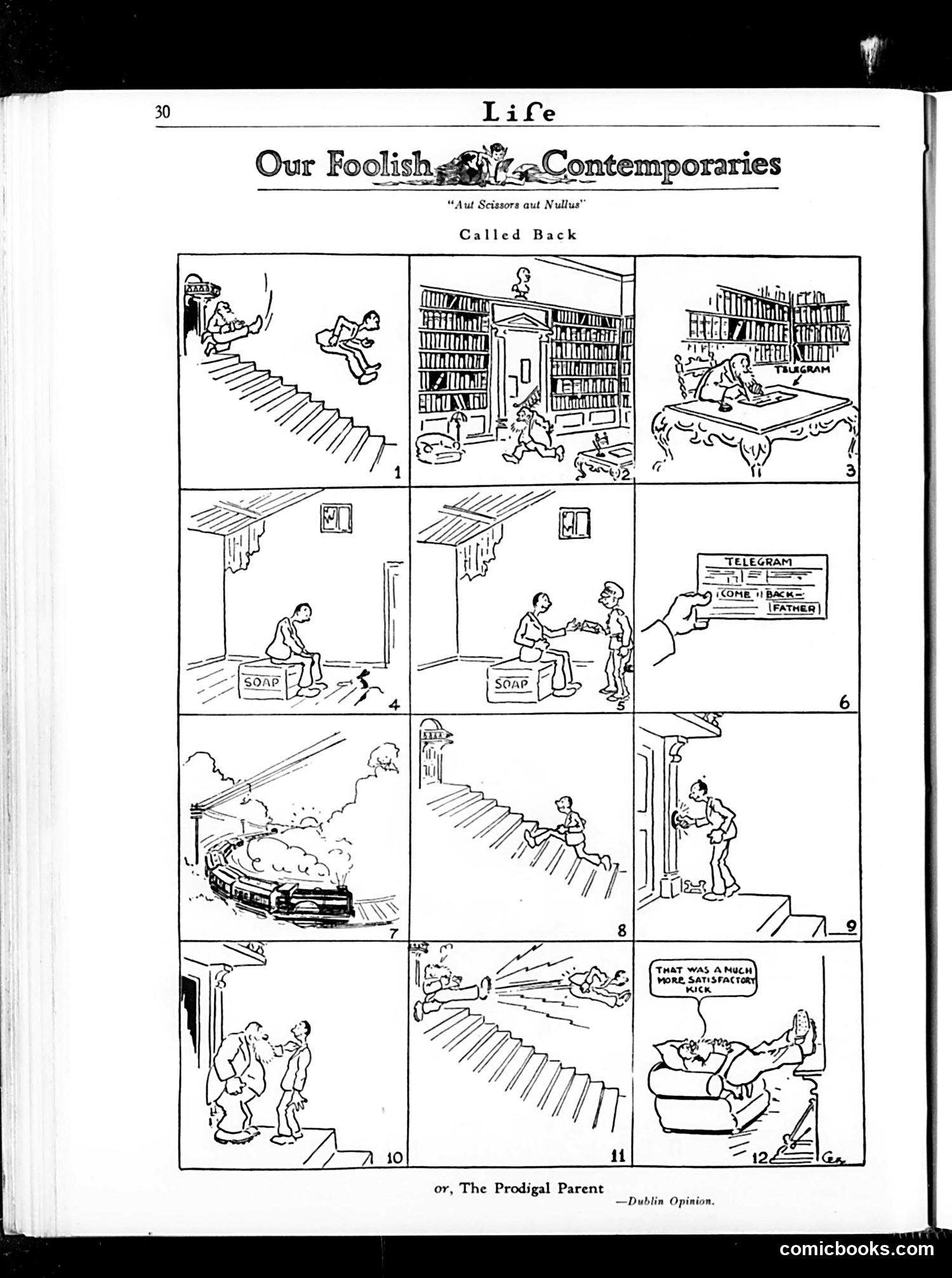
This is a 12-panel satirical comic titled "Called Back; or, The Prodigal Parent" (subtitle: "Dublin Opinion"). The narrative follows a father figure who appears to abandon his family responsibilities, then is summoned back via telegram. The sequence depicts: a man fleeing down stairs (panel 1), a library scene (2), chaos in a home (3-5), his departure via soap box/makeshift transport (7-8), and escalating domestic disorder during his absence (9-11). The final panel shows him relaxing while the mother comments "That was a much worse devastation" — suggesting his return has created even more chaos than his departure. The satire targets irresponsible parenthood and the domestic disruption caused by absent fathers, positioning the "prodigal parent" (playing on the biblical prodigal son) as the source of family turmoil rather than redemption.
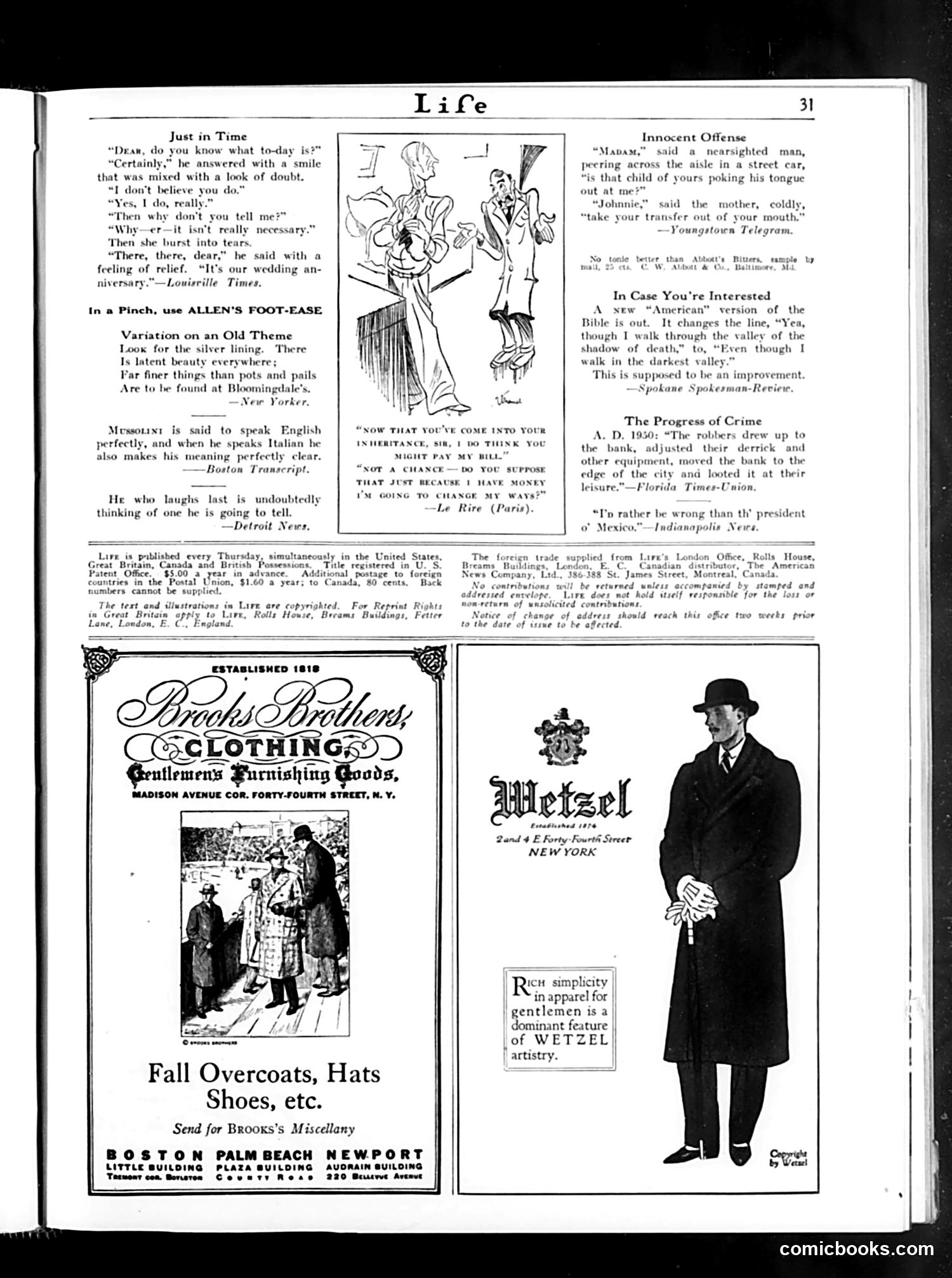
This page contains several short humorous pieces typical of Life's satirical format: **"Just in Time"**: A domestic comedy sketch where a husband forgets his wedding anniversary. The joke relies on the husband's evasiveness and the wife's emotional response—common early-20th-century marital humor. **"Variation on an Old Theme"**: A brief quip about finding beauty in unexpected places (Bloomingdale's department store) rather than traditional sources—gentle consumerist satire. **The central cartoon** appears to show a man refusing to pay debts despite inheriting money, with the caption suggesting he won't change his ways regardless of fortune—satirizing the wealthy's indifference to obligations. **"The Progress of Crime"** jokes darkly about criminal evolution: rather than robbing a bank directly, modern criminals apparently move the entire bank to the city's edge for convenience—a comment on increasing audacity or absurdity of crime. The page also includes advertisements for Brooks Brothers and Wetzel clothing, typical of Life's commercial content. Overall, this reflects 1920s-era American humor: domestic mishaps, gentle social observation, and light cynicism about wealth and morality.
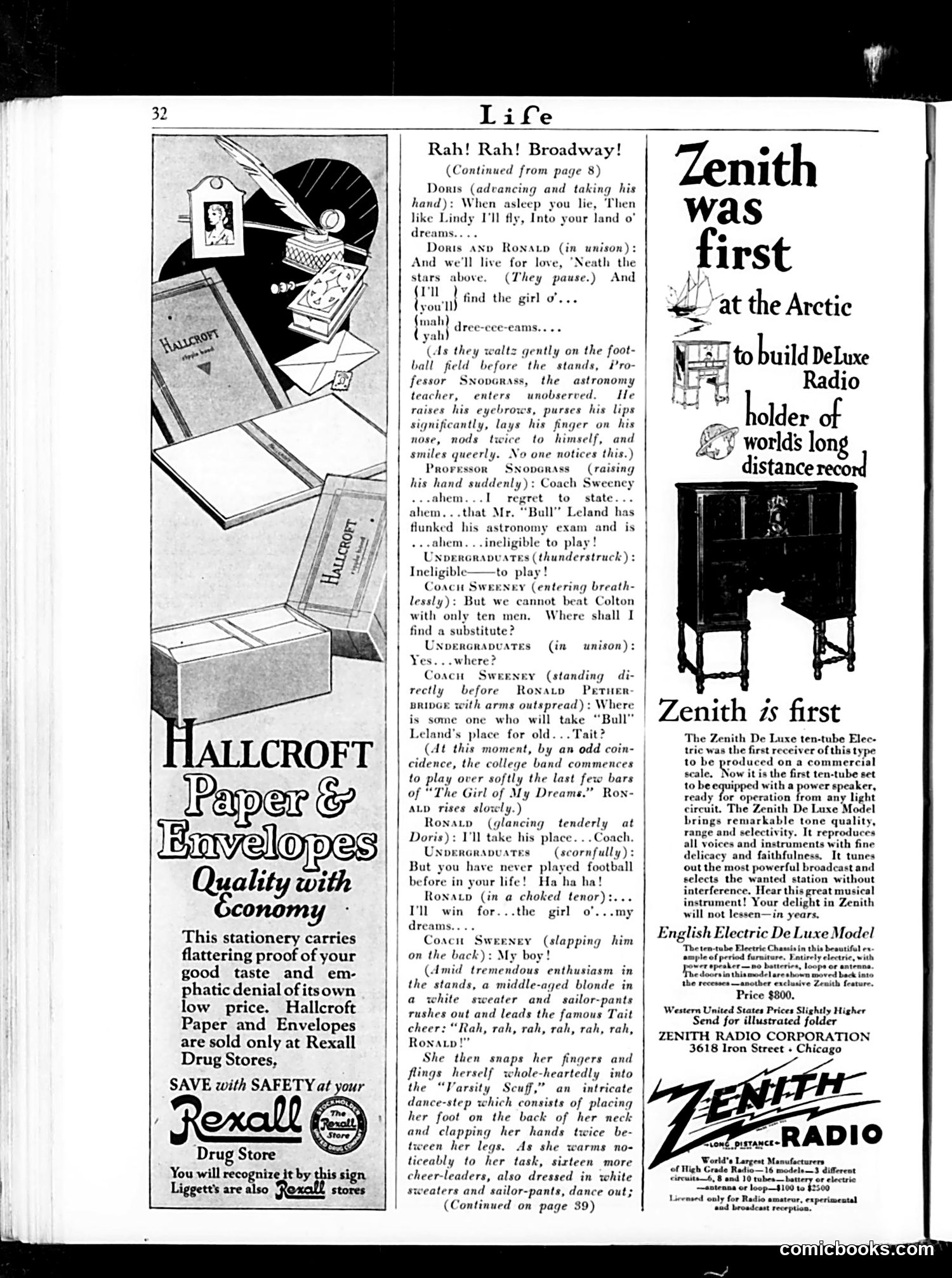
This page is primarily **advertising** rather than political satire. The dominant content includes: **Left side:** A Hallcroft Paper & Envelopes advertisement emphasizing affordable quality, sold exclusively at Rexall Drug Stores. **Center:** A continuation of a theatrical comedy sketch titled "Rah! Rah! Broadway!" involving college romance and football. The plot concerns Ronald, who volunteers to replace an ineligible player ("Bull" Leland) in a football game to win over his love interest Doris. The sketch parodies sentimental Broadway musicals with corny dialogue ("When asleep you lie, Then like Lindy I'll fly") and includes comic supporting characters like a pedantic astronomy professor and enthusiastic cheerleaders performing the "Varsity Scuff" dance. **Right side:** Advertisement for the Zenith De Luxe radio receiver, claiming it was "first at the Arctic to build DeLuxe Radio" and offering superior tone and selectivity. The page reflects 1920s entertainment and consumer culture rather than political commentary.
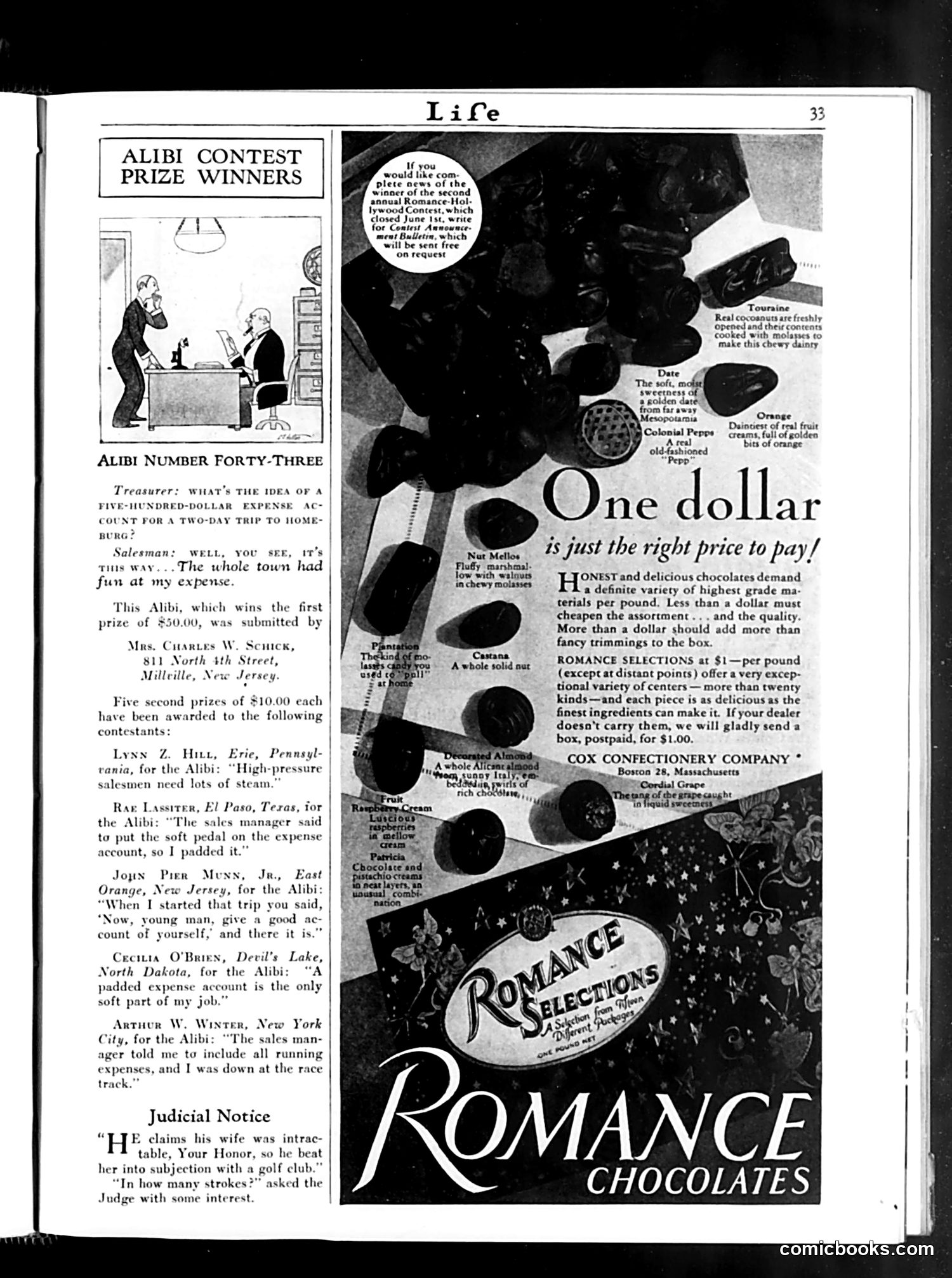
This page contains two distinct sections: **Left side—"Alibi Contest Prize Winners":** Life magazine ran a humor contest asking readers to submit creative excuses (alibis) for inflated business expense accounts. The winning entry shows a salesman justifying a $500 expense for a two-day trip by claiming "the whole town had fun at my expense"—a pun suggesting he treated everyone to drinks/entertainment rather than actually working. The joke satirizes corporate expense-account padding, a common practice where salesmen would submit fraudulent business expenses. The other winning alibis play on similar themes of workers padding their claims. The small cartoon at bottom ("Judicial Notice") is a separate joke about domestic violence, which Life treated as comedic subject matter—reflecting attitudes we'd now find deeply inappropriate. **Right side:** A large advertisement for Romance Chocolates, emphasizing that one dollar is the ideal price point for quality chocolate assortments. The page reflects 1920s-30s business culture and satirical humor standards of that era.
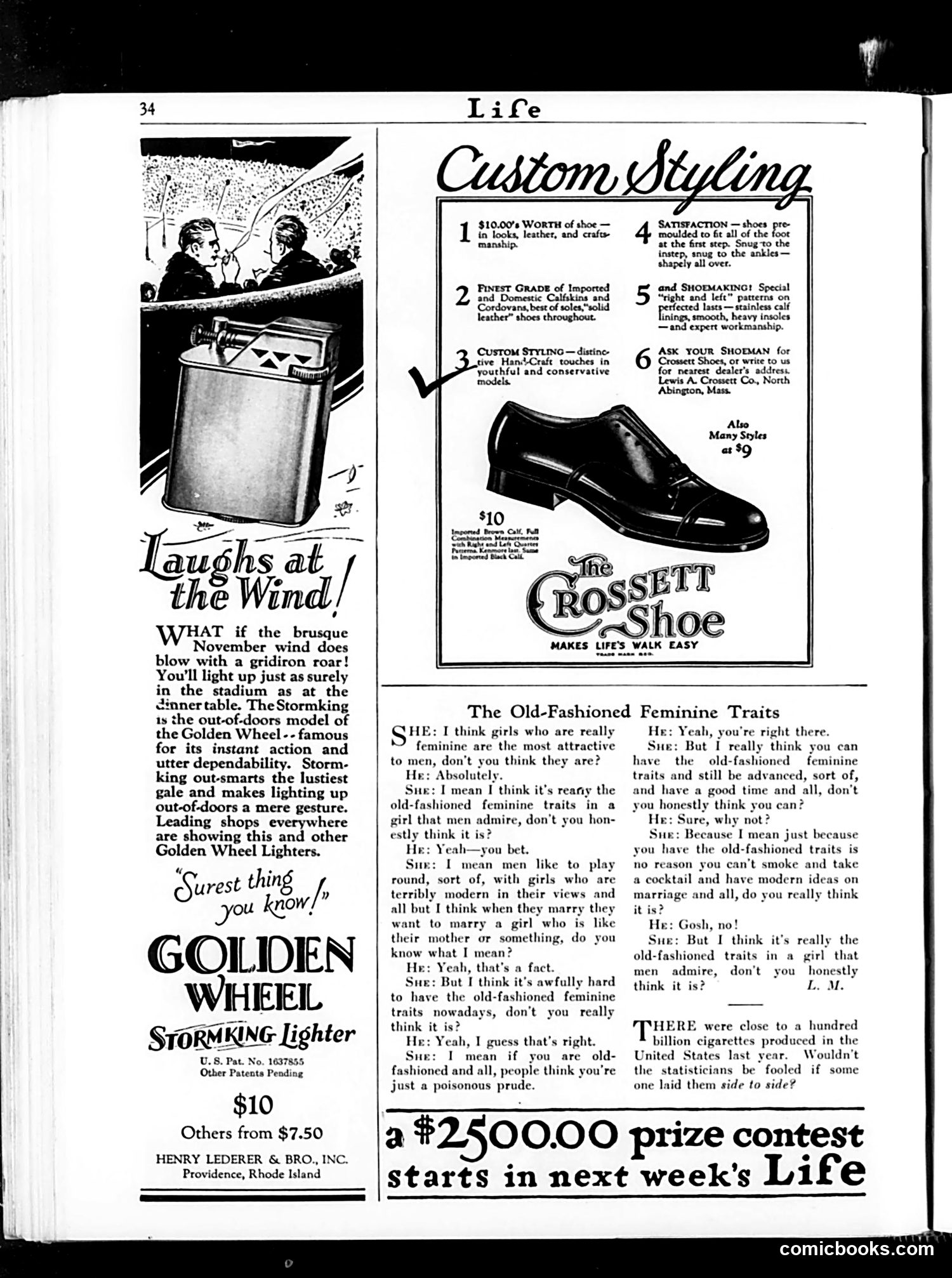
This page is primarily **advertising** interspersed with humor content. The main items are: **Advertisements:** - Golden Wheel Stormking lighter ($10) — pitched for outdoor use - Crossett shoes ($10) — emphasizing quality materials and custom fit **Satirical Dialogue:** "The Old-Fashioned Feminine Traits" is a conversational piece where a woman (Sue) repeatedly argues that men want old-fashioned, feminine women, while simultaneously contradicting herself by insisting modern women can smoke, drink cocktails, and hold progressive ideas. The humor lies in her circular logic and the apparent contradiction between claiming to be "old-fashioned" while embracing modern behaviors. The man (He) simply agrees with her throughout, appearing bemused by the contradiction. **Cigarette Joke:** A brief gag about cigarette production statistics — suggesting if "a hundred billion cigarettes" were laid end-to-end, statisticians would be surprised (likely at the absurd length). The page reflects 1920s-era social anxieties about changing women's roles and modern behavior.
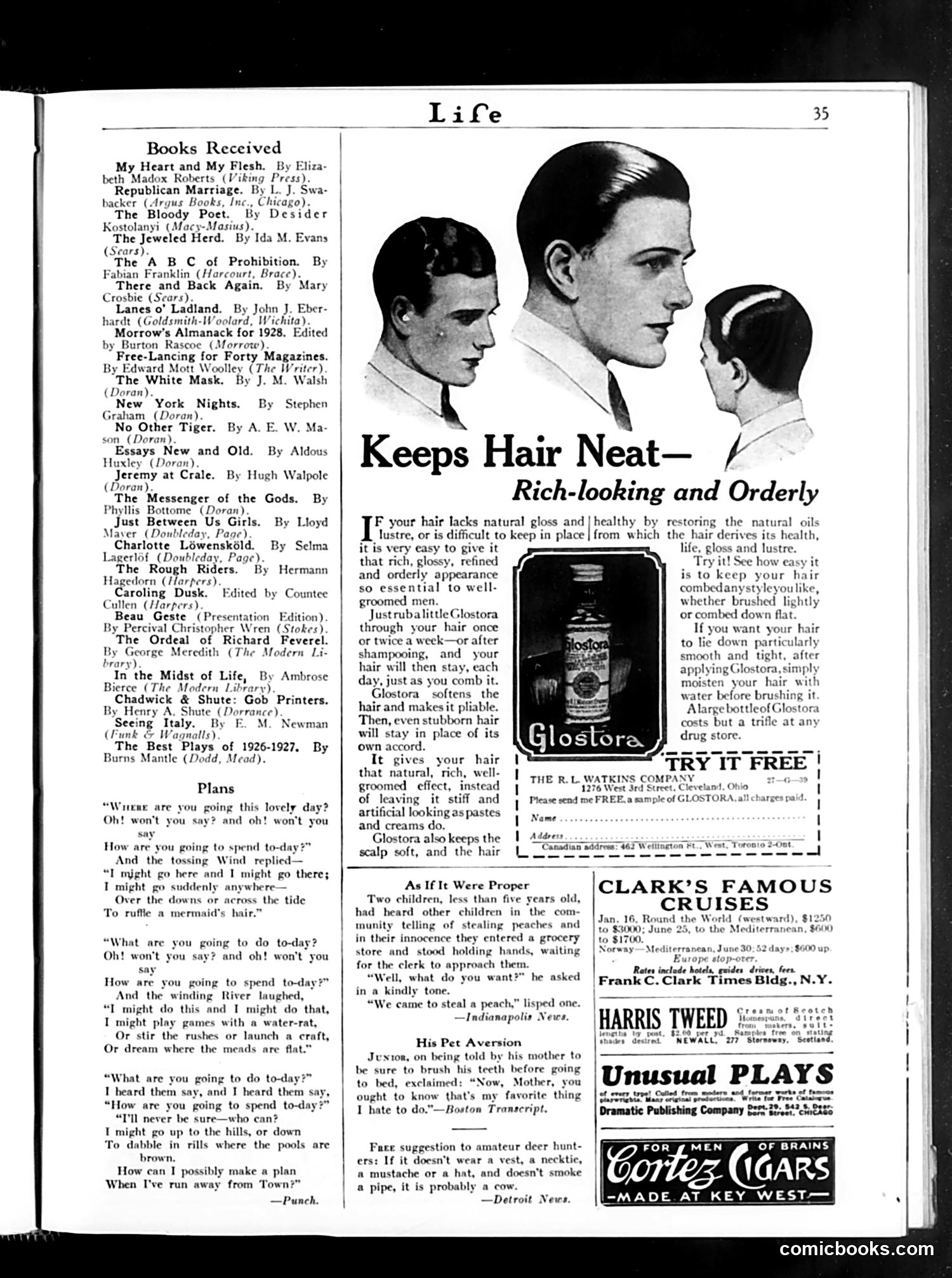
This page is primarily a **book review and advertisements section** with limited satirical content. The main elements are: **Books Received**: A standard literary listing of 1926-1927 publications, including titles on prohibition, marriage, and poetry—reflecting contemporary social interests of the Jazz Age. **"Plans" Poem**: A whimsical verse from *Punch* magazine about indecision, personifying Wind and River as carefree entities. It's gentle humor about life's unpredictability, not political satire. **Advertisements**: The majority of the page features ads for Glostora hair product and Clark's Cruises, Harris Tweed, and Cortez Cigars—typical 1920s consumer marketing. **Notable Context**: The presence of "The ABC of Prohibition" in the books list reflects the contentious Prohibition era (1920-1933), though there's no overt satirical treatment here. This is essentially a **commercial magazine page** blending literary content with advertising rather than political or social satire. Any humor is incidental to the advertising-driven layout.
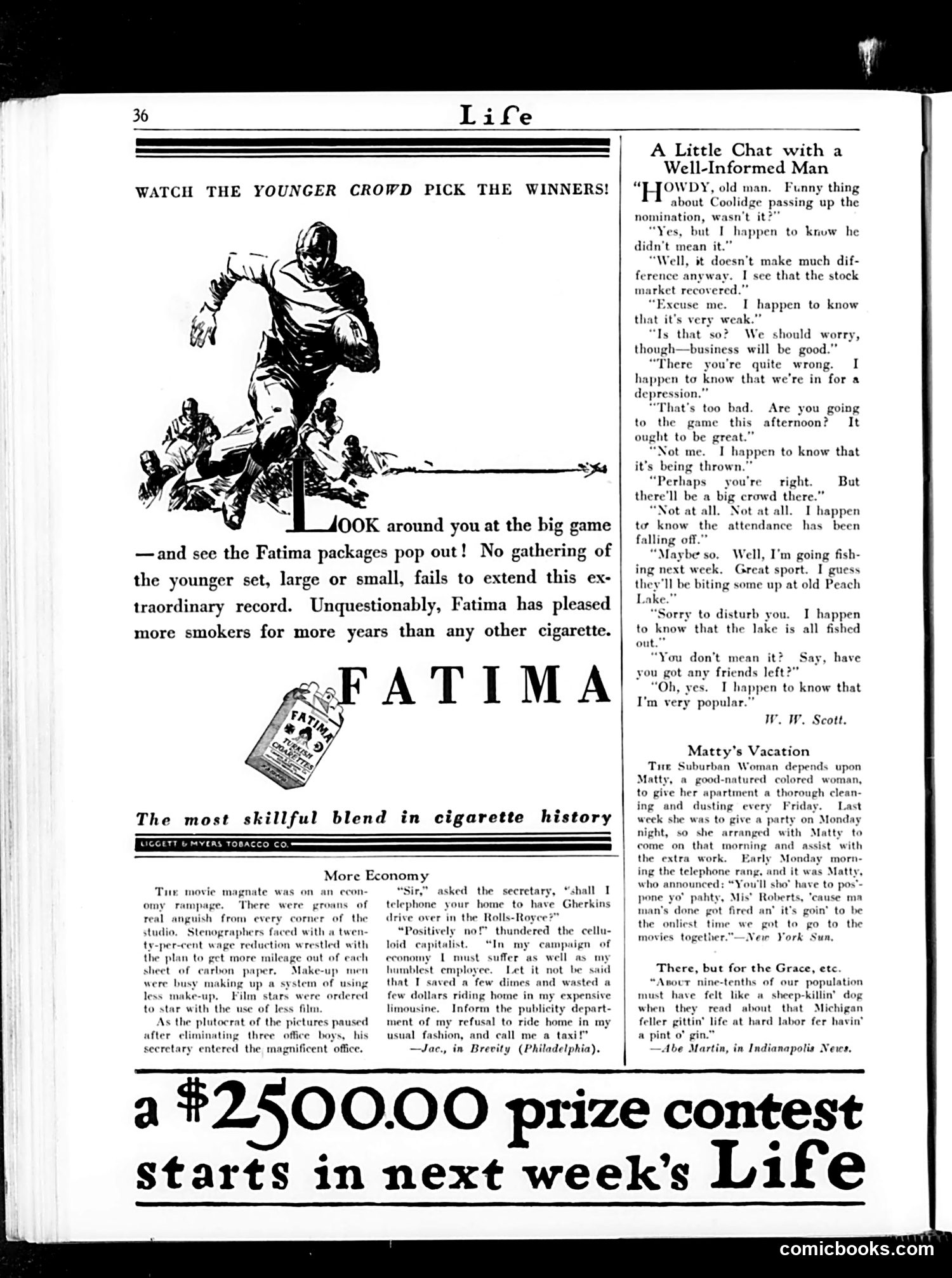
This page contains **multiple brief satirical items** rather than a single cartoon. The main content includes: 1. **Fatima Cigarette Advertisement** (top): A large ad claiming younger crowds prefer this brand, using an illustration of a football player surrounded by spectators. 2. **"A Little Chat with a Well-Informed Man"** (W.W. Scott): A joke mocking someone who contradicts every statement with "I happen to know"—claiming Coolidge didn't mean his nomination refusal, the stock market is weak despite recovery, depression is coming, the game will be thrown, attendance is falling, and the fishing lake is fished out. The humor lies in this contrarian's absurd omniscience. 3. **"More Economy"**: A satire on wealthy industrialists preaching thrift while living luxuriously—a movie executive eliminates office staff but refuses to stop using his expensive limousine. 4. **"Matty's Vacation"**: A brief anecdote about a Black household employee postponing her employer's party because she needs time off—likely satirizing employer entitlement. These are typical Life magazine humor pieces from the 1920s era.
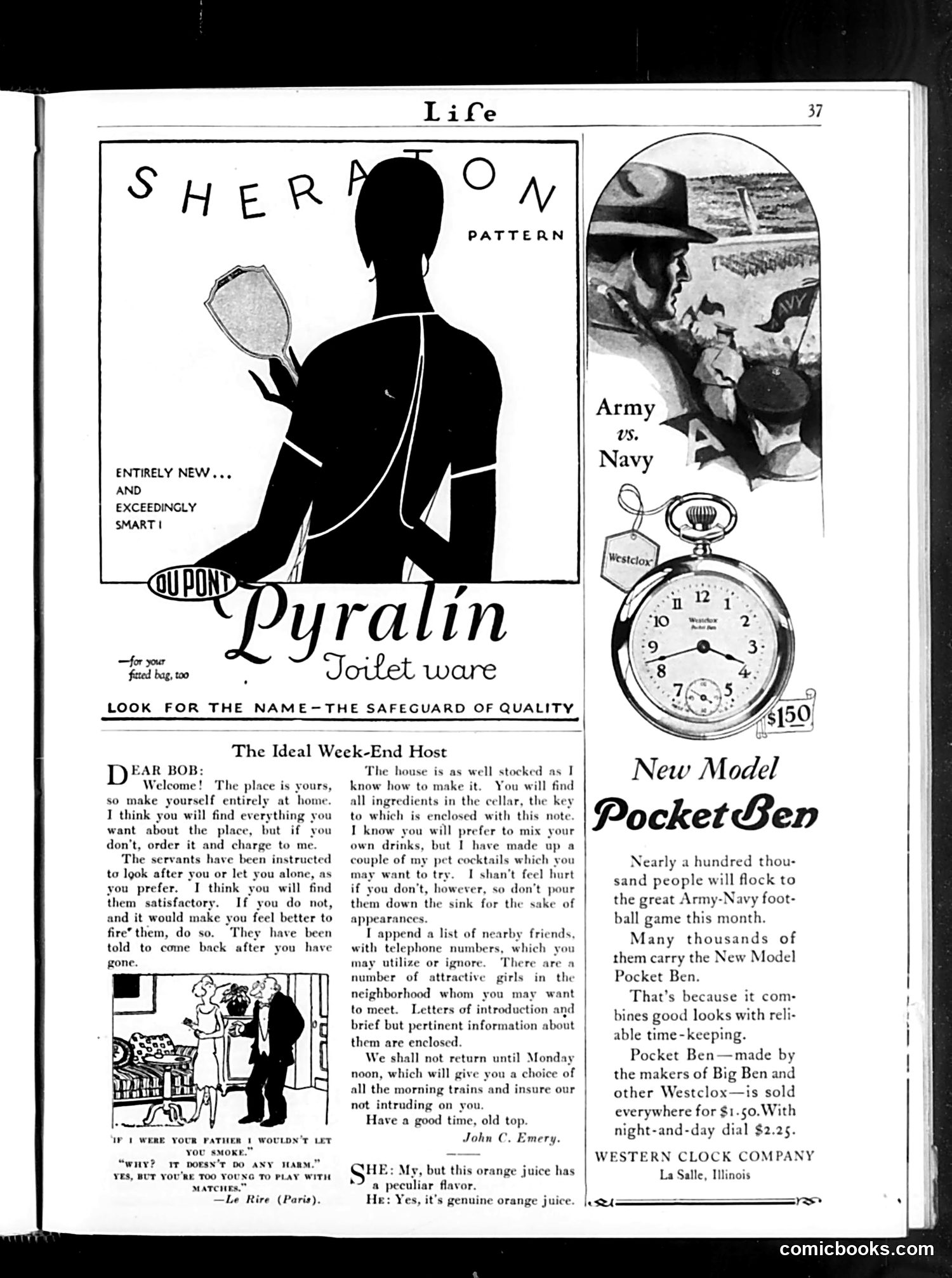
This Life magazine page (page 37) contains three distinct elements: **Left side**: A DuPont Pyralin toiletries advertisement featuring a silhouette of a fashionable woman with a tennis racket, promoting new "Sheraton Pattern" products as smart and modern. **Center**: A humorous letter titled "The Ideal Week-End Host" from John C. Emery, addressed to "Dear Bob." It satirizes excessive upper-class hospitality by describing absurdly permissive hosting—encouraging a guest to order anything, fire servants if displeased, access a fully-stocked liquor cellar, and even meet local women with provided introductions. A small cartoon below shows a father forbidding his son to smoke (it causes no harm) but not play with matches (he's too young)—the joke being about inappropriate risk assessment. **Right side**: Advertisements for a Pocket Ben watch ($1.50) promoted as ideal for Army-Navy football game attendees, and text about orange juice flavor. The page is primarily **advertising and light humor** rather than political commentary—typical of Life magazine's mix of satirical content and commercial messaging from this era.
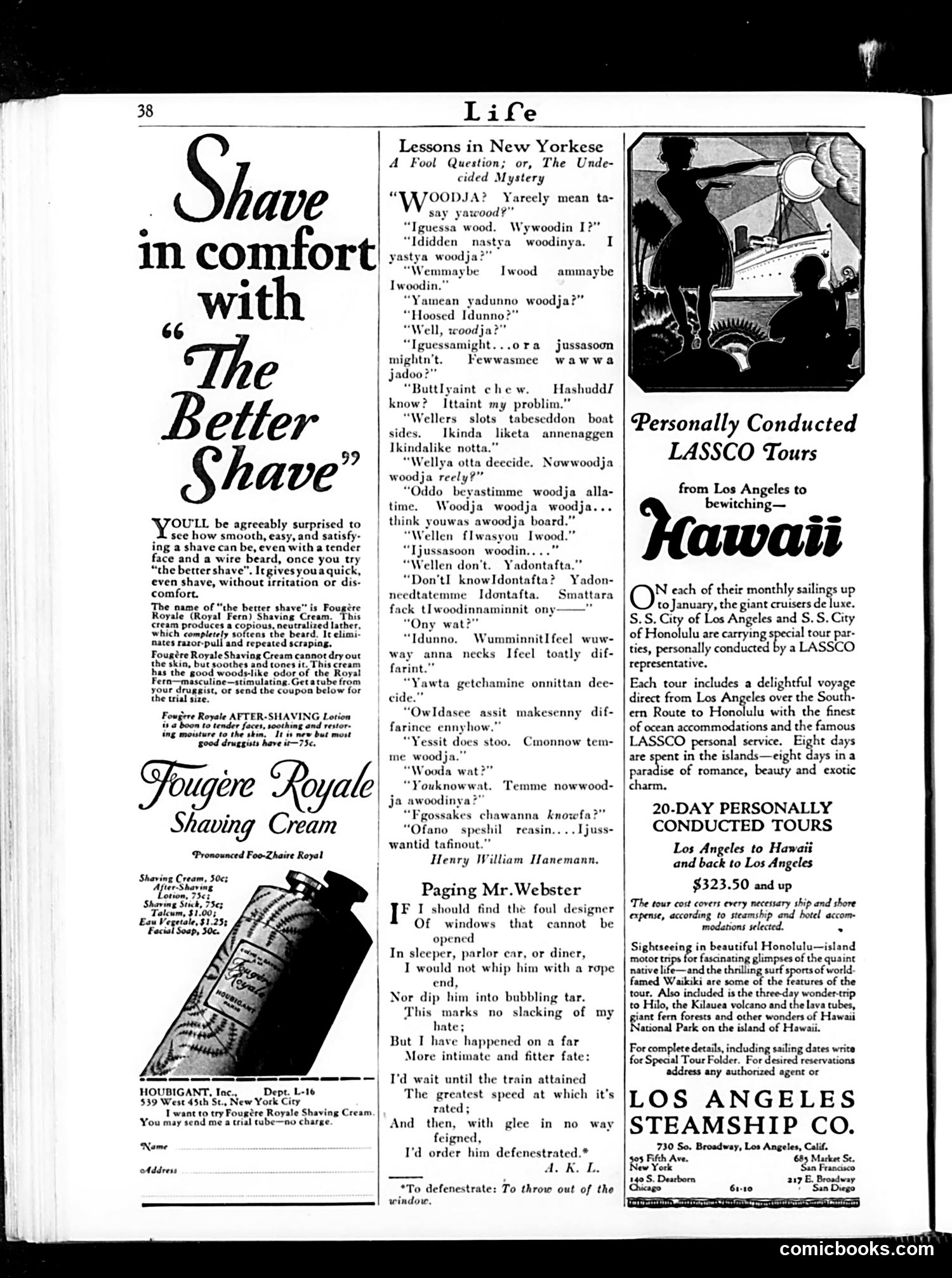
This page contains three distinct elements: **Left side:** An advertisement for Fougère Royale Shaving Cream—straightforward marketing with no satirical content. **Center: "Lessons in Newyo kese"** — A humorous linguistic sketch by Henry William Hanemann satirizing New York City working-class dialect. The piece is a circular conversation where characters repeatedly ask each other "would you/wouldn't you" (rendered phonetically as "woodja") in increasingly absurd variations, never actually deciding anything. It mocks the verbal patterns and rapid-fire speech rhythm distinctive to 1920s New York working-class speakers, presenting them as indecisive and repetitive. The humor lies in exaggerated phonetic spelling and the characters' inability to reach any conclusion. **Right side:** Two items—a poem titled "Paging Mr. Webster" humorously proposing to "defenestrate" (throw out a window) a train designer whose windows won't open, and a LASSCO cruise advertisement to Hawaii. The page is primarily **advertising-driven**, with the "Newyo kese" piece being the main satirical content targeting regional dialect stereotypes.
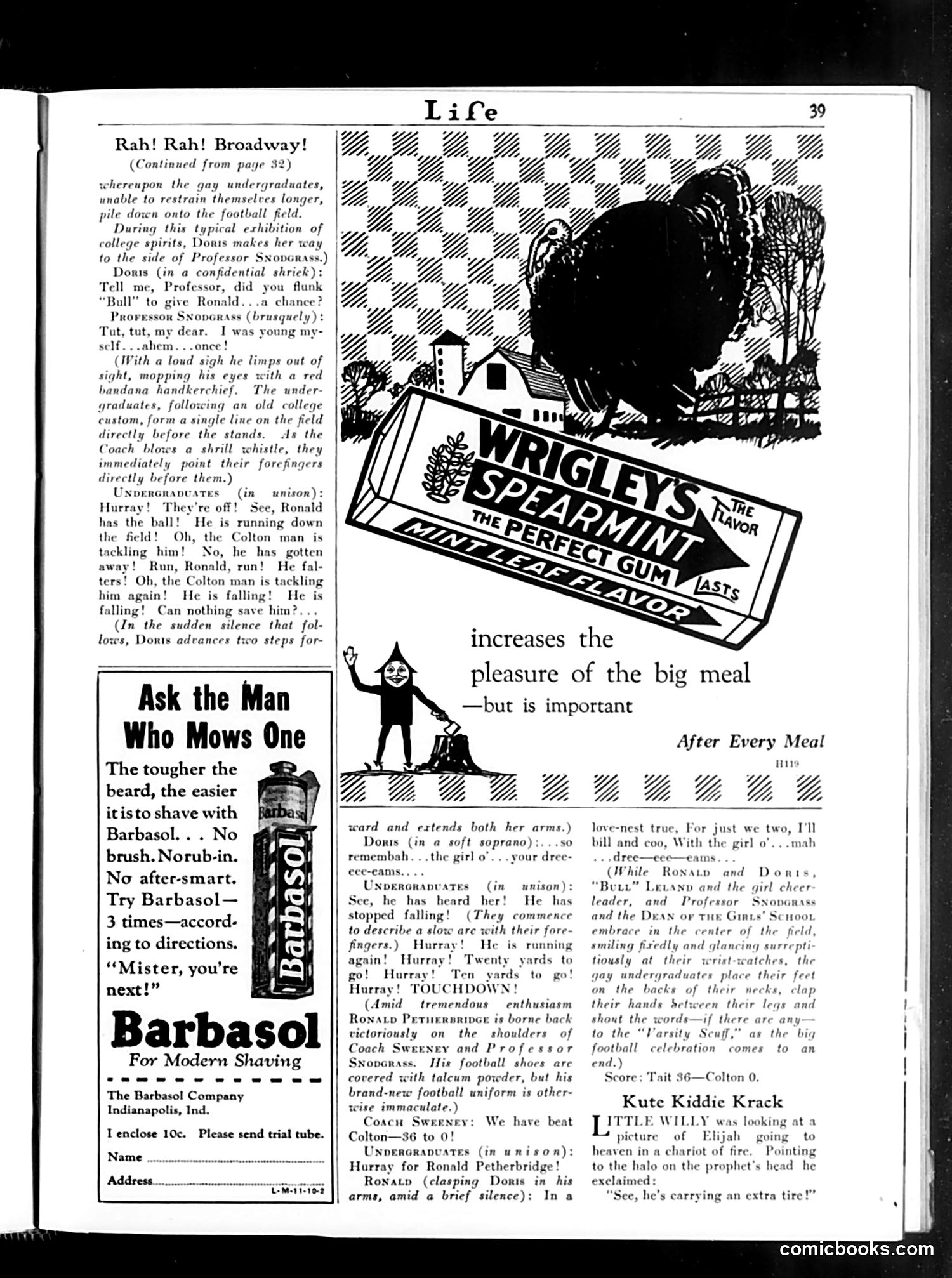
This page continues a serialized story about college life centered on a football game. The narrative follows Ronald Petherbridge and Doris through a dramatic match between two schools (Tait vs. Colton). The story satirizes typical college football enthusiasm: undergraduates performing synchronized cheering gestures, coaches and professors getting swept up in school spirit, and romantic subplots intertwining with athletic competition. The climax involves Ronald scoring a touchdown while Doris emotionally encourages him from the sidelines. The satire gently mocks the overwrought drama and earnestness of collegiate football culture of the era—the breathless play-by-play narration, the synchronized crowd responses, and how football games become occasions for romantic and institutional theater. The page also includes period advertisements (Barbasol shaving cream, Wrigley's gum) and a brief joke ("Kute Kiddie Krack") unrelated to the main story.
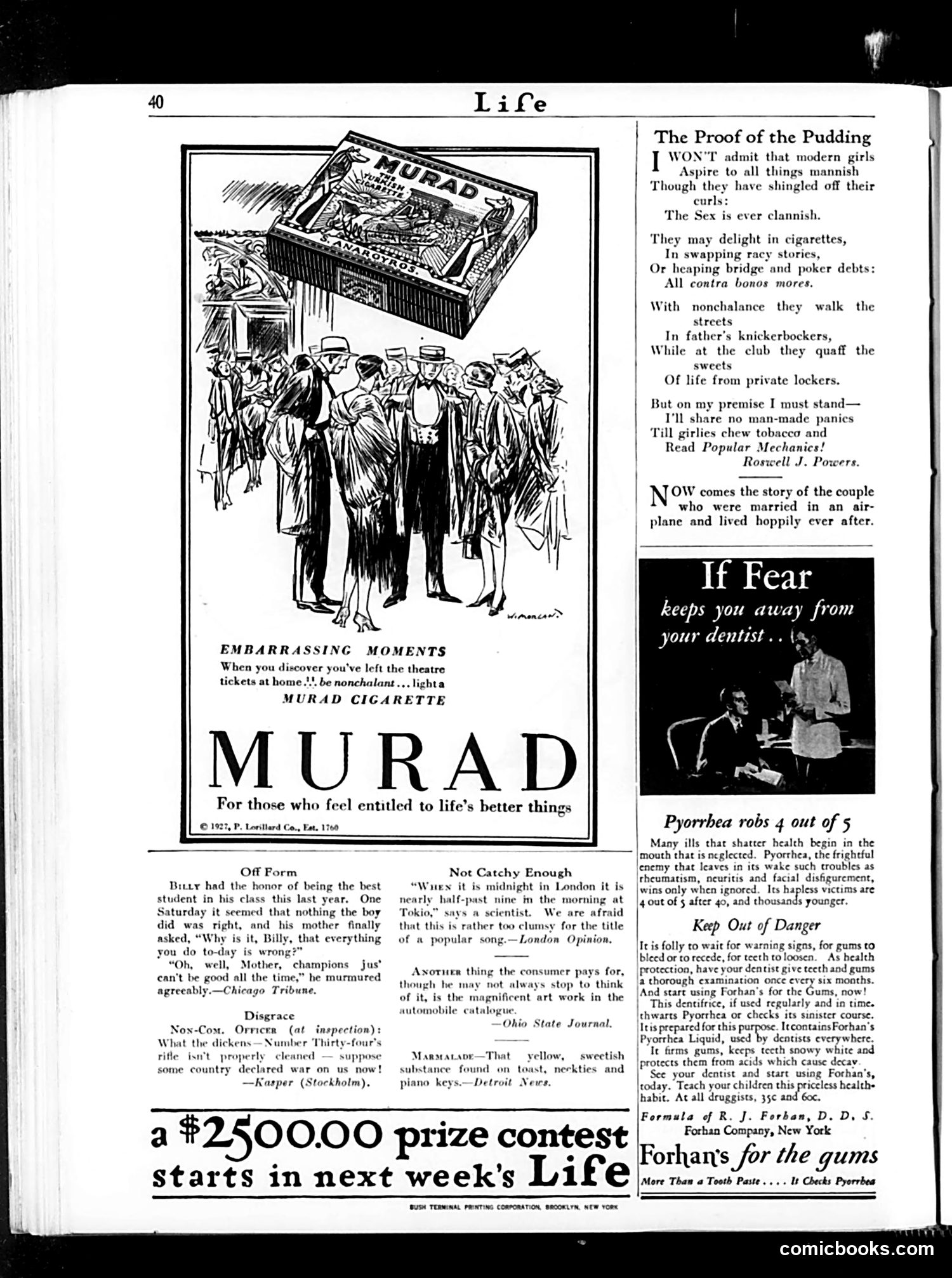
This page blends satirical commentary with period advertising, circa 1920s. The main cartoon shows embarrassed theatergoers discovering they've left tickets home—a relatable social mishap. The caption recommends lighting a Murad cigarette to appear nonchalant, reflecting 1920s attitudes about cigarettes as props of sophistication. The poetry section "The Proof of the Pudding" satirizes modern women's increasing independence and "mannish" behavior—shingled hair, smoking, wearing men's knickerbockers, playing bridge, and reading *Popular Mechanics*. The author humorously claims he won't acknowledge these changes until women chew tobacco. This reflects 1920s anxiety about women's liberation and changing gender roles during the post-war era. Supporting items mock pretentious language, military incompetence, and social awkwardness typical of period humor magazines. The dental advertisement warns of pyorrhea (gum disease) affecting 4 of 5 people over 40—standard health-scare advertising of the era.
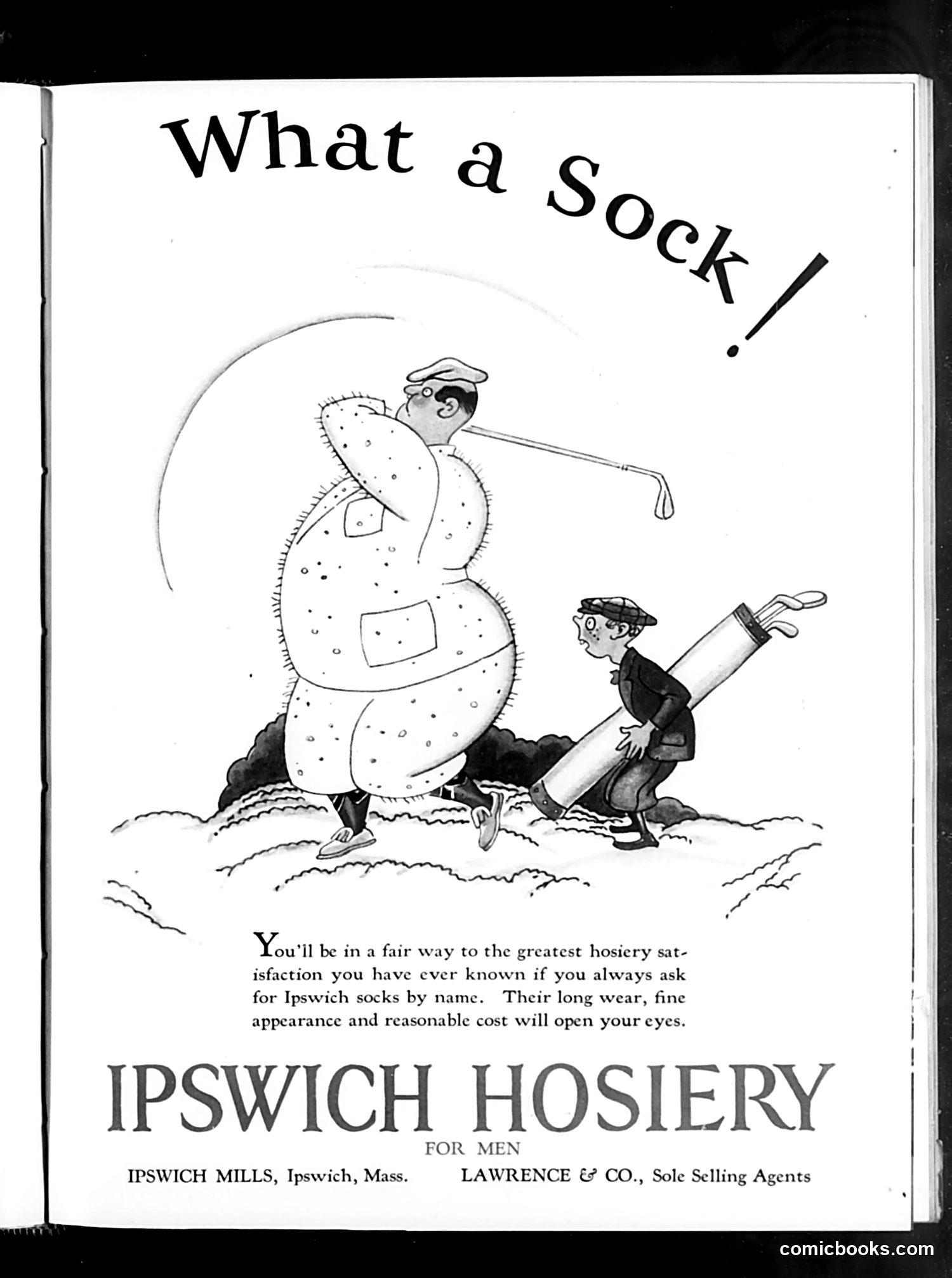
This is primarily a **vintage advertisement** for Ipswich Hosiery socks, not political satire. The humor is visual and punny rather than satirical. The cartoon depicts a large man made entirely of socks (representing durability and quality) being used as a golf club by a smaller man. The joke plays on the headline "What a Sock!"—a pun where "sock" means both the garment and a punch or hit. The advertisement's message is straightforward: Ipswich socks are durable ("long wear"), attractive ("fine appearance"), and affordable ("reasonable cost"). The exaggerated visual of a sock-made-golfer is meant to be humorous and memorable advertising, emphasizing the product's strength and usefulness. There is no political commentary or social satire present—this is simply product marketing using comic illustration common in early 20th-century advertising.
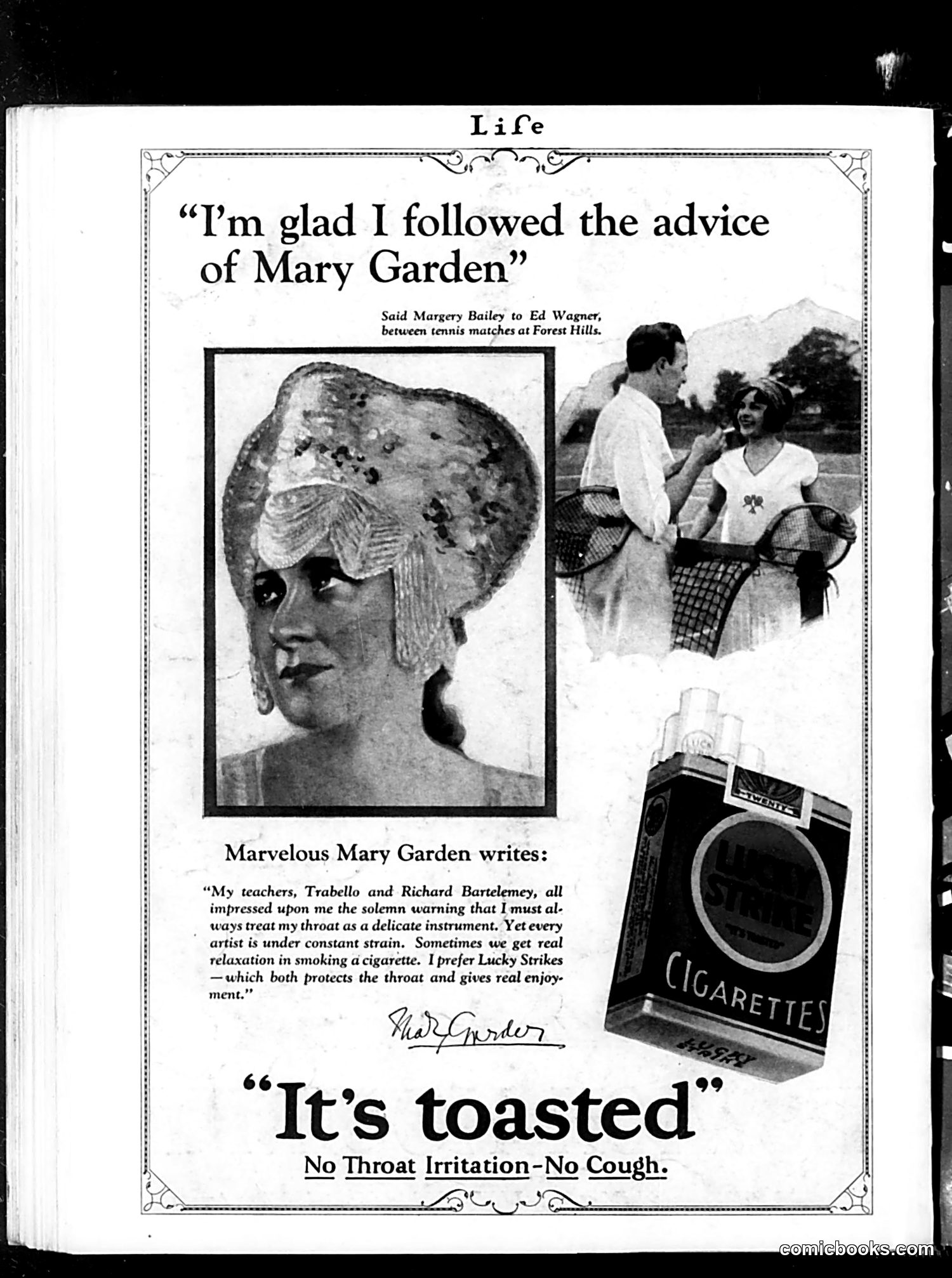
This is a **cigarette advertisement disguised as celebrity endorsement**, not satire. Mary Garden was a famous opera singer known for her distinctive voice and throat care. The ad quotes her endorsing Lucky Strike cigarettes, claiming they "protect the throat" while providing "relaxation"—a medically false claim typical of 1920s-30s tobacco marketing. The page includes a photo of Garden, a tennis scene (suggesting active, healthy lifestyle), and the product. The tagline "It's toasted—No Throat Irritation—No Cough" promises health benefits. **For modern readers:** This represents the pre-regulation era when cigarette companies made unsubstantiated health claims and used celebrity testimonials without disclosure. Such advertising would be illegal today under FDA regulations.