
Life, 1927-11-10 · page 15 of 44
Life — November 10, 1927 — page 15: what you’re looking at
What you’re looking at
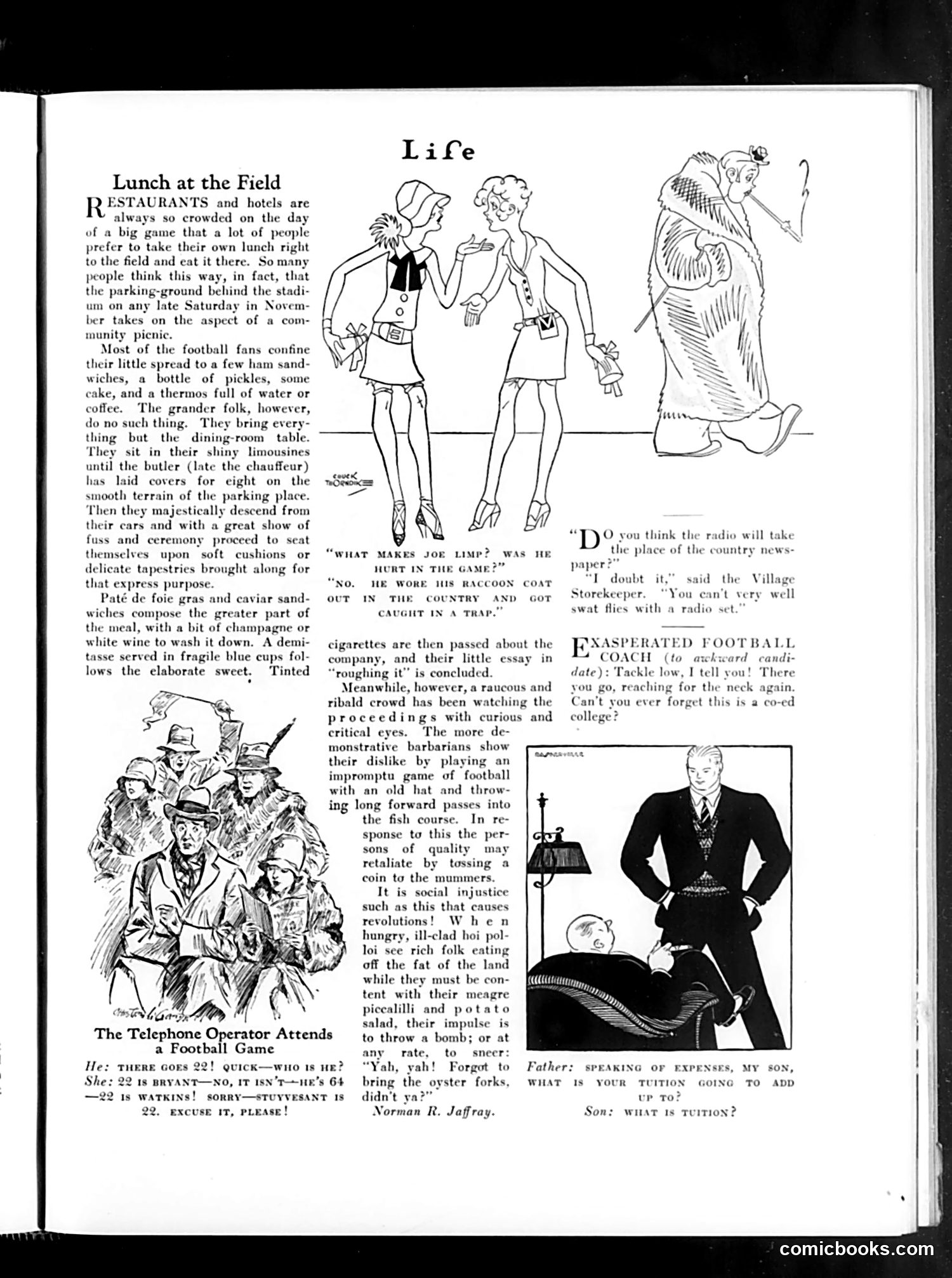
This page satirizes class distinctions in 1920s American leisure. The main article mocks wealthy spectators at football games who bring elaborate picnics—champagne, caviar, foie gras—while ordinary fans eat simple ham sandwiches. The humor lies in the contrast between the wealthy's pretentious display ("great show of fuss and ceremony") and their disconnect from actual game-going. The cartoons below mock both working-class rowdiness (the "Telephone Operator" attending a game, making crude jokes) and upper-class anxiety about expenses. The father-son dialogue about tuition costs represents generational concerns about education affordability. The satire targets both extremes: the ostentatiously wealthy and the struggling middle class, reflecting 1920s anxieties about social mobility and economic inequality.
📄 Transcribed text from this page (OCR, searchable)
Machine-transcribed from the original scan — historical spelling and the odd misread are preserved.
Lunch at the Field RESTAURANTS and hotels are always so crowded on the day of a big game that a lot of people prefer to take their own lunch right to the field and eat it there. So many people think this way, in fact, that the parking-ground behind the stadi- um on any late Saturday in Novem- ber takes on the aspect of a com- munity picnic. Most of the football fans coi their little spread to a few wiches, a bottle of pickles, some cake, and a thermos full of water or coffee. The grander folk, however, do no such thing. They bring every- thing but the dining-room table. They sit in their shiny limousines until the butler (late the chauffeur) has laid covers for eight on the smooth terrain of the parking place. Then they majestically descend from their cars and with a great show of fuss and ceremony proceed to seat themselves upon soft cushions or delicate tapestries brought along for that express purpose. Paté de foie gras and caviar sand- wiches compose the greater part of the meal, with a bit of npa; white wine to wash it down. A demi- tasse served in fragile blue cups fol- lows the elaborate sweet. Tinted am sand- ‘A we The Telephone Operator Attends a Football Game He: tTurre Gors 22! guick—wito 1s ur? é She: 218 WATK 22 SORRY—STUY EXCUSE IT, PLEASE! 2 18 BRYANT—NO, IT ISN’T—11k’s 6+ ANT 18 HURT IN THE GAME?” HE WORE 11S RACCOON COAT IN THE COUNTRY AND CAUGHT IN A TRAP.” out Got cigarettes are then passed about the company, and their little essay in “roughing it” is concluded. Meanwhile, however, a raucous and ribald crowd has been watching the proceedings with curious and critical eyes. ‘The more de- monstrative barbarians show their dislike by pl impromptu game of football with an old hat and throw- ing long forward passes into the fish course. In re- sponse to this the per- sons of quality may retaliate by tossing a coin ta the mummers. It is social injustice such as this that causes revolutions! W hen hungry, ill-clad hoi pol- loi see rich folk eating off the fat of the land while they must be con- tent with their meagre picealilli and potato salad, their impulse is to throw a bomb; or at rate, to sneer: ‘ah, yah! Forgot to bring the oyster forks, didn’t ya? Norman R. Jaffray. WHAT Father: = O you think the radio will take the place of the country news- paper?” “I doubt. it,” Storekeeper swat flies with the Village “You can't very well said 1 radio set PeXASPERATE D FOOTBALL ~ COACH (to awkward candi- ackle low, I tell you! There reaching for the neck again. date): "I you gi SPEAKING OF your EXPENSES, TUITION up To? WHAT IS TUITION? MY To SON, ADD 1s GOING Son: comicbooks.com