
Life, 1927-11-10 · page 25 of 44
Life — November 10, 1927 — page 25: what you’re looking at
What you’re looking at
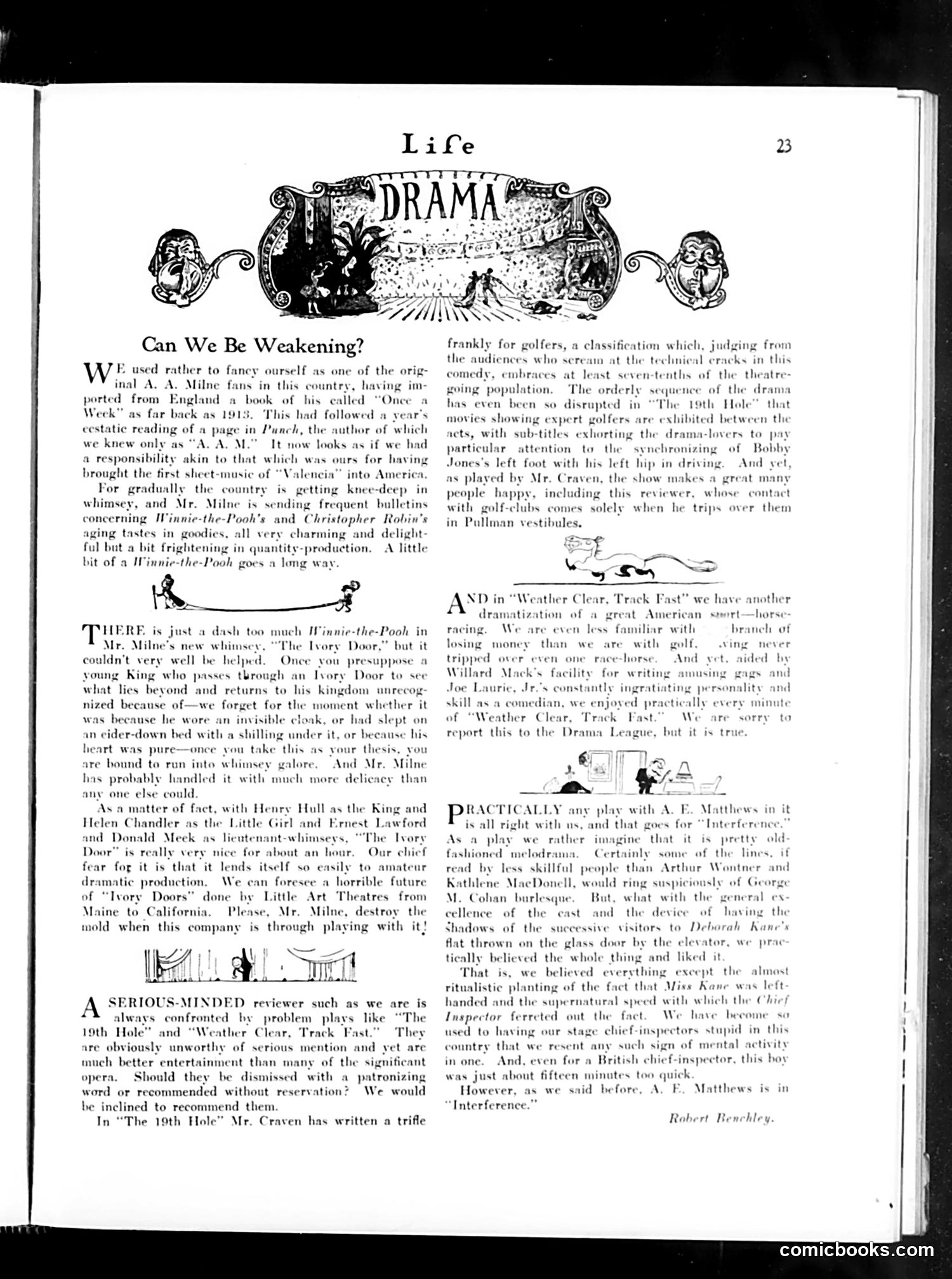
This page reviews three theatrical productions, criticizing the cultural trend toward whimsy while acknowledging audience enjoyment. **Main Critique**: The author warns that A.A. Milne's whimsical style—popularized through *Winnie-the-Pooh* and *Christopher Robin*—is becoming overused. While praising Milne's original work imported from England around 1913, the reviewer suggests the American theater is now saturated with cutesy, whimsical productions. *The Ivory Door*, featuring Henry Hull and Helen Chandler, is competent but represents this concerning trend. **The Paradox**: The reviewer admits that lighter entertainment like *The 19th Hole* and *Weather Clear, Track Fast*—specialized comedies about golf and horse-racing—are more enjoyable than pretentious serious drama, despite being "unworthy of serious mention." **The Point**: This satirizes the tension between highbrow theatrical standards and popular taste, suggesting critics should acknowledge that accessible, entertaining plays serve audiences better than self-important artistic failures.
📄 Transcribed text from this page (OCR, searchable)
Machine-transcribed from the original scan — historical spelling and the odd misread are preserved.
Can We Be Weakening? WE used rather to fancy ourself as one of the orig- inal A. A. Milne fans in this country, having im- ported from England a book of his called “Once a Week” as far back as 1913. This had followed a year's eestatic reading of a page in Punch, the author of which “A. ALM It now looks as if we had 1 responsibility akin to that which was ours for having brought the first sheet-music of into America For gradually the country is getting knee-deep in whimsey, and Mr. Milne is sending frequent bulletins concerning MWinnie-the-Pooh's and Christopher Robin's we knew only as Valencia ng tastes in goodies, all very charming and delight ful but a bit fri A little bit of a Winnie-th ng in quantity-production. ooh goes a long way. rad K 4 HERE, is just a dash too much Winnie-the-Pooh in Mr. Milne’s new whimsey, “The Ivory Door,” but it couldn't very well be helped. Once young King who passes through an Ivory Door to. sec what lies ond and returns to his kingdom unrecog nized be we forget for the was because he wore an invisible cloak, or had slept on you presuppose a ause of moment whether it in cider-down bed with a shilling under it, or because his heart was pure—once vou take thiy as your thesis, you ire bound to run into whimsey galore. And Mr. Milne has probably handled it with much more delicacy than any one else could As a matter of fact, with Henry Hull as the King and Helen Chandler as the Little Girl t Lawford and Donald Meek as lieutenant-whimseys, “The Ivory Door” is really very nice for about an hour. Our chief fear fog it is that it lends itself so easily to amateur dramatic production. We can foresee a horrible future of “Ivory Doors” done by Little Art Theatres from Maine to California. Please, Mr. Milne, mold when this company is through playing with it! Ly 4 \ YE cde; Ae mat laea ta SE SERIOUS-MINDED reviewer such as we are is always confronted by problem plays like “The loth T and “Weather Clear, Track Fast.” They ire obviously unworthy of serious mention and yet arc much better entertainment than many of the significant opera. Should they be dismissed with a patronizing word or recommended without reservation? We would he inclined to recommend them. In “The 19th Hole” Mr. Craven has written a trifle and Er destroy the frankly for golfers, a classification which, judging from the audiences who scream at the technical cracks in this comedy, embraces at least seven-tenths of the theatre- going population has even been so disrupted in “The The orderly sequence of the drama 19th Hole” that movies showing expert golfers are exhibited between the acts, with sub-titles exhorting the attention to the Bobby Jones's left foot with his left hip in driving. And vet, as played by Mr. Craven, the show makes a great many drama-lovery to pay particular synchronizing of people happy, including this reviewer, whose contact with in Pullman vestibules, er t \ f-clubs comes solely when he trips over them I) ND in “Weather Clear, Track Fast” we have American seert—ho dramatization of a great racing. We are eve ss familiar with branch of golf, And unusing gags an with never losing than we are tripped over « Willard Mack’s facility Joe Laurie skill as a comedian, we enjoyed practically every mit of “Weather Clear, Track Fast We are report this to the Drama Le S. a RACTICALLY any play with A. I is all right with us, and that goes for that it is money ving n one race-horse yet. aided by for writing 1 Jr.'s constantly ingratiating personality ue, but it is true ~ Matthews in it Interference rather pretty old As a play we imagit fashioned melodrama. Certainly some of the lines. if read by less skillful people than Arthur Wontner and Kathlene MacDonell, would r M. Cohan burlesque. But cellence of the “ Shadows of the Kane's flat thrown on the glass door by the elevator, we prac tically believed the thing and liked it That is, we believed everything except the al ritualistic planting of the fact that Miss was left handed and the supernatural speed with which the Chief Inspector ferreted out the fact. We have t used to having our stage chief-inspectors stupid in’ this suspiciously of George what with the general ex east and the device of having the successive visitors to Deborah whole country that we resent any such sign of mental activity And, even for a British chief-inspector, this boy was just about fifteen minutes too quic k said before, A. F However, Matthews is in Interference.” as We Robert Benchley comicbooks.com