
Life, 1927-11-10 · page 28 of 44
Life — November 10, 1927 — page 28: what you’re looking at
What you’re looking at
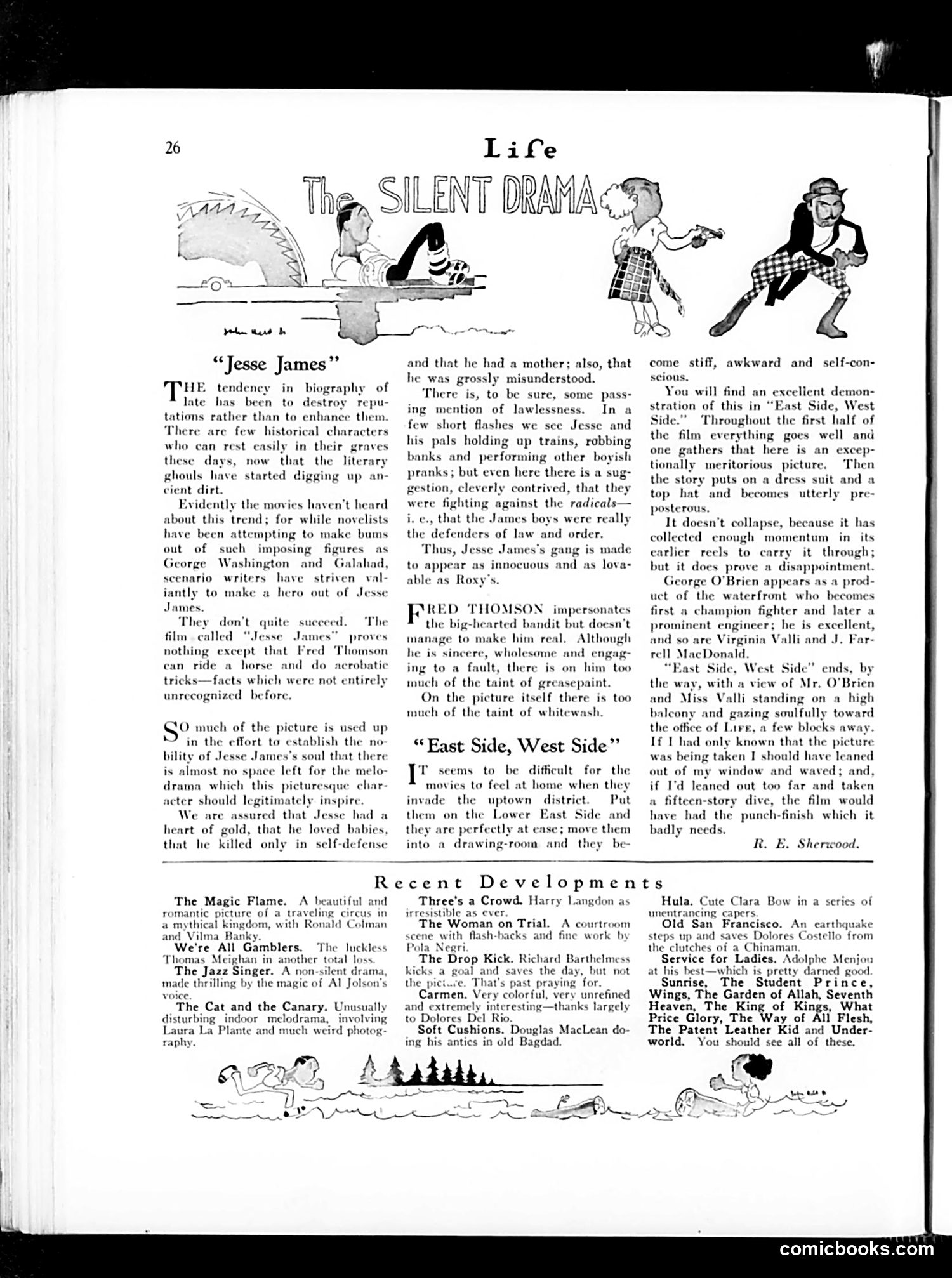
This page contains film reviews critiquing 1920s silent movies. The main pieces review "Jesse James" (starring Fred Thomson) and "East Side, West Side" (starring George O'Brien and Virginia Valli). The **Jesse James review** satirizes Hollywood's sanitization of the outlaw: the film portrays him as misunderstood and noble rather than criminal, depicting his gang as defenders against "radicals" rather than genuine lawbreakers. The critic mocks this whitewashing, noting Thomson performs acrobatics competently but the film drowns real drama in sentimentality about Jesse's "heart of gold" and his mother. The **East Side, West Side review** argues the film excels in Lower East Side scenes but becomes "stiff, awkward and self-conscious" when moved to wealthy uptown settings—suggesting movies of this era struggled authentically portraying upper-class life. The critic even jokes he'd leap from his window to improve the ending's "punch." A "Recent Developments" section briefly lists other current films.
📄 Transcribed text from this page (OCR, searchable)
Machine-transcribed from the original scan — historical spelling and the odd misread are preserved.
26 ree es “Jesse James” ‘yin biography n to destroy rey ations rather than to enhance them. There are few who can rest easily in their graves that the literary ghouls have started digging up an- cient dirt. Evidently the movies haven't heard about this trend; for while novelists have been attempting to make bums historical eb these days, now out of such imposing figures as George Washington and) Galahad, scenario writers have striven val- iantly to make a hero out of Jesse don’t quite succeed. ‘The film called sse James" proves nothing except that Fred ‘Thomson an ride a horse and do acrobatic tricks—facts which were not entirely unrecognized before. SO much of the picture is used up 7 in the effort to establish the no: bility of Jesse James’s soul that there is almost no space left for the mel drama which this picturesque char- acter should legitimately inspire. We are assured that Jesse had a heart of gold, that he loved babies, and that he had a mother; also, that he was grossly misunderstood. There is, to be sure, some pass- In a ing mention of lawlessness. few short flashes we see Jesse and his pals holding up trains, robbing banks and performing other boyish pranks; but even here there is a sug- gestion, cleverly contrived, that they were fighting against the radicals— i. c., that the James boys were really the defenders of law and order. Thus, Jesse James's gang is made s innocuous and as lova- to appear able as Roxy's. FrRED THOMSON impersona the big-hearted bandit but doesn’t re ton Although he is sincere, wholesome and enga, him real. ing to a fault, there is on him too much of the taint of greasepaint. On the picture itself there is too much of the taint of whitewash. “East Side, West Side”’ T seems to be difficult for the movies to feel at home when they invade the uptown district. Put them on the Lower East Side and they are perfectly at ease; move them into a drawing-room and they be- come stiff, awkward and_self-con- scious, You will find an excellent demon- stration of this in “East Side, West Side.” Throughout the first half of the film everything goes well and one gathers that here is an excep- tionally meritorious picture. Then the story puts on a dress suit and a top hat and becomes utterly pre- posterous. It doesn’t collapse, because it has collected enough momentum in its reels to carry it through; but it does prove a disappointment. earlier George O'Brien appears as a prod- uct of the waterfront first a champion fighter and later a prominent engineer; he is excellent, and so Virginia Valli and J. Far- rell MacDonald. “East Side, West Side” ends, by the way, with a view of Mr, O'Brien and Miss Valli standing on a high baleony and gazing soulfully toward the o of Lire, a few blocks awa If I had only known that the picture was being taken I should have leaned out of my window and waved; and, if I'd leaned out too far and taken a fifteen-story dive, the film would have had the punch-finish which it badly needs. who becomes RE. Sherwood. that he killed only in’ self-defense Recent The Magic Flame. A beautiful and romantic picture of a traveling circus a mythical ki om, with Ronald Colman and Vilma Banky. We're All Gamblers. The luckless Thomas Meighan in another total loss. The Jazz Singer. A non-silent drama, made thrilling by the magic of Al Jolson’s voice The Cat and the Canary. Unusually disturbing indoor melodrama, invol Laura La Plante and much weird photo; raphy. 4 aa) P of > ARK & Three’s a Crowd. Harry Langdon as irresistible as ever. The Woman on Trial. A courtroom scene with flash-backs and fine work by Pola Negri The Drop Kick. Richard Barthelmess kicks a goal and saves the day, but not the picicce. That's past praying for. Carmen. Very colorful, very unrefined and extremely resting—thanks largely to Dolores Del Rio. Soft Cushions. Douglas MacLean do- ing his antics in old Bagdad. oO pee re ae OE Lo... Developments Hula. Cute Clara Bow in a series of unentrancing capers Old San Francisco. An earthquake steps up and saves Dolores Costello from the clutches of a Chinaman Service for Ladies. Adolphe Mer at his best—which is pretty darned Sunrise, The Student Prince, Wings, The Garden of Allah, Seventh Heaven, The King of Kings, What Price Glory, The Way of All Flesh, The Patent Leather Kid and Under- world. You should see all of these. wt comicbooks.com