
A complete issue · 40 pages · 1927
Life — October 6, 1927
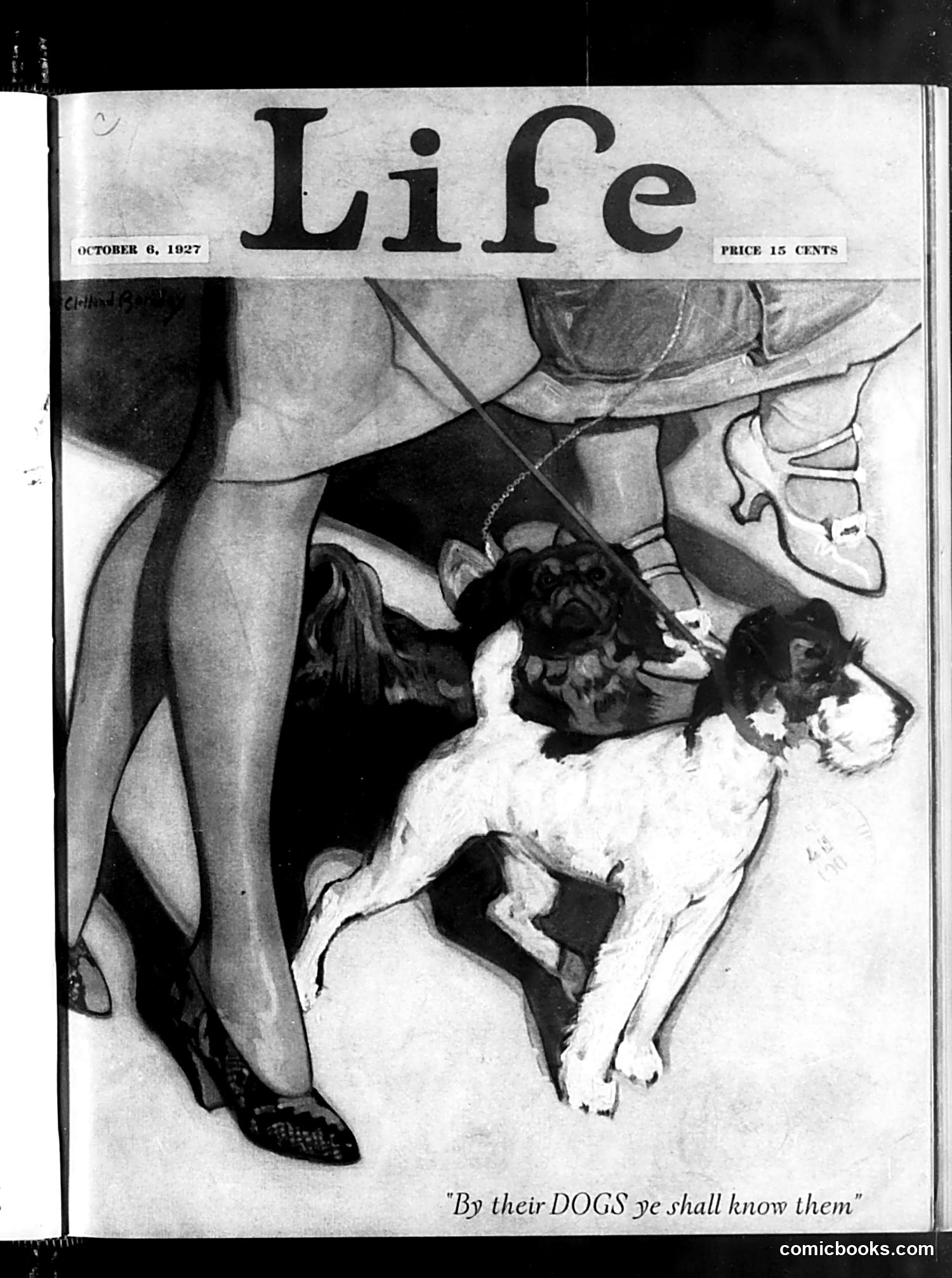
This cover satirizes social hierarchy and class distinctions through the caption "By their DOGS ye shall know them." The image shows a well-dressed woman and man (appearing to be from the upper class, based on clothing and posture) with two small dogs—one appears to be a fashionable lap dog breed, the other a scruffier, mixed-breed dog. The satire suggests that people's choice of pets reflects their social status and pretensions. The juxtaposition implies that even among the wealthy, there's a hierarchy of "acceptable" dogs—purebred versus common breeds—mirroring human class distinctions. The 1920s context emphasizes the era's obsession with status symbols and conspicuous consumption during the Jazz Age.
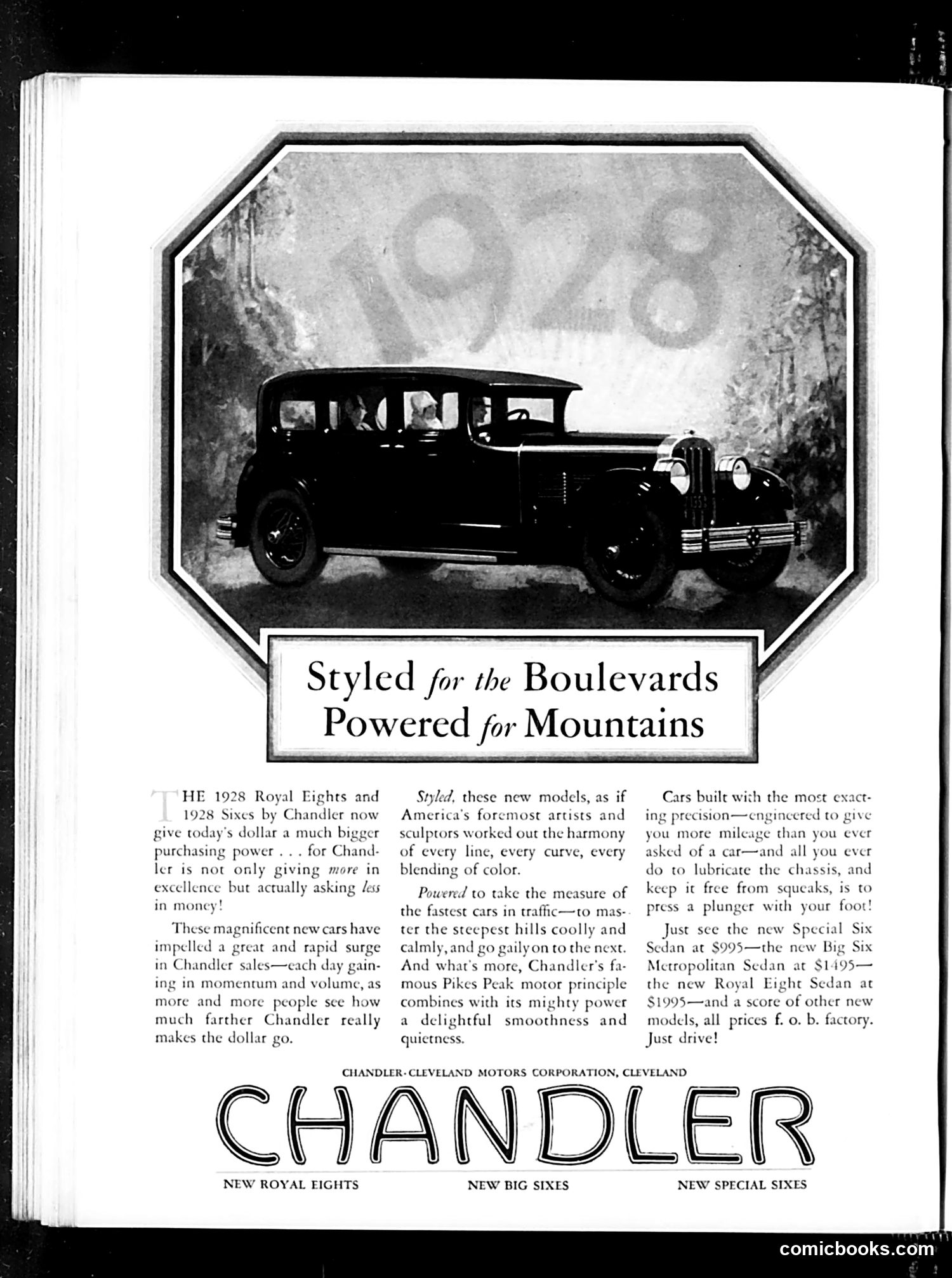
This is not a political cartoon or satirical content—it's a **straightforward automobile advertisement** from 1928 for Chandler cars, published in *Life* magazine. The image shows a sleek sedan positioned against a stylized mountain backdrop. The ad's slogan, "Styled for the Boulevards / Powered for Mountains," emphasizes the vehicle's dual appeal: aesthetic sophistication for city driving and mechanical power for challenging terrain. The text highlights Chandler's engineering precision, comfort features (like easy braking), and competitive pricing for their 1928 models (Royal Eights, Big Sixes, and Special Sixes). This reflects the pre-Depression automotive market when manufacturers emphasized both luxury and practical performance. There is no satire or political commentary—it's period advertising celebrating American industrial manufacturing and consumer choice.
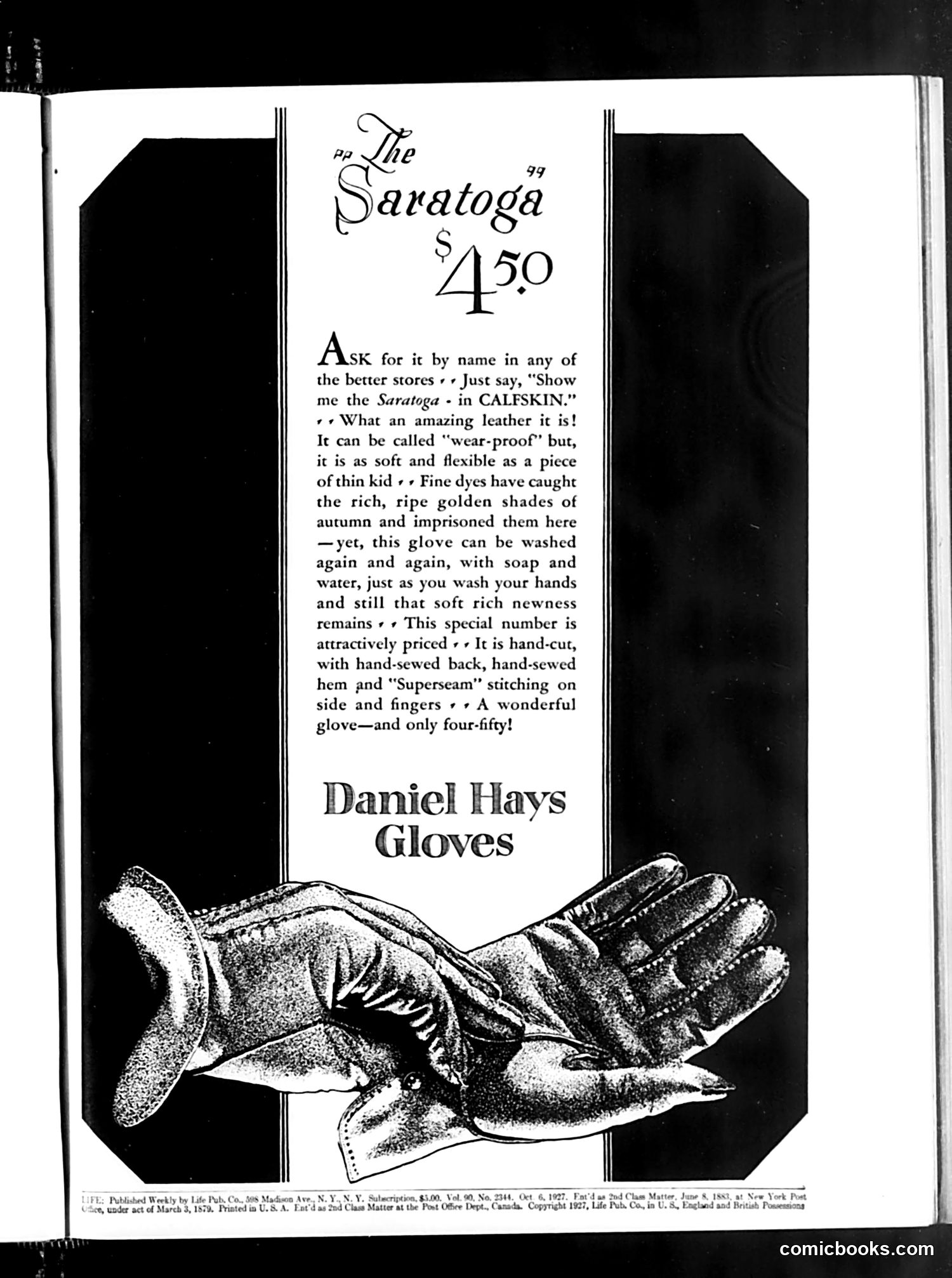
This is **not a political cartoon or satire** — it's a straightforward advertisement for Daniel Hays Gloves, specifically their "Savatoga" model priced at $4.50. The page features an illustration of an elegant gloved hand and describes the product's features: a "wear-proof" calfskin leather in golden autumn shades that can be repeatedly washed without losing softness. The ad emphasizes craftsmanship details (hand-cut, hand-sewn back, superseam stitching) and positions the glove as a luxury item at an "attractively priced" four dollars and fifty cents. The small asterisks (*) are decorative flourishes typical of period advertising typography. This represents early 20th-century magazine advertising targeting affluent consumers seeking quality leather goods.
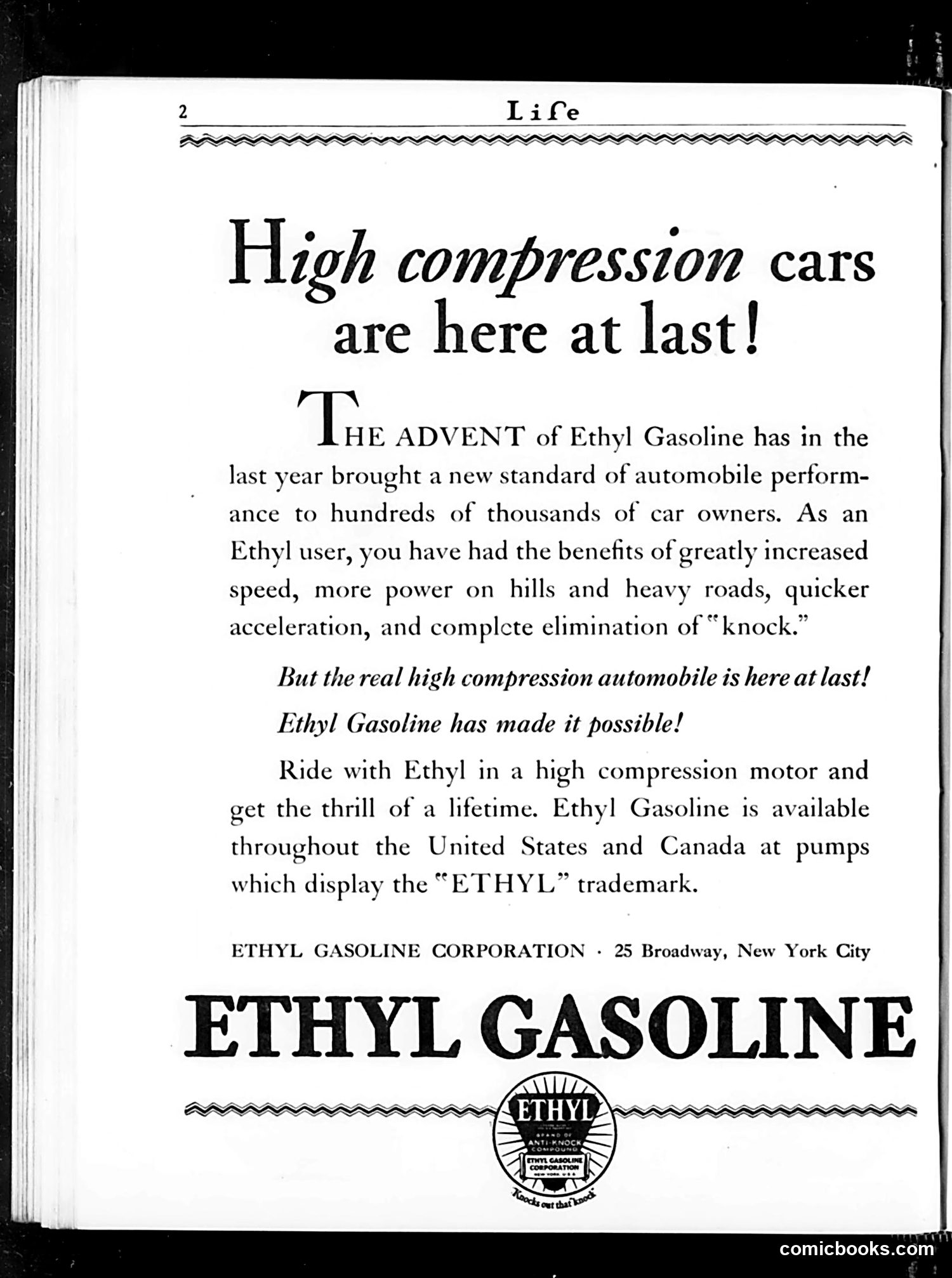
This is **not satire or a political cartoon**—it's a straightforward advertisement for Ethyl Gasoline from the Ethyl Gasoline Corporation (25 Broadway, New York City). The ad promotes the benefits of ethyl-based fuel for automobiles, claiming it enables "high compression" engines with increased speed, power, acceleration, and elimination of engine "knock" (a combustion problem). The text emphasizes that ethyl gasoline made true high-compression cars finally possible. The ad appeared in *Life* magazine during the 1920s-1930s when ethyl fuel was a new automotive innovation. It's a period advertisement reflecting contemporary enthusiasm for automotive technological advancement, not editorial content or satire.
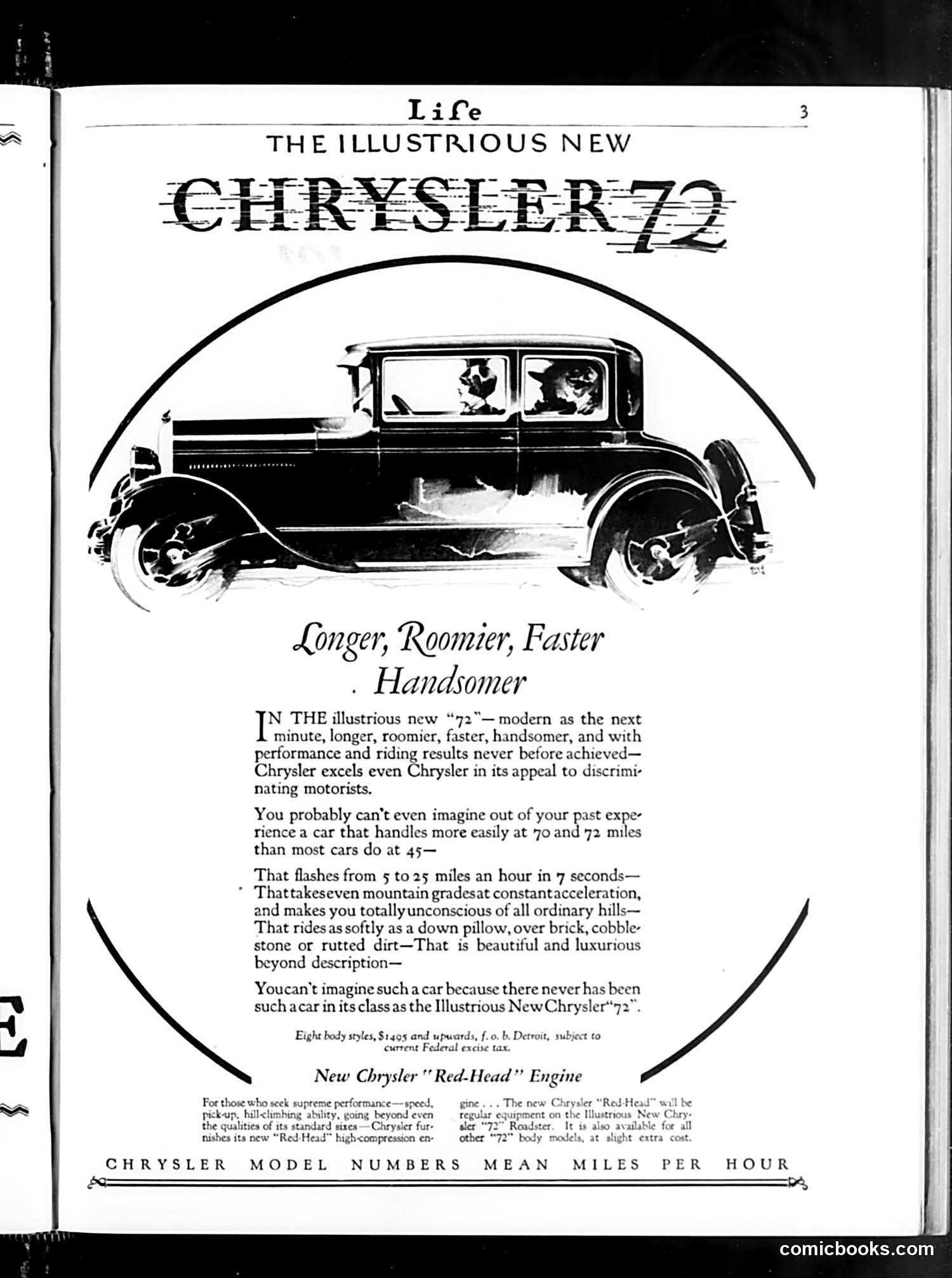
This is primarily a **Chrysler automobile advertisement**, not satire or political commentary. The page features the "Illustrious New Chrysler '72" with marketing copy highlighting performance features: exceptional speed (5-25 mph in 7 seconds), smooth handling on various road conditions, and a new "Red-Head" high-compression engine. The illustration shows a sedan with two fashionably-dressed passengers—typical advertising imagery of the era depicting aspirational, sophisticated automobile ownership. The language emphasizes luxury and technical superiority over competitors. There is **no political cartoon or satire** on this page. It represents straightforward 1920s commercial advertising using exaggerated claims common to that period's marketing approach.
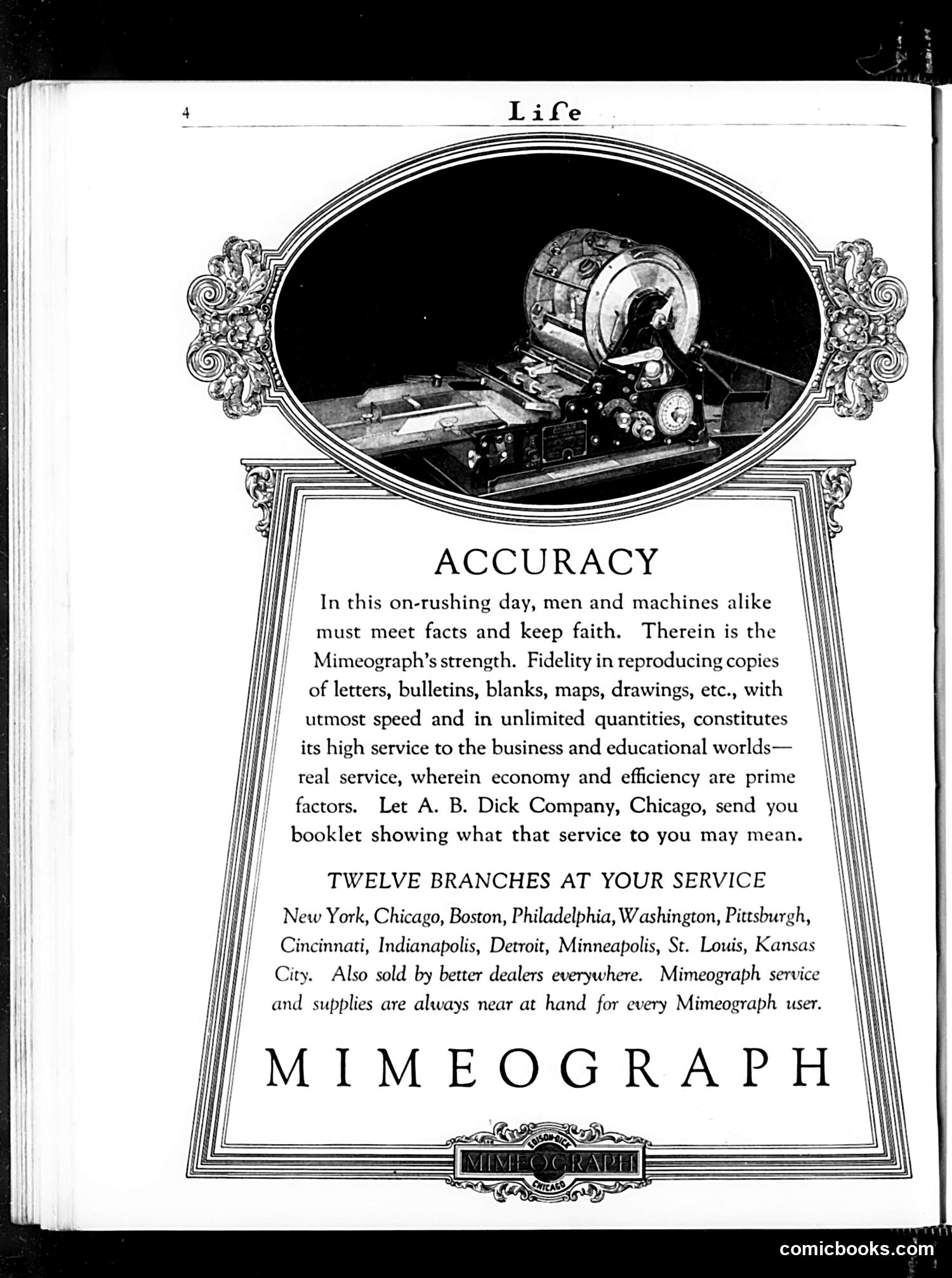
This page is **primarily an advertisement**, not a political cartoon. It advertises the Mimeograph machine, marketed by A.B. Dick Company of Chicago. The ad emphasizes "accuracy" and reliability—key selling points for office equipment in this early 20th-century business context. The image shows an actual Mimeograph device, a copying machine that reproduced documents by pushing ink through stencils. The copy appeals to businesses and educational institutions by stressing speed, efficiency, and cost-effectiveness ("economy and efficiency are prime factors"). The listing of twelve branch locations nationwide suggests this was a national marketing campaign. There is no political satire here—this is straightforward commercial advertising emphasizing the machine's practical value to modern American business.
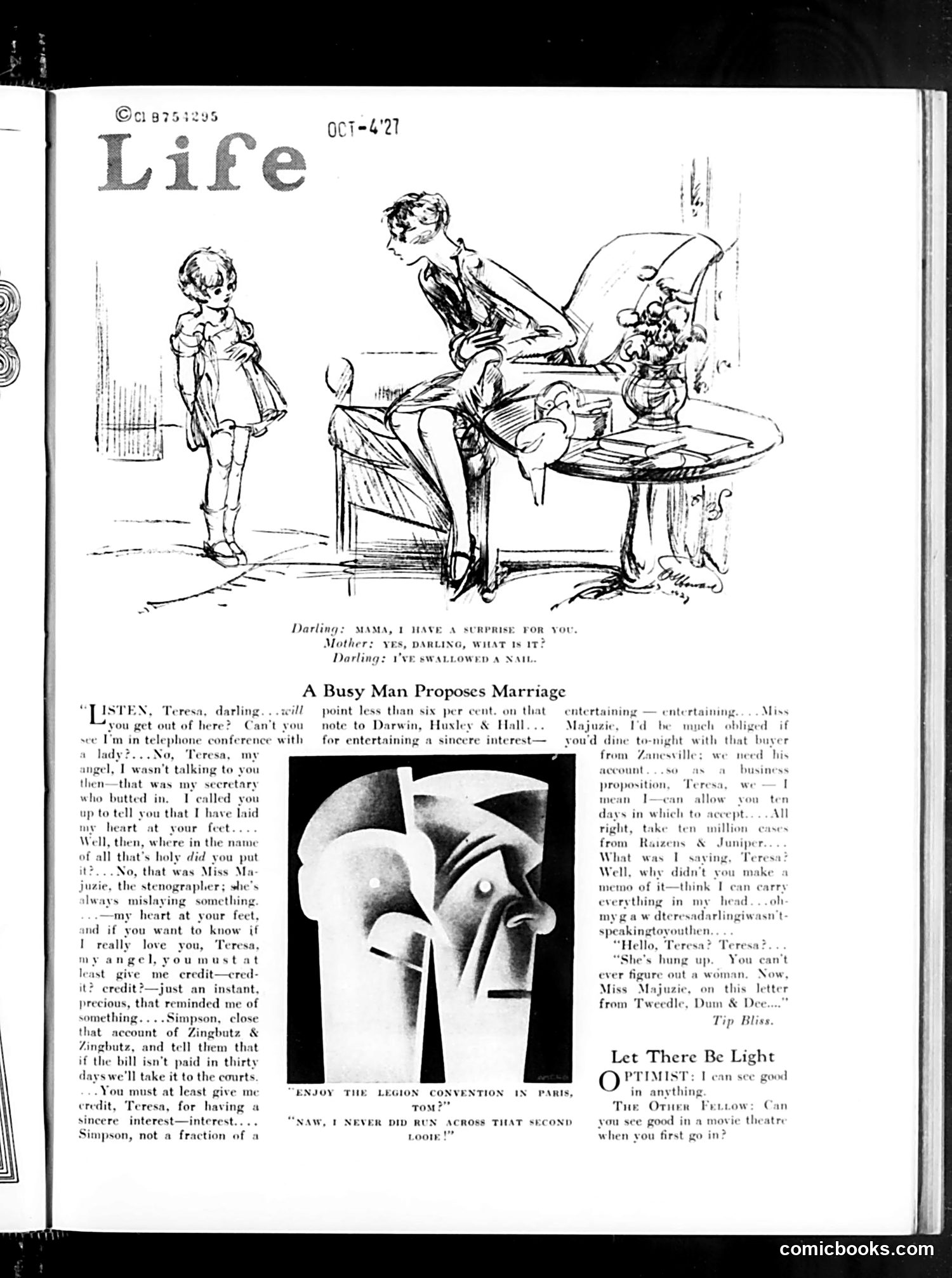
This is a satirical dialogue about an impatient businessman proposing to a woman named Teresa. The man (Simpson) is portrayed as so preoccupied with his business that he can barely focus on the romantic moment. He rushes through a marriage proposal, complaining about work obligations and demanding she give him "credit" for the sincere interest he's mustering. The humor targets the stereotype of the early-20th-century American businessman—so consumed by commerce and efficiency that he treats even intimate personal matters as transactions requiring haste. He's essentially proposing while mentally calculating business deals, reducing a romantic gesture to another item on his busy schedule. The cartoon satirizes masculine materialism and the erosion of genuine sentiment by commercial culture.
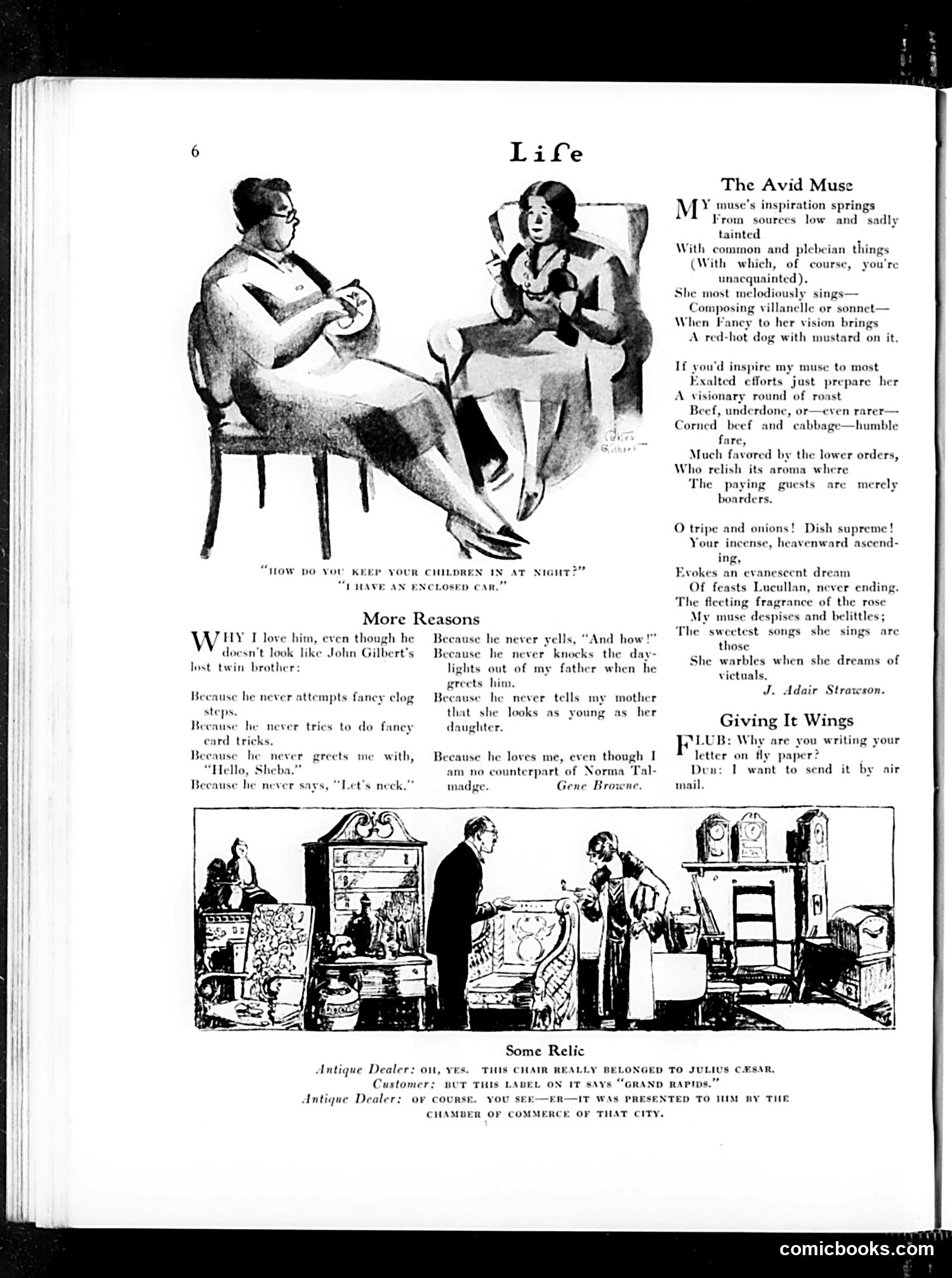
This page contains three separate pieces of humor commentary: **Top illustration:** Shows a couple with the caption "How do you keep your children in at night? I have an enclosed car." This satirizes how automobiles—then still relatively new—were becoming popular venues for young people's unsupervised dating and socializing, alarming parents. **"More Reasons":** A poem by Gene Bromme listing why he loves someone, humorously emphasizing their *lack* of pretension—never attempting fancy clothing, never knocking on doors loudly, never being overly familiar. It's gentle mockery of ordinary, unpretentious affection. **"Some Relic":** A cartoon dialogue between an antique dealer and customer about a chair allegedly belonging to Julius Caesar, with the dealer later claiming it came from a Chamber of Commerce. This satirizes both dubious antique authentication and boosterism.
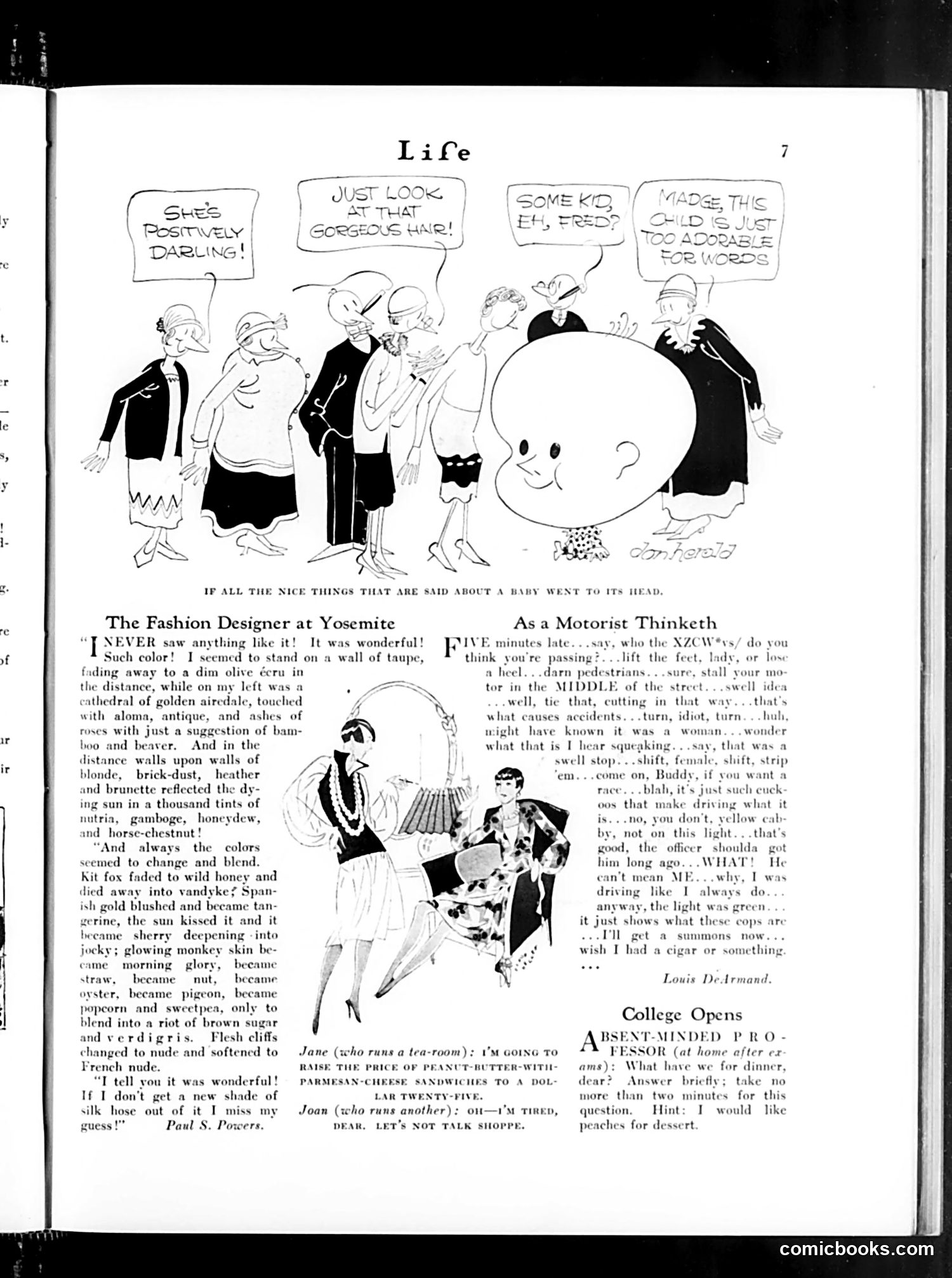
**Top Cartoon**: A large baby's head dominates the scene while adults admire it. The satire mocks excessive compliments paid to infants—people make exaggerated remarks about the baby's appearance ("gorgeous hair," etc.), a common social convention the cartoonist finds absurd. **"The Fashion Designer at Yosemite"**: Paul S. Powers recounts visiting Yosemite Valley and observing how nature's colors—golden atriums, rose hues, wild gamebirds—inspired him. The humor lies in a fashion designer finding haute-couture inspiration in wilderness scenery. **"As a Motorist Thinketh"** and **"College Opens"**: Brief humorous anecdotes about driving frustrations and dormitory life. These pieces exemplify Life magazine's early 20th-century style: gentle social satire about middle-class American experiences (fashion, nature tourism, college life).
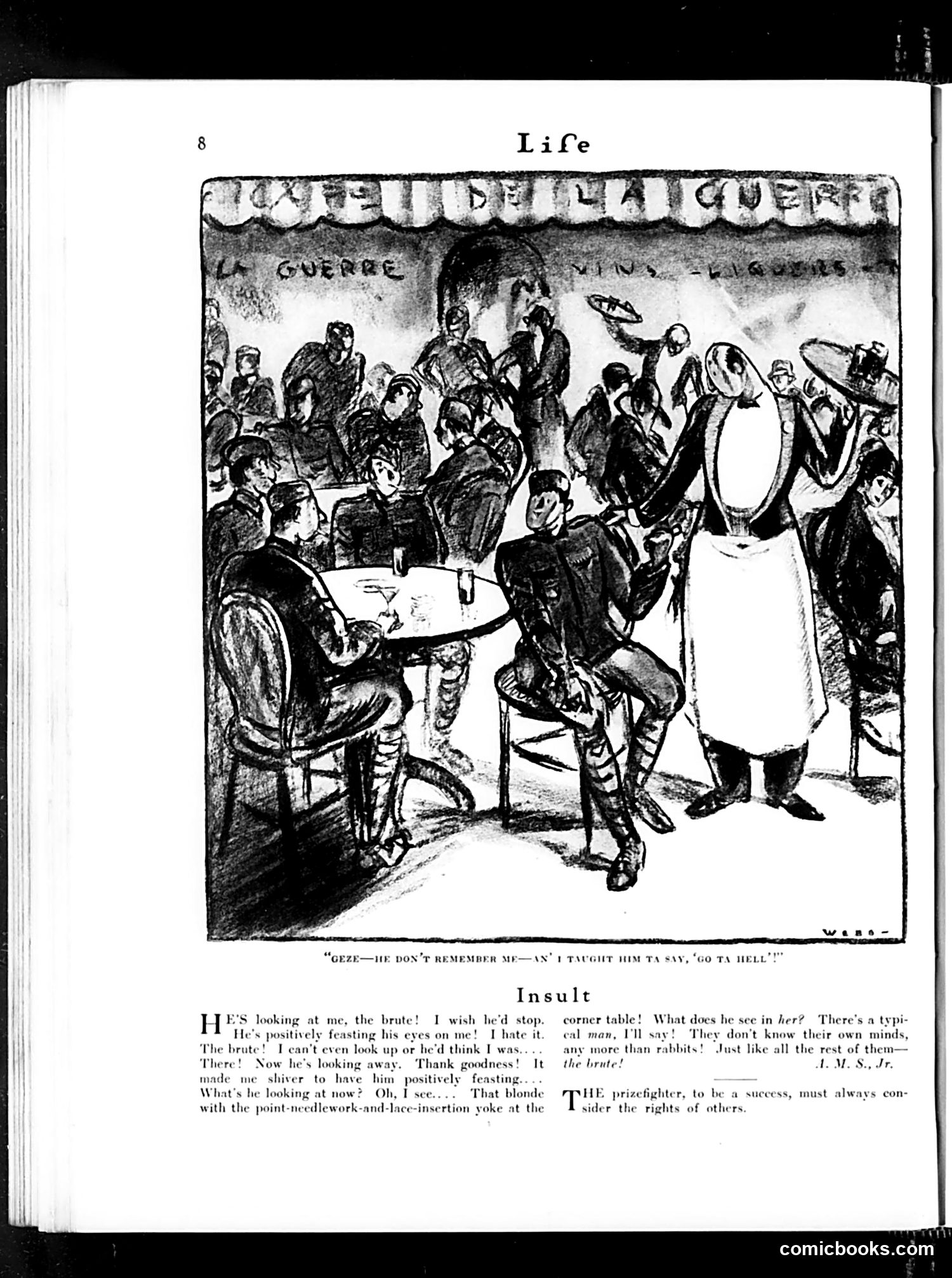
This page from *Life* magazine features a WWI-era satirical cartoon titled "Insult" with the caption: "GEEZ—HE DON'T REMEMBER ME—'N' I TAUGHT HIM TA SAY, 'GO TA HELL!'" The cartoon depicts soldiers in a crowded military setting. The satire appears to target **military discipline and dehumanization**: a soldier encounters an officer or superior who doesn't recognize him despite their previous relationship. The joke suggests that military training transforms individuals into interchangeable units who lose their individuality and former identities. The accompanying text discusses how prizefighters (and by extension, soldiers) must "consider the rights of others," contrasting this with depictions of brutish behavior. The satire criticizes both military culture and masculine aggression, portraying soldiers as stripped of personality and reduced to obedient automatons—a common WWI-era critique of militarism.
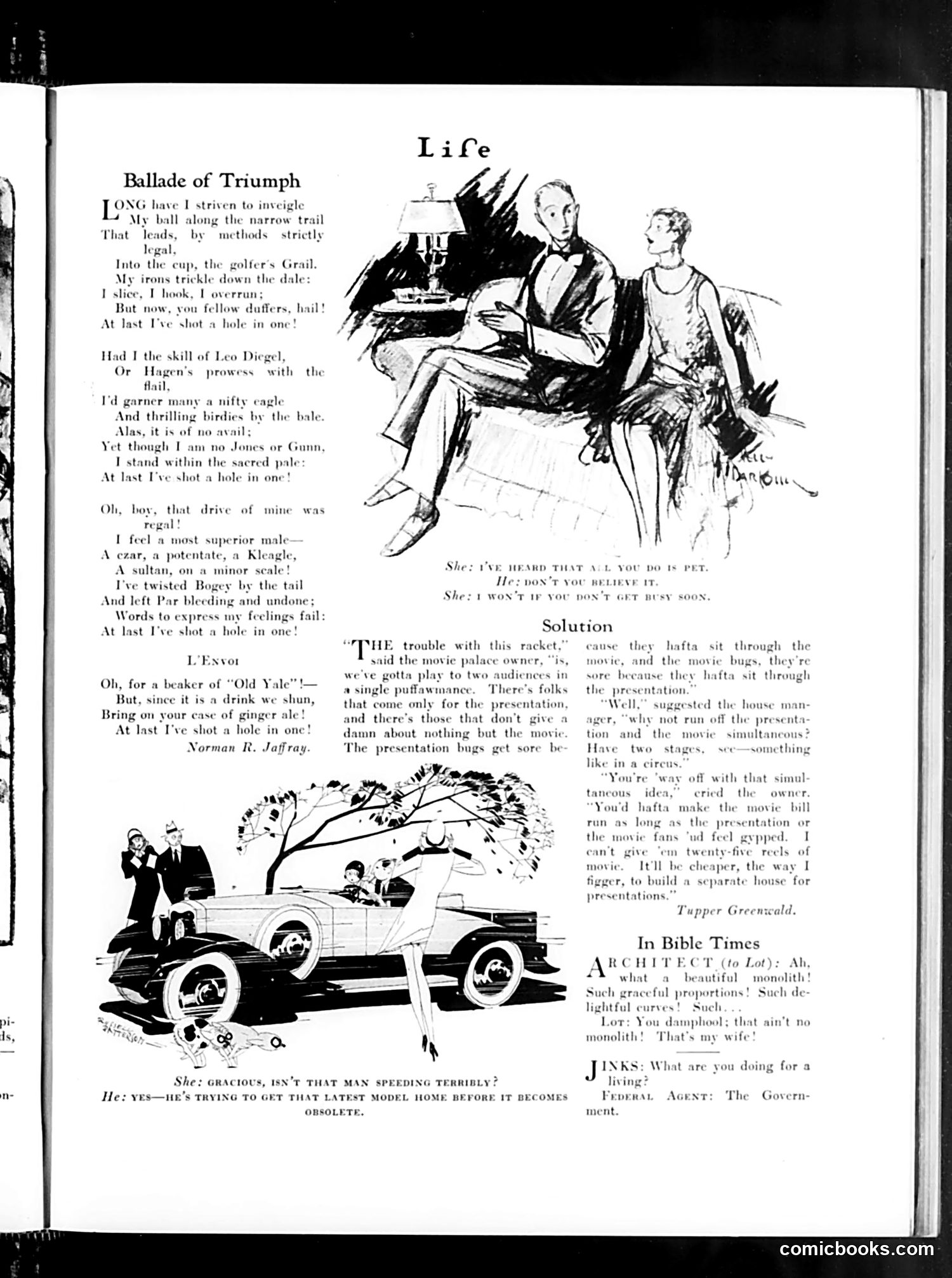
This page contains humorous sketches satirizing early 20th-century American life and aspirations. The "Ballade of Triumph" poem mocks a golfer boasting about finally hitting a hole-in-one after years of failure—a joke about persistence in mundane pursuits. The car illustration satirizes the automobile's status symbol role. A man speeds recklessly to get "the latest model home before it becomes obsolete," suggesting the era's obsession with constant consumption and keeping up with neighbors. The woman's comment "gracious, isn't that man speeding terribly?" underscores the social pressure driving such behavior. The "Solution" section presents a movie-theater dispute where the owner solves double-booking by suggesting a circus setup with simultaneous presentations—absurdist humor mocking business inefficiency. The "Bible Times" section offers light wordplay between biblical figures and modern concerns (an architect admiring monoliths, a man named Jinks). Overall, the page lampoons materialism, status anxiety, and modern commercial culture.
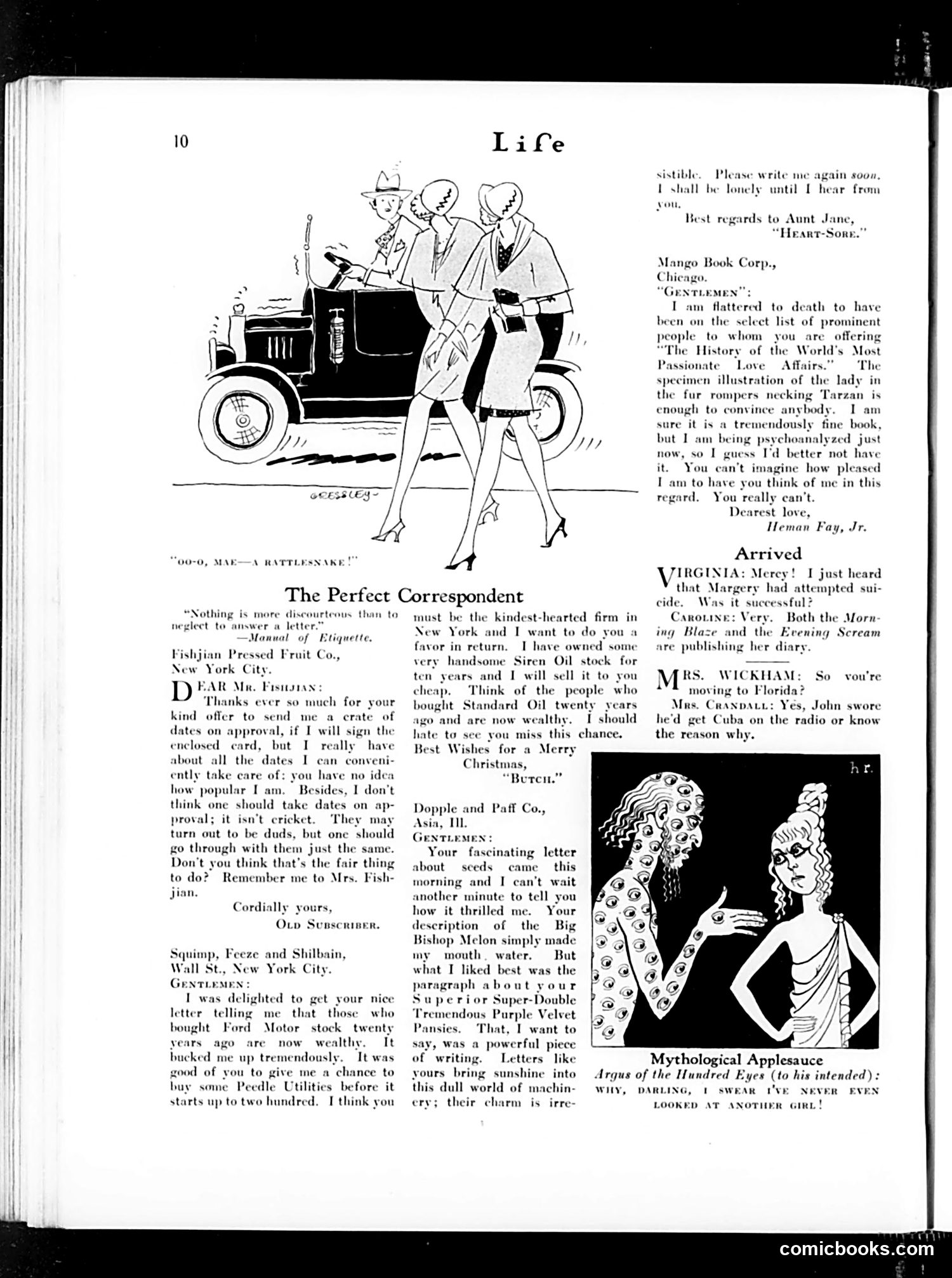
This cartoon shows three fashionably-dressed women in 1920s attire posing around a vintage automobile, with the caption suggesting one has spotted a rattlesnake. The humor appears to rely on the contrast between the women's elegant presentation and an alarming, decidedly unromantic discovery—playing on period anxieties about nature intruding on modern urban life. The page is primarily a "Letters to the Editor" section titled "The Perfect Correspondent," containing humorous correspondence about various topics including stock tips, seeds, and romantic advice. These satirize readers' expectations that a magazine should solve all their practical and personal problems. The tone is gently mocking of both the letter-writers' presumptions and consumer culture generally.
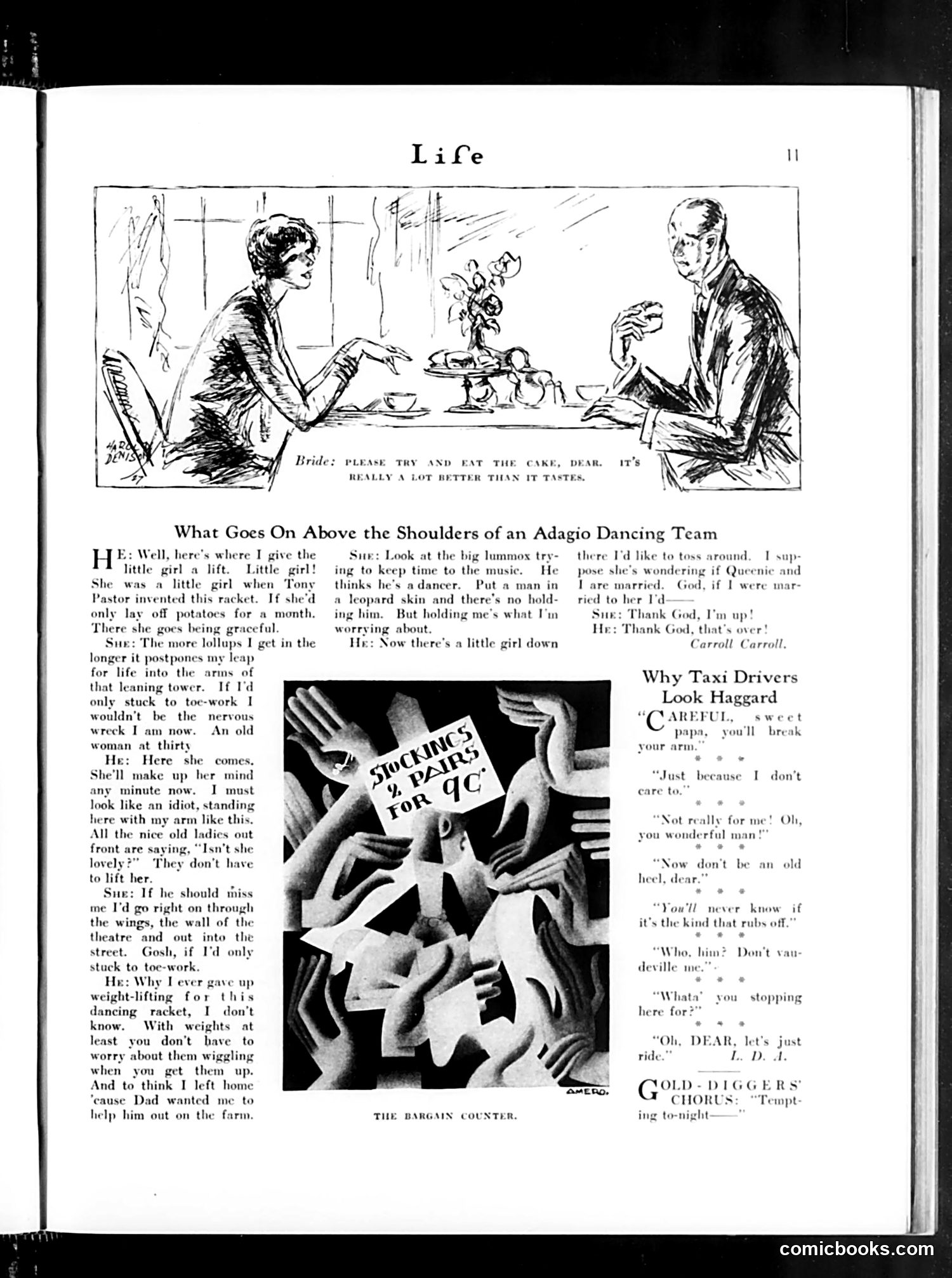
This page from *Life* magazine contains three separate humor pieces: **Top cartoon**: Shows a newlywed couple at breakfast. The bride urges her husband to eat her homemade cake, claiming it tastes better than it looks. The joke satirizes newlyweds' domestic expectations—particularly the bride's cooking abilities—and the husband's diplomatic response to potentially inedible food. **Center image**: "The Bargain Counter" shows hands exchanging a package labeled "Stocking & Garters for 9¢"—likely mocking Depression-era discount shopping or mail-order deals. **Right section**: "Why Taxi Drivers Look Haggard" presents a comic dialogue between a taxi driver and reckless passenger, satirizing dangerous driving habits and passenger indifference to safety—a common urban social complaint of the era. All three pieces target everyday social behaviors and domestic/urban life comedy.
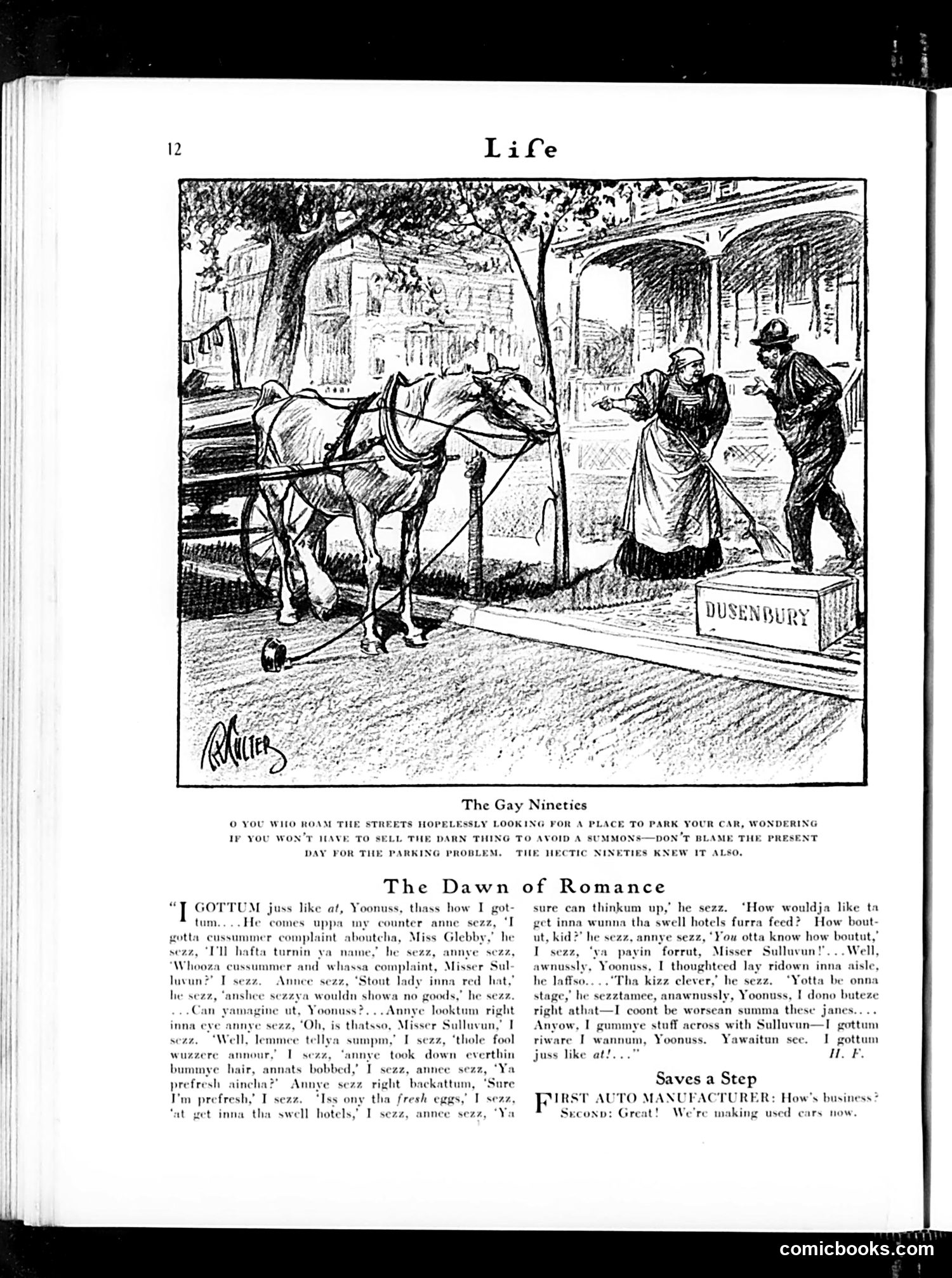
**The Main Cartoon ("The Gay Nineties"):** This illustration depicts a street scene with a horse and cart, showing the parking problems of the 1920s era. The caption satirizes car owners complaining about nowhere to park, sarcastically noting that "the hectic nineties knew it also"—ironically comparing modern parking woes to the 1890s, when horses (not cars) dominated streets and presumably faced similar congestion issues. The joke is that urban crowding is not new; only the type of vehicle has changed. **Two Short Humor Pieces Below:** "The Dawn of Romance" features dialect humor with a man using exaggerated immigrant or working-class speech patterns attempting to woo a woman. "Saves a Step" is a brief joke about automobile manufacturing and used cars. The page reflects 1920s urban anxieties about automobile proliferation and social satire through vernacular comedy.
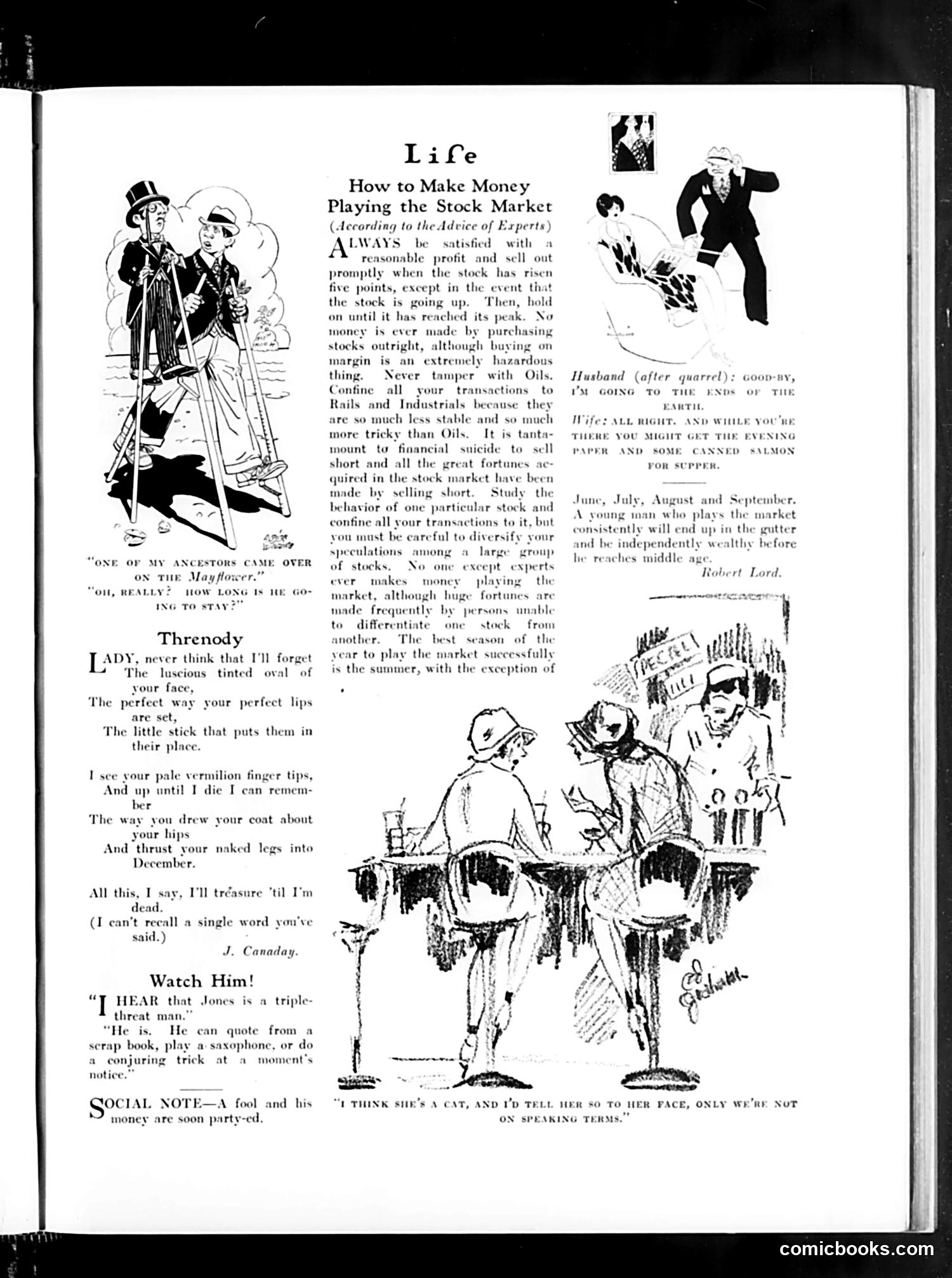
This satirical page mocks stock market speculation during what appears to be the early 20th century. The main article, "How to Make Money Playing the Stock Market," presents advice from financial "experts" recommending cautious strategies—buy on dips, sell at modest profits, avoid oils, stick to stable stocks. The accompanying cartoons and poems undercut this seriousness with humor about foolish speculation and romance. One cartoon shows a couple quarreling over the husband's market losses. Another depicts three figures at what appears to be a social gathering, with a caption suggesting gossip and social tension. The page satirizes both naive investors who lose money chasing quick profits and the pretentious "expert" advice that claims to guarantee success—mocking the hubris of both speculators and their supposed advisors.
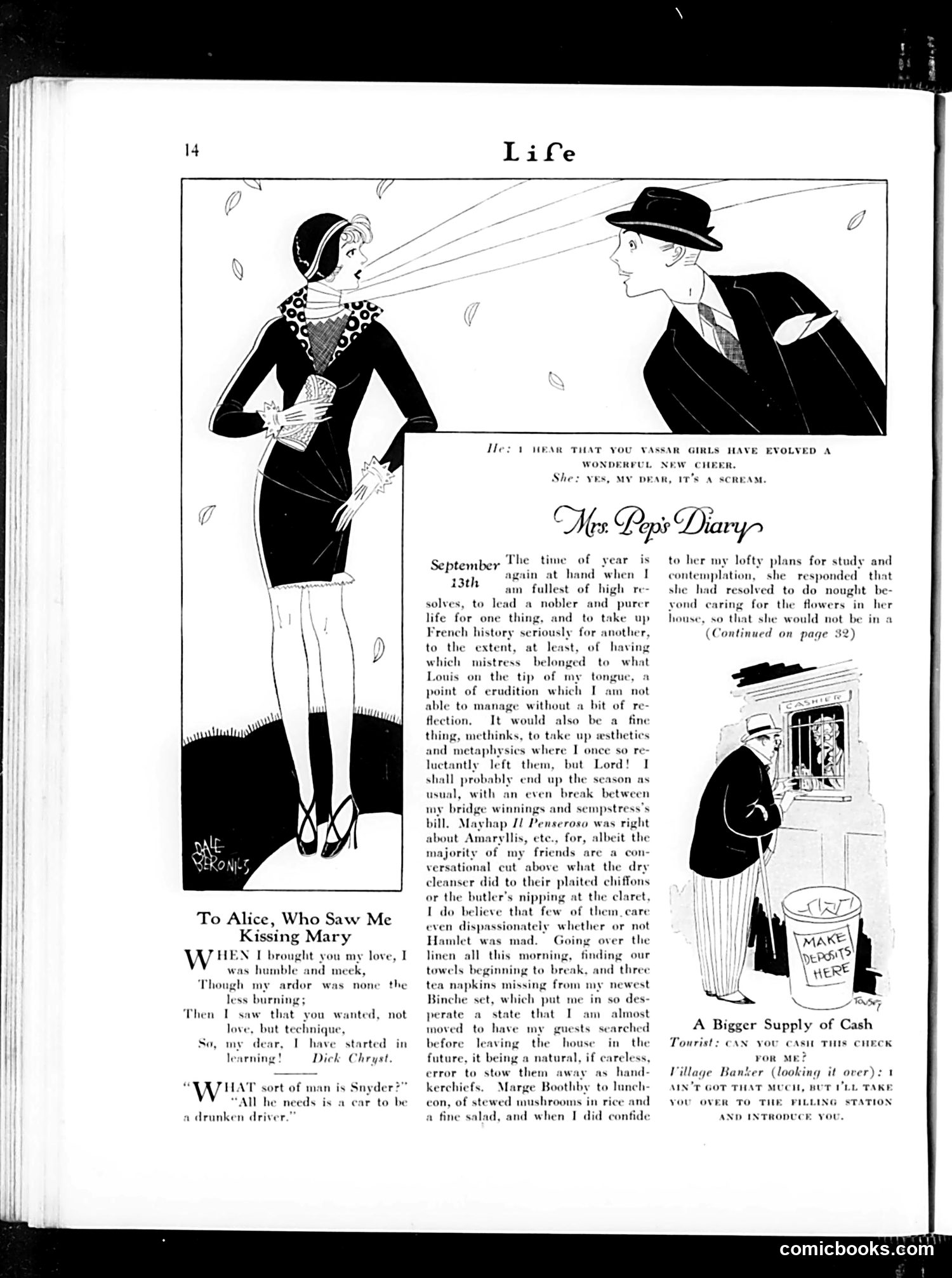
This page features **Mrs. Peps's Diary**, a recurring satirical column mocking upper-class social life. The main illustration shows a fashionable woman and man in 1920s dress, with dialogue about "Vassar girls" developing a "wonderful new cheer." The diary entry satirizes the pretensions of wealthy women who aspire to intellectual pursuits (French history, aesthetics, metaphysics) while remaining absorbed in trivial social gossip. The humor targets the contradiction between their stated noble ambitions and actual idle behavior. A smaller cartoon titled "A Bigger Supply of Cash" depicts financial anxiety—a tourist asking a villager to cash a check, highlighting class anxieties about money during this period. The page overall mocks the affectations and shallow concerns of the privileged classes, a characteristic target of *Life* magazine's satirical humor.
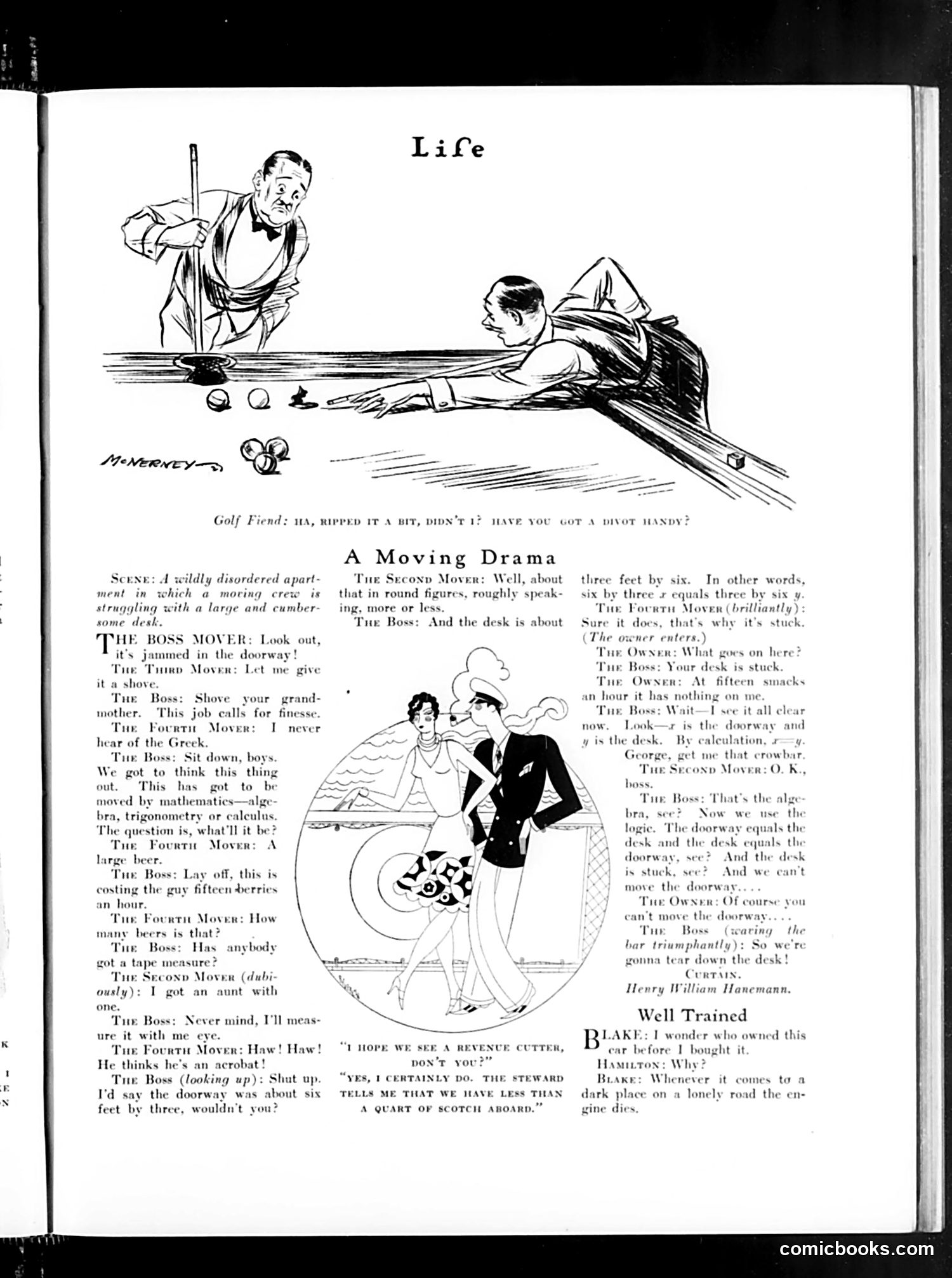
This page contains two distinct pieces of humor content: **Top Cartoon ("Life"):** A golf-themed joke depicting two men on a golf course. One man has apparently damaged his golf club ("ripped it a bit"), and the other asks if he has a "divot handy"—a pun on the golf term "divot" (displaced turf). The humor relies on wordplay rather than political commentary. **"A Moving Drama":** A comedic sketch about office workers struggling to move a desk through a doorway. The humor derives from the mathematical absurdity of their situation—the desk is stuck because its dimensions don't fit the doorway's, yet they debate using algebra and trigonometry to solve a fundamentally impossible physical problem. This satirizes overcomplication of simple problems through excessive intellectualization. Both pieces are lighthearted social satire without obvious political content.
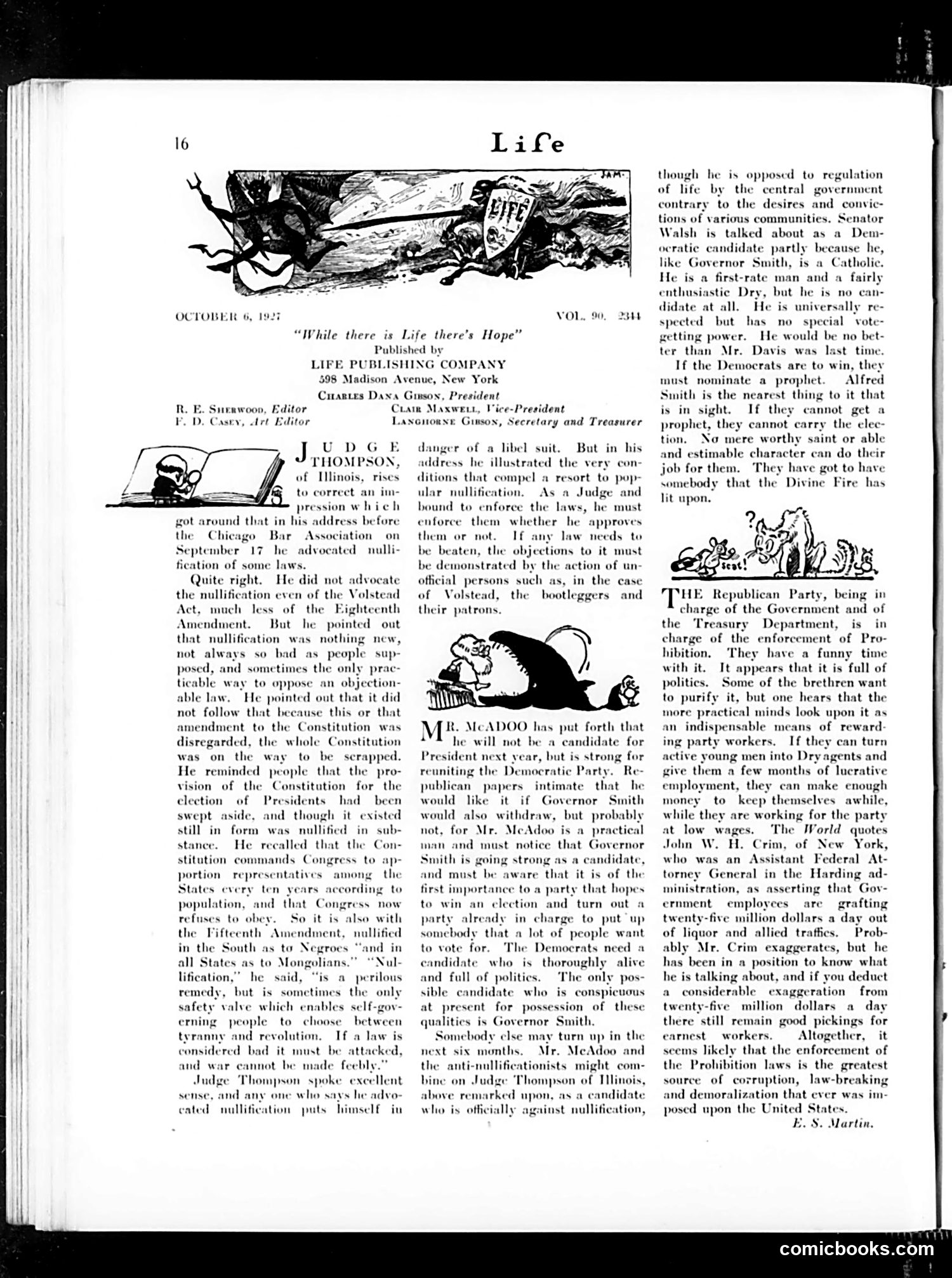
This October 6, 1927 *Life* page contains political editorial commentary on upcoming Democratic and Republican candidate selections. The text discusses Governor Smith as a potential Democratic nominee and references Mr. McAdoo's reluctance to run for president again. The key cartoon (top left) appears to show a figure labeled "PIFF" emerging from or associated with a coffin or dark mass—likely representing corruption or scandal threatening the political process. The commentary criticizes Prohibition enforcement, linking it to bootlegging and organized crime. It also mocks the Republican Party's handling of government positions as a patronage system for "rewarding party workers." The overall tone satirizes both parties' practical politics versus idealistic principles.
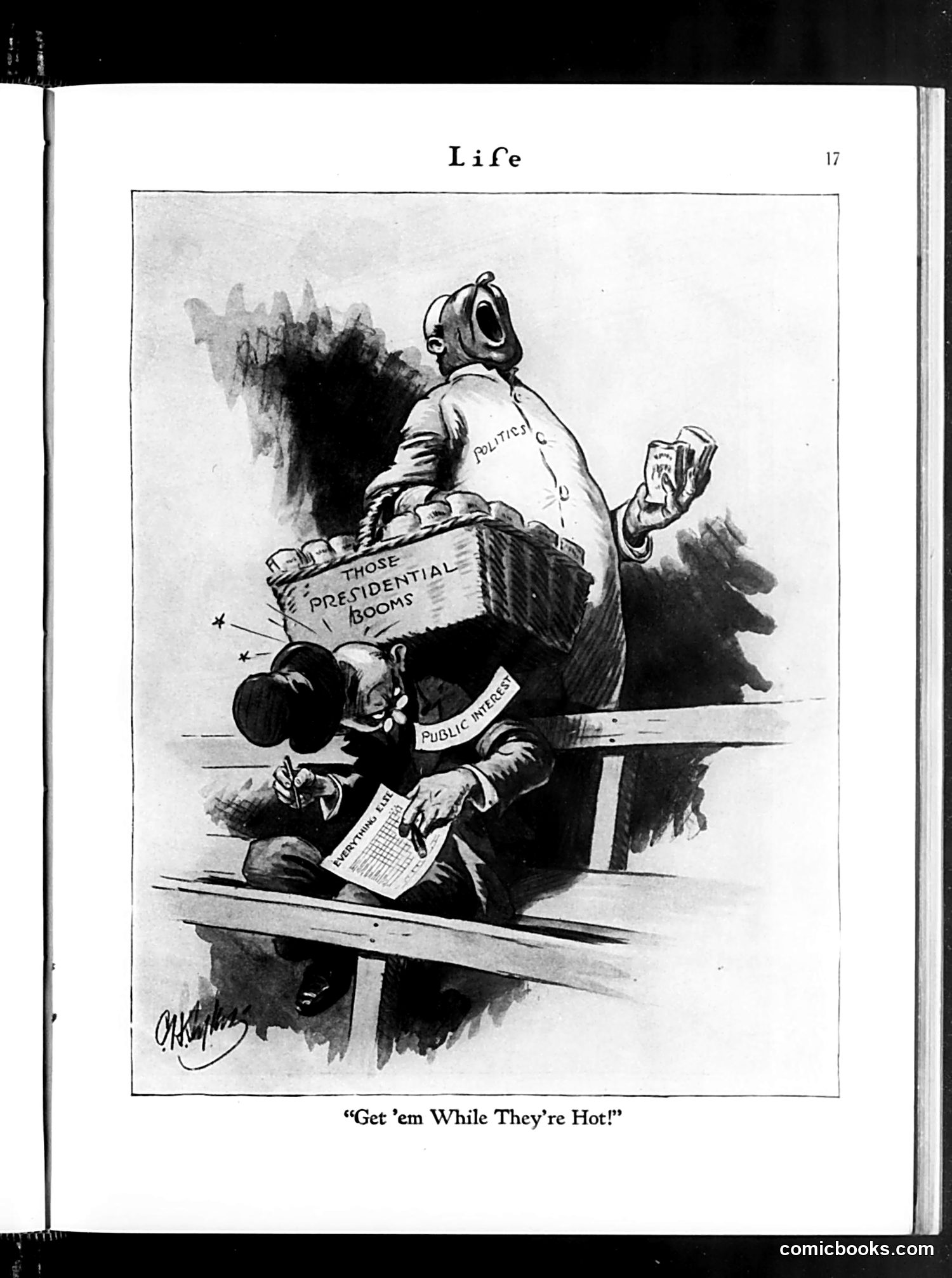
This political cartoon depicts a figure labeled "POLITICAL" (wearing a gas mask) holding a basket labeled "THOSE PRESIDENTIAL BOOMS" above what appears to be a mouse or rat character sitting at a desk labeled "PUBLIC INTEREST." The seated figure holds papers marked "SECRETARIAL WORK." The satire suggests that politicians are opportunistically promoting "presidential booms" (likely referring to premature or manufactured presidential candidacies) to the public while actual governmental work and public interest suffer neglect. The "get 'em while they're hot" caption implies these booms are being rushed, sensationalized offerings rather than serious deliberation. The gas mask suggests the political sphere is toxic or noxious, and the small, trapped mouse-figure represents the diminished public interest amid political spectacle.
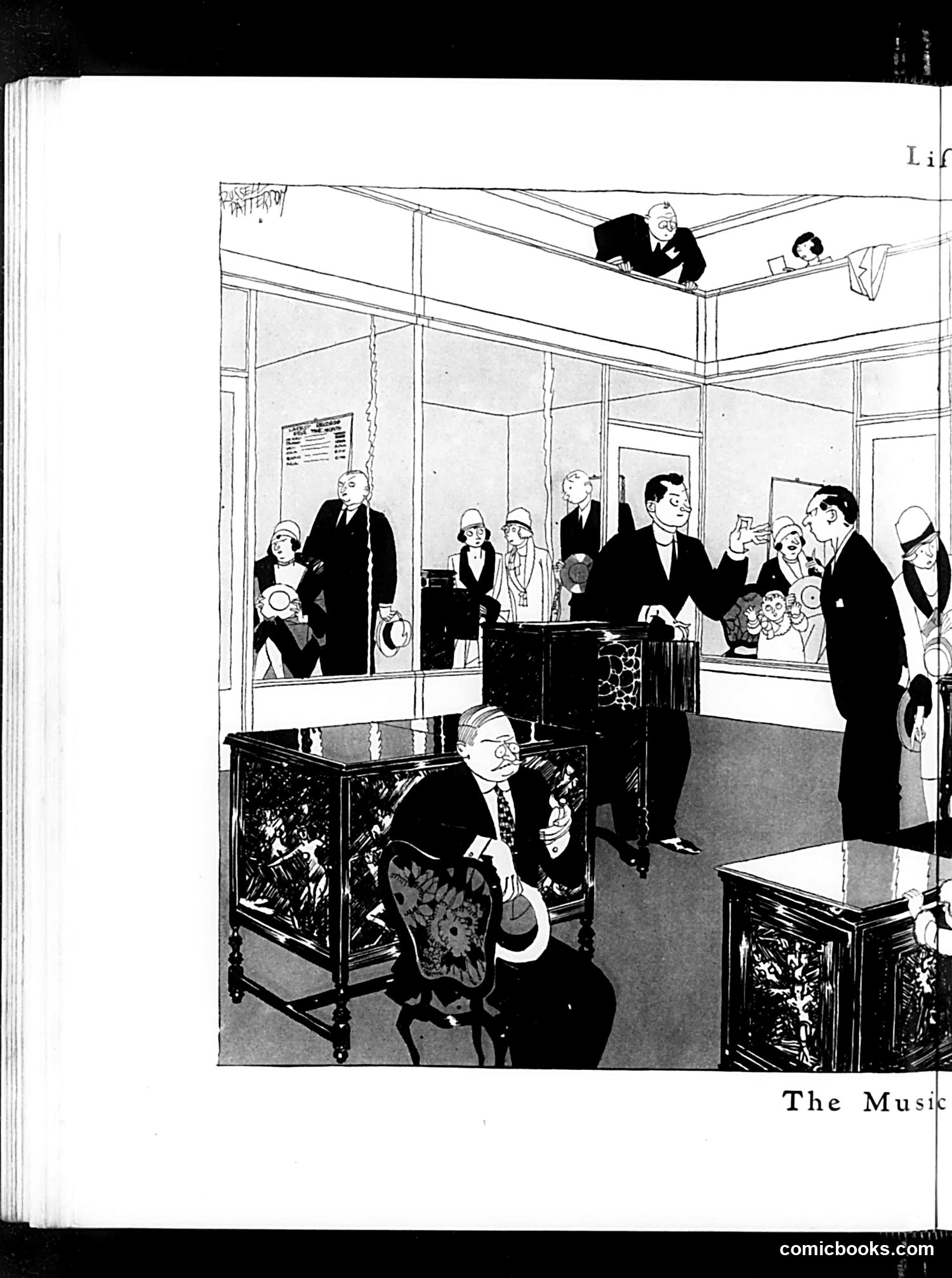
This is a satirical cartoon depicting what appears to be a formal concert or musical performance in an elegant venue. A distinguished gentleman sits at an ornate piano or musical instrument in the center, while well-dressed audience members observe from surrounding gallery spaces. The scene uses architectural perspective to show multiple viewing levels. The satire likely mocks either pretentious classical music culture or a specific musician/composer of the era. The formal attire, elaborate furnishings, and staged viewing arrangement suggest commentary on the artificiality or social pretension surrounding "high" music. However, without the complete OCR text or publication date, the specific target of the satire—whether a particular performer, musical movement, or cultural institution—remains unclear.
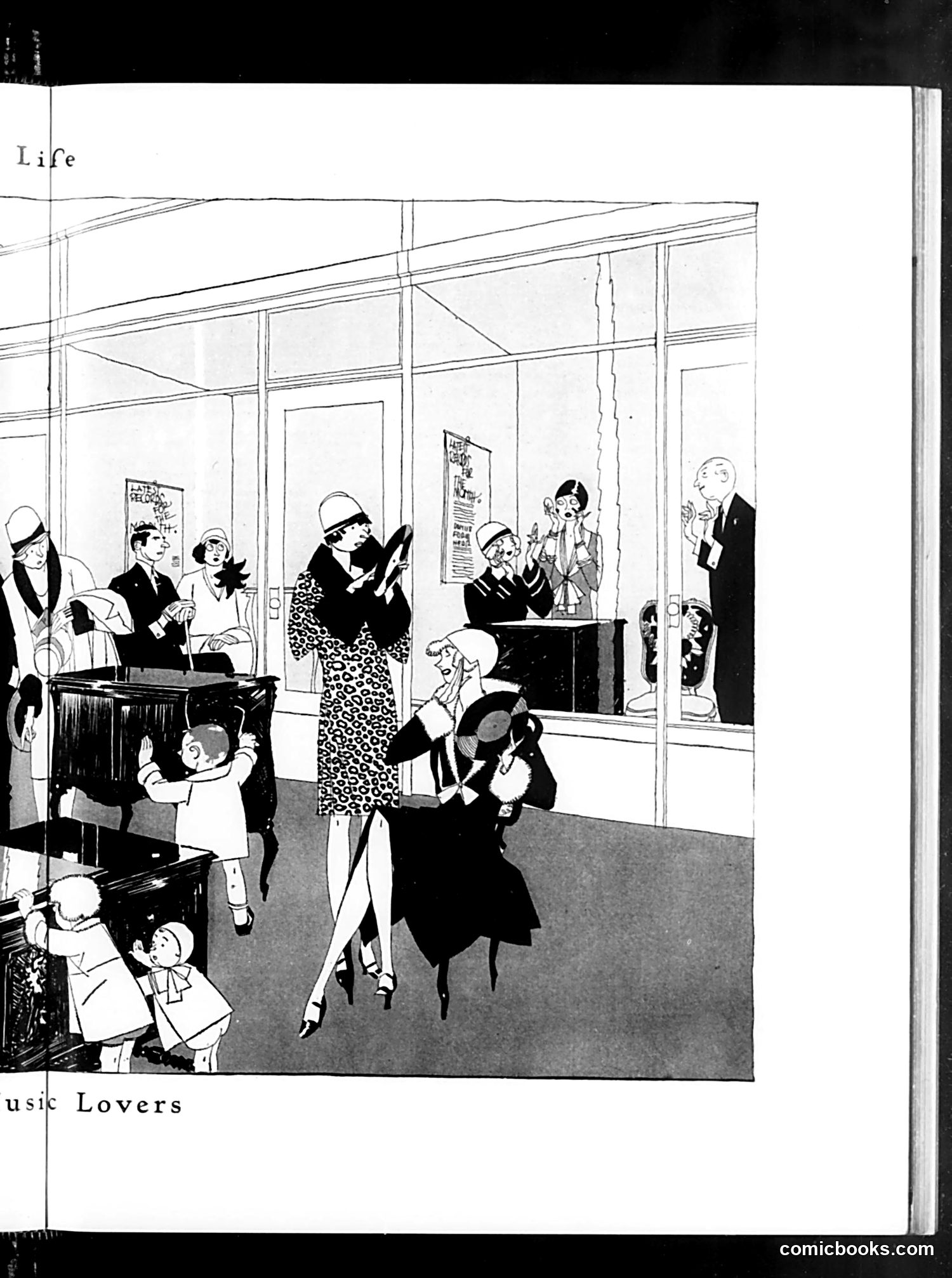
This appears to be a section heading or chapter title page from Life magazine labeled "Life" at the top and "usk Lovers" at the bottom (likely "Music Lovers" with the "M" cut off). The illustration depicts an elegant 1920s-30s social scene—a fashionable indoor venue with well-dressed patrons. A woman in the foreground dances enthusiastically while men in suits and hats observe. The scene captures the Jazz Age atmosphere of speakeasies or upscale entertainment venues. Without clearer context, the specific satirical target is unclear, though the composition likely mocks the pretensions or behavior of wealthy socialites engaged in nightlife entertainment. The title "Music Lovers" suggests irony about the patrons' actual appreciation for music versus their focus on fashionable socializing.
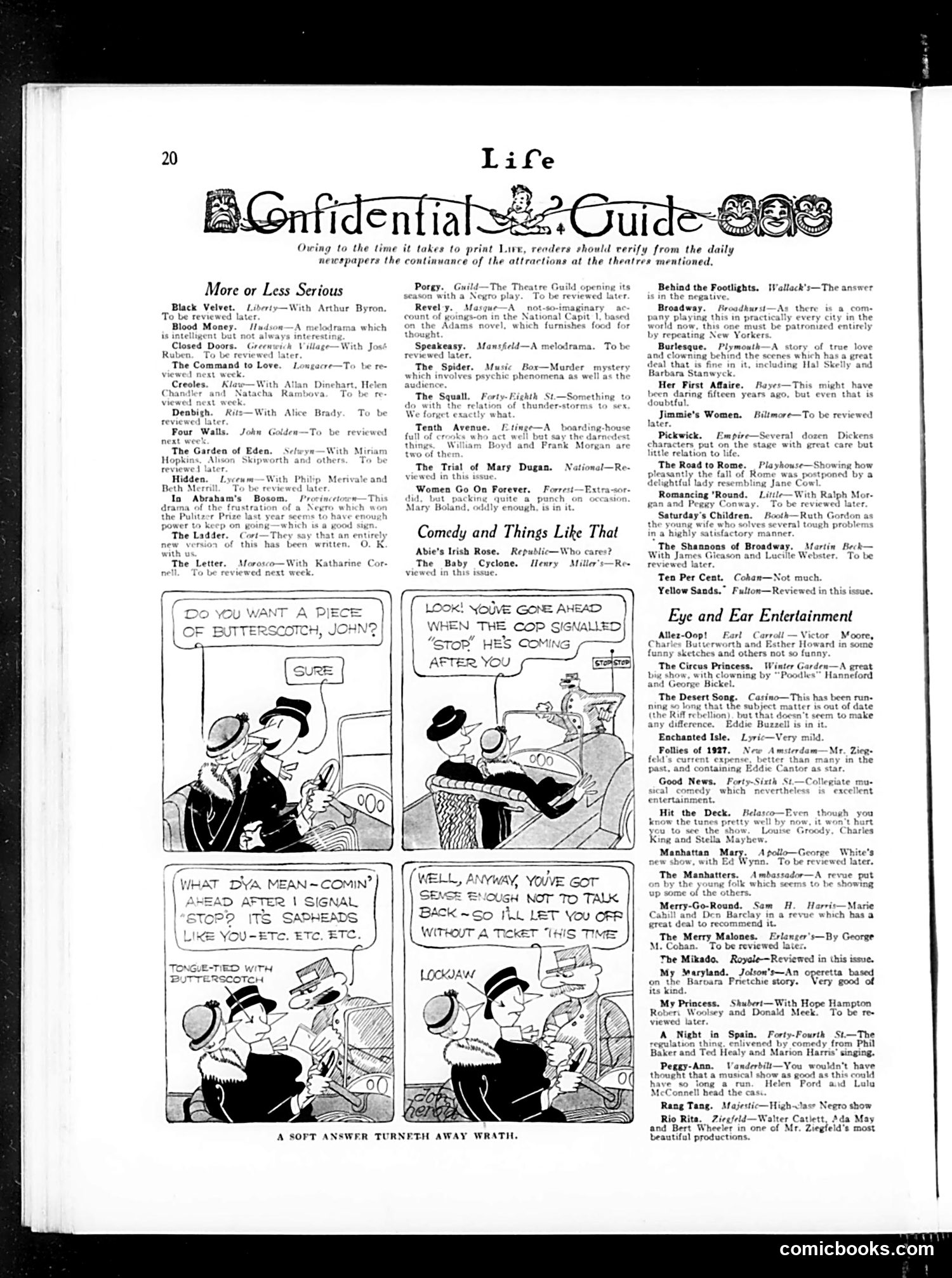
This four-panel comic strip depicts a traffic confrontation between a policeman and a driver (appears to be two men in a car). The joke follows escalating tension: the cop signals the car to stop; the driver questions why; the cop threatens consequences; the driver nervously agrees to comply without a ticket "this time." The humor relies on the era's common anxiety about traffic enforcement and police authority in the 1920s automobile age. The title—a biblical reference ("A soft answer turneth away wrath," Proverbs 15:1)—is ironic, as the driver's compliance stems from fear rather than actual softness. The cartoon satirizes how ordinary citizens navigated unpredictable police authority and the power imbalance between law enforcement and the public. This appears in Life's "More or Less Serious" theater review section, suggesting the magazine used humor to comment on contemporary social situations alongside entertainment coverage.
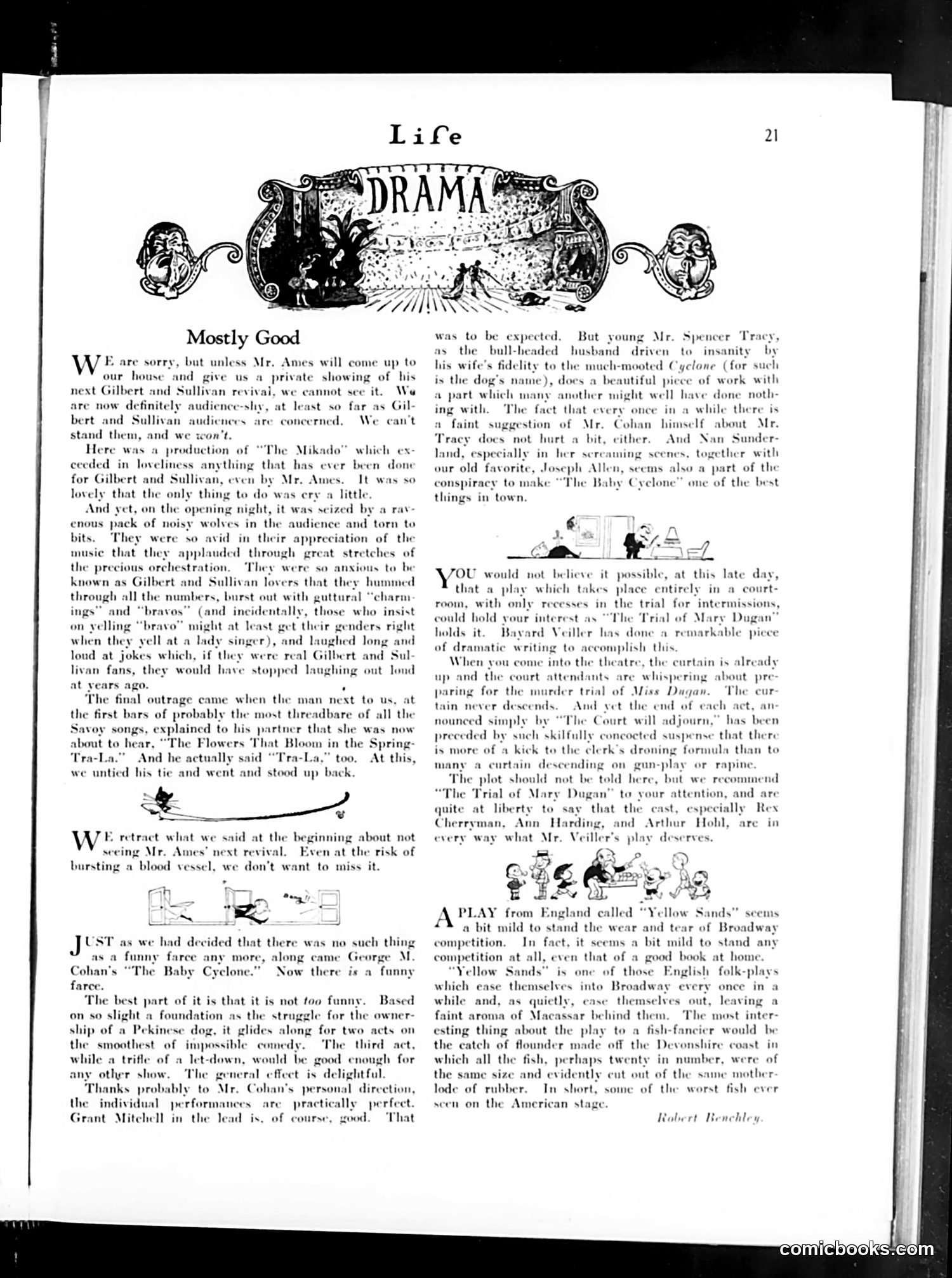
This page contains theater reviews from Life's drama section, circa early 1900s. The critic discusses three Broadway productions: **"The Mikado"** revival—praised for beautiful staging but mocked for its audience of loud, uncultured "Gilbert and Sullivan lovers" who applaud during orchestral passages, laugh at dated jokes, and interrupt performances. The reviewer humorously retaliates by untying a nearby patron's necktie. **"The Baby Cyclone"** by George M. Cohan—favorably reviewed as a clever farce about a custody battle over a Pekingese dog. The critic praises Grant Mitchell's lead performance and notably mentions young Spencer Tracy's "bull-headed husband" role. **"The Trial of Mary Dugan"** by Bayard Veiller—commended for maintaining suspense in a courtroom-set play with minimal set changes, proving dramatic tension doesn't require physical spectacle. The satire targets pretentious theater-goers and celebrates well-crafted entertainment regardless of subject matter's sophistication.
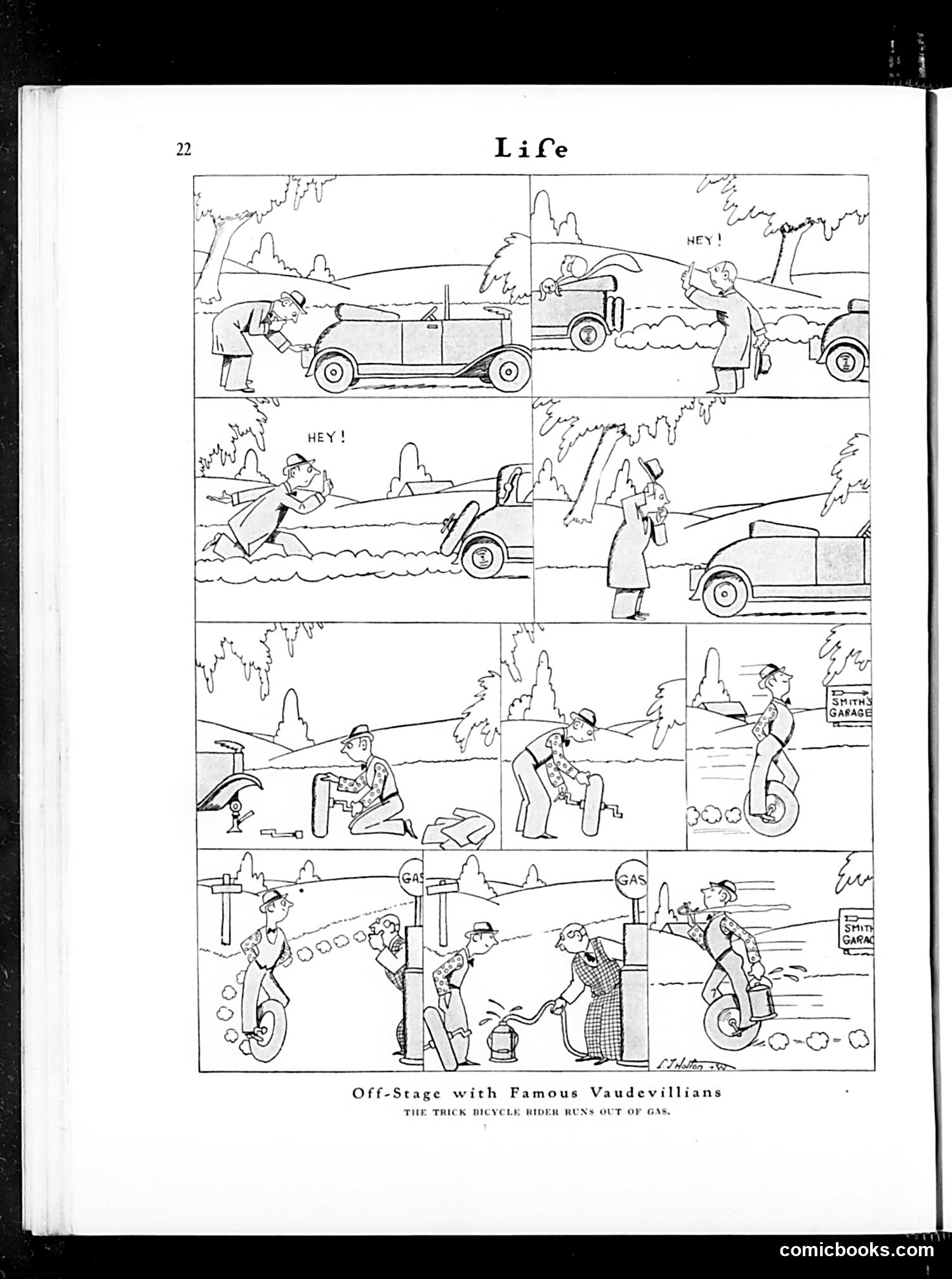
This is a satirical comic strip about a vaudeville performer known for trick bicycle riding. The humor comes from an ironic contrast: the entertainer performs death-defying bicycle stunts on stage, but in his everyday life, he encounters mundane modern problems—specifically, running out of gasoline. The strip depicts a progression: the performer's car breaks down, he attempts various solutions (checking the gas tank, getting help at a gas station), and encounters frustrated onlookers. The joke mocks the gap between theatrical personas and real life—a skilled trick cyclist, celebrated for physical prowess, is helpless against a basic automobile mechanical failure. This reflects early 20th-century anxieties about cars as new, unreliable technology that could humble even accomplished performers.
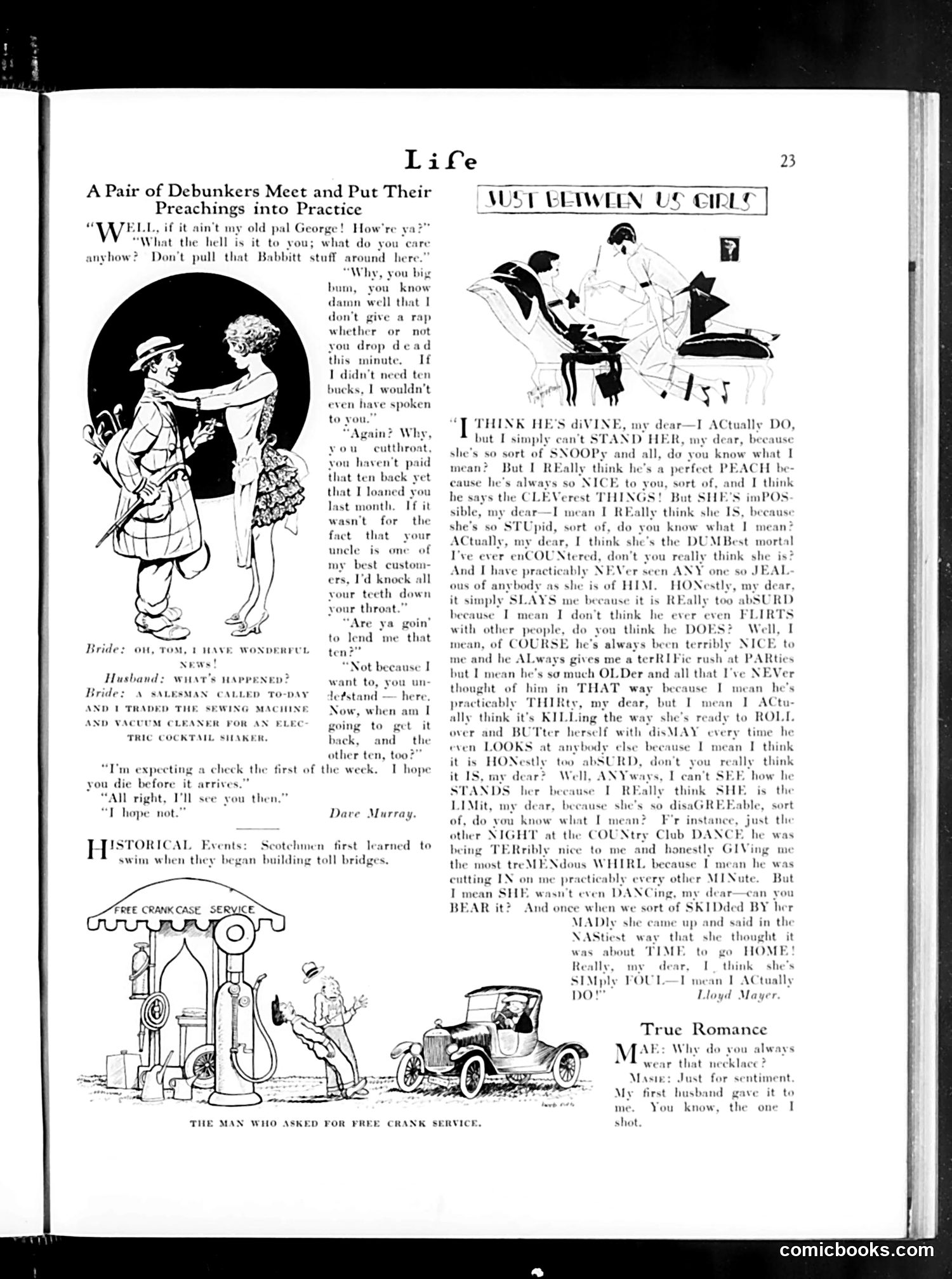
This page contains three satirical pieces mocking 1920s social hypocrisy and materialism: **"A Pair of Debunkers Meet"** (top left): Two men who publicly preach cynicism and brutality ("debunkers" of sentiment) reveal themselves as needy and dependent when alone. The joke exposes their performative toughness—one needs to borrow money from the other despite their claimed indifference to human connection. **"Just Between Us Girls"** (right): A woman's breathless gossip about a couple uses exaggerated emphasis (capitalized syllables) to mock superficial society chatter. She claims the man is "divine" while calling his girlfriend stupid and jealous—displaying the cattiness and fakeness of upper-class women's friendships. **"True Romance"** (bottom right): A bride casually mentions shooting her first husband while discussing a necklace he gave her. Dark comedy highlighting either casual cruelty or absurd storytelling among the wealthy. **"The Man Who Asked for Free Crank Service"** (cartoon): Visual gag about a man trying to get free auto service—likely mocking Depression-era cheapness or entitlement. The page satirizes 1920s pretension, materialism, and the gap between public personas and private behavior.
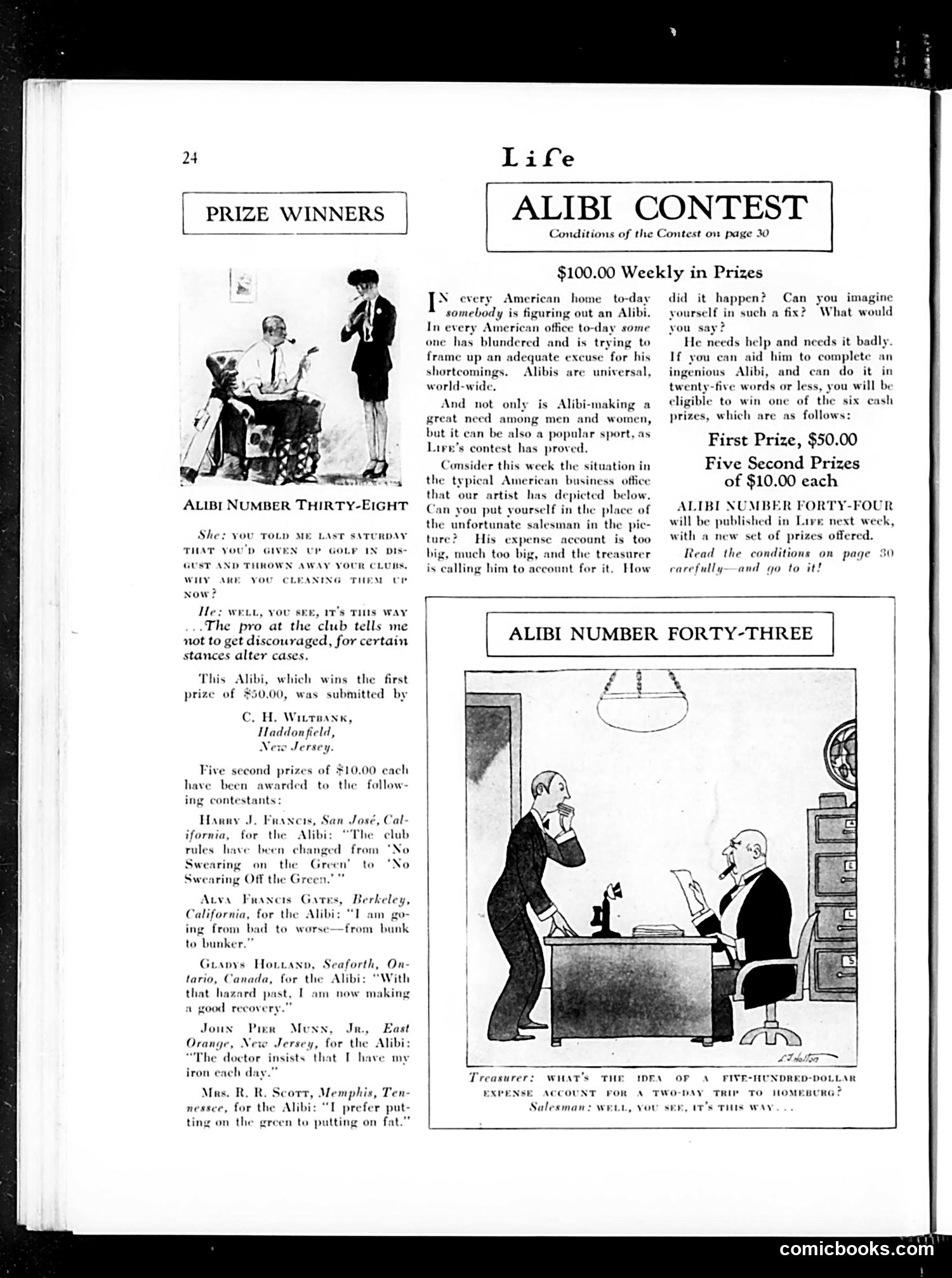
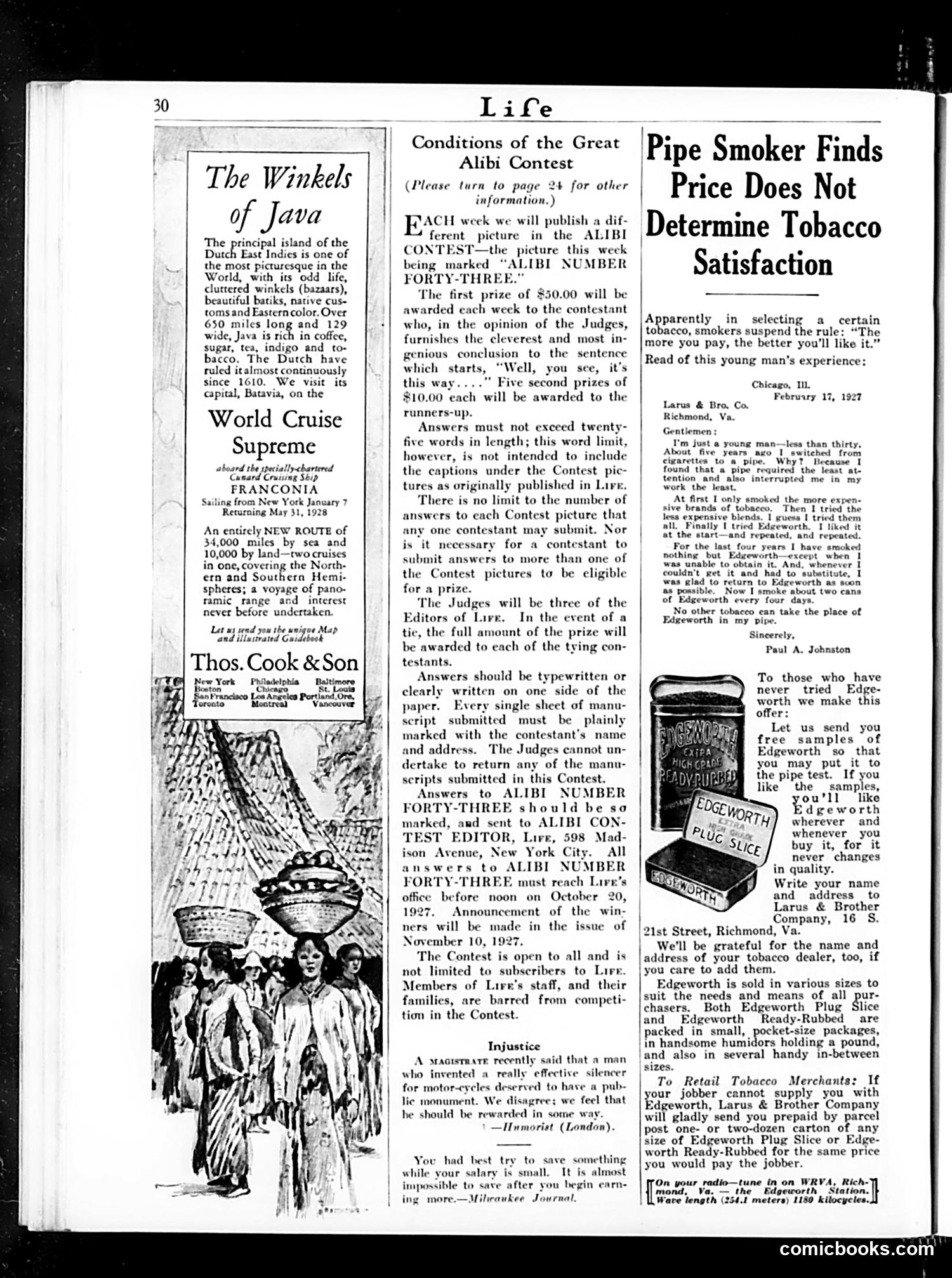
This page showcases Life magazine's "Alibi Contest," a humor competition where readers submit creative excuses for everyday situations. The central cartoon (Alibi #43) depicts a salesman defending an inflated $500 expense account to his treasurer—a common workplace scenario of the era. The contest asks readers to imagine themselves as this salesman and create a plausible excuse in 25 words or less. Winning entries are published; the page shows previous winners' alibis, which are puns playing on double meanings (e.g., "prefer putting on the green to putting on fat" = golf vs. weight gain). The humor reflects early 20th-century office culture where expense fraud and elaborate excuses were considered amusing rather than serious—a satirical jab at American business dishonesty. The contest format itself was entertainment, targeting both office workers and golfers with relatable predicaments about blunders, overspending, and the creative justifications required to escape accountability.
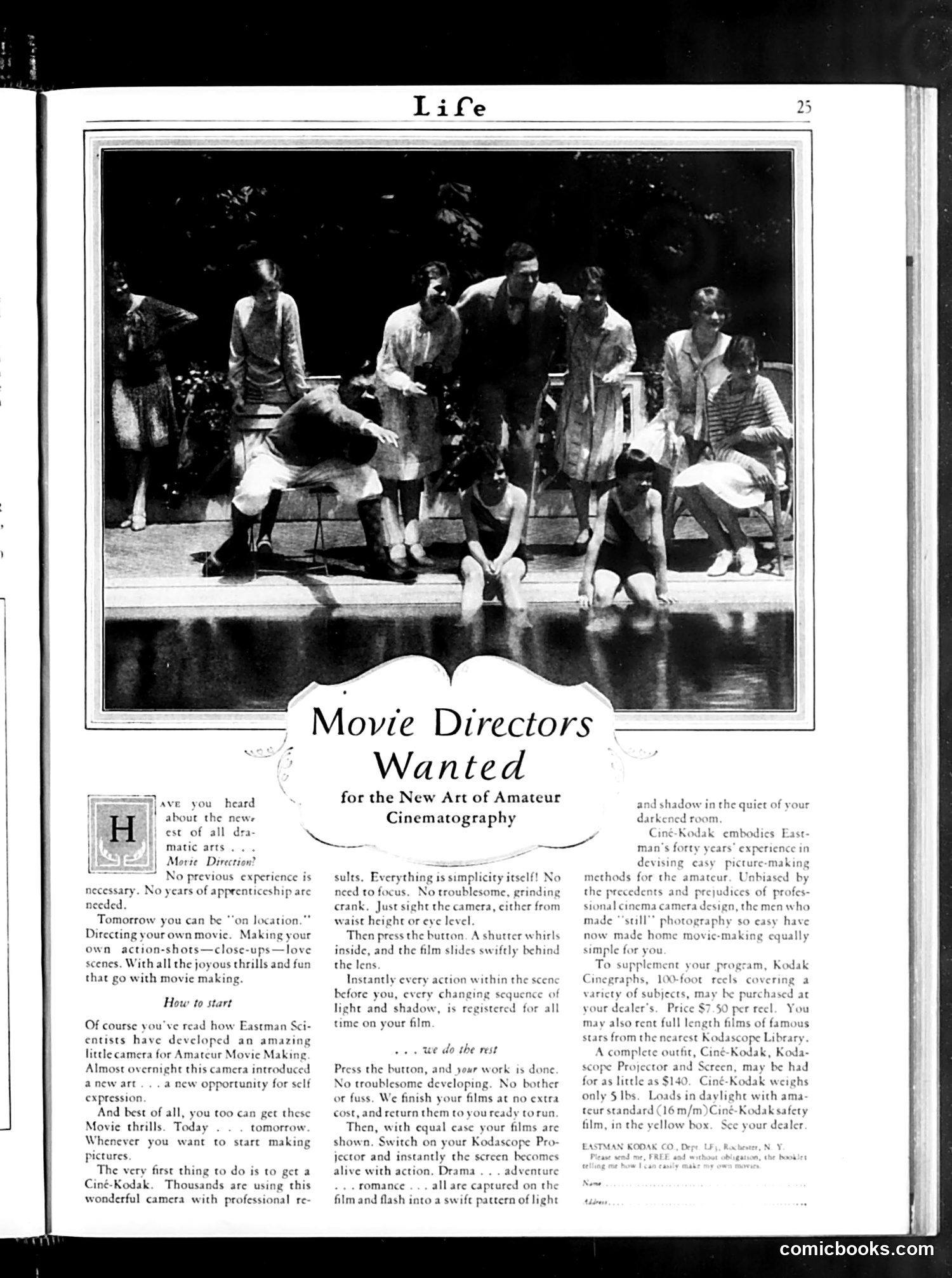
This is an advertisement, not a cartoon or satire. It promotes Eastman Kodak's Ciné-Kodak camera for amateur home movie-making. The image shows a group of people (adults and children) by a pond or water's edge, apparently filming or demonstrating the camera. The ad targets ordinary people interested in filmmaking, emphasizing that no prior experience or training is needed—anyone can become a "movie director." The appeal is democratic and consumerist: Kodak claims to have democratized filmmaking technology, making professional-quality results accessible to amateur users. The text emphasizes simplicity ("no need to focus"), affordability, and Kodak's development of fast film and processing services. This reflects 1920s consumer culture and the emerging home-movie hobby market. There is no political satire here—rather, it's a straightforward pitch celebrating new technology and mass-market accessibility to creative expression.
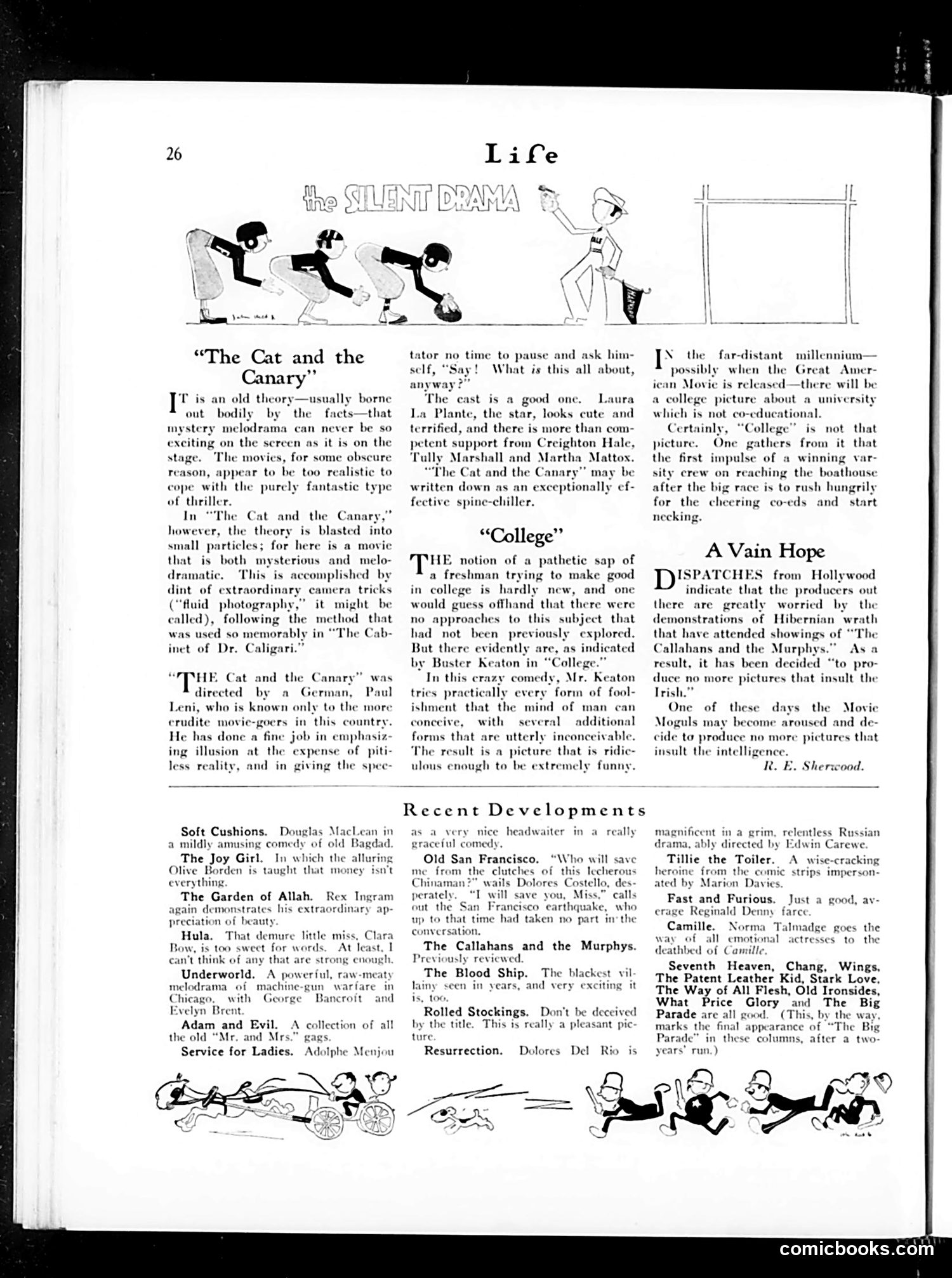
This page reviews recent films, with two main articles highlighted: **"The Cat and the Canary"** critiques how mystery thrillers translate from stage to screen. The reviewer argues that while movies are typically *too realistic* for fantastic thriller plots, director Paul Leni (a German filmmaker) successfully uses expressionistic techniques ("fluid photography," referencing *The Cabinet of Dr. Caligari*) to create an effectively suspenseful film despite its theatrical origins. **"College"** reviews Buster Keaton's film about a college student attempting various foolish schemes. The satire targets college movie clichés—the reviewer sarcastically notes the film depicts winning athletes' first instinct after victory is to rush toward female students ("co-eds") for "necking" (kissing/romance), suggesting such narratives are predictable and emphasize romantic conquest over education. The "Recent Developments" section briefly reviews other current films, including noting Irish-American concerns about *The Callahans and the Murphys*, indicating ethnic representation issues in early cinema.
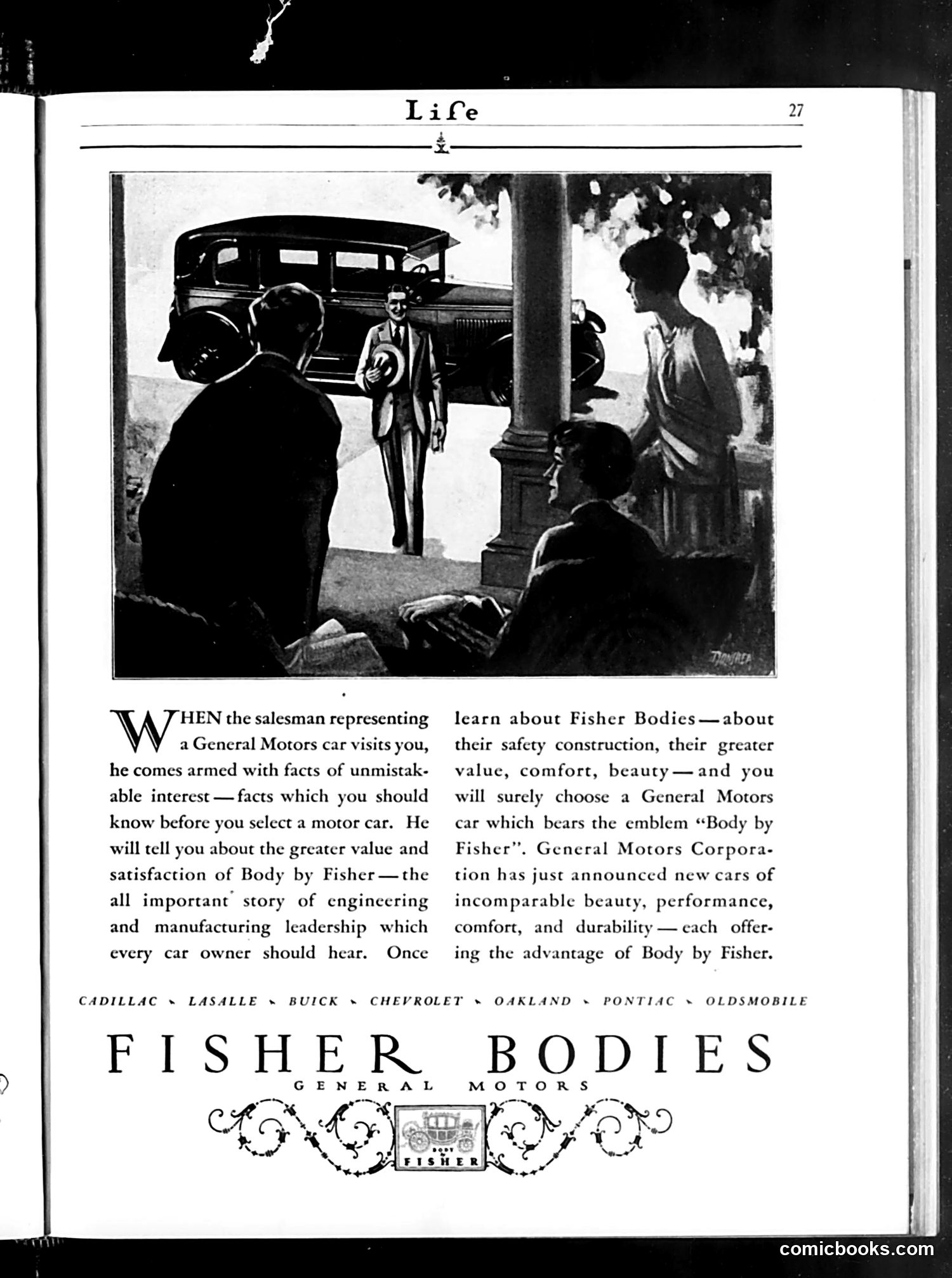
This is primarily a **General Motors advertisement**, not political satire. It appears in *Life* magazine (page 27) promoting Fisher Bodies, a coachbuilding company owned by GM. The image depicts a salesman presenting a General Motors car to potential customers. The ad's message is straightforward: GM salesmen will convince buyers that "Body by Fisher" represents superior engineering, safety, comfort, and value—making Fisher-bodied cars the obvious choice. The text lists GM brands that featured Fisher bodies: Cadillac, LaSalle, Buick, Chevrolet, Oakland, Pontiac, and Oldsmobile. Rather than satire, this is **genuine corporate messaging** emphasizing brand prestige and manufacturing quality. The "facts of unmistakable interest" the salesman carries are marketing claims about superior construction. For modern readers, it illustrates how early 20th-century automotive companies marketed technical specifications and craftsmanship as selling points.
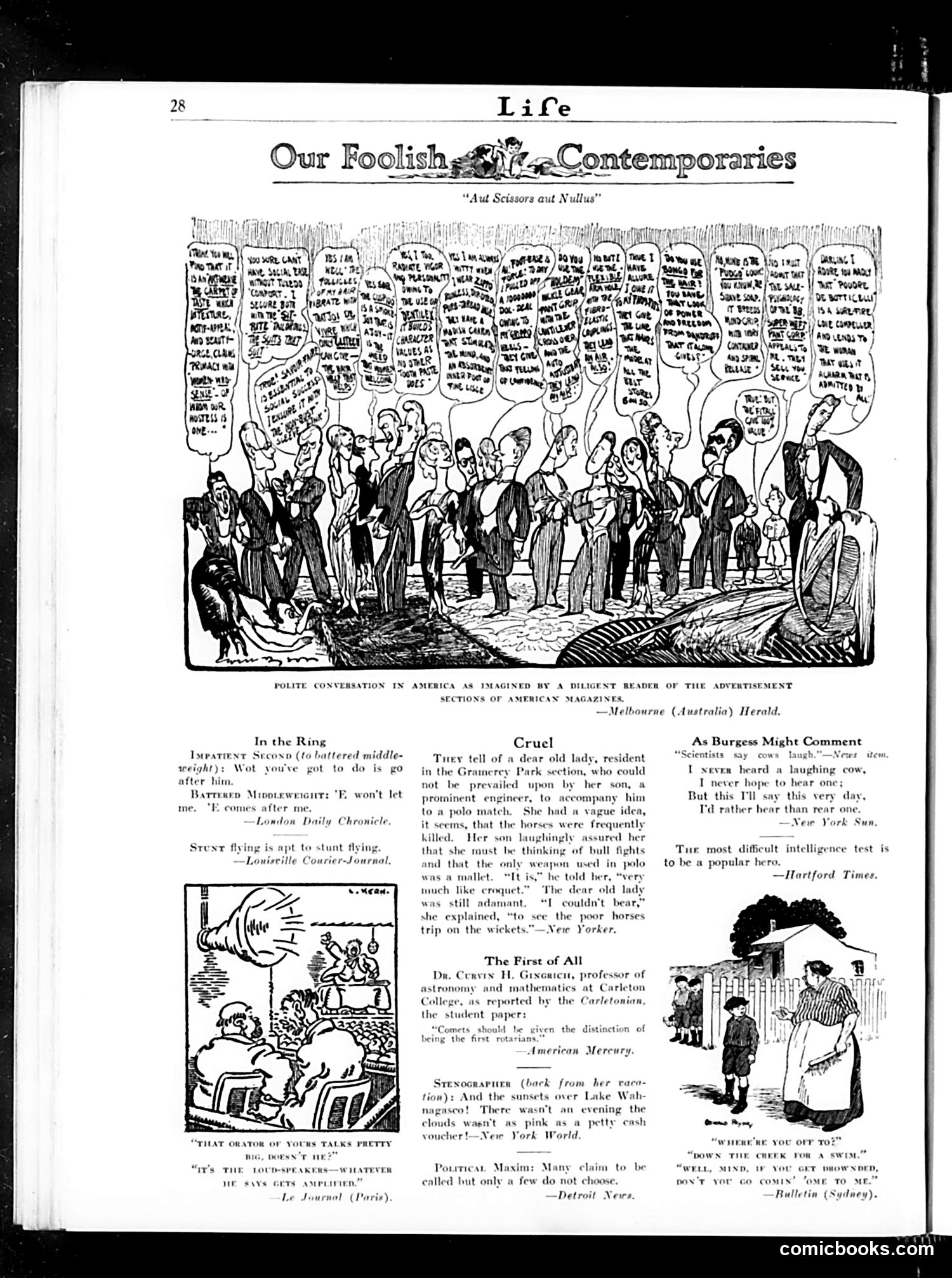
This page satirizes early 20th-century American social pretensions and foolish behavior through multiple short jokes and cartoons. The banner cartoon depicts "polite conversation in America as imagined by a diligent reader of advertisement sections"—showing people earnestly discussing absurdities (appears to mock how advertising creates false sophistication). Individual items mock various targets: an impatient boxing spectator with confused strategy; a woman unable to understand that polo uses mallets, not wickets; stenographers disappointed that sunset clouds don't resemble cash vouchers; and a professor claiming to be "first" at something trivial. The final cartoon depicts Australian parental indifference—a mother casually tells her child "don't come home" if he drowns while swimming. Throughout, the satire targets American materialism, false erudition, and general foolishness—using international sources (Australian Herald, London Chronicle, Paris Journal) to suggest this American foolishness was internationally recognized and mocked.
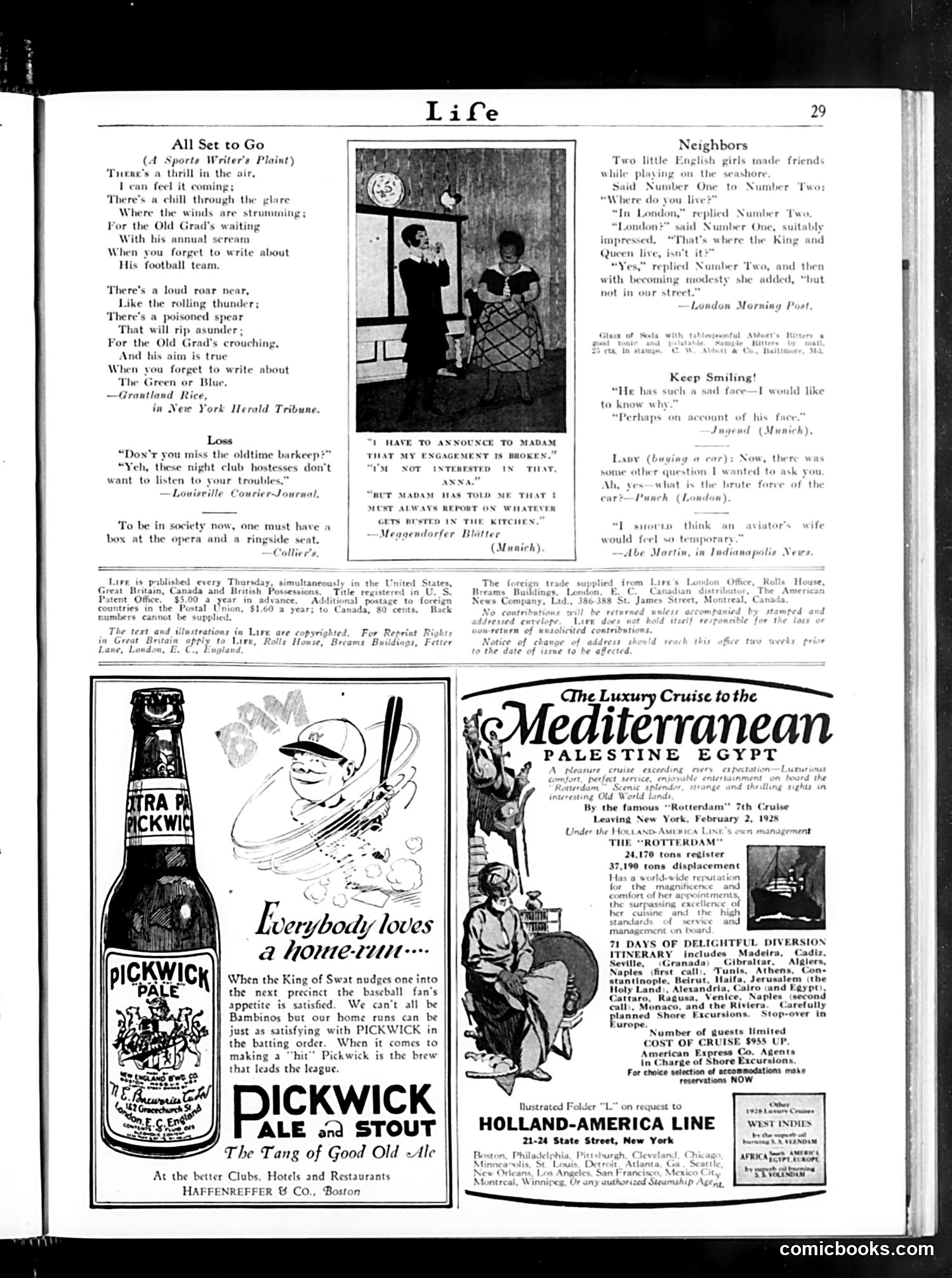
This page contains several unrelated satirical pieces and advertisements typical of 1920s Life magazine: **Top section:** Short humorous poems and anecdotes about sports, romance, and social life—standard filler content poking gentle fun at contemporary manners. **Central cartoon:** Shows a domestic servant announcing to her employer that the engagement is broken, but the maid has been instructed by the employer's wife to report all kitchen gossip. The joke satirizes the employer's hypocrisy—demanding household scandal reports while pretending propriety. **Bottom half:** Primarily advertisements for Pickwick ale (playing on baseball's "King of Swat"—likely Babe Ruth) and a luxury Mediterranean cruise on the SS Rotterdam departing February 1928, along with travel line information. The page is mostly advertising with light satirical content scattered between ads—typical of Life's format as a humor magazine dependent on commercial revenue.
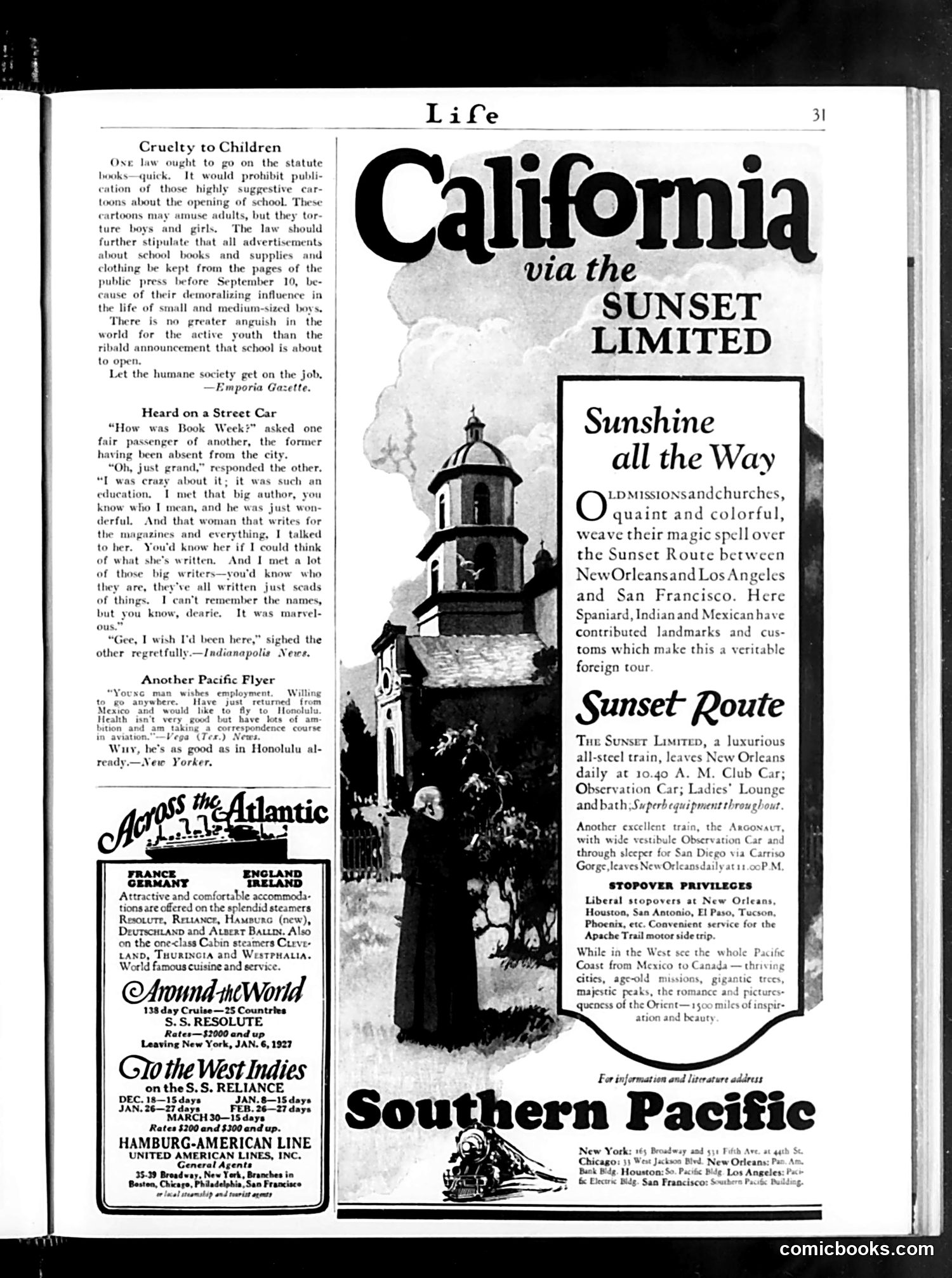
This page contains **satirical commentary and advertisements** rather than political cartoons. The **satirical pieces** mock American social pretensions: 1. **"Cruelty to Children"** jokes that back-to-school advertisements torture children by reminding them school is opening—a humorous exaggeration of childhood dread. 2. **"Heard on a Street Car"** satirizes a woman who attended a literary event (likely "Book Week") and name-drops famous authors she met but can't remember their names, mocking superficial cultural aspiration and poor memory. 3. **"Another Pacific Flyer"** is a brief quip about employment-seeking through classified ads. The **advertisements** promote luxury travel—steamship cruises, train routes to California and the West Indies—targeting affluent readers. The Southern Pacific's "Sunset Limited" emphasizes exotic destinations (missions, Spanish colonial heritage) as romantic appeal. This reflects **1920s American culture**: post-war prosperity, leisure travel becoming accessible to the wealthy, and gentle mockery of social climbers and cultural pretension.
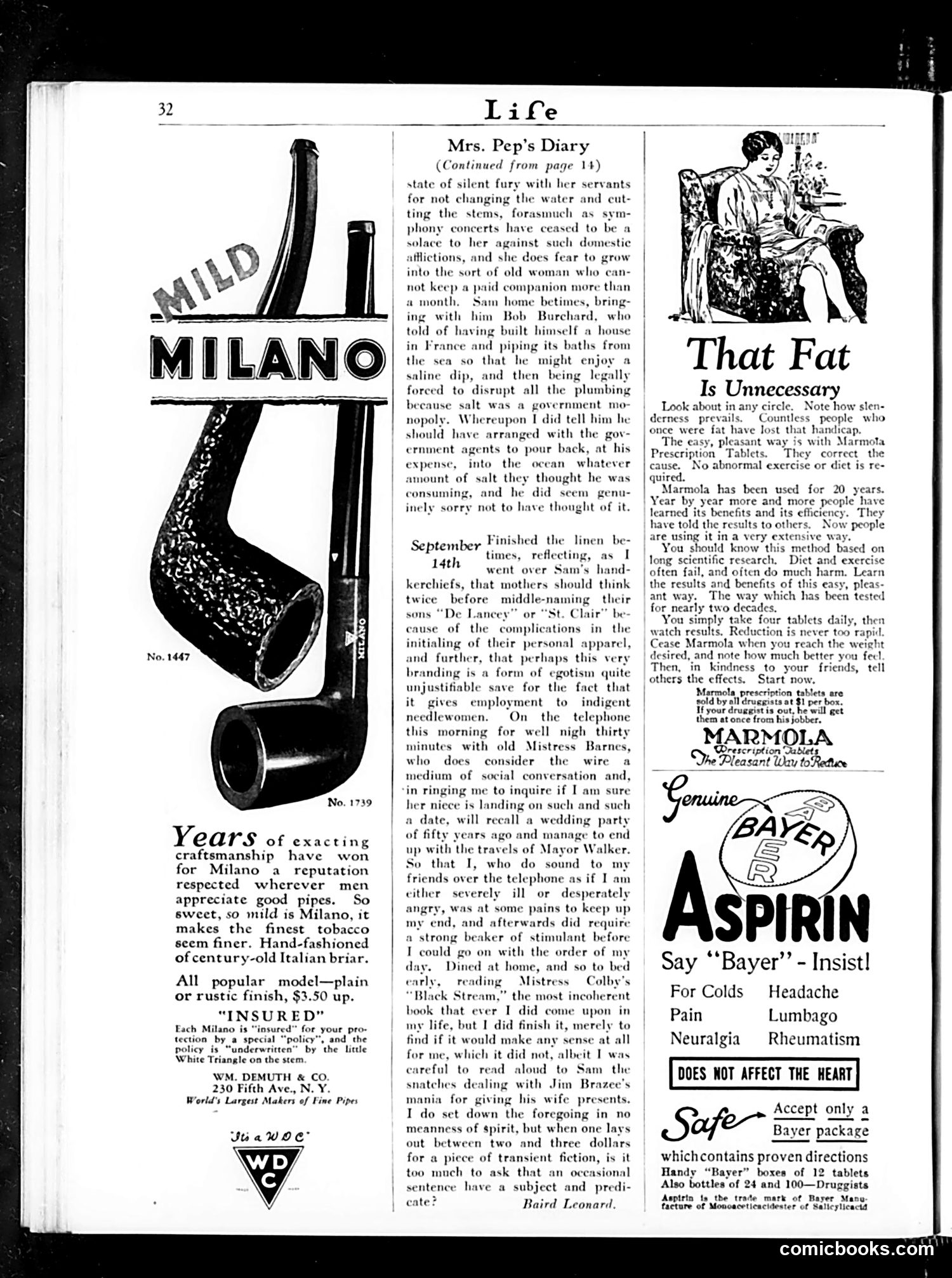
This page combines **advertising with satirical social commentary**, typical of Life magazine's format. The **Milano pipe advertisement** (left) uses straightforward product promotion, emphasizing Italian craftsmanship and quality. The main content is **"Mrs. Pep's Diary,"** a humorous column satirizing upper-middle-class domestic life. The narrator complains about servants, her husband's houseguests, and—crucially—the tedious social obligations of her class: lengthy telephone conversations with gossipy older women (Mrs. Barnes) who use the phone merely for chatting rather than necessity. The diary mocks the pretension of initialing handkerchiefs and critiques poorly-written popular fiction. The **Marmola and Bayer Aspirin ads** (right) exploit period anxieties: weight-loss obsession and medicinal solutions for everyday discomfort. Together, the page satirizes 1920s affluent society's superficiality—its focus on appearances, consumer products, and modern technology (the telephone) as social status markers—while advertising solutions to self-inflicted problems.
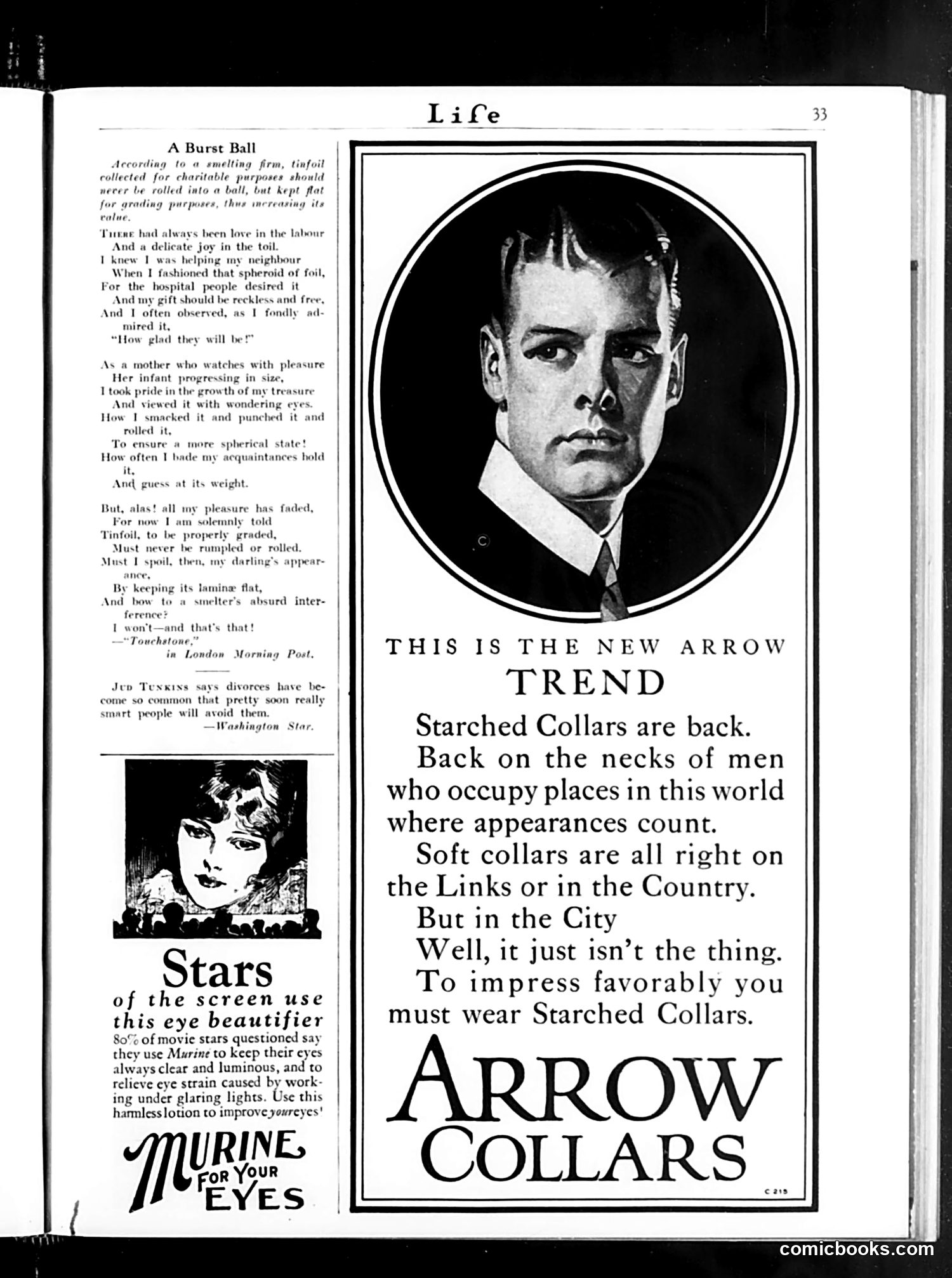
This Life magazine page (page 33) combines satirical poetry with period advertisements, reflecting early-20th-century consumer culture. **Left side**: "A Burst Ball" is a humorous poem about inflating a foil ball for charity, taking pride in its perfect spherical shape, then being disappointed when it deflates. It's gentle domestic satire about vanity and futile effort. Below sits a quip attributing to "Jep Tuxkins" (likely a made-up name for comedic effect) that divorces are becoming common—implying smart people should avoid marriage. This reflects contemporary anxiety about rising divorce rates. **Right side**: Two advertisements—Murine eye drops (claiming 80% of movie stars use it) and **Arrow Collars**, which argues starched collars signal urban sophistication and professional respectability, while soft collars belong only to golf courses and rural settings. The ads reveal period class anxieties: appearance as social marker, celebrity endorsement as marketing tool, and strict grooming codes distinguishing city from country life.
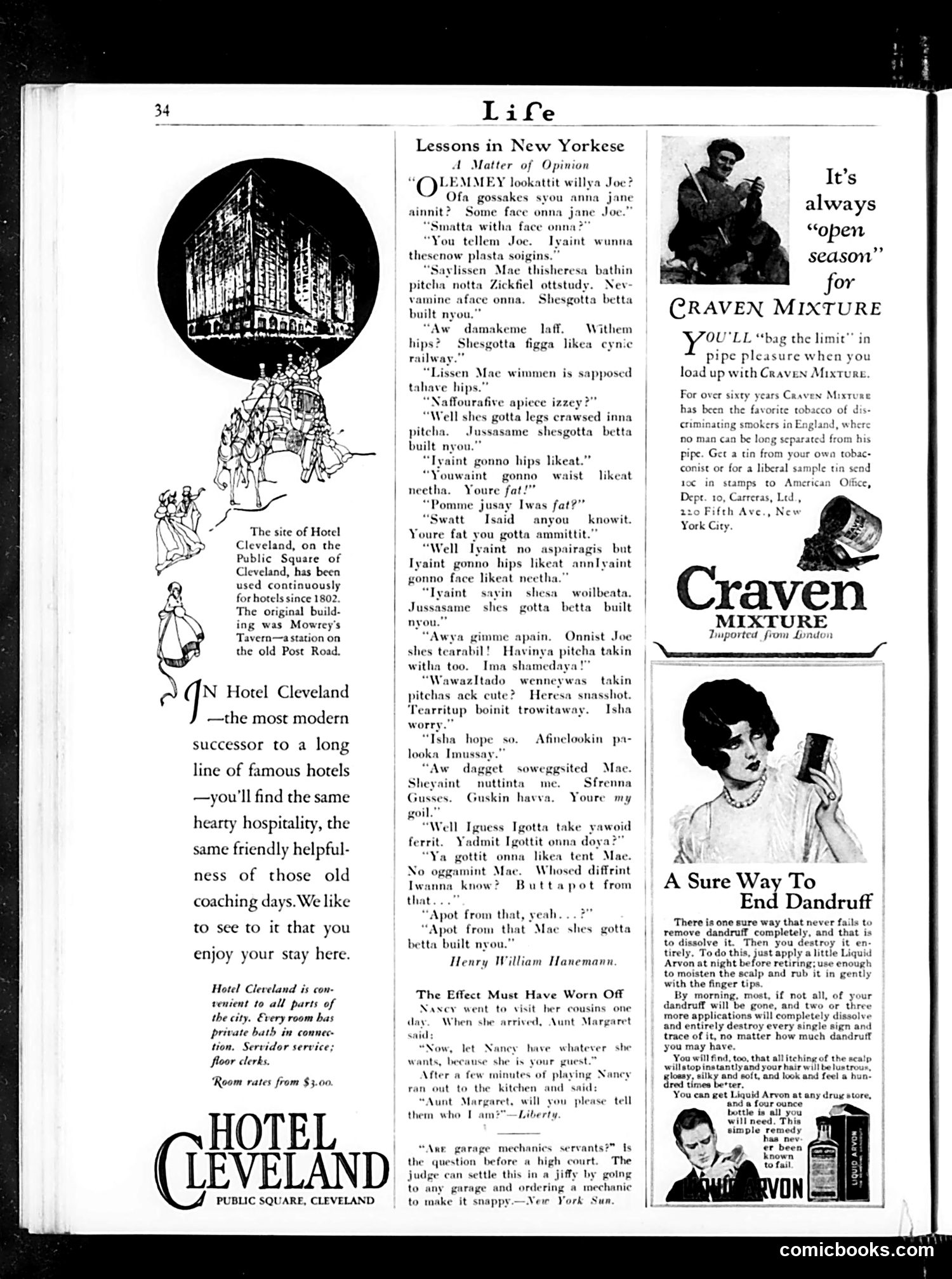
This page satirizes the distinctive speech patterns of working-class New Yorkers, particularly their accent and colloquialisms. The dialogue mocks characteristic features: dropped g's ("Lemmey," "Youre"), vowel shifts ("woisty," "goil"), and fast-paced, casual phrasing ("Smatta witha face?"). The humor centers on a conversation between "Joe" and "Mae" about a woman's appearance—specifically her figure and facial features. The speakers are depicted as common New Yorkers freely critiquing a woman's body with blunt, crude remarks ("Youre fat!"). The satire assumes readers (likely from outside New York or of higher social standing) would find this dialect comical and the characters' directness about a woman's appearance amusing or shocking. It reflects early 20th-century American humor that mocked regional accents and working-class speech patterns as inherently funny. The piece represents typical *Life* magazine content: gentle mockery of American social types through exaggerated dialect and situation comedy.
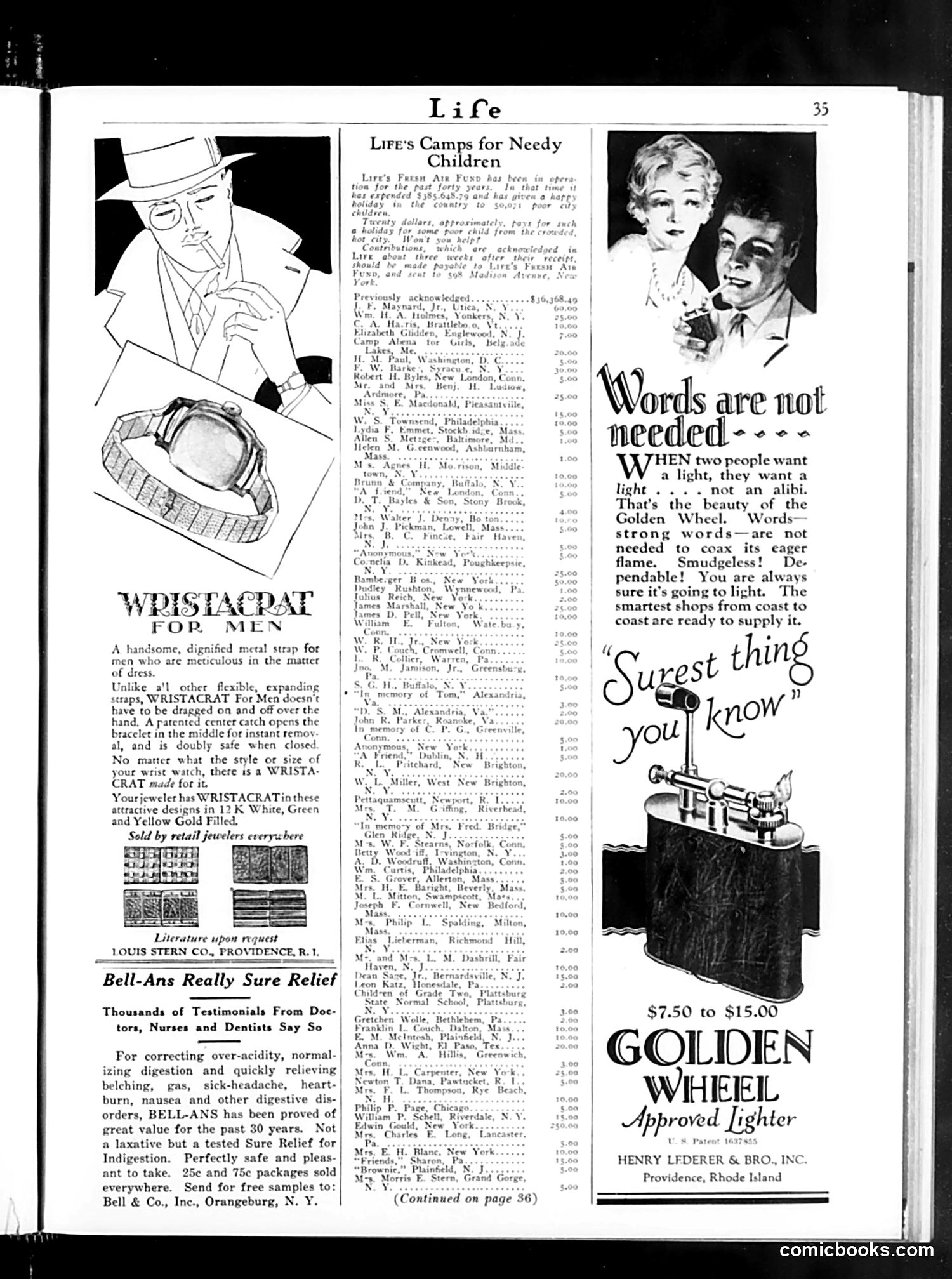
This page is primarily **advertising**, not political satire. It contains three distinct product advertisements: 1. **Wristacrat** (top left): A men's watch bracelet with a patented clasp mechanism, marketed as a dignified accessory for well-dressed men. 2. **Bell-Ans** (bottom left): An antacid remedy claiming 30 years of use, promoted for digestive relief with testimonials from medical professionals. 3. **Golden Wheel Lighter** (right side): The dominant advertisement features a couple and emphasizes reliability—the lighter "always" works without need for persuasion or excuses ("words are not needed"). The page also includes a partial list of donors to **Life's Fresh Air Fund camps for needy children**, a charitable initiative. No political cartoon or satire appears on this page. It represents typical 1920s-era consumer advertising emphasizing quality, reliability, and social respectability.
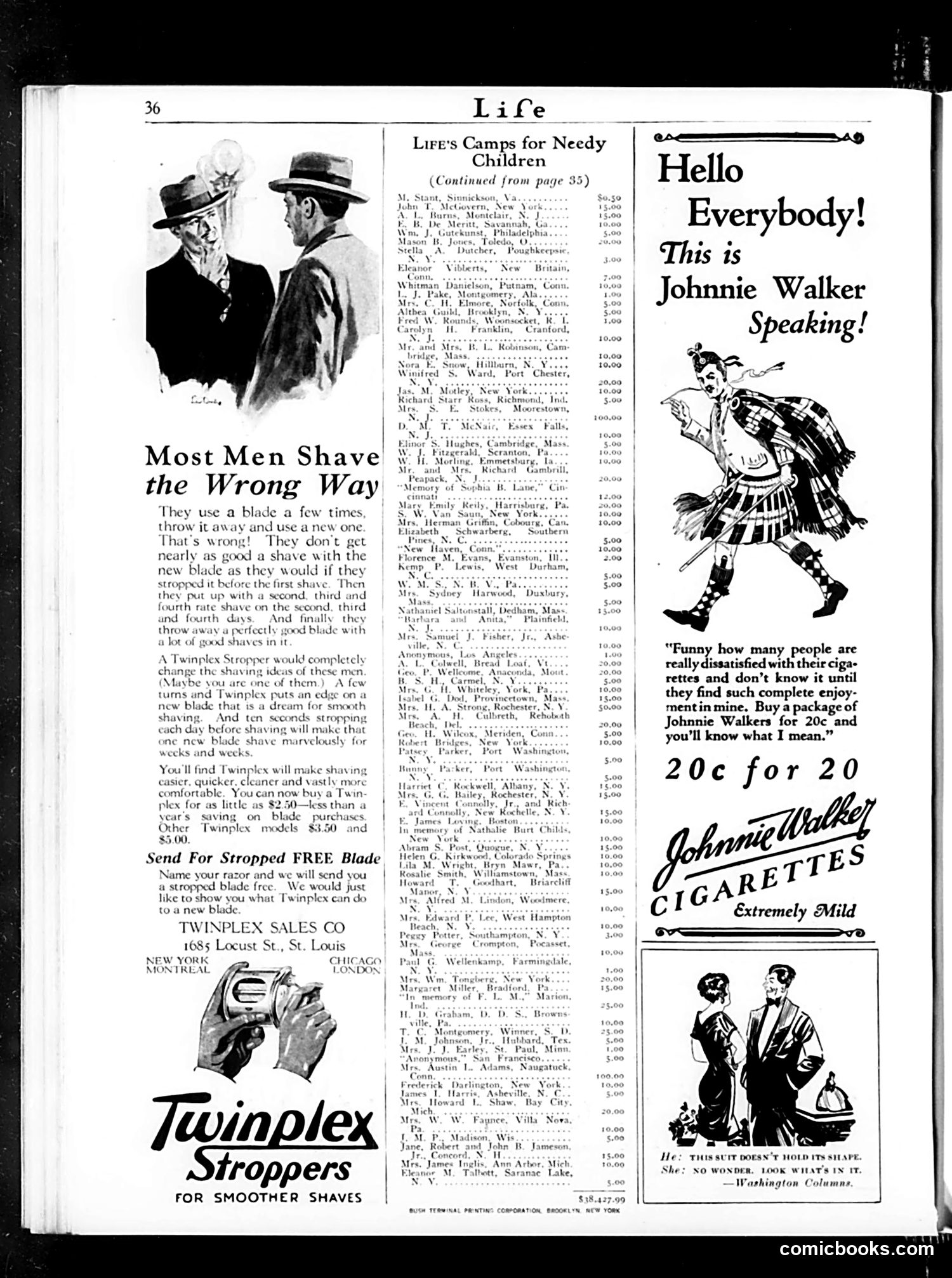
This page is primarily **advertising**, not editorial content or political satire. **Main advertisements:** 1. **"Most Men Shave the Wrong Way"** — A Twinplex razor stropper ad arguing that men waste money by discarding dull blades instead of stropping them. It's a practical consumer pitch about shaving efficiency. 2. **"Hello Everybody! This is Johnnie Walker Speaking!"** — A Johnnie Walker cigarettes ad featuring a cartoon mascot character. The ad boasts the product's mildness and uses a testimonial format ("Funny how many people are really dissatisfied..."). This is straightforward product marketing. 3. **Bottom cartoon** — A small domestic humor panel about a suit not holding its shape, unrelated to political content. The page contains no political commentary or satirical cartoons. It's a commercial page from Life magazine filled with advertisements, including the famous Johnnie Walker cigarettes brand character and grooming product promotions typical of 1920s magazine content.
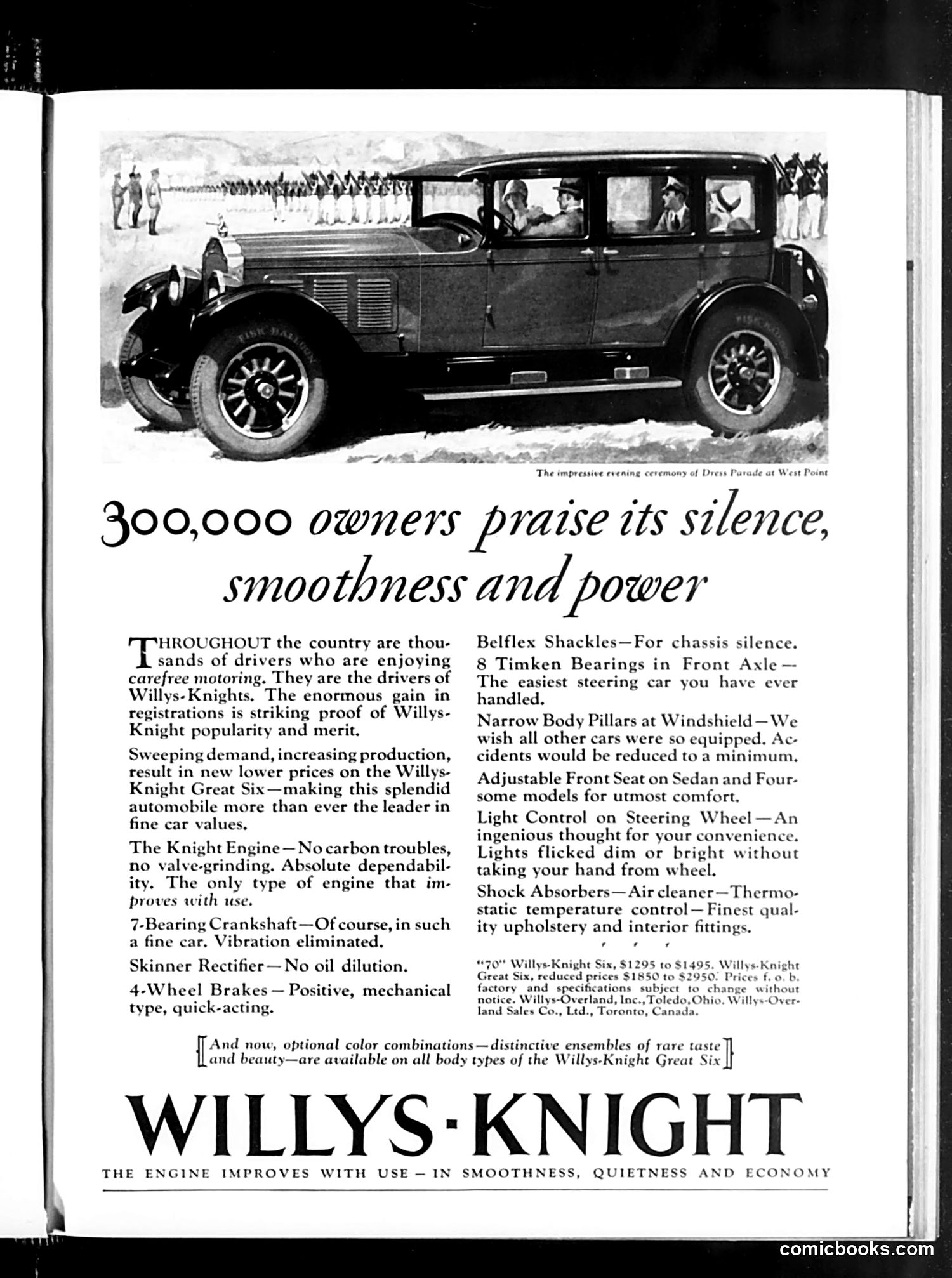
This is **not a cartoon or satire**—it's a straightforward automobile advertisement for the Willys-Knight Great Six, a luxury car of the 1920s-30s era. The page features a photograph of the elegant sedan with passengers visible through multiple windows, positioned above West Point military cadets in dress parade (the caption reads "The impressive evening ceremony of Dress Parade at West Point"). This juxtaposition associates the automobile with military precision, discipline, and American prestige. The advertisement emphasizes technical innovations: a "Knight Engine" requiring no valve-grinding, 7-bearing crankshaft, 4-wheel brakes, and shock absorbers. The headline claims 300,000 owners praise its "silence, smoothness and power"—key selling points for 1920s-30s automobiles competing on engineering quality. The pairing with West Point imagery suggests the car embodies American excellence and reliability, appealing to affluent buyers valuing both innovation and tradition.
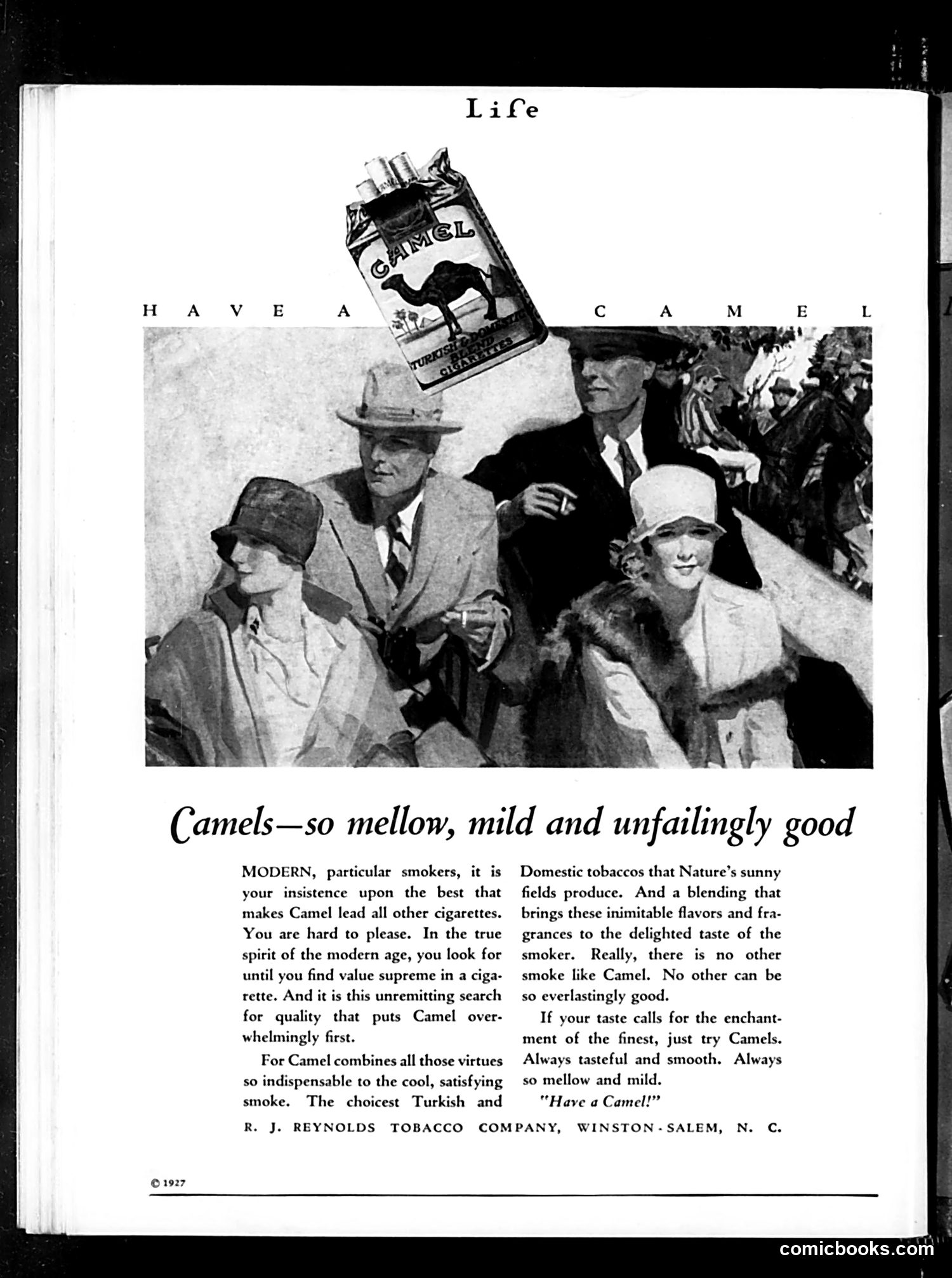
This is a **Camel cigarette advertisement**, not satire or political commentary. Dated 1927, it uses a photograph of well-dressed men and women in 1920s attire and hats to market cigarettes as a luxury product associated with sophistication and modernity. The ad targets "modern, particular smokers" by emphasizing quality and refinement. The tagline "Have a Camel!" and repeated claims of being "mellow, mild and unfailingly good" appeal to aspirational consumers seeking status through tobacco consumption. **Historical context for modern readers**: This predates the Surgeon General's 1964 warning on smoking's health dangers. Cigarette advertising in mainstream magazines was standard and used lifestyle imagery to normalize smoking among affluent audiences. The gendered presence of women in the photo reflects early 20th-century marketing's gradual shift toward female smokers.