
Life, 1927-10-06 · page 28 of 40
Life — October 6, 1927 — page 28: what you’re looking at
What you’re looking at
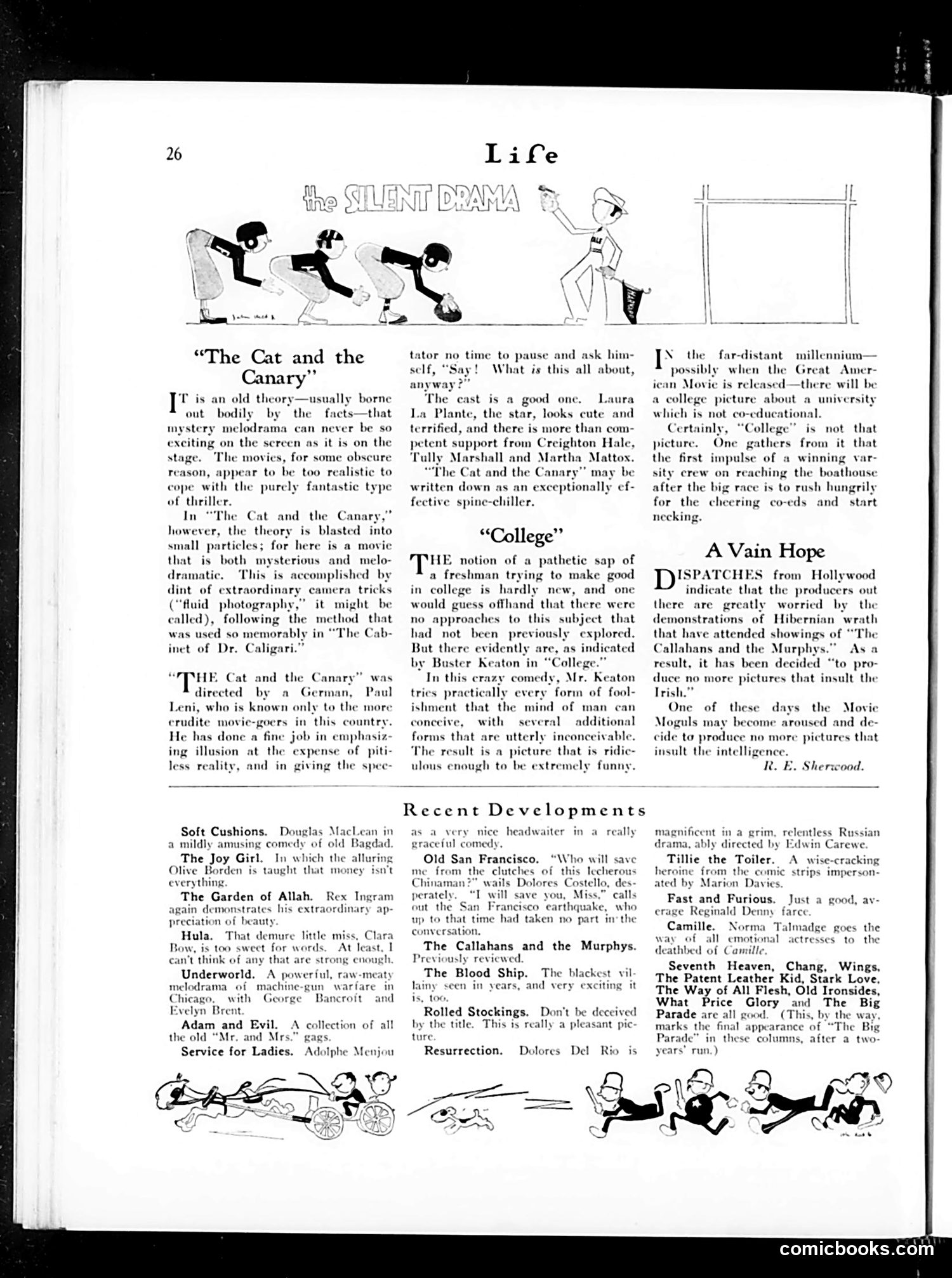
This page reviews recent films, with two main articles highlighted: **"The Cat and the Canary"** critiques how mystery thrillers translate from stage to screen. The reviewer argues that while movies are typically *too realistic* for fantastic thriller plots, director Paul Leni (a German filmmaker) successfully uses expressionistic techniques ("fluid photography," referencing *The Cabinet of Dr. Caligari*) to create an effectively suspenseful film despite its theatrical origins. **"College"** reviews Buster Keaton's film about a college student attempting various foolish schemes. The satire targets college movie clichés—the reviewer sarcastically notes the film depicts winning athletes' first instinct after victory is to rush toward female students ("co-eds") for "necking" (kissing/romance), suggesting such narratives are predictable and emphasize romantic conquest over education. The "Recent Developments" section briefly reviews other current films, including noting Irish-American concerns about *The Callahans and the Murphys*, indicating ethnic representation issues in early cinema.
📄 Transcribed text from this page (OCR, searchable)
Machine-transcribed from the original scan — historical spelling and the odd misread are preserved.
“The Cat and the Canary” [© is an old theory—usually borne out bodily by the facts—that mystery melodrama can never be so exciting on the sereen as it is on the stage. The movies, for some obscure reason, appear to be too realistic to cope with the purely fantastic type of thriller. In “The however, the small particles; is a movie that is both and melo- dramatic. ‘This is accomplished by dint of extraordinary (“fluid photography, called), following the was used so memora inet of Dr. Caligari.” Cat and the Canary,” theory is blasted into for here mysterious Cat and the Canary” was ted by a German, Paul Leni, who is known only to the more erudite movi He has done ing illusion less reality, ers in this country. a fine job in emphasiz- at the expense of piti- and in giving the spec- Soft Cushions. Douglas MacLean in a mildly amusing comedy of old Bagdad. The Joy Girl. In which the alluring Olive Borden is taught that money isn’t everything The Garden of Allah. Rex Ingram » demonstrates his extraordinary ap- reciation of beauty Hula. That demure little miss, Clara Bow, is too sweet for words. At least, 1 can't think of any that are strong enough. Underworld. melodrama of Chicago, with Evelyn Brent Adam and Evil. A collection of all the old “Mr, and Mrs.” gags. Service for Ladies. A powerful, raw-meaty machine-gun warfare in George Bancroft and Adolphe Menjou tator no time to pause and ask him- What is this all about, The cast is a good one. ira a Plante, the star, looks cute and terrified, and there is more than com- petent support from Creighton Hale, Marshall and Martha Mattox. nd the Canary” may be un exceptionally ef- hiller. fective spine “College” HE notion of a pathetic sap of a freshn trying to make good in college is hardly new, and one would guess offhand that there were no approaches to this subject that had not been previously explored. But there evidently are, as indicated by Buster Keaton in “Collegi In this crazy comedy, Mr. Keaton tries practically every form of fool- ishment that the mind of man can conceive, with several additional forms that are utterly ale The picture that is rid ulous enough to be extremely funny. result is Recent Developments as a nice graceful comedy, Old San Francisco. “Who will save me from the clutches of this lecherous Chinaman?" wails Dolores Costello, des- perately. “I will save you, Miss.” calls out the San Francisco earthquake, who up to that time had taken no part inthe conversation, The Callahans and the Murphys. Previously reviewed. The Blood Ship. The blackest vil lainy seen in years, and very exciting it Rolled Stockings. Don't be deceived by the title. This is really a pleasant pic ture Resurrection. very headwaiter in a really Dolores Del Rio is N the far-distant —millennium— possibly when the Great Amer- ican Movie is re ed—there will be a college picture about a university which is not co-educational. Certainly, “College” is not that picture. One gathers from it that the first impulse of a winning var- sity crew on reaching the boathouse after the big race is to rush hungrily for the cheering co-eds and. start necking. A Vain Hope ISPATCH from Hollywood indicate that the producers out there are greatly worried by the demonstrations of Hibernian that have attended showings of Callahans and the Murphys.” result, it has been decided “to pro- duce no more pictures that insult the Trish.” One of these Moguls may become days the Movie ‘oused and de- cide to produce no more pictures that insult the intelligence R. E. Sherwood. nificent in a grim, relentless Russian drama, ably directed by Edwi Tillie the Toiler. A wise-cracking heroine from the comic strips imperson- d by Marion Davies Fast and euros: ewe. Just a good, av- Camille. Talmadge goes the way of all 1 actresses to the deathbed of Camille Seventh Heaven, Chang, Wings, The Patent Leather Kid, Stark Love, The Way of All Flesh, Old Ironsides, What Price Glory and The Big Parade are all good. (This, by the way, marks the final appearance of “The Big Parade” in these columns, after a two- years’ run.) ID comicbooks.com