
A complete issue · 36 pages · 1927
Life — July 28, 1927
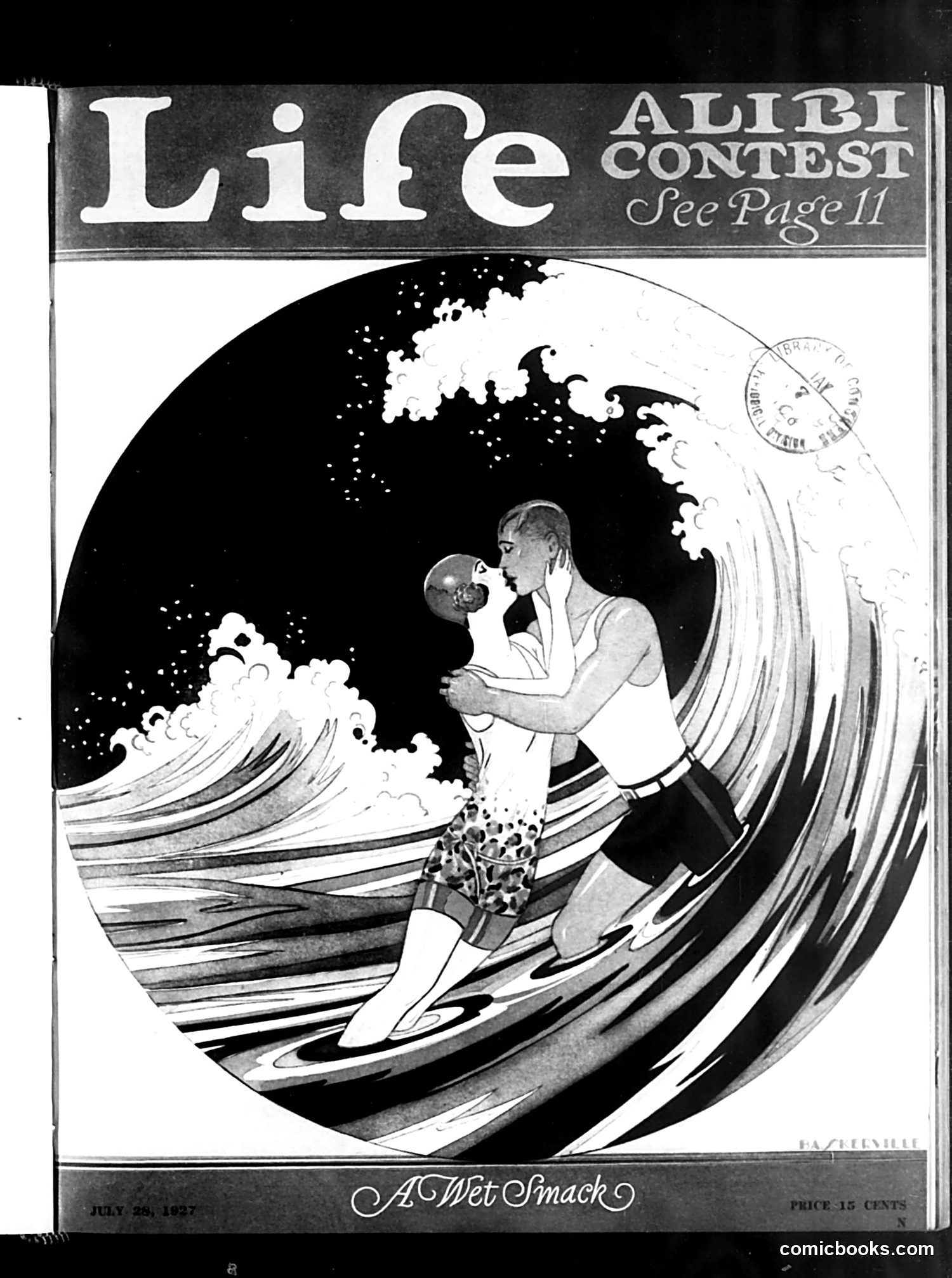
This cover depicts a man in swimming attire holding a globe while standing in ocean waves, titled "A Wet Smack." The reference is likely to **contemporary swimming or athletic achievement**, given Life's frequent coverage of sports and leisure activities in the 1920s. The "Alibi Contest" reference suggests readers submitted humorous excuses or explanations, a popular magazine feature of the era. The globe-holding pose may satirize either inflated athletic ego or competitive boasting common in sports journalism. Without clearer identifying features, the specific figure remains unclear—possibly referencing a notable swimmer or athlete of 1927. The overall tone is lighthearted mockery of masculine bravado and sporting pretension typical of Life's satirical approach to American culture.
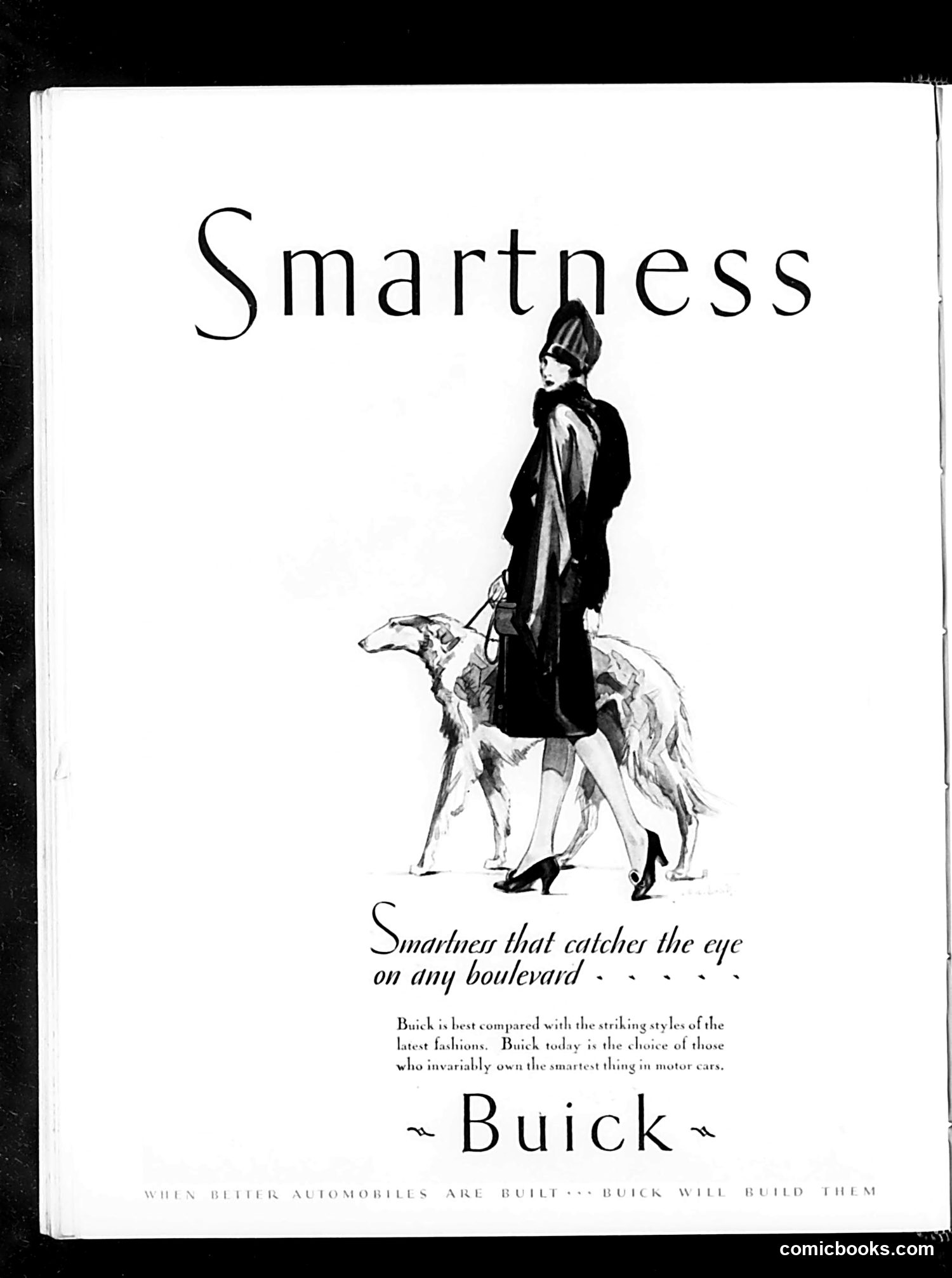
This page is **primarily an advertisement**, not satire or political commentary. It's a Buick automobile ad from an era (likely 1920s-30s based on style) when car advertising frequently emphasized fashion and lifestyle. The ad features an elegantly dressed woman in fashionable attire standing with two greyhound dogs. The tagline "Smartness that catcher the eye on any boulevard" associates Buick ownership with sophistication and social status. The text claims Buick represents "the choice of those who invariably own the smartest thing in motor cars"—equating the car with high fashion and refined taste. This was common marketing strategy: selling automobiles as fashion statements and status symbols rather than merely as transportation. There is no political satire present on this page.
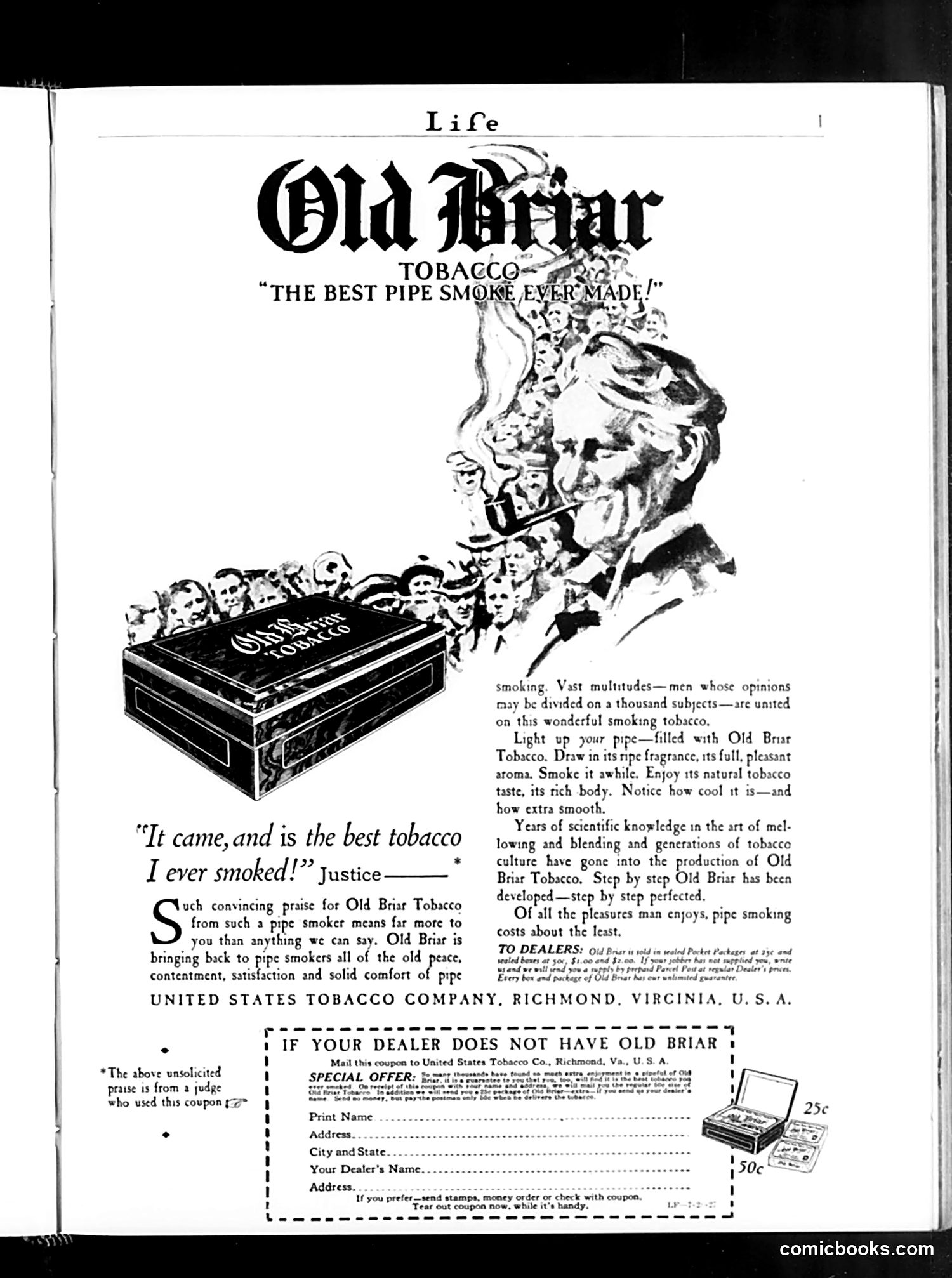
This page is primarily a **tobacco advertisement**, not political satire. It features Old Briar Tobacco marketed as "the best pipe smoke ever made" by the United States Tobacco Company of Richmond, Virginia. The imagery shows an elderly man with a pipe surrounded by smaller faces emerging from a tobacco box, suggesting the product appeals to diverse demographics. The quoted endorsement—"It came, and is the best tobacco I ever smoked!"—is attributed to "Justice" (likely a generic reference rather than a specific person). The ad emphasizes the tobacco's quality, smooth smoking experience, and affordability. A coupon at the bottom offers a special deal for dealers without stock. This represents straightforward early 20th-century commercial advertising, not editorial content or satire.
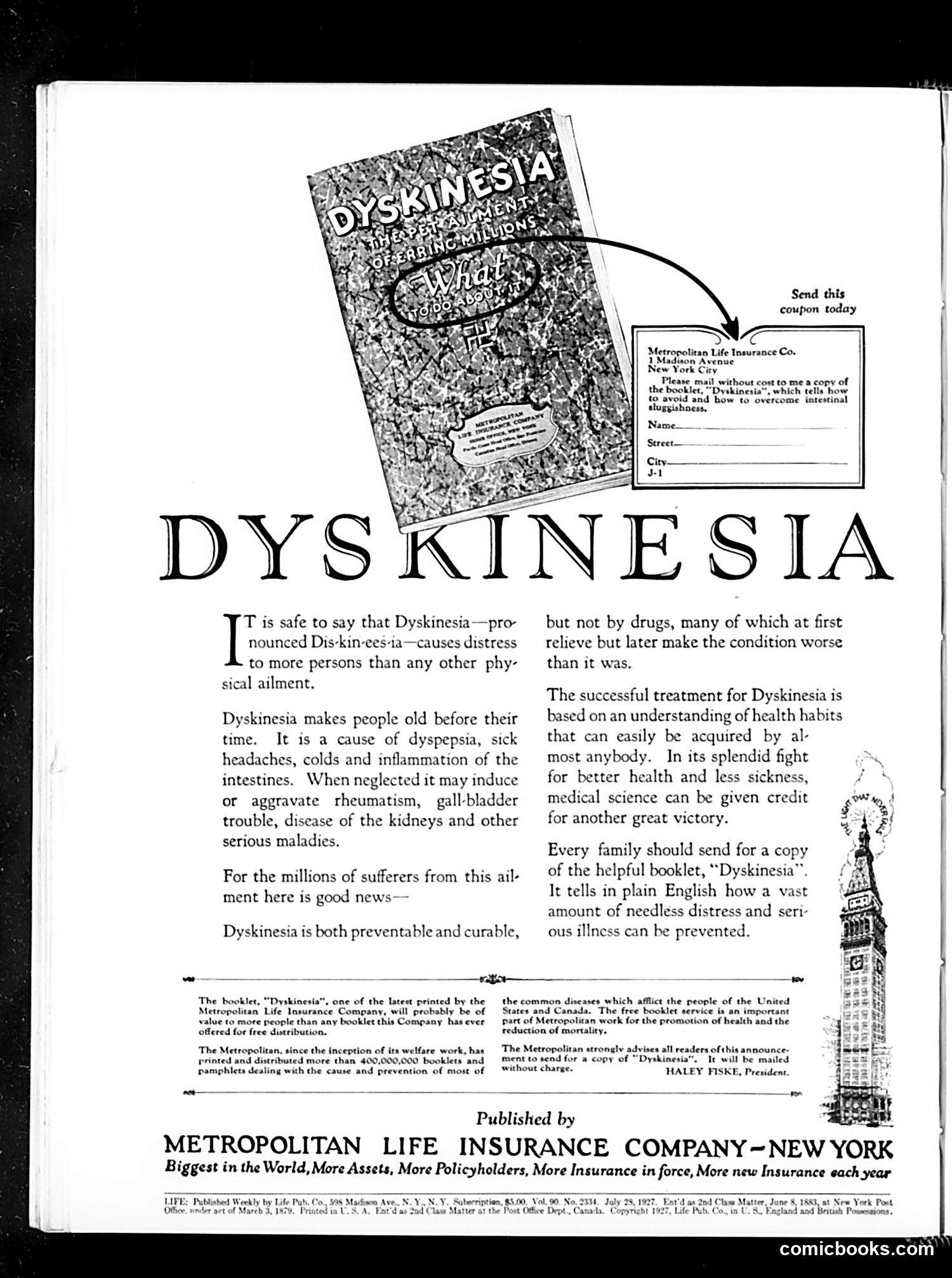
This page is **primarily an advertisement**, not satire or political commentary. The Metropolitan Life Insurance Company uses the page to promote a free booklet about "Dyskinesia"—a real medical condition involving digestive and intestinal problems. The ad emphasizes that dyskinesia is "preventable and curable" through proper health habits rather than drugs. There is no cartoon or caricature. The only illustration is the company's building (the iconic Metropolitan Life Tower in New York). The coupon invites readers to request the free booklet. The ad reflects early 20th-century insurance company marketing: positioning themselves as public health educators and trustworthy institutions promoting wellness. This was standard practice for major insurers of the era seeking to build corporate reputation and customer goodwill.
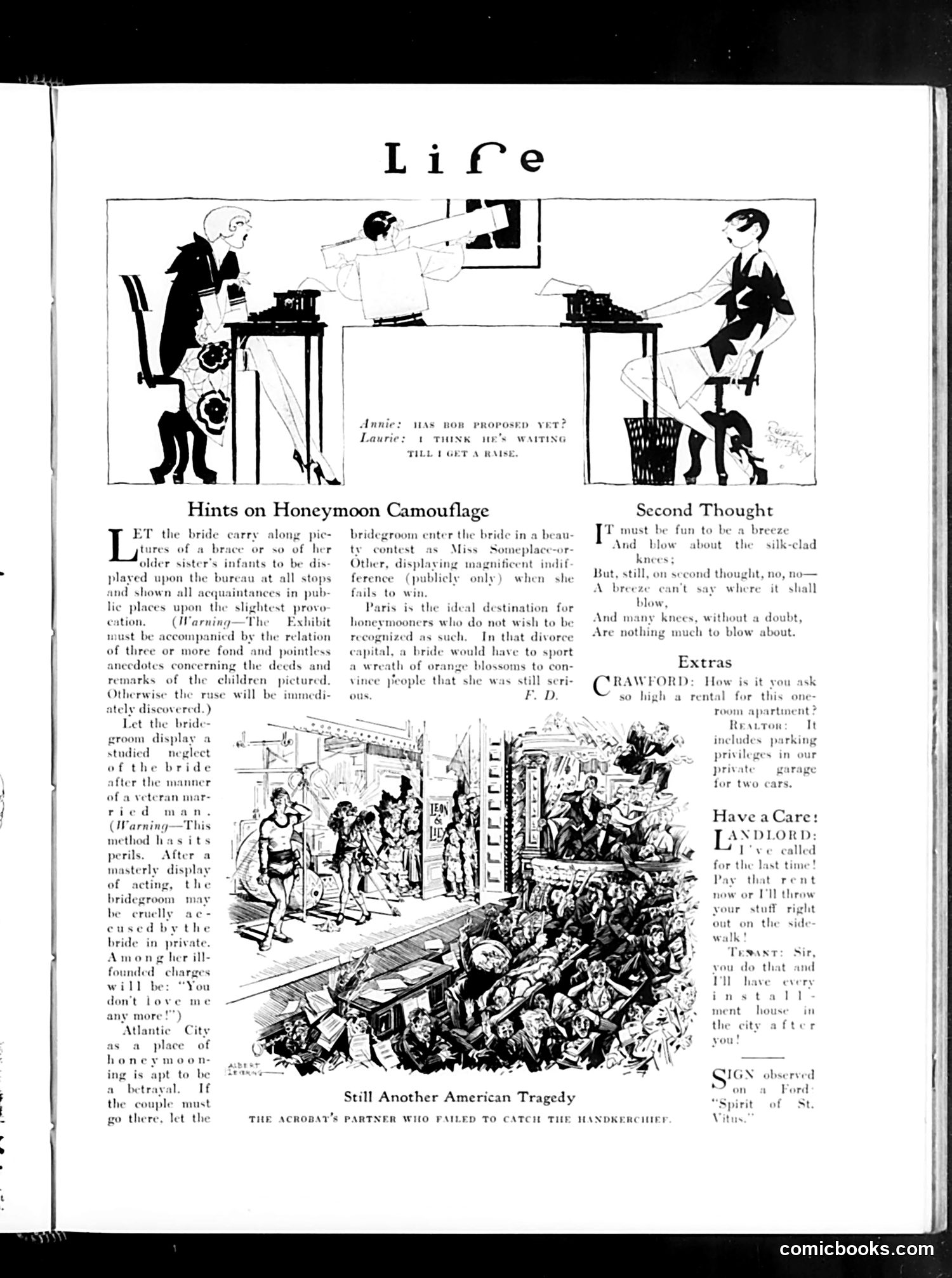
This page contains three satirical pieces from an early 20th-century Life magazine: **Top cartoons** mock honeymoon expectations versus reality—the left shows a bride arriving with elaborate trousseau; the right depicts practical concerns about affording a home. **"Hints on Honeymoon Camouflage"** satirizes newlyweds' desire to hide their honeymoon destination to avoid being recognized and pranked by friends—a common practice of the era. **"Still Another American Tragedy"** depicts an acrobat's failed attempt to catch a handkerchief, suggesting physical comedy mishaps. **"Have a Care" and "Extras"** contain brief humorous dialogues about rental apartments and car storage—typical urban middle-class concerns of the period. The page overall reflects Life's focus on satirizing contemporary marriage customs, urban living, and social pretensions among the American middle class.
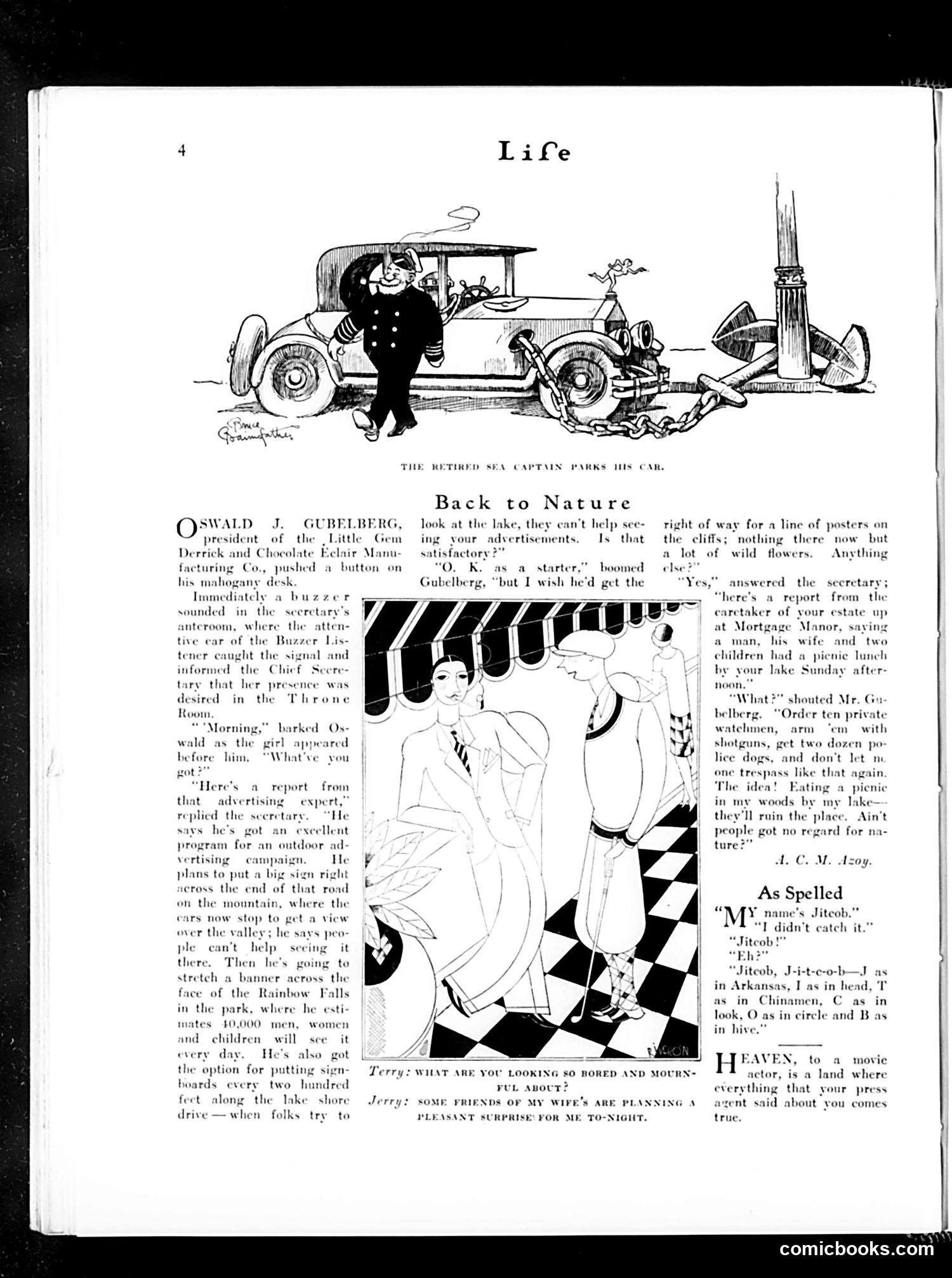
This page contains three distinct pieces of humor from what appears to be the 1920s era. **Top cartoon:** "The Retired Sea Captain Parks His Car" depicts an elderly man with a nautical background attempting to park an automobile—a vehicle he apparently doesn't understand. The joke plays on generational disconnect: older people struggling to adapt to new technology. **"Back to Nature" story:** A businessman (Oswald Gubelberg) wants to advertise on rural cliffs and hold picnics on his private lake. His secretary's objection—that outsiders and children will trespass—satirizes how wealthy industrialists romanticize "nature" while resisting actual public use. **"As Spelled" and "Heaven":** Brief wordplay jokes about names and aspirational ideals. The page reflects 1920s anxieties about modernization, class tensions, and the gap between wealthy leisure aspirations and practical reality.
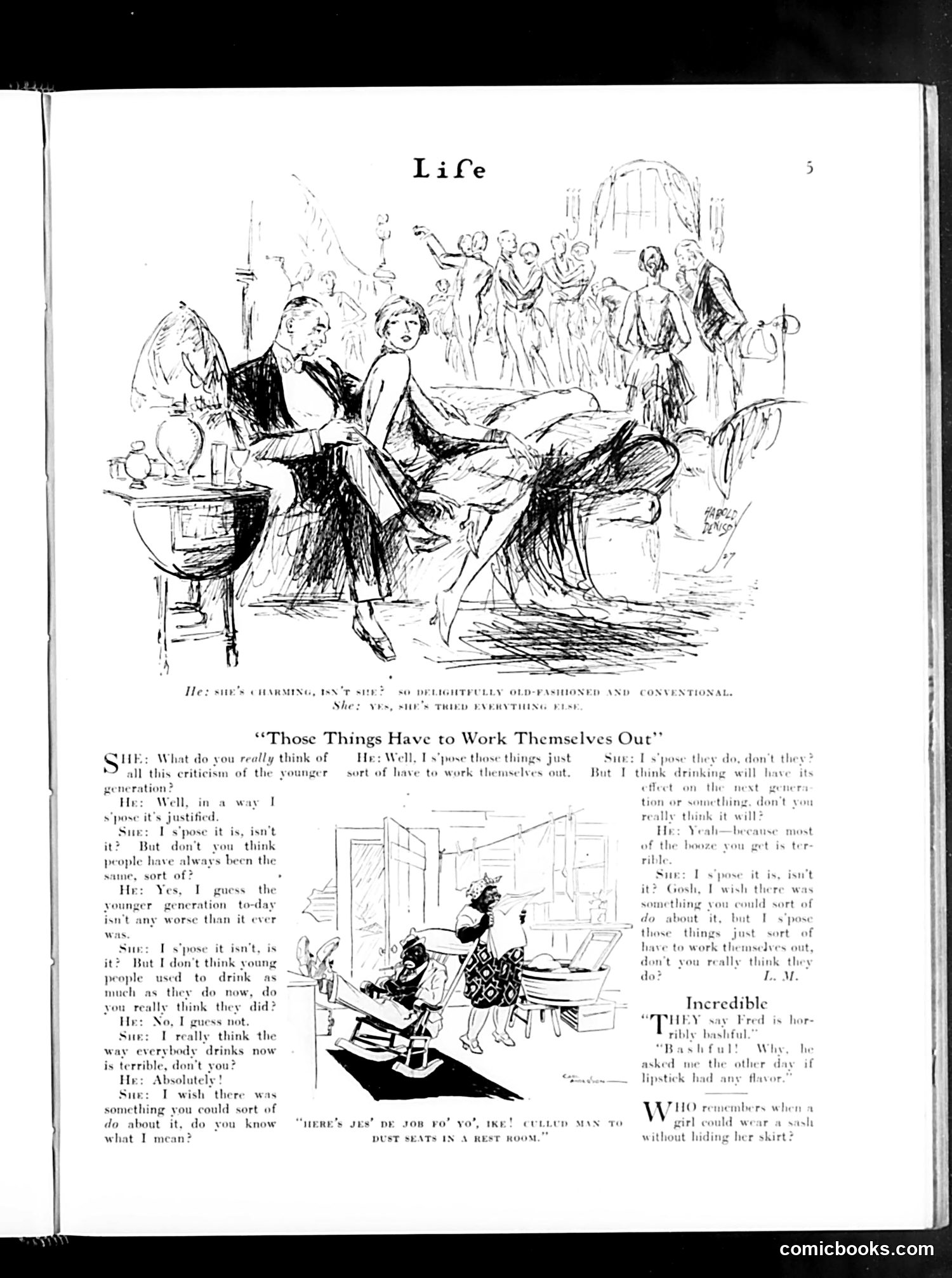
This satirical dialogue criticizes the younger generation's drinking habits. The cartoon depicts a social scene where a man and woman discuss whether youth drink more than previous generations. **The satire's point:** The woman defends young people, suggesting heavy drinking is inevitable and will "work itself out." The man counters that previous generations didn't drink as much. The humor lies in her resigned acceptance of alcohol abuse as an unavoidable social problem rather than something requiring intervention. **Context:** This reflects Prohibition-era concerns (pre-1920s) about youth morality and drinking. The "Incredible" sidebar mocks a man named Fred for wearing lipstick, suggesting anxieties about changing gender norms alongside concerns about moral decay. The overall message satirizes permissive attitudes toward youth vice.
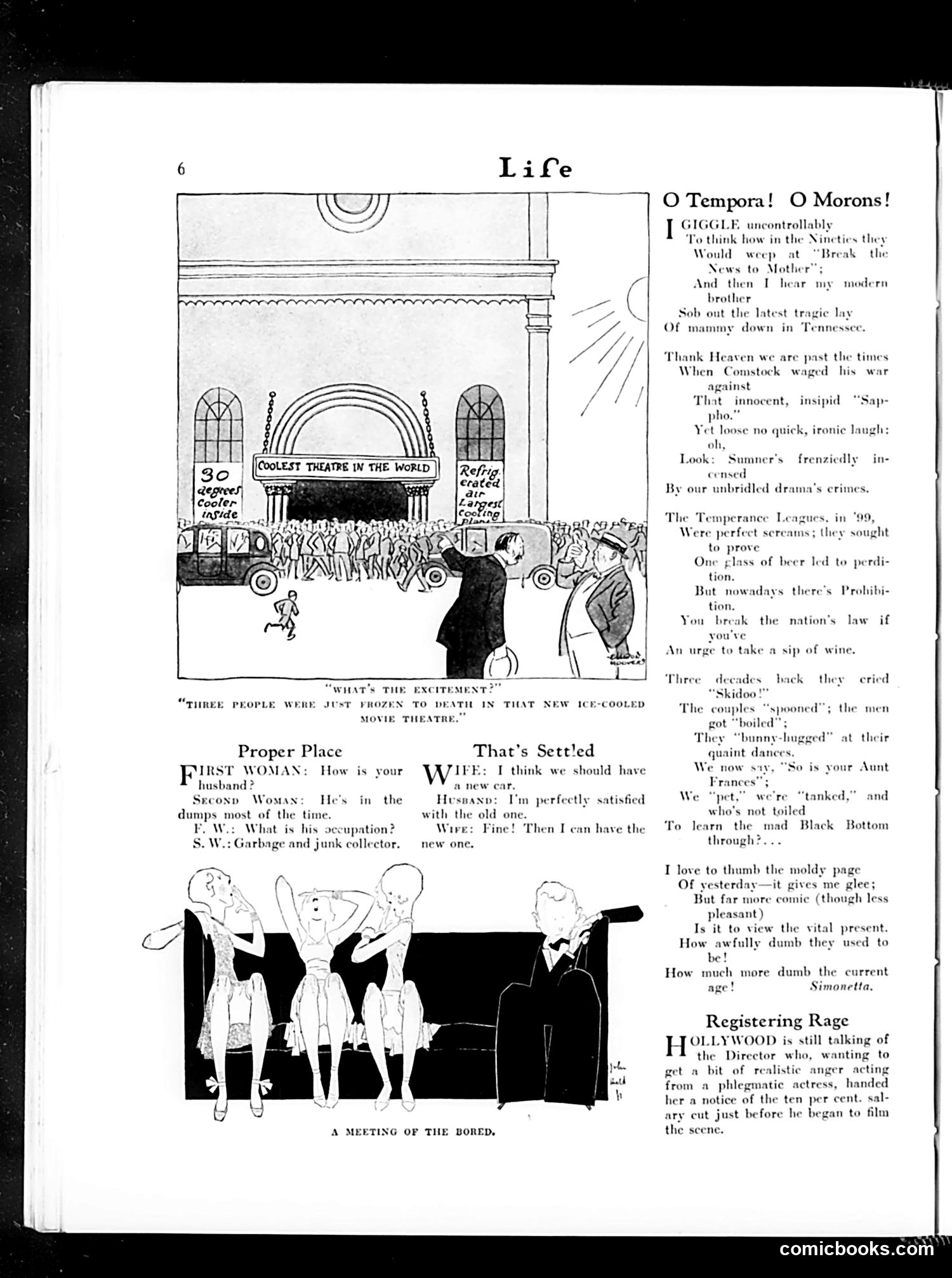
This page satirizes early 20th-century American social and cultural trends through multiple cartoons and commentary. **Top cartoon**: Mocks the "coolest movie theater" advertisement—showing a packed theater advertising ice-cooled air, with the caption highlighting the absurdity of people being "frozen to death" by new cooling technology. **Middle section "Proper Place"**: A domestic joke where a husband is a garbage collector, satirizing class consciousness and marital dynamics of the era. **"A Meeting of the Bored"**: Depicts upper-class figures sitting listlessly, mocking wealthy society's lack of meaningful engagement. **Right column poetry**: Nostalgic social commentary comparing past decades (references to "Comstock," Temperance Leagues, Prohibition) with modern times, suggesting the current age is paradoxically both more permissive and more foolish. The overall theme critiques technological novelty, class pretension, and social decline.
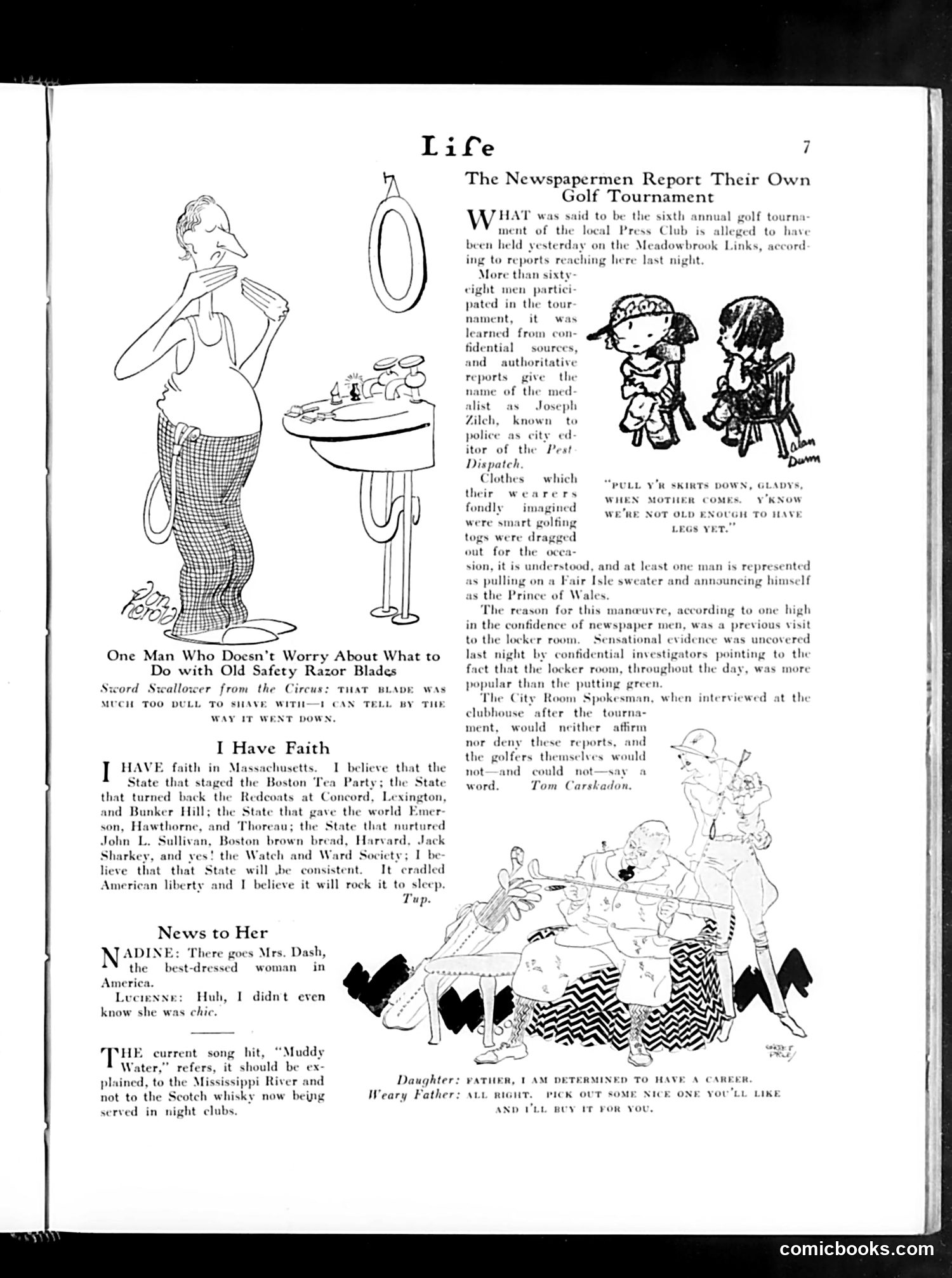
This page contains several satirical pieces typical of 1920s humor: **"One Man Who Doesn't Worry About What to Do with Old Safety Razor Blades"** shows a rotund man unconcerned about disposable razors—satirizing consumer anxieties about waste. **"The Newspapermen Report Their Own Golf Tournament"** mocks journalists covering a local Press Club golf event, suggesting they exaggerated participants' accomplishments and invented details (like calling one golfer "the Prince of Wales"). The satire critiques how newspapers sensationalize minor events through biased reporting. **Supporting cartoons** ridicule various social pretensions: women's fashion claims, parental ambitions, and domestic scenes. The overall tone mocks both contemporary consumer culture and journalistic integrity.
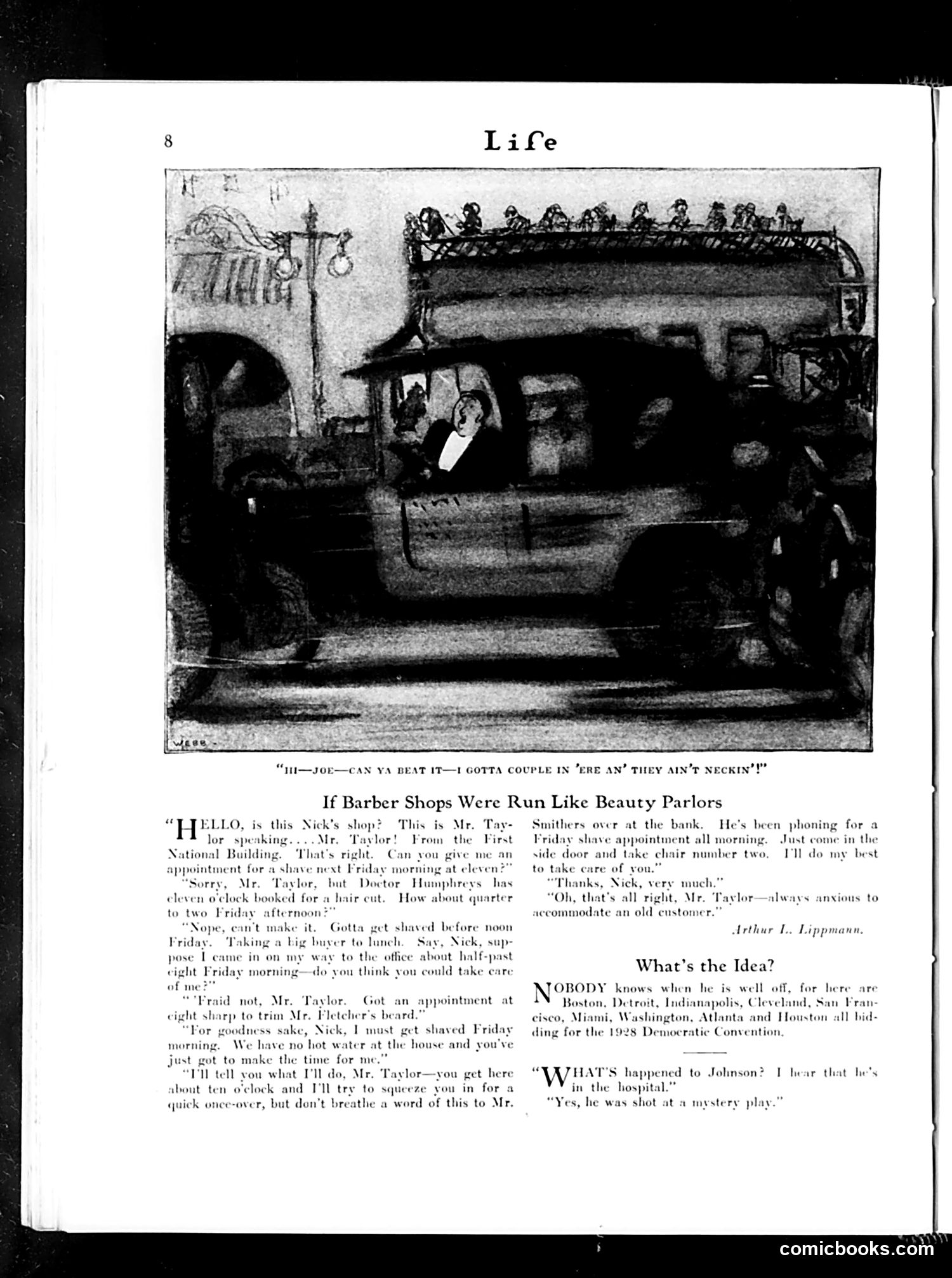
This cartoon satirizes the contrast between barber shops and beauty parlors through a humorous dialogue. A man named Nick (apparently a barber) is shown accommodating a customer's requests with the solicitous, appointment-focused service style typical of beauty parlors—scheduling precise times, offering to fit in extra clients, and prioritizing customer convenience over operational efficiency. The joke targets early 20th-century gender norms: beauty parlors were associated with leisured, pampered service for women, while barber shops served working men with quick, efficient service. The satire suggests that if barbers adopted beauty parlor courtesies—elaborate scheduling, personal attention, multiple services—it would be absurdly impractical for a male clientele expecting no-nonsense grooming.
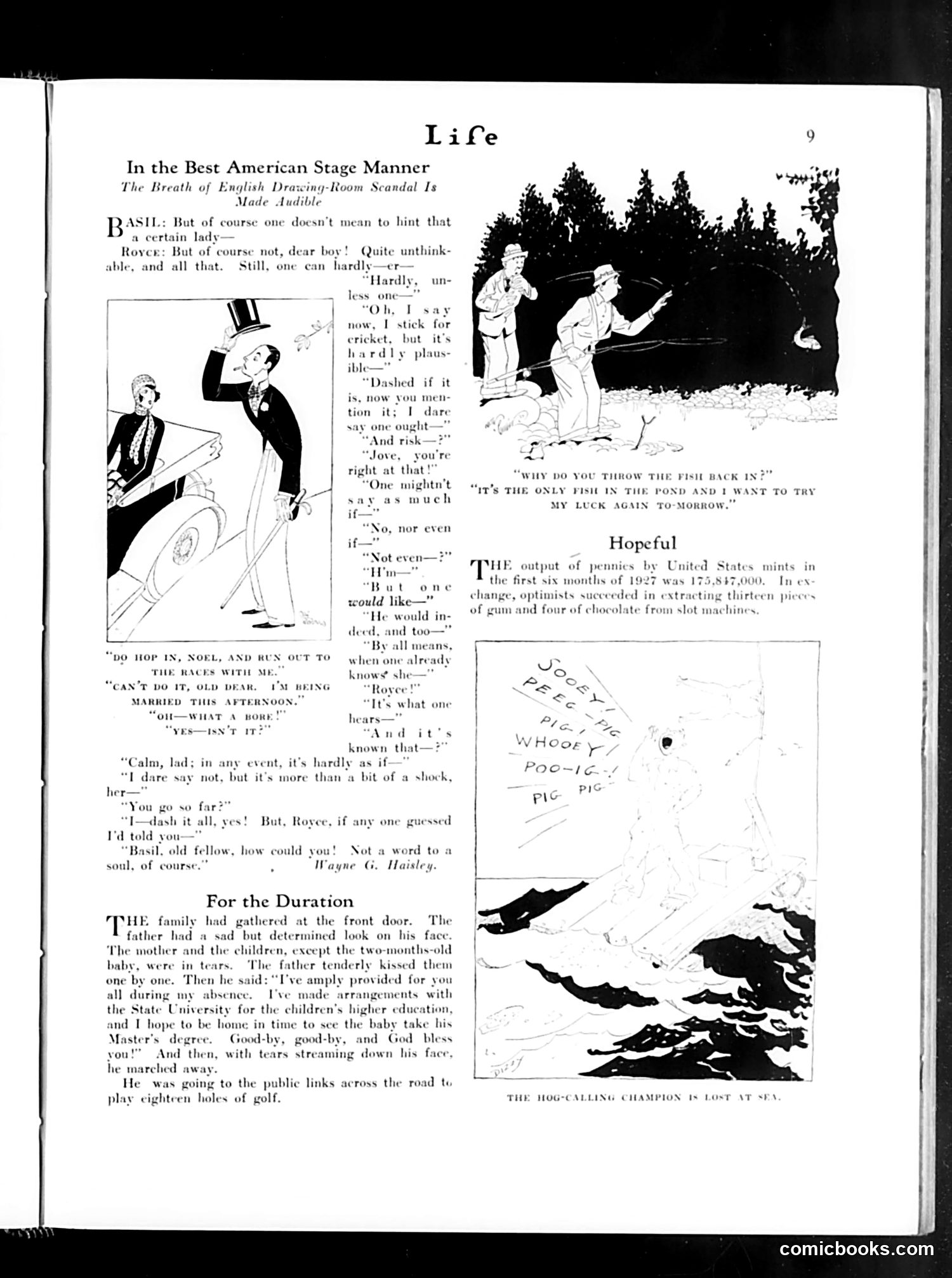
**Top Section ("In the Best American Stage Manner"):** A satirical dialogue between two men in formal dress about a drawing-room scandal. One character (Basil) hints at impropriety involving "a certain lady" and cricket, while the other (Royce) plays coy. The joke mocks overwrought theatrical conventions of the era—characters speak in affected, circumlocutory ways rather than directly addressing gossip. The byline credits Wayne G. Wasley. **"Hopeful" Cartoon:** A whimsical illustration showing a pig calling out to fish, apparently hoping to retrieve one from a pond. The caption suggests the pig's optimistic but futile attempt reflects broader themes of misplaced hope or expectation. **"For the Duration" Story:** A brief narrative about a father bidding emotional farewell to his family before departing for golf, framed solemnly as if he were leaving for war. The satire mocks the self-importance men attach to leisure activities.
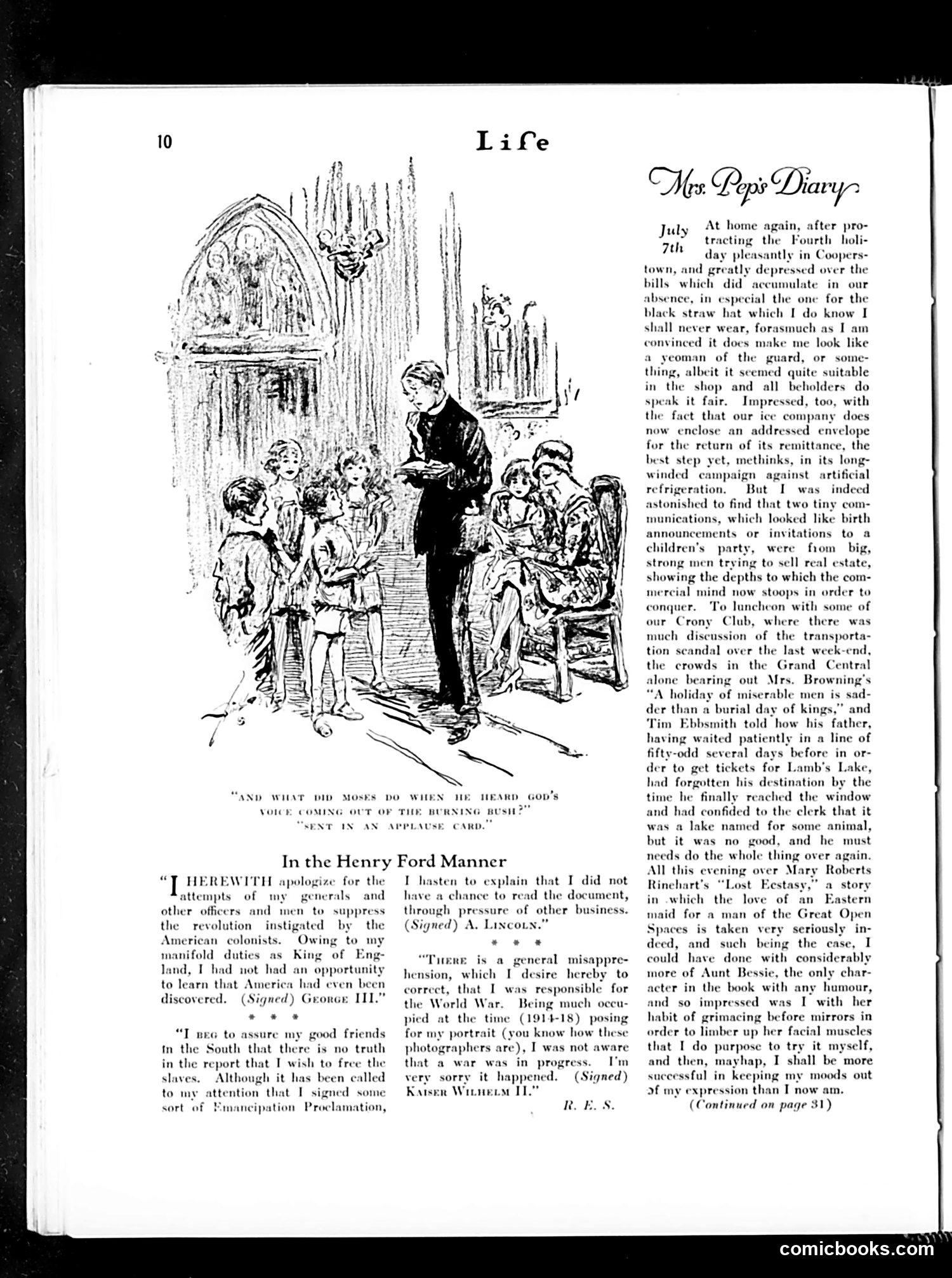
This page from *Life* magazine features a sketch depicting what appears to be a formal social gathering or children's party, with an adult man addressing several young children in an interior setting with a doorway visible. The accompanying diary entry by "Mrs. Peps" describes returning home after a holiday, finding accumulated bills, and attending a Crony Club luncheon where transportation scandals were discussed. References to "Mrs. Browning's holiday" and mentions of obtaining tickets suggest social commentary on wealthy circles and their frivolous concerns. The section "In the Henry Ford Manner" contains apologetic statements attributed to historical figures (Lincoln, George III, and Kaiser Wilhelm II) regarding their wartime actions—a satirical commentary on accountability and historical revisionism, likely from the WWI era.
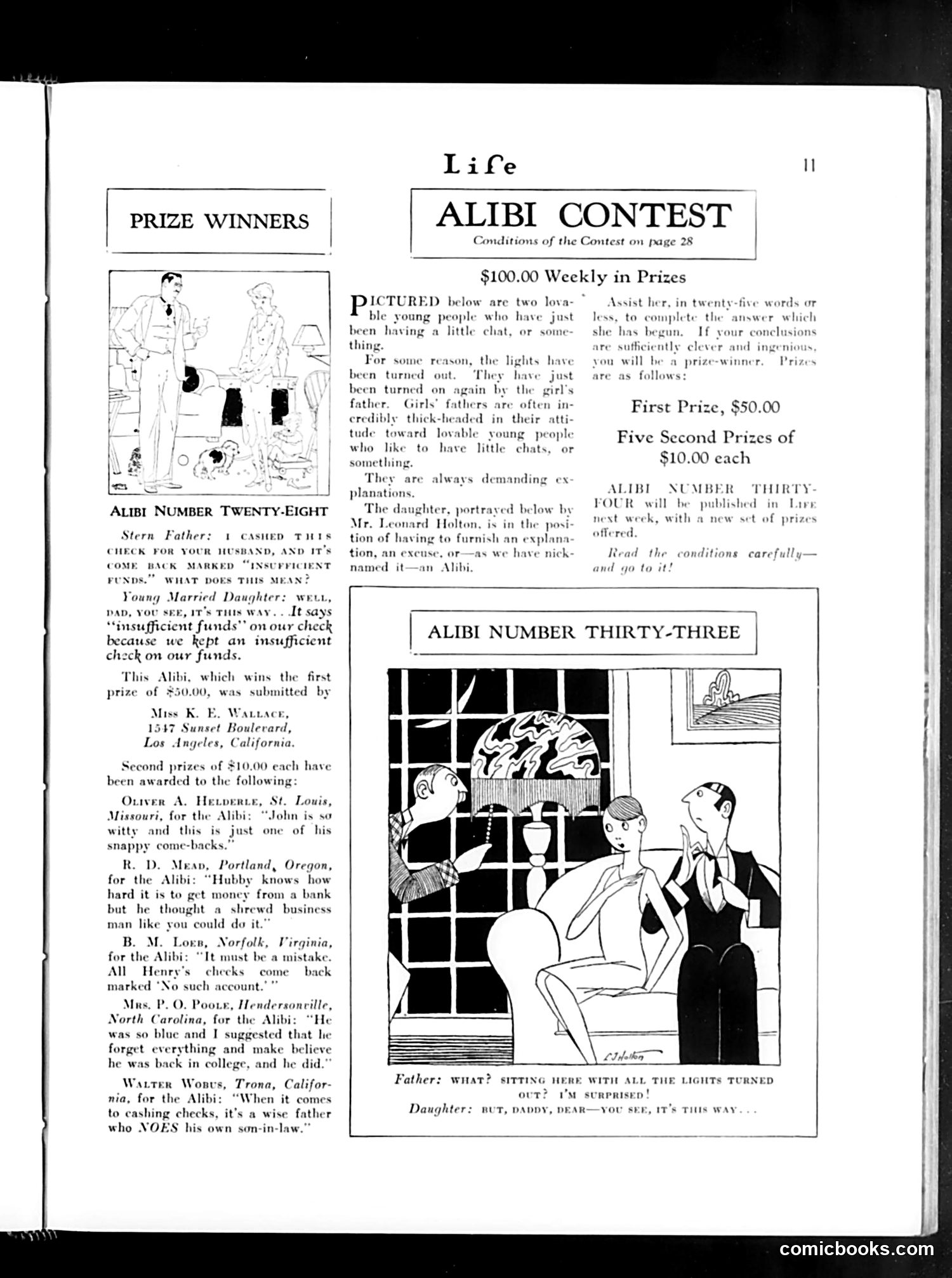
This page presents "Alibi Number Thirty-Three," a cartoon contest where readers submit humorous excuses (alibis) for everyday situations. The illustrated scenario shows a domestic scene: a father discovers his daughter sitting in a darkened room with a young man, the lights deliberately turned off. The daughter's caption reads: "But, Daddy, dear—you see, it's this way..." The humor relies on the obvious implication of impropriety (unsupervised intimate time with a suitor) and the daughter's attempt to fabricate an innocent explanation. Readers compete by submitting clever alibis under 25 words to explain the suspicious scenario. This reflects early-20th-century courtship anxieties and parental concerns about young women's behavior with unmarried men—a socially fraught subject of the era.
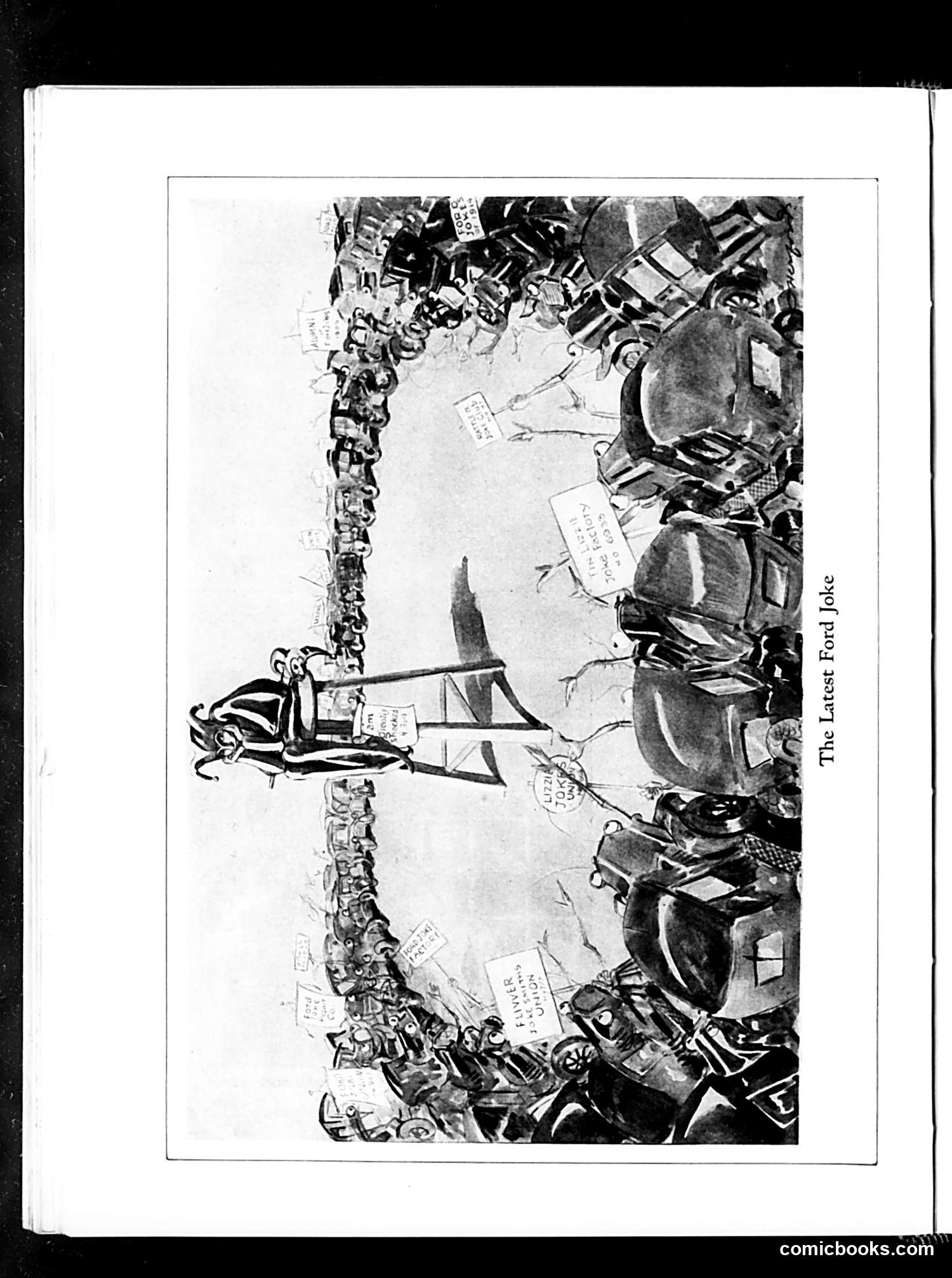
This appears to be a photograph or illustration of a large globe surrounded by Ford automobiles arranged in a circle. The caption reads "The Largest Ford Globe," suggesting this depicts a promotional or exhibition display showcasing Ford Motor Company's scale and reach. The image likely celebrates Ford's dominance in automobile manufacturing during the early-to-mid 20th century, when the company was at peak prominence. The arrangement of multiple vehicles around a globe symbolizes Ford's global manufacturing presence and market penetration. This appears to be documentation of an actual display or promotional event rather than political satire—a celebration of American industrial power and Ford's role in it.
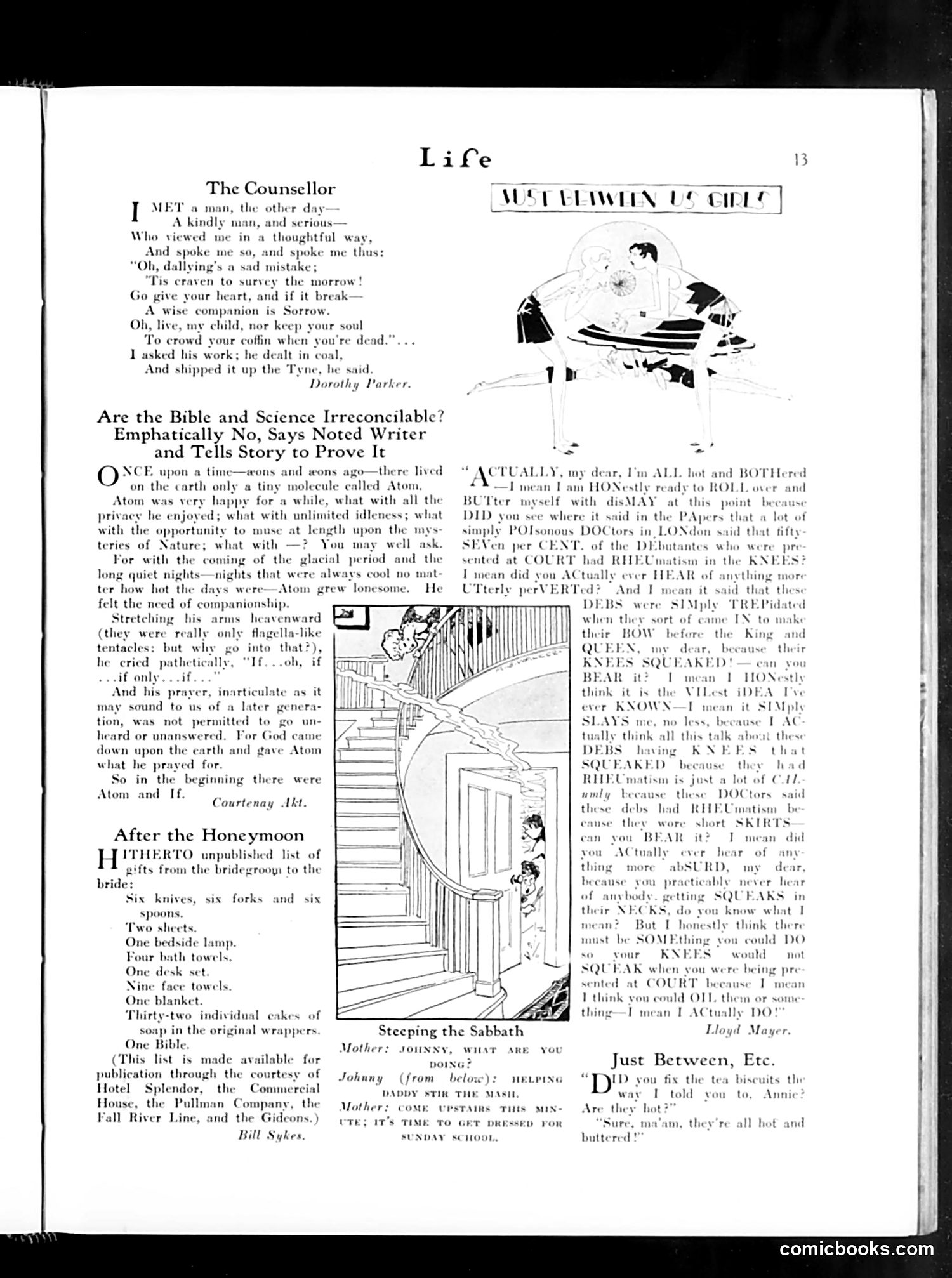
This page contains three distinct items: 1. **"The Counsellor"** — A poem by Dorothy Parker about a man offering life advice, emphasizing that sorrow and a wise companion are preferable to crowding one's coffin with possessions. 2. **"Are the Bible and Science Irreconcilable?"** — An article arguing they are not, featuring a story about "Atom" and "H" (likely representing hydrogen atoms), suggesting divine creation operates through natural laws. 3. **"Steeping the Sabbath"** — A cartoon showing a domestic scene where a mother instructs her son Johnny to dress for Sunday school while he's been "stirring the mash" (appears to reference alcohol-making during Prohibition). The humor targets both parental hypocrisy and Prohibition-era illegality. The cartoon implicitly mocks families observing religious propriety while engaging in illegal activities like home alcohol production.
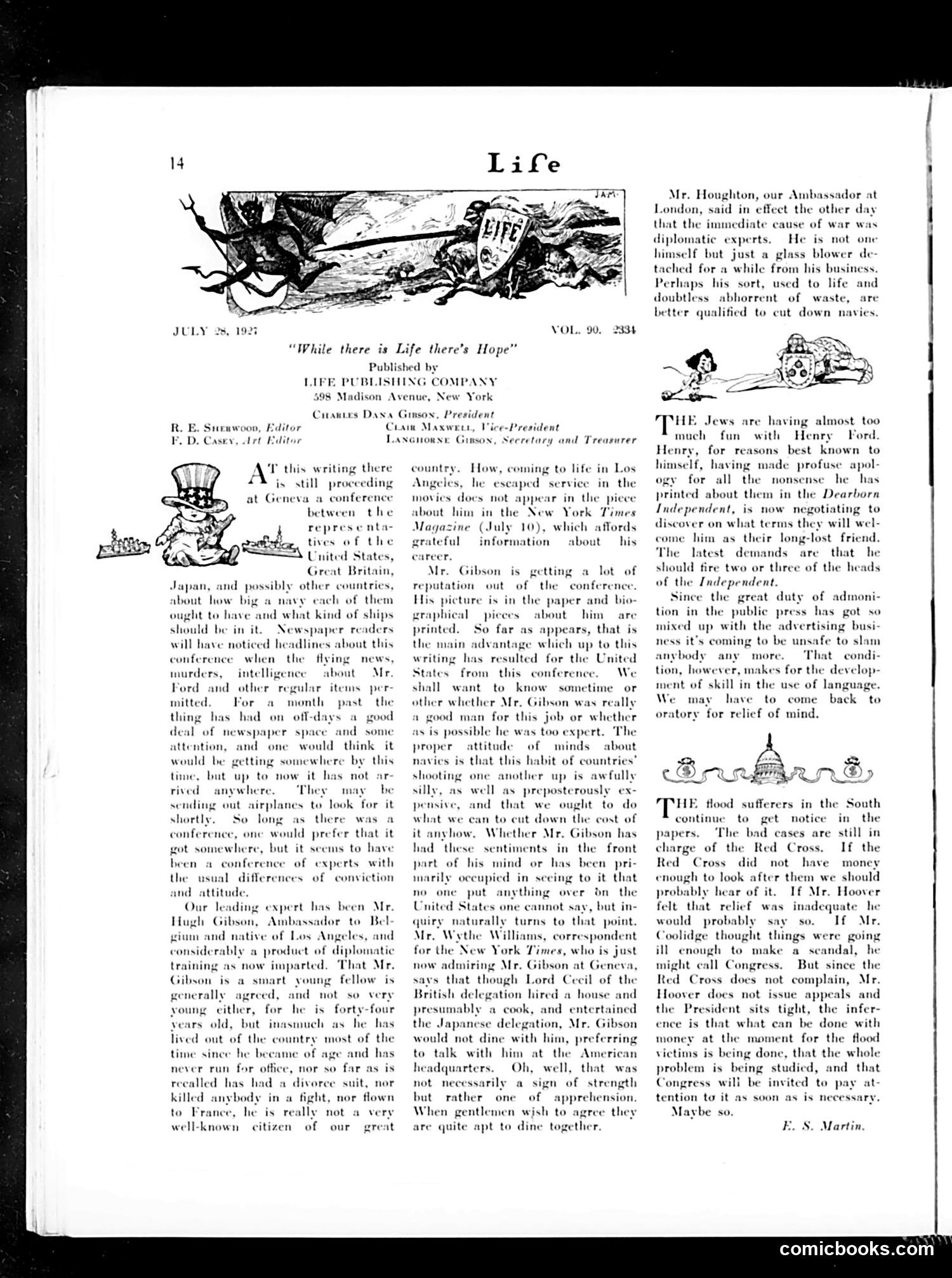
This page is primarily editorial commentary rather than political cartoon. The main illustration shows a skeletal "Life" figure holding a shield, representing the magazine's satirical voice. The editor discusses ongoing diplomatic conferences at Geneva involving representatives from the United States, Britain, Japan, and other countries regarding naval armaments and international relations. The commentary critiques Hugh Gibson (U.S. Ambassador to Belgium) regarding his role in these negotiations and his statements about naval policy. The editorial also addresses two domestic issues: Henry Ford's negotiations with the Independent newspaper, and flood relief efforts in the American South through the Red Cross. The tone is characteristic of Life's satirical commentary on contemporary politics and diplomacy, though it requires historical knowledge of these specific 1925 events to fully appreciate.
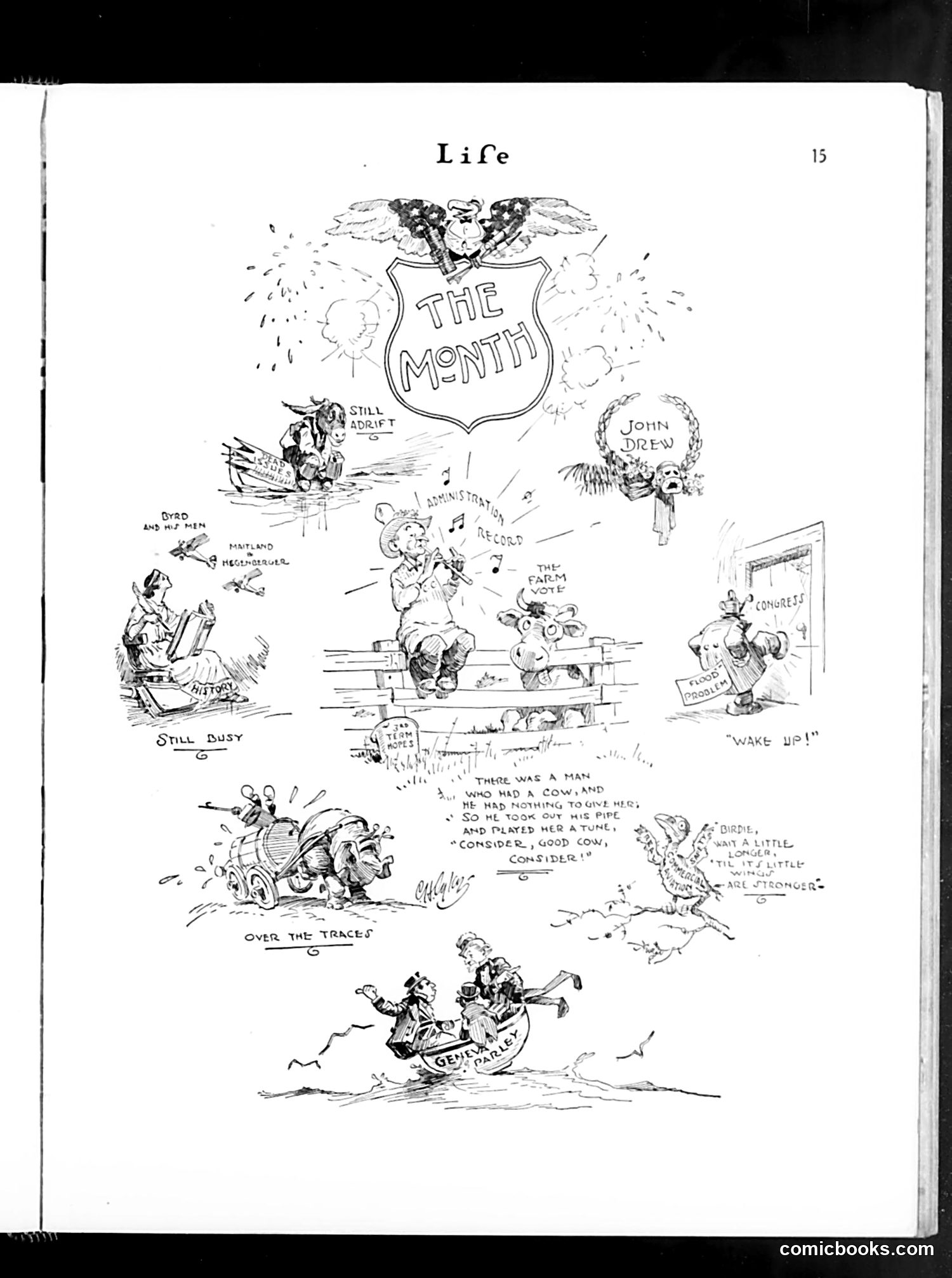
This page presents interconnected satirical vignettes on American political and social issues. Central figures include caricatures labeled "Still Adrift" (appears to reference an uncertain political position), "John Drew" (likely a contemporary public figure), and "Still Busy" (depicting bureaucratic activity). The sketches mock various targets: "Administration Record" shows political record-keeping; "The Farm Vote" ridicules agricultural political influence; "Wake Up!" criticizes congressional inattention; "Over the Traces" depicts chaos or loss of control. A narrative about a man with a cow and pipe appears—a folk anecdote used to satirize something, though the specific reference is unclear today. The overall theme seems to critique political incompetence, administrative confusion, and the disconnect between government and constituents during an unspecified period of American political turmoil.
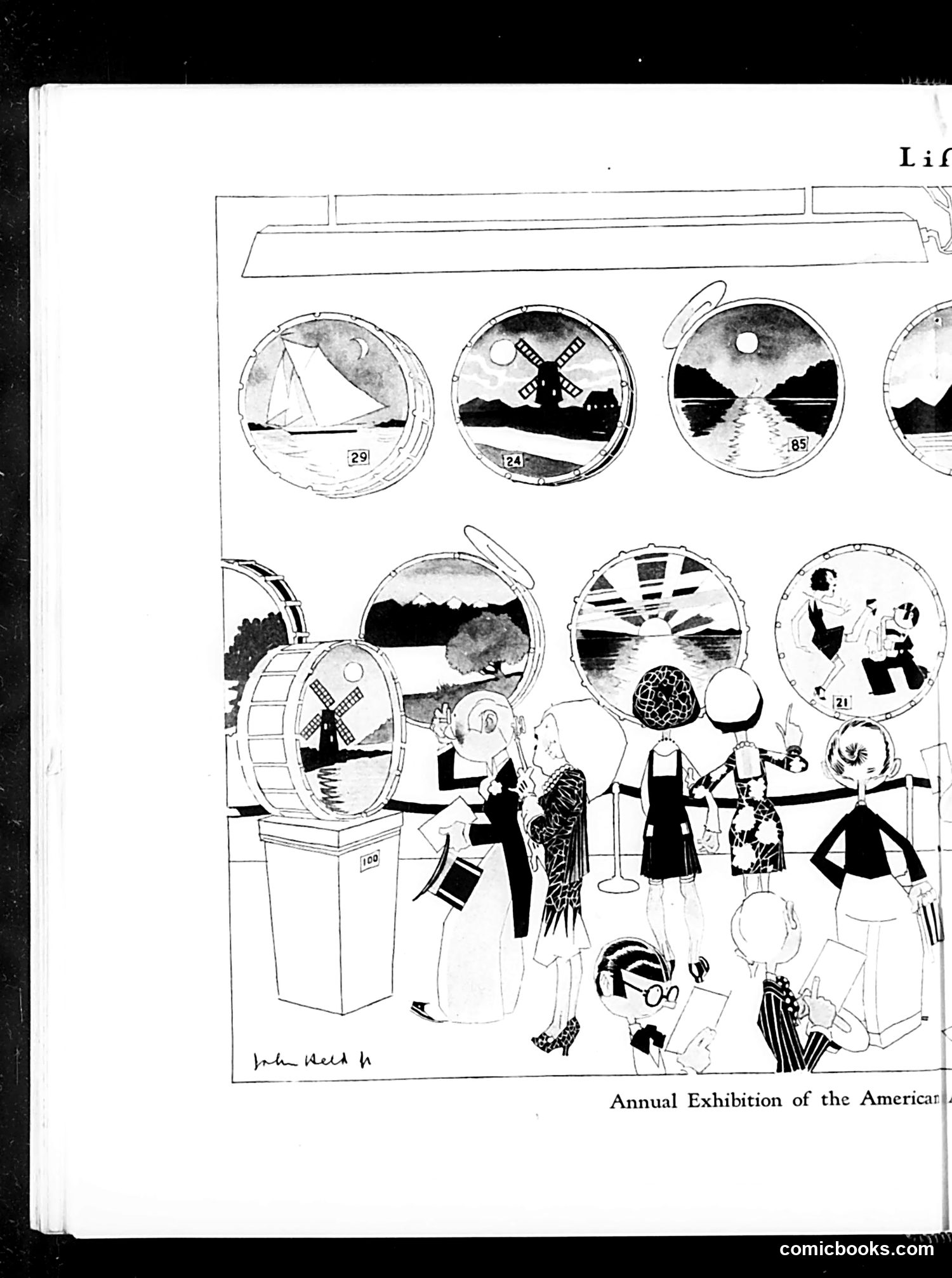
This illustration depicts an "Annual Exhibition of the American" (text cut off, likely "American Art" or similar institution). The cartoon shows a museum or gallery scene where visitors view circular display cases mounted on walls—each containing different landscape scenes numbered (29, 24, 85, 21, etc.). The satire appears to mock mass-produced or standardized American art exhibition practices. The circular frames resemble decorative plates or mass-manufactured items rather than fine art. The diverse visitors—rendered in period fashion suggesting 1920s-30s—examine these uniform, repetitive displays with apparent seriousness. The joke likely critiques either: the commercialization of American art, the homogenization of artistic expression through institutional display, or the public's naive consumption of mediocre mass-market "art." The numbered cataloging emphasizes treating artwork as interchangeable commodities rather than unique creations.
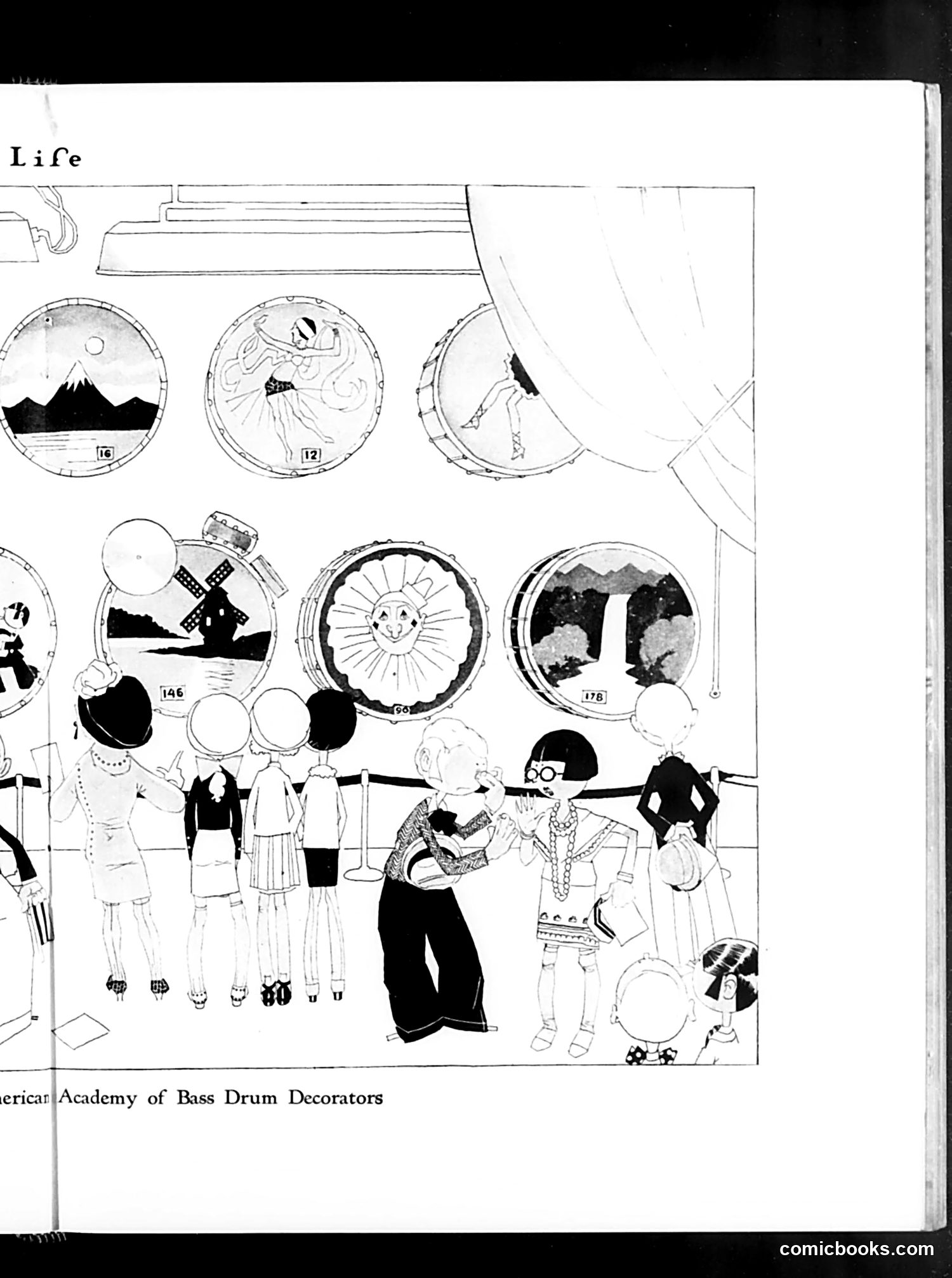
This page from *Life* magazine satirizes the "American Academy of Bass Drum Decorators"—a mock-serious institution parodying overly formal or pretentious organizations. The cartoon shows several figures in various styles of dress examining decorated bass drums displayed in circular frames above them, like museum exhibits. The humor targets the absurdity of treating bass drum decoration as a serious academic discipline worthy of an official "academy." The circular displays mimic museum presentations, elevating the mundane and ridiculous to high art status. The diverse figures and their earnest engagement with these drums emphasize the satirical intent. The overall joke critiques both institutional pomposity and perhaps the proliferation of specialized "academies" in American culture that lend false legitimacy to trivial pursuits.
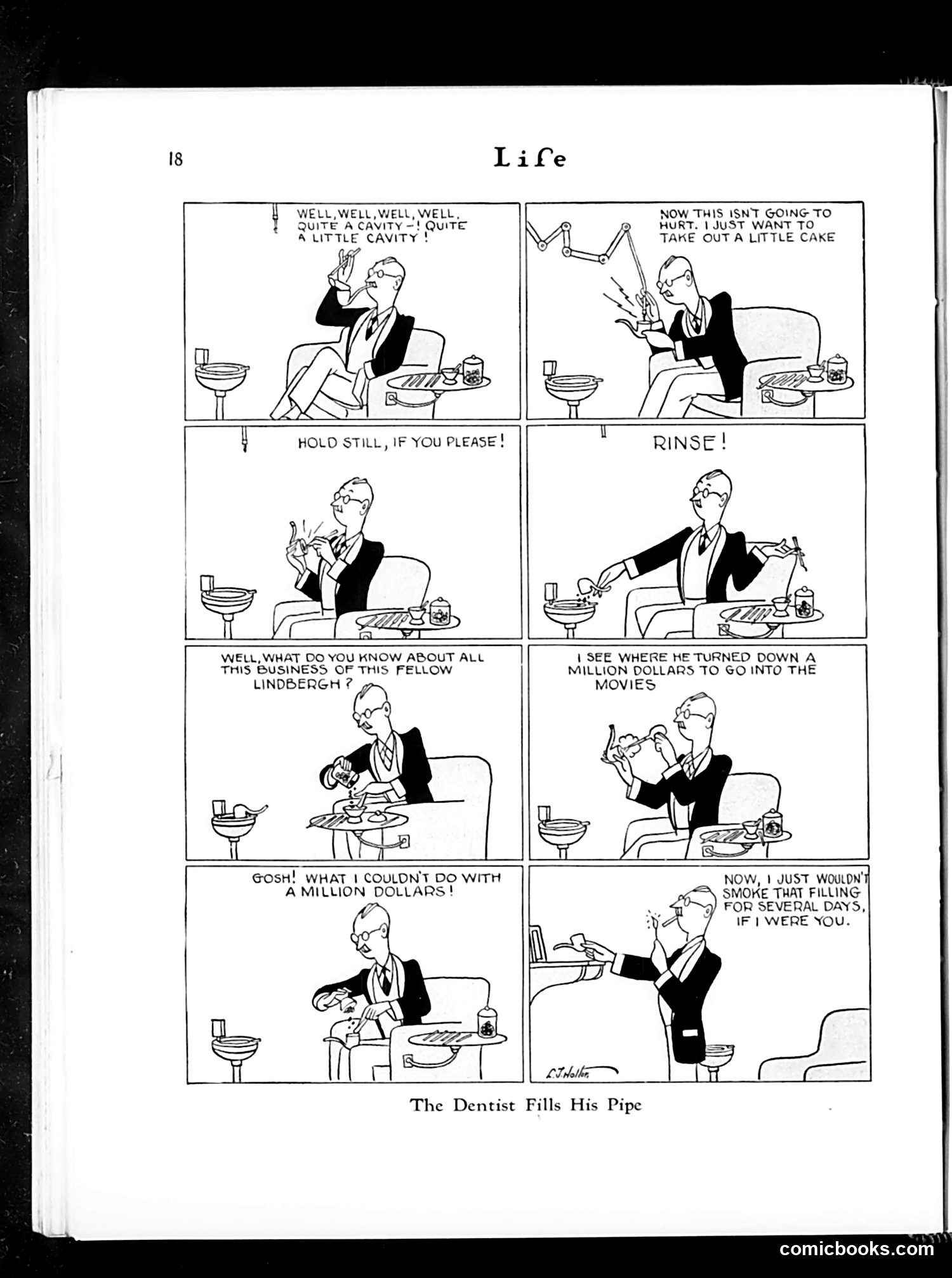
This satirical comic mocks Charles Lindbergh's recent decision to decline a lucrative Hollywood film offer. The scenario shows a dentist and patient in conversation: the dentist extracts a tooth while casually discussing how Lindbergh supposedly turned down a million dollars for movies. The patient expresses envy at such wealth, while the dentist offers unsolicited advice about not smoking immediately after dental work. The joke's satire operates on two levels: it ridicules Lindbergh's rejection of easy money (suggesting his decision was foolish), while simultaneously poking fun at the dentist character for offering sanctimonious life advice while performing routine work. The juxtaposition between the dentist's humble profession and his commentary on a famous aviator's million-dollar decisions underscores the absurdity of such casual moralizing.
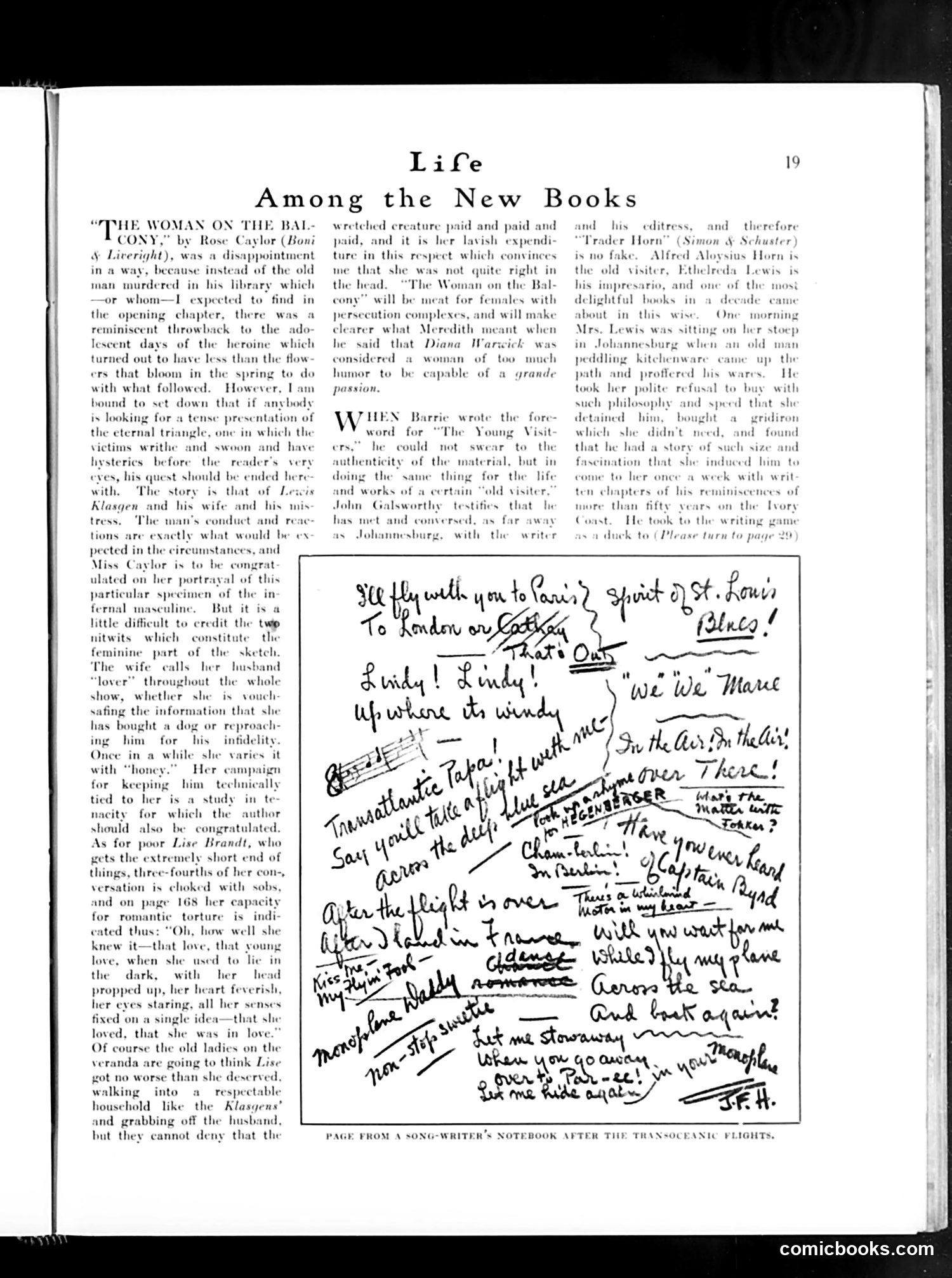
This page contains a literary book review section titled "Life Among the New Books," discussing novels including Rose Caylor's "The Woman on the Balcony" and works by J.M. Barrie and John Galsworthy. The notable feature is a large handwritten musical staff with lyrics overlaid in the center-right of the page. The caption identifies this as "PAGE FROM A SONG-WRITER'S NOTEBOOK AFTER THE TRANSOCENIC FLIGHTS"—likely referencing transatlantic airplane travel, which was becoming notable in the 1920s-30s. The handwritten musical notations and scattered lyrical phrases (including references to "Lindy," "Spirit of St. Louis," and London) appear to be satirizing songwriters' attempts to capitalize on contemporary travel and aviation themes. The chaotic, overlapping handwriting suggests both creative inspiration and commercial desperation—mocking how popular culture rushed to commercialize modern achievements like transatlantic flights.
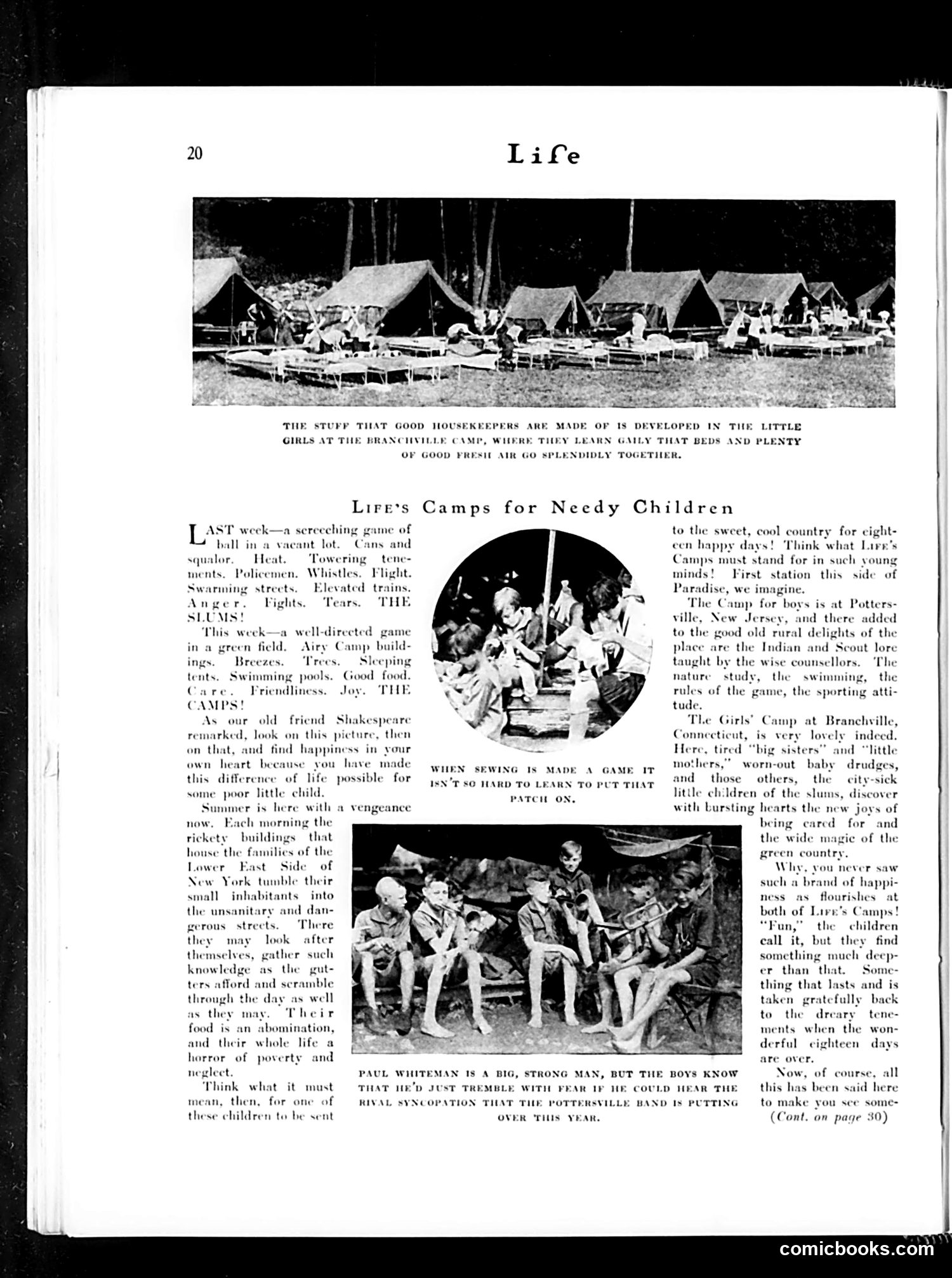
This is not a political cartoon but rather a feature article promoting **Life magazine's charitable summer camps** for poor urban children from New York's Lower East Side slums. The article contrasts the misery of tenement life (overcrowding, heat, dangerous streets) with the wholesome benefits of two camps: one for boys in Potterville, New Jersey, and one for girls in Branchville, Connecticut. The photographs show children engaged in recreational activities—sewing, group gatherings, and outdoor games. A humorous reference appears to **Paul Whiteman**, the famous bandleader of the era, joking that even this "big, strong man" would tremble hearing the Potterville boys' band's "rival syncopation"—meaning their amateur jazz music. This is light mockery, not satire. The piece appeals to readers' charitable impulses, emphasizing how camps provide urban slum children with fresh air, nature, proper food, and care—presenting the camps as transformative, nearly paradisiacal experiences.
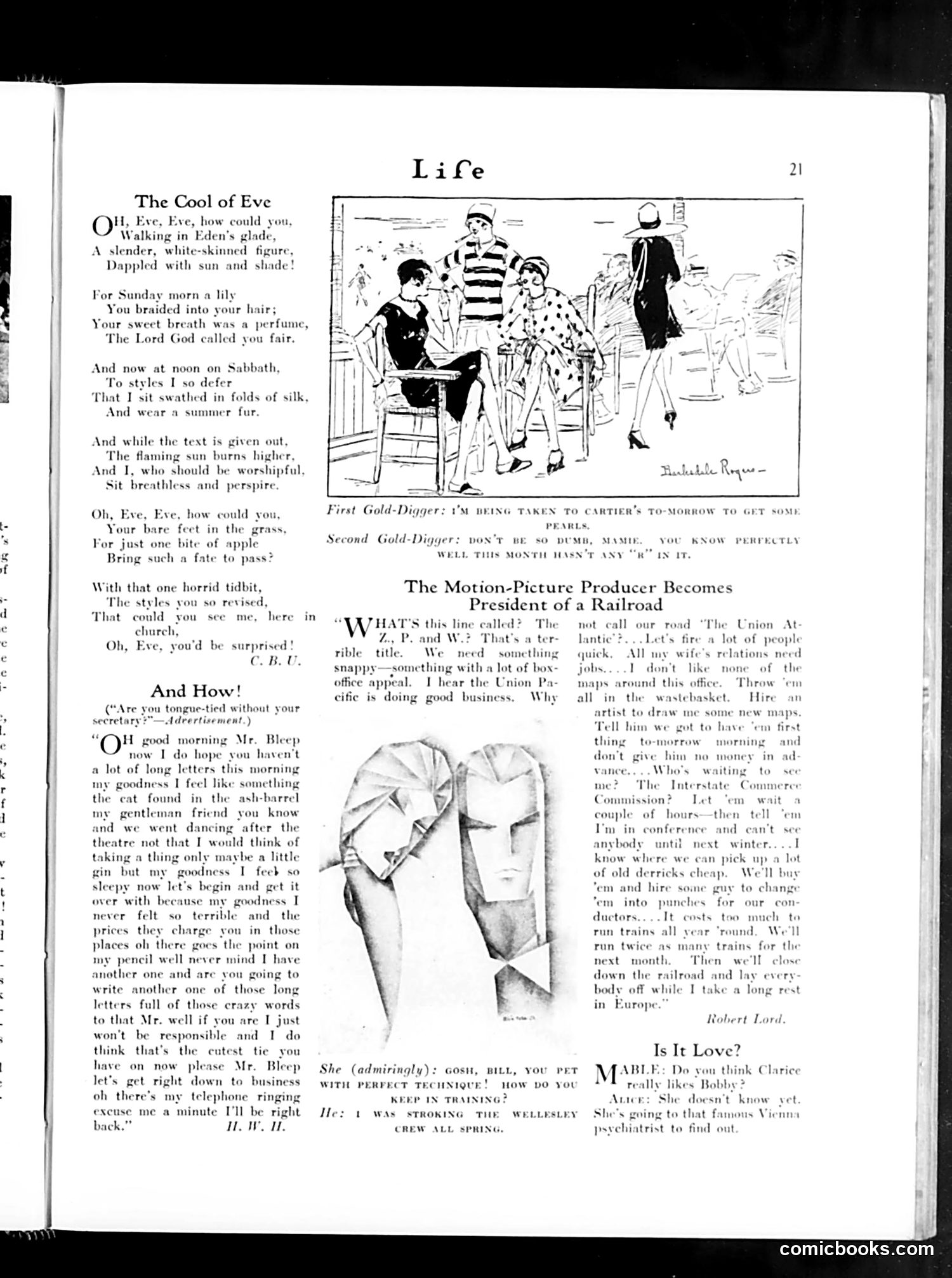
This Life magazine page (dated 21) contains three separate satirical pieces: 1. **"The Cool of Eve"**: A poem mocking women's fashion excess. The speaker laments that modern women, unlike the biblical Eve, are trapped wearing heavy silk and furs even on hot days due to fashion conventions—suggesting fashion standards have made women uncomfortable and enslaved to vanity. 2. **"And How!"**: A comedic monologue by a chatty, scattered office worker (likely a secretary or receptionist) who rambles endlessly while supposedly working. The satire targets workplace inefficiency and women's perceived tendency toward excessive talking. 3. **"Motion-Picture Producer Becomes President of a Railroad"**: A businessman casually discusses converting a railroad into a money-making scheme, hiring unqualified staff, ignoring regulations ("Interstate Commerce Commission"), and planning to shut down operations for personal vacation. This satirizes corporate greed and incompetence during the early railroad/industrial era. 4. **"Is It Love?"**: A brief joke about a woman consulting a Viennese psychiatrist about romantic uncertainty—mocking psychological fads of the era. The overall tone critiques fashion tyranny, workplace absurdity, corporate malfeasance, and modern psychological trends.
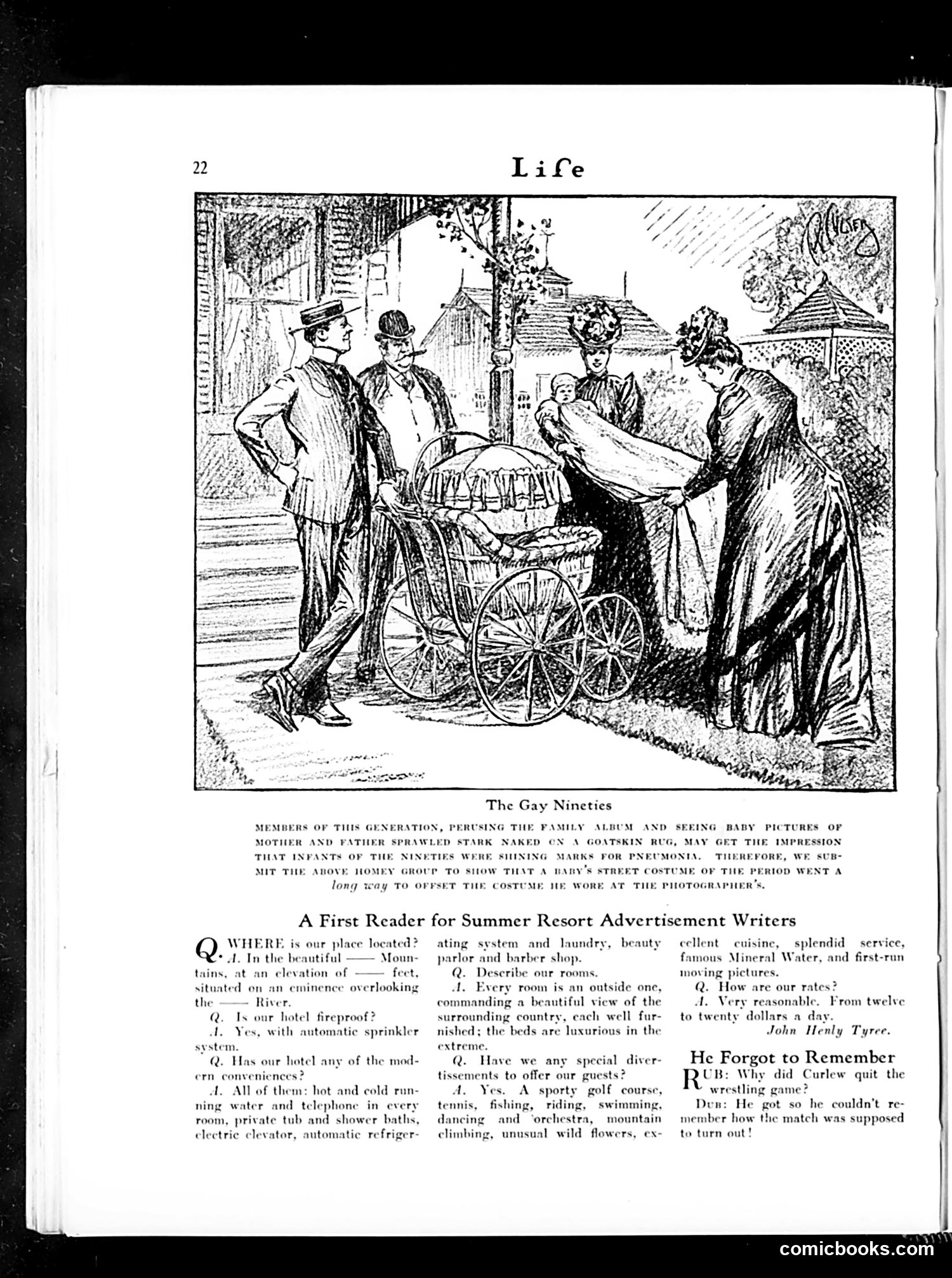
**Main Cartoon:** This satirical illustration mocks the 1890s by contrasting how babies were actually dressed then—naked or minimally clothed on goatskin rugs for photos—with the false impression that period infants wore elaborate street costumes. The joke targets nostalgic misremembering of "the Gay Nineties" as more refined than reality. **"First Reader for Summer Resort":** A template-style satire of formulaic resort advertising. It mimics the Q&A format of children's primers while exposing how resorts use identical cookie-cutter descriptions (beautiful mountains, all modern conveniences, golf/tennis/swimming, mineral water) regardless of actual location or quality. It's advertising satire. **"He Forgot to Remember":** A brief joke mocking fixed wrestling matches—the wrestler couldn't even remember which predetermined outcome he was supposed to perform, suggesting the match-fixing was so prevalent and meaningless it became forgettable. Together, the page satirizes nostalgia, standardized marketing language, and entertainment fraud.
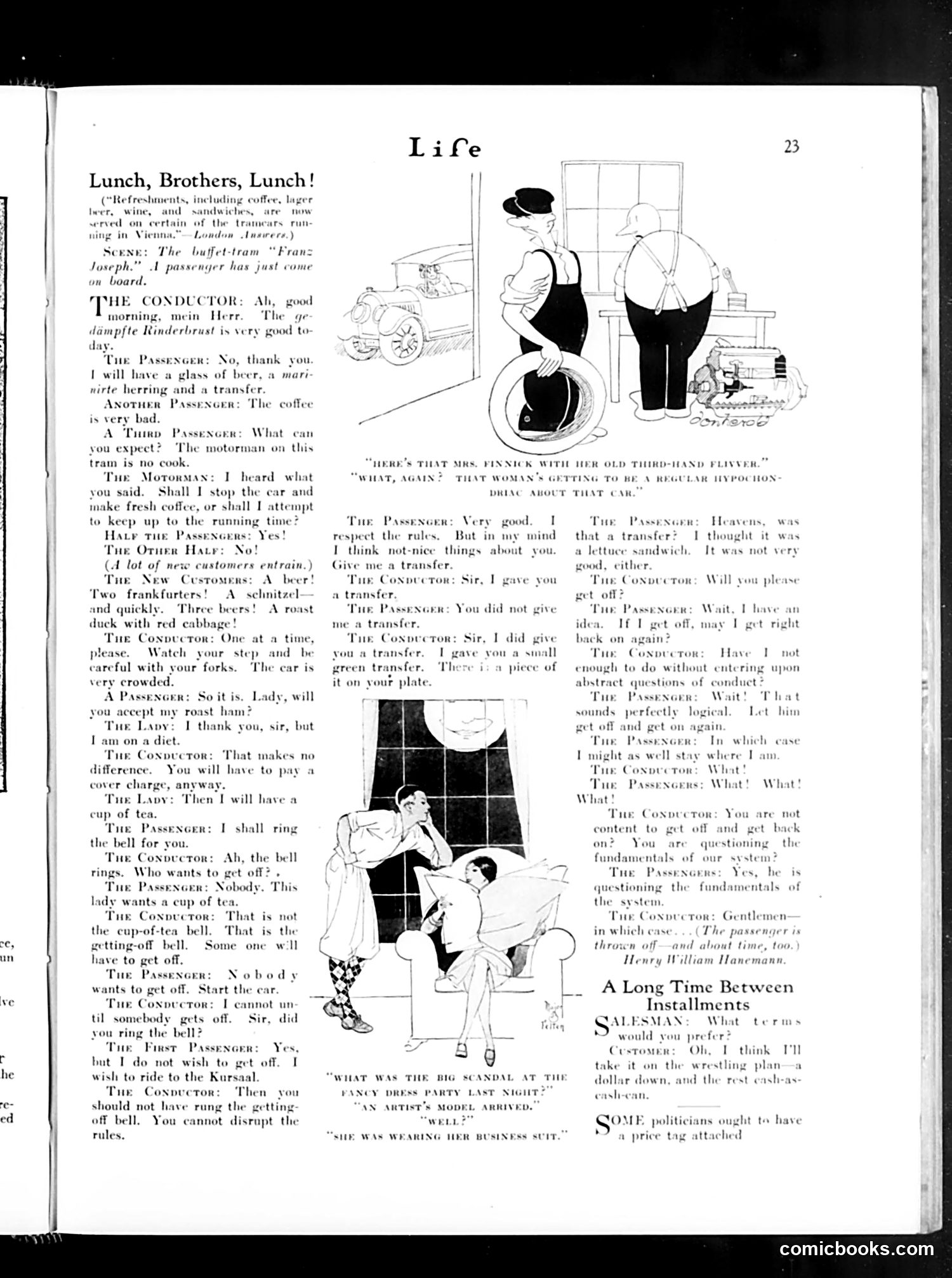
This page contains a humorous sketch satirizing rigid bureaucratic rules on a Viennese buffet-tram (a streetcar serving refreshments). The joke centers on a conductor who enforces nonsensical regulations: a passenger rings the "getting-off bell" to request tea, but the conductor insists someone must actually exit the car because the bell has been rung—disrupting the rules is forbidden. The satire mocks Austrian/European officialdom's obsession with procedure over common sense. When passengers question this absurdity, the conductor accuses them of "questioning the fundamentals of our system," suggesting bureaucrats hide behind inflexible rules to avoid accountability. The accompanying cartoons are brief social gags: one depicts a woman in practical business attire arriving at a fancy dress party (implying hypochondria or absent-mindedness); another jokes about installment-plan pricing ("wrestling plan—a dollar down, rest cash-as-you-go"). The overall effect ridicules how officials prioritize regulations over customer service and reason.
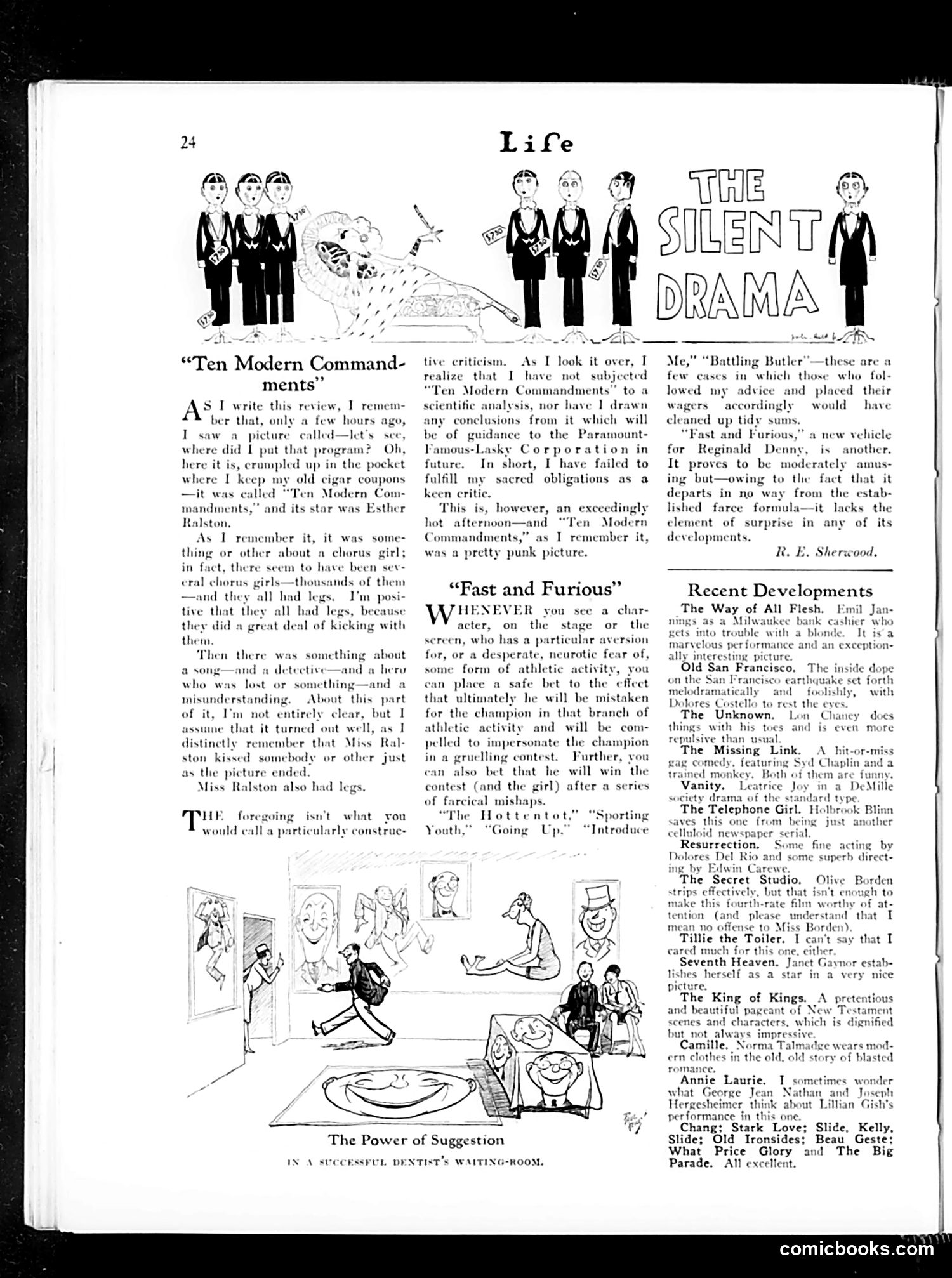
This page contains film reviews from Life magazine's entertainment section. The main cartoon—"The Power of Suggestion"—depicts a dentist's waiting room where patients' anxieties manifest visually: a man imagines himself in a boxing ring, another envisions a confrontation. It illustrates how suggestion and fear shape perception, a common satirical theme about human psychology. The reviews mock predictable cinema formulas of the era. The critic sarcastically critiques "Ten Modern Commandments" (starring Esther Ralston) for being forgettable—he can't recall the plot, only "thousands" of chorus girls with legs doing kicks. "Fast and Furious" (Reginald Denny) is dismissed as following an exhausted farce template: a character fears athletic activity, gets mistaken for a champion, wins the girl after mishaps. The "Recent Developments" section briefly reviews current releases, praising Emil Jannings's performance in "Old San Francisco" and Lon Chaney's grotesqueness in "The Unknown," while dismissing others as formulaic or poorly executed. The tone is weary toward formulaic Hollywood output.
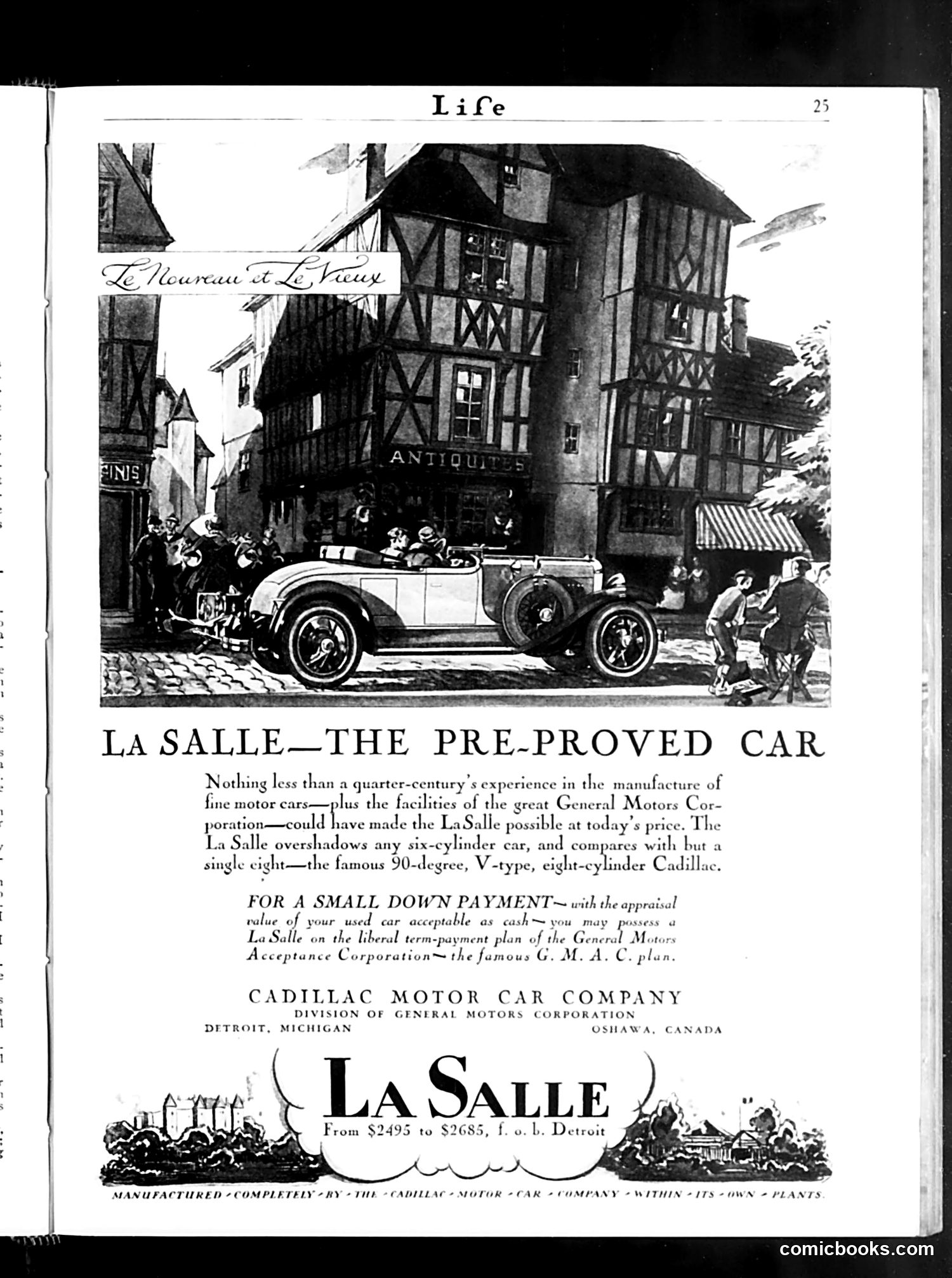
This is primarily a **car advertisement**, not political satire. It's a full-page ad for the La Salle automobile by Cadillac Motor Car Company, appealing to middle-class buyers. The image shows an elegant 1920s-era convertible parked in front of a European-style street scene (marked "L'Moreau à L'Vieux" and "ANTIQUES"), suggesting sophistication and aspirational lifestyle. **The pitch**: The La Salle offers luxury comparable to the famous eight-cylinder Cadillac but at a lower price point ($2495-$2685). The ad emphasizes General Motors' manufacturing expertise and highlights the **G.M.A.C. financing plan**—allowing buyers with modest down payments and trade-in value to afford the vehicle. The "pre-proved car" claim suggests reliability through Cadillac's established reputation. The European setting aims to convey elegance and class appeal to American consumers seeking affordable luxury during what appears to be the prosperous 1920s. No satirical commentary is evident; this is straightforward automotive marketing.
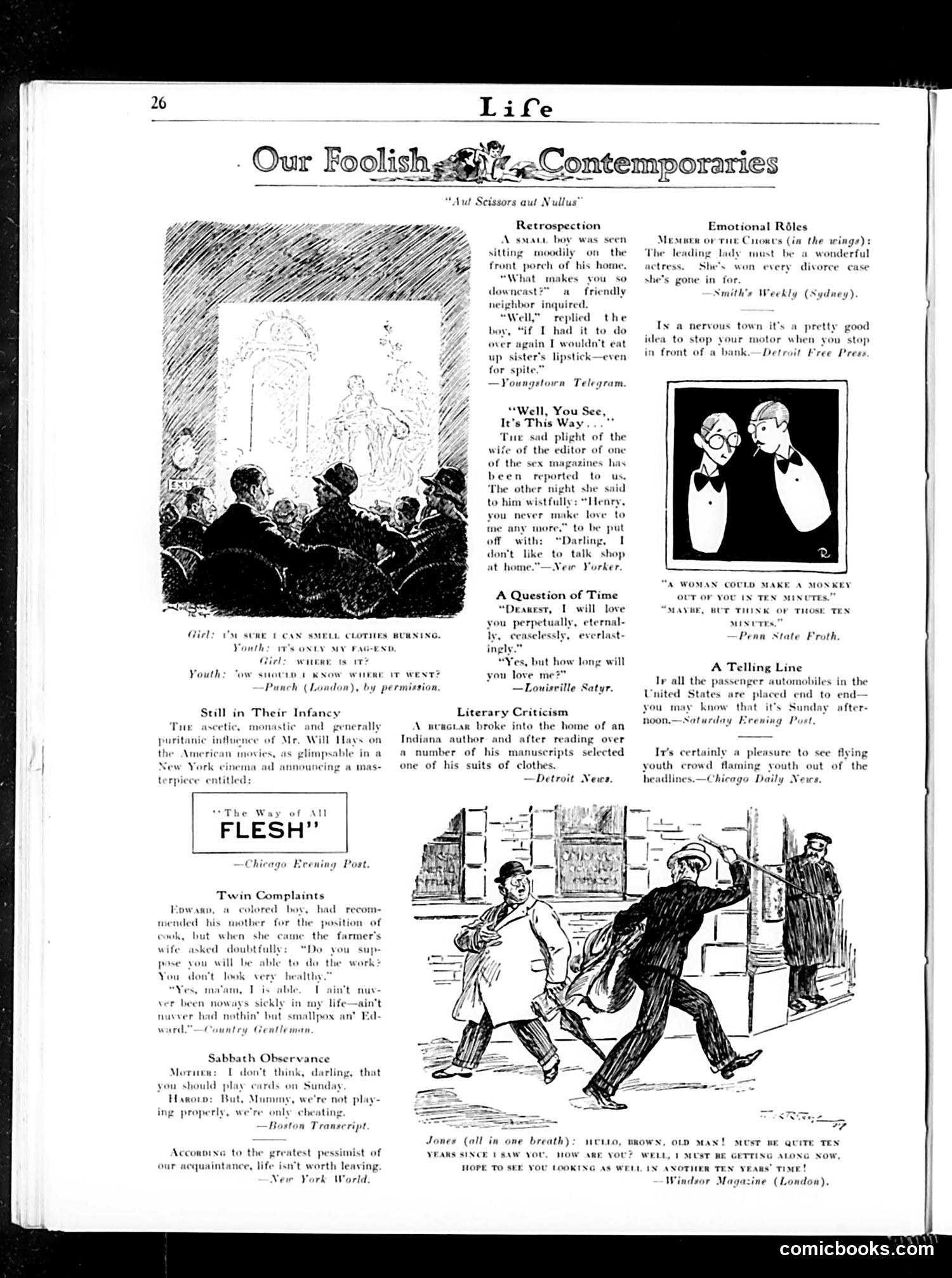
This page collects brief humorous observations and satirical anecdotes from contemporary American newspapers and magazines, organized under the heading "Our Foolish Contemporaries." The cartoons and jokes mock everyday social absurdities: - **Relationship humor**: A wife complains her editor-husband discusses work at home; a man questions how long romantic love will last. - **Racial stereotypes**: Period-typical depictions of Black characters (a boy eating lipstick, a farm worker) that reflect the era's casual prejudice. - **Class commentary**: A burglar stealing an author's suit suggests his writing is worthless; parents' hypocrisy about Sunday observance. - **Modern anxieties**: Traffic concerns, theatrical pretense, worried encounters between old acquaintances. The satire targets human folly generally—vanity, dishonesty, inconsistency—rather than specific political events. The format allowed Life to curate amusing snippets from newspapers nationwide, presenting itself as a sophisticated observer of American culture's minor contradictions and absurdities.
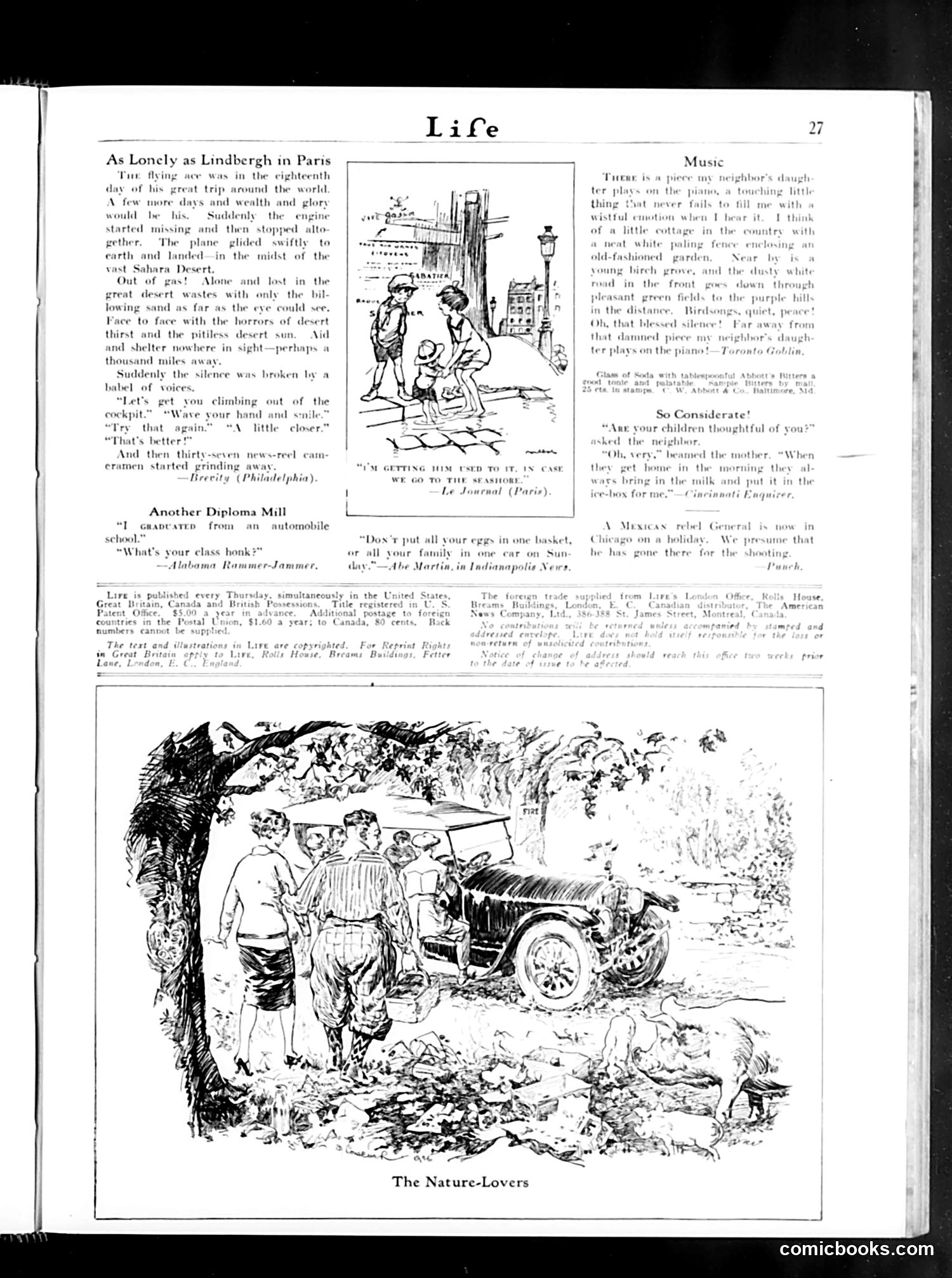
This page contains three separate pieces of satirical humor typical of early 20th-century Life magazine: **"As Lonely as Lindbergh in Paris"** references Charles Lindbergh's famous 1927 transatlantic flight, using it as a comedic comparison. The sketch depicts a plane crash in the Sahara Desert where survivors are told to "wave hand and smile"—likely mocking publicity-obsessed behavior or press management. **"Another Diploma Mill"** satirizes the low academic standards of certain colleges, with "Alabama Rammer-Jammer" as a fake college name, suggesting diploma mills that granted degrees without rigor. **"The Nature-Lovers"** (bottom illustration) shows a family with an automobile in a natural setting, likely satirizing the emerging phenomenon of recreational car culture and how automobiles were changing leisure activities—a commentary on 1920s modernization and consumerism. The page reflects Life's focus on mocking contemporary American social trends, educational fraud, and the cultural impact of new technology.
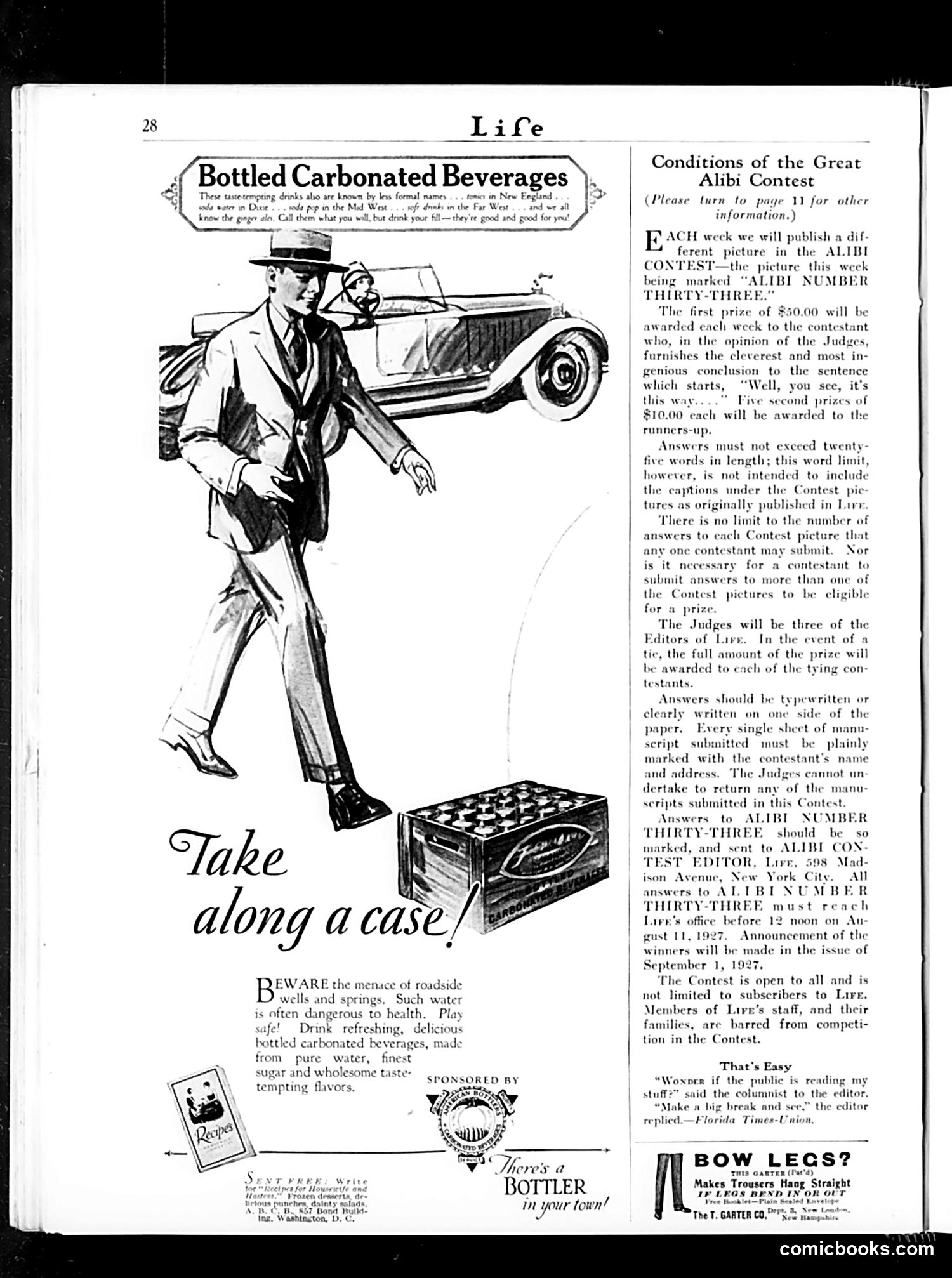
This page combines a carbonated beverage advertisement with Life's "Alibi Contest"—a popular weekly humor feature where readers submitted humorous explanations for captioned illustrations, competing for cash prizes ($50 first place, $10 runners-up). **The Advertisement:** The left side promotes bottled carbonated beverages with a stylish illustration of a man in a suit and hat holding a beverage case near an automobile. The ad warns against unsafe roadside water sources, positioning commercial sodas as safe, pure alternatives. This reflects 1920s public health concerns and the growing commercial beverage industry. **The Contest:** The right side details rules for submitting "alibis"—witty twenty-five-word excuses completing the prompt "Well, you see, it's this way..." Winners would be announced September 1, 1927. This participatory contest was Life magazine's signature humor feature, engaging readers directly while filling pages inexpensively. The small joke snippet ("That's Easy") at bottom mocks columnists fishing for reader feedback—meta-humor about publishing itself.
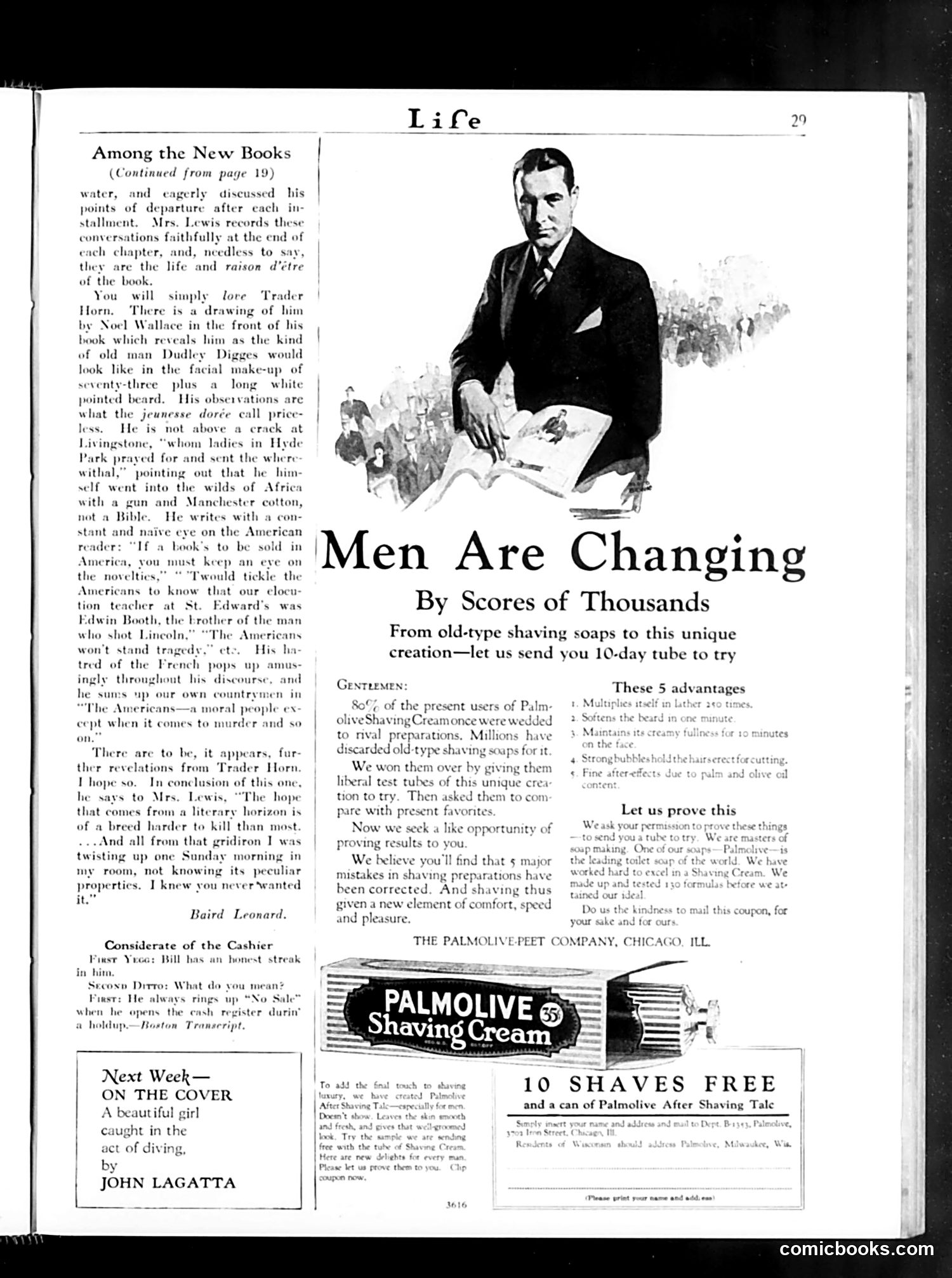
This page is primarily an **advertisement for Palmolive Shaving Cream** disguised as editorial content. The dominant image shows a man in business attire examining the product. The page header discusses new books, including "Trader Horn"—a real travel memoir popular in the 1920s. The brief literary discussion serves as filler around the advertisement. Below the book review is a small joke labeled "Considerate of the Cashier," a simple pun: a cashier rings "No Sale" during a holdup to maintain honesty—humor derived from the incongruity of ethical behavior during a crime. The main advertisement's headline claims "Men Are Changing By Scores of Thousands" from traditional shaving soaps to Palmolive's product. It offers 10 free shaves and promises five specific advantages (lather quality, beard softening, etc.). **The satire here is subtle**: Life magazine—known for sharp social commentary—has essentially sold a full page to advertising, with minimal editorial content. The juxtaposition of literary discussion and hard-sell advertising reflects 1920s consumer culture's growing dominance in American media.
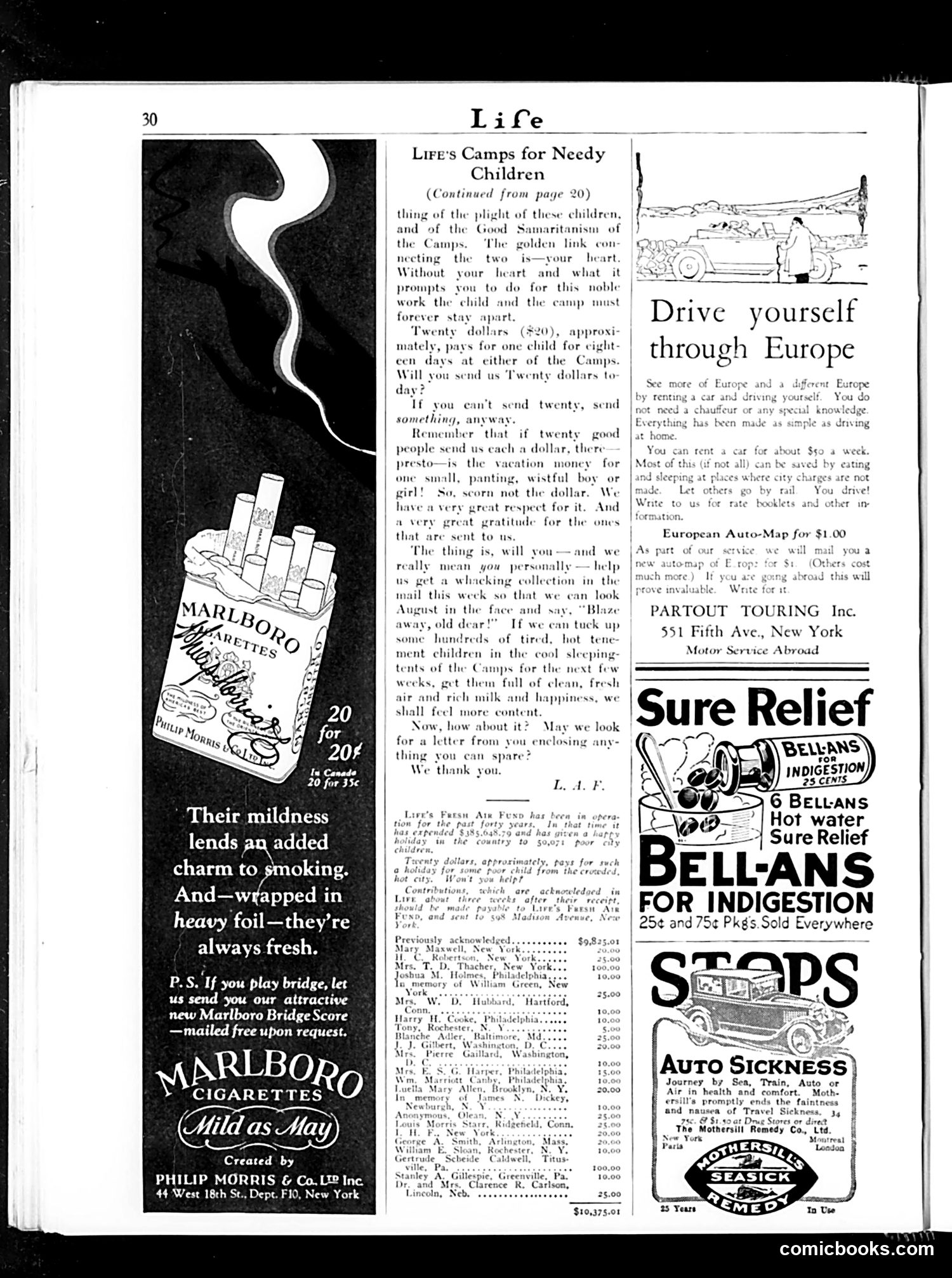
This page is primarily **advertising and fundraising content**, not political satire. The dominant feature is a Marlboro cigarette advertisement (left side) promoting the mildness of the product with decorative imagery of cigarettes wrapped in foil. The bulk of the page contains a **charity appeal** (continued from page 20) for "Life's Camps for Needy Children," soliciting donations—specifically $20 per child for eight-week camp stays. The text emphasizes the camps' charitable mission to provide poor, urban children with fresh air, milk, and rest. Additional advertisements occupy the right side: a car-rental service promoting European travel, Bell-Ans indigestion remedy, and Stops auto-sickness medicine. **There is no political cartoon on this page.** The content reflects 1920s-era American philanthropic concerns and consumer advertising typical of *Life* magazine during this period.
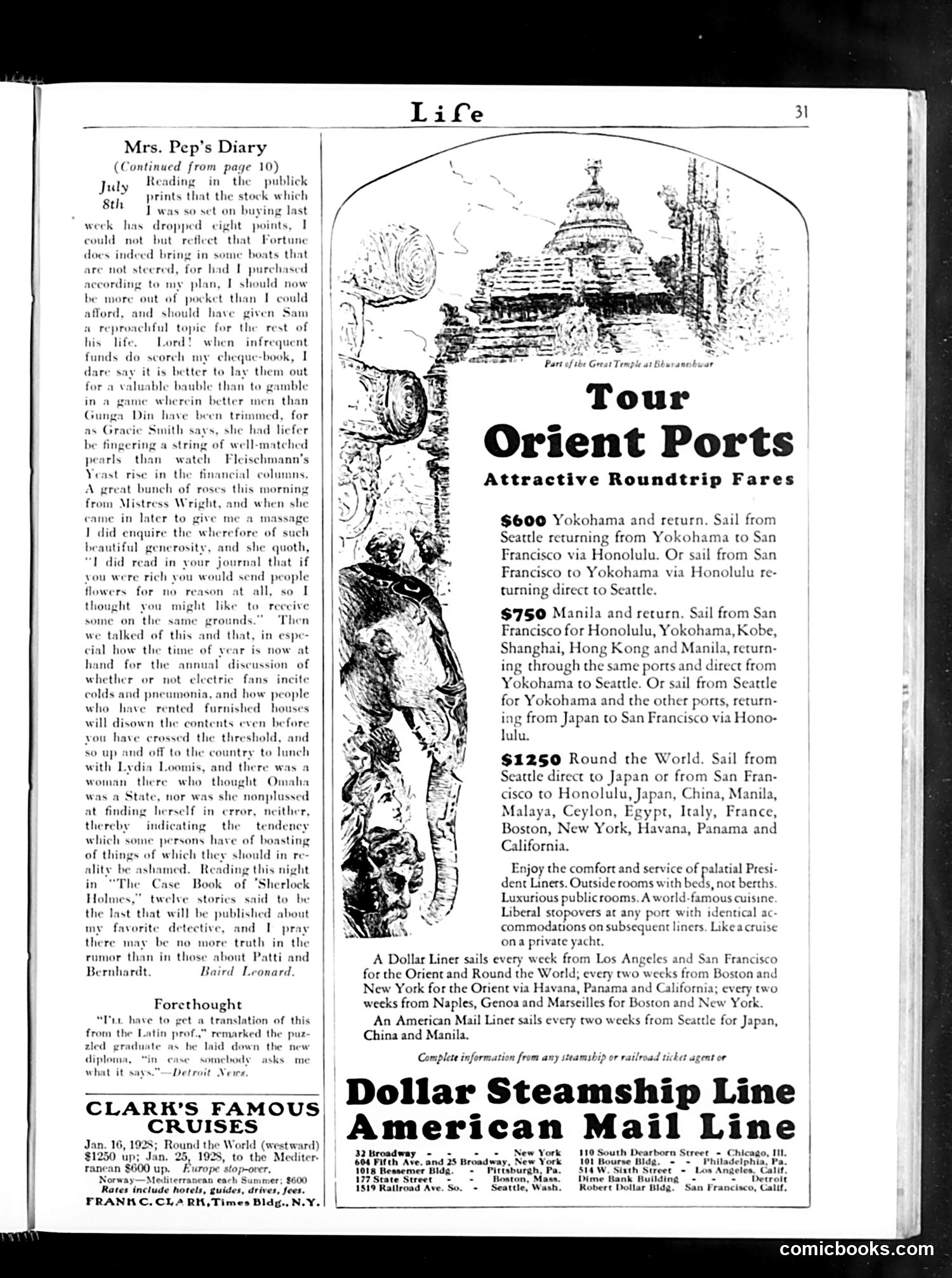
This page combines a personal diary column with cruise-line advertising. **Mrs. Pep's Diary** (continued serialized feature) documents upper-class social commentary through a wealthy woman's observations about stock-market losses, gift-giving etiquette, and social pretension. The diary format allowed *Life* to satirize contemporary attitudes—here, Mrs. Pep reflects on financial risk-taking, the generosity of friends, and the absurdity of people boasting about their ignorance (the Omaha/State confusion). The page's dominant content is advertising for **Dollar Steamship Line and American Mail Line** offering Orient cruises at various price points ($600–$1,250), targeting affluent readers *Life* cultivated. The juxtaposition of frivolous diary musings with luxury-travel ads reflects *Life's* satirical focus on wealth and consumption during the prosperous 1920s.
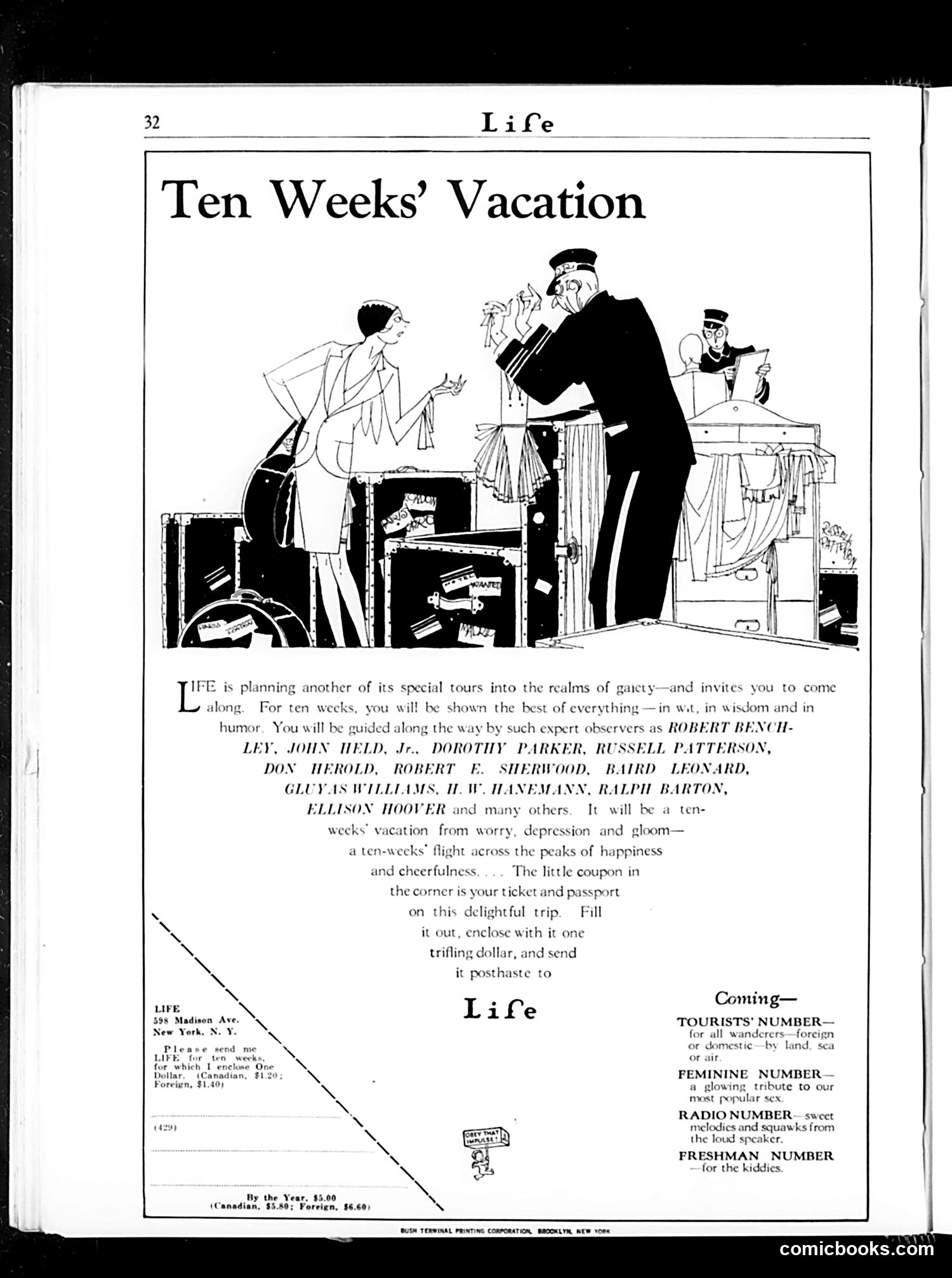
This is a promotional advertisement for Life magazine's subscription service, not a political cartoon. The illustration shows a well-dressed man (likely representing Life's editor or spirit) conducting a tour through scenes of leisure and social life—suggesting the magazine will provide ten weeks of entertainment and escape from the economic gloom of the era (likely early 1930s, given the Depression-era language about "worry, depression and gloom"). The advertisement lists prominent humorists and illustrators of the period—Robert Benchley, Dorothy Parker, Ralph Barton, and others—as guides for this "vacation." The satire is gentle: Life promises readers an escape from hardship through witty commentary and humor. The coupon mechanism and upcoming special issues (Tourists', Feminine, Radio, Freshman numbers) reflect Life's strategy to attract diverse readerships during economically difficult times.
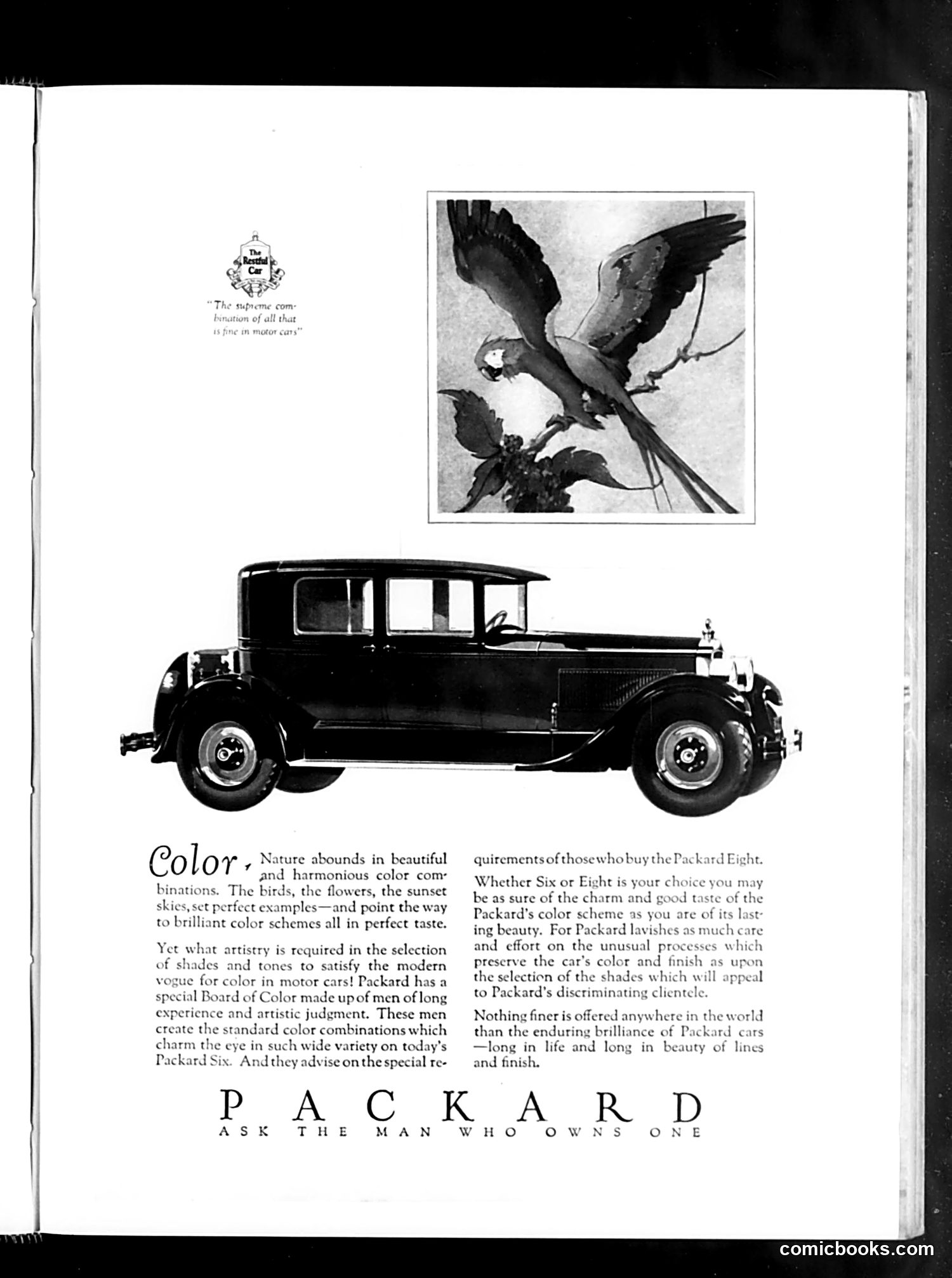
This is **not a cartoon or satire—it's a straight automobile advertisement** for the Packard automobile company, likely from the 1920s. The page features a black-and-white photograph of a Packard Six sedan on the left, paired with a nature illustration of parrots at the top. The ad's strategy compares the car's color options to harmonious colors found in nature (flowers, sunsets, birds), arguing that Packard employs an artistic "Board of Color" to ensure discriminating taste in paint schemes. The tagline "Ask the man who owns one" was Packard's actual famous slogan emphasizing owner satisfaction and prestige. There is no political satire or caricature here. The page demonstrates how early 20th-century luxury car marketing appealed to consumers' aspirations toward refined aesthetic judgment and social status.
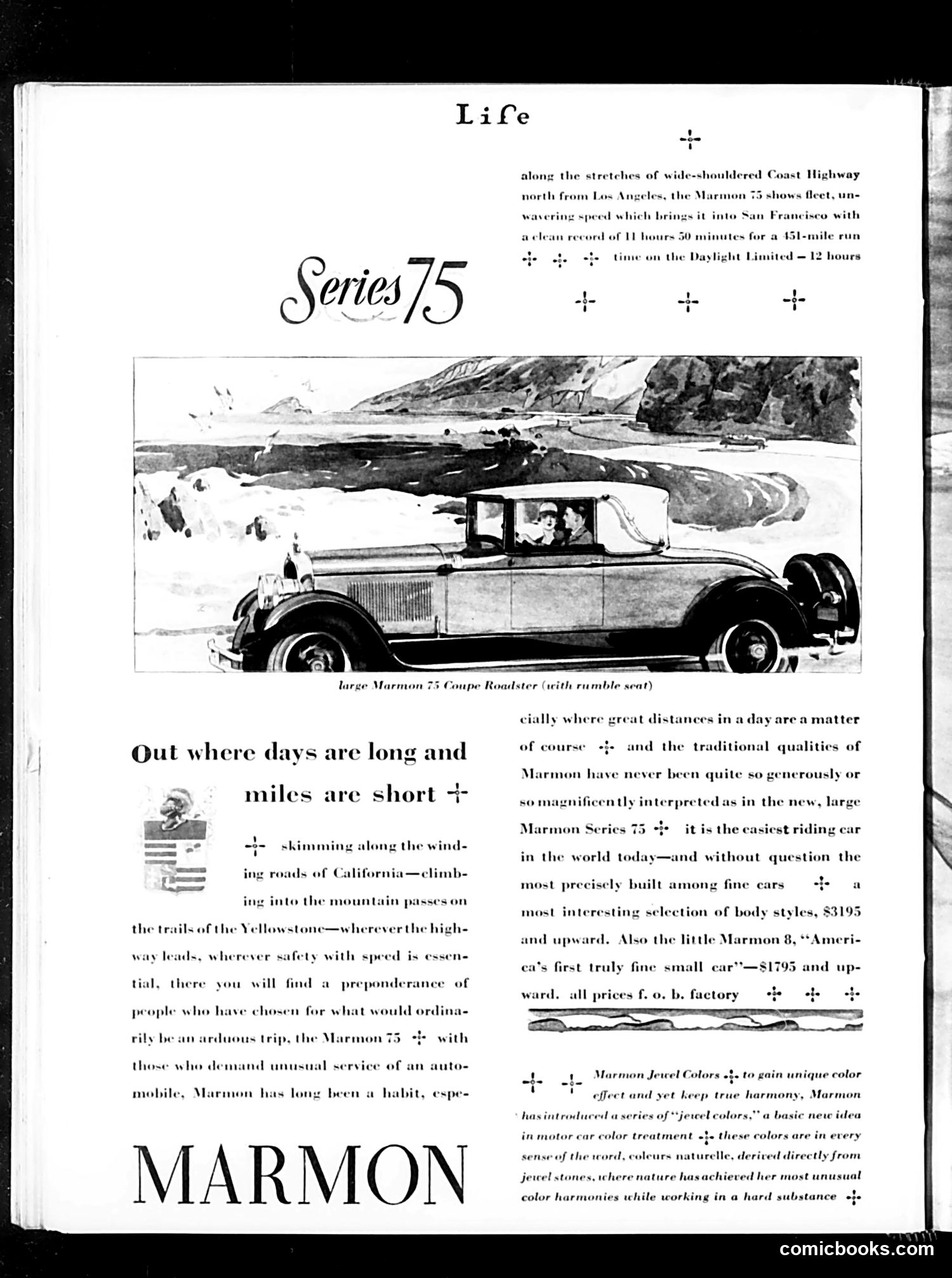
This is **not a cartoon or satire**—it's a straightforward automobile advertisement from Life magazine. The page promotes the Marmon Series 75 luxury car through aspirational copy and imagery. The ad emphasizes the car's performance (11 hours 50 minutes from Los Angeles to San Francisco) and targets wealthy drivers undertaking long-distance trips across California and the American West. The illustration shows a convertible roadster on a scenic coastal highway, appealing to the leisure class. The ad highlights the car's comfort, precision engineering, and availability in multiple body styles at premium prices ($3,195+). It also mentions the smaller Marmon 8 as "America's first truly fine small car" ($1,795+). The "Marmon Jewel Colors" section describes proprietary paint colors inspired by gemstones—a novel marketing concept for the era. This represents typical interwar automotive advertising targeting affluent consumers.