
A complete issue · 35 pages · 1927
Life — June 30, 1927
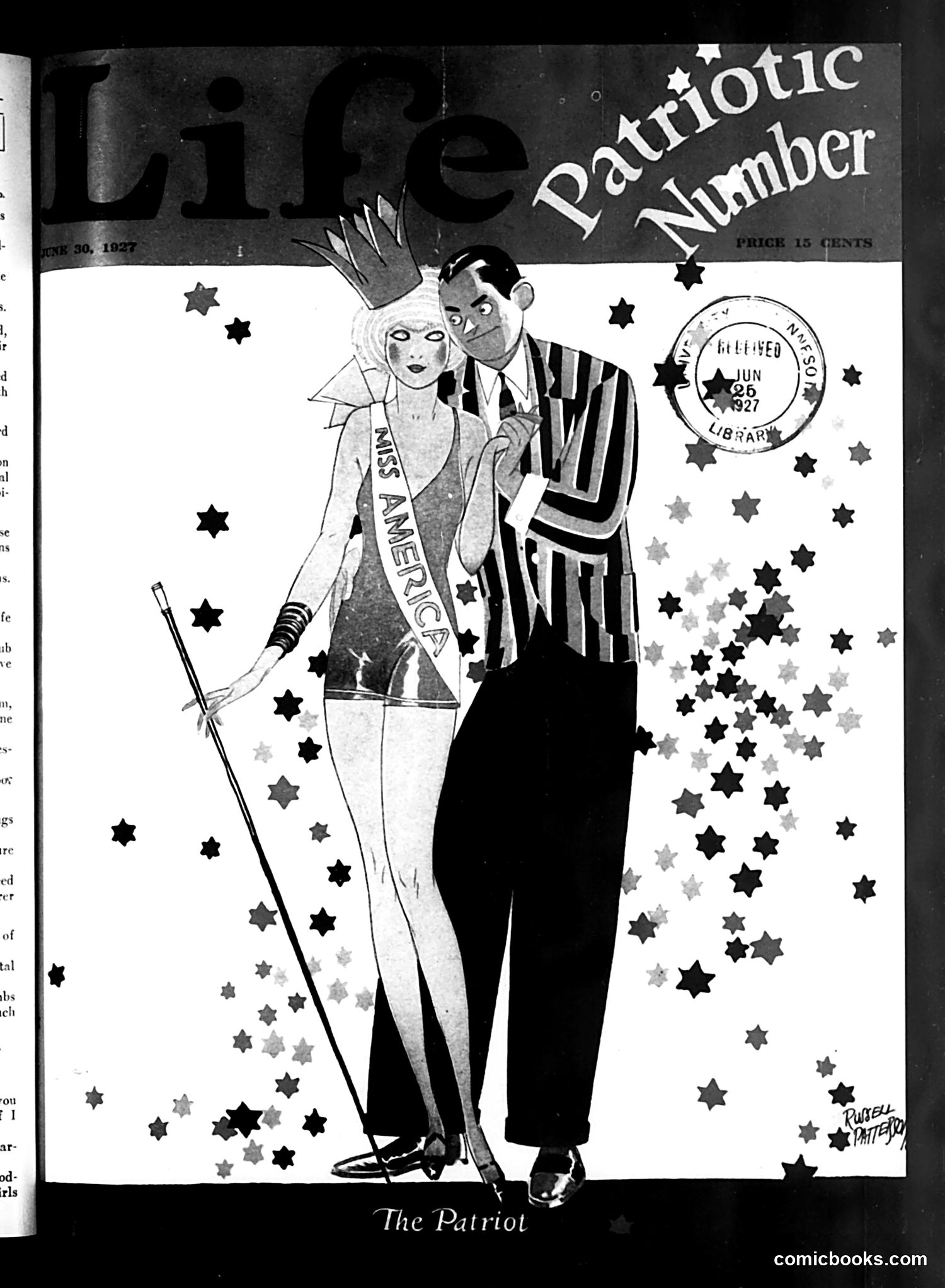
This cover illustrates a couple in 1920s attire celebrating American patriotism. The woman wears a "Miss America" sash and holds a golf club; the man sports a striped suit jacket. Both are surrounded by stars. The satire appears to target the commercialization and superficiality of American patriotism in the Jazz Age. The juxtaposition of symbols—beauty pageants, leisure sports (golf), fashionable dress—suggests that contemporary "patriotism" had become hollowed into mere consumerism and entertainment rather than substantive civic virtue. The title "The Patriot" is likely ironic, mocking how modern Americans expressed nationalism through shallow consumer culture rather than traditional values. The library stamp indicates this is an archival copy from 1927.
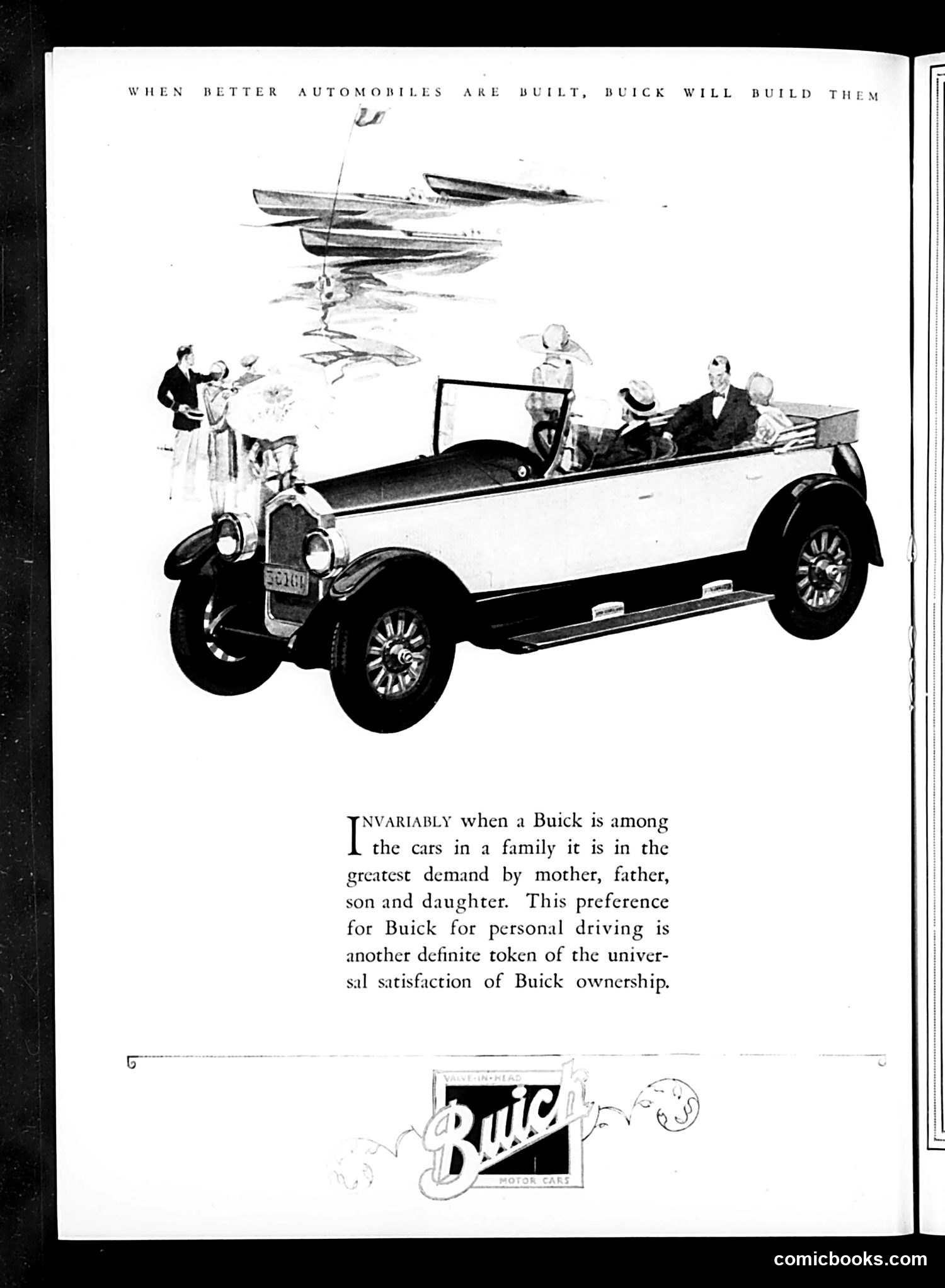
This is a **Buick automobile advertisement**, not political satire. The page promotes Buick motor cars through an aspirational lifestyle image showing a well-dressed family enjoying leisure time—some boating in the background, others riding in an open-air Buick convertible. The advertisement's claim is straightforward: when multiple family members have car access, they invariably prefer the Buick for personal driving. This "preference" is presented as evidence of the car's universal appeal and quality. The messaging targets middle and upper-class families, suggesting that owning a Buick signals social status and satisfies all household members equally. The boats and elegant clothing emphasize prosperity and leisure—the lifestyle Buick ownership supposedly enables. This is **commercial messaging**, not editorial commentary.
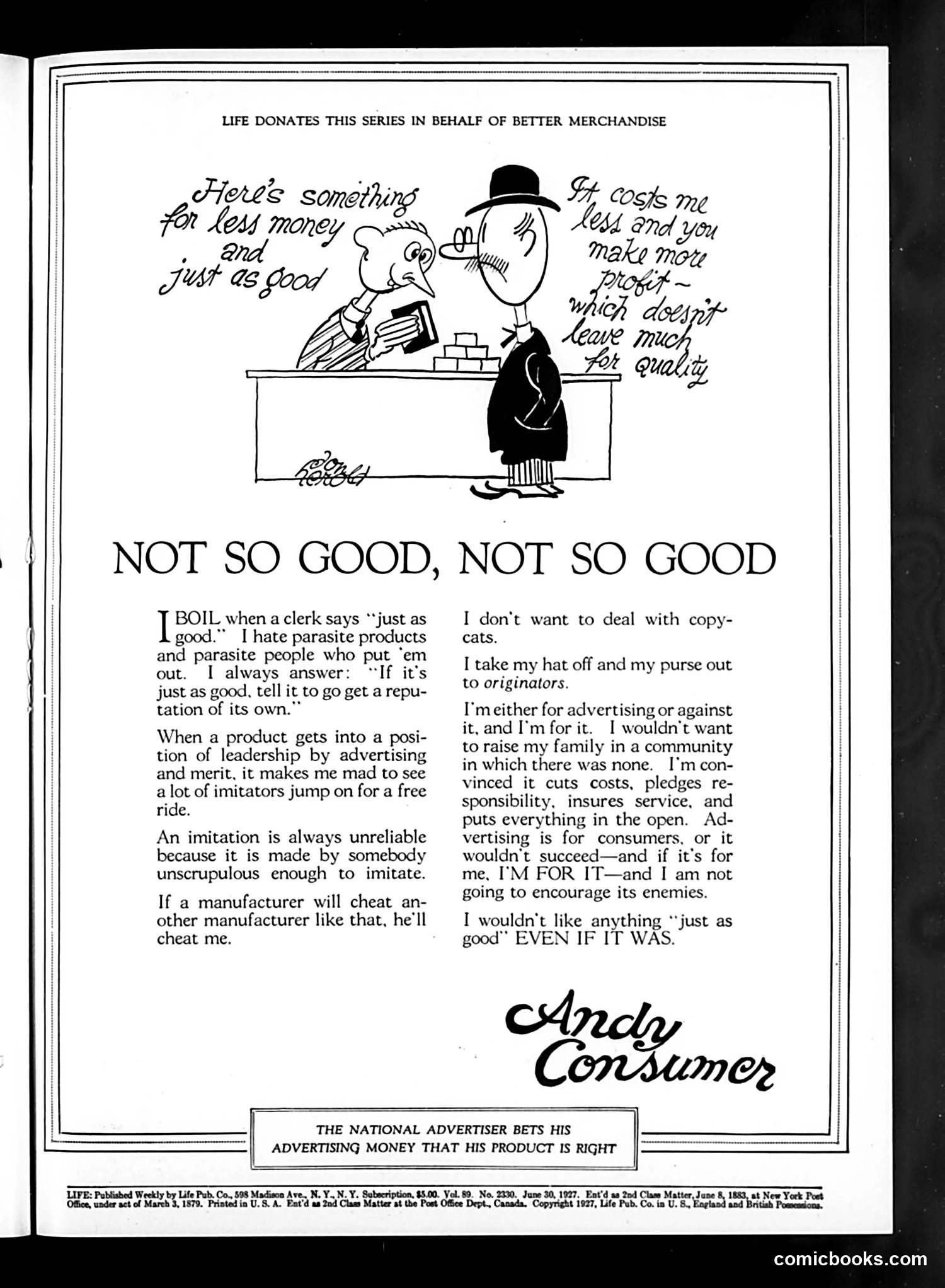
This satirical piece by "Andy Consumer" criticizes cheap imitations of successful brand-name products. The cartoon shows a merchant offering inferior knockoff goods to a customer, claiming they're "just as good" while costing less—but sacrificing quality. The text argues against both parasitic imitation products and the consumers who buy them. The author opposes advertising that promotes such inferior items, viewing it as undermining honest business. The piece advocates for supporting original manufacturers through advertising rather than encouraging competitors to cut corners. This reflects 1920s consumer debates about product quality, brand loyalty, and the emerging importance of advertising in establishing market leadership and consumer trust.
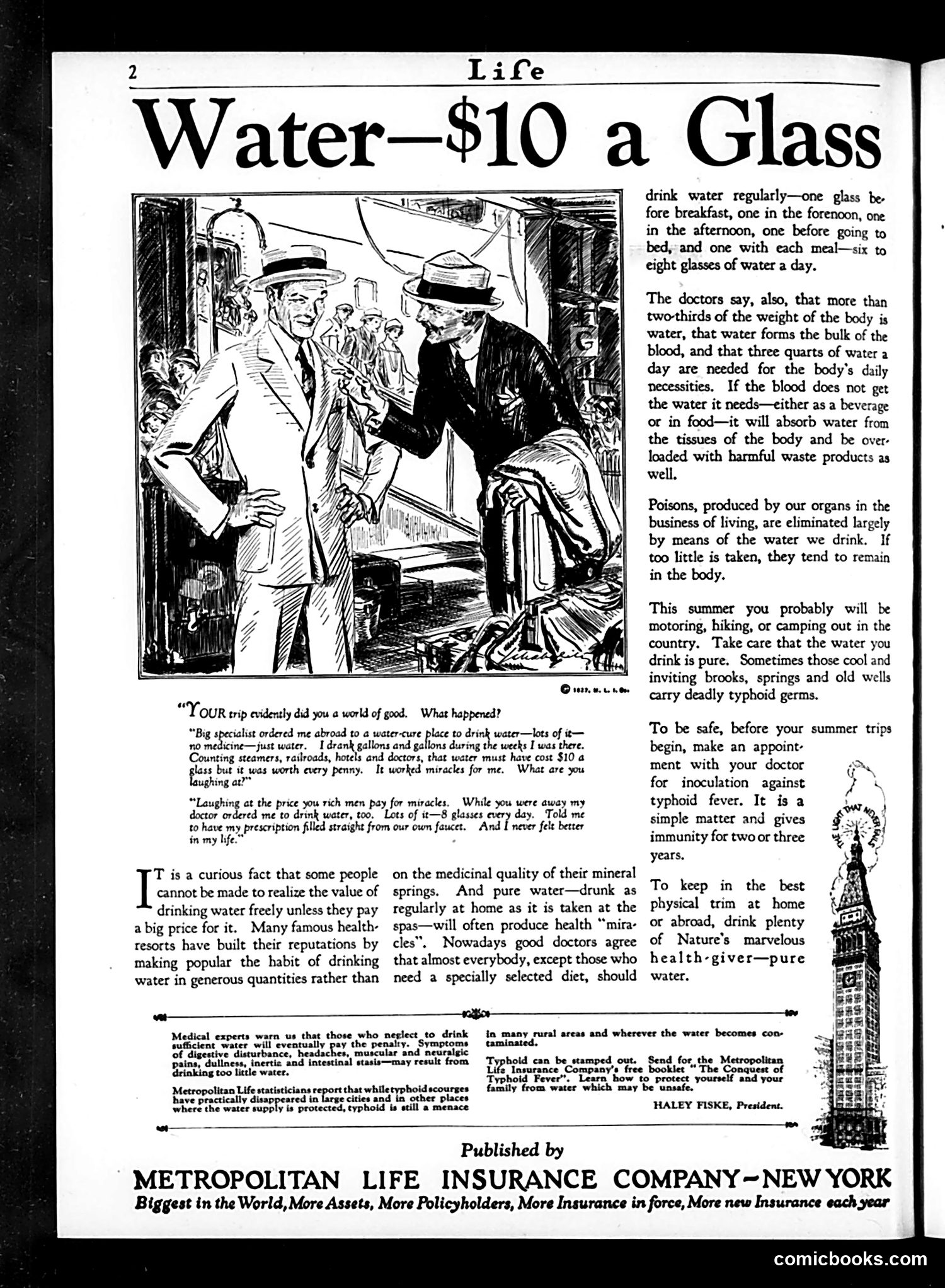
This page is primarily a **public health advertisement** disguised as satire, published by Metropolitan Life Insurance Company. The cartoon depicts two men in suits discussing water treatment. The dialogue reveals the satire's target: a wealthy person who paid $10 per glass for water at an expensive spa/health resort abroad, only to learn their doctor prescribed simply drinking more water—costing nothing. The joke mocks **health tourism and expensive "miracle cures"** while promoting practical, free health habits. The accompanying text earnestly advocates drinking 6-8 glasses of water daily, warns against contaminated water sources (particularly typhoid from untreated wells), and recommends medical consultation before traveling. This reflects early 20th-century public health campaigns promoting hygiene and preventive medicine, presented through humor to engage readers.
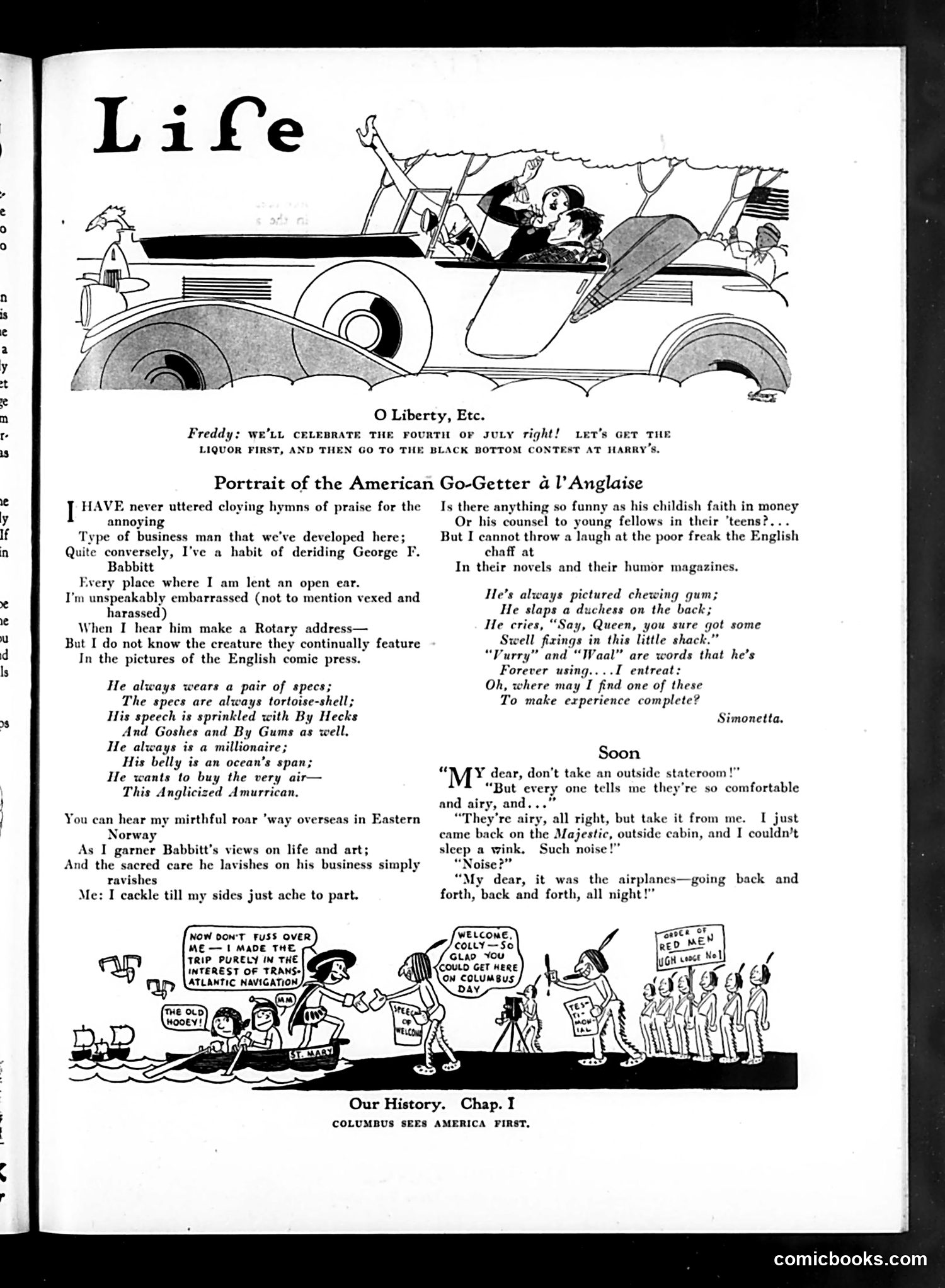
This Life magazine page satirizes American business culture and attitudes toward leisure. The top cartoon mocks the stereotypical American businessman ("George F. Babbitt," referencing Sinclair Lewis's 1922 novel critiquing conformist business culture). The accompanying poem ridicules the "Americanized" businessman's mannerisms—his constant gum-chewing, his wealth, his misuse of English slang ("Furry," "Waal"). The "Soon" dialogue parodies complaints about shipboard noise from airplane engines, mocking wealthy Americans' inability to enjoy comfortable leisure without complaint. The bottom cartoon, "Our History, Chap. I: Columbus Sees America First," appears to be a humorous take on historical discovery, though its specific political reference is unclear from the visible text alone. Overall, the page satirizes American materialism, business-class pretension, and the inability of the wealthy to appreciate their own comfort.
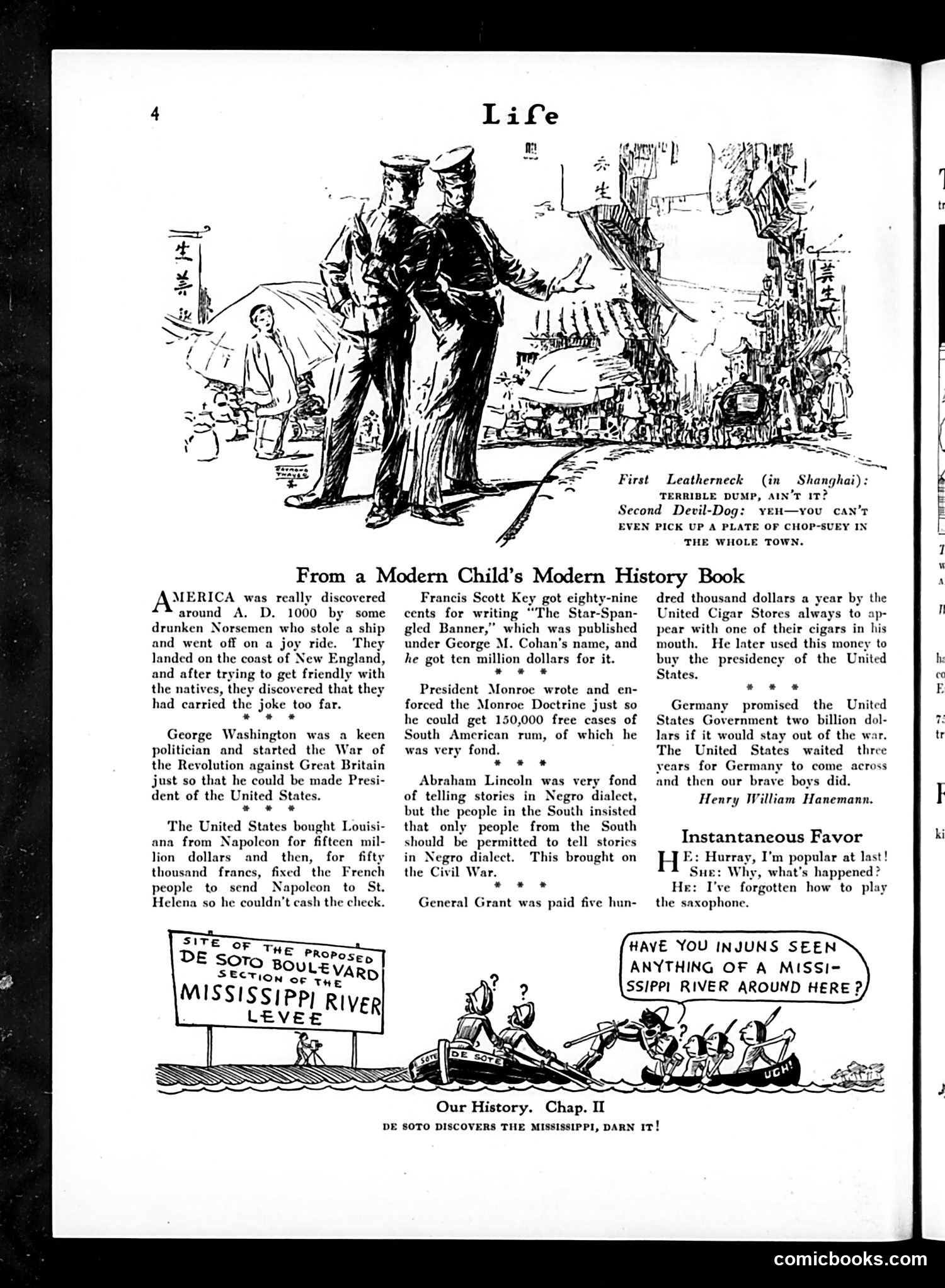
This page from *Life* magazine satirizes American history through mock-serious cartoons. The top illustration mocks colonial encounters—two British soldiers dismiss a Chinese merchant as a "terrible dump," mocking cultural superiority attitudes. The text below parodies history textbooks with deliberately absurd claims: America was "discovered" by drunk Dutchmen, George Washington became president solely to avoid work, and Francis Scott Key sold his poem for pennies while George M. Cohan profited enormously. The bottom cartoon shows De Soto "discovering" the Mississippi River while Native Americans (labeled "injuns") ask if he's seen anything of a Mississippi River—a joke about European "discovery" of lands already known to indigenous peoples. The satire targets pretentious historical narratives and their erasure of prior inhabitants and non-European perspectives.
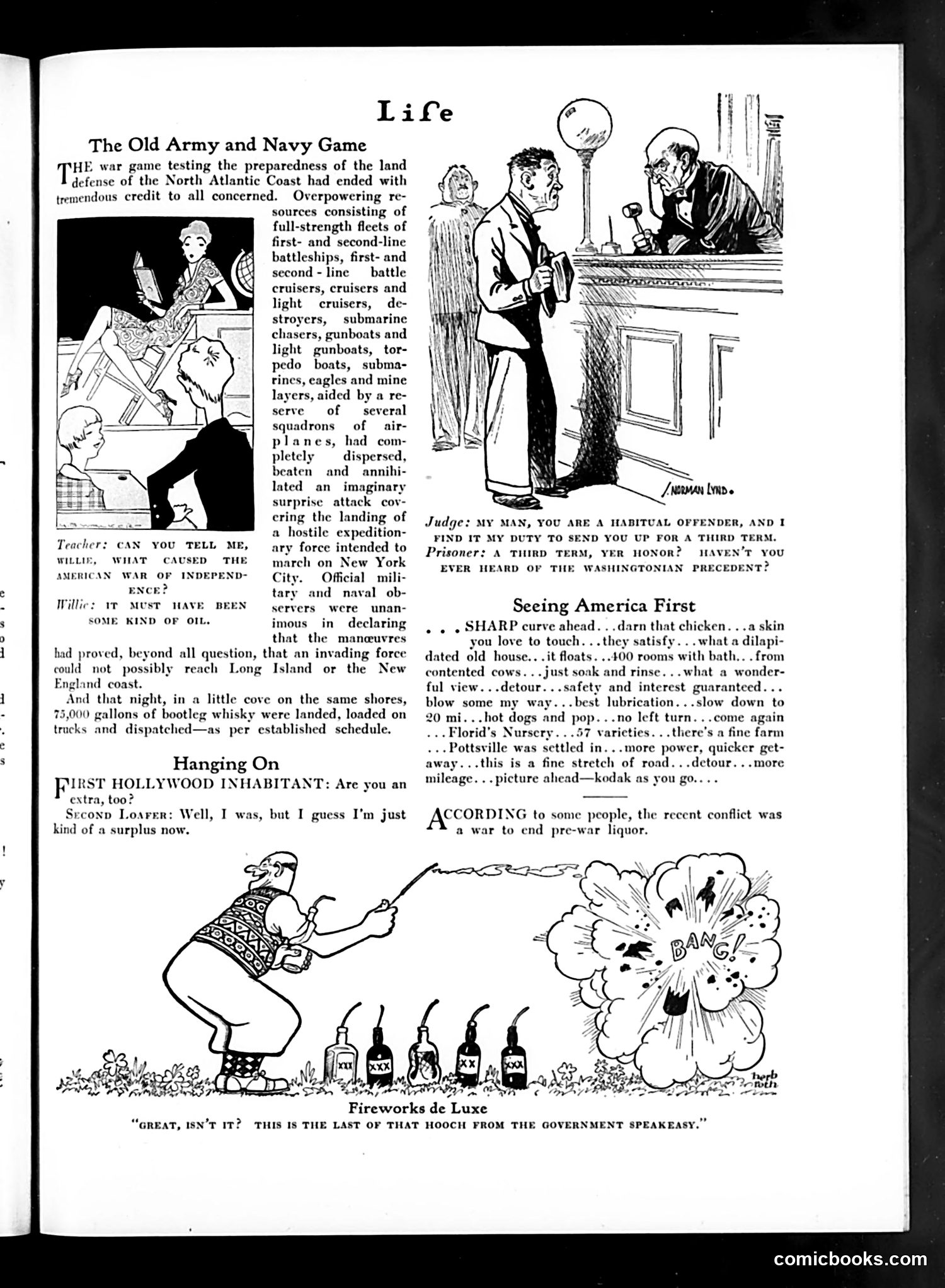
This page contains three separate satirical pieces from the WWI era: 1. **"The Old Army and Navy Game"**: A classroom scene mocking military unpreparedness. A teacher questions a student ("Willie") about the causes of U.S. independence, but Willie—distracted by a naval battle map—hasn't been paying attention. The satire critiques how military exercises overwhelmed civilian life and attention. 2. **"Seeing America First"**: A romantic road-trip monologue celebrating American tourism and landscapes, likely satirizing jingoistic "America First" sentiment of the period. 3. **"Fireworks de Luxe"**: A judge sentences a repeat offender to prison, quipping that this is "the last of that hooch from the government speakeasy." This mocks Prohibition enforcement and corruption—judges and officials allegedly profited from seized alcohol.
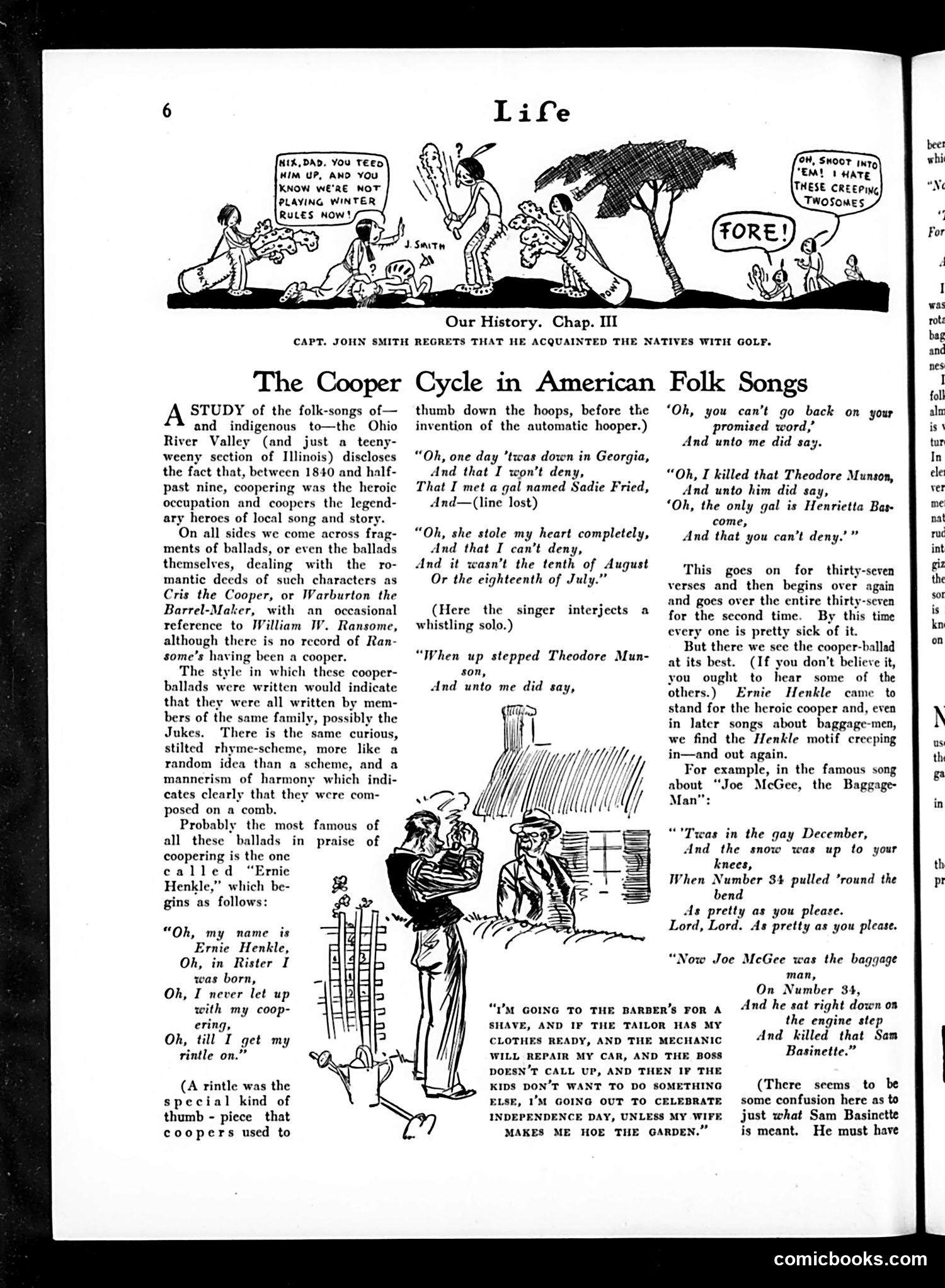
The cartoon at the top depicts **Captain John Smith introducing golf to Native Americans**. The caption reads: "CAPT. JOHN SMITH REGRETS THAT HE ACQUAINTED THE NATIVES WITH GOLF." This is satirical American history. It shows Smith teaching Indigenous people to play golf while they're confused or distressed by the activity. The joke is a **reversal of the historical narrative**: rather than regretting colonization's destructive impact, Smith supposedly regrets teaching golf—a trivial cultural import that apparently made Native Americans unhappy. The satire mocks both colonial arrogance and early 20th-century golf culture's perceived absurdity, suggesting that introducing golf to indigenous peoples was among colonialism's regrettable contributions.
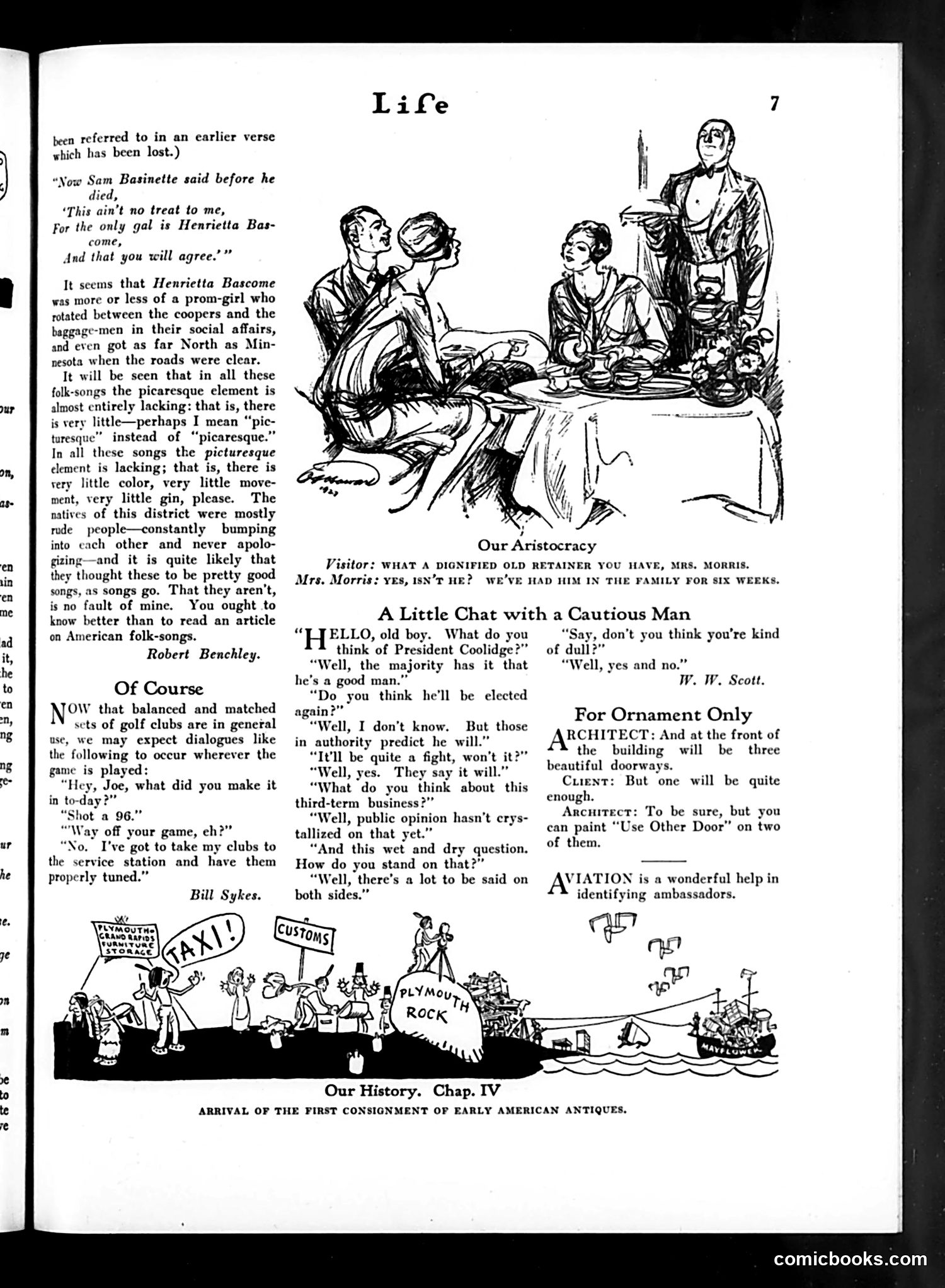
The bottom cartoon titled "Our History. Chap. IV" satirizes early American immigration and commerce. It depicts ships arriving at "Plymouth Rock" labeled with goods like "TAXI" and "CUSTOMS," alongside figures representing various nationalities and commercial interests. The satire suggests that America's founding wasn't purely about the Pilgrims seeking religious freedom, but rather involved mercantile exploitation and cultural mixing from the start—a cynical commentary on American mythology. The upper illustration labeled "Our Aristocracy" shows a conversation where a visitor compliments Mrs. Morris on retaining a servant for six weeks, treating domestic help retention as a mark of social status. This mocks the pretensions of American upper-class society claiming "aristocratic" refinement while struggling with basic household management—a common Life magazine theme ridiculing American social climbers.
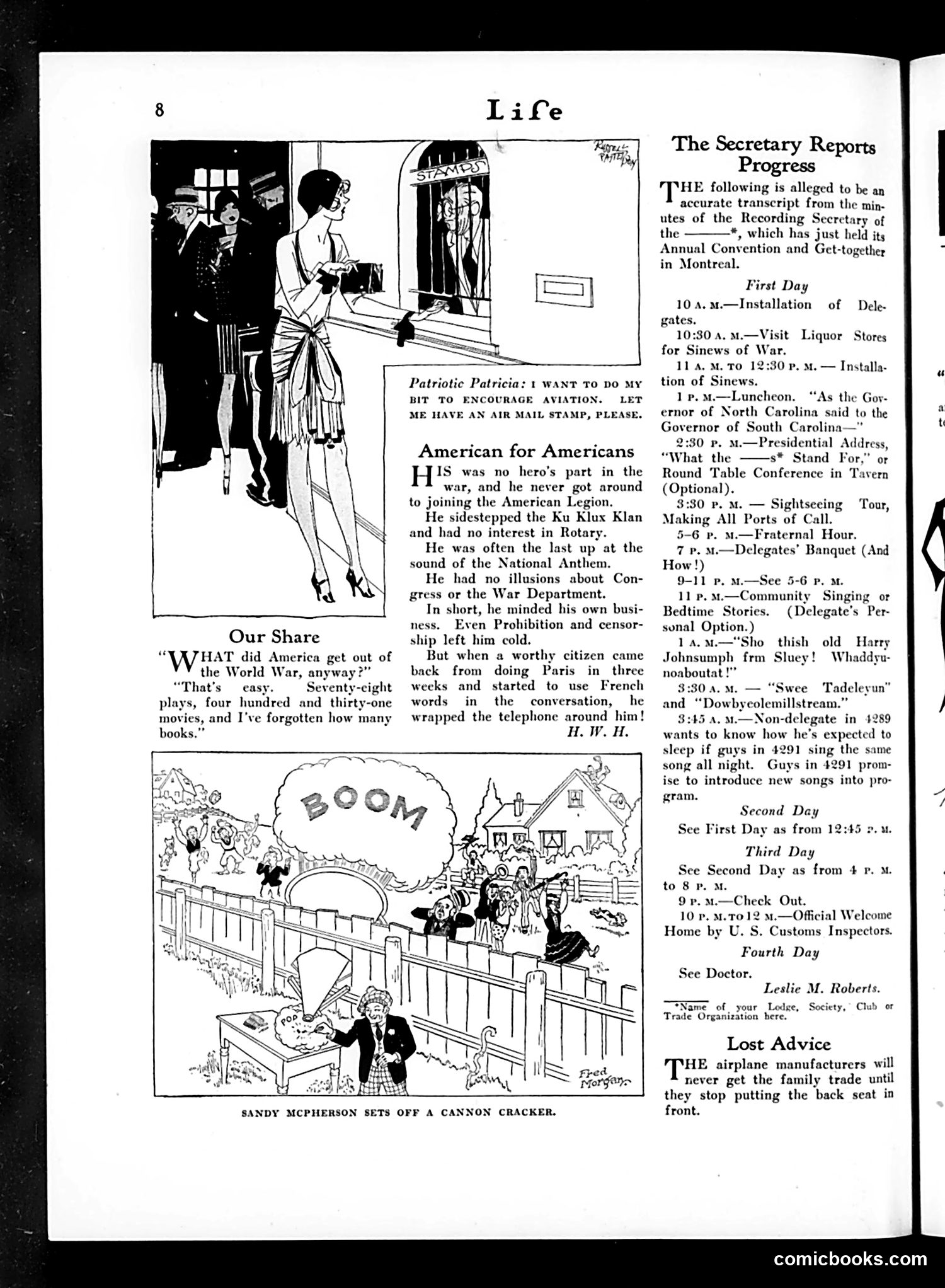
This *Life* magazine page contains satirical commentary on post-WWI American society: **"American for Americans"** (main story): Criticizes a man who avoided joining the American Legion, showed no interest in civic organizations like Rotary, and ignored patriotic causes. However, when a French visitor mentioned French words casually, he suddenly adopted French phrases in conversation—demonstrating shallow, performative patriotism. **"Our Share"** (cartoon): The joke questions what America actually gained from World War I, answering "Seventy-eight plays, four hundred and thirty-one movies, and I've forgotten how many books"—satirizing America's focus on entertainment rather than meaningful post-war accomplishments or growth. Both pieces mock superficial patriotism and materialism in 1920s America.
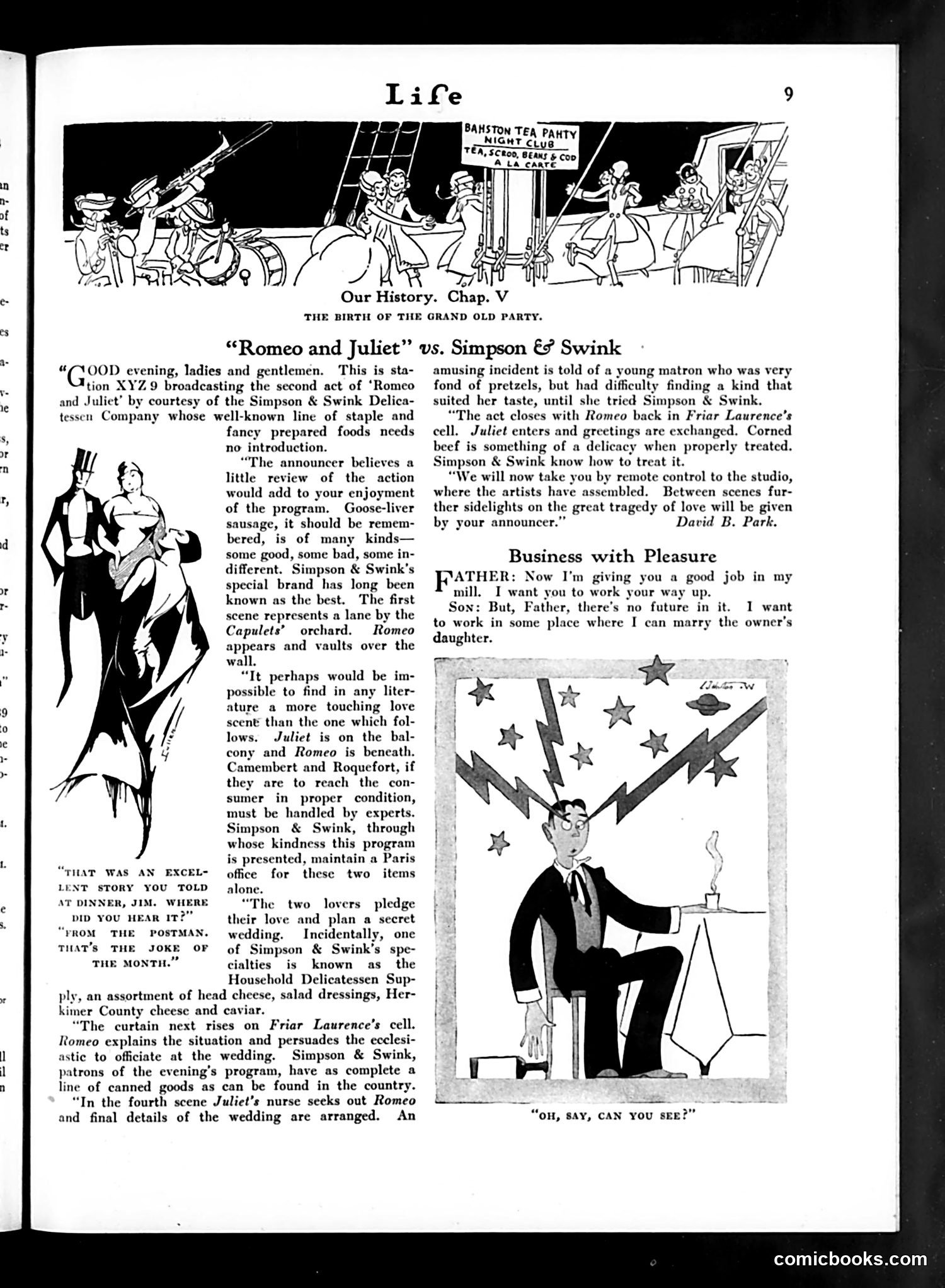
This page satirizes a 1920s radio broadcast of Shakespeare's "Romeo and Juliet" sponsored by Simpson & Swink, a delicatessen company. The satire mocks the incongruity of commercial food advertising interrupting high literature. The main cartoon shows a man at a dinner table beneath stars and lightning bolts, captioned "Oh, say, can you see?" — a joke about radio's invisible medium. The accompanying sketch depicts a couple in romantic poses, referencing the tragic lovers. The text parodies how Simpson & Swink exploits the program by promoting their canned goods and specialty foods (corned beef, cheeses, caviar) as "refined" products suitable to the elevated artistic context. The humor targets both pretentious advertising claims and the absurdity of selling groceries through Shakespeare broadcasts.
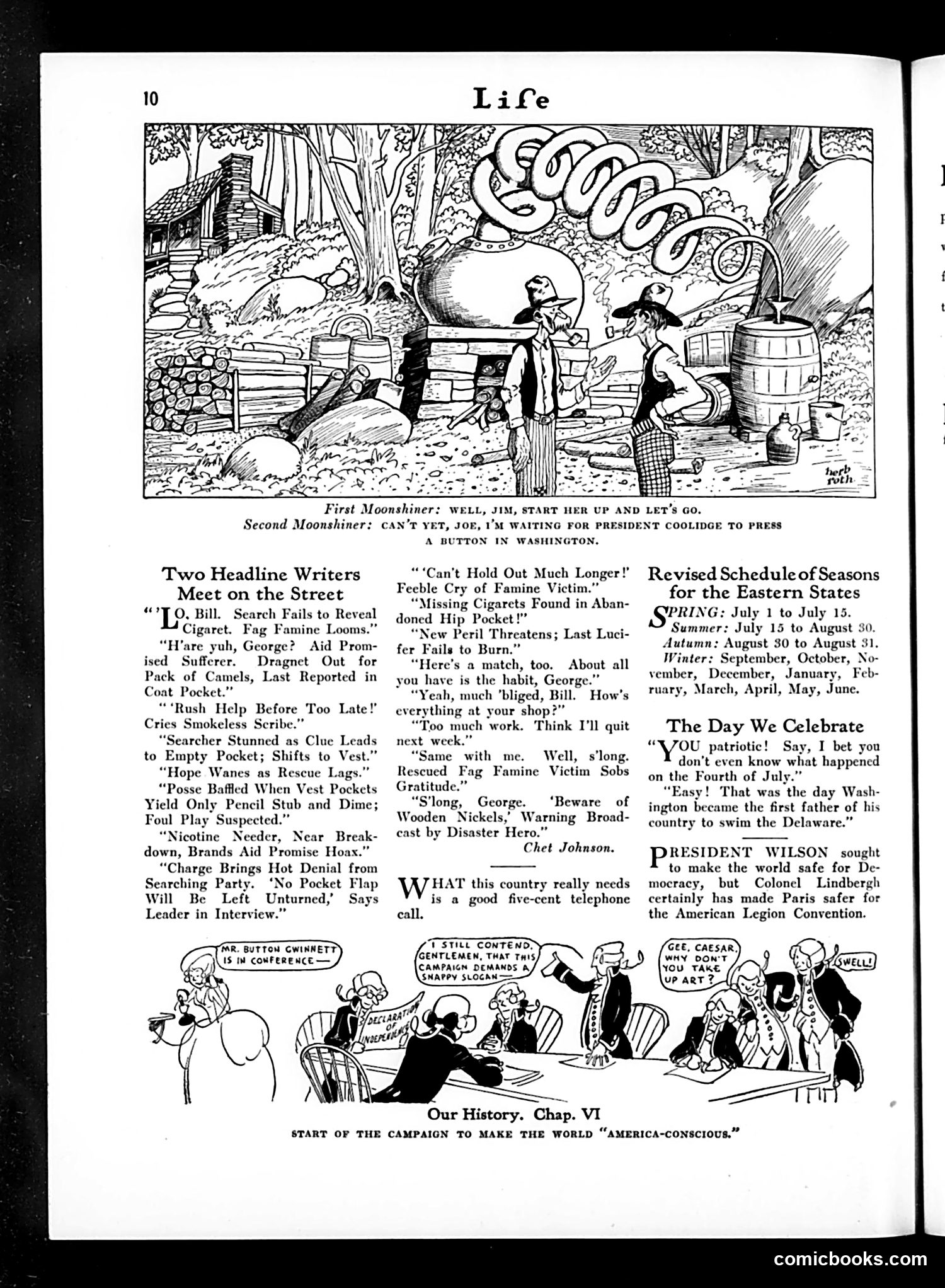
The page contains two satirical cartoons: **Top cartoon**: Depicts illegal moonshine production during Prohibition. The "First Moonshiner" and "Second Moonshiner" dialogue mocks the absurdity of waiting for President Coolidge's approval to operate, satirizing how Prohibition enforcement was ineffective and openly flouted. **Bottom cartoon** ("Our History, Chap. VI"): Shows gentlemen in conference debating whether their campaign is "creative enough," likely satirizing post-WWI American political movements to promote American values and influence globally. The figures appear to be politicians or business leaders, with one holding what looks like propaganda material. Both cartoons critique Prohibition's failure and American political/social pretensions of the 1920s era.
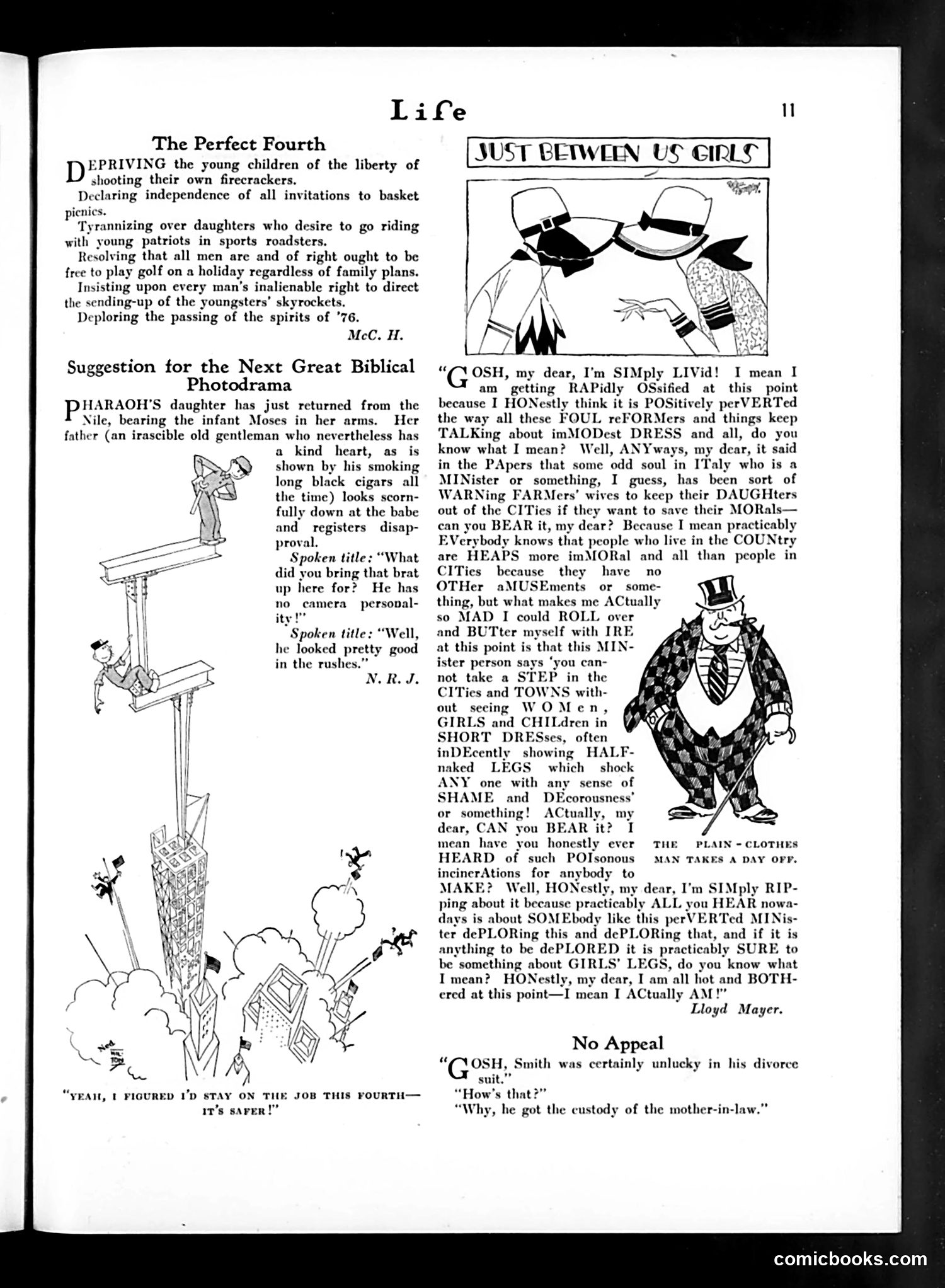
This page contains three distinct pieces of satire: **"The Perfect Fourth"** mocks American patriotic excess—men claiming independence while denying it to women and daughters, insisting on golf holidays while controlling their families' activities. **"Just Between Us Girls"** features a woman ranting about women's fashion and public behavior. She criticizes short dresses showing legs as scandalous and immoral, and objects to women appearing in cities without male chaperones. The satire targets prudish attitudes toward women's liberation and changing social norms of the 1920s. **"No Appeal"** is a brief divorce joke playing on custody outcomes. The cartoons mock both rigid patriarchalism and outdated social conventions, particularly attitudes toward women's freedom and dress—likely reflecting 1920s debates over the "New Woman" and changing morality.
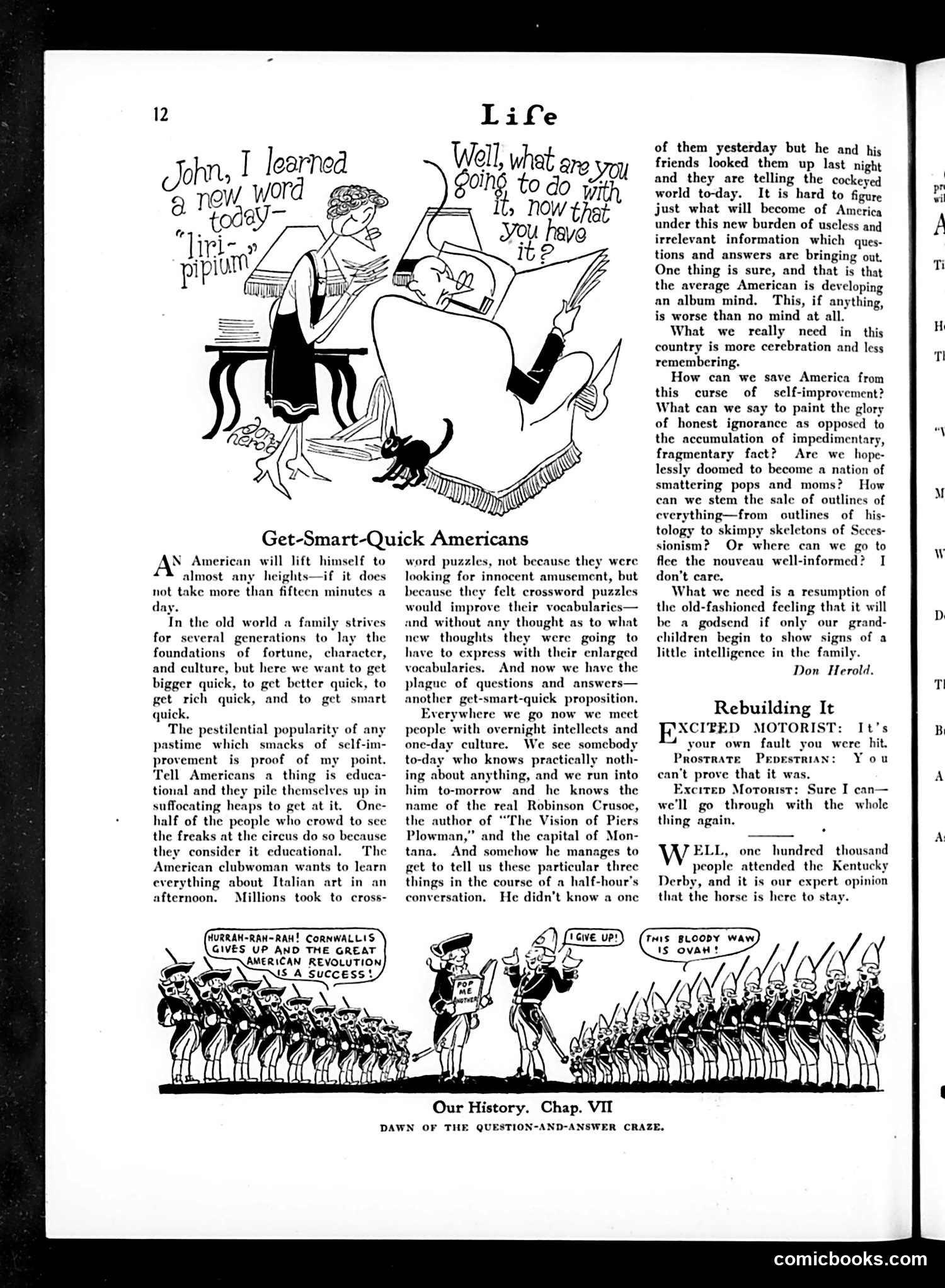
This page satirizes America's obsession with self-improvement and quick learning. The top cartoon shows a student proudly learning the word "filtrum" (a real anatomical term), illustrating the article's critique: Americans pursue useless knowledge through crossword puzzles and overnight self-education rather than developing genuine understanding. The article argues this "get-smart-quick" mentality produces superficial intellects—people who memorize facts without comprehension. It contrasts this with the old-world value of building character over time. The bottom cartoon, titled "Dawn of the Question-and-Answer Craze," parodies American Revolutionary history as soldiers mindlessly repeat patriotic phrases, suggesting modern Americans similarly absorb information without critical thought. The satire targets American culture's preference for rapid, easy intellectual consumption over substantive learning.
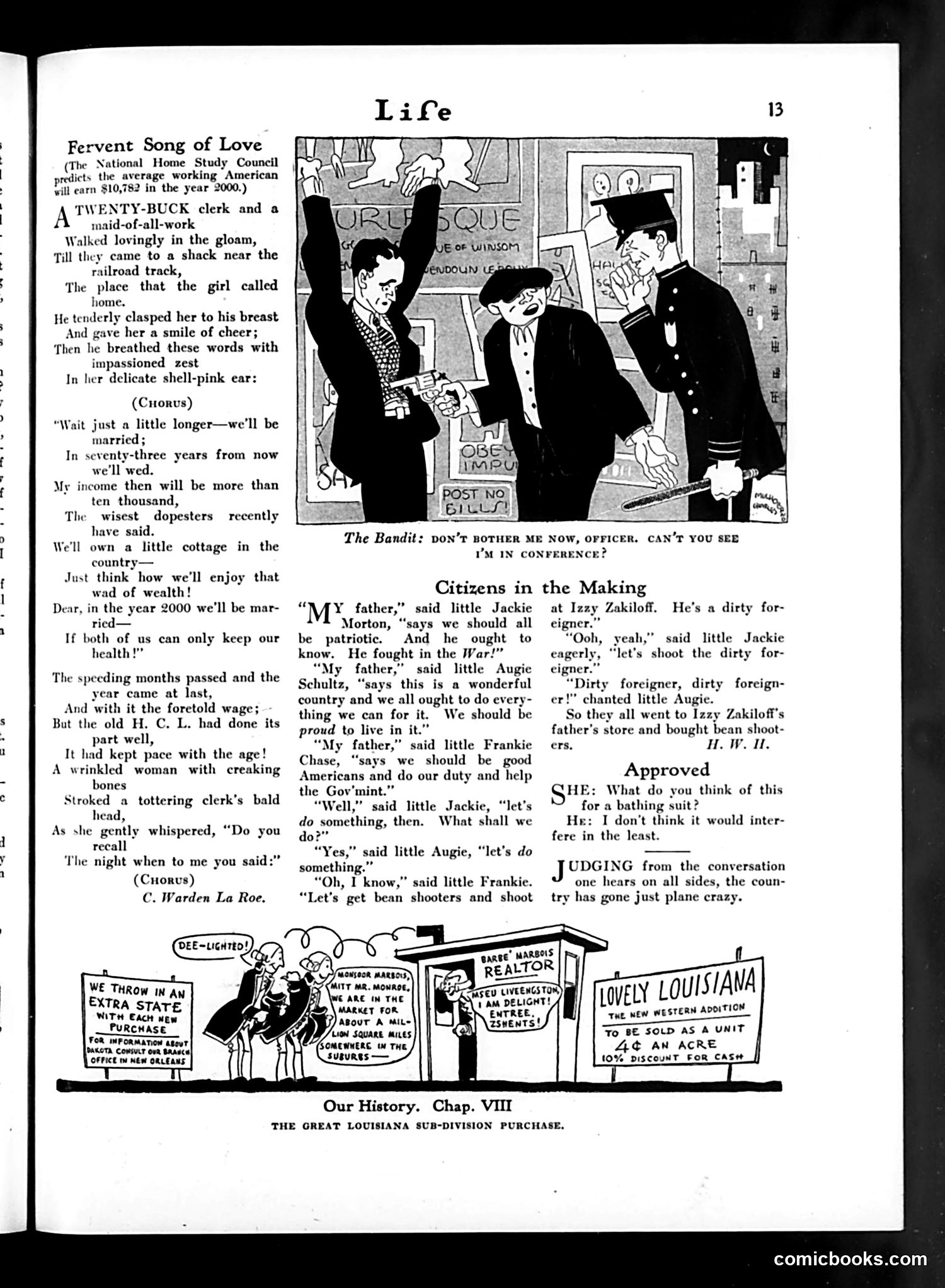
**"The Bandit" cartoon:** A man in formal dress confronts three officials (one wearing a top hat, suggesting authority). The caption reads: "Don't bother me now, officer. Can't you see I'm in conference?" The satire mocks someone of apparent importance evading police authority by claiming private business takes precedence—likely targeting corrupt politicians or wealthy figures who use their status to avoid accountability. **"Citizens in the Making" section:** Children discuss patriotic duties inspired by their fathers' wartime service, deciding to "shoot the dirty foreigner." This dark satire criticizes how nationalist rhetoric and wartime propaganda can poison youth, turning children into xenophobic participants in harmful ideology. Both pieces critique American social hypocrisy and dangerous nationalism.
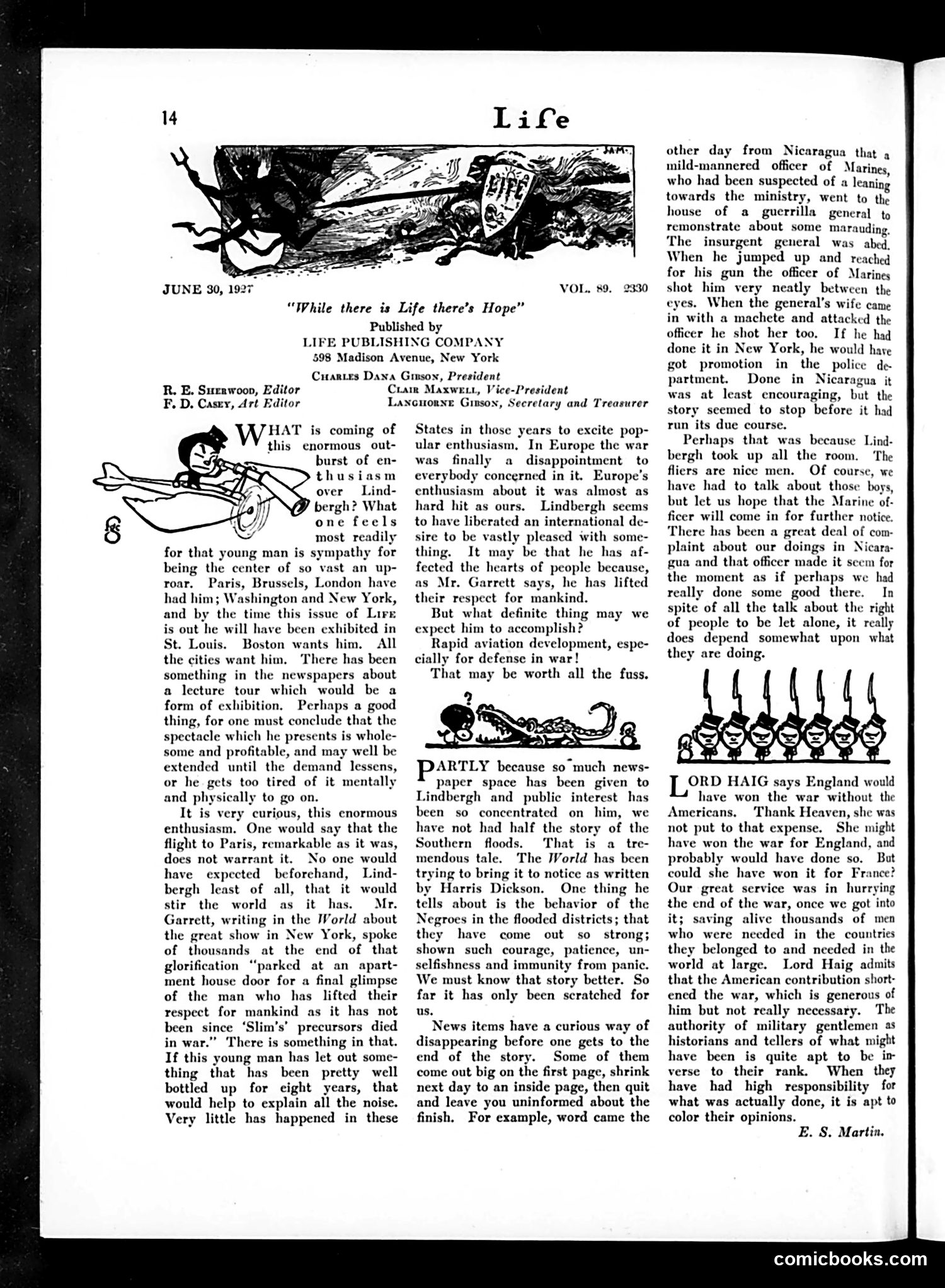
This editorial page features commentary on **Charles Lindbergh's transatlantic flight** (which occurred in May 1927). The text discusses the enormous public enthusiasm surrounding Lindbergh, noting that this young aviator has become "the center of so vast an upheaval of popular enthusiasm" that cities compete to exhibit him. The cartoons appear to satirize this obsessive media and public fixation. The first illustration shows what appears to be **Lindbergh surrounded by chaos**—suggesting the overwhelming nature of his celebrity. The second cartoon depicts **"Lord Haig"** and references WWI, apparently contrasting England's wartime heroes with America's current fascination with an aviator. The editorial tone is somewhat skeptical, questioning whether this enthusiasm is proportionate and sustainable, while acknowledging Lindbergh's genuine achievement in aviation.
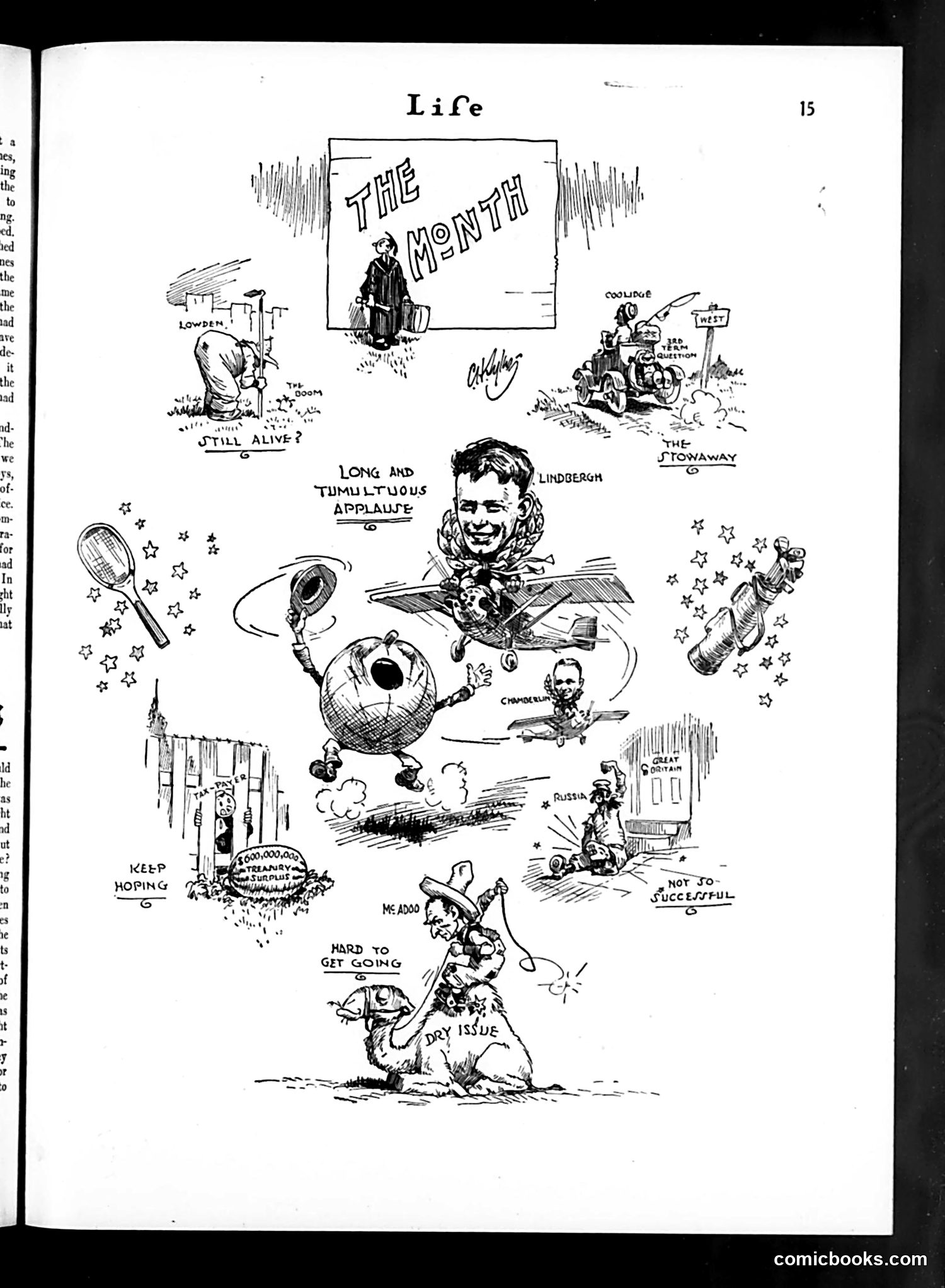
This is a celebratory caricature of **Charles Lindbergh**, the famous aviator who made the first solo transatlantic flight in 1927. The central figure shows Lindbergh's head superimposed on a globe, surrounded by symbolic imagery of his accomplishments and contemporary events. The surrounding vignettes reference various topics of that era: "Keep Hoping" (political optimism), "Hard to Get Going" (economic concerns), "Dry Issue" (Prohibition debate), "Not Successful" (failed initiatives), and others. The tennis rackets, globe, and airplane imagery celebrate Lindbergh's achievement and international fame. "Long and Tumultuous Applause" and "Stowaway" likely reference public reaction to his flight and related stories. This appears to be Life's monthly summary of newsworthy figures and events, with Lindbergh as the featured celebrity of the month.
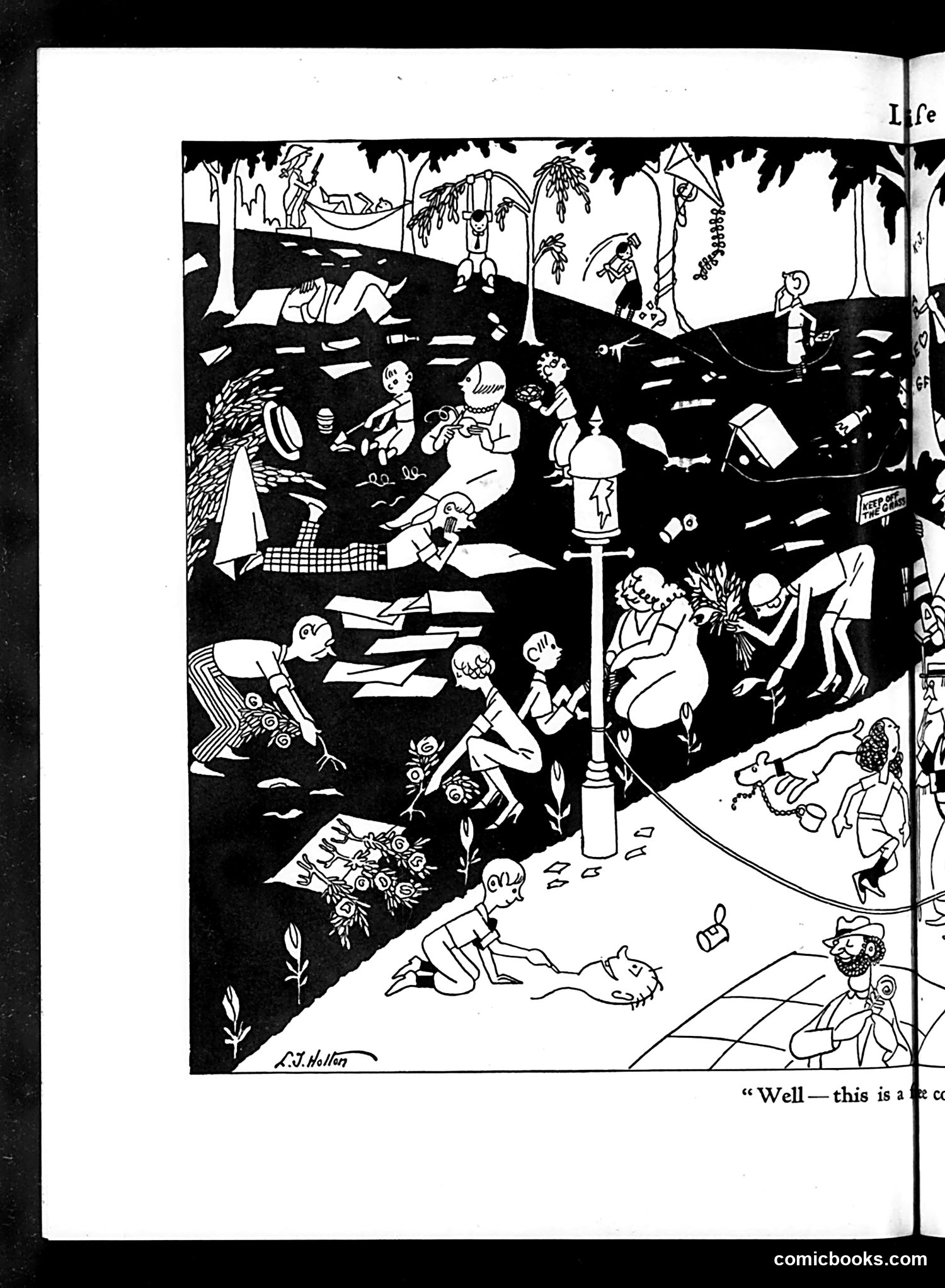
This is a single-panel cartoon by C.J. Holton depicting a chaotic garden or backyard scene with multiple children engaged in various activities—digging, playing, building, and exploring nature. The illustration uses stark black-and-white contrast typical of early-to-mid 20th century magazine art. The partially visible caption at bottom reads "Well—this is a..." but is cut off, making the specific satirical point unclear from the text alone. Based purely on the image, this appears to be social commentary on childhood behavior or parenting—possibly satirizing either the messiness of unsupervised children or, conversely, celebrating their natural curiosity and independence in outdoor play. Without the complete caption, the specific satirical target remains unclear.
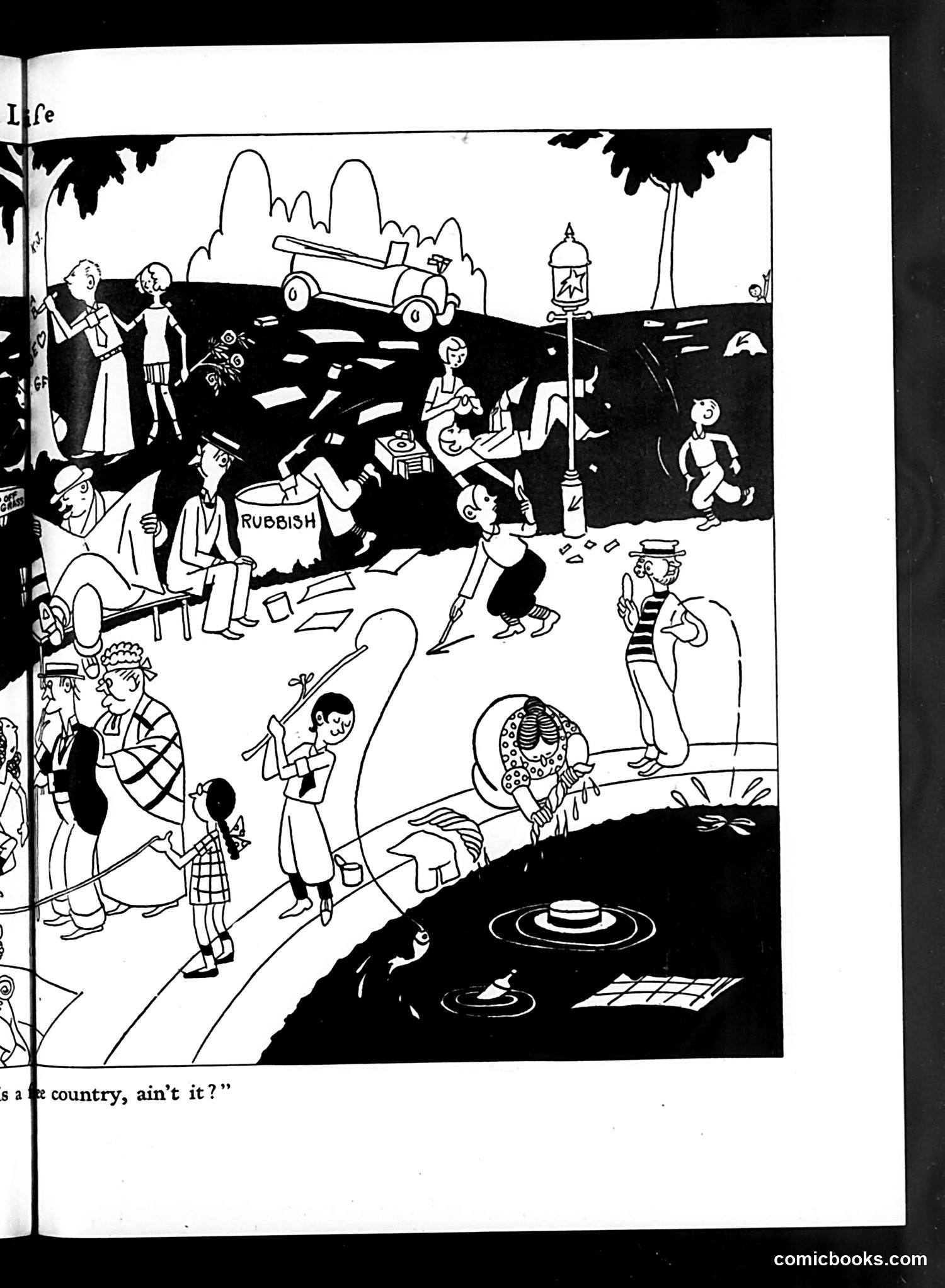
This is a satirical cartoon depicting a chaotic public space—likely a park or recreational area—where various social classes and types coexist. The scene shows littering ("RUBBISH" visible), people fishing in what appears to be polluted water, children playing, and adults socializing amid general disorder and waste. The partially visible caption at bottom reads "...a ze country, ain't it?" suggesting commentary on American society and conditions. The black-and-white illustration satirizes urban decay, social disorder, and environmental degradation in what Life's audience would recognize as contemporary America. The mixed crowd—working-class figures, children, and various characters—suggests this critique applies broadly across society rather than targeting one group. The overall tone mocks the gap between idealized notions of "the country" and actual lived conditions.
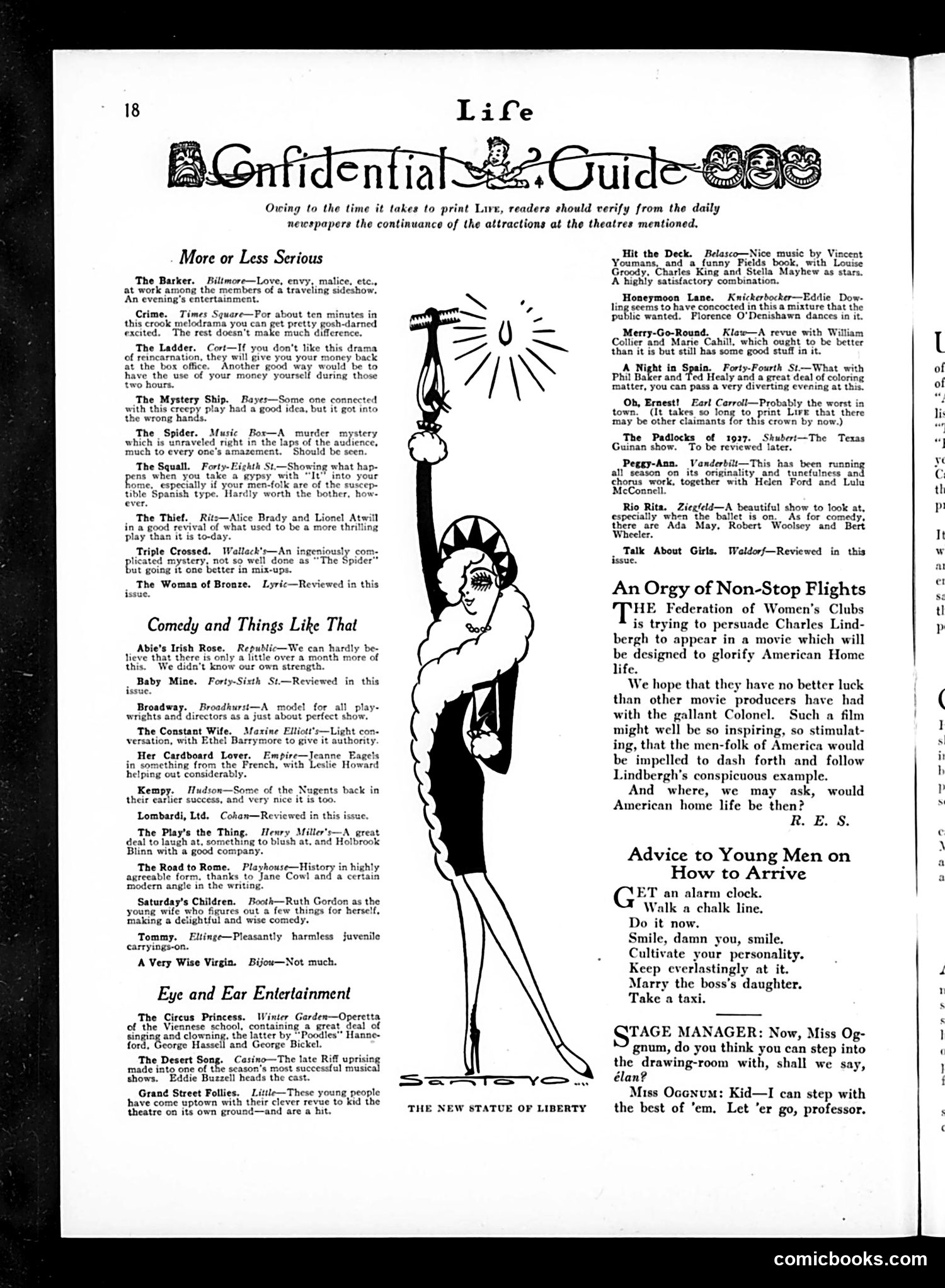
The large cartoon depicts a stylized female figure climbing a rope or ladder, labeled "THE NEW STATUE OF LIBERTY" at the bottom. This appears to be political satire critiquing the changing meaning of American liberty, likely during the 1920s era (based on the page number and magazine style). The climbing pose—precarious and undignified compared to the iconic standing Statue of Liberty—suggests a satirical commentary that American freedom or ideals are in decline or being undermined. The figure's exertion contrasts with Liberty's traditional stately pose, implying liberty itself has become difficult, desperate, or corrupted. The exact political context remains unclear without additional historical markers, though the Prohibition era appears referenced elsewhere on the page.
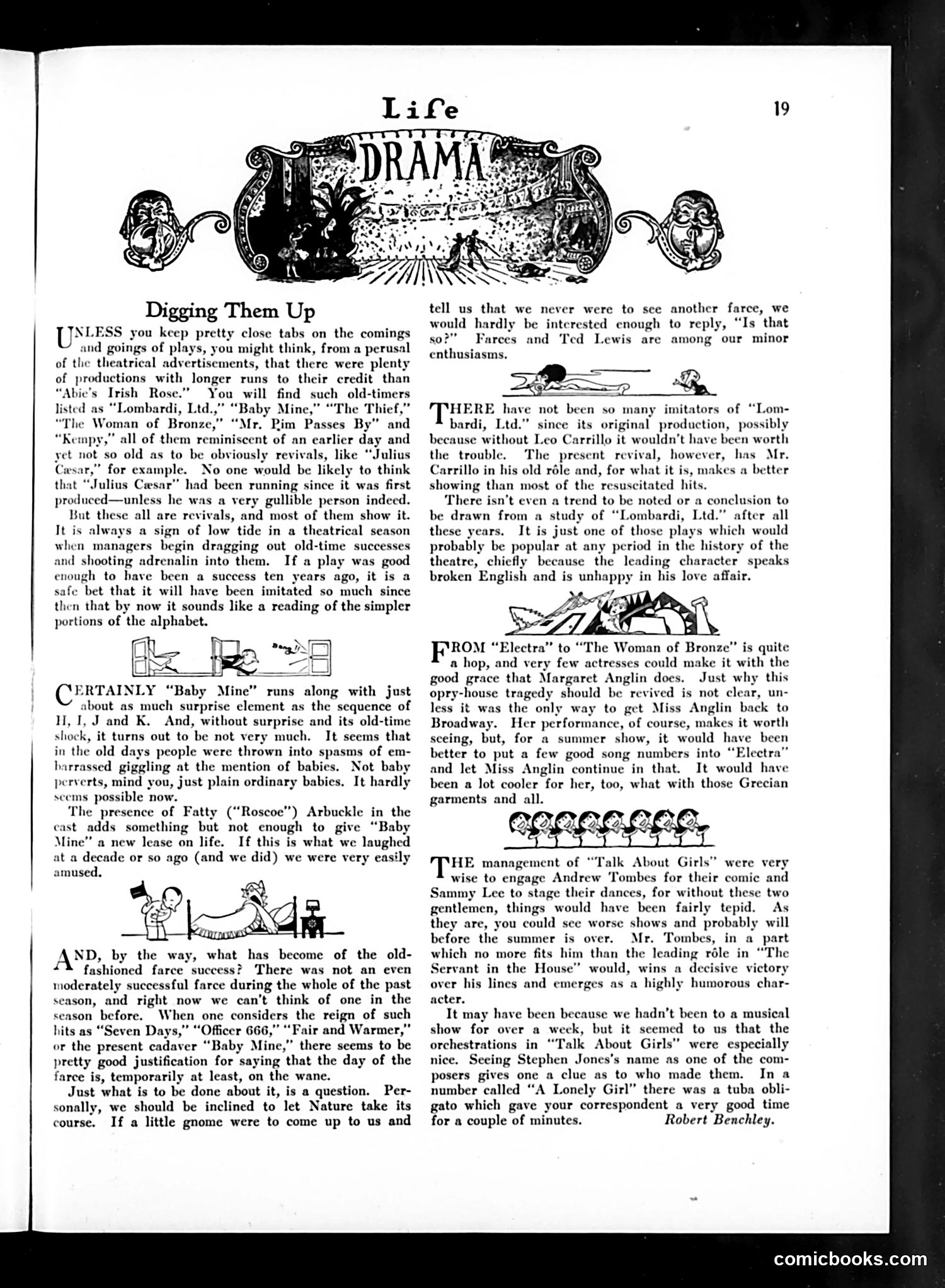
This theater column critiques Broadway's practice of reviving old comedies during a slow season—a sign the writer sees as artistic desperation. The author argues that farces like "Baby Mine," "Lombardi, Ltd.," and "Julius Caesar" (revivals, not new productions) lack the shock value they once had. What audiences found hilarious a decade earlier now seems dated; the jokes feel predictable as "reading the simpler portions of the alphabet." The satire targets theatrical managers for lazily recycling proven hits rather than developing fresh material. The columnist's dismissive tone toward farces generally—grouping them with Ted Lewis as "minor enthusiasms"—underscores the broader point: Broadway's reliance on revivals reflects creative bankruptcy, not audience demand. Even strong performers like Fatty Arbuckle and Margaret Anglin can't fully revive these creaky scripts.
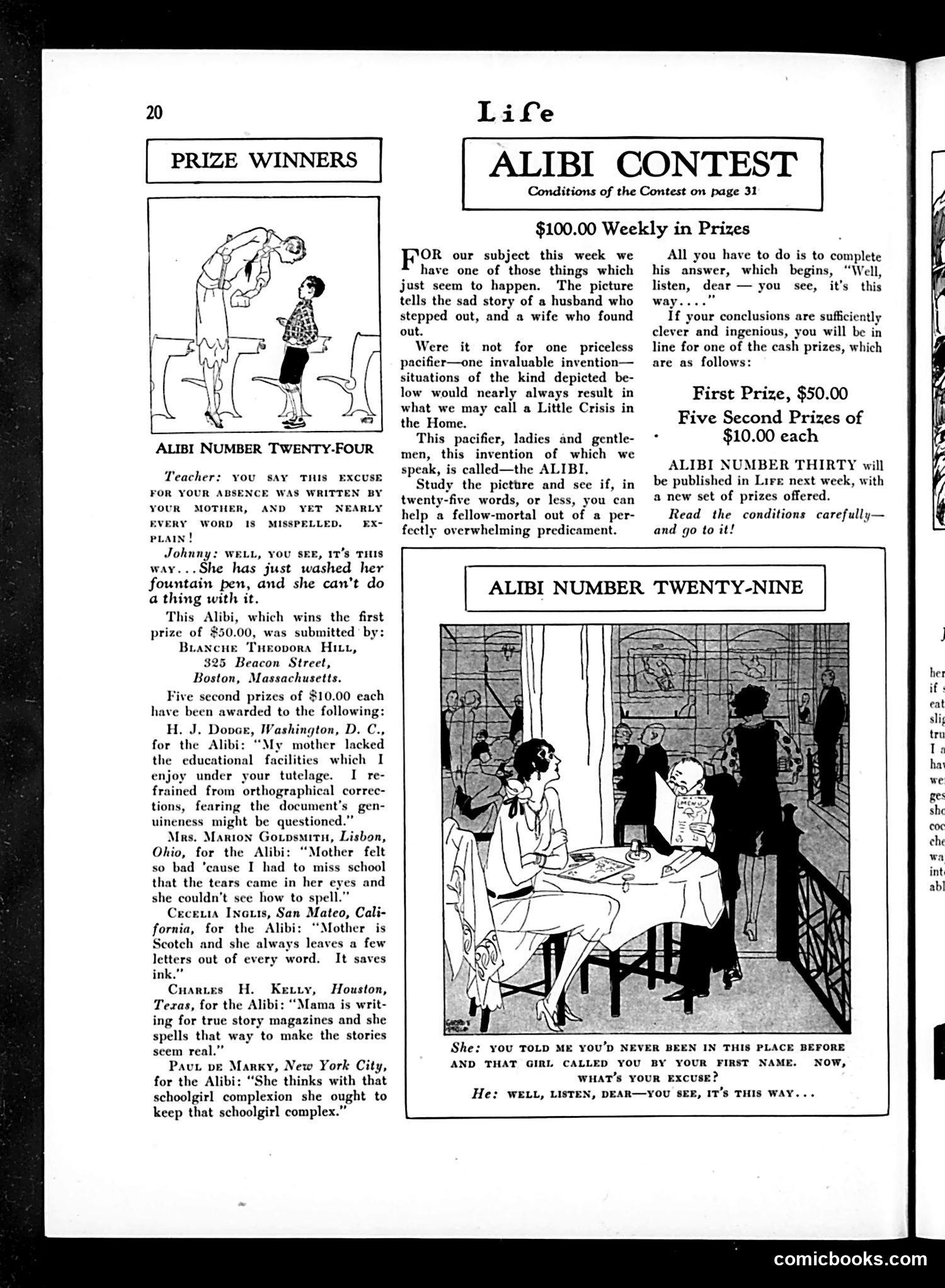
This page presents a 1920s-era humor contest called "Alibi." The top cartoon shows a teacher confronting a student (Johnny) about a misspelled absence note supposedly written by his mother—Johnny's excuse is that his mother just washed her fountain pen. The main feature is a marital drama: a husband has been caught in a compromising situation—a woman at a restaurant called him by his first name, suggesting prior acquaintance. His wife demands an explanation. The contest challenges readers to complete his alibi (excuse) in 25 words or fewer, with cash prizes offered. The humor relies on the assumption that fabricating excuses to escape blame for infidelity or suspicious behavior is both common and entertaining. This reflects period attitudes about marital deception and male infidelity as comic fodder. The "alibi" itself—the art of plausible lying—is treated as a clever, admirable skill worthy of prize money.
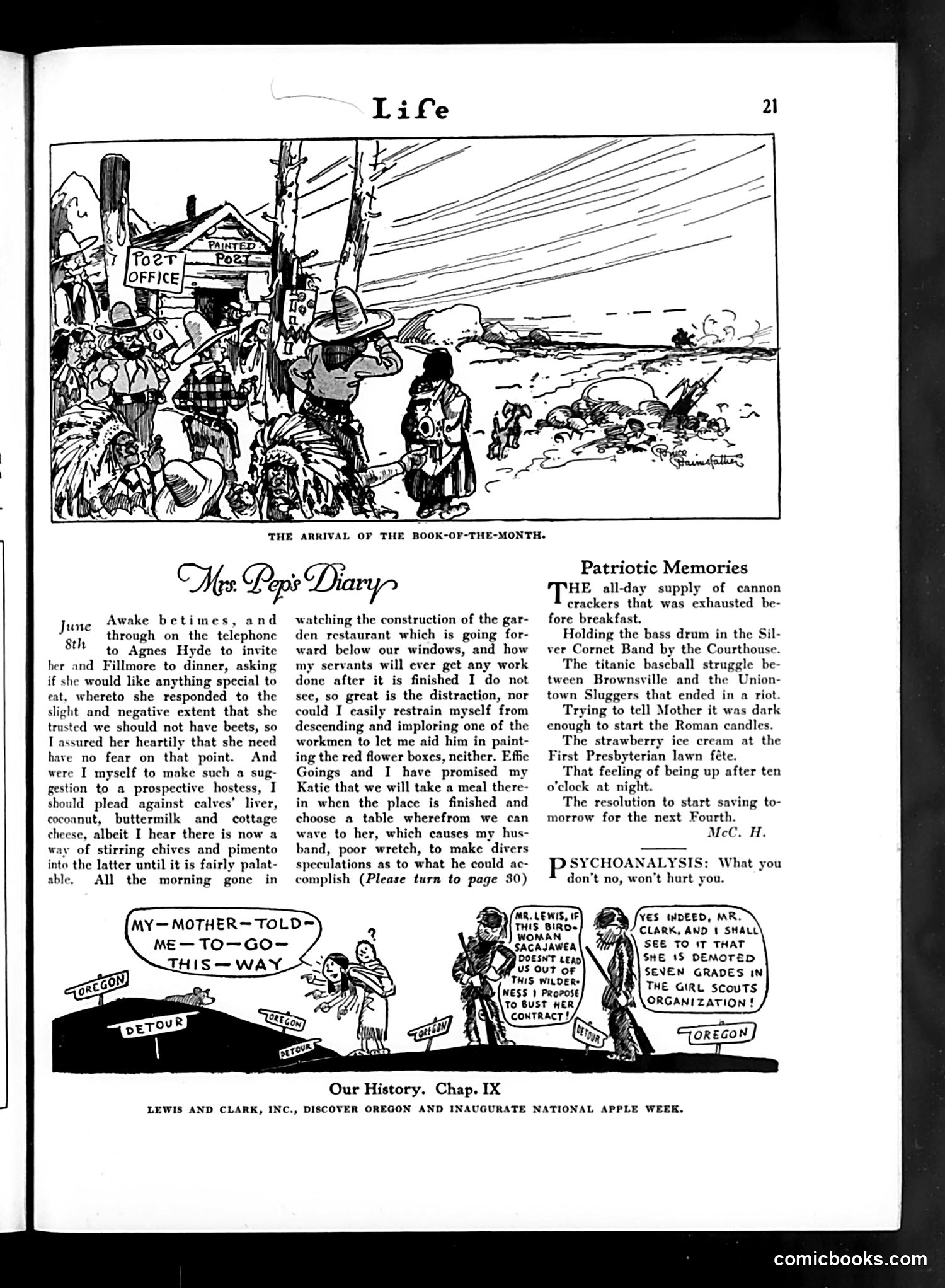
This page contains three distinct pieces of satire: **Top cartoon** ("The Arrival of the Book-of-the-Month"): Shows a frontier settlement welcoming what appears to be a book delivery, satirizing the newly-popular Book-of-the-Month Club subscription service as a significant cultural event deserving frontier-style celebration. **"Mrs. Peps' Diary"**: A society gossip column mocking upper-class dinner etiquette anxieties and preoccupations (concerns about serving beets, buttermilk, etc.). **Bottom cartoon** ("Lewis and Clark"): Depicts the historical explorers with a modern Girl Scouts leader claiming credit for "discovering Oregon." The joke satirizes both the rewriting of history and contemporary Girl Scouts' prominence. The punchline about demoting a girl "seven grades" for unknown misconduct mocks administrative overreach. **"Patriotic Memories"**: Lists nostalgic Fourth of July traditions (cannon crackers, baseball games, Roman candles). The page overall satirizes American pretension, historical revisionism, and institutional bureaucracy through mock-earnest tone and juxtaposition of trivial with grandiose.
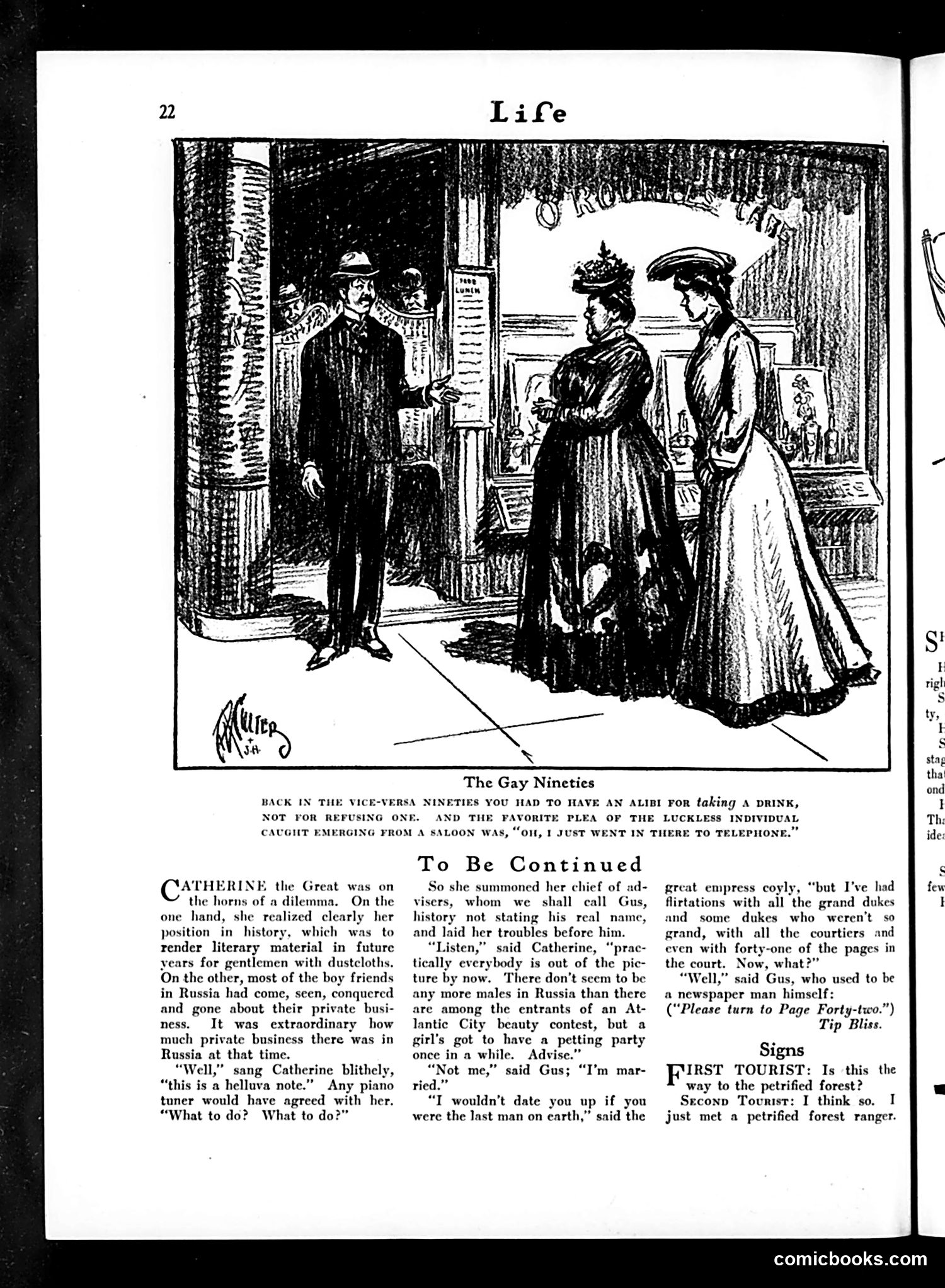
This page from *Life* magazine contains two distinct satirical pieces: **Top Cartoon**: "The Gay Nineties" mocks 1890s social hypocrisy. The caption explains that men caught drinking needed alibis—the "favorite plea" being they went into a saloon "to telephone." This satirizes the contradiction between Victorian propriety and actual behavior: men were supposedly respectable but frequented bars, requiring convenient excuses to cover their actions. **Bottom Story**: A comedic serialized narrative about Catherine the Great seeking romantic companionship after her former suitors have disappeared from Russia. The humor relies on treating a historical figure casually and anachronistically (she consults "Gus," a former newspaperman, as an advisor). The subplot joke with "Gus" refusing to help because he's married adds mild marital humor typical of era comedy. **Small "Signs" Section**: Two short joke items playing on words—tourists confused about a "petrified forest" and meeting an appropriately "petrified" ranger. All represent typical *Life* magazine humor: social observation, historical irreverence, and wordplay.
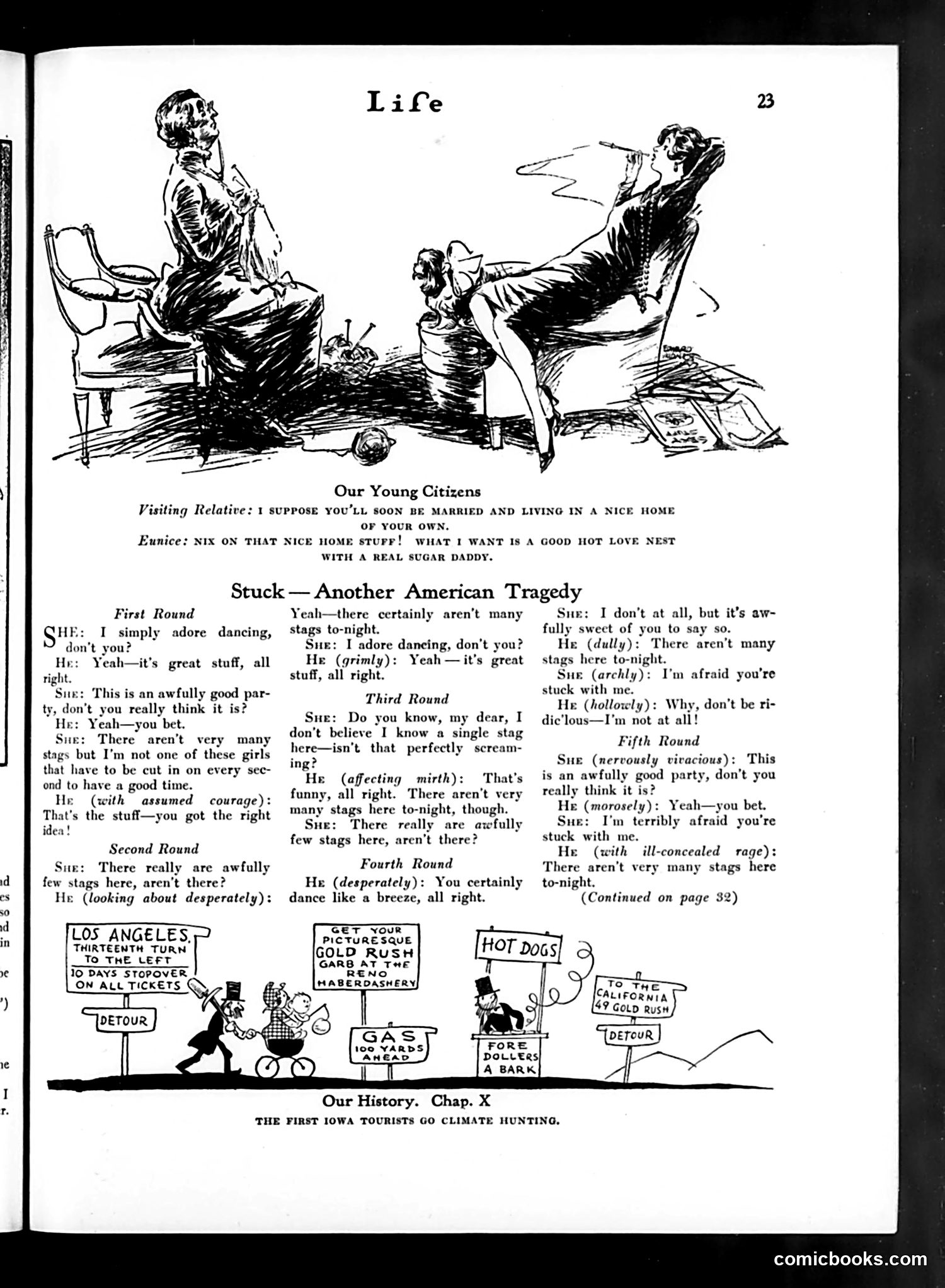
**Top Section - "Our Young Citizens"**: A visiting relative expresses traditional expectations about marriage and homemaking. The young woman, Eunice, rejects this, declaring she wants a "sugar daddy" and a "love nest" instead—satirizing the modern woman's rejection of domestic conventionality in favor of romantic excitement and financial security through male patronage. **Middle Section - "Stuck: Another American Tragedy"**: A comedic dialogue showing a couple at a party where the man repeatedly complains there aren't enough available women ("stags"). As the evening progresses through five rounds, their conversation becomes increasingly strained and repetitive, with the man growing visibly frustrated while trapped with the same undesirable partner. The satire mocks the awkward social dynamics of dating culture and the desperation of men forced into unwanted companionship. **Bottom Section**: Advertisement-style cartoons for tourist attractions (Los Angeles, Gold Rush garb, hot dogs) and a caption about "Iowa Tourists" seeking "climate hunting"—appears to be unrelated satirical commentary on American tourism. The page satirizes modern courtship, changing gender expectations, and social anxiety.
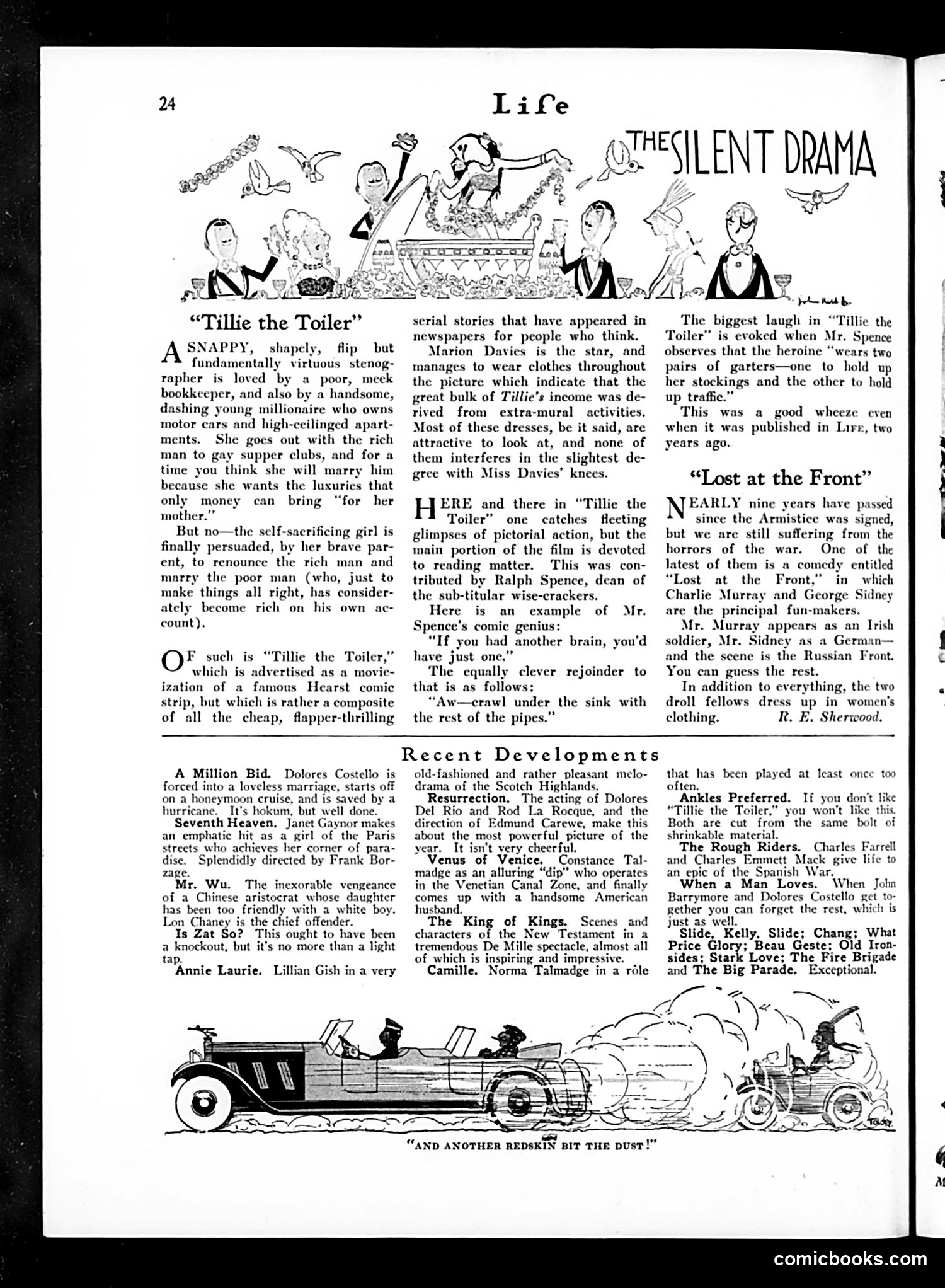
This page reviews recent silent films, with particular focus on "Tillie the Toiler," a Marion Davies movie adapted from a popular newspaper comic strip. The satire targets the film's formulaic plot: a working-girl stenographer must choose between a wealthy suitor and a poor bookkeeper—she picks poverty, which conveniently resolves when he becomes rich anyway. The reviewer mocks this as typical "cheap, flapper-thrilling" melodrama disguised as sophisticated entertainment. The humor critiques the film's reliance on title cards (written jokes by Ralph Spence) rather than visual comedy. The example given—about a woman wearing "two pairs of garters—one to hold up her stockings and the other to hold up traffic"—is mocked as recycled material, already published in *Life* two years prior. Other reviews dismiss contemporary films like "Lost at the Front" (featuring cross-dressing comedians) as post-war exploitation, while praising visually impressive spectacles like DeMille's "King of Kings."
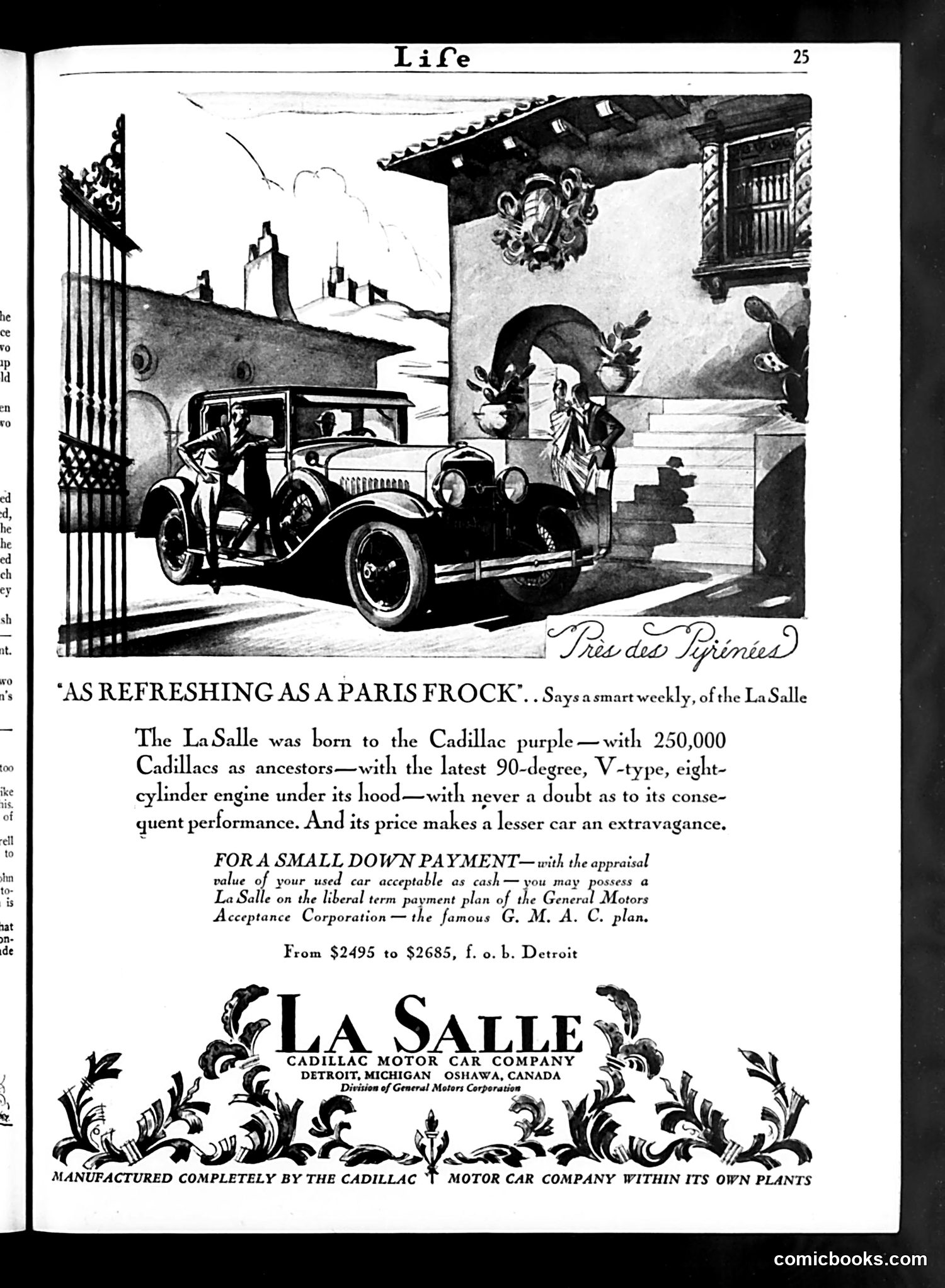
This is primarily a **car advertisement**, not political satire. The page promotes the LaSalle automobile, a mid-range Cadillac product. The illustration depicts an elegant couple arriving at what appears to be a European villa or estate in their LaSalle, emphasizing luxury and sophistication. The caption "As Refreshing as a Paris Frock" uses fashionable European appeal to market the vehicle to aspirational American consumers. The ad's satire is **commercial, not political**: it mocks the contradiction between luxury and affordability. LaSalle positions itself as inheriting Cadillac's prestige (claiming 250,000 Cadillacs as "ancestors") while remaining price-accessible—the joke being that a "lesser car" becomes wasteful by comparison, making the LaSalle seem like a bargain luxury item. The financing mention (G.M.A.C. plan, used-car trade-ins) reflects 1920s consumer credit innovation, allowing middle-class purchases of expensive goods.
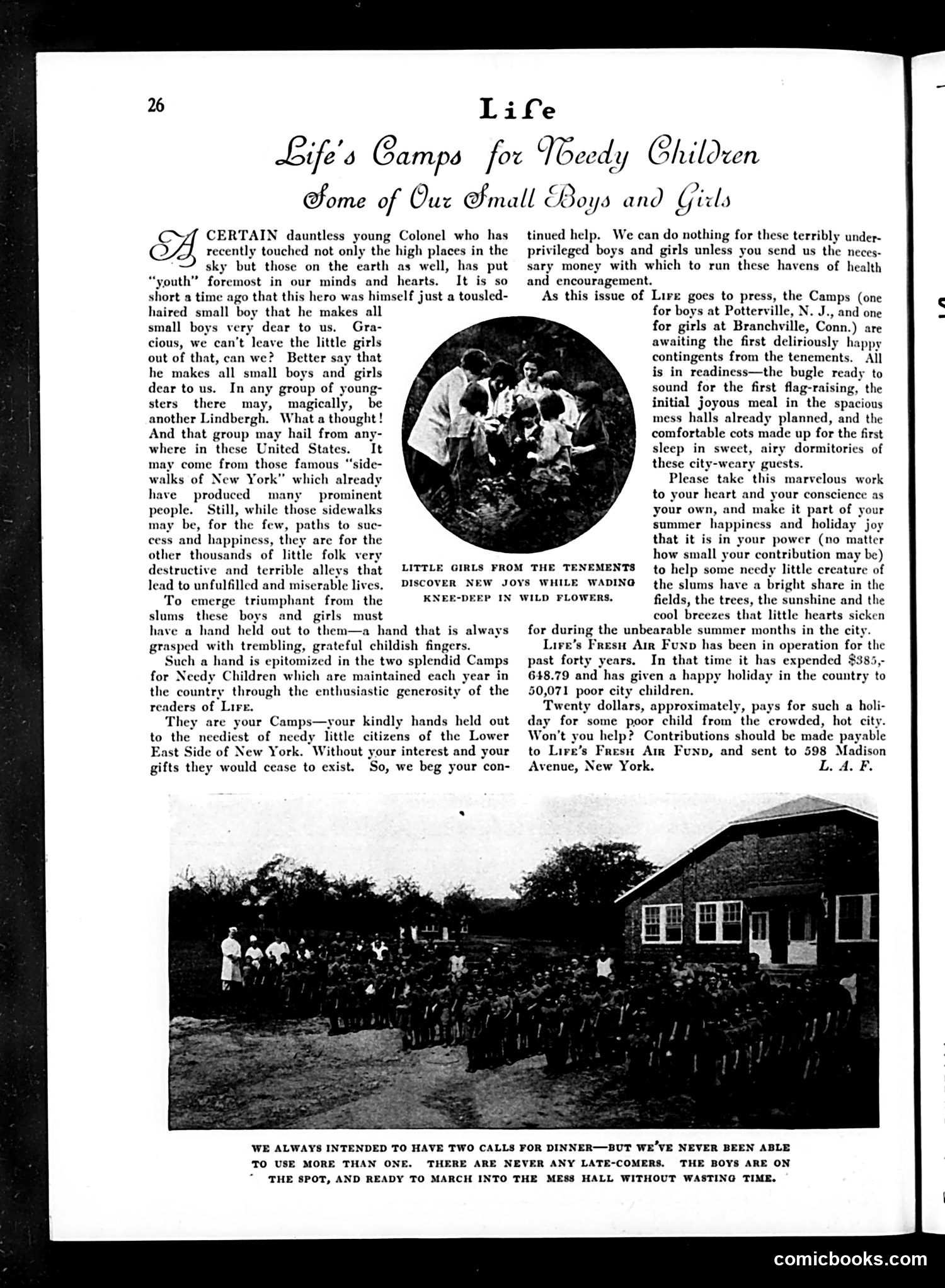
This is a **fundraising article**, not satire. The page promotes Life's Fresh Air Fund, which operates summer camps for poor children from New York City's Lower East Side tenements. The piece references **Colonel Lindbergh's** recent aviation achievement to invoke admiration for youth and potential—suggesting that needy slum children, like Lindbergh, deserve opportunity to flourish. The article contrasts the "destructive" urban environment with healthful country camps at Potterville, N.J., and Branchville, Conn. Two photographs show: children wading in wildflowers (idealized camp life) and a large group assembled for meals (demonstrating scale and organization). The appeal is explicit: readers should contribute $20 per child. The fund claims forty years of operation, $385,648.79 spent, and 50,071 children served—figures meant to establish credibility and inspire continued donations. The caption's humor about punctual mess-hall arrivals gently emphasizes the program's efficiency and the children's eagerness.
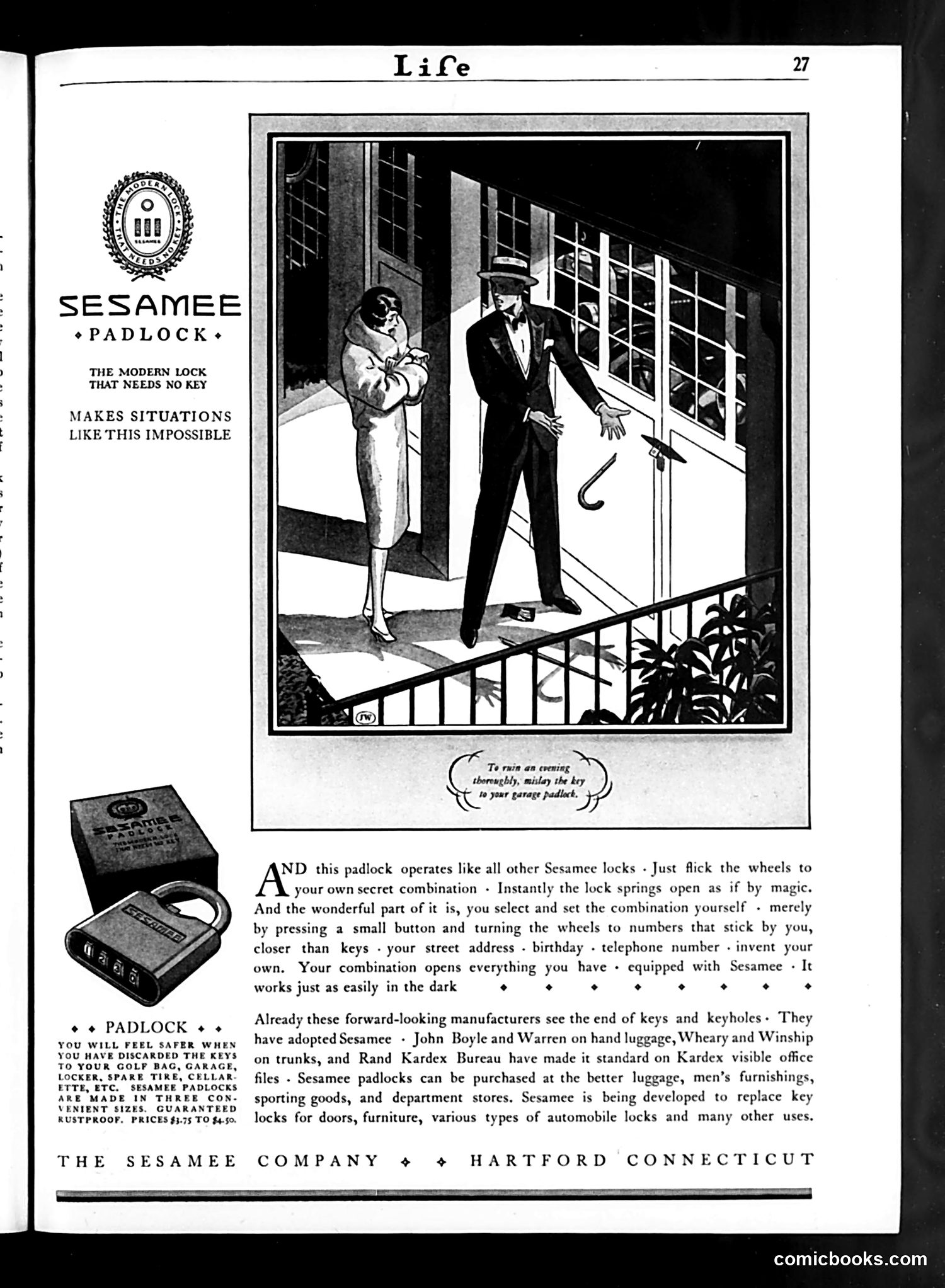
This is primarily a product advertisement for the Sesamee combination padlock, presented as a modern innovation replacing traditional key locks. The cartoon illustrates the problem the product solves: a couple locked out of their garage because they've misplaced the key—a relatable domestic inconvenience. The satire is gentle and self-aware. The caption acknowledges the very real frustration: "To ruin an evening thoroughly, mislay the key to your garage padlock." The advertisement then positions the Sesamee lock as the solution—users select their own combination (address, birthday, phone number) rather than depending on physical keys. The ad emphasizes modernity and forward-thinking adoption by manufacturers like John Boyle, Warren, and Kardex. The product appears designed for 1920s-30s consumers concerned with convenience and security for automobiles, luggage, and household items. There is no political satire here—this is straightforward commercial messaging using relatable humor to sell an innovative security product.
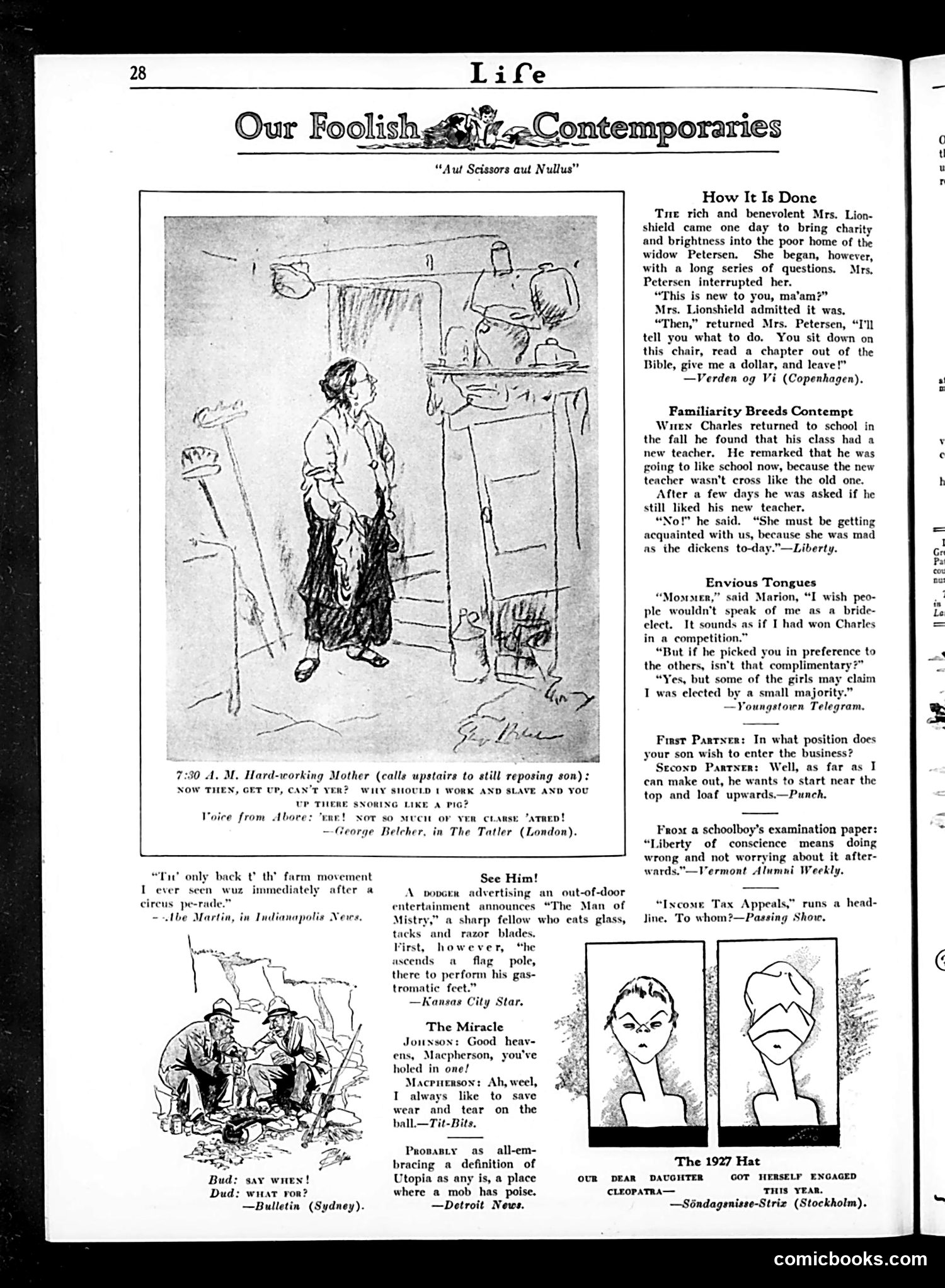
This is a collection of short humorous anecdotes from various newspapers, satirizing everyday social situations of the 1920s. Key jokes include: **"Hard-working Mother"**: A working-class son refuses to rise at 7:30 AM, claiming he wasn't "raised" to work and slave—mocking lazy youth and class resentment. **Charity visit**: Mrs. Lionshield, a wealthy woman attempting charity, receives blunt practical advice from a poor widow—satirizing the condescension of upper-class charitable efforts. **School teacher**: A boy notes his new teacher is "nice" because she isn't cross *yet*—once familiar with the class, she becomes angry like the old one, mocking how familiarity breeds contempt. **The 1927 Hat cartoon**: Shows two women's faces with different expressions, commenting on a daughter's engagement—likely satirizing changing fashion or courtship customs. Throughout, the page ridicules social pretense, class conflict, and human nature through brief, punchy observations typical of 1920s satirical journalism.
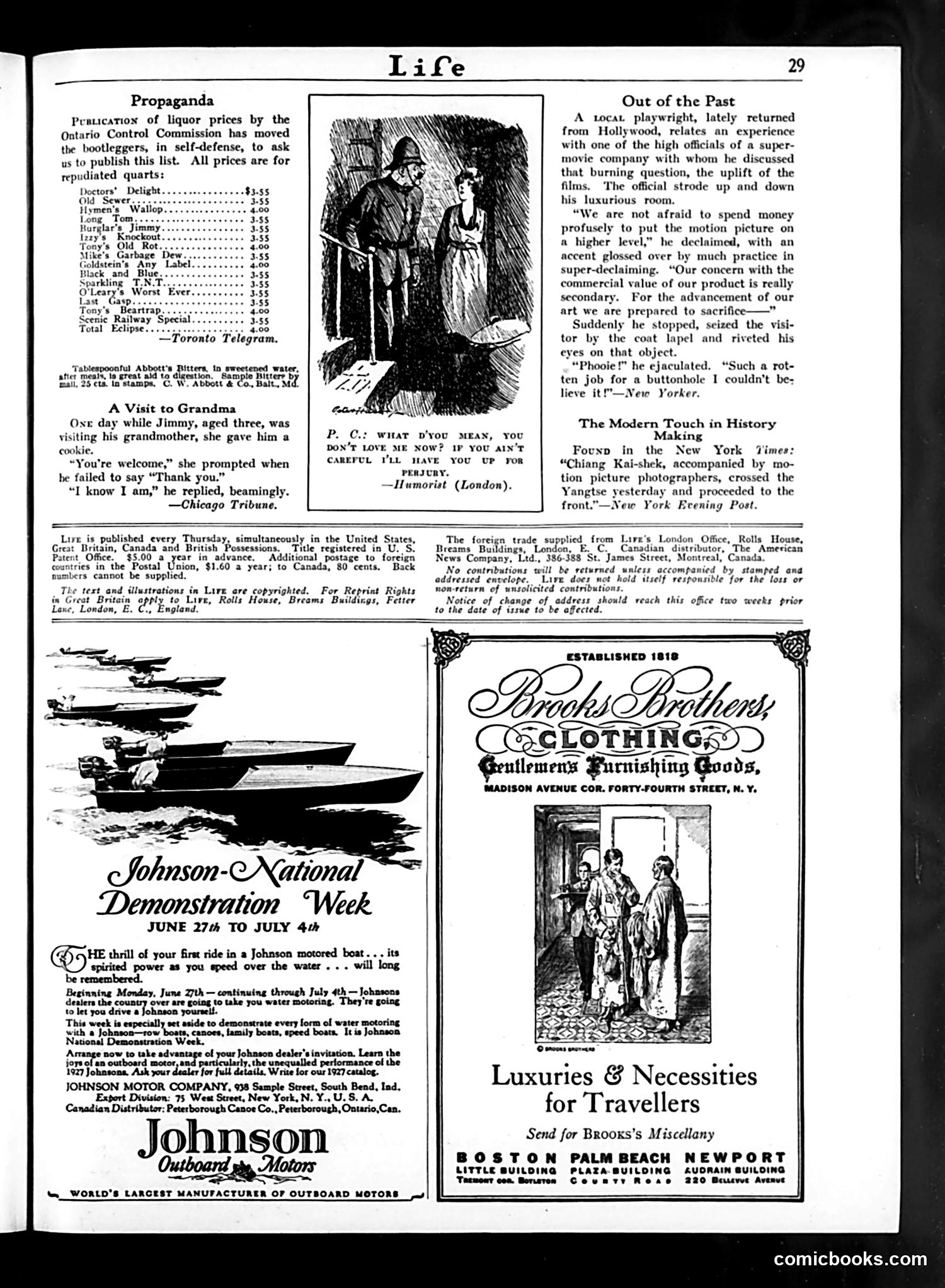
This page is primarily **advertisements and humorous short items**, typical of Life's satirical format. The "Propaganda" section mocks **Prohibition-era bootlegging**. Ontario's liquor control commission published official prices; bootleggers sarcastically "published" their own competing prices for illegal alcohol, with absurdist brand names ("Sparkling T.N.T.," "Last Gasp," "Total Eclipse") that joke about the product's danger and potency. The three brief humorous anecdotes satirize social pretense: a child's honest self-regard, a woman's legal threat over rejected romance, and a Hollywood executive's hypocrisy—claiming art matters while obsessing over a visible buttonhole flaw. "The Modern Touch in History Making" is a **satirical news observation**: a Chinese general (Chiang Kai-shek) crossed the Yangtse River with motion picture photographers present, suggesting military operations were staged for publicity rather than genuine strategic purpose. The page also contains period advertisements for Brooks Brothers clothing and Johnson outboard motors.
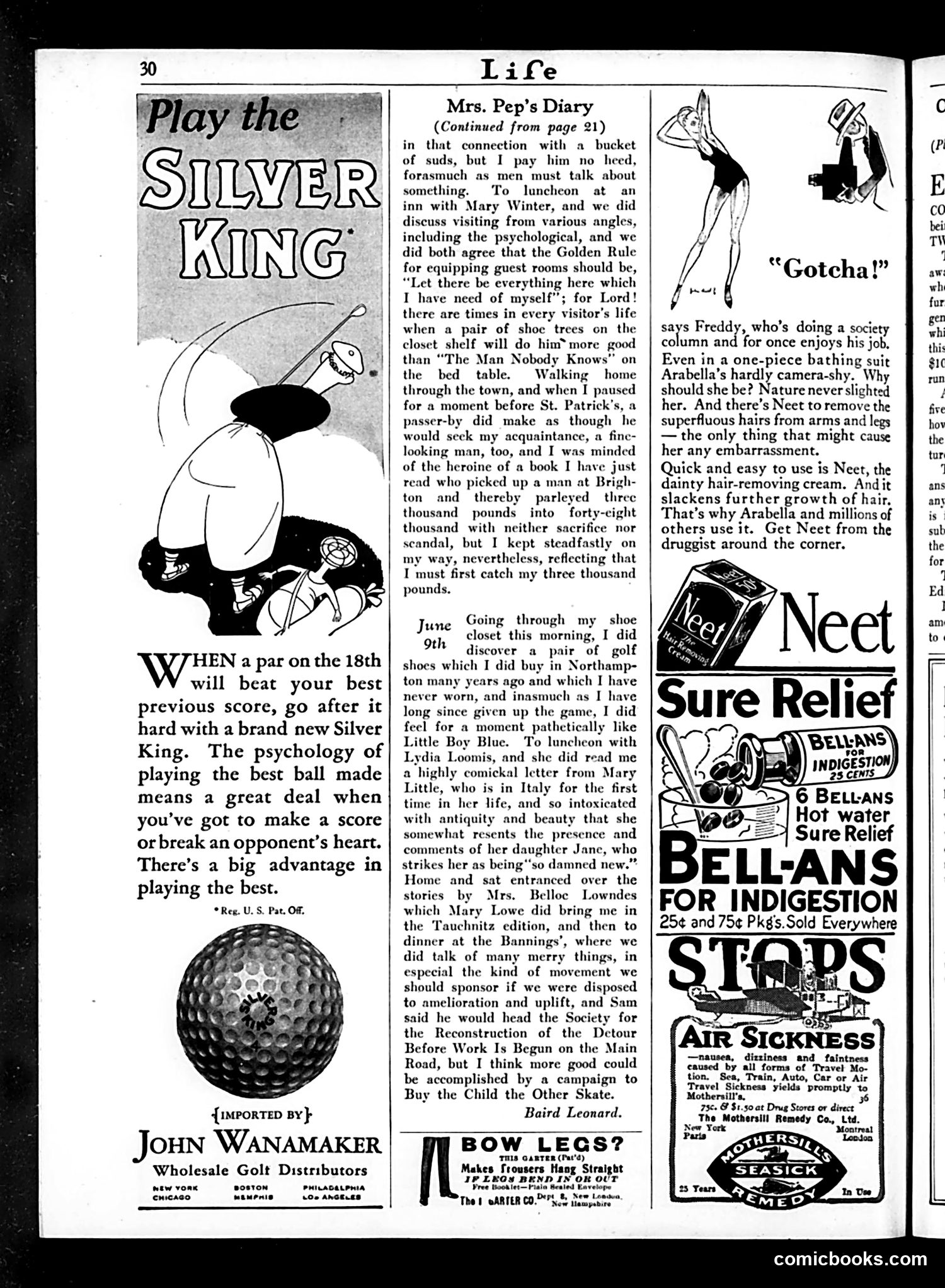
This page mixes editorial content with advertising—typical of 1920s magazines. **Main Content:** "Mrs. Pep's Diary" is a humor column about upper-middle-class social life, satirizing genteel concerns: proper guest-room furnishings, encounters with suitors, charitable impulses ("Buy the Child the Other Skate"), and antiquated sensibilities. The June 9th entry gently mocks women obsessed with European "culture" while dismissing their modern daughters as "so damned new." **The Advertisements** (left and right margins) are period product pitches: Silver King golf balls, John Wanamaker sporting goods, Neet hair-removal cream, Bellans indigestion remedy, and Mothersill's travel sickness pills—revealing common anxieties of the era (bodily hair, digestive upset, motion sickness). **Satire:** The column mocks pretentious leisure pursuits and shallow social values among the prosperous class, while advertisements underscore their vanities and physical insecurities. Together, they create an ironic portrait of interwar American affluence.
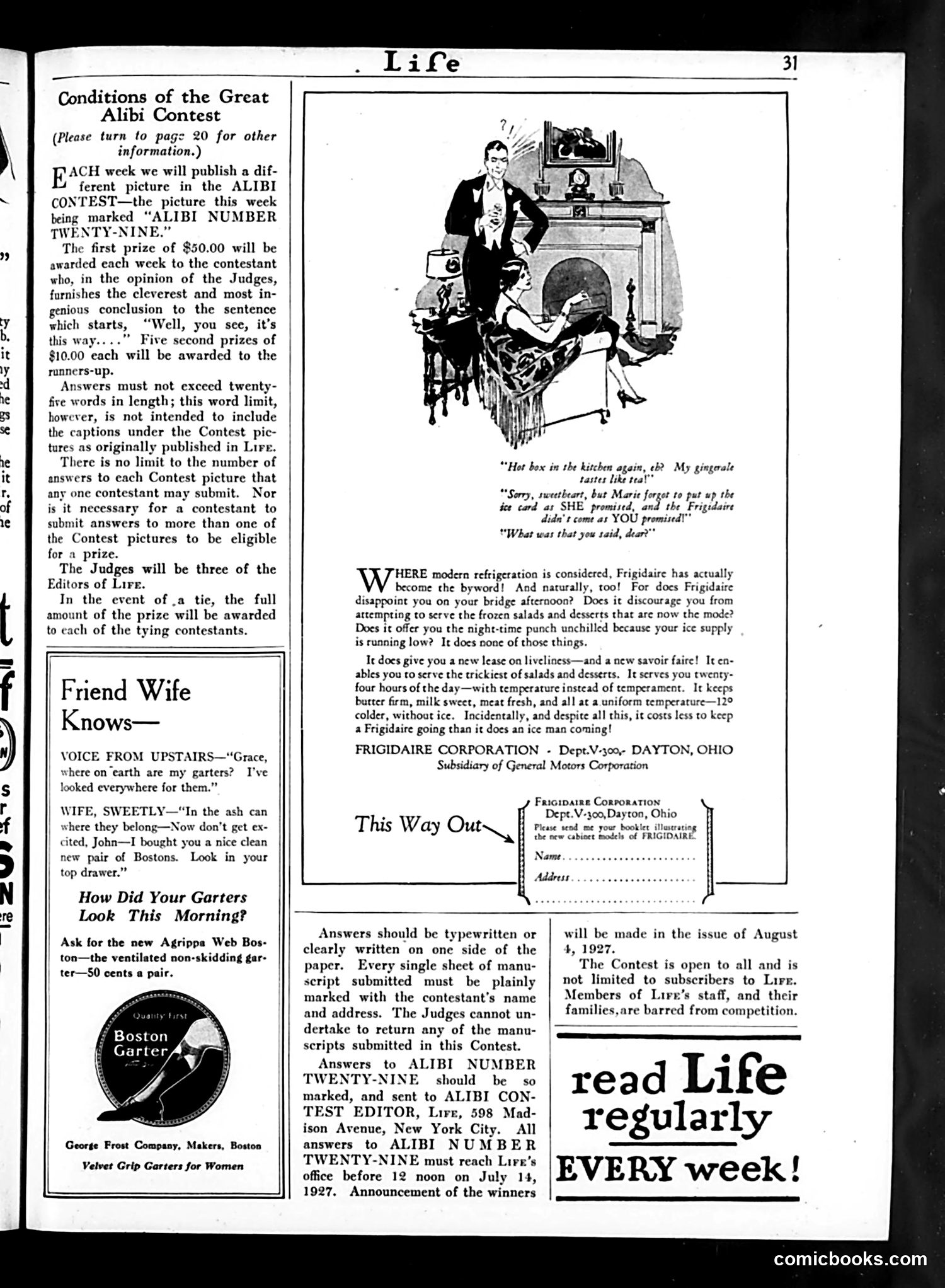
This page primarily features **an advertising and contest section**, not political satire. The main content is **"The Alibi Contest"**: Life's weekly humor competition where readers submit clever 25-word excuses completing "Well, you see, it's this way..." The featured cartoon (ALIBI NUMBER TWENTY-NINE) shows a domestic dispute—a woman confronting a man about a failed ice-delivery or refrigerator malfunction, with a portrait of another woman visible above, suggesting infidelity as the unstated "alibi." The page is dominated by **Frigidaire refrigerator advertising**, which frames the cartoon: modern refrigeration technology is positioned as solving domestic problems and marital tensions. The ad copy ironically suggests that reliable ice-keeping prevents the kind of domestic strife depicted in the cartoon. Secondary content includes brief humorous "Friend Wife Knows" vignettes and advertisements for Boston Garters. **For modern readers**: This reflects 1920s consumer culture where new appliances were marketed as solutions to household stress, and humor magazines profited from reader participation contests.
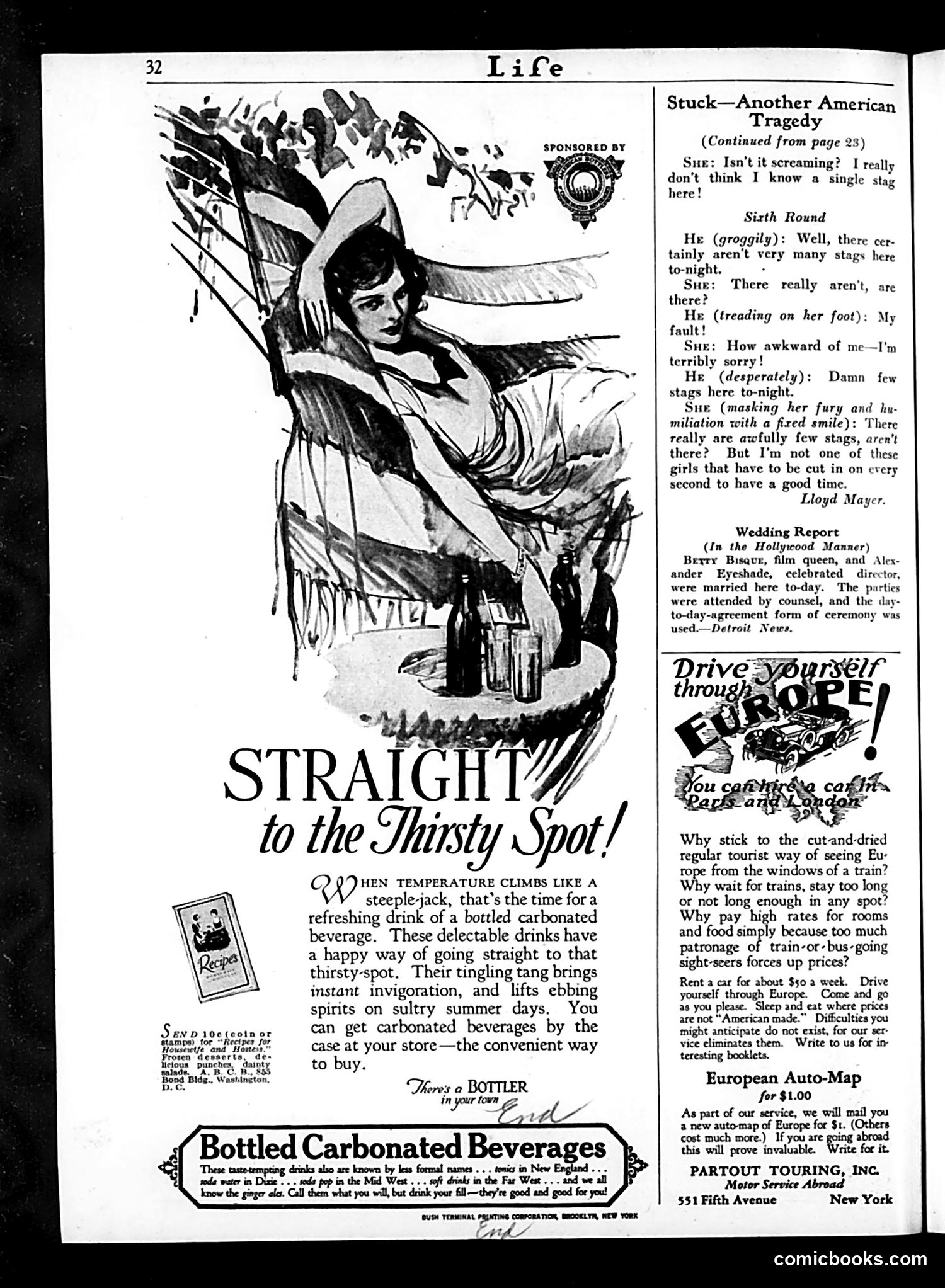
This page contains two distinct elements: **Main Comic Strip: "Stuck—Another American Tragedy"** A satirical dialogue between a young man and woman ("Sue") at what appears to be a dance or social event. The humor derives from their repeated, awkward conversation about the shortage of "stags" (unattached male dance partners). The woman masks frustration with forced politeness while the man grows increasingly desperate, all while literally treading on her foot. The satire mocks both the superficial social conventions of courtship and the performative politeness required of young women in this era. **Advertisements:** The remainder consists of period ads for bottled carbonated beverages, a travel guide for self-driving through Europe, and an auto-map service—typical commercial content for Life's affluent readership. The beverages ad uses the phrase "straight to the thirsty spot," playing on period slang. The page reflects 1920s social anxieties about dating etiquette and the emerging consumer leisure culture.

I can see this is a mostly blank page from what appears to be a Life magazine issue, with only the "comicbooks.com" watermark visible at the bottom. The page contains no visible cartoon, illustration, text content, or advertisements to analyze. Without actual satirical content, political figures, or social commentary visible on this particular page, I cannot identify any caricatures, historical references, or points of satire. This appears to be either a blank page from the original publication, a page that did not scan clearly, or a separator page between content sections. To provide meaningful analysis of Life magazine's political satire, I would need a page with visible cartoon artwork or text.