
Life, 1927-06-30 · page 16 of 35
Life — June 30, 1927 — page 16: what you’re looking at
What you’re looking at
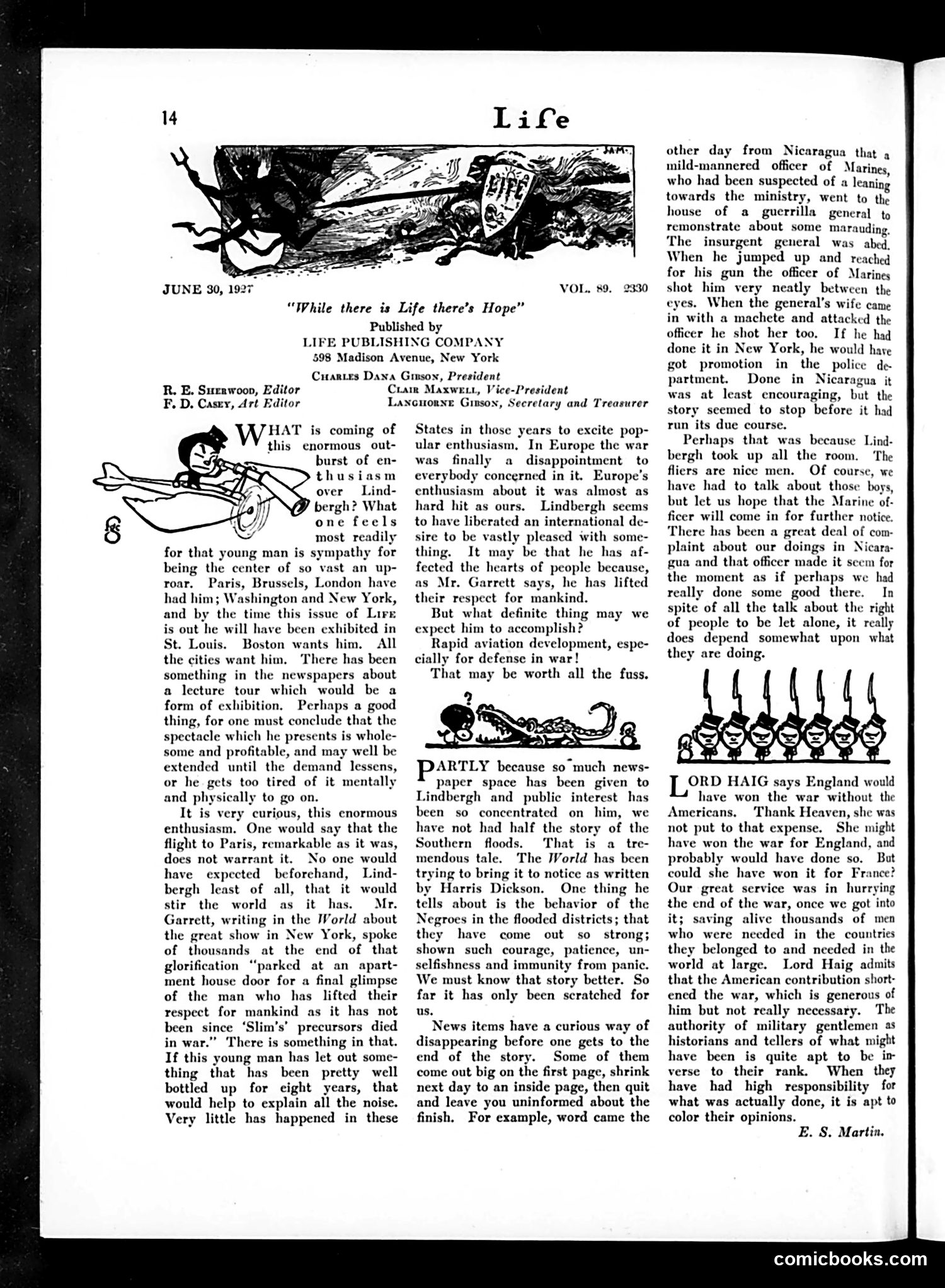
This editorial page features commentary on **Charles Lindbergh's transatlantic flight** (which occurred in May 1927). The text discusses the enormous public enthusiasm surrounding Lindbergh, noting that this young aviator has become "the center of so vast an upheaval of popular enthusiasm" that cities compete to exhibit him. The cartoons appear to satirize this obsessive media and public fixation. The first illustration shows what appears to be **Lindbergh surrounded by chaos**—suggesting the overwhelming nature of his celebrity. The second cartoon depicts **"Lord Haig"** and references WWI, apparently contrasting England's wartime heroes with America's current fascination with an aviator. The editorial tone is somewhat skeptical, questioning whether this enthusiasm is proportionate and sustainable, while acknowledging Lindbergh's genuine achievement in aviation.
📄 Transcribed text from this page (OCR, searchable)
Machine-transcribed from the original scan — historical spelling and the odd misread are preserved.
JUNE 30, 1927 VOL. 89. 2330 “While there is Life there’s Hope” Published by LIFE PUBLISHING COMPANY 598 Madison Avenue, New York Cuartes Dana Ginson, President R. E. Surawoon, Editor F. D. Casry, Art Editor HAT is coming of this enormous out- burst of en- thusiasm bergh? What one feels most readily for that young man is sympathy for being the center of so vast an up- roar. Paris, Brussels, London have had him; Washington and New York, and by the time this issue of Lire is out he will have been exhibited in St. Louis. Boston wants him. All the cities want him. There has been something in the newspapers about a lecture tour which would be a form of exhibition. Perhaps a good thing, for one must conclude that the spectacle which he presents is whole- some and profitable, and may well be extended until the demand lessens, or he gets too tired of it mentally and physically to go on. It is very curious, this enormous enthusiasm. One would that the flight to Paris, remarkable as it was, does not warrant it. No one would have expected beforehand, Lind- bergh least of all, that it would stir the world as it has. Mr. Garrett, writing in the World about the great show in New York, spoke of thousands at the end of that glorification ‘‘parked at an apart- ment house door for a final glimpse of the man who has lifted their respect for mankind as it has not been since ‘Slim’s’ precursors died in war.” There is something in that. If this young man has let out some- thing that has been pretty well bottled up for eight years, that would help to explain all the noise. Very little has happened in these Cram Maxwext, Vice-President Lancuorne Ginson, Secretary and Treasurer States in those years to excite pop- ular enthusiasm, In Europe the war was finally a disappointment to everybody concerned in it. Europe's enthusiasm about it was almost as hard hit as ours. Lindbergh seems to have liberated an international de- sire to be vastly pleased with some- thing. It may be that he has af- fected the hearts of people because, as Mr. Garrett says, he has lifted their respect for mankind. But what definite thing may we expect him to accomplish? Rapid aviation development, espe- cially for defense in war! That may be worth all the fuss. PARTLY because so much news- paper space has been given to Lindbergh and public interest has been so concentrated on him, we have not had half the story of the Southern floods. That is a tre- mendous tale. The World has been trying to bring it to notice as written by Harris Dickson. One thing he tells about is the behavior of the Negroes in the flooded districts; that they have come out so strong; shown such courage, patience, un- selfishness and immunity from panic. We must know that story better. So far it has only been scratched for us. News items have a curious way of disappearing before one gets to the end of the story. Some of them come out big on the first page, shrink next day to an inside page, then quit and leave you uninformed about the finish, For example, word came the other day from Nicaragua that 4 mild-mannered officer of Marines who had been suspected of a leaning towards the ministry, went to the house of a guerrilla general to remonstrate about some marauding. The insurgent general was abed, When he jumped up and reached for his gun the officer of Marines shot him very neatly between the eyes. When the general's wife came in with a machete and attacked the officer he shot her too. If he had done it in New York, he would have got promotion in the police de partment. Done in Nicaragua it was at least encouraging, but the story seemed to stop before it had run its due course, Perhaps that was because Lind- bergh took up all the room. The fliers are nice men. Of course, we have had to talk about those boys, but let us hope that the Marine of- ficer will come in for further notice. There has been a great deal of com- plaint about our doings in Nicara- gua and that officer made it seem for the moment as if perhaps we had really done some good there. In spite of all the talk about the right of people to be let alone, it really does depend somewhat upon what they are doing. ORD HAIG says England would have won the war without the Americans, Thank Heaven, she was not put to that expense. She might have won the war for England, and probably would have done so. But could she have won it for France? Our great service was in hurrying the end of the war, once we got into ing alive thousands of men who were needed in the countries they belonged to and needed in the world at large. Lord Haig admits that the American contribution short- ened the war, which is generous of him but not really necessary. The authority of military gentlemen as historians and tellers of what might have been is quite apt to be ir verse to their rank. When they have had high responsibility for what was actually done, it is apt to color their opinions. E. S. Martin. comicbooks.com