
Life, 1927-06-30 · page 8 of 35
Life — June 30, 1927 — page 8: what you’re looking at
What you’re looking at
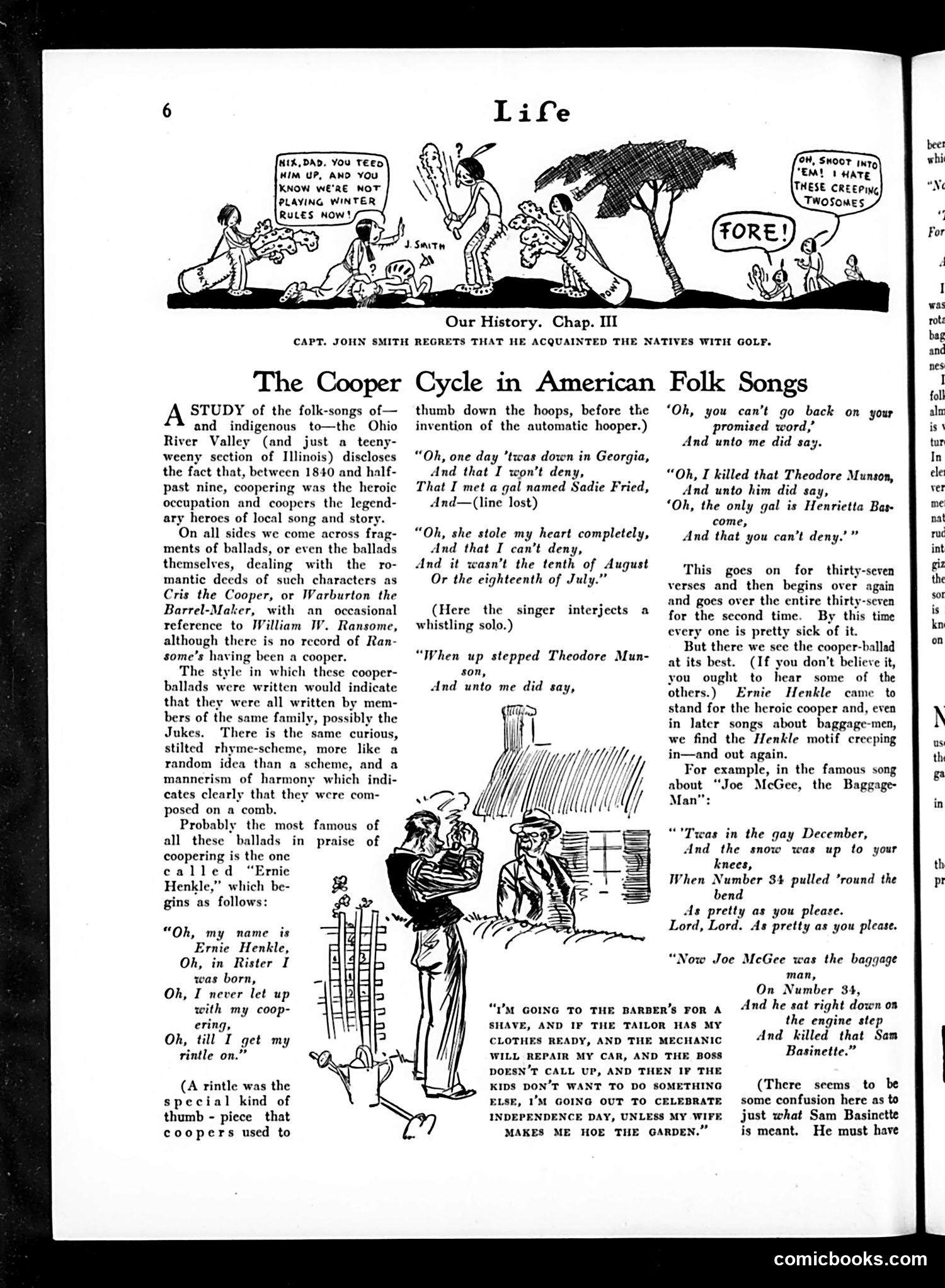
The cartoon at the top depicts **Captain John Smith introducing golf to Native Americans**. The caption reads: "CAPT. JOHN SMITH REGRETS THAT HE ACQUAINTED THE NATIVES WITH GOLF." This is satirical American history. It shows Smith teaching Indigenous people to play golf while they're confused or distressed by the activity. The joke is a **reversal of the historical narrative**: rather than regretting colonization's destructive impact, Smith supposedly regrets teaching golf—a trivial cultural import that apparently made Native Americans unhappy. The satire mocks both colonial arrogance and early 20th-century golf culture's perceived absurdity, suggesting that introducing golf to indigenous peoples was among colonialism's regrettable contributions.
📄 Transcribed text from this page (OCR, searchable)
Machine-transcribed from the original scan — historical spelling and the odd misread are preserved.
[MiX,DAD. You TEED HIM UP, AND YOU KNOW WE'RE NOT PLAYING WINTER Our History. Chap. III ‘OW, Snoor INTO) “EM! HATE CAPT. JOHN SMITH REGRETS THAT HE ACQUAINTED THE NATIVES WITH GOLF. The Cooper Cycle in American Folk Songs STUDY of the folk-songs of— and indigenous to—the Ohio River Valley (and just a teeny- weeny section of Illinois) discloses the fact that, between 1840 and half- past nine, coopering was the heroic occupation and coopers the legend- ary heroes of local song and story. On all sides we come across frag- ments of ballads, or even the ballads themselves, dealing with the ro- mantic deeds of such characters as Cris the Cooper, or Warburton the Barrel-Maker, with an_ occasional reference to William W. Ransome, although there is no record of Ran- some’s having been a cooper. The style in which these cooper- ballads were written would indicate that they were all written by mem- bers of the same family, possibly the Jukes. There is the same curious, stilted rhyme-scheme, more like a random idea than a scheme, and a mannerism of harmony which indi- cates clearly that they were com- posed on a comb. Probably the most famous of all these ballads in praise of coopering is the one called “Ernie Henkle,” which be- 2 gins as follows: “Oh, my name is Ernie Henkle, Oh, in Rister I was born, Oh, I never let up with my coop- ering, Oh, till I get my rintle on.” (A rintle was the special kind of thumb - piece that coopers used to thumb down the hoops, before the invention of the automatic hooper.) “Oh, one day ’twas down in Georgia, And that I won't deny, That I met a gal named Sadie Fried, And—(line lost) “Oh, she stole my heart completely, And that I can’t deny, And it wasn’t the tenth of August Or the eighteenth of July.” (Here the whistling solo.) singer interjects a “When up stepped Theodore Mun- son, And unto me did say, ‘Oh, you can’t go back on your promised word,’ And unto me did say. “Oh, I killed that Theodore Munson, And unto him did say, ‘Oh, the only gal is Henrietta Bas- come, And that you can’t deny.” This goes on for thirty-seven verses and then begins over again and goes over the entire thirty-seven for the second time. By this time every one is pretty sick of it. But there we see the cooper-ballad at its best. (If you don’t believe it, you ought to hear some of the others.) Ernie Henkle came to stand for the heroic cooper and, even in later songs about baggage-men, we find the Henkle motif creeping in—and out again. For example, in the famous song about “Joe McGee, the Baggage- Man”: “'Twas in the gay December, And the snow was up to your knees, When Number 34 pulled ’round the bend As pretty as you please. Lord, Lord. As pretty as you please. “Now Joe McGee was the baggage man, On Number 34, “VM GOING TO THE BARBER’S FOR A SHAVE, AND IF THE TAILOR HAS MY CLOTHES READY, AND THE MECHANIC WILL REPAIR MY CAR, AND THE BOSS DOESN’T CALL UP, AND THEN IF THE KIDS DON’T WANT TO DO SOMETHING ELSE, I’M GOING OUT TO CELEBRATE INDEPENDENCE DAY, UNLESS MY WIFE MAKES ME HOE THE GARDEN.” And he sat right down on the engine step And killed that Sam Basinette.” (There seems to be some confusion here as to just what Sam Basinctte is meant. He must have comicbooks.com