
Life, 1927-06-30 · page 9 of 35
Life — June 30, 1927 — page 9: what you’re looking at
What you’re looking at
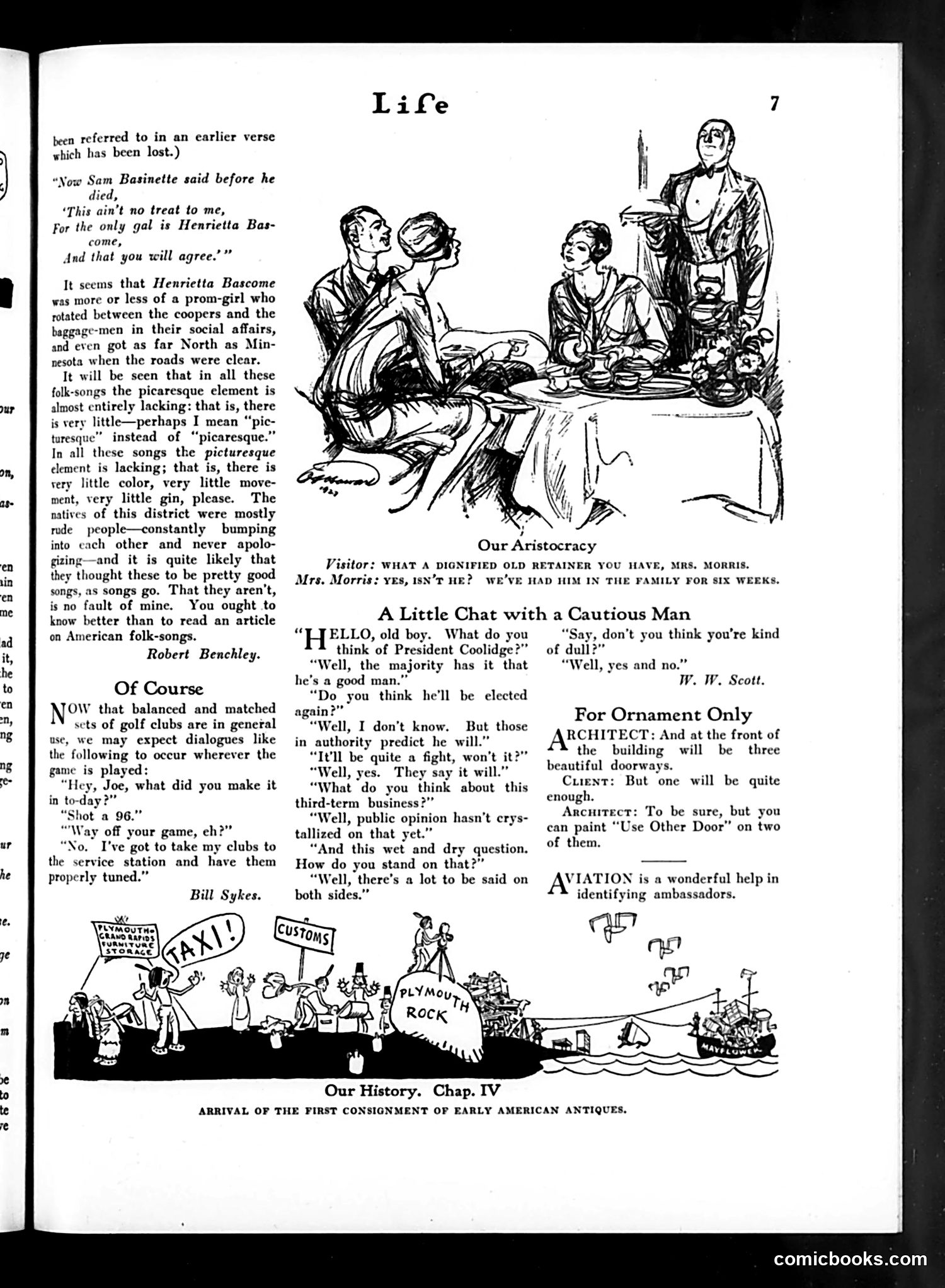
The bottom cartoon titled "Our History. Chap. IV" satirizes early American immigration and commerce. It depicts ships arriving at "Plymouth Rock" labeled with goods like "TAXI" and "CUSTOMS," alongside figures representing various nationalities and commercial interests. The satire suggests that America's founding wasn't purely about the Pilgrims seeking religious freedom, but rather involved mercantile exploitation and cultural mixing from the start—a cynical commentary on American mythology. The upper illustration labeled "Our Aristocracy" shows a conversation where a visitor compliments Mrs. Morris on retaining a servant for six weeks, treating domestic help retention as a mark of social status. This mocks the pretensions of American upper-class society claiming "aristocratic" refinement while struggling with basic household management—a common Life magazine theme ridiculing American social climbers.
📄 Transcribed text from this page (OCR, searchable)
Machine-transcribed from the original scan — historical spelling and the odd misread are preserved.
been referred to in an earlier verse which has been lost.) “Now Sam Basinette said before he died, ‘This ain’t no treat to me, For the only gal is Henrietta Bas- come, And that you will agree.’ ” It seems that Henrietta Bascome was more or less of a prom-girl who rotated between the coopers and the baggage-men in their social affairs, and even got as far North as Min- pesota when the roads were clear. It will be seen that in all these folk-songs the picaresque element is almost entirely lacking: that is, there is very little—perhaps I mean “pic- turesque” instead of “picaresque.” In all these songs the picturesque element is lacking; that is, there is very little color, very little move- ment, very little gin, please. The natives of this district were mostly rude people—constantly bumping into cach other and never apolo- gizing—and it is quite likely that they thought these to be pretty good songs, as songs go. That they aren't, is no fault of mine. You ought to know better than to read an article on American folk-songs. Robert Benchley. Of Course OW that balanced and matched sets of golf clubs are in general use, we may expect dialogues like the following to occur wherever the game is played: “Hey, Joe, what did you make it in to-day?” “Shot a 96.” “Way off your game, eh?” No. I've got to take my clubs to the service station and have them properly tuned.” Bill Sykes. Our Aristocracy Visitor: WHAT A DIGNIFIED OLD RETAINER YOU HAVE, MRS. MORRIS. Mrs. Morris: yes, sn’? HE? WE'VE HAD HIM IN THE FAMILY FOR SIX WEEKS. A Little Chat with a Cautious Man “LTELLO, old boy. What do you think of President Coolidge?” “Well, the majority has it that he’s a good man.” “Do you think he'll be elected again?” “Well, I don’t know. But those in authority predict he will.” “It'll be quite a fight, won't it?” “Well, yes. They say it will.” “What do you think about this third-term business?” “Well, public opinion hasn't crys- tallized on that yet.” “And this wet and dry question. How do you stand on that?” “Well, there’s a lot to be said on both sides.” Our History. Chap. IV “Say, don’t you think you're kind of dull?” “Well, yes and no.” W. W. Scott. For Ornament Only RCHITECT: And at the front of the building will be three beautiful doorways. Cuient: But one will be quite enough. Arcut can paint of them. : To be sure, but you se Other Door” on two AVIATION is a wonderful help in identifying ambassadors. “Ave cower ARRIVAL OF THE FIRST CONSIGNMENT OP EARLY AMERICAN ANTIQUES. comicbooks.com