
Life, 1927-06-30 · page 30 of 35
Life — June 30, 1927 — page 30: what you’re looking at
What you’re looking at
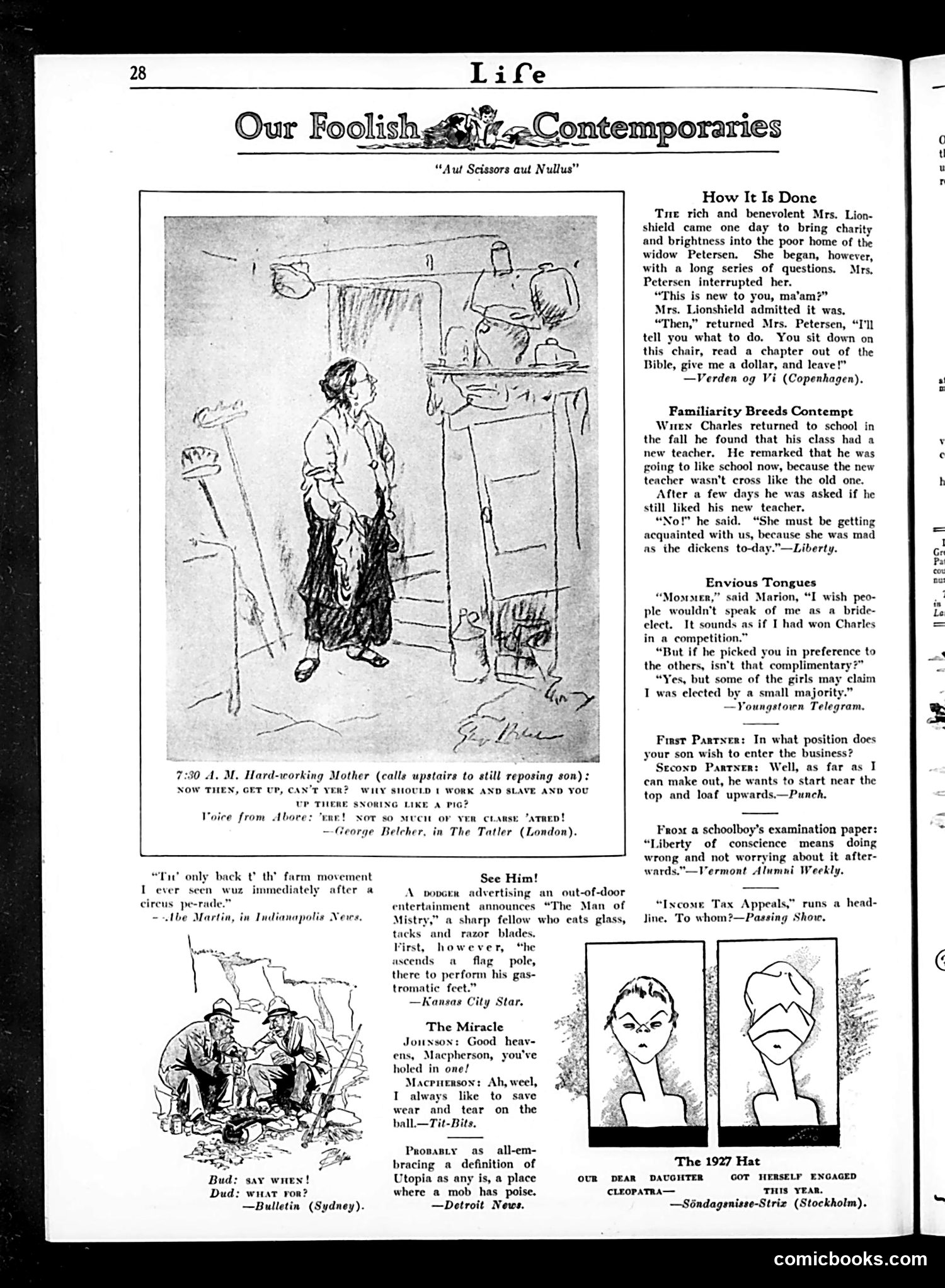
This is a collection of short humorous anecdotes from various newspapers, satirizing everyday social situations of the 1920s. Key jokes include: **"Hard-working Mother"**: A working-class son refuses to rise at 7:30 AM, claiming he wasn't "raised" to work and slave—mocking lazy youth and class resentment. **Charity visit**: Mrs. Lionshield, a wealthy woman attempting charity, receives blunt practical advice from a poor widow—satirizing the condescension of upper-class charitable efforts. **School teacher**: A boy notes his new teacher is "nice" because she isn't cross *yet*—once familiar with the class, she becomes angry like the old one, mocking how familiarity breeds contempt. **The 1927 Hat cartoon**: Shows two women's faces with different expressions, commenting on a daughter's engagement—likely satirizing changing fashion or courtship customs. Throughout, the page ridicules social pretense, class conflict, and human nature through brief, punchy observations typical of 1920s satirical journalism.
📄 Transcribed text from this page (OCR, searchable)
Machine-transcribed from the original scan — historical spelling and the odd misread are preserved.
NOW THEN, GET UP, CAN'T YER? uP THERE 7:30 A. M. Hard-working Mother (calls upstairs to still reposing son): WHY SHOULD 1 WORK AND SLAVE AND You Voice from Above: ‘rn! Nor so Mven or yer ctanst ’aTnED! —George Belcher, in The Tatler (London). “Lit only back th farm movement I ever seen wuz immediately after a circus pe-rade.” --.Abe Martin, in Indianapolis News, SAY wHteN! Dud: wuat ror? —Bulletin (Sydney). See Him! A poverr advertising an out-of-door entertainment announces “The Man of Mistry,” a sharp fellow who eats glass, tacks and razor blades, First, however, “he ascends a flag pole, there to perform his gas- tromatic feet.” —Kansas City Star. The Miracle Jouxsox: Good heav- ens, Macpherson, you've holed in one! Macritenson: Ah, weel, I always like to save wear and tear on the ball.—Tit-Bits. Pronanty as all-em- bracing a definition of Utopia as any is, a place where a mob has poise. —Detroit News. OUR DEAR CLEOPATRA— How It Is Done Tne rich and benevolent Mrs. Lion- shield came one day to bring charity and brightness into the poor home of the widow Petersen. She began, however, with a long series of questions. Mrs, Petersen interrupted her. “This is new to you, ma’am?” Mrs. Lionshield admitted it was, “Then,” returned Mrs. Petersen, “I'll tell you what to do. You sit down on this chair, read a chapter out of the Bible, give me a dollar, and leave!” —Verden og Vi (Copenhagen). Familiarity Breeds Contempt Wuewx Charles returned to school in the fall he found that his class had a new teacher. He remarked that he was going to like school now, because the new teacher wasn’t cross like the old one. After a few days he was asked if he new teacher. he said. “She must be getting acquainted with us, because she was mad as the dickens to-day."—Liberty. Envious Tongues “Moser,” said Marion, “I wish peo- ple wouldn't speak of me as a bride- clect. It sounds as if I had won Charles in a competition.” “But if he picked you in preference to the others, isn't that complimentary?” “Yes, but some of the girls may claim I was elected by a small majority.” —Youngstown Telegram. Fist Partyer: In what position does your son wish to enter the business? Seconp Partner: Well, as far as I can make out, he wants to start near the top and loaf upwards—Punch, Frost a schoolboy’s examination paper: “Liberty of conscience means doing wrong and not worrying about it after- wards."—Vermont Alumni Weekly. scone Tax Appeals,” runs a head- line, To whom?—Passing Show. The 1927 Hat DAUGHTER —- GOT_ HERSELF ENGAGED THIS YEAR. —Séndagsnisse-Striz (Stockholm). comicbooks.com