
Life, 1927-06-30 · page 21 of 35
Life — June 30, 1927 — page 21: what you’re looking at
What you’re looking at
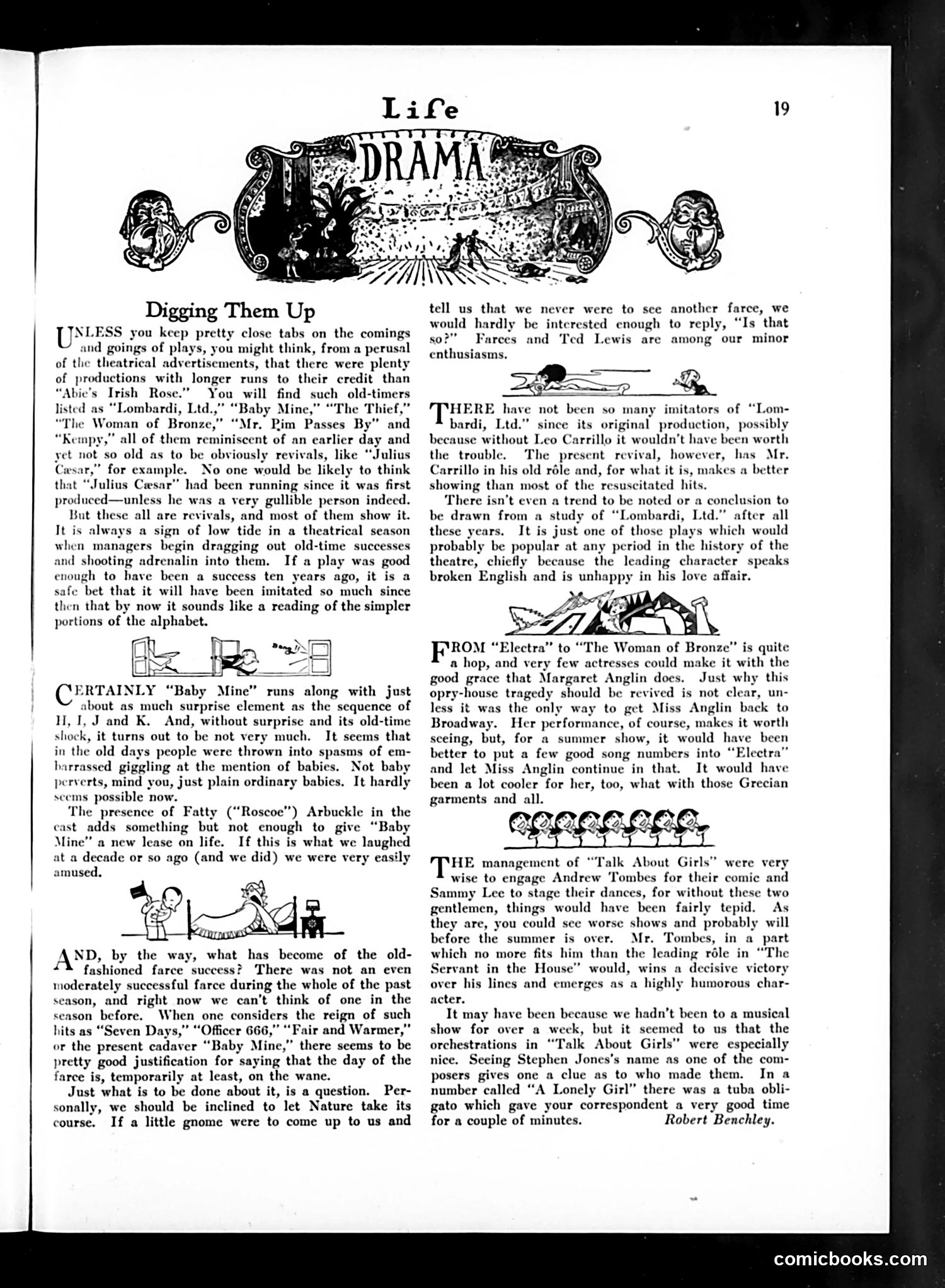
This theater column critiques Broadway's practice of reviving old comedies during a slow season—a sign the writer sees as artistic desperation. The author argues that farces like "Baby Mine," "Lombardi, Ltd.," and "Julius Caesar" (revivals, not new productions) lack the shock value they once had. What audiences found hilarious a decade earlier now seems dated; the jokes feel predictable as "reading the simpler portions of the alphabet." The satire targets theatrical managers for lazily recycling proven hits rather than developing fresh material. The columnist's dismissive tone toward farces generally—grouping them with Ted Lewis as "minor enthusiasms"—underscores the broader point: Broadway's reliance on revivals reflects creative bankruptcy, not audience demand. Even strong performers like Fatty Arbuckle and Margaret Anglin can't fully revive these creaky scripts.
📄 Transcribed text from this page (OCR, searchable)
Machine-transcribed from the original scan — historical spelling and the odd misread are preserved.
Digging Them Up U™! ESS you keep pretty close tabs on the comings nd goings of plays, you might think, from a perusal of the theatrical advertisements, that there were plenty of productions with longer runs to their credit than “Abie's Irish Rose.” You will find such old-time listed as “Lombardi, Ltd.,” “Baby Mine,” ‘ the Woman of Bronz Mr. Pim Passes By” and “Kemy all of them reminiscent of an earlier day and yet not so old as to be obviously revivals, like “Julius Cwsar,” for example. No one would be likely to think that “Julius Cesar” had been running since it was first produced—unless he was a very gullible person indeed. But these all are revivals, and most of them show it. It is always a sign of low tide in a theatrical season when managers begin dragging out old-time successes and shooting adrenalin into them. If a play was good enough to have been a success ten years ago, it is a safe bet that it will have been imitated so much since then that by now it sounds like a reading of the simpler portions of the alphabet. ERTAINLY “Baby Mine” runs along with just about as much surprise element as the sequence of HI, 1, J and K. And, without surprise and its old-time shock, it turns out to be not very much. It seems that in the old days people were thrown into spasms of em- harrassed giggling at the mention of babies. Not baby perverts, mind you, just plain ordinary babics. It hardly seems possible now. The presence of Fatty (“Roscoe”) Arbuckle in the cast adds something but not enough to give “Baby Mine” a new lease on life. If this is what we laughed at a decade or so ago (and we did) we were very easily amused, ND, by the way, what has become of the old- fashioned farce success? There was not an even moderately successful farce during the whole of the past season, and right now we can’t think of one in the season before. When one considers the reign of such hits as “Seven Days,” “Officer 666,” “Fair and Warmer,” or the present cadaver “Baby Mine,” there seems to be pretty good justification for saying that the day of the farce is, temporarily at least, on the wane. Just what is to be done about it, is a question. Per- sonally, we should be inclined to let Nature take its course. If a little gnome were to come up to us and tell us that we never were to see another farce, we would hardly be interested enough to reply, “Is that so?” Farces and Ted Lewis are among our minor enthusiasms, HERE have not been so many imitators of “Lom- bardi, Ltd.” since its original production, possibly because without Leo Carrillo it wouldn't have been worth the trouble. The present revival, however, | Mr. Carrillo in his old réle and, for what it is, makes a better showing than most of the resuscitated hits. There isn’t even a trend to be noted or a conclusion to be drawn from a study of “Lombardi, Ltd.” after all these years. It is just one of those plays which would probably be popular at any period in the history of the theatre, chiefly because the leading character speaks broken English and is unhappy in his love affair. ROM “Electra” to “The Woman of Bronze” is quite a hop, and very few actresses could make it with the good grace that Margaret Anglin does. Just why this opry-house tragedy should be revived is not clear, un- less it was the only way to get Miss Anglin back to Broadway. Her performance, of course, makes it worth seeing, but, for a summer show, it would have been better to put a few good song numbers into “Electra” and let Miss Anglin continue in that. It would h been a lot cooler for her, too, what with those Grecian garments and all. c HE management of “Talk About Girls” were very wise to engage Andrew Tombes for their comic and Sammy Lee to stage their dances, for without these two gentlemen, things would have been fairly tepid. As they are, you could see worse shows and probably will before the summer is over. Mr. Tombes, in a part which no more fits him than the leading réle in “The Servant in the House” would, wins a decisive victory over his lines and emerges as a highly humorous char- acter. It may have been because we hadn’t been to a musical show for over a week, but it seemed to us that the orchestrations in “Talk About Girls” were especially nice. Seeing Stephen Jones’s name as one of the com- posers gives one a clue as to who made them. In a number called ‘A Lonely Girl” there was a tuba obli- gato which gave your correspondent a very good time for a couple of minutes. Robert Benchley. comicbooks.com