
Life, 1927-06-30 · page 26 of 35
Life — June 30, 1927 — page 26: what you’re looking at
What you’re looking at
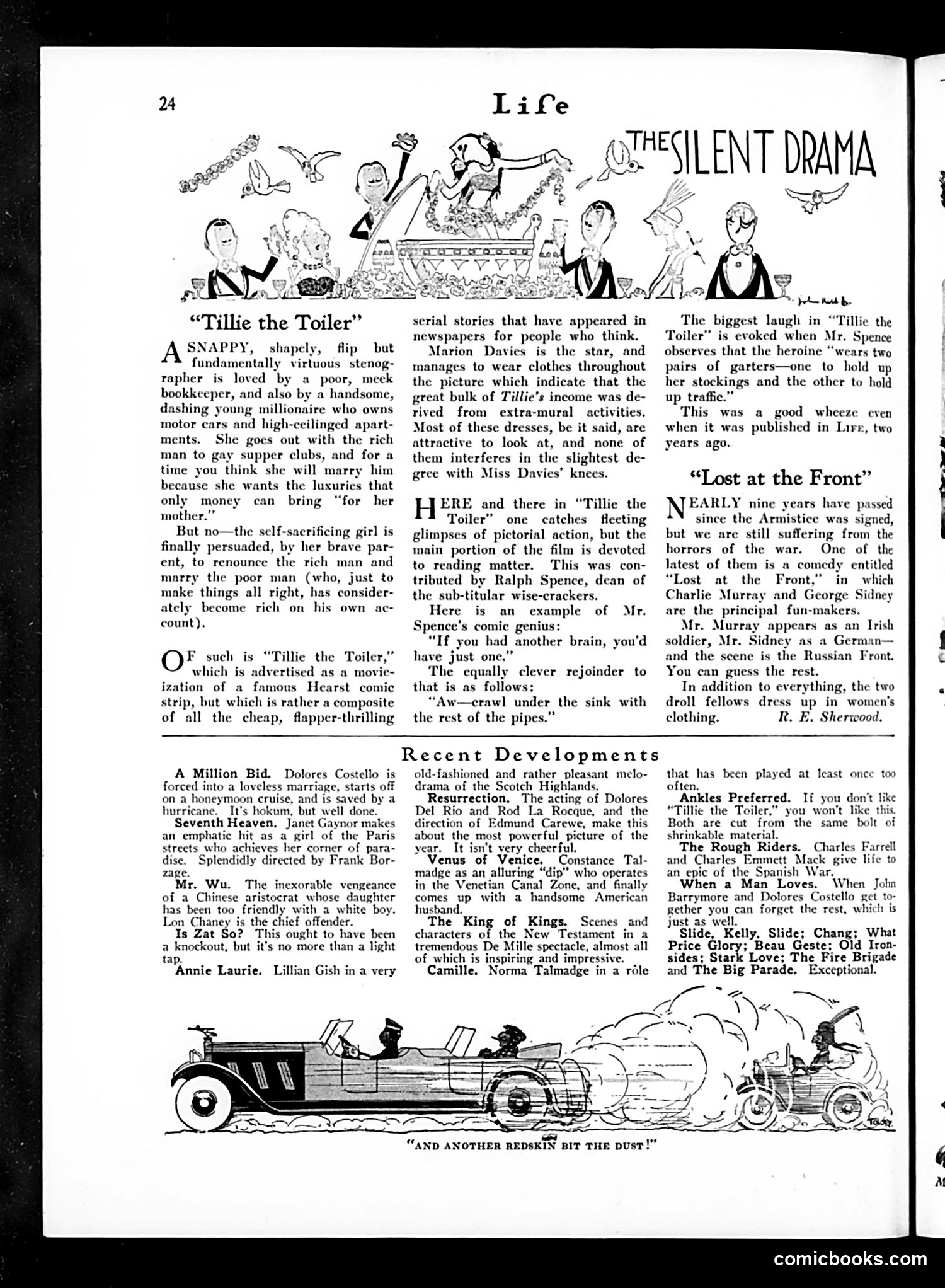
This page reviews recent silent films, with particular focus on "Tillie the Toiler," a Marion Davies movie adapted from a popular newspaper comic strip. The satire targets the film's formulaic plot: a working-girl stenographer must choose between a wealthy suitor and a poor bookkeeper—she picks poverty, which conveniently resolves when he becomes rich anyway. The reviewer mocks this as typical "cheap, flapper-thrilling" melodrama disguised as sophisticated entertainment. The humor critiques the film's reliance on title cards (written jokes by Ralph Spence) rather than visual comedy. The example given—about a woman wearing "two pairs of garters—one to hold up her stockings and the other to hold up traffic"—is mocked as recycled material, already published in *Life* two years prior. Other reviews dismiss contemporary films like "Lost at the Front" (featuring cross-dressing comedians) as post-war exploitation, while praising visually impressive spectacles like DeMille's "King of Kings."
📄 Transcribed text from this page (OCR, searchable)
Machine-transcribed from the original scan — historical spelling and the odd misread are preserved.
“Tillie the Toiler” SNAPPY, shapely, flip but fundamentally virtuous stenog- rapher is loved by a poor, meek bookkeeper, and also by a handsome, dashin, pung millionaire who owns motor cars and high-ceilinged apart- ments. She goes out with the rich man to gay supper clubs, and for a time you think she will marry him because she wants the luxuries that only money can bring “for her mother.” But no—the self-sacrificing girl is finally persuaded, by her brave par- ent, to renounce the rich man and marry the poor man (who, just to make things all right, has consider- ately become rich on his own ac- count). “Tillie the Toiler,” advertised as a mov famous Hearst comic strip, but which is rather a composite of all the cheap, flapper-thrilling serial stories that have appeared in newspapers for people who think. Marion Davies is the star, and manages to wear clothes throughout the picture which indicate that the great bulk of Tillie’s income was de- rived from extra-mural activities. Most of these dresses, be it said, are attractive to look at, and none of them interferes in the slightest de- gree with Miss Davies’ kne ERE and there in “Tillie the Toiler” one catches fleeting glimpses of pictorial action, but the main portion of the film is devoted to reading matter. This was con- tributed by Ralph Spence, dean of the sub-titular wise-crackers. Here is an example of Mr. Spence’s comic genius: “Tf you had another brain, you'd have just one.” The equally clever rejoinder to that is as follows: “Aw—crawl under the sink with the rest of the pipes.” A Million Bid. Dolores Costello is forced into a loveless marriage, starts off on a honeymoon cruise, and is saved by a hurricane. It's hokum, but well done. Seventh Heaven. Janet Gaynor makes an emphatic hit as a girl of the Paris streets who achieves her corner of para- dise. Splendidly directed by Frank Bor- zage. Mr. Wu. The inexorable vengeance of a Chinese aristocrat whose daughter has been too friendly with a white boy. Lon Chaney is the chief offender. Is Zat So? This ought to have been a knockout, but it's no more than a light tap. vinnie Laurie. Lillian Gish in a very pour wre a The biggest laugh in “Tillie the Toiler” is evoked when Mr. Spence observes that the heroine “wears two pairs of garters—one to hold up her stockings and the other to hold up traffic.” This was a good wheeze even when it was published in Lire, two years ago. “Lost at the Front” EARLY nine years have passed since the Armistice was signed, but we are still suffering from the horrors of the war. One of the latest of them is a comedy entitled “Lost at the Front,” in which Charlie Murray and George Sidney are the principal fun-makers. Mr. Murray appears as an Irish soldier, Mr. Sidney as a German— and the scene is the Russian Front. You can guess the rest. In addition to everything, the two droll fellows dress up in women's clothing. R. E. Sherwood. Recent Developments old-fashioned and rather pleasant melo- drama of the Scotch Highlands. Resurrection, The acting of Dolores Del Rio and Rod La_Rocque, and the direction of Edmund Carewe, make this about the most powerful picture of the year. It isn’t very cheerful. Venus of Venice. Constance Tal- madge as an alluring “dip” who operates in the Venetian Canal Zone, and finally comes up with a handsome American husband. The King of Kings. Scenes and characters of the New Testament in a tremendous De Mille spectacle, almost all of which is inspiring and impressive. Camille. Norma Talmadge in a réle “ = Eo] ” AND ANOTHER REDSKIN BIT THE Dust! that has been played at least once too often. Ankles Preferred. If you don't like “Tillie the Toiler,” you won't like this. Both are cut from the same bolt of shrinkable material. The Rough Riders. Charles Farrell and Charles Emmett Mack give life to an epic of the Spanish War. then a Man Loves. When John Barrymore and Dolores Costello get. to- gether you can forget the rest, which is just as well. Slide, Kelly. Slide; Chang; What Price Glory; Beau Geste; Old Iron- sides; Stark’ Love; The Fire Brigade and The Big Parade. Exceptional. comicbooks.com FS I gee aa TY