
A complete issue · 42 pages · 1927
Life — May 19, 1927
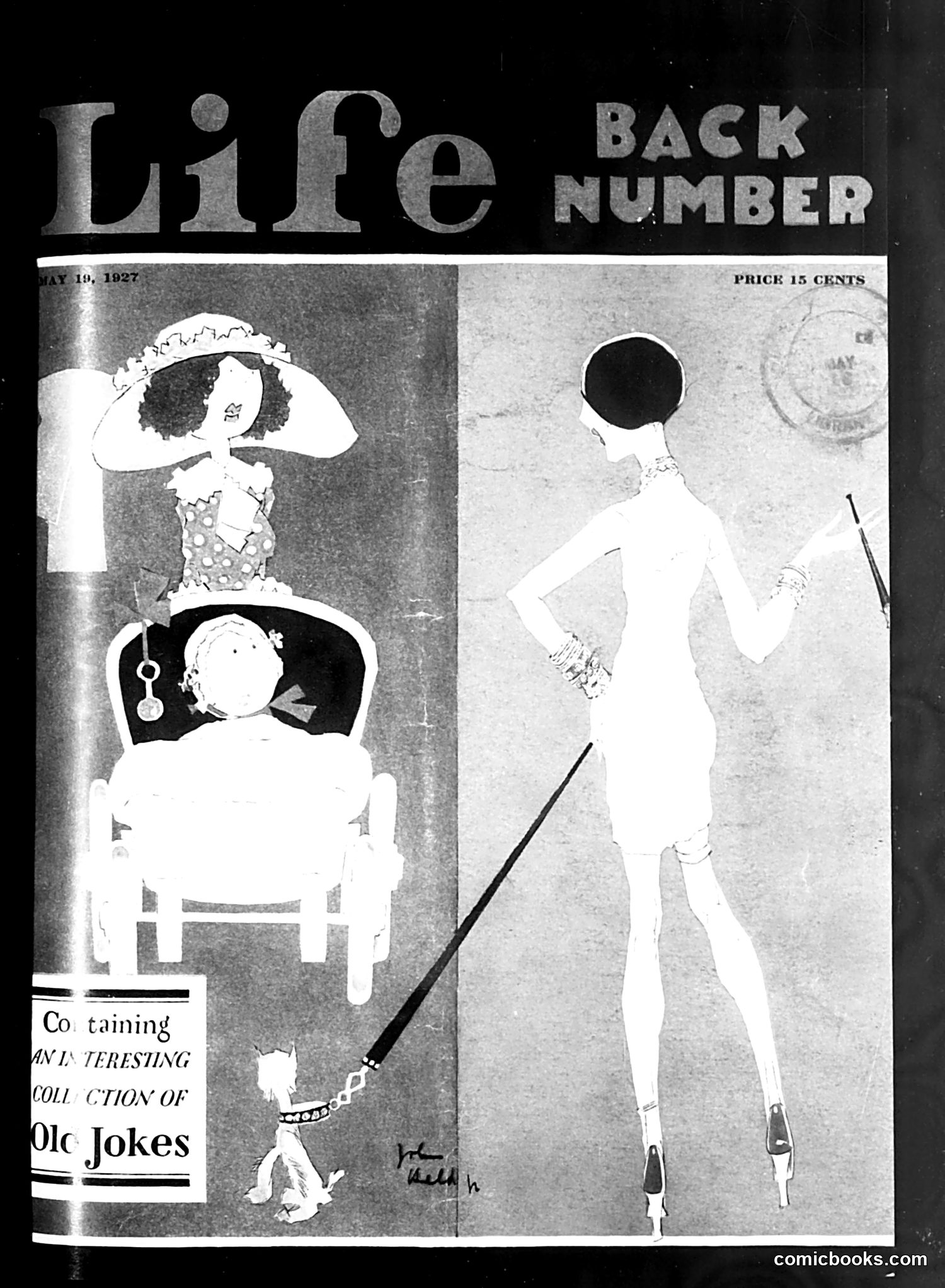
This is a back cover for Life magazine's May 10, 1927 issue, priced at 15 cents. The left illustration depicts a stylized figure seated in an ornate chair, rendered in an abstract, modernist style typical of 1920s satirical art. The right illustration shows a standing figure in a minimalist pose. The page advertises that this issue contains "an interesting collection of old jokes." The specific cartoons' satirical targets are unclear from the image alone, though the modernist artistic style reflects 1920s aesthetic sensibilities. The figures' exaggerated proportions and geometric rendering were common in period satire. Without additional context or readable caption text, the precise social or political commentary these illustrations intended remains uncertain.
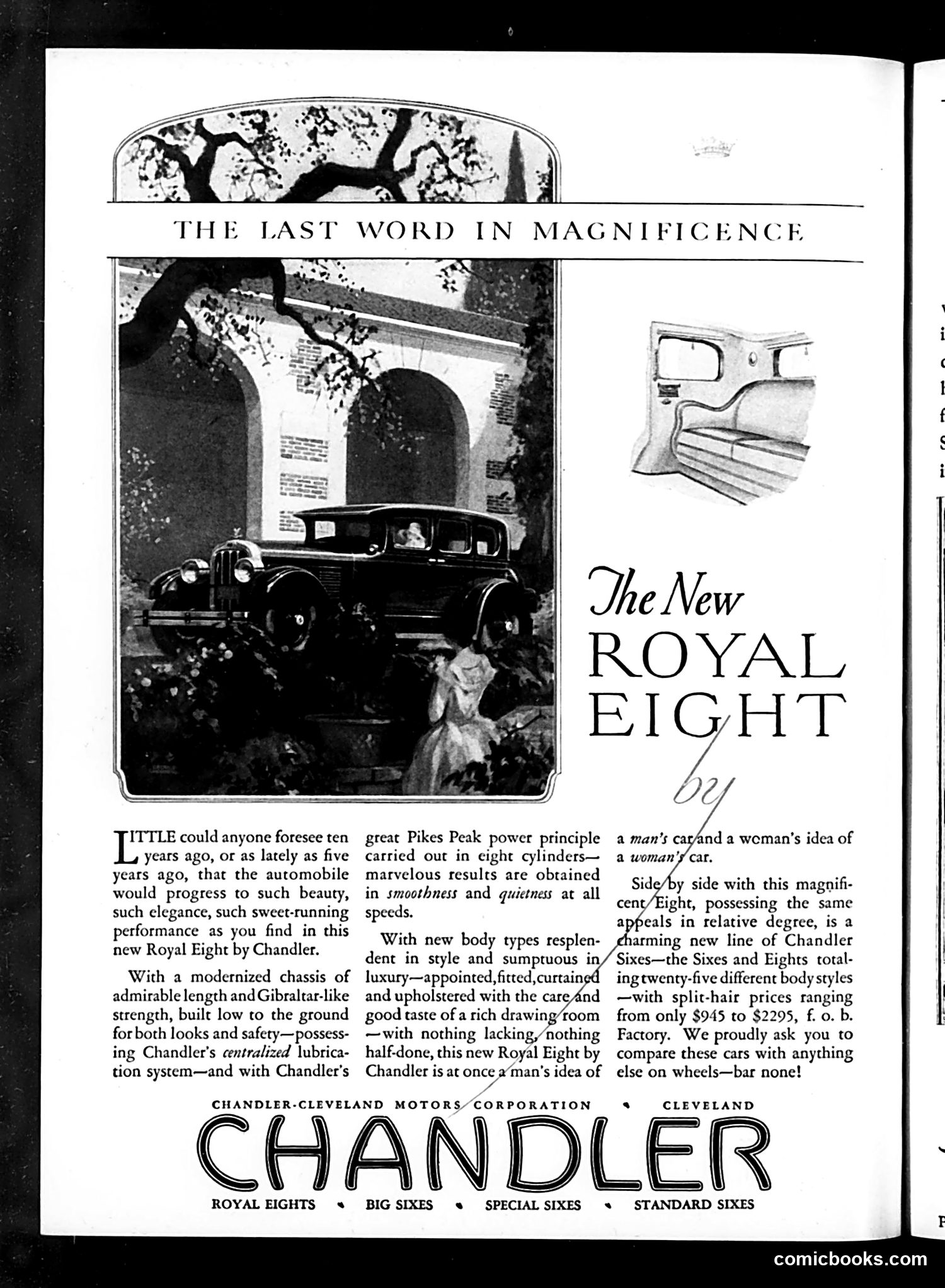
This is not a cartoon or satire—it's a **straightforward automobile advertisement** for the Chandler Royal Eight, placed in Life magazine. The page promotes Chandler-Cleveland Motors' new eight-cylinder car as the pinnacle of automotive luxury and engineering. The headline "The Last Word in Magnificence" claims superiority over competitors, particularly Chandler's own "Big Sixes" line. The advertisement targets affluent buyers by emphasizing style ("charming new line"), performance ("smoothness and quietness"), and exclusivity (prices from $895-$2295). The photograph depicts the car in an idealized pastoral setting with well-dressed figures, reinforcing aspirational lifestyle messaging typical of 1920s luxury marketing. No political commentary or satire is present—this represents period advertising conventions.
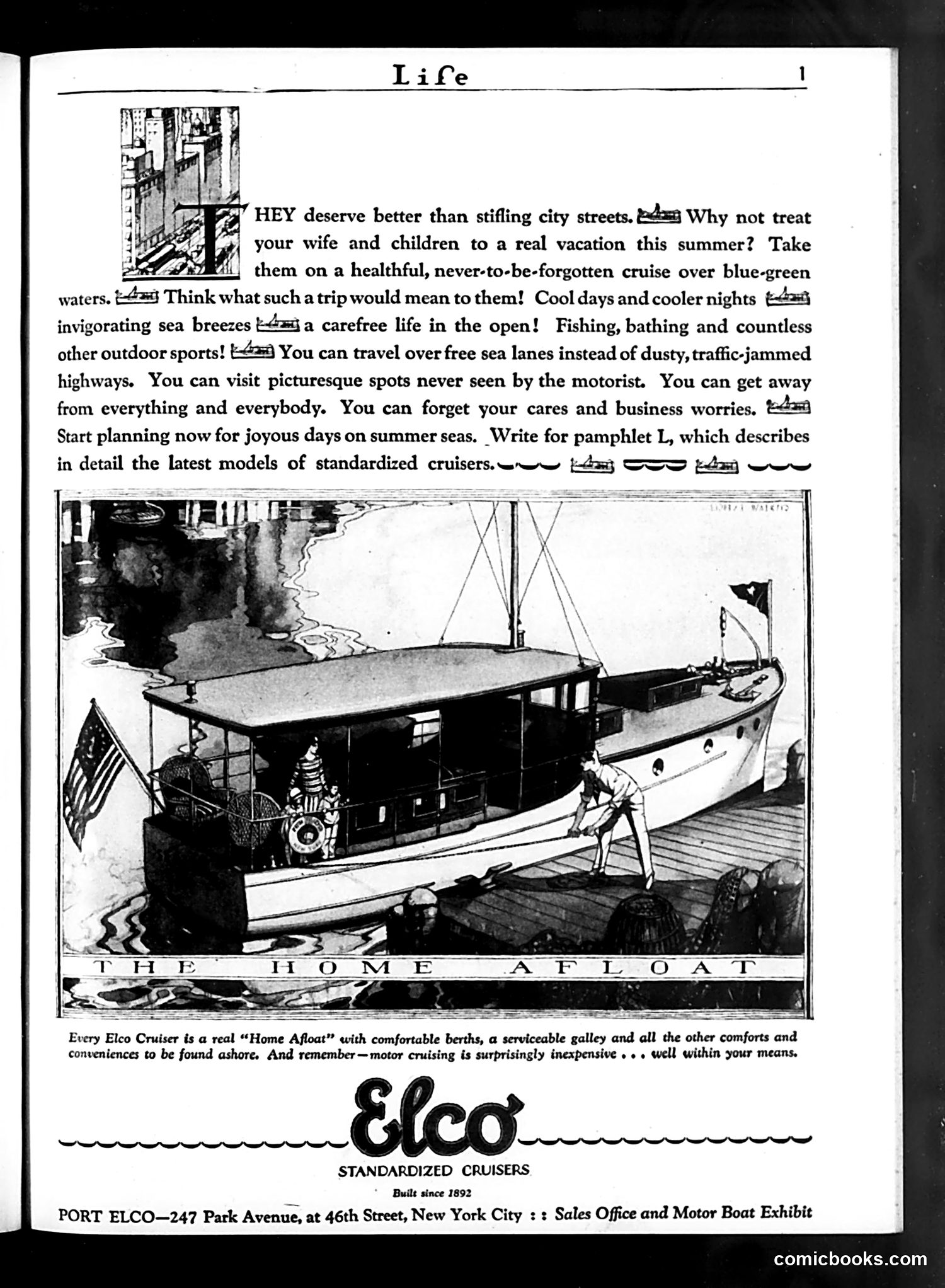
This is primarily **advertising content, not satire**. The page contains a promotional advertisement for Elco motor cruisers, presented in Life magazine's house style. The ad targets affluent readers, promising escape from "stifling city streets" through leisurely cruising. The rhetorical approach is aspirational rather than satirical: it appeals to desires for leisure, family bonding, and romantic getaway—common luxury marketing themes of the era. The image shows a cabin cruiser moored at a dock with an American flag, emphasizing comfort and patriotism. The text emphasizes practical benefits (carefree life, fishing, bathing) alongside emotional appeals. There is **no political cartoon or satire** present. This represents straightforward commercial messaging typical of Life magazine's advertising pages during this period.
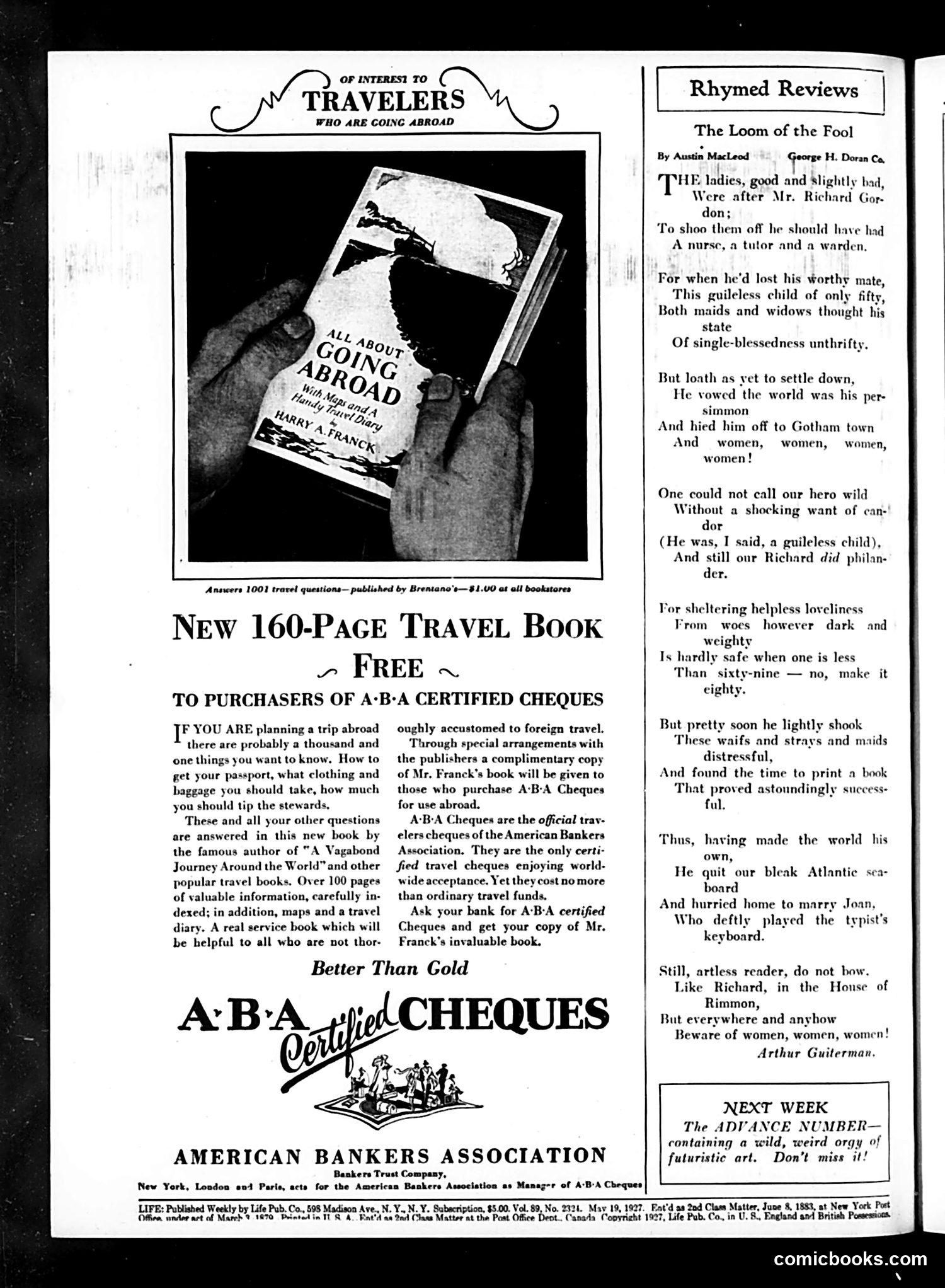
This page is primarily **advertising**, not political satire. The main content promotes A·B·A Certified Cheques for international travelers, marketed as superior to ordinary travel funds ("Better Than Gold"). The image shows hands holding a travel guide book titled "All About Going Abroad" by Harry A. Franck. The right column contains "The Loom of the Fool," a **humorous rhymed poem** by Austin MacLeod and George H. Doran about a foolish man named Richard Gordon who abandons his respectable life to chase women around the world, eventually returning home chastened. This is light satirical verse poking fun at youthful recklessness and romantic escapades—not political commentary. The poem serves as editorial filler typical of Life magazine's format.
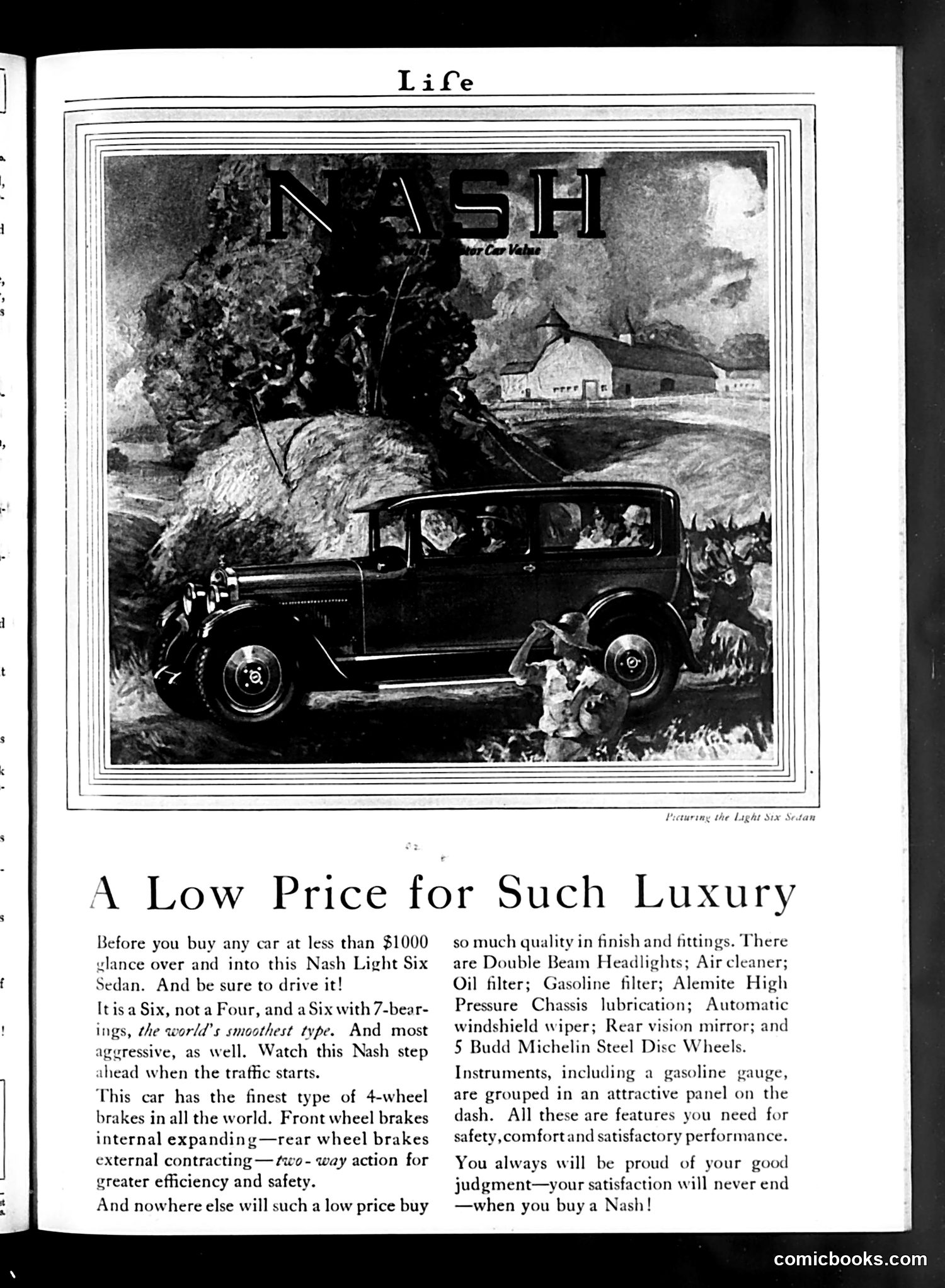
This is **not a satirical cartoon page** but rather a **automobile advertisement** for the Nash Light Six Sedan, disguised as editorial content in Life magazine. The image shows a 1920s car positioned in a scenic rural landscape with a farmhouse, emphasizing the vehicle's suitability for countryside travel. The ad's headline—"A Low Price for Such Luxury"—targets middle-class buyers by claiming exceptional value under $1000. The copy highlights technical features (6-cylinder engine, advanced braking system, quality finishes) to justify the price point. This represents early automotive advertising strategy: positioning affordable cars as luxury items for aspirational consumers. This reflects 1920s American consumer culture when car ownership was becoming accessible to the middle class, not just the wealthy.
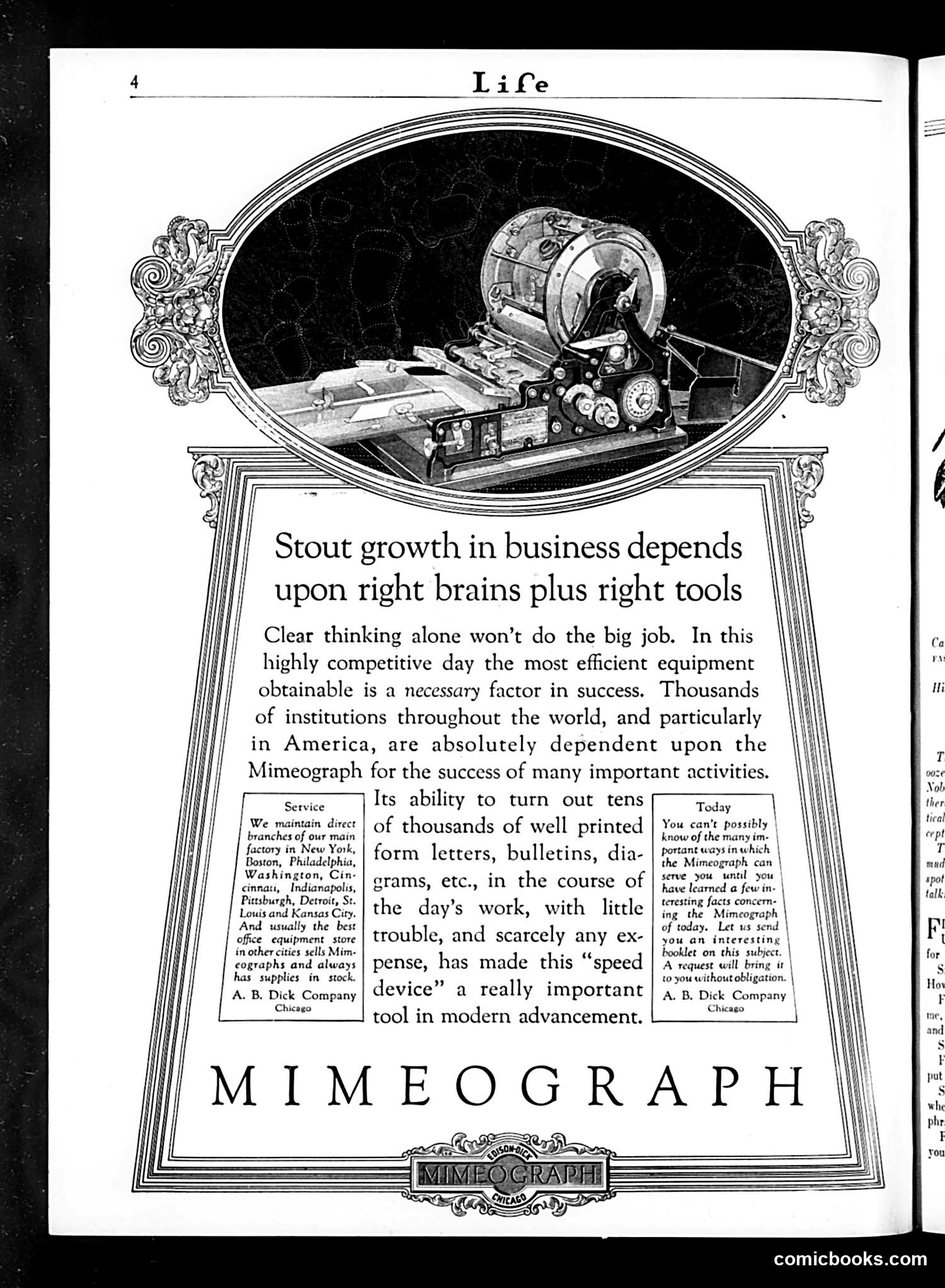
This page is primarily **advertising**, not satire or political commentary. It promotes the Mimeograph machine, a then-modern office copying device. The ad's headline claims business success requires "right brains plus right tools"—arguing that thinking alone isn't enough; companies need efficient equipment. The text emphasizes the mimeograph's practical value: it rapidly produces thousands of printed documents (letters, bulletins, diagrams) cheaply and with minimal effort. The two testimonial boxes from A. B. Dick Company (the manufacturer) cite their service locations and claim the machine is essential for modern business advancement. The ornate decorative border and the mechanical illustration at top are typical of early 20th-century advertising design. This is straightforward product promotion rather than commentary or humor.
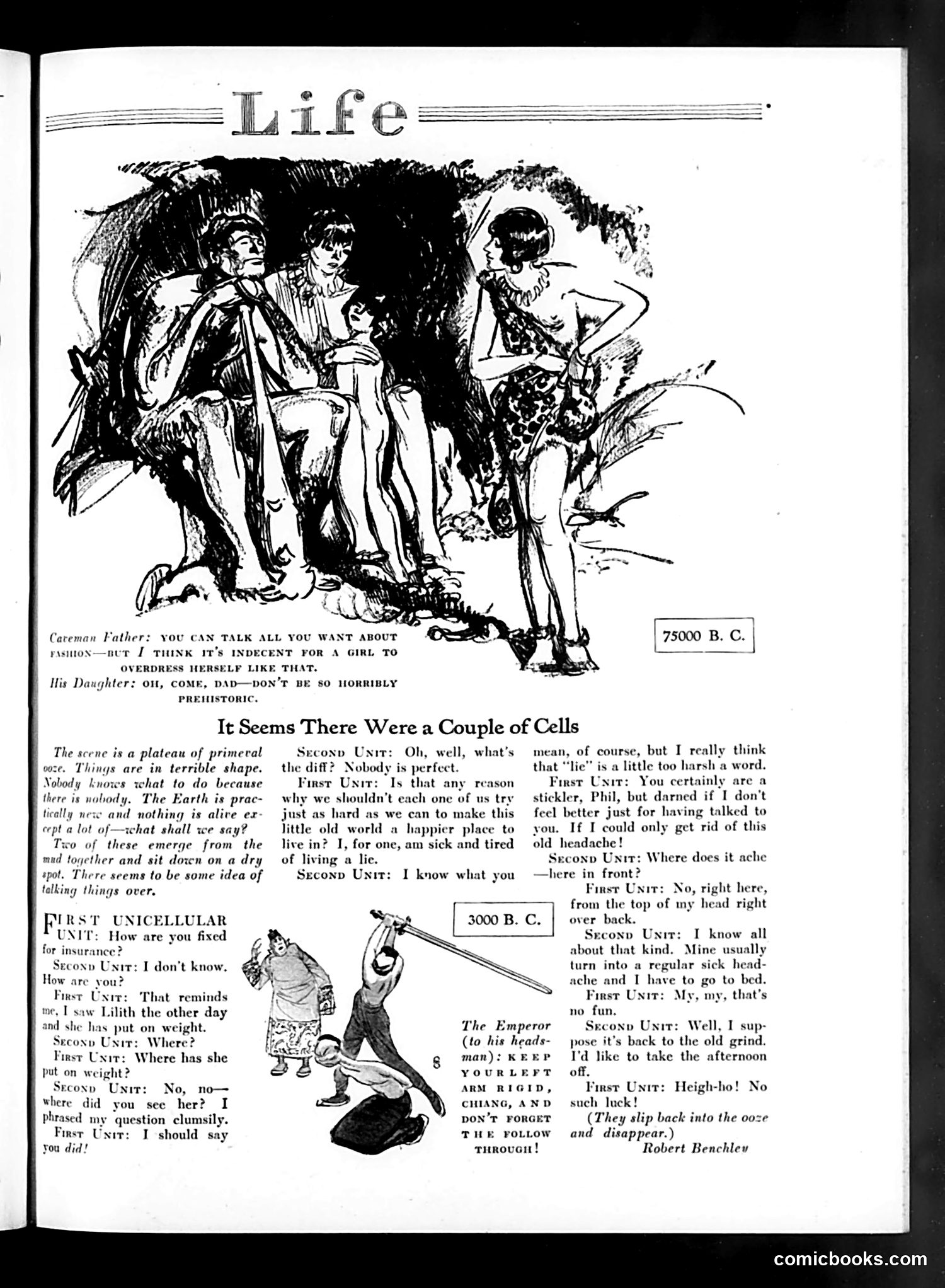
This page satirizes **gender roles and prehistoric "fashion"** through humor about cavemen. The top cartoon mocks paternal disapproval of women's dress, with a "Caveman Father" scolding his daughter for immodesty—anachronistically importing Victorian prudishness into prehistoric times. The joke suggests fashion controversies are timeless. Below, two separate comic dialogues depict cavemen discussing **insurance** and **physical ailments** in modern bureaucratic language. The humor derives from applying contemporary concerns (health insurance, headaches requiring doctors) to primitive humans, creating absurdist comedy. The cartoons satirize how humans obsess over the same trivial problems across eras—suggesting modernity hasn't fundamentally changed human nature or preoccupations, just dressed them in different clothing.
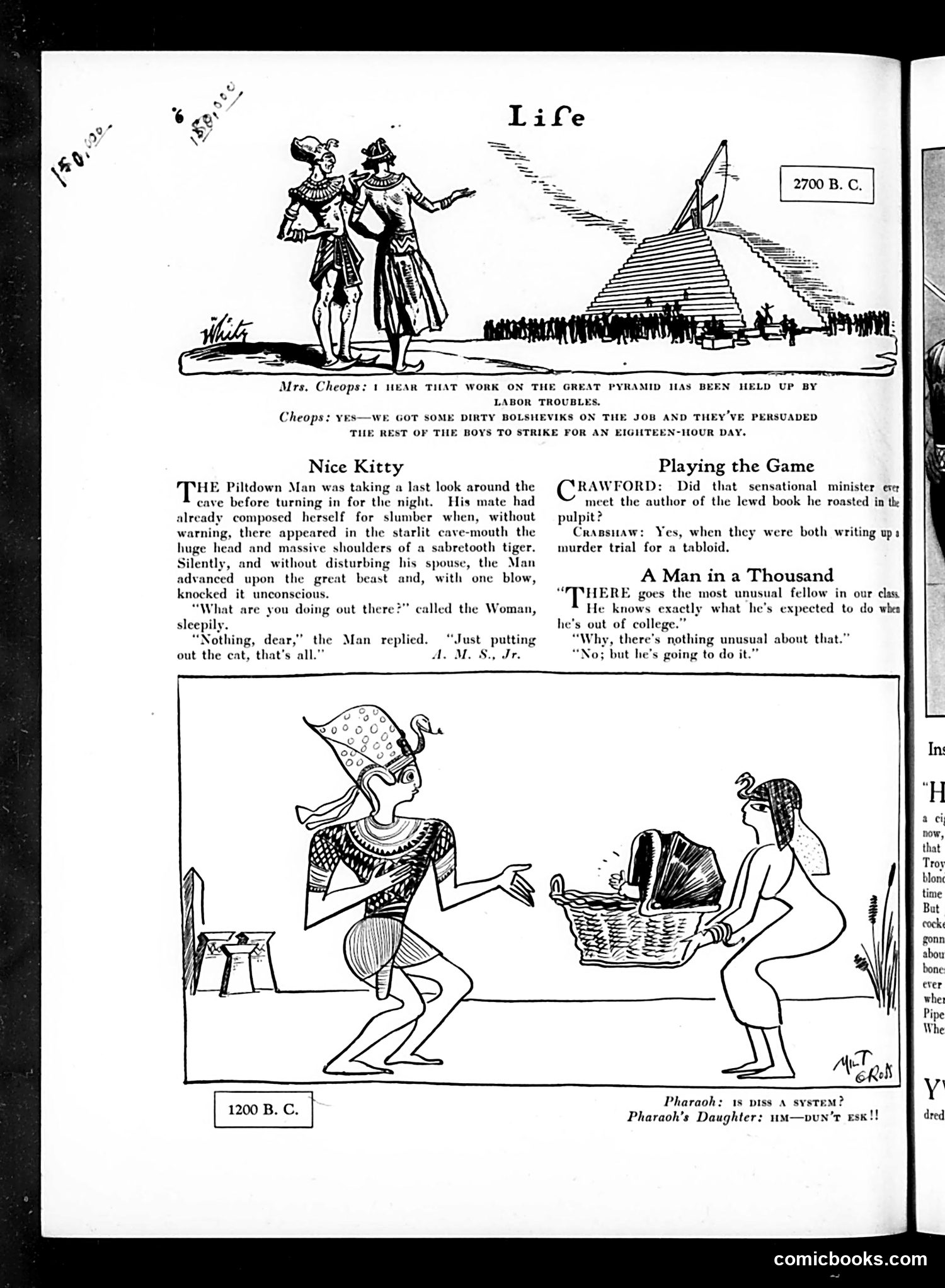
This page contains three separate satirical pieces spanning different historical periods: **"Life" (2700 B.C.):** A cartoon about Egyptian pyramid construction, showing workers and officials. The dialogue references modern labor strikes—Mrs. Cheops mentions work delays caused by "labor troubles" and boys striking for an eighteen-hour workday. This is anachronistic humor, applying contemporary 1920s labor disputes to ancient Egypt. **"Nice Kitty":** A domestic humor piece about a man knocking out a cat to silence it. **"Playing the Game":** A brief social commentary about an unusual fellow. **Bottom Cartoon (1200 B.C.):** An Egyptian scene where a Pharaoh asks his daughter "Is bliss a system?" and she responds "Don't ask!" This appears to satirize marital philosophy or romantic relationships through ancient Egyptian framing.
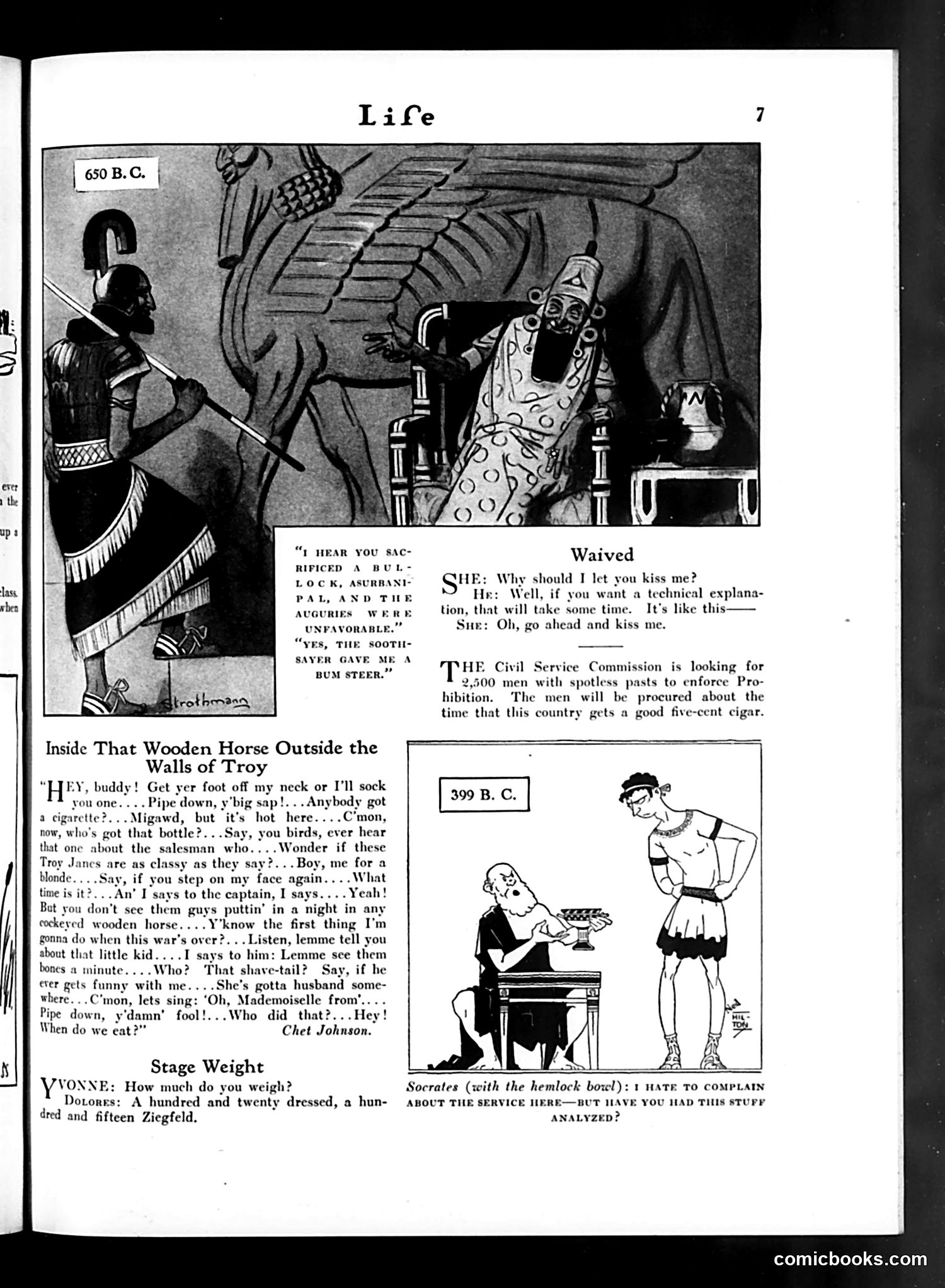
This page contains humorous sketches and dialogue from circa 650-399 B.C., satirizing historical figures and situations. **"Inside That Wooden Horse Outside the Walls of Troy"** features soldiers crammed in the famous Trojan Horse, complaining about conditions—cramped quarters, heat, and impatience. The humor lies in treating this legendary military deception as an absurd troop transport, complete with casual soldier banter. **"Waived"** presents a brief comedic exchange about kissing that plays on miscommunication. **"Stage Weight"** jokes about actor Dolores weighing "a hundred and fifteen Ziegfeld"—likely referencing Florenz Ziegfeld's famous theatrical company, where actresses were presumably lighter or more glamorous. The cartoons use historical and theatrical references to create humor through anachronistic situations and wordplay typical of Life magazine's satirical style.
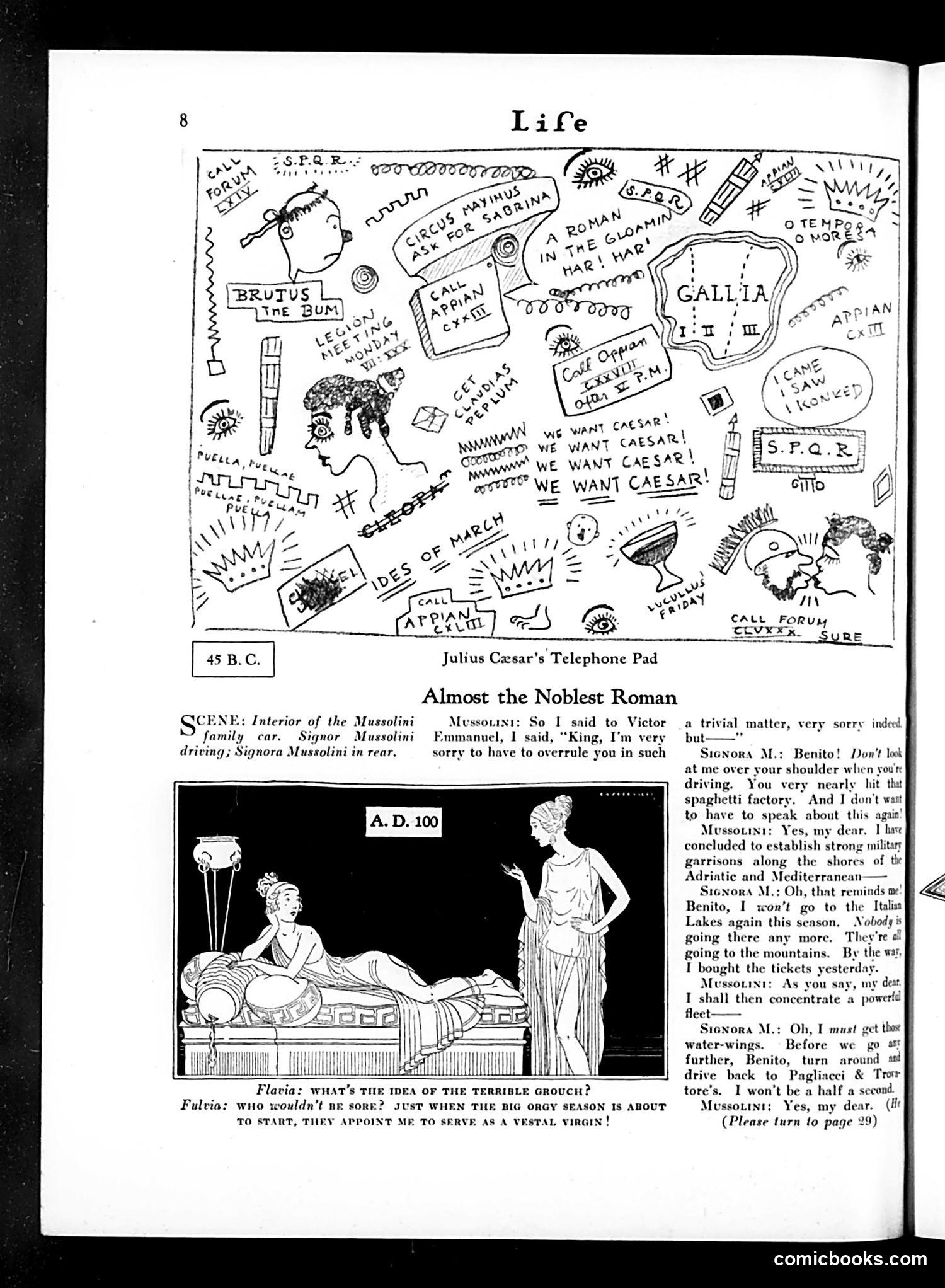
This page satirizes **Julius Caesar** and Roman politics through two pieces: **Top cartoon** ("Julius Caesar's Telephone Pad"): A chaotic sketch mocking Caesar's administrative challenges. It references historical locations (Gallia, Britannia) and shows crowds chanting "WE WANT CAESAR!"—satirizing both ancient Roman politics and contemporary political fervor. The messy, overlapping details suggest governmental chaos and competing demands. **Bottom illustration** ("Almost the Noblest Roman"): Shows Mussolini in a car with his wife, captioned as a scene from "A.D. 100." The dialogue mocks Mussolini's attempts at military grandeur while his wife complains about domestic matters (tickets, lakes, mountains). It's satirical commentary on Mussolini's authoritarian posturing versus mundane reality, comparing him to Caesar while undermining his pretensions to greatness.
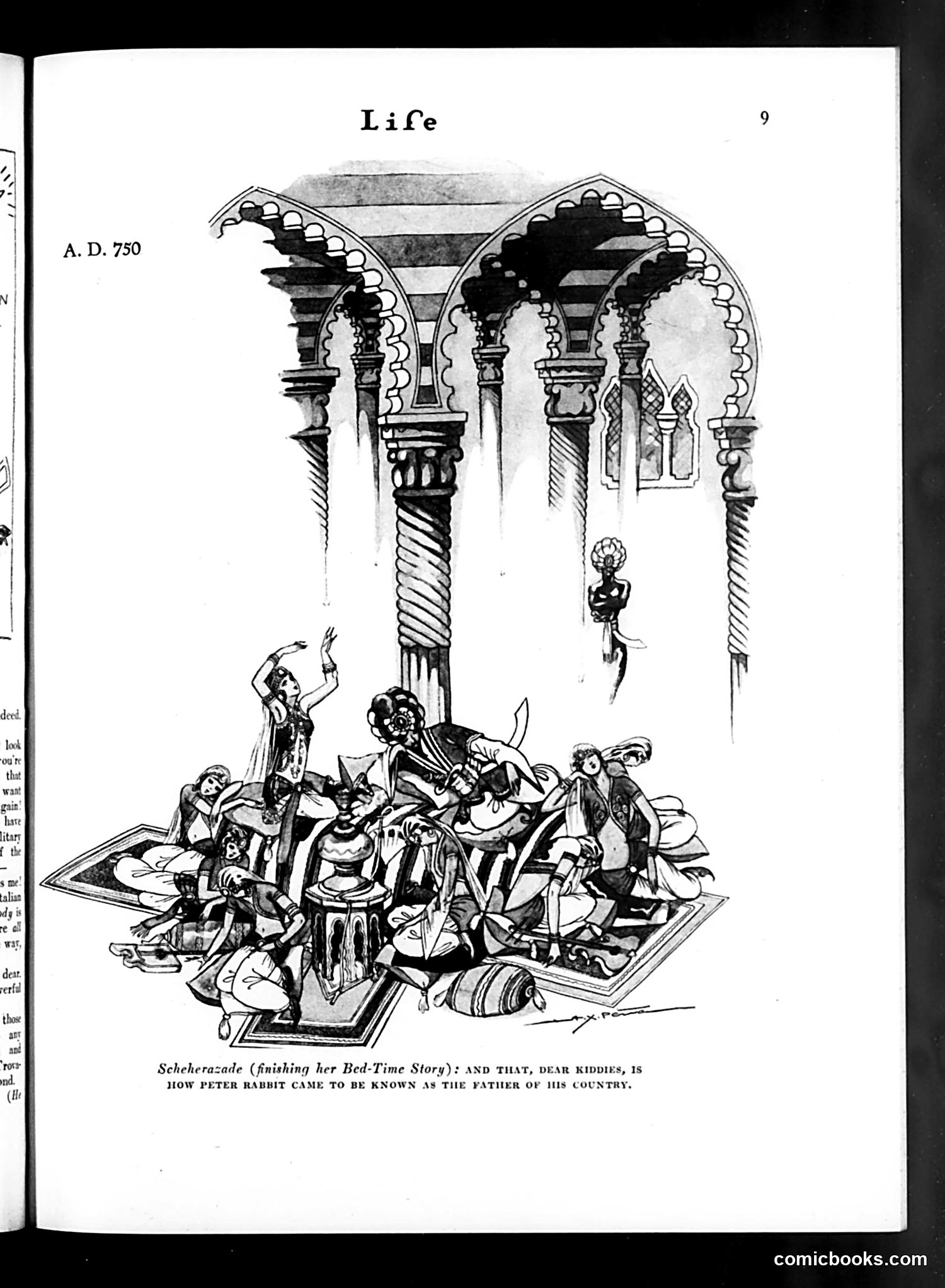
This is an illustration captioned "Scheherazade (finishing her Bed-Time Story): and that, dear kiddies, is how Peter Rabbit came to be known as the father of his country." The image depicts an ornate Arabian interior with multiple figures lounging on cushions beneath arched columns. It's a humorous mashup of two cultural references: Scheherazade, the storyteller from *One Thousand and One Nights*, finishing a bedtime tale to children. However, the joke conflates this with American folklore by claiming Peter Rabbit (the Beatrix Potter character) became "the father of his country"—a title reserved for George Washington. The satire appears to mock either the blending of children's literature with American mythology, or perhaps satirizes how bedtime stories shape national identity. Without additional context, the precise political target remains unclear, though it likely comments on American cultural pretensions or education practices circa 1910.
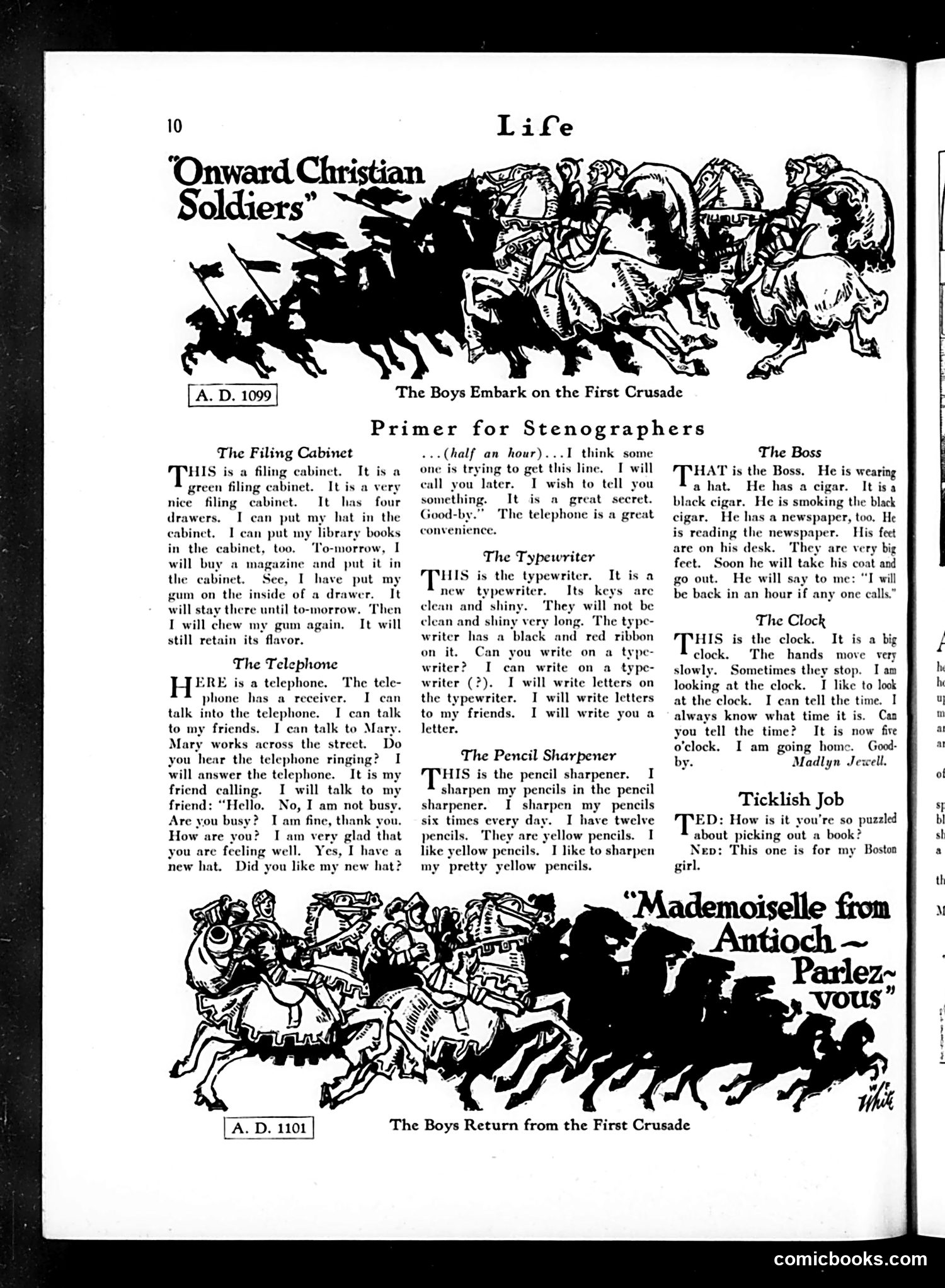
This page contains a "Primer for Stenographers"—instructional humor for office workers learning shorthand. The content is mundane workplace satire: sections on filing cabinets, typewriters, telephones, pencil sharpeners, and clocks describe office objects in exaggerated, anthropomorphic language. The two illustrations frame the text: "The Boys Embark on the First Crusade" (A.D. 1099) shows medieval crusaders on horseback, while "The Boys Return from the First Crusade" (A.D. 1101) depicts them returning. These parallel the mundane "office crusade" described in the primer—suggesting that secretarial work is as epic and exhausting as historical crusades. The humor relies on treating ordinary office tasks with grandiose language, poking gentle fun at clerical workers' daily routines.
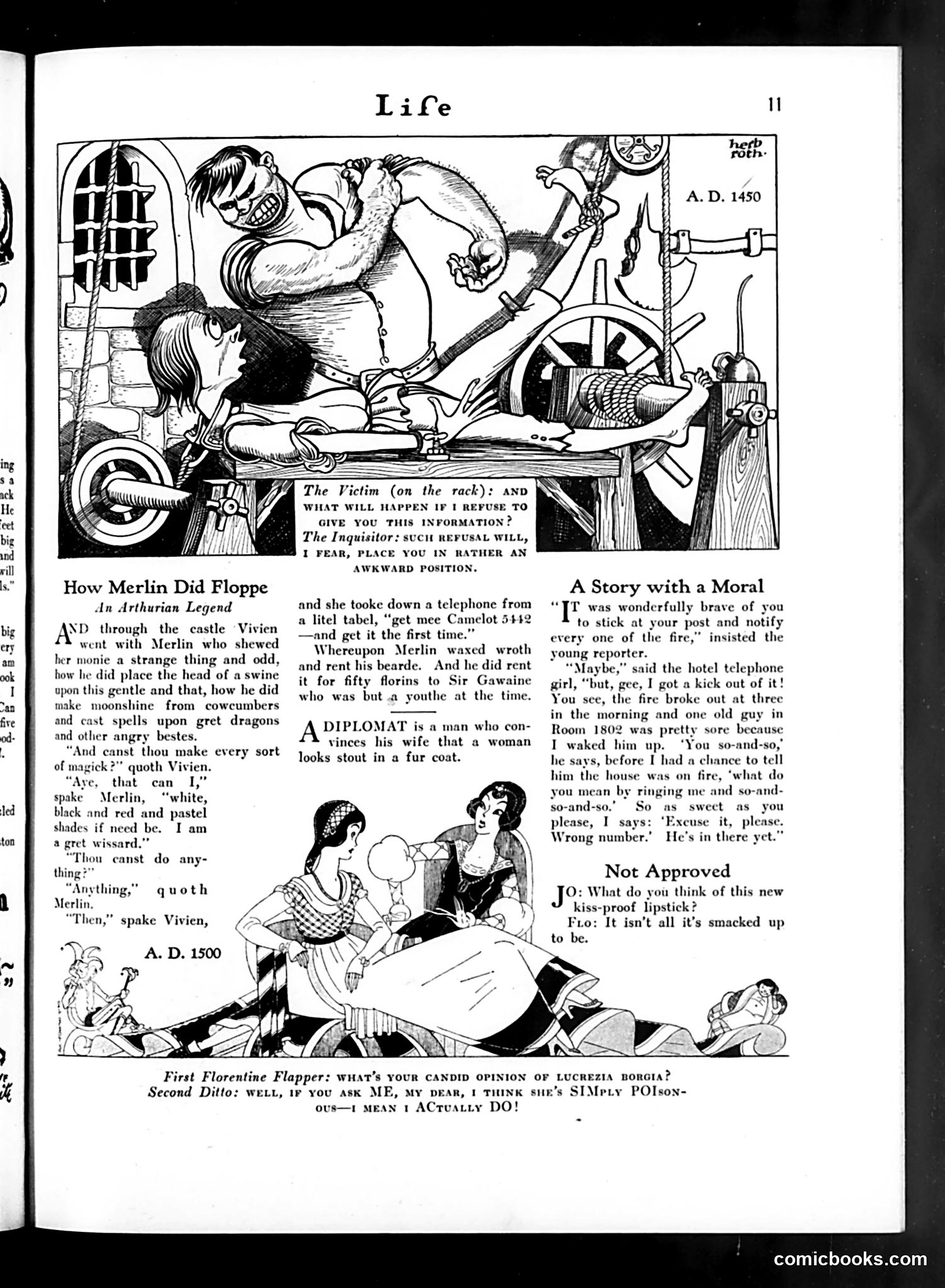
This page contains three humorous pieces mocking medieval/historical figures and 1920s social conventions: **Top cartoon**: Depicts torture ("The Victim on the rack"), satirizing an inquisitor's demand for information through threatening physical punishment—a commentary on coercive interrogation methods. **"How Merlin Did Floppe"**: A mock-historical story set in Arthurian legend (A.D. 1500, though historically inconsistent) where the wizard Merlin uses magic to humiliate Sir Gawain. The satire appears to target pomposity and male vanity. **"A Story with a Moral"**: Mocks a young reporter who gets a telephone tip about a fire but refuses to follow up properly—satirizing laziness and incompetence in journalism. **Bottom section**: Jazz-age gossip items poking fun at 1920s socialites' opinions on historical figures and their disapproval of new cosmetics trends. The satire targets both frivolous celebrity culture and changing social mores around women's appearance.
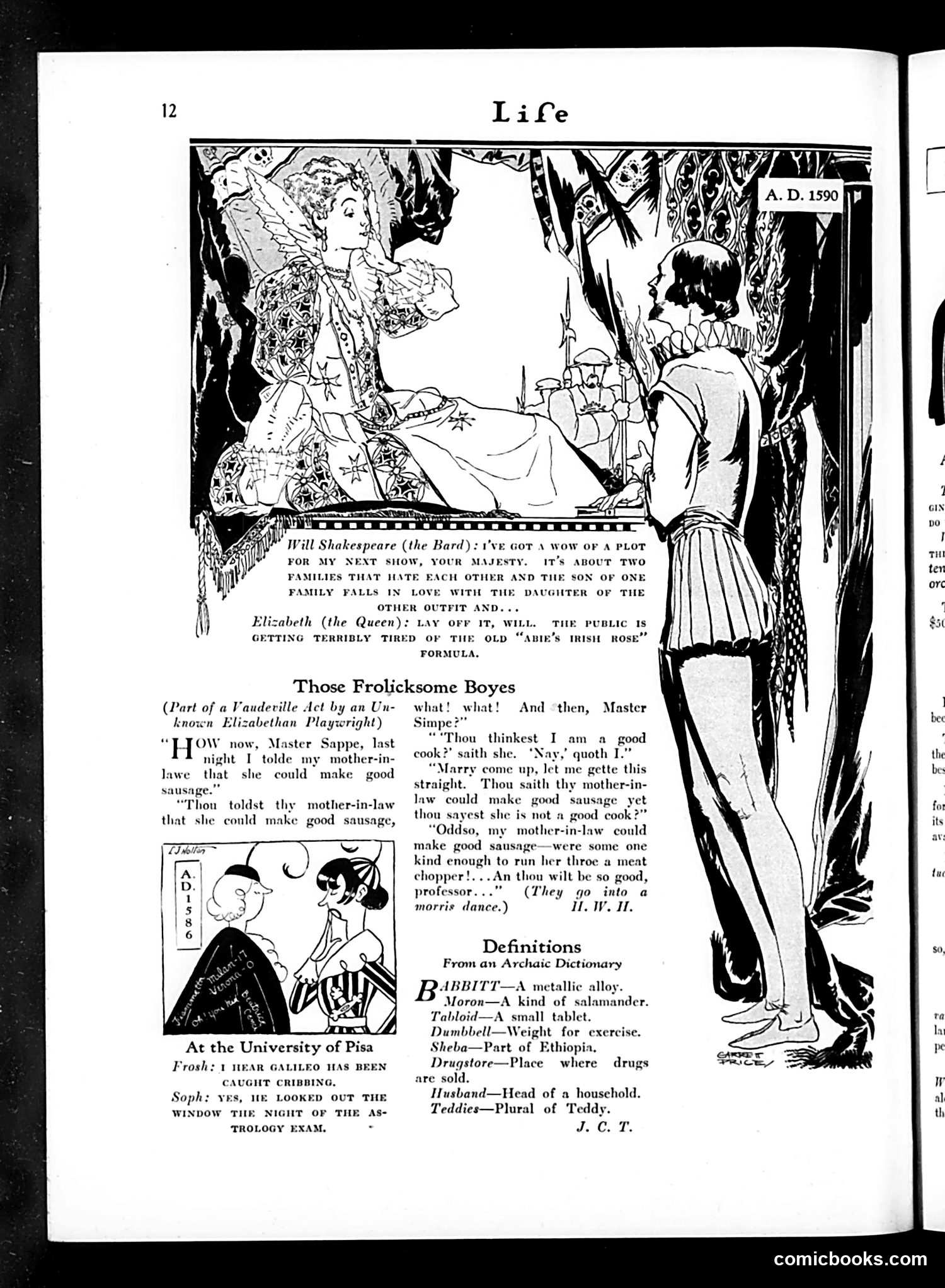
This page presents early 1900s satirical content mixing literary and humorous commentary. The top illustration depicts a scene labeled as involving Shakespeare (the Bard) pitching a plot to Queen Elizabeth I. The joke involves "two families that have each other" with romantic entanglement—likely mocking the familiar plot formula of Shakespeare's works, particularly *Romeo and Juliet*. Below, "Those Frolicksome Boyes" presents a Vaudeville sketch about a man boasting his mother-in-law makes good sausage, followed by increasingly absurd wordplay about cooking and marriage. Additional sections include brief comedic anecdotes ("At the University of Pisa") and an "Archaic Dictionary" defining obsolete terms. The illustration on the right shows period-costumed figures, though their specific identity remains unclear from context alone. The overall tone is light satirical humor typical of early Life magazine's theatrical and literary parody approach.
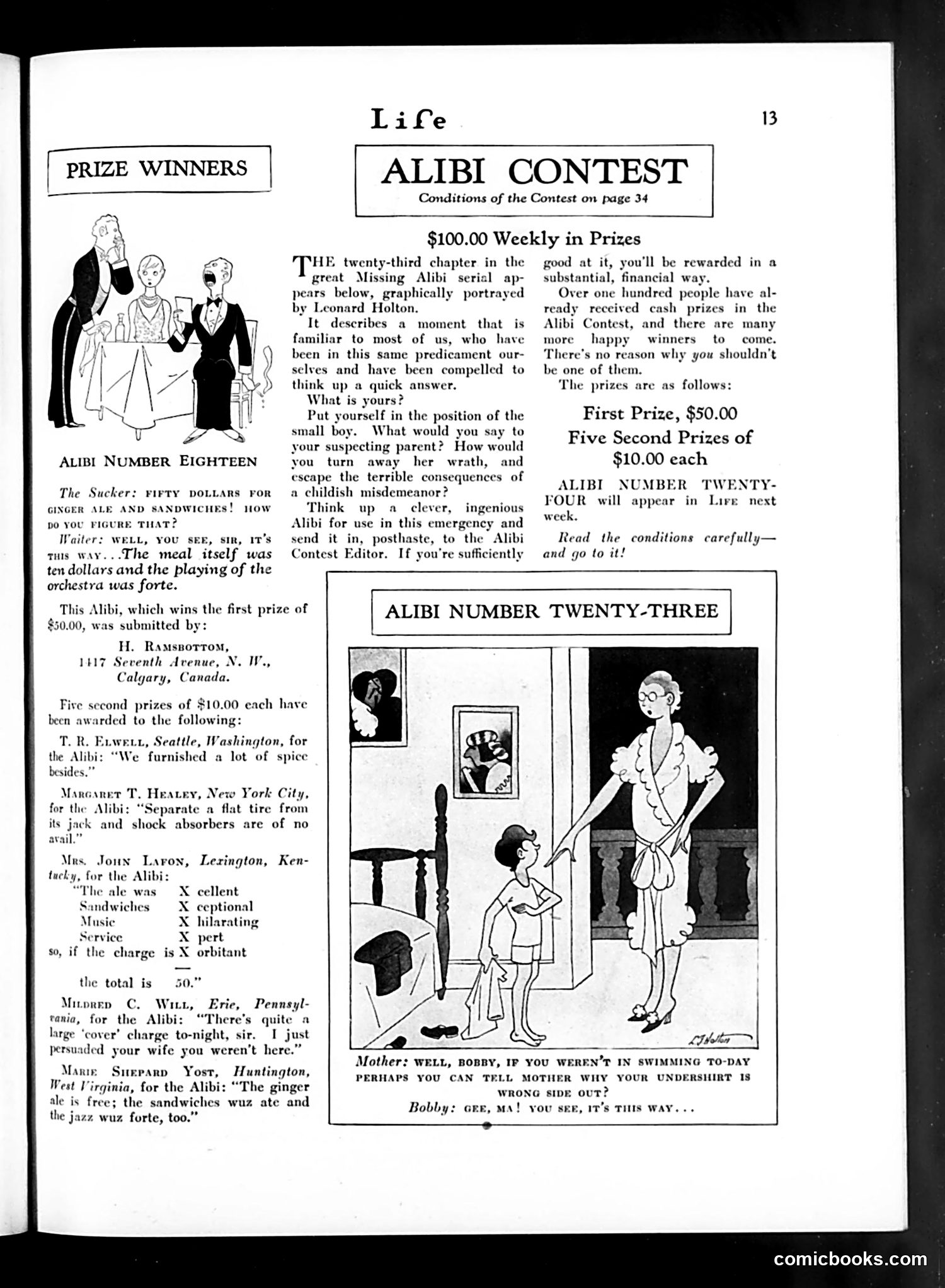
This page contains an **Alibi Contest**—a humor feature inviting readers to submit creative excuses for everyday social mishaps. The contest offers $100 weekly in prizes ($50 first prize, five $10 second prizes). **Alibi Number Twenty-Three** illustrates the joke: a boy has worn his undershirt inside-out to swimming. When his mother notices, he claims he "weren't in swimming to-day" and frames the mishap as the shirt being on the "wrong side out." The humor lies in his transparent, ridiculous lie—the obvious contradiction between his denial and the visible evidence. The page also lists previous contest winners' creative alibis (spice on shoes, tire repairs, etc.), showing how readers submitted humorous excuses for various predicaments. This reflects 1920s-30s popular humor and audience participation culture.
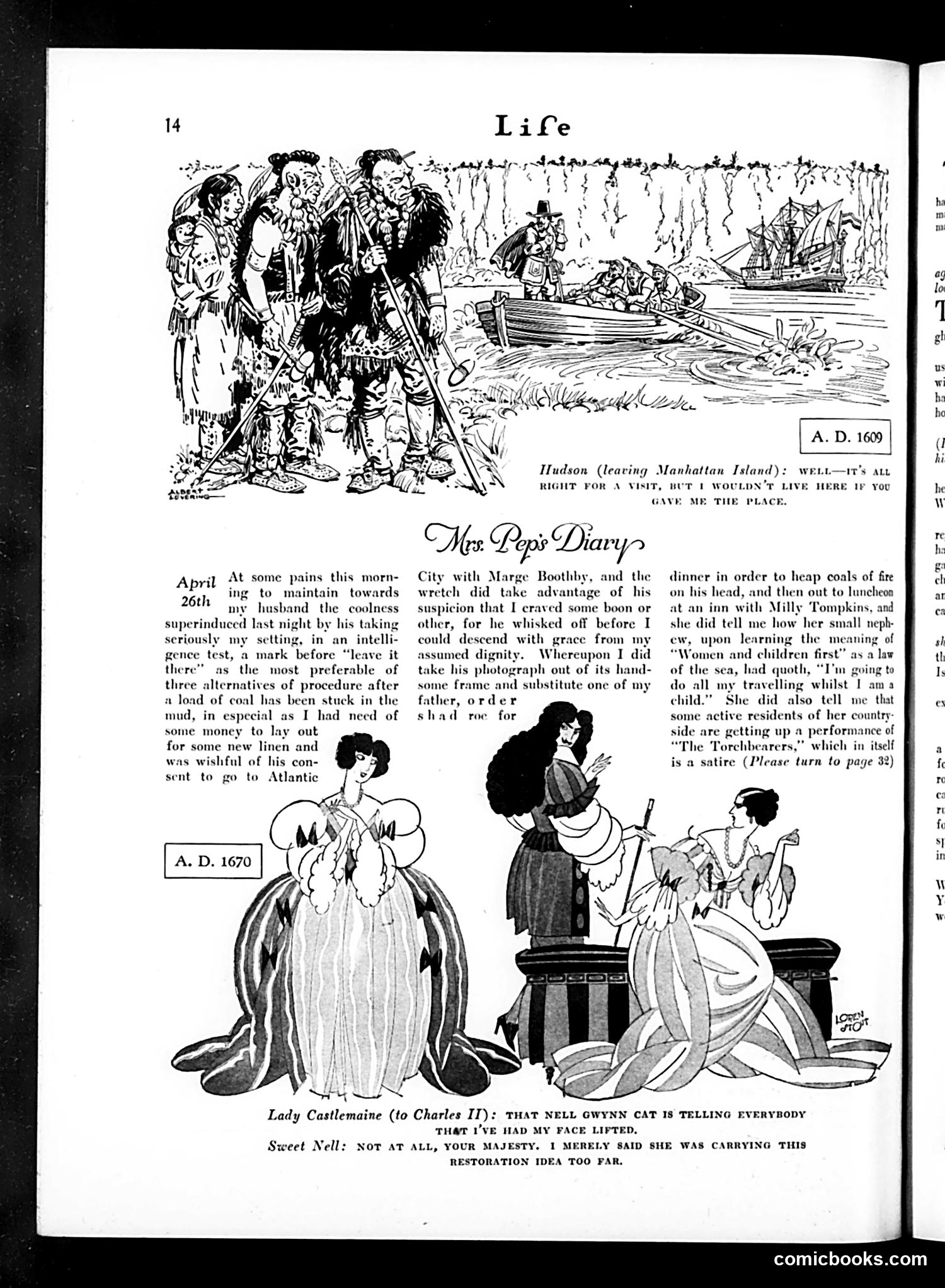
This page contains two satirical cartoons with historical settings: **Top cartoon** depicts Hudson leaving Manhattan Island in 1609, with the caption being Hudson's sardonic comment that he wouldn't live there despite its merits—a joke about early colonial New York's undesirability. **Bottom cartoon** shows Lady Castlemaine (mistress of Charles II) and Sweet Nell Gwyn discussing cosmetic surgery ("face lifting"). Lady Castlemaine boasts about her procedure while Nell sarcastically suggests she took the restoration idea "too far"—mocking both vanity and the absurdity of aristocratic beauty obsessions. Both cartoons use historical figures as vessels for commentary on contemporary (1920s-era) American social pretensions and vanity.
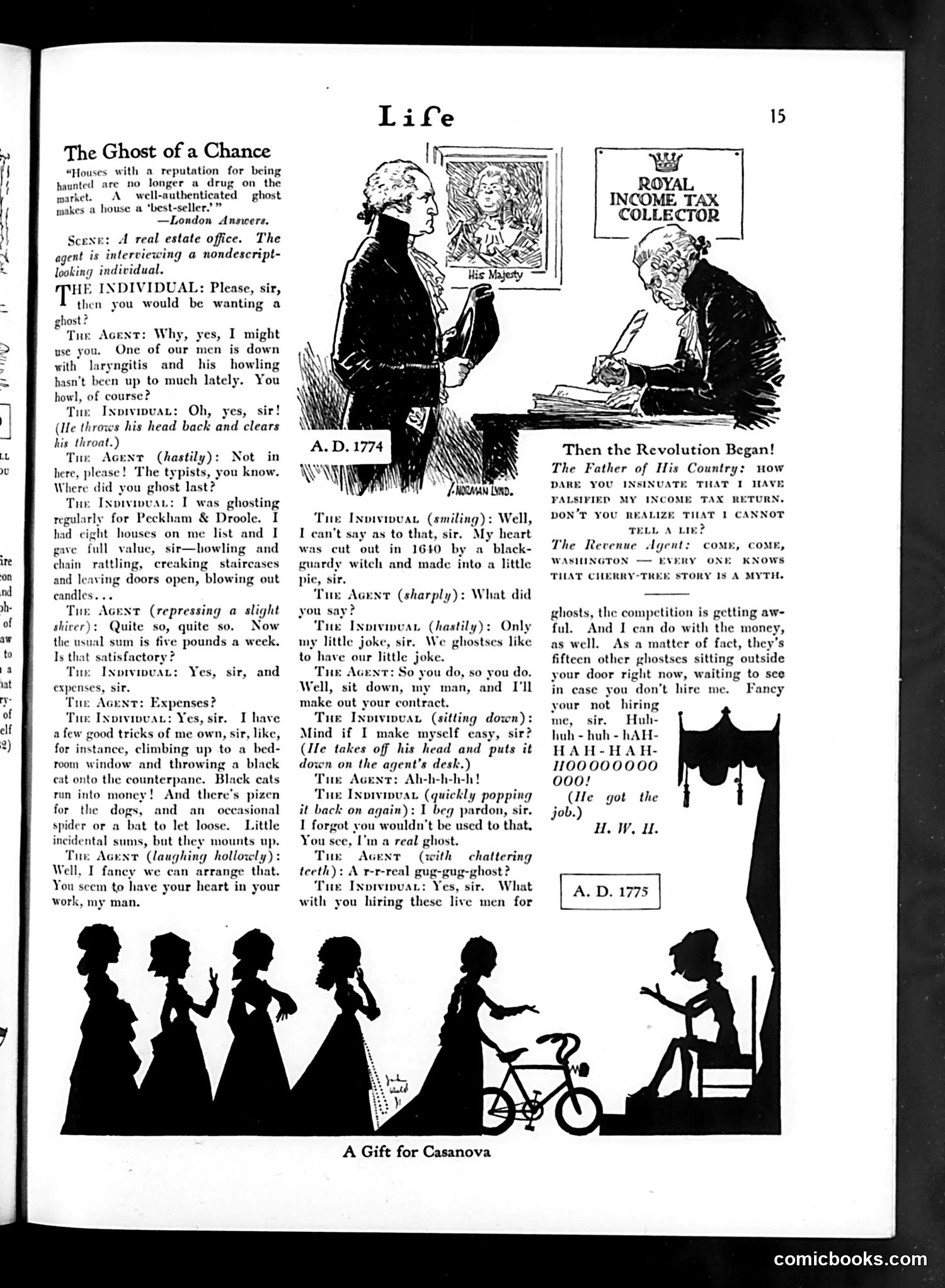
This page contains two satirical sketches mocking the real estate market and tax collection. **"The Ghost of a Chance"** depicts a real estate agent trying to sell an unsold property by claiming it's haunted—a con to justify why no one wants it. The agent demands five pounds weekly commission despite the obvious scam. The humor lies in the agent's shameless dishonesty. **"Then the Revolution Began!"** shows a Revenue Agent confronting someone about unpaid taxes dating to 1774-1775 (American Revolutionary period). The joke is absurd: demanding modern taxes for houses from before American independence. The individual's exasperation ("don't you realize I cannot tell a lie?") satirizes government overreach and unreasonable tax demands. The silhouette vignette below reinforces everyday social commentary typical of Life magazine's satire.
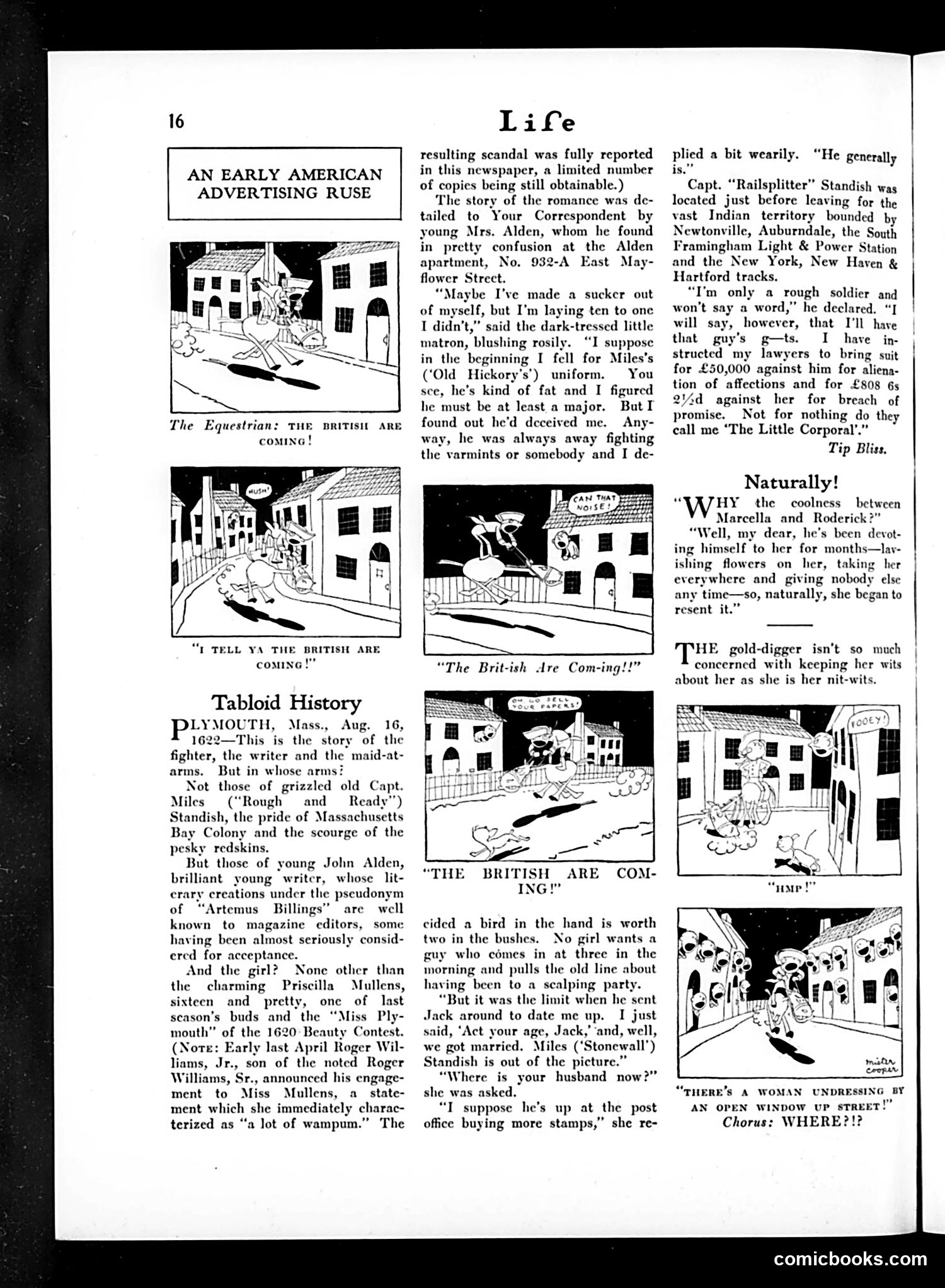
This page contains satirical cartoon strips mocking a romantic scandal. The sequence depicts "The British Are Coming!" — apparently a reference to a deceptive courtship or advertising scheme involving a young woman named Mrs. Alden at an East Mayflower Street apartment. The cartoons show comedic misunderstandings and romantic entanglements, with one caption referencing a lawsuit ("The Little Corporal") involving breach of promise claims totaling substantial sums. The satire targets early 20th-century courtship deceptions and possibly misleading personal advertisements. The "British" framing appears to be a humorous exaggeration of pretense or false sophistication in romantic schemes. The overall tone mocks both the deceptive parties and the social scandal it generated.
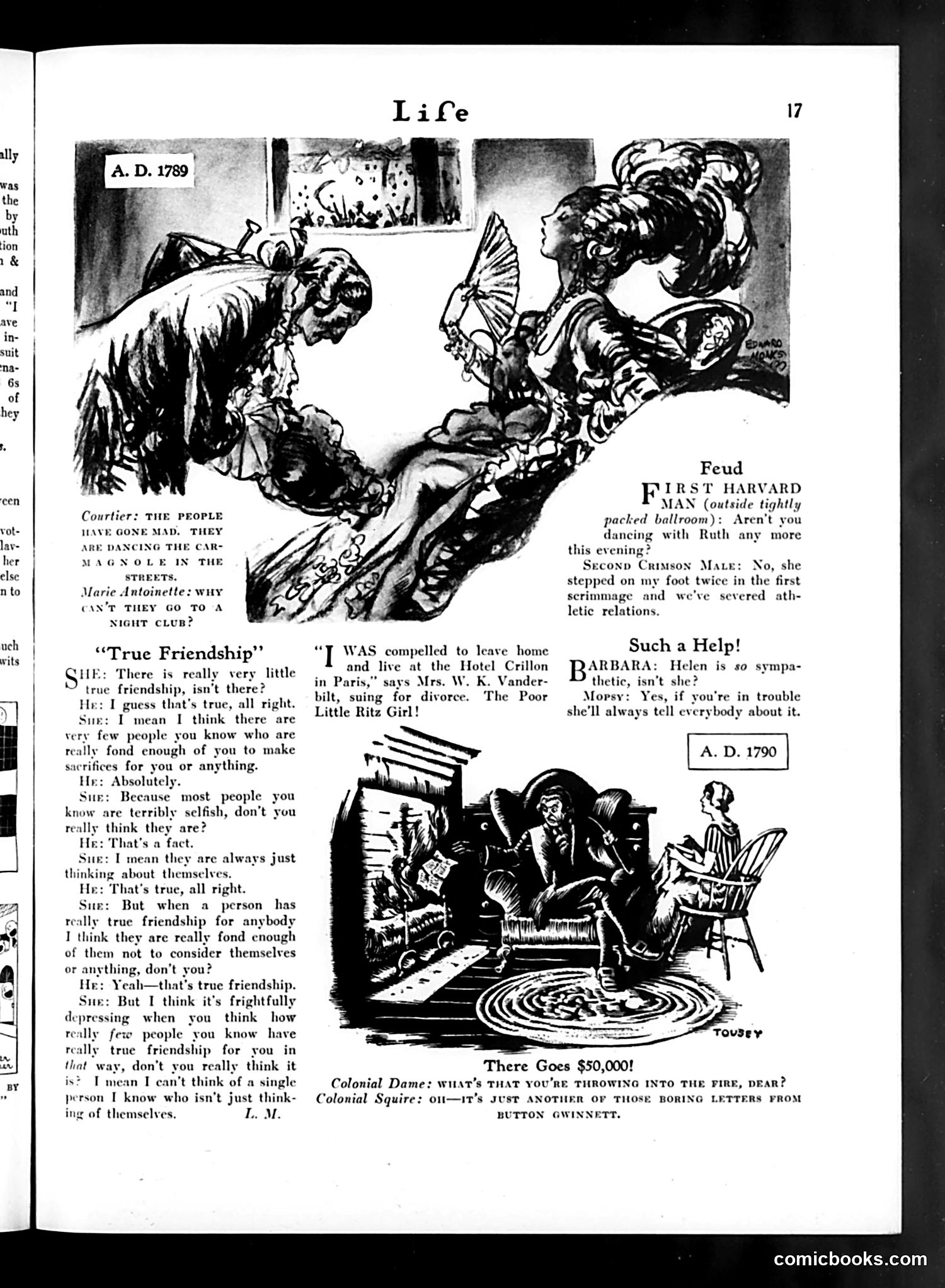
This page contains three unrelated humor pieces typical of Life's satirical format: 1. **"True Friendship"** – A philosophical dialogue between a man and woman debating whether true friendship exists. The joke plays on the difference between their definitions: she argues real friends sacrifice everything; he cynically notes most people are selfish. The humor lies in their conflicting worldviews about human nature. 2. **"Feud"** and **"Such a Help!"** – Brief joke exchanges about social scandals (a Harvard man's dancing partner, broken engagement rumors). 3. **"There Goes $50,000!"** – A Colonial-era scene satirizing wasteful letter-burning, mocking the frivolous destruction of expensive correspondence. The squire's dismissal of "boring letters from Button Gwinnett" is the joke's punchline. These are society-humor pieces reflecting upper-class concerns of the 1789-1790 period.
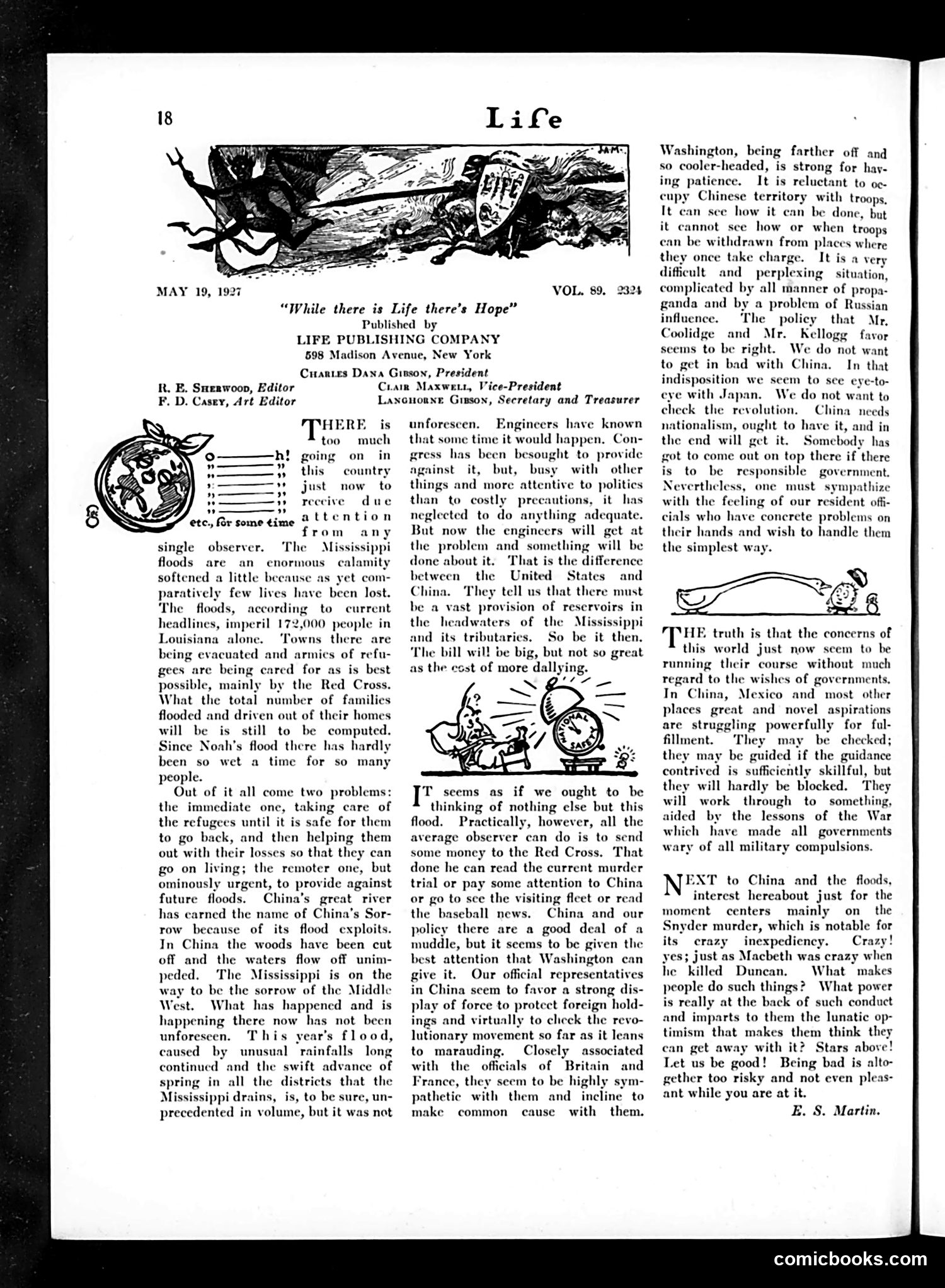
This editorial page addresses America's simultaneous crises: the catastrophic Mississippi River floods (imperil 172,000 in Louisiana) and confusing U.S. policy toward China during its political turmoil. **The floods argument**: Congress neglected preventative infrastructure despite engineers' warnings. Now action is imperative—though expensive. **The China problem**: The U.S. faces a complex situation with Revolutionary movement, foreign interests, and Russian influence. The page criticizes Britain and France's military interventionism while noting President Coolidge's more cautious, patient approach—reluctant to occupy Chinese territory militarily, yet uncertain how troops would ever withdraw once deployed. The cartoon's central clock references the competition for American attention: citizens can't focus on everything simultaneously. The broader point: ordinary Americans can only send Red Cross donations while newspapers distract with murder trials and baseball, leaving complex policy decisions to distant officials.
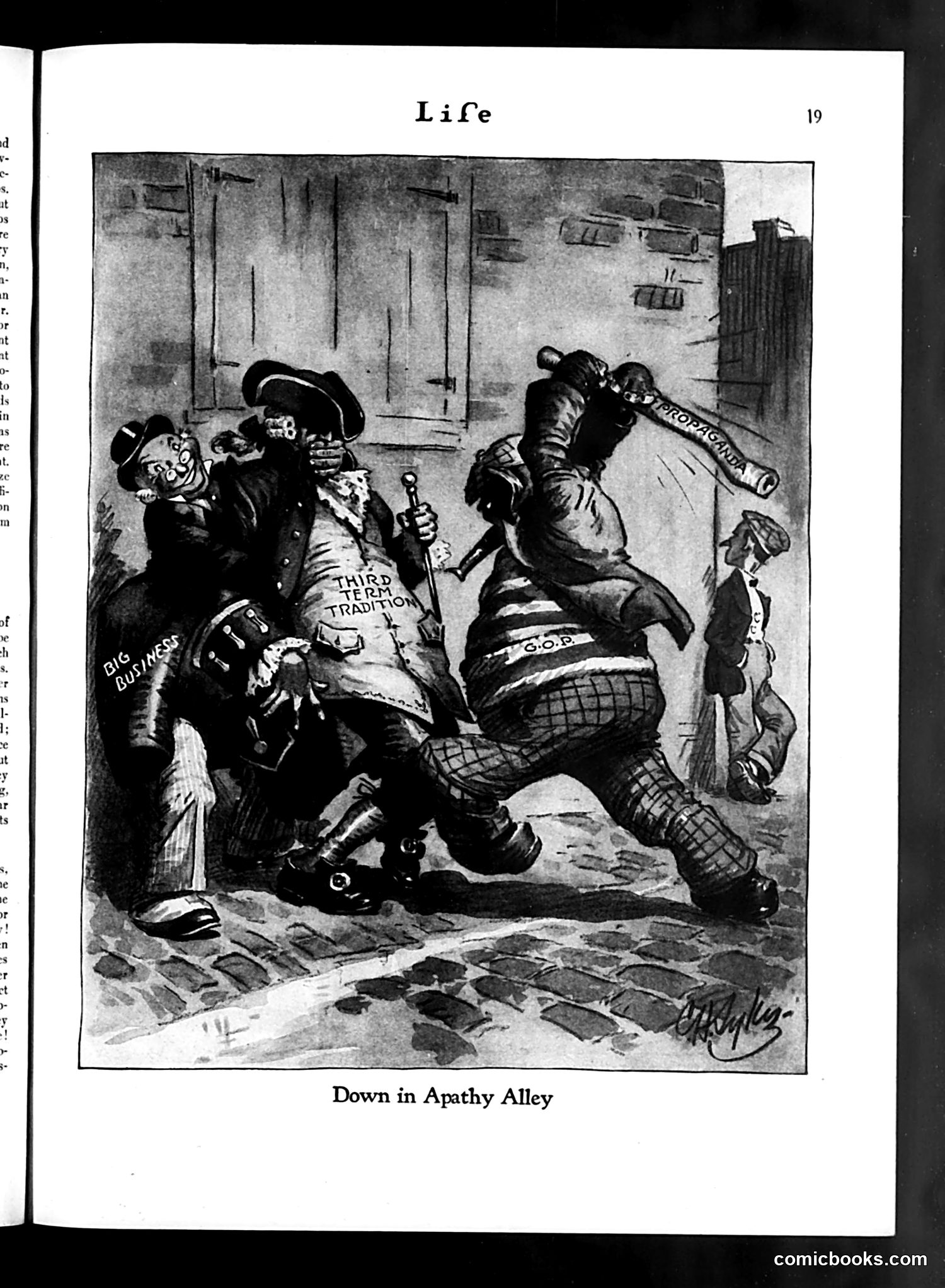
This political cartoon depicts several caricatured figures in an alley, labeled with references to political factions or concepts: "Big Business," "Third Term Tradition," and what appears to be "G.O.P." The figures are shown in conflict or struggle, with one figure appearing knocked down or defeated on the ground. The title "Down in Apathy Alley" suggests indifference or public disengagement. Without the magazine's publication date visible, the specific historical context is unclear. However, the imagery appears to critique political tensions between business interests, Republican Party politics, and constitutional traditions (possibly referencing presidential term limits). The "apathy" reference suggests the cartoon criticizes public passivity regarding these political struggles. The style and content are consistent with early-to-mid 20th century American political satire.
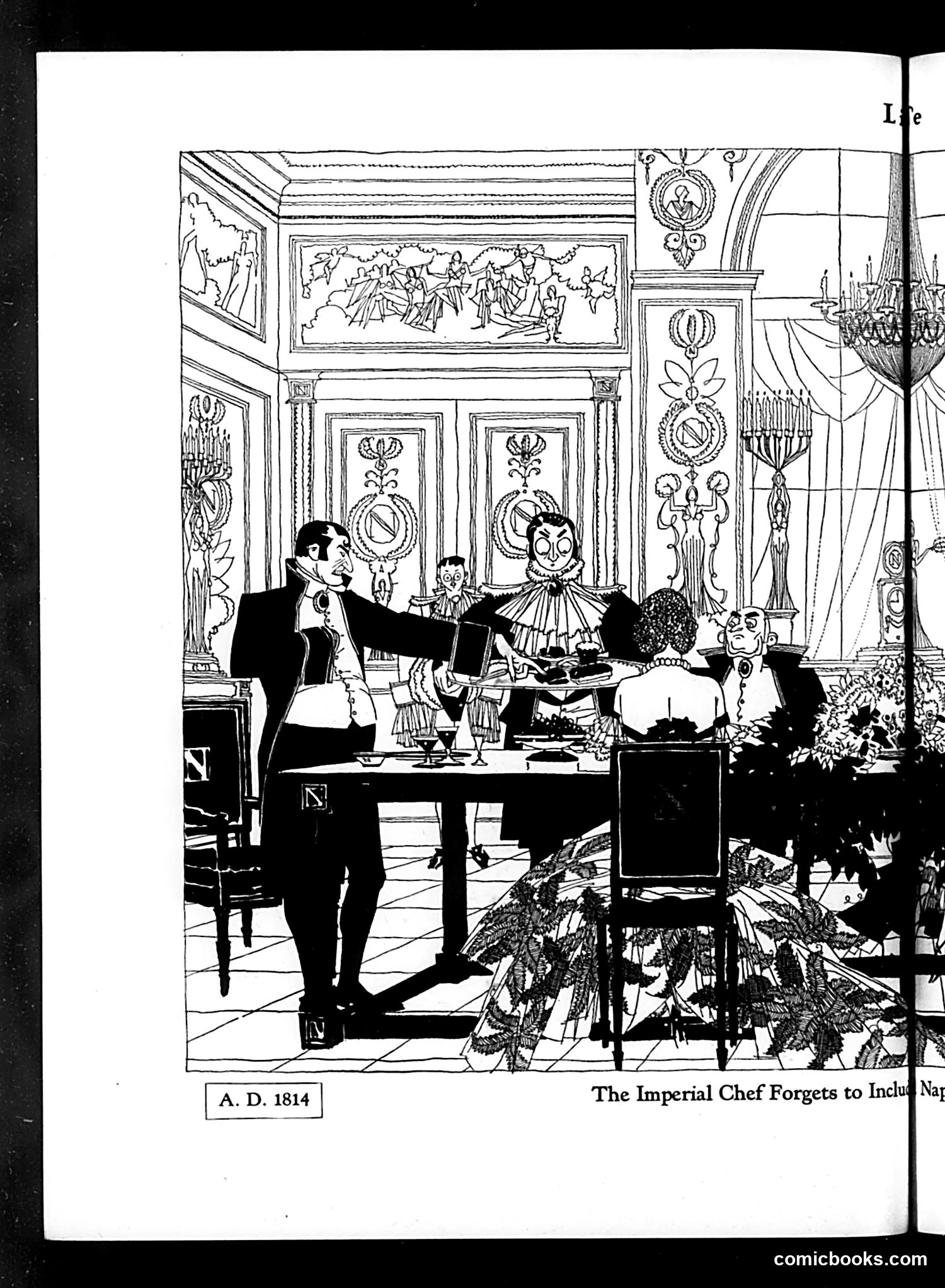
This satirical cartoon depicts a formal dining scene in an ornate imperial palace. The caption indicates it's dated A.D. 1814 and references "The Imperial Chef Forgets to Include Napoleon." The scene shows well-dressed figures at a grand table in an elaborate rococo room. The joke appears to be a political commentary on Napoleon's situation in 1814—the year of his first abdication and exile to Elba. By depicting Napoleon being "forgotten" or excluded from an imperial dinner, the cartoon satirizes his sudden fall from power and removal from the imperial court after his military defeats by European coalitions. The ornate setting emphasizes the grandeur he's lost.
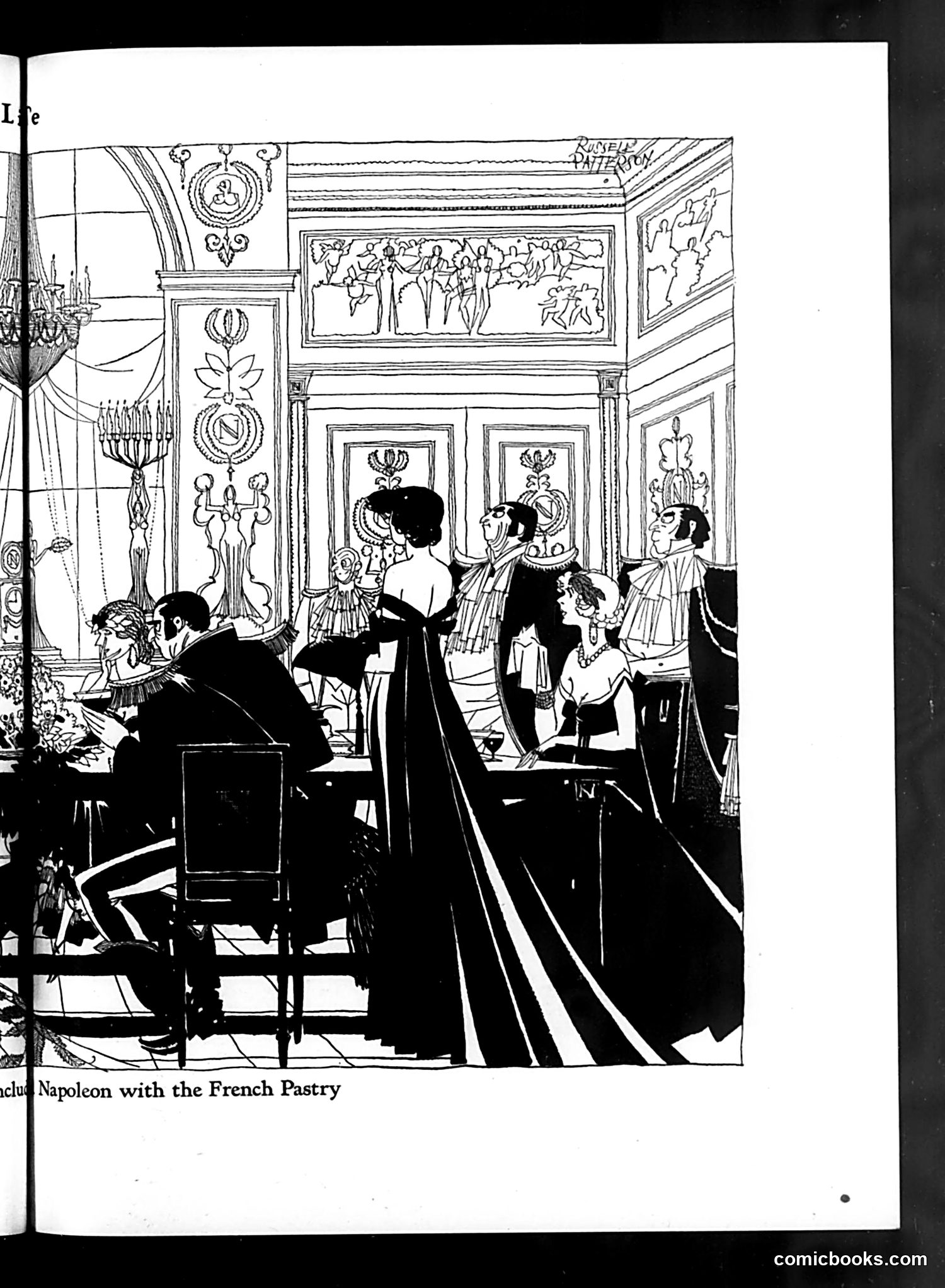
This satirical illustration depicts a formal French court or diplomatic scene, with a figure identified as Napoleon (seated at left, in military uniform) amid elegantly dressed courtiers and officials in an ornate palace interior. The caption's title suggests wordplay: "French Pastry" likely refers both to the elaborate desserts visible and, satirically, to the French aristocratic society itself—portrayed here as superficial, decorative, and frivolous. The satire appears to mock Napoleon's relationship with French high society, suggesting that despite his military power, he remains subject to or absorbed by the artificiality of court life and refined excess. The contrast between his martial bearing and the ornate, leisurely setting emphasizes this ironic tension.
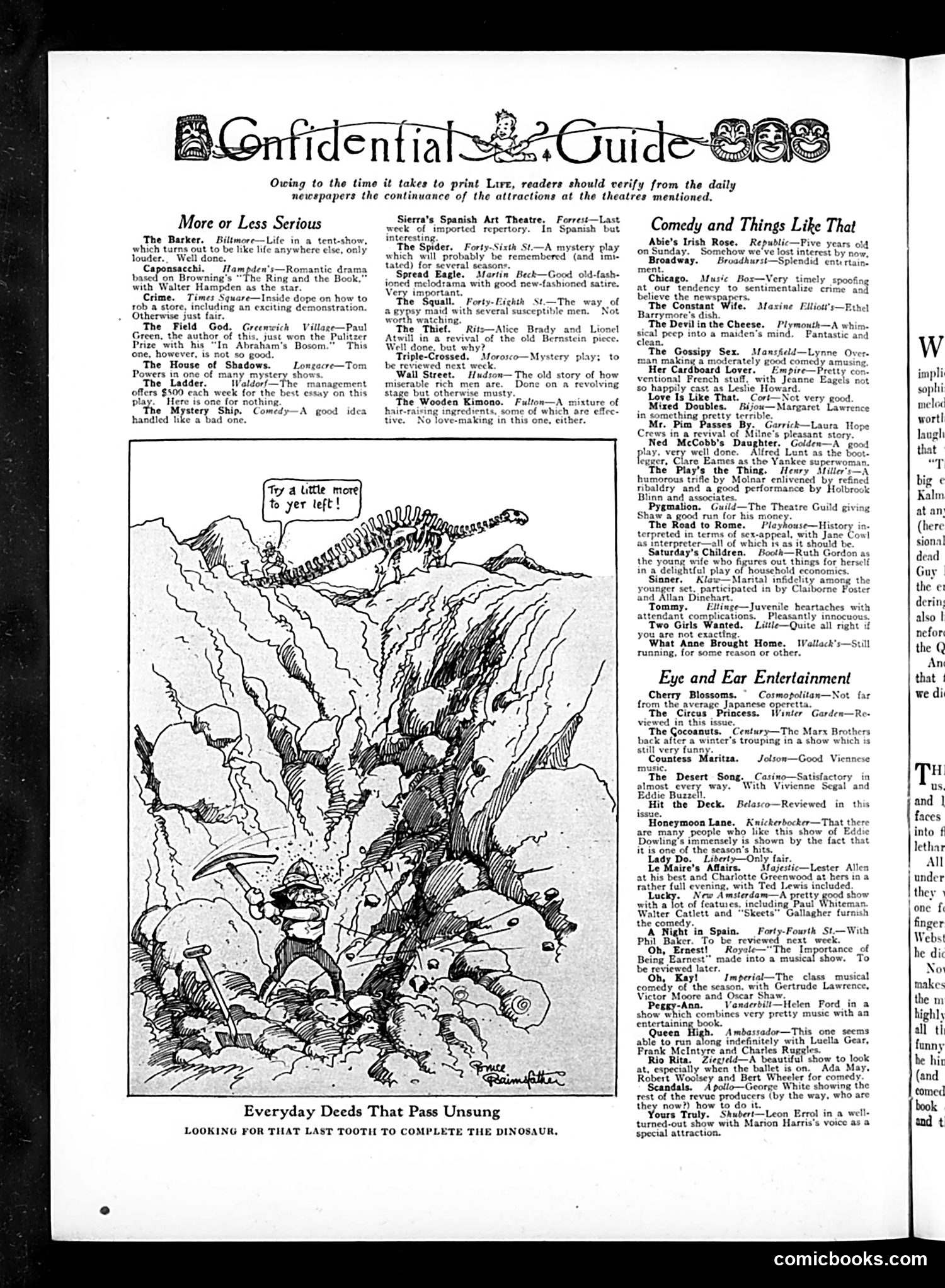
This page is a **theatre review section** from Life magazine, not primarily political satire. The large cartoon illustrates the caption "Looking for That Last Tooth to Complete the Dinosaur"—a humorous reference to paleontologists' ongoing efforts to reconstruct complete dinosaur skeletons from fossil fragments. The cartoon depicts a chaotic excavation scene where workers search through rubble for a final missing tooth. It's **not satirizing any political figure or event**, but rather making a lighthearted joke about scientific pursuits and the obsessive attention to detail required in paleontology. The rest of the page contains brief reviews of Broadway productions and theatrical attractions, evaluating shows like "Abie's Irish Rose," "The Constant Wife," and various mystery plays with the magazine's characteristic wit and social commentary about trends in contemporary theatre.
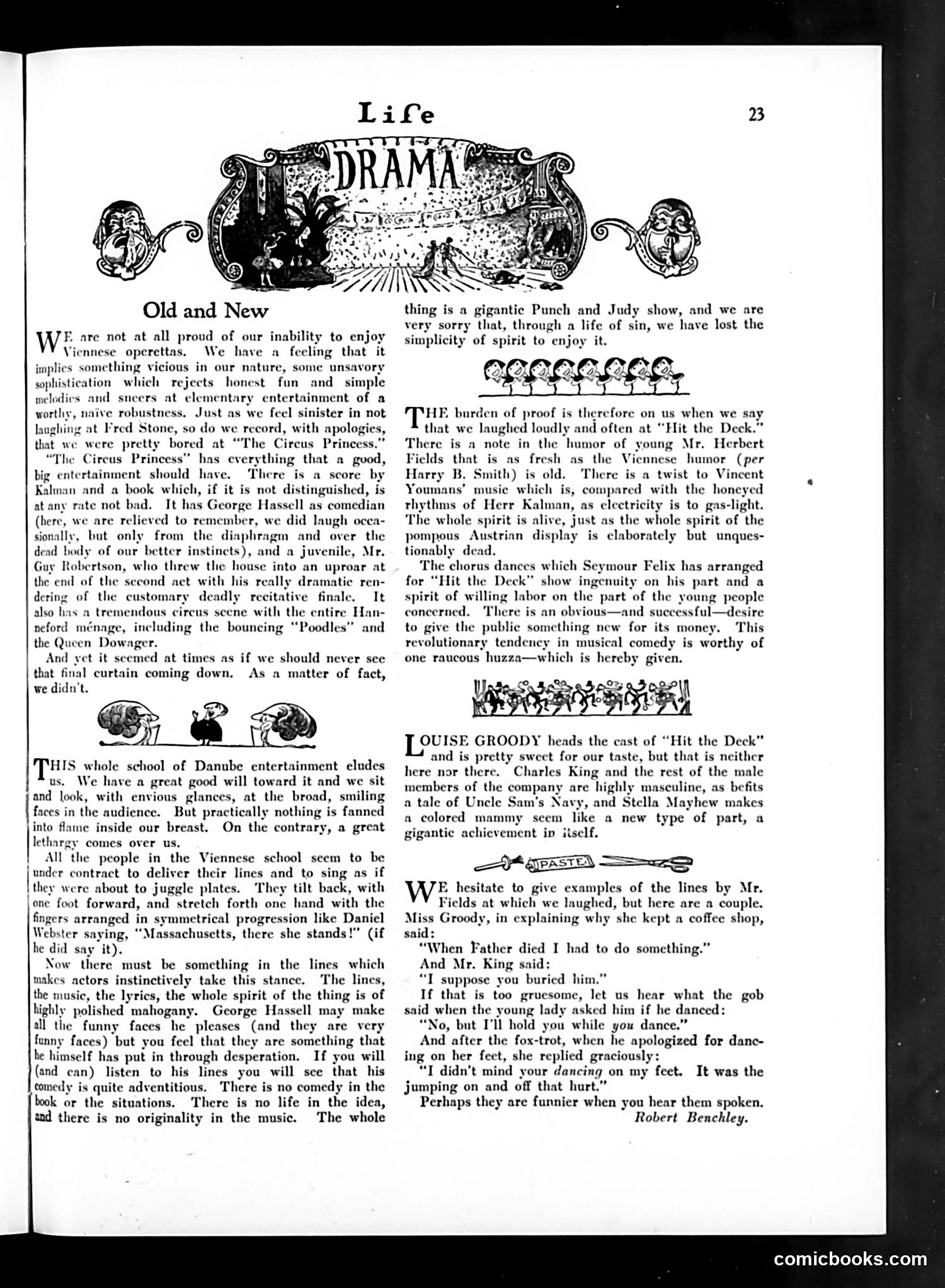
This page reviews two theatrical productions, contrasting old-fashioned Viennese operetta with modern American musical comedy. The critic dismisses "The Circus Princess" (music by Kalman), a Viennese operetta, as formulaic and lifeless despite impressive staging—elaborate circus scenes, skilled comedians like George Hassell, and acrobatic performers. The review mocks the artificial, stiff performance style of Viennese theater, comparing actors' rigid posturing to Daniel Webster's famous oratorical stance. By contrast, the critic praises "Hit the Deck," featuring music by Vincent Youmans and book/lyrics by Herbert Fields, as fresh and energetic. The satire positions American musical comedy as vital and innovative versus European operetta as "polished mahogany"—superficially refined but essentially dead. The reviewer self-deprecatingly confesses losing the "simplicity of spirit" to enjoy old-fashioned entertainment, suggesting modernist sensibilities have replaced Victorian tastes.
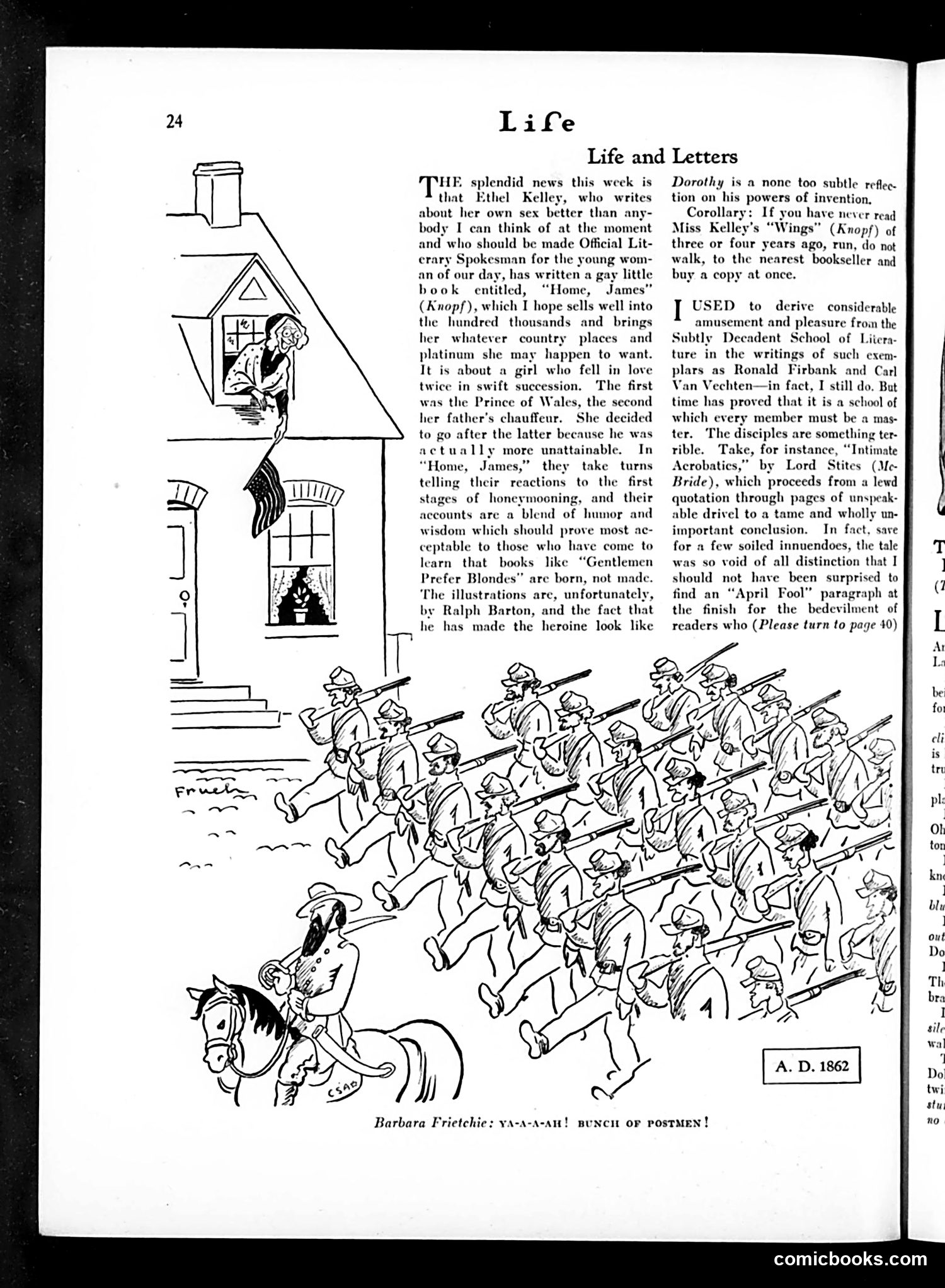
This page contains a literary column reviewing new books, topped by a cartoon illustration. The main cartoon depicts a Civil War-era scene (dated A.D. 1862) showing a mounted officer directing a large formation of soldiers with bayoneted rifles marching in formation. The caption reads "Barbara Frietchie: YA-A-A-AU! BUNCH OF POSTMEN!"—a satirical reference to John Greenleaf Whittier's famous 1863 poem "Barbara Frietchie," which glorified an elderly woman waving the American flag at Confederate troops. The cartoonist appears to mock this romanticized Civil War narrative by recontextualizing the soldiers as "postmen" (mail carriers), deflating the martial heroism through absurdist humor. The satire likely critiques overwrought patriotic literature or the gap between wartime mythology and mundane reality, though the exact satirical target remains somewhat unclear without fuller publication context.
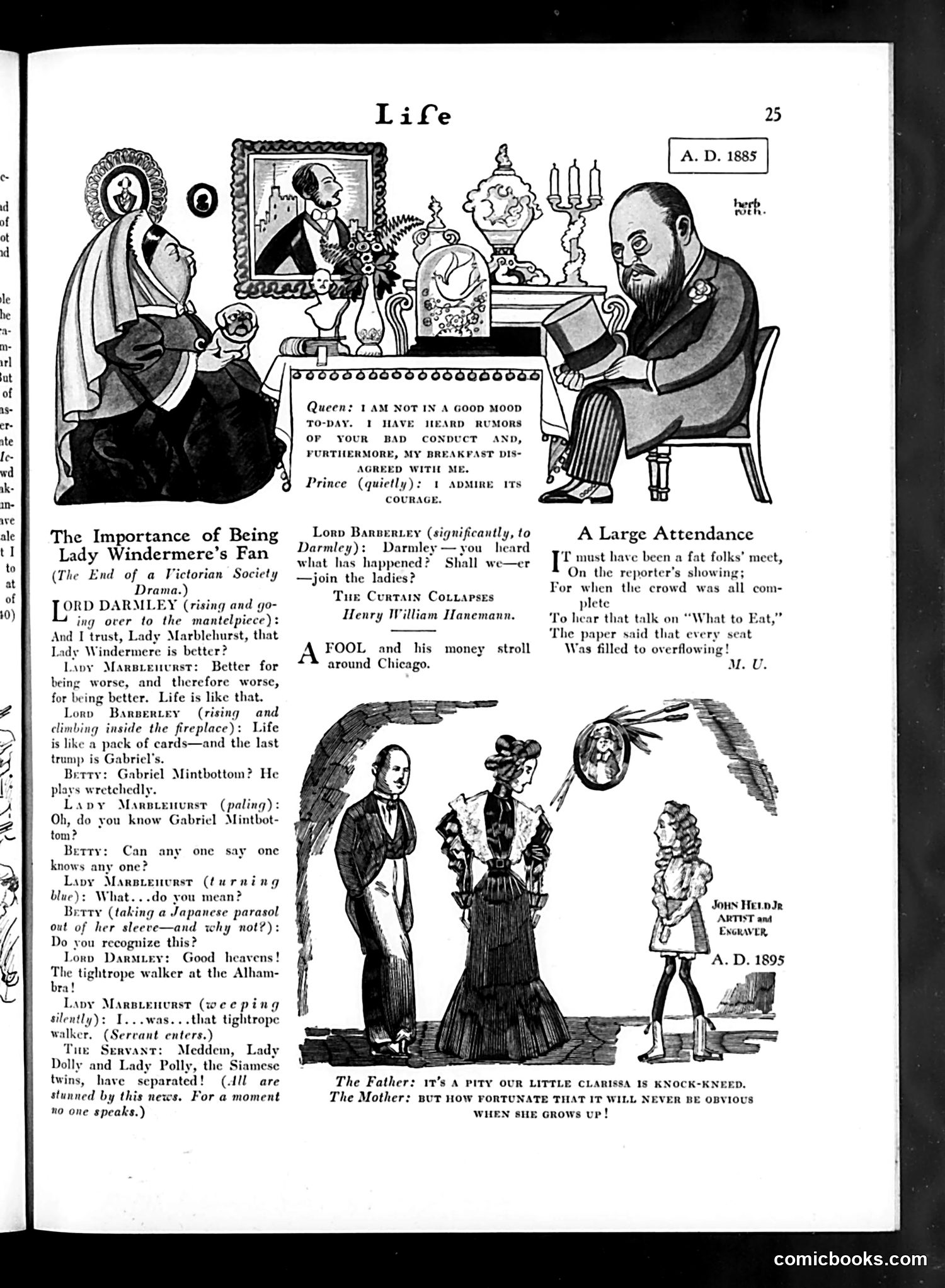
This page contains two satirical pieces from *Life* magazine (A.D. 1885/1895): **Top section**: A parody of Oscar Wilde's "Lady Windermere's Fan," a famous Victorian society play. The satire mocks the pretentious dialogue and melodramatic plot conventions of upper-class drama—characters speak in absurdly philosophical non-sequiturs ("Life is like a pack of cards"), and shocking revelations (a noblewoman was once a tightrope walker) interrupt drawing-room conversations. The humor targets Victorian theatrical clichés and social hypocrisy. **Bottom section**: Two separate short jokes. One mocks the absurdity of Victorian parental wishful thinking (parents hoping their daughter's knock-knees won't be noticed when she grows up). The other references a Chicago gathering about diet/nutrition, joking that attendance was so large the newspaper's report overstated the crowd. The cartoons reflect *Life*'s role as satirical commentary on contemporary culture, theatrical trends, and middle-class social anxieties.
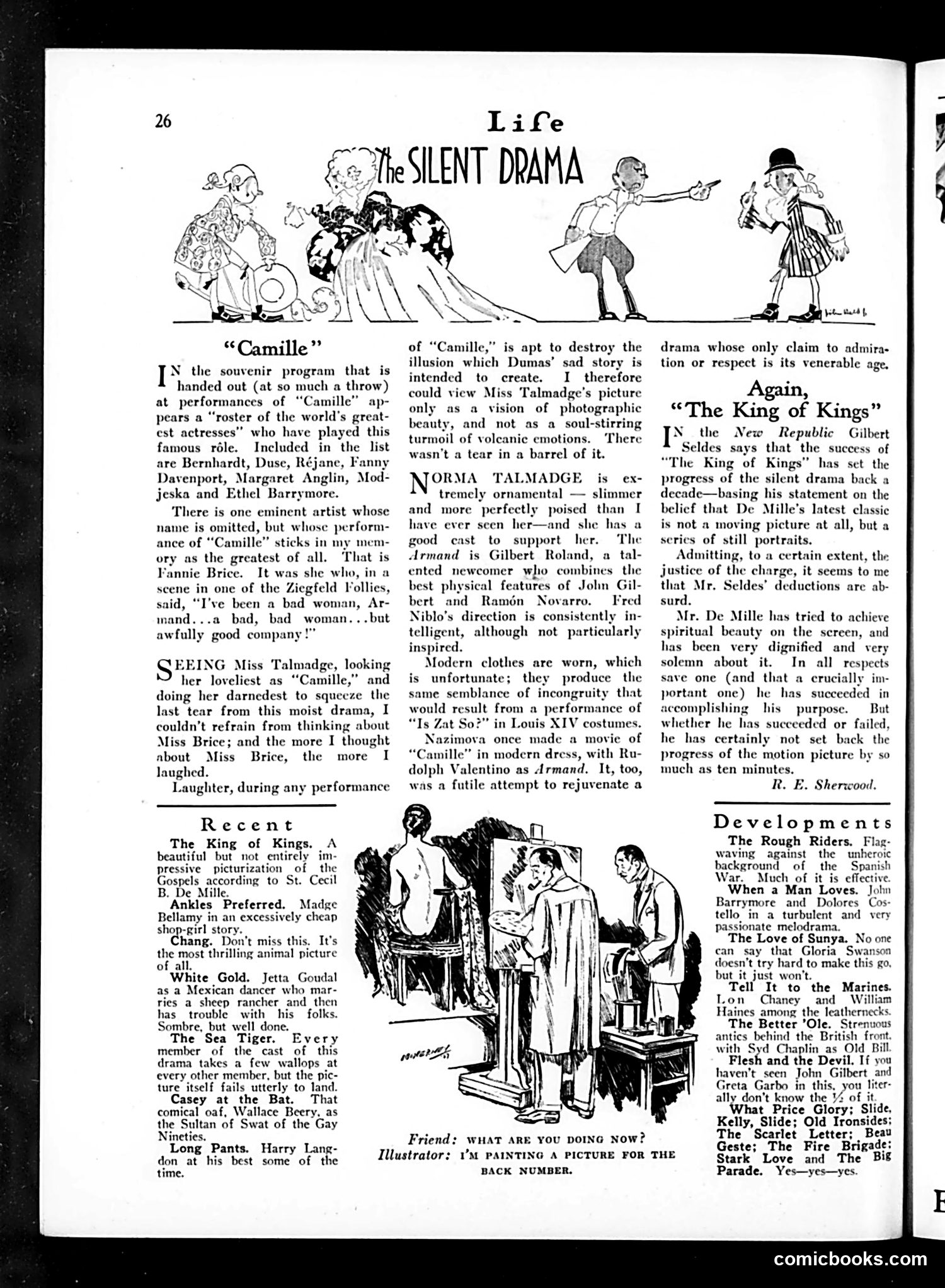
This page critiques silent films, particularly Norma Talmadge's performance in "Camille." The humor centers on a contrast: the author finds Talmadge's technical beauty and composure *prevents* emotional engagement with the melodrama. He contrasts this with Fannie Brice's comedic parody of the same role in the Ziegfeld Follies, where her deadpan delivery ("awfully good company!") actually proved more memorable and entertaining than the "serious" version. The satire targets overwrought theatrical emotion—the author argues that modern costumes and Talmadge's polished presentation undermine the story's impact. He also jokes that watching "Camille" in 1920s dress is absurd, like performing "Is Zat So?" in Louis XIV costumes. The page also reviews "The King of Kings" (De Mille's biblical epic), dismissing critical claims it harmed cinema's progress as exaggerated.
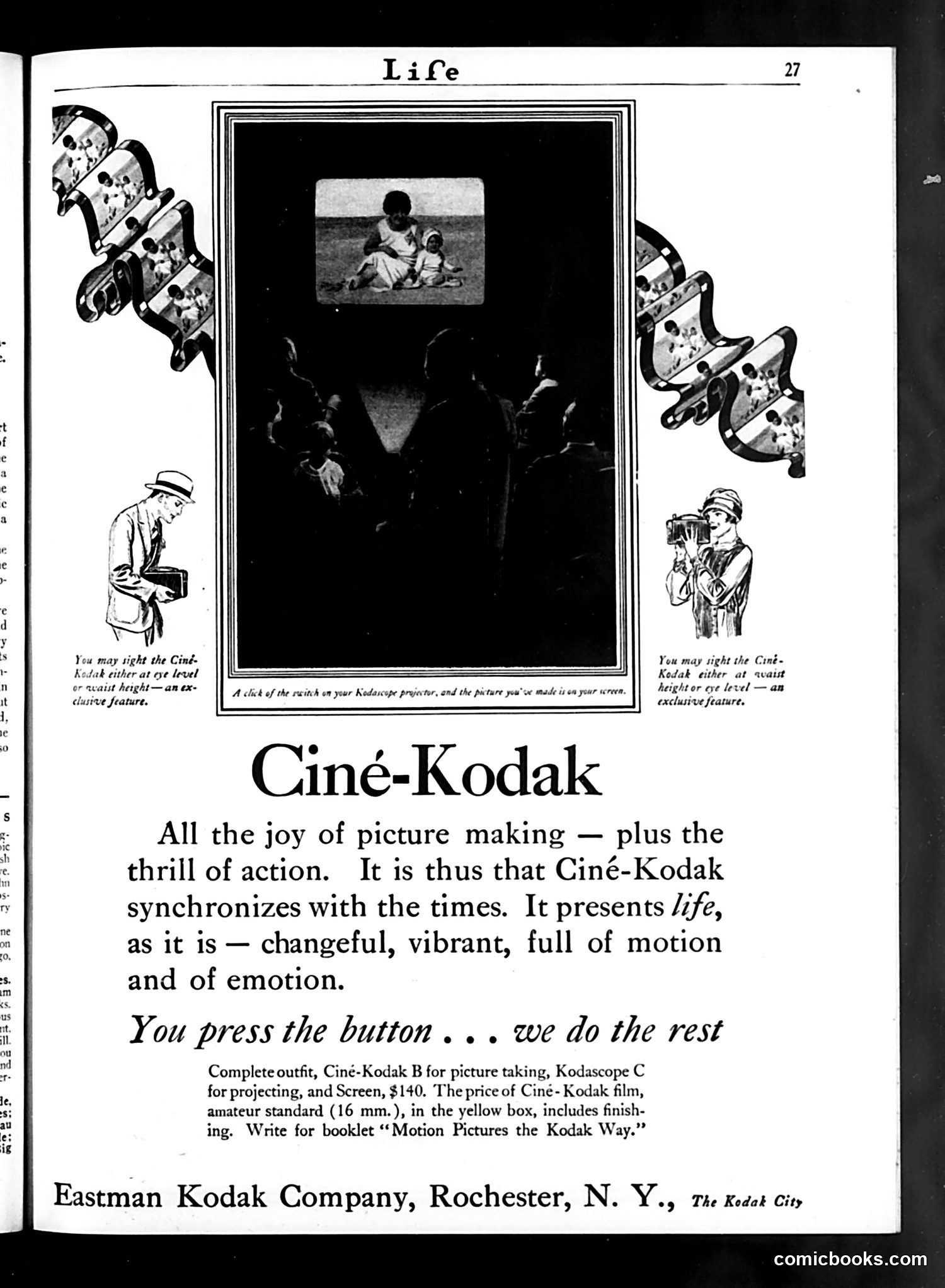
This is primarily a **product advertisement**, not political satire. The page promotes Eastman Kodak's motion picture camera system (Ciné-Kodak) to amateur users. The imagery shows silhouetted figures watching projected film on a screen—depicting the consumer experience of home movie-making. The decorative borders feature illustrated men with cameras, representing the target demographic: middle-class hobbyists. The marketing appeal emphasizes **democratization of filmmaking**: "You press the button... we do the rest" (echoing Kodak's famous slogan). The ad positions amateur cinematography as modern, exciting, and accessible—capturing "life, as it is—changeful, vibrant, full of motion." This reflects 1920s-30s consumer culture and the emerging home entertainment industry. The price ($140 complete outfit) suggests targeting affluent households. There is **no political satire** on this page—it's straightforward commercial messaging positioned within *Life* magazine's editorial content.
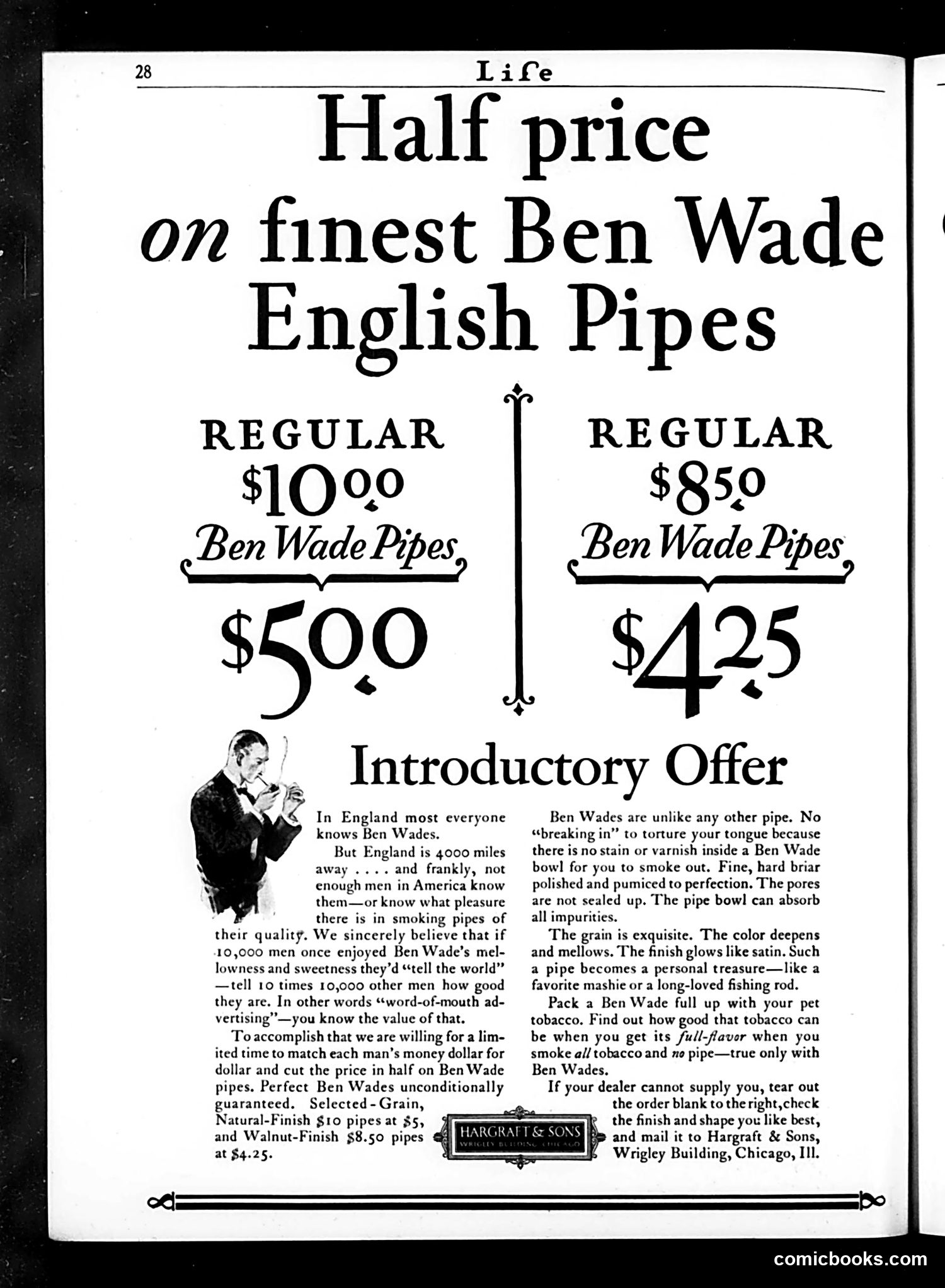
This is a **full-page advertisement**, not political satire. It promotes Ben Wade English smoking pipes during what appears to be the early 20th century. The ad uses a marketing strategy common to the era: an "introductory offer" cutting prices in half to build word-of-mouth advertising among American consumers unfamiliar with the British brand. The text explicitly states this goal—10,000 satisfied customers will tell 100,000 others. The small illustration shows a man smoking contentedly, emphasizing the pipe's quality and appeal. Key selling points highlighted: the pipes require no "breaking in," contain no varnish or stain, feature fine briar construction, and improve with age like treasured possessions (compared to a golf club or fishing rod—markers of leisure-class status). The ad addresses tobacco quality too, claiming Ben Wade pipes unlock tobacco's "full-flavor" better than competitors. This is straightforward commercial advertising, not editorial content or satire.
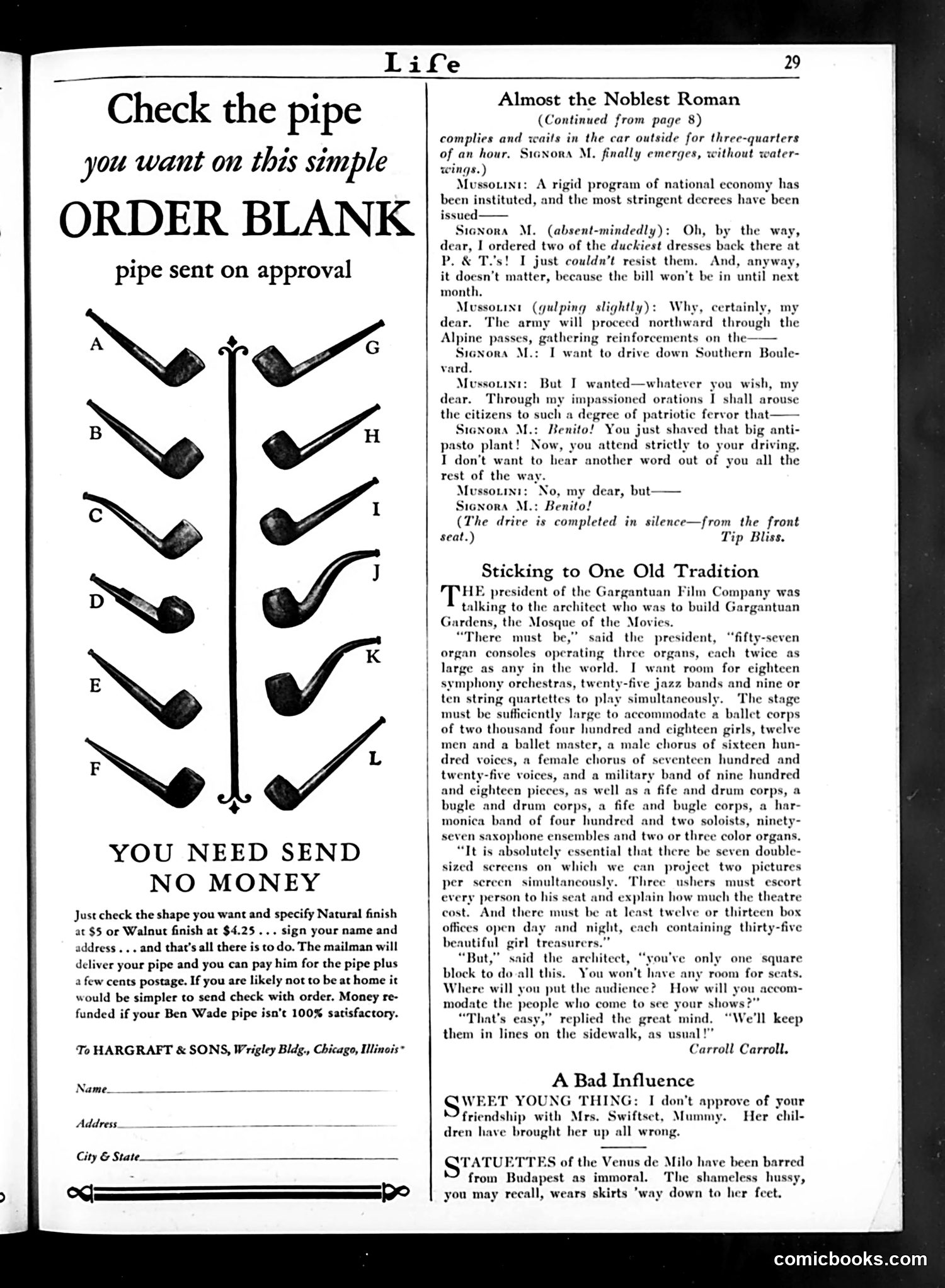
This page contains three satirical pieces mocking contemporary society: **"Almost the Noblest Roman"** (top right): A dialogue between Mussolini and Signora M. during a car ride. Mussolini grandioses about national economy decrees and arousing patriotic fervor, but Signora M. ignores him—complaining about dress purchases, demanding driving directions, and silencing him with "Benito!" The satire targets Mussolini's inflated rhetoric versus his actual powerlessness in domestic life. **"Sticking to One Old Tradition"** (center): A film executive describes absurdly extravagant theater specifications (dozens of organs, thousands of performers, multiple screens) to an architect, who finally asks how audiences fit in. The reply: they'll stand in lines outside. This satirizes Hollywood's bloated excess and indifference to actual patrons. **"A Bad Influence"** and **Venus de Milo reference** (bottom): Brief snippets mocking prudishness—one about a child corrupted by association, another about Budapest banning Venus statues as "immoral" for showing legs. The page also contains a pipe advertisement order blank (left side).
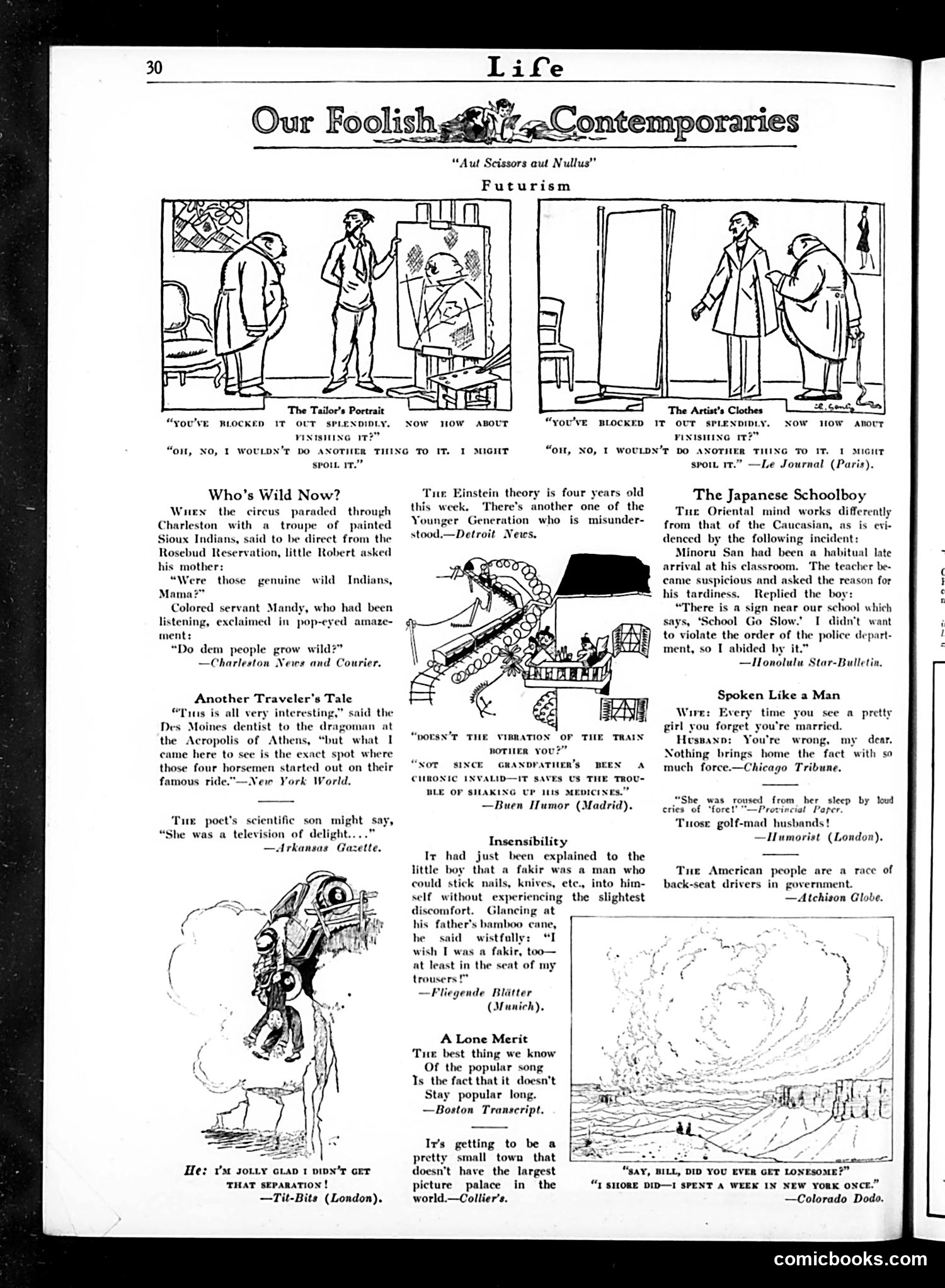
This page collects brief humorous anecdotes and quips mocking contemporary society. The top section features two Futurism cartoons satirizing avant-garde artists: a tailor and painter each insist their "blocked out" work is complete, refusing further refinement—mocking modernist art's apparent incompleteness to conventional eyes. Below are miscellaneous jokes targeting: racial attitudes (a Black servant's confusion about "wild" Indians); tourist ignorance (an American dentist seeking the "four horsemen's" departure point at Athens); Einstein's relativity theory (dismissed as incomprehensible like other youth trends); and social absurdities (a Japanese schoolboy literally obeying a "School Go Slow" traffic sign; Americans as backseat drivers in politics). The scattered items reflect *Life's* satirical mission: lampooning modern pretension, scientific bewilderment, and cultural foolishness through brevity and wit, often with casual racial humor typical of the era.
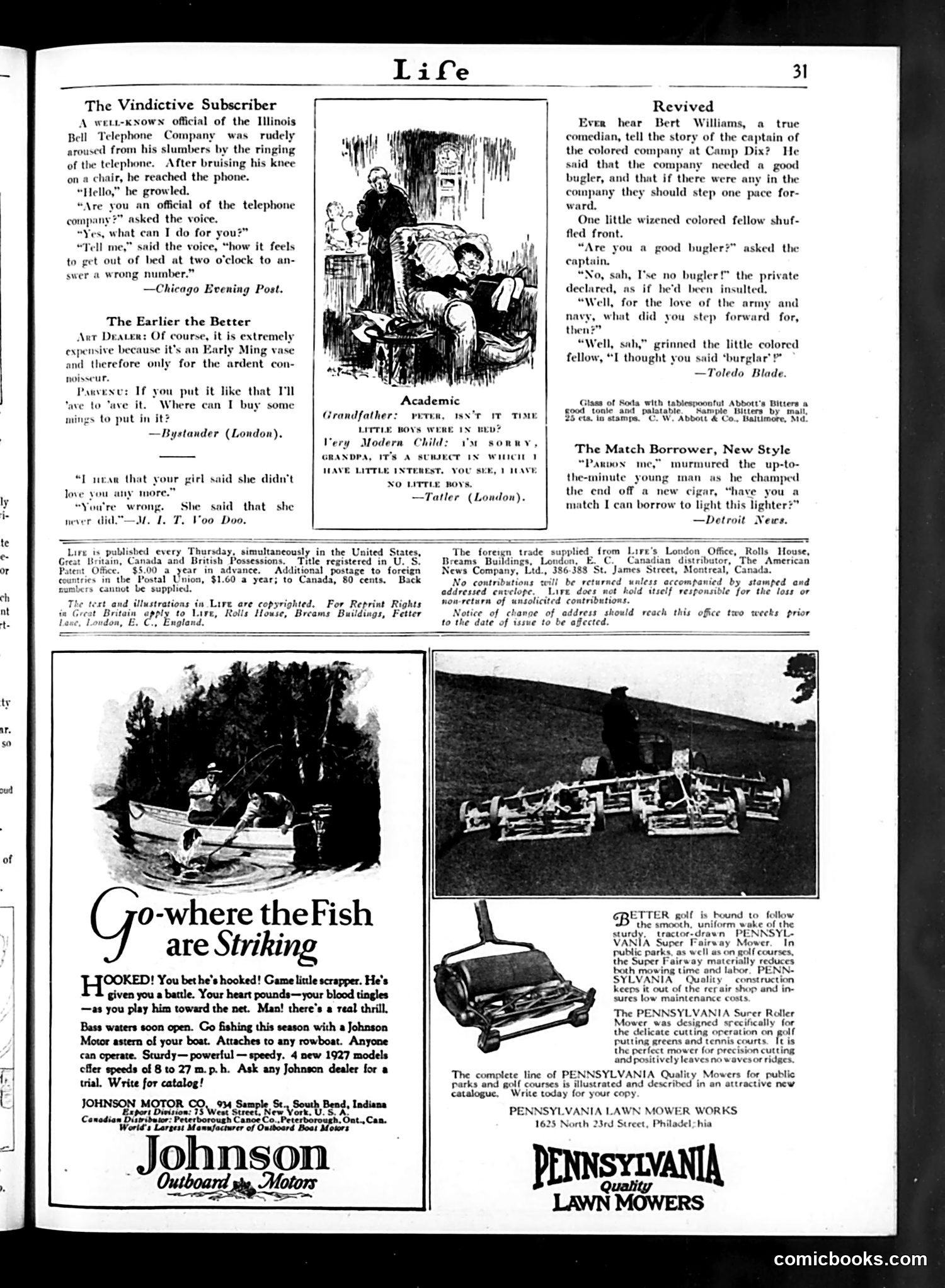
This page contains five brief humorous anecdotes and two advertisements, typical of *Life* magazine's satirical format. The cartoons mock everyday frustrations and social pretensions: 1. **"The Vindictive Subscriber"** satirizes telephone company rudeness—a telephone official is awakened at 2 a.m. by a wrong number, then gets comeuppance when the caller reveals he's calling to complain about the official's own rudeness. 2. **"The Earlier the Better"** mocks wealthy art collectors' snobbery: a dealer uses "Early Ming vase" as a selling point, and the buyer naively asks where to buy "mings" to fill it with. 3. **"Grandfather"** plays on generational differences about modern parenting. 4. **"Revived"** features Bert Williams (a famous Black comedian) telling a story about a confused soldier mishearing "bugler" as "burglar"—humor derived from dialect and misunderstanding. 5. **"The Match Borrower, New Style"** jokes about modern cigarette etiquette replacing the old practice of borrowing matches. The advertisements promote Johnson Outboard Motors and Pennsylvania Lawn Mowers, targeting leisure activities.
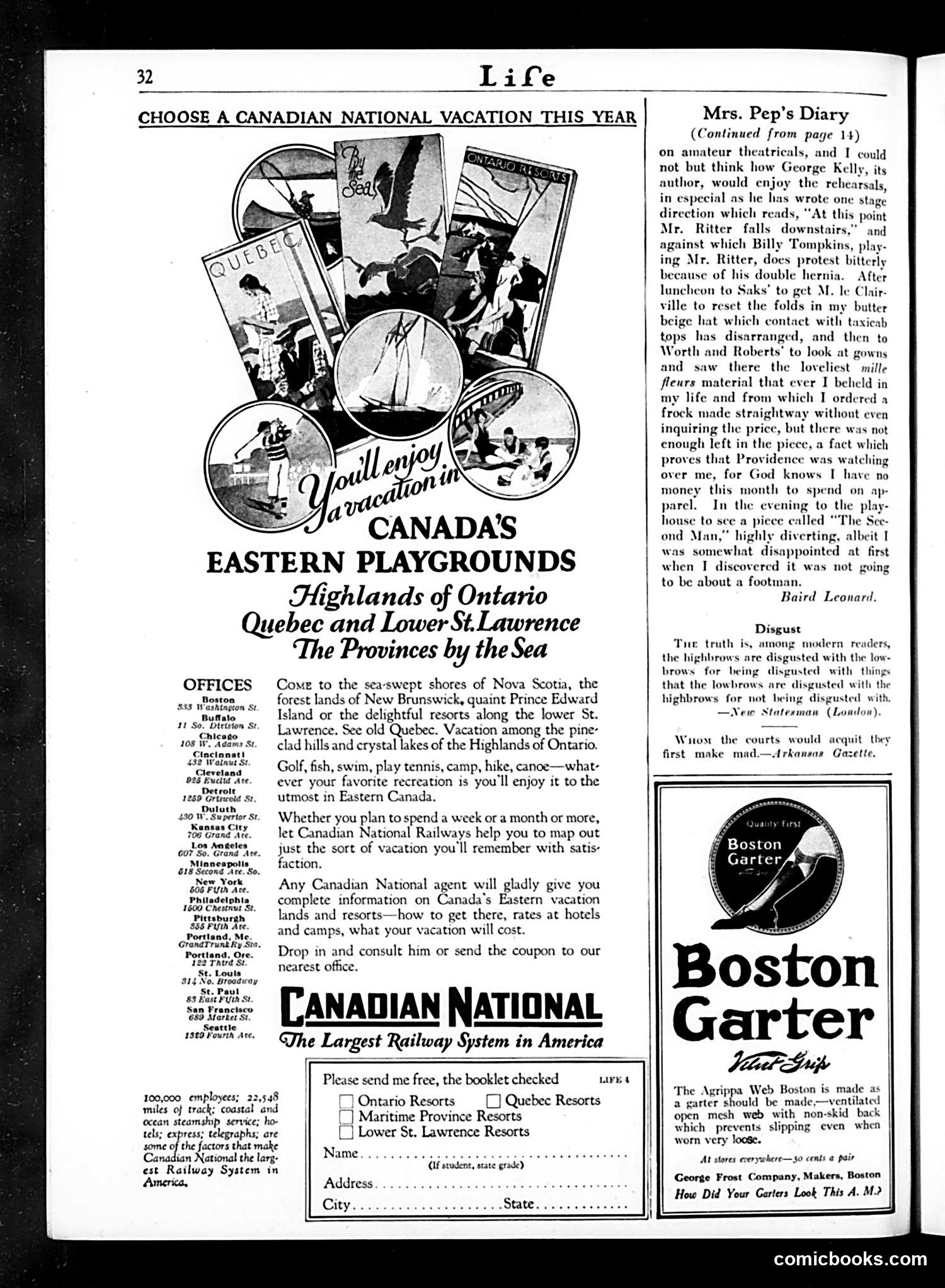
This page is primarily **advertising**, not political satire. The dominant content is a Canadian National Railways vacation advertisement featuring scenic photographs of Eastern Canada destinations (Ontario Highlands, Quebec, Maritime Provinces). The page includes two supplementary humor pieces: 1. **"Mrs. Pep's Diary"** — A satirical society column mocking wealthy women's frivolous concerns (theatrical productions, shopping at Saks and Worth, complaining about hat damage from taxicabs, impulsively buying expensive fabric despite having "no money"). 2. **"Disgust"** — A brief joke about modern intellectual hypocrisy: highbrows and lowbrows are mutually disgusted with each other's lack of disgust. Additionally, there's a **Boston Garter** advertisement promoting ventilated hosiery garters for women. The page represents typical 1920s-30s *Life* magazine content: upscale advertising mixed with light social satire aimed at wealthy, educated readers. The humor relies on recognizing brand names (Saks Fifth Avenue, Worth) and mocking upper-class pretension.
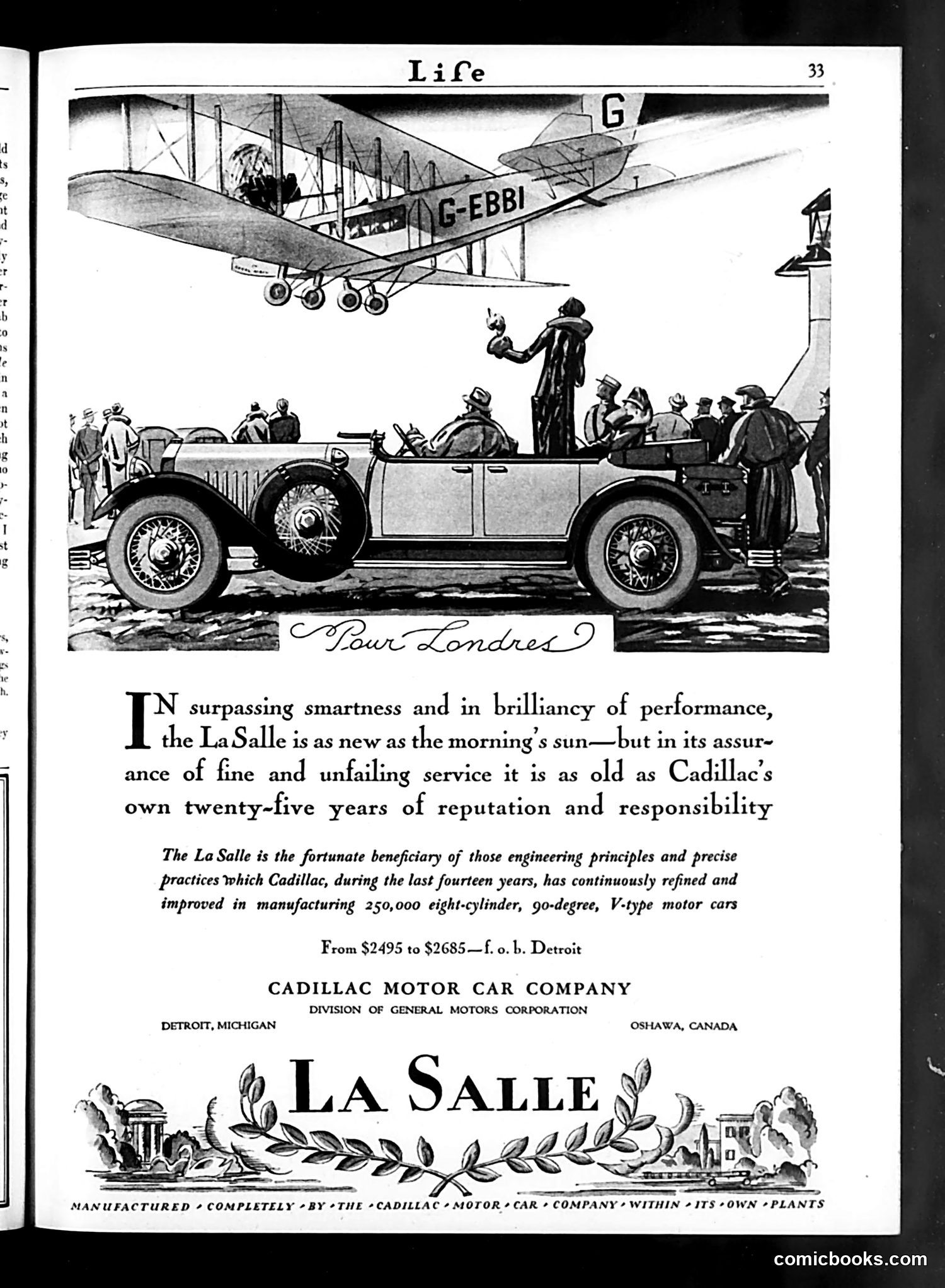
This is primarily a **Cadillac LaSalle automobile advertisement**, not political satire. The illustration depicts a luxurious 1920s open-air automobile at an airfield in London ("Pour Londres"), with well-dressed passengers and onlookers, overseen by a flying aircraft marked "G-EBBI." The ad's rhetorical strategy contrasts novelty with tradition: the LaSalle is "as new as the morning's sun" yet backed by Cadillac's "twenty-five years of reputation." The exotic London airfield setting conveys sophistication and modern luxury for a wealthy American audience. The airplane detail appears designed to emphasize cutting-edge technology and cosmopolitan aspirations—suggesting the car appeals to those who travel internationally and appreciate aviation-age innovation. There is no discernible political cartoon or satire present on this page.
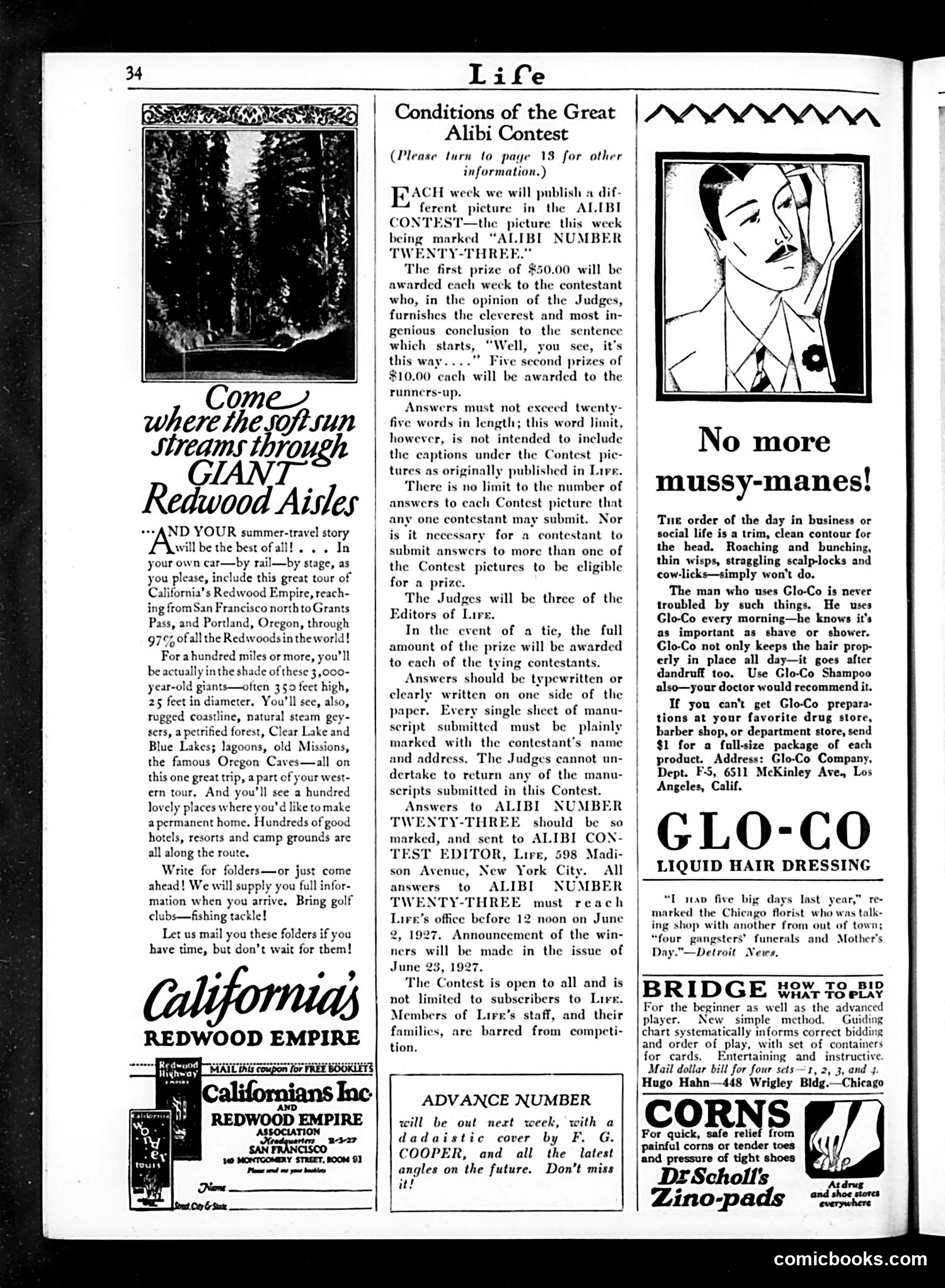
This page is primarily **advertising and contest information**, not political satire. The main content features: 1. **Redwood Empire tourism advertisement** — promoting California's giant redwoods as a summer travel destination, emphasizing their age (3,000 years old) and size (350 feet high). 2. **"Alibi Contest"** — Life's weekly humor contest where readers submit clever 25-word endings to the phrase "Well, you see, it's this way...." Winners receive $50 (first prize) or $10 (runner-up prizes). Entries due by June 2, 1927. 3. **Glo-Co hair dressing advertisement** — promoting a grooming product to eliminate "mussy" hair, dandruff, and messy styling ("roaching and bunching"). The ad reflects 1920s men's grooming standards emphasizing neat, controlled appearance. 4. **Bridge game instructions** and **Corns/Zino-pads advertisements** — typical period product placements. The page reflects 1920s consumer culture and advertising conventions rather than political commentary.
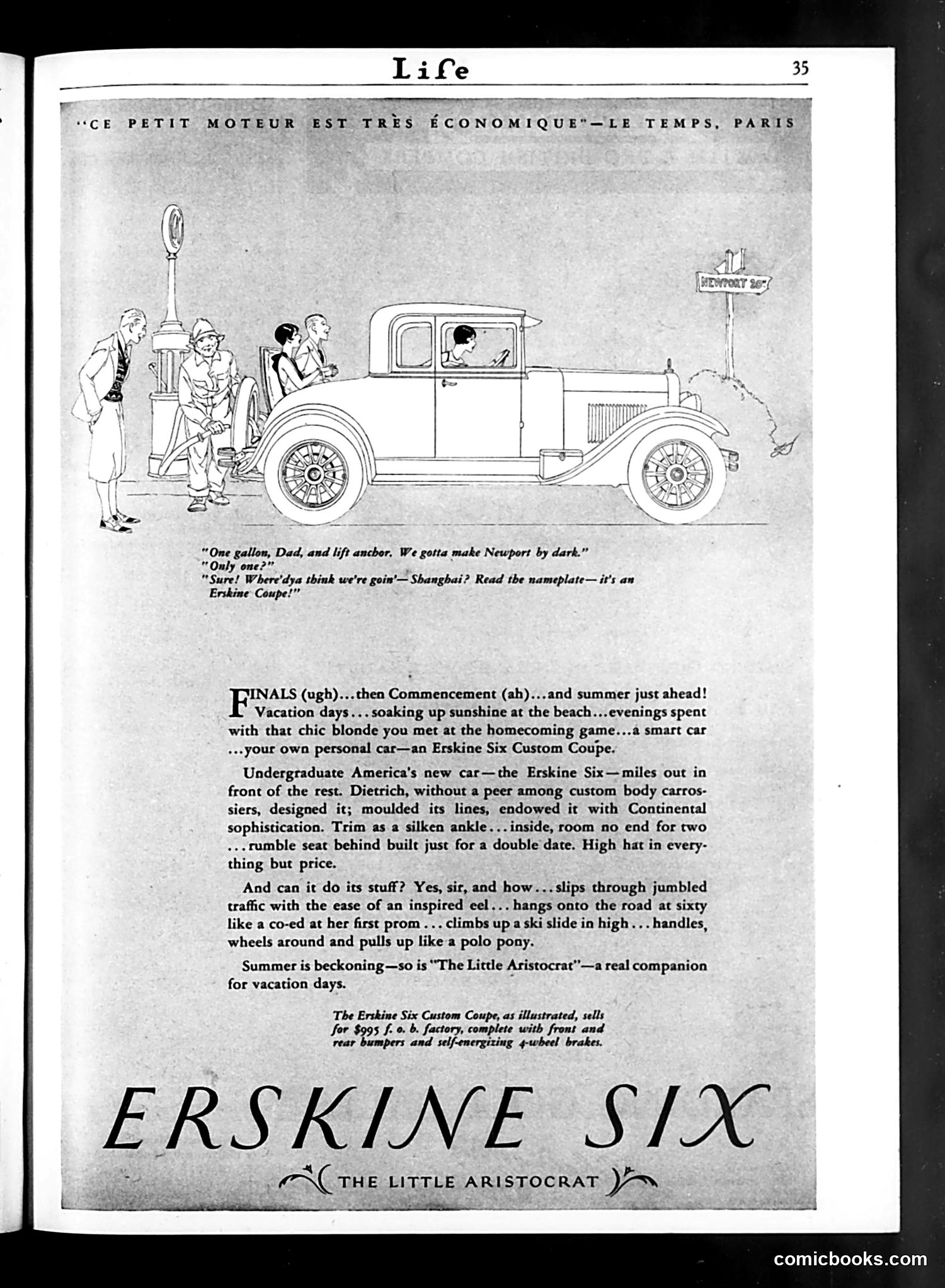
This is primarily an **automobile advertisement** for the Erskine Six, disguised as humorous editorial content. The cartoon depicts a father and son at a gas station; the son claims they can reach Newport on one gallon because they're driving an economical Erskine (the joke being the car's fuel efficiency). The advertisement targets **young, affluent men**—college graduates anticipating summer vacation, romantic dates, and leisure travel. The copy uses period slang ("chic blonde," "co-ed") and lifestyle aspirations (beach vacations, homecoming dances, polo) to market the vehicle as both practical and desirable. "The Little Aristocrat" tagline positions the $995 car as sophisticated yet affordable—a status symbol for undergraduate America. The humor relies on mild exaggeration (comparing the car's handling to a polo pony) rather than satire. This reflects 1920s auto advertising that conflated cars with social identity and romantic success.
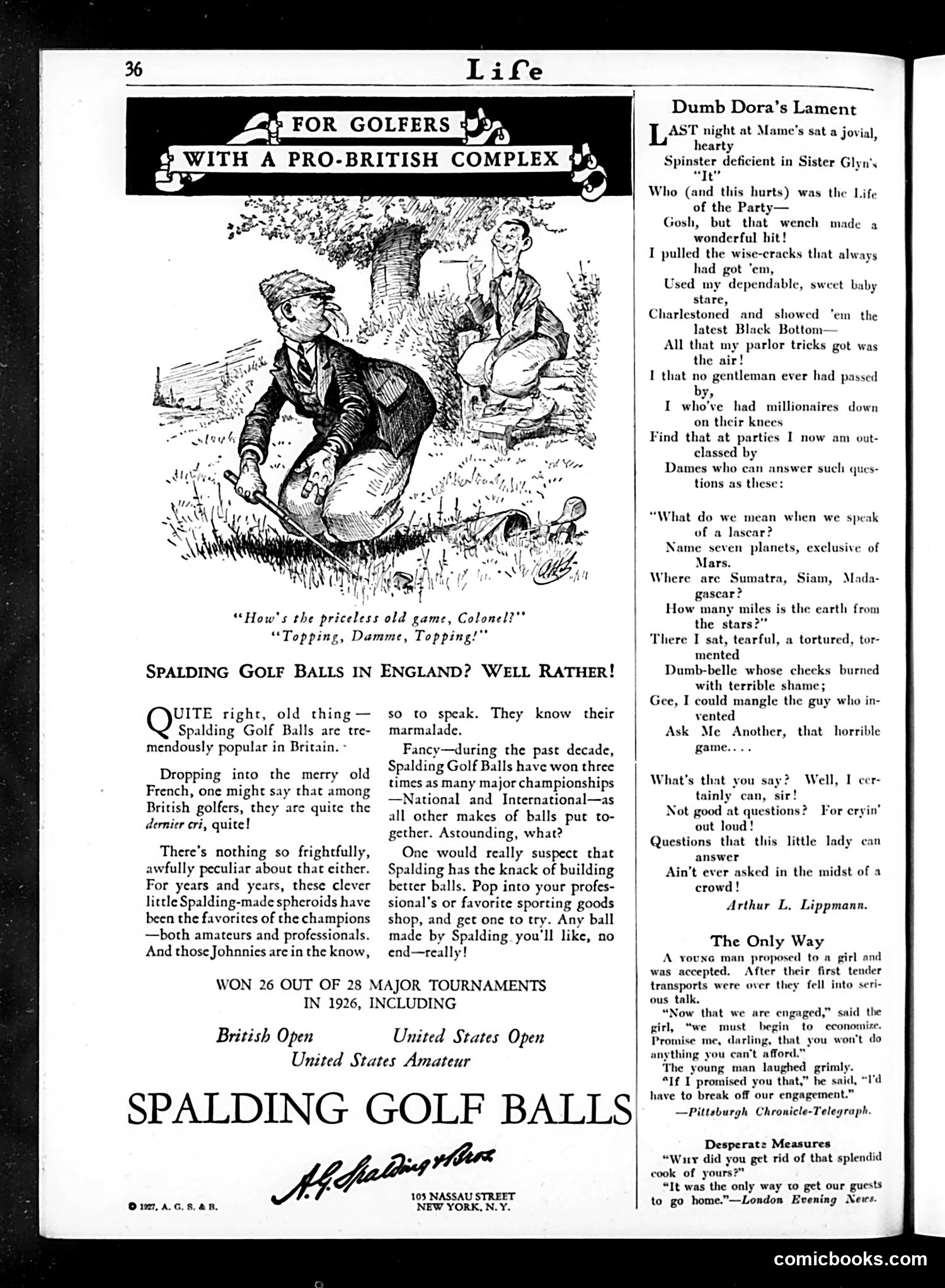
This page contains **advertising and humor columns**, not political cartoons. The main feature is a **Spalding Golf Balls advertisement** (center-left), employing British upper-class stereotypes for comedic effect. Two gentlemen in golf attire speak in exaggerated British dialect ("priceless old game, Colonel," "Topping, Damme"), mocking the pro-British affectations of American golfers. The ad emphasizes that Spalding balls dominated tournaments (26 of 28 major championships in 1926), positioning American-made products as superior despite British pretension. The right column contains **three humor pieces** unrelated to the ad: 1. **"Dumb Dora's Lament"** — A woman laments losing social status because witty women now must answer trivia questions (referencing "Ask Me Another," a popular game show), rather than relying solely on charm and flirtation. 2. **"The Only Way"** — A short joke about an engaged couple's differing views on economizing. 3. **"Desperate Measures"** — A brief anecdote about firing a cook to discourage guests. The satire targets changing social dynamics (women's education) and marriage economics.
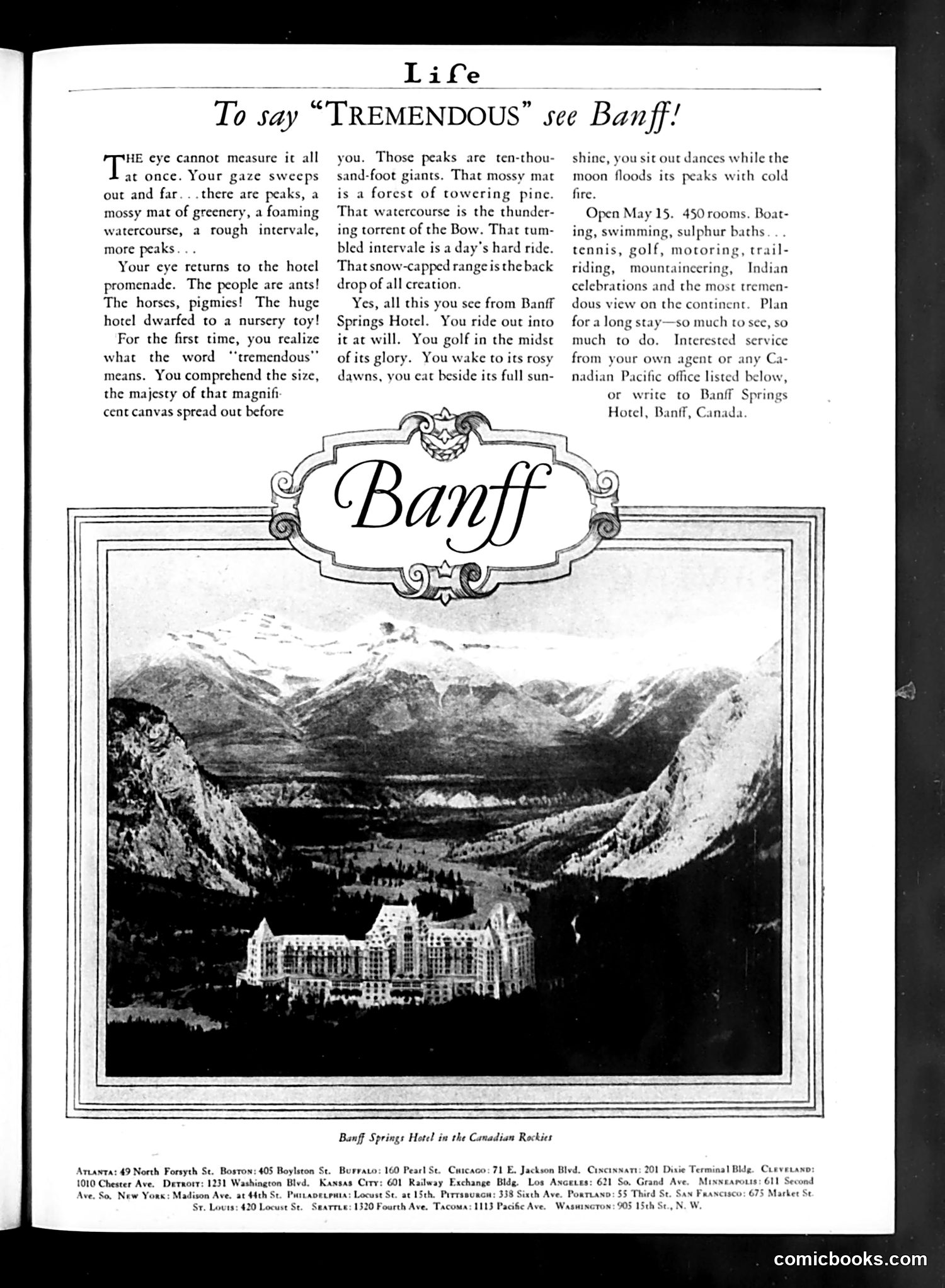
This page is primarily a **hotel advertisement**, not political satire or a cartoon. It promotes Banff Springs Hotel in the Canadian Rockies. The text uses vivid descriptive language to convey the overwhelming scale of the mountain landscape—peaks described as "ten-thousand-foot giants," forests, and waterfalls. The rhetorical device compares human visitors to "ants" and "pigmies" against the landscape, emphasizing nature's grandeur. The advertisement emphasizes leisure activities (golf, boating, swimming, dancing) available to wealthy tourists, positioning the hotel as a destination where guests can experience both the "tremendous" wilderness and comfortable modern amenities. The phrase "tremendous" anchors the sales pitch—visitors will finally understand what the word truly means upon seeing these vistas. The extensive list of North American office locations indicates this was a major national advertising campaign by the Canadian Pacific Railway's hotel division, targeting affluent American travelers seeking prestige vacation experiences during the early 20th century.
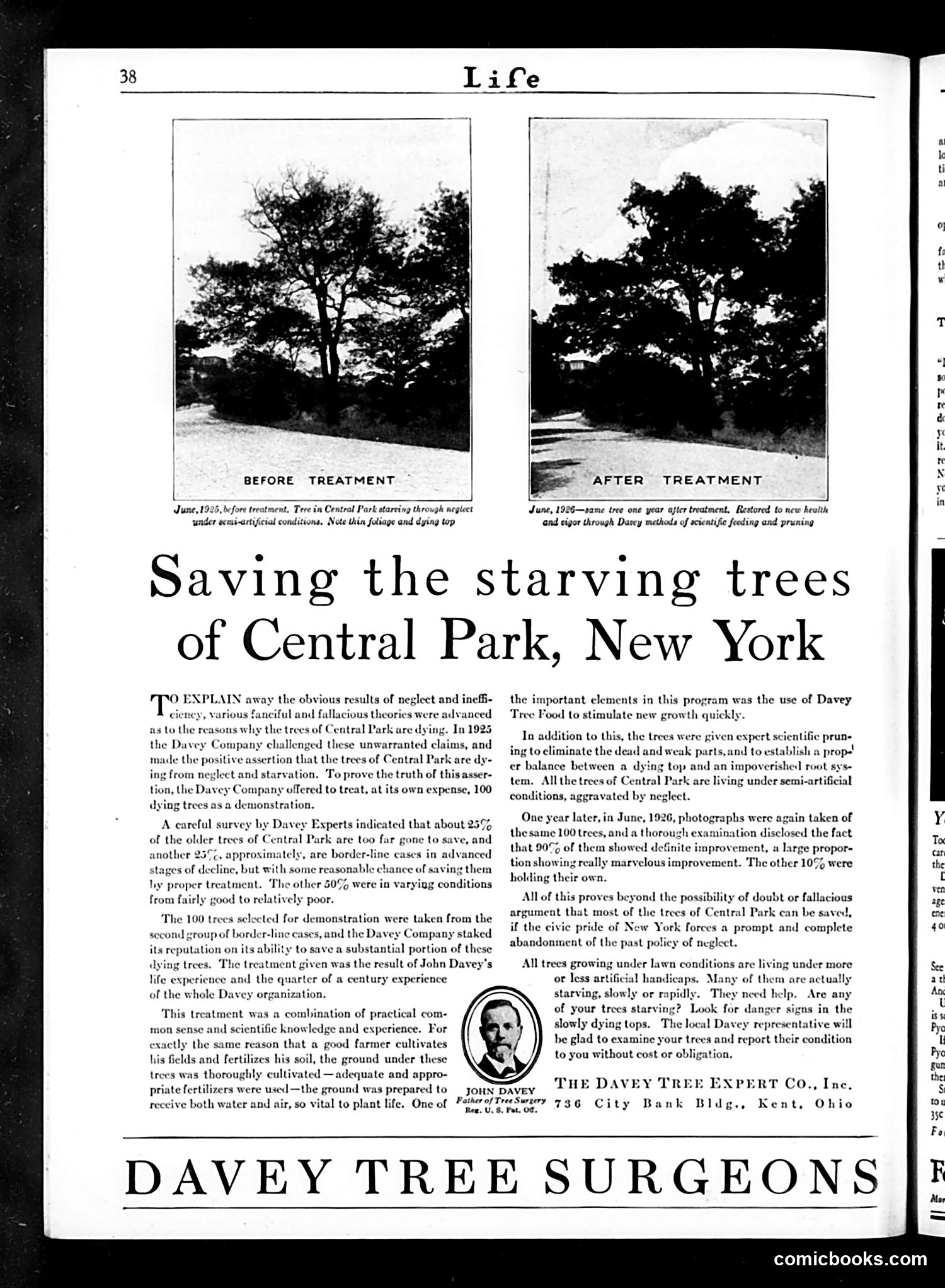
This is **not satire or a cartoon**—it's a full-page advertisement disguised as a public service article. The Davey Tree Company used *Life* magazine to present a case study proving their tree treatment methods work. The "before/after" photographs show Central Park trees in 1925 (neglected, sparse foliage) versus 1926 (restored, full canopy). The company treated 100 declining trees at their own expense as a demonstration. The results claimed 90% showed improvement. The appeal targets civic pride: New York's iconic park was visibly dying from neglect and poor urban conditions. The Davey Company positions themselves as scientific experts (invoking founder John Davey's experience) who understand trees need cultivation, fertilizer, pruning, and their proprietary "Davey Tree Food"—just like farming. This is essentially early-20th-century corporate marketing disguised as journalism, leveraging a recognizable public space and environmental concern to advertise commercial tree care services.
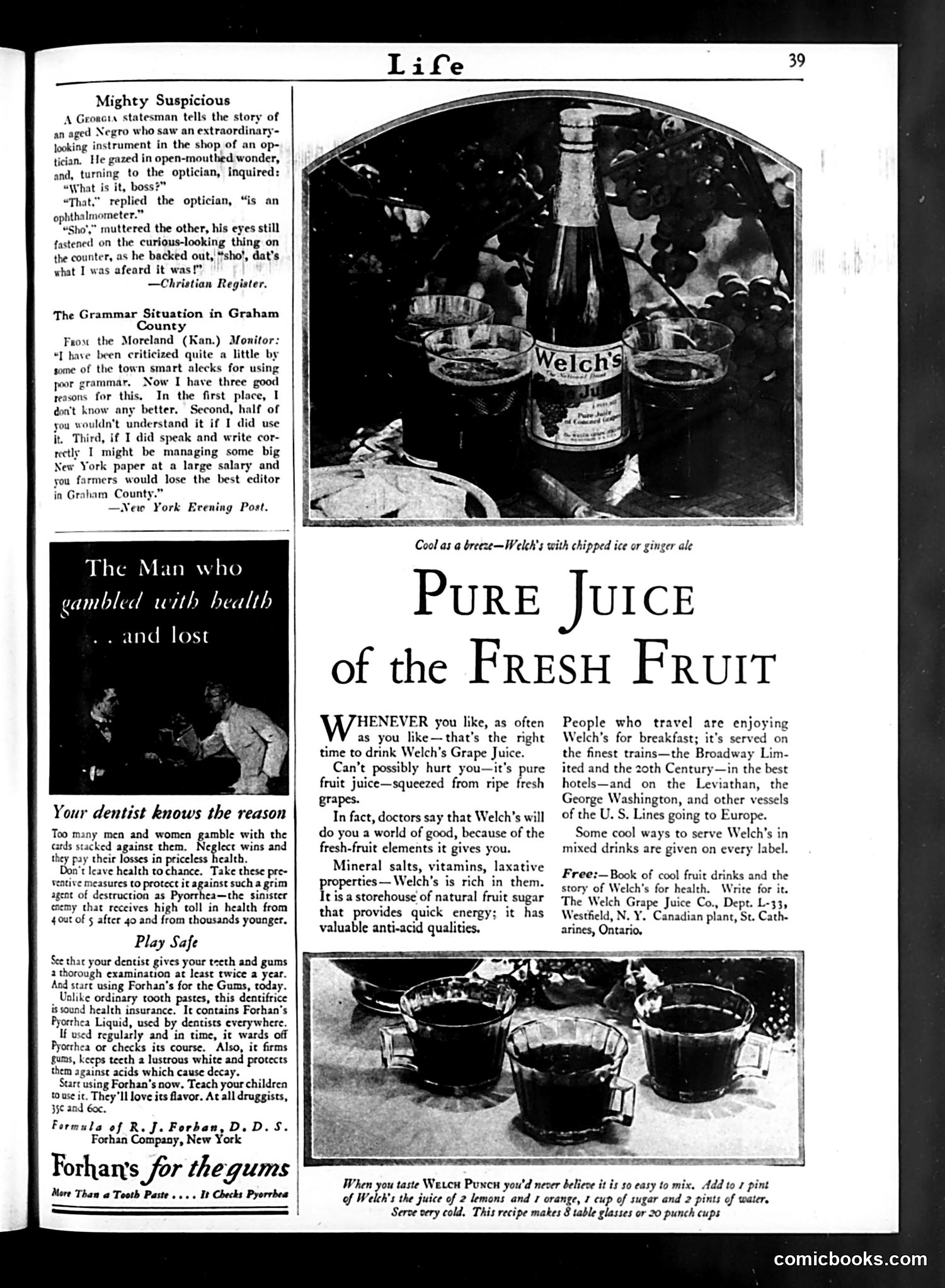
This page contains three brief humorous anecdotes and two product advertisements—typical of *Life* magazine's format during this era. **"Mighty Suspicious"** presents a racist dialect joke about an elderly Black man encountering an ophthalmometer (eye-testing device) in an optician's shop. The humor relies on stereotypical speech patterns and the implication that the man fears the unfamiliar instrument, backing away in alarm. **"Grammar Situation in Graham County"** satirizes a newspaper editor's deliberately poor grammar. Rather than apologize, he justifies it through three reasons: ignorance, audience incomprehension, and self-interest (good grammar might earn him a better job in New York). The advertisements promote Forhan's toothpaste (emphasizing gum disease prevention) and Welch's Grape Juice (marketed as healthful, endorsing its availability on luxury trains and ocean liners). Both ads employ health-based appeals common to 1920s marketing. The page reflects period attitudes: casual racial stereotyping in humor, anti-intellectual rural self-deprecation, and the medicalization of consumer products.
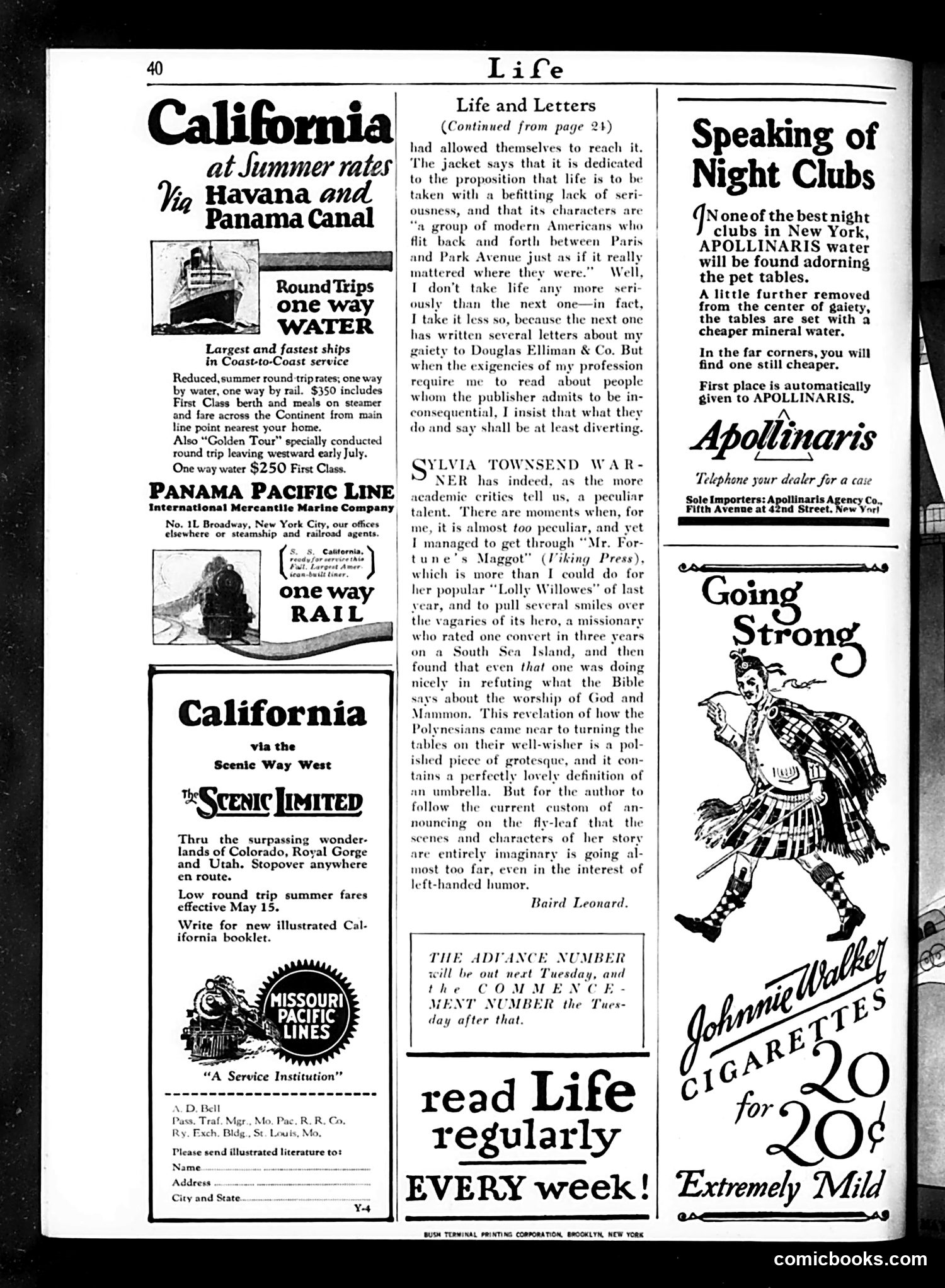
This is primarily an **advertising page** with a book review section. The main content is travel and commercial ads for California routes (steamship, rail), with one substantial book review by "Baird Leonard." The review discusses **Sylvia Townsend Warner's novel "Mr. Fortune's Maggot"** (Viking Press). Leonard praises Warner's peculiar talent but notes the book is "almost too peculiar"—he struggled through it despite finding moments of humor, particularly regarding a missionary character who converts one person in three years on a South Sea island. Leonard satirizes Warner's fly-leaf claim that characters are "entirely imaginary," suggesting this disclaimer goes too far "even in the interest of left-handed humor." The page also contains ads for **Johnnie Walker cigarettes** (20 for 20¢, "Extremely Mild") and **Apollinaris mineral water**, which humorously suggests the brand's status symbol positioning—appearing on "pet tables" at fashionable nightclubs while cheaper mineral waters grace less prestigious venues.