
Life, 1927-05-19 · page 20 of 42
Life — May 19, 1927 — page 20: what you’re looking at
What you’re looking at
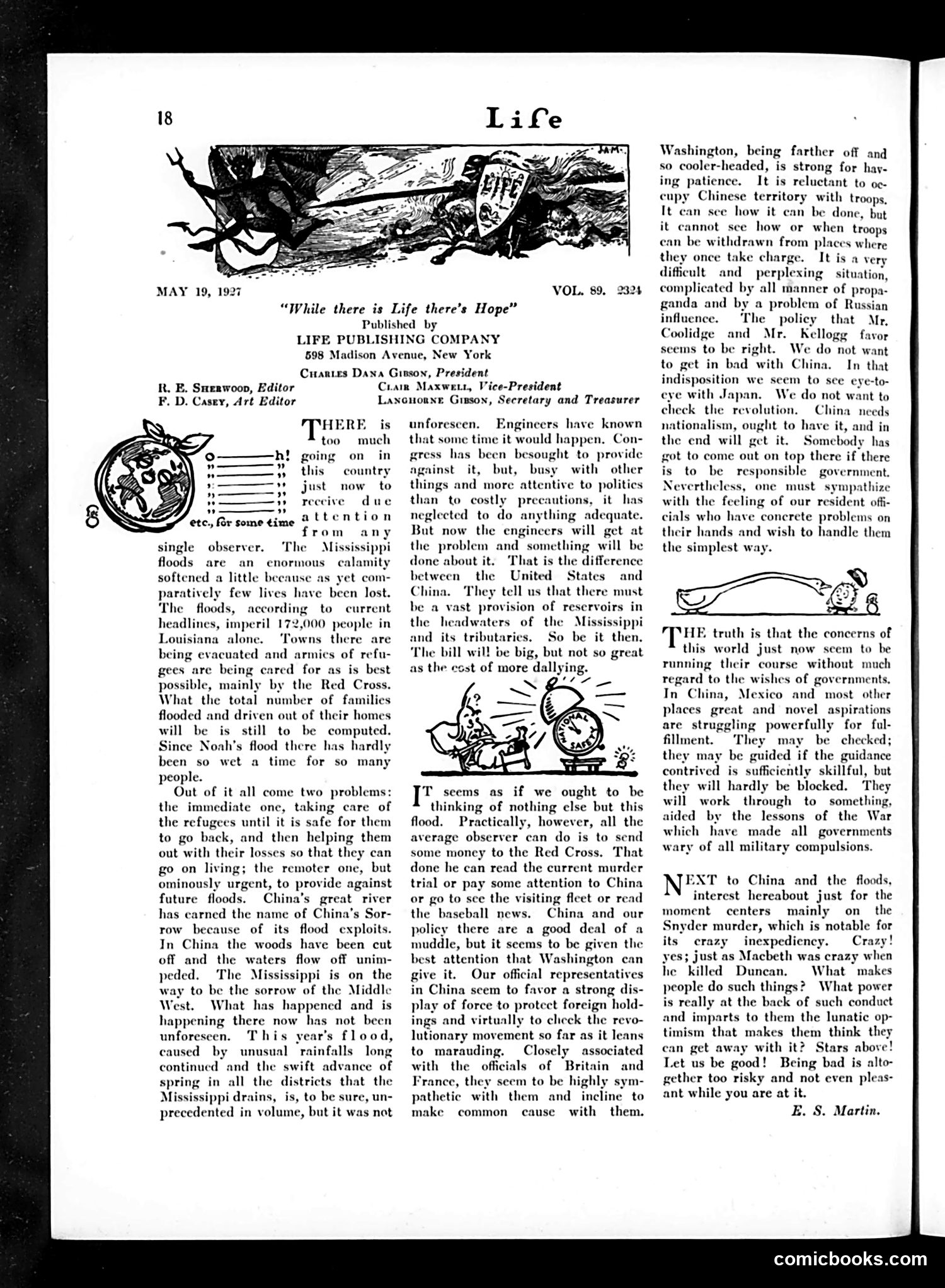
This editorial page addresses America's simultaneous crises: the catastrophic Mississippi River floods (imperil 172,000 in Louisiana) and confusing U.S. policy toward China during its political turmoil. **The floods argument**: Congress neglected preventative infrastructure despite engineers' warnings. Now action is imperative—though expensive. **The China problem**: The U.S. faces a complex situation with Revolutionary movement, foreign interests, and Russian influence. The page criticizes Britain and France's military interventionism while noting President Coolidge's more cautious, patient approach—reluctant to occupy Chinese territory militarily, yet uncertain how troops would ever withdraw once deployed. The cartoon's central clock references the competition for American attention: citizens can't focus on everything simultaneously. The broader point: ordinary Americans can only send Red Cross donations while newspapers distract with murder trials and baseball, leaving complex policy decisions to distant officials.
📄 Transcribed text from this page (OCR, searchable)
Machine-transcribed from the original scan — historical spelling and the odd misread are preserved.
MAY 19, 1927 VOL. 89, 2324 “While there is Life there’s Hope” Published by LIFE PUBLISHING COMPANY 6598 Madison Avenue, New York Cuantes Dana Ginson, President R. E. Suerwoon, Editor F. D. Casey, Art Editor HERE. is too much h! going on in 2}, this country ’ =" just now to ” ” . receive due attention from any The Mississippi floods are an enormous calamity softened le because as yet com- paratively few lives have been lost. The floods, according to current headlines, imperil 172,000 people in Louisiana alone. ‘Towns there are being evacuated and armies of refu- gees are being cared for as is best possible, mainly by the Red Cro: What the total number of families flooded and driven out of their homes will be is still to be computed. Since Noah's flood there has hardly been so wet a time for so many people. Out of it all come two problems: the immediate onc, taking care of the refugees until it is safe for them to go back, and then helping them out with their losses so that they can go on living; the remoter one, but ominously urgent, to provide against future floods. China’s great river has carned the name of China’s Sor- row because of its flood exploits. In China the woods have been cut off and the waters flow off unim- peded. The Mississippi is on the way to be the sorrow of the Middle West. What has happened and is happening there now has not been unforeseen. This year’s flood, caused by unusual rainfalls long continued and the swift advance of spring in all the districts that the Mississippi drains, is, to be sure, un- precedented in volume, but it was not ” ” ” ” etc., fer some time single observer. Cram Maxwett, Vice-President Laxcuonxe Ginson, Secretary and Treasurer unforescen. Engineers have known that some time it would happen. Con- gress has been besought to provide against it, but, busy with other things and more attentive to polities than to costly precautions, it has neglected to do anything adequate. But now the engineers will get at the problem and something will be done about it. That is the difference between the United States and China. They tell us that there must be a vast provision of reservoirs in the headwaters of the Mississippi and its tributaries, So be it then, The bill will be big, but not so great as the esst of more dallying. T seems as if we ought to be thinking of nothing else but this flood. Practically, however, all the average observer can do is to send some money to the Red Cross. That done he can read the current murder trial or pay some attention to China or go to sce the visiting fleet or read the baseball news. China and our policy there are a good deal of a muddle, but it seems to be given the best attention that Washington can give it. Our official representatives in China scem to favor a strong dis- play of force to protect foreign hold- ings and virtually to check the revo- lutionary movement so far as it leans to marauding. Closely associated with the officials of Britain and France, they seem to be highly sym- pathetic with them and incline to make common cause with them. Washington, being farther off and so cooler-headed, is strong for hay- ing patience. It is reluctant to oc- cupy Chinese territory with troops, It can see how it can be done, but it cannot see how or when troops can be withdrawn from places where they once take charge. It is a very difficult. and perplexing situation, complicated by all manner of propa- ganda and by a problem of Russian influe The policy that Mr, Coolidge and Mr. Kellogg favor seems to be right. We do not want to get in bad with China. In that indisposition we seem to see eye eye with Japan. We do not check the revolution. Chi nationalism, ought to have it, and in the end will get it. Somebody has got to come out on top there if there government, ‘less, one must sympathize ling of our resident offi- ls who have concrete problems on their hands and wish to handle them the simplest way. be responsible THE truth is that the concerns of this world just now seem to be running their course without much regard to the wishes of governments, In China, Mexico and most other places great and novel aspirations are struggling powerfully for ful- fillment. They may be checked; they may be guided if the guidance contrived is sufficiently skillful, but they will hardly be blocked. They will work through to something, aided by the lessons of the War which have made all governments ary of all military compulsions. NEST to China and the floods, interest hereabout just for the moment centers mainly on the Snyder murder, which is notable for its crazy inexpediency. Crazy! yes; just as Macbeth was crazy when he killed Duncan, What makes people do such things? What power is really at the back of such conduct and imparts to them the lunatic op- timism that makes them think they can get away with it? Stars above! Let us be good! Being bad is alto- gether too risky and not even pleas- ant while you are at it. E. S. Martin. comicbooks.com