
Life, 1927-05-19 · page 26 of 42
Life — May 19, 1927 — page 26: what you’re looking at
What you’re looking at
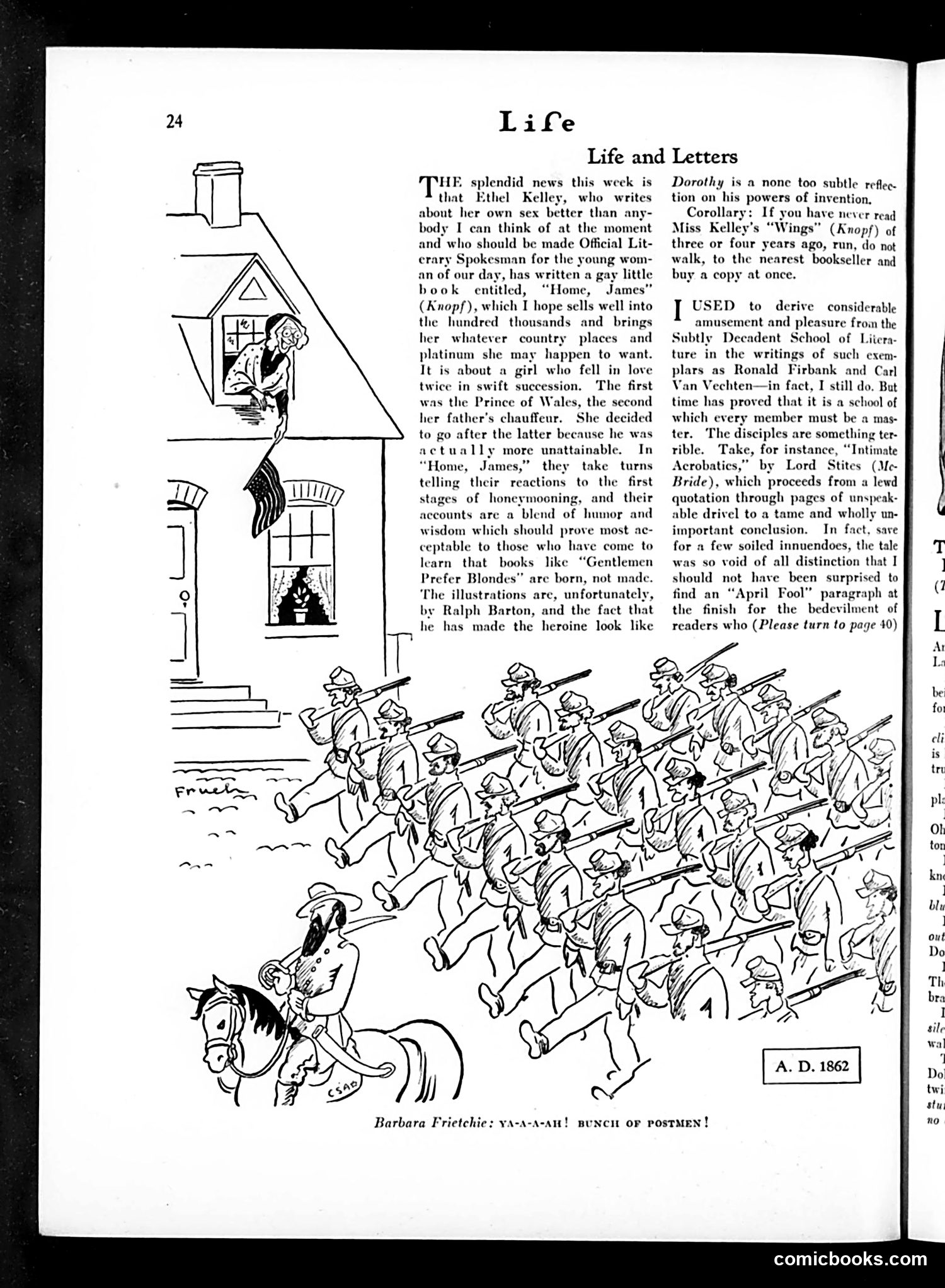
This page contains a literary column reviewing new books, topped by a cartoon illustration. The main cartoon depicts a Civil War-era scene (dated A.D. 1862) showing a mounted officer directing a large formation of soldiers with bayoneted rifles marching in formation. The caption reads "Barbara Frietchie: YA-A-A-AU! BUNCH OF POSTMEN!"—a satirical reference to John Greenleaf Whittier's famous 1863 poem "Barbara Frietchie," which glorified an elderly woman waving the American flag at Confederate troops. The cartoonist appears to mock this romanticized Civil War narrative by recontextualizing the soldiers as "postmen" (mail carriers), deflating the martial heroism through absurdist humor. The satire likely critiques overwrought patriotic literature or the gap between wartime mythology and mundane reality, though the exact satirical target remains somewhat unclear without fuller publication context.
📄 Transcribed text from this page (OCR, searchable)
Machine-transcribed from the original scan — historical spelling and the odd misread are preserved.
Life Life and Letters HE, splendid news this week is that Ethel Kelley, who writes about her own sex better than any- body I can think of at the moment and who should be made Official Lit- crary Spokesman for the young wom- an of our day, has written a gay little book entitled, “Home, (Knopf), which I hope sells well into the hundred thousands and her whatever country places and platinum she may happen to want. It is about a girl who fell in love twice in swift succession. The first was the Prince of Wales, the second her father’s chauffeur. She decided to go after the latter because he was aetually more unattainable. In “Home, James,” they take turns telling their reactions to the first stages of honeymooning, and their accounts are a blend of humor and wisdom which should prove most ac- ceptable to those who have come to learn that books like “Gentlemen Prefer Blondes” are born, not made. ‘The illustrations are, unfortunately, by Ralph Barton, and the fact that he has made the heroine look like Dorothy is a none too subtle reflec tion on his powers of invention, Corollary: If you have never read Miss Kelley’s “Wings” (Knopf) of three or four years ago, run, do not walk, to the nearest bookseller and buy a copy at once. USED to derive considerable amusement and pleasure from the Subtly Decadent School of Liicra- ture in the writings of such exem- plars as Ronald Firbank and Carl Van Vechten—in fact, I still do. But time has proved that it is a school of which every member must be a mas- ter. The disciples are something ter- rible. Take, for instance, “Intimate Acrobatics,” by Lord Stites (Me- Bride), which proceeds from a lewd quotation through pages of unspeak- able drivel to a tame and wholly un- important conclusion. In fact, save for a few soiled innuendoes, the tale was so void of all distinction that I should not have been surprised to find an “April Fool” paragraph at the finish for the bedevilment of readers who (Please turn to page 40) Barbara Frietchie: ya-a-A-au! BUNCH OF POSTMEN ! comicbooks.com