
Life, 1927-05-19 · page 28 of 42
Life — May 19, 1927 — page 28: what you’re looking at
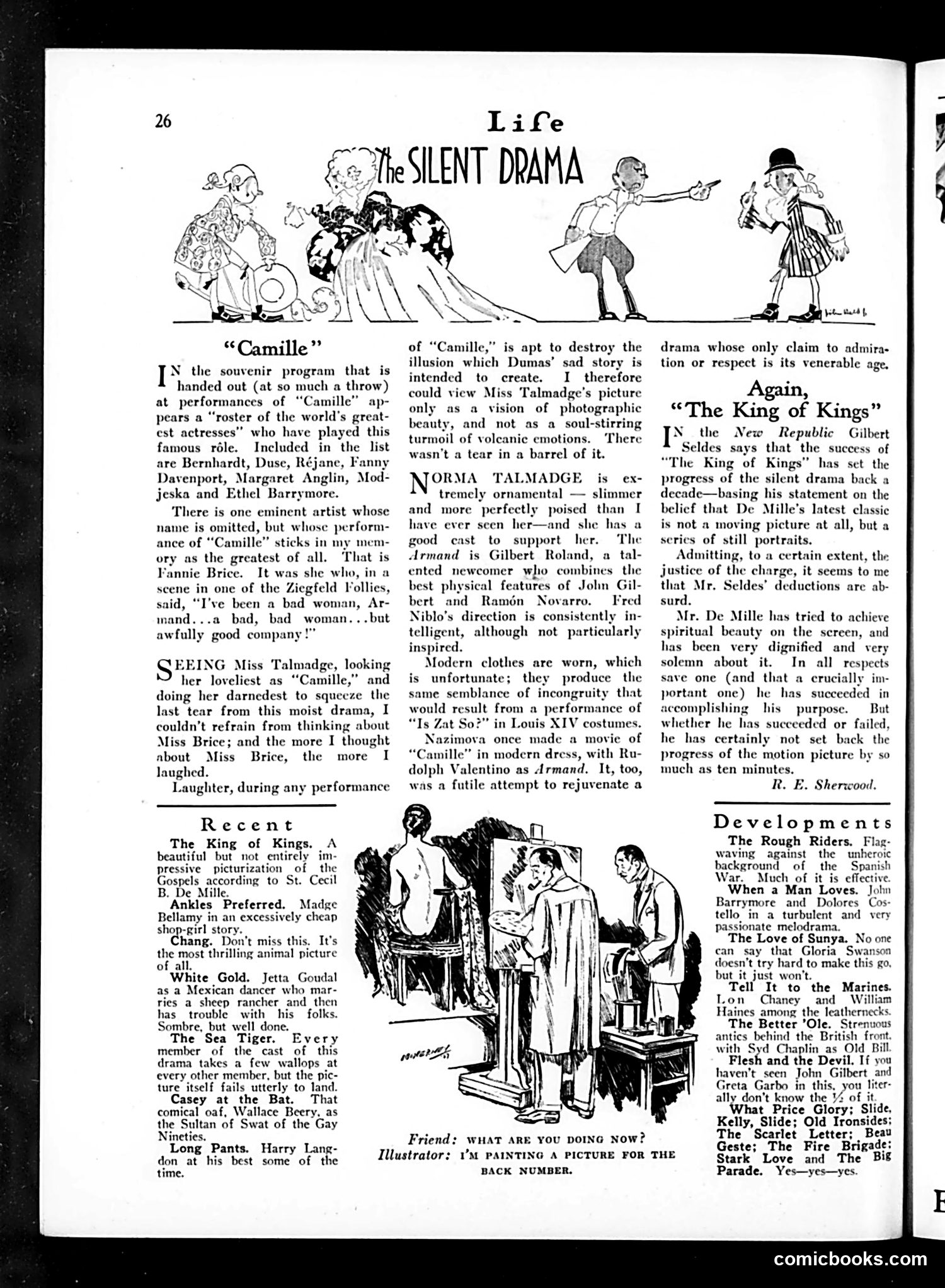
What you’re looking at
This page critiques silent films, particularly Norma Talmadge's performance in "Camille." The humor centers on a contrast: the author finds Talmadge's technical beauty and composure *prevents* emotional engagement with the melodrama. He contrasts this with Fannie Brice's comedic parody of the same role in the Ziegfeld Follies, where her deadpan delivery ("awfully good company!") actually proved more memorable and entertaining than the "serious" version. The satire targets overwrought theatrical emotion—the author argues that modern costumes and Talmadge's polished presentation undermine the story's impact. He also jokes that watching "Camille" in 1920s dress is absurd, like performing "Is Zat So?" in Louis XIV costumes. The page also reviews "The King of Kings" (De Mille's biblical epic), dismissing critical claims it harmed cinema's progress as exaggerated.
📄 Transcribed text from this page (OCR, searchable)
Machine-transcribed from the original scan — historical spelling and the odd misread are preserved.
COMRSUENT DRAMA I* the souvenir program that is handed out (at so much a throw) at performances of “Camille” ap- pears a “roster of the world’s g est actresses” who have played this famous réle. Included in the list are Bernhardt, Duse, Réjane, Fanny Davenport, Margaret Anglin, Mod- jeska and Ethel Barrymore. There is one eminent artist whose name is omitted, but whose perform- ance of “Camille” sticks in my mem- ory as the greatest of all. That is Fannie Brice. It was she who, in a scene in one of the Ziegfeld Follies, said, “I've been a bad woman, Ar- mand...a bad, bad woman. ..but awfully good company !” SE ZING N Talmadge, looking her loveliest as “Camille,” and doing her darnedest to squecze the last tear from this moist drama, I couldn't refrain from thinking about Miss Brice; and the more I thought about Miss Brice, the more I laughed. Laughter, during any performance Recent The King of Kings. A beautiful but not entirely im- pressive picturization of the Gospels according to St. Cecil B. De Mille. Ankles Preferred. Madge Bellamy in an excessively cheap shop-girl story. Chang. Don’t miss this. It’s the most thrilling animal picture of all. White Gold. Jetta Goudal as a Mexican dancer who mar- ries a sheep rancher and then has trouble with his folks. Sombre, but well done. The Sea Tiger. Every member of the cast of this drama takes a few wallops at every other member, but the pic- ture itself fails utterly to land. Casey at the Bat. That comical oaf, Wallace Beery, as the Sultan of Swat of the Gay Nineties. Long Pants. Harry Lang- don at his best some of the time. Illustrator: Life Vaan of “Camille,” is apt to destroy the illusion which Dumas’ sad story is intended to create. I therefore could vi Miss Talmadge’s picture only as a ion of photographic beauty, and not as a soul-stirring turmoil of volcanic emotions. There wasn’t a tear in a barrel of it. NORMA TALMADGE is ex- tremely ornamental — slimmer and more perfectly poised than I have ever seen her—and she has a good cast to support her. The Armand is Gilbert Roland, a tal- ented newcomer who combines the best physical features of John Gil- bert and Ramén Novarro. Fred Niblo’s direction is consistently telligent, although not particularly inspired. Modern clothes are worn, which is unfortunate; they produce the same semblance of incongruity that would result from a performance of “Is Zat So?” in Louis XIV costumes. Nazimova once made a movie of “Camille” in modern dress, with Ru- dolph Valentino as Armand. It, too, was a futile attempt to rejuvenate a Friend: WHAT ARE YOU DOING Now? BACK NUMBER. VM PAINTING A PICTURE FOR THE drama whose only claim to admira- tion or respect is its venerable age, Again, “The King of Kings” I. the New Republic Gilbert Seldes says that the success of “The King of Kings” has set the progress of the silent drama back a decade—basing his statement on the belicf that De Mille’s latest classic is not a moving picture at all, but a Admitting, to a certa justice of the charge, it s that Mr. Seldes’ deductions are ab- surd. Mr. De Mille has tried to achieve spiritual beauty on the screen, and has been very dignified and very solemn about it. In all respects save one (and that a crucially im- portant one) he has succeeded in accomplishing his purpose. But whether he has succeeded or failed, he has certainly not set back the progress of the motion picture by so much as ten minutes. R. E. Sherwood. Developments The Rough Riders. Flag- waving against the unheroic background of the Spanish War. Much of it is effective. When a Man Loves. John Barrymore and Dolores Cos- tello in a turbulent and very passionate melodrama. The Love of Sunya. No one can say that Gloria Swanson doesn’t try hard to make this go, but_it just won't. Tell It to the Marines. Lon Chaney and William Haines among the leathernecks. The Better ’Ole. Strenuous antics behind the British front. with Syd Chaplin as Old Bill. Flesh and the Devil. If you haven't seen John Gilbert, and Greta Garbo in this, you liter- ally don’t know the % of it What Price Glory; Slide, Kelly, Slide; Old Ironsides; The ‘Scarlet Letter; Beau Geste; The Fire Brigade: Stark Love and The Bis Parade. Yes—yes—yes. comicbooks.com = a. a