
A complete issue · 35 pages · 1927
Life — April 28, 1927
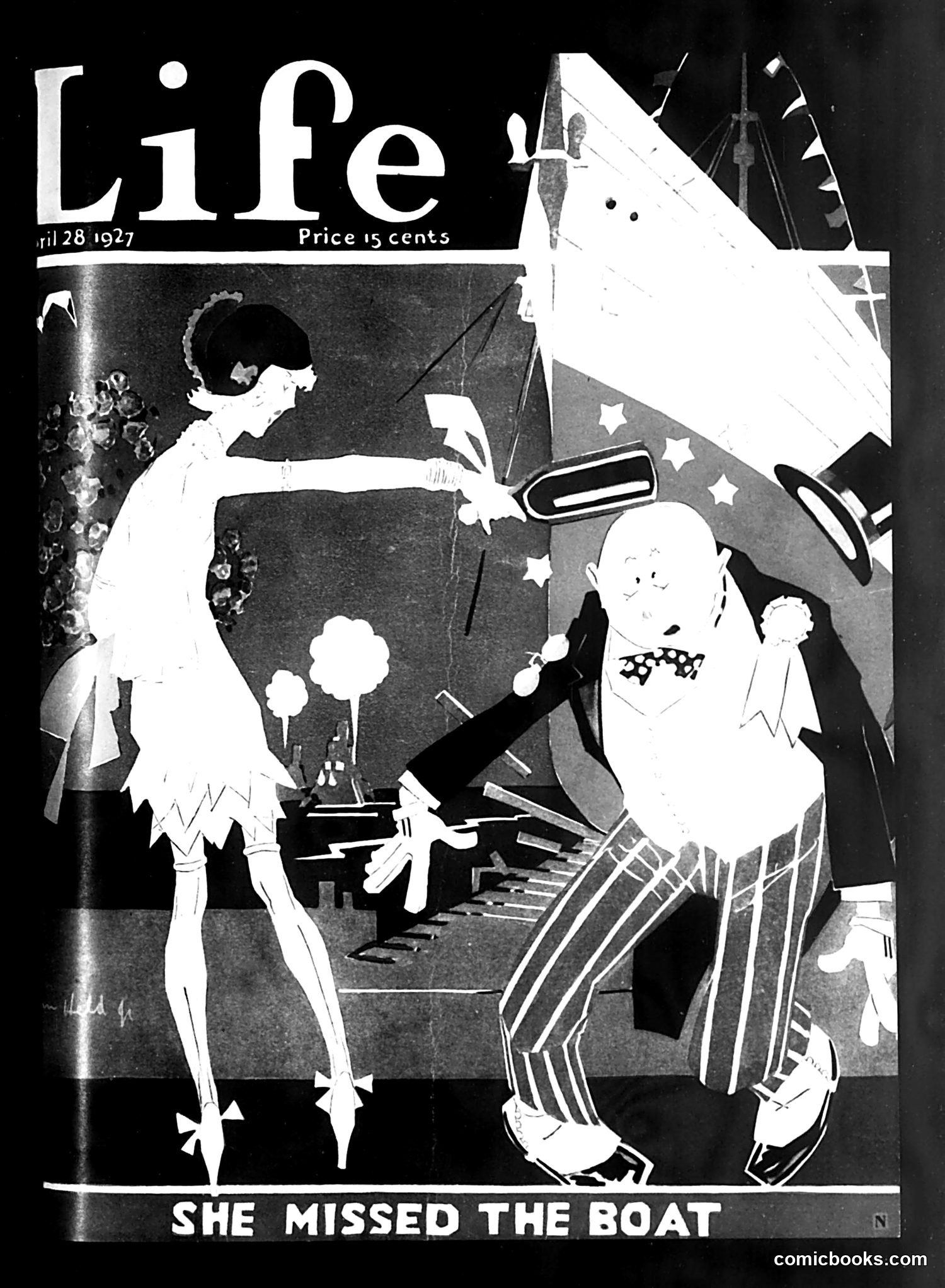
This cartoon satirizes a woman who failed to board a departing ship, depicted through Art Deco-style illustration. The title suggests she missed an opportunity—likely a romantic or social one, given the 1920s context and the fashionable woman in a short dress characteristic of the "flapper" era. The man in striped pajamas and top hat appears to be the figure she missed connecting with, possibly representing wealth or social status. The ship in the background and maritime setting reinforce the "missed boat" metaphor—a common idiom for losing an opportunity. The satire reflects 1920s concerns about modern courtship, social advancement, and the competitive social scene among young, fashionable urbanites of the Jazz Age.
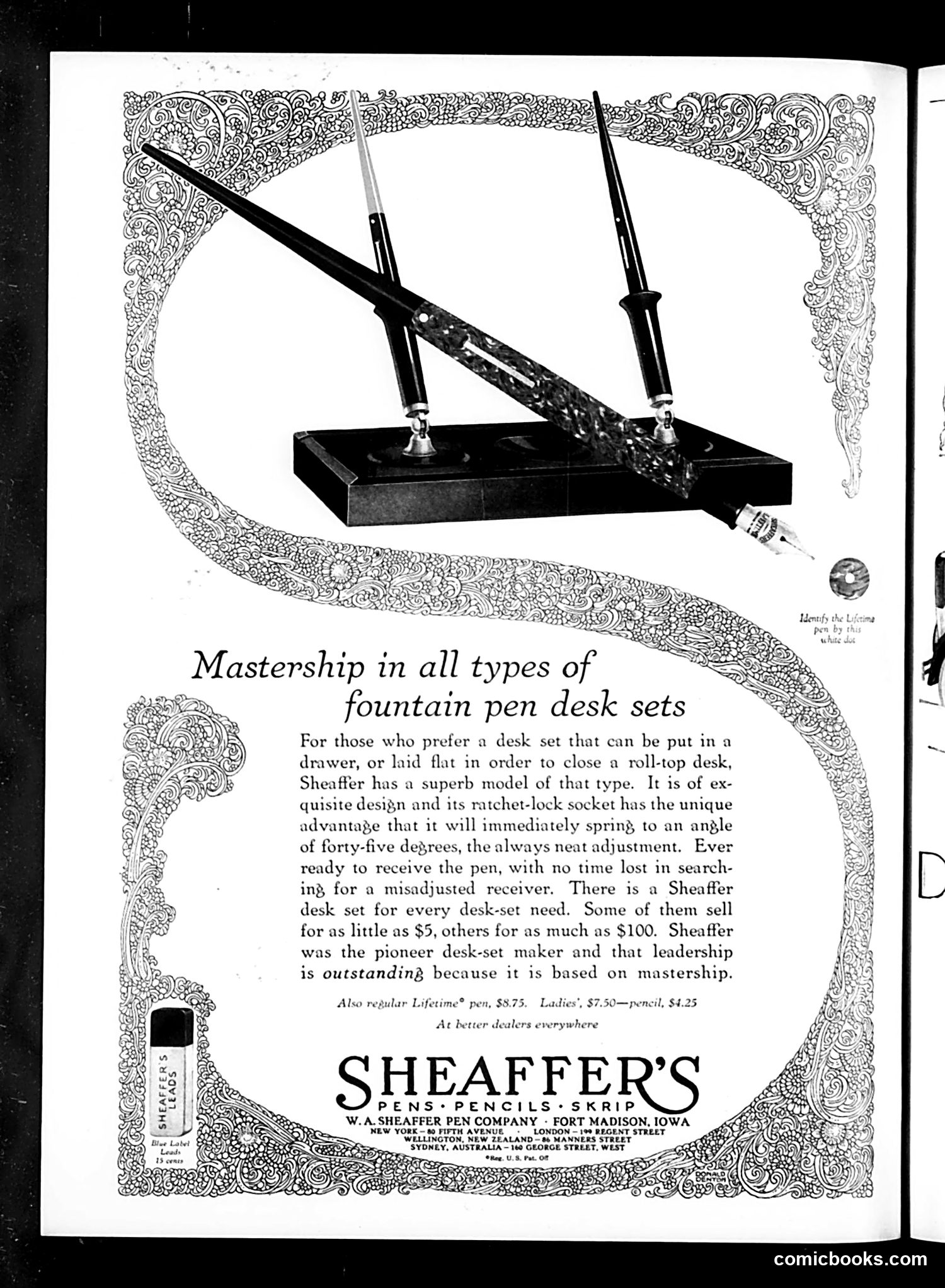
This is **not a political cartoon**, but rather a **vintage advertisement** for Sheaffer fountain pen desk sets, likely from the early-to-mid 20th century. The page features an ornate, decorative border framing a product display. The central image shows a black desk set with two fountain pens mounted at a 45-degree angle in a ratchet-lock mechanism. The advertisement emphasizes the desk set's practicality—it fits in drawers or rolls up with roll-top desks—and highlights Sheaffer's pioneering position in desk-set manufacturing. The copy notes pricing ranging from $5 to $100, positioning Sheaffer as the market leader based on "mastery and leadership." This is straightforward commercial advertising, not satire.
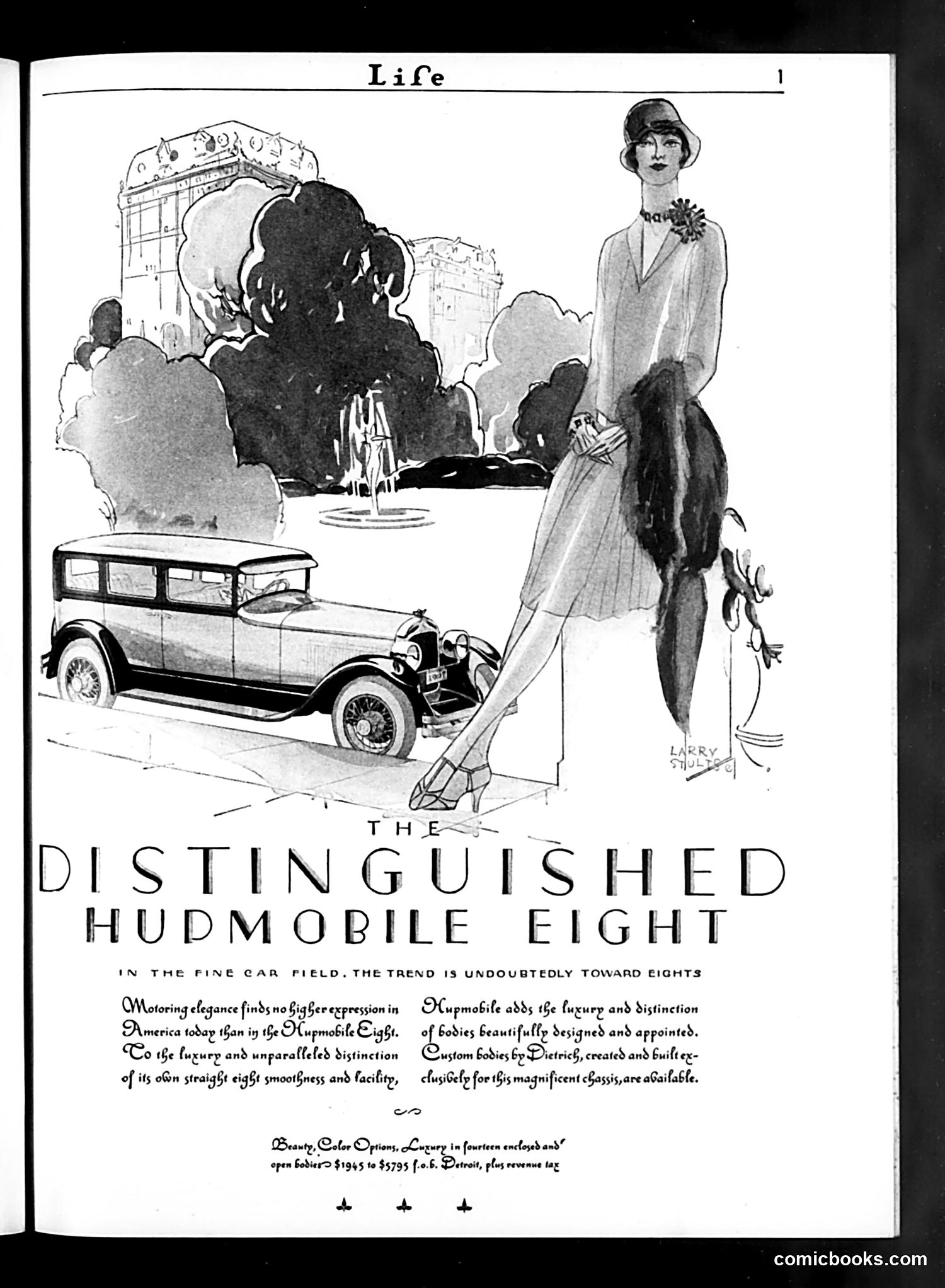
This is primarily a **car advertisement**, not political satire. It promotes the Hupmobile Eight automobile to readers of *Life* magazine. The illustration depicts a fashionable 1920s woman displaying the vehicle to an admiring crowd at what appears to be a social gathering or "fine car field." The ad emphasizes luxury and social distinction—the car as a status symbol that conveys "elegance" and "luxury." The text claims the Hupmobile Eight represents the automotive trend toward eight-cylinder engines, positioning it as sophisticated and superior. The copywriting associates car ownership with refined taste and social standing—typical advertising strategy of the era. The female figure serves as an aspirational image linking the product to modernity and desirability, common in 1920s marketing. This is commercial messaging, not commentary.
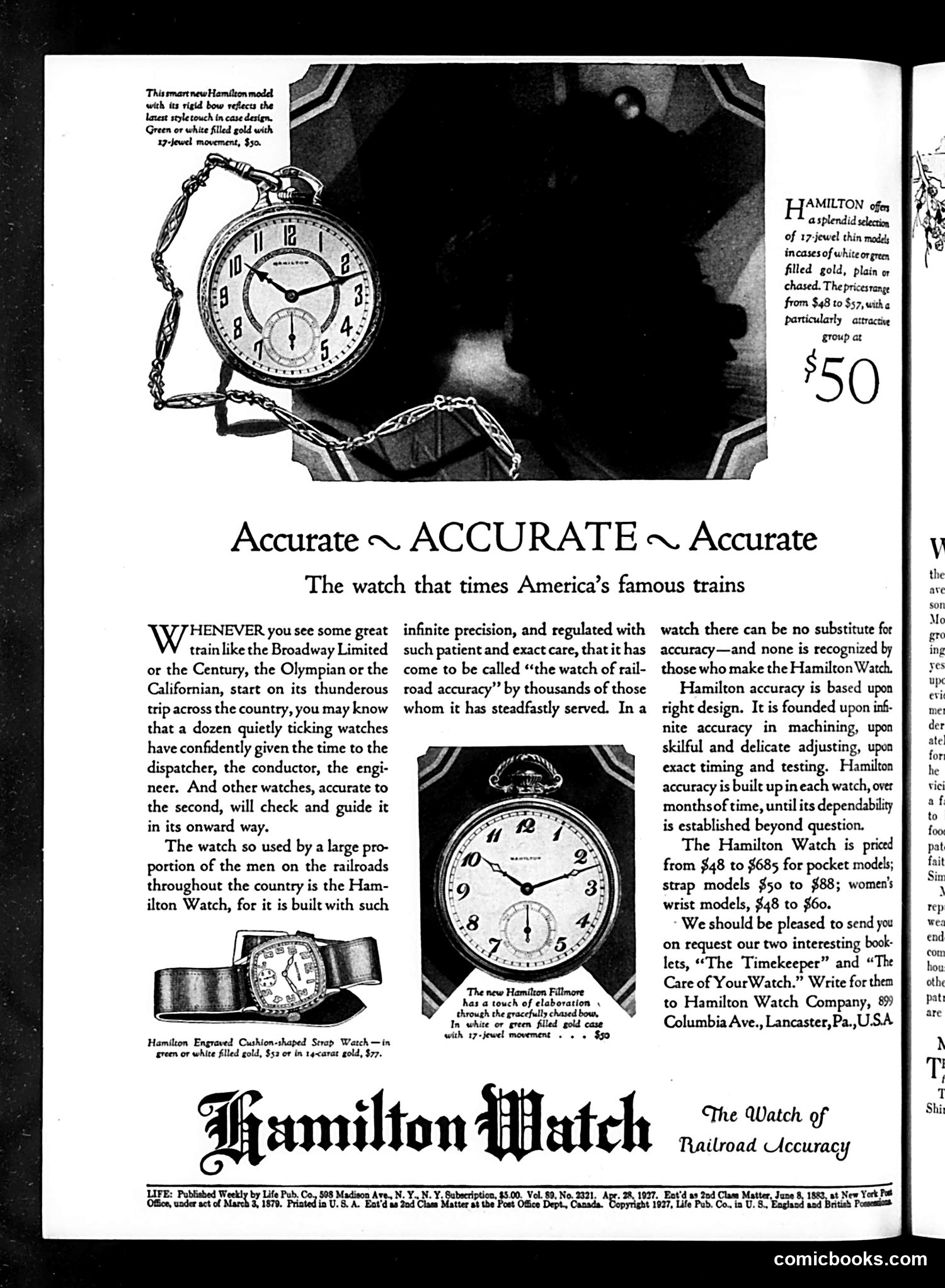
This page is primarily **advertising, not satire or political commentary**. It's a Hamilton Watch Company advertisement from Life magazine (April 28, 1927, per the footer). The ad promotes Hamilton pocket watches as "The watch of Railroad Accuracy," emphasizing their use by railroad dispatchers, conductors, and engineers across America's famous trains (Broadway Limited, Century, Olympian, Californian). The three watch images showcase different Hamilton models with prices ranging from $48-$685. The text stresses precision engineering and reliability—qualities essential for railroad operations where accurate timekeeping was critical for safety and scheduling. This is straightforward product marketing leveraging railroad prestige and precision as selling points, not political or social satire.
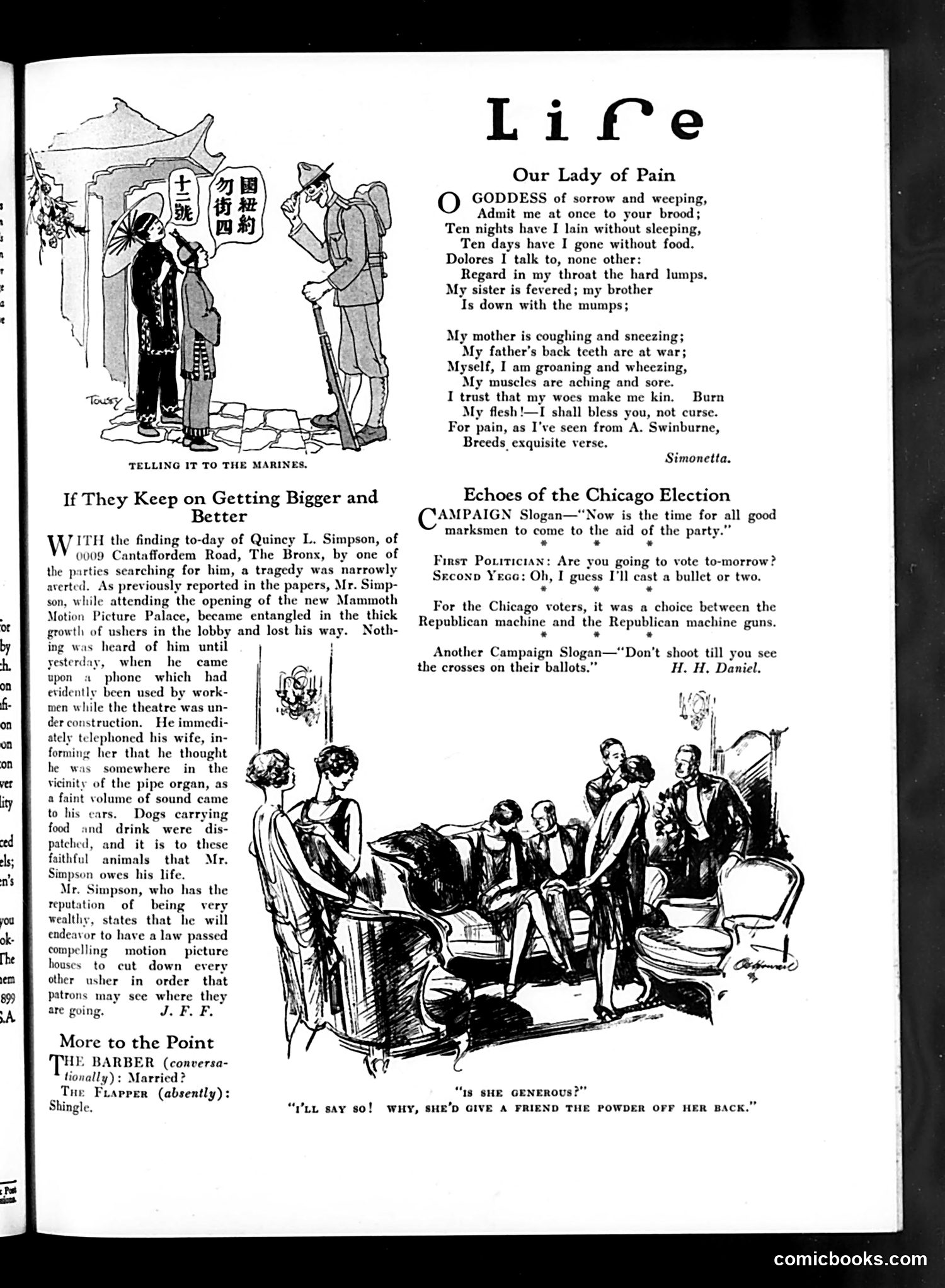
This page contains three distinct pieces of satire: **"Life" poem** (top right): A mock prayer to "Our Lady of Pain" by a character named Simonetta, listing ailments—insomnia, hunger, sick family members, fever, mumps—and asking the goddess to "bless you, not curse." It's satirical commentary on urban hardship and suffering. **"If They Keep on Getting Bigger and Better"** (left): Reports on Quincy L. Simpson, a theater usher lost during construction at the Mammoth Motion Picture Palace. The satire mocks how massive movie palaces had become—so enormous that workers could disappear unnoticed. **"Echoes of the Chicago Election"** (bottom): Political satire about Chicago voting, contrasting two campaign slogans. It critiques the city's machine politics and apparent violence ("don't shoot till you see the crosses on their ballots"). The bottom cartoon illustrates a social scene with the caption "Is she generous? I'll say so! Why, she'd give a friend the powder off her back"—likely mocking superficial society women.
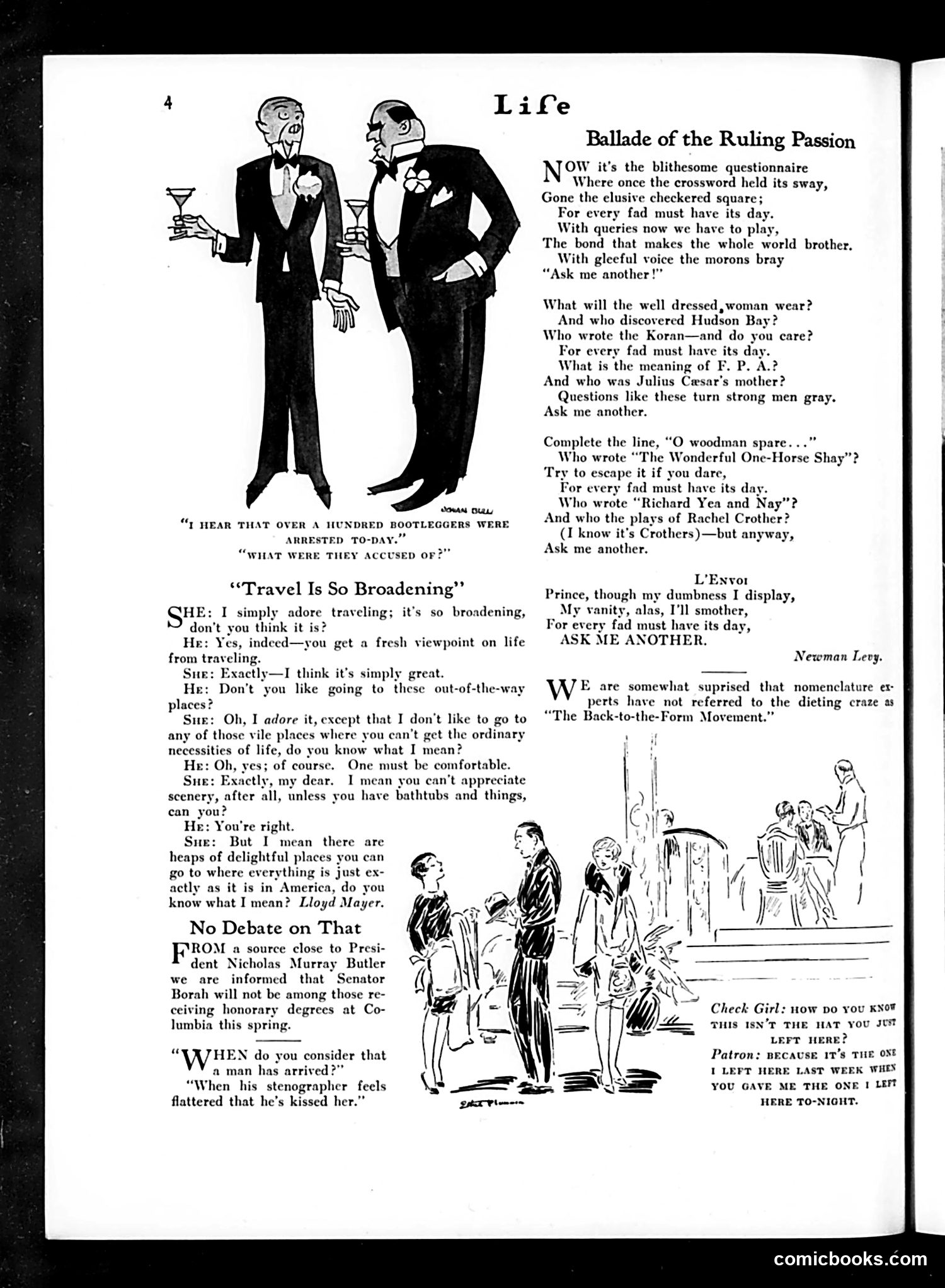
This page contains several satirical pieces mocking intellectual fashions and social pretensions of the era. **"Travel Is So Broadening"** is a dialogue joke satirizing wealthy people who justify frivolous travel by claiming it's "educational" or "broadening." The humor lies in the woman's admission that she actually just wants comfort and familiar luxuries abroad—contradicting the intellectual justification. **"Ballad of the Ruling Passion"** mocks trivia obsession, where people prioritize answering obscure questions (Hudson Bay's discoverer, the Koran's author) over substantive concerns. **"No Debate on That"** references Senator Borah receiving honorary degrees, with a joke about when a man has "arrived"—apparently when his stenographer finds him kissable. The bottom cartoon depicts what appears to be a nightclub or restaurant scene with social comedy about hat-checking protocols.
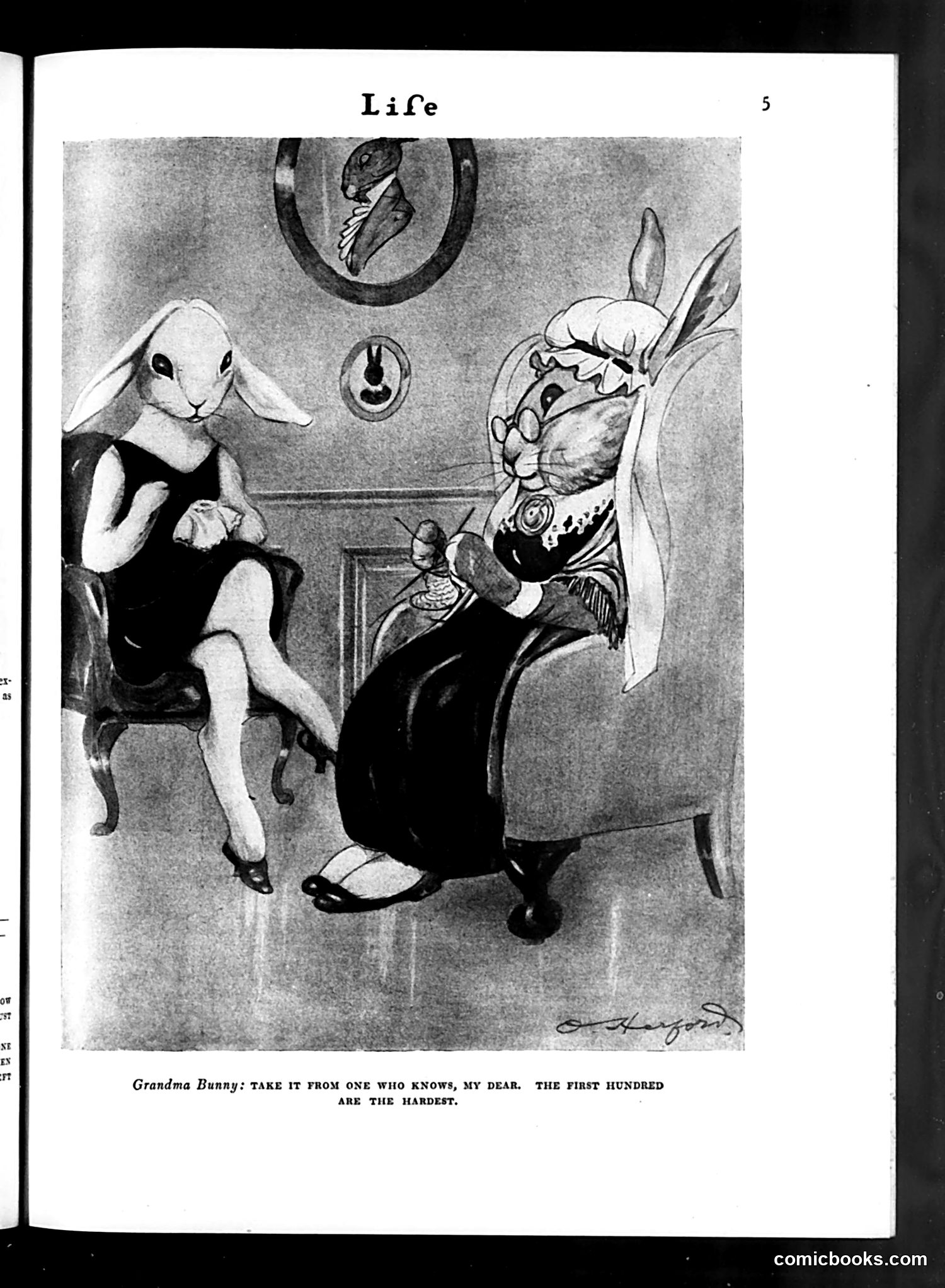
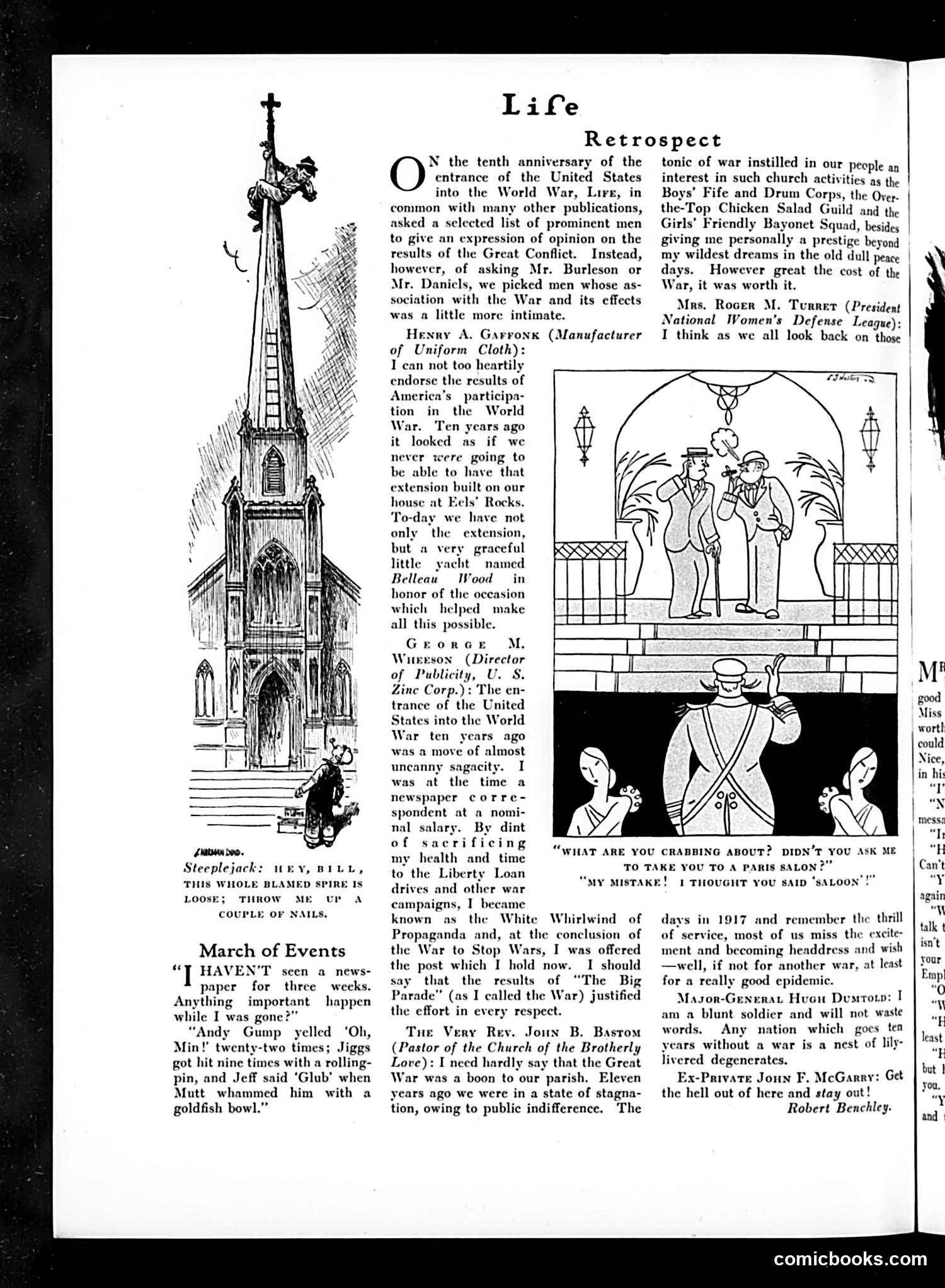
This "Life Retrospect" page commemorates the tenth anniversary of America's WWI involvement. The central cartoon depicts a soldier asking a woman about going to a "Paris salon," to which she responds he promised to take her there—a joke about soldiers' wartime promises versus postwar reality. The text features prominent Americans reflecting on the war's impact: Henry Gaffonk (uniform cloth manufacturer), George Wilkinson (U.S. Zinc Corp director), and Reverend John H. Bassey discuss how the conflict affected their lives and industries. Their reflections range from personal (extensions built on estates) to patriotic (Liberty Loan campaigns). The "March of Events" section humorously recounts newspaper headlines from wartime, capturing the era's absurdist humor amid serious circumstances.
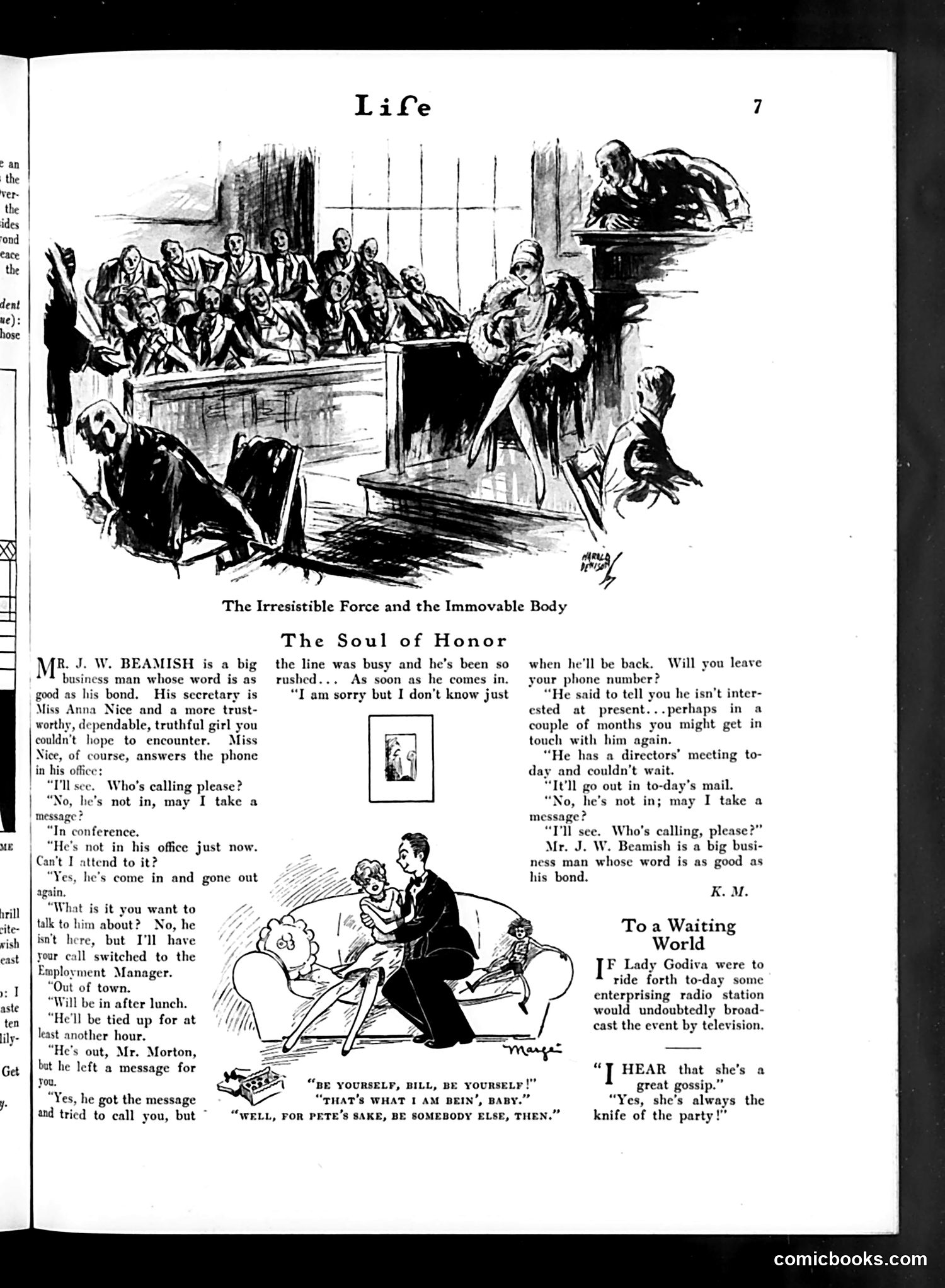
This page contains three separate pieces of satirical content: **"The Irresistible Force and the Immovable Body"** (top cartoon) depicts a courtroom scene, likely satirizing a legal dispute where conflicting claims meet. **"The Soul of Honor"** (middle story with illustration) satirizes business ethics. Mr. J.W. Beamish is a businessman whose "word is as good as his bond," yet his secretary Miss Nice struggles to reach him—he's perpetually "in conference" or out. The satire mocks the gap between claimed integrity and actual availability/honesty in business dealings. The cartoon shows him with a child, captioned with dialogue about keeping one's word. **"To a Waiting World"** (right column) makes a brief joke about Lady Godiva and radio broadcasting—a reference to her famous nude ride, suggesting the spectacle would translate well to television. All pieces satirize human hypocrisy and modern social pretense.
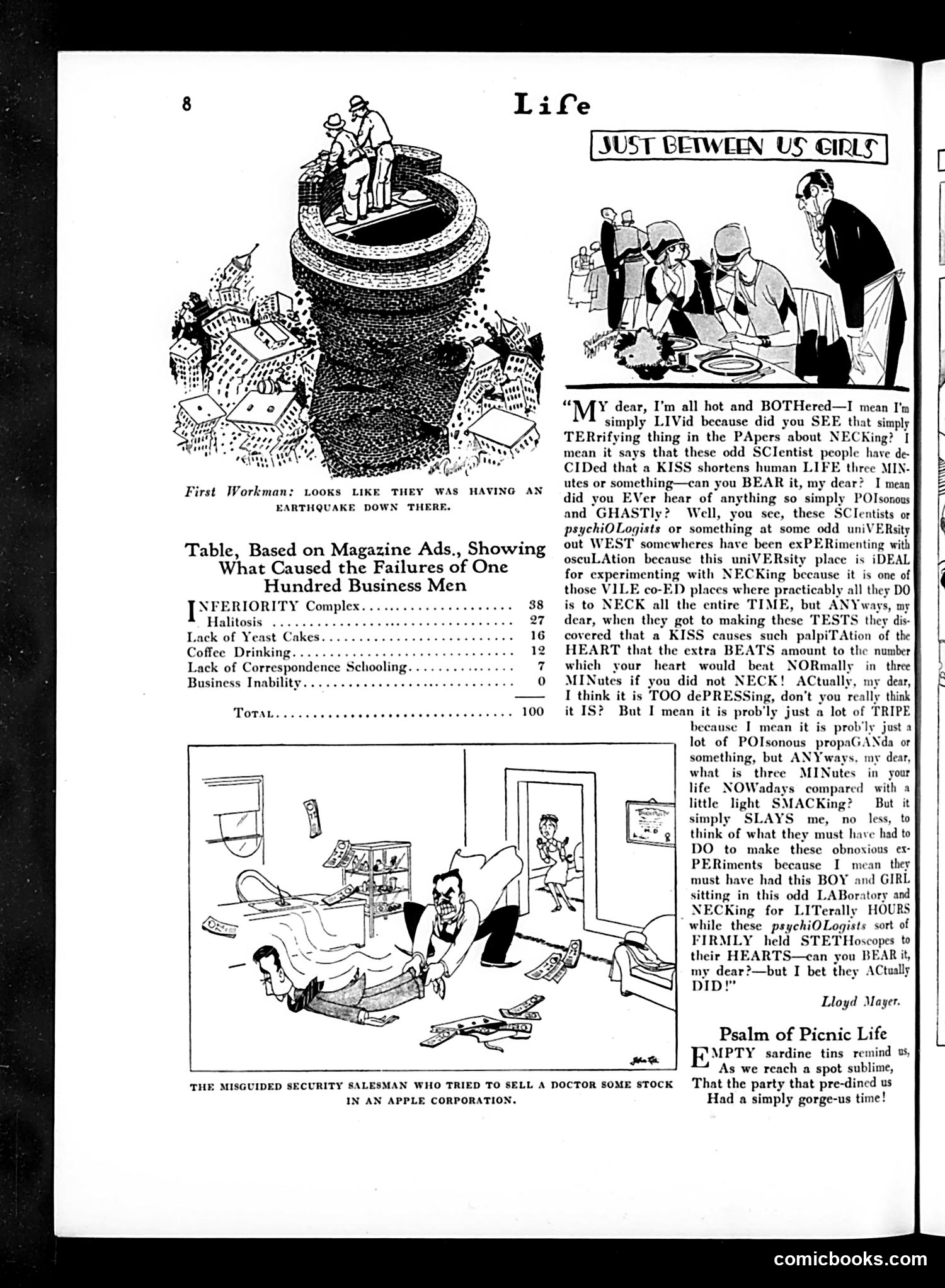
This page contains two satirical pieces mocking early 20th-century scientific pretension and business culture. **Left cartoon**: "The Misguided Security Salesman Who Tried to Sell a Doctor Some Stock in an Apple Corporation" depicts a chaotic laboratory where a salesman has been literally thrown around by an angry scientist-doctor. The cartoon ridicules fraudulent stock salesmen preying on professionals through false "scientific" investment schemes. **Right section**: "Just Between Us Girls" is a gossip column in exaggerated typography, mocking women's magazine rhetoric. The author (Lloyd Mager) satirizes pseudo-scientific claims—particularly about universities conducting dubious kiss-testing and necking experiments—as absurd modern trends. The humor targets both sensationalized science journalism and women's breathless fascination with relationship pseudo-science. Both pieces lampoon the era's gullibility toward fake science and get-rich-quick schemes.
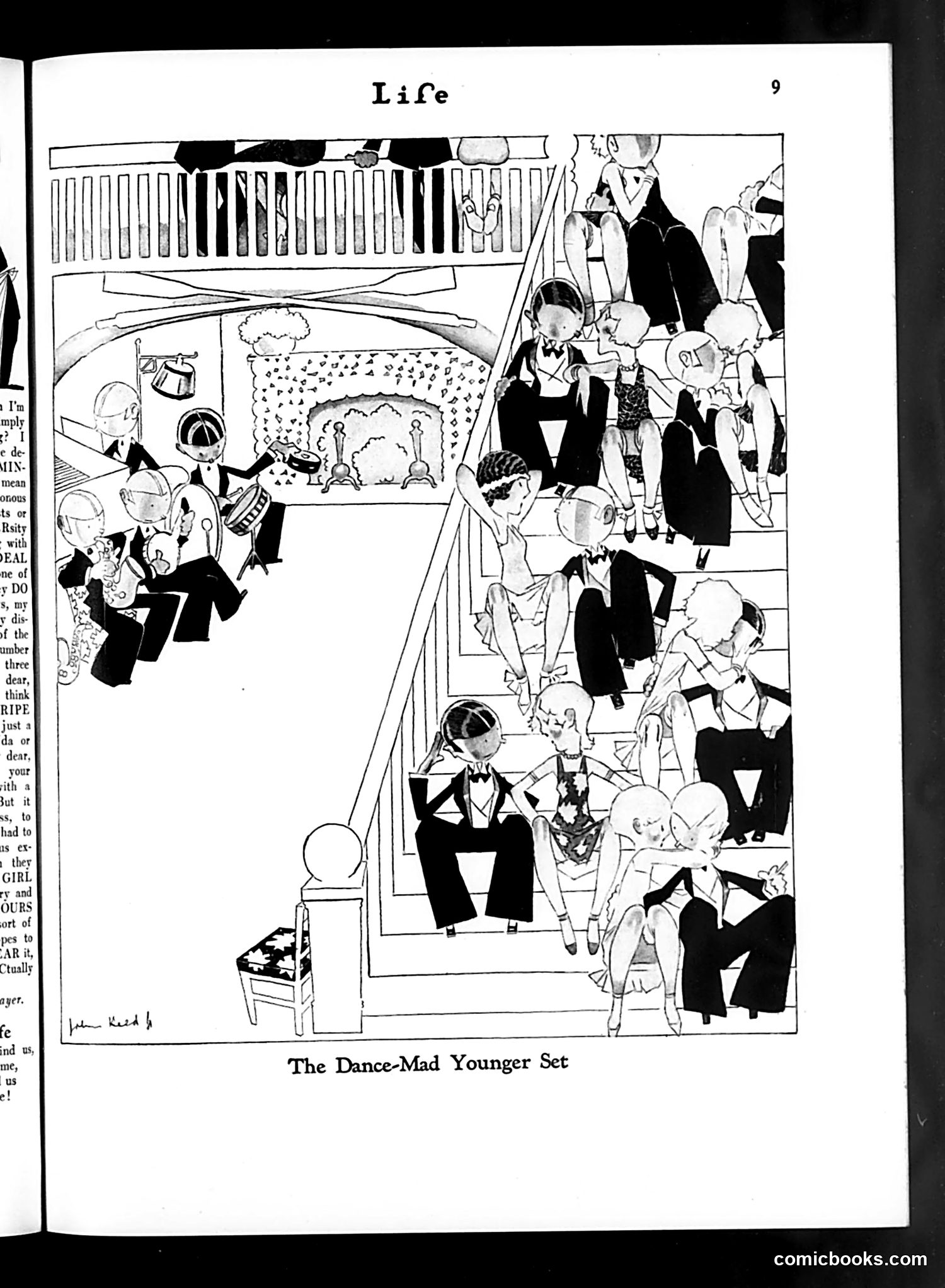
This illustration satirizes the 1920s youth culture obsession with dancing. The cartoon depicts an elaborate, multi-level dance venue packed with young people in formal attire (tuxedos and dresses), all actively dancing or socializing. The stacked, tiered composition emphasizes the sheer density and frenzy of activity. The satire targets what older generations viewed as excessive frivolity—the "younger set's" apparent inability to do anything but dance. The elaborate architectural staging and crowded composition mock both the popularity of dance halls and the perceived moral concern among adults that youth were abandoning propriety for constant entertainment and nightlife. This reflects genuine 1920s generational anxiety about post-WWI youth culture and changing social norms.
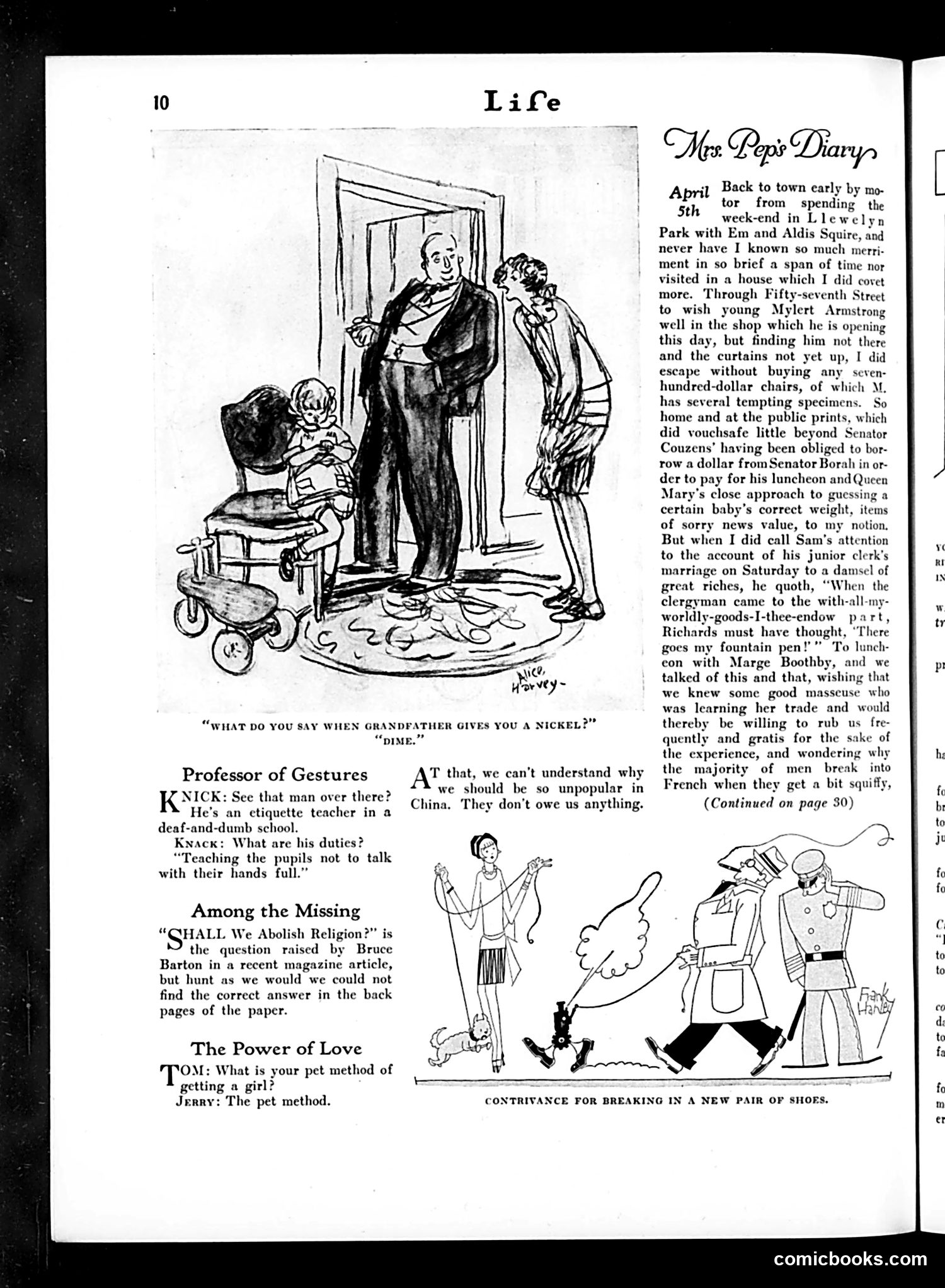
**Mrs. Peps Diary (top right):** A personal gossip column describing the writer's weekend activities and social encounters in elite circles. The humor relies on name-dropping and complaints about wealthy acquaintances' behavior—typical satirical fodder for mocking high society. **"What Do You Say When Grandfather Gives You a Nickel?" (center left):** A cartoon joke contrasting etiquette instruction with children's actual responses. The humor is straightforward: the "proper" answer versus a child's blunt practicality. **"Professor of Gestures" & "Among the Missing":** Brief joke snippets about social pretension and absent-minded intellectuals. **"Contrivance for Breaking in a New Pair of Shoes" (bottom):** A humorous illustration showing an elaborate mechanical device meant to break in shoes, satirizing over-engineered solutions to everyday problems. The page exemplifies *Life*'s focus on satirizing upper-class manners and social conventions.
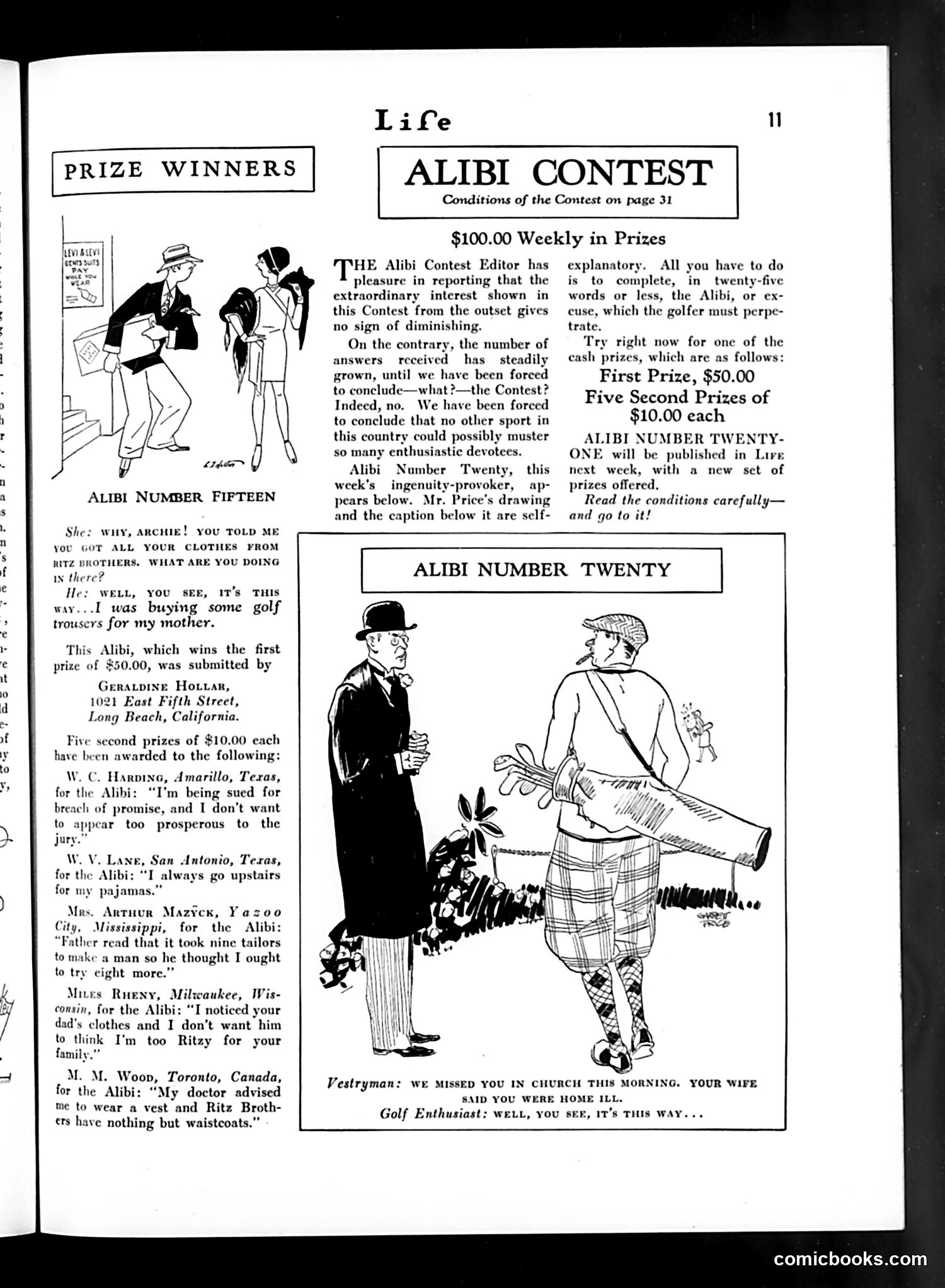
This page features *Life* magazine's "Alibi Contest," a humor competition where readers submit creative excuses. The winning entry (Alibi Number Fifteen) shows a man telling his wife he bought golf clubs from "Ritz Brothers" for his mother—a transparent lie since the wife suspects he bought them for himself. Alibi Number Twenty depicts a golfer caught playing truant from church. When confronted by a clergyman, the golfer claims he was "home ill," but his wife contradicts him, saying he was actually golfing. The satire mocks the common male vice of prioritizing golf over religious or family obligations, and the absurdity of poor excuses husbands invented to justify neglecting responsibilities for their hobby.
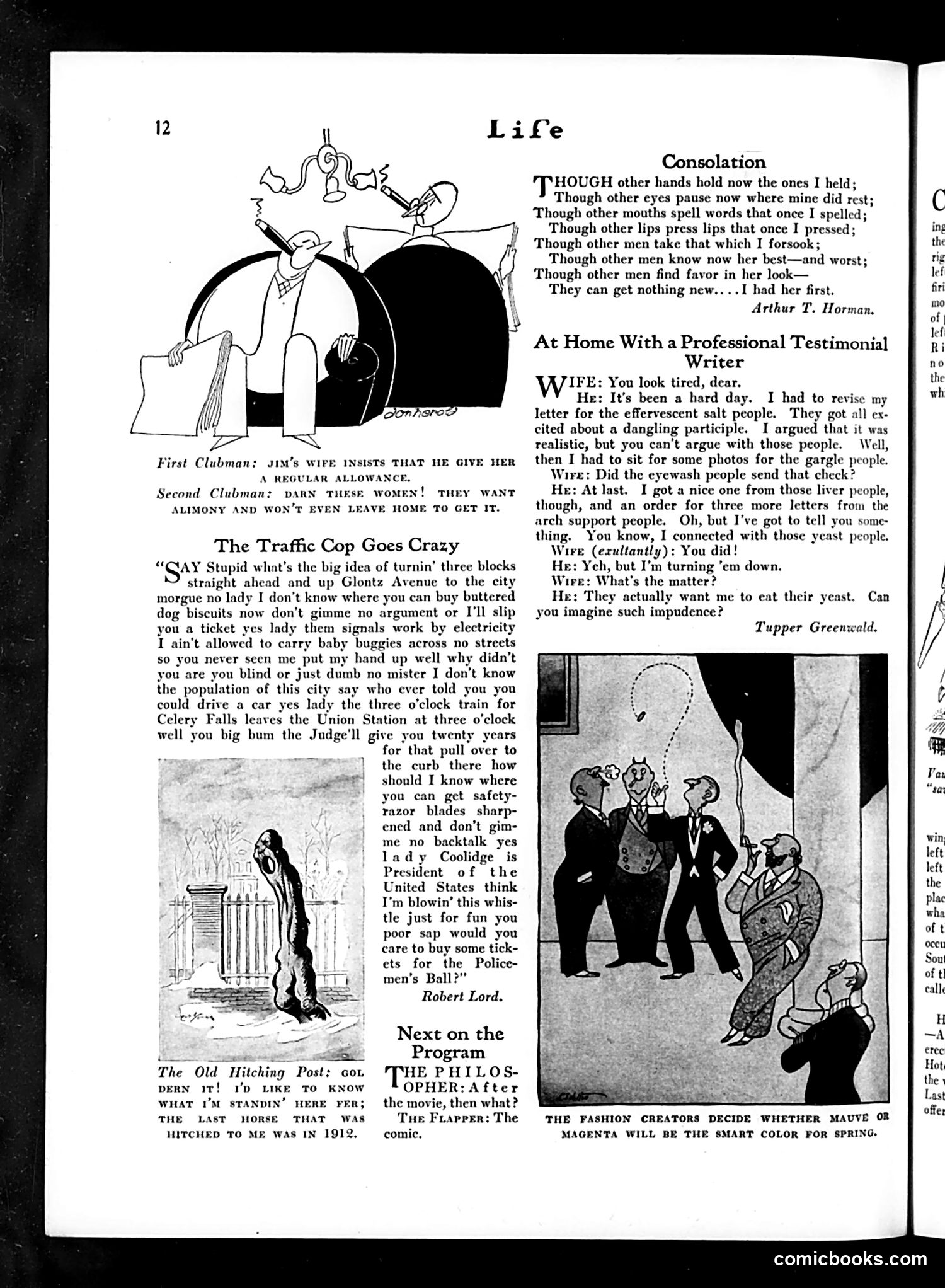
This page contains several humor pieces: **"Consolation"** (poem by Arthur T. Horman): Addresses lost love—a woman now with another man. The speaker claims consolation in having "had [her] first." **"At Home With a Professional Testimonial Writer"**: Satirizes writers who produce paid endorsements. A husband revises letters praising products (yeast, arch supports) he doesn't genuinely use, receiving payment while pretending authenticity. **"The Traffic Cop Goes Crazy"**: A rant by a frustrated traffic officer criticizing chaotic urban conditions—baby carriages blocking streets, illegal car operations—demanding enforcement of traffic laws. The cartoons mock consumerism, dishonest advertising, and urban disorder—reflecting early 20th-century anxieties about modern life's commercialization and chaos.
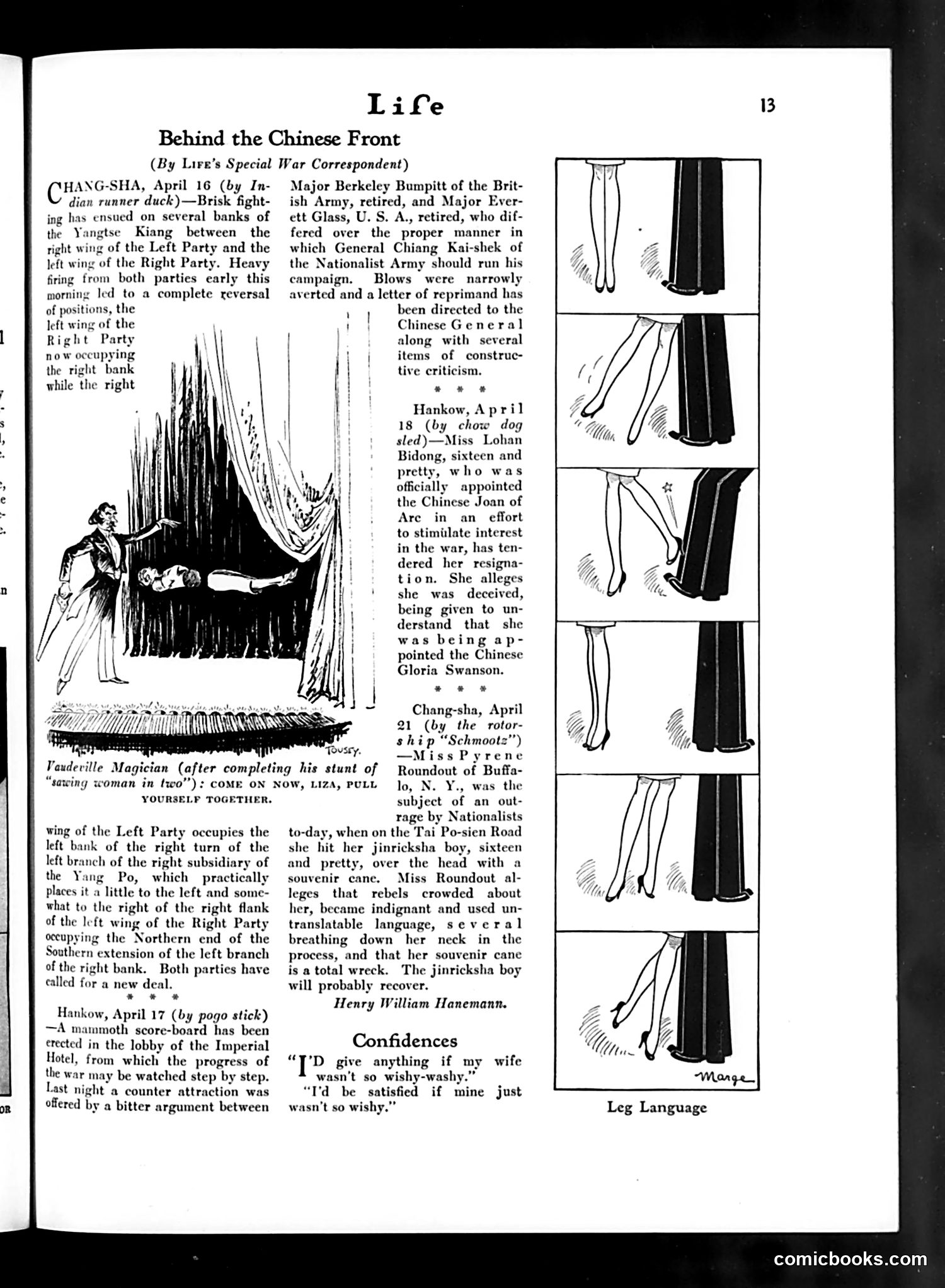
This page contains a humorous illustration series titled "Leg Language" by cartoonist Marge, showing various positions of women's legs and feet paired with different skirt styles. The visual joke satirizes how women's leg movements and postures could supposedly "communicate" different messages or social meanings through fashion—a playful commentary on 1920s women's fashion and behavior. The accompanying text covers war dispatches from China and brief humorous anecdotes ("Confidences") about marriage expectations. The main cartoon "Fanderville Magician" appears to depict a stage performer in an absurdist scene. The "Leg Language" feature represents period humor about how modern women's increasingly visible legs and fashionable clothing choices were interpreted as social or behavioral signals.
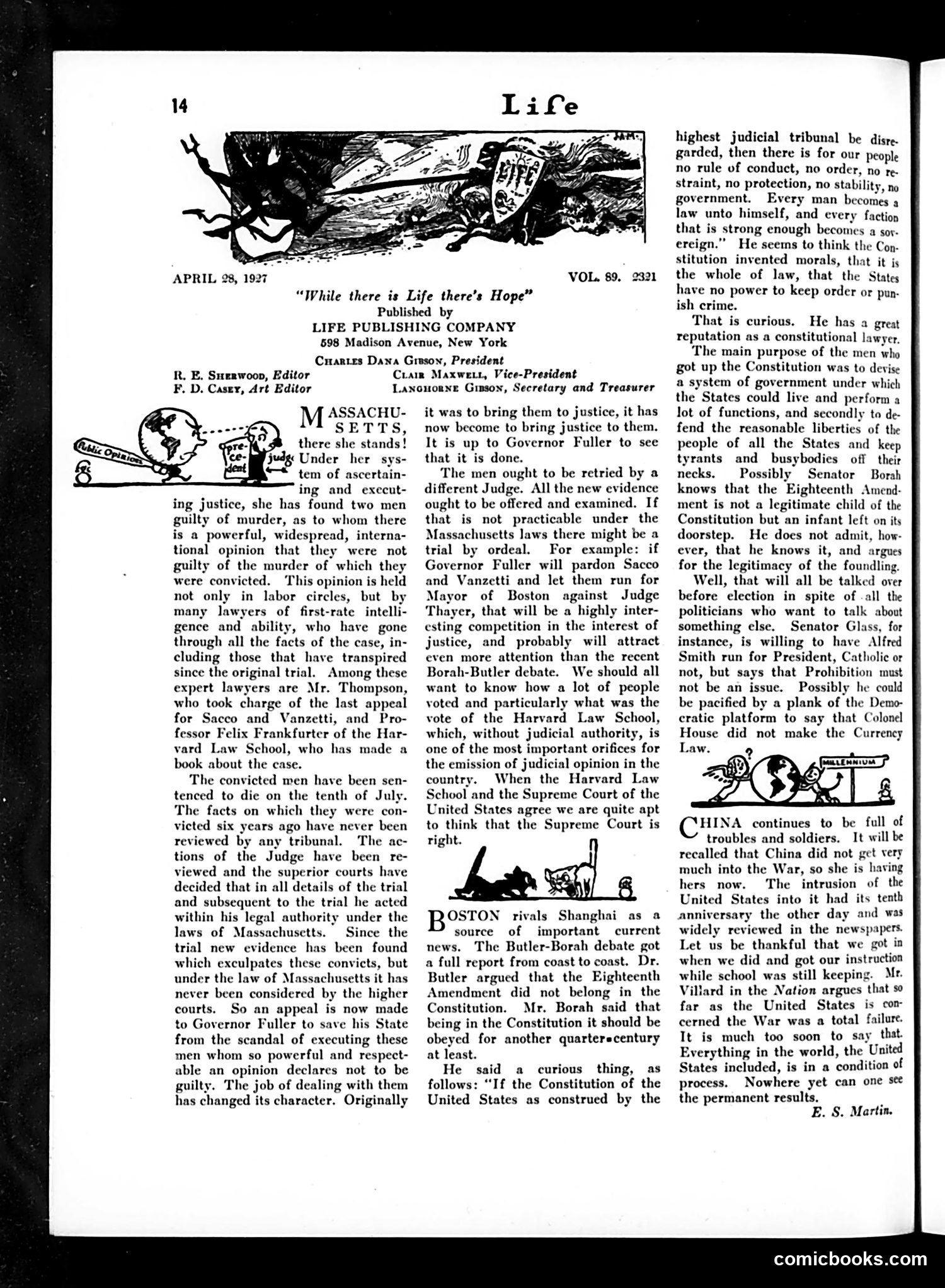
This page discusses the Sacco and Vanzetti case, wherein two men were convicted of murder in Massachusetts. The article critiques Governor Fuller's potential pardon of the convicts, noting the case has attracted significant attention among legal experts and intellectuals. The text references a debate between Dr. Butler and Mr. Borah regarding whether the Eighteenth Amendment (Prohibition) belongs in the Constitution—suggesting the broader constitutional question of governmental authority. The small cartoon at bottom right depicts China as troubled and militaristic, commenting on U.S. involvement there. The overall thrust criticizes judicial processes, executive power, and questions whether American institutions adequately protect citizens' liberties against both tyranny and disorder.
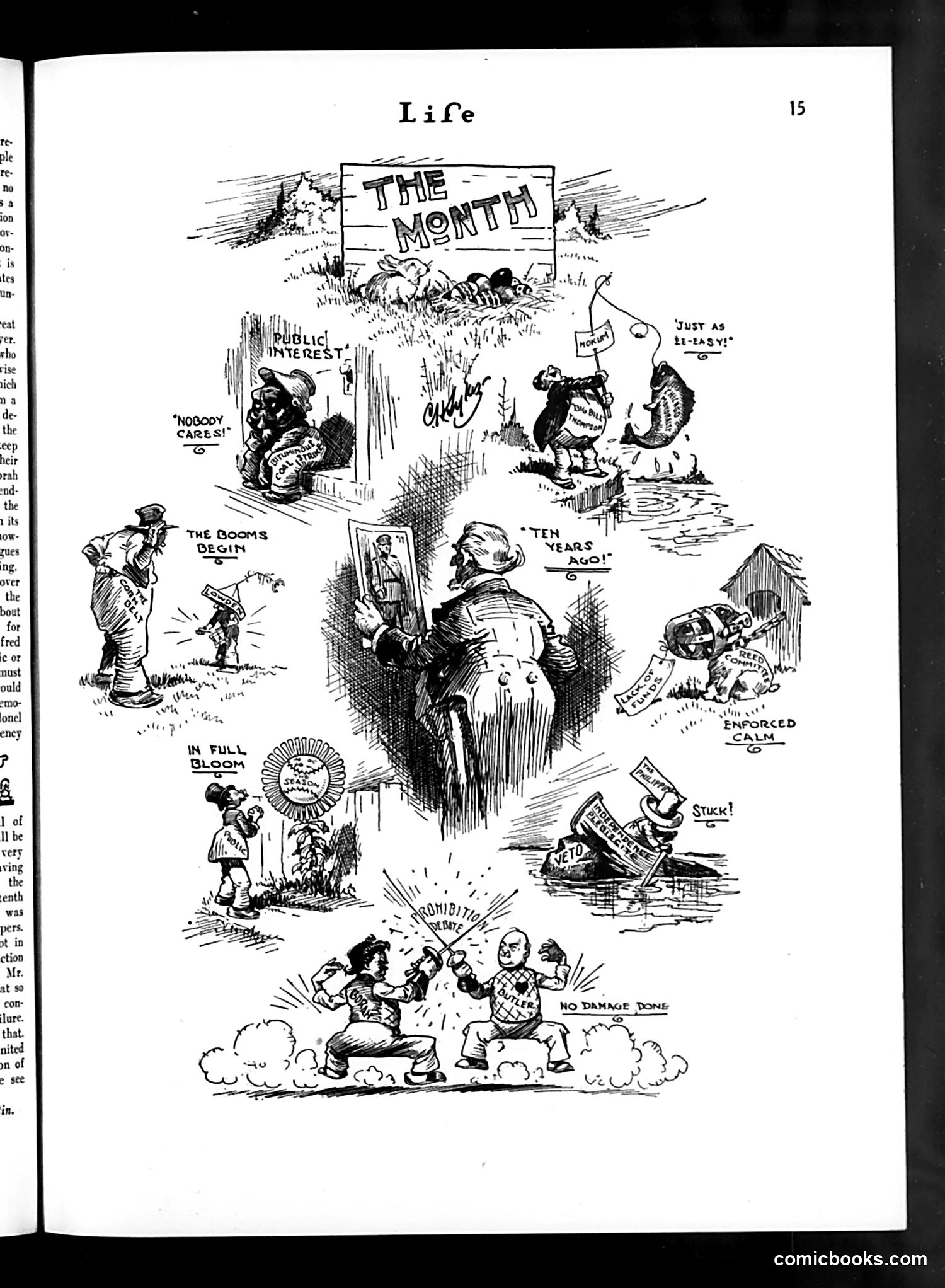
This page presents a satirical overview of current events arranged around a central figure viewing "The Month." The cartoon references several early 20th-century concerns: - **"The Booms Begin"** and **"In Full Bloom"**: Likely references to economic speculation or bubbles - **"Nobody Cares!"** and **"Just as it's Easy!"**: Appear to reference public indifference to social issues - **"Ten Years Ago"**: Contrasts past versus present conditions - **"Prohibition"**: Shows enforcement struggles, with figures fighting over the policy - **"Stuck!"** and **"Becalmed Calm"**: Reference economic or political stagnation - **"No Damage Done"**: Sardonic commentary on disaster or scandal The overall effect satirizes public apathy toward mounting social and economic problems of the era, using caricatured figures to mock various stakeholders' responses.
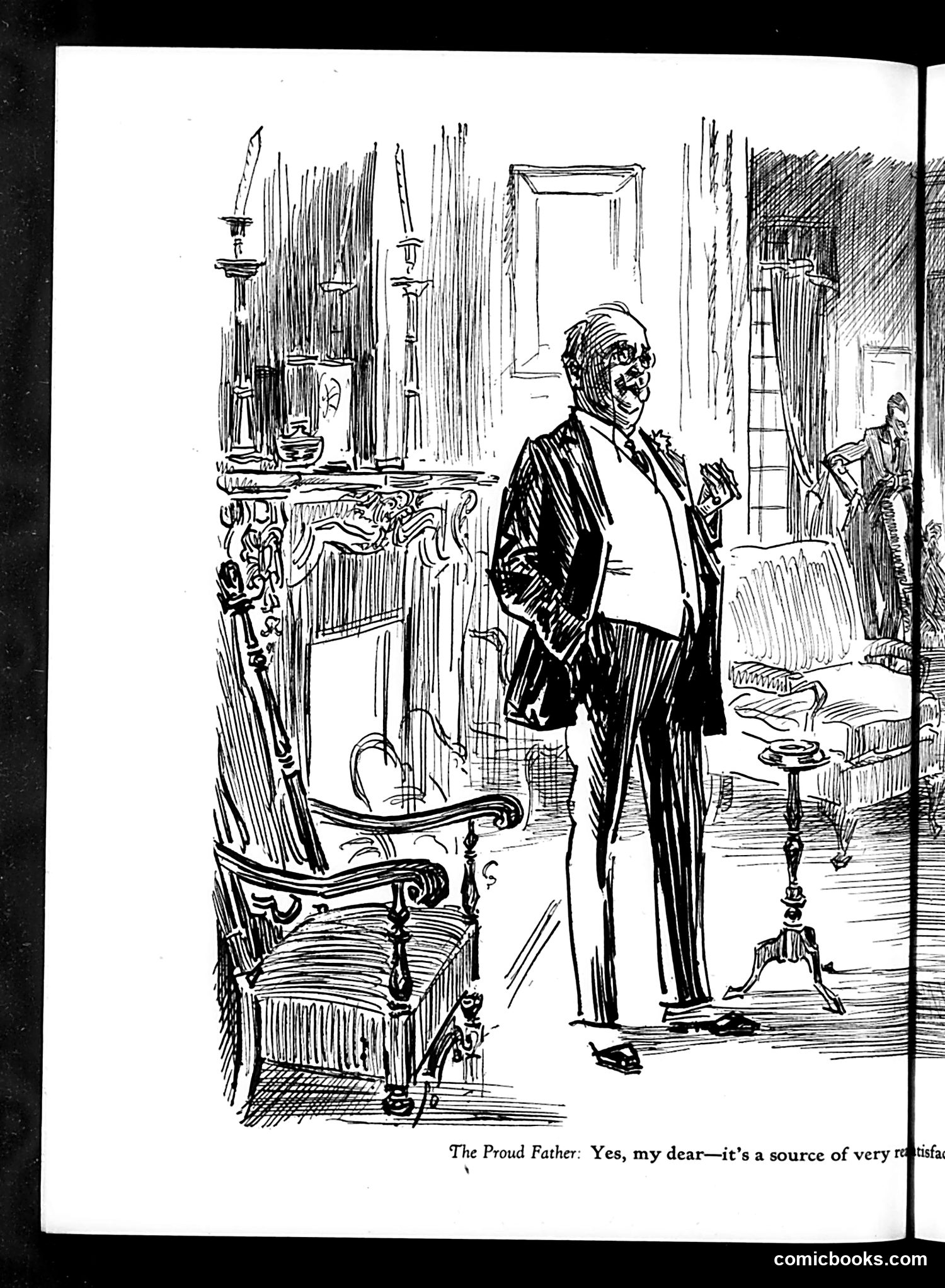
This cartoon depicts a well-dressed man in formal attire standing in an ornate interior, speaking the caption: "Yes, my dear—it's a source of very satisf[action]" (text cuts off). The sketch appears to satirize upper-class parental pride, likely regarding a son's accomplishment or inheritance. The elaborate setting—with candlesticks, fireplace, and well-appointed furnishings—emphasizes the character's wealth and status. The man's satisfied expression and body language suggest smugness about his family's position or achievement. Without additional context or visible signatures identifying the specific subject or date, the precise target of satire remains unclear, though it likely mocks wealthy fathers' pretentiousness or class consciousness typical of *Life* magazine's social commentary.
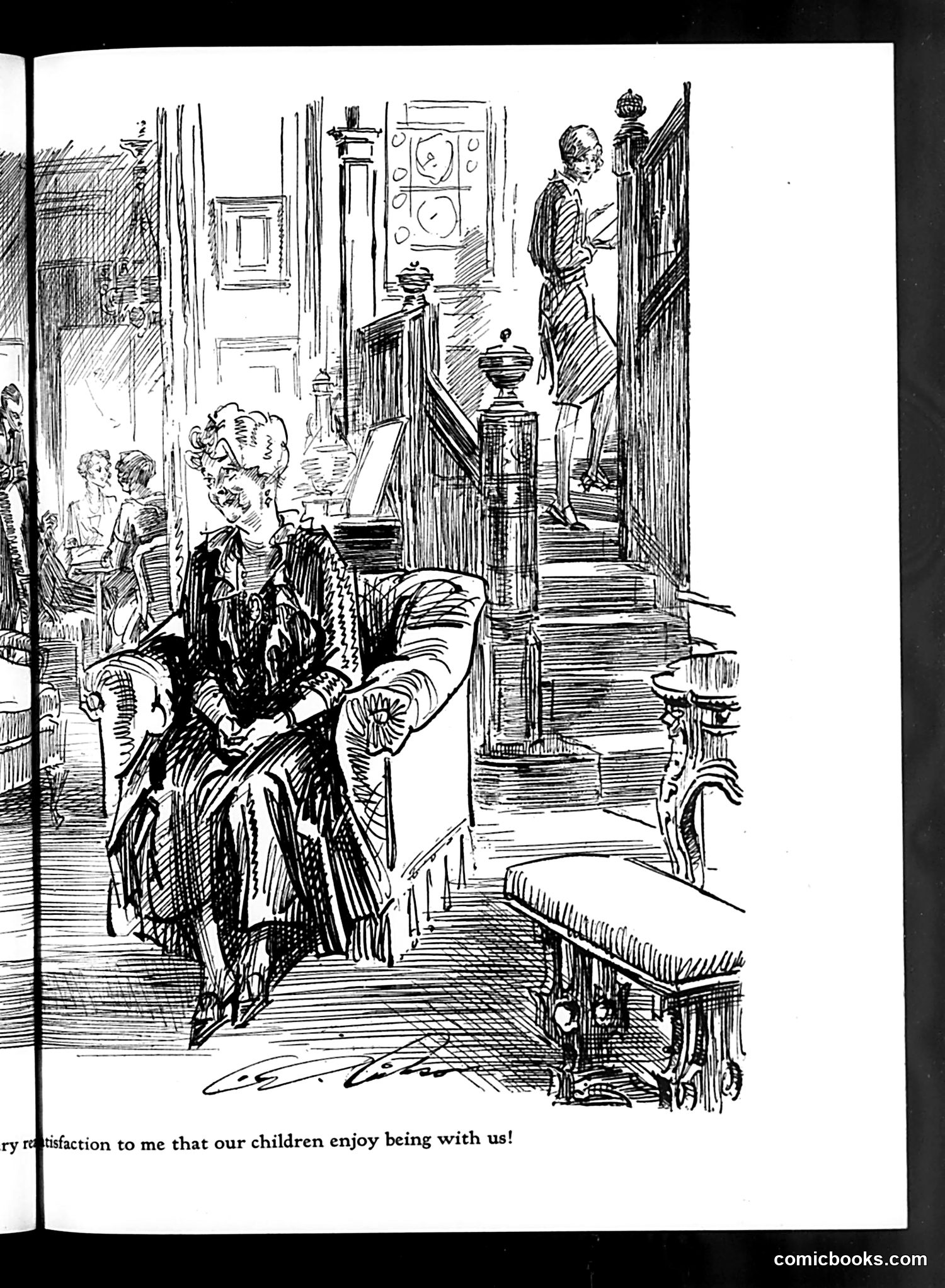
This pen-and-ink illustration depicts a domestic interior scene from what appears to be the late 19th or early 20th century. A well-dressed woman sits prominently in the foreground wearing elaborate clothing with detailed patterns. Behind her, other figures move through hallways and doorways of what seems to be an upper-class home, with period furnishings visible including decorative urns and elegant architectural details. The partial caption visible at bottom reads: "ry satisfaction to me that our children enjoy being with us!" This appears to satirize parental self-satisfaction or obliviousness—suggesting the speaker congratulates themselves on their children's contentment while the illustrated scene may imply the children are actually occupied with other activities or companions, not necessarily focused on their parents.
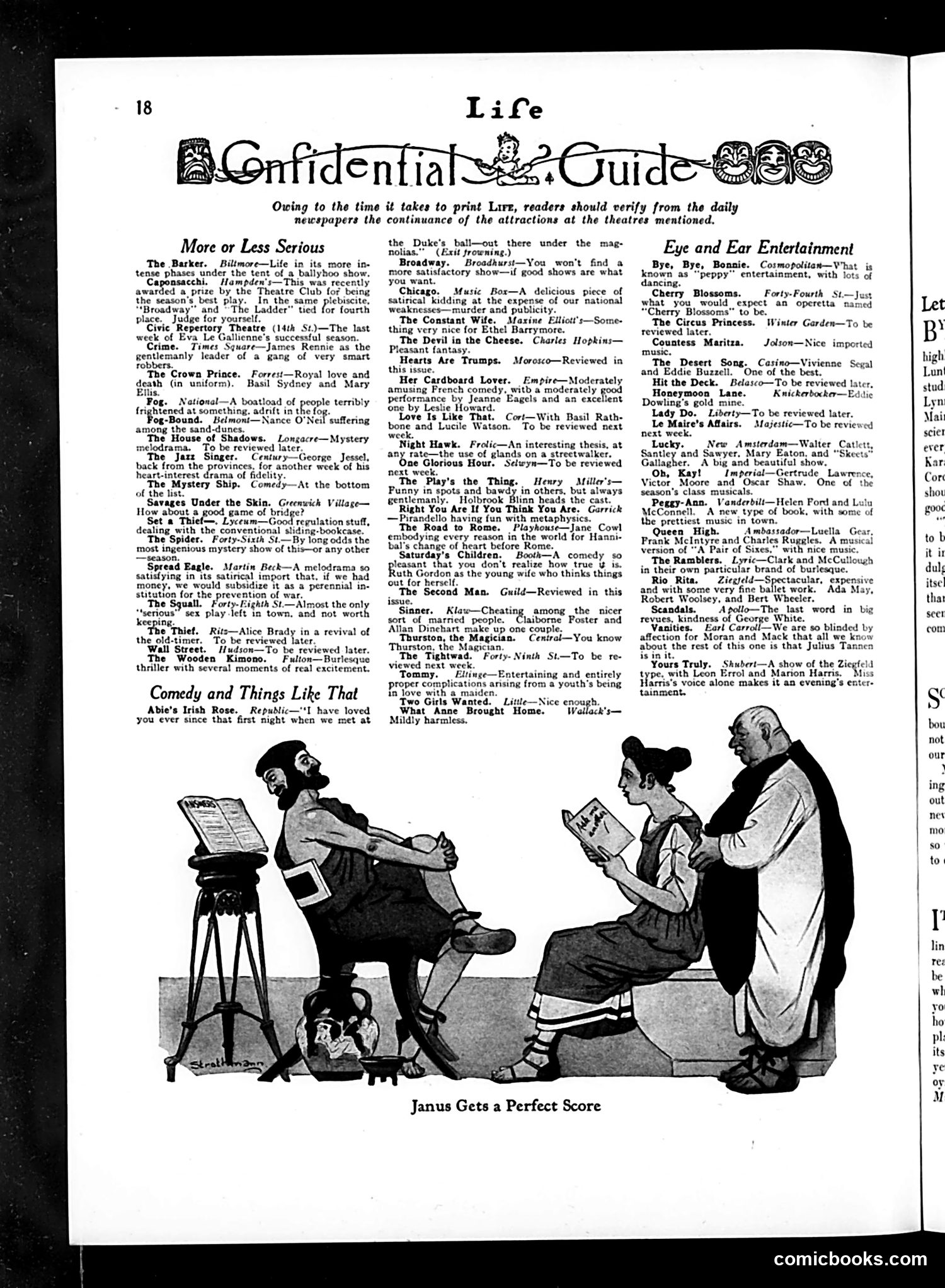
This page is a **theater review section** from Life magazine, listing current Broadway and off-Broadway productions with brief critical commentary. The illustration at bottom ("Janus Gets a Perfect Score") depicts a couple being scored by judges—a visual pun on theatrical reviewing itself. The reviews use Life's signature style: **witty, irreverent capsule critiques** aimed at sophisticated readers. Notably, "Spread Eagle" is praised as anti-war satire worthy of "subsidization as a perennial institution for the prevention of war"—reflecting post-WWI sentiment. "Chicago" is mocked for satirizing "our national weaknesses—murder and publicity," suggesting contemporary anxiety about crime and sensationalism. References to **Eva Le Gallienne, Jane Cowl, and Ethel Barrymore** indicate major theatrical stars of the era. "Abie's Irish Rose" and "Broadway" represent popular commercial theater. The tone is dismissive toward lighter fare ("at the bottom of the list") while praising clever satire and serious drama. This reflects the 1920s cultural divide between "serious" theater and mass entertainment.
This is a theater review column by Robert Benchley examining Broadway productions in 1929. The piece discusses: **Main subjects:** - The Theater Guild's repertory season, praising actors Alfred Lunt and Lynn Fontanne - "The Second Man," S.N. Behrman's comedy debut, which Benchley finds entertaining despite simple plot mechanics - Translation issues in French comedies adapted for American stages **The satire:** Benchley humorously critiques audience behavior—particularly how theatergoers laugh loudest at throwaway gag translations of foreign phrases (like "In Vino Veritas" becoming "when you're tight you tell your own name"), suggesting audiences enjoy feeling clever by recognizing the original language. He also mocks how actors in French farce adaptations artificially pitch their voices high and stiffly, apparently believing this sounds "more Frenchy." **Context for modern readers:** This reflects 1920s Broadway's heavy reliance on European theatrical imports and the common practice of adapting continental comedies for American audiences—often awkwardly.
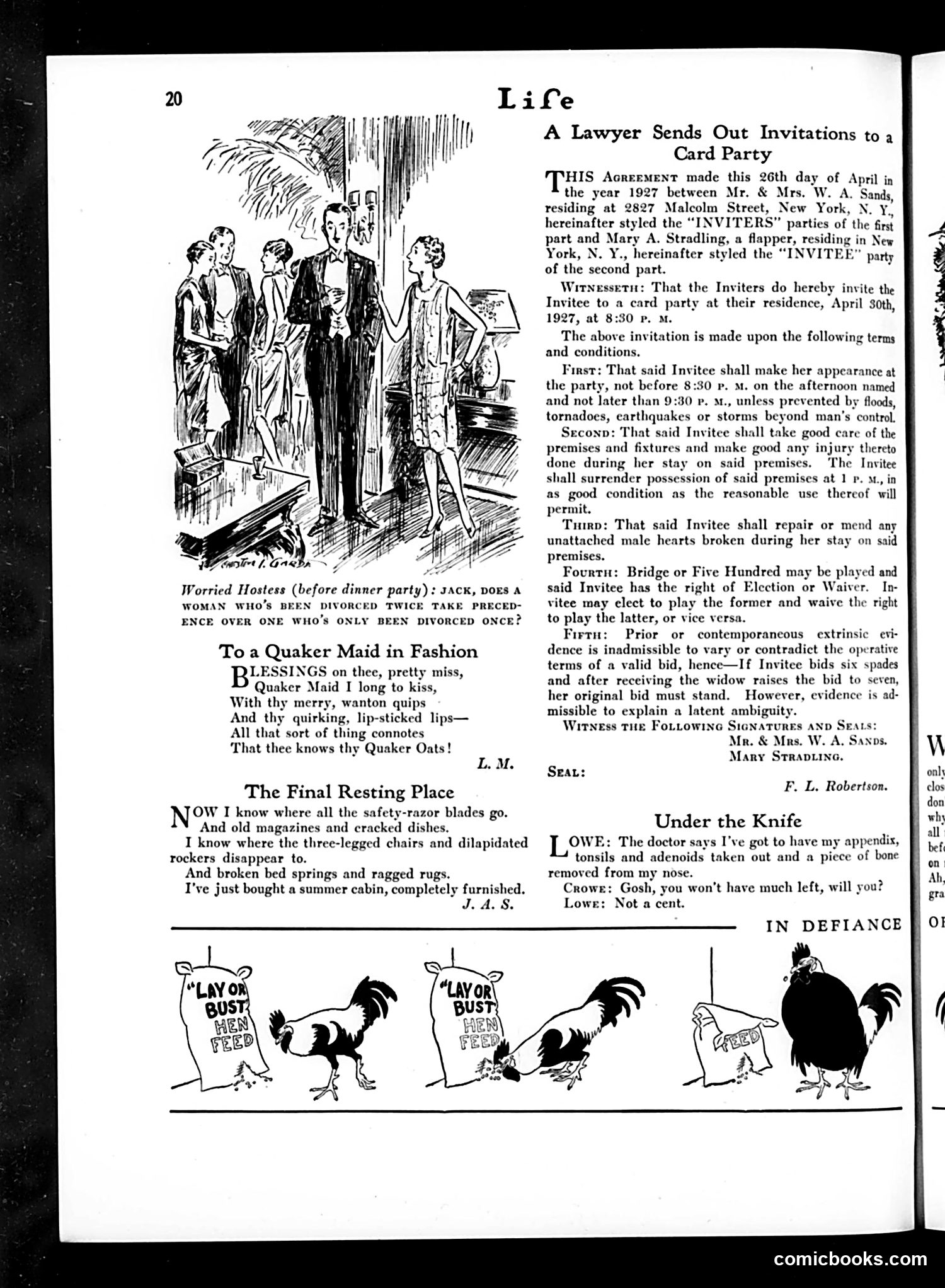
This 1927 *Life* page satirizes social anxieties of the Jazz Age era through humor about etiquette, divorce, and dating: **"Worried Hostess"** jokes about divorce's prevalence among the wealthy—a woman frets over seating precedence for twice-divorced versus once-divorced guests, treating serial divorce as a status category. **"Lawyer Sends Invitations to Card Party"** is the page's centerpiece: a lawyer issues a party invitation as a formal legal contract, complete with conditions (arrival times, property liability, the invitee must "repair" broken hearts). This satirizes both excessive legalism and the era's anxiety about young "flappers" (Mary Stradling) as potentially reckless guests. **"Under the Knife"** uses gallows humor about medical procedures—a man jokes he'll have nothing left after removing his appendix, tonsils, adenoids, and nose bone. **"In Defiance"** (bottom cartoon) appears to show a rooster defying something, likely labor-related (a "Lay Off" sign visible). The overall tone reflects 1920s anxieties: rapid social change, divorce normalization, flapper culture, and modernization's disorienting effects.
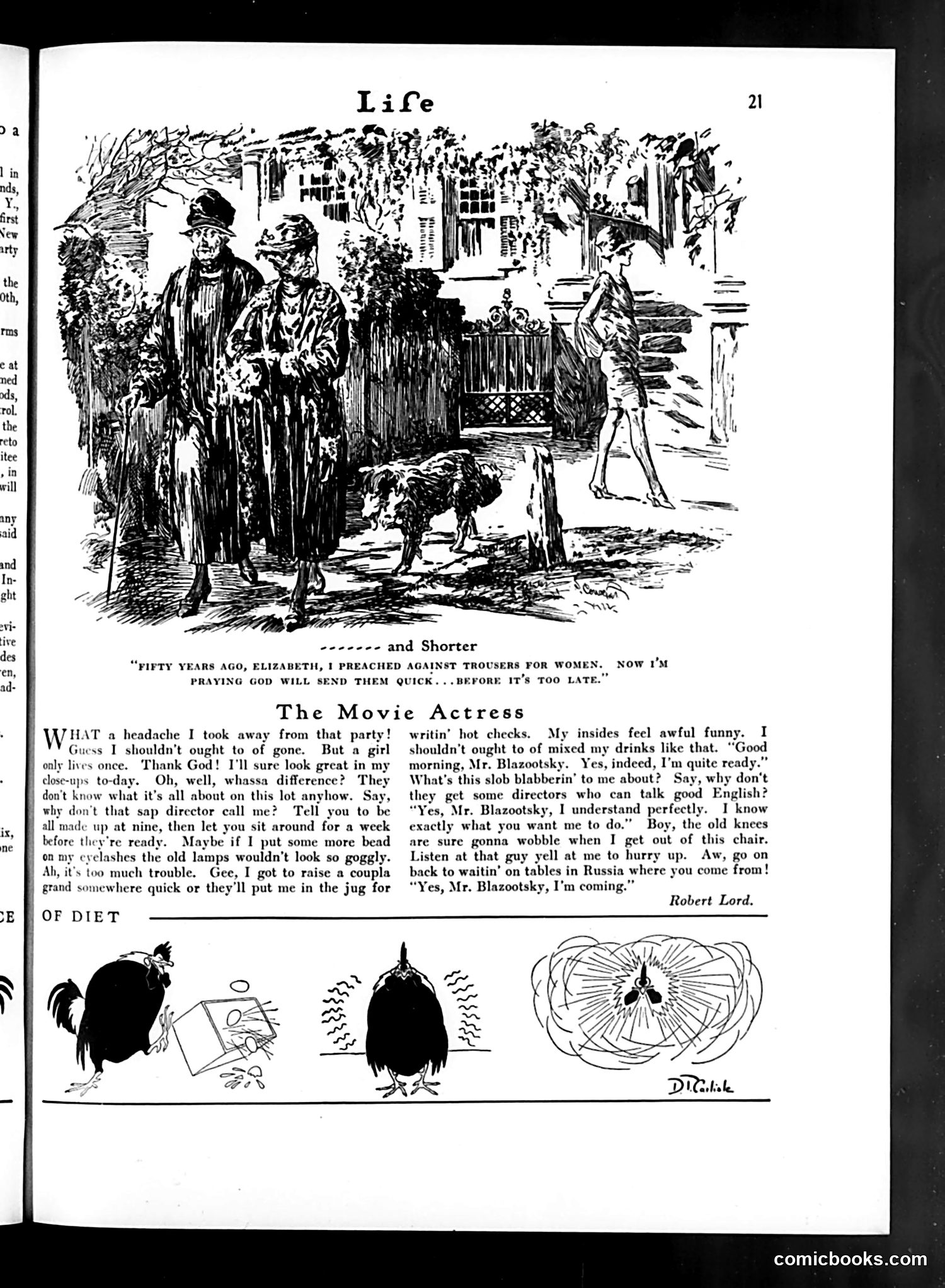
This page satirizes Hollywood's treatment of actresses and the gap between glamorous public image and private reality. **Main cartoon (top):** An elderly couple observes a young woman on a film set. The caption shows a reversal: fifty years ago the man preached against women wearing trousers; now he prays God will send them quickly—suggesting moral standards have collapsed so severely that even modest clothing seems preferable to current immodesty. **Article below:** Written as an actress's stream-of-consciousness monologue by Robert Lord, it mocks the superficiality and desperation of film actresses. She's hungover from a party, financially desperate (writing bad checks), physically uncomfortable, and verbally mistreated by a foreign director ("Mr. Blazootsky"), yet maintains a false professional demeanor. The satire exposes the actress as simultaneously vain about appearance, cynical about her craft, and trapped by circumstances. **Bottom cartoons:** Simple diet humor illustrations (unrelated to main content). The overall point critiques both Hollywood's exploitation of women and actresses' complicity through vanity and moral compromise.
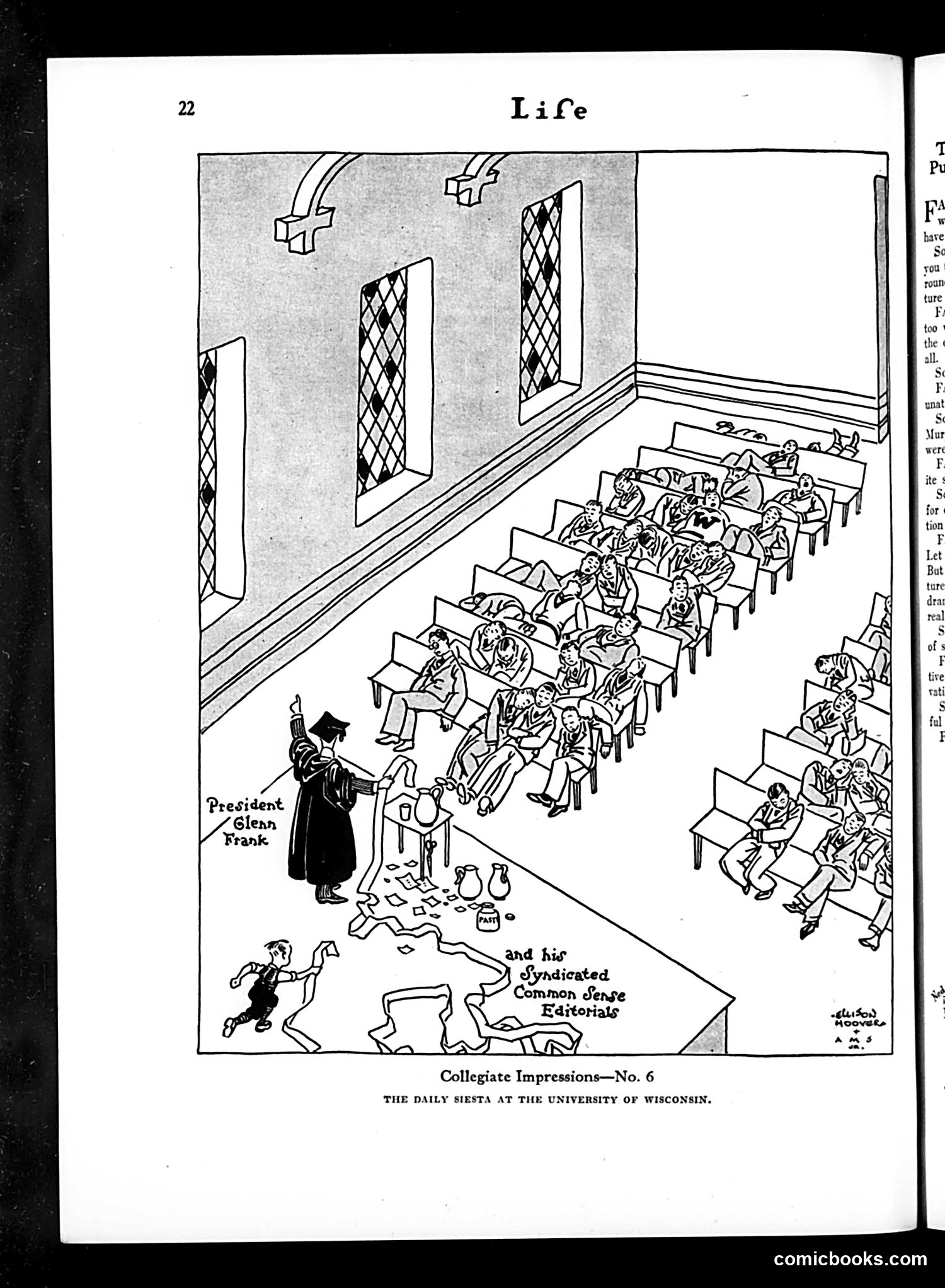
This satirical cartoon from *Life* magazine depicts "President Glenn Frank" addressing a lecture hall of university students. The figure at the podium appears to be Glenn Frank, likely a real public figure of the era, drawn in caricature style. The joke targets Frank's syndicated "common sense editorials"—referenced in the caption as appearing in multiple newspapers. The cartoon satirizes the gap between earnest academic lectures and their actual reception by students, who appear distracted or disengaged in their seats. The scattered papers and casual postures suggest students aren't absorbing Frank's message despite his authoritative position. The humor lies in mocking both Frank's pretensions as a moral authority and students' indifference to earnest public intellectuals attempting to educate them.
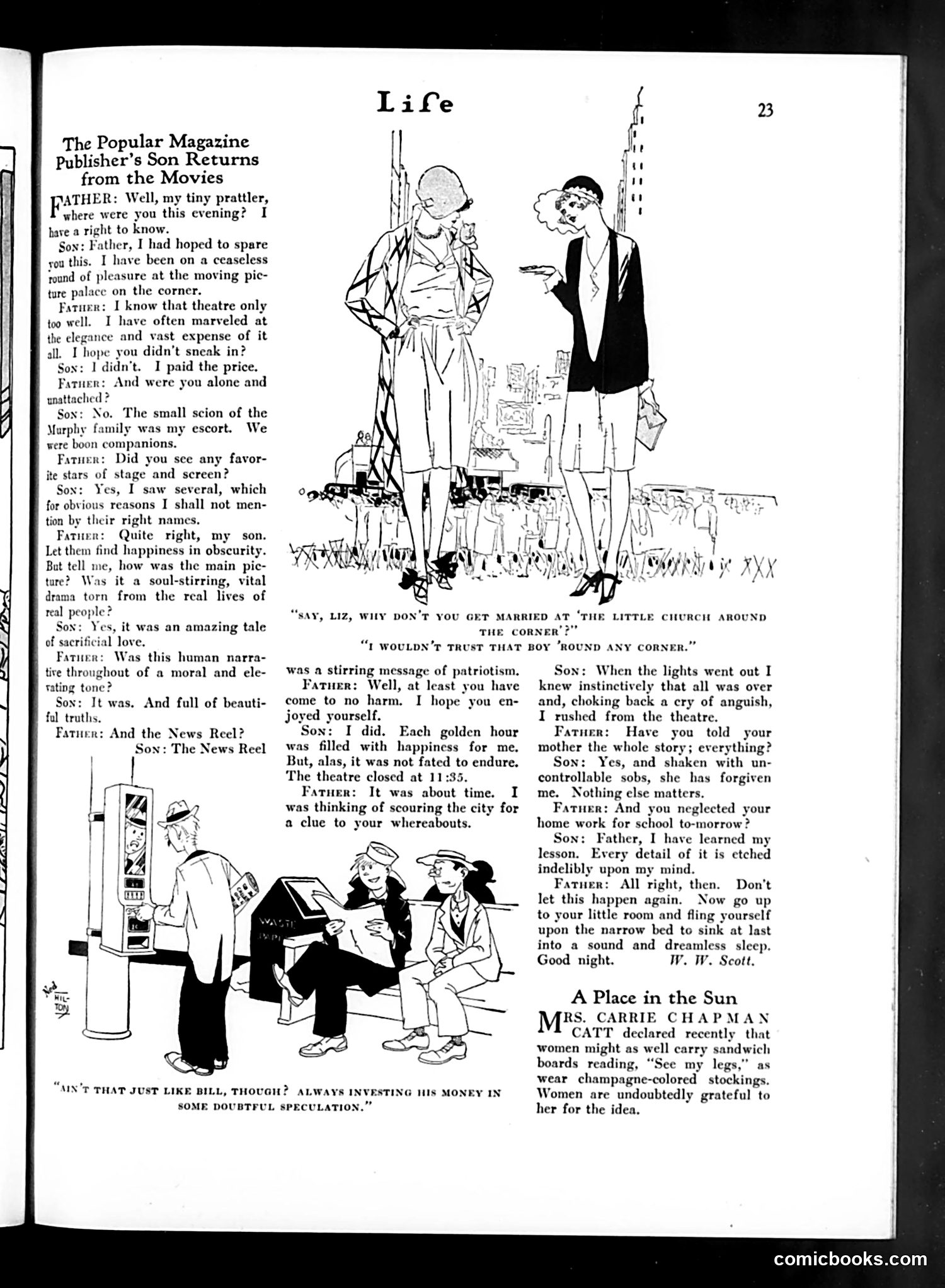
This satirical dialogue mocks the Victorian moral anxiety about cinema as a corrupting influence on youth. The father interrogates his son with exaggerated solemnity about an evening at "the moving picture palace," treating a simple theater visit as a potentially scandalous transgression. The humor lies in the son's pompous, flowery responses—describing the film as containing "sacrificial love" and "beautiful truths"—which parody both melodramatic silent films and the overwrought language used to discuss them. The father's relief that the boy came to "no harm" suggests contemporaries viewed movies with deep suspicion. The secondary cartoons satirize 1920s social types: a man making risky financial investments, and a woman wearing fashionable but controversial champagne-colored stockings (referenced in the Carrie Chapman Catt excerpt below). The overall message: Life magazine ridicules the older generation's hand-wringing over "modern" entertainment while gently mocking cinema's own dramatic pretensions.
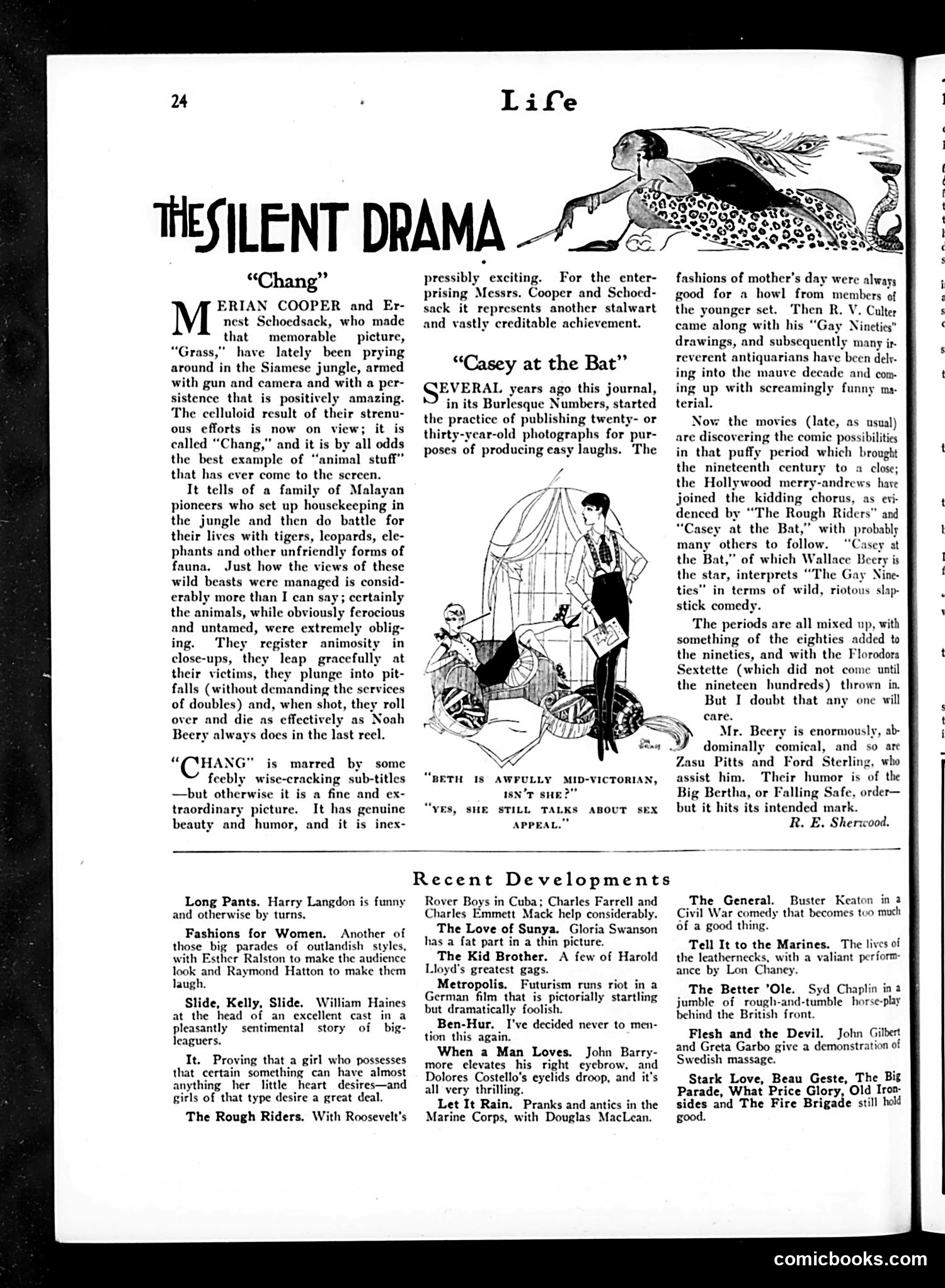
This page reviews silent films from the 1920s. The main article discusses "Chang," a wildlife adventure film by Cooper and Schoedsack about Malayan pioneers battling jungle animals. The reviewer praises it as exceptional "animal stuff" cinema, though notes the subtitle text is weak. The animals, while appearing genuinely ferocious, seem suspiciously cooperative—performing dramatic death scenes with the reliability of actor Noah Beery. The cartoon captioned "Beth is awfully mid-Victorian, isn't she?" satirizes outdated female propriety: Beth still discusses "sex appeal" in dated fashion, drawing laughter from modern audiences by contrast. The "Recent Developments" section briefly reviews other contemporary films, including "Casey at the Bat" (featuring Wallace Beery), which the reviewer critiques for confusingly mixing historical periods while delivering effective slapstick comedy. The page exemplifies how 1920s cinema was still developing as an art form, with reviewers noting both technical achievements and comedic timing.
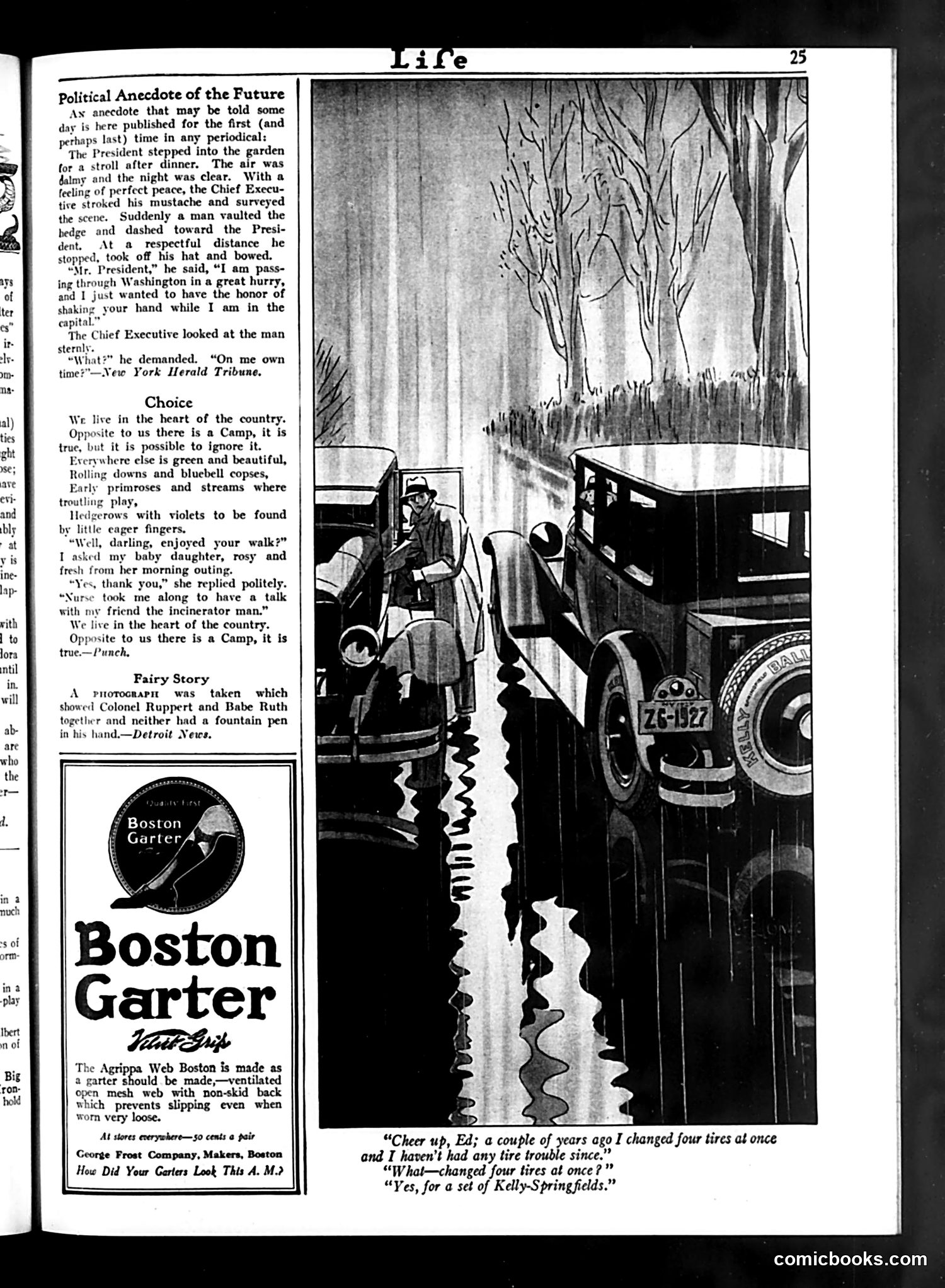
This page contains three satirical pieces and an advertisement: **"Political Anecdote of the Future"** imagines a scenario where a stranger vaults the presidential hedge to shake hands—presented as absurdly impossible in the future, suggesting increasing security or isolation of the presidency. **"Choice"** (from *Punch*) is a brief social commentary about a family living near a military camp. A child prefers visiting "the incinerator man" to enjoying the natural countryside, satirizing how industrial/wartime infrastructure intrudes upon and corrupts pastoral life. **"Fairy Story"** (from *Detroit News*) is a humorous non-sequitur: a photograph of Colonel Ruppert and Babe Ruth (famous baseball figures) is noteworthy *only* because neither held a fountain pen—mocking the era's obsession with promotional product placement in publicity photos. The **Boston Garter advertisement** occupies the lower left, typical of magazine monetization. The large cartoon below depicts motorists discussing tire changes, promoting Kelly-Springfields brand tires as reliable.
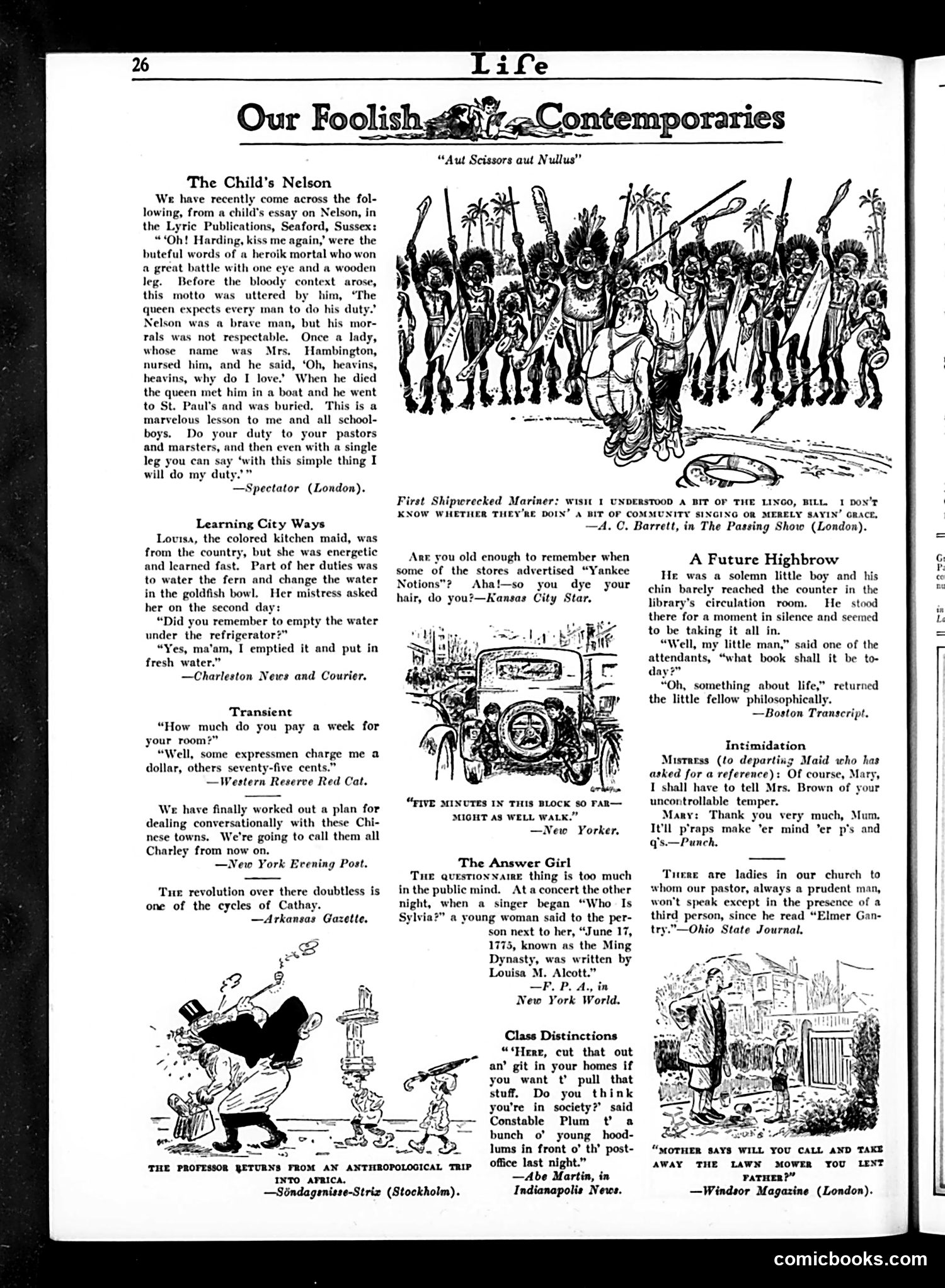
This page from *Life* magazine collects humorous anecdotes and satirical cartoons under "Our Foolish Contemporaries." **Key items:** 1. **"The Child's Nelson"**: Satirizes a schoolboy's garbled essay about Admiral Nelson, mocking poor education and spelling ("buteful," "morals"). 2. **"Learning City Ways"**: A Black domestic servant misunderstands instructions about emptying the refrigerator pan, highlighting urban/rural culture clash and the assumption of ignorance. 3. **Shipwrecked Mariner cartoon**: Two sailors observe Indigenous people singing/praying, unable to distinguish between religious ceremony and communal singing—colonial-era stereotyping. 4. **Various short jokes**: Mock contemporary absurdities (Chinese town names being called "Charley," questionnaire crazes, etc.). 5. **"Class Distinctions"**: A constable tells young hoodlums they're not in "society"—satirizing pretentious class consciousness. The page reflects early-20th-century *Life* humor: gentle mockery of educational failures, servant mishaps, cultural ignorance, and social pretension. Period-specific references assume reader familiarity with Nelson, "Yankee Notions," and contemporary advertisements.
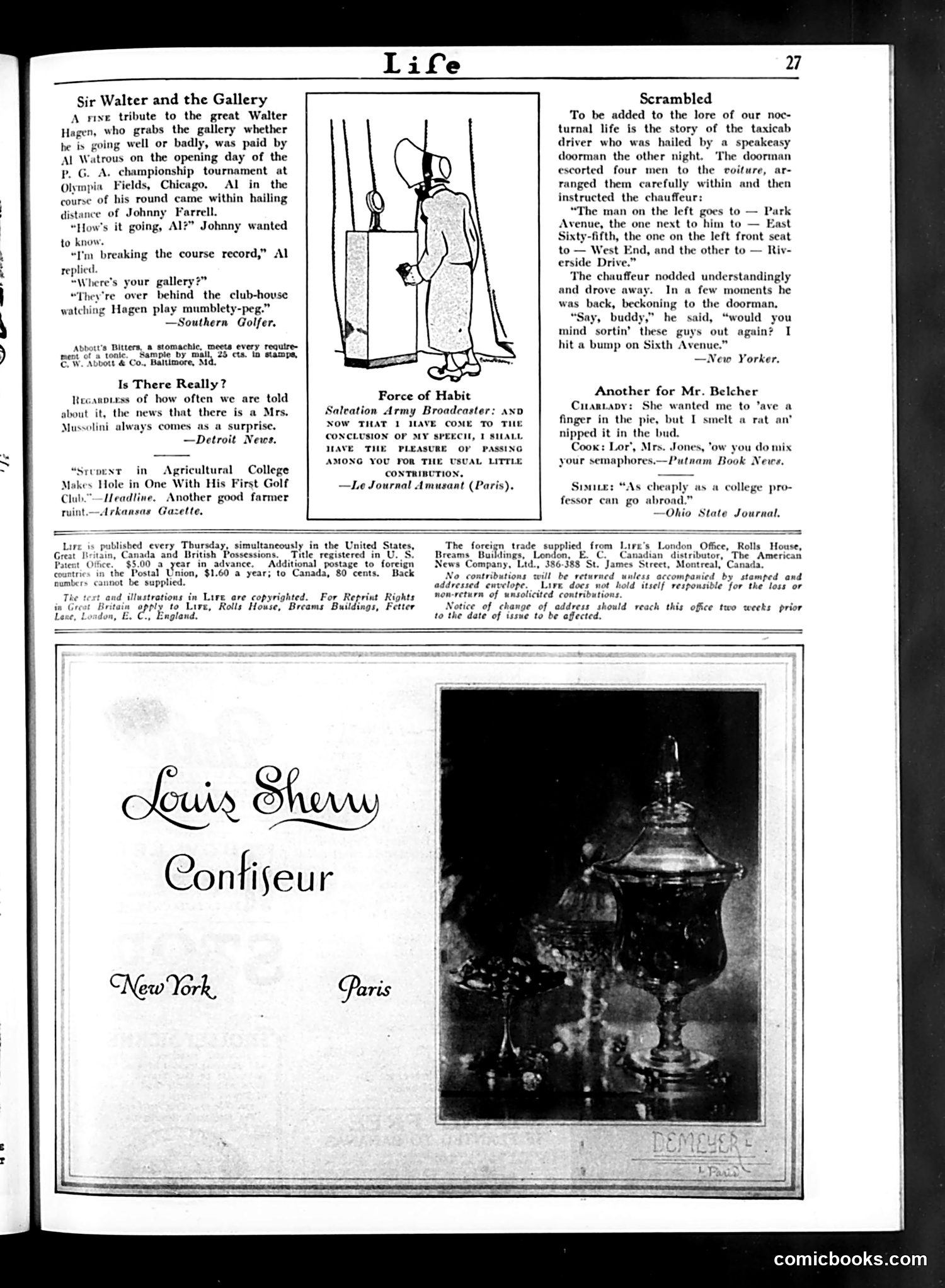
This page contains several brief humor items typical of Life's satirical style: **"Sir Walter and the Gallery"** jokes about golfer Walter Hagen's showmanship. The humor contrasts Hagen's ability to command spectators' attention even when playing poorly versus Johnny Farrell's lack of gallery appeal—the implication being that Hagen's charisma matters more than actual performance. **"Force of Habit"** satirizes the Salvation Army's fundraising practices by showing a broadcaster concluding his speech and immediately requesting donations, suggesting this is automatic procedure rather than genuine appeal. **"Scrambled"** presents a Prohibition-era joke about a speakeasy patron and taxi driver. The humor lies in the driver's inability to keep four drunk men separated after hitting a bump on Sixth Avenue—a commentary on 1920s nightlife and alcohol consumption. The remaining items are brief quips about agricultural college, Mrs. Mussolini, and college professors. At bottom is an advertisement for Louis Sherry Confiseur. These are standard Life magazine filler content.
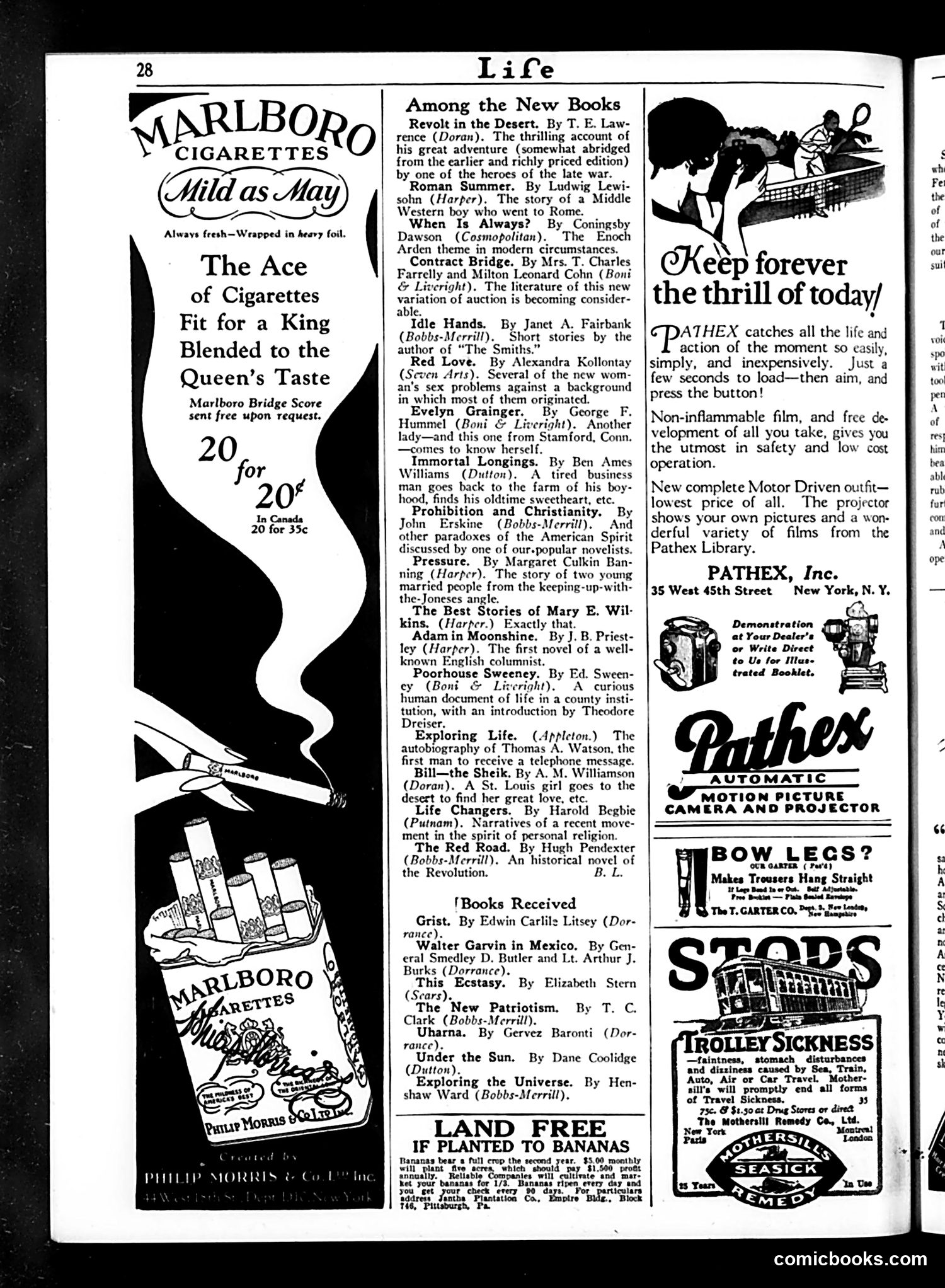
This is primarily a **book review and advertising page** from Life magazine (likely 1920s based on references to Prohibition and post-WWI titles). The **left side features a Marlboro cigarette advertisement**, showing cigarettes emerging from a pack with elegant styling. The tagline "Fit for a King / Blended to the Queen's Taste" emphasizes luxury and sophistication—a marketing approach common in this era before cigarette health warnings. The **center contains book reviews**, listing new publications including T.E. Lawrence's "Revolt in the Desert" (his famous WWI memoir) and works addressing contemporary social issues like Prohibition, Contract Bridge (a newly popular card game), and modern relationships. The **right side displays consumer product ads**: Pathex movie cameras and projectors, remedies for "bow legs" and "trolley sickness" (motion sickness from streetcars—a real concern in the 1920s), and a banana plantation investment scheme. This page reflects 1920s consumer culture, post-war literature interests, and the advertising conventions of the era. No political satire is evident—it's a standard magazine page.
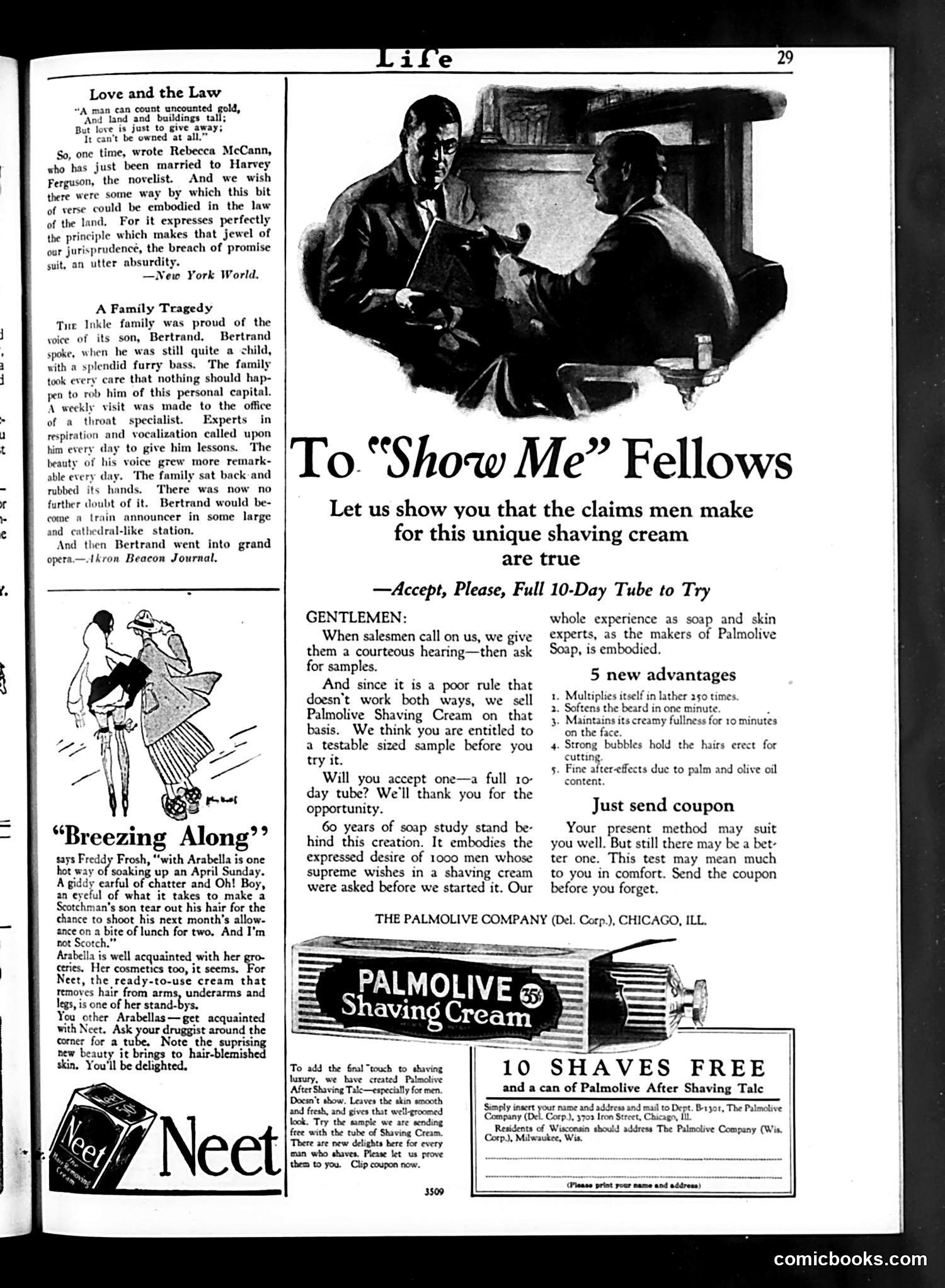
This page contains three distinct sections: **"Love and the Law"** discusses a quote from Rebecca McCann (newly married to novelist Harvey Ferguson) critiquing breach-of-promise lawsuits as absurd—arguing love cannot be legally owned or compensated. **"A Family Tragedy"** humorously recounts the Inkle family's investment in their son Bertrand's singing voice through expensive training, only to see him pursue grand opera instead of becoming a train announcer—implying this was a wasteful outcome. **"Breezing Along"** is a lighthearted dating anecdote about a college student named Freddy Frosh courting a woman named Arabella, noting her use of Neet hair-removal cream. The remainder is advertising: two full-page product pitches for **Palmolive Shaving Cream** (offering free samples) and **Neet** hair-removal cream, typical of magazine monetization in this era. These ads target male and female readers respectively through humor and testimonial-style copy.
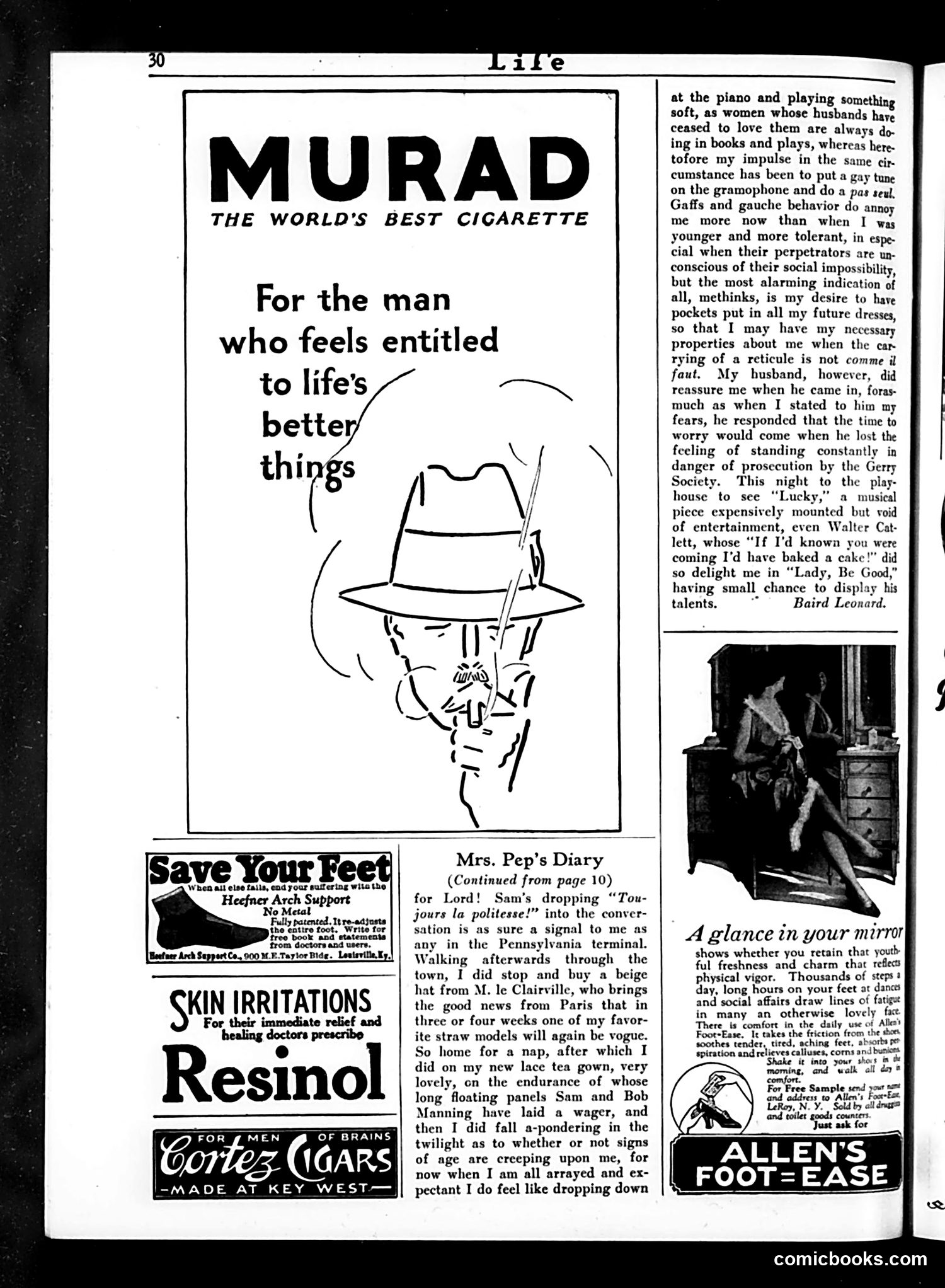
This page is primarily **advertising**, featuring cigarette, foot care, and skin remedy ads alongside a gossip column called "Mrs. Pep's Diary." **The Murad Cigarette Advertisement** (top) uses class-based messaging: it targets affluent men who see themselves as deserving "life's better things," positioning premium cigarettes as a luxury marker. The illustration shows a satisfied gentleman in a fedora. **Mrs. Pep's Diary** (right column) is a satirical society column chronicling the anxieties of a wealthy woman concerned with aging, fashion, and social propriety. References include the "Gerry Society" (a real child-welfare organization known for moral policing), mentions of Paris fashions, and theatrical gossip about performer Walter Catlett. The humor lies in her self-absorbed worries—pockets in dresses, signs of aging—presented with exaggerated earnestness. The remaining ads for foot supports, skin salve, and cigars target similar upper-middle-class readers concerned with appearance and status. The page reflects 1920s consumer culture and gender anxiety about aging and respectability.
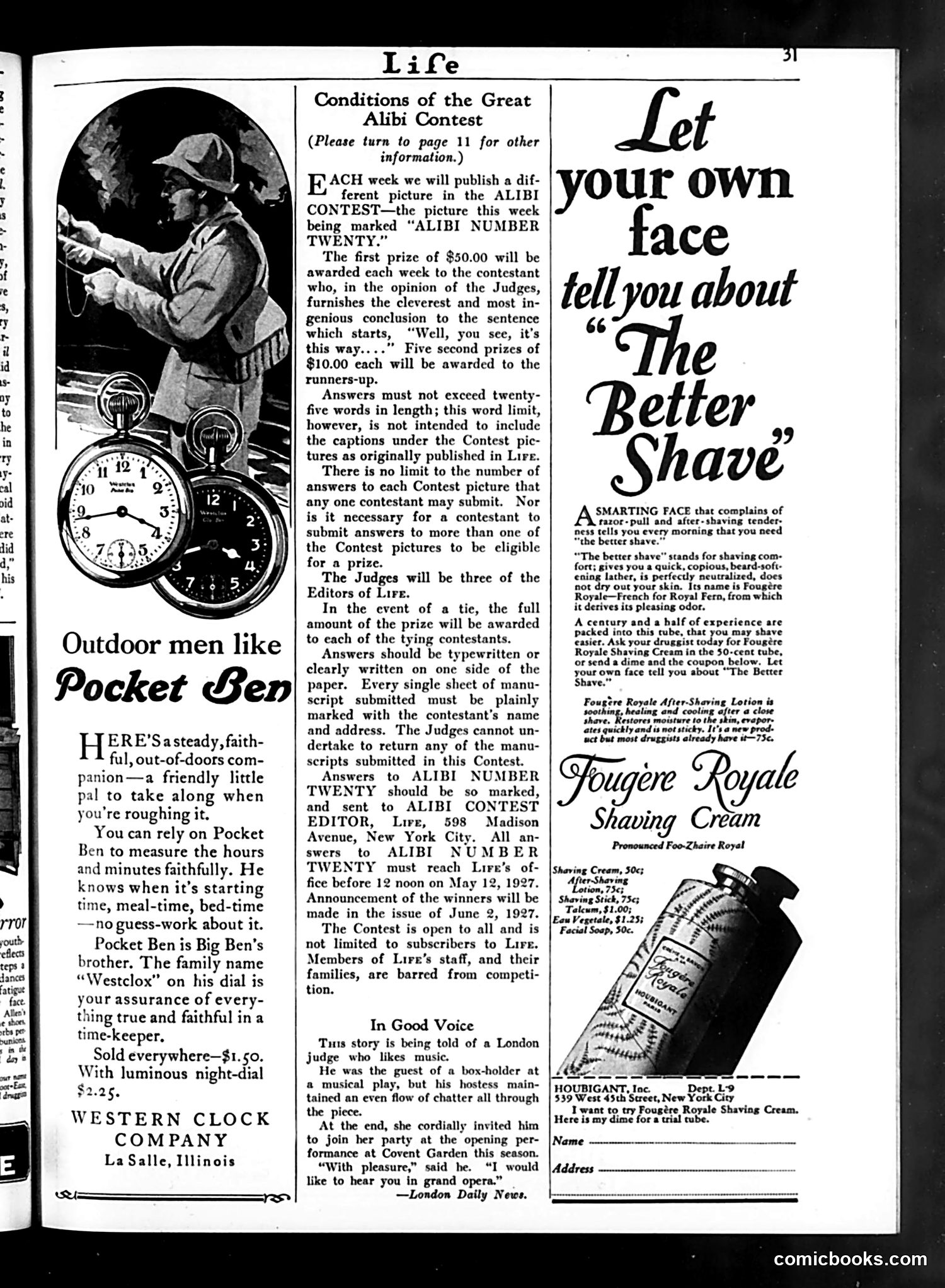
This page contains primarily **advertisements and contest information**, not political satire. The main content is Life magazine's "Great Alibi Contest," inviting readers to complete humorous sentences beginning "Well, you see, it's this way...." for weekly prizes ($50 first place, $10 second places). Answers limited to 25 words, deadline May 12, 1927. The advertisements include: - **Pocket Ben** pocket watch by Western Clock Company—marketed to "outdoor men" as a reliable timekeeper for "roughing it" - **Fougère Royale Shaving Cream**—emphasizing comfort and a quality shave A brief humor item, "In Good Voice," mocks a chatty London woman at a theater; when she invites a judge to hear her sing opera, he replies he'd "like to hear you in grand opera"—implying she should sing there instead of talking. The page reflects 1920s consumer culture and genteel humor rather than political commentary.
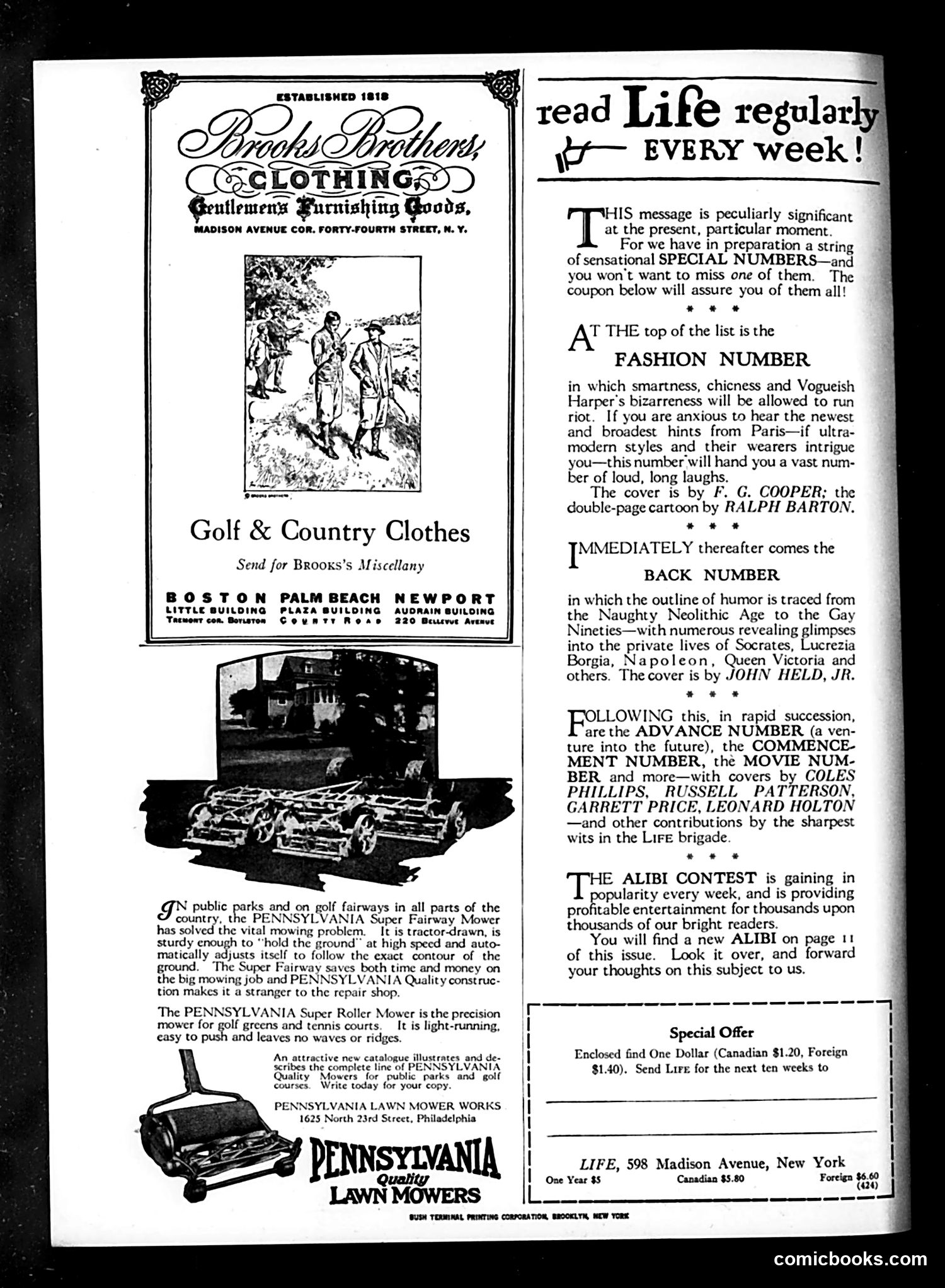
This is primarily a **promotional/advertising page** for Life magazine itself, not a political cartoon page. The text announces upcoming special issues Life plans to publish, featuring satirical content on fashion, history, and contemporary society. **Key upcoming issues mentioned:** - **Fashion Number**: Features fashion satire by cartoonist Ralph Barton, mocking Harper's Bazaar's avant-garde styling - **Back Number**: Historical humor tracing comedy from "Naughty Neolithic Age to Gay Nineties," with glimpses into figures like Socrates, Napoleon, and Queen Victoria - Additional numbered issues covering movies, commencement, and the future The page also promotes Life's **"Alibi Contest"**—a humor competition where readers submit alibis, apparently a popular recurring feature. The advertisements (Brooks Brothers clothing, Pennsylvania lawn mowers) are incidental to the main message: Life is positioning itself as America's premier satirical publication with upcoming special issues readers shouldn't miss.

I can see this is a very dark, high-contrast image from what appears to be a historical publication. The page is predominantly black with minimal visible content—just a single small bright spot (possibly the moon or a light source) visible in the upper left portion, and some darker tonal variations on the right side that might suggest lunar surface features or craters. However, the image quality and extreme darkness make it impossible for me to reliably identify any cartoon figures, read text, or determine specific political or social references. Without being able to see the actual content clearly, I cannot accurately explain what satire or joke is being made, or identify any caricatures present. I can only confirm this appears to be from a historical publication based on the "comicbooks.com" credit line visible.