
Life, 1927-04-28 · page 21 of 35
Life — April 28, 1927 — page 21: what you’re looking at
What you’re looking at
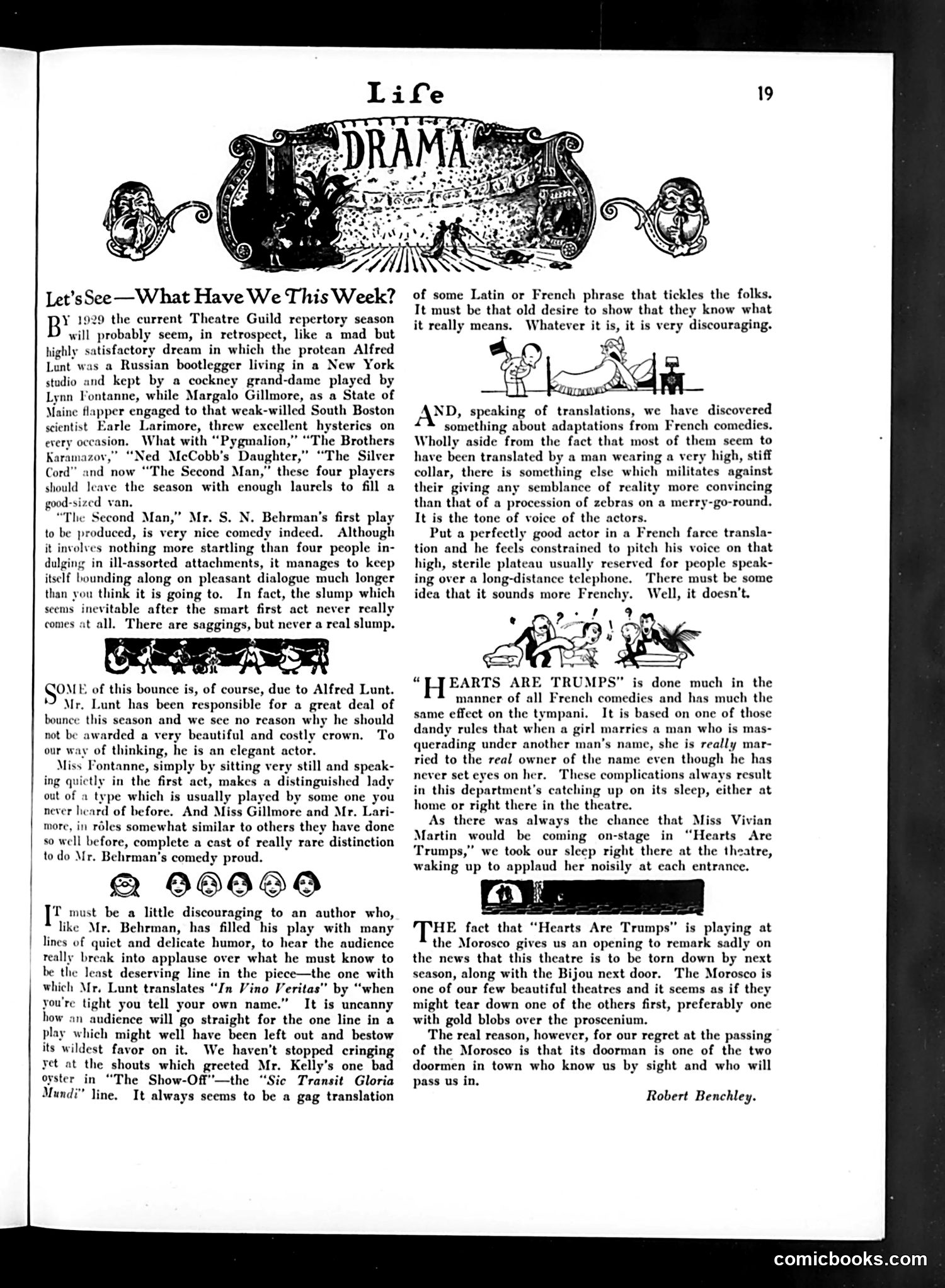
This is a theater review column by Robert Benchley examining Broadway productions in 1929. The piece discusses: **Main subjects:** - The Theater Guild's repertory season, praising actors Alfred Lunt and Lynn Fontanne - "The Second Man," S.N. Behrman's comedy debut, which Benchley finds entertaining despite simple plot mechanics - Translation issues in French comedies adapted for American stages **The satire:** Benchley humorously critiques audience behavior—particularly how theatergoers laugh loudest at throwaway gag translations of foreign phrases (like "In Vino Veritas" becoming "when you're tight you tell your own name"), suggesting audiences enjoy feeling clever by recognizing the original language. He also mocks how actors in French farce adaptations artificially pitch their voices high and stiffly, apparently believing this sounds "more Frenchy." **Context for modern readers:** This reflects 1920s Broadway's heavy reliance on European theatrical imports and the common practice of adapting continental comedies for American audiences—often awkwardly.
📄 Transcribed text from this page (OCR, searchable)
Machine-transcribed from the original scan — historical spelling and the odd misread are preserved.
Let’sSee—What Have We This Week? B* 1929 the current Theatre Guild repertory season will probably seem, in retrospect, like a mad but highly satisfactory dream in which the protean Alfred Lunt was a Russian bootlegger living in a New York studio and kept by a cockney grand-dame played by Lynn Fontanne, while Margalo Gillmore, as a State of Maine flapper engaged to that weak-willed South Boston scientist Earle Larimore, threw excellent hysterics on ion. What with “Pygmalion,” “The Brothers Karamazov,” “Ned McCobb’s Daughter,” “The Silver Cord” and now “The Second Man,” these four players should leave the season with enough laurels to fill a good-sized van, “The Second Man,” Mr. S. N. Behrman’s first play to be produced, is very nice comedy indeed. Although it involves nothing more startling than four people in- dulging in ill-assorted attachments, it manages to keep itself bounding along on pleasant dialogue much longer than you think it is going to. In fact, the slump which seems inevitable after the smart first act never really comes at all. There are saggings, but never a real slump. eS Some of this bounce is, of course, due to Alfred Lunt. ‘“ Mr. Lunt has been responsible for a great deal of bounce this season and we see no reason why he should not be awarded a very beautiful and costly crown. To our way of thinking, he is an elegant actor. Miss Fontanne, simply by sitting very still and speak- ing quictly in the first act, makes a distinguished lady | out of a type which is usually played by some one you never heard of before. And Miss Gillmore and Mr. Lari- more, in roles somewhat similar to others they have done so well before, complete a cast of really rare distinction todo Mr. Behrman’s comedy proud. QA Y9O8OHHH I" must be a little discouraging to an author who, like Mr. Behrman, has filled his play with many lines of quict and delicate humor, to hear the audience really break into applause over what he must know to be the least deserving line in the piece—the one with which Mr, Lunt translates “In Vino Veritas” by “when you're tight you tell your own name.” It is uncanny how an audience will go straight for the one line in a play which might well have been left out and bestow its wildest favor on it. We haven't stopped cringing yet at the shouts which greeted Mr. Kelly's one bad oyster in “The Show-Off’—the “Sic Transit Gloria Mundi” line. Tt always seems to be a gag translation of some Latin or French phrase that tickles the folks. It must be that old desire to show that they know what it really means. Whatever it is, it is very discouraging. AND: speaking of translations, we have discovered something about adaptations from French comedies. Wholly aside from the fact that most of them seem to have been translated by a man wearing a very high, stiff collar, there is something else which militates against their giving any semblance of reality more convincing than that of a procession of zebras on a merry-go-round, It is the tone of voice of the actors. Put a perfectly good actor in a French farce transla- tion and he feels constrained to pitch his voice on that high, sterile plateau usually reserved for people speak- ing over a long-distance telephone. There must be some idea that it sounds more Frenchy. Well, it doesn’t. & EARTS ARE TRUMPS” is done much in the manner of all French comedies and has much the same effect on the tympani. It is based on one of those dandy rules that when a girl marries a man who is mas- querading under another man’s name, she is really mar- ried to the real owner of the name even though he has never set eyes on her. These complications always result in this department's catching up on its sleep, either at home or right there in the theatre. As there was always the chance that Miss Vivian Martin would be coming on-stage in “Hearts Are Trumps,” we took our sleep right there at the theatre, waking up to applaud her noisily at each entrance, 'HE fact that “Hearts Are Trumps” is playing at the Morosco gives us an opening to remark sadly on the news that this theatre is to be torn down by next season, along with the Bijou next door. The Morosco is one of our few beautiful theatres and it seems as if they might tear down one of the others first, preferably one with gold blobs over the proscenium. The real reason, however, for our regret at the passing of the Morosco is that its doorman is one of the two doormen in town who know us by sight and who will pass us in, Robert Benchley. comicbooks.com