
Life, 1927-04-28 · page 28 of 35
Life — April 28, 1927 — page 28: what you’re looking at
What you’re looking at
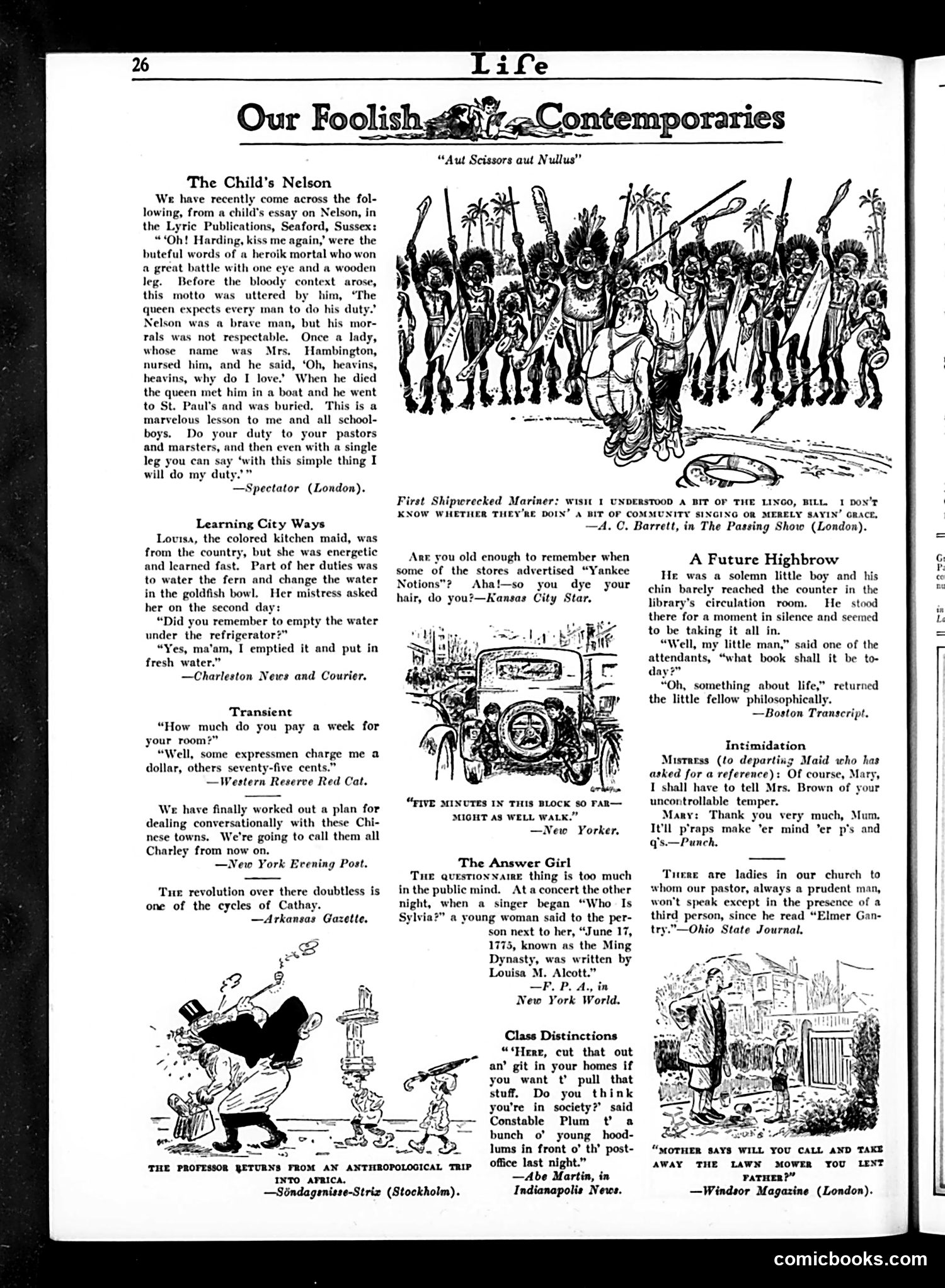
This page from *Life* magazine collects humorous anecdotes and satirical cartoons under "Our Foolish Contemporaries." **Key items:** 1. **"The Child's Nelson"**: Satirizes a schoolboy's garbled essay about Admiral Nelson, mocking poor education and spelling ("buteful," "morals"). 2. **"Learning City Ways"**: A Black domestic servant misunderstands instructions about emptying the refrigerator pan, highlighting urban/rural culture clash and the assumption of ignorance. 3. **Shipwrecked Mariner cartoon**: Two sailors observe Indigenous people singing/praying, unable to distinguish between religious ceremony and communal singing—colonial-era stereotyping. 4. **Various short jokes**: Mock contemporary absurdities (Chinese town names being called "Charley," questionnaire crazes, etc.). 5. **"Class Distinctions"**: A constable tells young hoodlums they're not in "society"—satirizing pretentious class consciousness. The page reflects early-20th-century *Life* humor: gentle mockery of educational failures, servant mishaps, cultural ignorance, and social pretension. Period-specific references assume reader familiarity with Nelson, "Yankee Notions," and contemporary advertisements.
📄 Transcribed text from this page (OCR, searchable)
Machine-transcribed from the original scan — historical spelling and the odd misread are preserved.
Our Foolis The Child’s Nelson We have recently come across the fol- lowing, from a child’s essay on Nelson, in the Lyric Publications, Seaford, Sussex: “‘Oh! Harding, kiss me again, were the buteful words of a heroik mortal who won a great battle with one eye and a wooden leg. Before the bloody context arose, this motto was uttered by him, “The queen expects every man to do his duty. Nelson was a brave man, but his mor- rals was not respectable. Once a lady, whose name was Mrs. Hambington, nursed him, and he said, ‘Oh, heavins, heavins, why do I love.’ When he died the queen met him in a boat and he went to St. Paul’s and was buried. This is a marvelous lesson to me and all school- boys. Do your duty to your pastors and marsters, and then even with a single leg you can say ‘with this simple thing I will do my duty.” —Spectator (London). Learning City Ways Louisa, the colored kitchen maid, was from the country, but she was energetic and learned fast. Part of her duties was to water the fern and change the water in the goldfish bowl. Her mistress asked her on the second day: “Did you remember to empty the water under the refrigerator?” “Yes, ma'am, I emptied it and put in fresh water.” —Charleston News and Courier. Transient “How much do you pay a week for your room?” “Well, some expressmen charge me a dollar, others seventy-five cents.” —Western Reserve Red Cat. We have finally worked out a plan for dealing conversationally with these Chi- nese towns, We're going to call them all Charley from now on. —New York Evening Post. Tur. revolution over there doubtless is one of the cycles of Cathay. —Arkansas Gazette. THE PROFESSOR BETURNS FROM AN ANTHROPOLOGICAL TRIP INTO AFRICA, —Séndagsnisse-Striz (Stockholm). “Aut Scissors aut Nullus” mtemporaries First Shipwrecked Mariner: wisit 1 UNDERSTOOD A BIT OF THE LINGO, BILL. 1 DON'T KNOW WHETHER THEY'RE DOIN’ A BIT OF COMMUNITY SINGING OR MERELY SAYIN’ GRACE, —A. C. Barrett, in The Passing Show (London). Are you old enough to remember when some of the stores advertised “Yankee Notions"? Aha!—so you dye your hair, do you?—Kansas City Star. “FIVE MINUTES IN THIS BLOCK 80 FAR— MIGHT AS WELL WALK.” —New Yorker, The Answer Girl Tue qurstionnaire thing is too much in the public mind. At a concert the other night, when a singer began “Who Is Sylvia?” a young woman said to the per- son next to her, “June 17, 1775, known as the Ming Dynasty, was written by Louisa M. Alcott.” —F. P. A,, in New York World. Class Distinctions “‘Here, cut that out an’ git in your homes if you want t’ pull that stuff. Do you think you're in society?’ said Constable Plum t? a bunch 0’ young hood- lums in front o’ th’ post- office last night.” —Abe Martin, in Indianapolis News. A Future Highbrow He was a solemn little boy and his chin barely reached the counter in the library's circulation room. He stood there for a moment in silence and seemed to be taking it all in. “Well, my little man,” said one of the attendants, “what book shall it be to- day?” “Oh, something about life,” returned the little fellow philosophically. —Boston Transcript. Intimidation Mistarss (to departing Maid who has asked for a reference): Of course, Mary, I shall have to tell Mrs. Brown of your uncontrollable. temper. Mary: Thank you very much, Mum. It'll p'raps make ‘er mind ’er p's and q's.—Punch. Turre are ladies in our church to whom our pastor, always a prudent man, won't speak except in the presence of a third person, since he read “Elmer Gan- try.”"—Ohio State Journal. “MOTHER SAYS WILL YOU CALL AND TAKE AWAY THE LAWN MOWER YOU LENT PaTHER?” —Windsor Magazine (London). comicbooks.com