
Life, 1927-04-28 · page 16 of 35
Life — April 28, 1927 — page 16: what you’re looking at
What you’re looking at
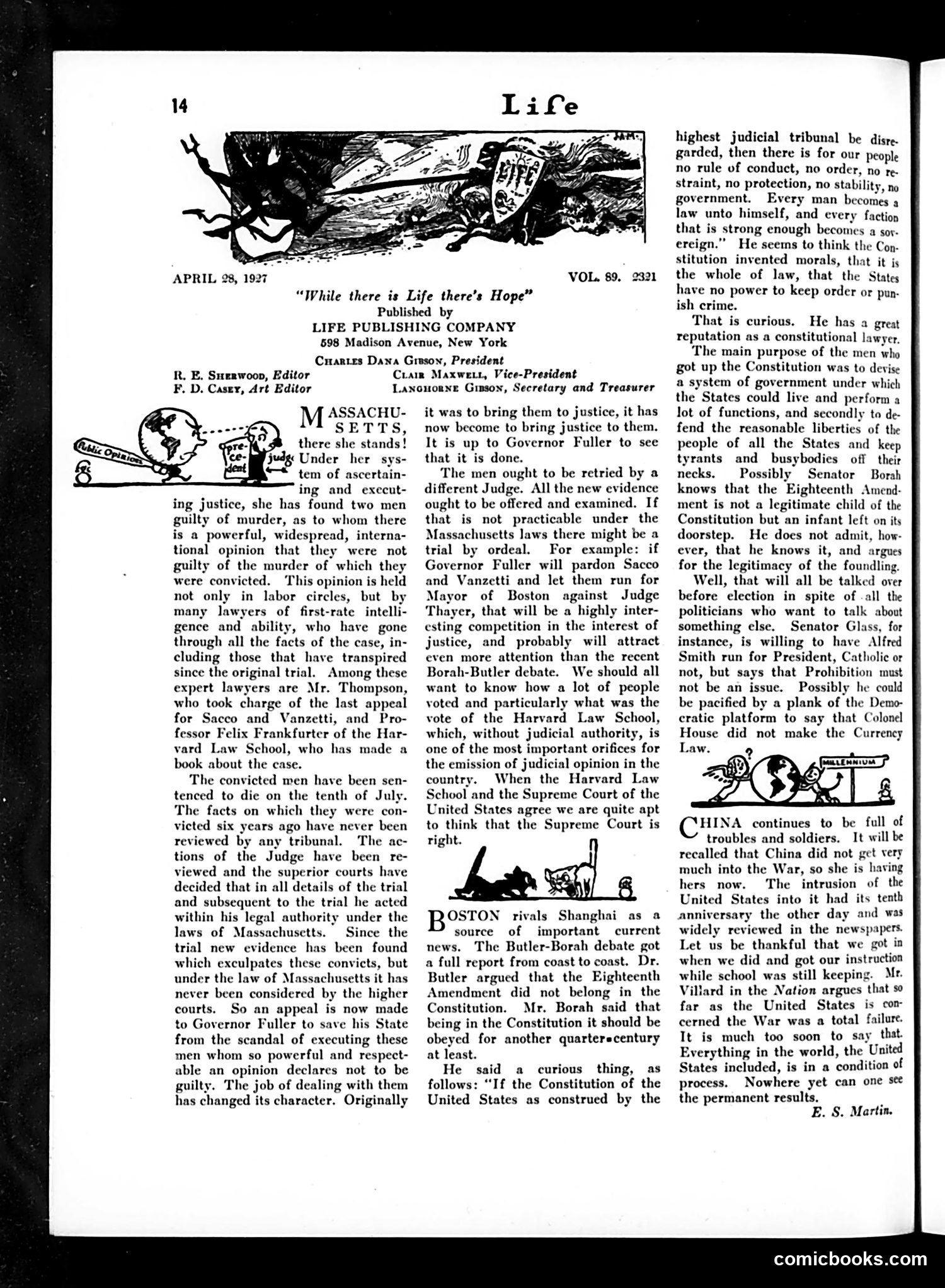
This page discusses the Sacco and Vanzetti case, wherein two men were convicted of murder in Massachusetts. The article critiques Governor Fuller's potential pardon of the convicts, noting the case has attracted significant attention among legal experts and intellectuals. The text references a debate between Dr. Butler and Mr. Borah regarding whether the Eighteenth Amendment (Prohibition) belongs in the Constitution—suggesting the broader constitutional question of governmental authority. The small cartoon at bottom right depicts China as troubled and militaristic, commenting on U.S. involvement there. The overall thrust criticizes judicial processes, executive power, and questions whether American institutions adequately protect citizens' liberties against both tyranny and disorder.
📄 Transcribed text from this page (OCR, searchable)
Machine-transcribed from the original scan — historical spelling and the odd misread are preserved.
APRIL 28, 1927 VOL. 89. 2321 “While there is Life there’s Hope” Published by LIFE PUBLISHING COMPANY 598 Madison Avenue, New York Cuartes Dana Gruson, President R. E. Suerwoop, Editor F. D. Casey, Art Editor M ASSACHU- SETTS, §8 there she stands! judg Under her sys- s—* tem of ascertain- ing and execut- ing justice, she has found two men guilty of murder, as to whom there is a powerful, widespread, interna- tional opinion that they were not guilty of the murder of which they were convicted. This opinion is held not only in labor circles, but by many lawyers of first-rate intelli- gence and ability, who have gone through all the facts of the case, in- cluding those that have transpired since the original trial. Among these expert lawyers are Mr. Thompson, who took charge of the last appeal for Sacco and Vanzetti, and Pro- fessor Felix Frankfurter of the Har- vard Law School, who has made a book about the case. The convicted men have been sen- tenced to die on the tenth of July. The facts on which they were con- victed six years ago have never been reviewed by any tribunal. The ac- tions of the Judge have been re- viewed and the superior courts have decided that in all details of the trial and subsequent to the trial he acted within his legal authority under the laws of Massachusetts. Since the trial new evidence has been found which exculpates these convicts, but under the law of Massachusetts it has never been considered by the higher courts. So an appeal is now made to Governor Fuller to save his State from the scandal of executing these men whom so powerful and respect- able an opinion declares not to be guilty. The job of dealing with them has changed its character. Originally Cram Maxweit, Vice-President Lanonorne Gipson, Secretary and Treasurer it was to bring them to justice, it has now become to bring justice to them. It is up to Governor Fuller to see that it is done. The men ought to be retried by a different Judge. All the new evidence ought to be offered and examined. If that is not practicable under the Massachusetts laws there might be a trial by ordeal. For example: if Governor Fuller will pardon Sacco and Vanzetti and let them run for Mayor of Boston against Judge Thayer, that will be a highly inter- esting competition in the interest of justice, and probably will attract even more attention than the recent Borah-Butler debate. We should all want to know how a lot of people voted and particularly what was the vote of the Harvard Law School, which, without judicial authority, is one of the most important orifices for the emission of judicial opinion in the country. When the Harvard Law School and the Supreme Court of the United States agree we are quite apt to think that the Supreme Court is right. OSTON rivals Shanghai as a source of important current news. The Butler-Borah debate got a full report from coast to coast. Dr. Butler argued that the Eighteenth Amendment did not belong in the Constitution. Mr. Borah said that being in the Constitution it should be obeyed for another quarterecentury at least. He said a curious thing, as follows: “If the Constitution of the United States as construed by the highest judicial tribunal be disre. garded, then there is for our people no rule of conduct, no order, no te. straint, no protection, no stability, no government. Every man becomes 3 law unto himself, and every faction that is strong enough becomes a soy- ercign.” He seems to think the Con- stitution invented morals, that it js the whole of law, that the States have no power to keep order or pun- ish crime. That is curious. He has a great reputation as a constitutional lawyer. The main purpose of the men who got up the Constitution was to devise a system of government under which the States could live and perform a lot of functions, and secondly ta de- fend the reasonable liberties of the people of all the States and keep tyrants and busybodies off their necks. Possibly Senator Borah knows that the Eighteenth Amend- ment is not a legitimate child of the Constitution but an infant left on its doorstep. He does not admit, how- ever, that he knows it, and argues for the legitimacy of the foundling. Well, that will all be talked over before election in spite of -all the politicians who want to talk about something else. Senator Glass, for instance, is willing to have Alfred Smith run for President, Catholic or not, but says that Prohibition must not be an issue. Possibly he could be pacified by a plank of the Demo- cratic platform to say that Colonel House did not make the Currency HINA continues to be full of troubles and soldiers. It will be recalled that China did not get very much into the War, so she is having hers now. The intrusion of the United States into it had its tenth anniversary the other day and was widely reviewed in the newspapers. Let us be thankful that we got in when we did and got our instruction while school was still keeping. Mr. Villard in the Nation argues that so far as the United States is com cerned the War was a total failure. It is much too soon to say that. Everything in the world, the United States included, is in a condition of process. Nowhere yet can one ste the permanent results, . E. S. Martin. comicbooks.com