
Life, 1927-04-28 · page 25 of 35
Life — April 28, 1927 — page 25: what you’re looking at
What you’re looking at
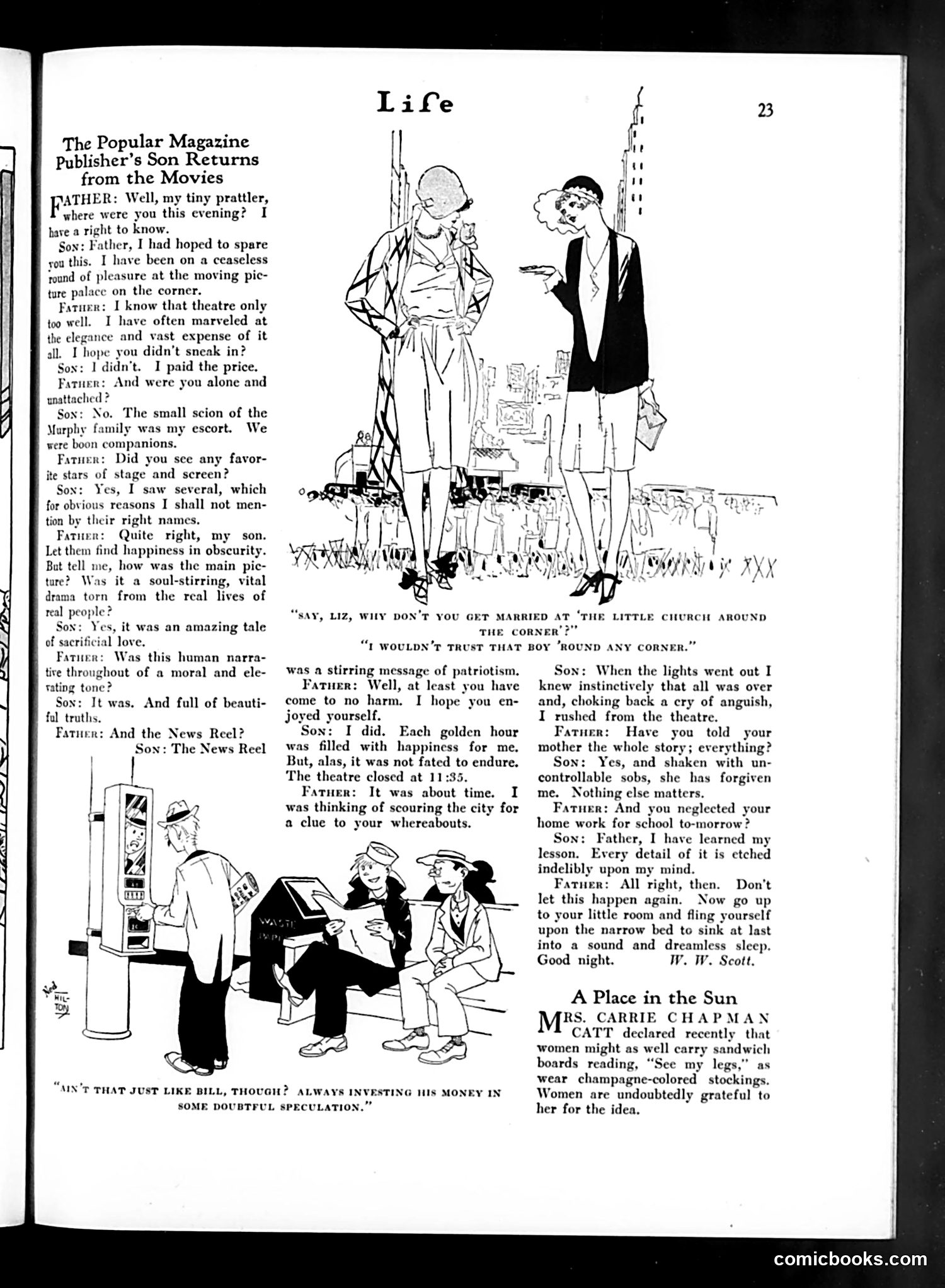
This satirical dialogue mocks the Victorian moral anxiety about cinema as a corrupting influence on youth. The father interrogates his son with exaggerated solemnity about an evening at "the moving picture palace," treating a simple theater visit as a potentially scandalous transgression. The humor lies in the son's pompous, flowery responses—describing the film as containing "sacrificial love" and "beautiful truths"—which parody both melodramatic silent films and the overwrought language used to discuss them. The father's relief that the boy came to "no harm" suggests contemporaries viewed movies with deep suspicion. The secondary cartoons satirize 1920s social types: a man making risky financial investments, and a woman wearing fashionable but controversial champagne-colored stockings (referenced in the Carrie Chapman Catt excerpt below). The overall message: Life magazine ridicules the older generation's hand-wringing over "modern" entertainment while gently mocking cinema's own dramatic pretensions.
📄 Transcribed text from this page (OCR, searchable)
Machine-transcribed from the original scan — historical spelling and the odd misread are preserved.
The Popular Magazine Publisher’s Son Returns from the Movies AATHER: Well, my tiny prattler, Frhere were you this evening? I have a right to know. Sox: Father, I had hoped to spare you this. I have been on a ceaseless yound of pleasure at the moving pic- ture palace on the corner. Fatuer: I know that theatre only too well. I have often marveled at the elegance and vast expense of it I hope you didn’t sneak in? s 1 didn’t. I paid the price. Farner: And were you alone and unattached ? s No. The small scion of the Murphy family was my escort. We were boon companions. Fatuen: Did you sce any favor- ite stars of stage and screen? Sox: Yes, I saw several, which for obvious reasons I shall not men- tion by their right names, Fatier: Quite right, my son. Let them find happiness in obscurity. But tell me, how was the main pic- ture? Was it a soul-stirring, vital drama torn from the real lives of real people ? s: Yes, it was an amazing tale of sacrificial love, Fatuer: Was this human narra- tive throughout of a moral and ele- tating tone? Sox: It was. And full of beauti- fal truths. Faturn: And the News Reel? Son: The News Reel “SAY, LIZ, WHY DON'T YOU GET MARRIED AT ‘THE LITTLE CHURCH AROUND THE CoRNER'?” “I WOULDN'T TRUST THAT BOY ’ROUND ANY CORNER.” was a stirring message of patriotism. Farner: Well, at least you have come to no harm. I hope you en- joyed yourself. Son: I did. Each golden hour was filled with happiness for me. But, alas, it was not fated to endure. The theatre closed at 11:35. Fatuer: It was about time. I was thinking of scouring the city for a clue to your whereabouts. “MNT THAT JUST LIKE BILL, THOUGH? ALWAYS INVESTING HIS MONEY IN SOME DOUBTFUL SPECULATION.” Son: When the lights went out I knew instinctively that all was over and, choking back a cry of anguish, I rushed from the theatre. Farner: Have you told your mother the whole story; everything? Son: Yes, and shaken with un- controllable sobs, she has forgiven me. Nothing else matters. Fatner: And you neglected your home work for school to-morrow? Son: Father, I have learned my lesson. Every detail of it is etched indelibly upon my mind. Fatuer: All right, then. Don't let this happen again. Now go up to your little room and fling yourself upon the narrow bed to sink at last into a sound and dreamless sleep. Good night. W. W. Scott. A Place in the Sun RS. CARRIE CHAPMAN CATT declared recently that women might as well carry sandwich boards reading, “See my legs,” as wear champagne-colored stockings. Women are undoubtedly grateful to her for the idea, comicbooks.com