
Life, 1927-04-28 · page 26 of 35
Life — April 28, 1927 — page 26: what you’re looking at
What you’re looking at
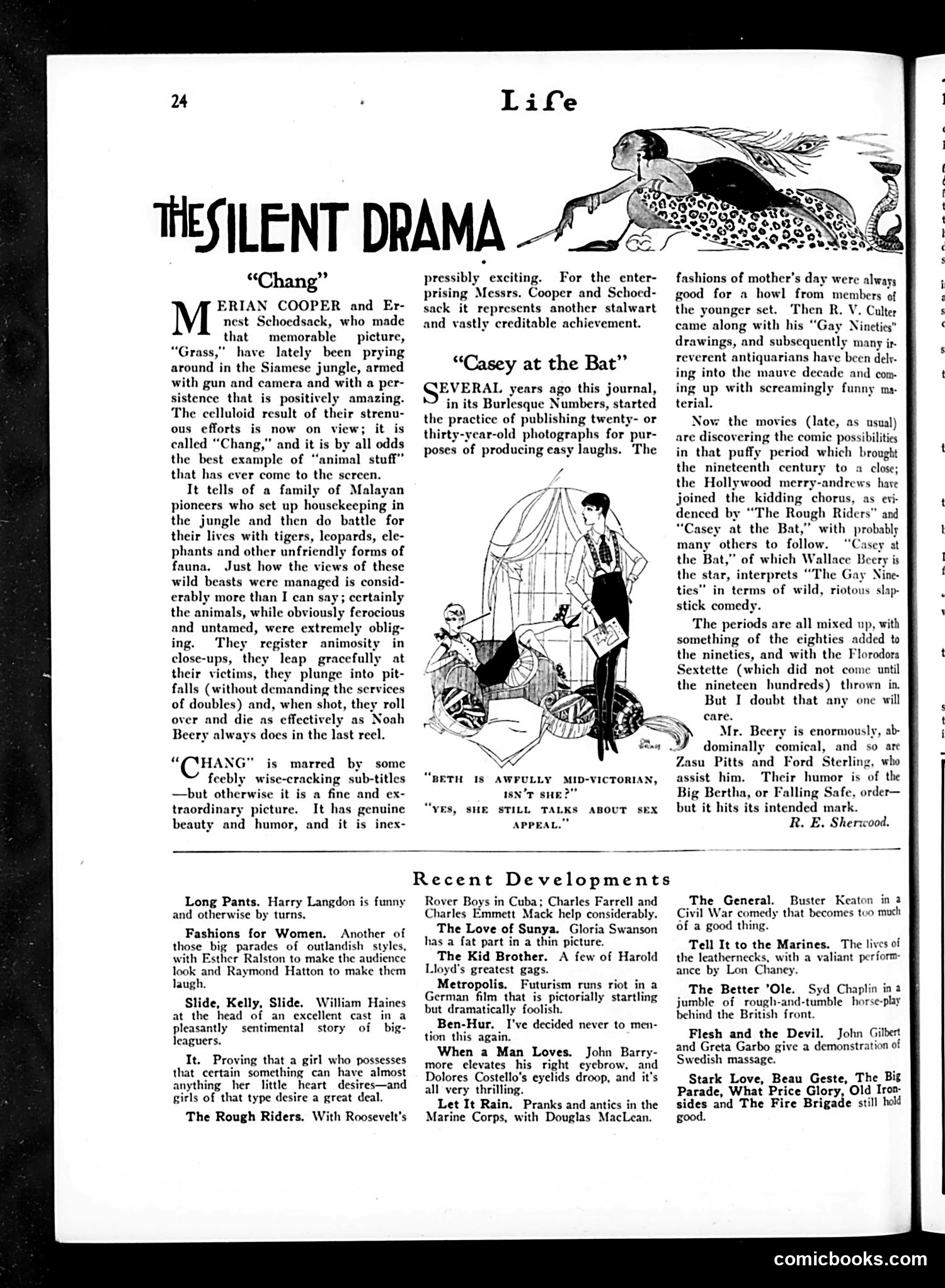
This page reviews silent films from the 1920s. The main article discusses "Chang," a wildlife adventure film by Cooper and Schoedsack about Malayan pioneers battling jungle animals. The reviewer praises it as exceptional "animal stuff" cinema, though notes the subtitle text is weak. The animals, while appearing genuinely ferocious, seem suspiciously cooperative—performing dramatic death scenes with the reliability of actor Noah Beery. The cartoon captioned "Beth is awfully mid-Victorian, isn't she?" satirizes outdated female propriety: Beth still discusses "sex appeal" in dated fashion, drawing laughter from modern audiences by contrast. The "Recent Developments" section briefly reviews other contemporary films, including "Casey at the Bat" (featuring Wallace Beery), which the reviewer critiques for confusingly mixing historical periods while delivering effective slapstick comedy. The page exemplifies how 1920s cinema was still developing as an art form, with reviewers noting both technical achievements and comedic timing.
📄 Transcribed text from this page (OCR, searchable)
Machine-transcribed from the original scan — historical spelling and the odd misread are preserved.
TESILENT DRAMA “Chang” ERIAN COOPER and Er- M nest Schoedsack, who made that memorable _ picture, “Grass,” have lately been prying around in the Siamese jungle, armed with gun and camera and with a per- sistence that is positively amazing. The celluloid result of their strenu- ous efforts is now on view; it is called “Chang,” and it is by all odds the best example of ‘animal stuff” that has ever come to the screen. It tells of a family of Malayan pioneers who sct up housckeeping in the jungle and then do battle for their lives with tigers, leopards, ele- phants and other unfriendly forms of fauna. Just how the views of these wild beasts were managed is consid- erably more than I can say; certainly the animals, while obviously ferocious and untamed, were extremely oblig- ing. They register animosity in close-ups, they leap gracefully at their victims, they plunge into pit- falls (without demanding the services of doubles) and, when shot, they roll over and die as effectively as Noah Beery always does in the last reel. “CHANG” feebly marred by some racking sub-titles —but other is a fine and ex- traordinary picture. It has genuine beauty and humor, and it is inex- pressibly exciting. For the enter- prising Messrs. Cooper and Schoed- sack it represents another stalwart and vastly creditable achievement. “Casey at the Bat” SEVERAL years ago this journal, in its Burlesque Numbers, started the practice of publishing twenty- or thirty-year-old photographs for pur- poses of producing easy laughs. The “BETH 18 AWFULLY MID-VICTORIAN, isn’? suk?” “YES, SHE STILL TALKS APPEAL. ABOUT SEX fashions of mother’s day were always good for a howl from members of the younger set. Then R. V. Culter came along with his “Gay Nineties” drawings, and subsequently many ir- reverent antiquarians have been dels- ing into the mauve decade and com- ing up with screamingly funny ms terial. Now the movies (late, as usual) are discovering the comic possibilities in that puffy period which brought the nineteenth century to a close; the Hollywood merry-andrews have joined the kidding chorus, as evi- denced by “The Rough Riders” and “Casey at the Bat,” with probably many others to follow. “Casey at the Bat,” of which Wallace Beery is the star, interprets “The Gay Nine- ties” in terms of wild, riotous slap- stick comedy. The periods are all mixed up, with something of the eighties added to the nineties, and with the Florodora Sextette (which did not come until the nineteen hundreds) thrown in. But I doubt that any one will care. y} Mr. Beery is enormously, ab- do minally comical, and so are Zasu Pitts and Ford Sterling, who assist him. Their humor is of the Big Bertha, or Falling Safe, order— but it hits its intended mark. R. E. Sherwood. Long Pants. Harry Langdon is funny and otherwise by turns. Fashions for Women. Another of those big parades of outlandish styles, with Esther Ralston to make the audience look and Raymond Hatton to make them laugh. Slide, Kelly, Slide. William Haines at the head of an excellent cast in a pleasantly sentimental story of big- leaguers. It. Proving that a girl who possesses that certain something can have almost anything her little heart desires—and girls of that type desire a great deal. The Rough Riders. With Roosevelt's Recent Developments Rover Boys in Cuba; Charles Farrell and Charles Emmett Mack help considerably. The Love of Sunya. Gloria Swanson has a fat part in a thin picture. The Kid Brother. A few of Harold Lloyd's greatest gags. Metropolis. Futurism runs riot in a German film that is pictorially startling but dramatically foolish. Ben-Hur. I've decided never to men- tion this again. When a Man Loves. John Barry- more clevates his right eyebrow, and Dolores Costello's eyelids droop, and it’s all very thrilling. Let It Rain. Pranks and antics in the Marine Corps, with Douglas MacLean. The General. Buster Ke: Civil War comedy that becomes of a good thing. Tell It to the Marines. The lives of the leathernecks, with a valiant perform ance by Lon Chaney. The Better Ole. Syd Chaplin ina jumble of rough-and-tumble horse-play behind the British front. Flesh and the Devil. John Gilbert and Greta Garbo give a demonstration of Swedish massage. Stark Love, Beau Geste, The Big Parade, What Price Glory, Old Iron- sides and The Fire Brigade still hold good. comicbooks.com