
A complete issue · 37 pages · 1926
Life — December 23, 1926
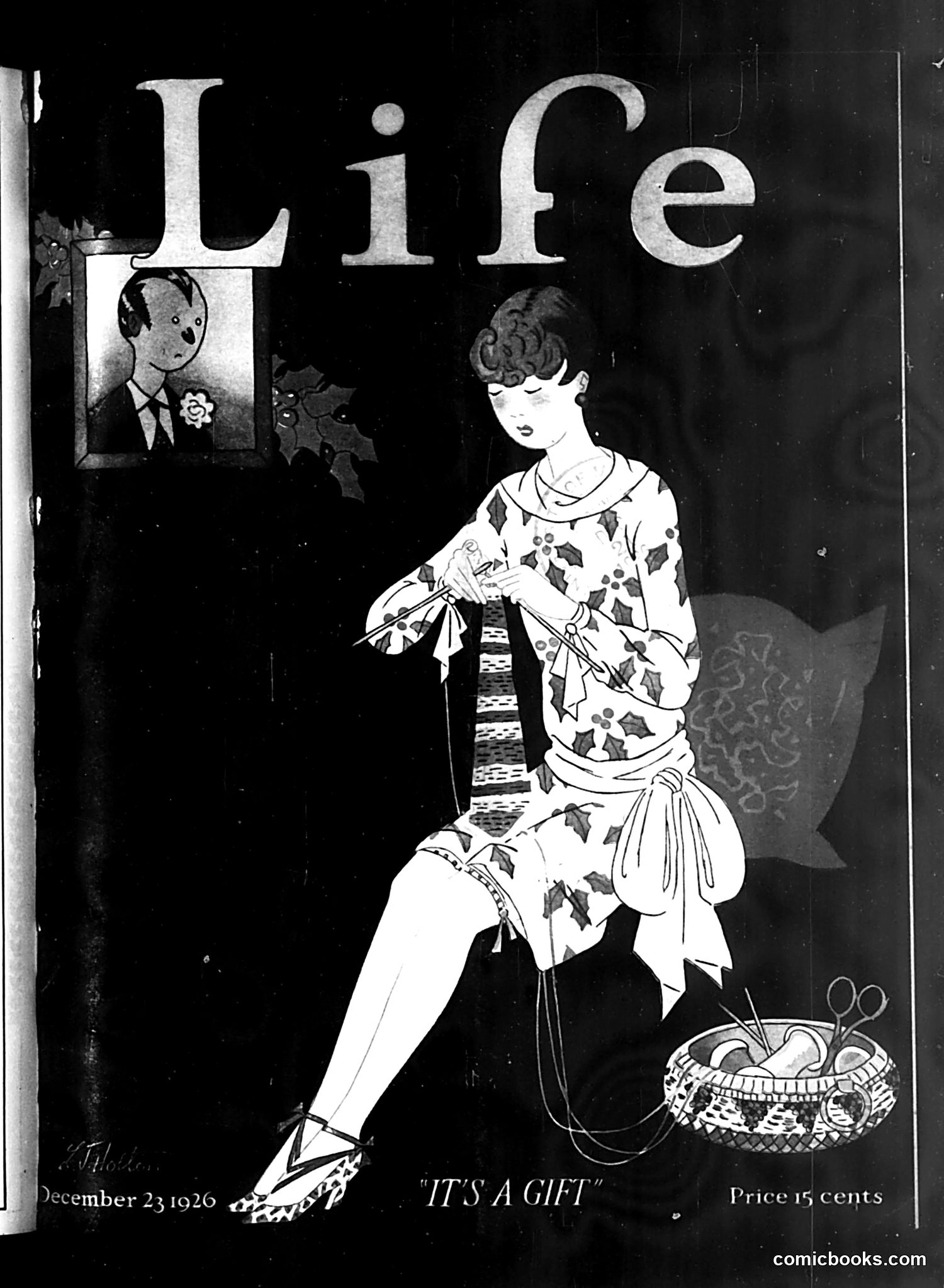
This is a **Life magazine cover** from December 1926, subtitled "It's a Gift," priced at 15 cents. The illustration shows a fashionable woman in 1920s style—bobbed hair, floral patterned dress, long legs—holding sewing supplies. A framed portrait of a man in a suit appears in the upper left corner, alongside ivy decoration. The satire likely plays on **Christmas gift-giving customs of the era**. The title "It's a Gift" suggests irony: the woman appears to be displaying either herself or her domestic/sewing skills as a gift to the man pictured. This reflects 1920s social commentary about women, marriage, and gender roles during the Jazz Age, when women's changing roles were frequently satirized. The cover mocks traditional courtship and matrimonial gift-giving conventions.
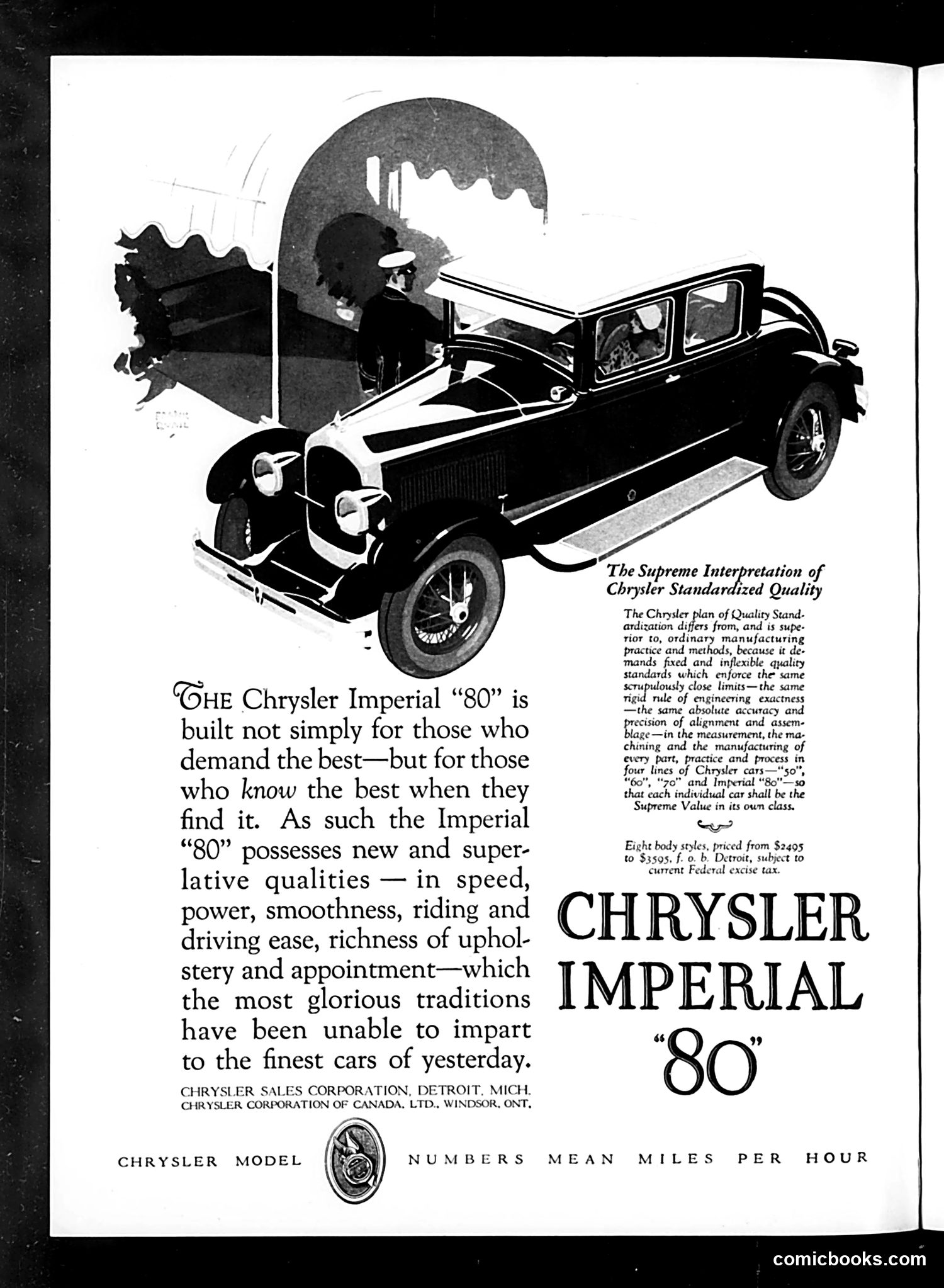
This is **not a political cartoon or satirical content**—it's a straightforward **automobile advertisement** for the Chrysler Imperial "80" model. The image shows a luxury car from what appears to be the 1920s-30s era, with an elegantly dressed couple. The advertisement emphasizes quality, precision manufacturing, and superior craftsmanship as markers of prestige. The tagline "Chrysler Model Numbers Mean Miles Per Hour" suggests the "80" designation refers to the car's top speed capability—a major selling point for luxury automobiles of that era. There is no satire, political commentary, or hidden meaning. This represents standard period advertising that appeals to wealthy consumers by associating the product with exclusivity, engineering excellence, and social status.
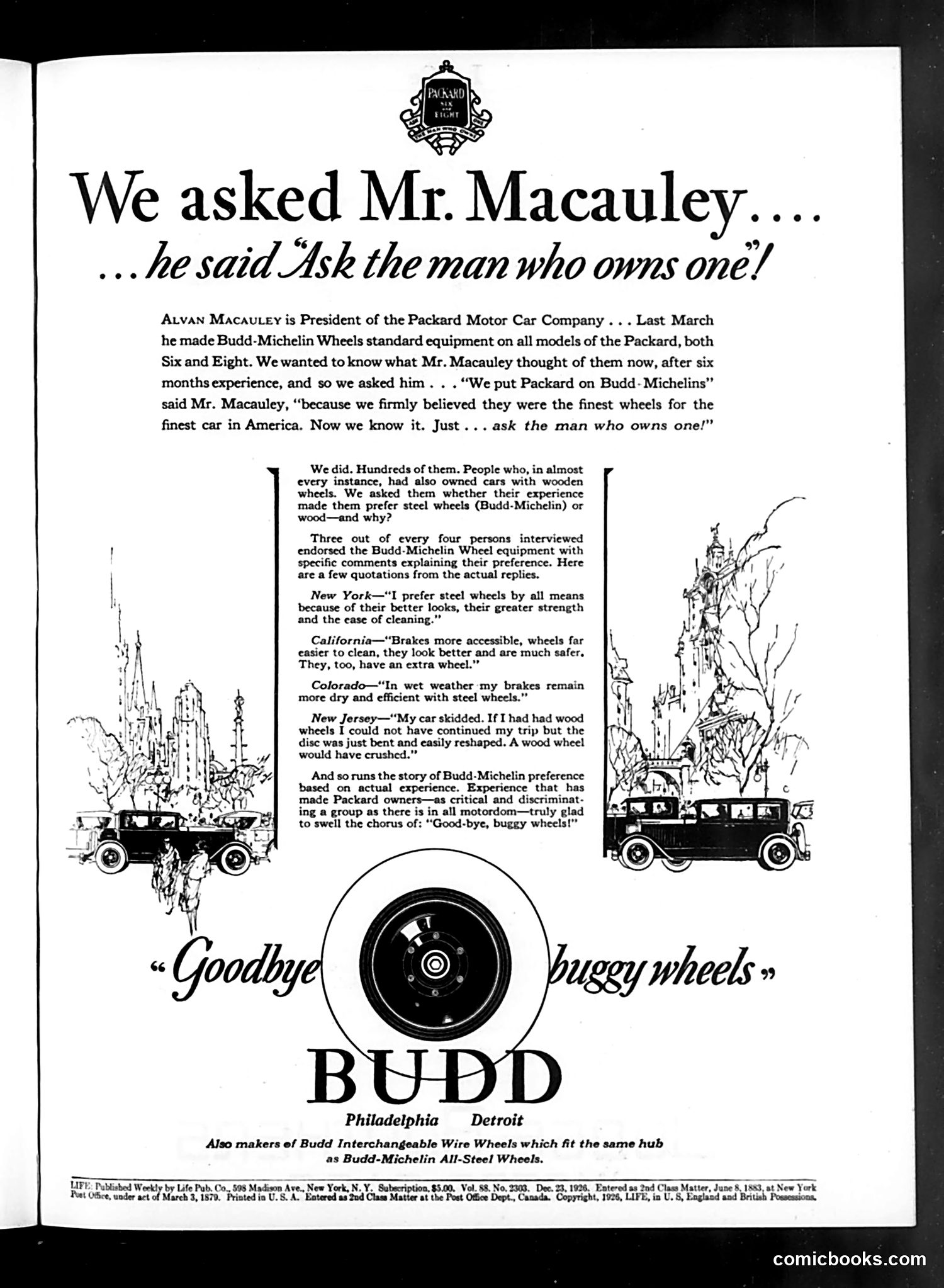
This is primarily **advertising**, not satire or political commentary. It's a 1920s advertisement for Budd-Michelin steel wheels, presented as a testimonial format. The ad claims Alvan Macauley, President of Packard Motor Car Company, endorsed switching to Budd-Michelin wheels as superior to wooden wheels. The "cartoon" elements—sketches of Packard automobiles in urban scenes—are decorative illustrations supporting the sales pitch, not satirical commentary. The ad uses customer testimonials from various locations (New York, California, Colorado, New Jersey) praising steel wheels' durability, appearance, and safety compared to wooden wheels. The phrase "Goodbye, buggy wheels" reflects the automotive industry's transition away from horse-drawn vehicles. This represents straightforward early automotive advertising rather than political or social satire.
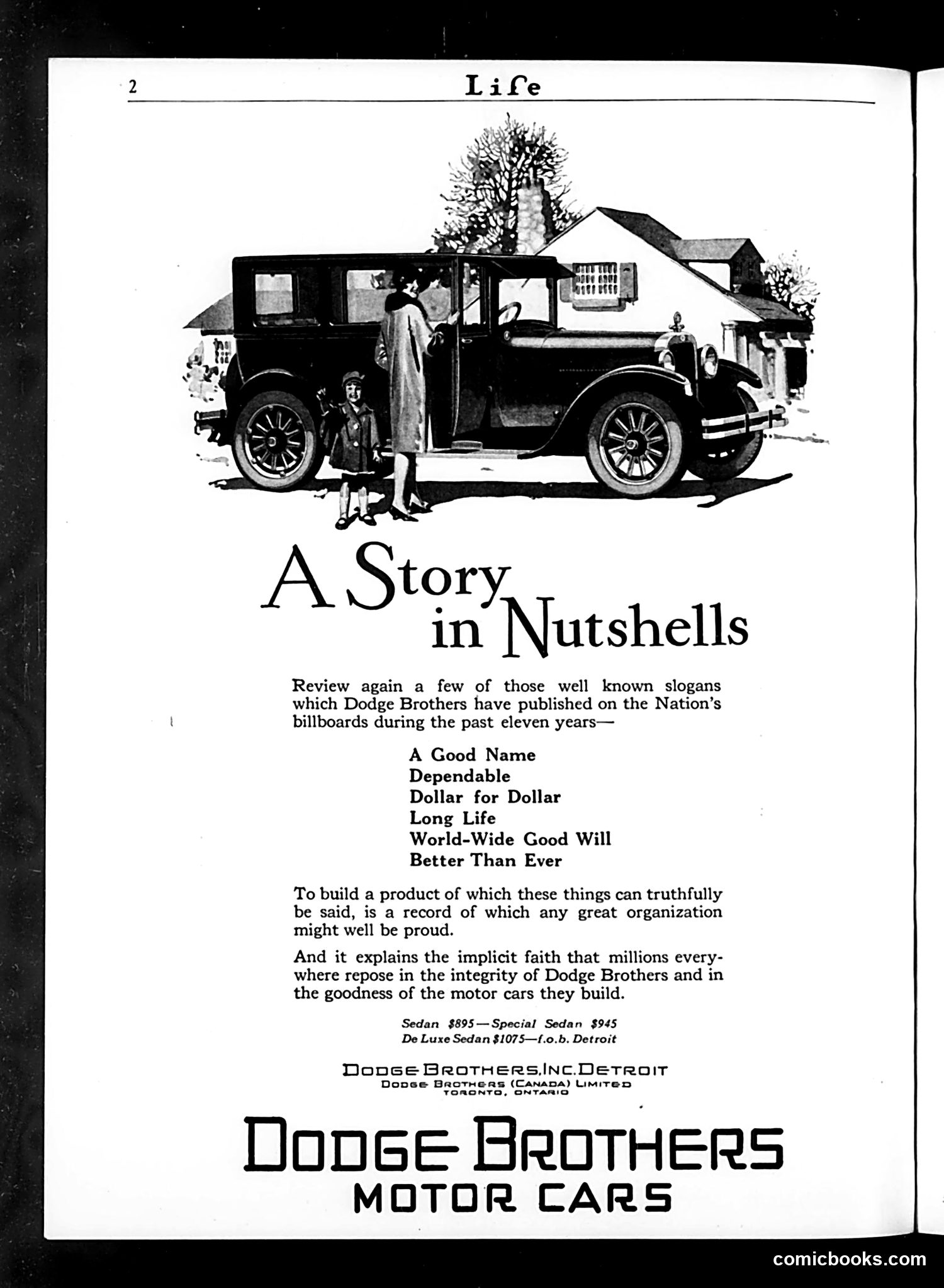
This is a **Dodge Brothers advertisement**, not satire or political commentary. The page promotes Dodge motor cars through a section titled "A Story in Nutshells," which reviews the company's marketing slogans from the previous eleven years: "A Good Name," "Dependable," "Dollar for Dollar," "Long Life," "World-Wide Good Will," and "Better Than Ever." The illustration shows a 1920s automobile parked in front of a suburban house with well-dressed figures nearby, representing the aspirational lifestyle the company associated with car ownership. The ad emphasizes Dodge Brothers' reputation and organizational integrity, arguing that building reliable vehicles demonstrates trustworthiness. Prices listed range from $895 to $1,075 for various sedan models, with manufacturing locations in Detroit and Toronto noted.
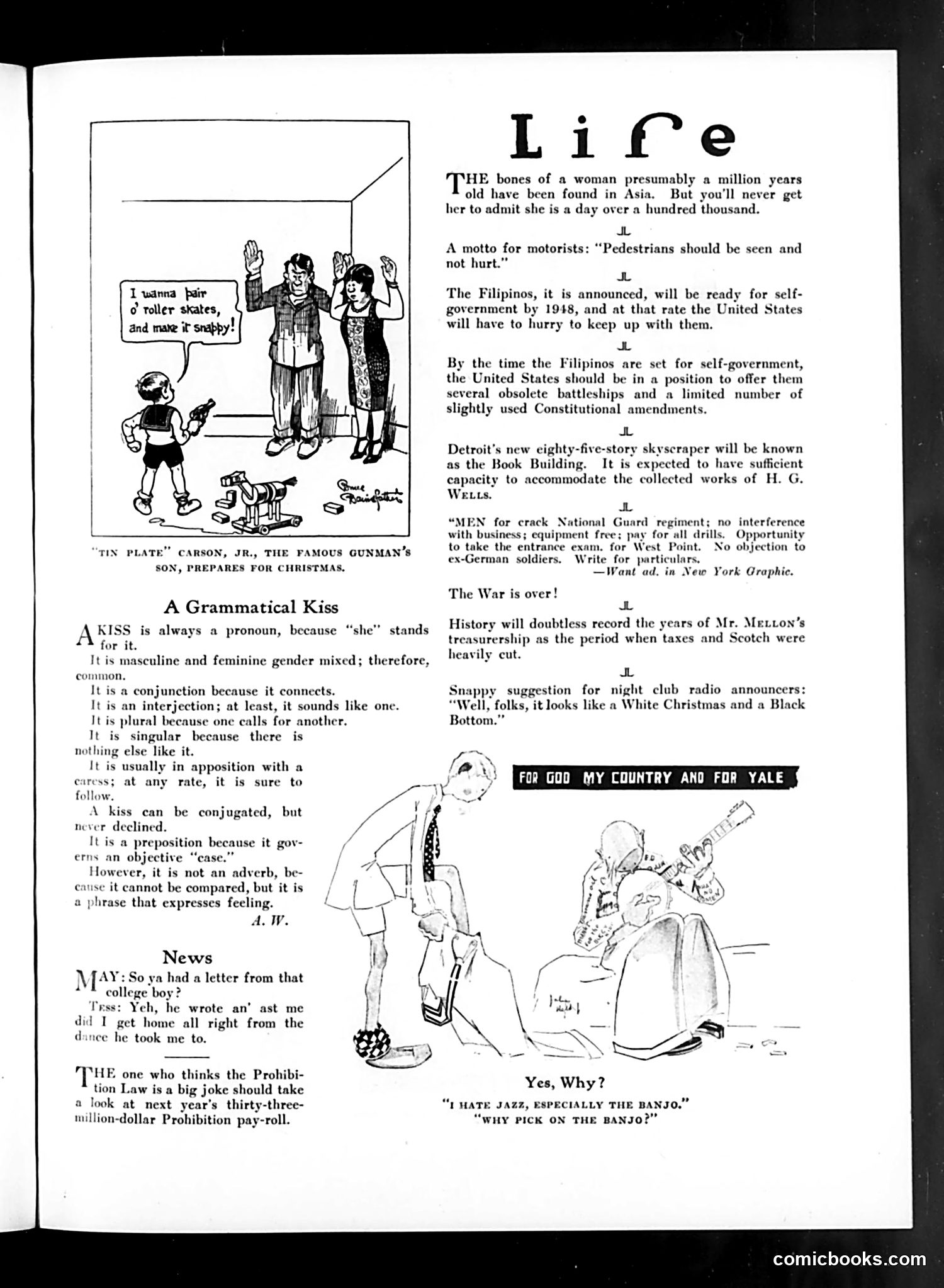
This page contains several satirical pieces from an early 20th-century Life magazine issue. **"Tin Plate" Carson Jr. cartoon**: Shows a child requesting roller skates for Christmas. The caption identifies him as the son of a famous gunman, satirizing the celebrity offspring of notorious figures through contrast—a violent man's child wanting innocent toys. **"A Grammatical Kiss"**: A humorous essay treating a kiss as a grammatical object, playing on wordplay and double meanings typical of Life's intellectual humor. **Other items**: Include news briefs mocking Prohibition's enforcement costs, Detroit's new skyscraper, and military recruitment. The "For God My Country and For Yale" cartoon appears to satirize patriotic excess or class-based military service attitudes. The page reflects post-WWI American society's social attitudes and contemporary concerns.
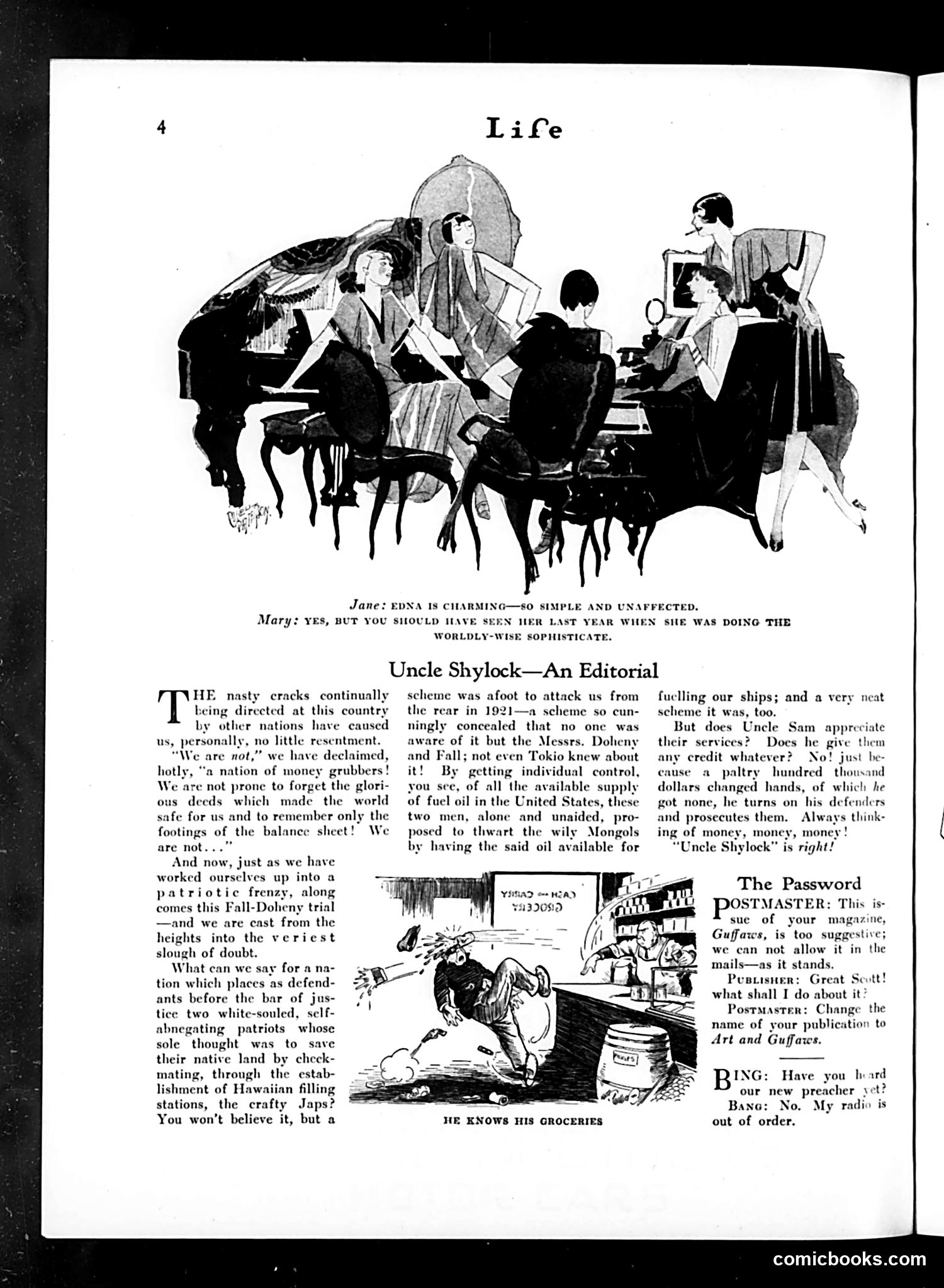
The top illustration satirizes women's fashion evolution, with a dialogue contrasting Edna's current "simple and unaffected" charm against her appearance "last year when she was doing the worldly-wise sophisticate"—mocking the rapid shifts in women's style and affected mannerisms. The editorial "Uncle Shylock" attacks international oil schemes, specifically referencing the Fall-Doheny trial (a major 1921-1924 scandal involving oil reserves and bribes). The cartoon depicts Japan recognizing its "groceries"—implying Japan's dependence on American oil supplies. The satire criticizes those profiting from the scheme while questioning whether the U.S. government deserves credit for patriotic defense versus simply pursuing profit. "The Password" joke mocks magazine naming conventions.
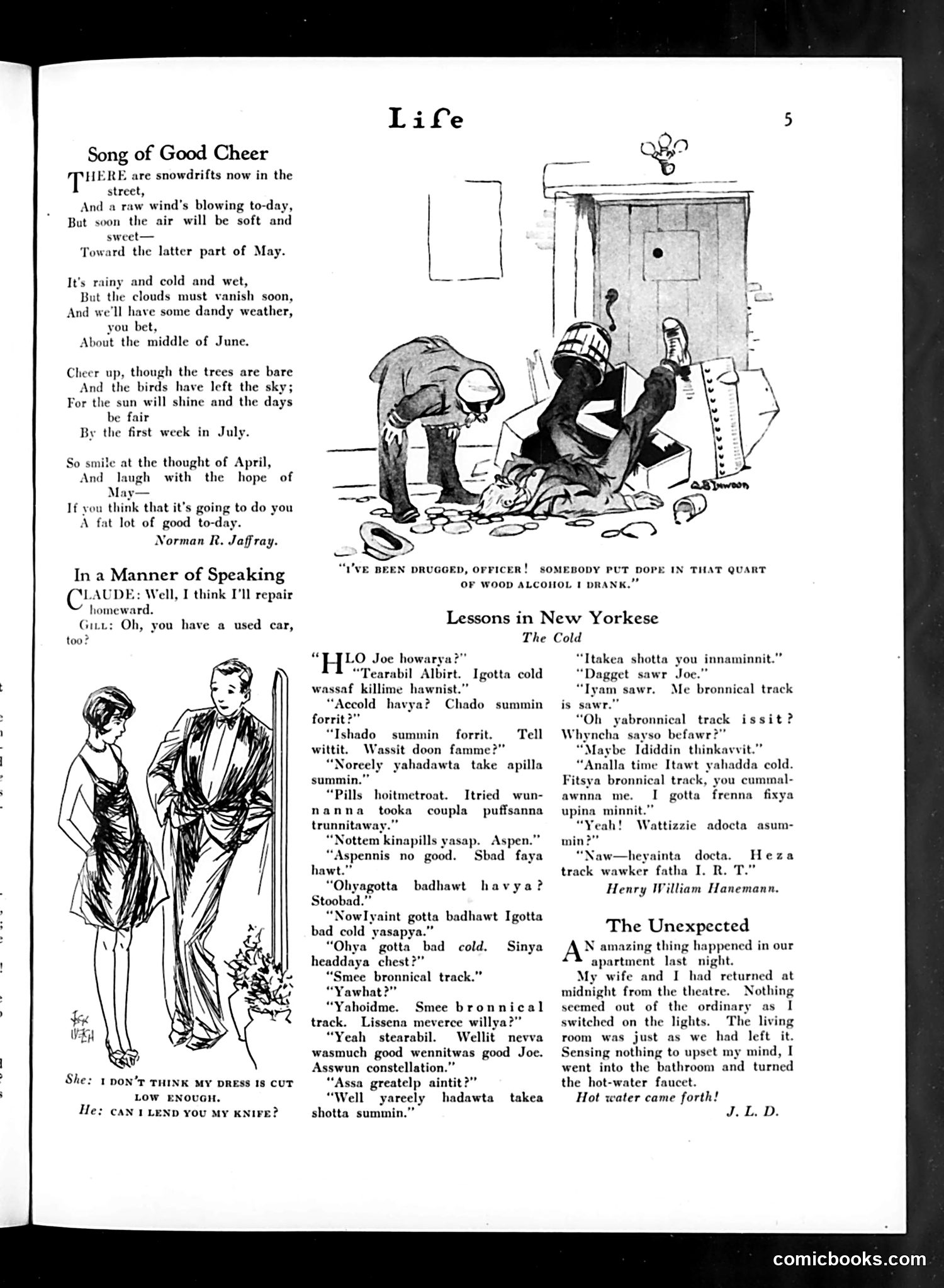
**Main Cartoon:** Shows a police officer discovering an intoxicated man in a doorway. The officer says "I've been drugged, officer! Somebody put dope in that quart of wood alcohol I drank." This satirizes Prohibition-era bootlegging and the dangers of illegal alcohol consumption. During Prohibition (1920-1933), desperate drinkers consumed unregulated "wood alcohol" and other toxic substitutes, which caused poisoning and death. The joke mocks both the drinker's foolishness and the absurdity of Prohibition itself. **Other Content:** Includes humor pieces like "Song of Good Cheer" (cheerful predictions about spring weather), "In a Manner of Speaking" (dialogue humor), "Lessons in New Yorkcese" (ethnic/dialect humor), and "The Unexpected" (domestic humor). The page exemplifies early 20th-century satirical magazine format targeting urban, educated readers.
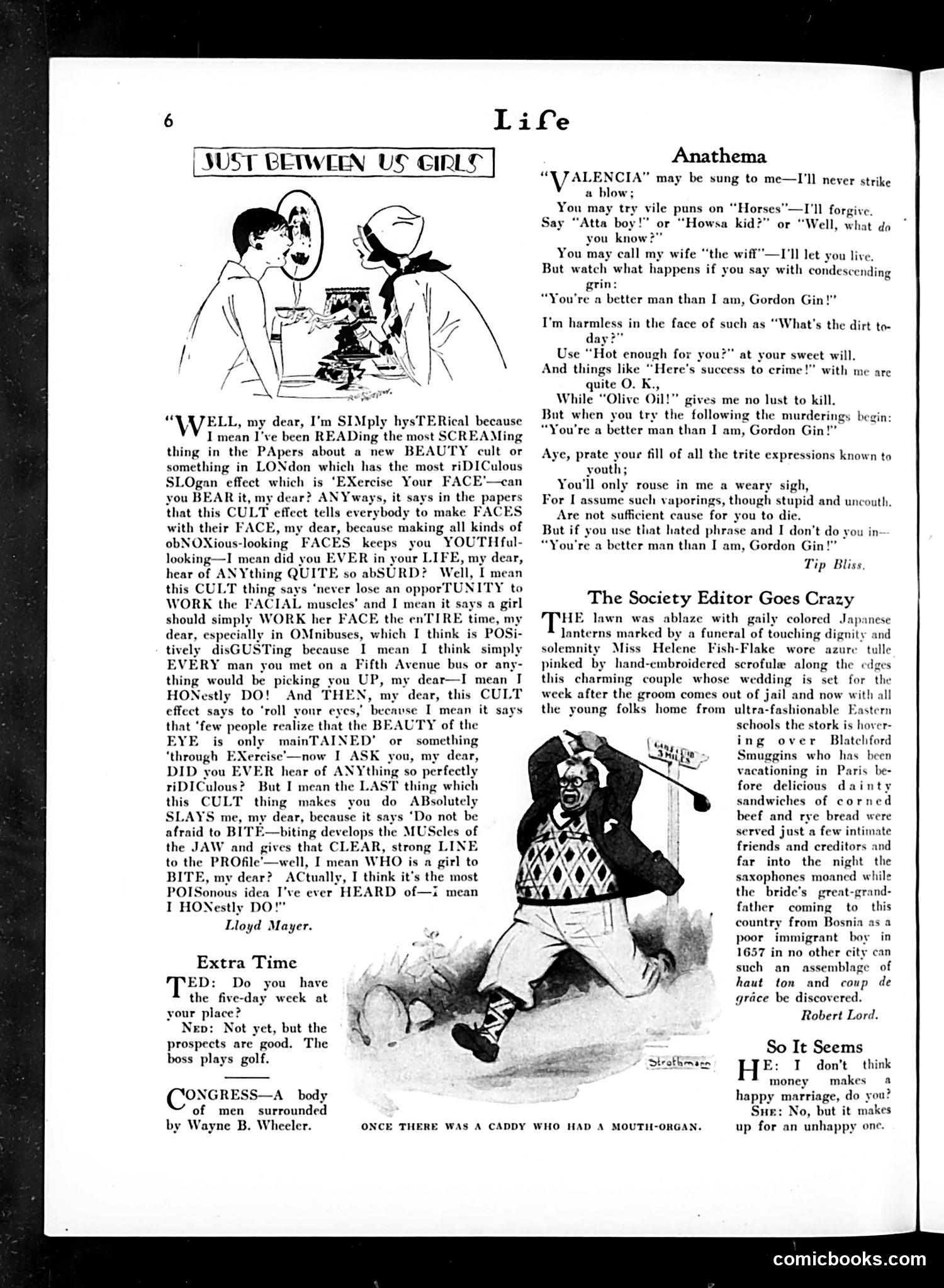
This page satirizes early 20th-century women's magazine beauty culture. The main cartoon features two women gossiping about a "BEAUTY cult" promoting facial exercises to achieve perfect faces. Lloyd Mayer's commentary mocks the absurdity of this trend—the cult claims "never lose an opportunity to WORK the FACIAL muscles" and promises youth through constant face-making. The satire targets how beauty magazines prey on women's insecurities by promoting exhausting, pointless routines. Phrases like "Exercise Your FACE" are presented as ridiculous commands that magazines push to make ordinary women feel inadequate. The accompanying items ("The Society Editor Goes Crazy," "Extra Time," "So It Seems") offer related social satire about marriage, leisure, and class pretension among the era's affluent set.
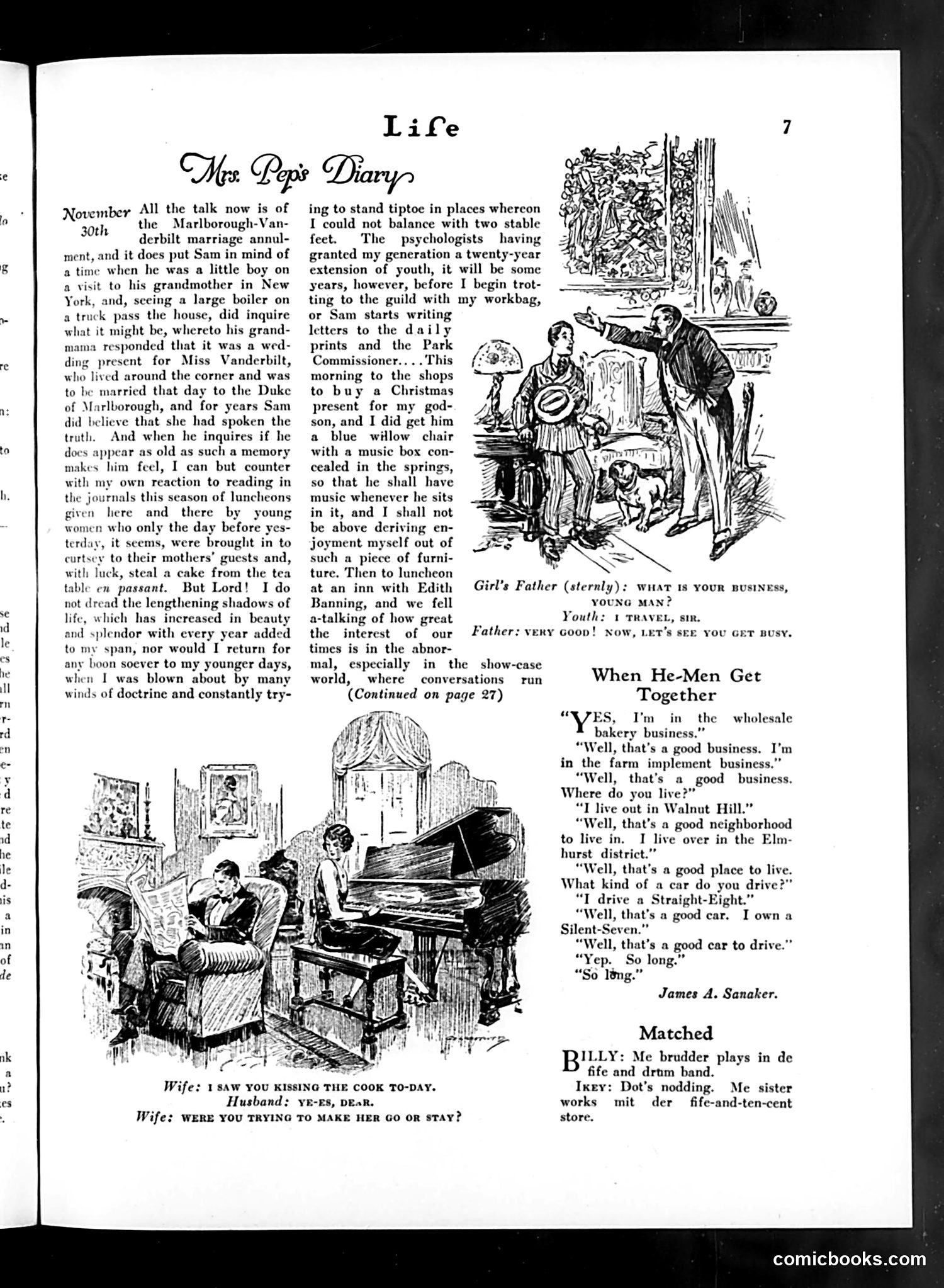
This page contains humor pieces rather than political cartoons. "Mrs. Pep's Diary" recounts domestic anecdotes from November 30th—a visit to grandmother, a truck passing the house, and shopping for Christmas presents. The tone is light domestic satire. "Girl's Father" depicts a common scenario: a young man visiting, with the father sternly asking his "business." The youth claims to travel, prompting the father's skeptical response to "get busy"—standard period humor about courtship anxieties. "When He-Men Get Together" satirizes men's casual conversations about their occupations and possessions (bakery, farm implements, cars)—poking fun at masculine small talk and materialism. "Matched" presents a brief dialogue where two people discover their siblings work together at a "five-and-ten-cent store." The cartoons employ gentle domestic and social humor typical of 1920s Life magazine.
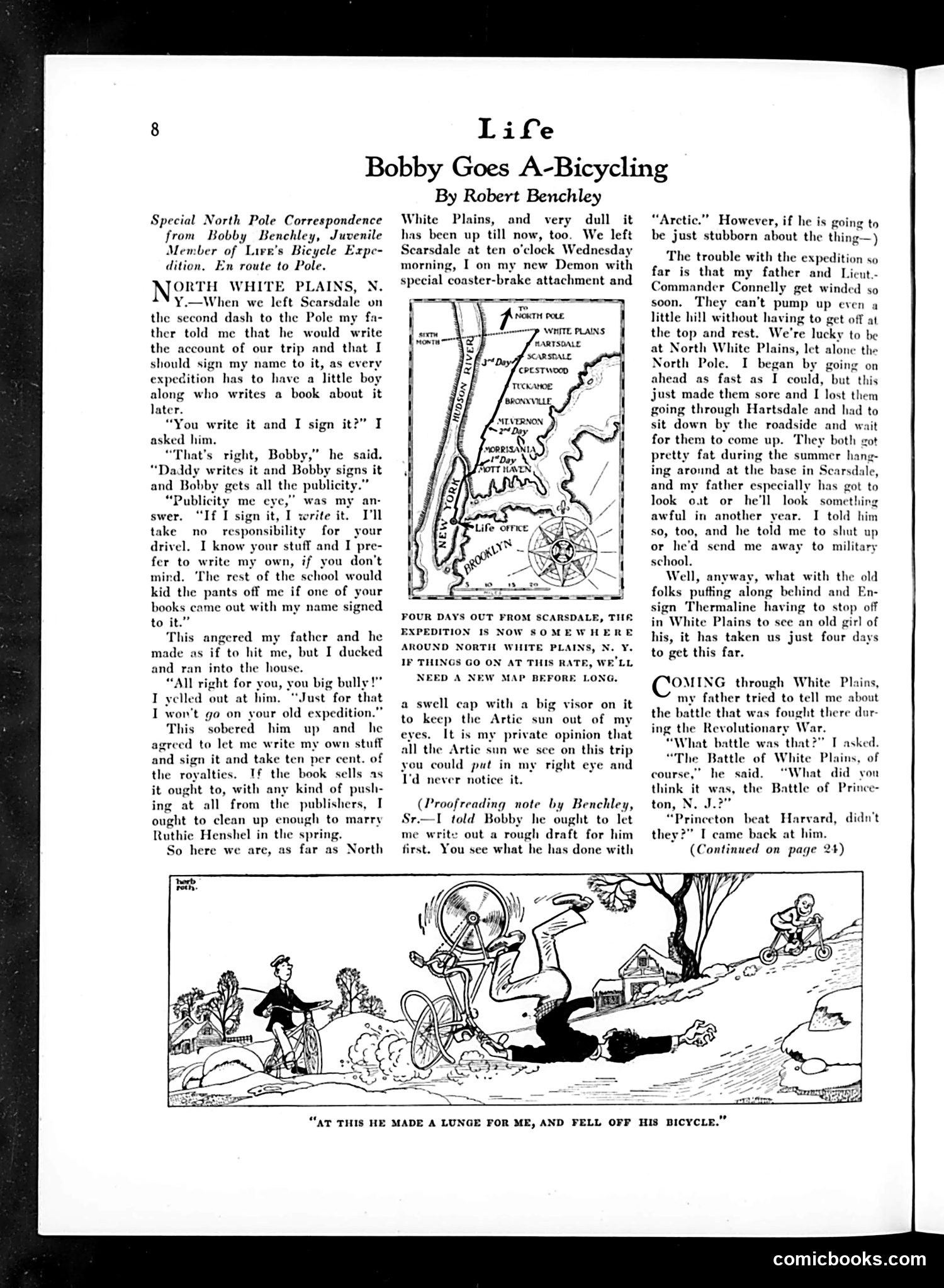
This is a humorous travel narrative by Robert Benchley about a bicycle expedition from Scarsdale to the North Pole. The story satirizes overly ambitious amateur expeditions and their inevitable failures through comic exaggeration. The illustrated map shows the planned route northward through New York state. The cartoon below depicts the predictable outcome: Bobby attempting a bicycle stunt, flying over the handlebars, and crashing—a visual punchline mocking the gap between grand aspirations and reality. The accompanying text includes Benchley's typical self-deprecating humor about physical mishaps and his father's skepticism about the venture. The satire targets both the foolish overconfidence of amateur adventurers and the publishing industry's appetite for documenting such doomed exploits. The humor derives from the inevitable comedic failure of an absurd enterprise.
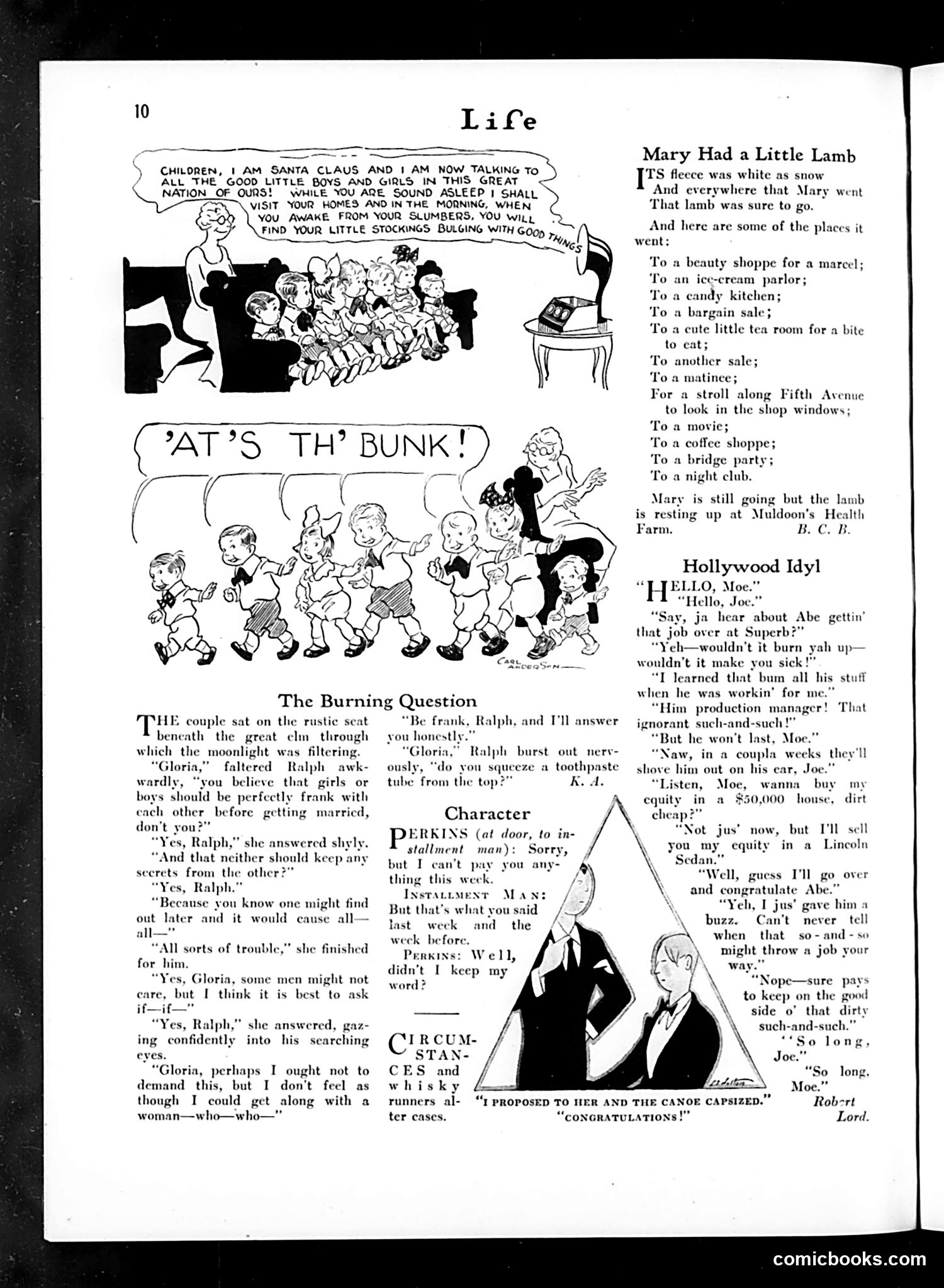
This page contains three distinct pieces of satirical content: 1. **Santa Claus Christmas Comic** (top): Santa addresses children about visiting homes and filling stockings—standard holiday fare with no apparent political satire. 2. **"At's Th' Bunk!"** (middle): A cartoon showing children dismissing something as nonsense, likely satirizing naive or false claims. 3. **"The Burning Question"** (bottom left): A couple discusses whether girls and boys should be "frank" (honest) before marriage. The satire mocks conventional relationship anxieties—Ralph's concern that honesty might cause problems, Gloria's pragmatic response that secrets are inevitable. This reflects 1920s-era debates about changing courtship norms. 4. **"Hollywood Idyl"** (right): A dialogue between characters "Moe" and "Joe" discussing someone named Abe's job at "Superb" (likely a studio). The satire appears to mock Hollywood's transient employment and casual industry gossip.
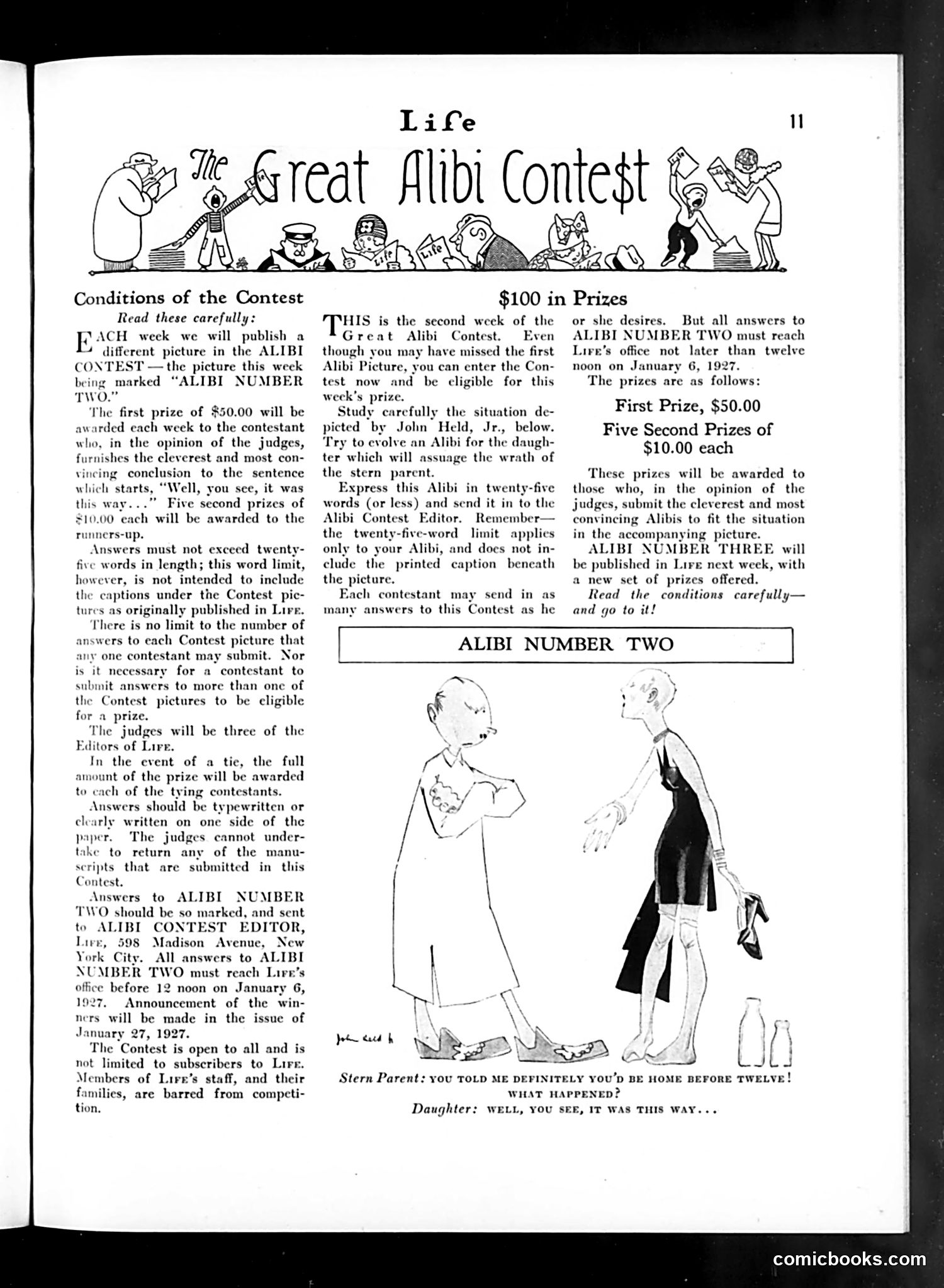
This page announces the second week of Life's "Great Alibi Contest," a humor competition inviting readers to create witty explanations (alibis) for awkward situations. The featured cartoon shows **"Alibi Number Two"**: a stern parent confronting a daughter about breaking curfew. The parent says: "you told me definitely you'd be home before twelve!" The daughter responds: "Well, you see, it was this way..." Readers were challenged to complete the daughter's alibi in 25 words or less. The contest offered $50 for first prize and five $10 second prizes, with winners announced the following week. This reflects 1920s concerns about youth social behavior and parental authority—particularly around dating and curfews—making alibis (excuses) a relatable, humorous topic for contemporary readers.
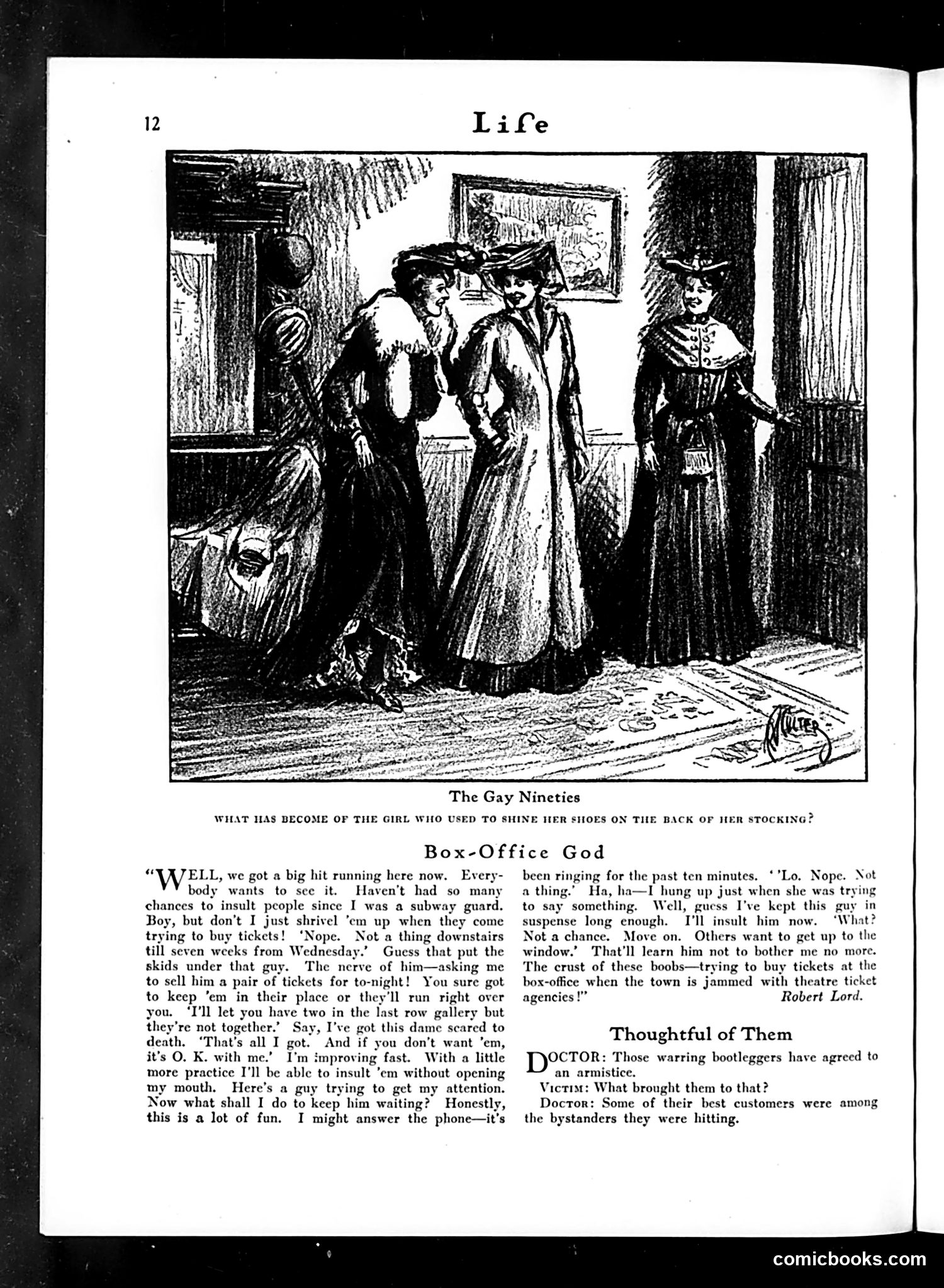
This page contains two satirical pieces from "The Gay Nineties" era: **"Box-Office God"** presents a cynical monologue from a subway guard boasting about insulting theater patrons and scalping tickets. The satire mocks both the guard's petty power-tripping and the desperation of theatergoers willing to overpay for sold-out shows. **"Thoughtful of Them"** is a brief joke about warring bootleggers (illegal alcohol distributors) who agreed to an armistice. The humor lies in the absurdity: their "best customers were among the bystanders they were hitting"—suggesting collateral damage from gang violence accidentally harmed the very people profiting from their illegal operations. Both pieces satirize urban American vices: ticket scalping and Prohibition-era organized crime.
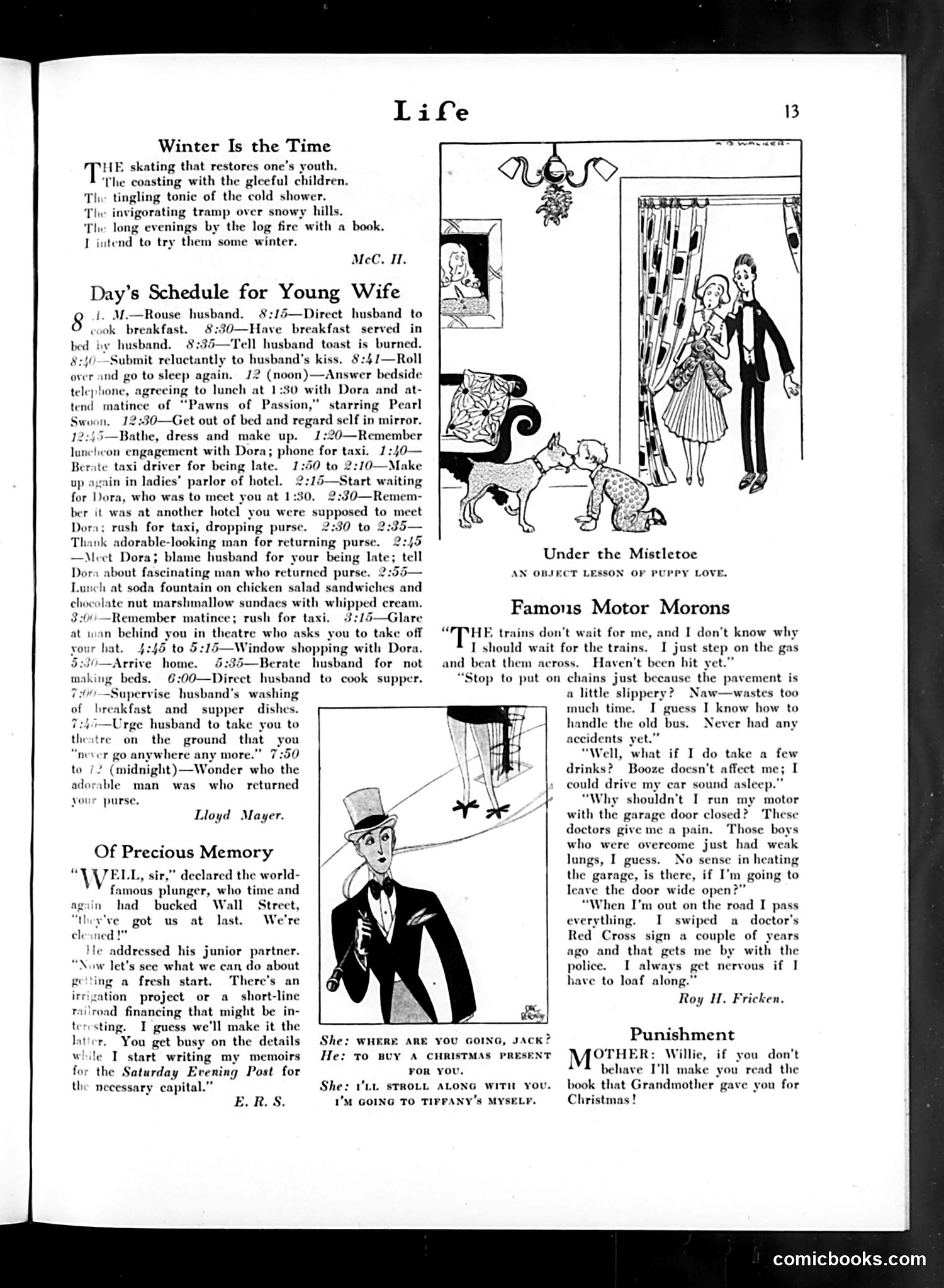
This page contains several humor pieces typical of Life's satirical format: **"Winter Is the Time"** — A short poem celebrating winter activities (skating, coasting, log fires). **"Day's Schedule for Young Wife"** — A comedic schedule mocking the exhausting, detail-obsessed life of a 1920s housewife, tracking her from 8 A.M. through midnight with constant errands, phone calls, and social obligations. The humor lies in the relentless triviality and her husband's apparent obliviousness. **"Famous Motor Morons"** — Satirizes reckless drivers making dangerous excuses (speeding, ignoring chains in slippery conditions, drinking while driving). The cartoon shows a well-dressed man and implies criticism of motorists who endanger others. **"Under the Mistletoe"** — A brief humorous illustration about puppy love. **"Of Precious Memory"** — A dialogue joke about Wall Street financiers discussing business opportunities. The page reflects 1920s middle-class anxieties about modern life, automobiles, and domestic expectations.
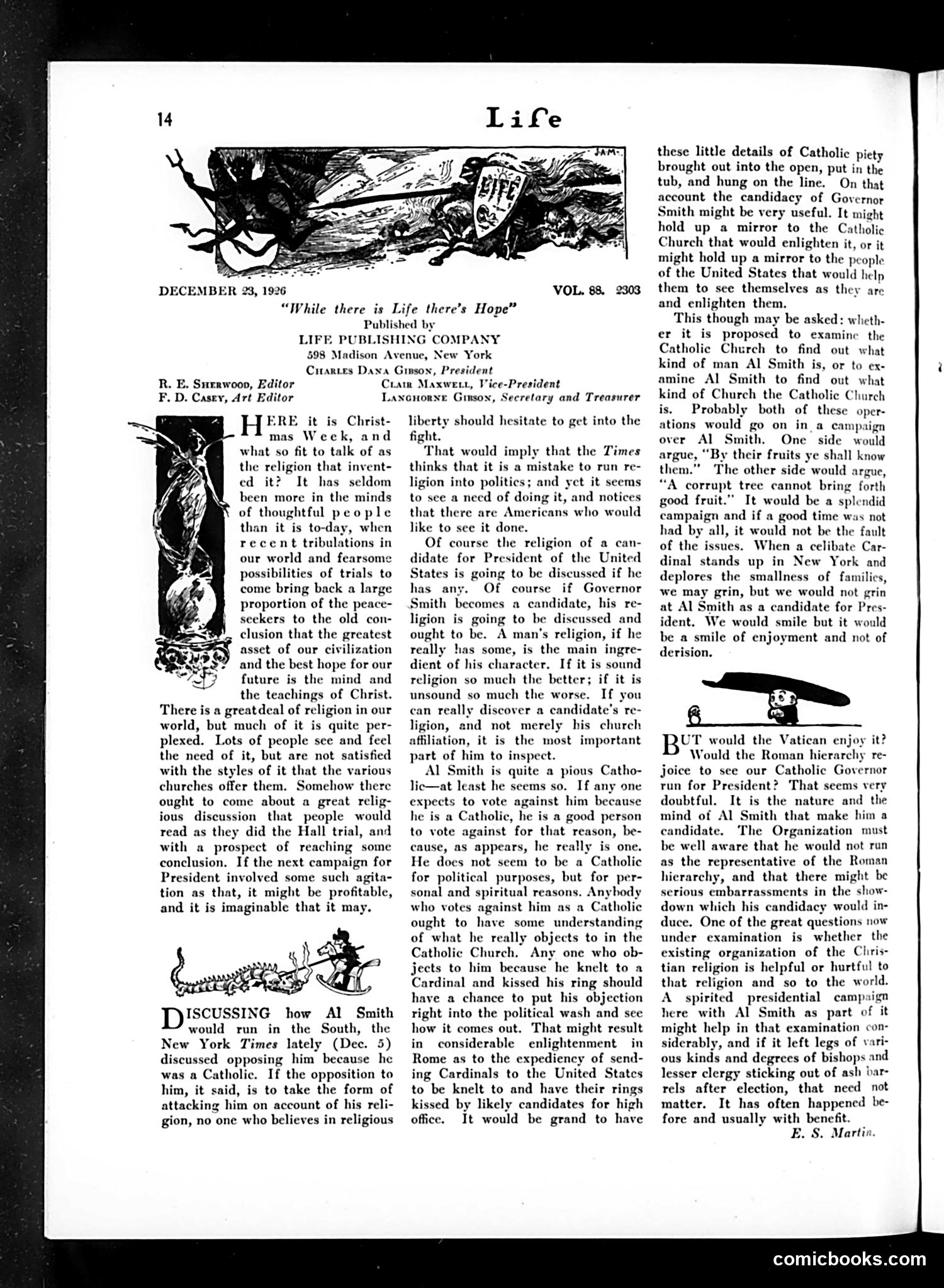
This *Life* editorial discusses the controversy surrounding Al Smith's candidacy for U.S. President in 1928. Smith was a Catholic, and the article addresses opposition to him based on his religion rather than his politics or qualifications. The editorial argues that attacking Smith's candidacy on religious grounds—rather than examining his actual positions—is inappropriate and reflects prejudice. The author suggests that voters should evaluate candidates based on character and policy, not faith. The cartoons (decorative rather than caricatured) illustrate the tension between religious liberty and political discourse. The piece ultimately advocates for separating religious identity from political fitness, challenging the anti-Catholic bias that influenced the 1928 election.
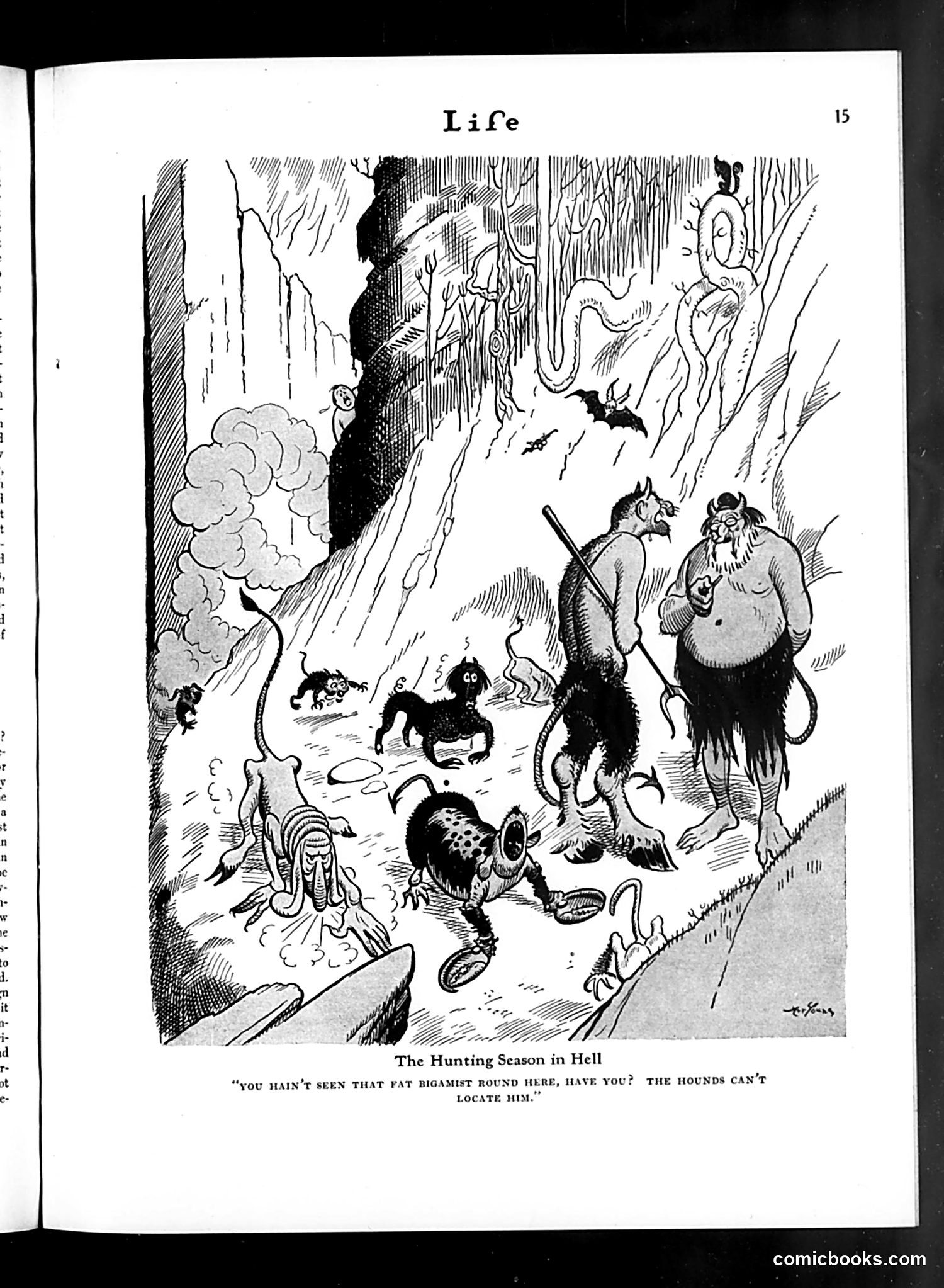
This cartoon depicts demonic and monstrous figures hunting in an infernal landscape. The caption reads: "You hain't seen that fat bigamist round here, have you? The hounds can't locate him." The satire targets a "fat bigamist"—likely a specific public figure of the era—who is being hunted through Hell. The joke plays on the concept of damnation: a man guilty of bigamy (illegal marriage to two people simultaneously) is so thoroughly lost in Hell that even the devil's hunting dogs cannot find him. This suggests either his moral corruption is extreme, or ironically, he's managed to evade even infernal justice. Without knowing the specific publication date, the exact target remains unclear, though bigamy scandals were popular satirical subjects in early 20th-century American humor.
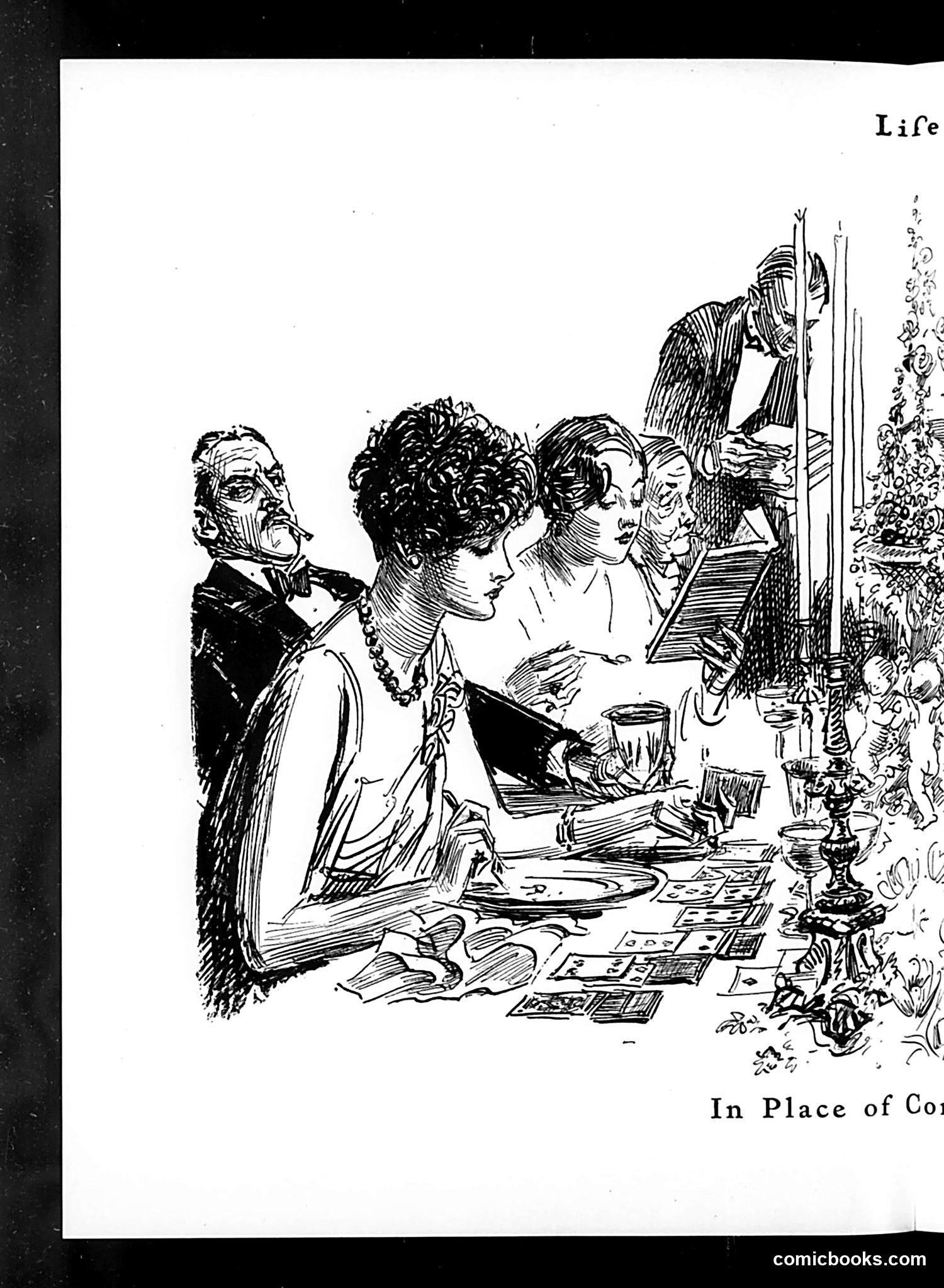
This satirical illustration from *Life* magazine depicts a social scene where well-dressed figures gather around a table with cards and refreshments. The title "Life / In Place of Co[nversation]" (text cut off) suggests the cartoon critiques how people occupy themselves during social gatherings. The satire appears to mocking the substitution of card games and gambling for genuine conversation and intellectual engagement at social events. The detailed rendering of the figures' fashionable dress contrasts with what the artist seems to view as empty entertainment. The elaborate decorative elements (flowers, urns) underscore the pretense of refined society engaging in shallow pastimes rather than meaningful discourse. The specific identities of these figures remain unclear from the image alone.
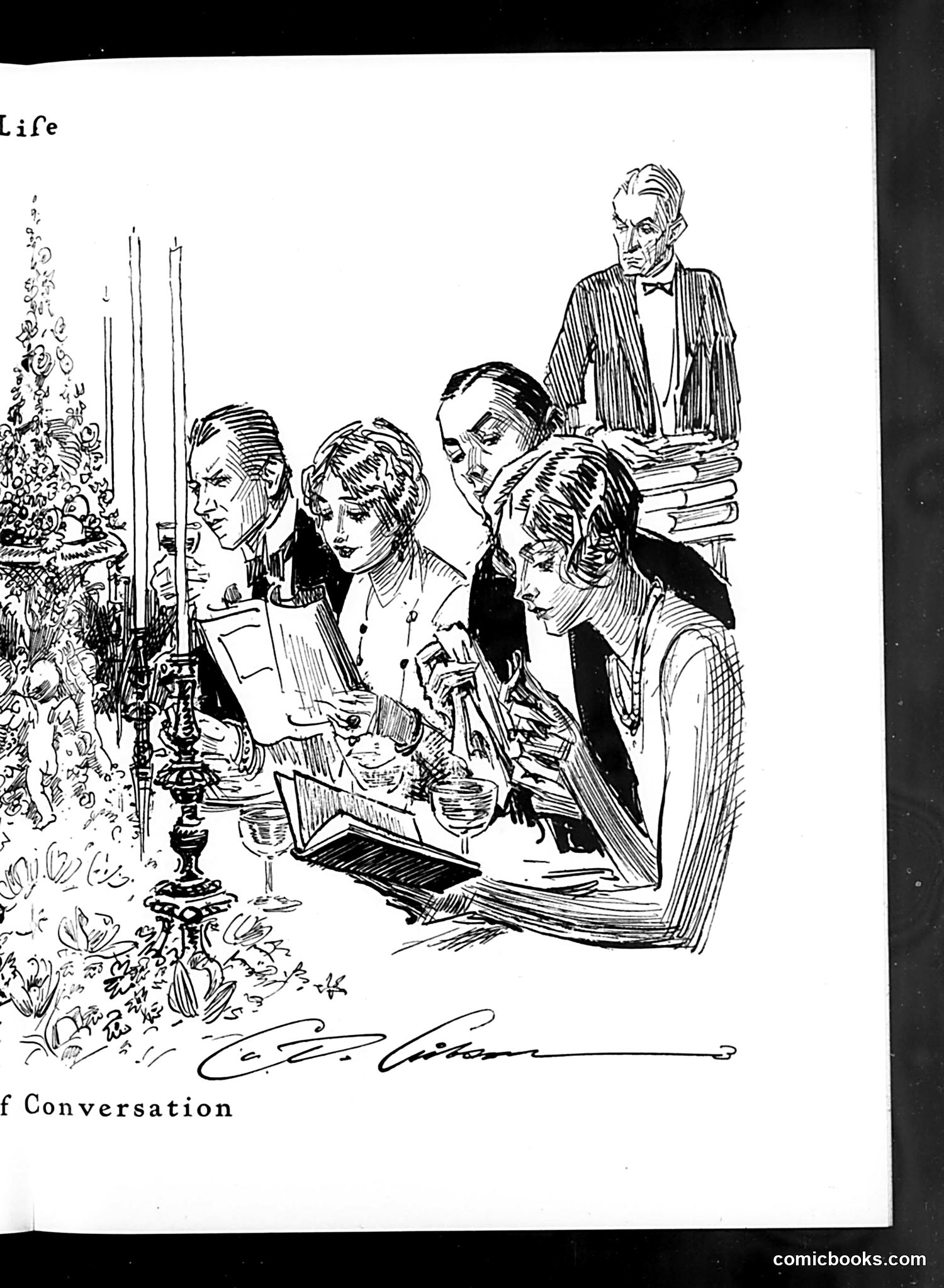
This illustration depicts five well-dressed people at what appears to be a formal social gathering, gathered around a table with candles and drinks. The title "Life of Conversation" suggests satire about upper-class social rituals. The sketch style and composition emphasize the figures' expressions and body language. The artist's signature is visible at bottom. The seated figures appear absorbed in conversation or documents, while one man stands observing in the background, suggesting commentary on social hierarchies or the performative nature of polite society. Without additional context about the specific publication date or artist, the exact satirical target remains unclear, though the overall tone suggests mockery of formal social conventions among the wealthy.
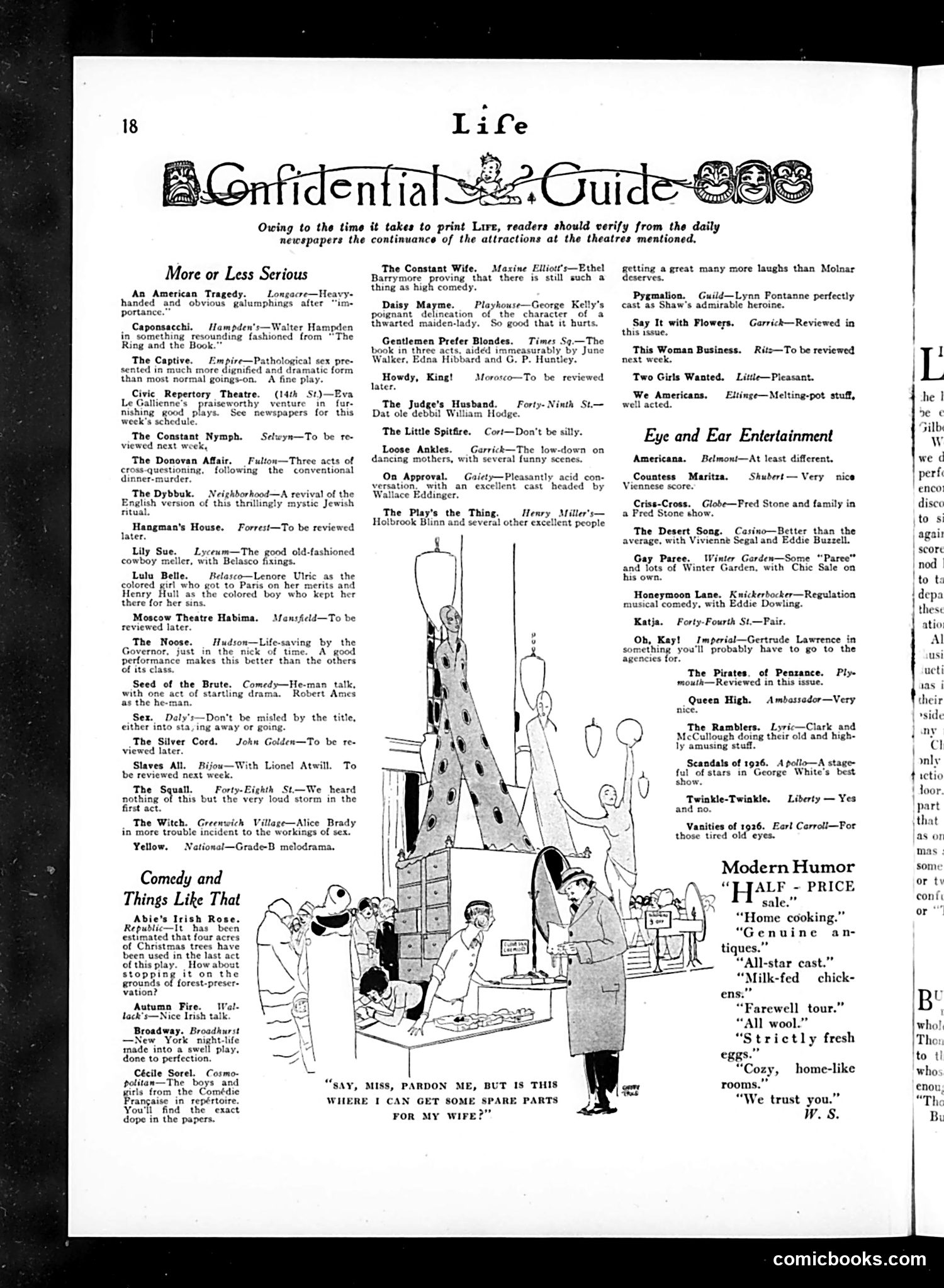
This page is a theater guide reviewing Broadway productions. The central cartoon depicts a man in a hat speaking to what appears to be a shop clerk or attendant at a counter, saying "Say, Miss, pardon me, but is this where I can get some spare parts for my wife?" The joke is a domestic humor quip playing on the idea of wives as mechanical objects needing repair—a common satirical trope of the era. It reflects period attitudes about marriage and gender roles, treating the concept humorously through the absurdist image of a "wife" requiring "spare parts" like machinery. The surrounding text consists of brief reviews of Broadway shows, ranging from serious dramas like "An American Tragedy" to comedies like "Abie's Irish Rose," with cryptic critical notes. This was typical Life magazine content from the 1920s theatrical season.
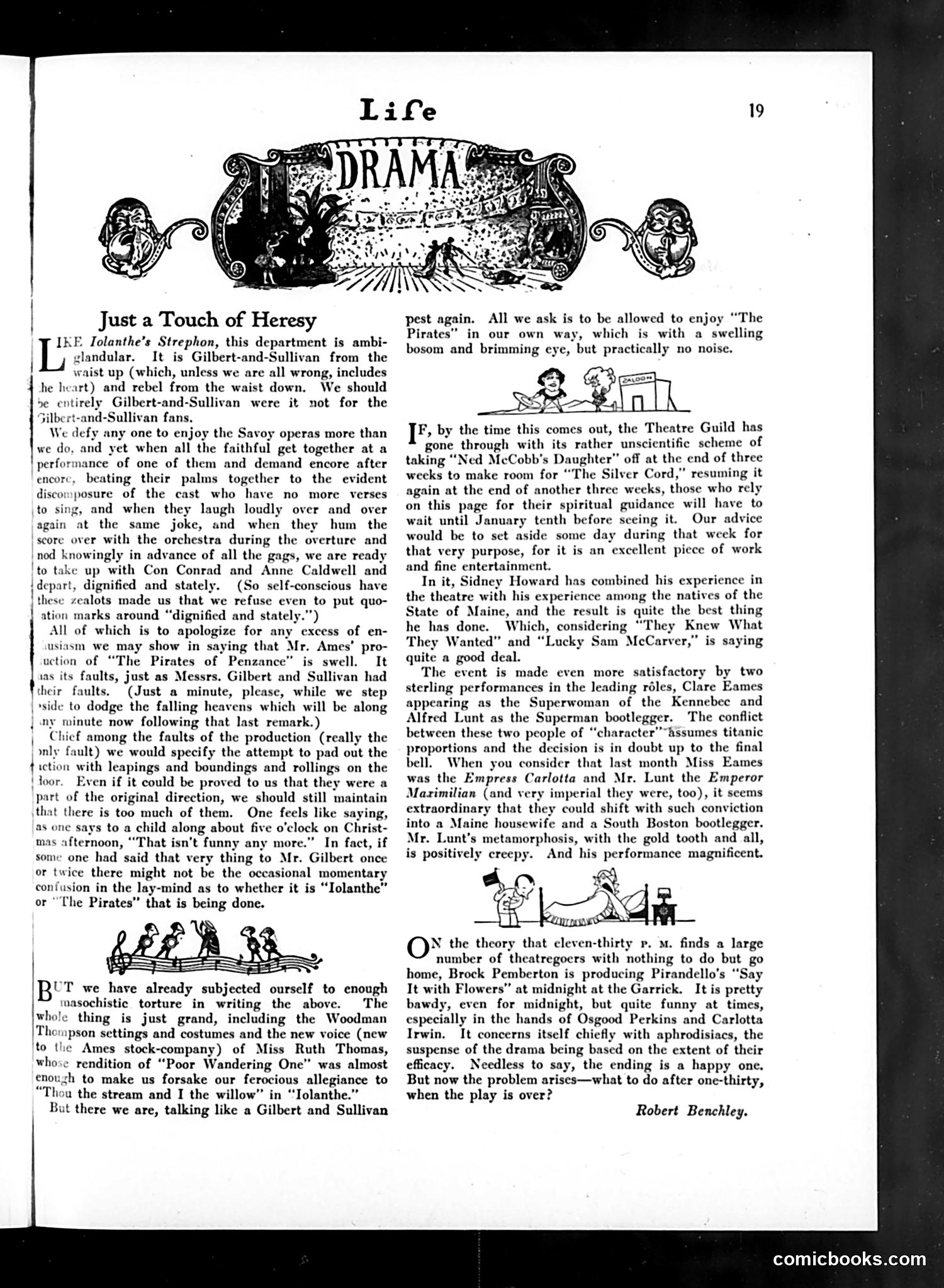
This is a theater review column criticizing overzealous Gilbert-and-Sullivan opera fans. The author praises a production of "The Pirates of Penzance" but complains that devoted fans attending performances—who sing along, laugh predictably at familiar jokes, and demand encores—ruin the experience for others through their obvious, self-conscious enthusiasm. The "heresy" is admitting that while Gilbert-and-Sullivan operettas are wonderful, their most devoted admirers can be insufferable. The reviewer playfully threatens to abandon this loyalty for modern musical theater (by Conrad and Caldwell) to escape the fanatics' behavior. The column also briefly reviews other productions: "Ned McCobb's Daughter" and "The Silver Cord." The small illustrations appear to be generic theater-related vignettes rather than specific caricatures, emphasizing the column's focus on theatrical behavior rather than particular public figures.
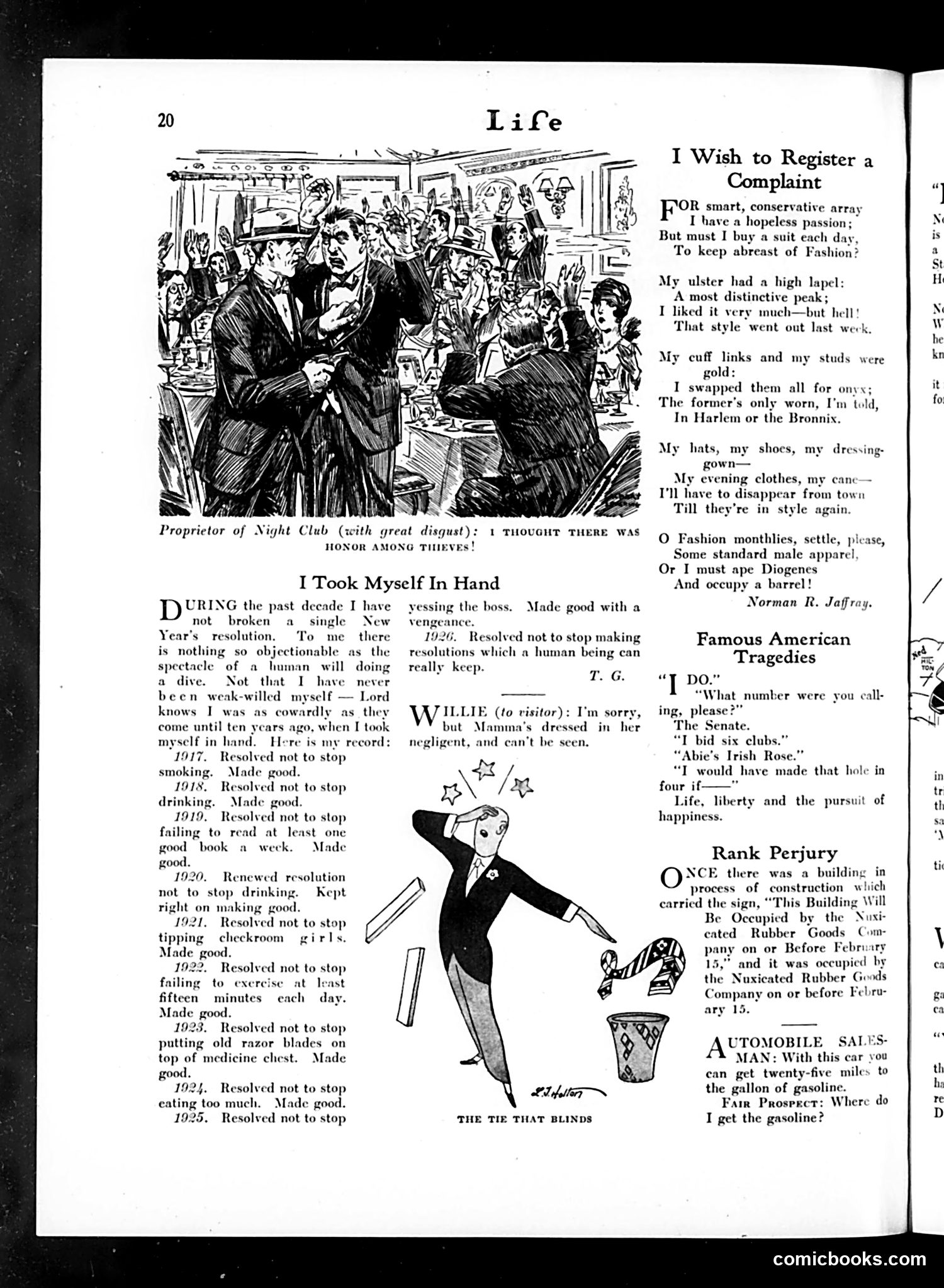
This page contains three satirical pieces mocking American social conventions: **"I Took Myself In Hand"** humorously inverts New Year's resolutions—the narrator resolves *not to stop* bad habits (smoking, drinking, neglecting exercise, keeping dirty razor blades) and claims success by maintaining these vices. The joke critiques how people make resolutions they'll break, so he's simply resolved to continue his existing failings. **"I Wish to Register a Complaint"** satirizes fashion's tyranny over men. The author complains that expensive accessories (cuff links, hats, shoes) become obsolete within weeks, forcing constant purchases to stay fashionable—a pointed critique of commercial fashion cycles that exploit consumer anxiety. **The remaining brief jokes** mock incongruity: Willie's mother being "dressed in her negligent" (negligée), and an absurd exchange where a car salesman claims 25-mile-per-gallon efficiency but the buyer logically asks where to find gasoline—implying the promise is worthless without practical supply. All target middle-class consumer culture and masculine vanity.
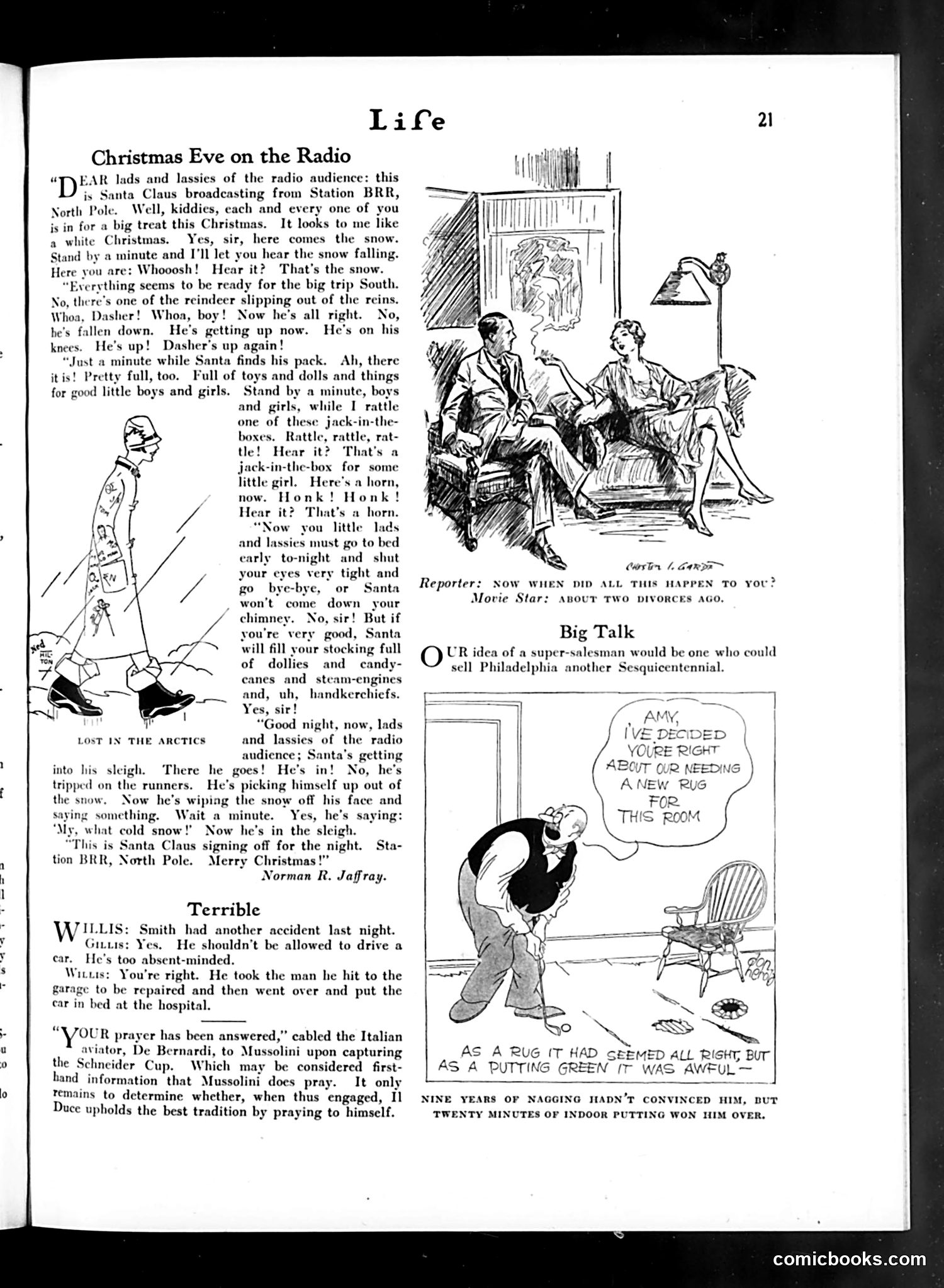
This page contains three distinct satirical pieces typical of 1920s-30s humor: **"Christmas Eve on the Radio"** is a comedic script mocking radio broadcasts. It presents Santa Claus narrating his North Pole departure with exaggerated sound effects (reindeer mishaps, jack-in-the-boxes, horns). The humor derives from the absurdity of radio drama—attempting to create vivid scenes through crude audio alone, with Santa repeatedly bungling his own departure. **"Terrible"** is a two-panel joke about absent-mindedness: a man so confused after a car accident takes his injured victim to a garage for repair while placing the car in a hospital—reversing what should be done with each. **"Big Talk"** contains brief quips, including a reference to Philadelphia's Sesquicentennial (likely the 1926 celebration), mocking civic boosterism. The "rug/putting green" cartoon shows a husband finally agreeing to replace a worn rug only after discovering it makes a makeshift indoor golf course—satirizing male stubbornness and unusual motivations.
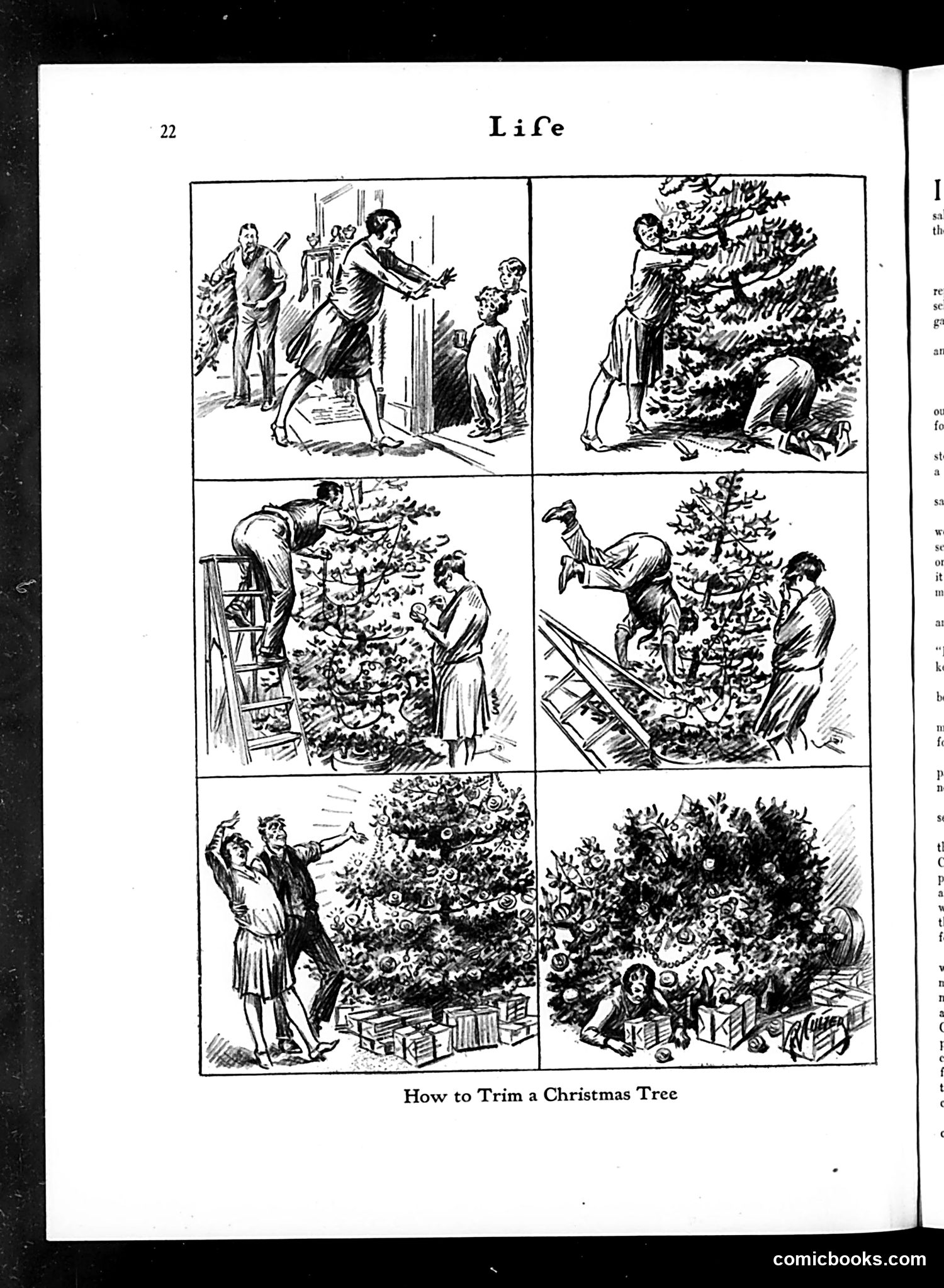
This is a six-panel instructional comic showing the progressive stages of decorating a Christmas tree, presented as humorous social satire. The sequence depicts: 1. Adults planning the decoration 2. Carefully placing ornaments 3. Using ladders to reach higher branches 4. Adults working cooperatively 5. A couple admiring the finished tree with presents 6. Children having ransacked it completely The joke satirizes the contrast between adults' careful, orderly Christmas preparations and children's chaotic destruction of the result. It's not political commentary but rather gentle domestic humor about family life—a common theme in *Life* magazine's satirical content. The humor relies on the visual progression from pristine to demolished, reflecting universal family experiences rather than specific historical references.
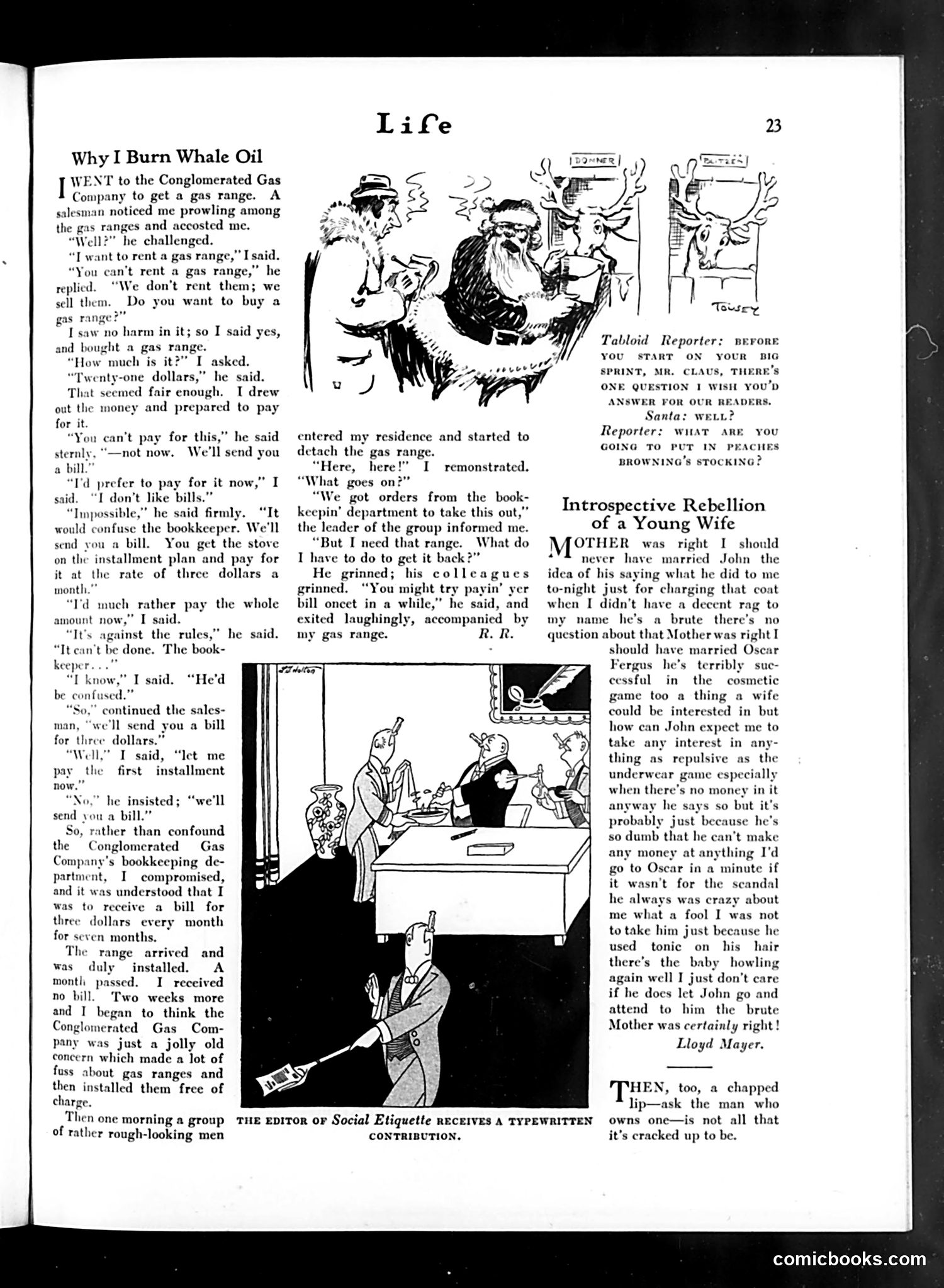
**"Why I Burn Whale Oil"** is a satirical piece mocking bureaucratic inflexibility and corporate indifference to customer needs. A man attempts to buy a gas range outright, but the Conglomerated Gas Company insists on an installment plan—allegedly because paying in full would "confuse the bookkeeper." After he agrees to monthly payments, the company never sends bills, then repossesses the range when payment doesn't arrive. The satire targets corporate absurdity: rigid systems that prioritize paperwork over logic, and companies that create problems through their own incompetence while blaming customers. **"Introspective Rebellion of a Young Wife"** presents a woman's internal monologue revealing marital discontent. She regrets not marrying a wealthier suitor (Oscar Fergus, successful in "the cosmetic game") and resents her husband John for objecting to her spending. The piece satirizes both her materialism and shallow reasoning—she acknowledges her mother's warnings about John yet focuses on his inability to provide wealth rather than actual character issues. The satire critiques women's financial dependence and the mercenary calculations sometimes driving marriage decisions. Both pieces use humor to expose social and economic frustrations of the era.
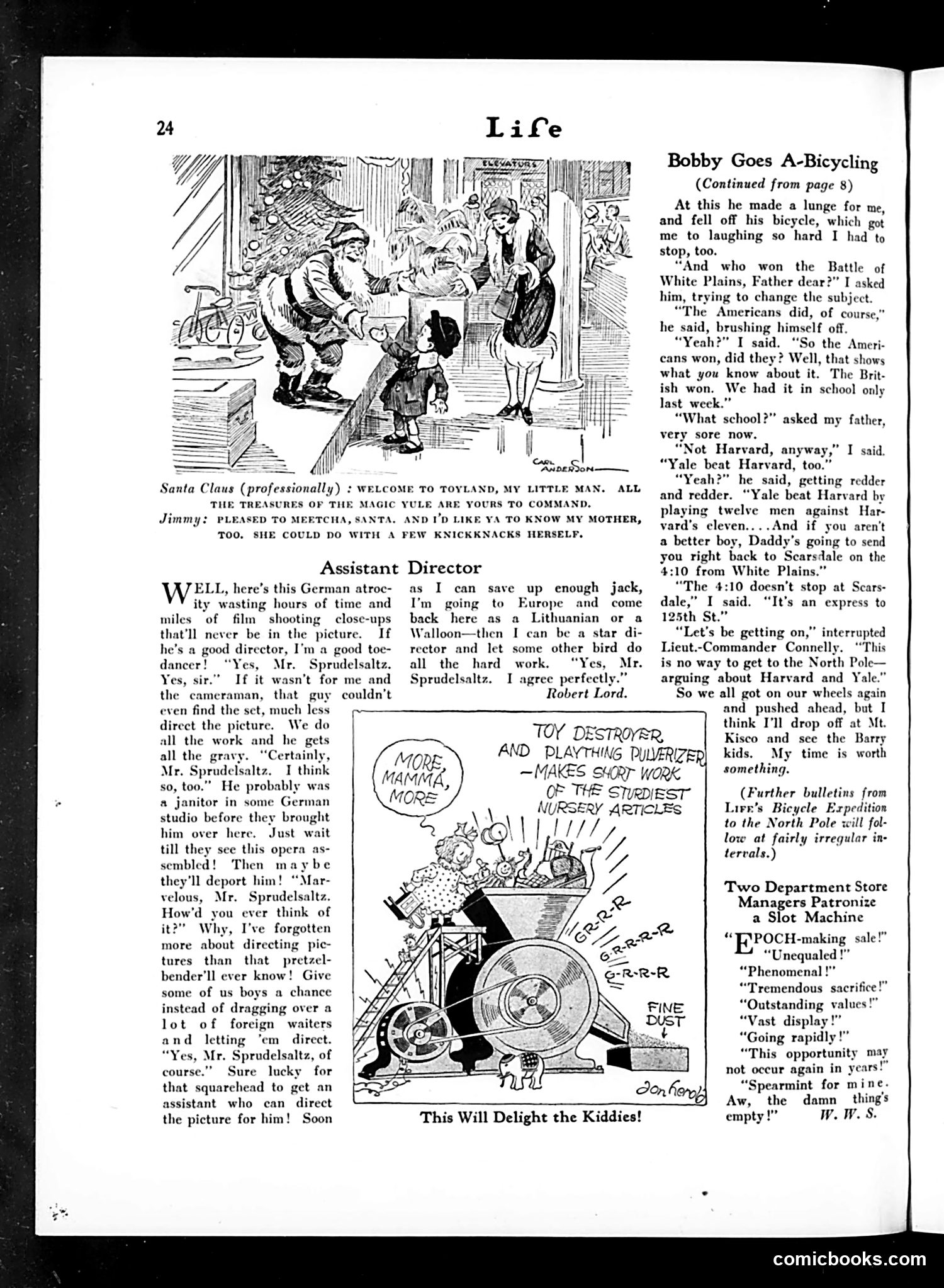
This Life magazine page contains two distinct pieces of satire: **"Assistant Director"** (by Robert Lord): This mocks anti-immigrant sentiment in 1920s Hollywood. An American assistant director resents working under a German filmmaker ("Sprudelsaltz"), viewing him as incompetent and undeserving. The assistant fantasizes about becoming a "star director" by fraudulently returning from Europe with a fake foreign identity—satirizing the ironic contradiction that foreigners receive opportunities Americans don't, while simultaneously revealing American prejudice against immigrant workers. **"Toy Destroyer" cartoon**: A humorous advertisement for a destructive toy, playing on children's desire to break things rather than preserve them. **"Two Department Store Managers"**: Brief satire on exaggerated advertising claims—managers celebrate their slot machine winnings while using hyperbolic sales language ("EPOCH-making," "Phenomenal," "Tremendous sacrifice"), until discovering the machine is empty. The anti-immigrant theme reflects 1920s nativism and labor anxieties in American entertainment industries.
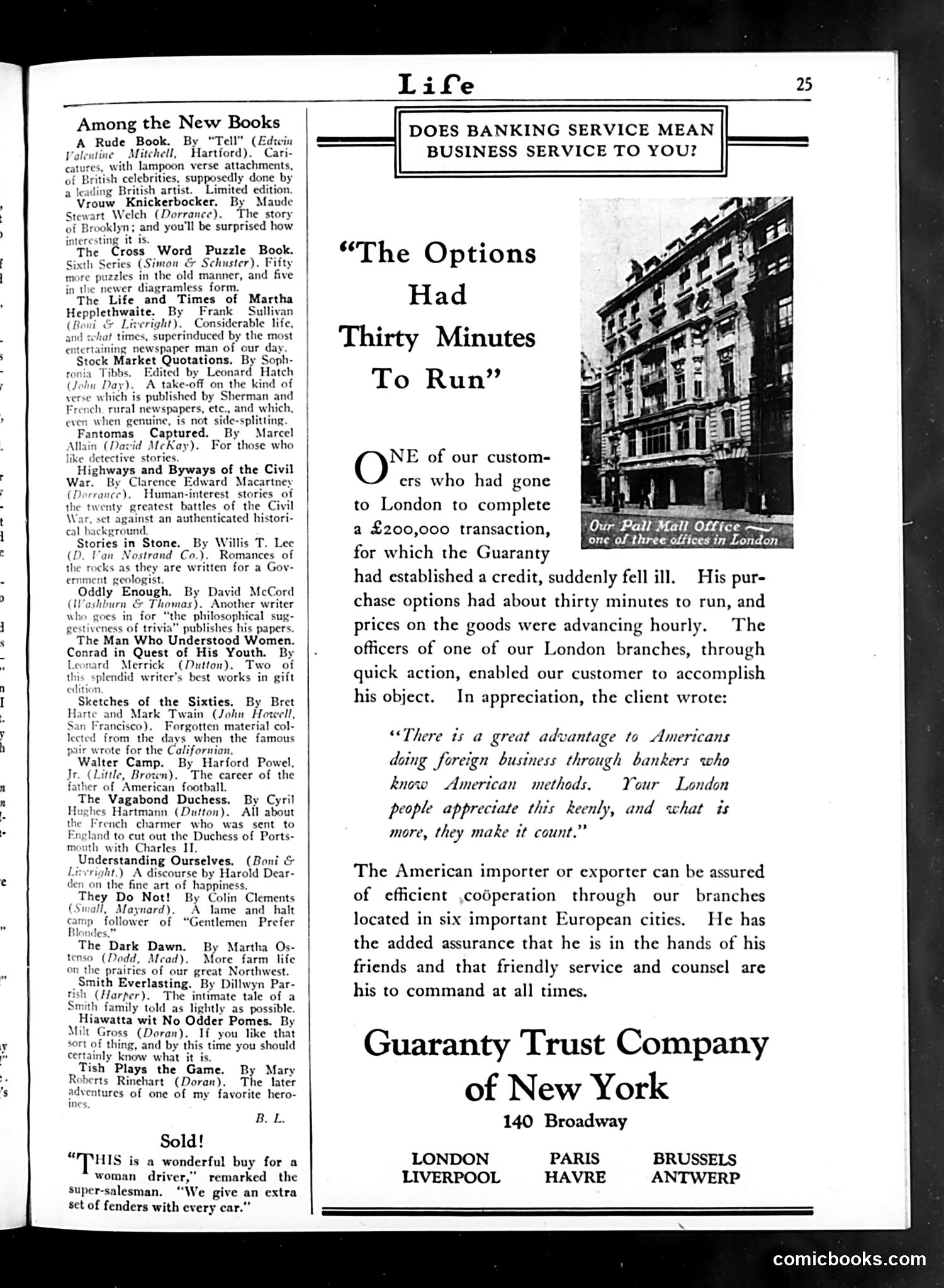
This page is primarily a **book review column** ("Among the New Books") alongside a **banking advertisement** for Guaranty Trust Company. The review section lists contemporary 1920s publications with brief, often witty commentary—including crossword puzzles, Civil War histories, and works by literary figures like Bret Harte and Mark Twain. A small joke at the bottom ("Sold!") depicts a car salesman's pitch to a woman driver, playing on period gender stereotypes about women drivers and automotive sales tactics. The larger advertisement tells a business success story: an American customer conducting a £200,000 transaction in London fell ill with only 30 minutes before his purchase options expired. Guaranty Trust's London branch acted quickly to resolve the crisis. The testimonial emphasizes the bank's understanding of "American methods" and its international reach across six European cities—positioning the bank as essential for American importers/exporters conducting foreign business. This is straightforward commercial content reflecting 1920s international finance and transatlantic business concerns.
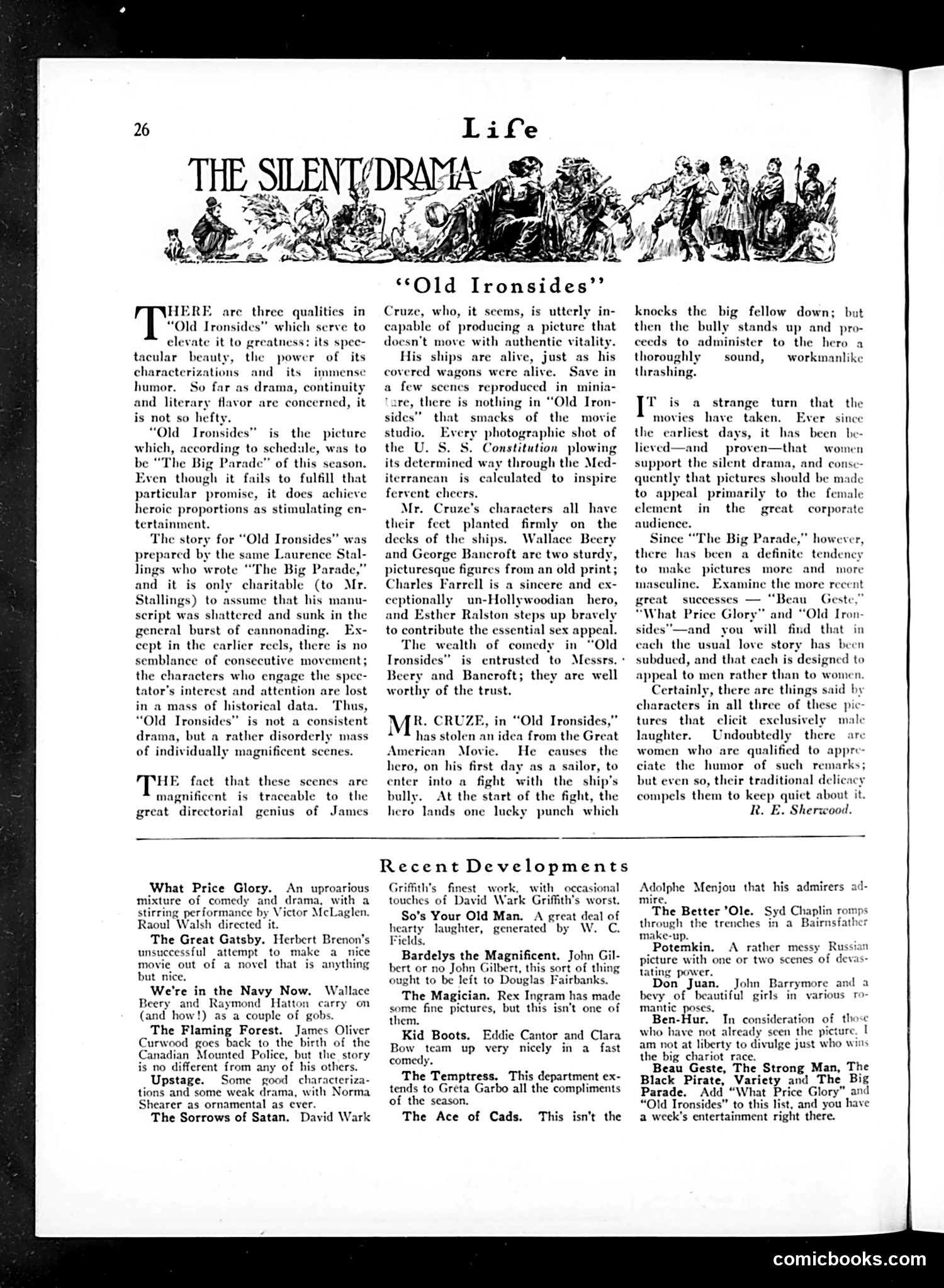
This is a film review page from Life magazine critiquing the silent film "Old Ironsides" (1926), directed by James Cruze. The review praises the film's visual spectacle and directorial skill while criticizing its narrative structure as disjointed and overstuffed with historical detail rather than coherent drama. The article notes that "Old Ironsides" was expected to be the season's major film (following Cruze's success with "The Big Parade"), but fails that promise despite impressive individual scenes. It highlights performances by Wallace Beery, George Bancroft, Charles Farrell, and Esther Ralston. The lower section observes a shifting trend in Hollywood: films increasingly appeal to male audiences through action and masculine themes rather than romantic storylines traditionally designed for female viewers—citing "Beau Geste," "What Price Glory," and "Old Ironsides" as examples of this new masculine-focused entertainment strategy.
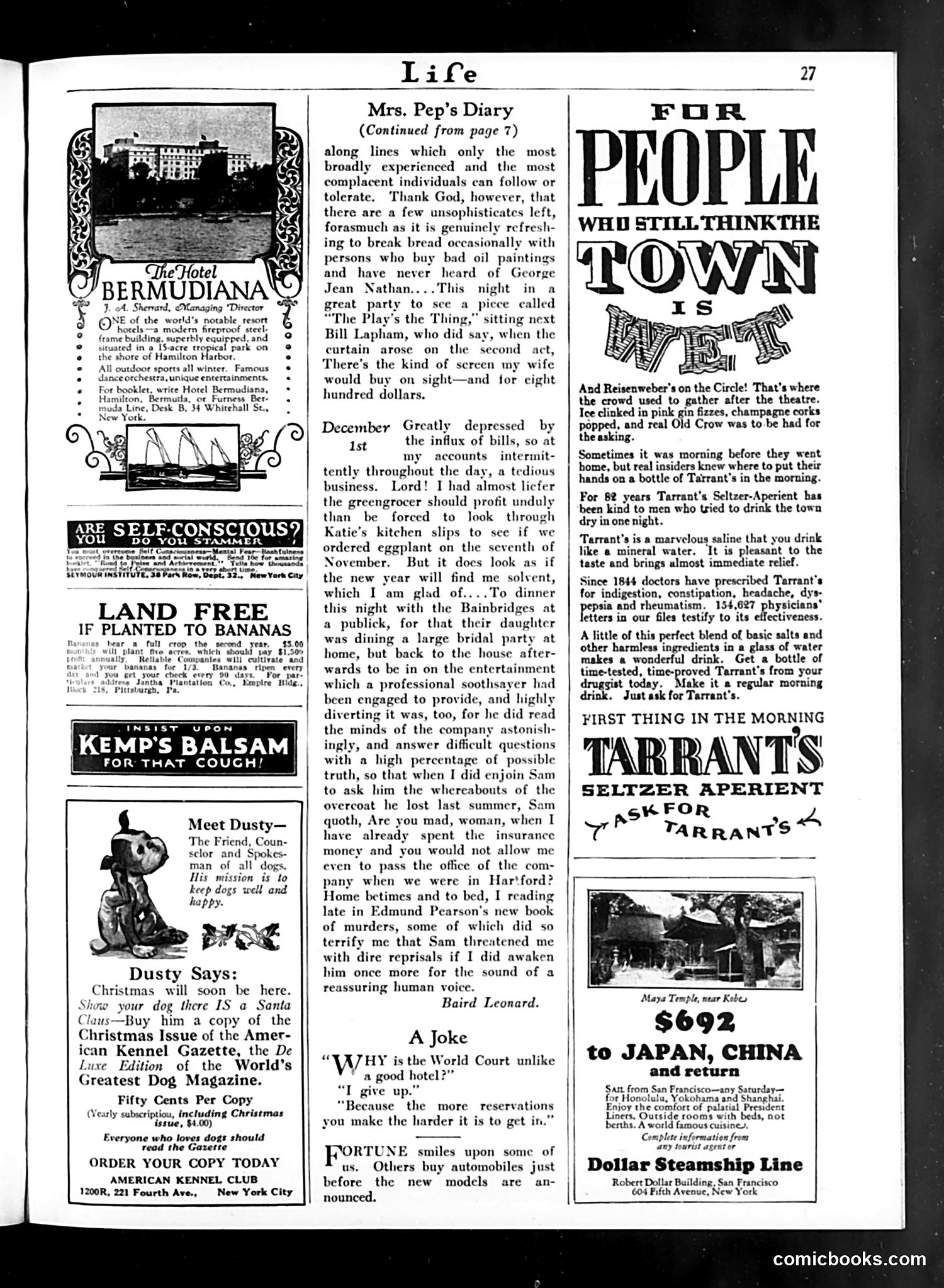
This page is primarily **advertising and society gossip** rather than political satire. The main content is "Mrs. Pep's Diary"—a satirical column mocking upper-class social pretensions. Pep complains about bills, attends plays and dinner parties, and reads Edmund Pearson's murder books; the humor targets wealthy people's frivolous concerns and affected sophistication. A small joke about the **World Court** appears at bottom—making a pun that the more "reservations" (both diplomatic hesitations and hotel bookings) one makes, the harder it is to "get in." This likely references 1920s isolationist skepticism about American involvement in international institutions. The page also contains typical period advertisements: a Bermuda resort hotel, banana plantation investment, dog magazine promotion, and a steamship line to Japan and China. The tone is lighthearted social commentary on the wealthy rather than serious political critique.
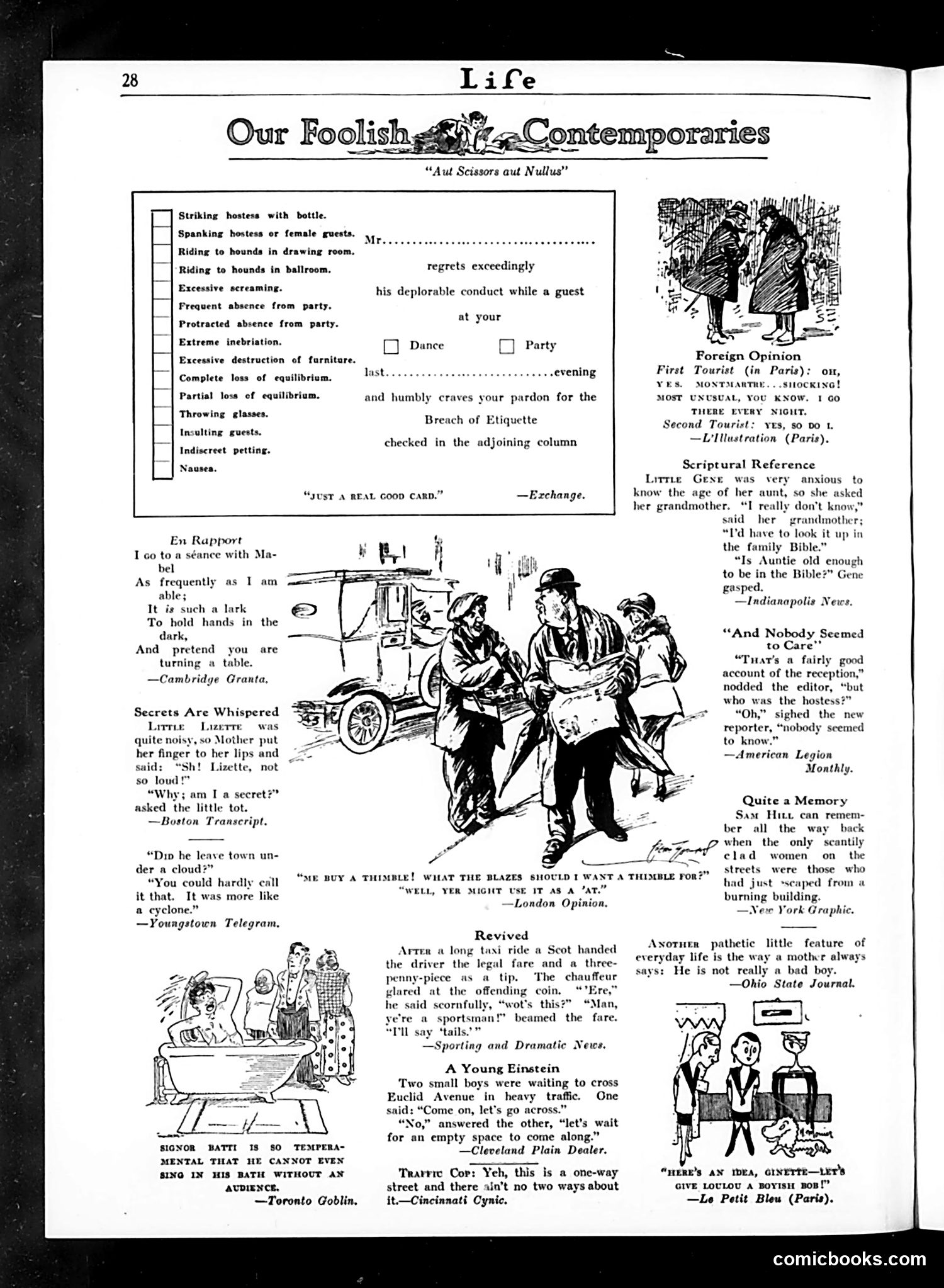
This page satirizes social etiquette breaches and modern manners through a checklist format and humorous anecdotes. The top section presents a mock apology card listing infractions (striking hosts with bottles, excessive drinking, destroying furniture, indiscreet behavior) that guests or hosts might commit—suggesting Jazz Age party culture had become so wild that standardized excuses were necessary. Below, brief jokes mock various social situations: séances as romantic opportunities, taxi drivers' stinginess (playing on Scottish stereotypes), traffic chaos, and absurd conversations. The "Foreign Opinion" section shows how different cultures view American behavior. The overall satirical point: modern social life has become so chaotic and rule-breaking that formal etiquette has collapsed into farce. The checklist humor suggests nobody follows proper conduct anymore—making apologetic cards almost comedic necessities.
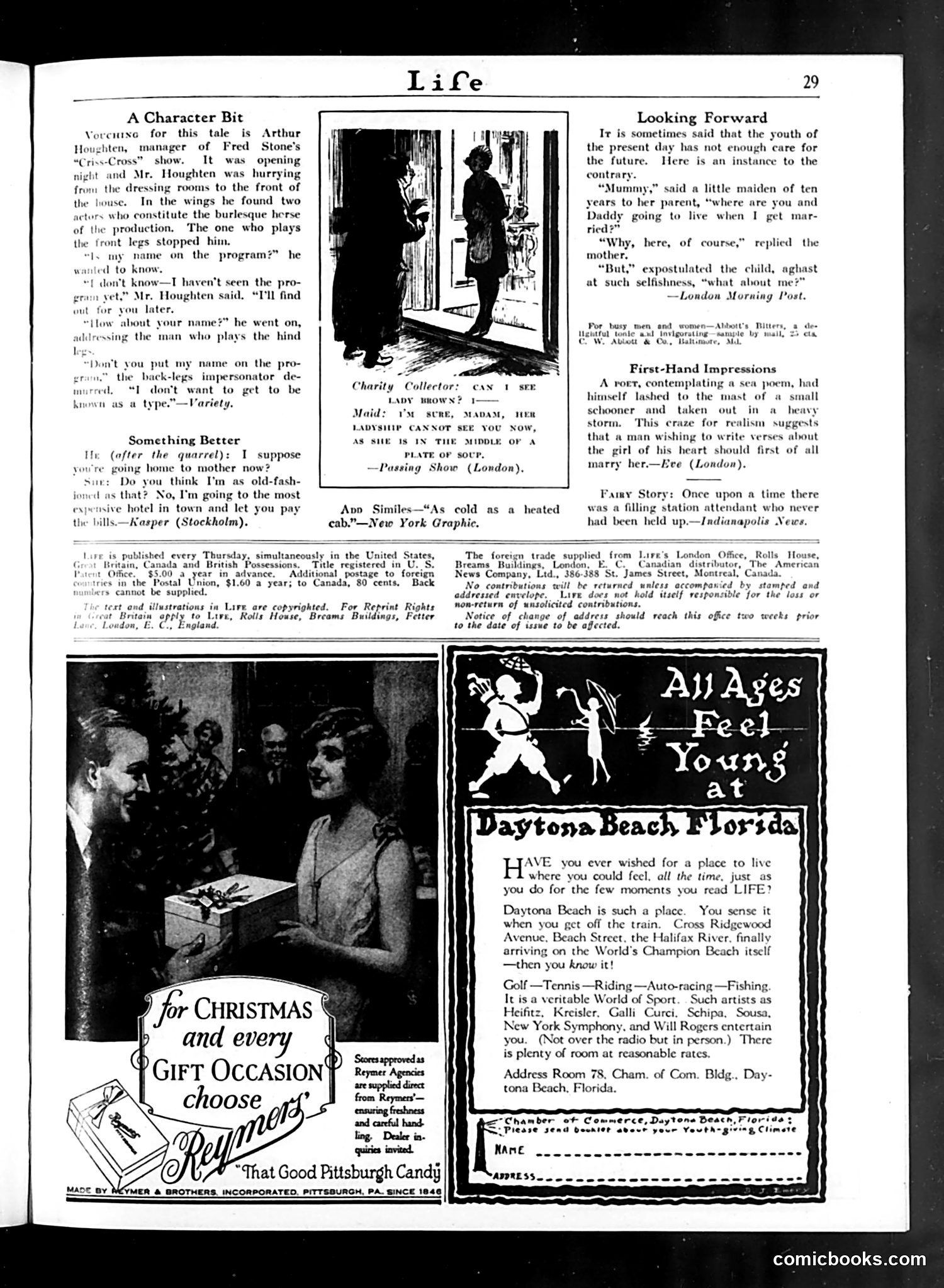
This page contains three unrelated satirical pieces typical of Life magazine's humor format: **"A Character Bit"** jokes about a horse in a burlesque production demanding program credit. The humor relies on the absurdity of a stage animal expecting billing—a play on theatrical vanity and the pecking order of performers. **"Looking Forward"** presents a child's practical concern about where her parents will live after she marries—satirizing parental selfishness by suggesting the parents hadn't considered their own future once their daughter leaves home. **"Something Better"** depicts a quarreling couple where the husband chooses to stay at an expensive hotel rather than go home, shifting the financial burden to his wife—commentary on marital discord and vindictive behavior. The remaining content consists primarily of advertisements (Daytona Beach tourism, Reymond's candy) and magazine circulation information. These brief comedic vignettes represent Life's satirical approach to contemporary social observations about family dynamics, theatrical pretension, and domestic conflict.
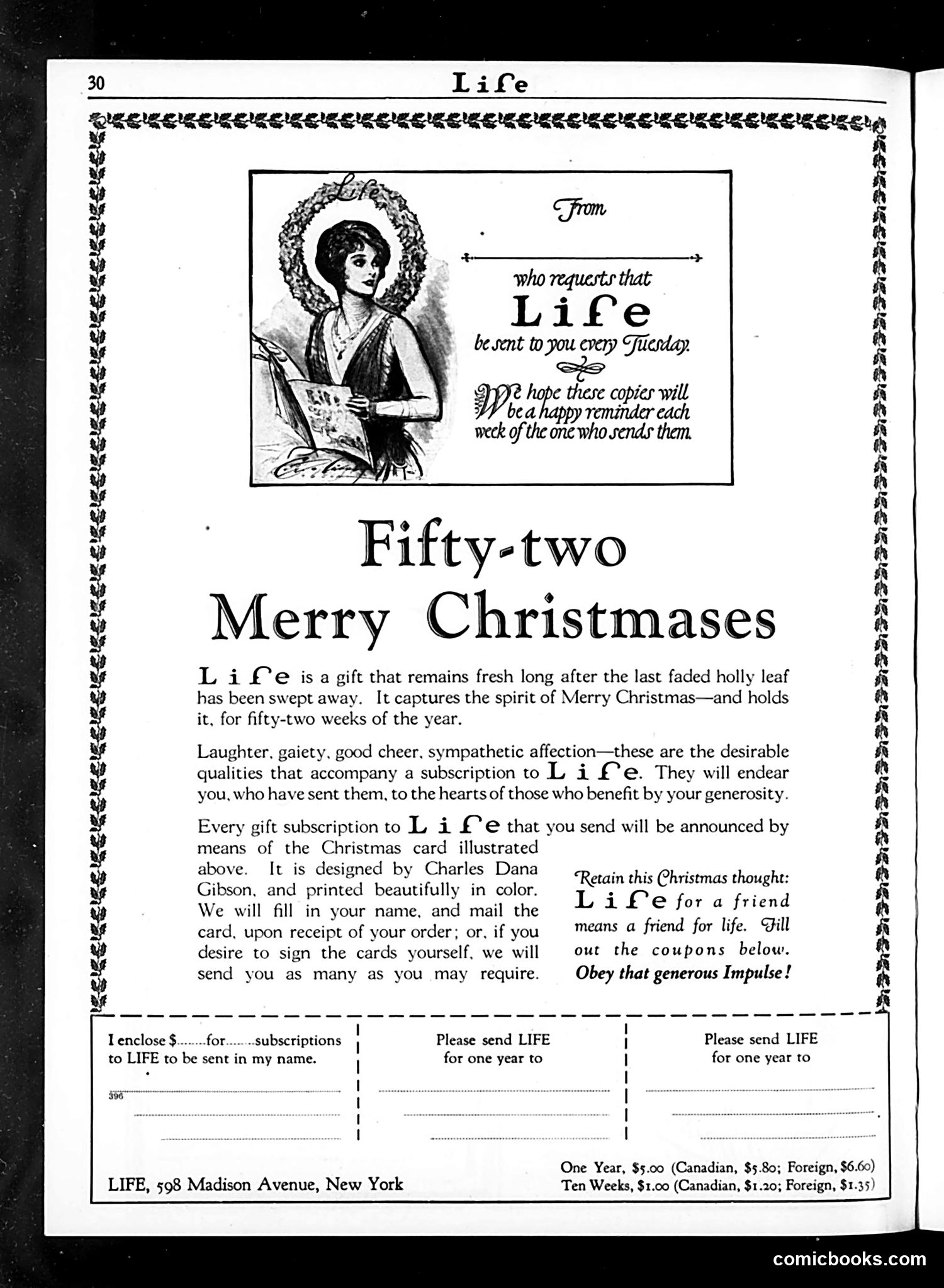
This is primarily a **gift subscription advertisement** for *Life* magazine, not a political cartoon. The page promotes giving *Life* subscriptions as Christmas presents. The illustration shows a woman reading *Life* magazine, framed by a decorative wreath—designed by the famous illustrator Charles Dana Gibson (known for "Gibson Girl" images). The ad emphasizes that *Life* subscriptions deliver weekly issues throughout the year, making them lasting gifts that embody Christmas spirit: "laughter, gaiety, good cheer, sympathetic affection." The page includes order coupons allowing readers to send subscription gifts to friends, with the Christmas card announcement featuring Gibson's illustration. Pricing ranged from $1.00 for ten weeks to $5.00 annually (with higher rates for Canadian and foreign delivery). This reflects early 20th-century consumer culture, where magazine subscriptions were marketed as thoughtful, enduring holiday gifts.
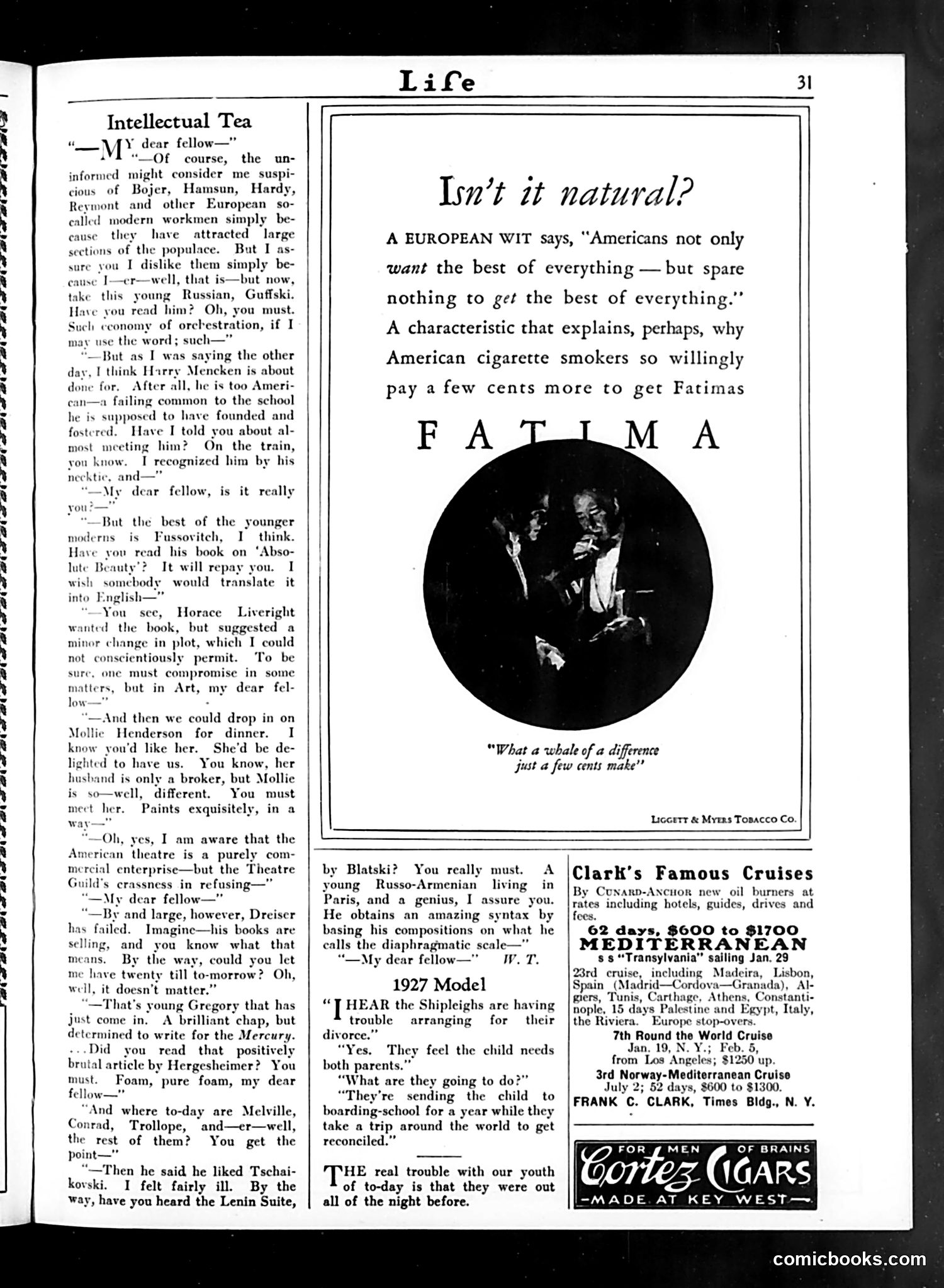
This page satirizes pretentious American intellectuals who affect European sophistication. The left column presents a tedious conversation between two men who constantly name-drop obscure European authors (Bojer, Hamsun, Fussovitch) and artists, while demonstrating their own shallowness—one asks to borrow money at the conversation's end, undermining their intellectual pretensions. The satire targets their affected speech patterns ("my dear fellow"), their dismissal of commercially successful American writers like Dreiser (whose popularity proves inferiority, they claim), and their contradictory values: they praise art over commerce while socializing with a broker's wife and considering publisher Horace Liveright's suggestions. The cigarette advertisement ironically undercuts this by celebrating American pragmatism—willingness to pay extra for quality—suggesting Americans have better judgment than the snobby conversation implies.
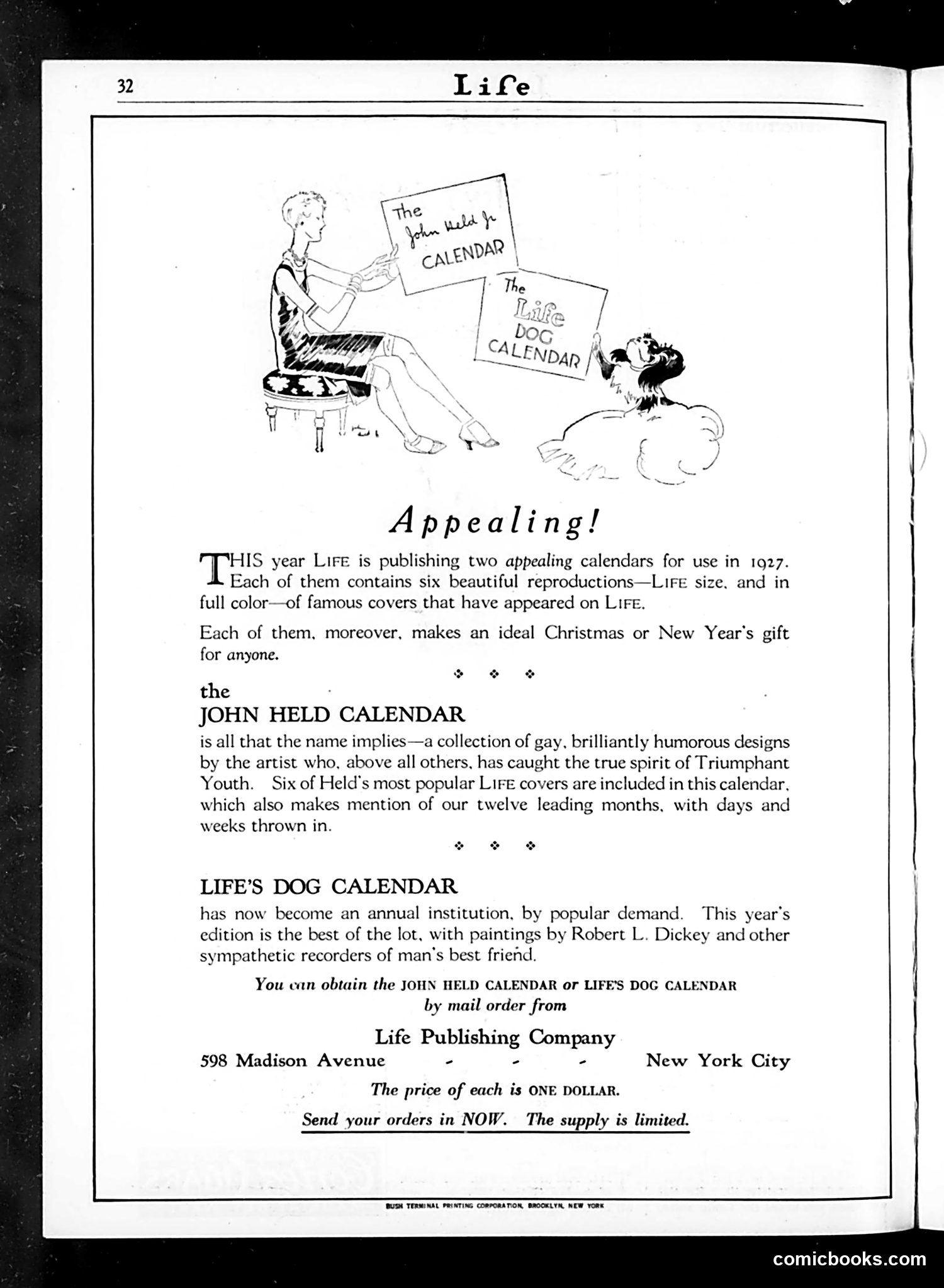
This is primarily a **1927 advertisement** for two calendars published by *Life* magazine, not political satire. The cartoon illustration shows a stylishly dressed woman and a dog holding calendar samples—a visual pun on the products being advertised. **Key content:** The ad promotes two calendars: 1. **John Held Calendar** — featuring humorous designs by artist John Held Jr., who was famous for capturing "Triumphant Youth" (likely referring to 1920s Jazz Age aesthetics and flapper culture) 2. **Life's Dog Calendar** — featuring paintings of dogs by Robert L. Dickey Both sold for one dollar by mail order from Life Publishing Company in New York City. The phrase "supply is limited" creates urgency for holiday gift purchases. This reflects 1920s consumer culture and the magazine's profitable sideline in calendar merchandise, which apparently had become a popular annual tradition by that time.
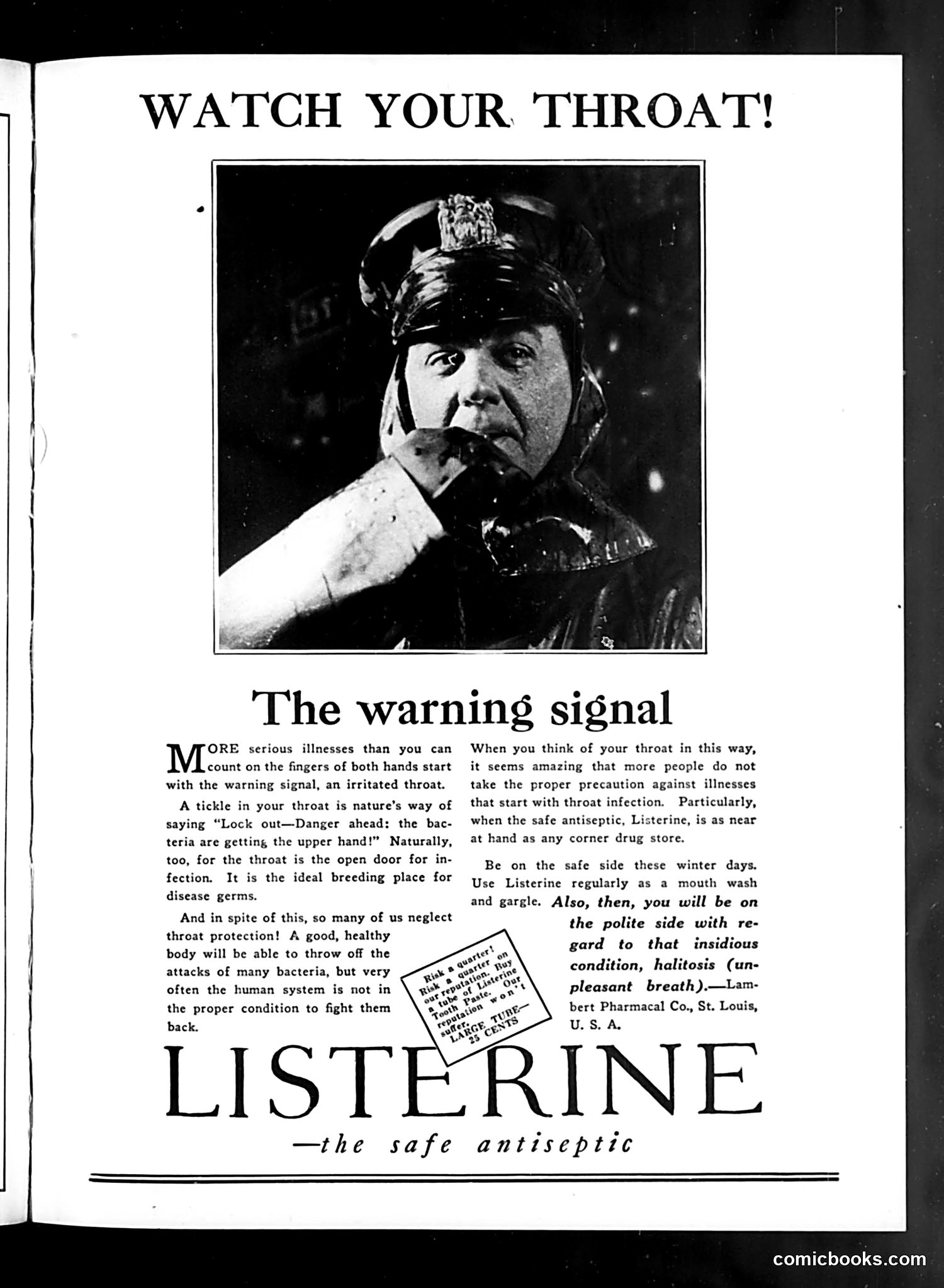
This is a **Listerine advertisement**, not political satire. The image shows a person with an exaggerated expression touching their throat—meant to illustrate the "warning signal" of throat irritation that the ad discusses. The ad's argument: sore throats are dangerous entry points for infection and disease. Most people neglect throat protection despite this risk. The solution: use Listerine mouthwash and gargle regularly as a preventative antiseptic. A secondary pitch targets social anxiety: regular Listerine use will also protect against halitosis (bad breath), making you "polite" company. **Context for modern readers**: This reflects early 20th-century medical thinking that emphasized hygiene and antiseptics as disease prevention. The dramatic language about bacteria and "danger" reflects the pre-antibiotic era when throat infections were genuinely serious threats. The social shame around bad breath was also heavily marketed in this period.
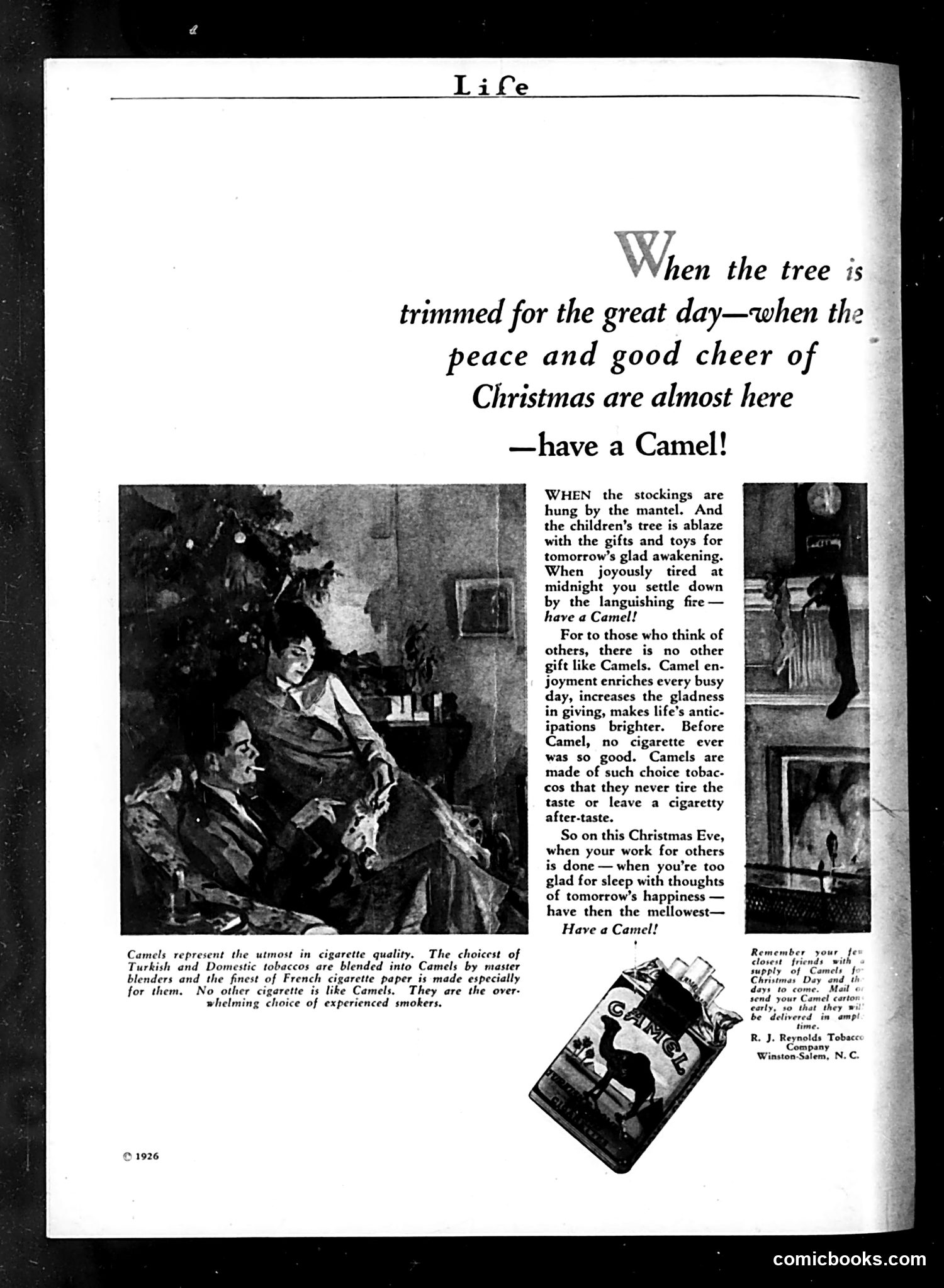
This is a **Camel cigarette advertisement**, not satire or political commentary. The page appeared in *Life* magazine in 1926 as paid advertising. The ad uses Christmas sentiment to market cigarettes by associating them with holiday relaxation and gift-giving. It depicts a cozy domestic scene—a couple by a fireplace with a decorated tree—and repeatedly urges readers to "have a Camel" at key Christmas moments: trimming the tree, hanging stockings, settling by the fire, and reflecting on the day's work. The pitch emphasizes quality ("choicest of Turkish and Domestic tobaccos") and suggests Camels as an ideal gift for friends. There's no identifiable caricature or political figure—just aspirational holiday imagery designed to normalize cigarette consumption as part of festive celebration. By modern standards, the advertisement is striking for its casual promotion of tobacco to mass audiences during a period before health warnings were mandated or widely publicized.

I can see this is a heavily degraded black and white page from Life magazine, with "comicbooks.com" credited at the bottom. However, the image quality is too poor for me to reliably identify specific cartoon content, text, or figures. The page appears to show some faint circular designs or patterns on the right side, and there's a white margin on the left, but the contrast and clarity are insufficient to read text or identify caricatures with confidence. To provide accurate historical analysis as requested, I would need a clearer or higher-contrast version of this page. I cannot responsibly guess at the identities of figures or political references when I cannot see them clearly.