
Life, 1926-12-23 · page 28 of 37
Life — December 23, 1926 — page 28: what you’re looking at
What you’re looking at
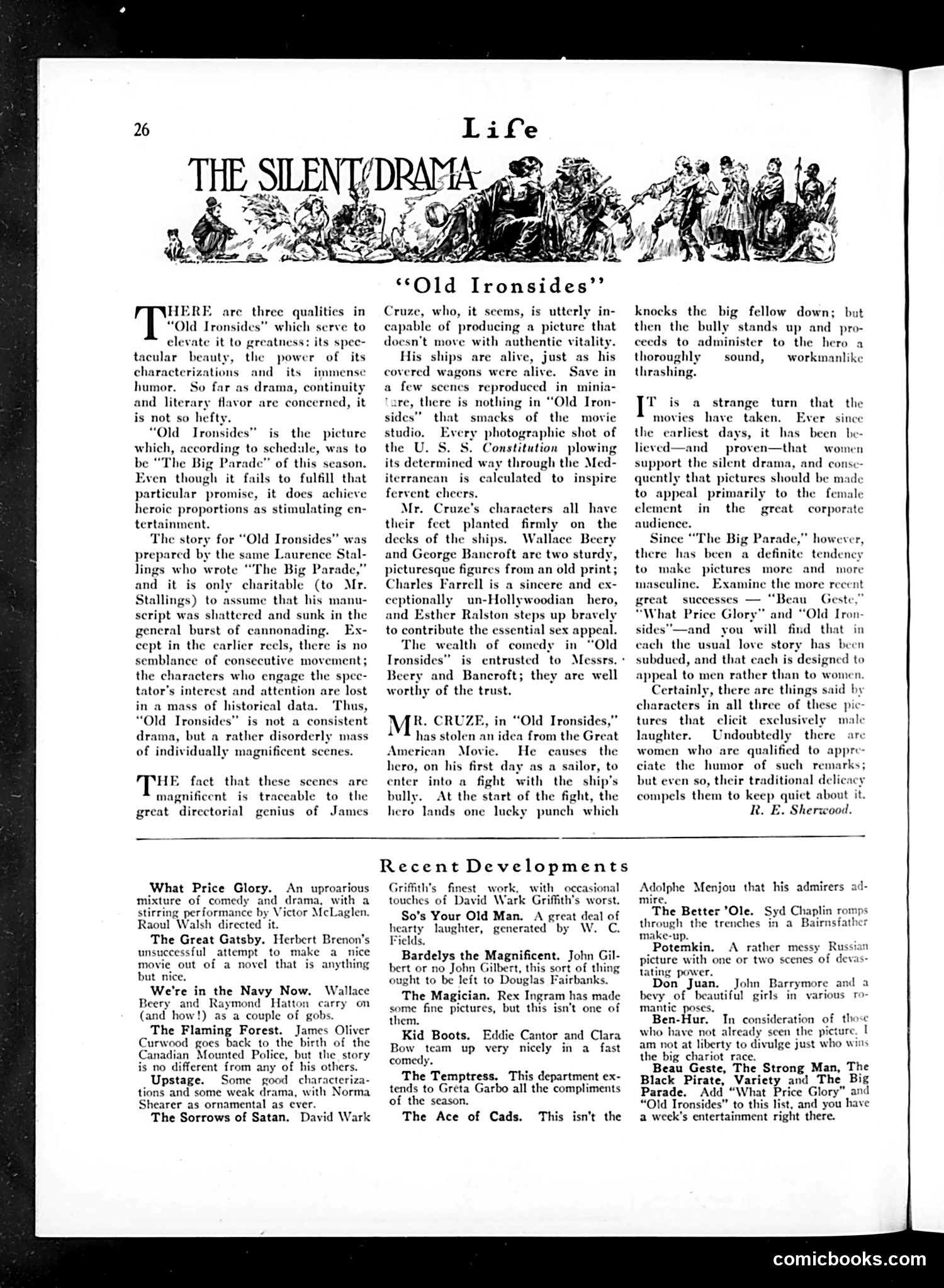
This is a film review page from Life magazine critiquing the silent film "Old Ironsides" (1926), directed by James Cruze. The review praises the film's visual spectacle and directorial skill while criticizing its narrative structure as disjointed and overstuffed with historical detail rather than coherent drama. The article notes that "Old Ironsides" was expected to be the season's major film (following Cruze's success with "The Big Parade"), but fails that promise despite impressive individual scenes. It highlights performances by Wallace Beery, George Bancroft, Charles Farrell, and Esther Ralston. The lower section observes a shifting trend in Hollywood: films increasingly appeal to male audiences through action and masculine themes rather than romantic storylines traditionally designed for female viewers—citing "Beau Geste," "What Price Glory," and "Old Ironsides" as examples of this new masculine-focused entertainment strategy.
📄 Transcribed text from this page (OCR, searchable)
Machine-transcribed from the original scan — historical spelling and the odd misread are preserved.
HERE are three qualities in “Old Ironsides” which serve to elevate it to greatness: its spec- tacular beauty, the power of its characterizations and its immense humor. So far as drama, continuity and literary flavor are concerned, it is not so hefty. “Old Tronsides” is the picture which, according to schedule, was to be “The Big Parade” of this season. Even though it fails to fulfill that particular promise, it does achieve heroic proportions as stimulating en- tertainment. The story for “Old Ironsides” was prepared by the same Laurence S$ lings who wrote “The Big Parade,” and it is only charitable (to Mr. Stallings) to assume that his manu- script was shattered and sunk in the general burst of cannonading. Ex- cept in the lier reels, there is no semblance of consecutive movement; the characters who engage the spec- tator’s interest and attention are lost in a mass of historical data. Thus, “Old Tronsides” is not a consistent drama, but a rather disorderly mass of individually magnificent scenes. HE fact that these scenes are magnificent is traceable to the great directorial genius of James Cruze, who, it seems, is utterly in- capable of producing a picture that doesn't move with authentic vitality. His ships are alive, just as his covered wagons were alive. Save in a few scenes reproduced in minia- tare, there is nothing in “Old Iron- sides” that smacks of the movie ery photographic shot of S. Constitution plowing its determined way through the Med- iterranean is calculated to inspire fervent cheers. Mr. Cruze’s characters all have their feet planted firmly on the decks of the ships. Wallace Beery and George Bancroft are two sturdy, picturesque figures from an old print; Charles Farrell is a sincere and cx- ceptionally un-Hollywoodian hero, and Esther Ralston steps up bravely to contribute the essential sex appeal. The wealth of comedy in “Old Tronsid: is entrusted to Messrs. ° Beery and Bancroft; they are well worthy of the trust. R. CRU “Old Ironsides,” idea from the Great He causes the hero, on his first day as a sailor, to enter into a fight with the ship's bully. At the start of the fight, the hero lands one lucky punch which What Price Glory. An uproarious mixture of comedy and drama, with a stirring performance by Victor McLaglen. Raoul Walsh directed it. The Great Gatsby. Herbert Brenon’s unsuccessful attempt to make a_ nice movie out of a novel that is anything but ni We're in the Navy Now. Wallace Beery and Raymond Hatton carry on (and how!) as a couple of gobs. The Flaming Forest. James Oliver Curwood goes back to the birth of the Canadian Mounted Police, but the story is no different from any of his others. Upstage. Some good characteriza- tions and some weak drama, with Norma arer_as ornamental as ever. The Sorrows of Satan, David Wark knocks the big fellow down; but then the bully stands up and_pro- ceeds to administer to the hero a thoroughly thrashing. sound, — workmanlike T is a strange turn that the movies have taken. Ever since the earliest days, it has been be- lieved—and_ — proven—that — women support the silent drama, and conse- quently that pictures should be made to appeal primarily to the female clement in’ the great audience. Since “The Big Parade,” however, there has been a definite tendenc to make pictures more and more masculine. Examine the more recent great successes — “Beau Geste,” “What Price Glory” and “Old Iron- sides"—and you will find that in h the usual love story | subdued, and that each is designed to appeal to men rather than to women, Certainly, there are things said by characters in all three of these pic- tures that clicit exclusively laughter. Undoubtedly _ there women who are qualified to appre- ciate the humor of such remarks; but even so, their traditional delicacy compels them to keep quiet about it. R. E. Sherwood. corporate s been male are Recent Developments Griffith's finest. work, with occasional touches of David Wark Griffith's worst. So’s Your Old Man. A great deal of hearty laughter, generated by W. C. Fields, Bardelys the Magnificent. John Gil- bert or no John Gilbert, this sort of thing ought to be left to Douglas Fairbanks. The Magician. Rex Ingram has made some fine pictures, but this isn’t one of them. Kid Boots, Eddie Cantor and Clara Bow team up very nicely in a fast comedy. The Temptress. This department ex- tends to Greta Garbo all the compliments of the season, The Ace of Cads. This isn’t the Adolphe Menjou that his admirers a mire. The Better ’Ole. through the trenches make-up. Potemkin. A rather messy Russiar picture with one or two scenes of de tating power. Don Juan. John Barrymore and a cautiful girls in various ro- Chaplin rom i a Bairnsfath In consideration of those who have not already scen the picture, | am not at liberty to divulge just who wins the big chariot race. Beau Geste, The Strong Man, The Black Pirate, Variety and The Big Parade. Add “What Price Glory” and “Old Ironsides” to this list, and you have a week's entertainment right there. comicbooks.com