
Life, 1926-12-23 · page 21 of 37
Life — December 23, 1926 — page 21: what you’re looking at
What you’re looking at
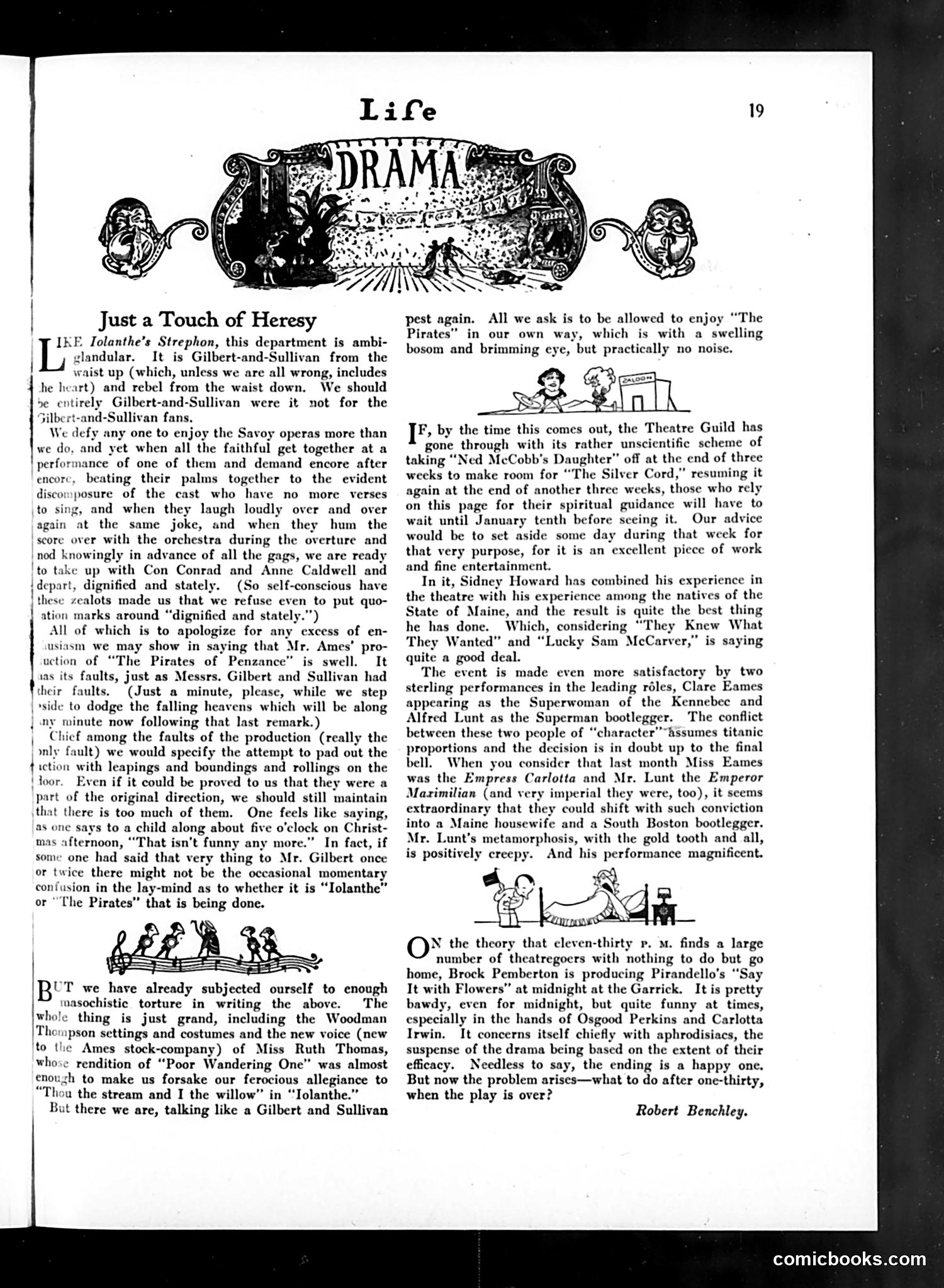
This is a theater review column criticizing overzealous Gilbert-and-Sullivan opera fans. The author praises a production of "The Pirates of Penzance" but complains that devoted fans attending performances—who sing along, laugh predictably at familiar jokes, and demand encores—ruin the experience for others through their obvious, self-conscious enthusiasm. The "heresy" is admitting that while Gilbert-and-Sullivan operettas are wonderful, their most devoted admirers can be insufferable. The reviewer playfully threatens to abandon this loyalty for modern musical theater (by Conrad and Caldwell) to escape the fanatics' behavior. The column also briefly reviews other productions: "Ned McCobb's Daughter" and "The Silver Cord." The small illustrations appear to be generic theater-related vignettes rather than specific caricatures, emphasizing the column's focus on theatrical behavior rather than particular public figures.
📄 Transcribed text from this page (OCR, searchable)
Machine-transcribed from the original scan — historical spelling and the odd misread are preserved.
Just a Touch of Heresy IKE. Jolanthe’s Strephon, this department is ambi- L glandular. It is Gilbert-and-Sullivan from the waist up (which, unless we are all wrong, includes he heart) and rebel from the waist down. We should be entirely Gilbert-and-Sullivan were it not for the Jilbert-and-Sullivan fans, We defy any one to enjoy the Savoy operas more than we do, and yet when all the faithful get together at a performance of one of them and demand encore after encore, beating their palms together to the evident discomposure of the cast who have no more verses to sing, and when they laugh loudly over and over again at the same joke, and when they hum the score over with the orchestra during the overture and nod knowingly in advance of all the gags, we are ready ‘to take up with Con Conrad and Anne Caldwell and jdepart, dignified and stately. (So self-conscious have these zealots made us that we refuse even to put quo- ation marks around “dignified and stately.” All of which is to apologize for any excess of en- usiasm we may show in saying that Mr. Ames’ pro- uction of “The Pirates of Penzance” is swell. It tas its faults, just as Messrs. Gilbert and Sullivan had their faults, (Just a minute, please, while we step | ‘side to dodge the falling heavens which will be along | ny minute now following that last remark.) Chief among the faults of the production (really the oly fault) we would specify the attempt to pad out the fiction with leapings and boundings and rollings on the \toor. Even if it could be proved to us that they were a part of the original direction, we should still maintain that there is too much of them. One feels like sayi as one says to a child along about five o’clock on Chris mas afternoon, “That isn’t funny any more.” In fact, if some one had said that very thing to Mr. Gilbert once or twice there might not be the occasional momentary confusion in the lay-mind as to whether it is “Iolanthe” or “The Pirates” that is being done. | UT we have already subjected ourself to enough masochistic torture in writing the above. The whole thing is just grand, including the Woodman Thompson settings and costumes and the new voice (new to the Ames stock-company) of Miss Ruth Thomas, whose rendition of “Poor Wandering One” was almost enough to make us forsake our ferocious allegiance to ‘Thou the stream and I the willow” in “Iolanthe.” But there we are, talking like a Gilbert and Sullivan pest again. All we ask is to be allowed to enjoy “The Pirates” in our own way, which is with a swelling bosom and brimming eye, but practically no noise. ) by the time this comes out, the Theatre Guild has gone through with its rather unscientific scheme of taking “Ned McCobb’s Daughter” off at the end of three weeks to make room for “The Silver Cord,” resuming it again at the end of another three weeks, those who rely on this page for their spiritual gu’ > will have to wait until January tenth befo Our advice would be to set aside some day during that week for that very purpose, for it is an excellent piece of work and fine entertainment. In it, Sidney Howard has combined his experience in the theatre with his experience among the natives of the State of Maine, and the result is quite the best thing he has done. Which, considering “They Knew What They Wanted” and “Lucky Sam McCarver,” is saying quite a good deal. The event is made even more satisfactory by two sterling performances in the leading réles, Clare Eames appearing as the Superwoman of the Kennebec and Alfred Lunt as the Superman bootlegger. The conflict between these two people of “character” Assumes titanic proportions and the decision is in doubt up to the final bell. When you consider that last month Miss Eames was the Empress Carlotta and Mr. Lunt the Emperor Maximilian (and very imperial they were, too), it seems extraordinary that they could shift with such conviction into a Maine housewife and a South Boston bootlegger. Mr. Lunt’s metamorphosis, with the gold tooth and all, is positively creepy. And his performance magnificent. N the theory that eleven-thirty p. m. finds a large number of theatregoers with nothing to do but go home, Brock Pemberton is producing Pirandello’s “Say It with Flowers” at midnight at the Garrick. It is pretty bawdy, even for midnight, but quite funny at times, especially in the hands of Osgood Perkins and Carlotta Irwin. It concerns itself chiefly with aphrodisiacs, the suspense of the drama being based on the extent of their efficacy. Needless to say, the ending is a happy one. But now the problem arises—what to do after one-thirty, when the play is over? Robert Benchley. comicbooks.com