
Life, 1926-12-23 · page 16 of 37
Life — December 23, 1926 — page 16: what you’re looking at
What you’re looking at
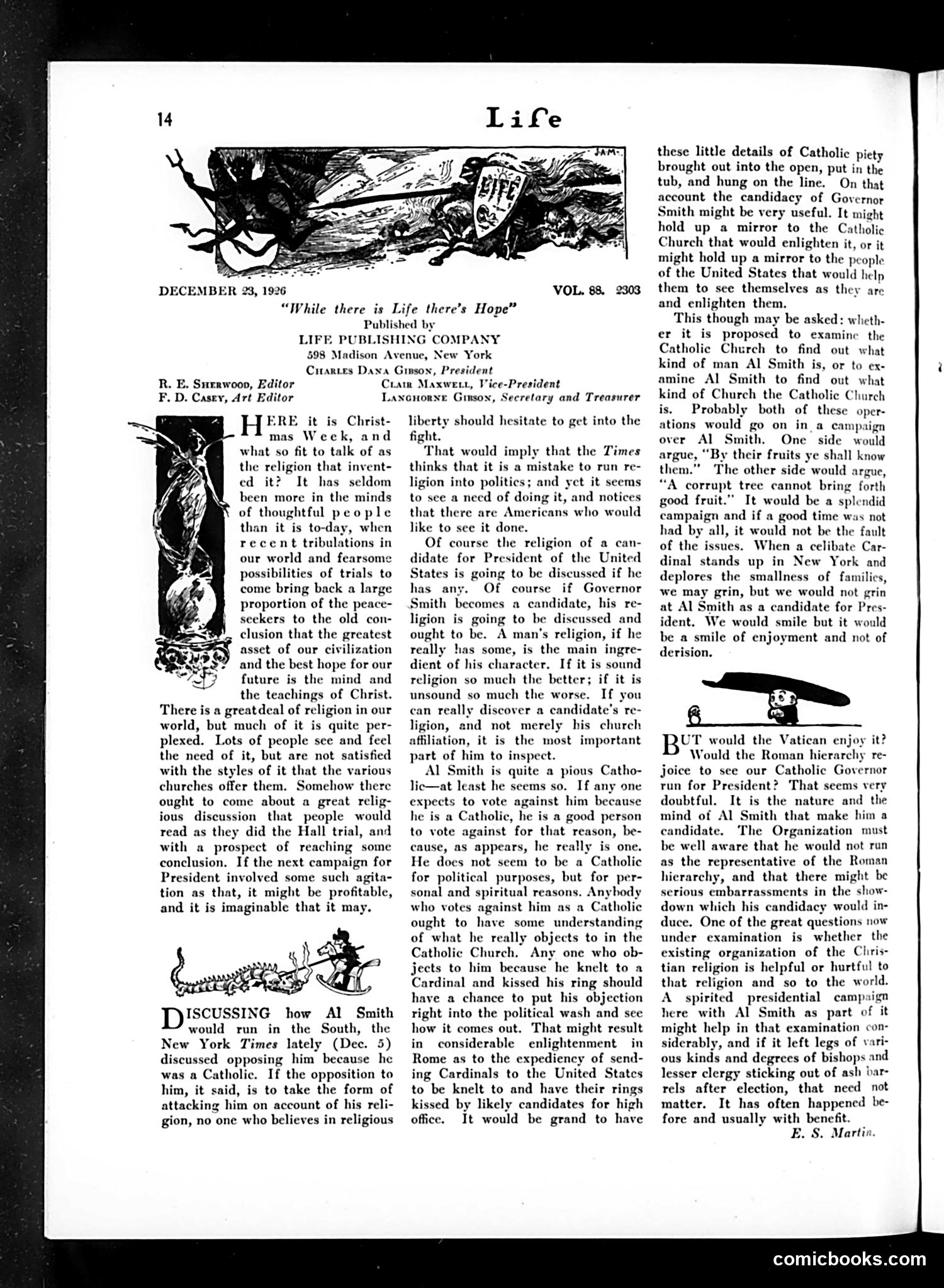
This *Life* editorial discusses the controversy surrounding Al Smith's candidacy for U.S. President in 1928. Smith was a Catholic, and the article addresses opposition to him based on his religion rather than his politics or qualifications. The editorial argues that attacking Smith's candidacy on religious grounds—rather than examining his actual positions—is inappropriate and reflects prejudice. The author suggests that voters should evaluate candidates based on character and policy, not faith. The cartoons (decorative rather than caricatured) illustrate the tension between religious liberty and political discourse. The piece ultimately advocates for separating religious identity from political fitness, challenging the anti-Catholic bias that influenced the 1928 election.
📄 Transcribed text from this page (OCR, searchable)
Machine-transcribed from the original scan — historical spelling and the odd misread are preserved.
“While there is Life there’s Hope” Published by LIFE PUBLISHING COMPANY 598 Madison Avenue, New York Ciantes Dana Ginson, President Maxwet, Vice-President Lanononxe Ginsox, Secretary and Treasurer R. E. Surrwoop, Editor Cu F. D. Casey, Art Editor ERE it is Christ- mas Weck, and what so fit to talk of as the religion that invent- ed it? It has seldom been more in the minds of thoughtful people than it is to-day, when recent tribulations in our world and fearsome possibilities of trials to come bring back a large proportion of the peace- seekers to the old con- clusion that the greatest asset of our civilization and the best hope for our future is the mind and the teachings of Christ. There is a great deal of religion in our world, but much of it is quite per- plexed. Lots of people see and feel the need of it, but are not satisfied with the styles of it that the various churches offer them. Somehow there ought to come about a great relig- ious discussion that people would read as they did the Hall trial, and with a prospect of reaching some conclusion. If the next campaign for President involved some such agita- tion as that, it might be profitable, and it is imaginable that it may. p ISCUSSING how Al Smith would run in the South, the New York Times lately (Dec. 5) discussed opposing him because he was a Catholic. If the opposition to him, it said, is to take the form of attacking him on account of his reli- gion, no one who believes in religious liberty should hesitate to get into the fight. That would imply that the Times thinks that it is a mistake to run re- ligion into politics; and yet it seems to see a need of doing it, and notices that there are Americans who would like to see it done. Of course the religion of a can- didate for President of the United States is going to be discussed if he has any. Of course if Governor Smith becomes a candidate, his re- ligion is going to be discussed and ought to be. A man’s religion, if he really has some, is the main ingre- dient of his character. If it is sound religion so much the better; if it is unsound so much the worse. If you really discover a candidate's re- ligion, and not merely his church affiliation, it is the most important part of him to inspect. Al Smith is quite a pious Catho- lic—at least he seems so. If any one expects to vote against him because he is a Catholic, he is a good person reason, be- cause, as appears, he really is one. He does not seem to be a Catholic for political purposes, but for per- sonal and spiritual reasons. Anybody who votes against him as a Catholic ought to have some understanding of what he really obj to in the Catholic Church, Any one who ob- jects to him because he knelt to a Cardinal and kissed his ring should have a chance to put his objection right into the political wash and see how it comes out. That might result in considerable enlightenment in Rome as to the expediency of send- ing Cardinals to the United States to be knelt to and have their rings kissed by likely candidates for high office. It would be grand to have these little details of Catholic piety brought out into the open, put in the tub, and hung on the line. On that account the candidacy of Governor Smith might be very useful. It might hold up a mirror to the Catholic Church that would enlighten it, or it might hold up a mirror to the people of the United States that would help them to see themselves as they are and enlighten them. . This though may be asked: wheth- er it is proposed to examine the Catholic Church to find out what kind of man Al Smith is, or to ex- amine Al Smith to find out what kind of Church the Catholic Church is. Probably both of these oper- ations would go on in. a campaign over Smith. One side would argue, “By their fruits ye shall know them.” The other side would argue, “A corrupt tree cannot bring forth good fruit.” It would be a splendid campaign and if a good time was not had by all, it would not be the fault of the issues. When a celibate Car- dinal stands up in New York and deplores the smallness of families, we may grin, but we would not grin at Al Smith as a candidate for Pres- ident. We would smile but it would be a smile of enjoyment and not of derision, UT would the Vatican enjoy it? Would the Roman hierarchy re- joice to see our Catholic Governor run for President? That seems very doubtful. It is the nature and the mind of Al Smith that make him a candidate. The Organization must be well aware that he would not run as the representative of the Roman hierarchy, and that there might be serious embarrassments in the show- down which his candidacy would in- duce. One of the great questions now under examination is whether the existing organization of the Cliris- tian religion is helpful or hurtful to ion and so to the world. spi presidential campaign here with Al Smith as part of it might help in that examination con- siderably, and if it left legs of vari- ous kinds and degrees of bishops and lesser clergy sticking out of ash bar- rels after election, that need not matter. It has often happened be- fore and usually with benefit. E. S. Martin. comicbooks.com