
A complete issue · 81 pages · 1926
Life — December 2, 1926
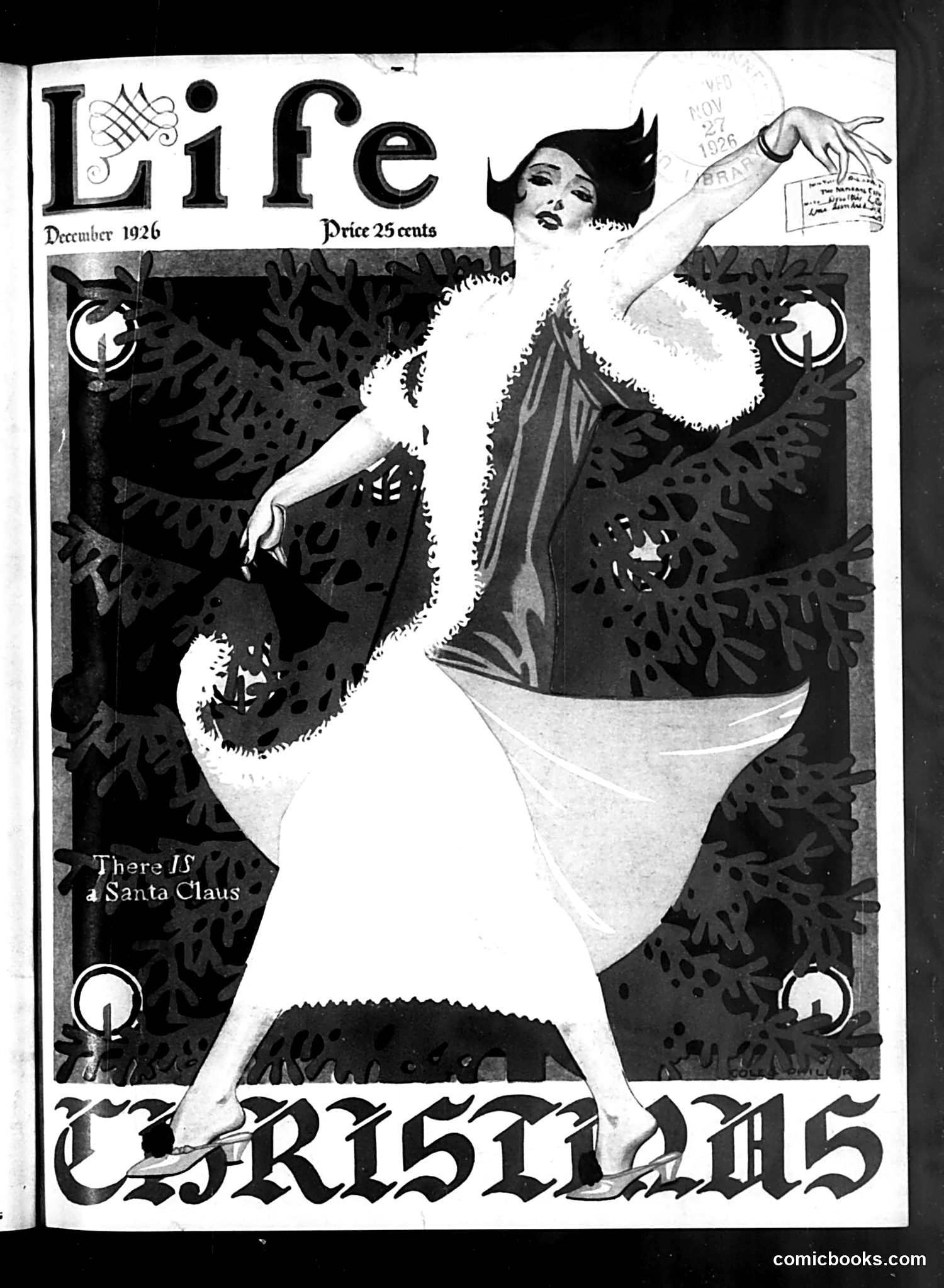
This is a **Christmas cover** for Life magazine's December 1926 issue (price 25 cents). The illustration depicts a fashionable woman in 1920s style—short dark hair, bare legs, and a fur-trimmed white dress—striking a theatrical pose. The text "There IS a Santa Claus" appears on the left side, while the bottom reads "CHRISTMAS." The satire likely mocks **1920s consumerism** and the commercialization of Christmas. The glamorous, somewhat frivolous figure embodies the "modern woman" of the Jazz Age, suggesting that for many Americans, Santa Claus now means shopping for fashionable goods rather than traditional religious observance. The cover captures Life's characteristic irreverent humor about contemporary American culture and materialism.
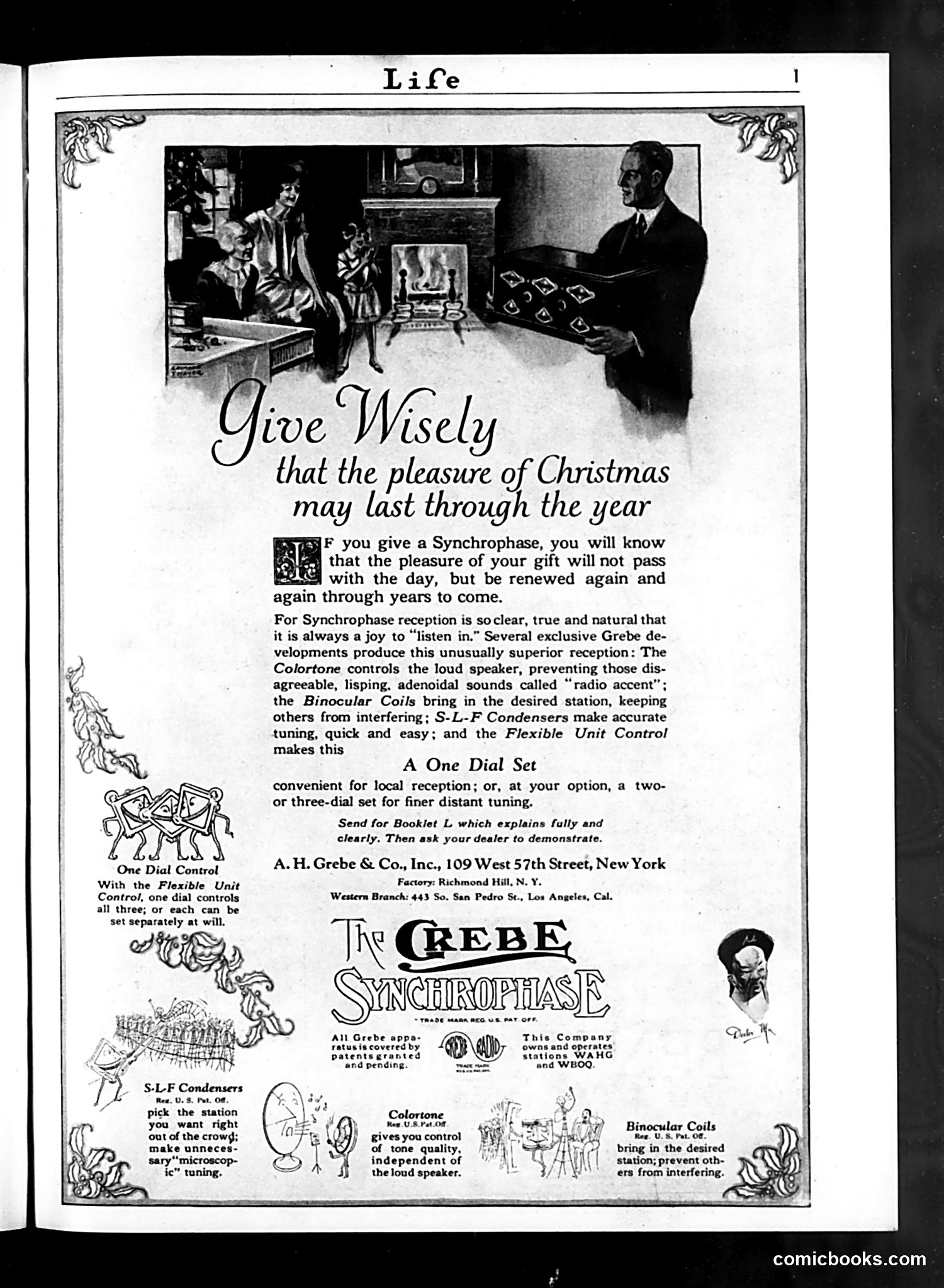
This page is primarily **advertising, not satire or political commentary**. It's a full-page advertisement for the Grebe Synchrophase radio receiver, published in Life magazine. The ad uses the Christmas gift-giving season as its marketing angle, with the headline "Give Wisely that the pleasure of Christmas may last through the year." The illustration shows a well-dressed man demonstrating the radio to a family gathered around a fireplace, positioning it as an aspirational luxury item. The advertisement emphasizes technical features like the Colortone speaker, Binocular Coils, and S-L-F Condenser. No political figures or satirical content are present—this is straightforward early-20th-century consumer marketing leveraging holiday sentiment to sell electronics.
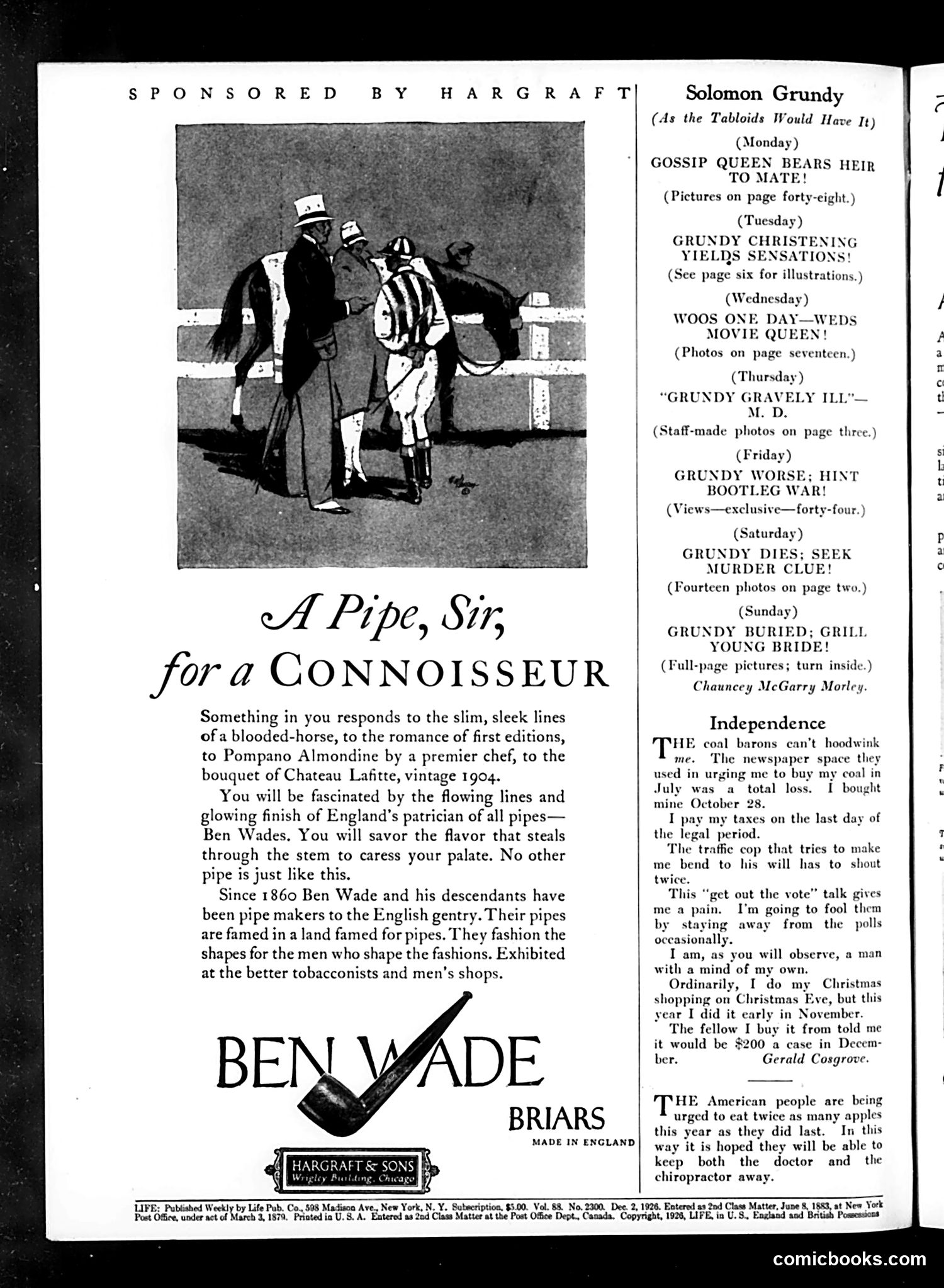
This page is primarily **advertising and editorial content** rather than political satire. The main image shows figures in formal dress at what appears to be a social gathering—likely illustrating "A Pipe, Sir, for a Connoisseur," a Ben Wade briars pipe advertisement emphasizing English craftsmanship since 1860. The right column contains **"Solomon Grundy"** — a serialized narrative for the week, with daily installments like "Gossip Queen Bears Heir to Mate!" and "Grundy Dies; Seek Murder Clue!" This was typical serialized fiction in Life magazine. Below that, two brief opinion columns discuss independence and American apple consumption—general editorial commentary rather than satire. The page reflects Life's mixed format: advertising, serialized entertainment, and lighthearted social commentary typical of 1920s American magazines.
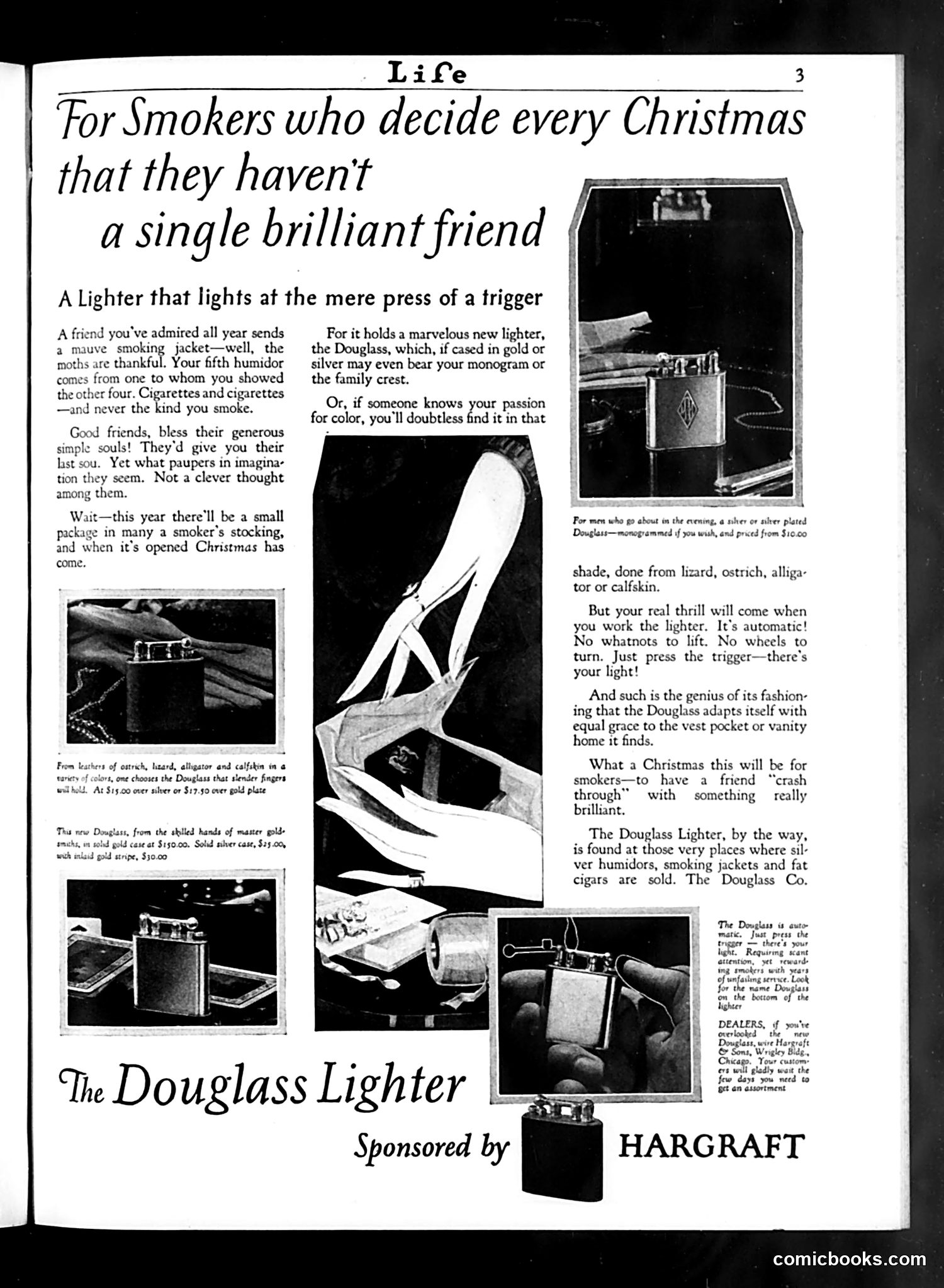
This is primarily **advertisement disguised as editorial content** for the Douglass Lighter, sponsored by Hargraft. The "satire" is gentle social commentary rather than political critique. The piece mocks smokers who receive cigarette-related gifts annually—here, a trigger-activated lighter. The humor targets the predictability of gift-giving to tobacco users: friends lack imagination, so they default to smoking accessories. The accompanying illustrations show the lighter's features and elegant design (available in precious metals). The implicit joke is that smokers celebrate receiving "a friend" in the form of a luxury gadget, playing on the opening line about lacking "a single brilliant friend." This represents mid-century consumer advertising that used light satire to sell lifestyle products to affluent readers.
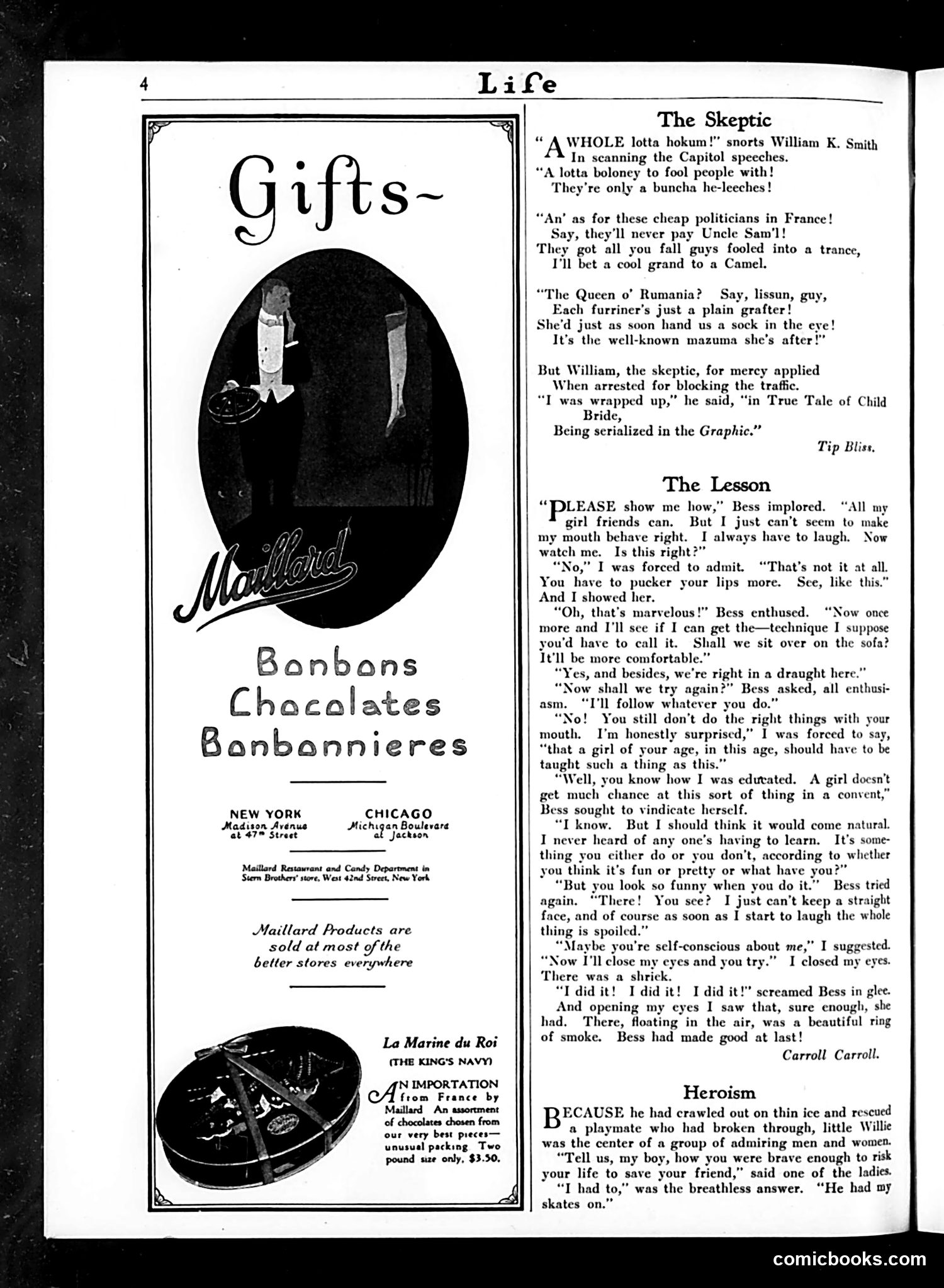
This page is primarily **advertising** for Maillard chocolates and candies (left side), with three unrelated short humorous pieces on the right. "The Skeptic" mocks William K. Smith, who dismisses various political and social claims—French politicians, the "Queen of Romania," and a mazuma (slang for money). The joke is that Smith was arrested for "blocking traffic" while claiming, via a serialized story, to have been "wrapped up." The satire targets his hypocrisy or dubious excuses. "The Lesson" humorously depicts a girl learning proper mouth etiquette from an unnamed narrator, progressing from awkward attempts to finally achieving a successful kiss. "Heroism" briefly presents a boy rescuing a playmate who broke through ice, with onlookers praising his bravery—a straightforward, sentimental anecdote rather than satire. The page reflects early 20th-century Life magazine's mix of advertisements, short satirical commentary, and light humor.
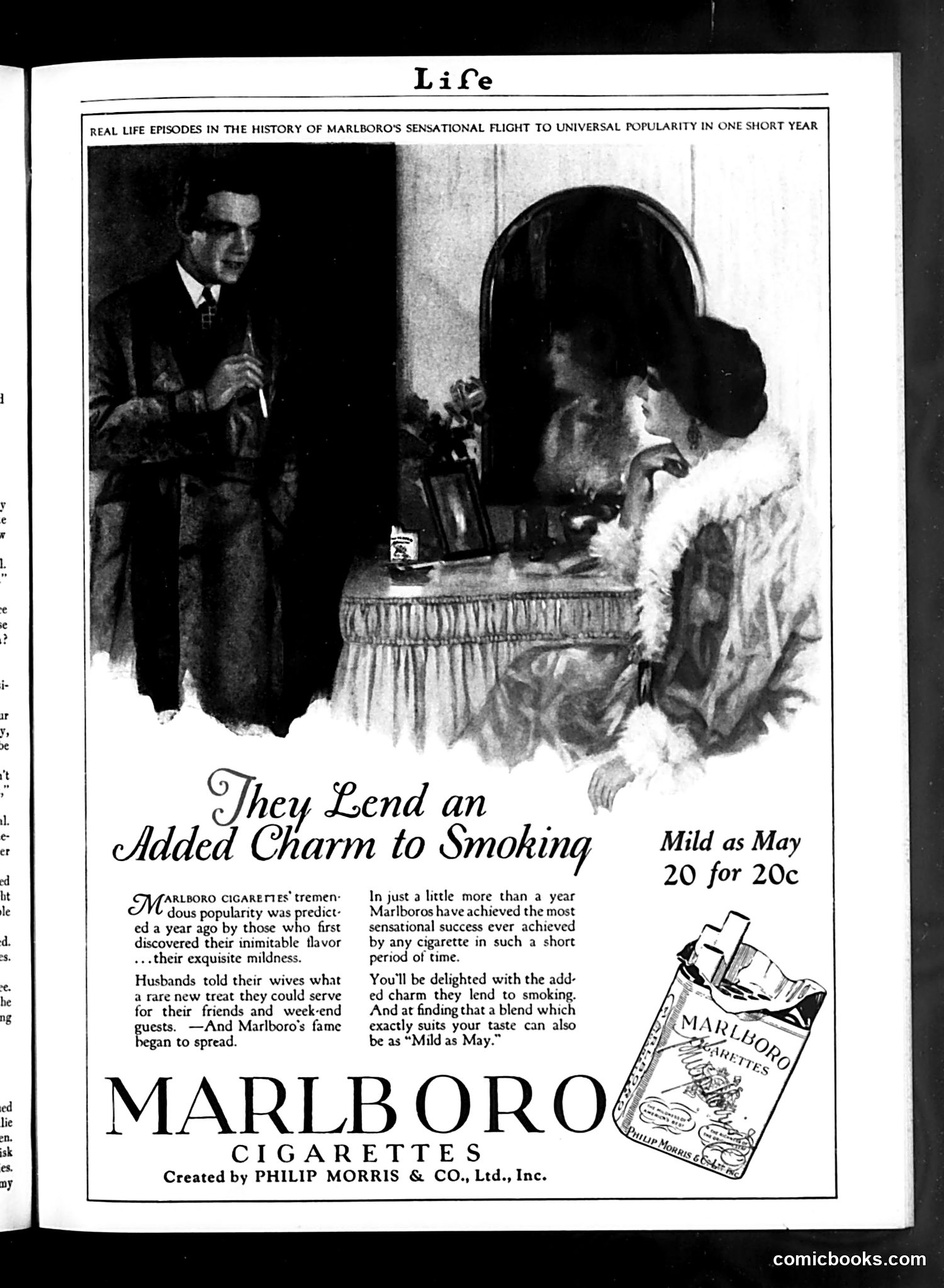
This is a **Marlboro cigarette advertisement**, not political satire. The page header claims to document "Real Life Episodes in the History of Marlboro's Sensational Flight to Universal Popularity in One Short Year." The ad depicts a social scene where a man presents cigarettes to a woman at what appears to be an elegant gathering. The copy celebrates Marlboro's rapid market success, attributing it to "exquisite mildness" and noting husbands recommending them to wives for social occasions. The tagline "They Lend an Added Charm to Smoking" — combined with imagery of refined, fashionable people — suggests cigarettes enhance social sophistication and appeal. The price ("20 for 20c") and "Mild as May" branding emphasize accessibility and gentleness, targeting both male and female consumers during an era when marketing cigarettes to women was becoming normalized.
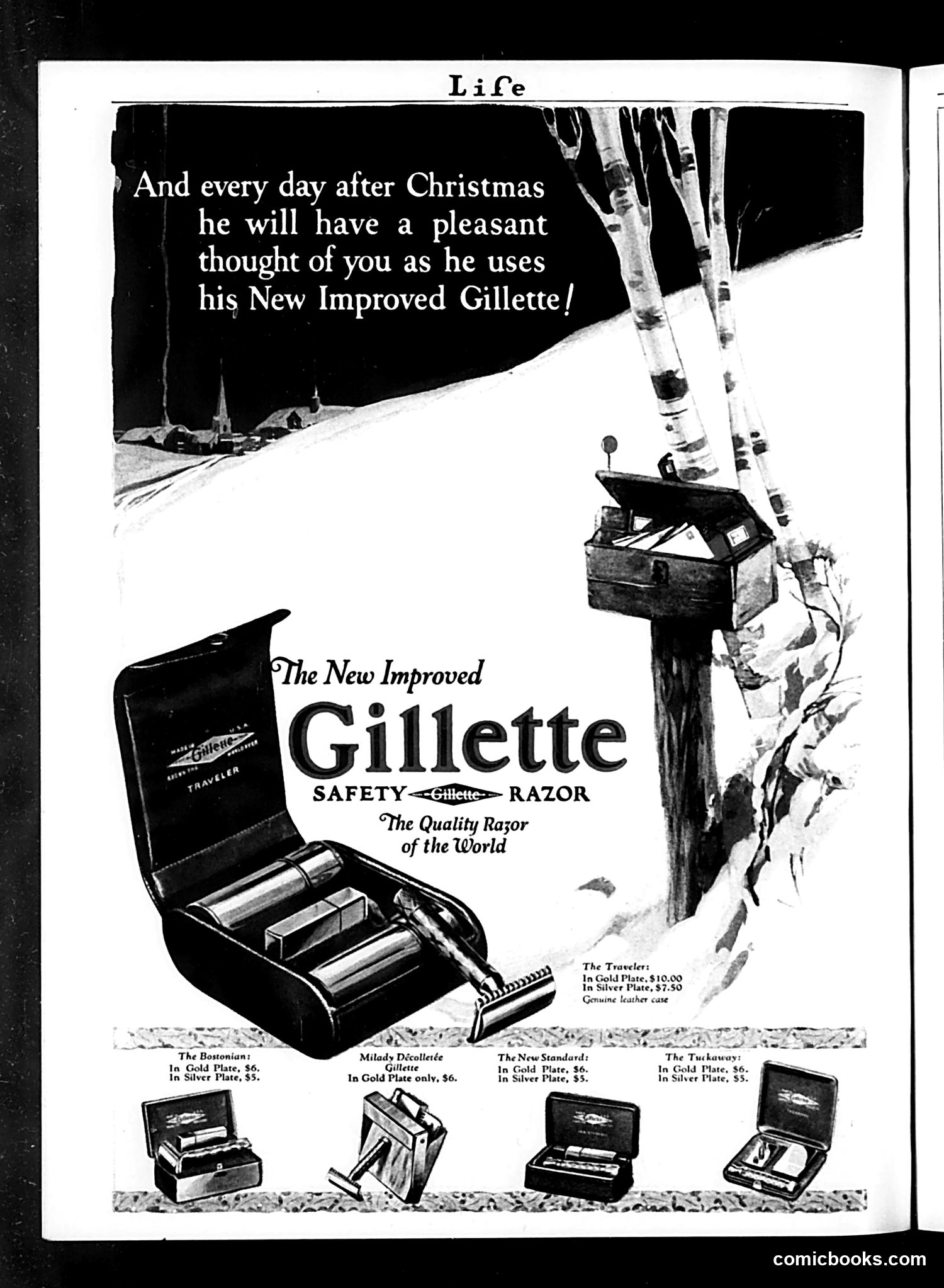
This is a **Gillette Safety Razor advertisement**, not a political cartoon. The page uses a winter/Christmas gift-giving theme to market Gillette razors. The ad features a snowy mountain scene with a man shaving near birch trees and a ski lodge, positioning the razor as an upscale gift. The tagline promises that recipients will think of the gift-giver daily while using the product. The advertisement showcases multiple Gillette razor sets in various price points and finishes (gold plate, silver plate), including models called "The Traveler," "The Rajah," "Middy Gillette," "The New Standard," and "The Tuxedo." This is commercial advertising using aspirational imagery—winter sports, luxury finishes, quality craftsmanship—rather than satire or political commentary.
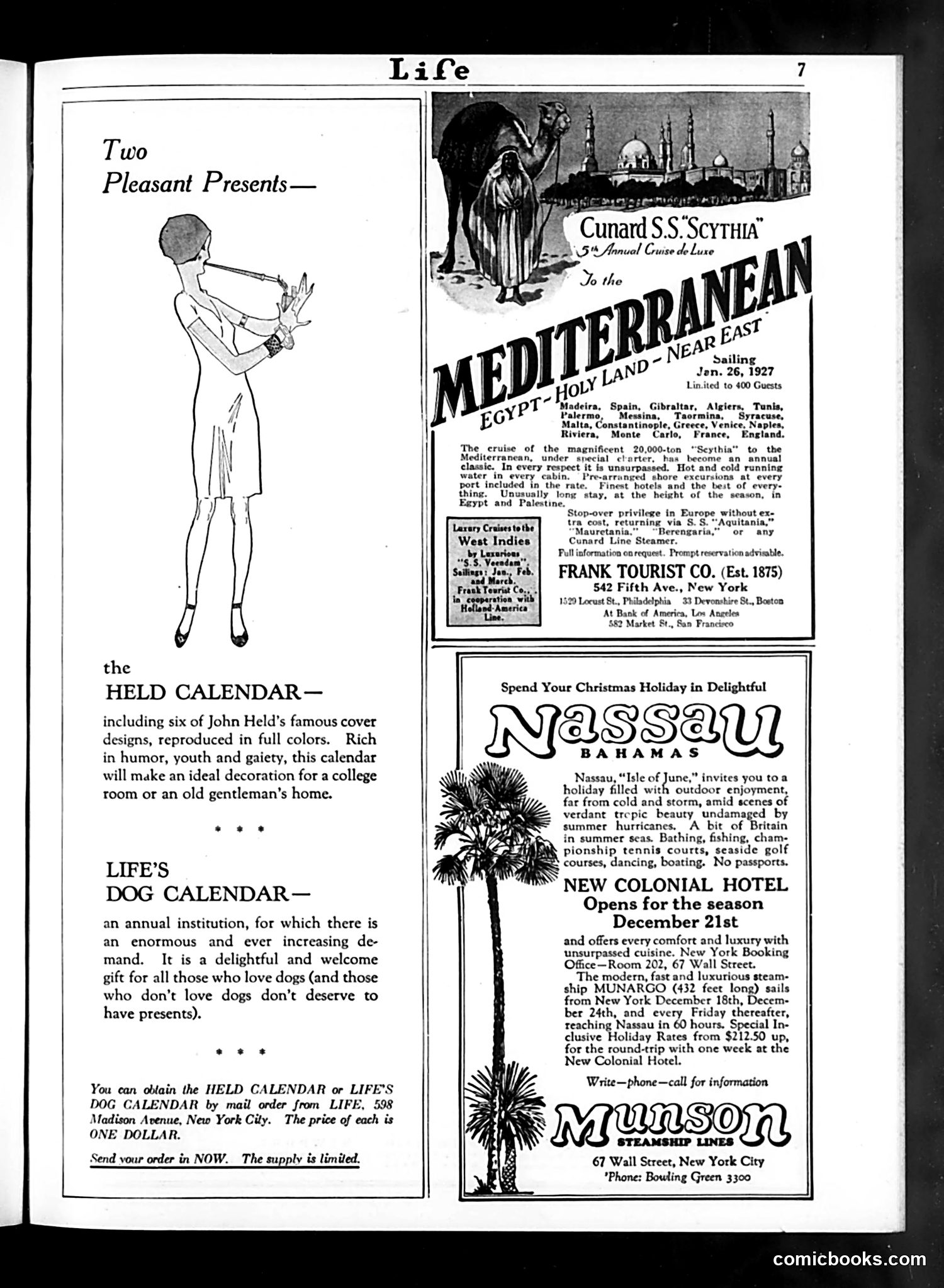
This page is primarily **advertising**, not political satire. The left side promotes two calendar products: the "Held Calendar" featuring John Held's famous cover designs (known for depicting stylized 1920s "flapper" women), and the "Life's Dog Calendar." The right side contains travel advertisements: a Cunard cruise to the Mediterranean, a Nassau/Bahamas resort promotion, and a Munson Steamship Line cruise advertisement. The single cartoon on the left shows a stylized woman in 1920s fashion—likely representing the "flapper" aesthetic that John Held popularized in his illustrations. This reflects the era's cultural fascination with modern, liberated women's fashion and behavior, though not satirizing any specific political figure or event.
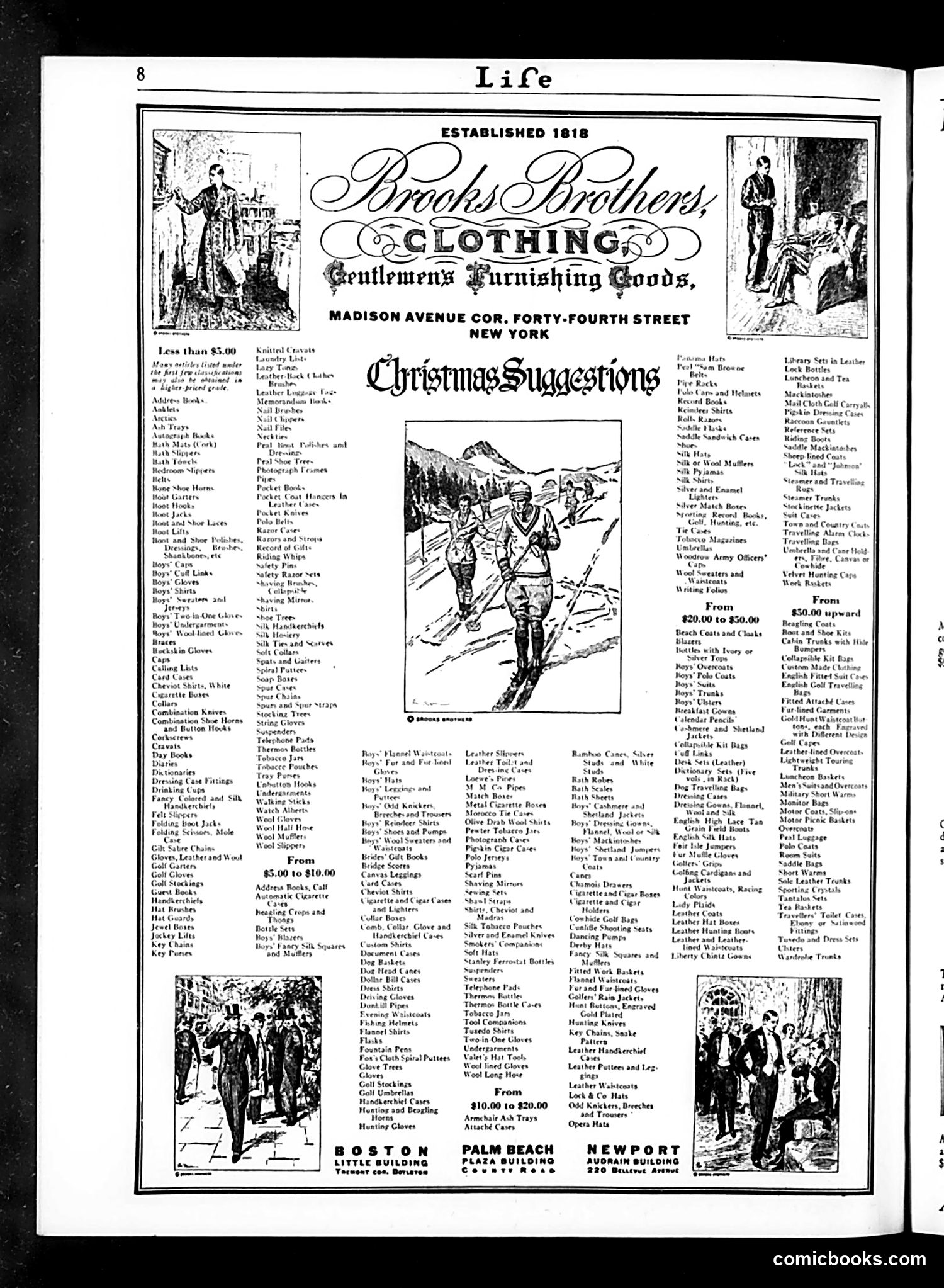
This page is primarily a **Brooks Brothers clothing advertisement** established in 1818, occupying most of the space. The central illustration shows two men skiing in a mountainous winter landscape, labeled "Christmas Suggestions." The ad lists gift items organized by price range—from less than $5.00 up to $50 and beyond—including clothing, accessories, and sporting goods appropriate for holiday gift-giving. The page contains **no political cartoons or satire**. Instead, it's a commercial advertisement using a pleasant winter sports scene to market gentlemen's furnishings and clothing. The smaller illustrations on the borders show men in various formal attire, reinforcing Brooks Brothers' positioning as a retailer of upscale menswear. Additional store locations in Boston, Palm Beach, and Newport are listed at the bottom.
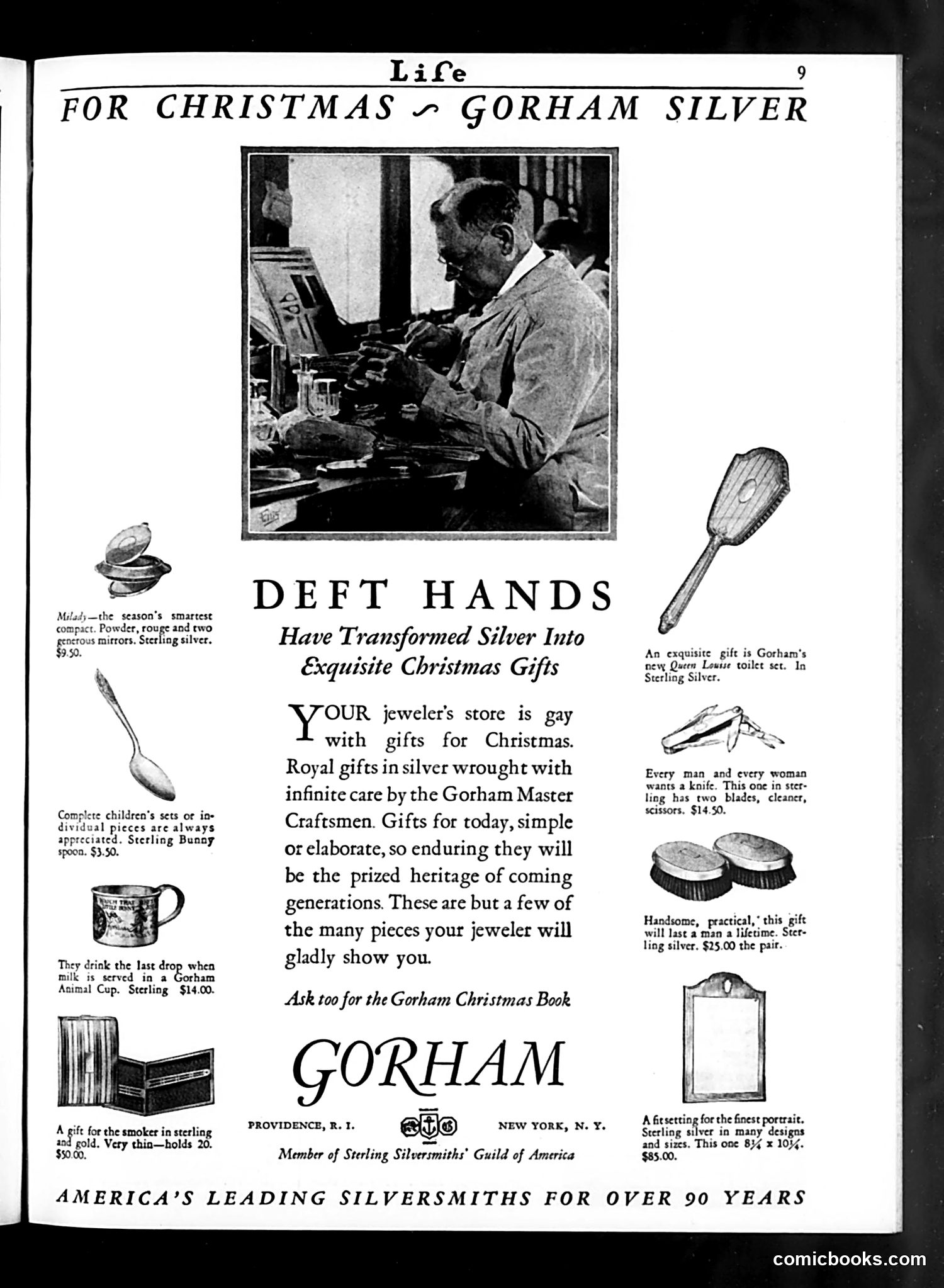
This is **not a cartoon or satire page**, but rather a **straight advertisement** for Gorham silver goods, a major American silversmith company. The page features a photograph of a craftsman at work and promotes various sterling silver Christmas gifts—flatware, serving pieces, toilet sets, hairbrushes, and portrait frames. The ad emphasizes handcrafted quality ("Deft Hands Have Transformed Silver Into Exquisite Christmas Gifts") and durability as heirlooms. The only potentially dated element is the pricing (ranging from $14 to $50) and the design aesthetic typical of early-to-mid 20th century advertising. This represents mainstream luxury gift marketing of the era, with no satirical intent.
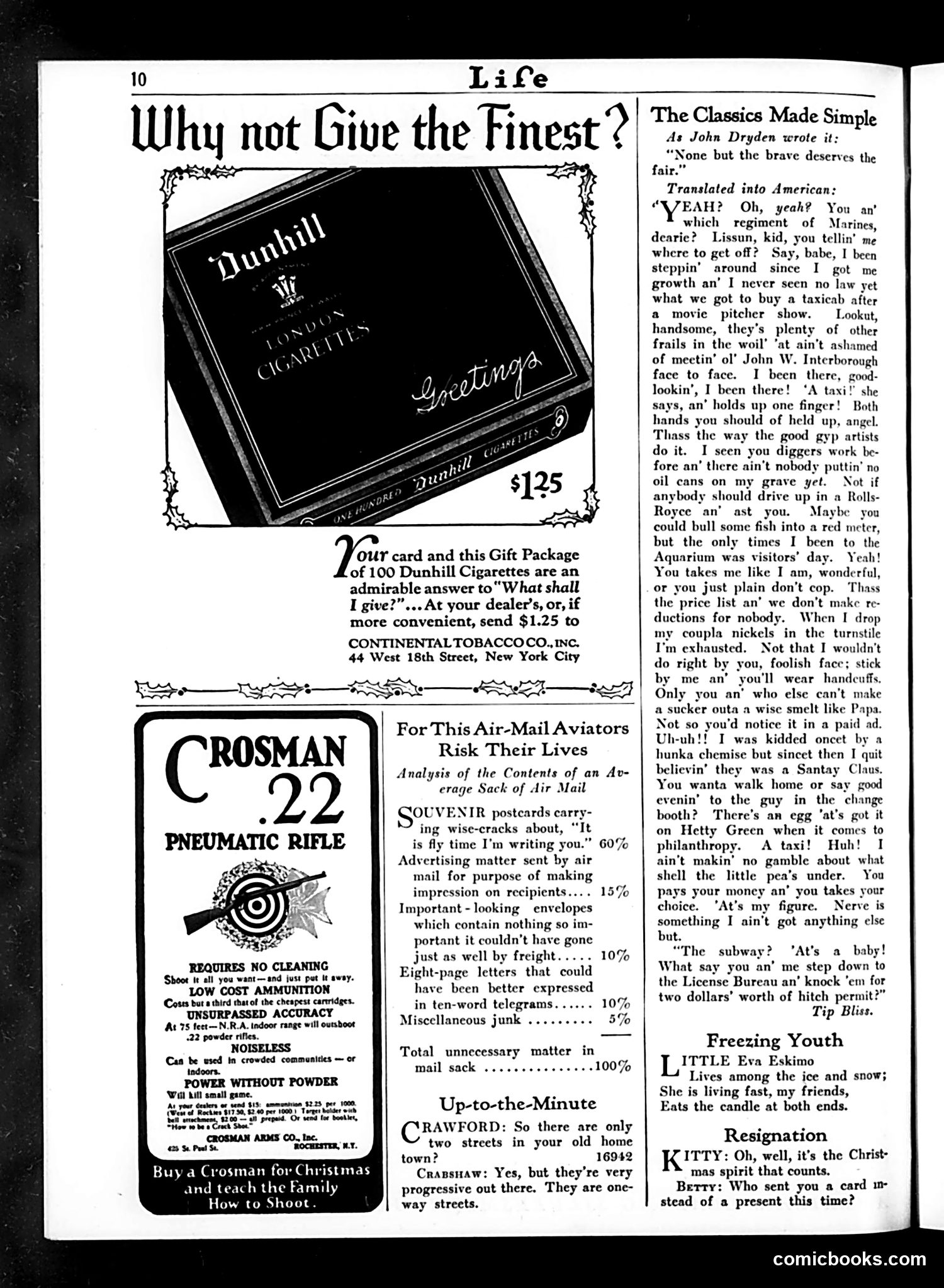
This page is primarily **advertising and light humor**, not political satire. The main ad promotes **Dunhill cigarettes** ($1.25 for 100 cigarettes with a gift card) and a **Crosman .22 pneumatic rifle** as Christmas gifts. The right column contains three brief humorous items: 1. **"The Classics Made Simple"** — a comedic rewrite of Dryden's poetry in exaggerated working-class dialect, poking fun at pretentious literary adaptations. 2. **"For This Air-Mail Aviators Risk Their Lives"** — satirizes the mundane contents of actual airmail (postcards, advertisements, junk), suggesting pilots risk death delivering trivial correspondence. 3. Brief jokes about youth, resignation, and urban life ("Freezing Youth," "Resignation") — light social commentary on modern living. The page reflects 1920s consumer culture and gentle contemporary satire.
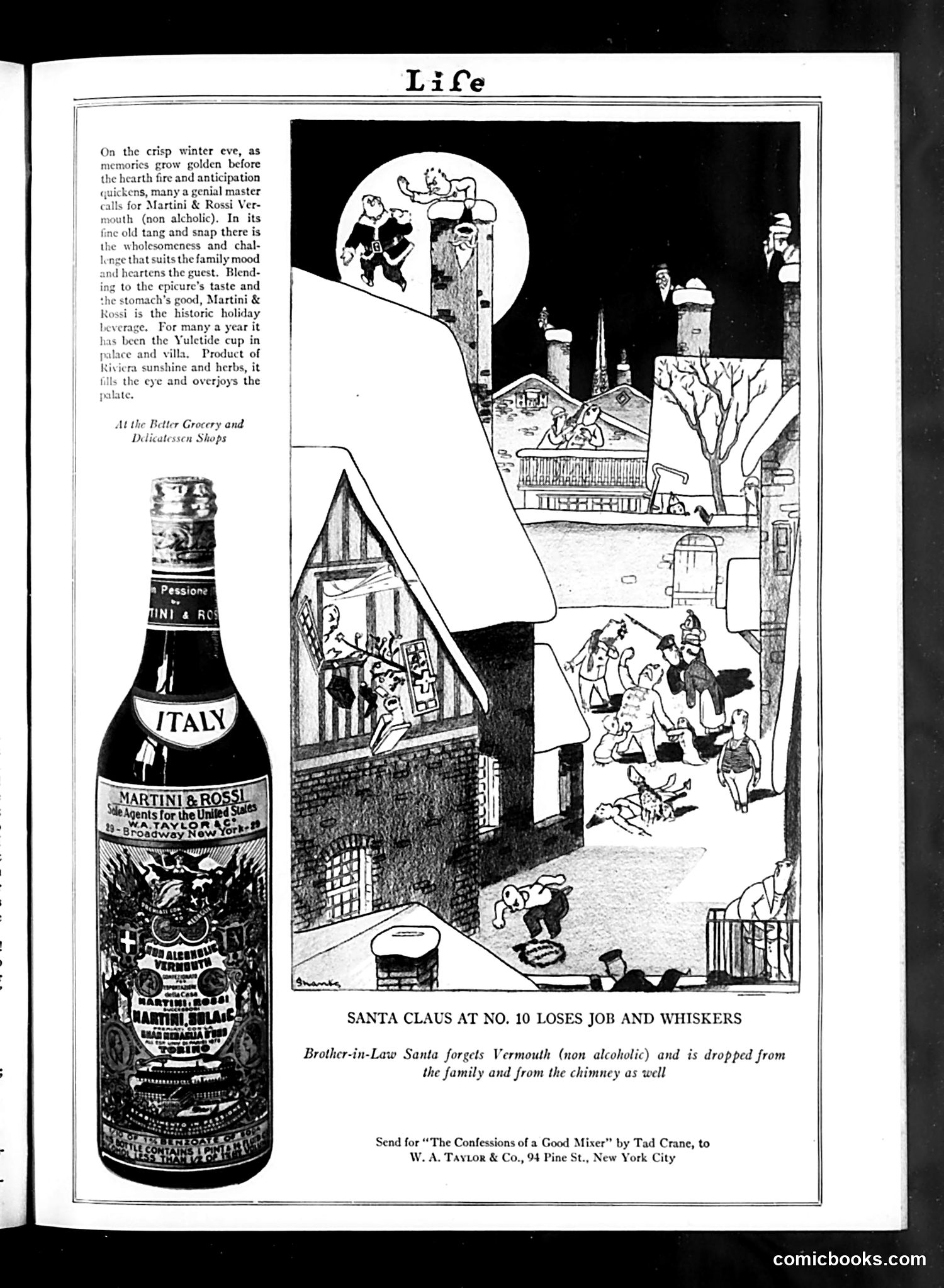
This page is primarily **advertising for Martini & Rossi vermouth**, disguised as editorial content in Life magazine's "Life" section (humor/satire). The cartoon depicts "Santa Claus at No. 10 Loses Job and Whiskers"—a satirical scene showing Santa being ejected from a chimney, with the caption explaining he was "dropped from the family and from the chimney as well" for forgetting vermouth (non-alcoholic). The joke hinges on **Prohibition-era context**: vermouth is an alcoholic beverage, so the ad humorously frames it as essential holiday tradition. The "brother-in-law Santa" losing his job for omitting this liqueur is the satirical premise—essentially advertising alcohol by mocking its absence during a holiday gathering. This represents how advertisers creatively circumvented Prohibition restrictions by embedding product placement within ostensibly humorous editorial cartoons.
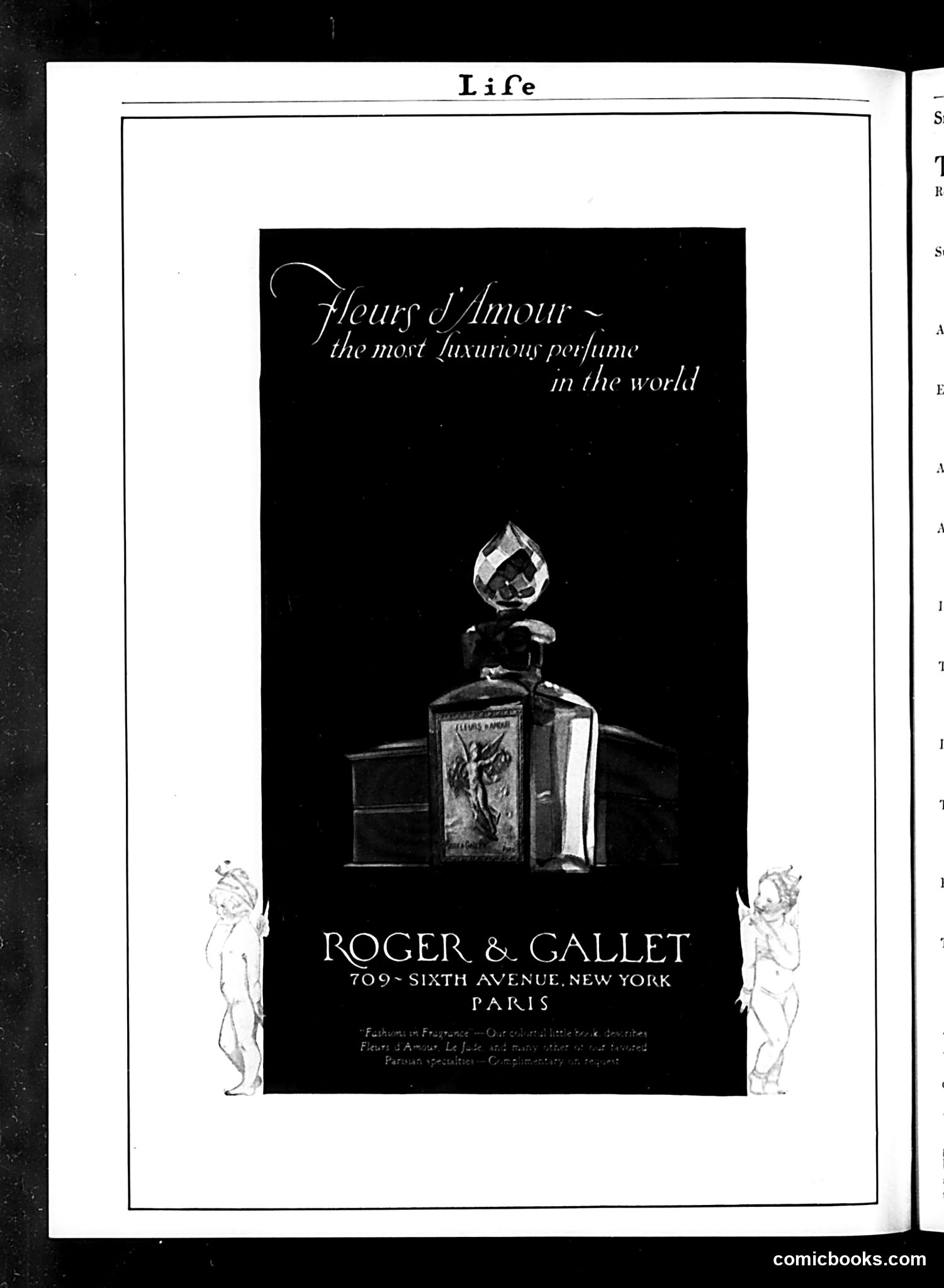
This page is primarily **advertising**, not political satire or commentary. It features a full-page advertisement for "Fleurs d'Amour," described as "the most luxurious perfume in the world," manufactured by **Roger & Gallet** (with locations listed as 709 Sixth Avenue, New York and Paris). The ad uses classic luxury marketing imagery: an ornate perfume bottle with an elaborate stopper against a black background, flanked by decorative cherub figures. The elegant typography and dramatic lighting are typical of high-end fragrance advertising from the early 20th century, designed to convey sophistication and exclusivity to Life magazine's affluent readership. There is no political cartoon or satirical content on this page.
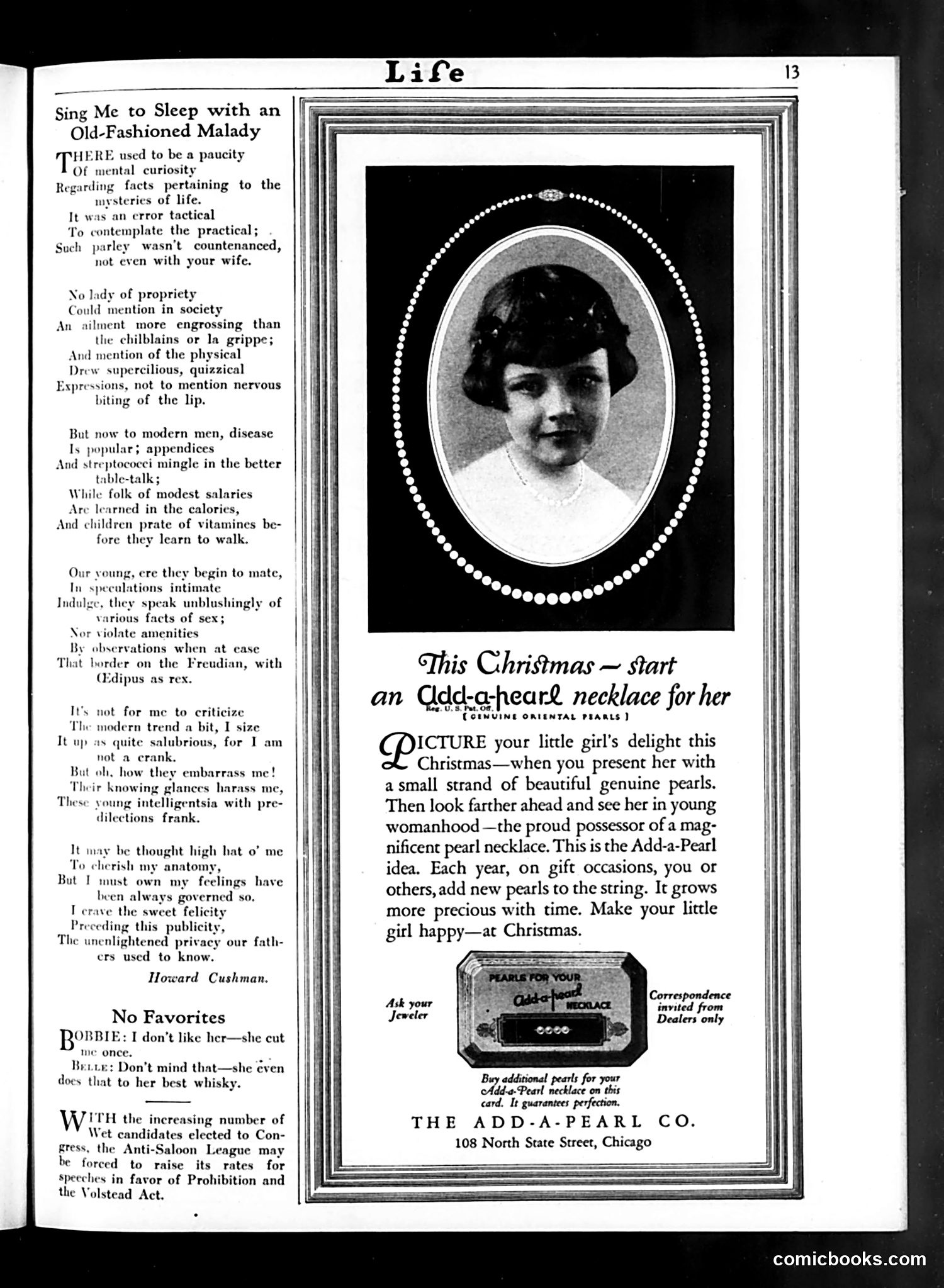
This page contains two distinct items: **Left side:** A poem titled "Sing Me to Sleep with an Old-Fashioned Malady" by Howcart Cushman, followed by a brief comedic exchange called "No Favorites" between characters Bobbie and Belle. The poem satirizes how modern society openly discusses medical and sexual topics that Victorian propriety once concealed—appendicitis, vitamins, and frank discussions of "sex" now feature in casual conversation and children's talk. Cushman expresses both embarrassment and resignation to this modern frankness. **Right side:** A full-page advertisement for the Add-a-Pearl company promoting pearl necklaces as Christmas gifts for girls. The ad encourages parents to start their daughters with a small strand, adding pearls yearly as she grows into "womanhood." The page juxtaposes Victorian sexual prudishness (the poem's subject) with emerging consumerist gift-giving culture marketed to children.
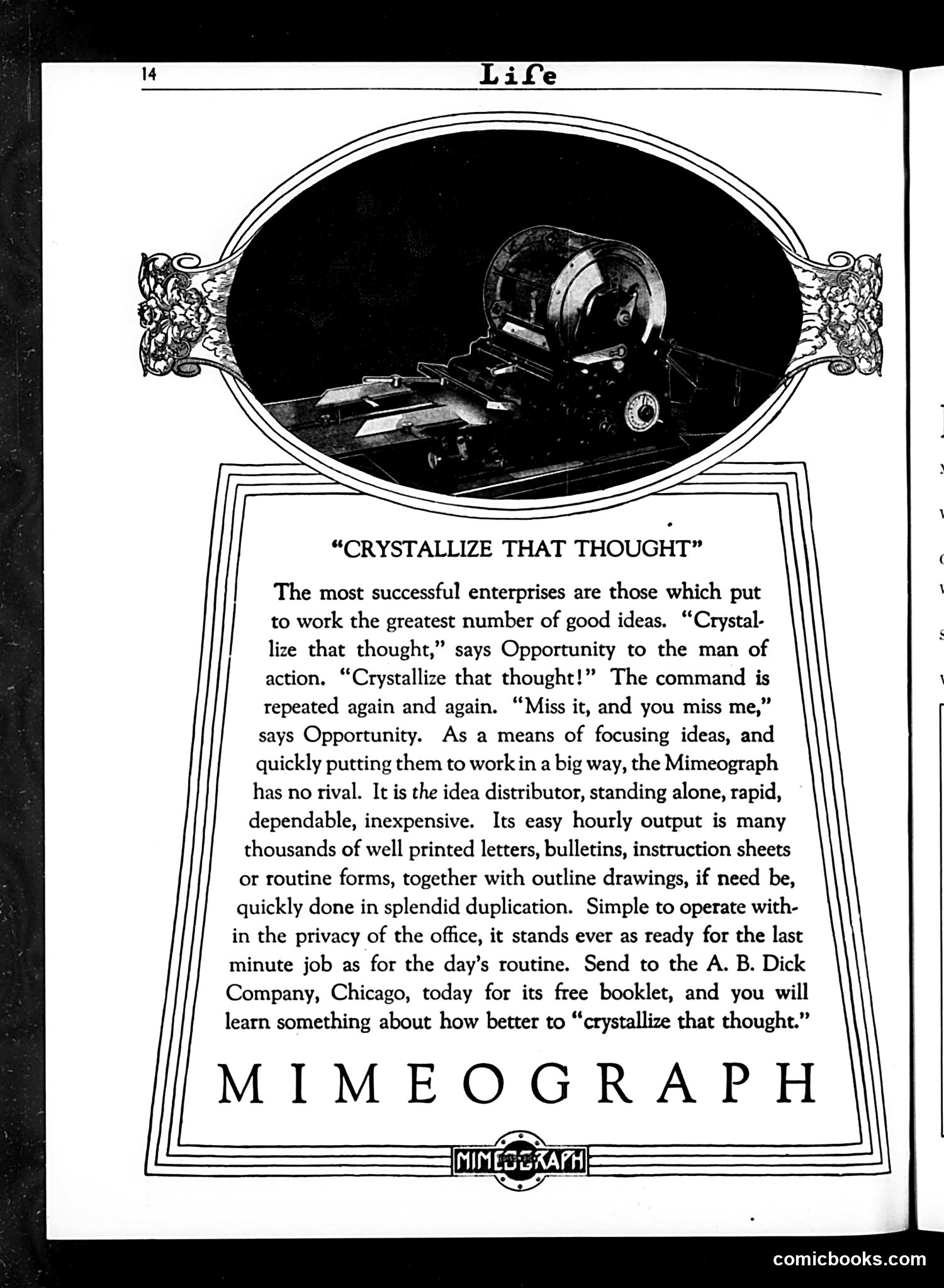
This is a **Mimeograph machine advertisement**, not political satire. The ad uses the metaphor of "crystallize that thought" to encourage businesspeople to convert their ideas into concrete action using the Mimeograph—a duplicating device that could quickly produce multiple copies of documents, letters, and forms. The image shows the Mimeograph machine itself. The ad's pitch emphasizes practical office benefits: rapid output, low cost, ease of operation, and reliability for routine tasks. It's marketed as an "idea distributor" for efficiently sharing business communications. The A.B. Dick Company (Chicago) published this to persuade 1920s-era business readers that the Mimeograph was essential office technology for transforming thoughts into printed materials quickly and cheaply.
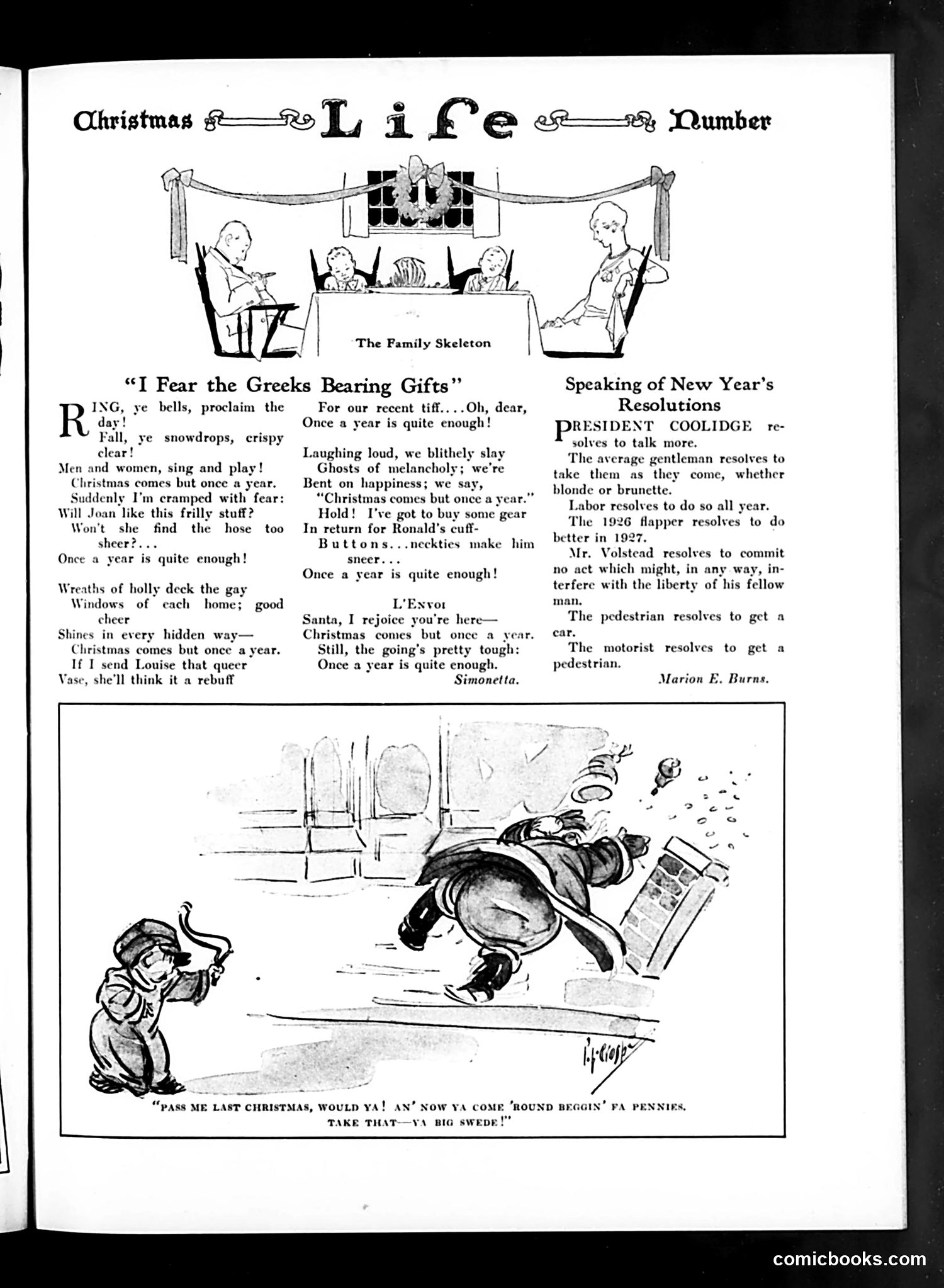
This Christmas-themed page contains humorous verse and a cartoon satirizing holiday excess and New Year's resolutions. The poems mock how Christmas arrives annually despite people's complaints about gift-buying obligations and family obligations. The verses are tongue-in-cheek complaints that "Christmas comes but once a year"—presented ironically as if this frequency is burdensome rather than pleasant. The lower cartoon depicts Santa Claus slipping on ice while carrying his sack, with a small child looking on. The caption uses dialectal speech: "Pass me last Christmas, would ya? An' now ya come 'round begins' fa pennies. Take that—ya big swede!" The satire targets the commercialization of Christmas and the relentless cycle of gift-giving expectations, suggesting Santa himself is exhausted by annual demands.
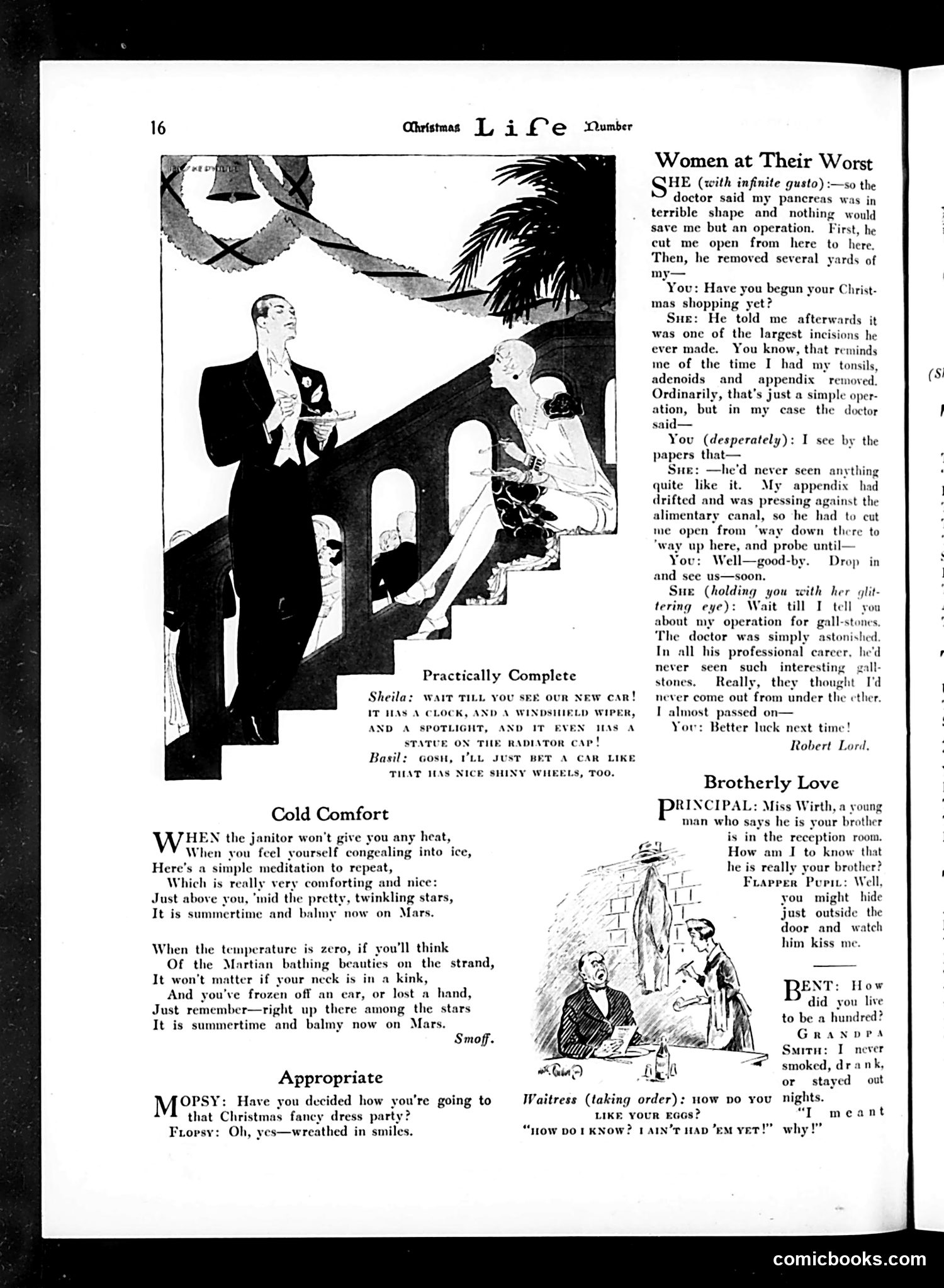
This page contains four separate humorous sketches satirizing domestic life and social conventions: 1. **"Practically Complete"** – A couple admires their new car's features (windshield wipers, spotlight, radiator cap). The satire targets materialism and consumerism among the affluent. 2. **"Cold Comfort"** – A poem offering meditation on winter hardship, with the twist ending that one should imagine summer and Mars. This is whimsical rather than political satire. 3. **"Appropriate"** – Two women discuss Christmas party attire, joking about wearing smiles as their costume. Light social satire about holiday conventions. 4. **"Brotherly Love"** and related sketches – Comic exchanges about identifying relatives and flirtation. Domestic humor without clear political content. Overall, this represents Life's typical early-20th-century focus on middle-class social situations rather than political commentary.
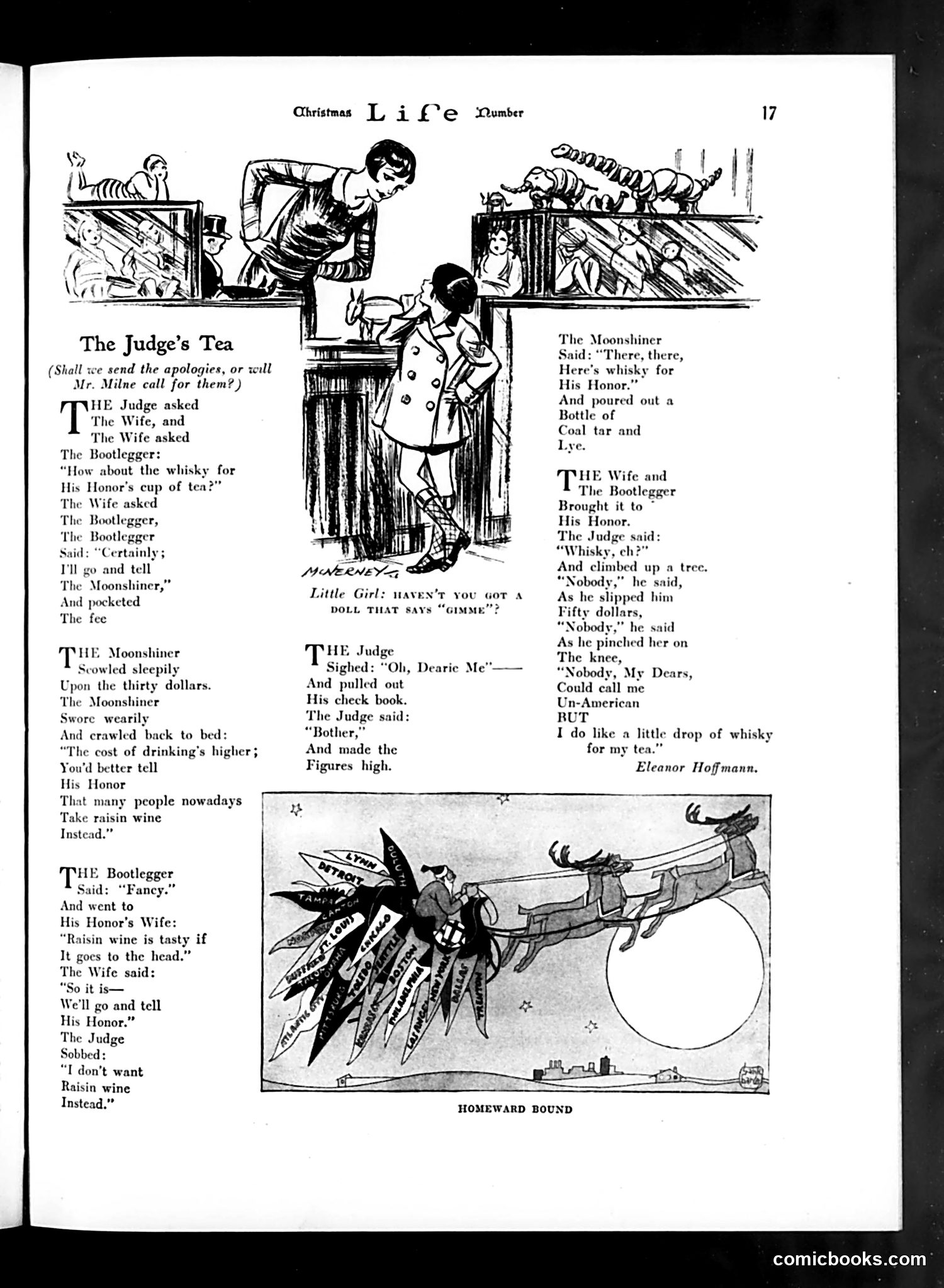
This satirical poem and illustrations mock Prohibition-era hypocrisy. A judge publicly demands propriety while privately accepting whiskey from a bootlegger (illegal alcohol supplier). The humor lies in the contradiction: the authority figure who should enforce the law is complicit in breaking it. The "Moonshiner" supplies contraband liquor. The joke escalates absurdly—the judge climbs a tree, pinches the bootlegger's daughter for "fifty dollars," then asks for whiskey in his tea while lecturing about "Un-American" behavior. The bottom cartoon, "Homeward Bound," depicts Santa's sleigh laden with labeled bottles heading toward homes, suggesting widespread holiday alcohol consumption despite Prohibition. The satire targets judicial corruption and the universal flouting of Prohibition laws across American society, particularly among the privileged.
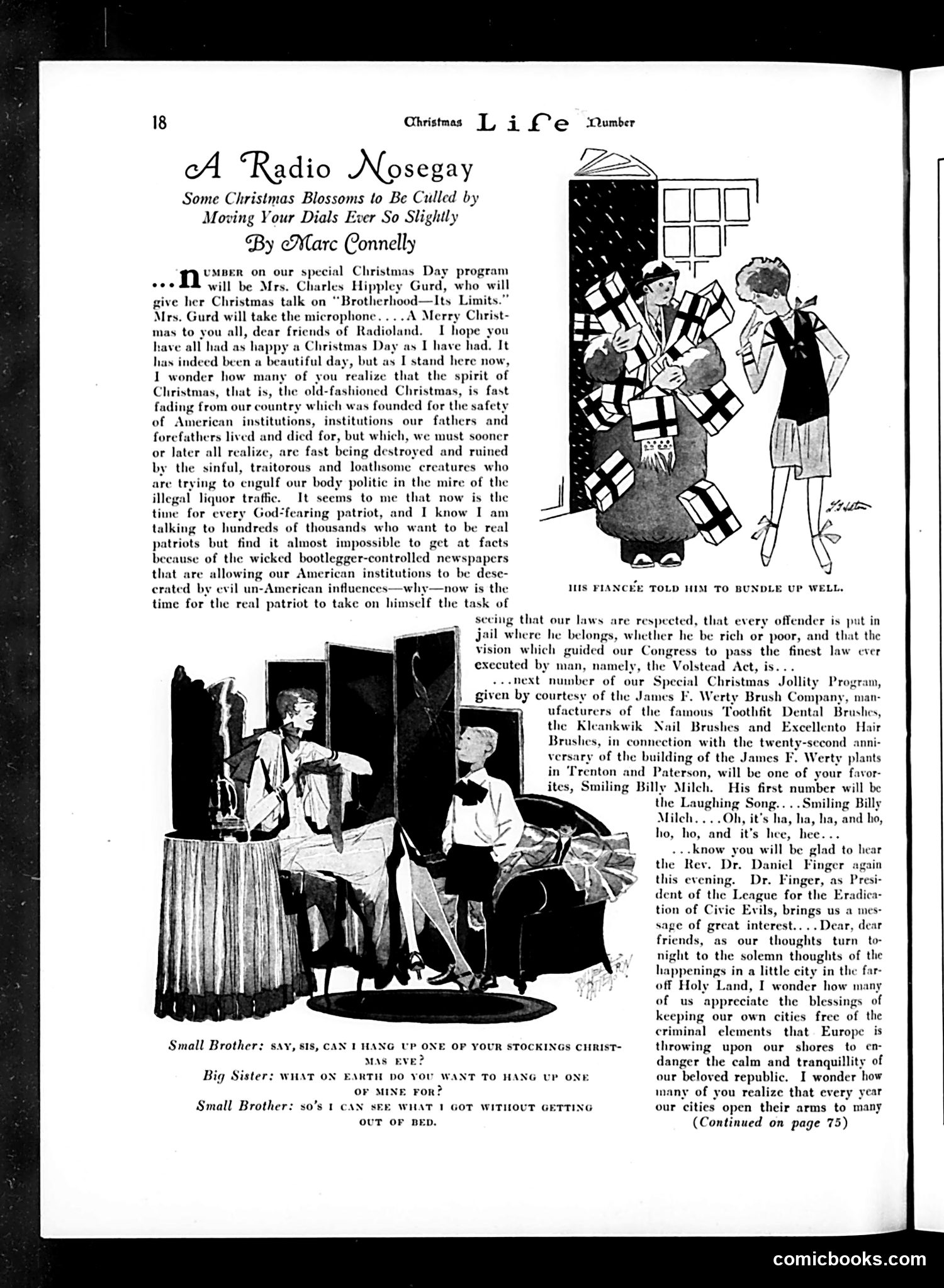
This 1920s satire by Marc Connelly mocks overwrought radio personalities who wrap xenophobic and Prohibition-era messaging in false piety. The fictional Mrs. Charles Hippley Gurd delivers a Christmas sermon blaming "evil un-American influences" and "bootlegger-controlled newspapers" for destroying American institutions—a common trope of that era's anti-immigrant, anti-alcohol crusaders. The accompanying cartoon joke shows a young couple; the caption reveals his fiancée insisted he "bundle up well," a mundane domestic exchange highlighting the contrast between the radio broadcast's grandiose moral panic and ordinary life. The satire targets how radio personalities exploited patriotic and religious sentiment to promote Prohibition and nativist anxieties. For modern readers: this reflects 1920s moral panic over immigration, organized crime linked to bootlegging, and the anxiety about preserving "American" values—concerns that sound familiar but were specifically tied to that era's enforcement of alcohol prohibition.
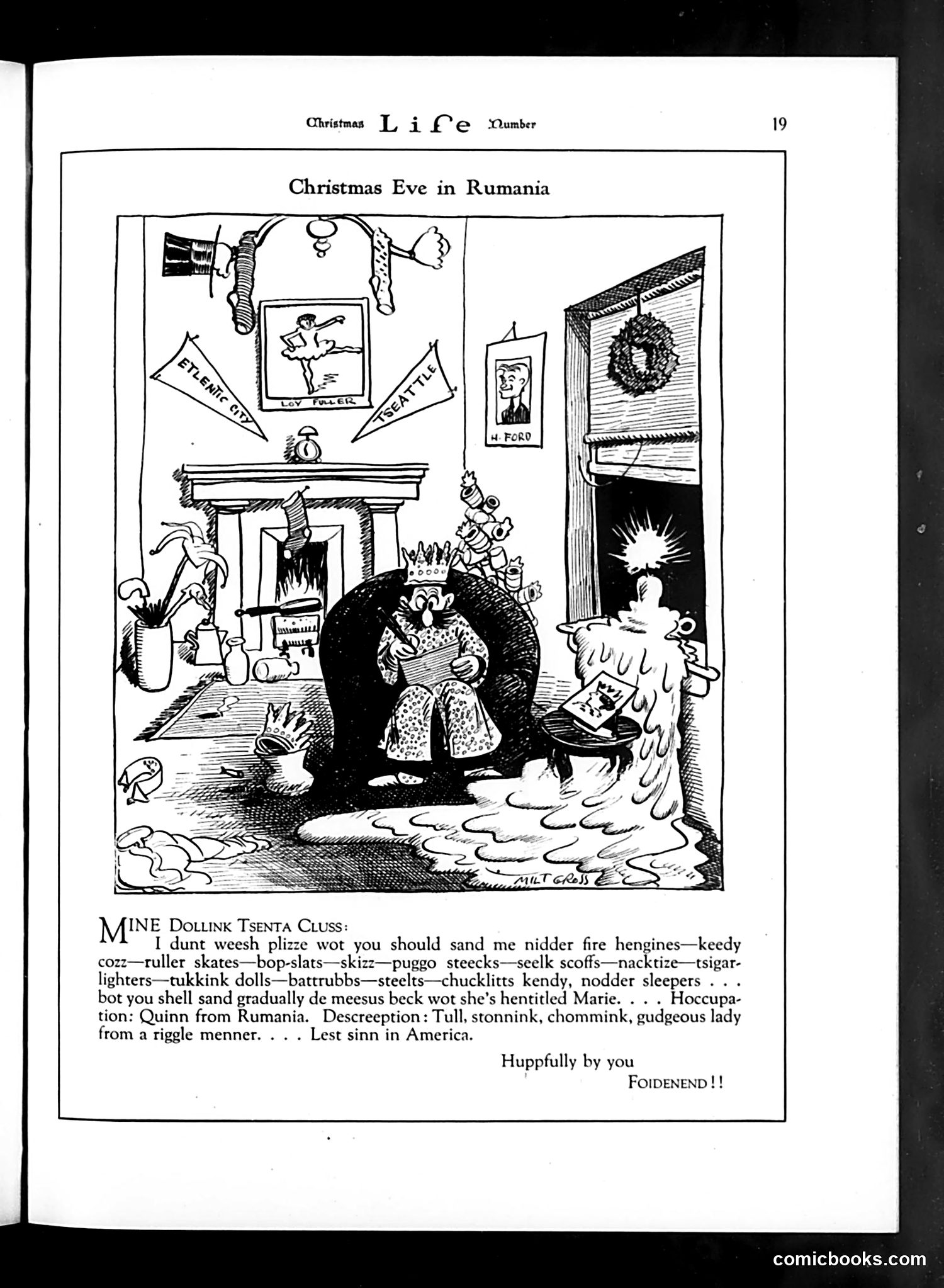
This satirical cartoon mocks a Romanian immigrant's request for Christmas gifts written in heavily exaggerated, phonetically-spelled broken English. The character "Mine Dottink Tsenta Cluss" humorously lists nonsensical or mangled gift requests ("keedy cozz," "ruller skates," "puggo steecks"), creating comedy through the fractured language. The joke targets early 20th-century American anxiety about Eastern European immigration. The figure—depicted as a rotund woman in traditional dress sitting by a fireplace—embodies the "foreign Other" stereotype. The satire works on two levels: mocking both broken English speakers and implying that immigrants' desires are materially base or comically unintelligible to native Americans. The signature "Foidenend!!" suggests the piece parodies immigrant speech patterns as humor. This reflects period attitudes treating immigrant accents as inherently funny rather than normal linguistic variation.
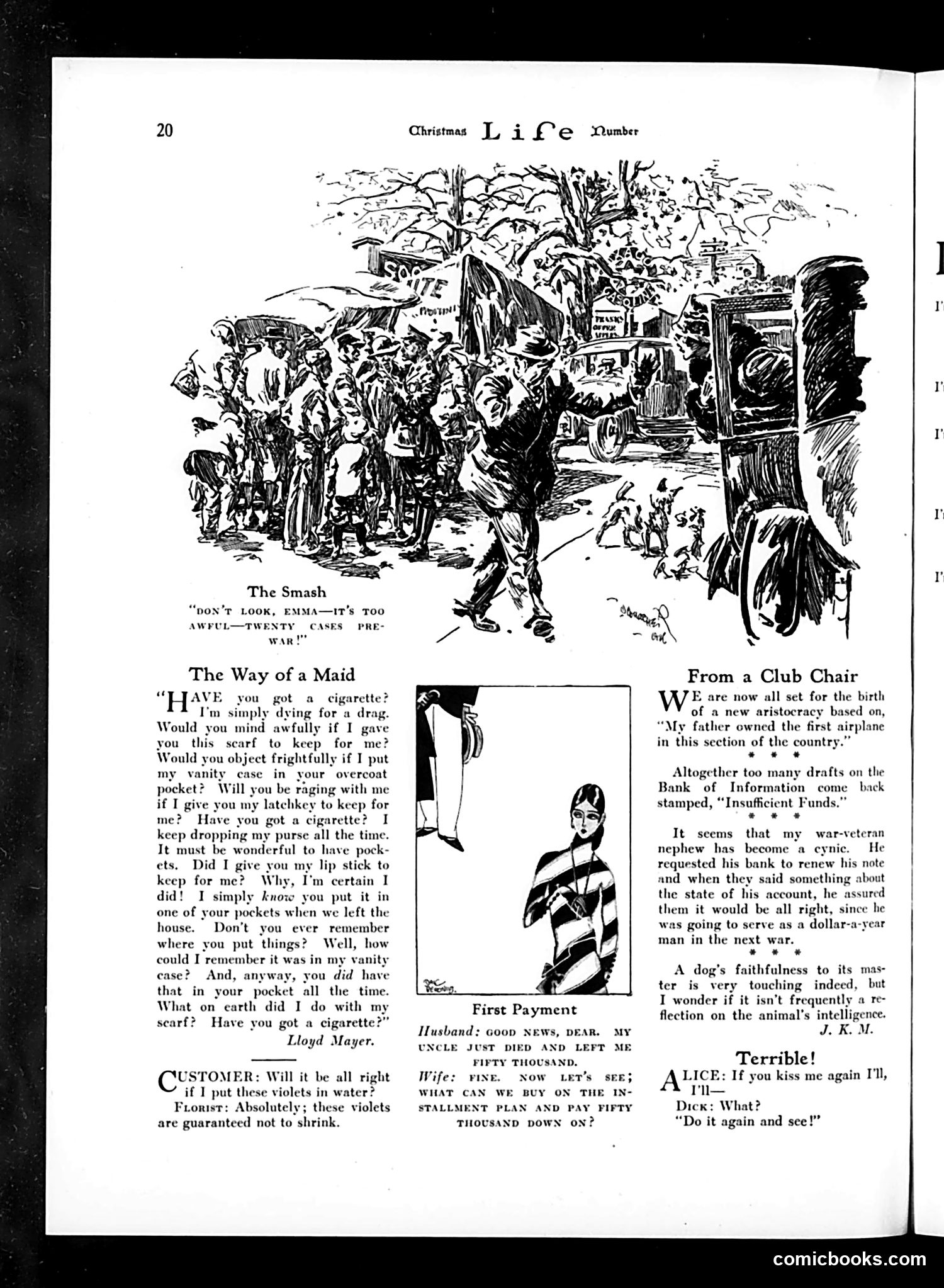
This Christmas-era *Life* magazine page contains several satirical pieces about post-WWI American society: **"The Smash"** (top illustration): Shows a crowded street scene with the caption mocking someone's distress over twenty cases of pre-war goods being damaged—satirizing the public's obsession with scarce luxury items and nostalgia for pre-war consumption. **"The Way of a Maid"** (Lloyd Mayer): A monologue mocking women's dependence on male pockets and attention, portraying women as scattered, demanding, and endlessly borrowing items. It's dated gender satire reflecting 1920s attitudes. **"First Payment"**: Jokes about post-war inflation and consumer culture—a man inherits fifty thousand dollars, immediately asks what he can buy on installment by putting fifty thousand down, implying prices have skyrocketed absurdly. **"From a Club Chair"**: Brief observations including mockery of nouveau-riche boasting about early aviation ownership, bank loan difficulties for war veterans, and cynical commentary on post-war economic hardship. **"Terrible!"**: A flirtatious dialogue joke about kissing. The page reflects 1920s anxieties about inflation, changing gender roles, and veterans' struggles.
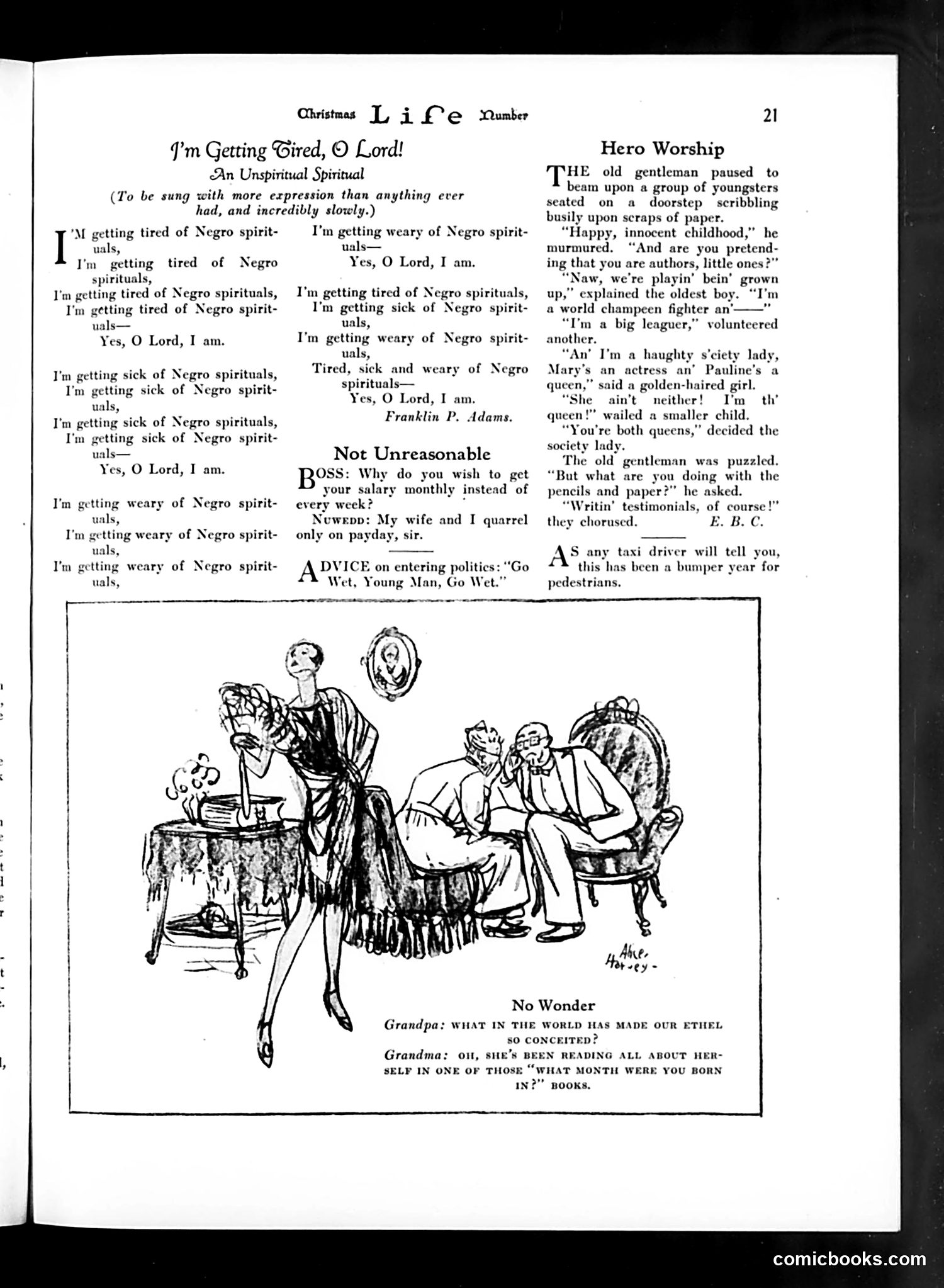
This page contains three separate satirical pieces: **"I'm Getting Tired, O Lord!"** (by Franklin P. Adams) is a parody of African American spirituals—religious folk songs with repetitive, emotional lyrics. Adams mocks the overwrought sentimentality of the form by having a speaker express exhaustion with spirituals themselves, using the spirituals' own repetitive structure ironically to convey fatigue. **"Hero Worship"** depicts children playing grown-up roles (fighter, baseball player, society lady, actress). The joke: when asked what they're doing with pencils and paper, they reveal they're "writin' testimonials"—satirizing how celebrities and public figures of the era were expected to endorse products through written endorsements, even when the endorsement was fabricated. **The cartoon "No Wonder"** shows a grandmother puzzled about why her granddaughter Ethel is "conceited," with the grandmother noting Ethel has been reading "what month were you born in?" books—likely referring to astrology or personality guides that were popular fads, blamed here for encouraging vanity. These pieces reflect 1920s-era American humor and social commentary about popular culture, celebrity culture, and passing fads.
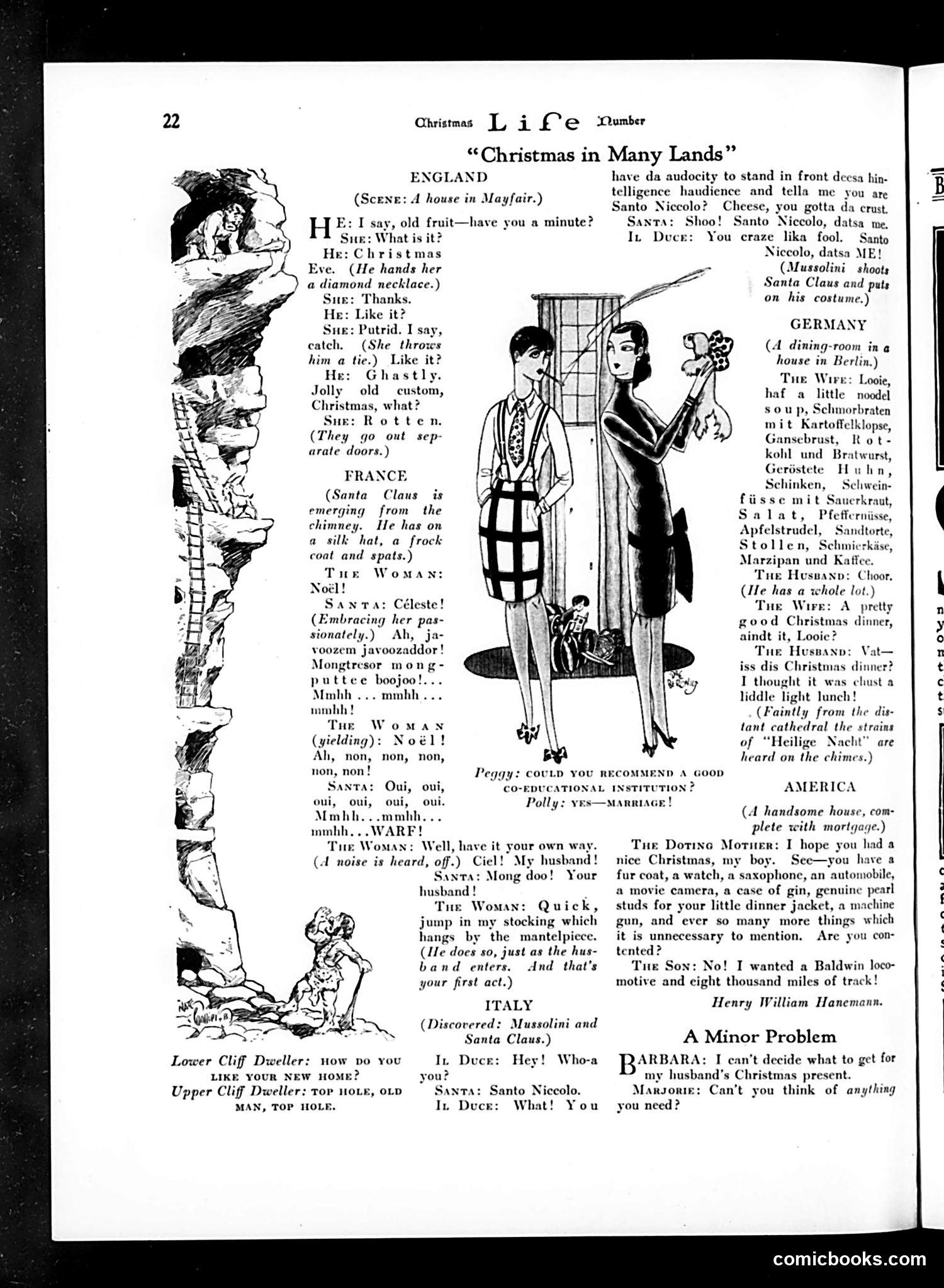
This page presents national stereotypes through Christmas vignettes mocking different cultures: **England**: Upper-class couple exchange insincere gifts with exaggerated indifference ("Putrid," "Ghastly"). **France**: Santa emerges from chimney to seduce a woman with passionate French dialogue, then hides in her stocking when her husband arrives—satirizing French romantic stereotypes. **Italy**: Mussolini violently displaces Santa Claus, claiming the identity for himself—a sharp political jab at fascist authoritarianism and ego. **Germany**: A wife lists exhaustively detailed German foods; the husband finds even this enormous meal inadequate—mocking German excess and materialism. **America**: A spoiled son, given luxuries (automobile, saxophone, pearls, machine gun), demands a Baldwin locomotive instead—satirizing American consumerism and children's ingratitude. The crude ethnic caricatures and stereotyped dialects reflect period attitudes. The Italy and America sketches carry sharper social criticism than the lighter cultural mockery elsewhere.
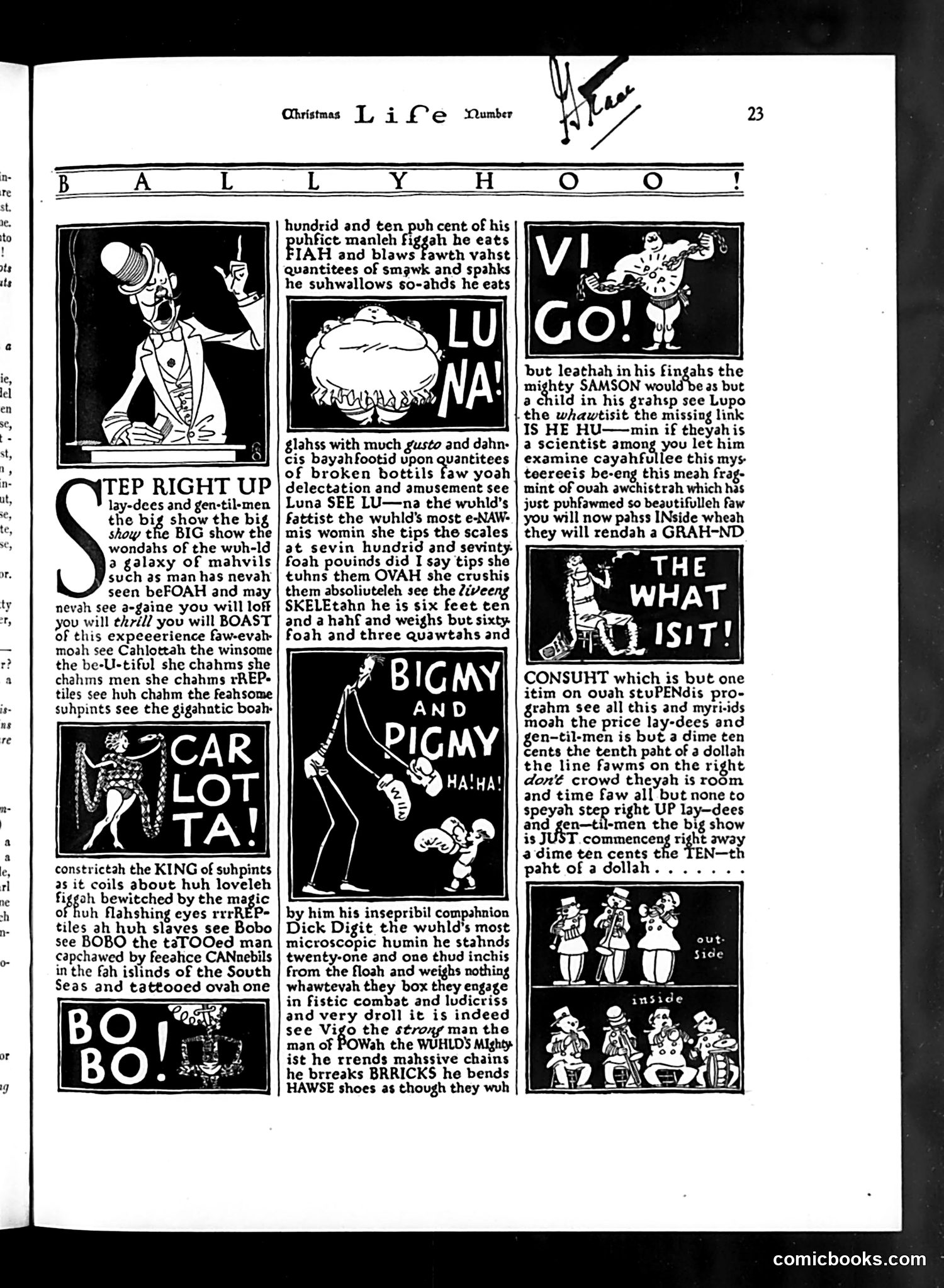
This page satirizes the classic American circus or traveling carnival "pitch"—the rapid-fire, hyperbolic spiel of a barker hawking attractions to crowds. The exaggerated dialect and bombastic language mock the salesmanship used to lure paying customers with promises of extraordinary spectacles. The cartoons depict typical sideshow attractions: "Luna," the "world's fattest woman"; a living skeleton; "Dick Digit," the "world's most microscopic human"; strongmen; and other freakish oddities. The repeated "$teP RIGHT UP" header frames this as satirizing the dehumanizing exploitation and commercialization of people with physical differences or disabilities, presented as entertainment for mass consumption. The satire critiques how carnival culture reduced human beings to curiosities sold for dimes, using sensationalism and crude spectacle to extract money from the public. The ornate language and typography exaggerate the artificiality and manipulation inherent in the pitch itself.
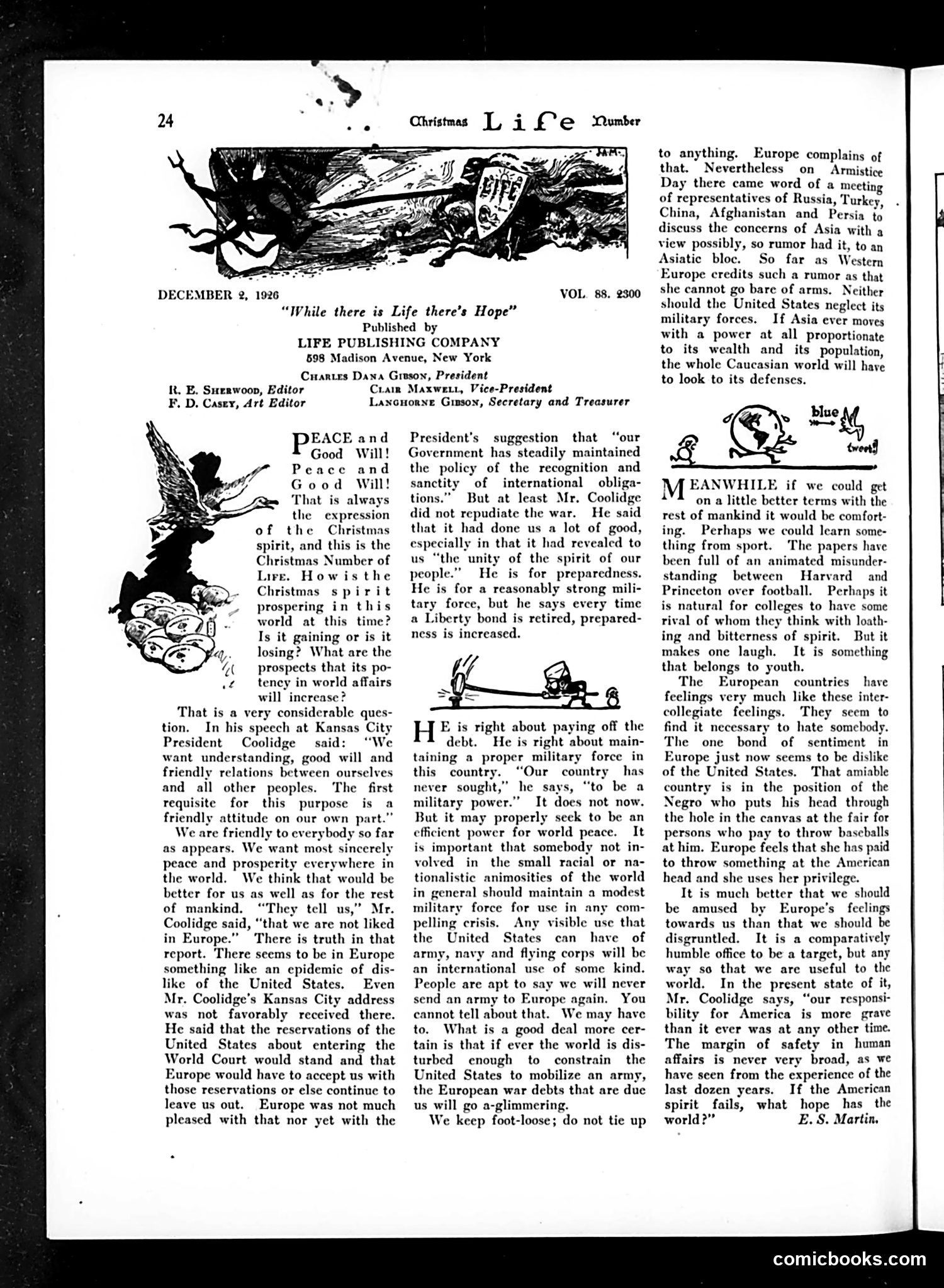
This page presents President Calvin Coolidge's Christmas message on international peace and American military preparedness. The editorial commentary responds to European criticism of the United States, particularly regarding American reluctance to join the World Court and Coolidge's statement that America isn't "liked in Europe." The satire targets the contradiction between Coolidge's rhetoric of peace and his advocacy for military strength. The cartoons appear to illustrate this tension—depicting Santa Claus and military figures, though the specific caricatures are unclear from image quality. The commentary addresses contemporary anxieties: European resentment of American isolationism and debt collection, rumors of an Asian political bloc (involving Russia, Turkey, China, Afghanistan, and Persia), and concerns this might necessitate Western military readiness. The piece argues American military power serves international stability, not conquest, while acknowledging European animosity toward the U.S. The tone is defensive about American intentions while simultaneously warning of future threats—a stance reflecting post-WWI geopolitical tensions.
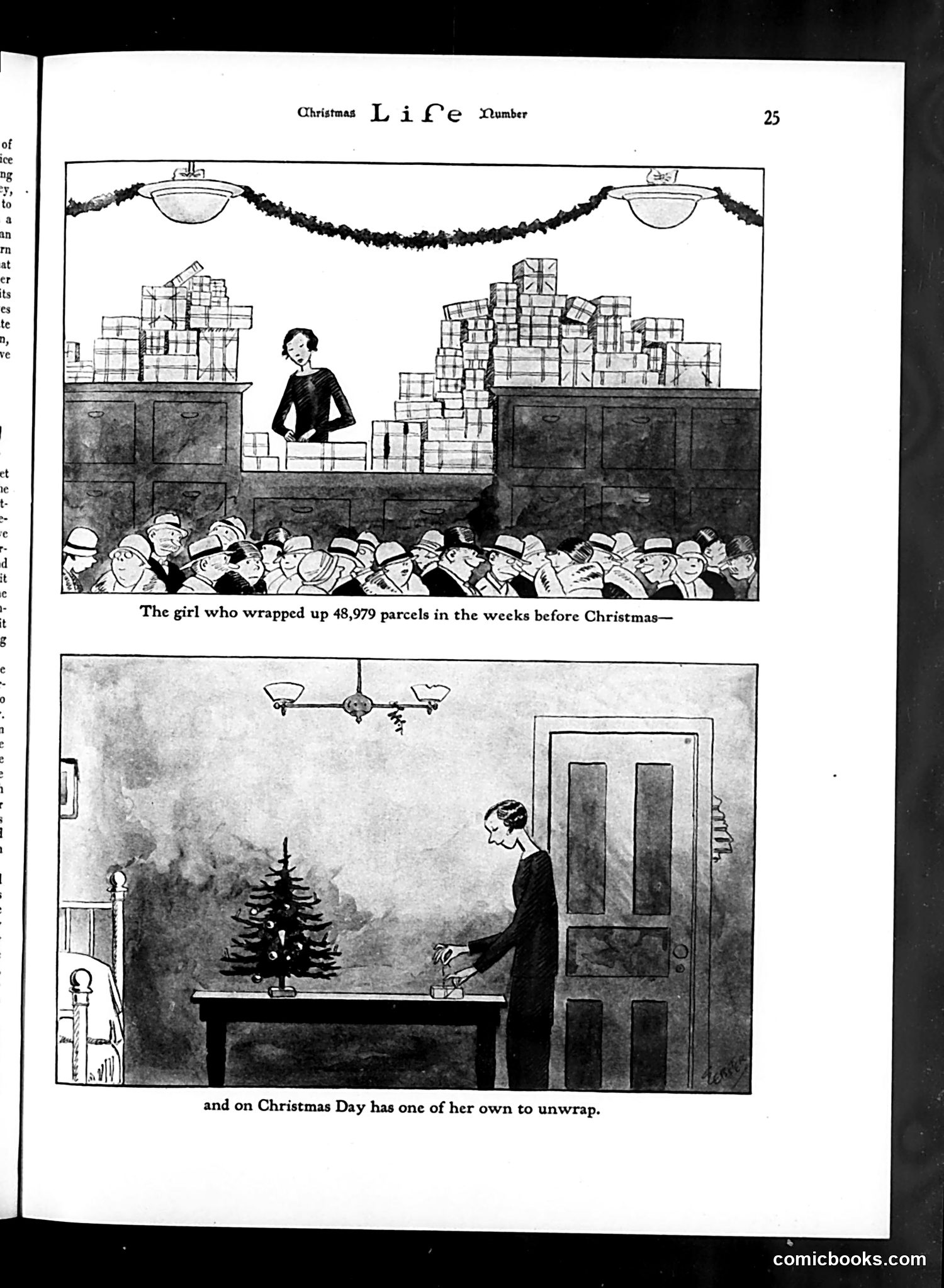
This page presents a two-panel satirical commentary on gendered labor during the Christmas season. **Top panel:** A lone woman stands amid massive stacks of wrapped packages, surrounded by a crowd of men wearing hats. The caption states she "wrapped up 48,979 parcels in the weeks before Christmas." **Bottom panel:** On Christmas Day, the woman unpacks a single small gift in her home—a modest present for herself. **The satire:** The contrast critiques the disproportionate labor expected of women during Christmas. While she performs enormous work wrapping thousands of packages (likely commercial retail work), she receives minimal recognition or gifts in return. The joke targets both workplace exploitation and the assumption that women's holiday labor goes uncompensated and underappreciated. This reflects early-to-mid 20th century gender dynamics around holiday commercialization.
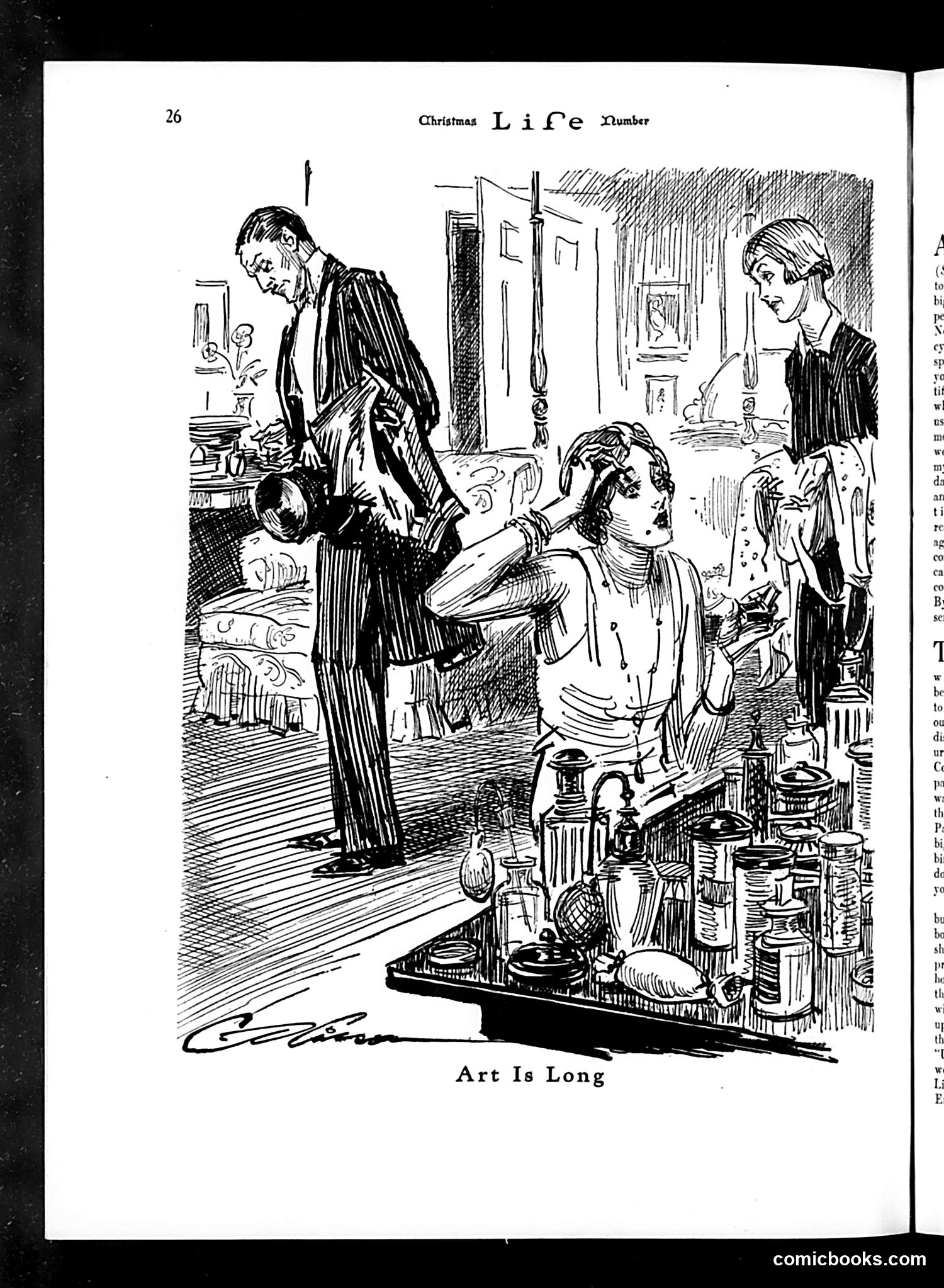
This satirical illustration depicts an artist's studio scene. A well-dressed man (likely a wealthy patron or critic) examines a young artist's work with apparent disapproval or condescension, while the artist sits surrounded by numerous bottles and jars—suggesting either painting supplies or, more likely given the satirical context, alcohol or other substances. The title "Art Is Long" (a reference to the classical phrase "Ars longa, vita brevis"—art is long, life is short) appears to mock the pretensions of either struggling artists or their patrons. The cartoon likely satirizes the bohemian artist stereotype: impoverished, substance-dependent, yet claiming artistic legitimacy. The contrast between the stern, well-off gentleman and the disheveled creative type reflects period anxieties about artistic authenticity, commercialism, and the stereotype of the dissolute artist.
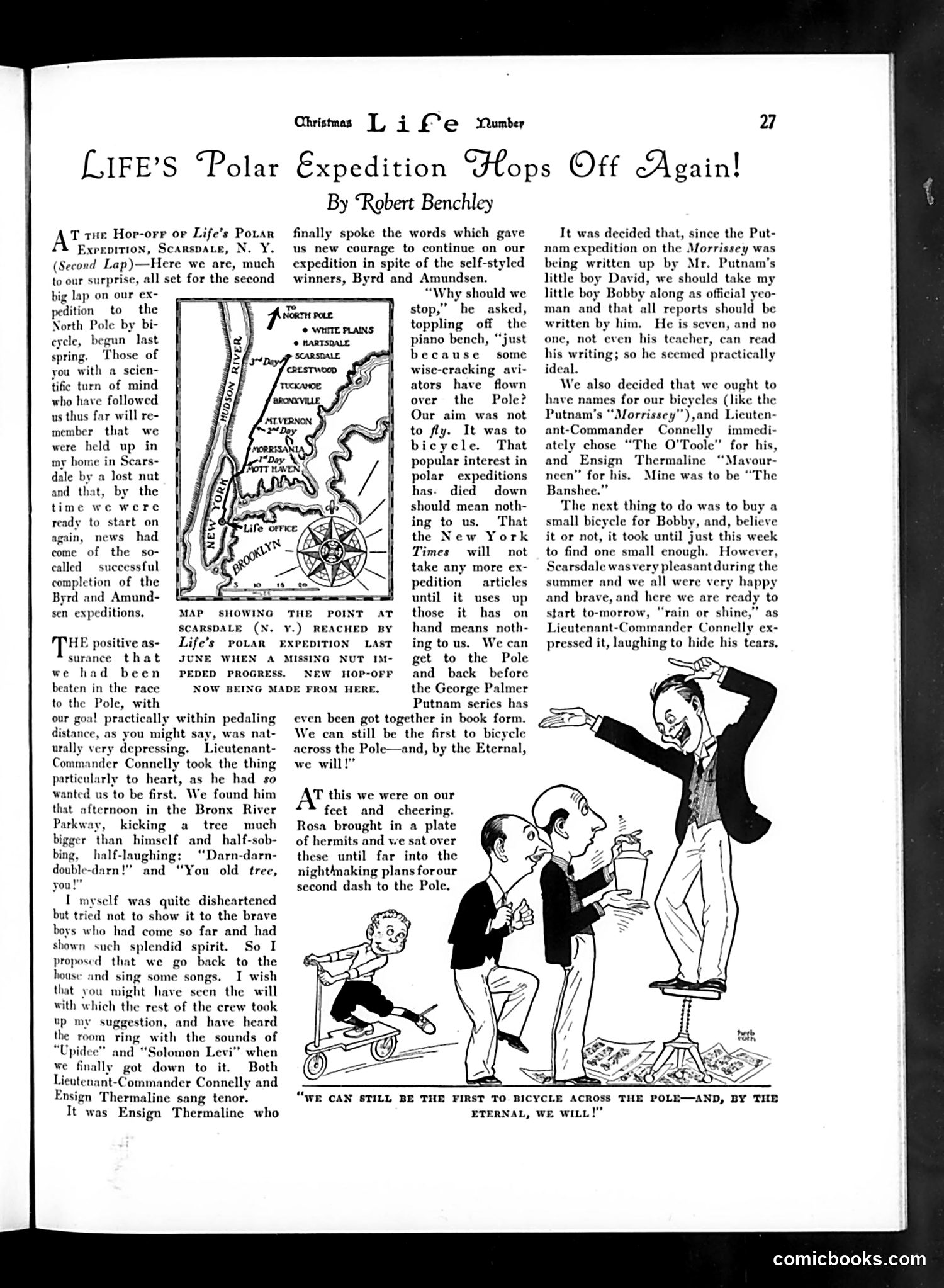
This humorous article by Robert Benchley satirizes the real polar expeditions of Richard Byrd and Roald Amundsen, who successfully reached the North Pole in 1926. Benchley's fictional "Life magazine expedition" aims to bicycle to the Pole—a deliberately absurd alternative to flying. The satire mocks the media frenzy around polar exploration: the narrator's crew is devastated to learn they've been "beaten" despite being practically there, and they're discouraged that the *New York Times* won't publish more expedition articles. The turning point comes when Ensign Thermaline argues their unique contribution—being the *first to bicycle* across the Pole—still matters, reviving their spirits through patriotic singing. The joke targets both the obsessive competition among explorers and the press's appetite for sensational adventure narratives. By replacing a genuine, dangerous achievement with an impossible, absurd one, Benchley ridicules how expeditions had become more about publicity than actual accomplishment.
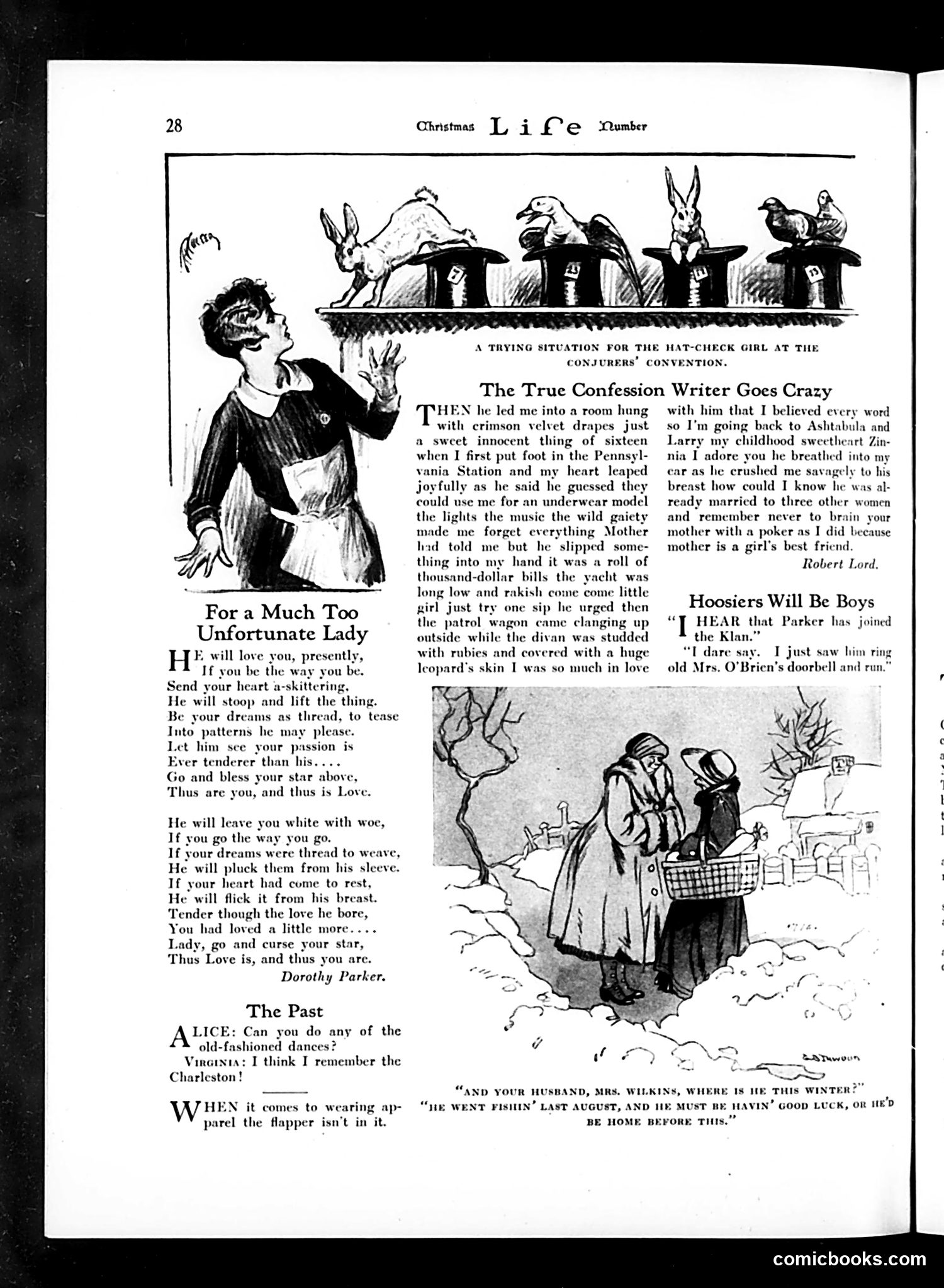
This page contains three separate satirical pieces typical of 1920s Life magazine humor: **"For a Much Too Unfortunate Lady"** — Dorothy Parker's poem mocks romantic disillusionment, contrasting love's initial promises with its inevitable betrayal. The verse satirizes idealized notions of romance. **"The True Confession Writer Goes Crazy"** — Robert Lord parodies the lurid "confession" magazine genre popular in the era, parodying their overwrought melodrama (yachts, rubies, leopard skins, bigamy). The humor lies in the absurdly contradictory plot and the mundane moral ("never brain your mother"). **The hat-check cartoon** depicts a magician's convention where conjurers with rabbits and birds emerging from top hats create chaos for the coat-check attendant—a visual pun on the magicians' tricks. **"Hoosiers Will Be Boys"** jokes about a man who joined the KKK, then depicts a woman whose husband has been fishing since August and hasn't returned, implying he's abandoned her. The humor is dark, playing on marital desertion. These pieces reflect 1920s satire of popular culture, romantic conventions, and social absurdities.
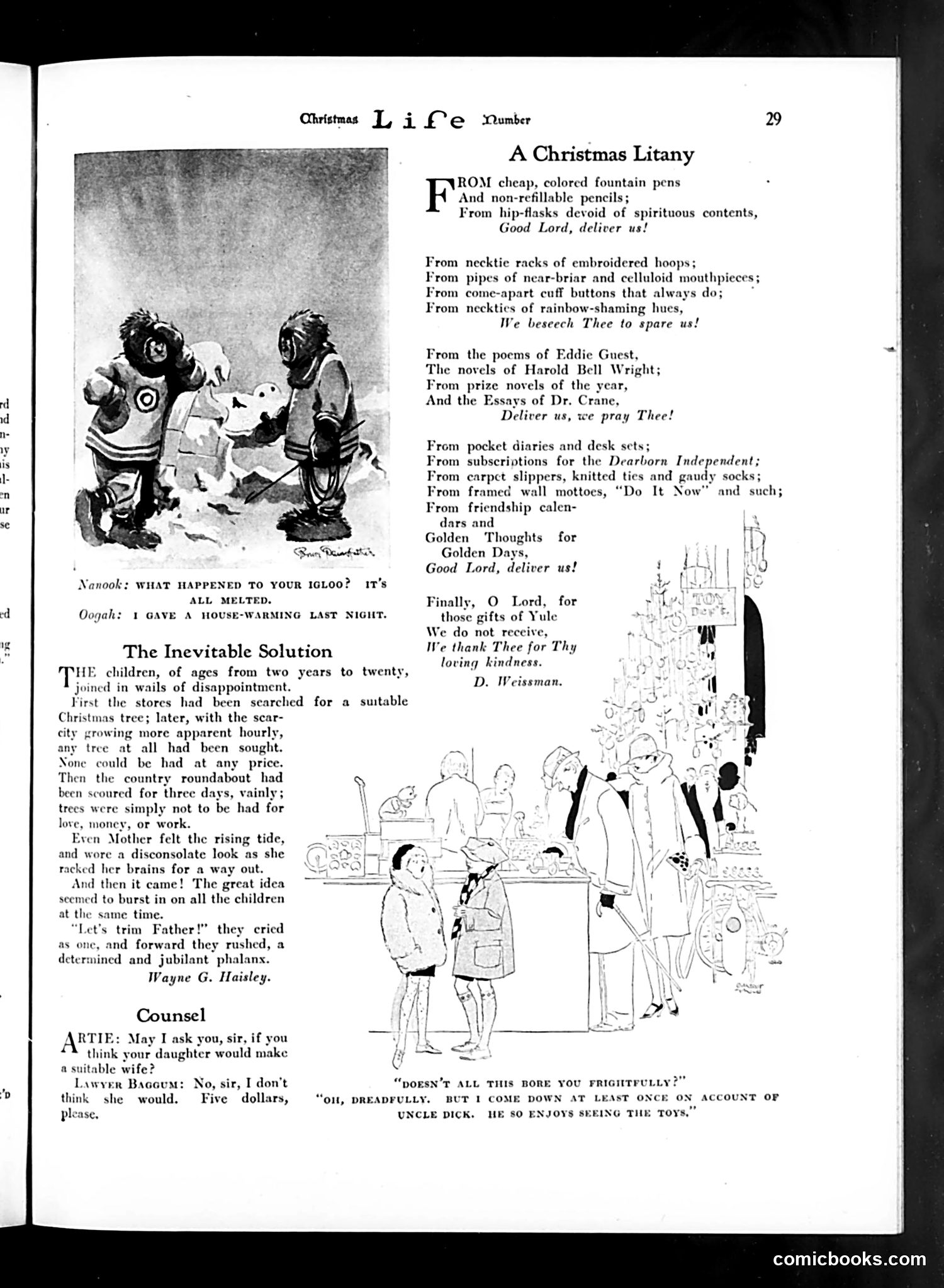
This page contains holiday-themed satirical content from Life magazine's Christmas issue (page 29). **"A Christmas Litany"** is a parody prayer listing annoying, cheap, or unwanted typical Christmas gifts—fountain pens, hip flasks (Prohibition-era reference), tacky neckties, poorly-made cuff buttons, and books by popular authors like Eddie Guest and Harold Bell Wright. It mocks both commercialized gift-giving and specific contemporary consumer products. **"The Inevitable Solution"** depicts a family unable to find a Christmas tree during apparent scarcity (likely WWI-era shortages), then deciding to humorously "trim Father" as a Christmas tree instead—decorating him like evergreen branches. **"Counsel"** is a brief lawyer joke where a man asks if the lawyer's daughter would make a suitable wife; the lawyer answers no and charges five dollars. **"Nanook" caption** references the famous documentary character, humorously explaining melted igloo as result of a "mouse-warming" party. The page satirizes consumer culture, gift-giving conventions, and wartime scarcity through humor accessible to period readers.
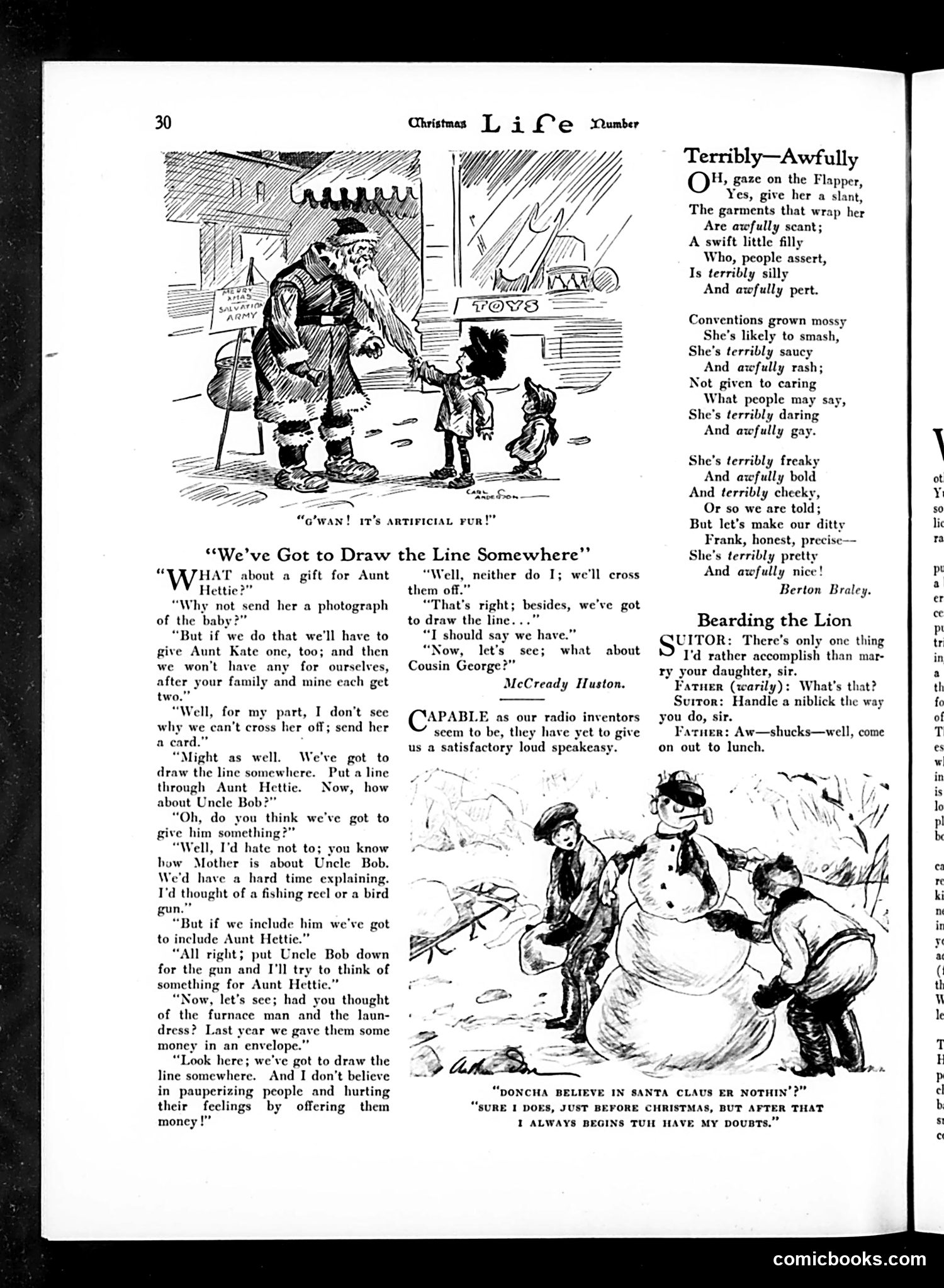
This page contains three separate satirical pieces from an early 20th-century Christmas issue. **"We've Got to Draw the Line Somewhere"** (main article with illustration): A couple debates gift-giving obligations, progressively crossing relatives off their list—Aunt Hettie, Uncle Bob, their furnace man and laundress—trying to establish where to limit expenses. The satire mocks middle-class anxiety about Christmas gift-giving obligations and the rationalization for excluding working-class employees from holiday generosity, which the narrator ironically defends as avoiding "pauperizing" them. **"Terribly—Awfully"** (poem by Berton Braley): A humorous critique of 1920s flapper culture, using repetitive "terribly/awfully" phrasing to describe young women as scandalously dressed, bold, and unconventional—while ultimately conceding she's "terribly pretty / And awfully nice." **Remaining items**: Brief jokes about radio speakers and a suitor impressing a farmer by flattering his golf skills—mild, conventional humor.
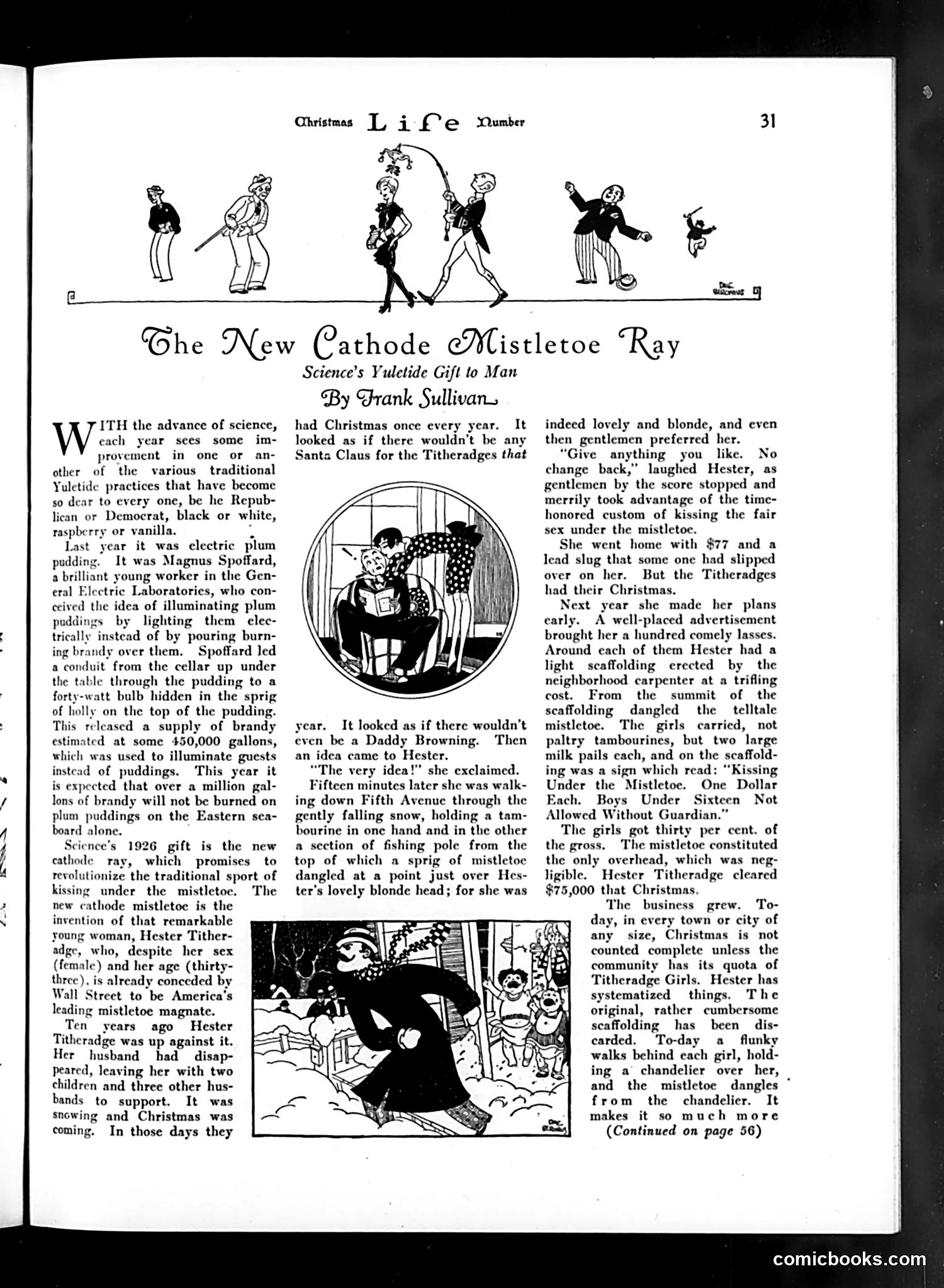
This is a satirical piece by Frank Sullivan mocking both technological progress and commercialization of Christmas traditions. The story traces how a widow named Hester Titheradge transforms the innocent custom of kissing under mistletoe into a profitable business enterprise. The satire operates on multiple levels: it ridicules the 1920s obsession with electrifying everything (the previous year's "electric plum pudding"), while simultaneously skewering the commodification of romance and female sexuality. Hester's progression from desperate widow earning $77 on Fifth Avenue to "America's leading mistletoe magnate" clearing $75,000 annually parodies both the era's entrepreneurial mythology and how capitalism reduces sentimentality to profit. The absurdist details—the lead slug payment, the scaffolding apparatus, the "funky with chandelier"—emphasize the ludicrous gap between tradition's romance and its commercialized reality. The piece reflects 1920s anxiety about modernity eroding authentic experience.
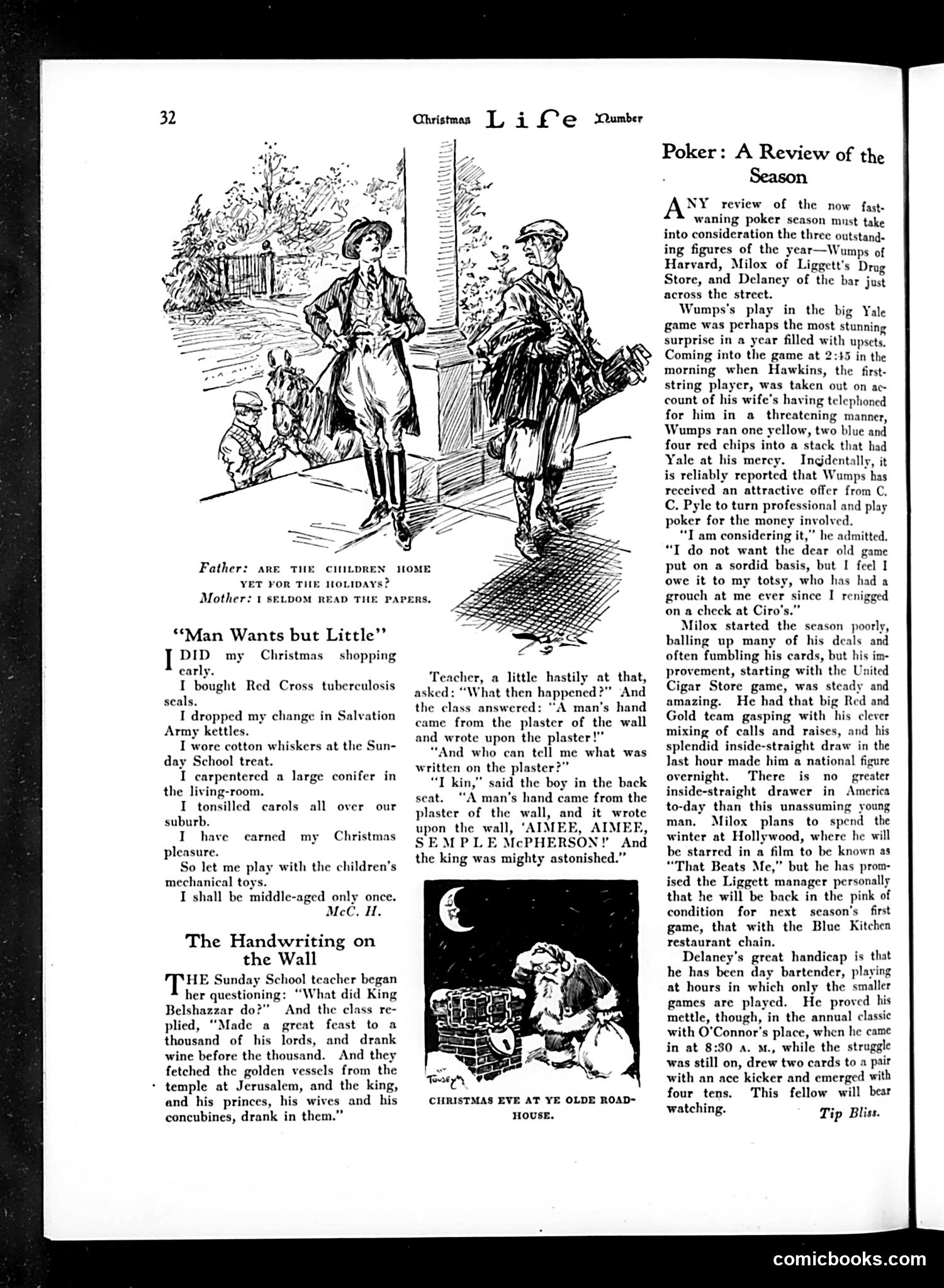
This Christmas 1920s *Life* magazine page contains three satirical pieces: **"Man Wants but Little"** mocks the speaker's modest Christmas activities (charity donations, homemade decorations, caroling) while selfishly demanding to monopolize the children's toys—satirizing hypocritical holiday virtue-signaling. **"The Handwriting on the Wall"** is a joke about a Bible lesson. The teacher asks Sunday School students about the Biblical King Belshazzar's feast. A student mishears "handwriting on the wall" (a famous Biblical prophecy) as literally referring to **Aimee Semple McPherson**—a prominent, real 1920s evangelist and media celebrity. The humor targets McPherson's controversial public prominence during this era. **"Poker: A Review of the Season"** humorously treats college poker games (played by characters named Wumps, Milox, and Delaney) as if they were professional sports, complete with dramatic plays and career offers—satirizing the overblown coverage of actual sports. All three pieces employ gentle satire of contemporary American behavior and celebrity culture.
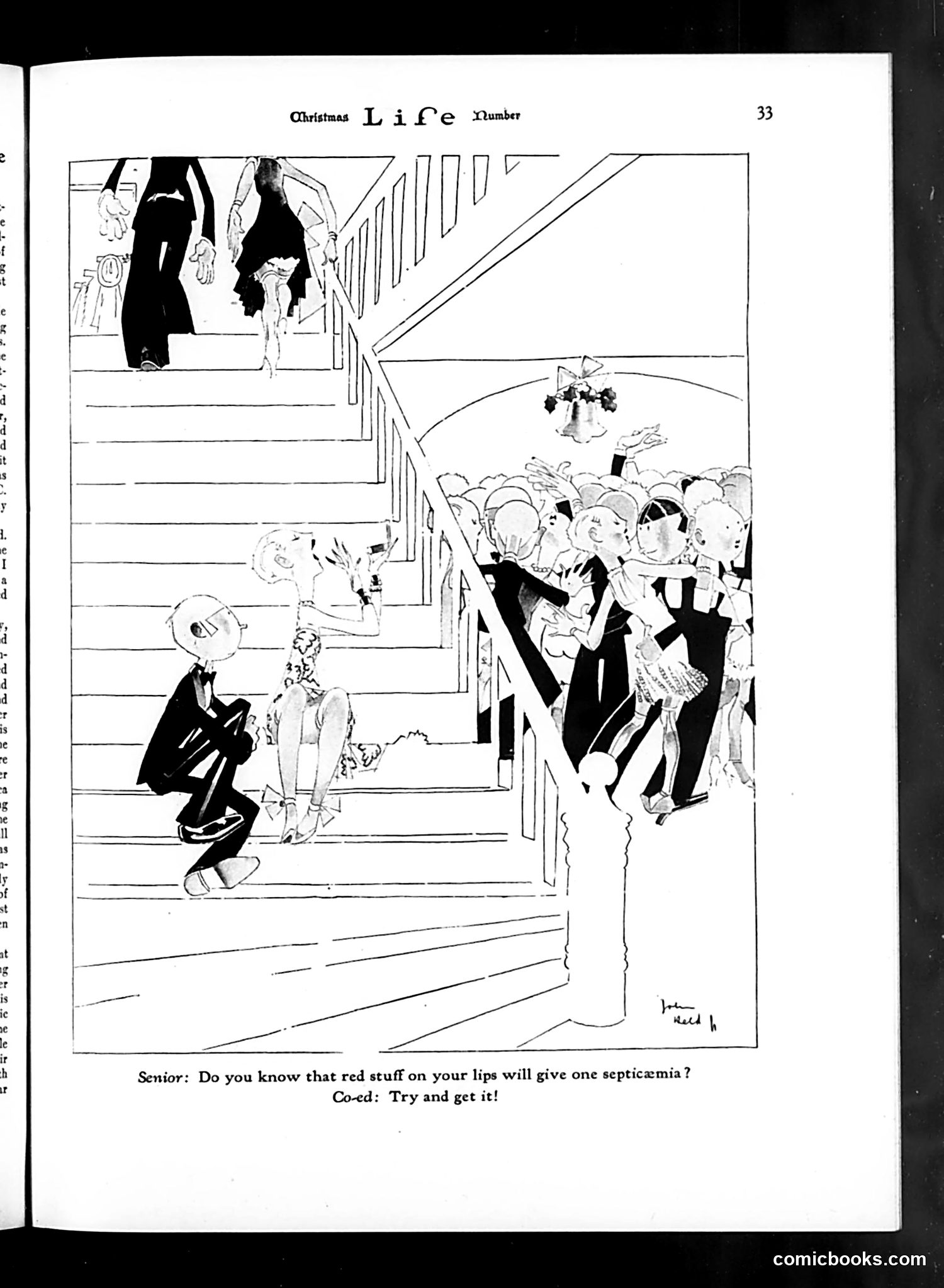
This is a Christmas-themed cartoon from *Life* magazine depicting a flirtation scene at what appears to be a formal holiday party or dance. A senior boy (in formal attire) attempts to warn a female college student ("co-ed") that lipstick causes septicemia (blood poisoning). The joke plays on the tension between: 1. **Medical concern** — a somewhat contrived health warning 2. **Flirtation** — his real intent is to get close enough to kiss her 3. **Her response** — "Try and get it!" is a cheeky dare challenging his nerve The satire mocks both pretentious young men who use pseudo-scientific excuses to justify romantic advances, and the carefree attitude of modern young women toward such warnings. It reflects 1920s-era anxieties about youth behavior and cosmetics.
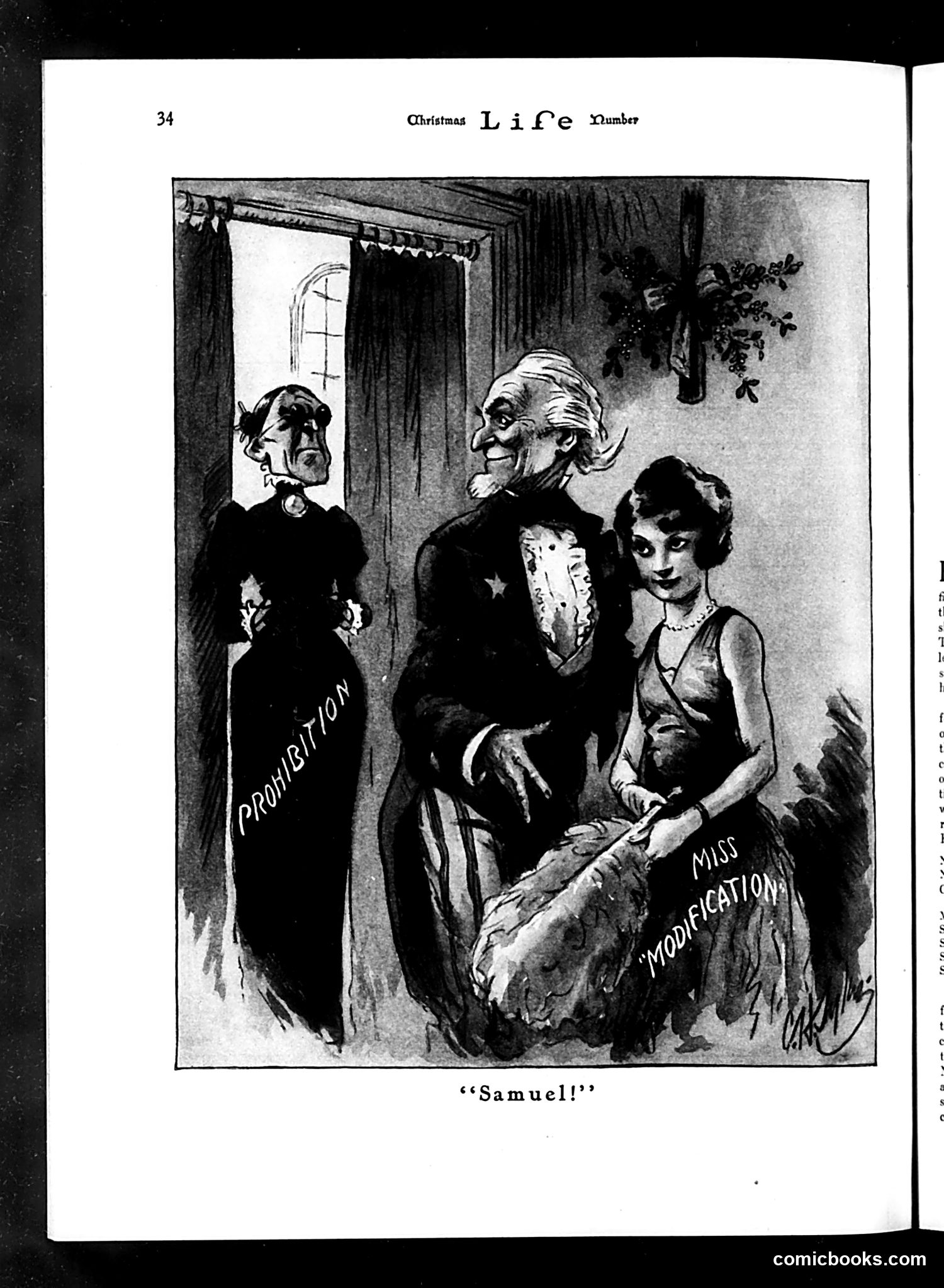
This Christmas-themed satirical cartoon depicts three figures presenting what appears to be a turkey or large bird to an elderly man with exaggerated features. The labels identify two of the women as representing "Prohibition" and "Miss Modification." The cartoon satirizes Prohibition—the constitutional ban on alcohol (1920-1933). The elderly man, apparently named Samuel, is being offered these "gifts" by personified concepts. The satire suggests that Prohibition advocates and those seeking to "modify" society are presenting their restrictive policies as holiday offerings, mocking the reform movement's intrusion into Christmas celebrations and personal freedoms. The cartoon critiques these social reform movements as unwelcome impositions disguised as benevolent gestures.
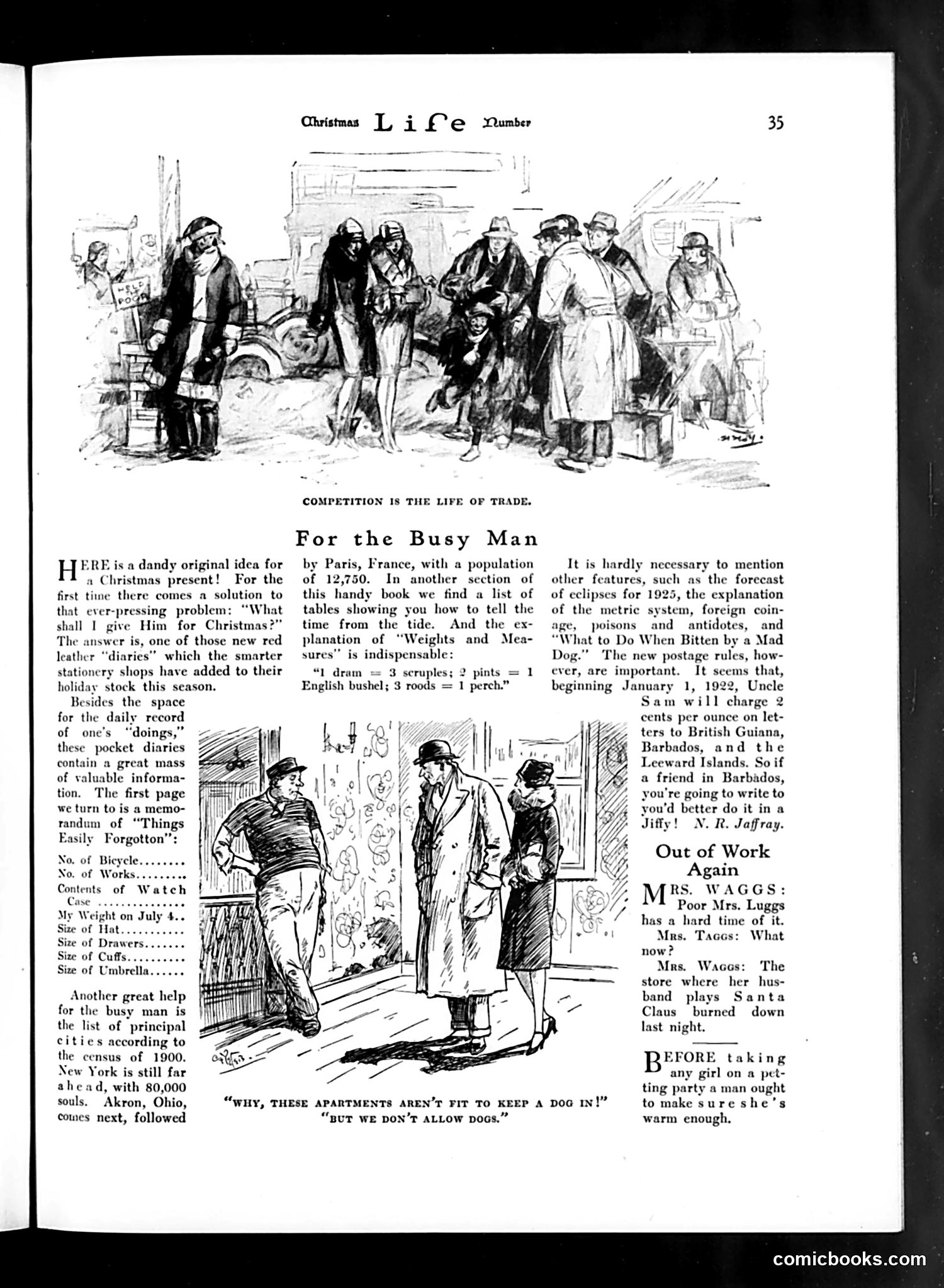
This 1920s *Life* magazine page satirizes the absurdity of pocket diaries marketed to busy men. The main article mocks these leather "diaries" as Christmas gifts by highlighting their useless reference content—outdated census data, obscure measurement conversions, eclipse forecasts for 1925, and postal rates to obscure Caribbean territories. The joke is that these practical gifts are actually impractical clutter masquerading as usefulness. The cartoon below shows an apartment landlord refusing to rent to someone with a dog, illustrating period housing discrimination. A side column includes brief jokes about unemployment during economic hardship and dating customs, typical of the era's casual humor about class struggle and courtship rituals. The satire targets consumer culture and the marketing of pseudo-useful products to busy professionals—a timeless target, though the specific references (metric conversions, Caribbean postage) are historically specific to the 1920s.
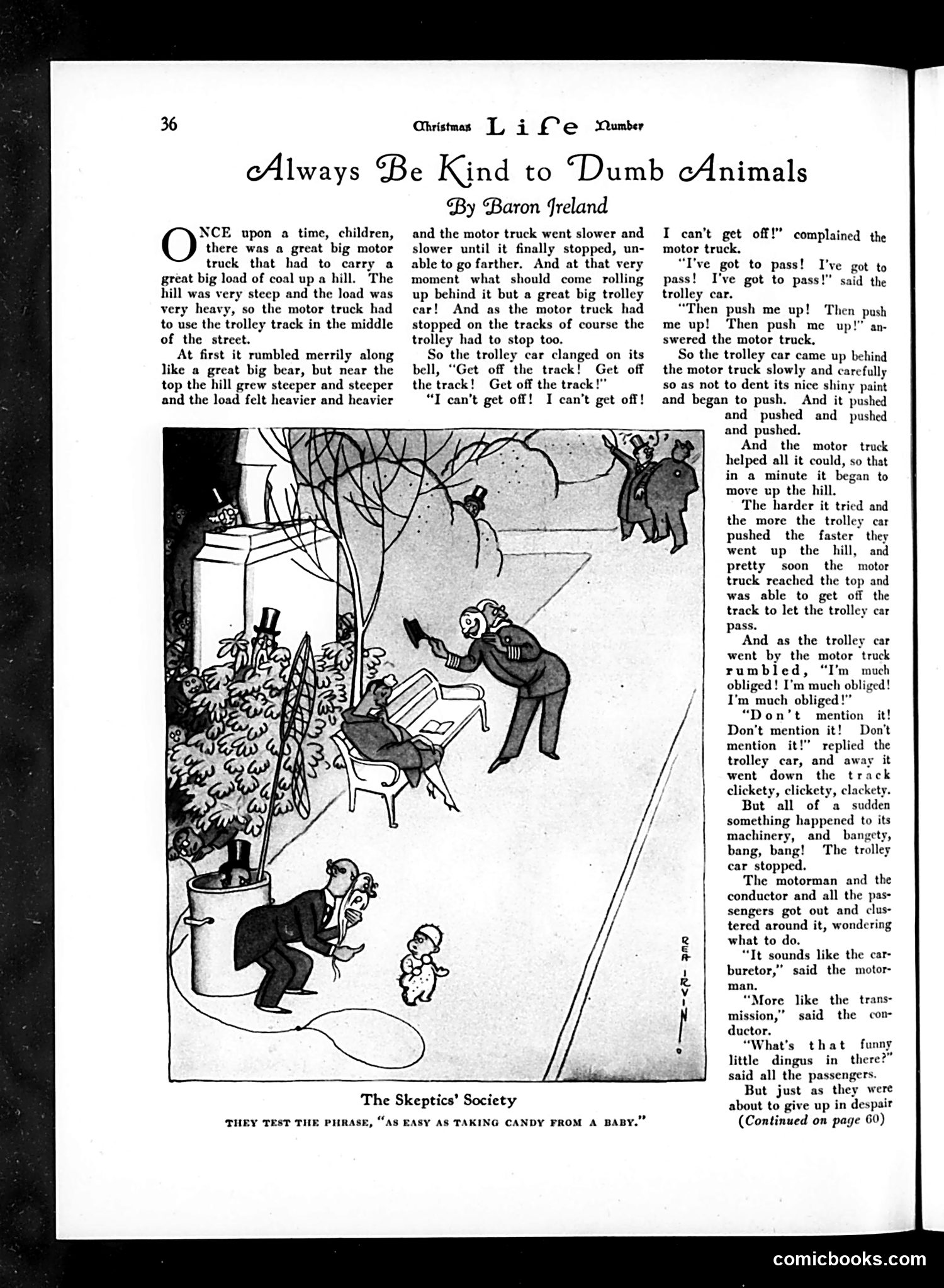
This is a children's fable by Baron Ireland presented as satire on the concept of reciprocal kindness. The narrative depicts a motor truck stuck on a hill using trolley tracks. A trolley car arrives, and instead of conflict, they cooperate: the trolley pushes the truck uphill. The truck expresses gratitude profusely. However, the satire emerges in the second half. Immediately after being helped, the trolley car breaks down with mechanical failure. The motorman, conductor, and passengers puzzle over the malfunction, unable to identify the problem. **The joke**: The title and setup promise a moral lesson about kindness to those weaker ("dumb animals"), but the outcome—where the helpful party is rewarded with mechanical disaster—inverts expectations. It satirizes either the futility of good deeds or the ironic justice of the universe. The accompanying cartoon at bottom, "The Skeptics' Society," reinforces this cynical theme by depicting people testing whether kindness is as "easy as taking candy from a baby."
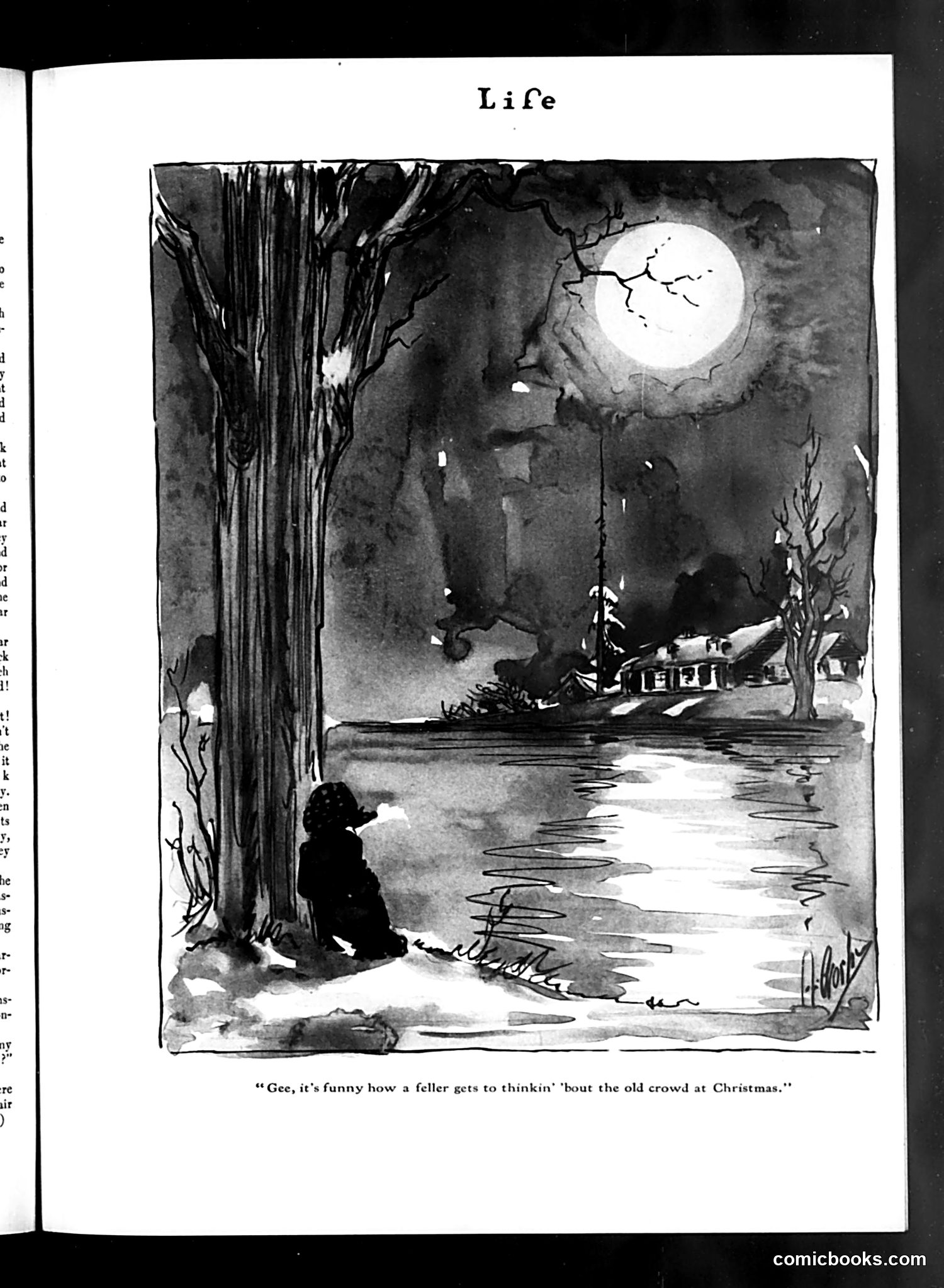
This is a single-panel cartoon titled "Life" depicting a solitary figure sitting beneath a large tree, gazing across a moonlit winter landscape toward a distant house. The scene is nostalgic and melancholic. The caption reads: "Gee, it's funny how a feller gets to thinkin' 'bout the old crowd at Christmas." The cartoon captures a sentimental Christmas theme common to early 20th-century American humor. It portrays homesickness and nostalgia—a person separated from their community during the holidays, reflecting on absent friends or family. The moonlit, winter setting reinforces emotional distance and loneliness. This likely appealed to *Life* magazine's urban, educated readership by romanticizing rural memories or relationships left behind during life's transitions.
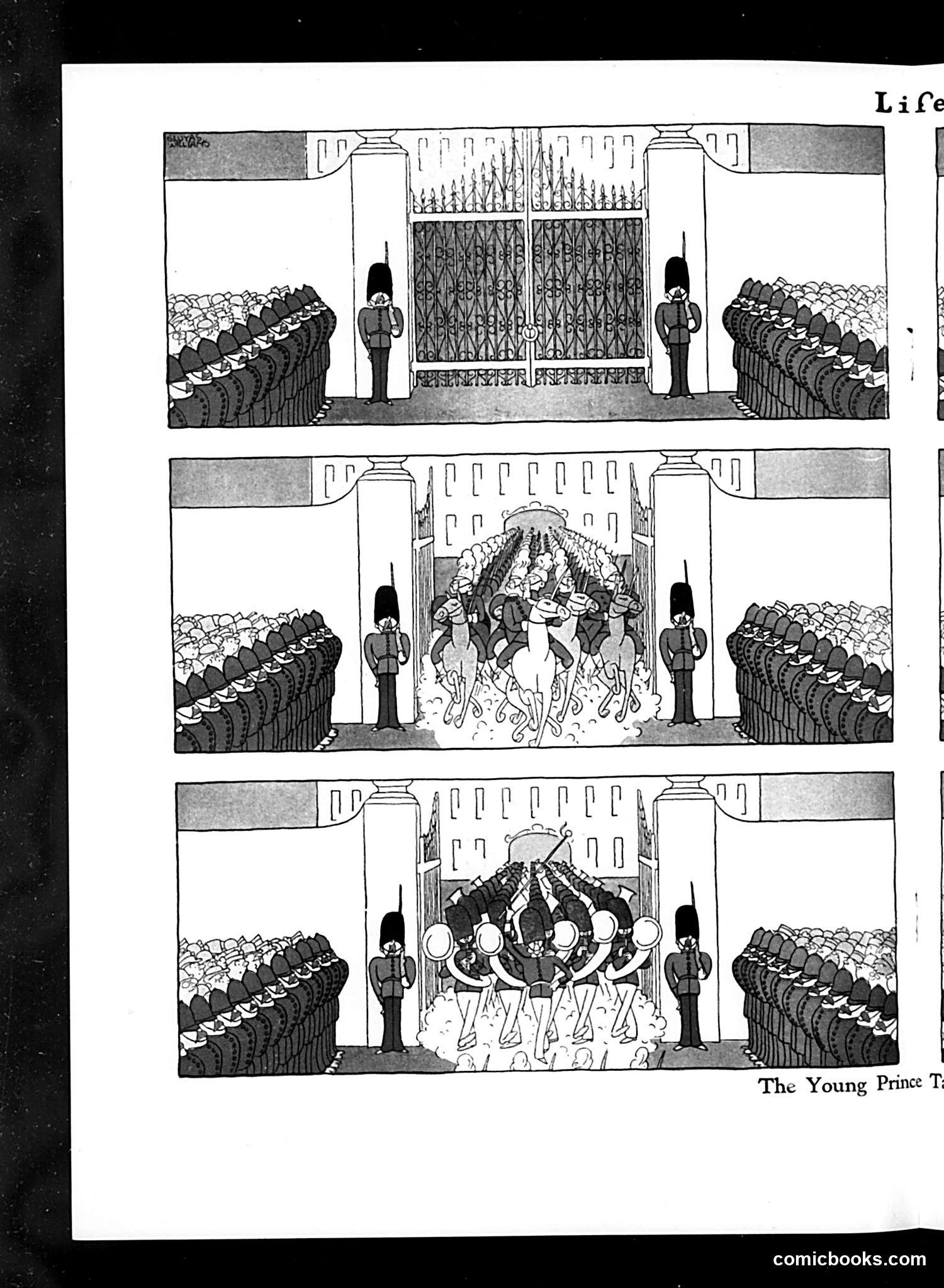
This appears to be a three-panel satirical sequence titled "The Young Prince T[...]" (title cut off). The cartoon depicts: **Panel 1**: Guards flanking ornate palace gates while dignitaries stand at attention. **Panel 2**: The gates open to reveal chaos—figures appear to be rioting or celebrating wildly inside the palace. **Panel 3**: The same figures now engaged in what appears to be a coordinated dance or synchronized activity, with raised objects (possibly plates or shields). The satire likely comments on the contrast between formal royal protocol and the actual behavior within—suggesting either the disorder lurking beneath ceremony, or the transformation of unruly behavior into controlled spectacle. Without the complete title and publication date, the specific royal figure referenced remains unclear, though the British palace setting and formal guards suggest this targets European monarchy, possibly from the early-to-mid 20th century.
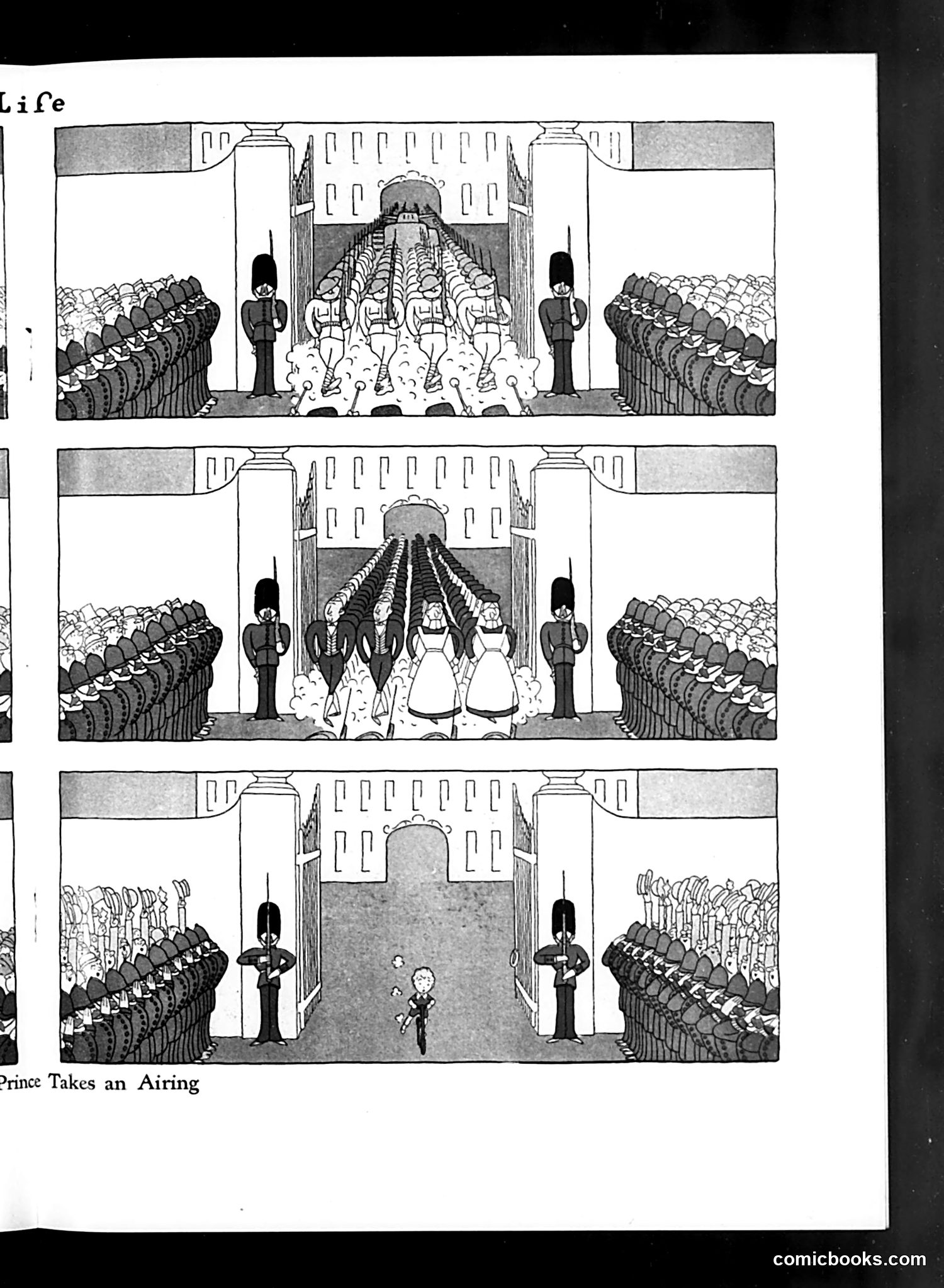
This three-panel satirical cartoon depicts a royal figure (identified as a "Prince" in the caption) being escorted through what appears to be a palace corridor by guards in ceremonial dress. The humor derives from the contrast between the elaborate military formality—rows of uniformed guards flanking both sides—and the prince's activity: he appears to be on a tricycle or small wheeled vehicle, suggesting childish behavior. The satire seems to mock either royal pretension (treating a child's activity with military grandeur) or to comment on a specific royal figure's immaturity or lack of serious authority. The progression from crowds to emptiness in the third panel may suggest the prince's isolation or insignificance despite the ceremonial display. Without knowing the specific historical context and which prince is referenced, the exact political target remains unclear.
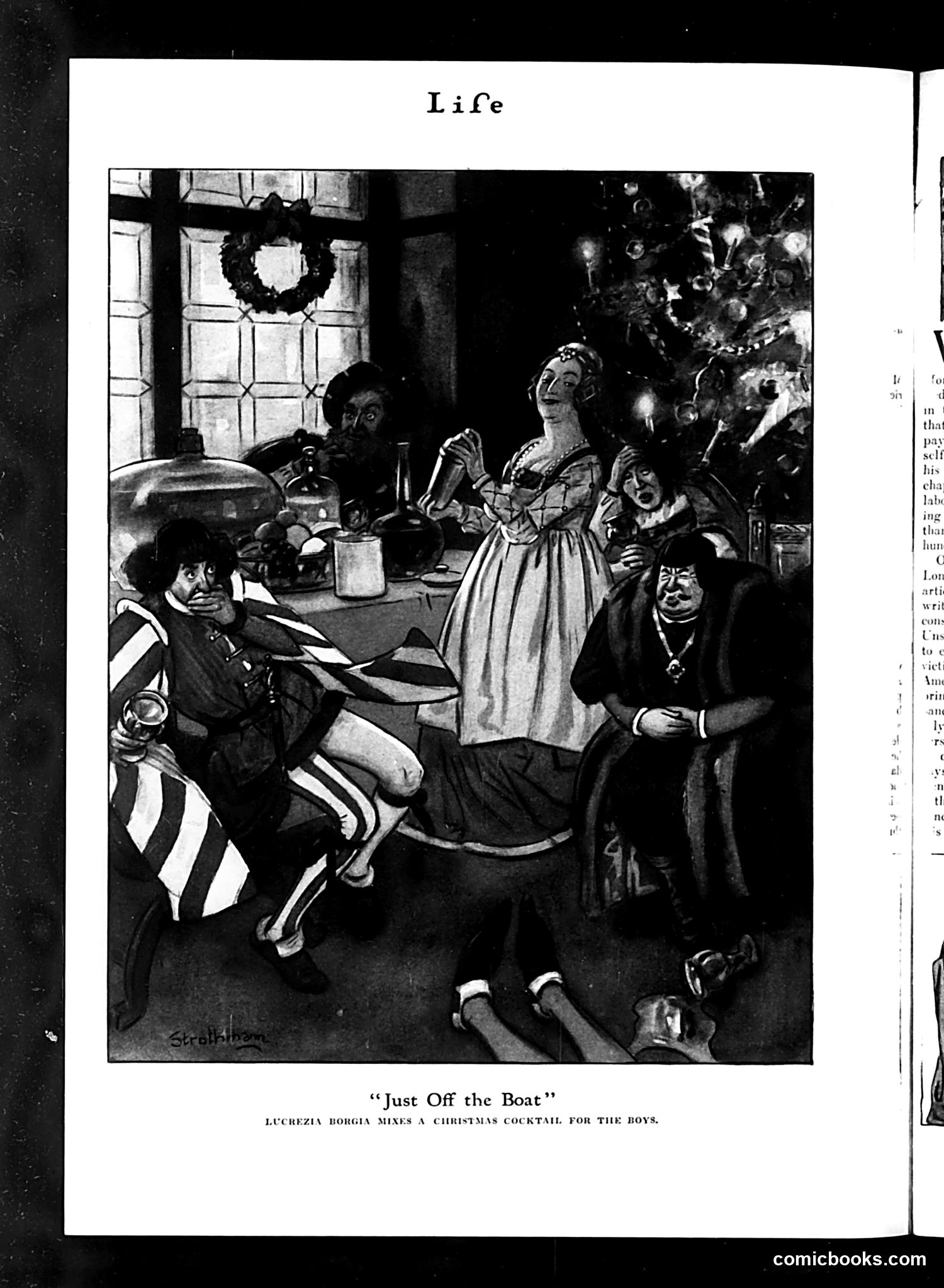
This satirical illustration depicts **Lucrezia Borgia** (a historical Italian Renaissance figure famous for alleged crimes and poison) mixing a Christmas cocktail for sailors or soldiers ("the boys"). The satire conflates two ideas: Borgia's notorious reputation for poisoning enemies with the act of serving drinks to military men. The joke appears to play on anxieties about women's roles—specifically, a dangerous woman providing hospitality to servicemen, inverting the expected domestic comfort into something potentially sinister. The nautical setting ("off the boat") and military uniforms suggest this may reference American military personnel, though the exact historical moment is unclear without the magazine's date. The humor relies on the audience recognizing Borgia as a symbol of feminine treachery.
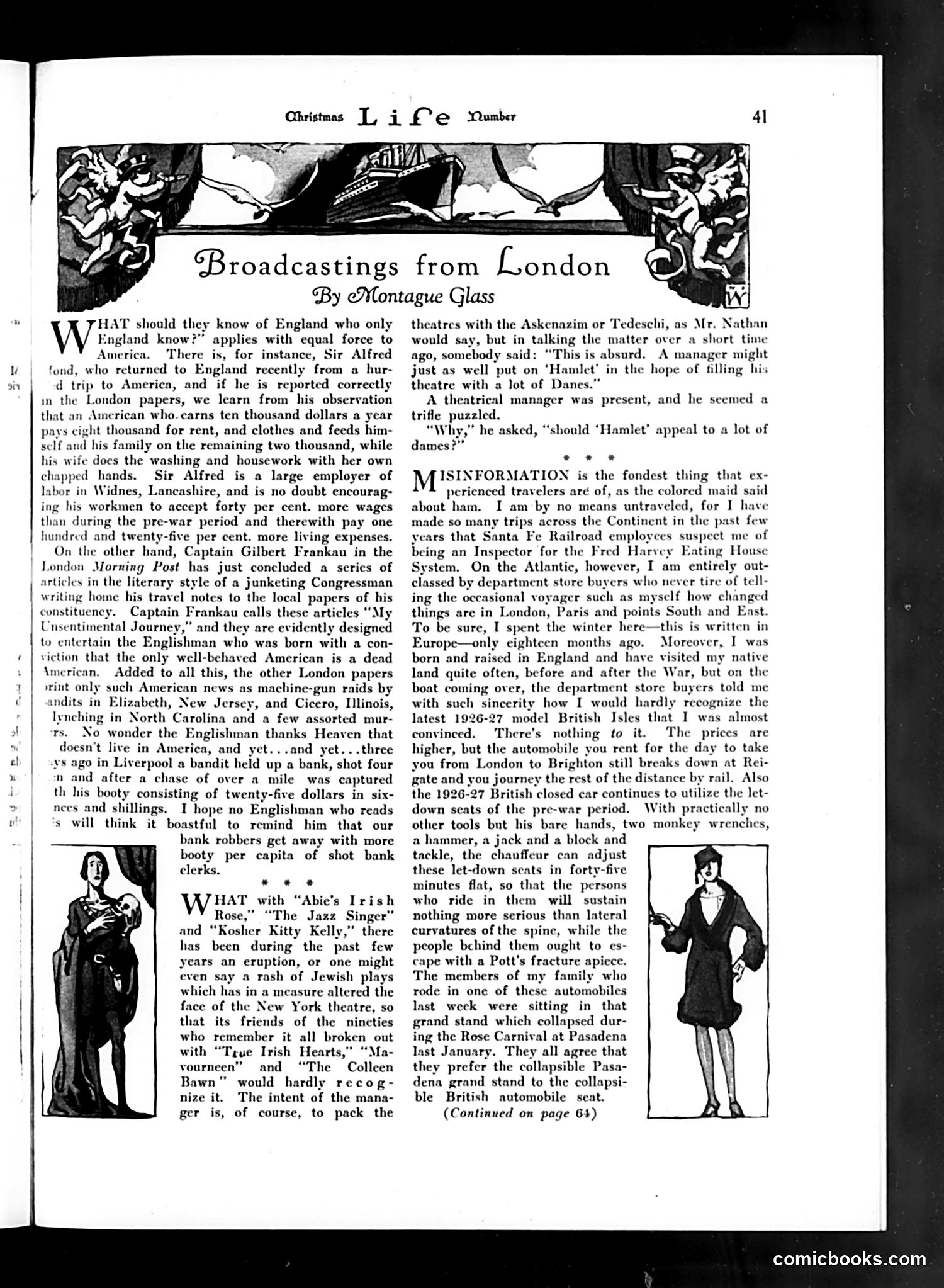
This satirical column compares English and American societies through traveler observations. The author mocks Sir Alfred Ford's claim that Americans earning $10,000 annually survive on $2,000 while wives do unpaid housework—highlighting the hypocrisy of British employers resisting wage increases while criticizing American inequality. A secondary joke targets theatrical managers: one assumes Jewish plays ("Abie's Irish Rose," "The Jazz Singer") will automatically fill theaters with Jewish audiences, just as putting on "Hamlet" would supposedly attract "dames" (Danes). The manager's bewildered response—asking why Hamlet would appeal to "dames"—satirizes this absurd ethnic stereotyping. The column uses witty contrasts between British pretension and American realities to expose prejudice on both sides of the Atlantic.
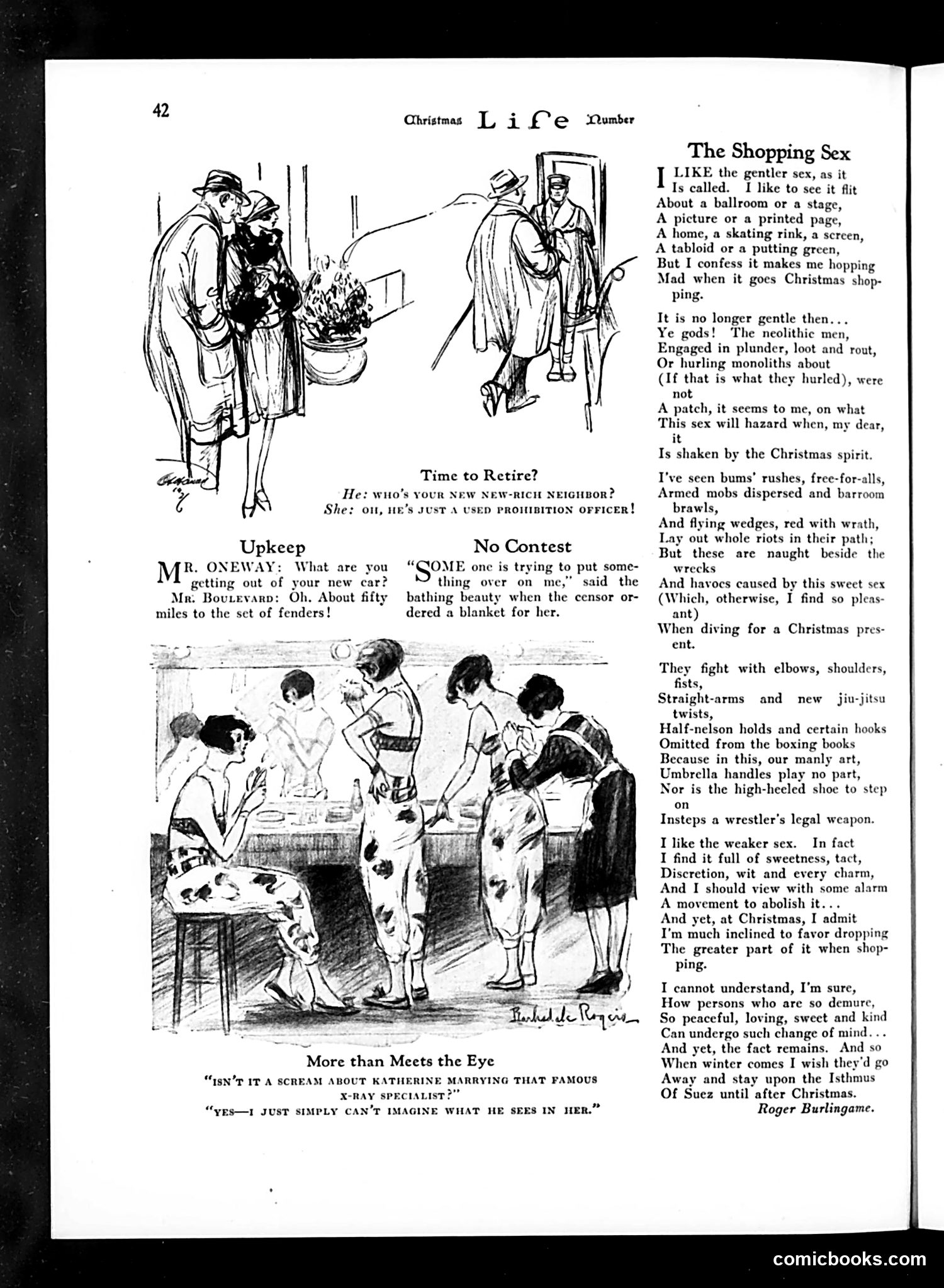
This page contains several cartoons and an essay satirizing 1920s American life, particularly focusing on women's behavior during Christmas shopping season. The cartoons mock: - **Prohibition era corruption**: A "used prohibition officer" neighbor, referencing how enforcement agents often became wealthy through bribery - **Car maintenance costs**: The running gag about fenders needing constant replacement - **Censorship absurdity**: A bathing beauty resisting modesty demands - **Celebrity gossip**: Speculation about Katherine Marrying a famous man (identity unclear from image alone) The main essay by Roger Burlingame humorously contrasts genteel femininity with aggressive Christmas shopping behavior. He claims women—normally "sweet and kind"—transform into violent competitors when pursuing holiday bargains, fighting with "elbows, shoulders, fists" and "jiu-jitsu twists." The exaggeration satirizes both the commercialization of Christmas and period gender stereotypes about "the weaker sex." The satire reflects 1920s anxiety about changing female behavior and consumer culture's intensity.
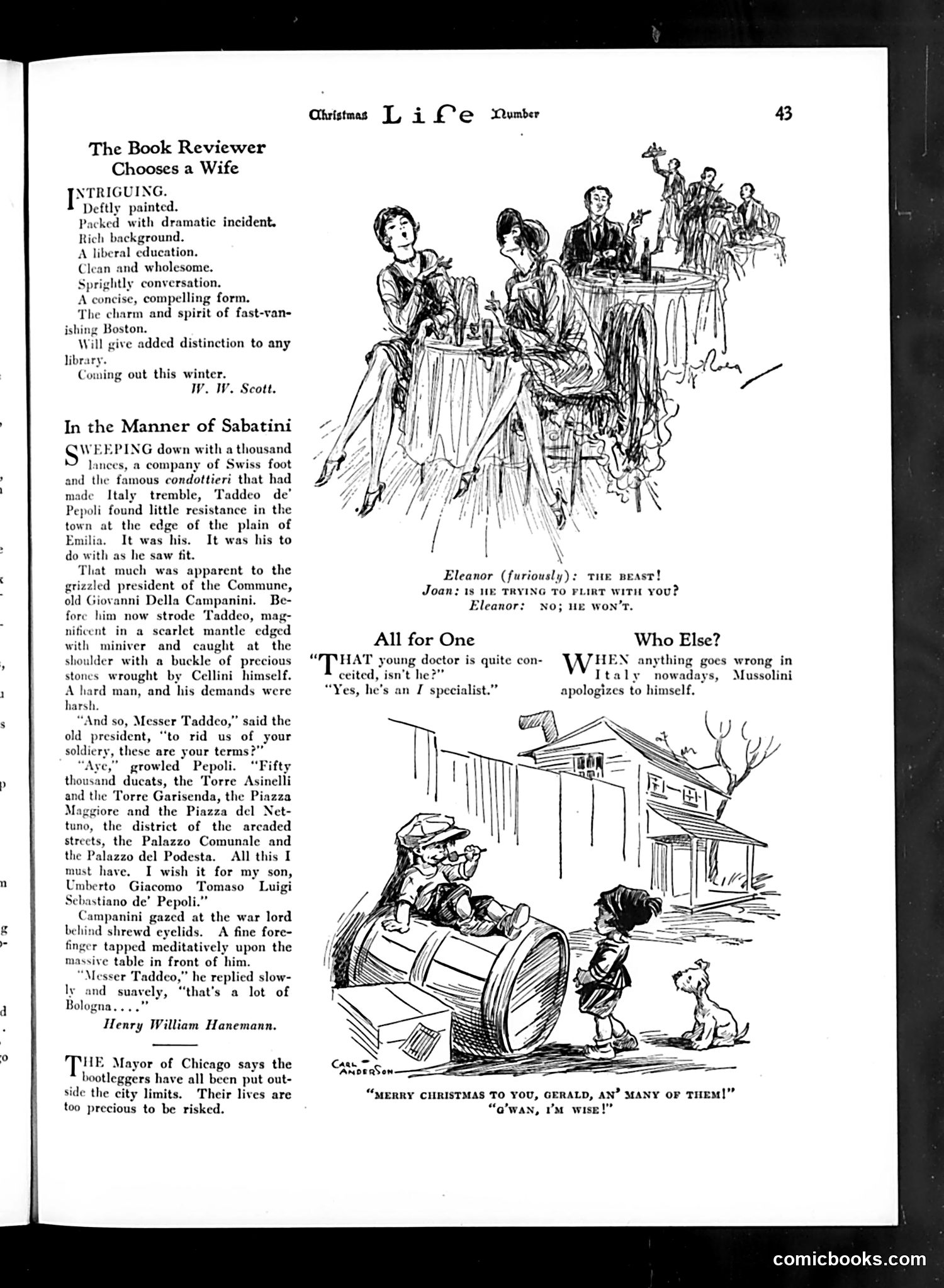
This page contains multiple satirical pieces mocking literary and political trends of the era. **"The Book Reviewer Chooses a Wife"** parodies pretentious book reviews by listing a woman's qualities using the inflated critical language of contemporary reviewers—"intriguing," "packed with dramatic incident," "charm and spirit of fast-vanishing Boston." The joke is that a wife is being evaluated like a fashionable novel. **"In the Manner of Sabatini"** satirizes popular historical adventure fiction (Rafael Sabatini wrote swashbuckling novels). It depicts a condottiero demanding Bologna's landmarks as ransom. The humor lies in the absurdly exhaustive list of demands and the sardonic response treating conquest as a real estate transaction. **"All for One / Who Else?"** appears to mock Italy under Mussolini, with the caption suggesting Mussolini must apologize to himself when things go wrong—commentary on fascist ideology or propaganda. The bottom cartoon shows children with a barrel marked "Christmas," likely satirizing holiday commercialism or scarcity (possibly post-WWI deprivation).
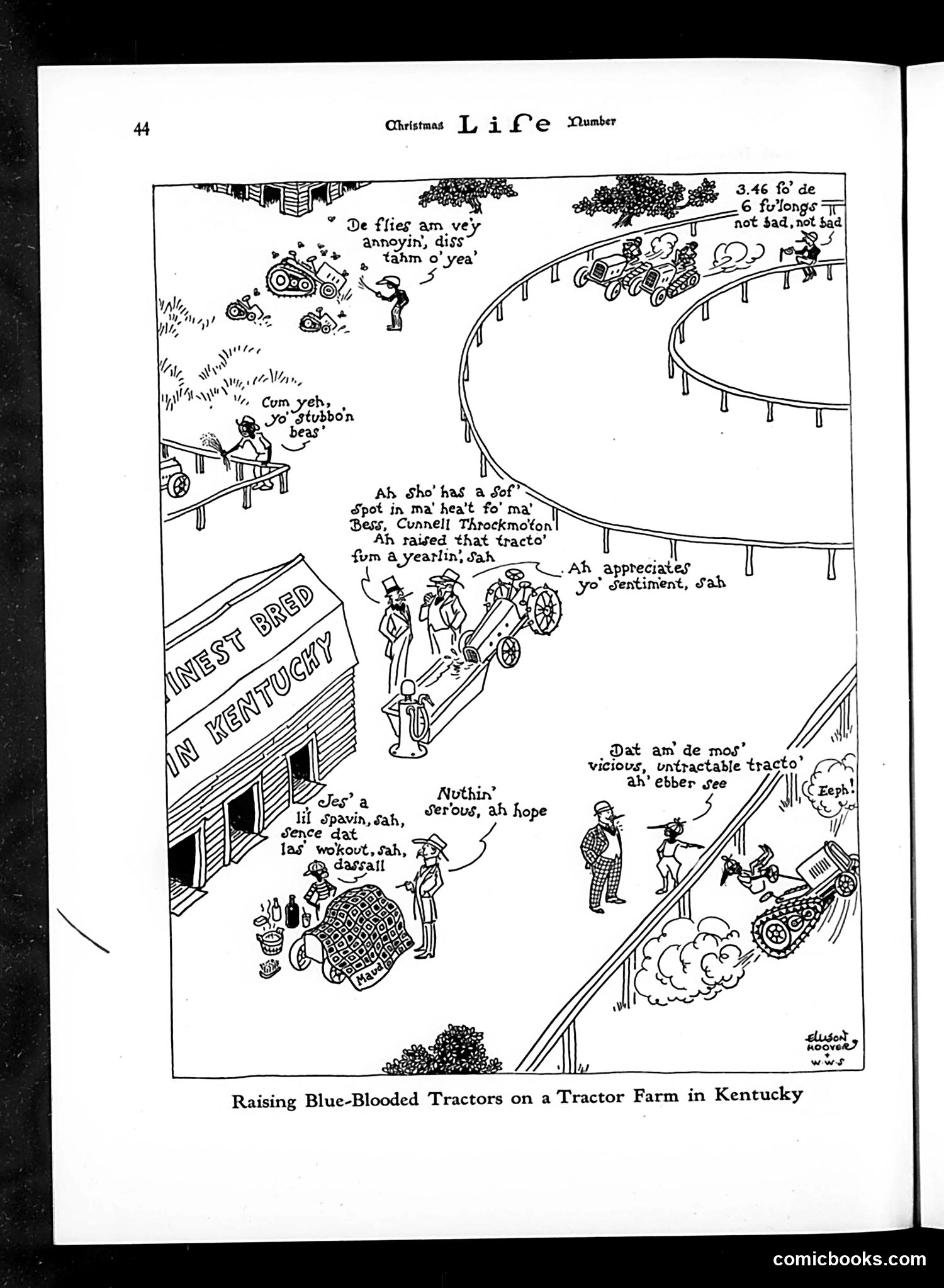
This is a satirical cartoon about breeding tractors like thoroughbred horses on a Kentucky farm. The humor relies on exaggerated "dialect" speech (written phonetically) attributed to Southern rural characters discussing tractors with the reverence typically reserved for prize livestock. The joke satirizes the agricultural modernization of the American South—tractors were replacing mules and manual labor. The cartoon mocks both the pretension of treating machinery as "blue-blooded" (aristocratic) stock and period stereotypes about Southern speech and culture. Characters use phrases like "yearlin'" and discuss tractors' temperaments ("vicious, untractable") as if they were horses. A building labeled "Finest Bred in Kentucky" references the state's famous thoroughbred horse industry, now absurdly applied to farm equipment. The satire targets rural Americana and technological progress, though the execution relies on dated, offensive dialect humor common in 1920s-era publications.
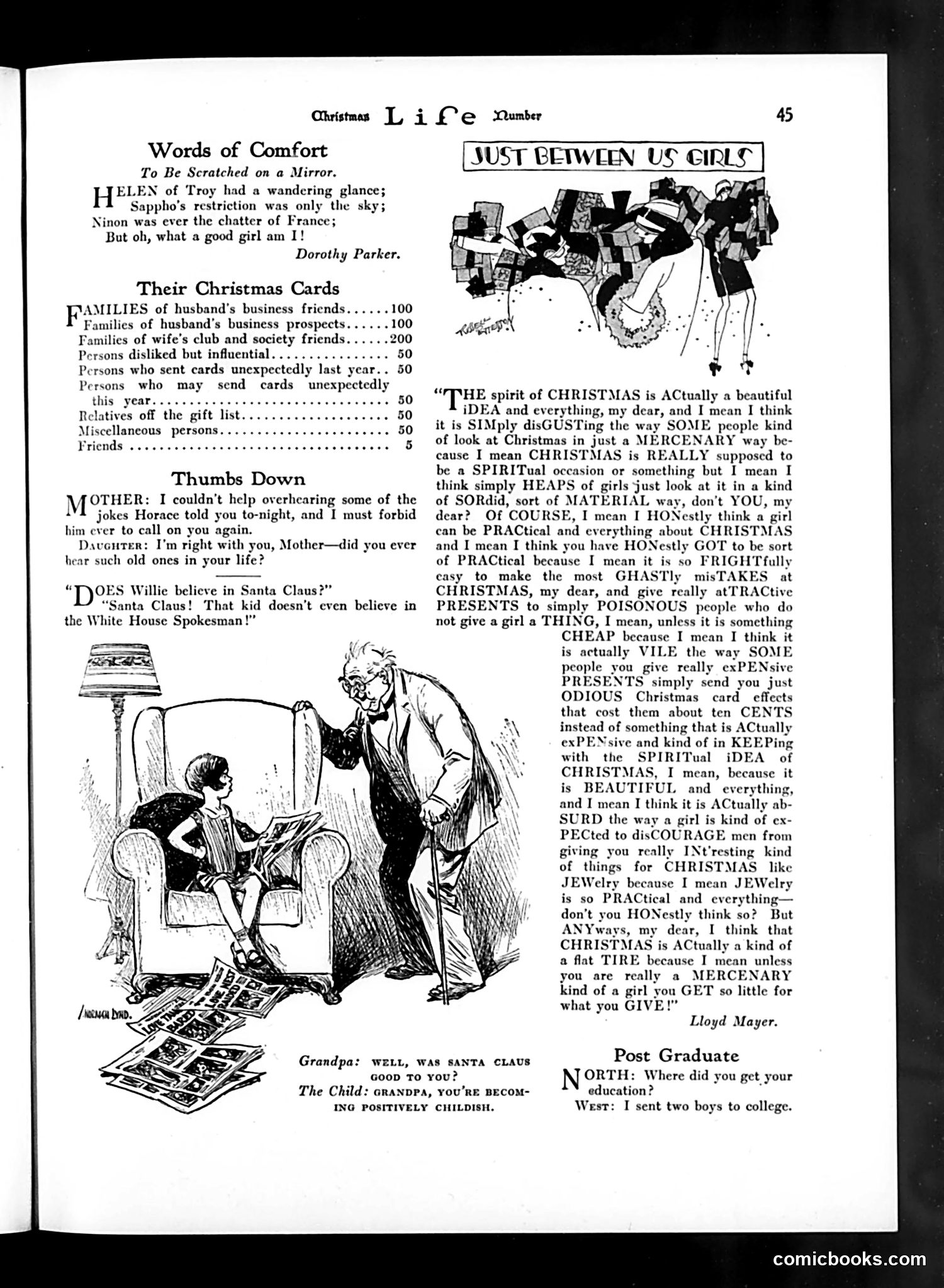
This page presents satirical humor typical of 1920s Life magazine. The main piece, "Just Between Us Girls," is a monologue by Lloyd Mayer satirizing young women's attitudes toward Christmas gift-giving. Through exaggerated capitalization and breathless rambling, it mocks girls who claim to value Christmas's "spiritual" meaning while obsessing over receiving expensive presents—jewelry, not cheap gifts. The satire exposes the contradiction between professed idealism and mercenary behavior. The surrounding content includes Dorothy Parker's witty verse about being a "good girl," a numbered list of Christmas card recipients (poking fun at social obligation), and brief jokes about Santa Claus and gift-giving. The cartoons show domestic scenes: a grandmother scolding a child for disbelief in Santa, and a mother forbidding her daughter from seeing a boy whose jokes are old-fashioned. The humor targets female materialism, generational gaps, and Christmas commercialization—evergreen satirical targets.
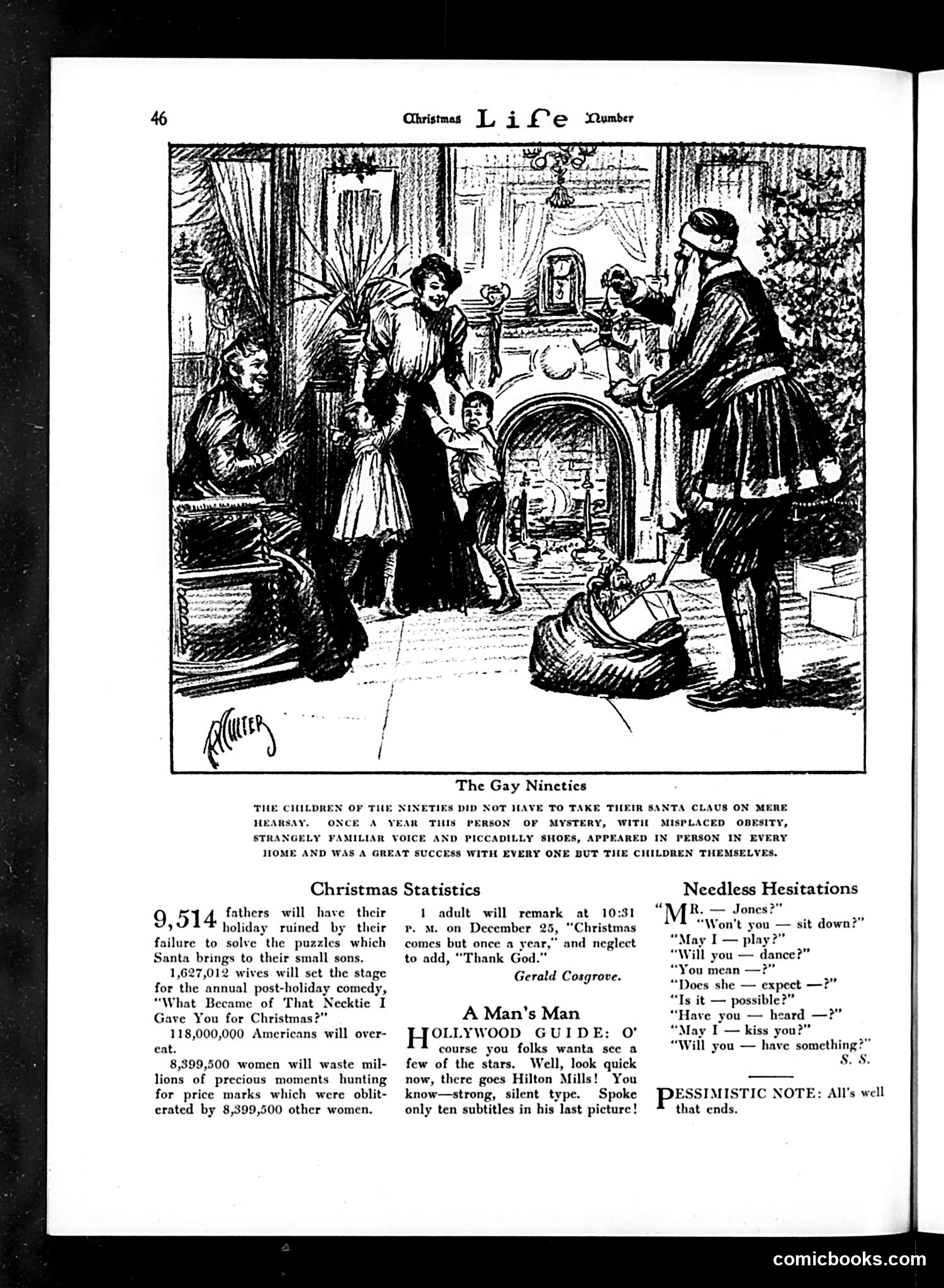
This page satirizes Christmas customs of the 1890s versus the present day (Life's publication era, early 1900s). The top illustration contrasts how wealthy families of the 1890s hired a professional "Santa Claus"—described as a mysterious, oddly-dressed figure with a distinctive voice—who successfully delighted adults but failed with children themselves. The satire implies nostalgia for simpler times. The "Christmas Statistics" section mocks modern American holiday dysfunction: fathers frustrated by puzzle gifts, wives resenting forgotten presents, mass overeating, and women obsessively hunting for price tags. One adult sardonically remarks "Christmas comes but once a year" without adding "Thank God"—suggesting relief at its rarity. The sidebar jokes target Hollywood's silent films (Hilton Mills credited with "ten subtitles") and social awkwardness ("Needless Hesitations" catalogues stammering romantic moments). Overall, the page presents Christmas as a commercialized, anxiety-producing modern institution—a sharp contrast to Life's idealized 1890s version.
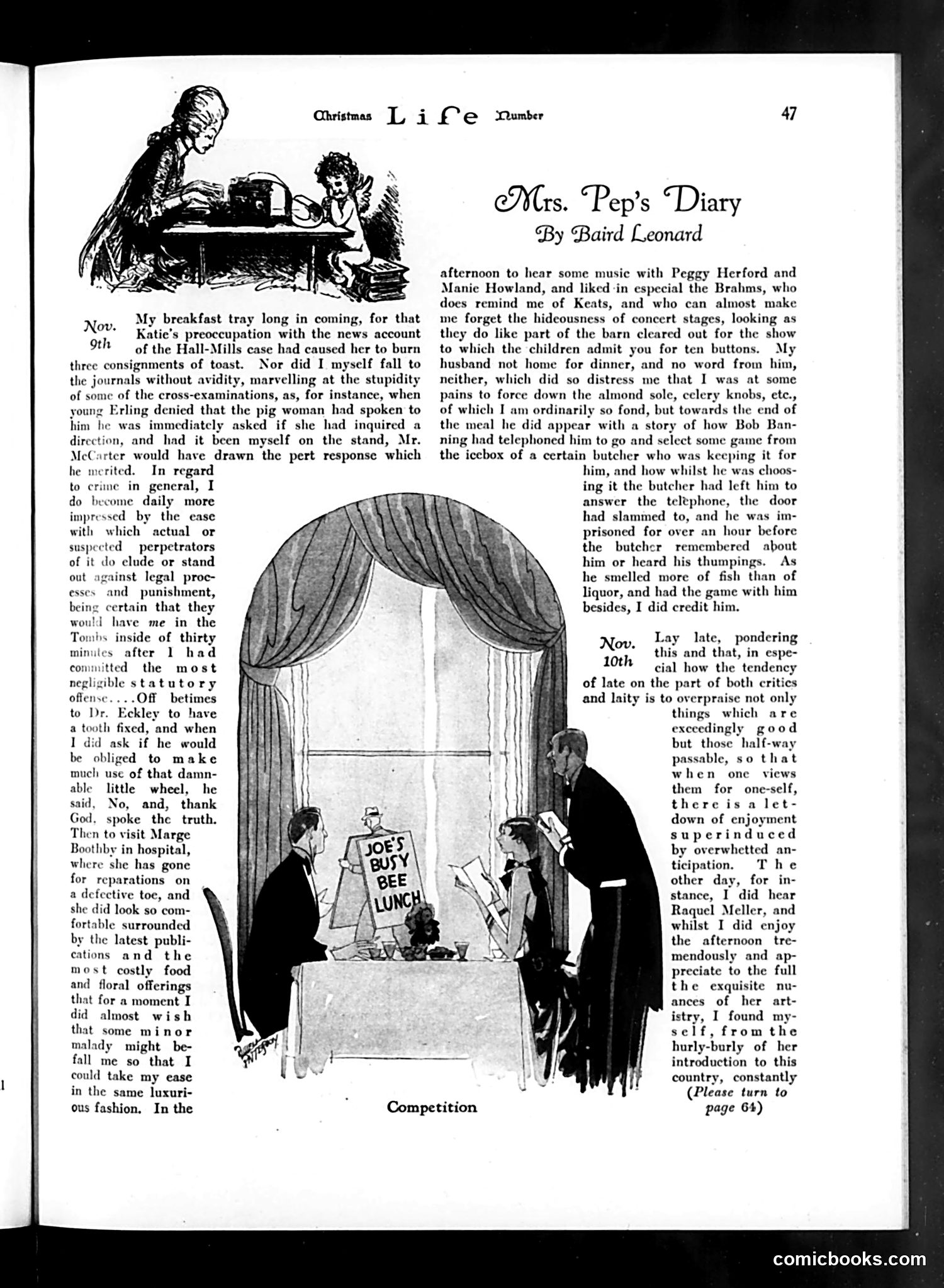
This is a diary-format humor column by Baird Leonard, not a political cartoon. The single illustration labeled "Competition" shows two men viewing a storefront window display reading "JOE'S BUSY BEE LUNCH"—likely satirizing the era's obsession with competitive commercial enterprise. The diary entries mock upper-class social life and concerns: Katie burning toast while obsessing over the "Hall-Mills case" (a sensational 1920s murder trial), dental visits, hospital gossip, concert attendance, and domestic frustrations. The humor derives from the diarist's affected tone contrasting with mundane complaints—a servant's delayed breakfast tray receives the same elaborate treatment as reflections on crime and justice. The entry about the husband imprisoned in a butcher's icebox satirizes how such mishaps are excused away. Overall, the column gently ridicules the pretensions and preoccupations of the leisure class during this period.
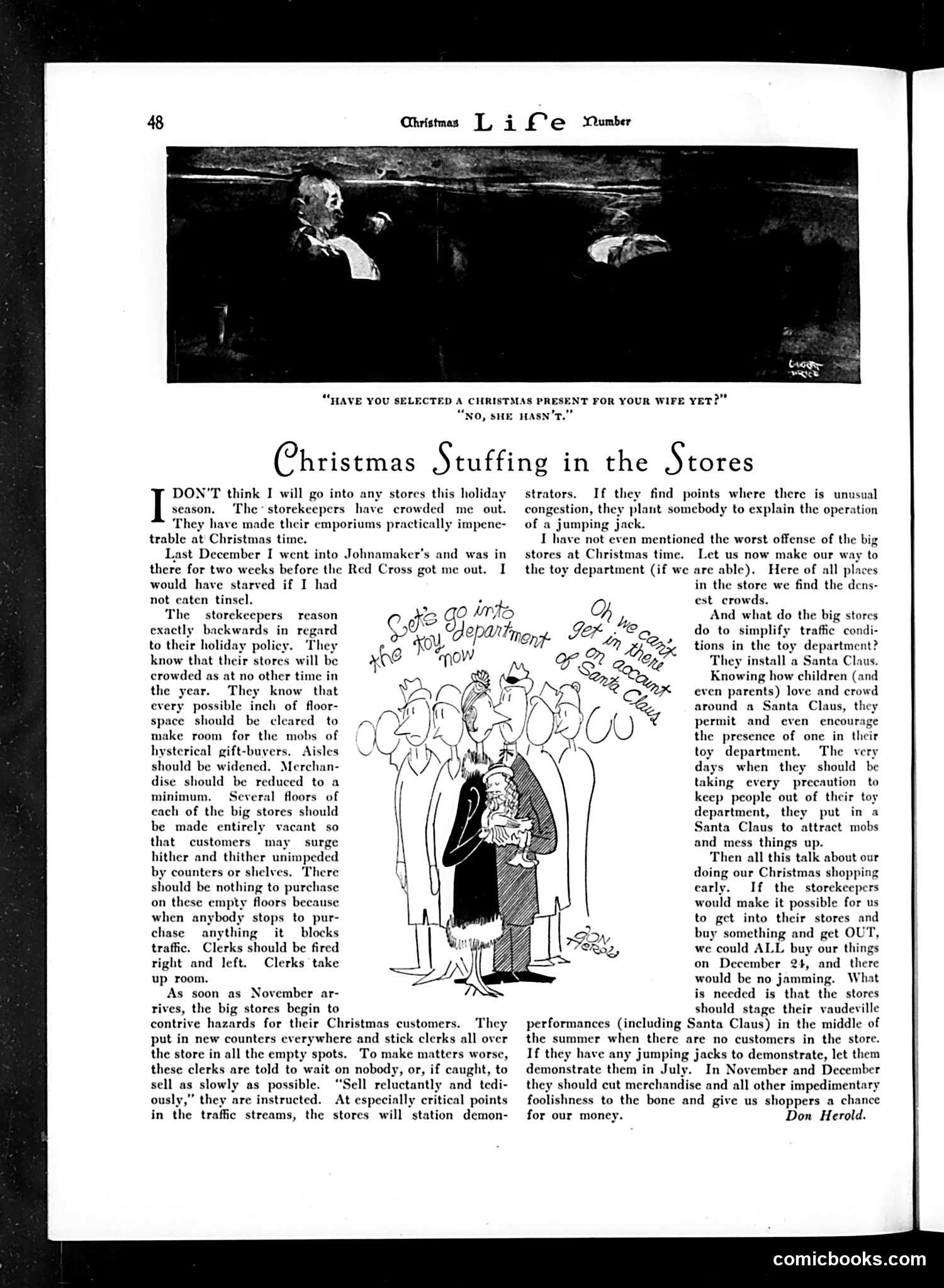
This is a satirical essay by Don Herold critiquing retail stores' counterintuitive Christmas shopping practices. The author argues that stores, knowing they'll be mobbed during the holidays, do the opposite of what makes sense: they *add* counters, clerks, and obstacles rather than clearing space for crowds. The opening cartoon jokes about husbands procrastinating on gift-buying—the husband hasn't selected a present because his wife (the decision-maker) hasn't told him what she wants. Herold's main complaint: stores intentionally make shopping worse by stationing demonstrators and—most absurdly—installing Santa Claus displays in toy departments, which creates massive congestion precisely when stores should be minimizing obstacles. His satirical solution: move all these "vaudeville performances" to summer when stores are empty, and strip merchandise down in November-December to let customers actually move and purchase. The humor targets retail's illogical holiday strategy during peak shopping season.
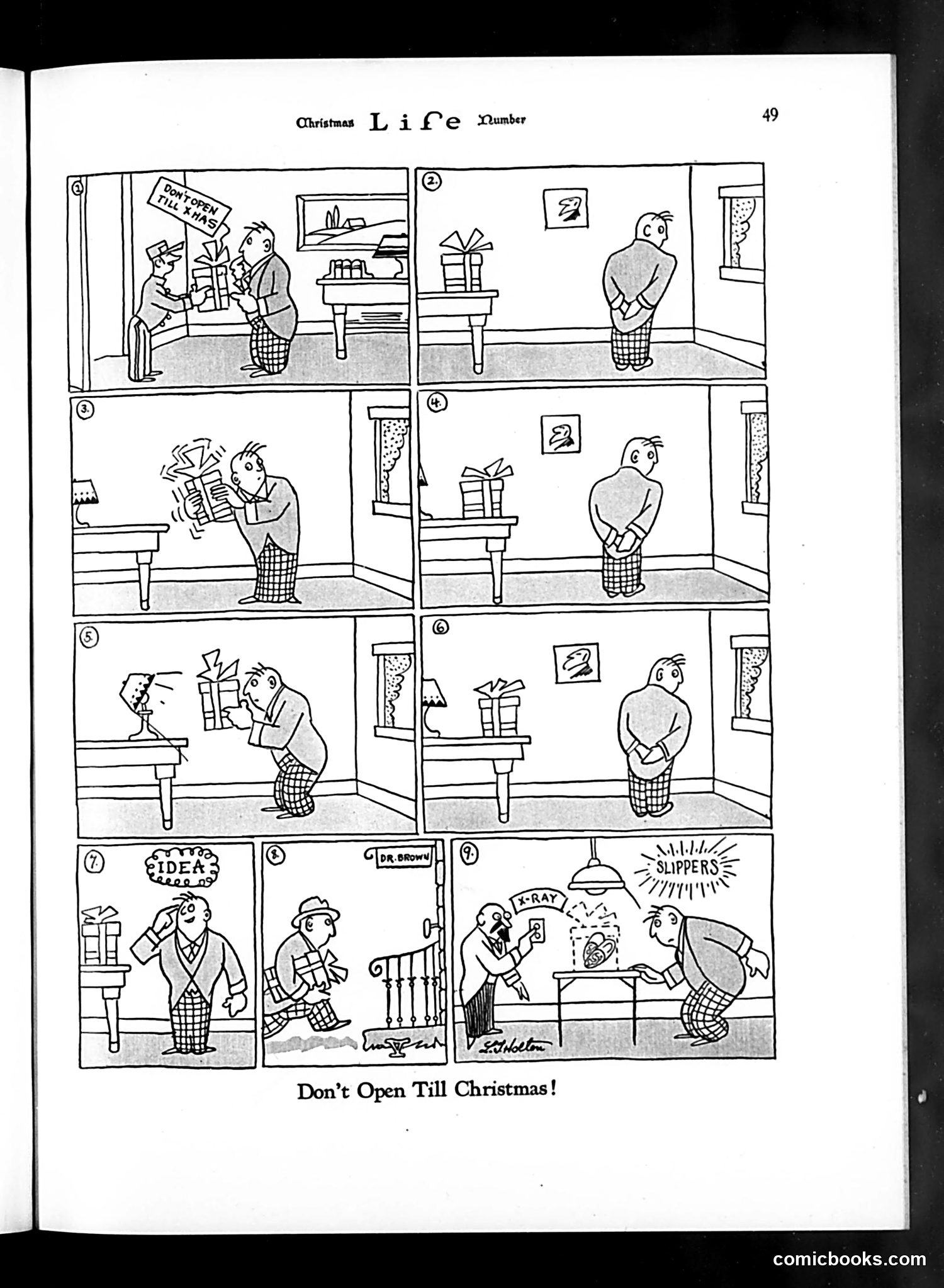
This comic strip, titled "Don't Open Till Christmas!", depicts a man's escalating attempts to hide wrapped Christmas presents from his wife. In panels 1-6, he repeatedly tries to conceal gifts in various spots around their home—a cabinet, behind furniture, under the tree—while she repeatedly discovers them. By panel 7, he has a sudden "idea" (marked with a lightbulb). Panels 8-9 show him presenting the gifts to "Dr. Brown" at what appears to be a hospital or medical facility, using an X-ray machine. The final panel reveals the joke: he's hidden the presents inside someone else's body via X-ray, making them impossible for his wife to find before Christmas. The satire satirizes both marital dynamics and the impossible task of keeping Christmas surprises secret from a determined spouse.
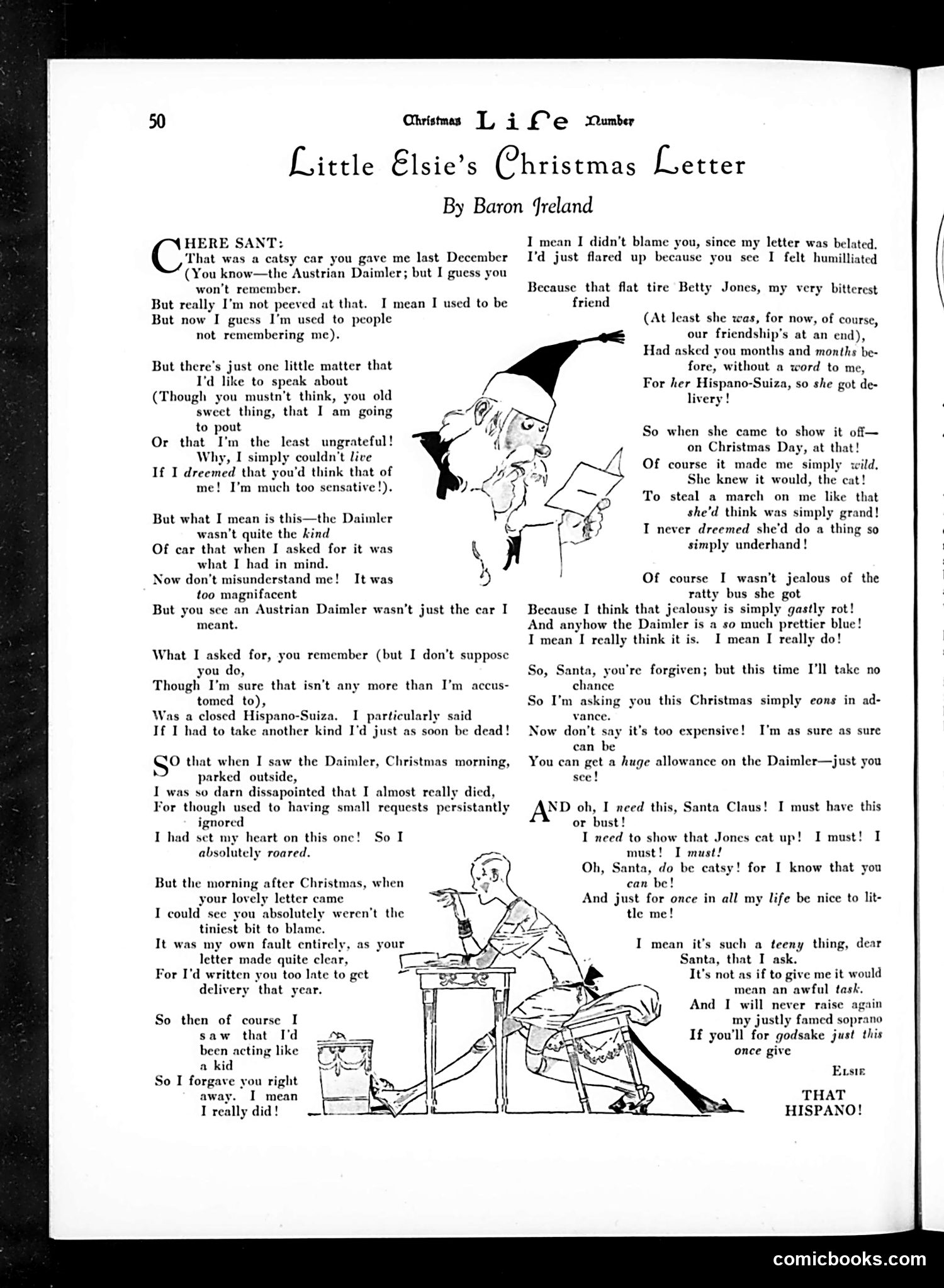
This satirical piece mocks entitled, petulant wealth through a spoiled child's letter to Santa. Elsie received an Austrian Daimler automobile for Christmas but is ungrateful because she specifically requested a Hispano-Suiza—a more expensive luxury car. The humor centers on Elsie's transparent contradictions: she claims not to be upset while clearly furious; denies jealousy of her friend Betty Jones (who received the desired Hispano-Suiza) while obsessing over it; and insists she's "not ungrateful" while demanding an even costlier replacement. The satire targets the superficiality and materialism of the wealthy, particularly spoiled children who view luxury automobiles as interchangeable commodities. References to "huge allowance" and car models reflect 1920s-30s upper-class indulgence. The exaggerated emotional language and bratty tone create the comedy, exposing how privilege breeds ingratitude and petty status competition.
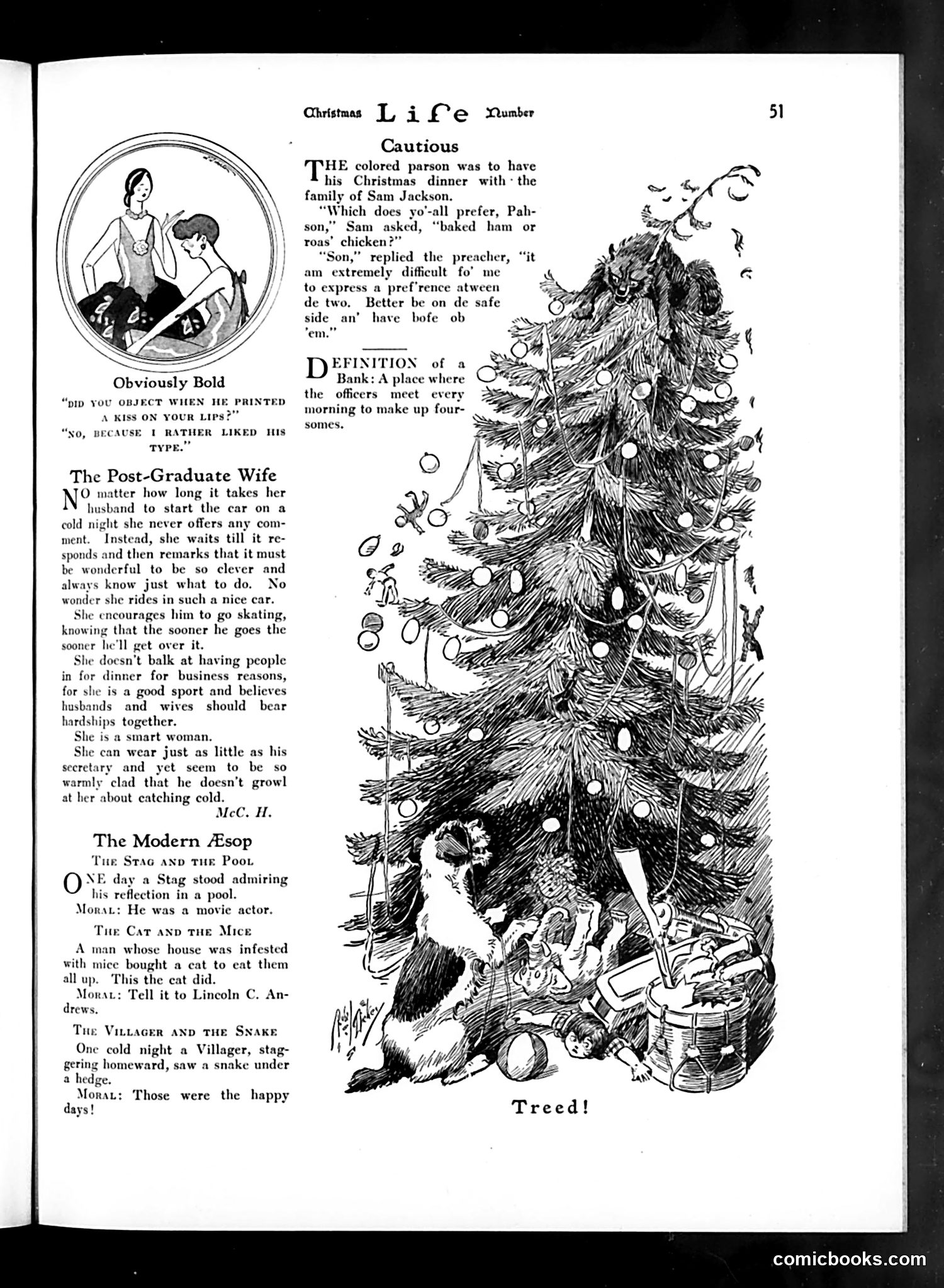
This page contains several short satirical pieces typical of Life magazine's humor: **"Obviously Bold"** mocks flirtation and printing technology with a quip about a man kissing a woman's lips in print. **"The Post-Graduate Wife"** satirizes the ideal 1920s wife who flatters her husband's competence, encourages his leisure activities, hosts business dinners without complaint, and dresses provocatively while avoiding his criticism—all through strategic manipulation framed as support. **"The Modern Aesop"** presents three brief moral fables mocking vanity (a stag admiring himself as a "movie actor"), logic (buying a cat to eat mice), and nostalgia (finding a snake harmless in "the happy days"). **"Cautious"** uses dialect humor featuring a Black preacher cautiously avoiding choosing between ham and chicken at Christmas dinner—a stereotype-based joke. **"Definition of a Bank"** jokes that bankers use morning meetings to organize golf foursomes rather than conduct business. The large illustration of a dog "treed" by a Christmas tree with ornaments depicts slapstick holiday chaos. These pieces reflect early-20th-century American magazine humor conventions, including now-offensive racial stereotypes.
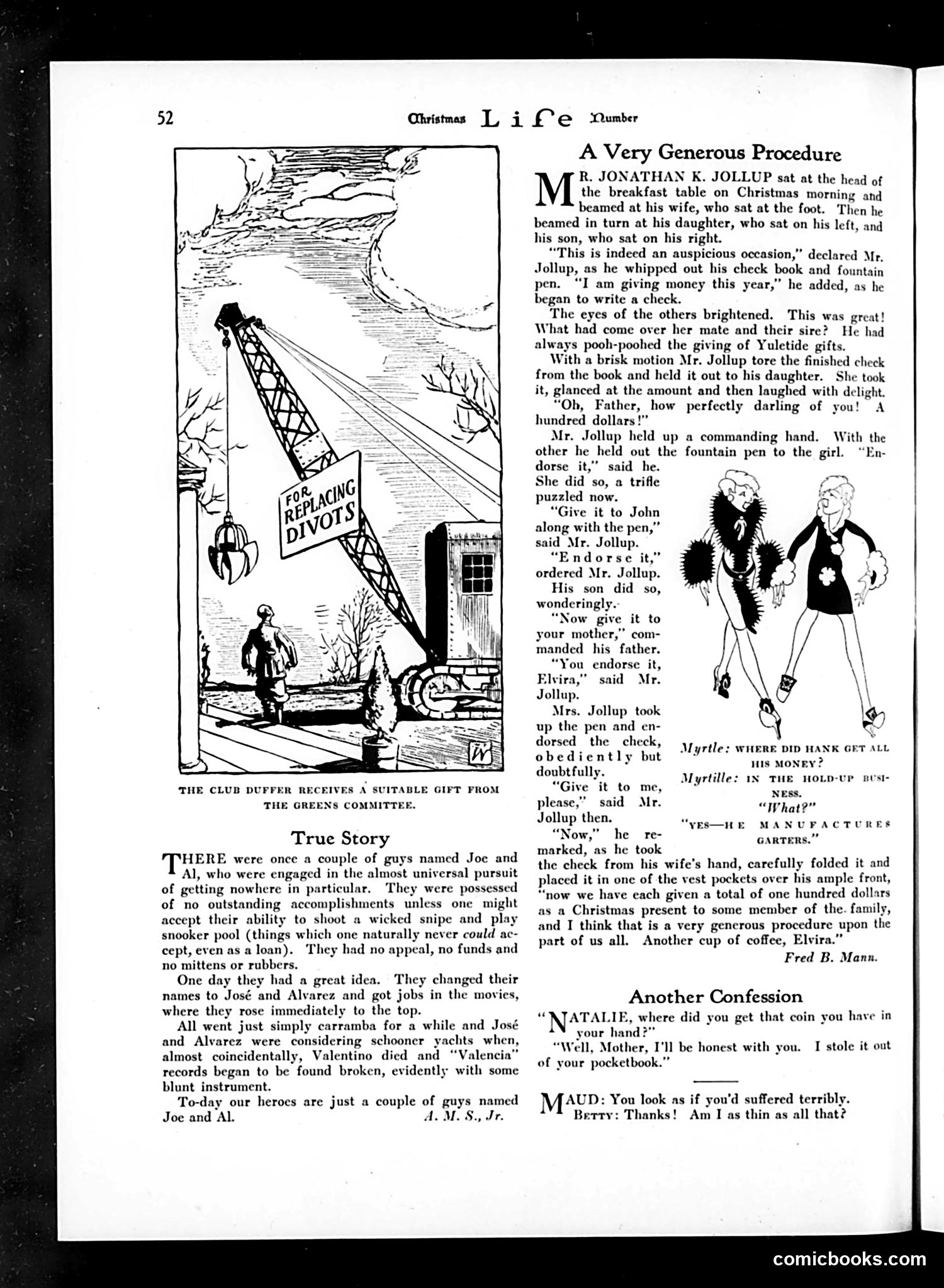
This satirical piece mocks stingy, penny-pinching fathers disguising selfishness as generosity. Mr. Jollup announces he's finally giving money for Christmas—breaking his usual habit of scorning gifts. However, the joke is revealed: he writes a single check, then has each family member endorse it as it passes around the table. When it returns to him, he pockets it, having technically allowed each person to "give" one hundred dollars while he keeps the money. The humor targets wealthy men who prioritize control and retaining their wealth while maintaining a facade of family generosity. The illustration showing Mr. Jollup standing triumphantly while endorsing the check drives home the con. It's a commentary on Depression-era financial stinginess masked by false magnanimity—a hollow Christmas gesture that leaves everyone worse off.
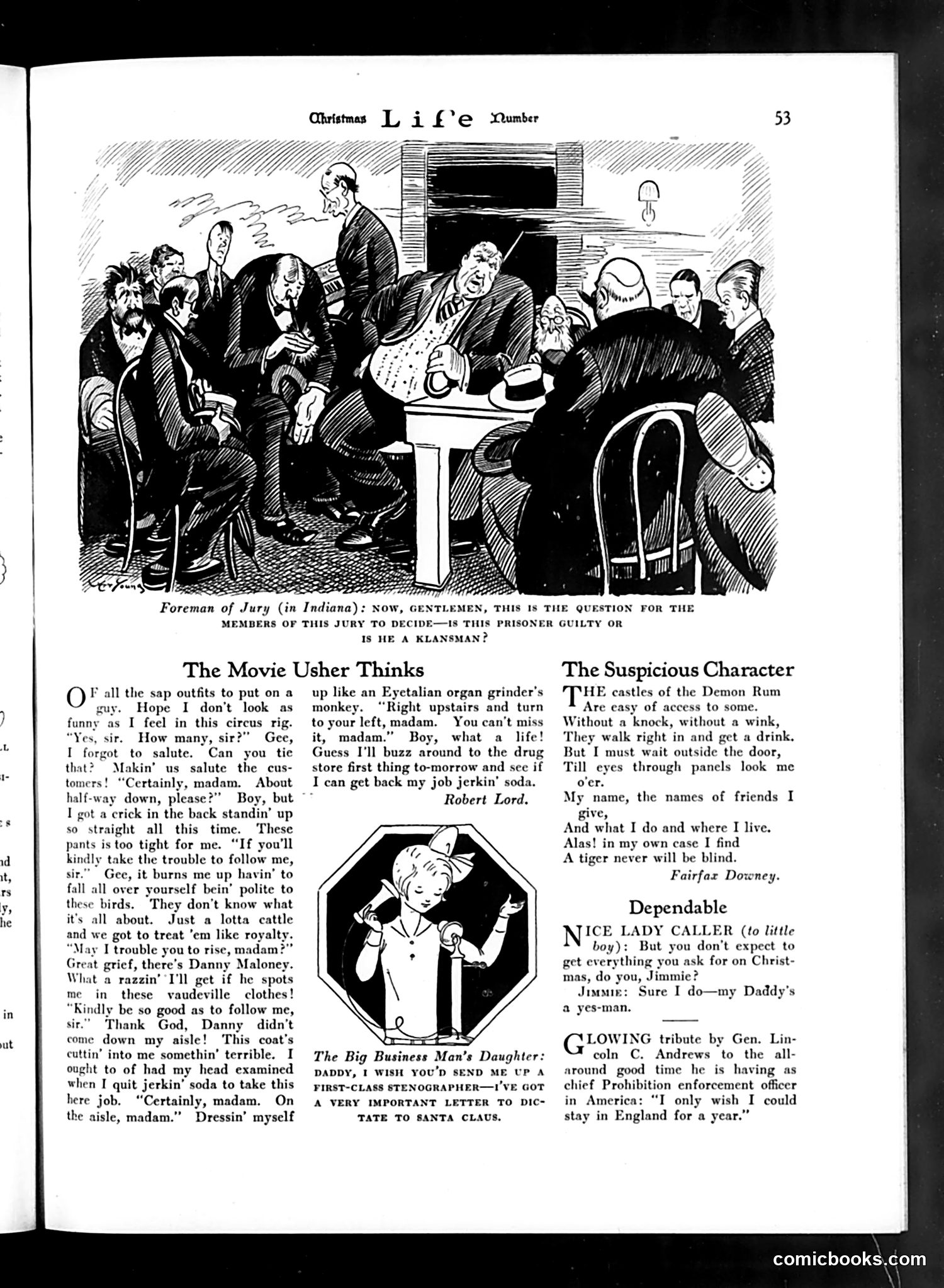
The main cartoon depicts a jury foreman in Indiana posing an extraordinary question: whether the prisoner is guilty OR a Klansman—implying these are the only two relevant categories. This satirizes the Ku Klux Klan's pervasive influence in 1920s Indiana, where the organization wielded such political power that Klan membership apparently superseded guilt or innocence in judicial proceedings. The accompanying humor pieces mock contemporary social issues: a movie usher resents his servile uniform; a businessman's daughter writes Santa as though to a subordinate; Prohibition enforcement officers' hypocrisy is mocked (the chief wants to escape to England); and a child's definition of a "yes-man" father reflects workplace conformity anxieties. The satire collectively critiques Klan infiltration of institutions, class pretension, corporate culture, and Prohibition's selective enforcement.
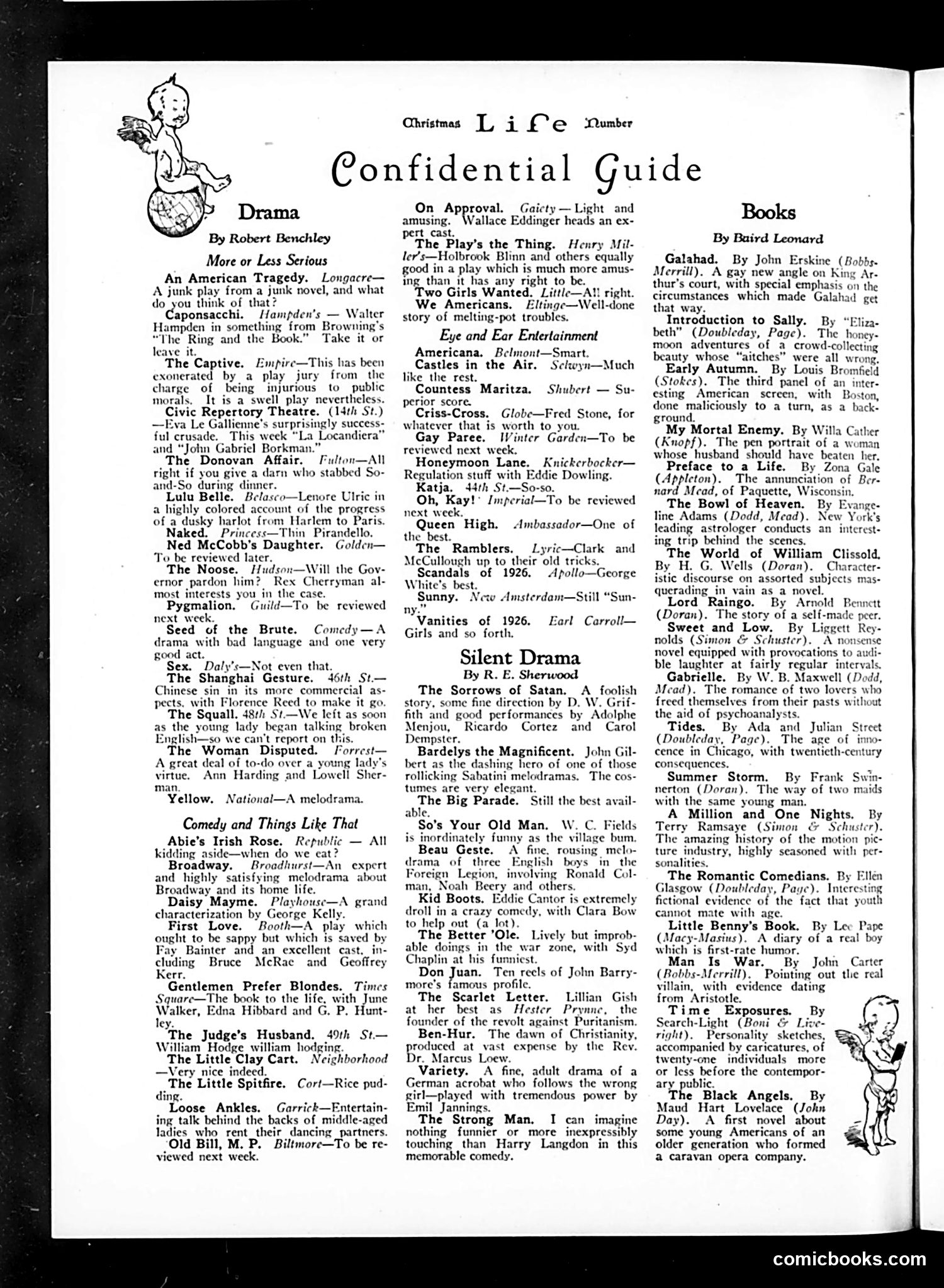
This is a "Confidential Guide" to Christmas-season entertainment—essentially a theater and film review column, not a political cartoon page. The two decorative illustrations (a baby figure at top left and another cherub at bottom right) are merely ornamental flourishes typical of *Life* magazine's design, not satirical commentary. The content consists of: - **Drama reviews** by Robert Benchley, assessing Broadway plays with characteristic wit ("An American Tragedy...a junk play from a junk novel") - **Books reviews** by Baird Leonard, discussing contemporary novels - **Entertainment listings** covering musicals and revues - **Silent film reviews** by R.E. Sherwood The satire is gentle and embedded within Benchley's review prose—dry observations about plays' quality—rather than visual. This is primarily reference material for readers deciding what entertainment to attend during the holiday season.
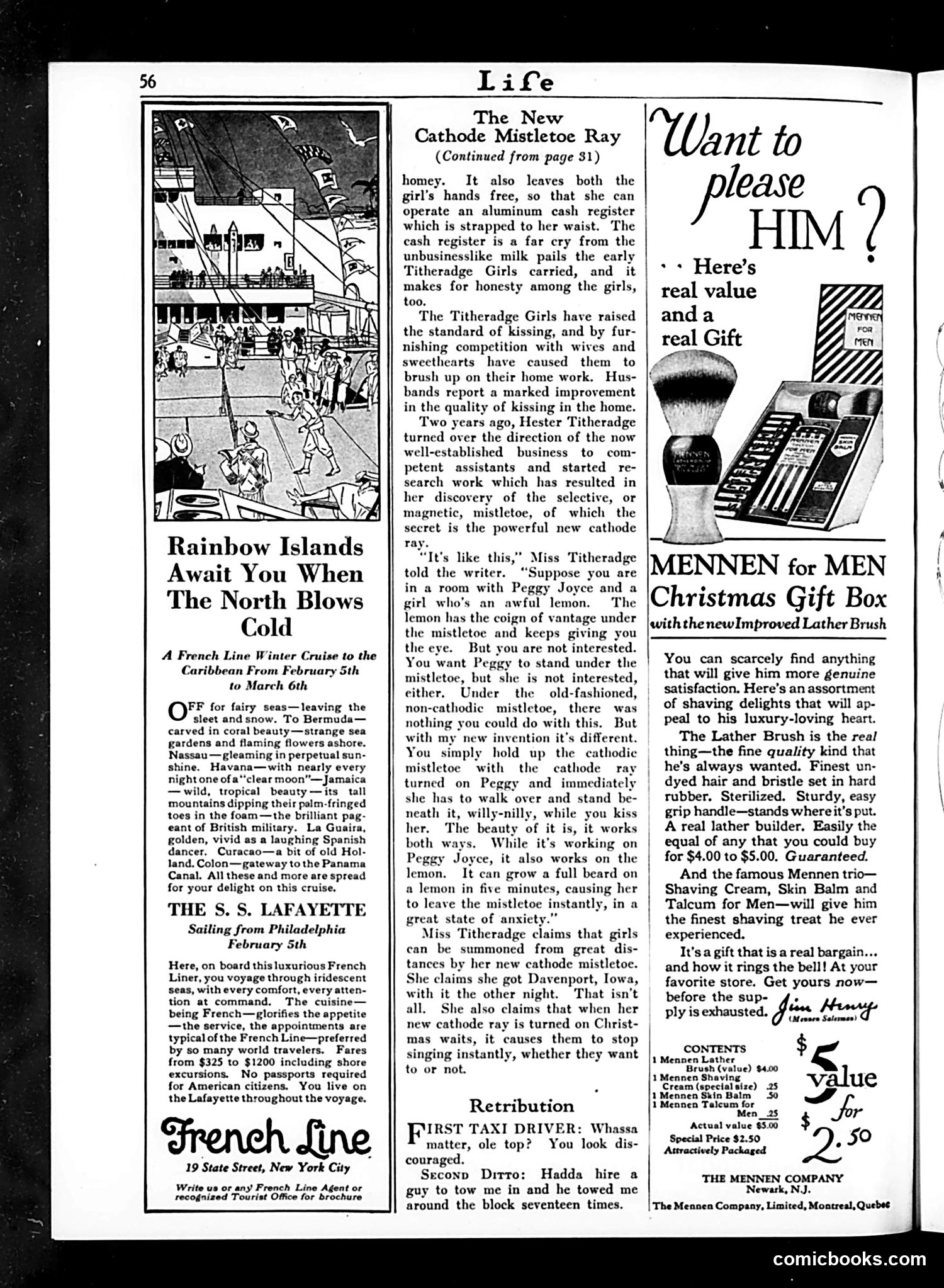
This page from *Life* magazine contains two distinct pieces: **Left side:** A cruise advertisement for the French Line's S.S. Lafayette, promoting a Caribbean winter voyage from Philadelphia (February 5–March 6). It emphasizes luxury, French cuisine, and exotic destinations (Bermuda, Nassau, Havana, Jamaica, Panama Canal). This is straightforward travel marketing with no satirical content. **Right side:** A humorous fiction piece titled "The New Cathode Mistletoe Ray" satirizing both technology and dating/romance conventions of the era. It describes an absurd invention by "Hester Titheradge" that uses a "cathode ray" to magnetically force women to stand under mistletoe for kisses—compellingly addressing men's romantic desires while repelling unattractive women. The satire mocks pseudo-scientific solutions to social awkwardness and the era's problematic attitudes toward consent. The brief joke at the bottom about a taxi driver being towed in circles is unrelated humor filler.
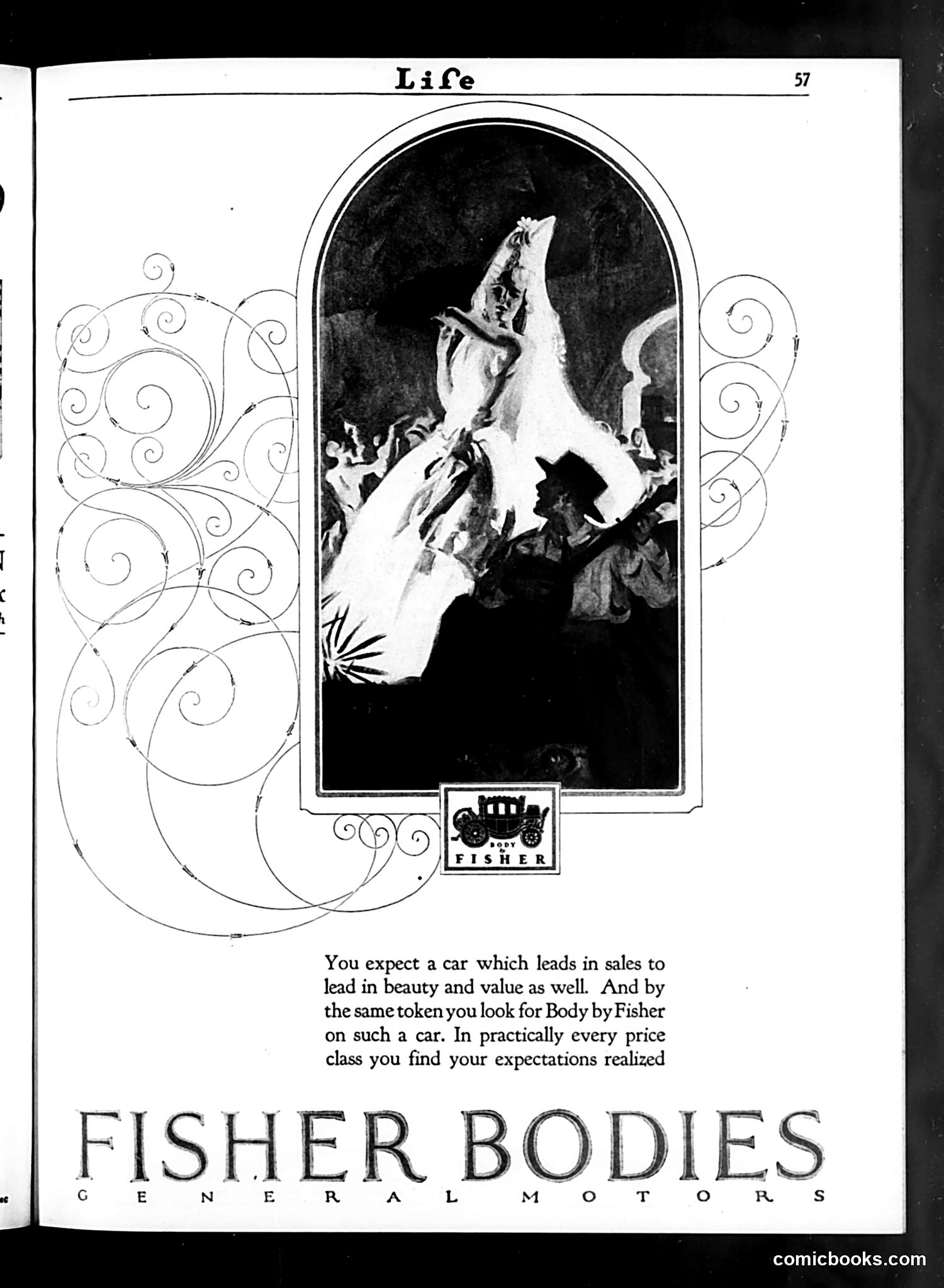
This is **advertising copy, not satire or political commentary**. The page features a Fisher Body advertisement for General Motors automobiles. The image shows an elegantly dressed woman in an arched, decorative frame—typical Art Deco styling of the era. The tagline argues that market leadership in sales correlates with leadership in beauty and design quality. "Body by Fisher" was Fisher Body Company's famous branding promise, emphasizing that their car bodies were superior in craftsmanship and aesthetic appeal across all price points. This was a genuine marketing appeal to consumers during the early-to-mid 20th century, when Fisher Bodies were considered a mark of quality automotive construction. There is no political satire or social commentary present—this is straightforward commercial advertising from *Life* magazine's paid content.
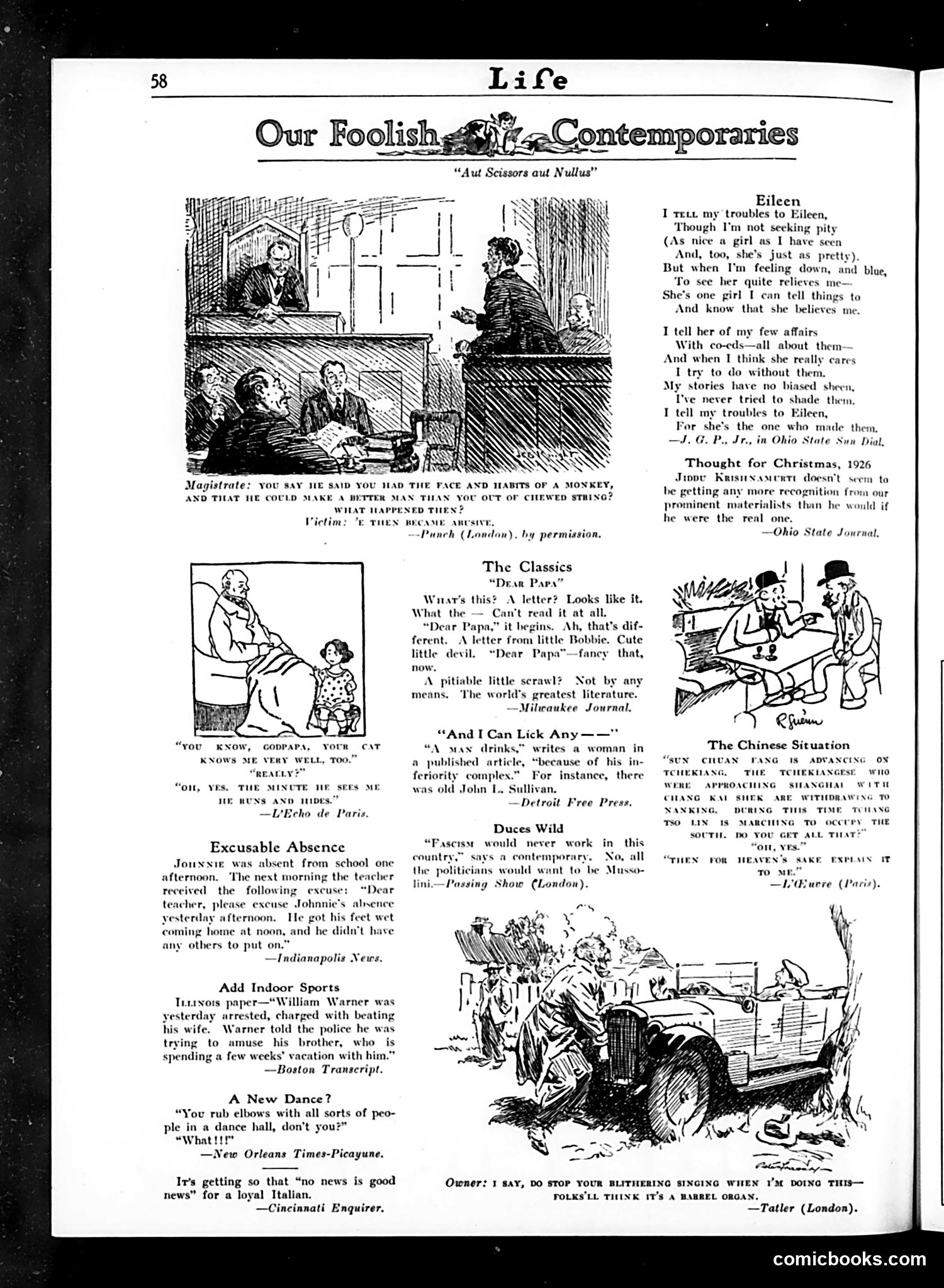
This 1926 *Life* page collects brief humorous anecdotes and cartoons mocking contemporary social behavior and politics. **Key sections:** - **"Eileen"**: A poem about a college student confessing troubles to a sympathetic girl—the punchline being she's the actual cause of his problems. - **"Dear Papa"**: Celebrates a child's letter as profound literature, satirizing sentimentality about childhood innocence. - **"And I Can Lick Any——"**: Mocks inferiority complexes, referencing boxer John L. Sullivan as an example of masculine bravado. - **"The Chinese Situation"**: References real 1926 Chinese political turmoil (Sun Chuanfang vs. Chang Kai-shek forces near Shanghai/Nanking), satirizing the West's confusion about Asian affairs. - **"Duces Wild"**: Criticizes fascism, suggesting all politicians want to be Mussolini—timely given Mussolini's recent consolidation of power. Other items mock domestic absurdities: wives beating husbands "as a joke," absent schoolchildren, and a singing car owner. The humor targets pretension, political instability, and everyday foolishness.
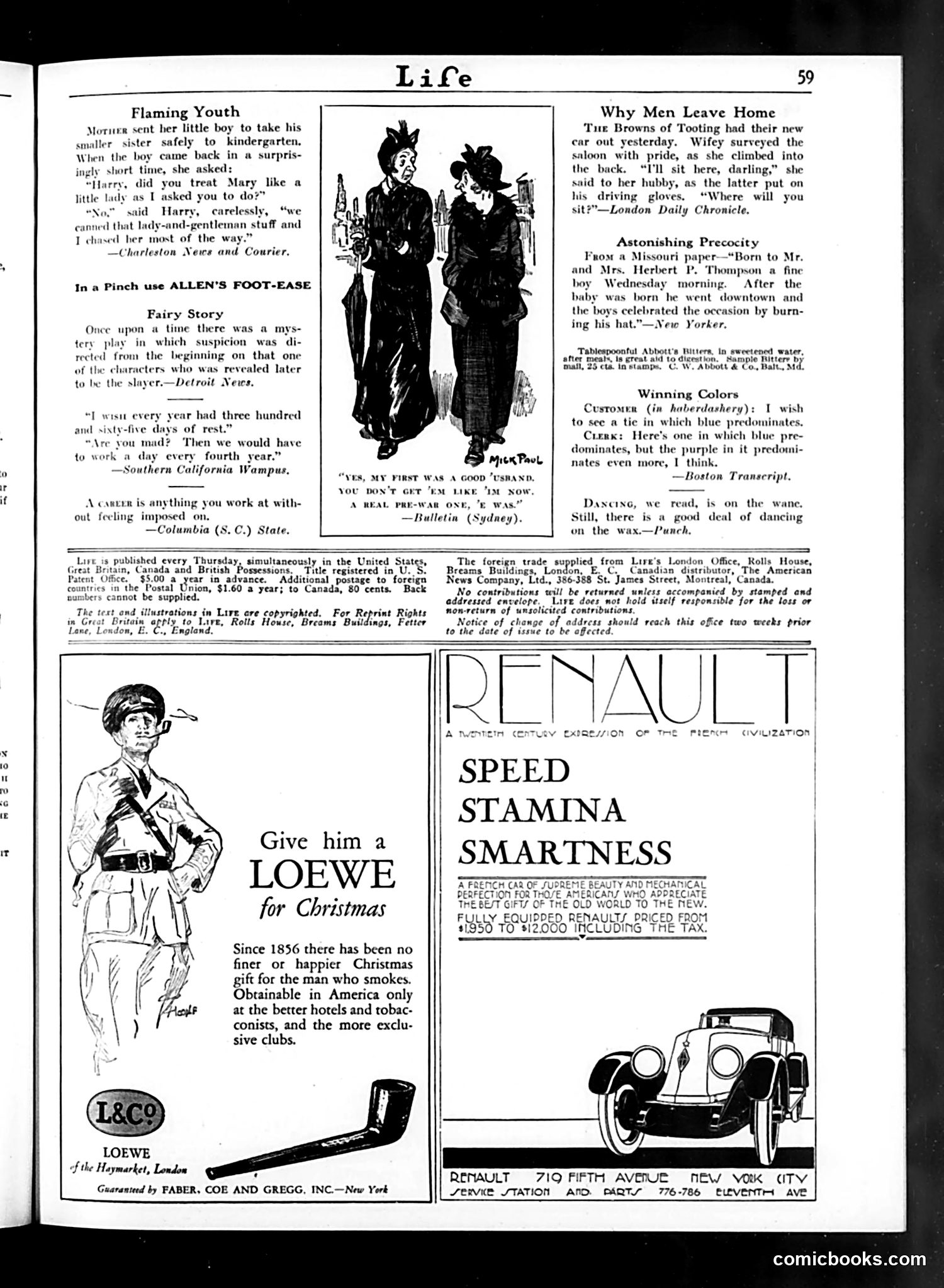
This page contains primarily **humor columns and advertisements** from an early 20th-century satirical magazine. The main satirical content includes short jokes about contemporary social changes: - **"Flaming Youth"** mocks modern children's informality, showing a boy telling his mother he abandoned polite "lady-and-gentleman" behavior with his sister and instead "chased her" — satirizing the perceived decline of Victorian propriety among youth. - **"Why Men Leave Home"** jokes about a wife's obsession with a new car, positioning herself in back while relegating her husband to driving — poking fun at changing gender dynamics and consumerism. - Various one-liners satirize modern attitudes toward work, romance, and fashion. The page is dominated by **period advertisements** for luxury goods (LOEWE cigars, Renault automobiles, Abbott's bitters), targeting affluent readers. The "Flaming Youth" reference reflects contemporary anxiety about post-WWI generational shifts toward more casual social behavior — a recurring theme in 1920s satire.
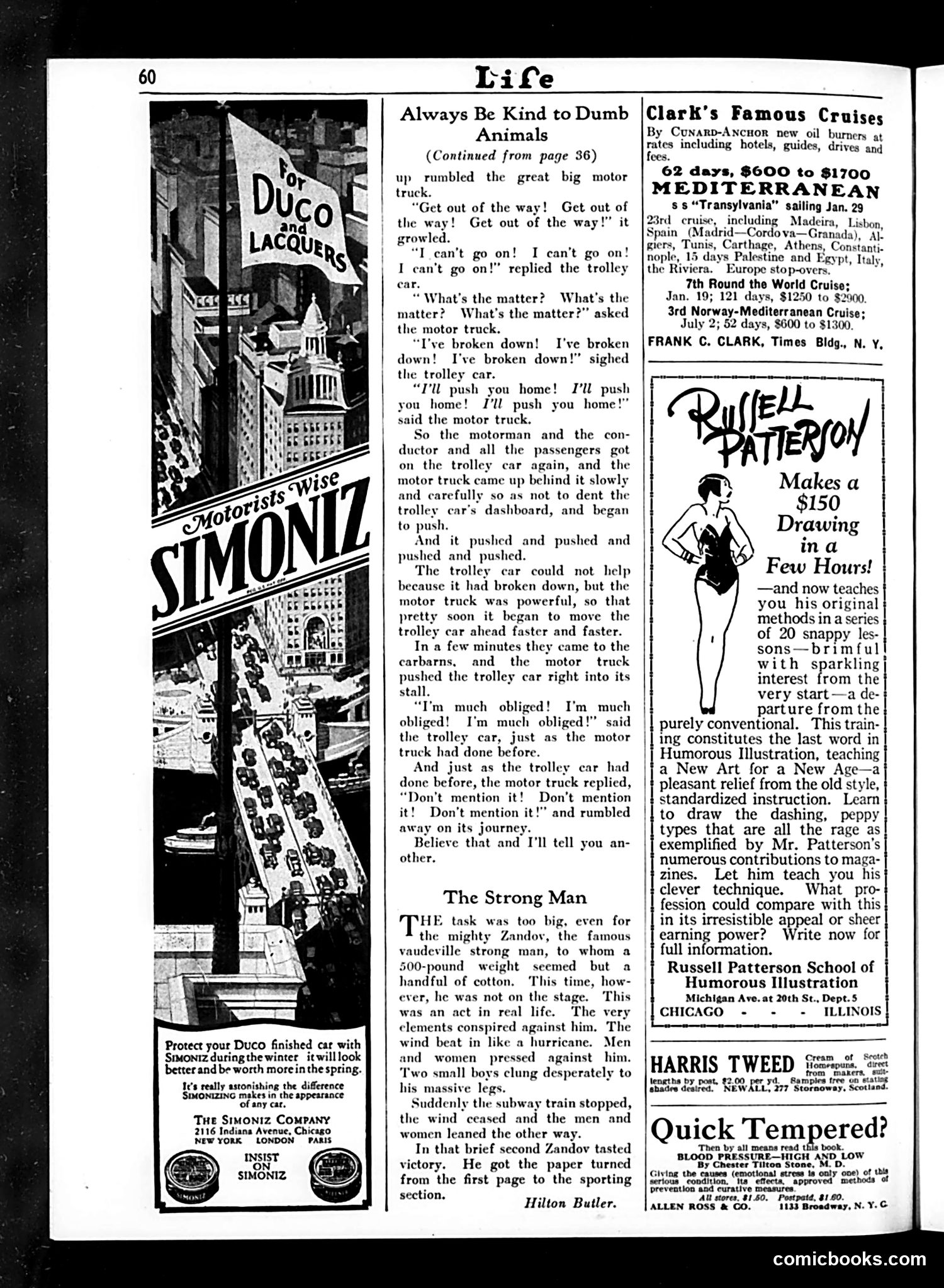
This page contains two satirical stories and advertisements typical of *Life* magazine's humor. **"Always Be Kind to Dumb Animals"** is a genteel fable mocking sentimental anthropomorphism. A broken-down trolley car and powerful motor truck exchange overly polite dialogue ("I'm much obliged!"). The joke satirizes the forced sweetness of children's moral tales by applying saccharine courtesy to inanimate objects—the absurdity exposes how such stories strain credibility with their relentless niceness. **"The Strong Man"** ridicules masculine vanity. Famous vaudeville strongman Zandov performs feats of tremendous physical power on stage, but in real life faces an embarrassingly trivial challenge: turning a newspaper from front page to sports section while crowds push against him and children cling to his legs. When the crowd finally yields, he achieves victory—but it's utterly mundane. The satire undercuts macho performance by showing that real-world obstacles mock theatrical strength. Both stories exemplify *Life*'s sardonic humor deflating pretense and false sentimentality.
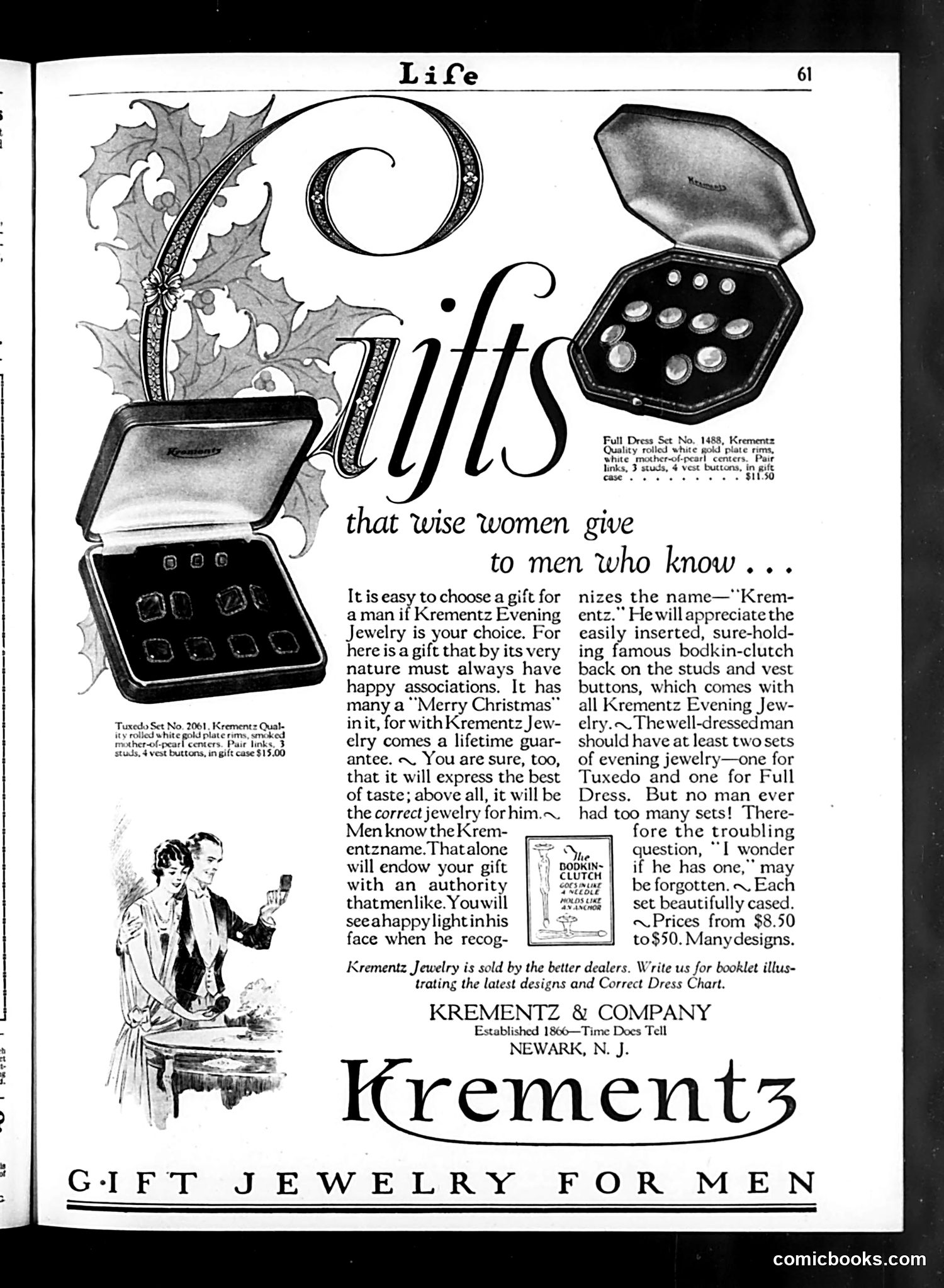
This is an advertisement for Krementz & Company jewelry, not political satire. The page promotes evening wear cufflinks and studs marketed as gifts from women to men. The decorative header illustration shows an elegant woman presenting jewelry to a man, establishing the gift-giving narrative. The text employs a patronizing tone typical of early 20th-century advertising: women are positioned as gift-givers seeking male approval, while men are portrayed as knowledgeable judges of taste and quality. The "satire" here is social rather than political—it gently mocks the pretension of gift-giving etiquette and men's supposed expertise. The line "no man ever had too many sets!" humorously addresses consumer anxiety while encouraging multiple purchases. The appeal relies on period concepts of masculinity (formal dress codes, sophisticated taste) and gender roles (women as purchasers seeking to impress men). To modern readers, the condescending framing of women's agency appears dated rather than amusing.
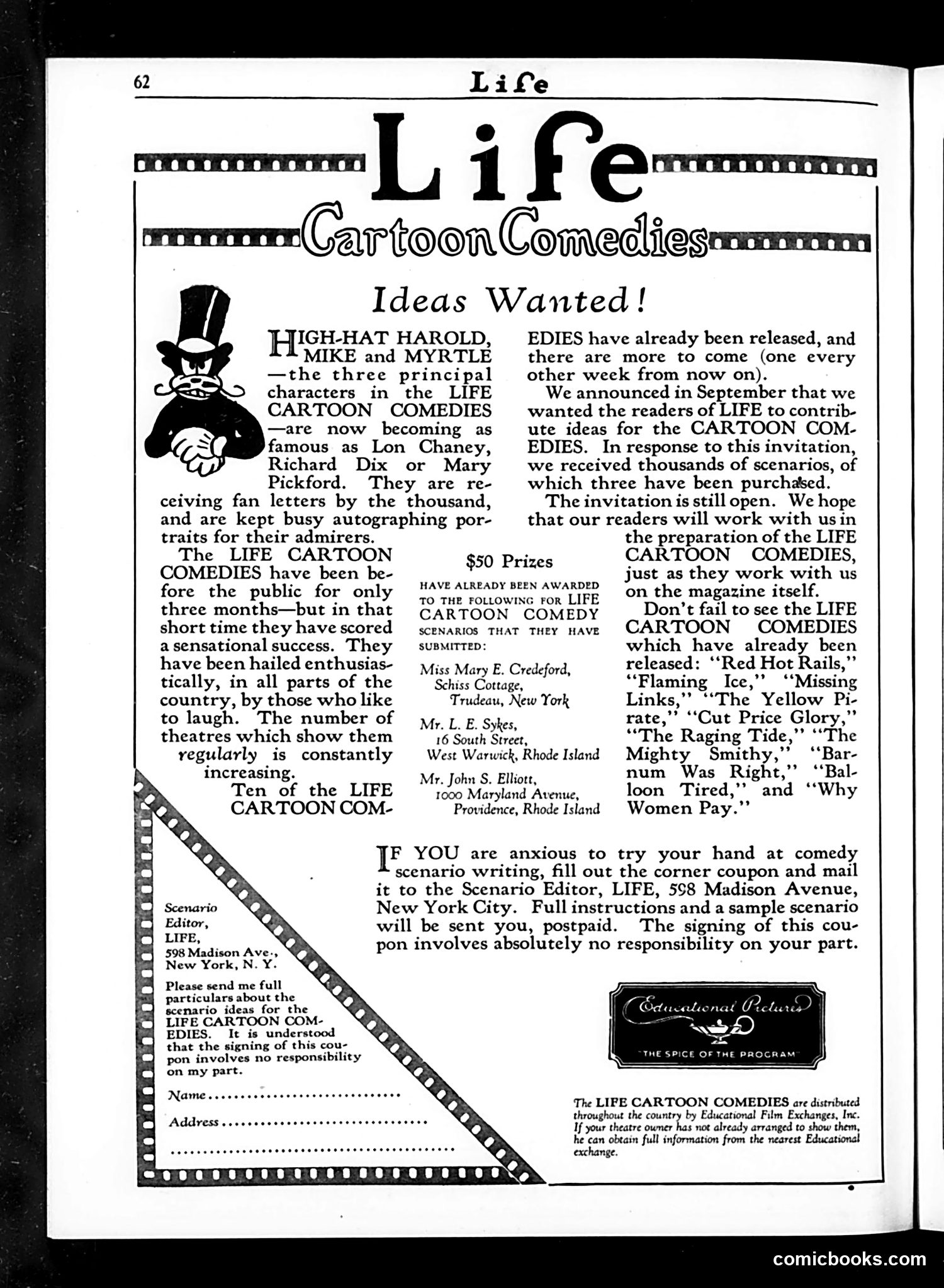
This page announces **Life magazine's film cartoon series** featuring three characters—High-Hat Harold, Mike, and Myrtle—who have become popular with audiences. The cartoons, distributed by Educational Film Exchanges, include titles like "Red Hot Rails" and "Flaming Ice." Life is soliciting **scenario ideas from readers**, offering $50 prizes for accepted scripts. Three scenarios have already been purchased from among thousands submitted. The appeal emphasizes that these short cartoons have achieved "sensational success" in theaters nationwide within just three months. The page includes a coupon for interested amateur writers to request submission guidelines. **Context for modern readers**: This reflects the 1920s silent film era when short comedies preceded feature films. Life magazine was actively monetizing its popular culture brand by crowdsourcing creative content—an early precedent for modern crowdsourcing and user-generated content campaigns.
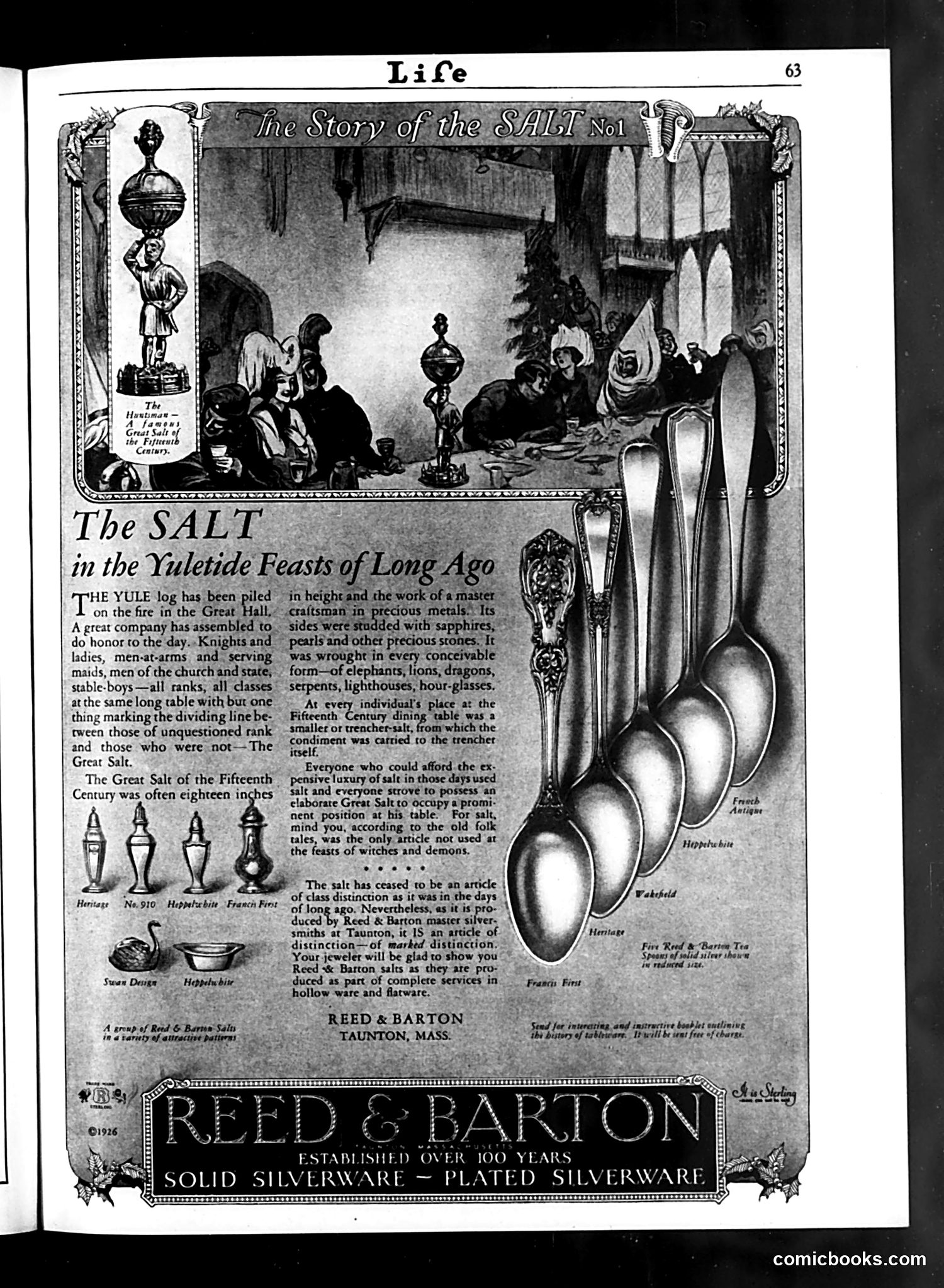
This is primarily a **product advertisement** for Reed & Barton silverware, not political satire. The page uses historical narrative framing rather than cartoon humor. The "content" is an educational piece titled "The Story of the SALT" that explains the historical significance of salt cellars in medieval banquets. The accompanying illustration depicts a 15th-century Yuletide feast where a large decorative salt cellar served as a class marker—positioned to divide nobility from commoners at the table. The advertisement leverages this history to market modern Reed & Barton salt cellars and silverware sets as luxury items of "marked distinction." The ornate spoons pictured (labeled French Antique, Hippodrome, Wakefield, and First Knot) connect contemporary products to that historical prestige. The subtle appeal: buying their silverware grants modern consumers the same social status once conferred by possessing fine salt in the medieval period. It's aspirational marketing dressed as cultural education, with no political or satirical commentary present.
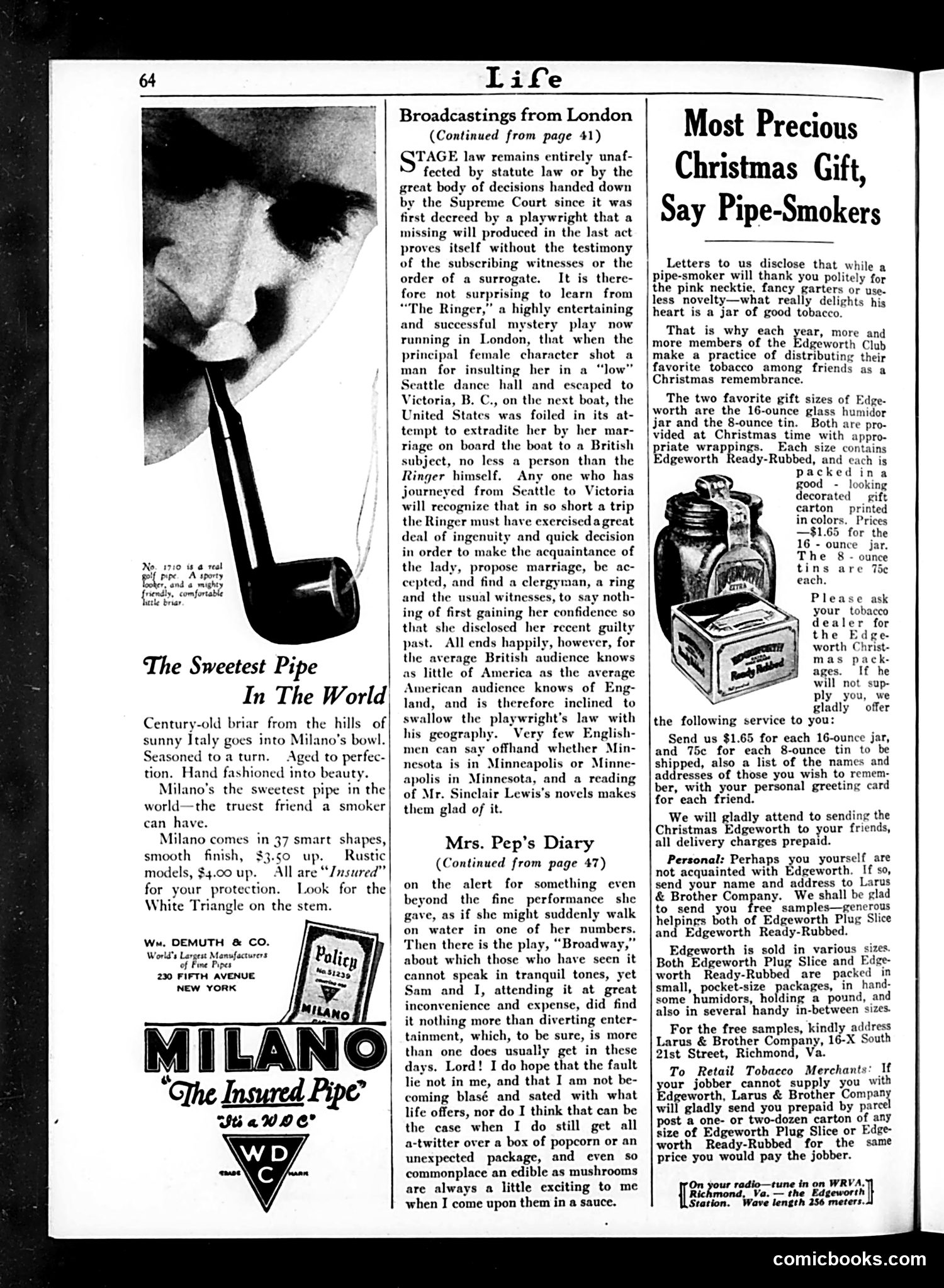
This page combines literary commentary with tobacco advertising, typical of 1920s Life magazine content. **Left side:** A Milano pipe advertisement emphasizes the product as "the sweetest pipe in the world"—a century-old Italian briar pipe positioned as a luxury good for discerning smokers. The design shows the pipe's silhouette and brand mark. **Center:** A theater review discusses "The Ringer," a London mystery play featuring an implausible plot where a woman escapes U.S. extradition by marrying a British subject aboard ship. The critic gently mocks both the play's absurd legal premise and British audiences' ignorance of American geography, noting they can't distinguish Minneapolis from Minnesota—a jab at transatlantic cultural gaps. **Right side:** An Edgeworth tobacco advertisement frames pipe tobacco as the "most precious Christmas gift" for smokers, claiming letters prove recipients prefer quality tobacco over conventional gifts like neckties or garters. The ad offers mail-order service with personalized greeting cards. The page exemplifies how advertising and editorial content intertwined in early 20th-century magazines, while satirizing both theatrical conventions and consumer culture.
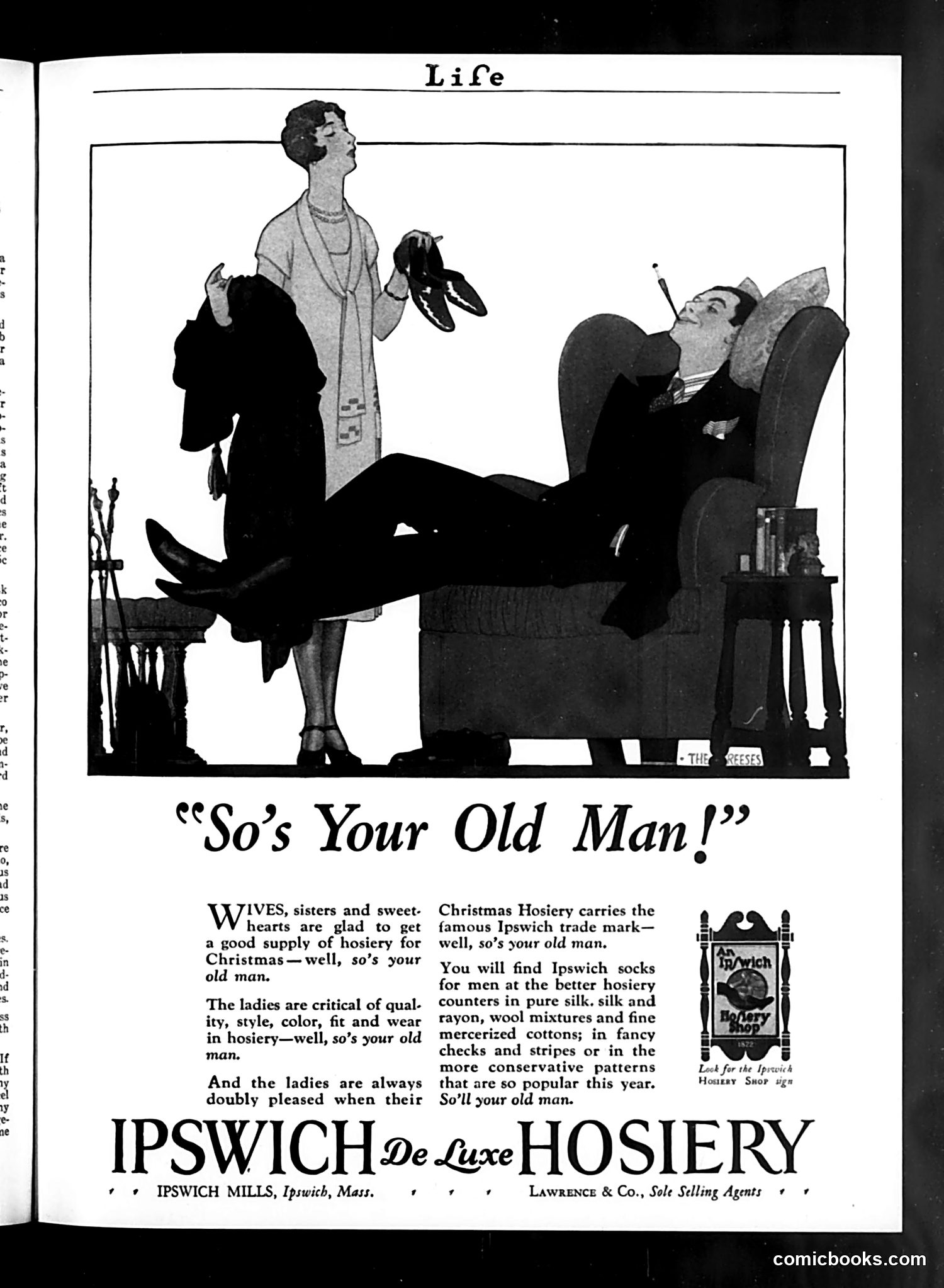
This is primarily a **commercial advertisement**, not political satire. It promotes Ipswich De Luxe Hosiery for a Christmas gift market. The illustration depicts a domestic scene: a man lounges contentedly in an armchair while a woman stands nearby holding socks. The caption "So's Your Old Man!" uses period slang suggesting "that's what your husband thinks too." The ad's humor relies on the gendered assumption that women choose gifts while men passively benefit. It appeals to wives, sisters, and sweethearts as gift-buyers, then cleverly suggests that men actually care deeply about hosiery quality—they're as discerning as women about style, fit, and color. The message: Ipswich hosiery pleases both the female shopper (quality-conscious) and the male recipient (who secretly appreciates good socks). The repeated phrase "so's your old man" reinforces that men appreciate fine hosiery as much as women do, making it an ideal gift choice.
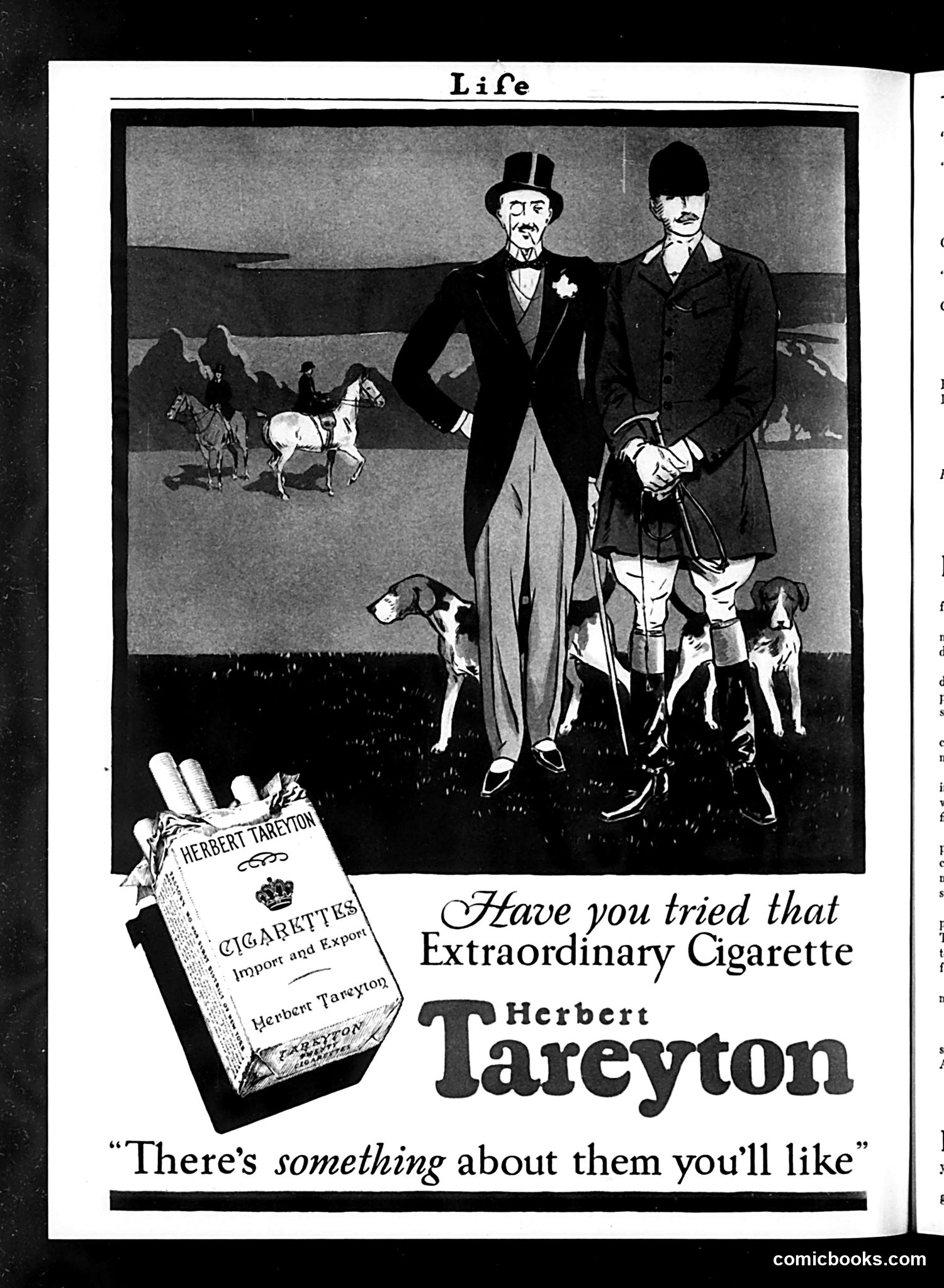
This is a cigarette advertisement disguised as satirical content. The page shows two well-dressed gentlemen in formal attire (top hats and coats) with hunting dogs and horses in the background—imagery suggesting upper-class leisure and sporting pursuits. The ad promotes Herbert Tareyton cigarettes as an "Extraordinary Cigarette," using the tagline "There's something about them you'll like." The cigarette package is displayed prominently at lower left. The satire appears mild: the gentlemen's exaggerated formal dress and the incongruity of refined aristocratic imagery paired with a commercial product pitch may be the intended humor. However, this is fundamentally an advertisement rather than political commentary. The "Life" magazine format lent credibility to product endorsements during this era.
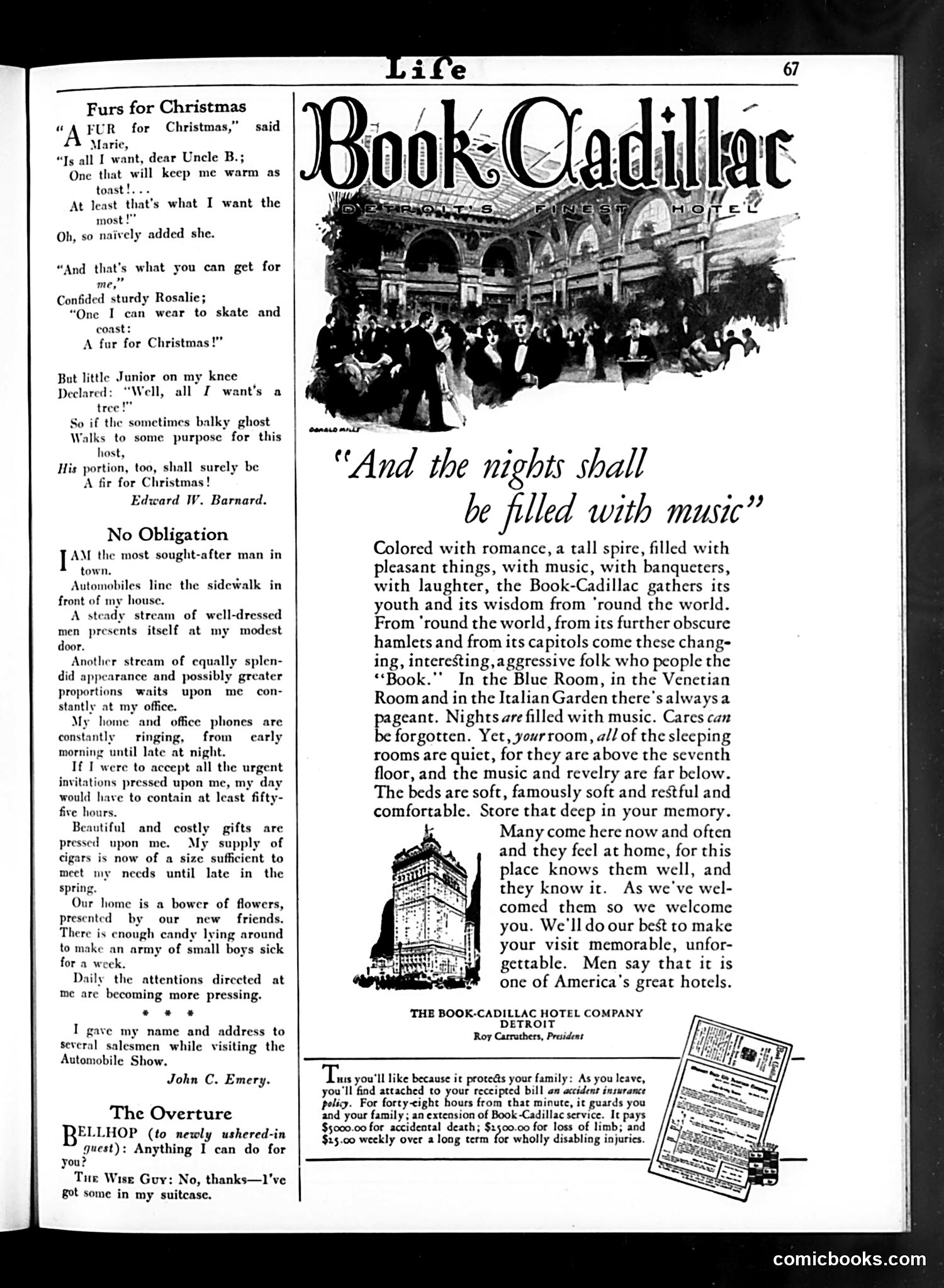
This page contains three separate pieces of satirical content: **"Furs for Christmas"** (poem): A gentle satire on materialism and gender expectations. Female relatives request luxury furs as Christmas gifts, while "little Junior" asks for a tree—establishing him as more innocent/virtuous than the women focused on expensive fashion. **"No Obligation"** (prose humor): Satirizes the anxiety of unsolicited attention from salesmen. The narrator, having carelessly given his address at an auto show, is now besieged by aggressive sales visits, calls, and expensive gifts. The satire targets both pushy 1920s sales tactics and the social awkwardness of unwanted courtship-like attention from commercial agents. **Book-Cadillac Hotel advertisement**: Dominates the right side. A luxury Detroit hotel advertisement emphasizing romance, music, and comfort, with inserted humor at the bottom: a bellhop offers service, but the guest says he brought alcohol in his suitcase—likely satirizing Prohibition-era hotel culture where guests smuggled liquor. The page blends consumer culture satire with period-specific humor about sales pressure and Prohibition.
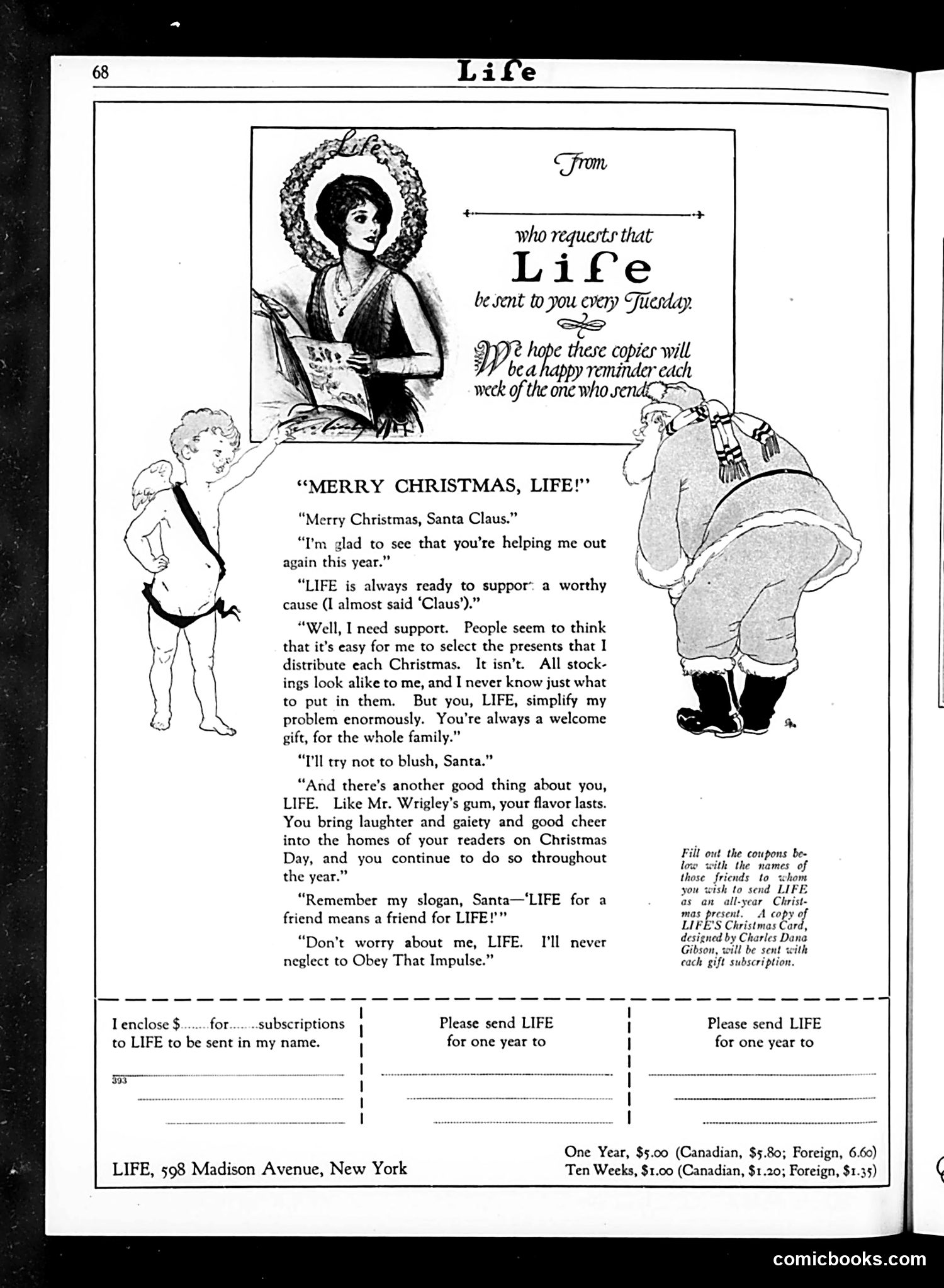
This is primarily a **gift subscription advertisement** disguised as seasonal humor. The "cartoon" features a dialogue between Santa Claus and the personified figure of *Life* magazine itself. **The Satire:** The page humorously positions *Life* magazine as Santa's essential helper—suggesting it solves his gift-giving problems by being universally appropriate for "the whole family." Santa praises the magazine for bringing "laughter and gaiety" year-round, comparing its lasting appeal to Wrigley's chewing gum (a contemporary brand reference). **The Sales Pitch:** The joke's real purpose is encouraging readers to give *Life* subscriptions as Christmas gifts. The coupon sections at bottom enable this. The tagline "LIFE for a friend means a friend for LIFE" is a play on words promoting the magazine's value. **Context for Modern Readers:** *Life* was a major American satirical weekly; gift subscriptions were common holiday presents. The ad assumes magazines were cherished family entertainment—a cultural practice largely obsolete today.
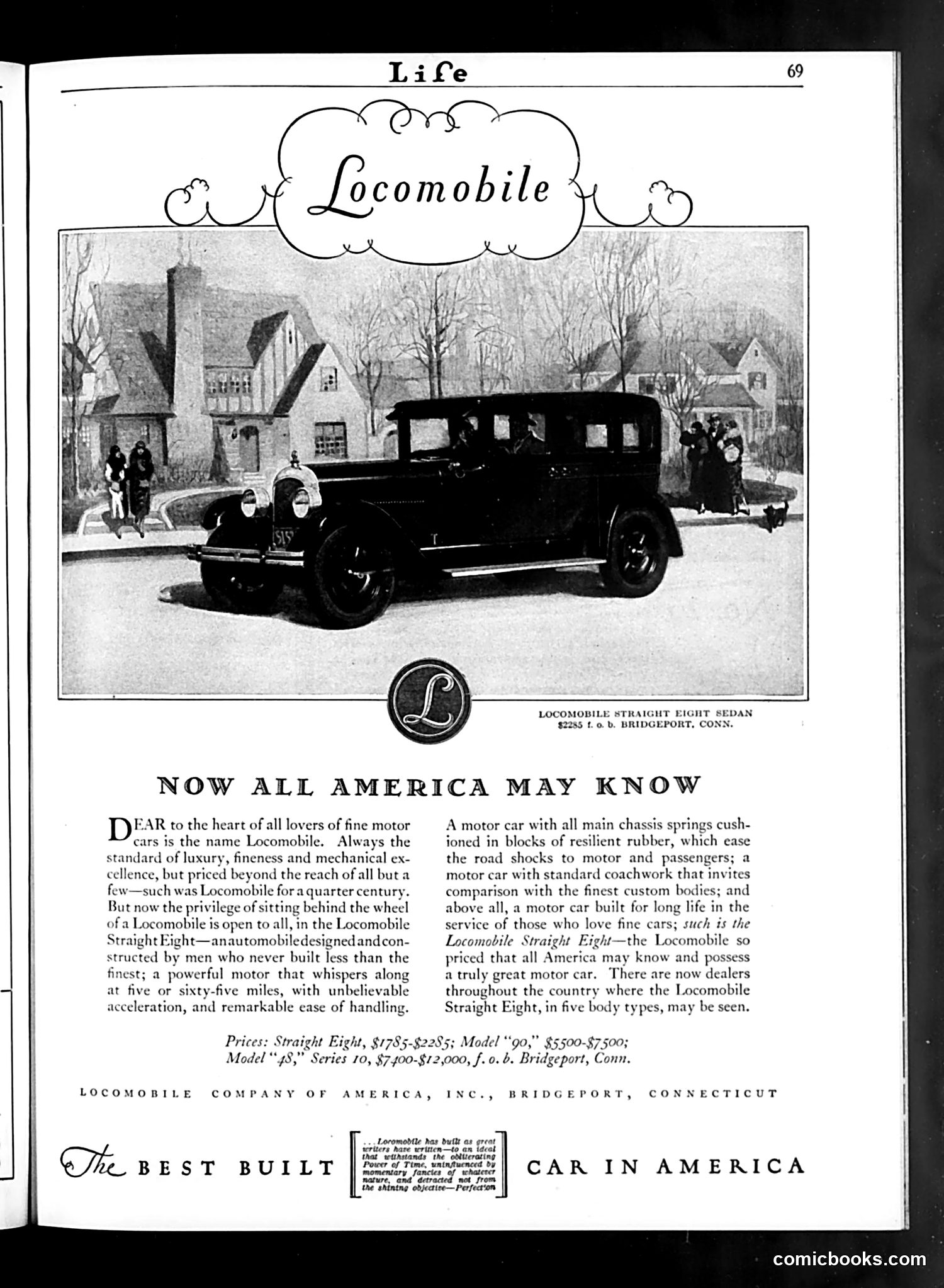
This is **not a cartoon or satire**, but rather a **automobile advertisement** for the Locomobile Straight Eight. The page appears in *Life* magazine's advertising section. The ad's rhetorical strategy is to democratize luxury: Locomobile had been "the standard of luxury...but priced beyond the reach of all but a few" for twenty-five years. Now, the company announces, they're offering the Straight Eight at lower prices ($1,785-$2,285), making fine automobiles accessible to ordinary Americans—"NOW ALL AMERICA MAY KNOW." The image shows the sedan parked in an idealized suburban street scene with period townhouses and pedestrians, emphasizing respectability and widespread availability. The copy emphasizes engineering quality, comfort features (rubber-cushioned springs), and reliability—appealing to middle-class buyers who wanted luxury without extravagance. The closing tagline, "The BEST BUILT CAR IN AMERICA," reinforces brand prestige. This reflects 1920s automotive marketing: democratizing previously elite products through industrial efficiency.
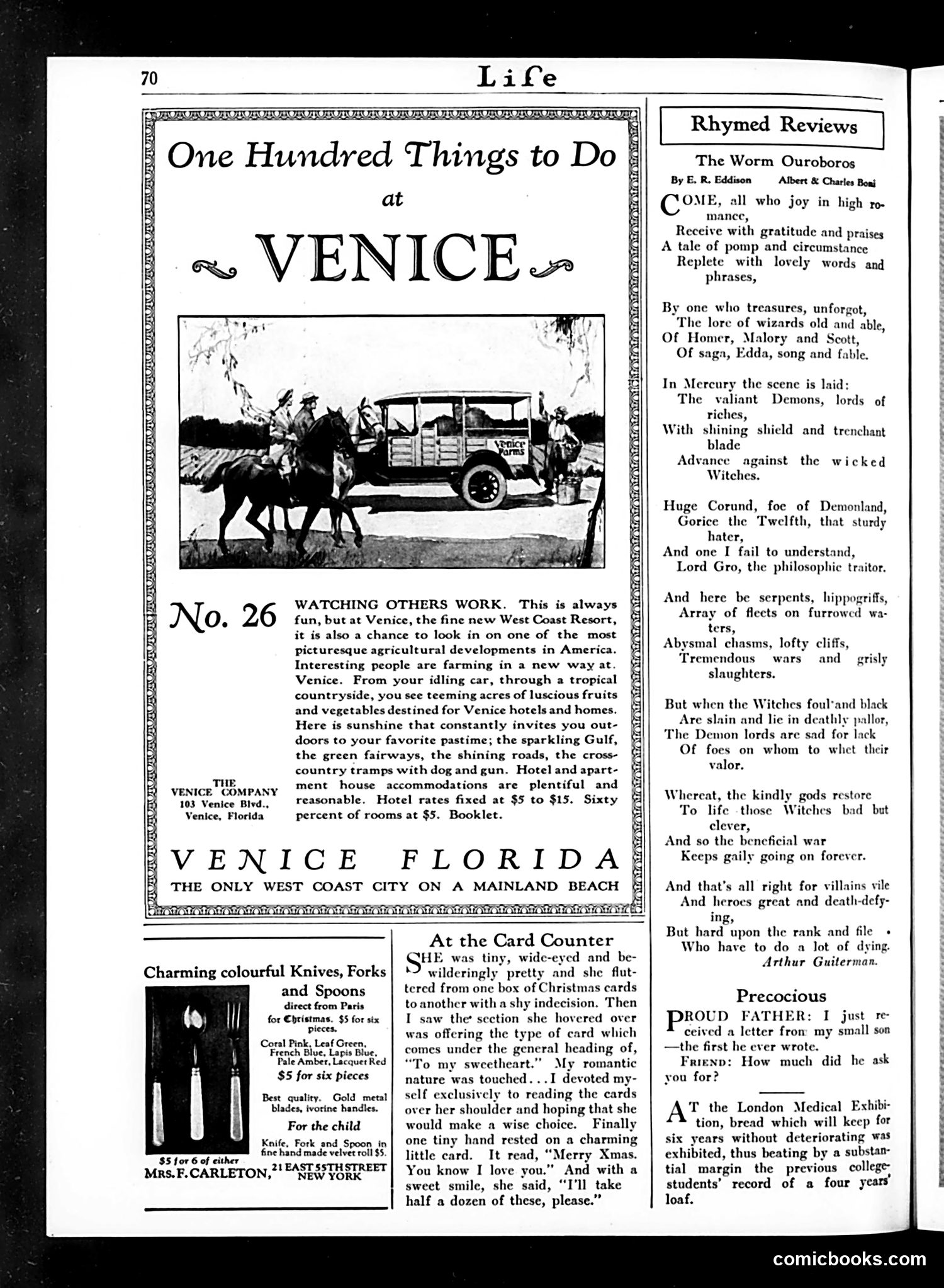
This page is primarily **advertising and light humor** rather than political satire. The main content is a Venice, Florida real-estate advertisement featuring a cartoon of tourists watching agricultural workers from a car—promoting the resort's "picturesque" farming as entertainment alongside golf and leisure. The "Rhymed Reviews" section offers a humorous poem about *The Worm Ouroboros*, a fantasy novel, mocking its overwrought medieval fantasy tropes (demons, witches, epic battles) before the final joke: soldiers and common folk doing the actual dying while heroes enjoy eternal conflict. "At the Card Counter" is a gentle humor piece about a shy woman buying Christmas cards—the mild joke being she buys multiple copies of a romantic "I love you" card, suggesting either insecurity or insincerity. "Precocious" is a one-liner joke: a proud father receives his son's first letter, assumes it's heartfelt, but the friend cynically predicts it's actually a money request—a common child behavior joke. The page reflects 1920s consumer culture, literary tastes, and domestic humor rather than political commentary.
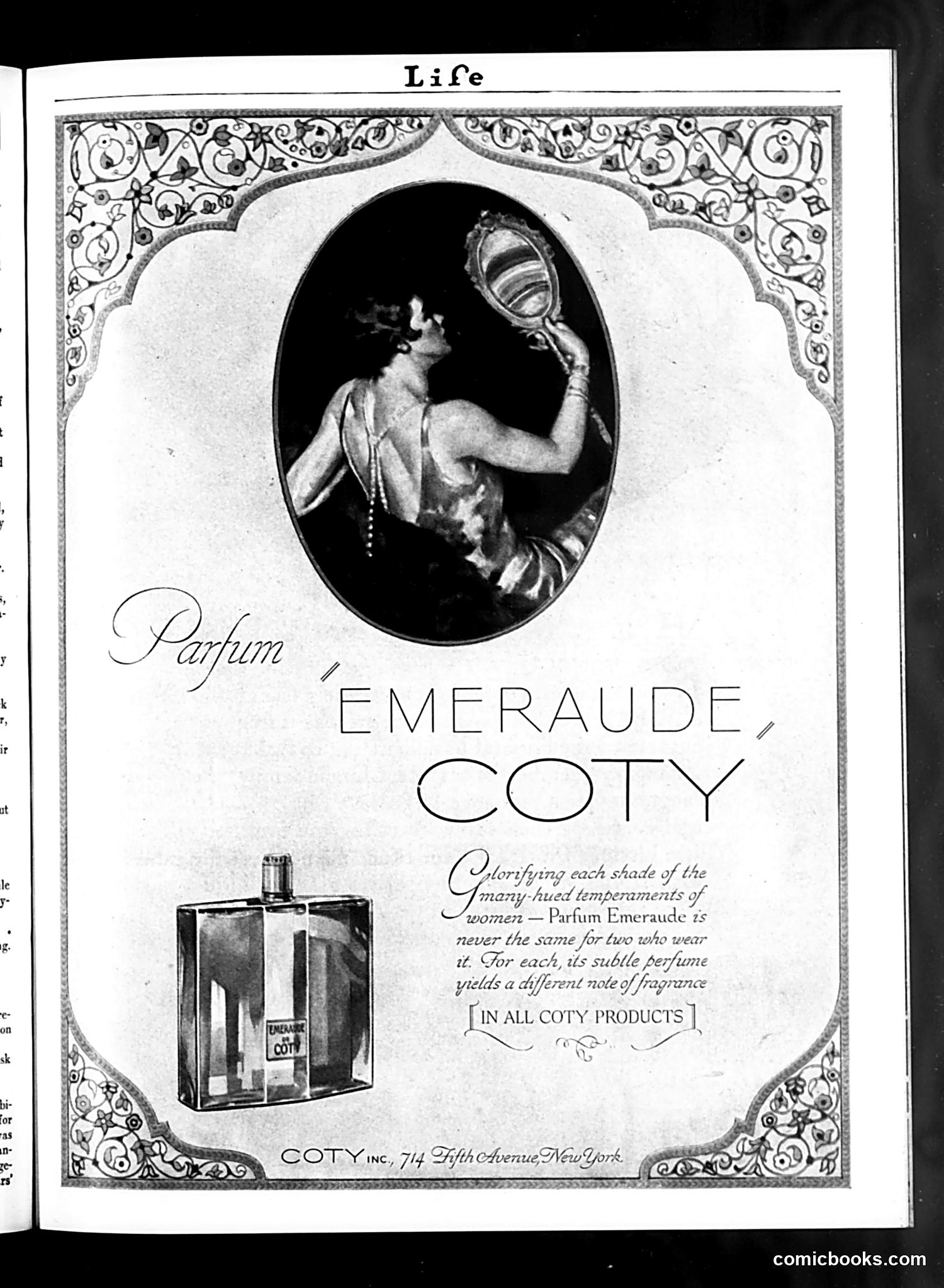
This is **not a political cartoon or satire** — it's a **perfume advertisement** for Coty Inc., a cosmetics company located at 714 Fifth Avenue in New York. The page shows a classical-style illustration of a woman admiring herself in a hand mirror, promoting "Parfum Emeraude." The ad's copywriting claims the perfume interacts differently with each wearer's individual chemistry, so "never the same for two who wear it." This represents early 20th-century luxury marketing: the ornate decorative border, the classical imagery, and the poetic language about feminine individuality were typical advertising conventions of the era. The appeal is to women's vanity and desire for personal distinction through fragrance. There is **no satire or political commentary** present on this page — it's straightforward commercial advertising from *Life* magazine's advertising section.
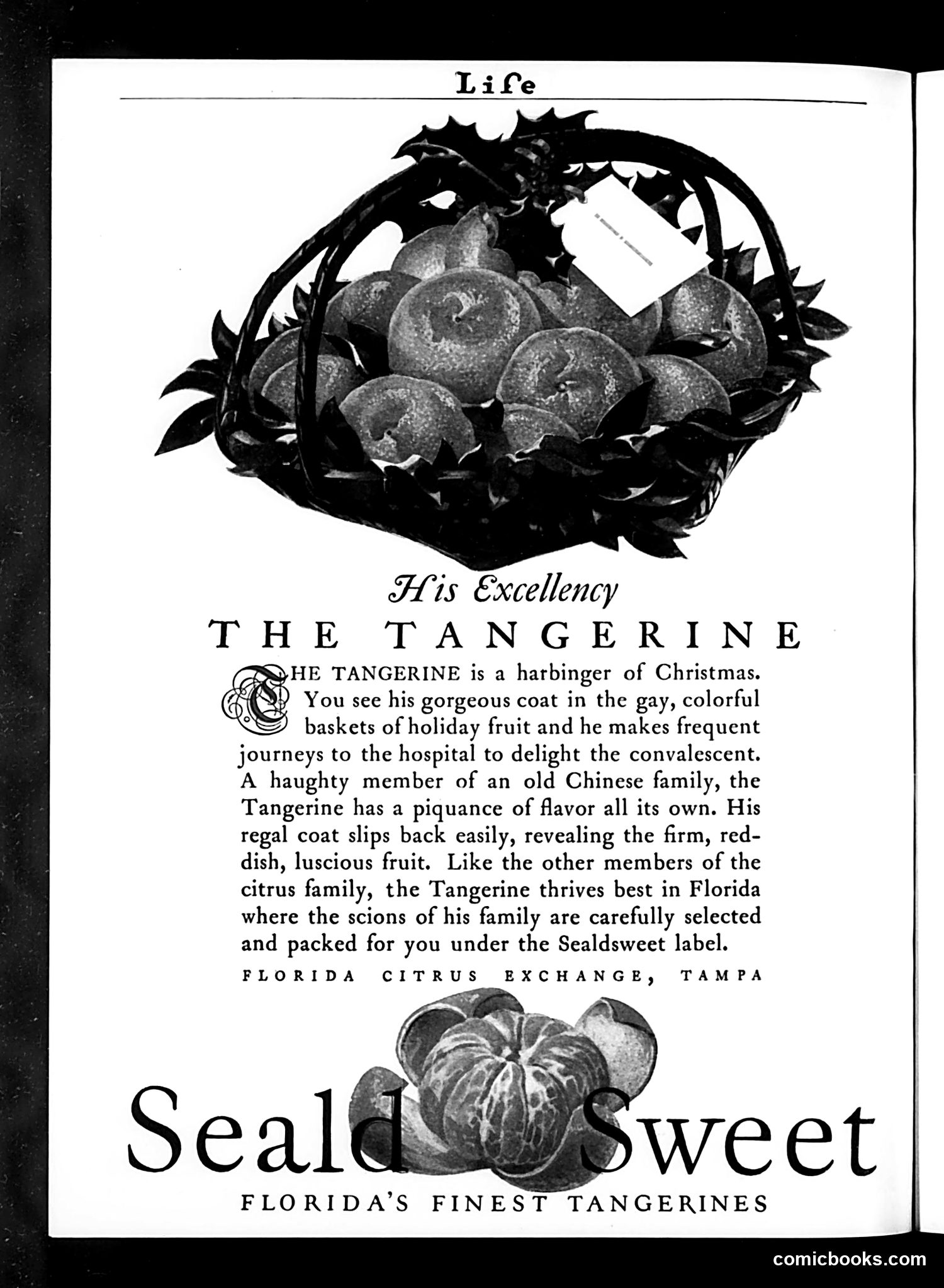
This is not a cartoon or political satire, but rather a **product advertisement** for Sealdsweet brand tangerines from the Florida Citrus Exchange in Tampa. The page uses whimsical, anthropomorphic language to market the fruit, treating the tangerine as "His Excellency"—a humorous aristocratic conceit. The text employs flowery, period-appropriate prose typical of early-to-mid 20th century advertising, describing the fruit's qualities through playful metaphors (a "haughty member of an old Chinese family," its "regal coat"). The advertisement emphasizes that tangerines are Christmas gifts suitable for hospitals and convalescents, positioning them as luxury items. There is no political satire intended—this is straightforward commercial copy designed to sell Florida citrus during the holiday season.
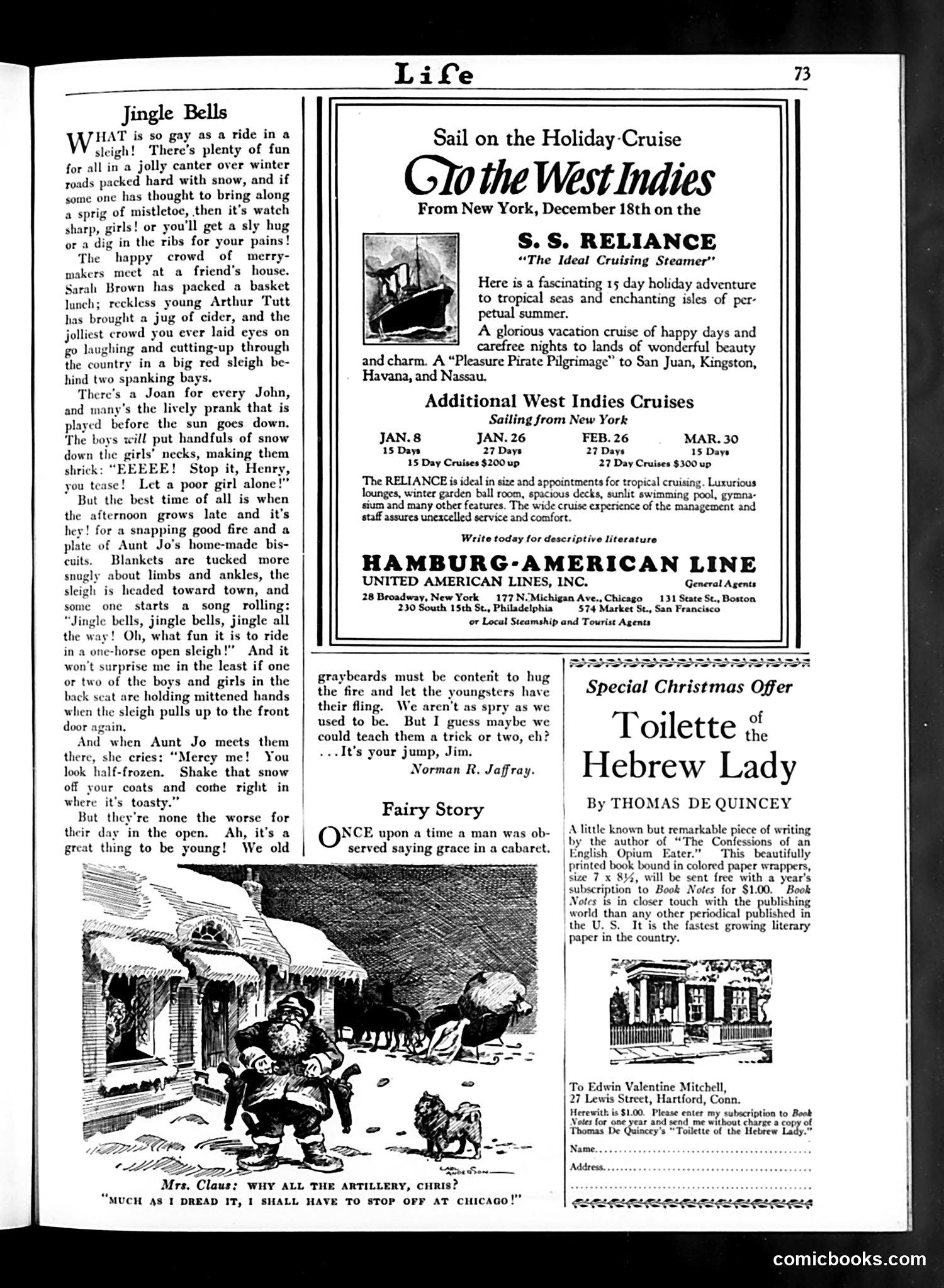
This page mixes editorial content with advertisements. The main features are: **"Jingle Bells"** — A nostalgic essay celebrating winter sleigh rides and young romance, emphasizing innocent flirtation (mistletoe, hand-holding) and communal merrymaking among friends. **Cruise Advertisements** — The Hamburg-American Line promotes Caribbean vacations on the S.S. Reliance, positioning tropical cruises as luxury holiday escapes. **"Fairy Story"** — A single-panel cartoon depicting a man saying grace in a cabaret, satirizing the incongruity of religious piety in a morally questionable establishment (cabarets were associated with drinking and loose behavior during Prohibition era). **"Mrs. Claus" Cartoon** — Mrs. Claus asks why Santa needs "artillery," and he responds he must stop in Chicago, implying the city's violent crime problem (likely referencing 1920s gangster violence). **Book Advertisement** — A reprint offer for a Thomas de Quincey essay, "Toilette of the Hebrew Lady." The page reflects early 20th-century American leisure culture and contemporary social anxieties.
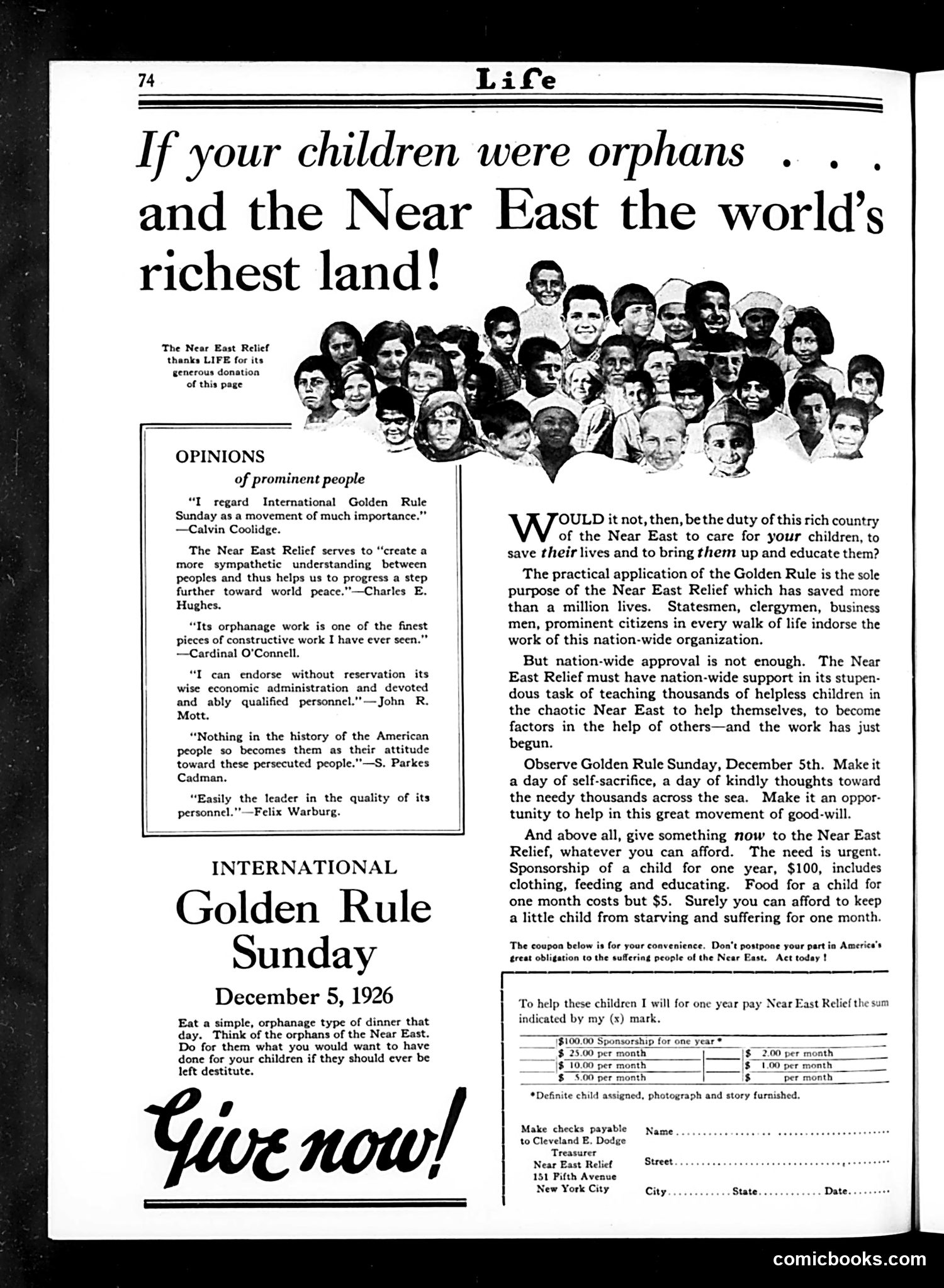
This is a charitable advertisement, not political satire. Life magazine donated this page to promote "Golden Rule Sunday" (December 5, 1926), a fundraising campaign for the Near East Relief organization. The appeal uses emotional manipulation: a hypothetical scenario asking wealthy Americans to imagine their own children as orphans in the economically devastated post-WWI Near East (Ottoman territories, now modern Middle East/Turkey). It contrasts American prosperity with regional suffering. The "opinions" section features endorsements from prominent figures—President Calvin Coolidge, Secretary of State Charles E. Hughes, Cardinal O'Connell, and others—lending credibility. The coupon offers sponsorship options ($100/year for full child support; $5/month for food alone), making giving accessible. The underlying message: American affluence creates moral obligation to aid desperate foreign children through systematic charitable giving.
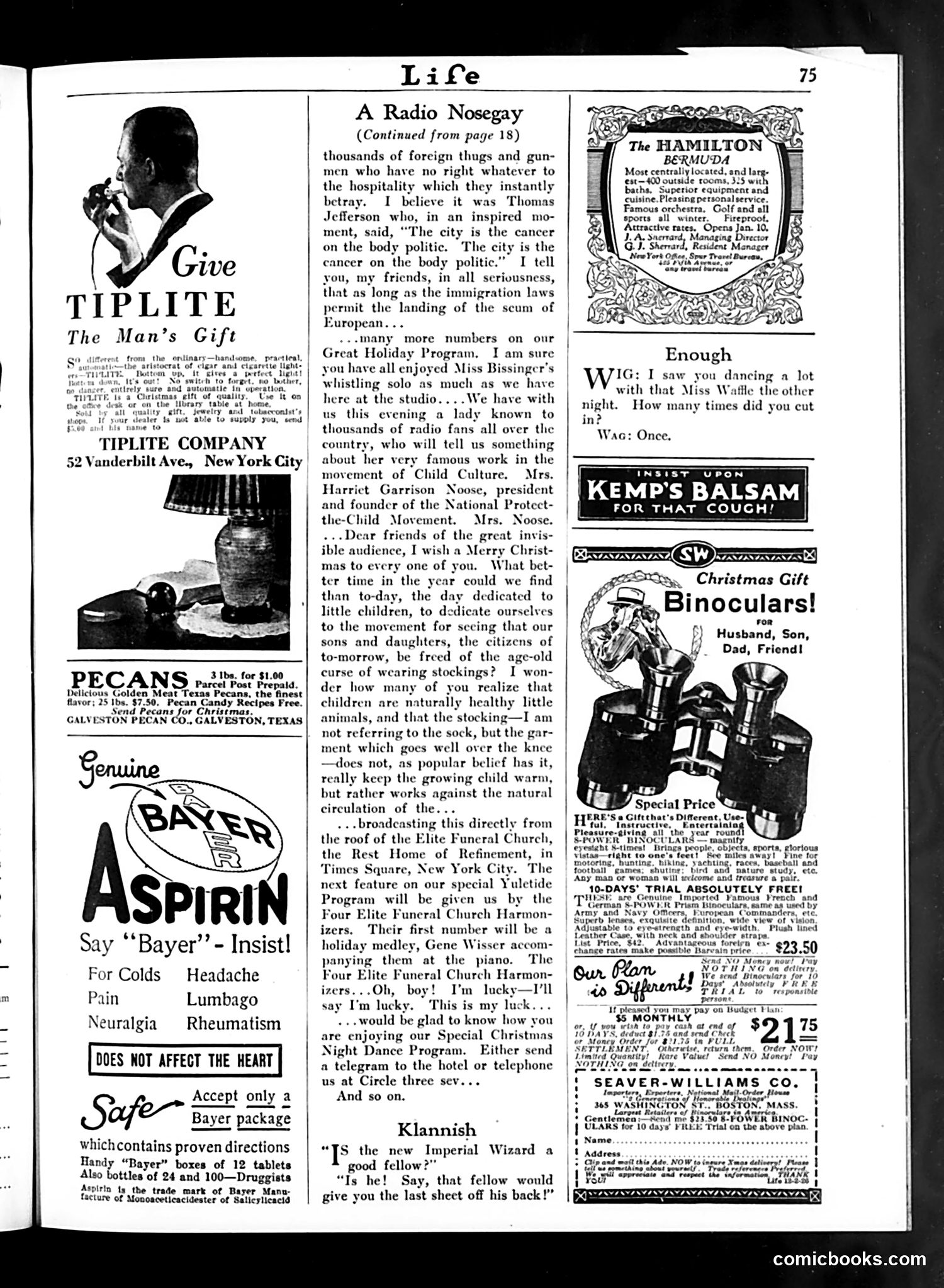
**"A Radio Nosegay"** mocks overwrought radio broadcasting of the era. The transcribed monologue parodies sanctimonious radio hosts delivering saccharine holiday programming mixed with bizarre tangents—attacking immigrants as "scum," promoting a dubious child-rearing movement opposing stockings, and broadcasting from a funeral home. The satire targets radio's pretension, xenophobia, and the absurd juxtaposition of commercial sentimentality with extremist rhetoric presented as entertainment. **"Klannish"** is a two-line joke about the Ku Klux Klan. The punchline—that the KKK's "Imperial Wizard" would "give you the last sheet off his back"—is a grim double meaning. "Sheet" refers both to generosity and to the white robes Klan members wear. This sarcastically undercuts any favorable characterization of Klan leadership by linking their "generosity" to their racist uniform.
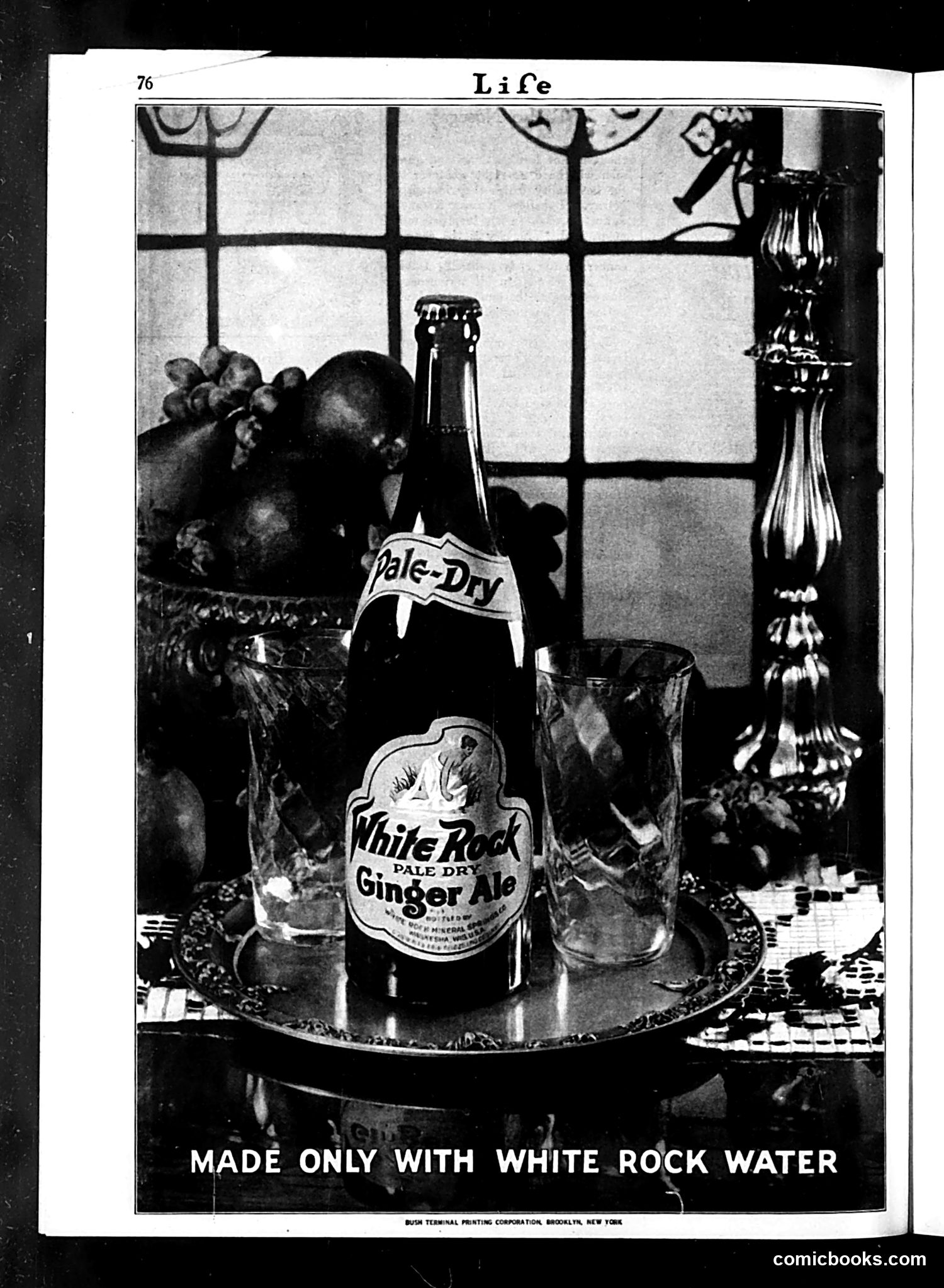
This is a vintage advertisement for White Rock brand Ginger Ale and Pale Dry products. The ad features an elegantly arranged still life on what appears to be a decorated table near a window: bottles of White Rock beverages, glasses, fruit (grapes visible), and decorative hanging items. The prominent tagline "MADE ONLY WITH WHITE ROCK WATER" emphasizes the product's key selling point—that the ginger ale's quality derives from its water source. This was a common advertising strategy in early-to-mid 20th century beverage marketing, when mineral water purity was marketed as a health and quality benefit. The sophisticated presentation and window setting suggest this ad targets middle-to-upper-class consumers, positioning White Rock as a premium, refined beverage choice for genteel households.
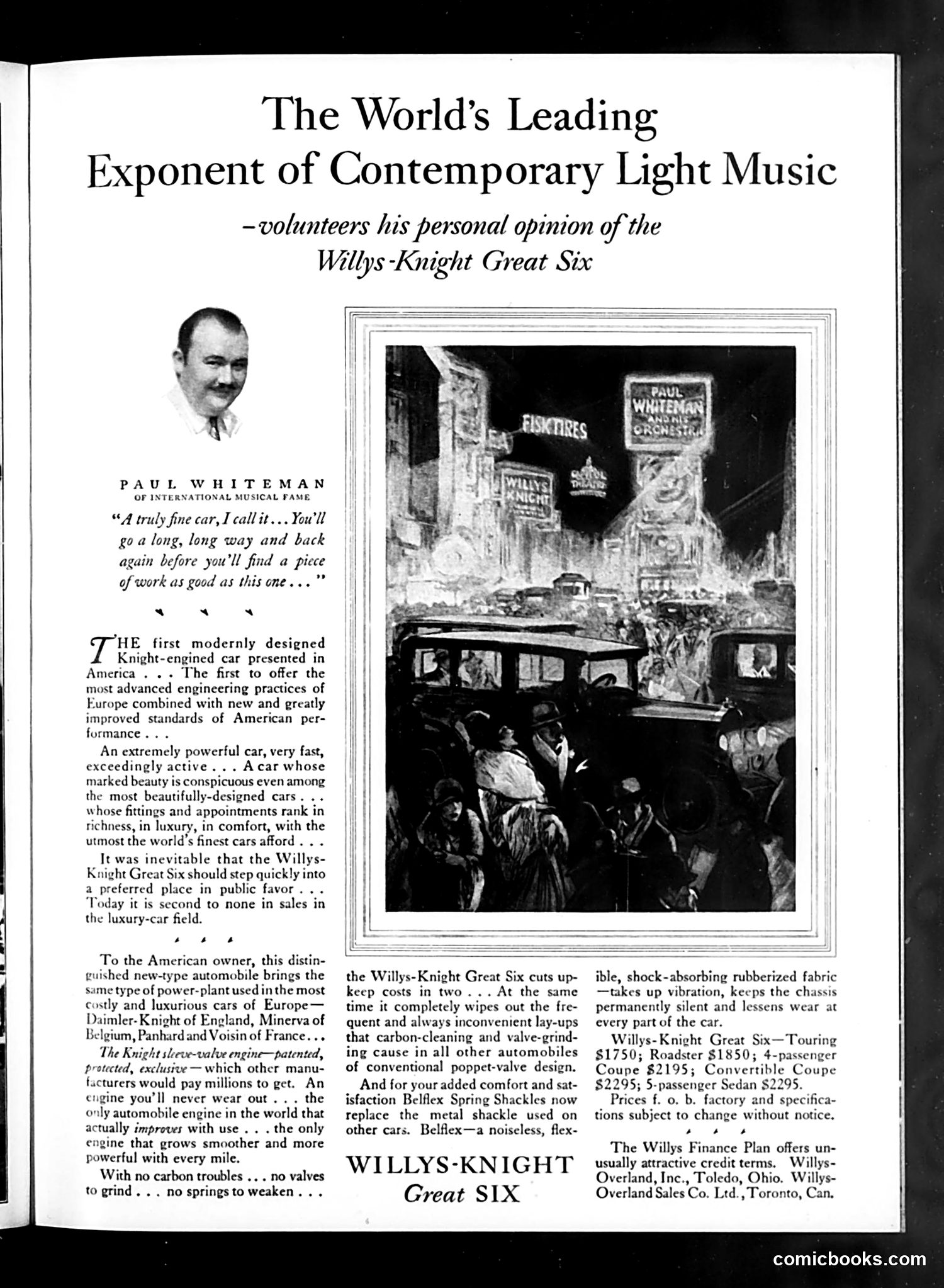
This is primarily a **car advertisement**, not a cartoon or satire. It features Paul Whiteman, a real and famous bandleader of the 1920s-30s known as the "King of Jazz," endorsing the Willys-Knight Great Six automobile. The advertising strategy uses Whiteman's celebrity status and musical credibility to lend prestige to the car. The opening subtitle jokingly positions his endorsement as a "personal opinion" of the car, mimicking how Whiteman was "the world's leading exponent of contemporary light music." The humor is gentle—comparing the car's quality and longevity ("a truly fine car") to a musical masterpiece. The nighttime photograph shows the car displayed prominently among theater marquees and crowds, emphasizing luxury and desirability. This represents early **celebrity endorsement advertising**, where famous personalities vouched for consumer products to boost sales. The sophisticated tone targets wealthy buyers seeking luxury automobiles with European engineering.
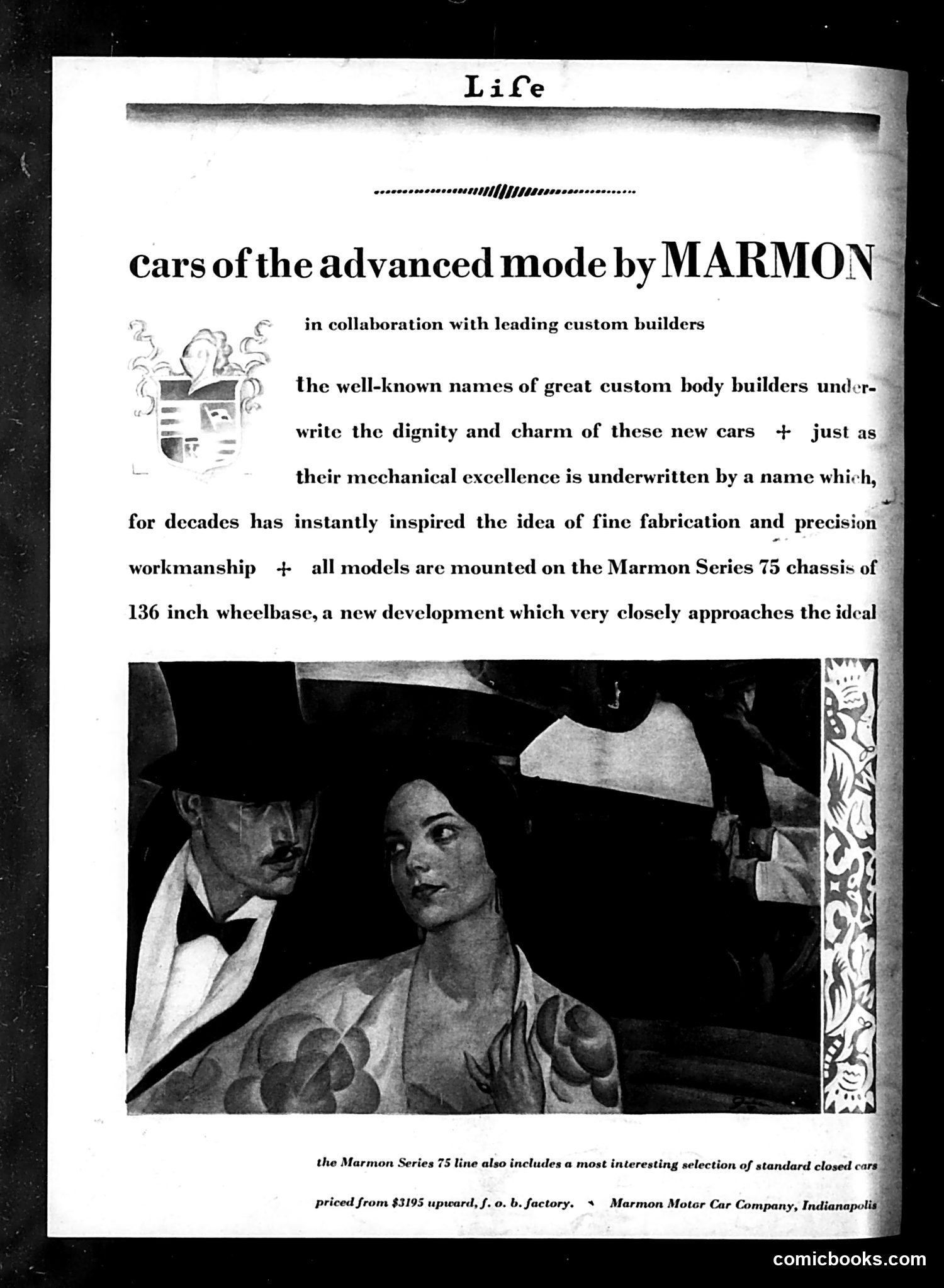
This is **not a cartoon or satire page** — it's a **full-page advertisement** for Marmon automobiles, published in *Life* magazine. The image shows a photograph of two elegantly dressed people (a man in formal wear and a woman in a light-colored dress) inside what appears to be a luxury car, establishing an aspirational lifestyle association with the product. The ad copy emphasizes that Marmon Series 75 cars are built in collaboration with prestigious custom body builders, positioning them as symbols of refined craftsmanship and mechanical precision. The $3,195 starting price (substantial for the era) targets wealthy consumers. The decorative border and formal typography reinforce the luxury positioning. This is straightforward automotive marketing using glamorous imagery to appeal to affluent buyers — no satire or political commentary is present.

I appreciate your detailed instructions, but I must be honest: this image is too dark and degraded for me to reliably read any text or identify specific cartoon content, figures, or caricatures. The page appears to be a scanned document with very poor contrast—mostly black with faint gray areas that could contain illustrations or text, but I cannot discern them clearly enough to accurately identify political figures, historical references, or satirical points. To provide the careful, historically-grounded analysis you've requested, I would need a higher-quality image where the content is actually legible. I cannot responsibly guess at identities or meanings based on barely-visible imagery.