
Life, 1926-12-02 · page 26 of 81
Life — December 2, 1926 — page 26: what you’re looking at
What you’re looking at
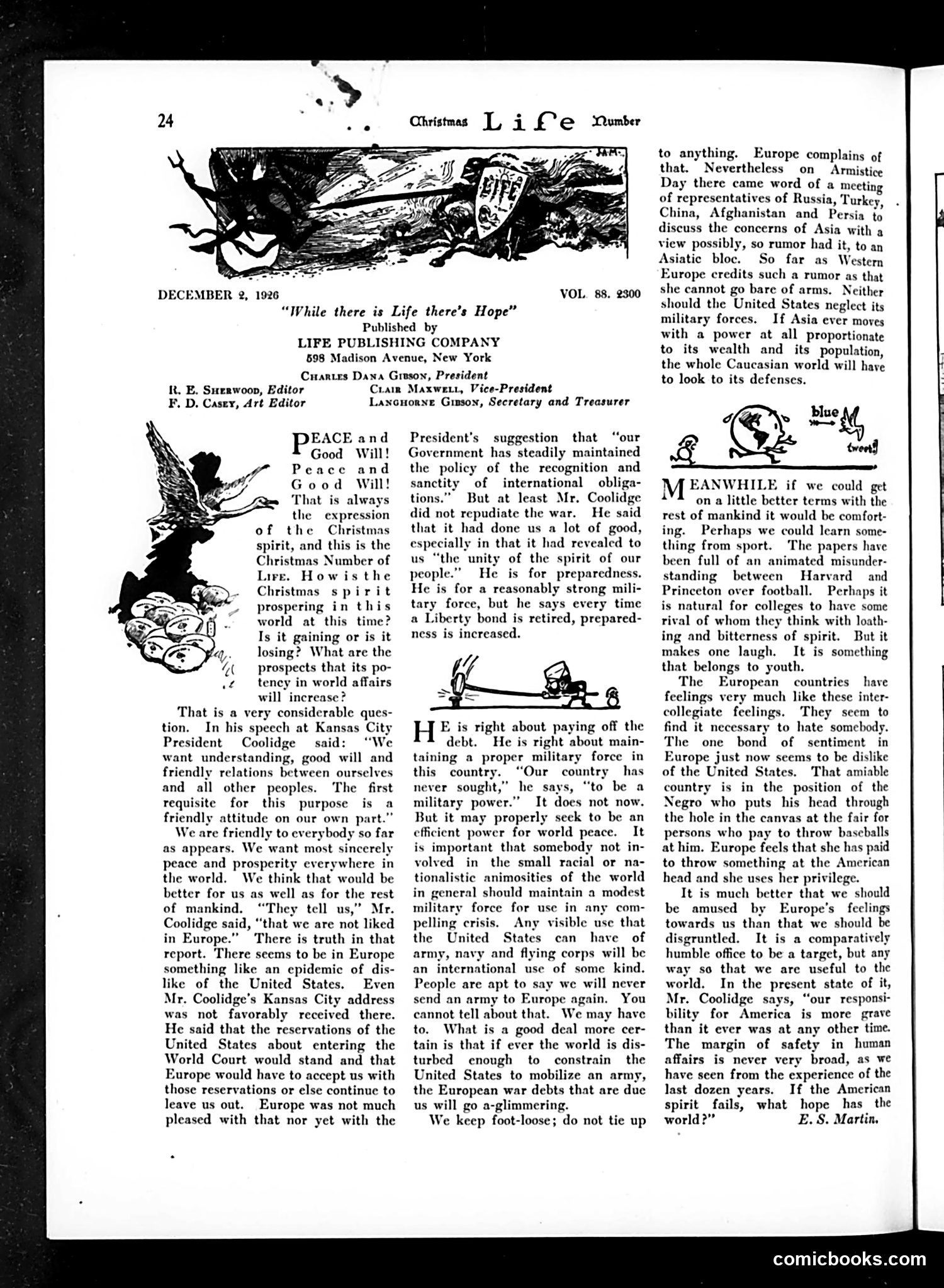
This page presents President Calvin Coolidge's Christmas message on international peace and American military preparedness. The editorial commentary responds to European criticism of the United States, particularly regarding American reluctance to join the World Court and Coolidge's statement that America isn't "liked in Europe." The satire targets the contradiction between Coolidge's rhetoric of peace and his advocacy for military strength. The cartoons appear to illustrate this tension—depicting Santa Claus and military figures, though the specific caricatures are unclear from image quality. The commentary addresses contemporary anxieties: European resentment of American isolationism and debt collection, rumors of an Asian political bloc (involving Russia, Turkey, China, Afghanistan, and Persia), and concerns this might necessitate Western military readiness. The piece argues American military power serves international stability, not conquest, while acknowledging European animosity toward the U.S. The tone is defensive about American intentions while simultaneously warning of future threats—a stance reflecting post-WWI geopolitical tensions.
📄 Transcribed text from this page (OCR, searchable)
Machine-transcribed from the original scan — historical spelling and the odd misread are preserved.
DECEMBER 2, 1926 VOL “While there is Life there’s Hope” Published by LIFE PUBLISHING COMPANY 698 Madison Avenue, New York Cuantrs Dana Gruson, President Cram Maxwett, Vice-President Lancuorne Gipson, Secretary and Treasurer Rt, E. Suerwoop, Editor F. D. Casey, Art Editor EACE and Good Will! Peace and Good Will! That is always the expression of the Christmas spirit, and this is the Christmas Number of Lire. How is the Christmas spirit prospering in this world at this time? Is it gaining or is it losing? What are the prospects that its po- tency in world affairs will increase? That is a very considerable ques- tion. In his speech at Kansas City President Coolidge said: ‘We want understanding, good will and friendly relations between ourselves and all other peoples. The first requisite for this purpose is a friendly attitude on our own part.” We are friendly to everybody so far as appears. We want most sincerely peace and prosperity everywhere in the world. We think that would be better for us as well as for the rest of mankind. “They tell us,” Mr. Coolidge said, “that we are not liked in Europe.” There is truth in that report. There seems to be in Europe something like an epidemic of dis- like of the United States. Even Mr. Coolidge’s Kansas City address was not favorably received there. He said that the reservations of the United States about entering the World Court would stand and that Europe would have to accept us with those reservations or else continue to leave us out. Europe was not much pleased with that nor yet with the President's suggestion that “our Government has steadily maintained the policy of the recognition and sanctity of international obliga- tions.” But at least Mr. Coolidge did not repudiate the war. He said that it had done us a lot of good, especially in that it had revealed to us “the unity of the spirit of our people.” He is for preparedness. He is for a reasonably strong mili- tary force, but he says every time a Liberty bond is retired, prepared- ness is increased. H E is right about paying off the debt. He is right about main- taining a proper military force in this country. “Our country has never sought,” he says, “to be a military power.” It does not now. But it may properly seck to be an efficient power for world peace. It is important that somebody not in- volved in the small racial or na- tionalistic animosities of the world in general should maintain a modest military force for use in any com- pelling crisis. Any visible use that the United States can have of army, navy and flying corps will be an international use of some kind. People are apt to say we will never send an army to Europe again. You cannot tell about that. We may have to. What is a good deal more cer- tain is that if ever the world is dis- turbed enough to constrain the United States to mobilize an army, the European war debts that are due us will go a-glimmering. We keep foot-loose; do not tie up to anything. Europe complains of that. Nevertheless on Armistice Day there came word of a meeting of representatives of Russia, Turkey, China, Afghanistan and Persia to discuss the concerns of Asia with a view possibly, so rumor had it, to an Asiatic bloc. So far as Western Europe credits such a rumor as that she cannot go bare of arms. Neither should the United States neglect its military forces. If Asia ever moves with a power at all proportionate to its wealth and its population, the whole Caucasian world will have to look to its defenses. blue uM — Nf EANWHILE if we could get on a little better terms with the rest of mankind it would be comfort- ing. Perhaps we could learn some- thing from sport. The papers have been full of an animated misunder- standing between Harvard and Princeton over football. Perhaps it is natural for colleges to have some rival of whom they think with loath- ing and bitterness of spirit. But it makes one laugh. It is something that belongs to youth. The European countries have feelings very much like these inter- collegiate feelings. They seem to find it necessary to hate somebody. The one bond of sentiment in Europe just now seems to be dislike of the United States. That amiable country is in the position of the Negro who puts his head through the hole in the canvas at the fair for persons who pay to throw baseballs at him. Europe feels that she has paid to throw something at the American head and she uses her privilege. It is much better that we should be amused by Europe's feelings towards us than that we should be disgruntled. It is a comparatively humble office to be a target, but any way so that we are useful to the world. In the present state of it, Mr. Coolidge says, “our responsi- bility for America is more grave than it ever was at any other time. The margin of safety in human affairs is never very broad, as we have seen from the experience of the last dozen years. If the American spirit fails, what hope has the world?” E. S. Martin, comicbooks.com