
Life, 1926-12-02 · page 56 of 81
Life — December 2, 1926 — page 56: what you’re looking at
What you’re looking at
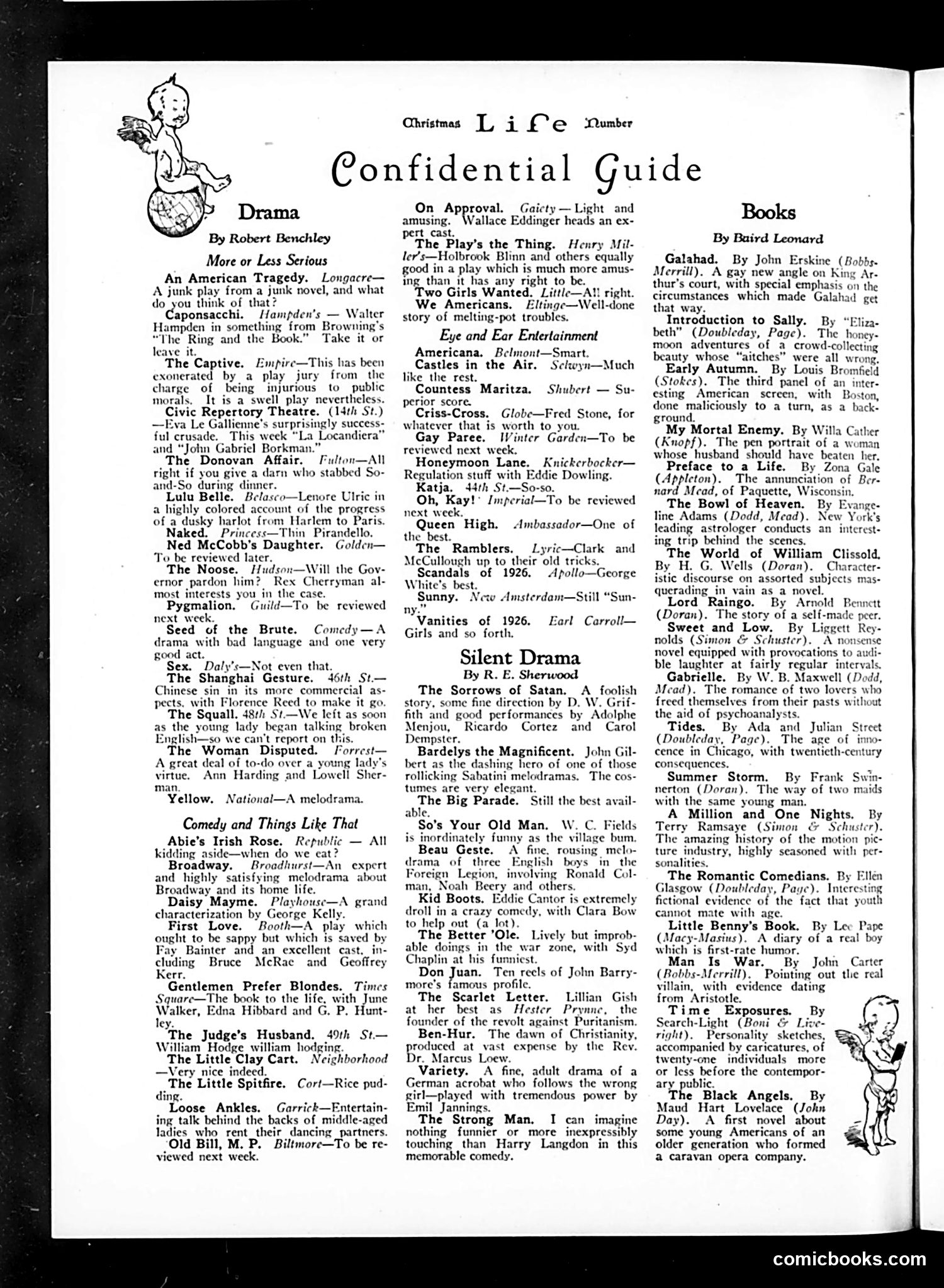
This is a "Confidential Guide" to Christmas-season entertainment—essentially a theater and film review column, not a political cartoon page. The two decorative illustrations (a baby figure at top left and another cherub at bottom right) are merely ornamental flourishes typical of *Life* magazine's design, not satirical commentary. The content consists of: - **Drama reviews** by Robert Benchley, assessing Broadway plays with characteristic wit ("An American Tragedy...a junk play from a junk novel") - **Books reviews** by Baird Leonard, discussing contemporary novels - **Entertainment listings** covering musicals and revues - **Silent film reviews** by R.E. Sherwood The satire is gentle and embedded within Benchley's review prose—dry observations about plays' quality—rather than visual. This is primarily reference material for readers deciding what entertainment to attend during the holiday season.
📄 Transcribed text from this page (OCR, searchable)
Machine-transcribed from the original scan — historical spelling and the odd misread are preserved.
Ohristmas L i fe RQumber ?7onfidential Guide By Robert Benchley More or Less Serious An American Tragedy. Longacre— A junk play from a junk novel, and what do you think of that? aponsacchi. Hampden’s — Walter Hampden in something from Browning's ‘The Ring and the Book.” Take it or leave it, The Captive. Empire—This has been exonerated by a play jury from the charge of being injurious to public morals. It is a swell play nevertheless. Civic Repertory Theatre. (14th St.) Le Gallienne’s surprisingly success- jul crusade. This week “La Locandiera” and “John Gabriel Borkman.” The Donovan Affair. right if you give a darn who s and-So during dinner. Lulu Belle. Belasco—Lenore Ulric in a highly colored account of the progress of a dusky harlot from Harlem to Paris. Naked. Princess—Thin Pirandello. Ned McCobb’s Daughter. Golden— To be reviewed later. The Noose. /udson—\Will the Gov- ernor pardon him? Rex Cherryman al- most interests you in the case. Pygmalion. Guild—To be reviewed next week. Seed of the Brute. Conedy—A drama with bad language and one very good act. Sex. Daly’s—Not even that. The Shanghai Gesture. 46th St.— Chinese sin in its more commercial as- pects, with Florence Reed to make it go. The Squall. 48¢h as the young lady beg English—so we can't report on this. The Woman Disputed. Forrest— A great deal of to-do over a young lady's virtue. Ann Harding and Lowell Sher- man Yellow. Wton—AN abbed So- National—A melodrama. Comedy and Things Like That Abie’s Irish Rose. Republic — All kidding aside—when do we cat? Broadway. Broadhurst—An_ expert and highly satisfying melodrama about Broadway and its home life. Daisy Mayme. Playhouse—A grand characterization by George Kelly. First Love. Booth—A play which ought to be sappy but which is saved by Fay Bainter and an excellent cast. in- cluding Bruce McRae and Geoffrey Kerr. Gentlemen Prefer Blondes. Times Square—The book to the life, with June Walker, Edna Hibbard and G, P, Hunt- ley. The Judge’s Husband. 49h St— William Hodge william hodging. The Little Clay Cart. Neighborhood —Very nice indeed. The Little Spitfire. Cor!—Rice pud- ding. Loose Ankles. Garrick—Entertain- ing talk behind the backs of middle-aged ladies who rent_their dancing partners. Old Bill, M. P. Biltmore—To be re- viewed next week. On Ap amusing. pert cast. The Play’s the Thing. Henry Mil- ler’s—Holbrook Blinn and others equally good in a play which is much more amus- ing than_it has any right to be. Two Girls Wanted. Little—Al!! right. We Americans. Eltinge—Well-done story of melting-pot troubles. Eye and Ear Entertainment Americana. Belmont—Smart. Castles in the Air. Sclwyn—Much like the rest. Countess Maritza. perior score. Criss-Cross. Globe—Fred Stone, for whatever that is worth to_you. Gay Paree. Winter Garden—To be reviewed next week, Honeymoon Lane. Knickerbocker— Regulation stuff with Eddie Dowling. Katja. 44th St- Oh, Kay!* Impe next week, Queen High. the best. The Ramblers. Lyric—Clark and McCullough up to their old tricks. Scandals of 1926. Apollo—George White's best. Sunny. New Amsterdam—Still “Sun- ny.” Vanities of 1926. Girls and so forth, Silent Drama By R. E. Sherwood The Sorrows of Satan. A_ foolish story, some fine direction by D. W. Grif- fith and good performances by Adolphe Menjou, Ricardo Cortez and Carol Dempster. Bardelys the Magnificent. John Gil- bert as the dashing hero of one of those rollicking Sabatini melodramas. The cos- tumes are very elegant. The Big Parade. Still the best avail- able. So’s Your Old Man. \ is inordinately funny as the vi Beau Geste. A fine, rousing melo- drama of three English boys in’ the Foreign Legion, involving Ronald Col- man, Noah Beery and _ others. Kid Boots. Eddie Cantor is extremely droll in a crazy comedy, with Clara Bow to help out (a lot). The Better Ole. Lively but improb- able doings in the war zone, with Syd Chaplin at his funniest. Don Juan. Ten recls of John Barry- more’s famous profile. The Scarlet Letter. Lillian Gish at her best as Hester Prynne, the founder of the revolt against Puritanism. Ben-Hur. The dawn of Christianity, roduced at vast expense by the Rev. Dr. Marcus Loew. Variety. A fine, adult drama of a German acrobat who follows the wrong girl—played with tremendous power by Emil Jannings. The Strong Man. I can imagine nothing funnier or more inexpressibly touching than Harry Langdon in this memorable comedy. roval. Gaicty — Light and Wallace Eddinger heads an ex- Shubert — Su- 0. I—To be reviewed Ambassador—One of Earl Carroll— Books By Baird Leonard Galahad. By John Erskine (Bobbs. Merrill). A gay new angle on King Ar. thur’s court, with special emphasis on the circumstances which made Galahad get that way. Introduction to Sally. By beth” (Doubleday, Page). The moon adventures of a crowd- -collecting beauty whose “aitches” were all wrong. Early Autumn. By Louis Bromfield (Stokes). The third panel of an inter- esting American screen, with Bc done maliciously to a turn, as a bac! ground. My Mortal Enemy. By W: (Knopf). The pen portrait of a woman whose husband should have beaten her. Preface to a Life. Zona Gale (Appleton). The annunc n of Ber- nard Mead, of Paquette, Wisconsin. The Bowl of Heaven. By anges line Adams (Dodd, Mead). New York's leading astrologer conducts an_ interest- ing trip behind the scenes. The World of William Clissold, By H, G. Wells (Doran). Character- istic discourse on assorted subjects mas- querading in vain as a novel. Lord Raingo. By Arnold Bennctt (Doran). The story of a self-made peer. Sweet and Low. By Liggett Rey- nolds (Simon & Schuster). A nonsense novel equipped with provocations to ble laughter at fairly regular intervals. Gabrielle. By W. B. Maxwell (Dodd, Mead). The romance of two lovers who freed themselves from their pasts without the aid of psychoanalysts. Tides. By Ada and Julian Street (Doubleday, Page). The age of cence in Chicago, with twentieth-cen consequences. Summer Storm. By Frank Sw nerton (Doran). The way of two maids with the same young man. A Million and One Nights. By Terry Ramsaye (Simon & Schuster). The amazing history of the motion pic- ture industry, highly seasoned with per- sonalities. The Romantic Comedians. By Glasgow (Doubleday, Paye). Interesti fictional evidence of the fact that youth cannot mate with age. Little Benny’s Book. By Lee Pape (Macy-Masius). A diary of a real boy which is first-rate humor. Man Is War. By John Carter (Bobbs-Merrill), Pointing out the real villain, with evidence dating from Aristotle. Time Exposures. By Search-Light (Boni & Liz right), Personality sketches, accompanied by caricatures, of twenty-one individuals more or less before the contempor- ary public. The Black Angels. By Maud Hart Lovelace (John Day). <A first novel about some young Americans of an older generation who formed a caravan opera company. comicbooks.com