
Life, 1926-12-02 · page 43 of 81
Life — December 2, 1926 — page 43: what you’re looking at
What you’re looking at
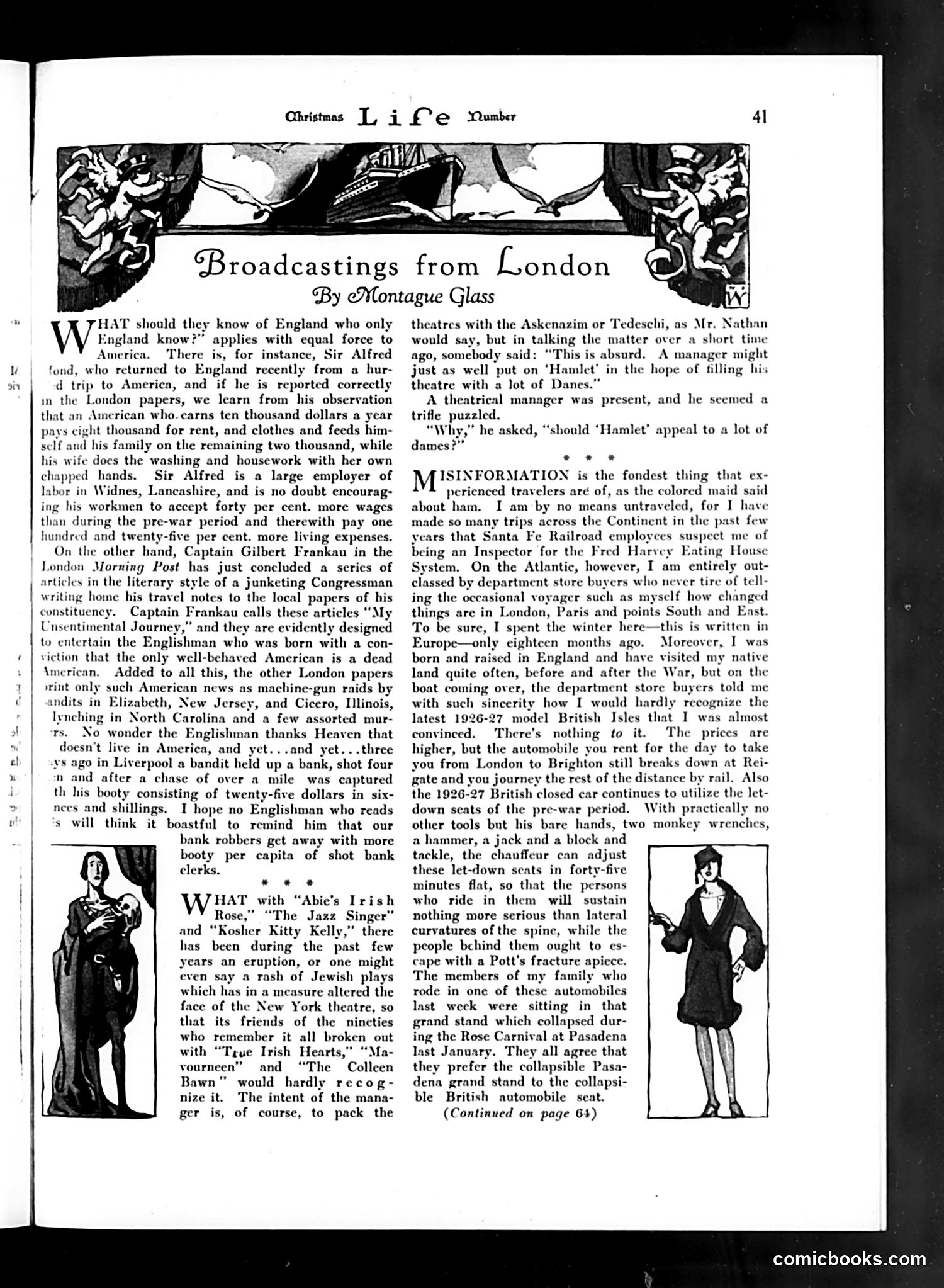
This satirical column compares English and American societies through traveler observations. The author mocks Sir Alfred Ford's claim that Americans earning $10,000 annually survive on $2,000 while wives do unpaid housework—highlighting the hypocrisy of British employers resisting wage increases while criticizing American inequality. A secondary joke targets theatrical managers: one assumes Jewish plays ("Abie's Irish Rose," "The Jazz Singer") will automatically fill theaters with Jewish audiences, just as putting on "Hamlet" would supposedly attract "dames" (Danes). The manager's bewildered response—asking why Hamlet would appeal to "dames"—satirizes this absurd ethnic stereotyping. The column uses witty contrasts between British pretension and American realities to expose prejudice on both sides of the Atlantic.
📄 Transcribed text from this page (OCR, searchable)
Machine-transcribed from the original scan — historical spelling and the odd misread are preserved.
* HAT should th W enctana kno | | | | ©Broadcastings from London y know of England who only applies with equal force to America. There is, for instance, Sir Alfred fond, who returned to England recently from a hur- d trip to America, and if he is reported correctly in the London papers, we learn from his observation that an American who. earns ten thousand dollars a year I cight thousand for rent, and clothes and feeds him- sclf and his family on the remaining two thousand, while his wife does the washing and housework with her own chapped hands. Sir Alfred is a large employer of labor in Widnes, Lancashire, and is no doubt encourag- ing his workmen to accept forty per cent. more wages than during the pre-war period and therewith pay one hundred and twenty-five per cent. more living expenses. On the other hand, Captain Gilbert Frankau in the London Morning Post has just concluded a series of articles in the literary style of a junketing Congressman writing home his travel notes to the local papers of his constituency. Captain Frankau calls these articles “My Unsentimental Journey,” and they are evidently designed to entertain the Englishman who was born with a con- viction that the only well-behaved American is a dead American. Added to all this, the other London papers srint only such American ne s machine-gun raids by andits in Elizabeth, New Jersey, and Cicero, Illinois, lynching in North Carolina and a few assorted mur- ‘rs. No wonder the Englishman thanks Heaven that doesn’t live in America, and yet...and yet...three ys ago in Liverpool a bandit held up a bank, shot four nand after a chase of over a mile was captured th his booty consisting of twenty-five dollars in six- nees and shillings. I hope no Englishman who reads s will think it boastful to remind him that our bank robbers get away with more booty per capita of shot bank clerks, *_*e HAT with “Abie’s Irish ose,” “The Jazz Singer” and “Kosher Kitty Kelly,” there has been during the past few years an eruption, or one might even say a rash of Jewish plays which has in a measure altered the face of the New York theatre, so that its friends of the nincties who remember it all broken out with “True Irish Hearts,” “Ma- vourneen” and “The Colleen Bawn” would hardly recog- nize it. The intent of the mana- ger is, of course, to pack the “By Montague Glass theatres with the Askenazim or Tedeschi, as Mr. Nathan would say, but in talking the matter over a short time ago, somebody said: “This is absurd. A manager might just as well put on ‘Hamlet’ in the hope of filling his theatre with a lot of Danes.” A theatrical manager was present, and he seemed a trifle puzzled. “Why,” he asked, “should ‘Hamlet’ appeal to a lot of dames?” * * * MISINFORMATION is the fondest thing that ex- perienced travelers are of, as the colored maid said about ham. I am by no means untraveled, for I have made so many trips across the Continent in the past few years that Santa Fe Railroad employees suspect me of ring an Inspector for the Fred Harvey Eating House System. On the Atlantic, however, I am entirely out- sed by department store buyers who never tire of tell- cla ing the occasional voyager such as myself how changed things are in London, Paris and points South and East. To be sure, I spent the winter here—this is written in Europe—only eighteen months ago. Moreover, I was born and raised in England and have visited my native land quite often, before and after the War, but on the boat coming over, the department store buyers told me with such sincerity how I would hardly recognize the latest 1926-27 model British Isles that I was almost convinced. There's nothing to it. The prices are higher, but the automobile you rent for the day to take you from London to Brighton still breaks down at Rei- gate and you journey the rest of the distance by rail. Also the 1926-27 British closed car continues to utilize the let- down seats of the pre-war period. With practically no other tools but his bare hands, two monkey wrenches, a hammer, a jack and a block and tackle, the chauffeur can adjust these let-down scats in forty-five minutes flat, so that the persons who ride in them will sustain nothing more serious than lateral curvatures of the spine, while the people bchind them ought to es- cape with a Pott’s fracture apiece. The members of my family who rode in one of these automobiles last week were sitting in that grand stand which collapsed dur- ing the Rose Carnival at Pasadena last January. They all agree that they prefer the collapsible Pasa- dena grand stand to the collapsi- ble British automobile seat. (Continued on page 64) comicbooks.com