
A complete issue · 44 pages · 1926
Life — November 18, 1926
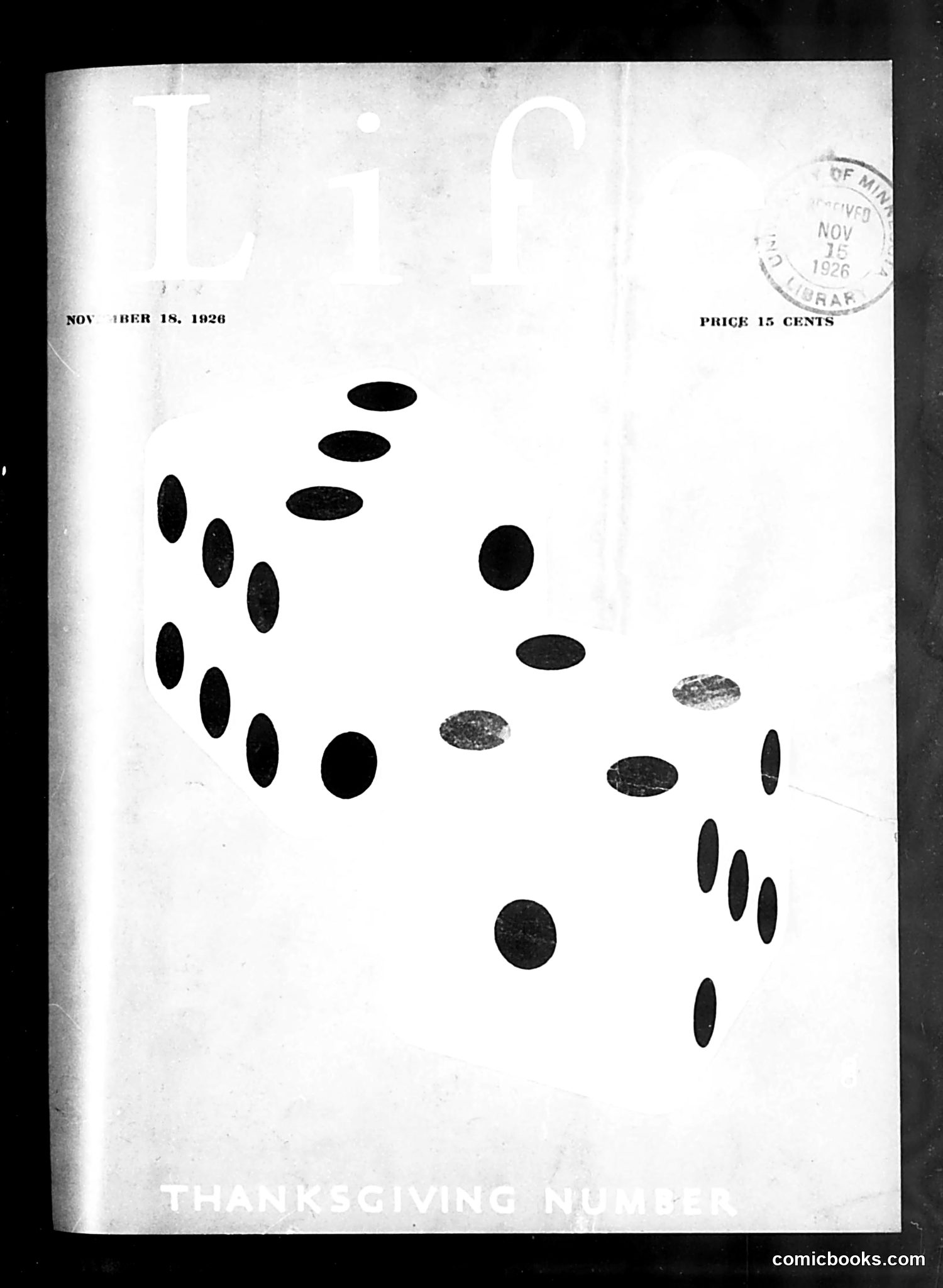
This page from *Life* magazine (November 18, 1926) contains only a visual composition titled "Thanksgiving Number" at the bottom. The image shows various black shapes—circles and ovals of different sizes—arranged abstractly across the white page. Without accompanying explanatory text, the specific satirical meaning is unclear. The shapes could represent: - A visual metaphor about Thanksgiving preparations or abundance - An abstract artistic commentary on contemporary social/political issues - A puzzle or visual gag typical of *Life*'s humor The arrangement and composition suggest intentional meaning, but without captions or additional context on this particular page, I cannot reliably identify what political figures, events, or social commentary these abstract forms represent. The piece appears experimental in style for 1926 magazine illustration.
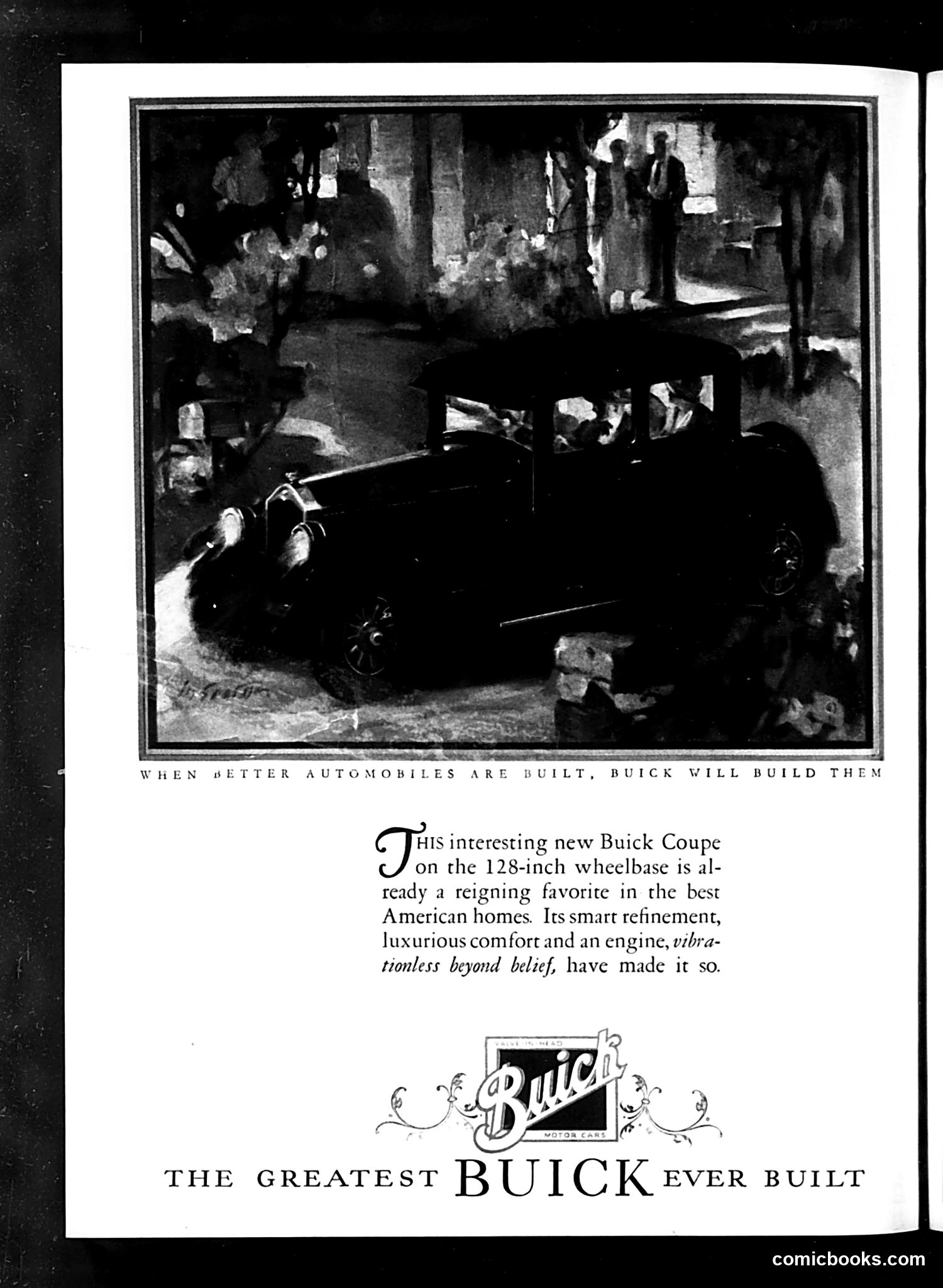
This page is primarily **a Buick automobile advertisement**, not political satire. It features a black-and-white photograph of a Buick Coupe on display at what appears to be a social gathering or showroom event, with well-dressed onlookers examining the vehicle. The advertisement employs the famous slogan "**When Better Automobiles Are Built, Buick Will Build Them**" at the top, promoting the new 128-inch wheelbase Buick Coupe. The copy emphasizes the vehicle's "smart refinement, luxurious comfort and an engine, vibrationless beyond belief." The bottom declares it "**The Greatest Buick Ever Built**." This is commercial advertising rather than editorial cartoon or satire—a product showcase typical of early 20th-century magazine advertising.
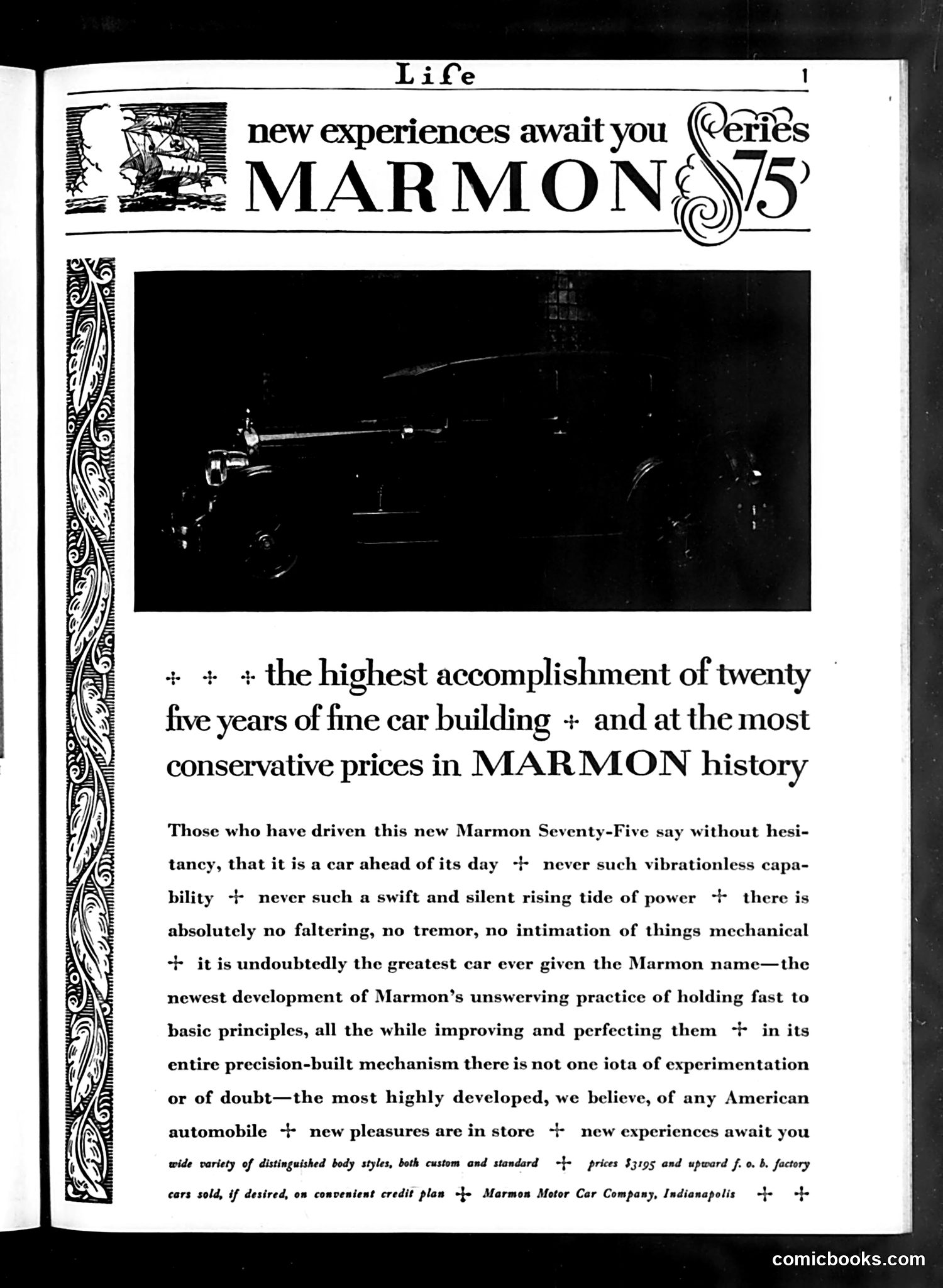
This page is **not a cartoon or satirical content**—it's a straightforward automobile advertisement for the Marmon Series 75, published in *Life* magazine. The advertisement promotes the Marmon automobile as a luxury vehicle, emphasizing twenty-five years of fine car building and "the most conservative prices in Marmon history." It highlights technical achievements: vibrationless capability, smooth power delivery, and precision engineering without "experimentation or doubt." The dark photograph shows the car's interior, though details are difficult to discern. The ornamental left border is typical of *Life's* design aesthetic from this era. The ad targets affluent buyers, offering prices starting at $1,305 f.o.b. factory and mentioning "convenient credit plan." This represents standard commercial advertising rather than satire or political commentary.
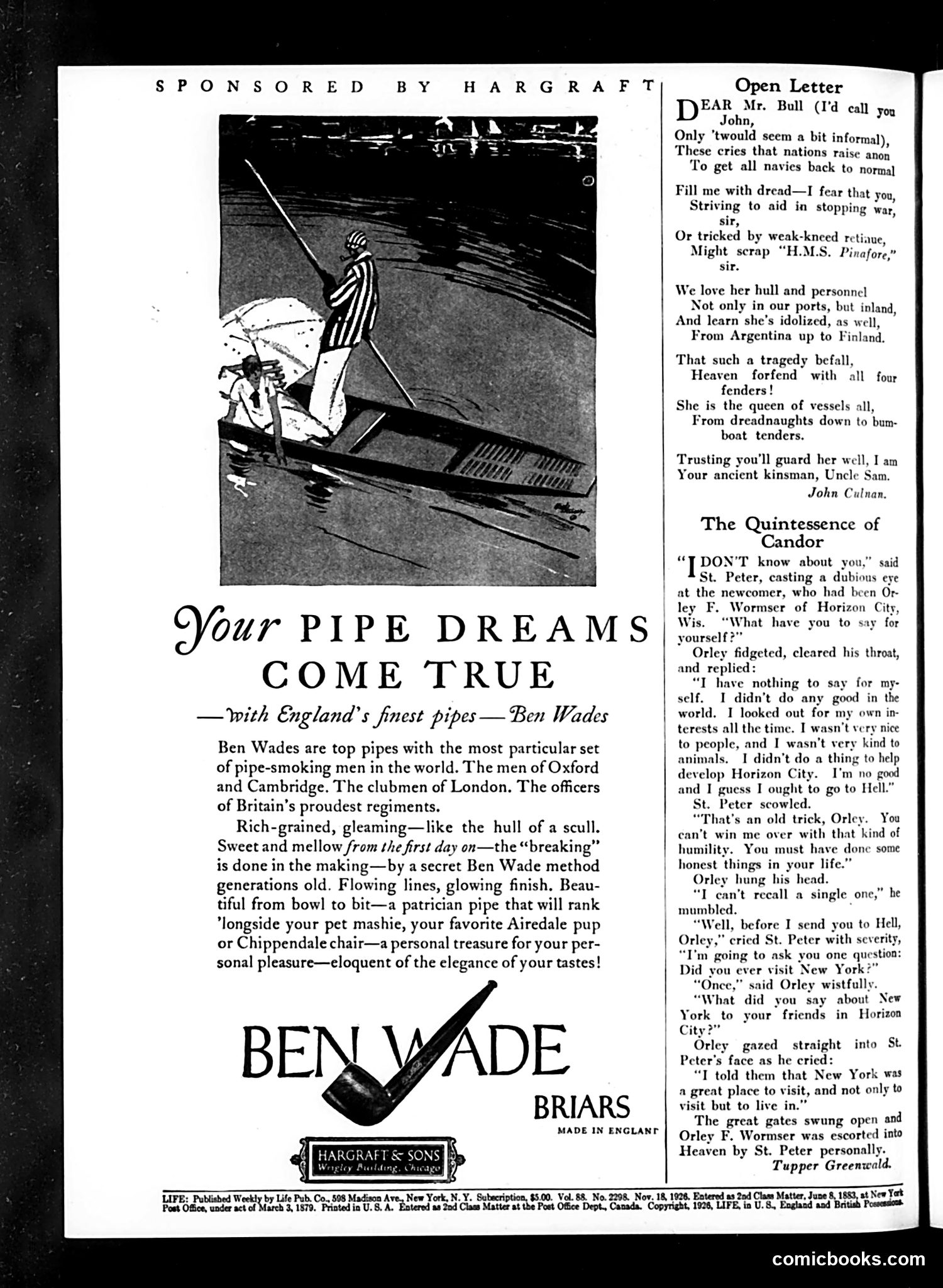
This page is primarily **advertising**, not satire or political commentary. The left side features a **Ben Wades pipe advertisement** showing a man smoking while boating. The ad emphasizes that Ben Wades pipes are favored by Oxford and Cambridge scholars, London clubmen, and British military officers—positioning the product as a luxury item for refined gentlemen. The right side contains **"The Quintessence of Candor,"** a humorous short story about St. Peter interviewing Orley F. Wormser at Heaven's gates. Orley admits to having done nothing good in life—he was selfish and unhelpful in Horizon City, Wisconsin. St. Peter sardonically grants him entry anyway, after Orley claims to have praised New York to his friends. The humor relies on ironic contrast: despite Orley's admitted worthlessness, he gains heavenly admission.
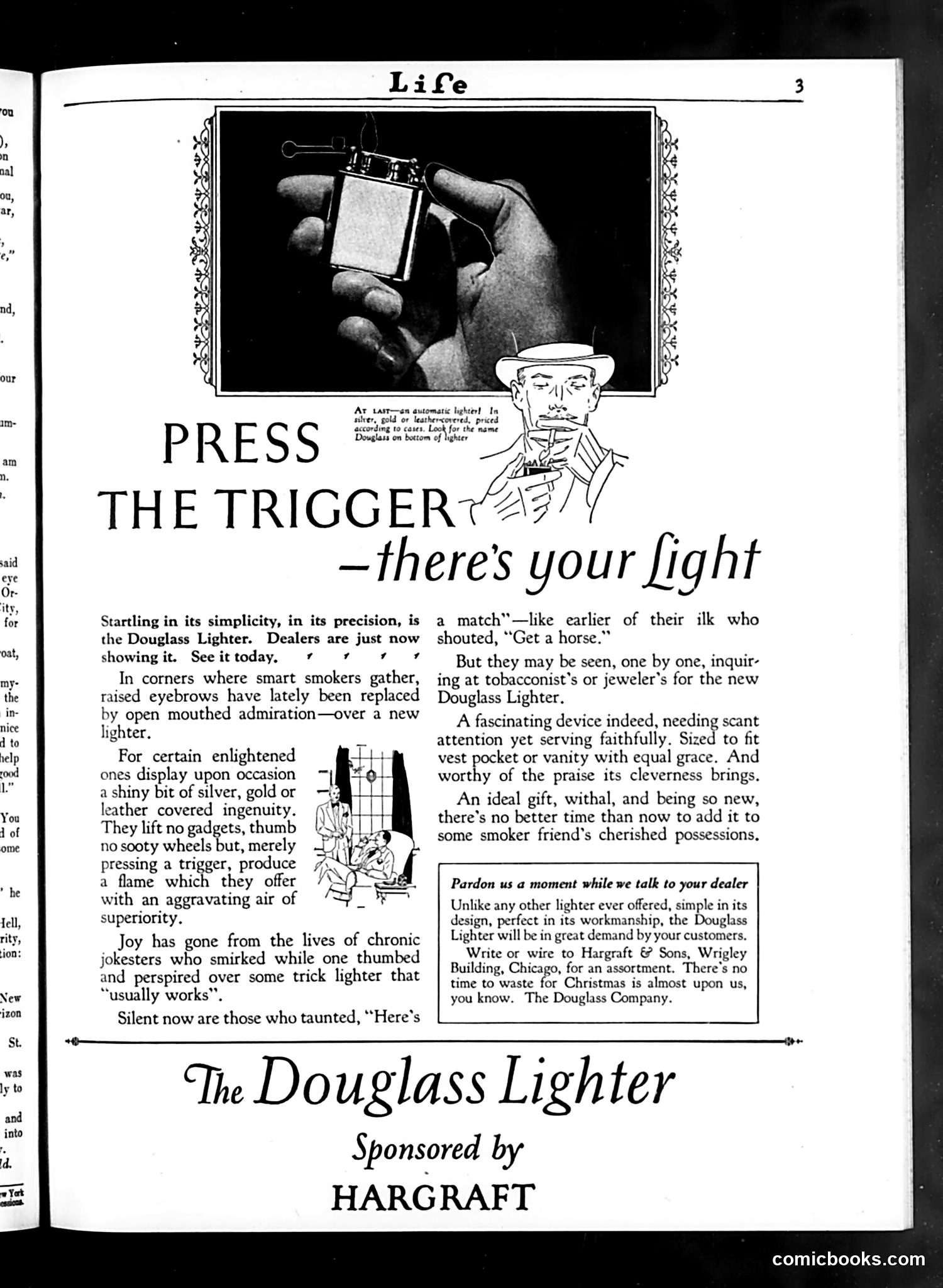
This page is primarily **advertising for the Douglass Lighter**, a cigarette lighter designed for smokers. The ad uses humor and social commentary typical of early 20th-century marketing. The central joke mocks smokers who struggle with unreliable lighters—those who "smirk while one thumbed and perspired over some trick lighter that 'usually works.'" The cartoon depicts frustration with inferior lighters, positioning the Douglass as a solution: simple, reliable, and requiring only a trigger press. The accompanying illustration shows men gathered (suggesting social settings where lighters would be displayed), emphasizing the Douglass as both functional and a status symbol—"shiny bit of silver, gold or leather covered ingenuity." The ad frames the product as an ideal gift for "smoker friends," reflecting mid-century consumer culture and social smoking customs.
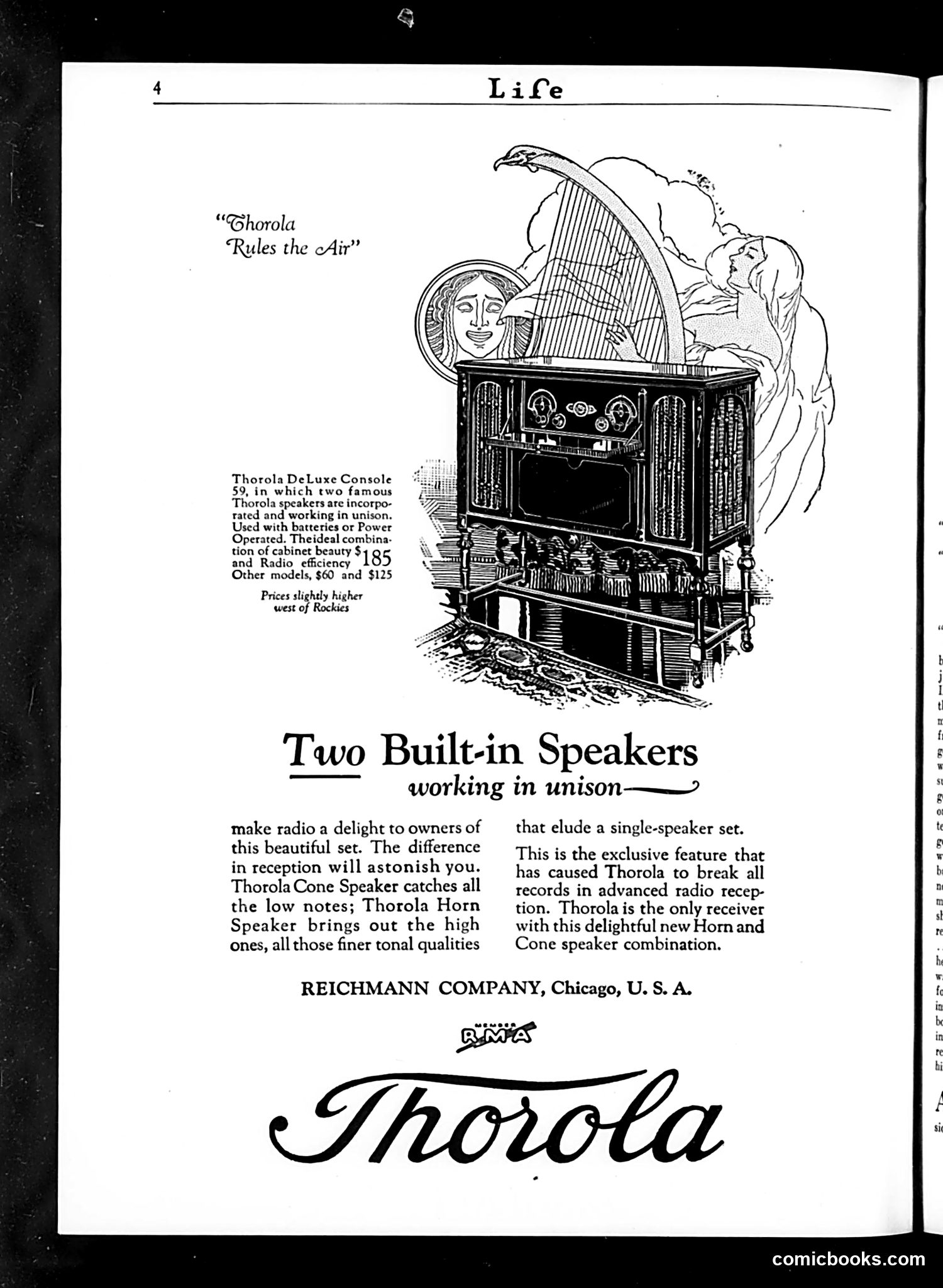
This is **not a political cartoon or satire**—it's a straightforward **product advertisement** for the Thorola DeLuxe Console radio, manufactured by Reichmann Company of Chicago. The page features decorative illustration of angelic/classical figures surrounding a radio console, with the tagline "Chorola Rules the Air." The ad emphasizes the radio's technical innovation: two built-in speakers (a Cone Speaker for low notes and a Horn Speaker for high notes) working together for superior sound quality. Key selling points highlighted: the $185 price point (noted as higher west of the Rockies), claims of superior reception compared to single-speaker competitors, and the exclusive speaker combination Thorola claims as a market distinction. This represents early-1920s consumer radio marketing during the rapid commercialization of home radio technology.
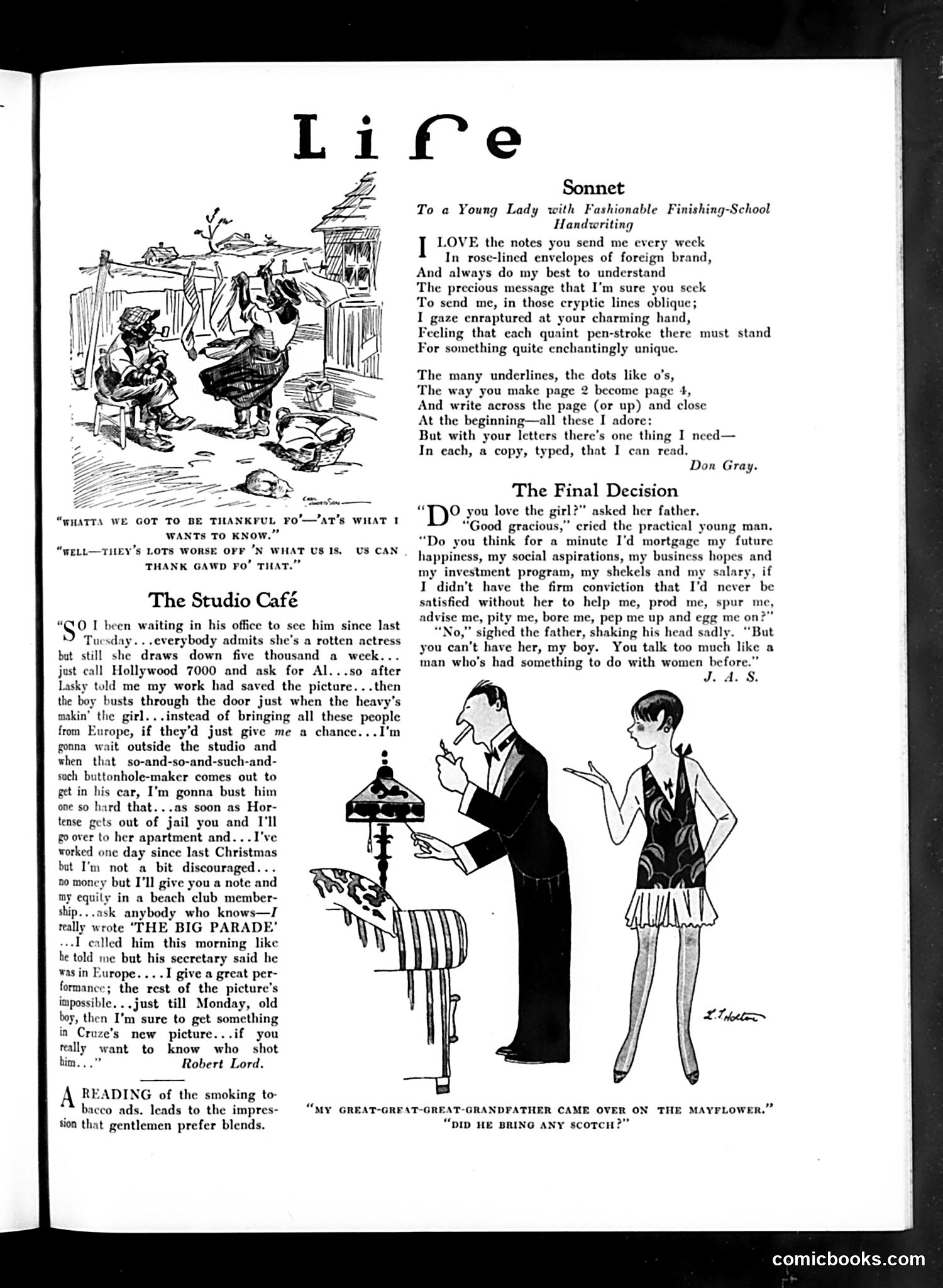
This page contains three satirical pieces typical of 1920s Life magazine: 1. **"The Studio Café"** (Robert Lord): A Hollywood satire about an aspiring actress waiting to meet a studio executive, reflecting the era's fascination with movie industry corruption and the exploitation of young women seeking stardom. 2. **"The Final Decision"** (J.A.S.): A domestic comedy about a father questioning his son's choice of girlfriend, with the son defensively listing material concerns (mortgages, investments) before admitting he simply loves her. It satirizes young men's materialism and anxiety. 3. **Bottom cartoon**: A joke about a woman's great-great-grandfather arriving on the Mayflower, with the punchline questioning whether he brought scotch—a prohibition-era reference mocking both genealogical snobbery and illegal alcohol.
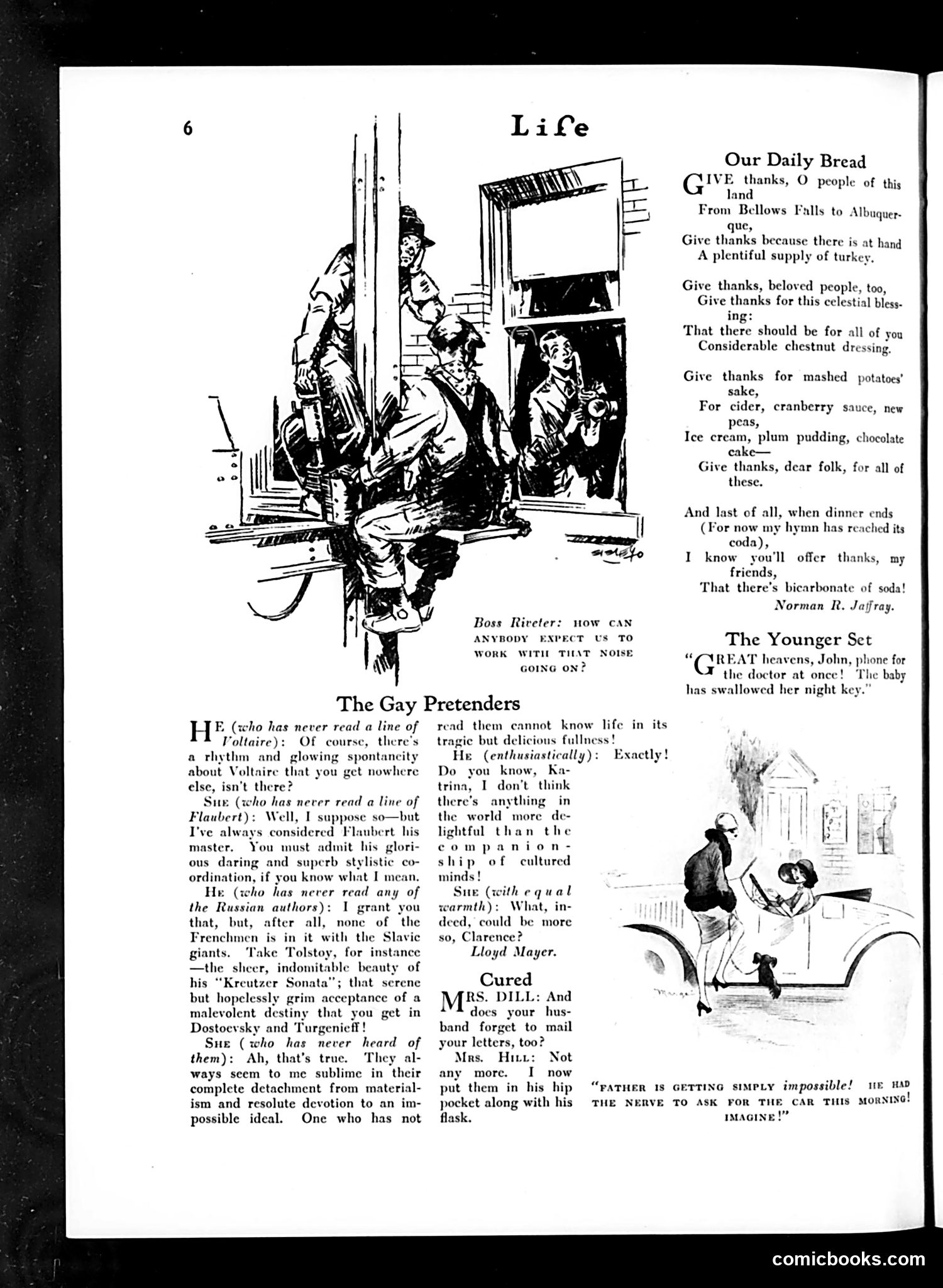
This page contains three distinct pieces: **"Our Daily Bread"** (top right): A poem by Norman R. Jaffray giving thanks for Thanksgiving foods—turkey, chestnut dressing, potatoes, cranberry sauce, desserts, and notably bicarbonate of soda, humorously suggesting indigestion from the heavy meal. **"The Gay Pretenders"** (left): A dialogue mocking people who claim literary sophistication without genuine understanding. Characters reference Flaubert, Russian authors, and Tolstoy, with replies suggesting these pretenders merely repeat fashionable opinions rather than actually reading or comprehending literature. **"The Younger Set"** (bottom right): A brief humorous sketch about a baby swallowing a house key, with an exasperated father unable to ask for the car because of the crisis. The overall theme satirizes social pretension and domestic chaos.
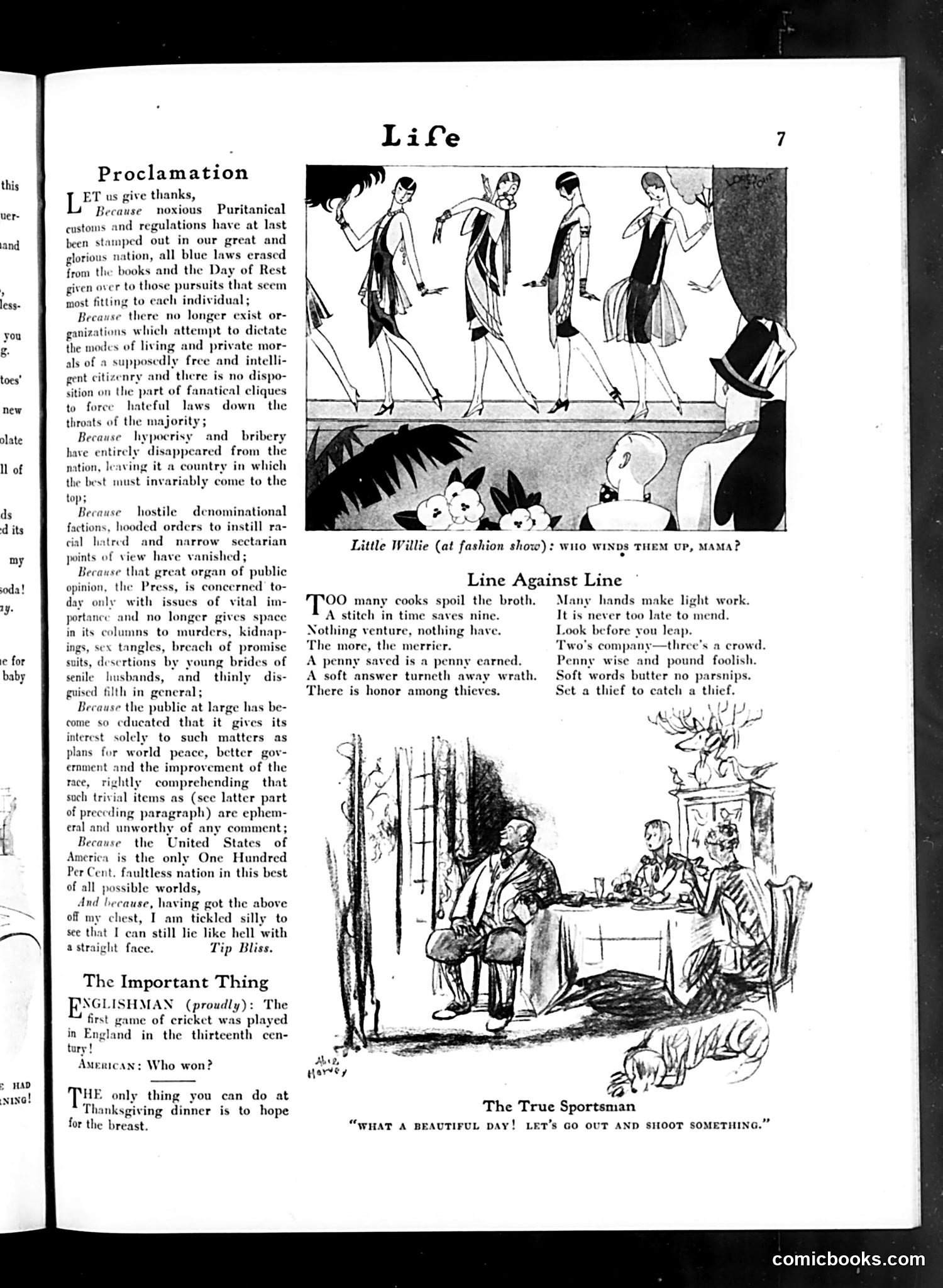
This page contains satirical commentary and humor rather than political cartoons. The top illustration titled "Little Willie (at fashion show): WHO WINGS THEM UP, MAMA?" mocks women's 1920s fashion by showing elongated, unnaturally posed figures at a fashion show, with a child questioning their artificiality. "Line Against Line" presents traditional proverbs and folk wisdom. "The Important Thing" jokes about cricket's English origins versus American sports culture, ending with humor about Thanksgiving dinner priorities. "The True Sportsman" cartoon satirizes wealthy leisure-class hunters who treat outdoor shooting as casual entertainment rather than serious sport—the caption's ironic tone ("WHAT A BEAUTIFUL DAY! LET'S GO OUT AND SHOOT SOMETHING") mocks their frivolous attitude toward killing animals. The left column contains "Proclamation," a lengthy satirical critique of American Puritanical customs and their social effects.
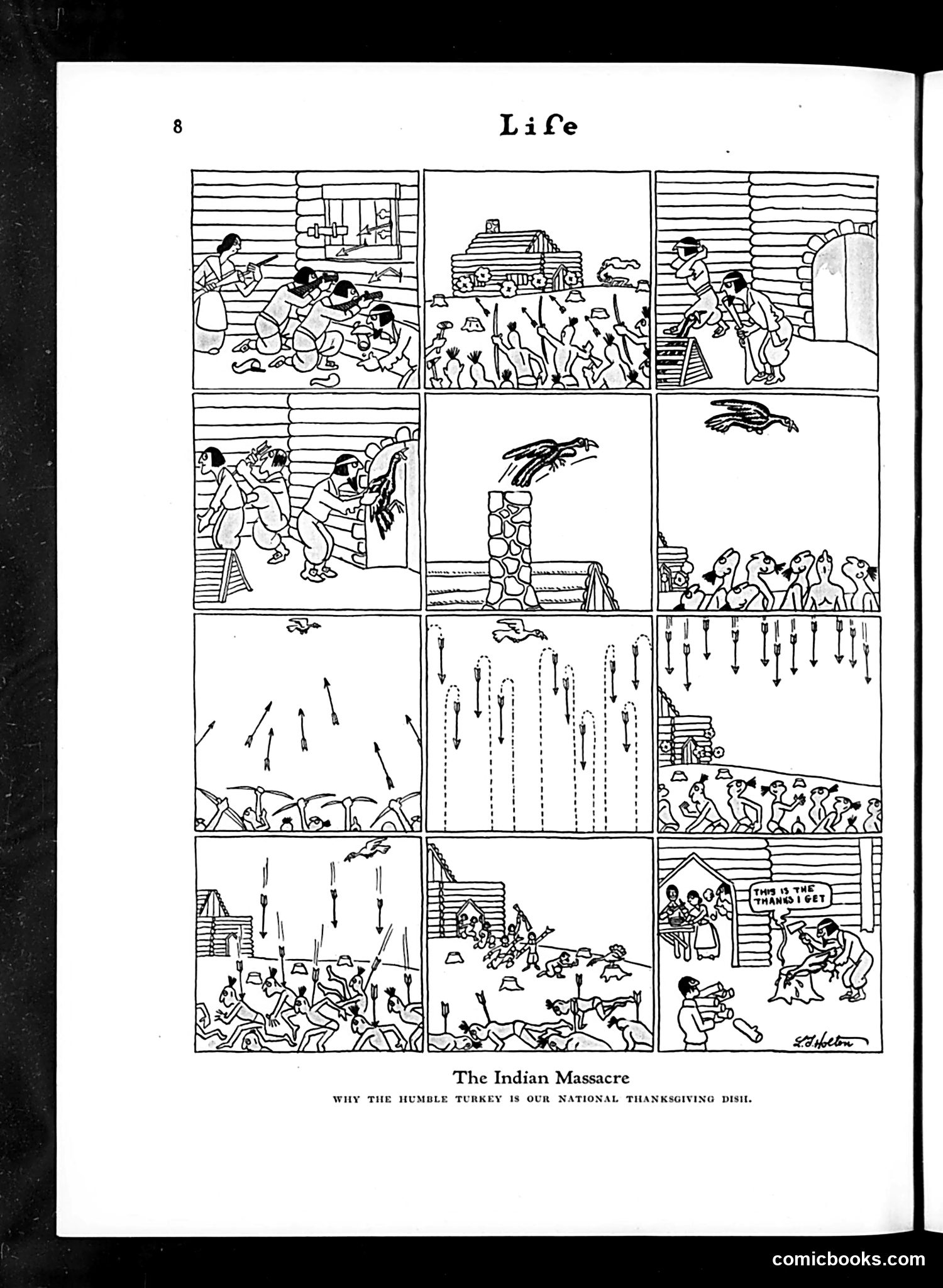
This is a satirical comic strip titled "The Indian Massacre: Why the Humble Turkey Is Our National Thanksgiving Dish." The narrative depicts European colonists arriving at a log settlement, encountering Native Americans, sharing a meal together, and then—in a dark satirical twist—the colonists attacking the Native Americans with weapons while arrows rain down on both groups. The final panel shows survivors giving thanks indoors. The satire works by presenting the historical narrative of Thanksgiving's origin in reverse moral logic: the comic acknowledges that colonists massacred Native Americans, yet ironically suggests this violence is "why" turkey became the traditional Thanksgiving dish—darkly implying Native Americans were displaced or eliminated, making colonial settlement possible. This reflects early 20th-century American satirical commentary on the sanitized Thanksgiving mythology.
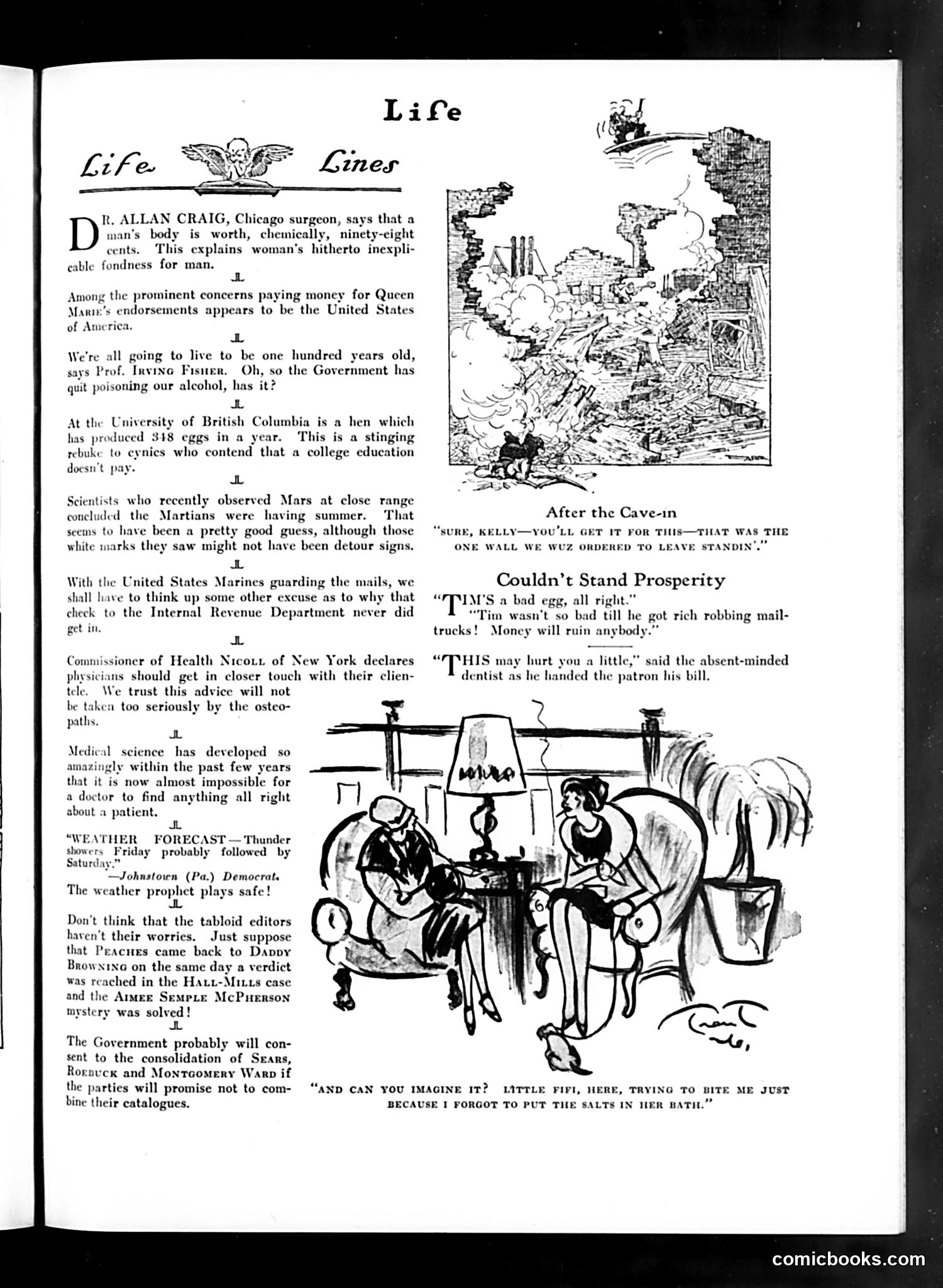
This cartoon satirizes a domestic dispute over household finances. A dentist presents his bill to his wife, who appears upset. The caption reads: "AND CAN YOU IMAGINE IT? LITTLE FIFI, HERE, TRYING TO BITE ME JUST BECAUSE I FORGOT TO PUT THE SALTS IN HER BATH." The humor relies on the wife's apparent spending on luxury items (implied by "salts") for a pet dog ("Fifi") while the household struggles financially—suggested by the dentist's concern over his unpaid bill. The cartoon mocks upper-class domestic tensions: husbands resenting wives' extravagant pet care while marital finances suffer. The "cave-in" title suggests financial collapse or domestic breakdown resulting from such frivolous spending priorities.
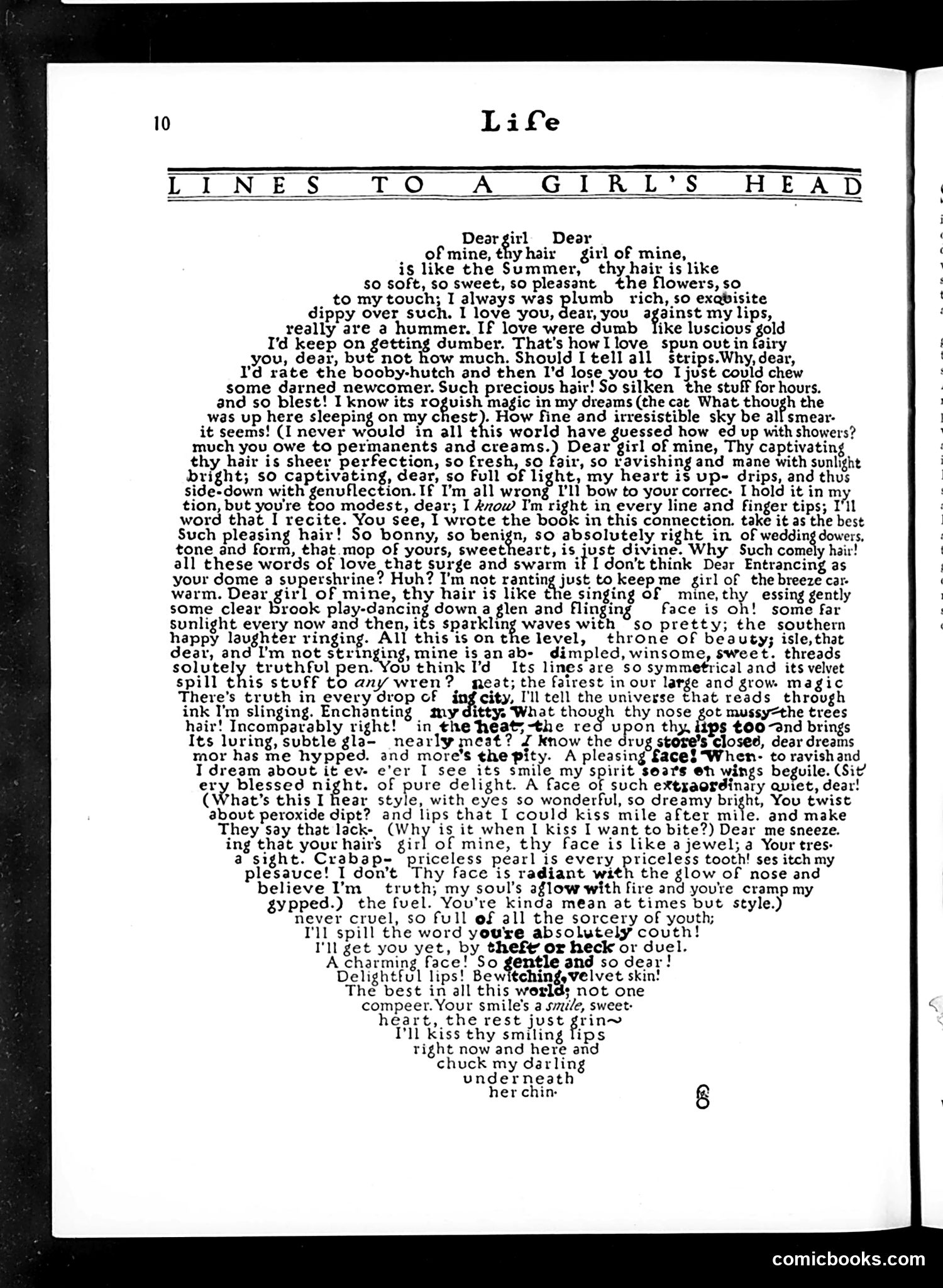
This page contains a romantic poem titled "Lines to a Girl's Head," presented as satirical verse in Life magazine's humorous style. The poem is an extended love letter praising a woman's physical attributes—her hair, face, skin, and smile—with exaggerated, flowery language typical of Victorian romantic poetry. The satire appears to mock overly sentimental love poetry and the conventions of praising women's beauty through elaborate metaphors (hair "like Summer flowers," face "like a jewel"). The poem's escalating intensity and occasional self-aware admissions (she's "kinda mean at times") suggest mockery of both idealized romance and male devotion. This represents Life magazine's typical humor: gently ridiculing social conventions and romantic sentimentality through parody.
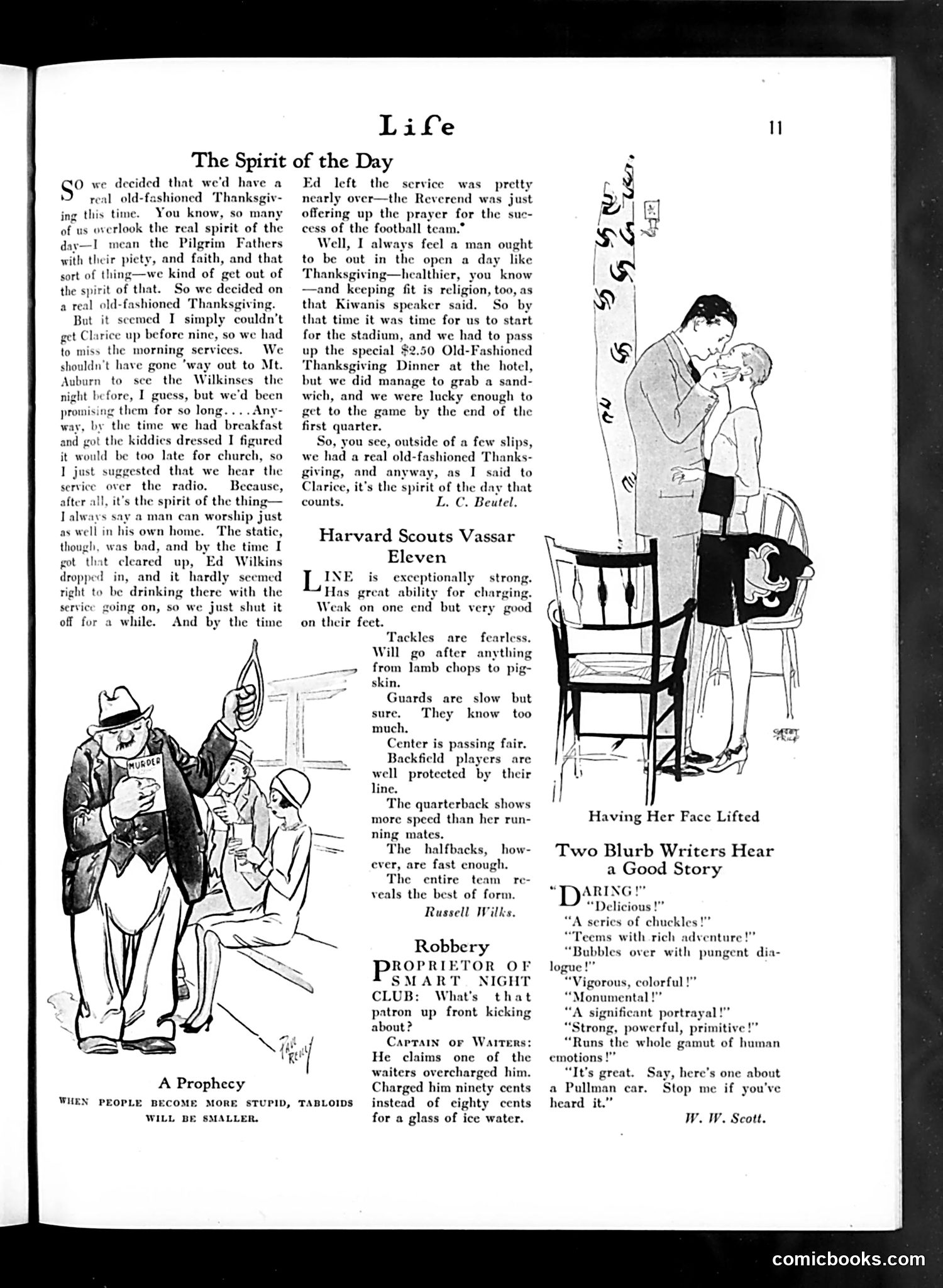
This page contains three satirical pieces: **"The Spirit of the Day"** (top left): An editorial essay by L.C. Beatel defending an old-fashioned Thanksgiving celebration that prioritized religious observance over modern convenience, even skipping church services to attend a football game. **"A Prophecy"** (bottom left): A cartoon showing a man in formal dress with a gun, captioned "When people become more stupid, tabloids will be smaller." This satirizes the inverse relationship between public intelligence and sensationalist media. **"Harvard Scouts Vassar Eleven"** and **"Two Blurb Writers Hear a Good Story"** (right side): These pieces appear to be light satirical commentary on collegiate sports culture and literary criticism, with humorous illustrations of young people. The page exemplifies Life magazine's satirical approach to American social customs and media culture.
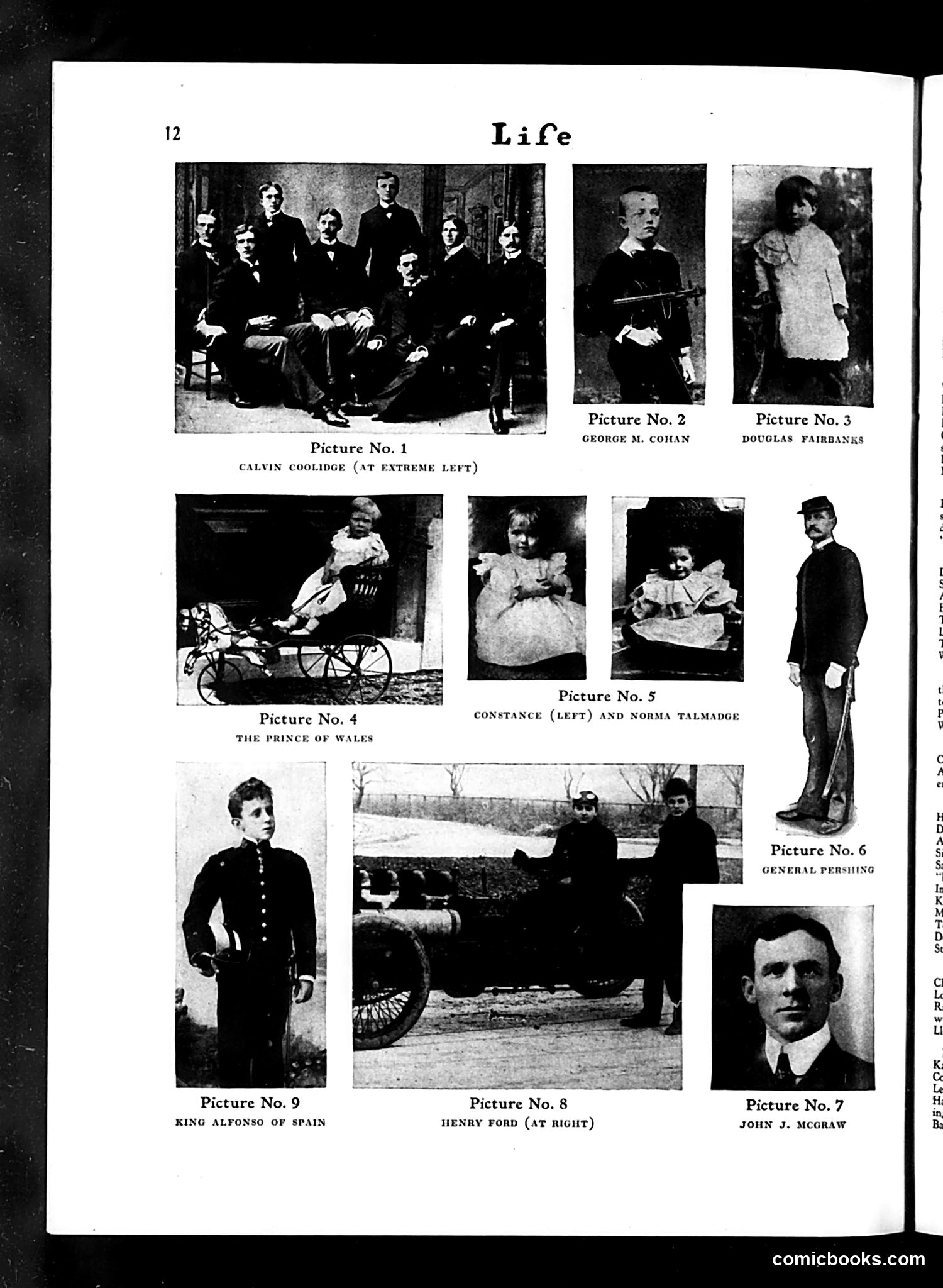
This page from *Life* magazine displays nine photographs of notable figures from the early 20th century, labeled as Picture No. 1 through No. 9. The identifications include Calvin Coolidge, George M. Cohan, Douglas Fairbanks, the Prince of Wales, Constance Talmadge, Norma Talmadge, General Pershing, Henry Ford, King Alfonso of Spain, and John J. McGraw. Rather than containing satirical cartoons, this appears to be a straightforward photo gallery showcasing prominent political leaders, entertainers, and public figures of the era. The mix of politicians, actors, and celebrities reflects *Life* magazine's focus on contemporary newsmakers and celebrities, presenting them to readers without apparent comedic intent or political commentary on this particular page.
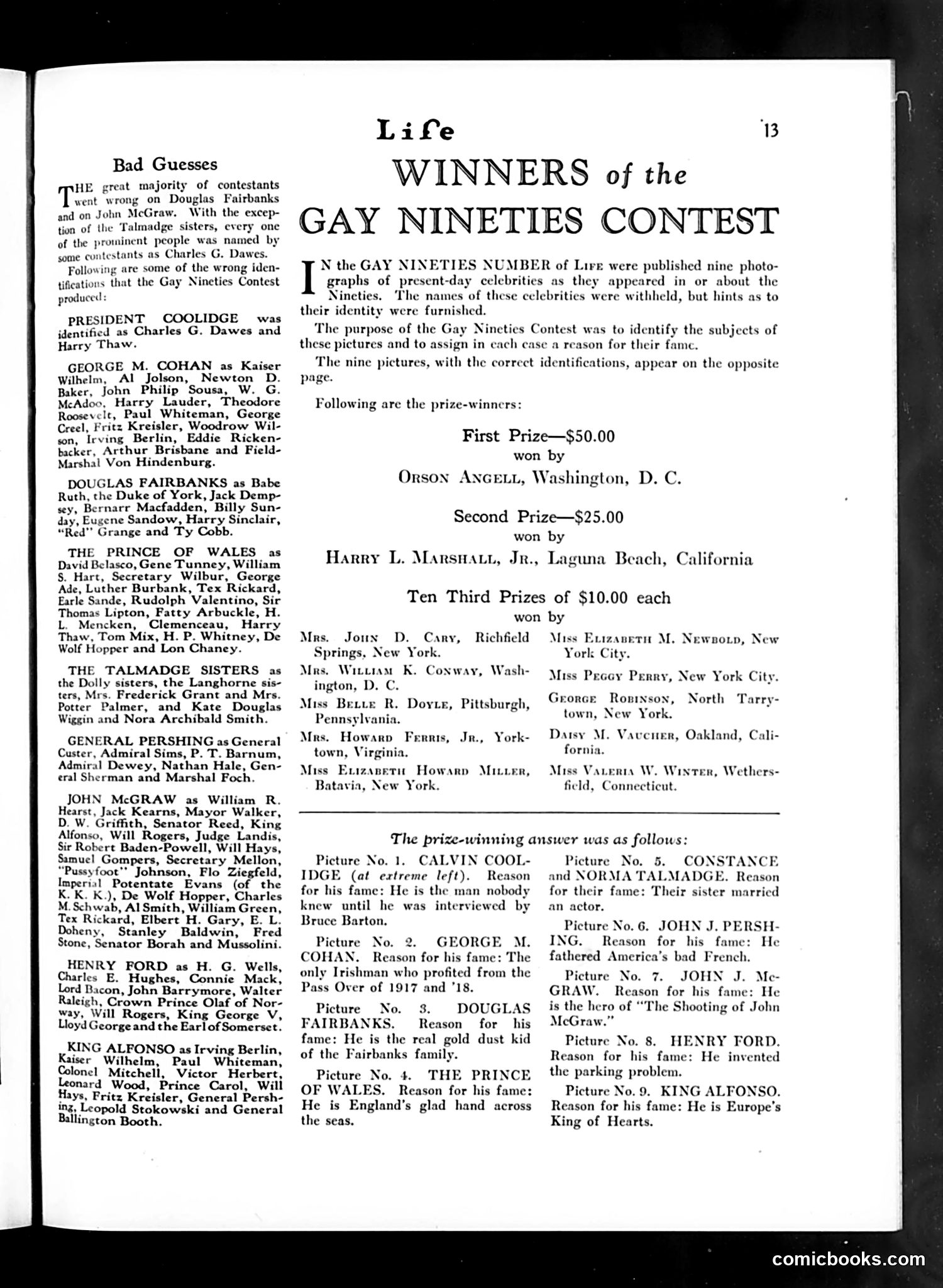
This page documents results of Life's "Gay Nineties Contest," where readers identified photographs of contemporary celebrities styled to resemble figures from the 1890s era. The contest featured nine mystery photographs of present-day celebrities in period costume. Readers competed to identify the subjects and explain their "fame." Winners received cash prizes ($50 for first place, $25 for second, $10 for ten third-place winners). The page lists winning identifications for nine pictures, including Calvin Coolidge, George M. Cohan, Douglas Fairbanks, the Prince of Wales, John J. Pershing, John McGraw, Henry Ford, and King Alfonso—all prominent public figures of the 1920s era. This represents lighthearted audience participation common in early Life magazine's satirical approach.
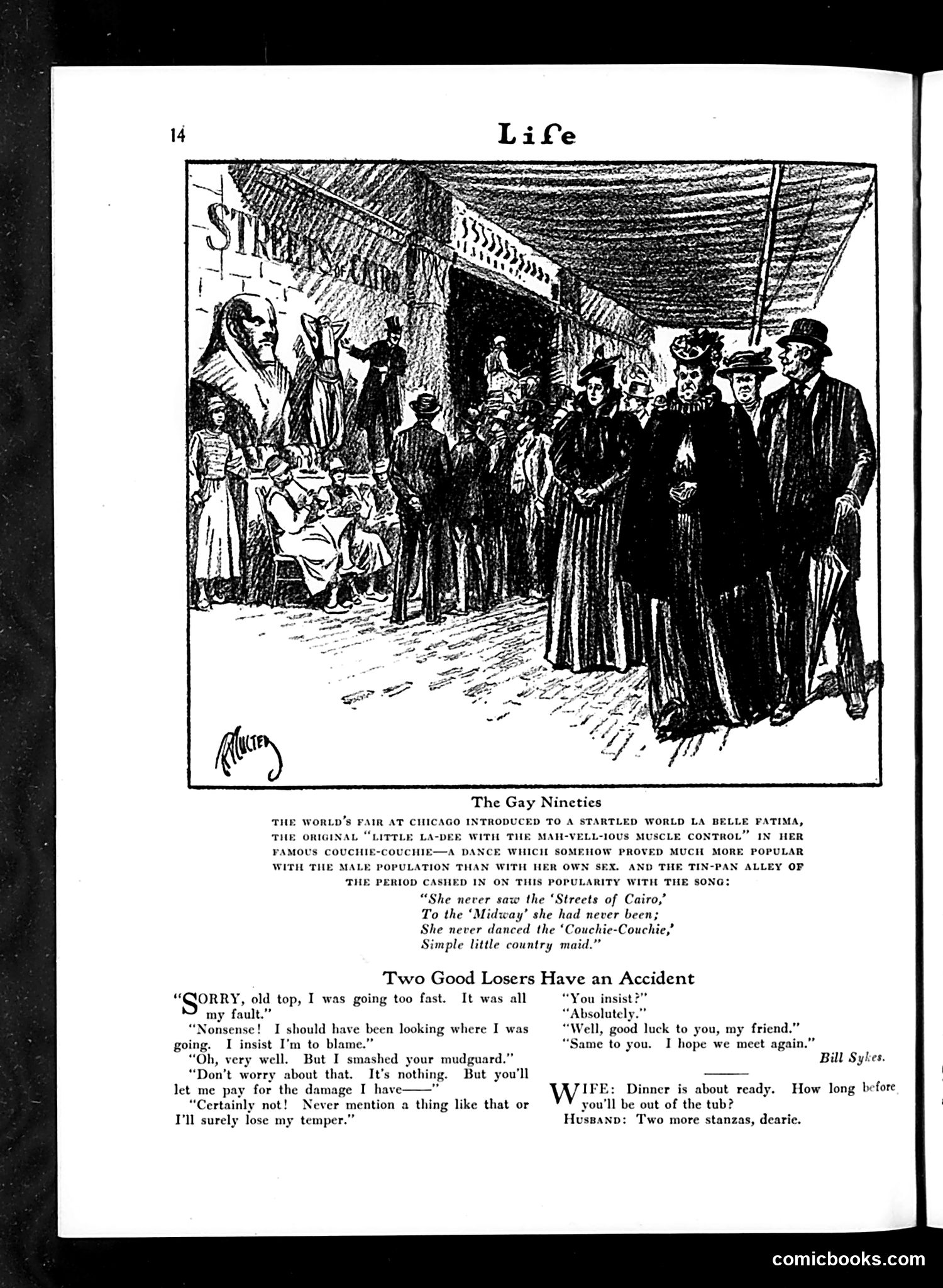
This page from *Life* magazine contains two separate items: **Top illustration** satirizes the 1893 World's Columbian Exposition in Chicago, which introduced American audiences to "La Belle Fatima" and her belly dance (the "Couche-Couche"). The cartoon mocks how this exotic dance captivated male visitors far more than female attendees, and how a tin-pan alley song capitalizing on the craze flooded the market. The verse notes a "simple country maid" never experienced such entertainment before the fair. **Bottom section** presents two brief comedic sketches: "Two Good Losers Have an Accident" depicts gentlemen handling a minor collision with grace and humor, exchanging cordial wishes. The second sketch shows domestic banter between husband and wife about dinner timing and bathing. Both exemplify period humor about masculine courtesy and marital dynamics.
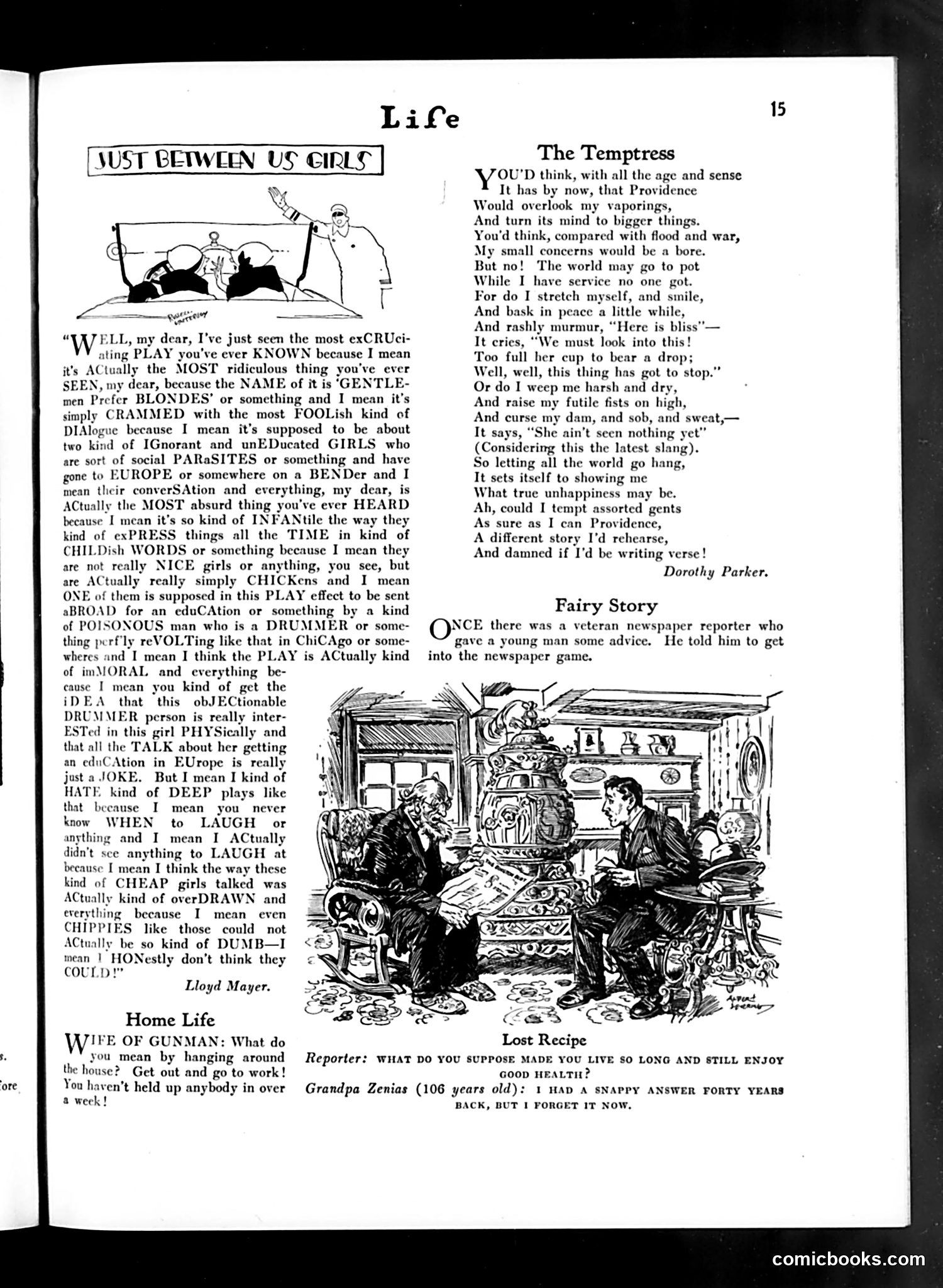
This column-style cartoon mocks contemporary attitudes toward women's theatrical productions and changing social norms. The speaker (signed Lloyd Mayer) sarcastically criticizes plays featuring "gentlemen blondes" and "infantile" behavior—likely referencing popular entertainment of the era. The satire targets both the productions themselves (portrayed as absurd and morally questionable) and audience tastes. References to European influence, "poisonous men" characters, and drumming suggest anxiety about modernized, cosmopolitan theater challenging traditional values. The piece reflects 1920s-era concerns about "cheap" popular entertainment, changing gender roles, and perceived European decadence infiltrating American culture through theater. The tone is dismissive toward contemporary female-oriented theatrical trends.
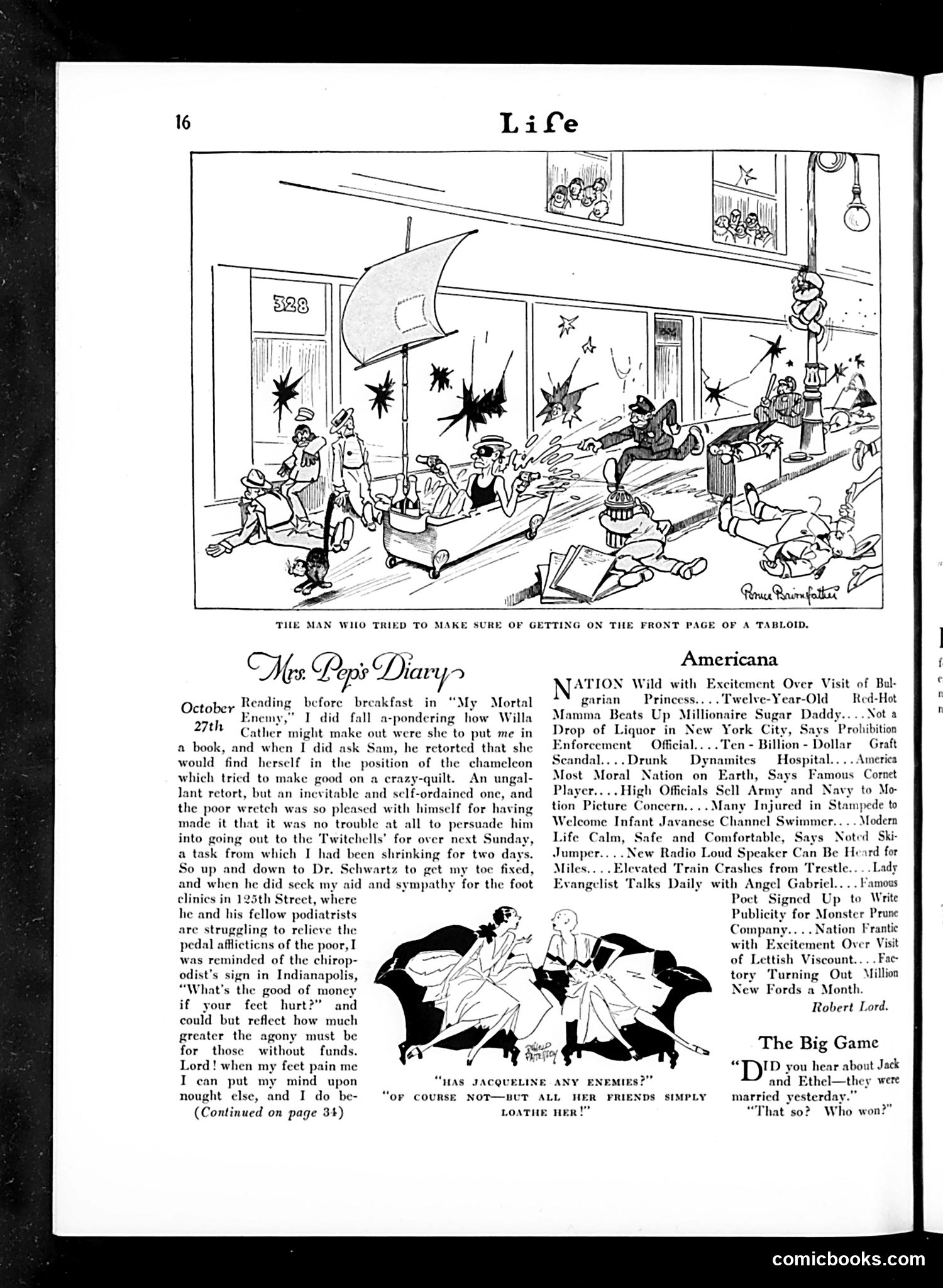
The top cartoon depicts "THE MAN WHO TRIED TO MAKE SURE OF GETTING ON THE FRONT PAGE OF A TABLOID." It shows a chaotic street scene with a figure creating mayhem—vehicles overturned, people scattered—apparently in an absurd attempt to generate sensational news coverage. This satirizes the era's tabloid journalism obsession and people's desperate hunger for publicity, mocking both the yellow press and publicity-seekers willing to cause disruption for headlines. The lower illustration accompanies "Mrs. Pep's Diary," a humor column about domestic life. The drawing shows a woman questioning a man ("Has Jacqueline any enemies?" / "Of course not—but all her friends simply loathe her!"), making a joke about the social hypocrisy of maintaining friendships with people one dislikes. Both pieces reflect 1920s-era concerns about media sensationalism and social pretense.
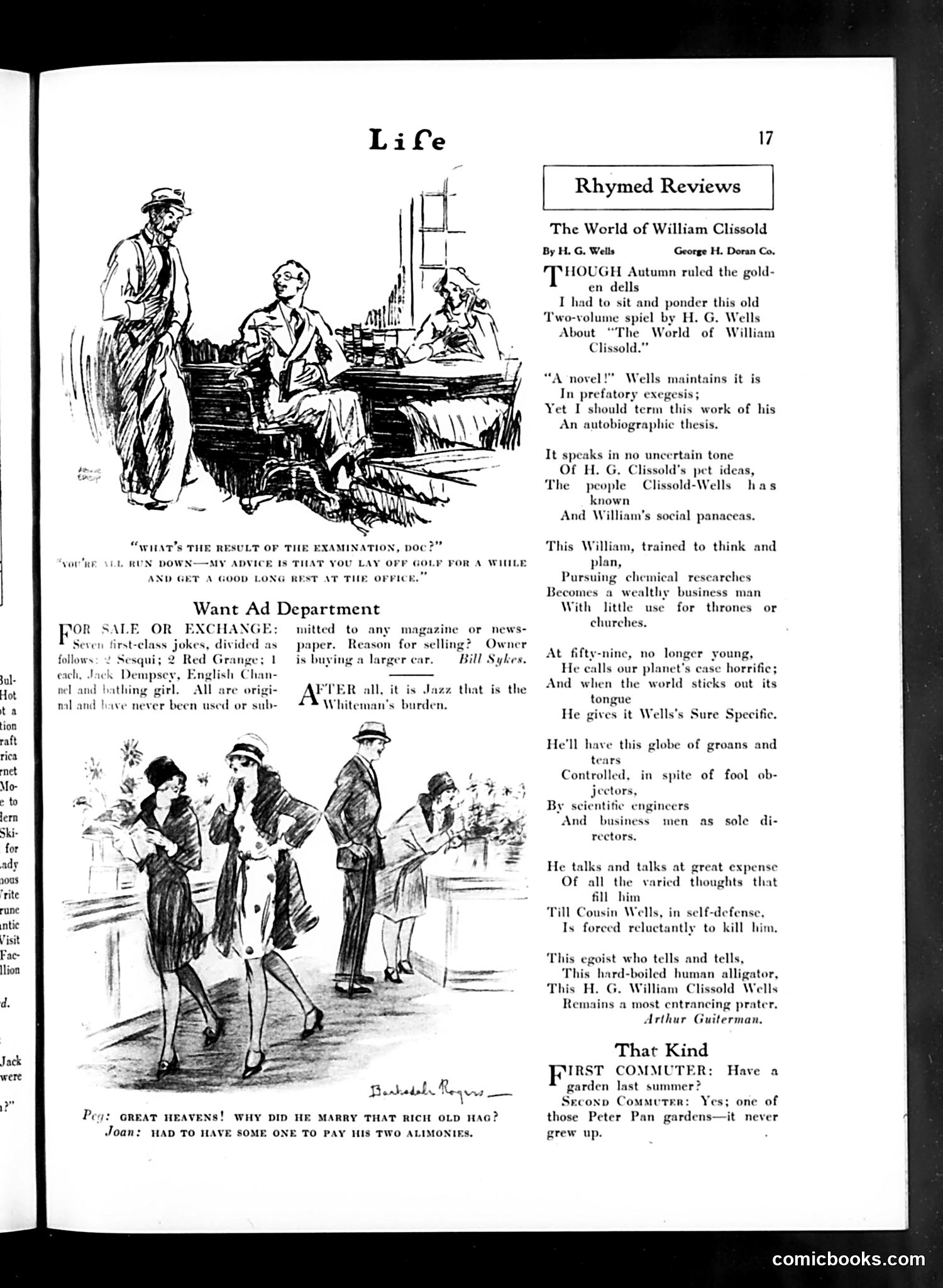
This page contains two unrelated items: **Top cartoon**: Shows a doctor telling an exam-taker to "lay off golf for a while and get a good book kept in the office." The joke satirizes white-collar workers' obsession with golf as recreation, suggesting they prioritize leisure over intellectual self-improvement. **Bottom cartoon & caption**: Depicts men in formal attire with women, with the caption asking why a wealthy man married a poor woman when "he had to have some one to pay his two alimonies." This jokes bitterly about divorce and remarriage—suggesting the man married for money precisely because he owed spousal support to previous wives. It mocks both infidelity and the financial consequences of multiple divorces among the wealthy. Both reflect 1920s concerns about leisure, class, and changing marriage customs.
This editorial page discusses Frank Buckman (called "F.B."), a religious figure being scrutinized at Princeton University for his spiritual influence on students. The piece defends Buckman's work of transforming people's values and motivations. The editorial pivots to argue that society desperately needs such moral reformation. It then uses the **Sacco and Vanzetti case** as a prime example—two Italian immigrants convicted of murder, facing execution despite widespread doubt about their guilt. The writer suggests Judge Thayer (who presided over their trial) exemplifies someone who needs moral recalibration; having witnessed the convicted men, even he now has "unwillingness" about their execution. The piece argues Massachusetts deserves credit for reconsidering the case due to reasonable doubt, comparing it to other expensive trials (like England's Parnell trial) that proved justice was functioning properly by catching potential errors. This reflects genuine 1926 anxiety about the Sacco-Vanzetti executions (carried out August 1927), which many viewed as a miscarriage of justice tied to anti-immigrant prejudice.
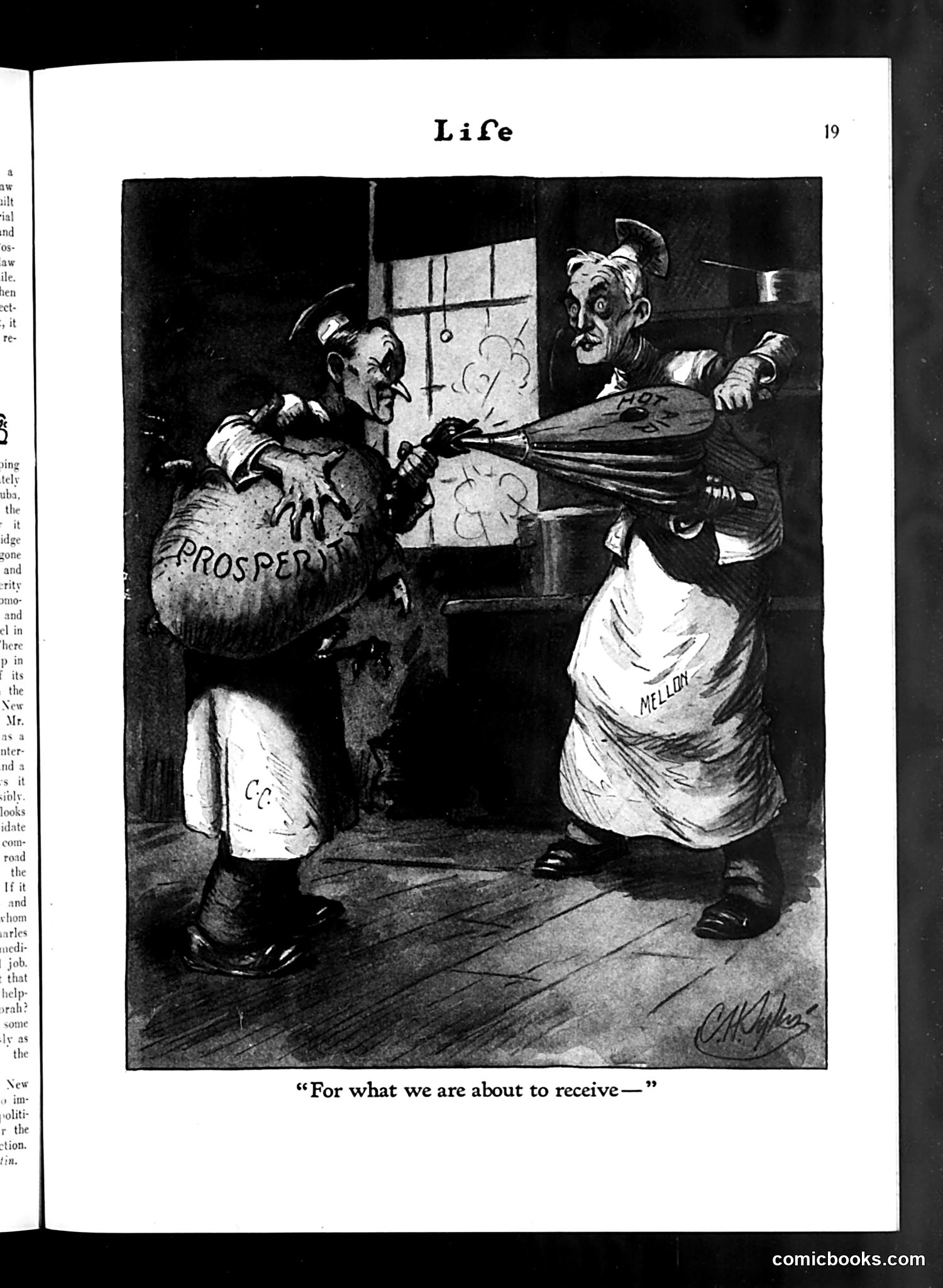
This is a satirical cartoon from *Life* magazine depicting two grotesque figures in what appears to be a corrupt transaction. The figure on the left is labeled "PROSPERITY" (marked with a bag), while the one on the right wears an apron labeled "MELLON" (likely Treasury Secretary Andrew Mellon). A third figure labeled "CO." is visible in the background. The cartoon satirizes wealthy financial interests exploiting "Prosperity" for personal gain. The caption—"For what we are about to receive—"—suggests ironic commentary on unequal distribution of economic benefits, implying that ordinary citizens will receive little while wealthy industrialists and politicians enrich themselves. This likely critiques 1920s-era tax policies and the concentration of wealth among the wealthy and politically connected.
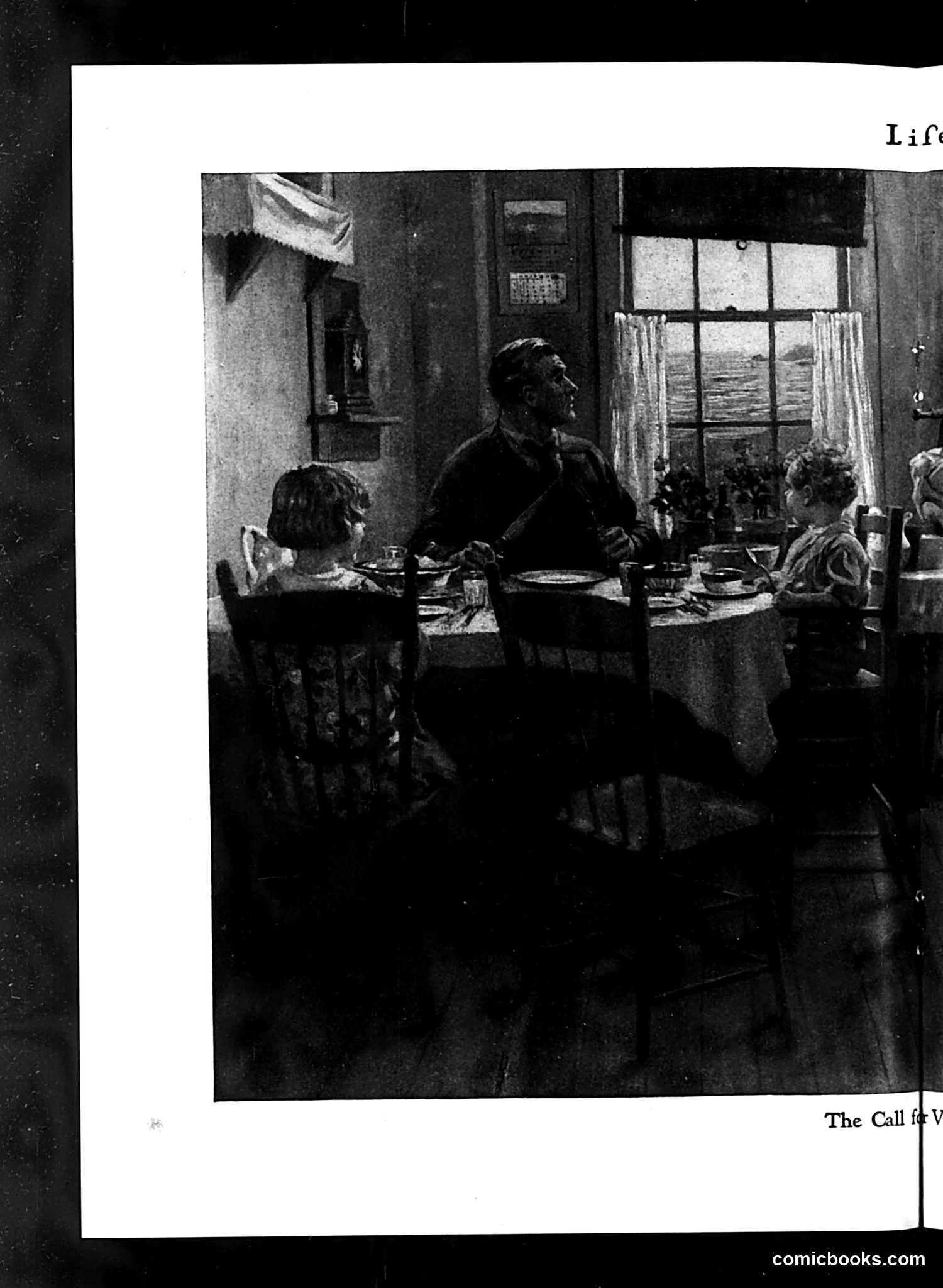
This appears to be a scene from a dramatic work or film still rather than a political cartoon. The black-and-white photograph shows a dining room scene with several figures seated at a table near a window. A man in dark clothing stands centrally, while others are seated around him. The caption reads "The Call f V" (text appears cut off), suggesting this illustrates a dramatic moment from a narrative work titled something like "The Call for..." Without additional context or visible captions identifying the figures or the specific work being referenced, I cannot definitively explain what political or social satire this represents. The image alone does not clearly convey satirical intent or identify specific historical figures being caricatured. More information would be needed to interpret this page's meaning for a modern reader.
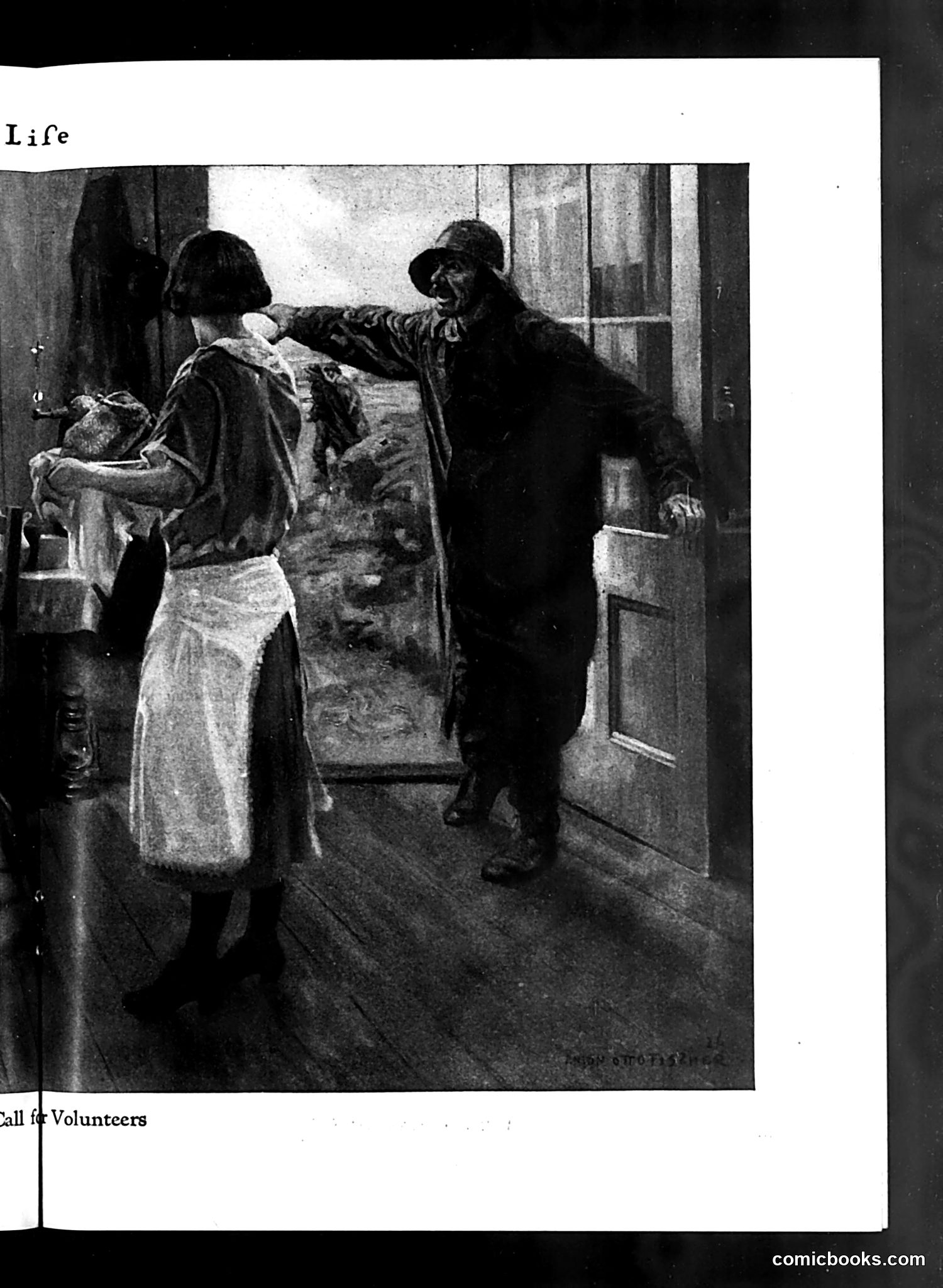
This black-and-white photograph shows a domestic scene in what appears to be a modest home or institution. An older man in a hat and dark coat gestures toward or examines a young woman holding a child. The caption "Call for Volunteers" suggests this is satirizing some kind of social appeal or recruitment effort. Without additional context or visible date information, the specific historical reference remains unclear. However, the image appears to critique either a charitable organization, public health initiative, or social program by showing its actual conditions—presenting the gap between what such "calls" promise and the reality depicted. The composition emphasizes the modest circumstances of those being served or recruited.
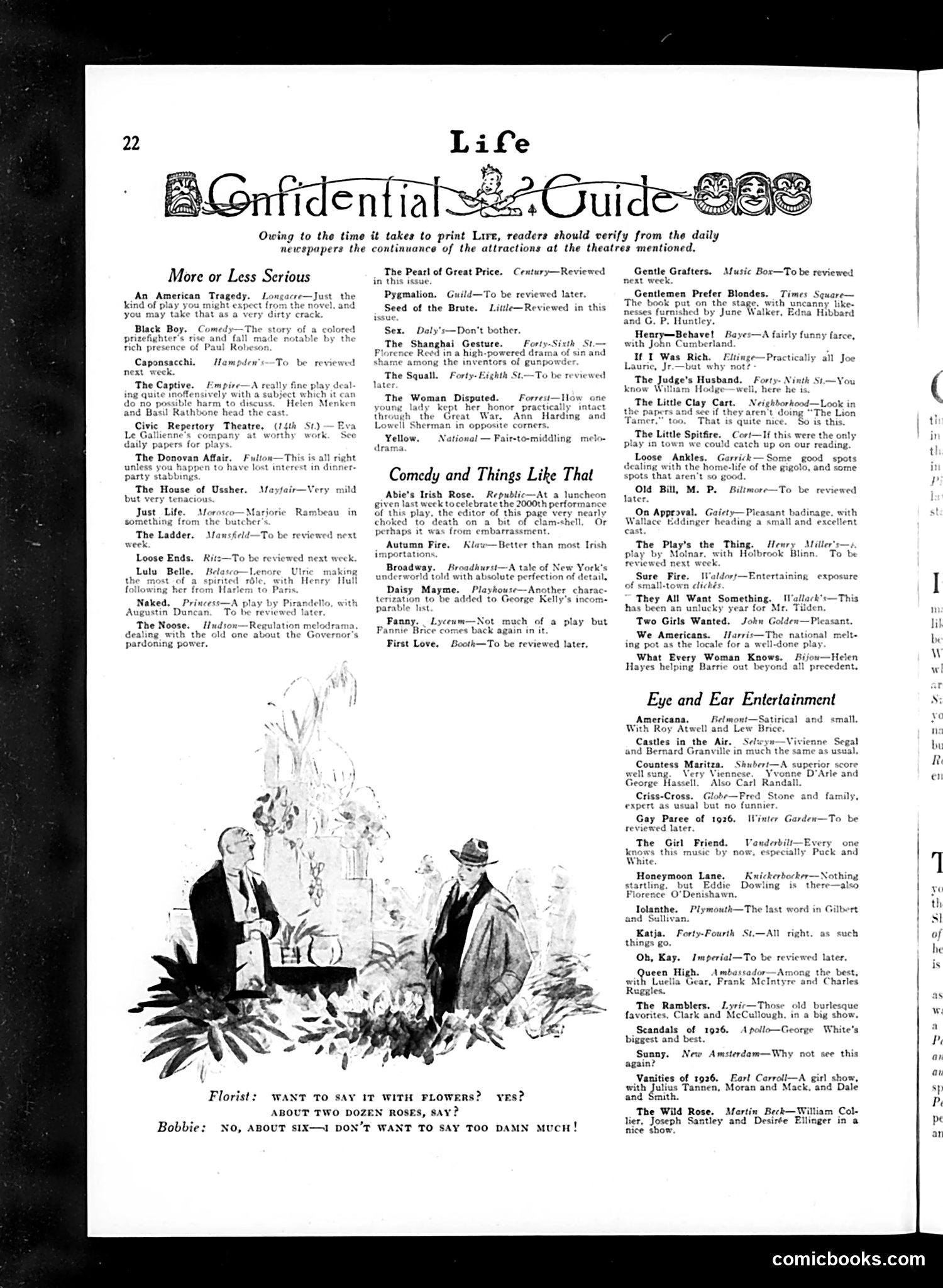
This page is primarily a **theater review guide**, not a political cartoon. The single cartoon depicts a florist and customer ("Bobbie") in a humorous domestic exchange about buying roses. **The Joke:** The florist asks if Bobbie wants to "say it with flowers"—a popular advertising slogan of the 1920s—and suggests two dozen roses. Bobbie deflates the romance, refusing to spend that much money, saying "I don't want to say too damn much!" **The Satire:** This mocks the commercialization of sentiment—the era's trend of marketing flowers as a way to express emotions. Bobbie's crude, stingy response undercuts the florist's romantic pitch, suggesting that affection (and apology) has practical economic limits. The humor lies in the gap between sentimental marketing language and working-class financial reality. The rest of the page lists Broadway shows and entertainment venues, with brief critical notes—standard magazine content of the period.
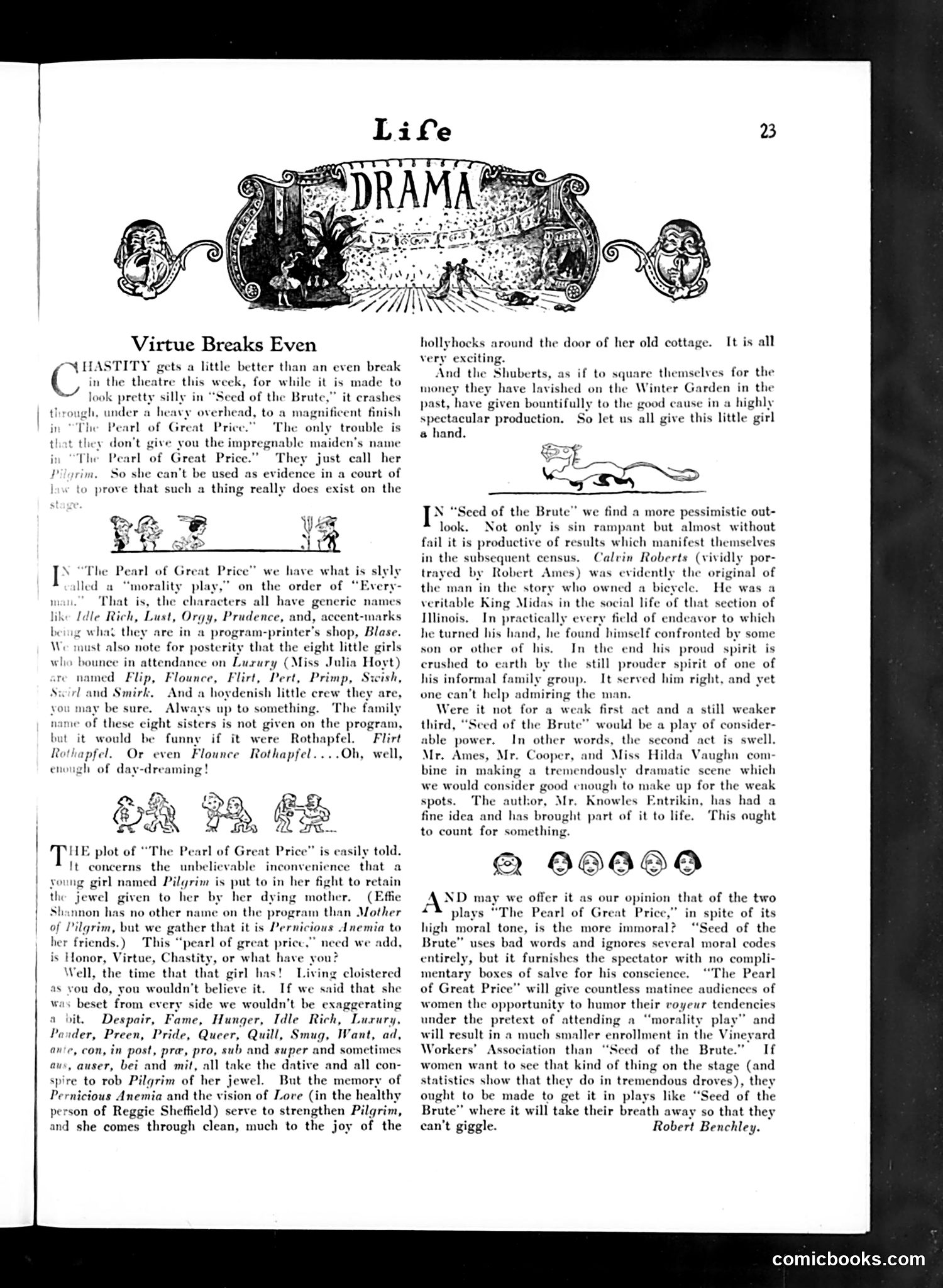
This page reviews two Broadway plays with moral themes. "The Pearl of Great Price" dramatizes a young woman named Pilgrim defending her chastity (symbolized as a jewel) against personified vices—Despair, Fame, Hunger, Lust, Pride, and others. The satire mocks the play's heavy-handed moralism: characters have obvious allegorical names (Virtue, Chastity, Idle Rich), and eight attendant girls are named Flip, Flounce, Flirt, Pert, etc. The reviewer notes wryly that the protagonist's real name isn't even given, so she can't serve as legal evidence that virtuous maidens exist. "Seed of the Brute" takes a darker view: a man's sexual conquests produce illegitimate children who ultimately destroy him. The reviewer finds the second act powerful but the first act weak. The satire targets both theatrical moralizing and contemporary anxieties about sin, sexuality, and social consequences—suggesting such melodramas oversimplify complex human behavior while paradoxically attracting audiences craving moral instruction.
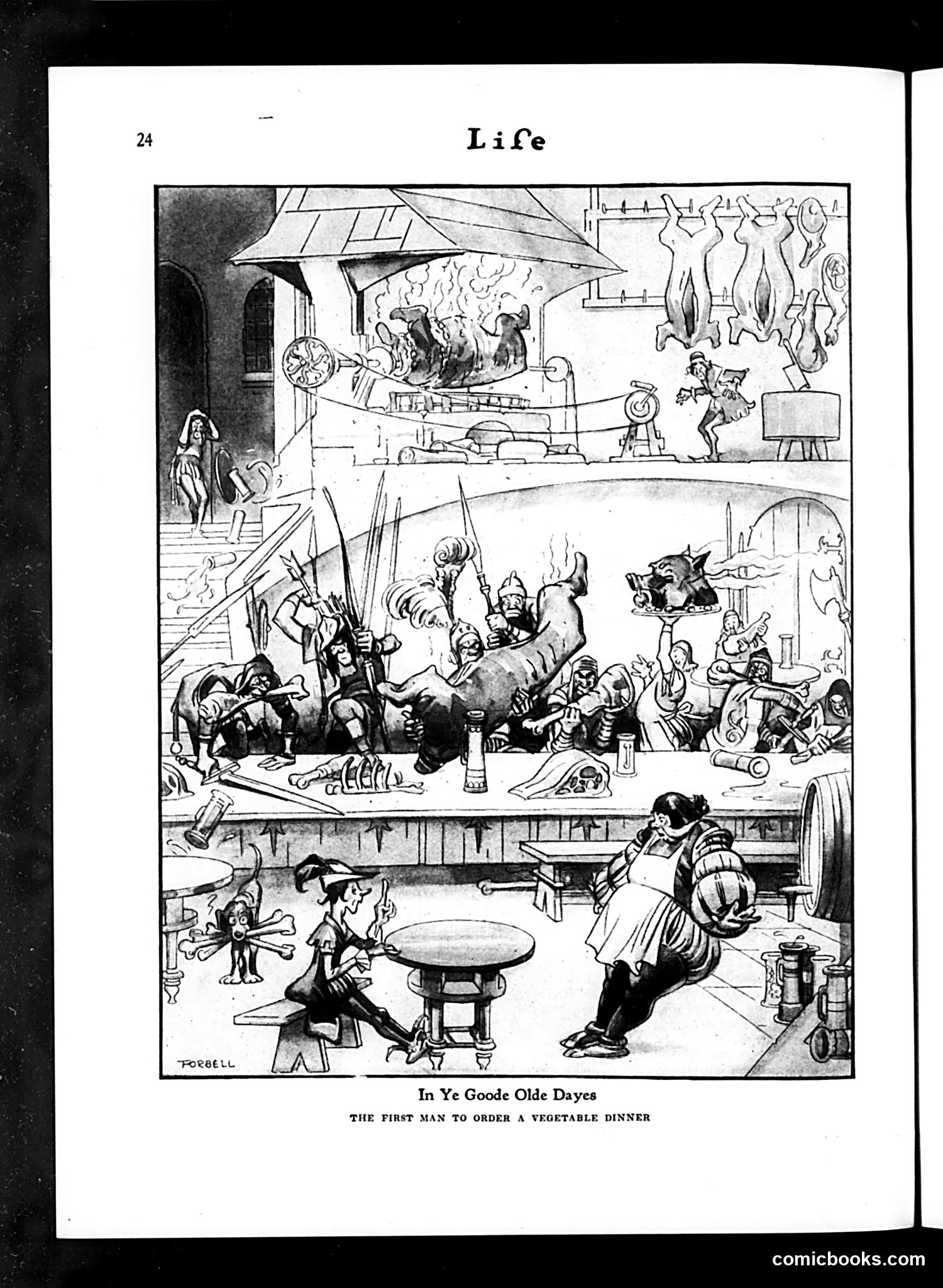
This is a humorous historical satire titled "In Ye Goode Olde Dayes" depicting "The First Man to Order a Vegetable Dinner." The cartoon shows a multi-level scene set in what appears to be a medieval or Tudor-era tavern or feast hall. The joke satirizes the absurdity of ordering only vegetables in an era when meat was the centerpiece of dining, particularly for men. The upper levels show typical feasting with roasted animals and revelry, while the lower level shows a single man attempting to order vegetables—presented as such an outlandish request that it's treated as a historical oddity worthy of commemoration. The satire likely reflects early 20th-century attitudes about masculinity and dining, mocking vegetarianism as an unnatural, unmanly choice by contrasting it with traditional hearty meat-eating culture. The detailed period setting emphasizes how counter to historical dining practices such restraint would have been.
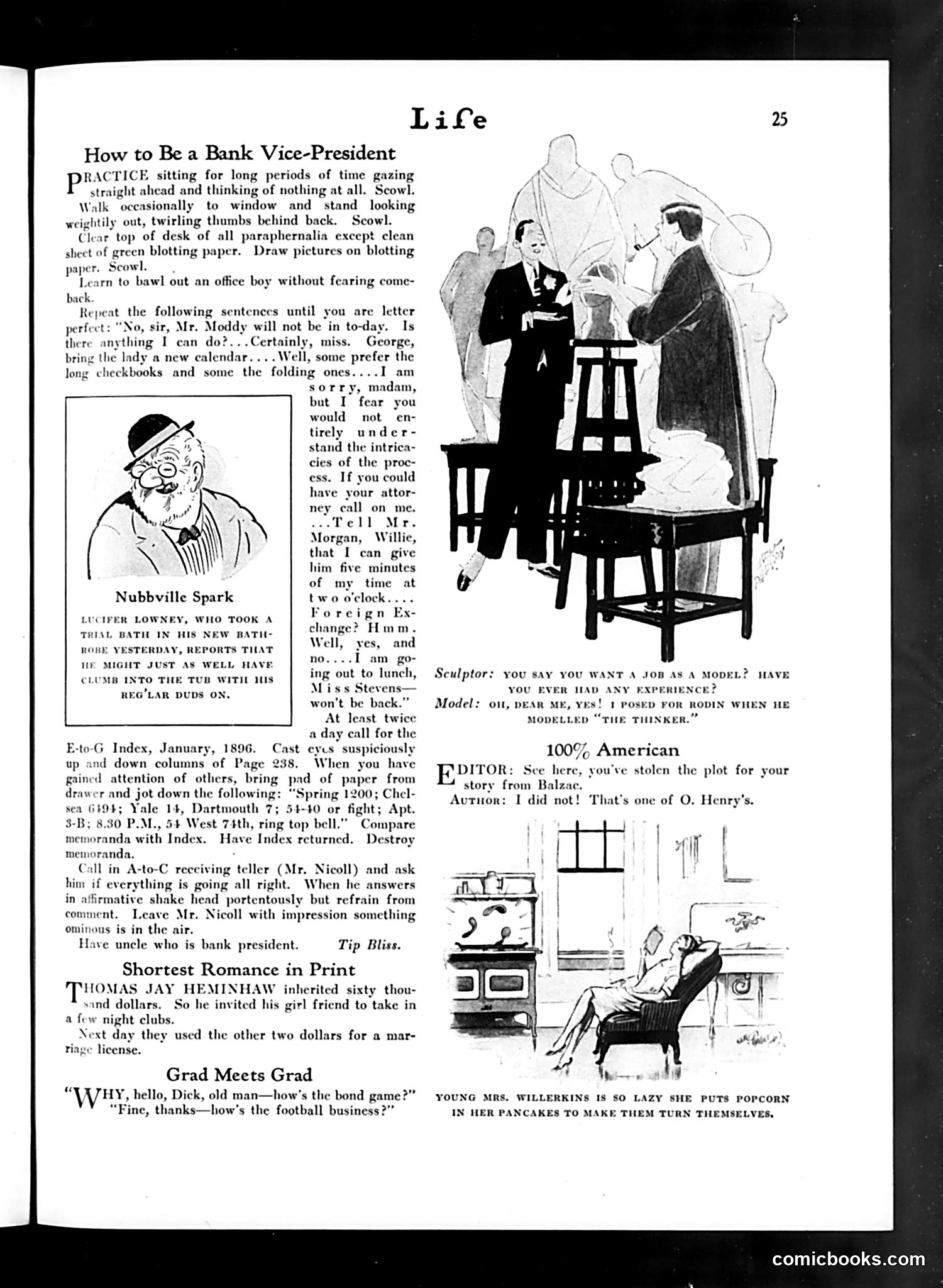
This page from *Life* magazine (circa 1896) contains several humorous vignettes satirizing American society: **"How to Be a Bank Vice-President"** mocks corporate bureaucracy by offering absurd instructions: sit idle, scowl constantly, keep a bare desk, intimidate subordinates, and repeat meaningless corporate phrases. The satire suggests bank executives succeed through affectation and pretense rather than actual competence. The final line—"Have uncle who is bank president"—reveals the joke's point: nepotism, not merit, determines advancement. **"Shortest Romance in Print"** jokes about financial irresponsibility: a wealthy man squanders his inheritance on nightlife with his girlfriend, leaving only two dollars for their marriage license. **Other brief items** (the sculptor/model exchange, the "Grad Meets Grad" dialogue, the laziness joke) are quick one-liners typical of *Life's* format. The overall tone satirizes Gilded Age American institutions—banking, social climbing, and romantic folly—through exaggeration and absurdist humor.
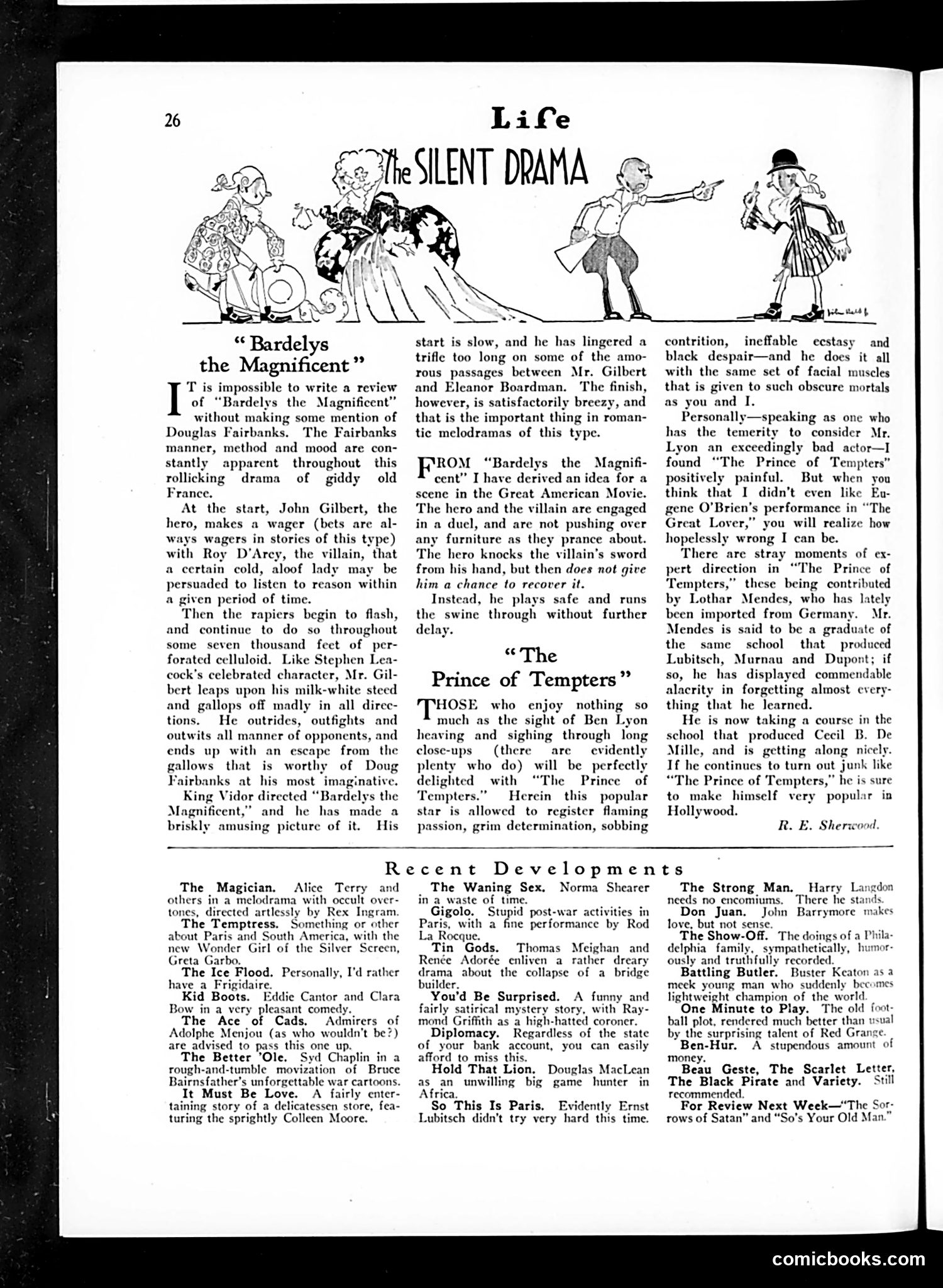
This page reviews three silent films from the 1920s. The top cartoon satirizes the conventions of silent film melodrama—showing exaggerated action poses typical of the era. **"Bardelys the Magnificent"** stars John Gilbert in a swashbuckling French period piece directed by King Vidor. The reviewer credits Douglas Fairbanks' influence on the film's style, noting Gilbert's constant leaping, fighting, and narrow escapes. The critic cleverly proposes an idea for "The Great American Movie": a hero who, instead of the typical theatrical gesture of returning a sword to his opponent, simply kills him directly—mocking the artificial conventions of silent melodrama. **"The Prince of Tempers"** features Ben Lyon, whom the reviewer frankly calls "an exceedingly bad actor." Despite Lyon's histrionic display of emotions (passion, determination, ecstasy, despair), the critic finds the film painful. He sarcastically praises director Lothar Mendes for supposedly studying under great German directors like Lubitsch and Murnau—yet failing to learn anything. The tone throughout is witty, dismissive, and insider-focused on Hollywood conventions.
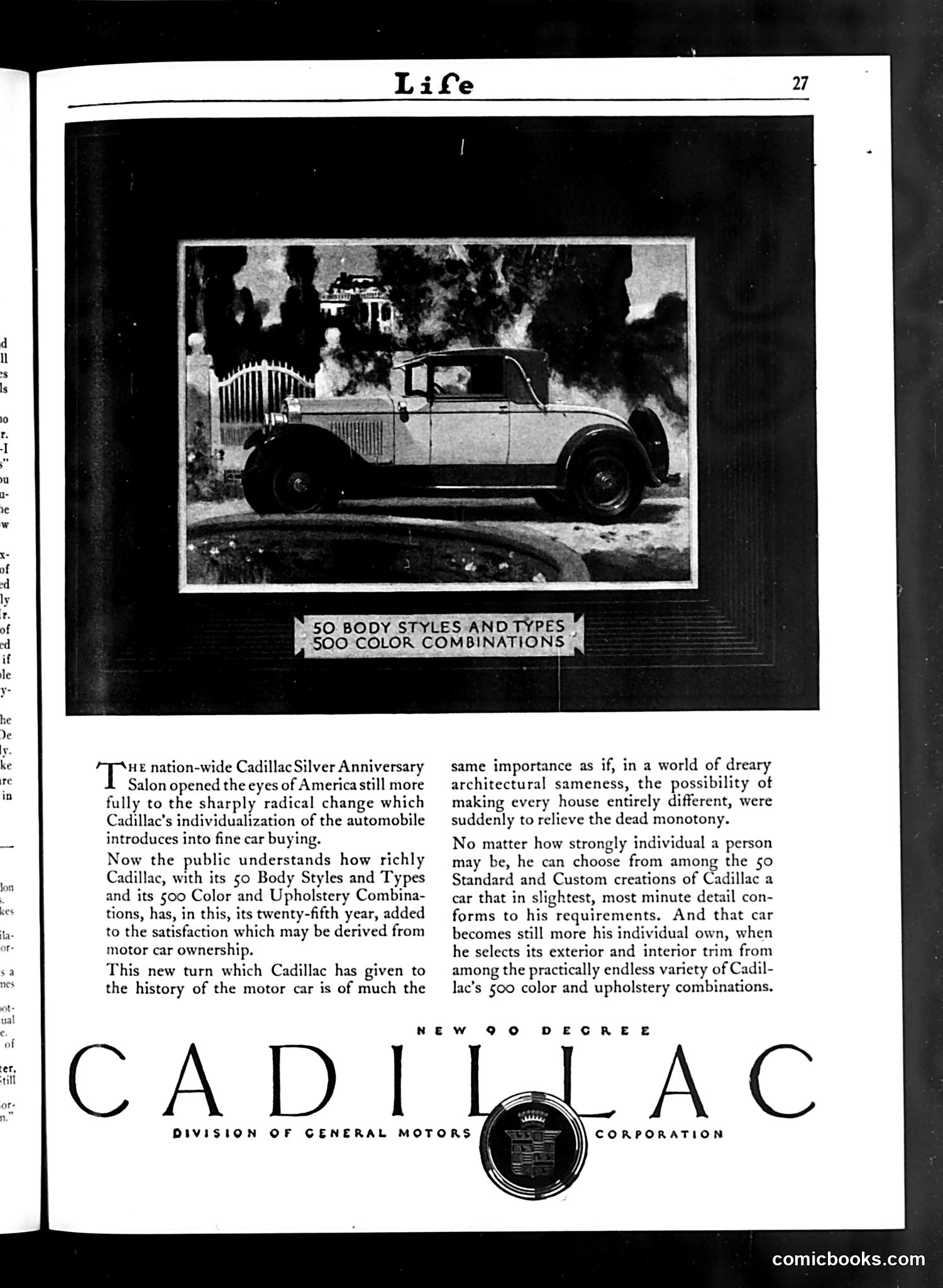
This is a **Cadillac automobile advertisement**, not political satire or a cartoon. It appears in *Life* magazine's advertising section (page 27). The ad promotes Cadillac's "Silver Anniversary" (25th year) by emphasizing consumer choice: 50 body styles and 500 color/upholstery combinations. The text frames this customization as revolutionary—comparing it to architectural individuality breaking monotonous uniformity. For modern readers: This reflects 1920s-30s **mass production marketing philosophy**. While Henry Ford famously offered Model Ts in any color "as long as it is black," Cadillac (GM's luxury division) positioned itself as offering personal expression through options. The underlying message appeals to American individualism while actually selling standardized vehicles with cosmetic variations—a strategy that became standard automotive marketing. The photograph shows a period roadster parked in front of a mansion, reinforcing the luxury positioning.
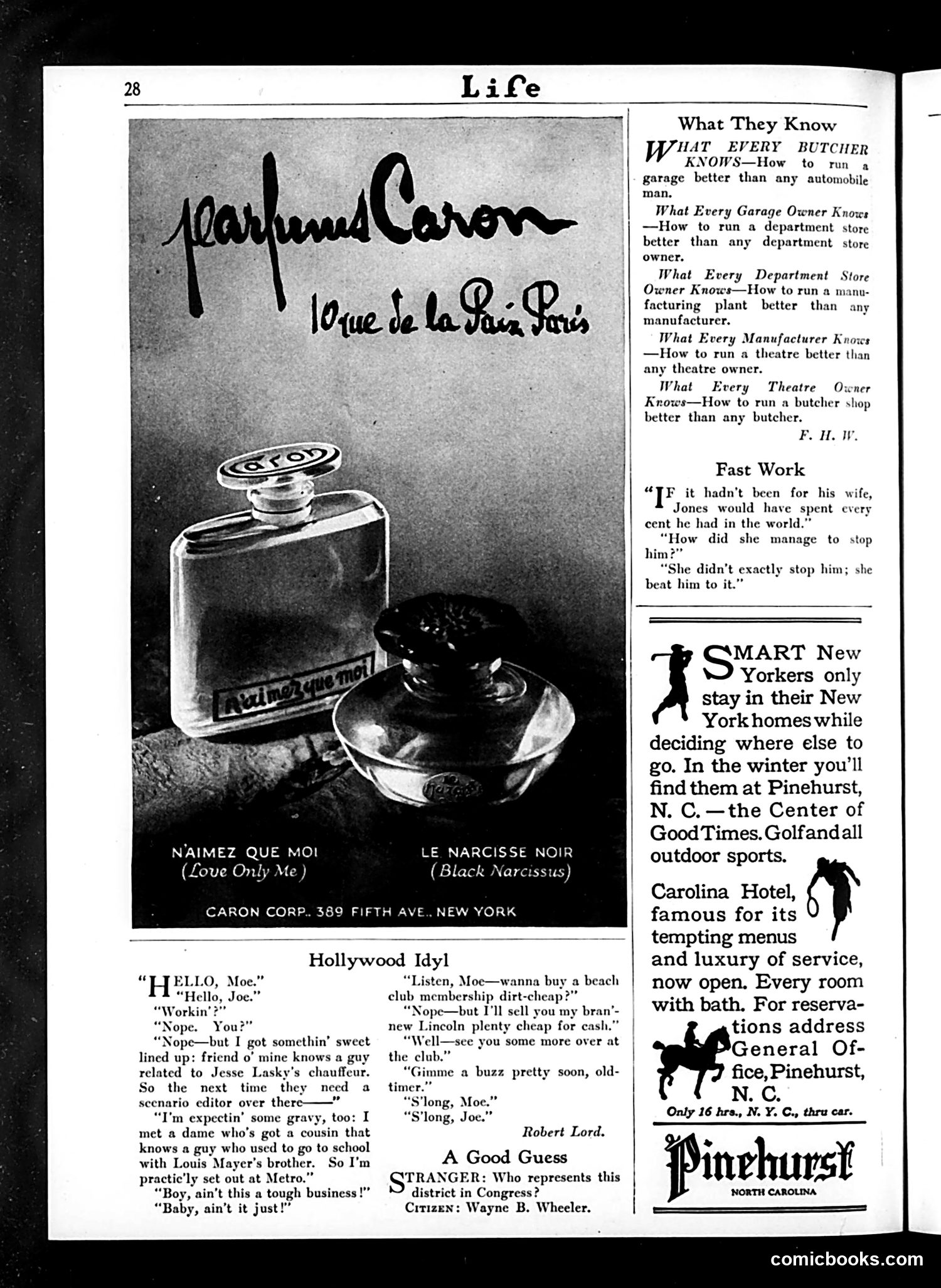
This page mixes advertising with satirical content about 1920s American society. **The Main Cartoon ("Hollywood Idyl")** by Robert Lord mocks aspiring screenwriters in Hollywood who rely entirely on nepotism and connections rather than talent. Moe and Joe discuss their prospects—neither has actual work, but both expect jobs through distant relatives of studio executives (Jesse Lasky's chauffeur, Louis B. Mayer's brother). The satire is that these men view the film industry as utterly corrupt, where access matters infinitely more than ability. **"What They Know"** satirizes professional arrogance—each tradesman (butcher, garage owner, department store owner, etc.) believes they could run a completely different business better than actual professionals, revealing widespread overconfidence. **"A Good Guess"** appears to reference Prohibition-era politics: Wayne B. Wheeler was a famous Prohibition advocate and Anti-Saloon League leader, suggesting citizens confuse prominent activists with elected representatives. The page reflects 1920s anxieties about corruption, nepotism in emerging industries, and Prohibition's cultural dominance.
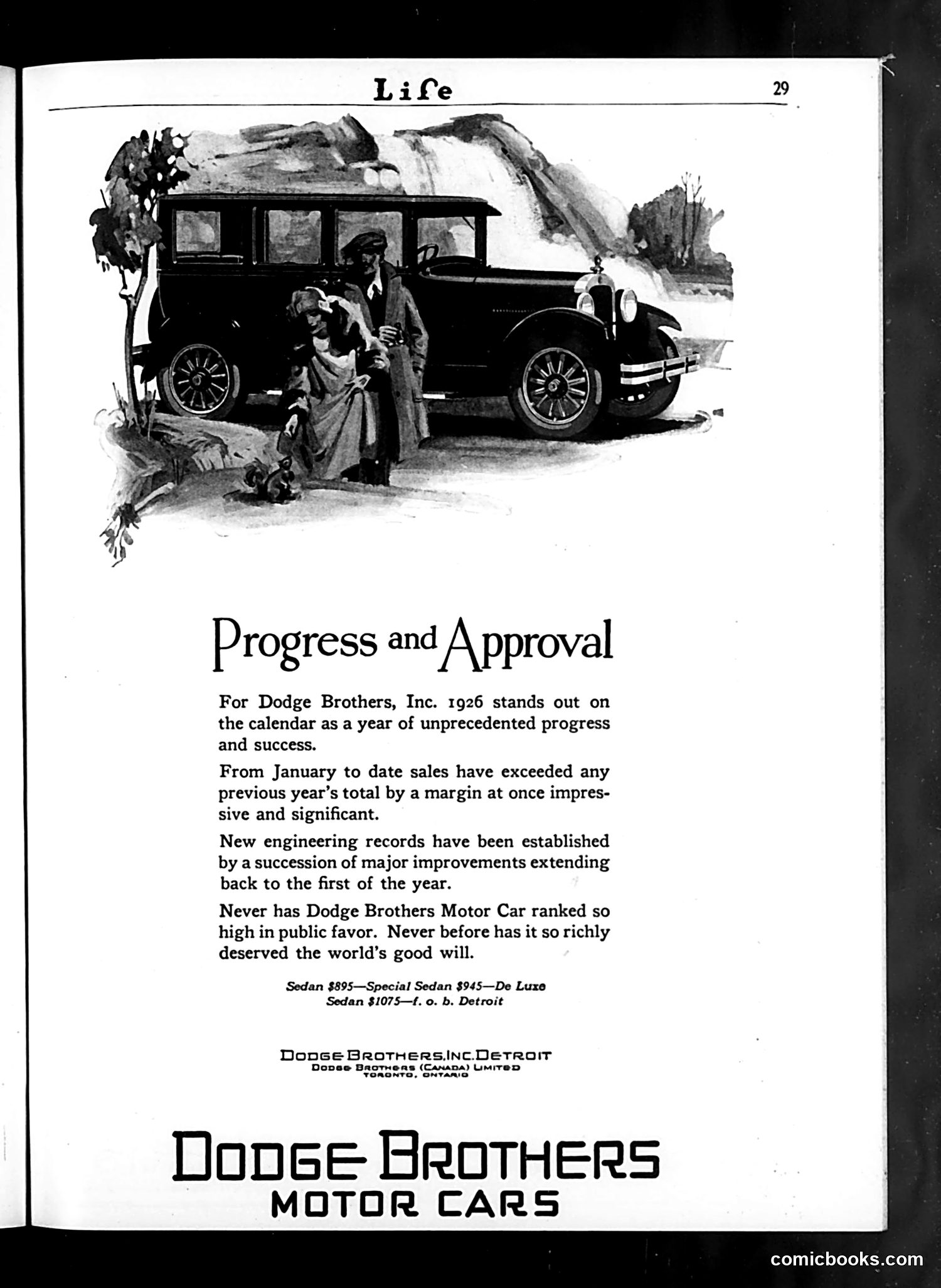
This is **not a satirical cartoon but a straightforward automobile advertisement** for Dodge Brothers Motor Cars, appearing in Life magazine's 1926 issue. The illustration shows a luxury sedan with well-dressed passengers—a couple standing beside the vehicle in what appears to be a scenic, mountainous setting. The ad emphasizes Dodge Brothers' commercial success: sales exceeding previous records, engineering improvements, and high public approval. The pricing ($895-$1,075) and Detroit location anchor this as genuine marketing copy targeting middle-to-upper-class consumers during the 1920s economic boom. Life magazine regularly mixed satirical editorial content with paid advertisements; this page represents the latter. There is **no political satire or social commentary** here—simply promotional messaging celebrating the company's prosperity during a prosperous year in American automotive history.
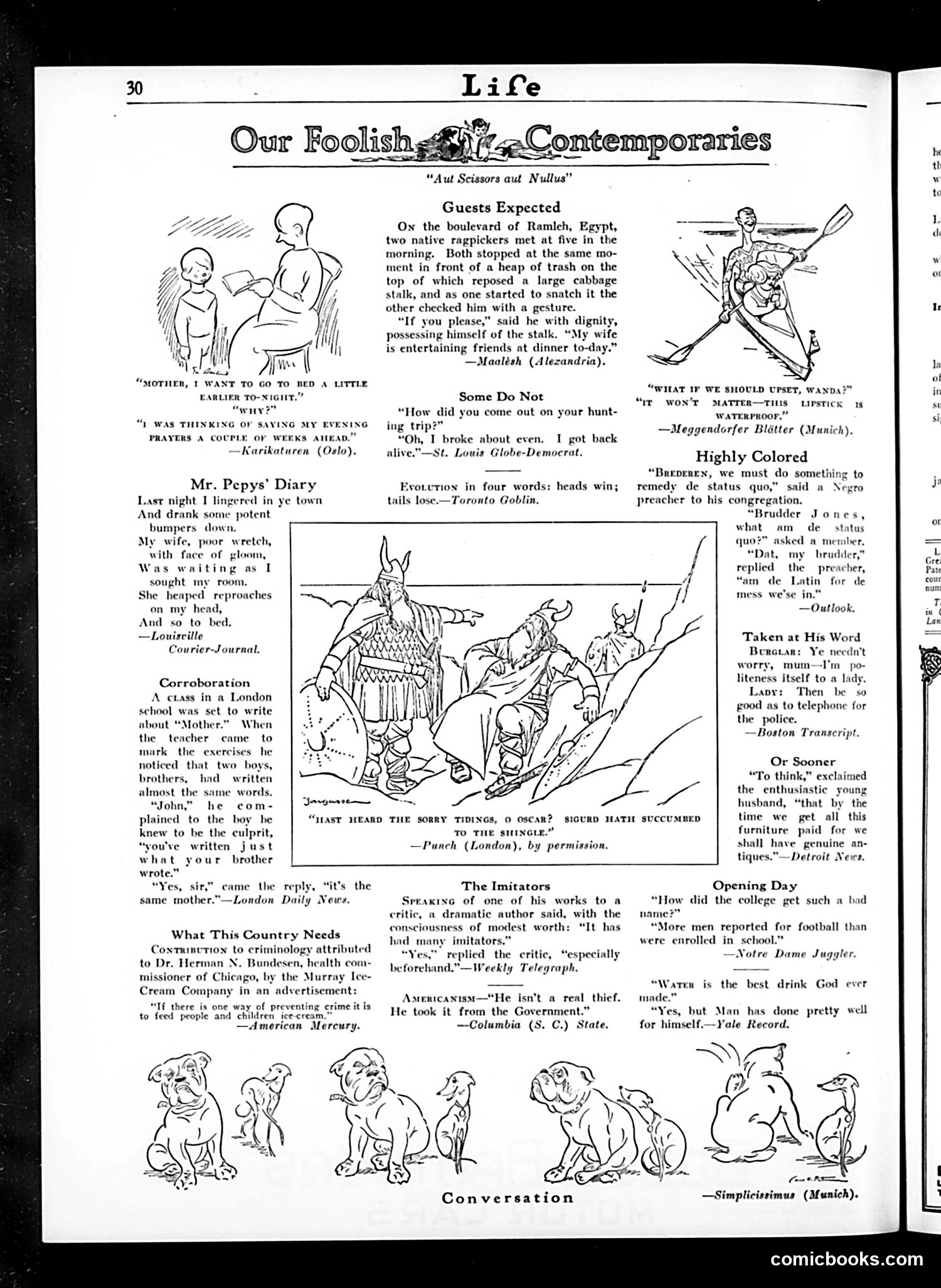
This page from *Life* magazine collects international humorous observations and cartoons, typical of the publication's satirical format. Key content includes: **Social Commentary:** - A Norwegian cartoon jokes about prayer timing—suggesting religious devotion as escape from domestic tension - A "Mr. Pepys' Diary" parody mocks the classic diary form with mundane complaints about a nagging wife - Multiple jokes mock pretension: Egyptian ragpickers claiming dignity over trash; a couple discussing waterproof lipstick during romance **Period Satire:** - A London school anecdote ridicules schoolboy excuses and sibling dishonesty - Chicago health commissioner's quote (mocking crime prevention via ice cream) satirizes naive bureaucratic solutions - A Negro preacher's malapropism ("status quo" misunderstood) relies on ethnic humor typical of 1920s-30s magazines **International Humor:** Cartoons credited to Munich, London, and Oslo reflect *Life's* cosmopolitan readership and sourcing. The overall effect: gentle mockery of matrimonial discord, bureaucratic folly, and social pretension across cultures.
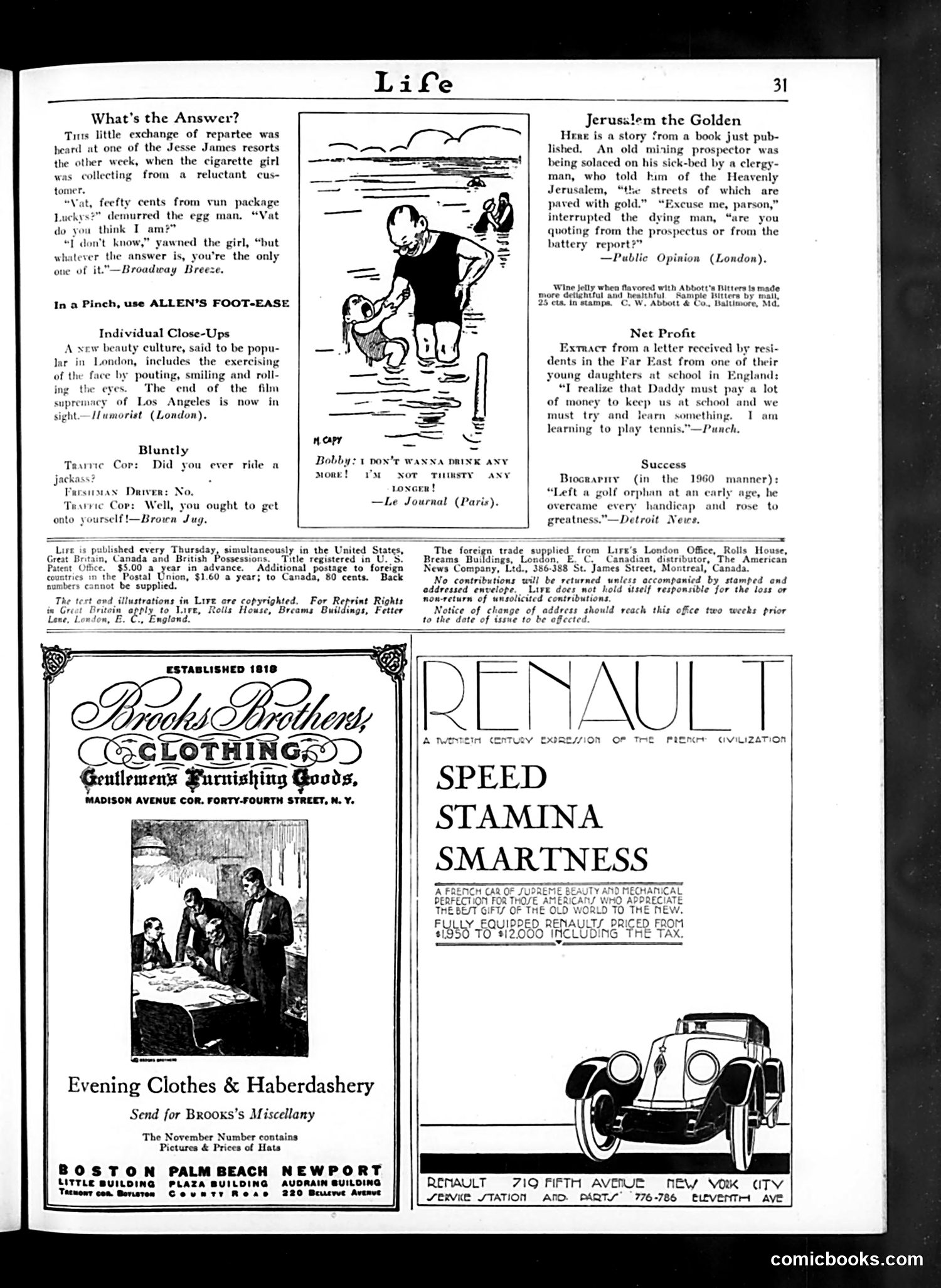
This page comprises short humorous anecdotes and advertisements rather than political cartoons. The jokes use ethnic stereotypes common to 1920s-era humor: **"What's the Answer?"** features a cigarette girl at a "Jesse James resort" (speakeasy) exchanging banter with a customer using exaggerated immigrant dialect ("feefty cents from vun package"), reflecting period casual antisemitism. **"Individual Close-Ups"** mocks a London beauty trend of facial exercises. **"Bobby"** shows a child refusing to drink milk, using childish dialect ("I DON'T WANNA DRINK ANY MORE"). Other brief items mock taxi drivers and reference a mining prospector rejecting religious platitudes about Heaven. The advertisements promote Brooks Brothers clothing and a Renault automobile emphasizing French refinement ("Speed, Stamina, Smartness"). The satire relies on class and ethnic humor typical of the era—nothing politically substantive, mostly period advertisements alongside lightweight comedic observations.
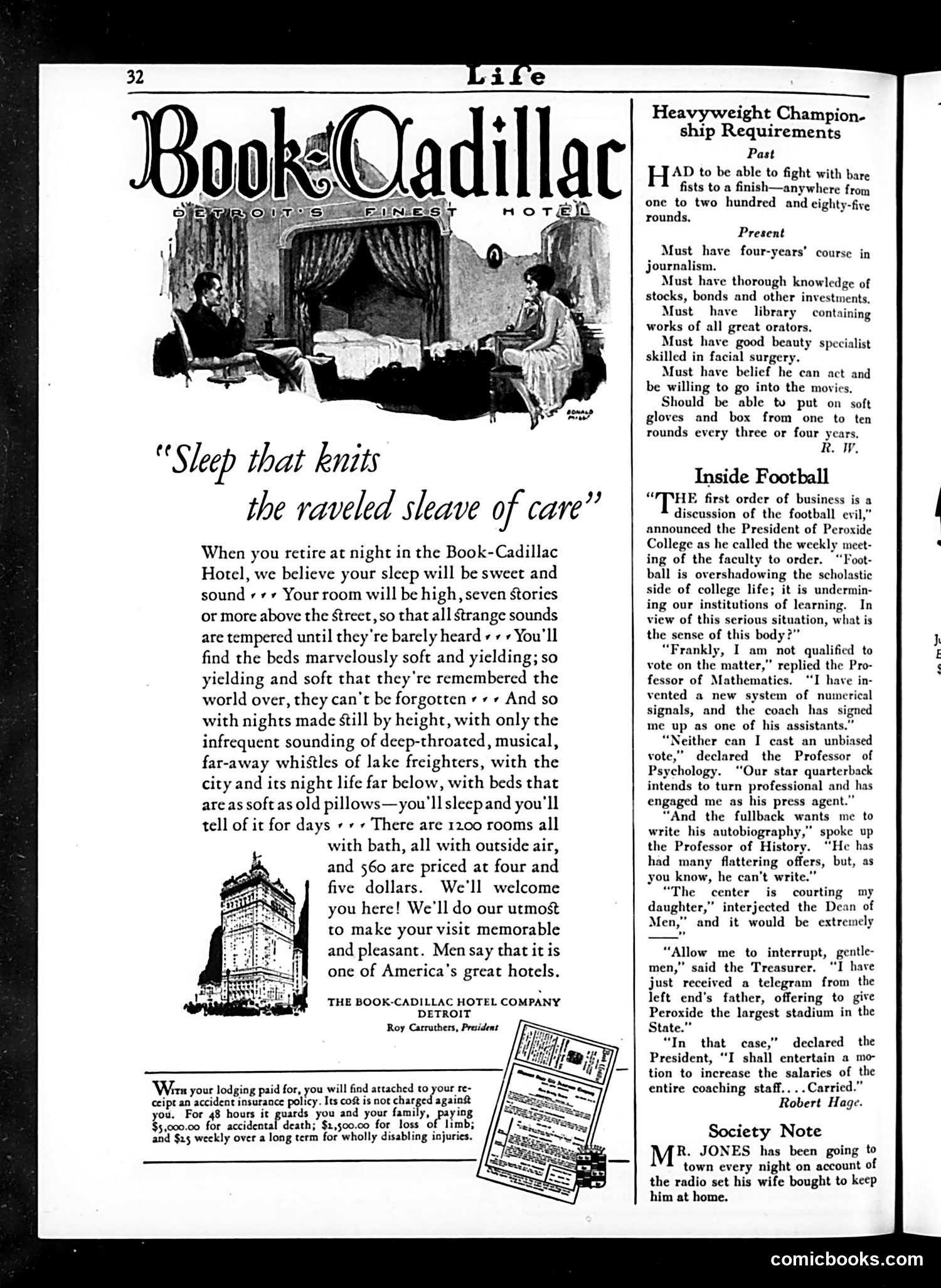
This page contains three distinct satirical pieces: 1. **Book-Cadillac Hotel Advertisement** (left): A luxury hotel ad using Shakespeare ("Sleep that knits the raveled sleave of care") to market upscale Detroit lodging at $4-5/night, emphasizing quietness and comfort. 2. **"Heavyweight Championship Requirements" (top right)**: A humorous comparison contrasting past boxing championship standards (bare-knuckle fights lasting 100-285 rounds) with present requirements that are absurdly non-athletic—journalism degrees, stock knowledge, library collections, beauty specialists, and willingness to act in movies. This satirizes how modern celebrity culture has diluted athletic achievement standards. 3. **"Inside Football" (bottom right)**: A satirical faculty meeting where college professors abandon their stated opposition to football's corrupting influence when personally benefiting—the math professor coaches, the psychology professor becomes a quarterback's press agent, the history professor ghostwrites an autobiography. The treasurer's stadium-donation offer ends all debate. This mocks institutional hypocrisy and football's outsized influence on academia.
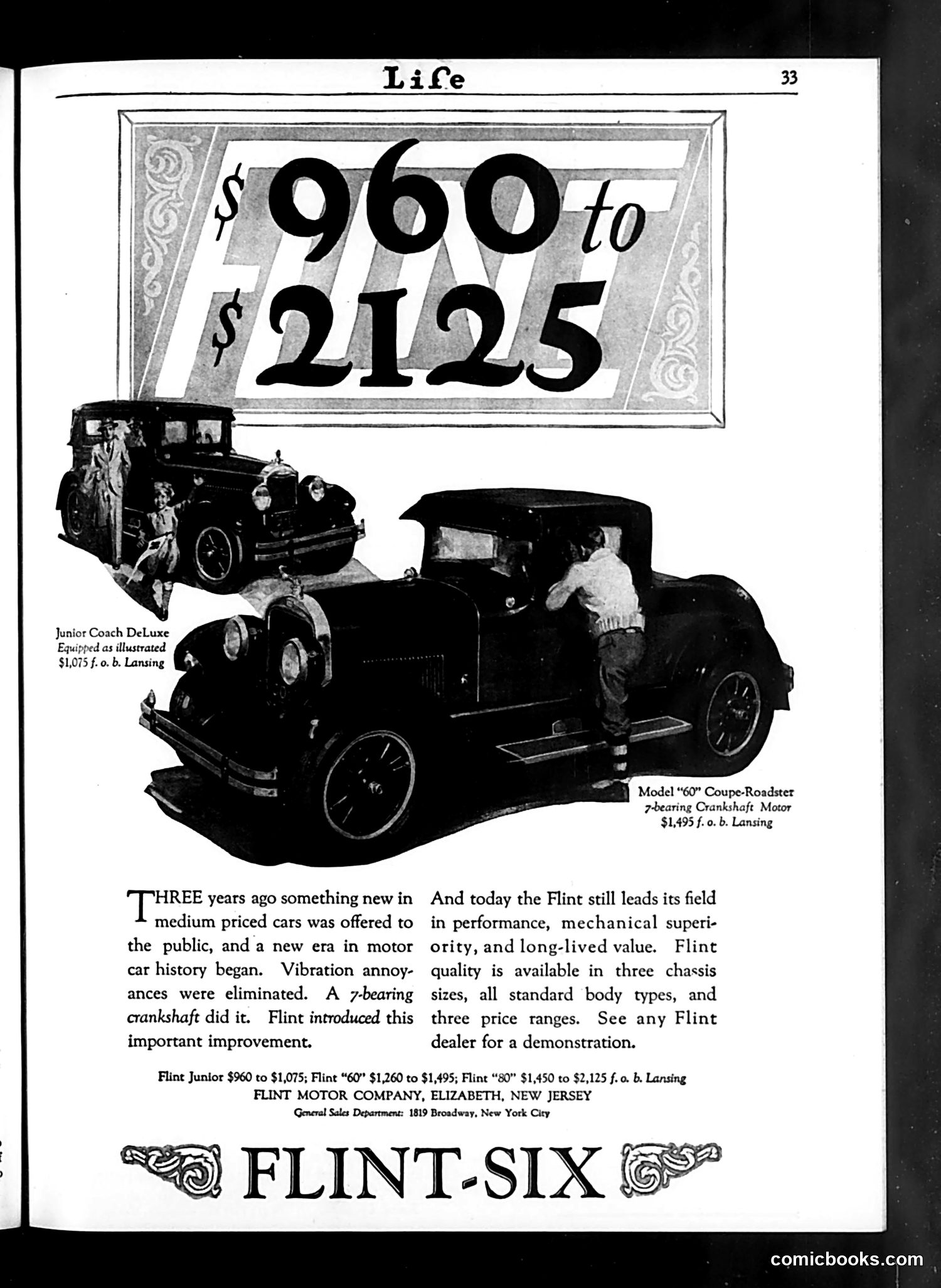
This is a **straightforward automobile advertisement**, not political satire. It appears in *Life* magazine (page 33) promoting the Flint-Six car manufactured by the Flint Motor Company of Elizabeth, New Jersey. The ad showcases three vehicle models with prices ranging from $960 to $2,125. The key selling point is the **7-bearing crankshaft**, which Flint claims eliminated vibration problems—presented as a major innovation introduced three years prior that revolutionized medium-priced automobiles. The text emphasizes Flint's competitive advantages: performance, mechanical superiority, durability, and availability across three chassis sizes and price ranges. Two car illustrations demonstrate different body styles available. This represents typical 1920s automotive marketing, targeting middle-class consumers seeking quality vehicles at affordable prices. There is no satirical content or political commentary visible on this page.
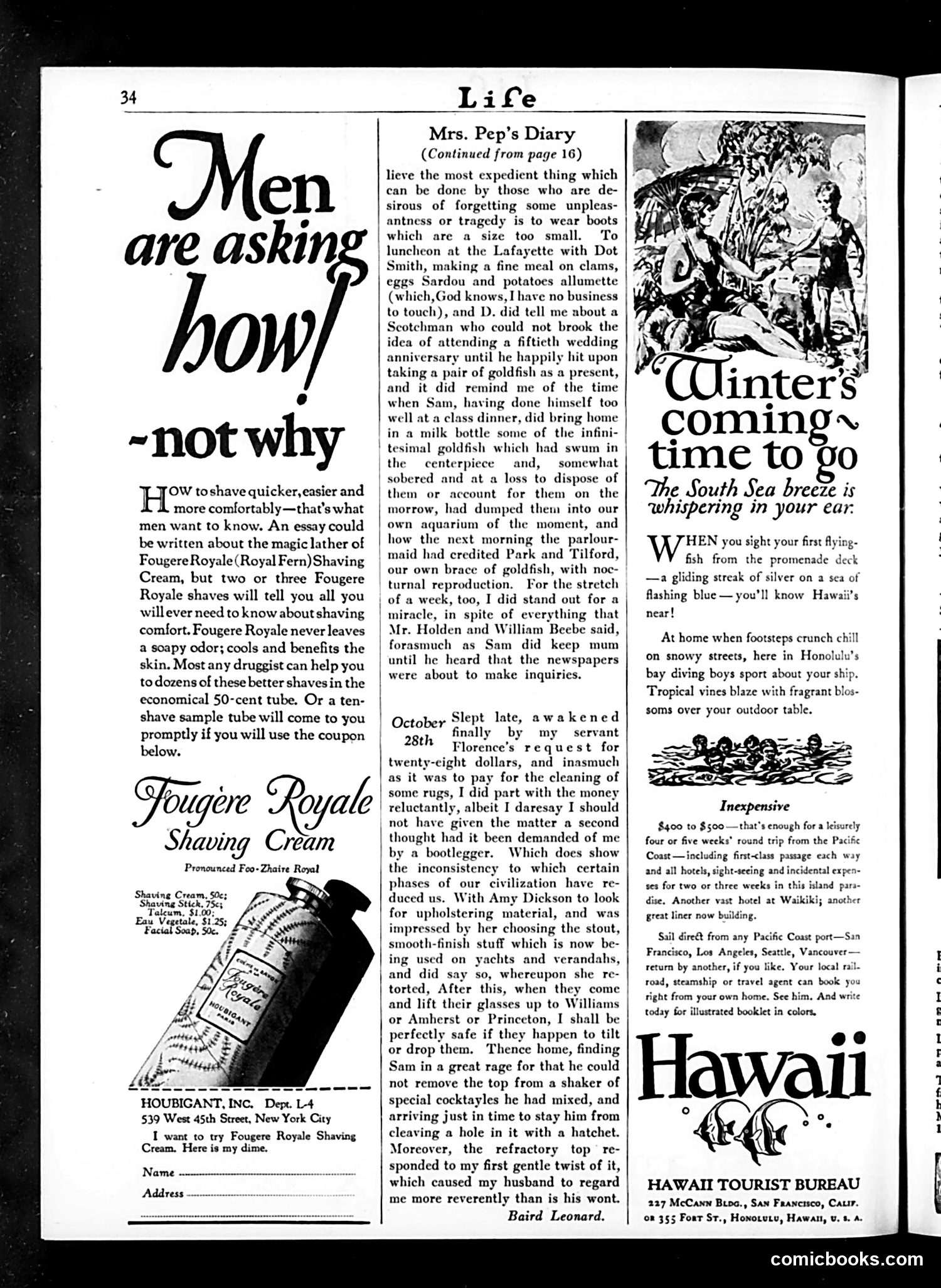
This page consists primarily of **advertising and diary content**, not political satire. **Main Content:** The dominant feature is a **Fougere Royale Shaving Cream advertisement**, which humorously frames men's shaving concerns as practical rather than philosophical—"Men are asking how! —not why." This reflects 1920s consumer marketing emphasizing convenience and comfort. **"Mrs. Pep's Diary"** (continued from page 16) is a satirical society column chronicling upper-class domestic absurdities: a guest bringing goldfish as a wedding gift, servants requesting money for rug cleaning, marital mishaps with cocktail shakers. The satire targets wealthy Manhattan social circles' pretensions and their casual inconsistencies (complaining about bootleggers while lavishly spending). **Travel Advertisement:** A Hawaii Tourist Bureau ad romanticizes tropical escape, positioned as relief from harsh winters—reflecting post-WWI leisure culture. **Context:** This represents Life's dual function as both satirical commentary on society *and* commercial venue. The diary's dry humor mocks the era's upper class; the advertisements target the same demographic seeking modern conveniences and exotic travel.
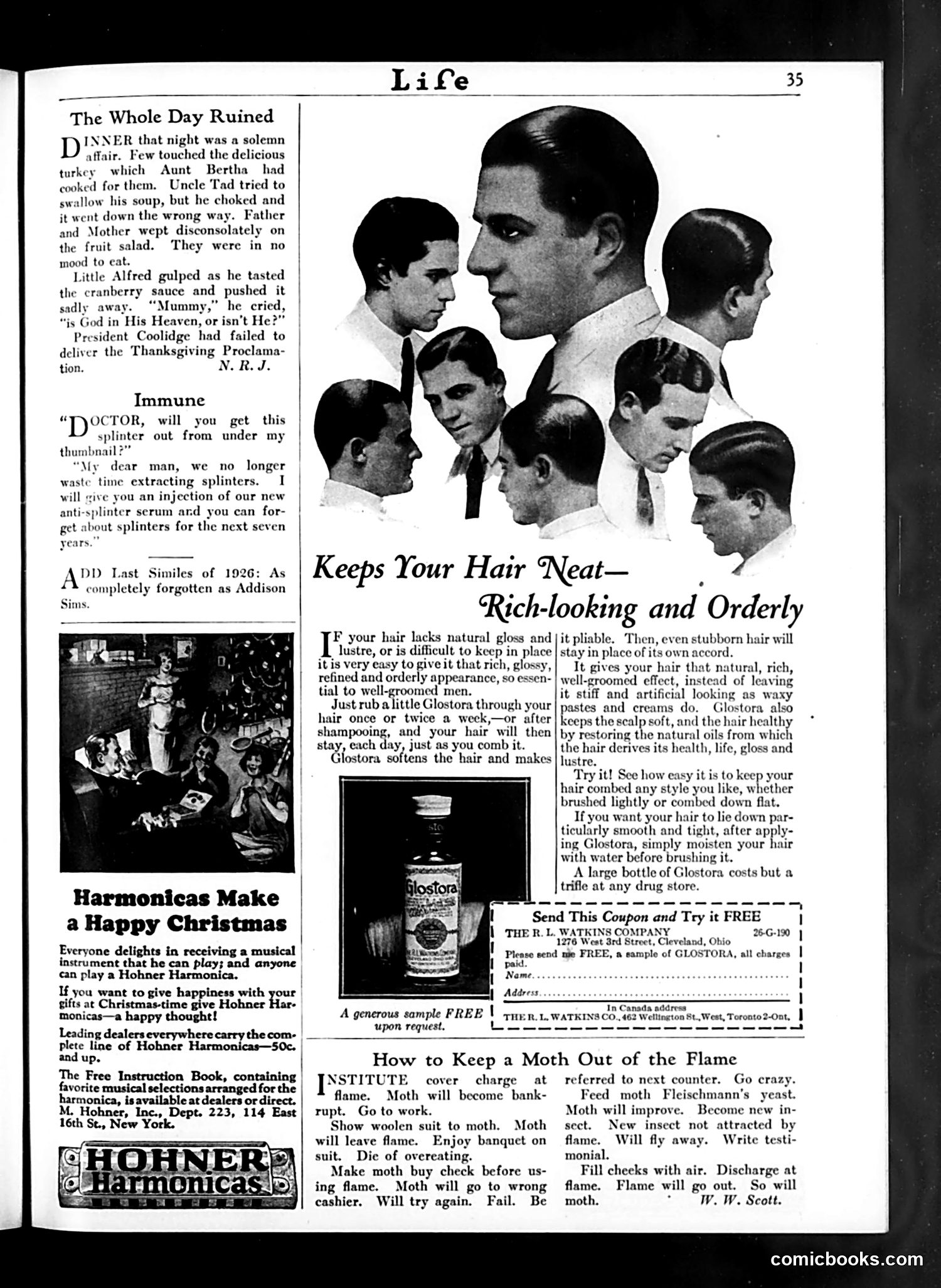
This page mixes satirical humor with period advertising (harmonicas, hair product, yeast). **"The Whole Day Ruined"** satirizes President Calvin Coolidge's failure to deliver the traditional Thanksgiving Proclamation. The joke depicts a family's holiday dinner completely ruined by this governmental oversight—even a child questions God's existence. This references Coolidge's actual 1926 Thanksgiving, when the proclamation was delayed, treating a mundane administrative failure as a catastrophic national event. **"Immune"** jokes about 1920s medical progress: a doctor offers an "anti-splinter serum" allowing patients to ignore splinters for seven years—absurd futurism masquerading as scientific advancement. **"How to Keep a Moth Out of the Flame"** is surreal wordplay about preventing moths from self-destructing in flames, offering increasingly ridiculous "solutions" (charging cover fees, feeding yeast). It's absurdist humor with no political content. The advertisements (Hohner harmonicas, Glostora hair product, Fleischmann's yeast) represent typical 1926 consumer marketing.
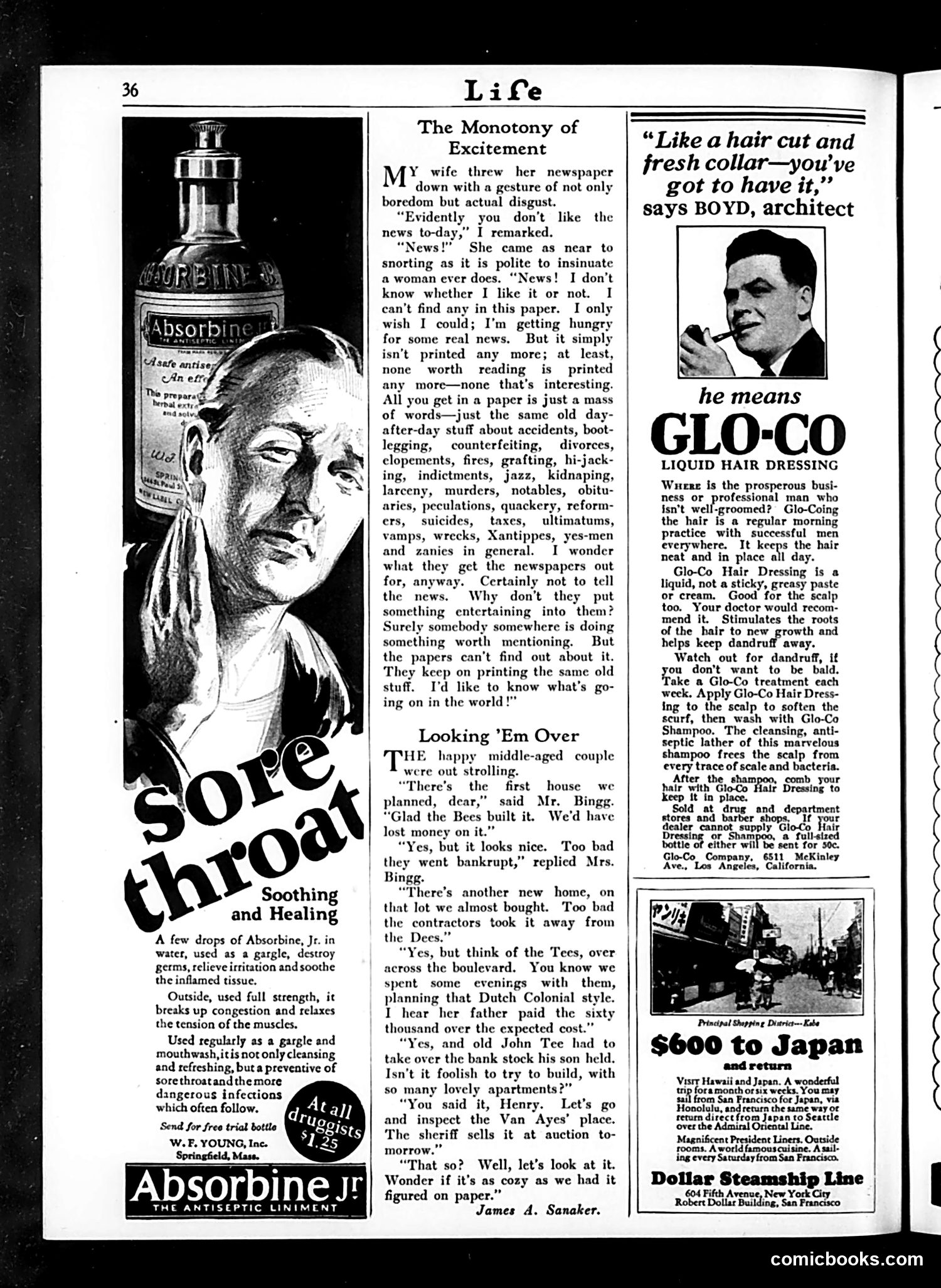
This page mixes editorial humor with advertising. The main article, "The Monotony of Excitement," satirizes newspaper content—a wife complains that papers endlessly repeat the same predictable crimes, scandals, and disasters (bootlegging, kidnapping, murders, divorces, etc.) rather than publishing genuinely interesting news. The satire suggests early 20th-century newspapers had become formulaic and sensationalistic. The second piece, "Looking 'Em Over," depicts a couple observing new homes while ironically noting that each owner went bankrupt or faced financial ruin building them—mocking the aspiration to homeownership during economically precarious times, possibly the 1920s. The advertisements for Absorbine Jr. liniment, Glo-Co hair dressing, and steamship lines to Japan are typical period product placements. The page reflects concerns about media quality and economic instability of the era.
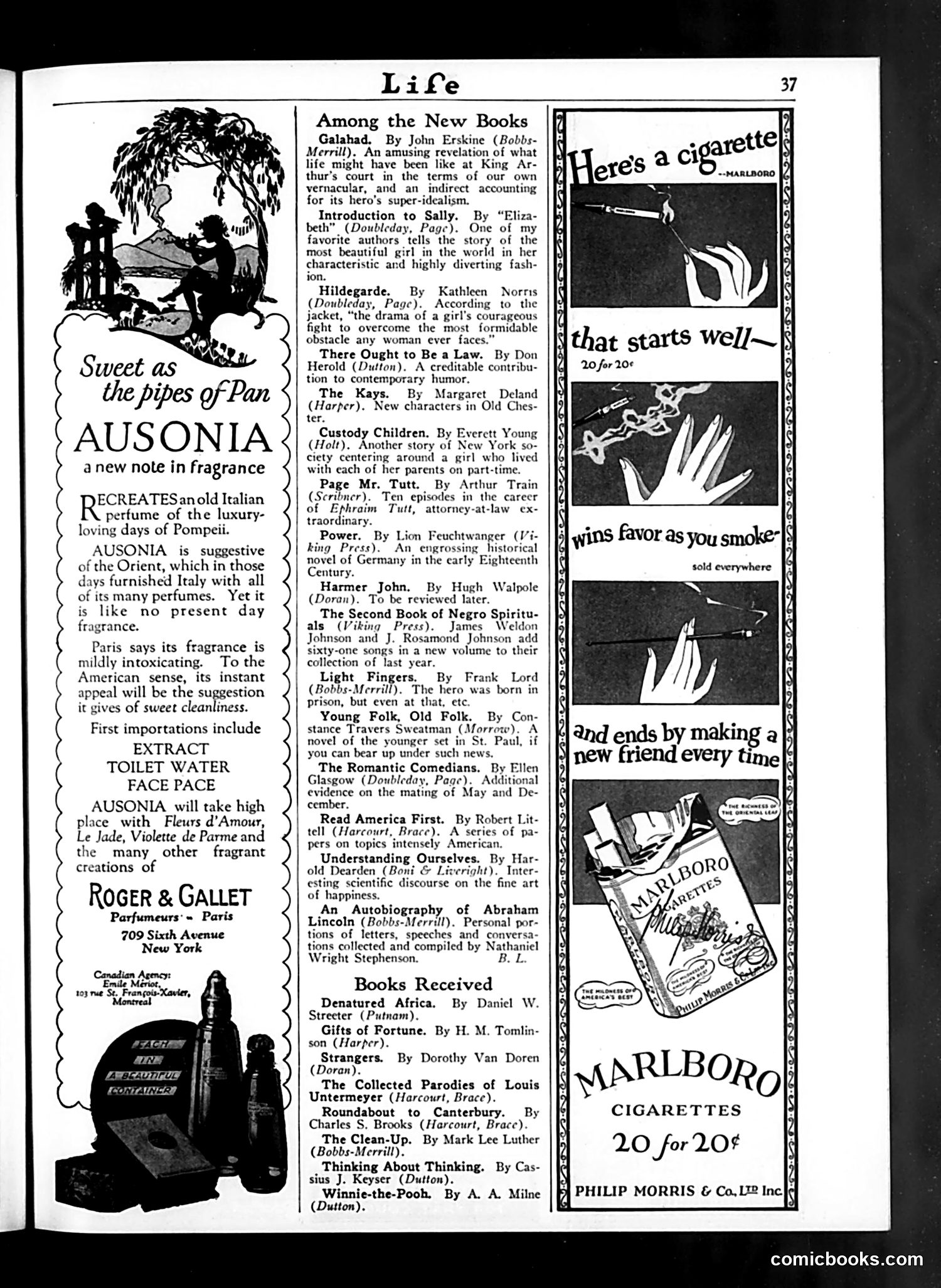
This page is primarily **advertising and book reviews**, not political satire. The left side features a fragrance advertisement for "Ausonia" perfume, marketed as recreating "an old Italian perfume of the luxury-loving days of Pompeii." The ad copy appeals to American consumers by emphasizing "sweet cleanliness" alongside exotic Oriental associations. The right side contains a **Marlboro cigarettes advertisement** prominently featuring the slogan "Here's a cigarette that starts well...20 for 20¢" and "wins favor as you smoke." This represents mid-1920s tobacco marketing—notably, before Marlboro's later masculine branding pivot. The center section lists **book reviews** from contemporary publishers (Doubleday, Harper, Scribner), covering novels and biography. Titles include works on Arthurian legend, African American spirituals, and early modernist fiction—typical highbrow literary fare for Life's educated readership. The page reflects 1920s consumer culture and intellectual life, with no detectable political satire present.
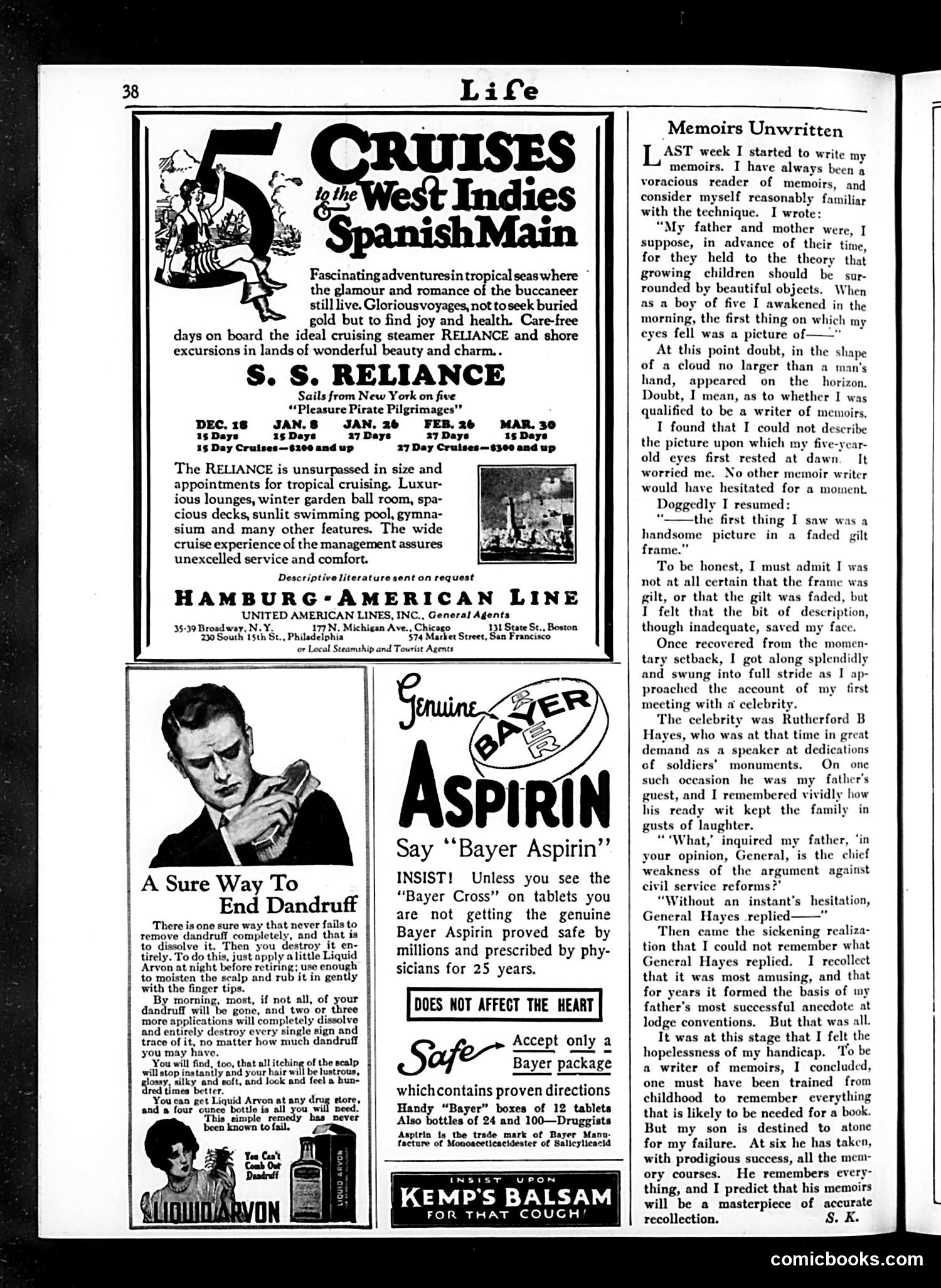
This page is primarily **advertising**, featuring cruise ship, pharmaceutical, and personal care product ads typical of 1920s magazines. The only non-advertisement content is the column "Memoirs Unwritten" (right side), a humorous essay about the author's failed attempt to write an autobiography. The piece satirizes the convention of memoir-writing—specifically how memoirists confidently describe childhood details they likely cannot actually remember. The author attempts to describe a picture from his five-year-old self's bedroom but realizes he has no real recollection of it. He then admits to fabricating details ("faded gilt frame") simply to sound authoritative, like established memoir writers do. The satire targets the pretension and dishonesty inherent in the memoir genre itself: the expectation that writers possess vivid, accurate childhood memories they almost certainly don't have. It's gentle social criticism of literary affectation rather than political commentary.
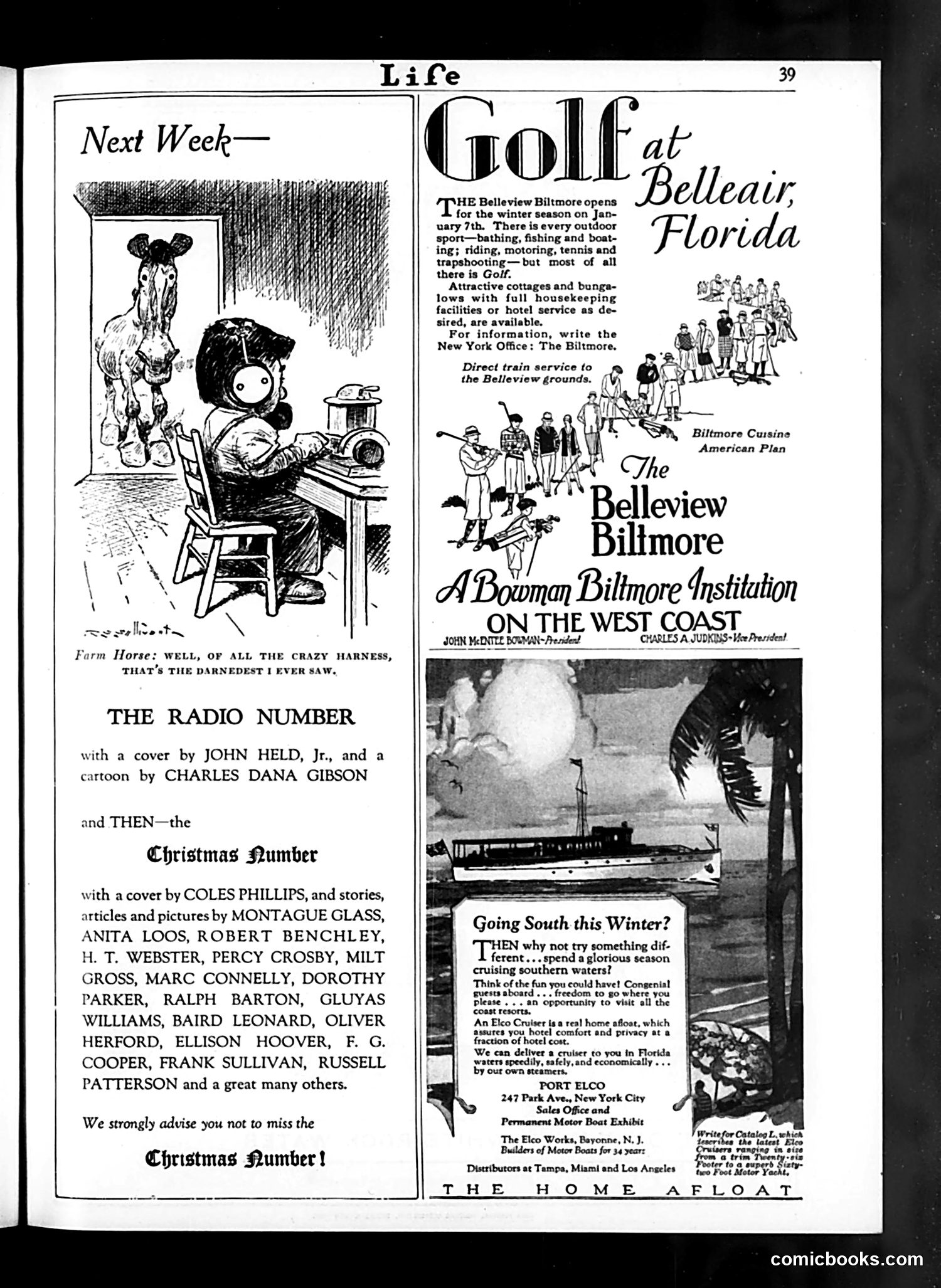
This page is primarily **advertising and promotional content** rather than political satire. The left side features a small cartoon joke: a farmer observes a horse wearing an elaborate, tangled harness, calling it "the darnedest" contraption he's seen. This is gentle domestic humor typical of the era. The page mainly promotes **Life magazine's upcoming issues**: "The Radio Number" (featuring cover art by prominent illustrator John Held Jr.) and the "Christmas Number" with contributions from celebrated writers and cartoonists including Dorothy Parker and Robert Benchley. The right side contains **tourism and luxury advertisements** for the Belleview Biltmore resort in Florida and Elco motor boats for winter cruising—reflecting 1920s leisure culture targeting affluent readers. These ads emphasize golf, comfort, and leisure travel to warm climates. No political commentary or social satire is evident; this is a straightforward magazine promotional and advertising page.
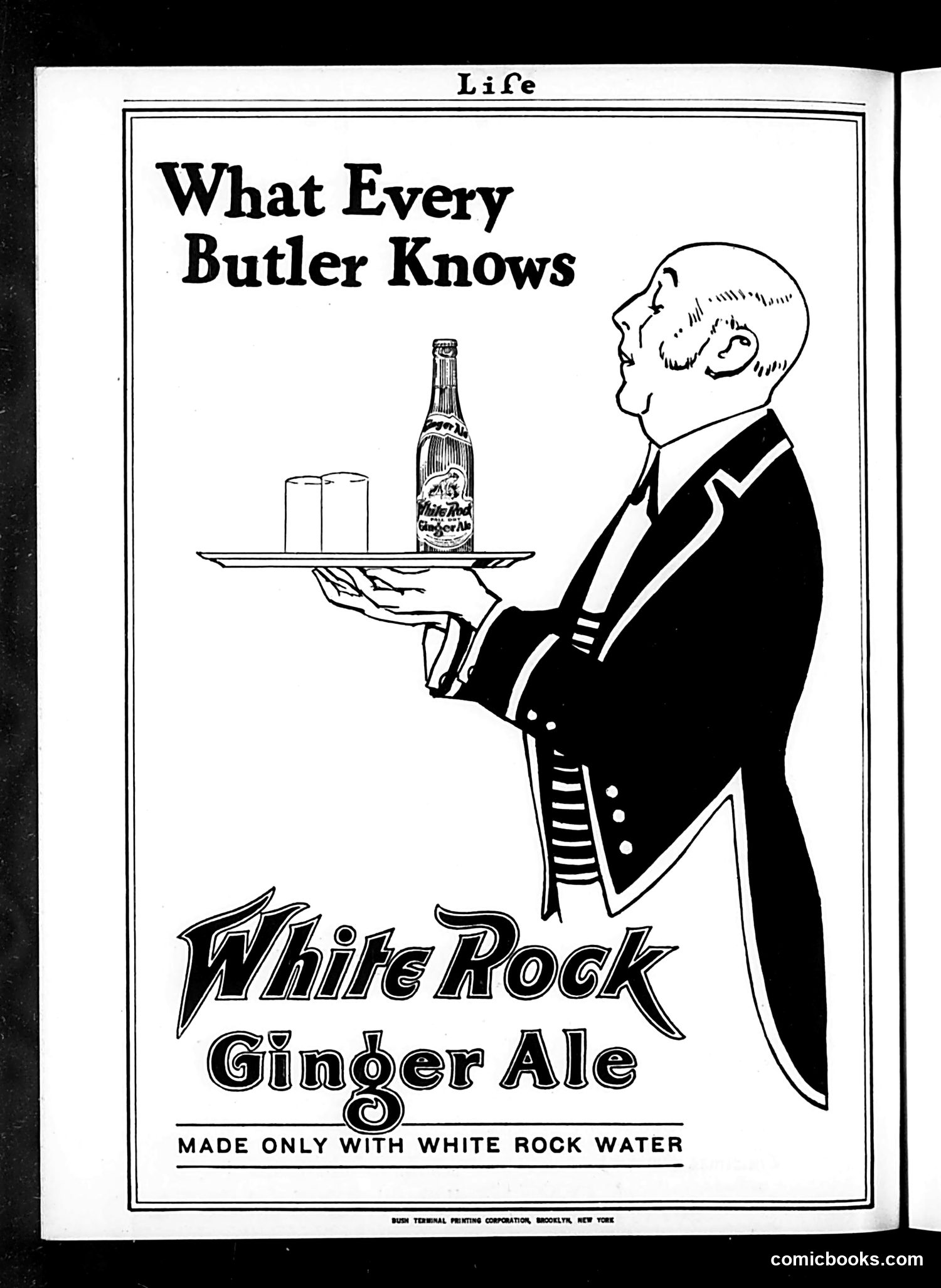
This is a **White Rock Ginger Ale advertisement**, not political satire. The ad depicts a formal butler in tuxedo carrying a serving tray with a bottle of White Rock Ginger Ale and what appears to be glasses. The headline "What Every Butler Knows" suggests that proper service—a marker of refined, upper-class domesticity—requires White Rock Ginger Ale specifically. The tagline emphasizes "MADE ONLY WITH WHITE ROCK WATER," positioning the product as premium. The visual appeal to butlers (symbols of refined service) and the formal presentation style were typical advertising strategies of this era, targeting middle and upper-class consumers who aspired to sophistication. The satire, if any, is subtle—possibly mocking the pretentiousness of such marketing—but this appears primarily as **straightforward product advertising** rather than social commentary.
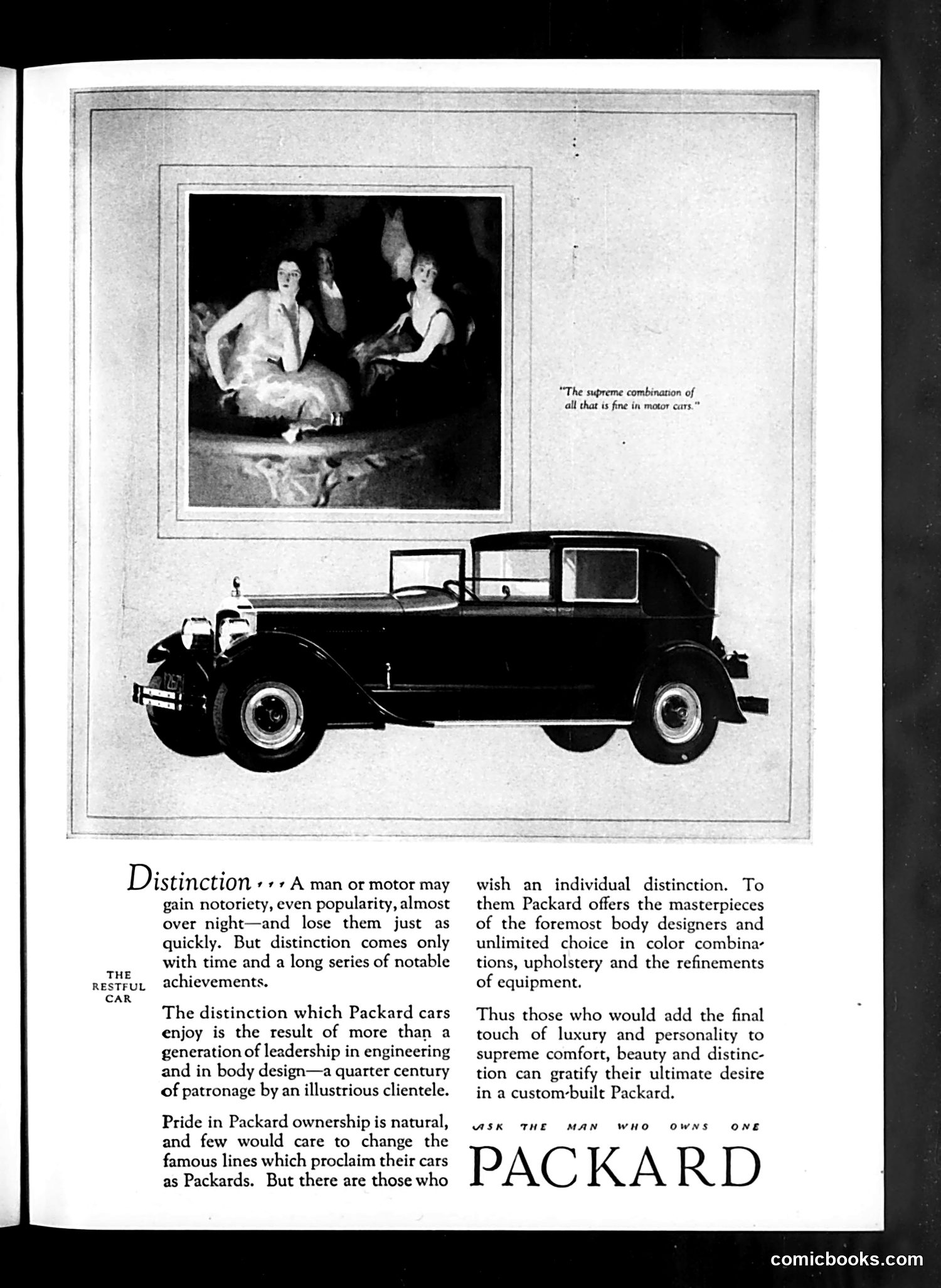
This is a **luxury car advertisement**, not a political cartoon. The page promotes Packard automobiles to wealthy consumers. The top image shows an elegantly dressed couple in what appears to be a theatrical or social setting, paired with the quote "The supreme combination of all that is fine in motor cars." This establishes an aspirational lifestyle association. Below is a side-view illustration of a Packard sedan—a high-end vehicle from the era. The text's central argument is that true "distinction" comes not from fleeting popularity but from sustained excellence and heritage. Packard claims a "quarter century" of leadership and patronage by an "illustrious clientele." For buyers seeking individual personality, Packard offers custom-built options in colors, upholstery, and refinements. The satirical angle—if any—is subtle: the ad conflates automobile ownership with personal character and social status, suggesting that buying a Packard signals refined taste and lasting distinction rather than mere trend-chasing.
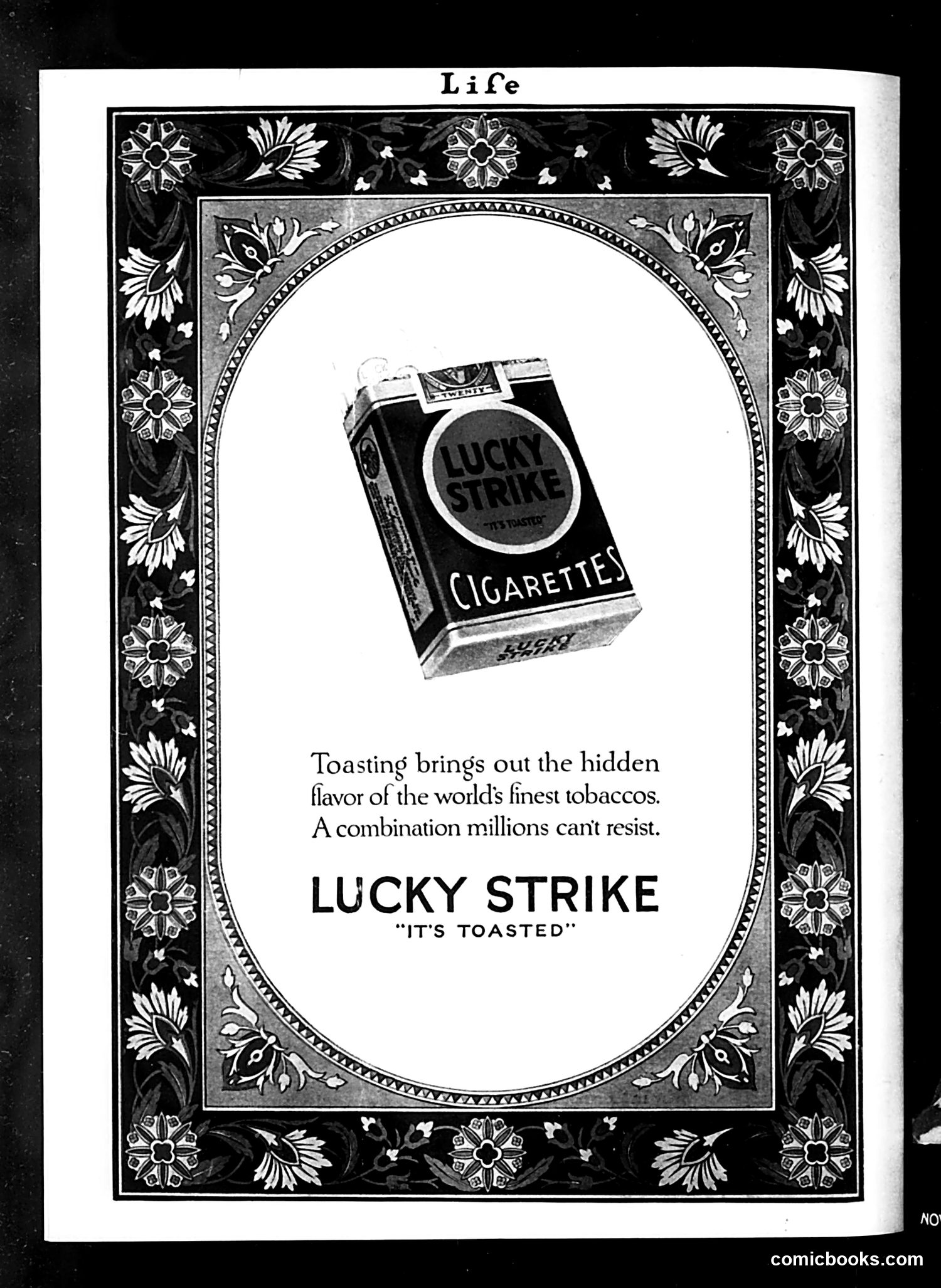
This is a cigarette advertisement, not political satire. It appears in *Life* magazine promoting Lucky Strike cigarettes, emphasizing their "toasted" processing method as a distinguishing feature that enhances tobacco flavor. The ad uses decorative ornamental borders typical of early 20th-century magazine design. The slogan "It's Toasted" was Lucky Strike's actual marketing claim during this era. No cartoon, caricature, or satirical commentary is present—this is a straightforward commercial advertisement. The page demonstrates how major tobacco companies advertised directly in mainstream magazines before modern advertising restrictions on cigarettes were implemented.