
Life, 1926-11-18 · page 20 of 44
Life — November 18, 1926 — page 20: what you’re looking at
What you’re looking at
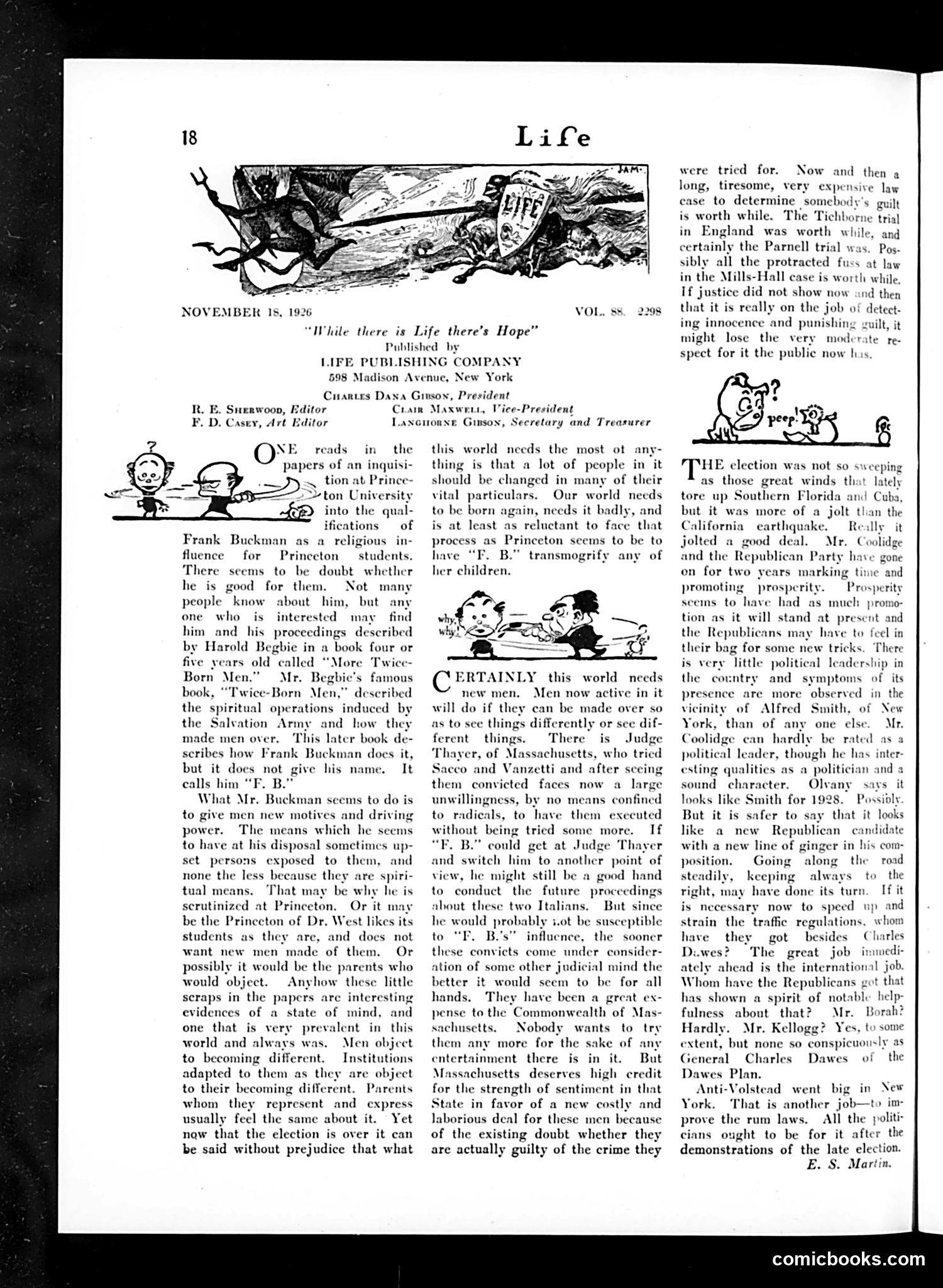
This editorial page discusses Frank Buckman (called "F.B."), a religious figure being scrutinized at Princeton University for his spiritual influence on students. The piece defends Buckman's work of transforming people's values and motivations. The editorial pivots to argue that society desperately needs such moral reformation. It then uses the **Sacco and Vanzetti case** as a prime example—two Italian immigrants convicted of murder, facing execution despite widespread doubt about their guilt. The writer suggests Judge Thayer (who presided over their trial) exemplifies someone who needs moral recalibration; having witnessed the convicted men, even he now has "unwillingness" about their execution. The piece argues Massachusetts deserves credit for reconsidering the case due to reasonable doubt, comparing it to other expensive trials (like England's Parnell trial) that proved justice was functioning properly by catching potential errors. This reflects genuine 1926 anxiety about the Sacco-Vanzetti executions (carried out August 1927), which many viewed as a miscarriage of justice tied to anti-immigrant prejudice.
📄 Transcribed text from this page (OCR, searchable)
Machine-transcribed from the original scan — historical spelling and the odd misread are preserved.
NOVEMBER 18, 1926 “While there is Life there’s Hope” Published by LIFE PUBLISHING COMPANY 598 Madison Avenue, New York Cuartes Dana Ginson, President Suenwoop, Editor Casey, Art Editor NE the papers of an inquisi- ~ tion at Prince- ton Universi into the qual- ifications of Frank Buckman as a religious in- fluence for Princeton students. There seems to be doubt whether he is good for them. Not many people know about him, but any one who is interested may find him and his proceedings described by Harold Begbie in a book four or five years old called “More Twice- Born Men.” Mr. Begbie’s famous book, “Twice-Born Me described the spiritual operations induced by the Salvation Army and how. they made men over. This later book de- scribes how Frank Buckman does it, but it does not give his name. It calls him “PF. B.” What Mr. Buckman seems to do is to give men new motives and driving power. The means which he seems to have at his disposal sometimes up- set persons exposed to them, and none the less because they are spiri- tual means. That may be why he is scrutinized at Princeton. Or it may be the Princeton of Dr. West likes its students as they are, and does not want new men made of them. Or possibly it would be the parents who would object. Anyhow these little scraps in the papers are interesting evidences of state of mind, and one that is v ent ine this world and alway Men object to becoming different. Institutions adapted to them as they are object to their becoming different. Parents whom they represent and express usually feel the same about it. Yet now that the election is over it can be said without prejudice that what reads in Cram Maxwets, Laxcuonxe Ginsox, Secretary and Treasurer President this world needs the most ot any- thing is that a lot of people in it should be changed in many of their vital particulars. Our world needs to be born again, needs it badly, and is at least as reluctant to face that process as Princeton seems to be to have “F. B.” transmogrify any of her children. CERTAINLY this world needs new men. Men now active in it will do if they can be made over so as to see things differently or see dif- ferent things. There is Jud Thayer, of Massachusetts, who triec Sacco and Vanzetti and after seeing them convicted faces now a large unwillingness, by no means confined to radicals, to have them executed without being tried some more. If “F. B.” could get at Judge T and switch him to another point of view, he might still be a good hand to conduct the future proceedings about these two Italians, But since he would probably sot be susceptible to “PF, B.'s” influence, the sooner these convicts come under consider- ation of some other judicial mind the better it would seem to be for all hands. They have been a great ex- pense to the Commonwealth of Mas- sachusetts. Nobody wants to try them any more for the sake of any entertainment there is in it. But Massachusetts deserves high credit for the strength of sentiment in that State in favor of a new costly and laborious deal for these men because of the existing doubt whether they are actually guilty of the crime they were tried for. Now and then long, tiresome, very expensive law case to determine somebod; is worth while. The England was nly the Parnell trial was. Pos- sibly all the protracted fuss at law in the Mills-Hall case is worth while, If justice did not show now and then that it is really on the job of detect- ing innocence and punishing guilt, it might lose the very modcrate re spect for it the public now hus HE election was not so sweeping as those great winds that lately tore up Southern Florida and Cubs, but it was more of a jolt than the California earthquake. Really it jolted a good deal. Mr. Coolidge and the Republican Party have gone on for two years marking time and promoting prosper Prosperity had as inuch promo- tion as it will stand at present and the Republicans may have to feel in their bag for some new tricks. There is very little political leadership in the country and symptoms of its presence are more observed in the vicinity of Alfred Smith, of New York, than of any one else. Mr Coolidge can hardly political leader, tho esting qualities as a poli sound character. Olvany says it looks like Smith for 1928. Possibly But it is safer to say that it looks like a new Republican candidate with a new line of ginger in his com- Going along the road keeping always to the ay have done its turn. If it is necessary now to speed up and strain the traffic regulations, whom they got Charles The great job immedi- d is the international job e the Republicans got that has shown a spirit of notable help- fulness about that? Mr. Borah? Hardly. Mr. Kellogg? Yes, t extent, but none so conspicuously as General Charles Dawes of — the Dawes Plan. Anti-Volstead went big in New York. That is another job—to im- prove the rum laws. All the politi- cians ought to be for it after the demonstrations of the late election. E. S. Martin. seems to have > rated as a > has inter- jan and a position. have besides ) some comicbooks.com