
Life, 1926-11-18 · page 28 of 44
Life — November 18, 1926 — page 28: what you’re looking at
What you’re looking at
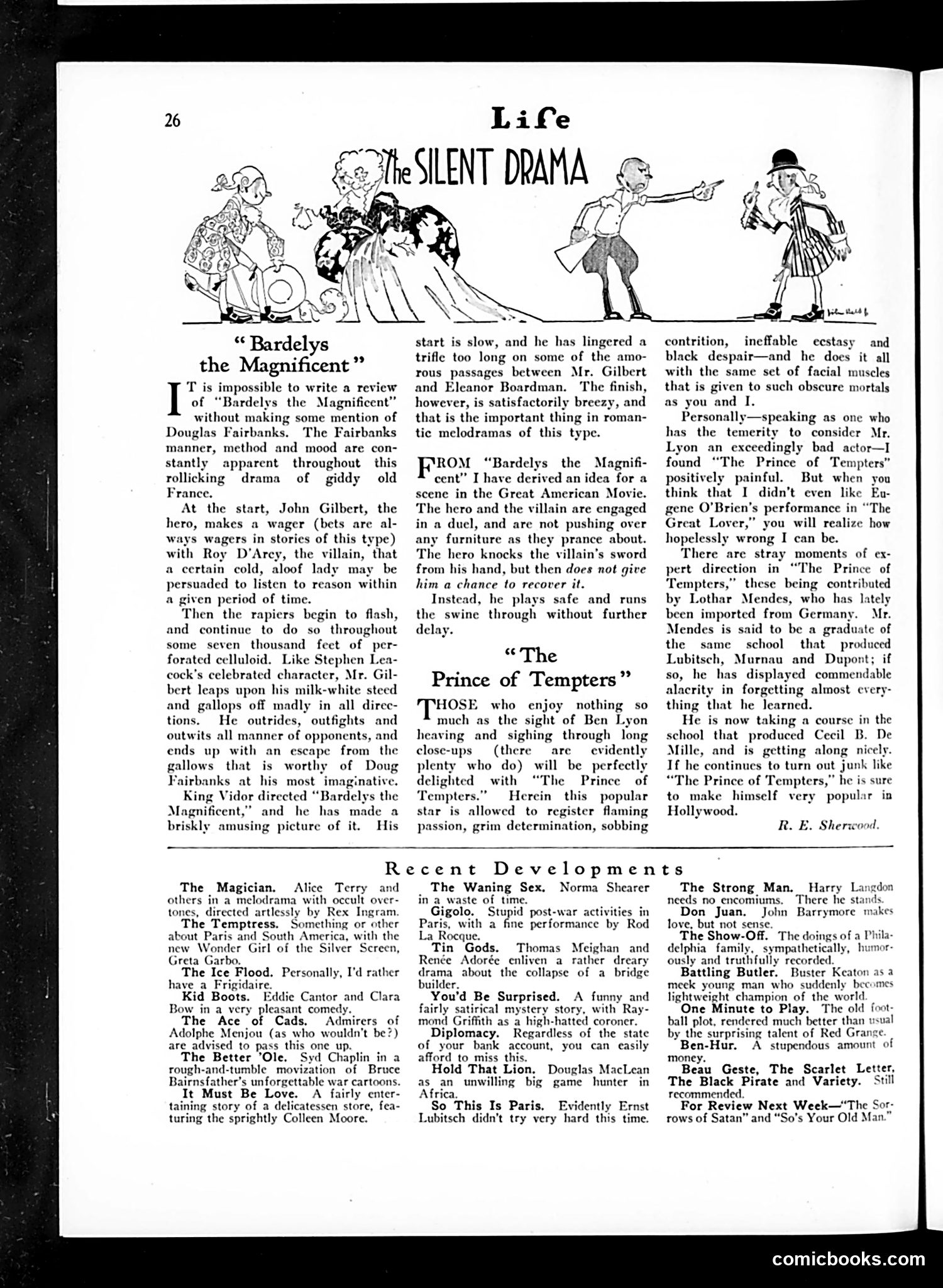
This page reviews three silent films from the 1920s. The top cartoon satirizes the conventions of silent film melodrama—showing exaggerated action poses typical of the era. **"Bardelys the Magnificent"** stars John Gilbert in a swashbuckling French period piece directed by King Vidor. The reviewer credits Douglas Fairbanks' influence on the film's style, noting Gilbert's constant leaping, fighting, and narrow escapes. The critic cleverly proposes an idea for "The Great American Movie": a hero who, instead of the typical theatrical gesture of returning a sword to his opponent, simply kills him directly—mocking the artificial conventions of silent melodrama. **"The Prince of Tempers"** features Ben Lyon, whom the reviewer frankly calls "an exceedingly bad actor." Despite Lyon's histrionic display of emotions (passion, determination, ecstasy, despair), the critic finds the film painful. He sarcastically praises director Lothar Mendes for supposedly studying under great German directors like Lubitsch and Murnau—yet failing to learn anything. The tone throughout is witty, dismissive, and insider-focused on Hollywood conventions.
📄 Transcribed text from this page (OCR, searchable)
Machine-transcribed from the original scan — historical spelling and the odd misread are preserved.
“ Bardelys the Magnificent ” T is impossible to write a review of “Barde the Magnificent” without making some mention of Douglas Fairbanks. The Fairbanks manner, method and mood are con- stantly apparent throughout this rollicking drama of giddy old France. At the start, John Gilbert, the hero, makes a wager (bets are al- ways wagers in stories of this type) with Roy D'Arcy, the villain, that a certain cold, aloof lady may be persuaded to listen to reason within a given period of time. Then the rapiers begin to flash, and continue to do so throughout some seven thousand feet of per- forated celluloid. Like Stephen Lea- cock’s celebrated character, Mr. Gil- bert leaps upon his milk-white steed and gallops off madly in all direc- tions. He outrides, outfights and outwits all manner of opponents, and ends up with an escape from the gallows that is worthy of Doug Fairbanks at his most imaginative. King Vidor directed “Bardelys the Mag ent,” and he has made a briskly amusing picture of it. His Life SILENT DRAMA far start is slow, and he has lingered a trifle too long on some of the amo- rous passages between Mr. Gilbert and Eleanor Boardman. The finish, however, is satisfactorily breezy, and that is the important thing in roman- tic melodramas of this type. ROM “Bardelys the Magnifi- cent” I have derived an idea for a scene in the Great American Movie. The hero and the villain are engaged in a duel, and are not pushing over any furniture as they prance about. The hero knocks the villain’s sword from his hand, but then does not give him a chance to recover it. Instead, he plays safe and runs the swine through without further delay. “ The Prince of Tempters” 'HOSE who enjoy nothing so much as the sight of Ben Lyon heaving and sighing through long close-ups (there are — evidently plenty who do) will be perfectly delighted with “The Prince of Tempters.” Herein this popular star is allowed to register flaming passion, grim determination, sobbing wey contrition, ineffable ecstasy and black despair—and he does it all with the same set of facial muscles that is given to such obscure mortals as you and I. Personally—speaking as one who has the temerity to consider Mr, Lyon an exceedingly bad actor—I found “The Prince of Tempters” positively painful. But when you think that I didn’t even like Eu- gene O'Brien's performance in “The Great Lover,” you will realize how hopelessly wrong I can be. There are stray moments of ex- pert direction in “The Prince of Tempters,” these being contributed by Lothar Mendes, who has lately been imported from Germany. Mr. Mendes is said to be a graduate of the same school that produced Lubitsch, Murnau and Dupont; if so, he has displayed commendable alacrity in forgetting almost every- thing that he learned. He is now taking a course in the school that produced Cecil B. De Mille, and is getting along nicely. If he continues to turn out junk like “The Prince of Tempters,” he is sure to make himself very popular in Hollywood. R. E. Sherwood. Recent Developments The Magician. Alice Terry and others in a melodrama with occult over- tones, directed artlessly by Rex Ingram. The Temptress. Something or other about Paris and South America, with the new Wonder Girl of the Silver Screen, Greta Garbo. The Ice Flood. Personally, I'd rather have a Frigidaire. Kid Boots. Eddie Cantor and Clara Bow in a very pleasant comedy. The Ace of Cads. Admirers of Adolphe Menjou (as who wouldn't be?) are advised to pass this one up. The Better ‘Ole. Syd Chaplin in a rough-and-tumble_ movization of Bruce Bairnsfather’s unforgettable war cartoons. It Must Be Love. A fairly enter- taining story of a delicatessen store, fea- turing the sprightly Colleen Moore. The Waning Sex. in a waste of time. Gigolo. Stupid post-war activities in Paris, with a fine performance by Rod La Rocque. Tin Gods. Thomas Meighan and Renée Adorée enliven a rather dreary drama about the collapse of a bridge builder, You'd Be Surprised. A funny and fairly satirical mystery story, with Ray- mond Griffith as a high-hatted coroner. Diplomacy. Regardless of the state of your bank account, you can easily afford to miss this. Hold That Lion, Douglas MacLean as an unwilling big game hunter in Africa, So This Is Paris, Evidently Ernst Lubitsch didn’t try very hard this time. Norma Shearer The Strong Man. Harry Langdon needs no _encomiums. There he stands Don Juan. John Barrymore makes love, but not sense. The Show-Off. The doings of a Phila- delphia family, sympathetically, humor- ously and truthfully recorded. Battling Butler. Buster Keaton as a meek young man who suddenly becomes lightweight champion of the world. One Minute to Play. The old foot- ball plot, rendered much better than usual by the surprising talent of Red Gi Ben-Hur. A stupendous amount of money. Beau Geste, The Scarlet Letter, The Black Pirate and Variety. Still recommended. For Review Next Week—‘“The Sor- rows of Satan” and “So’s Your Old Man. comicbooks.com