
A complete issue · 84 pages · 1925
Life — December 3, 1925
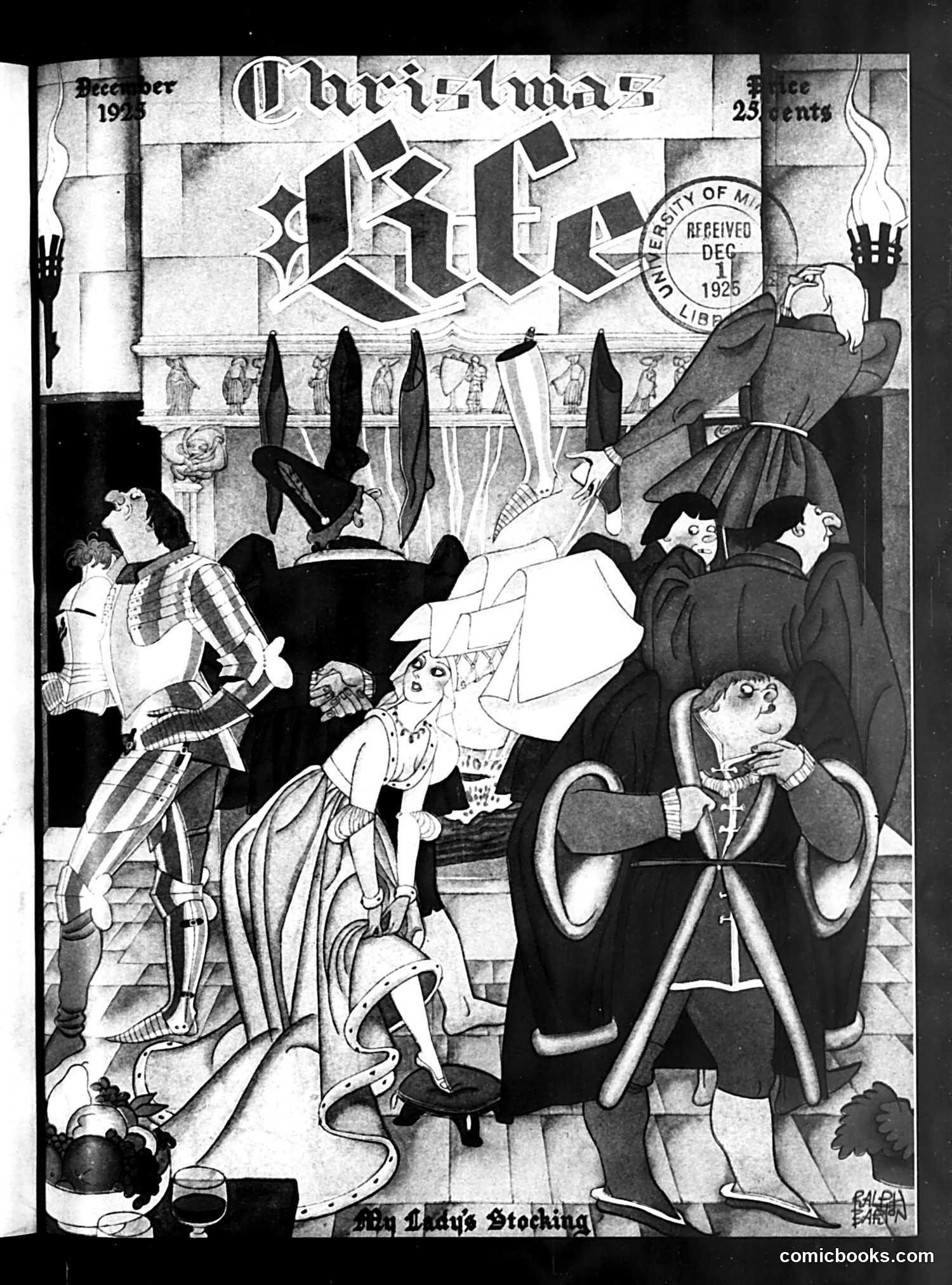
This December 1925 *Life* magazine cover depicts "Christmas" as a festive holiday scene, though the title "With Lady's Stocking" suggests the illustration's focus. The image shows an elaborate indoor celebration with various figures in period dress gathered around what appears to be a large decorative display or performance. The scene includes characters in formal attire, musicians or performers with instruments, and theatrical staging—typical of 1920s satirical humor about holiday excess and upper-class revelry. The exaggerated costumes and animated poses mock the ornate, sometimes ridiculous nature of wealthy Christmas celebrations during the Jazz Age. Without clearer text identifying specific figures, the precise satirical target remains unclear, though the general subject appears to be mocking elaborate holiday entertainment and conspicuous consumption among the affluent.
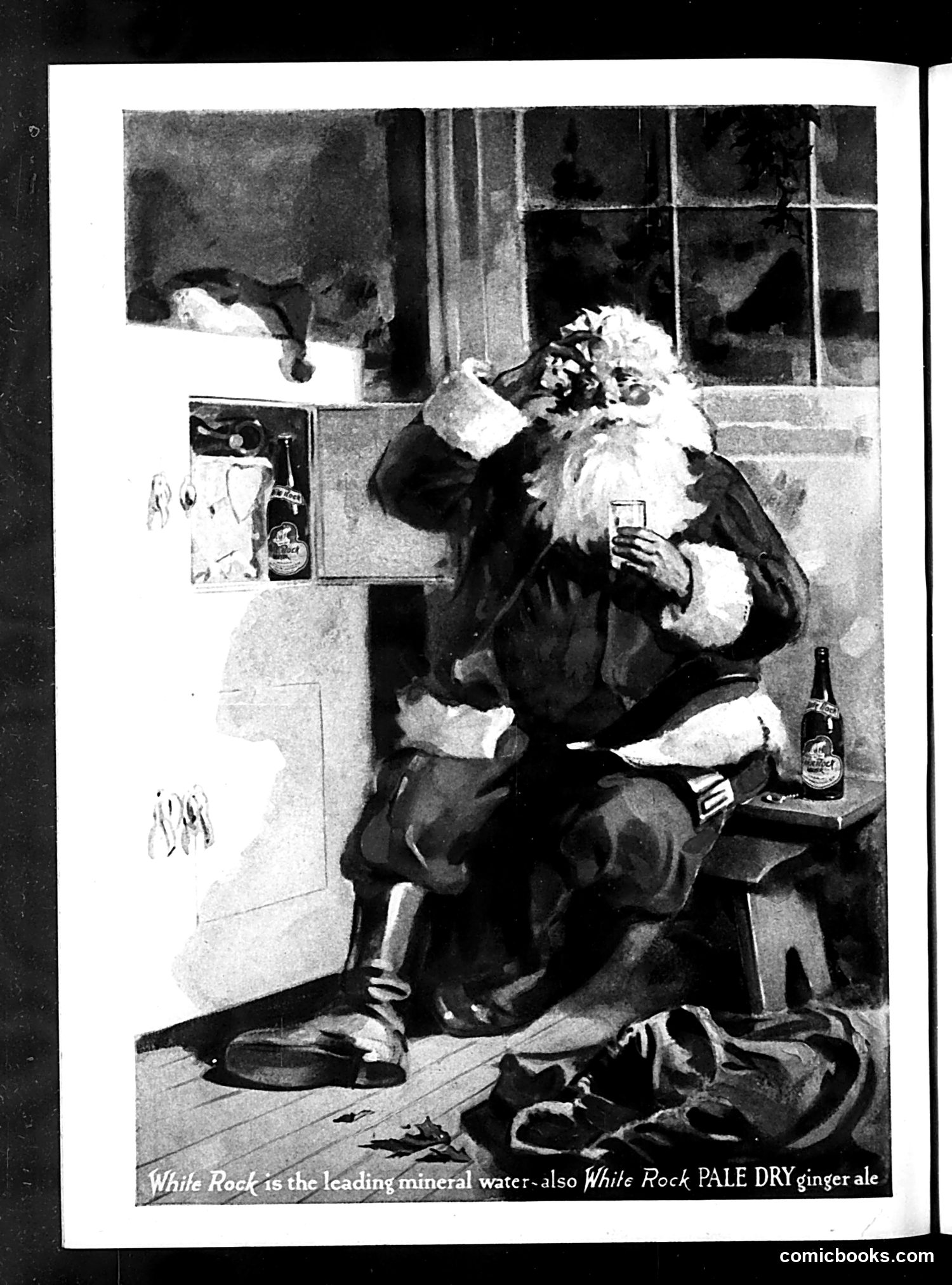
This page is primarily **advertising**, not satire or political commentary. It depicts Santa Claus in a domestic interior, apparently enjoying beverages and relaxation. The advertisement promotes White Rock mineral water and White Rock Pale Dry ginger ale, with the tagline "White Rock is the leading mineral water–also White Rock PALE DRY ginger ale." The humor is gentle and commercial rather than satirical: Santa, traditionally associated with work and Christmas delivery, is shown taking a break to enjoy these beverages. This uses Santa as an aspirational figure to market refreshments to consumers during what appears to be the holiday season. The image contains no obvious political commentary or caricature—it's a straightforward vintage advertisement using Santa Claus as a brand ambassador.
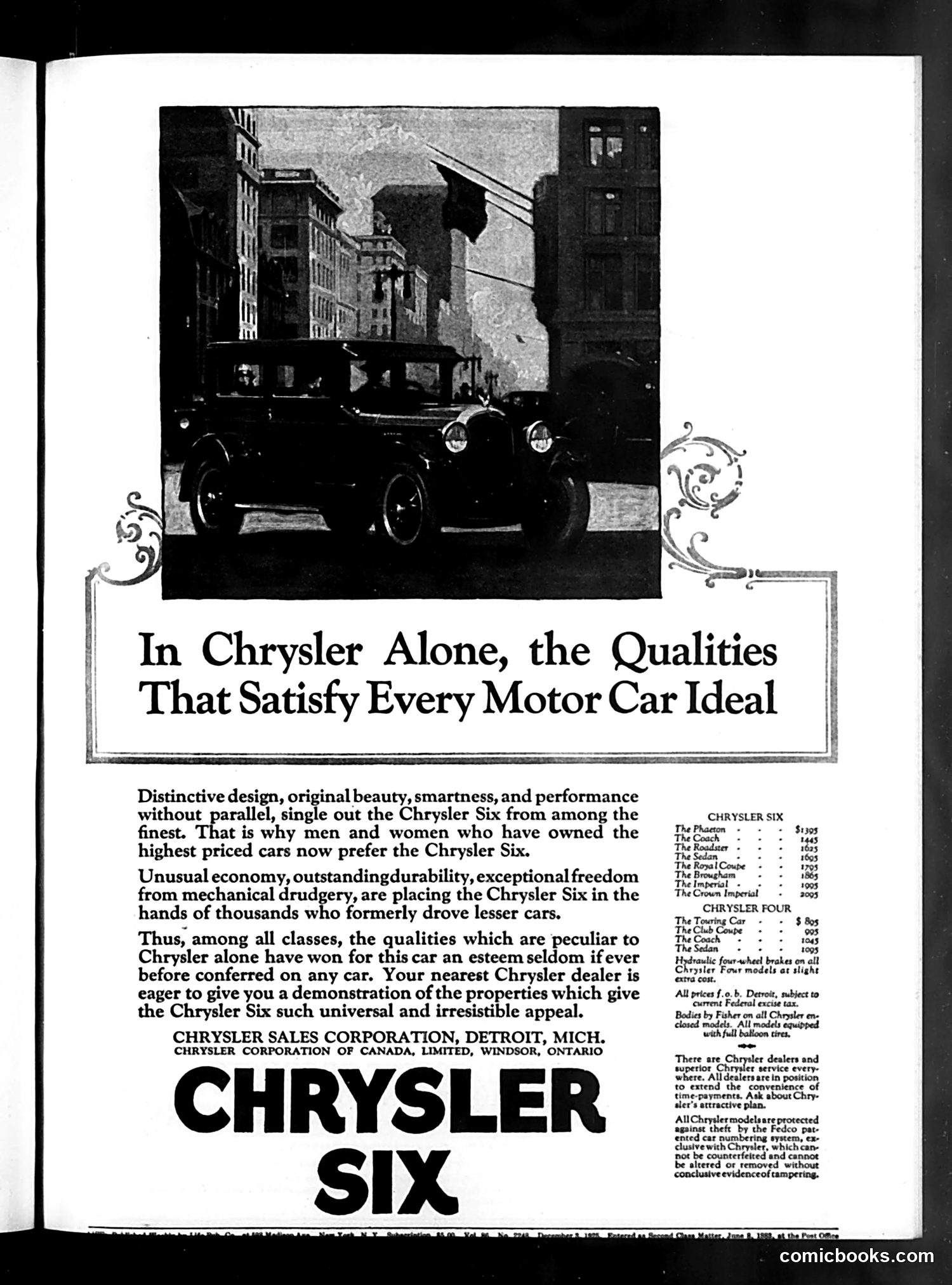
This is primarily a **Chrysler automobile advertisement**, not a political cartoon. The image shows a Chrysler Six sedan parked on an urban street with tall buildings in the background. The ad uses promotional language typical of 1920s marketing—claiming the Chrysler Six possesses "distinctive design, original beauty, smartness, and performance without parallel" and appeals to affluent buyers ("men and women who have owned the highest priced cars"). The decorative flourishes (ornamental corners) and layout reflect Art Deco design conventions of the era. The text emphasizes mechanical reliability, economy, and exclusivity as selling points. There is **no satire or political commentary** visible. This appears to be a straightforward commercial advertisement placed in *Life* magazine, showcasing the car's prestige and engineering claims to potential customers.

This is **not a satirical cartoon page**, but rather a **straightforward advertisement** for industrial construction materials. The page promotes mill construction and Douglas Fir lumber through: 1. **A case study**: Photos of the Patterson-Sargent Company's paint manufacturing plant in Long Island City, showcasing mill construction benefits 2. **Testimonial format**: A quote praising mill construction's superiority 3. **Educational content**: Boxes explaining why manufacturers should consider flexible internal plant arrangements 4. **Corporate endorsements**: References to The Ballinger Company architects and Weyerhaeuser Forest Products The "business men who know" language targets industrial decision-makers. This appears in *Life* magazine's advertising section, positioned as legitimate industrial guidance rather than satire. The page exemplifies early 20th-century B2B marketing strategy using authority, case studies, and expert testimony.
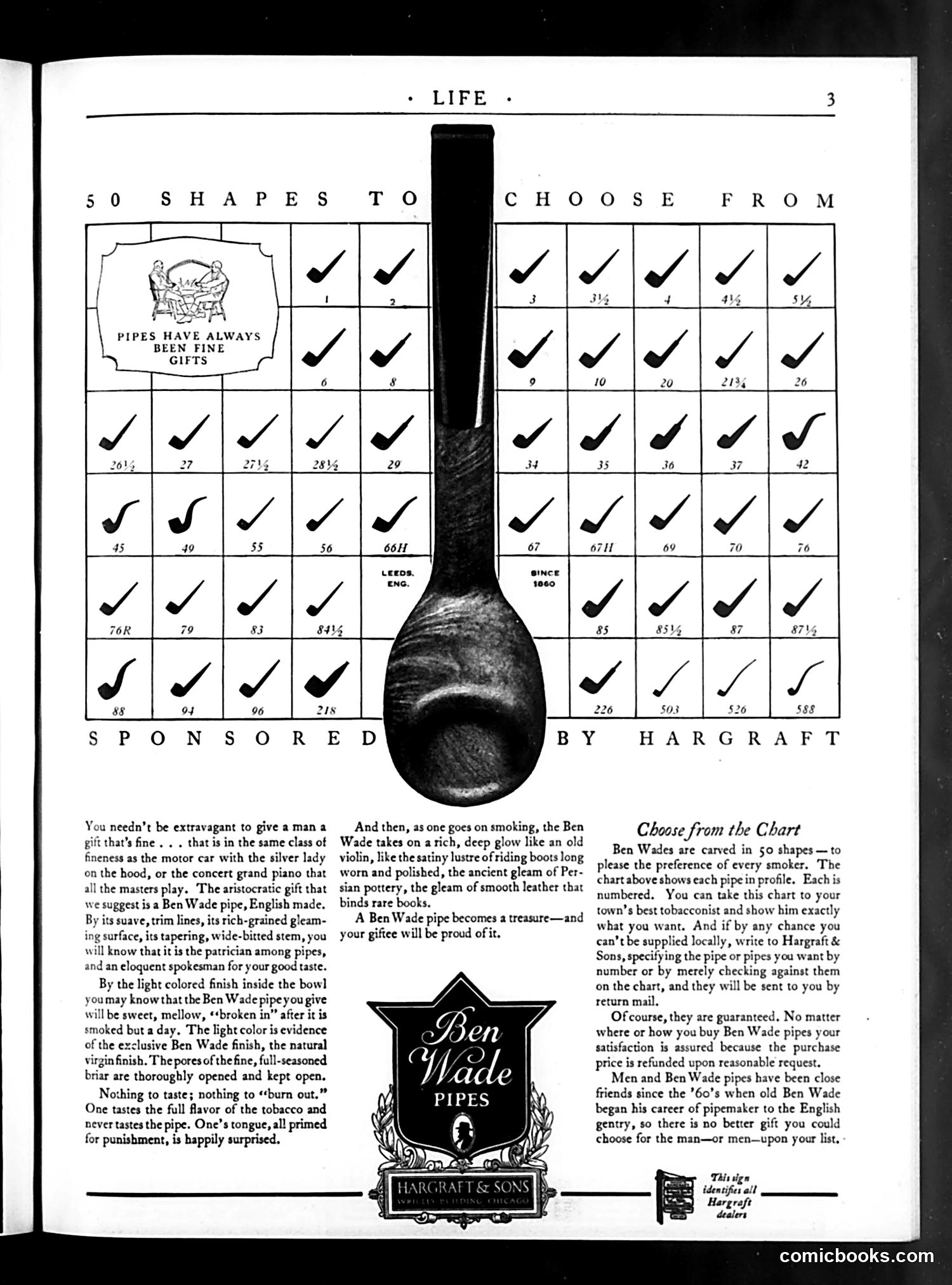
This page is primarily **advertising, not satire or political commentary**. It's a Ben Wade pipe advertisement from Harcraft & Sons, appearing in Life magazine. The ad promotes 50 different pipe shapes available for purchase, displayed in a grid with checkmarks. The central image shows a large tobacco pipe bowl. The text emphasizes that Ben Wade pipes are quality gifts—fine, durable products with a rich finish and smooth leather that improve with age and smoking. The advertisement appeals to masculine sophistication, suggesting pipe ownership signals refinement and good taste. There's a guarantee of satisfaction, with mail-order availability through Harcraft & Sons. This represents early 20th-century consumer advertising targeting middle and upper-class male readers of Life magazine.
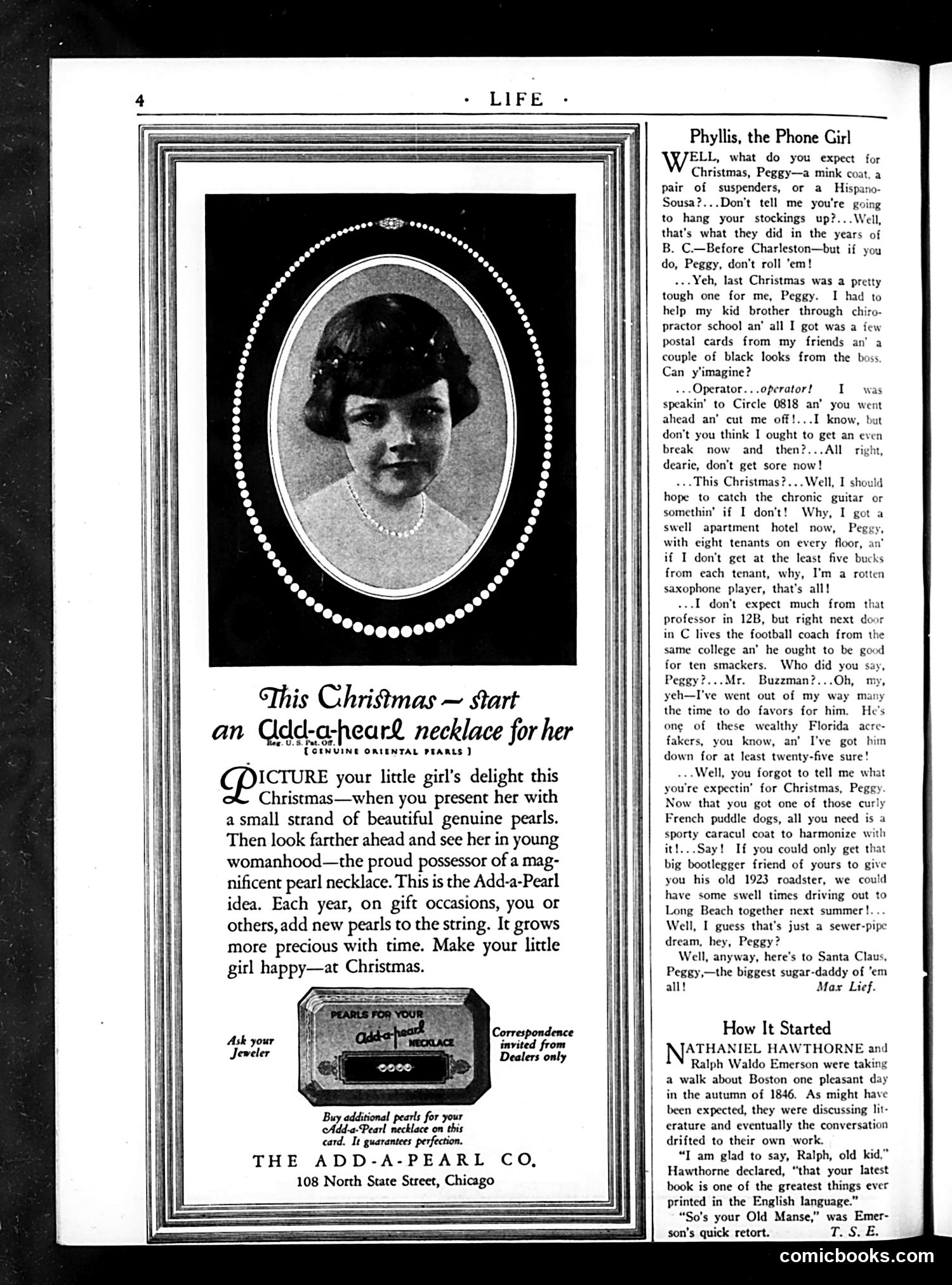
This page is primarily **advertising and humor columns**, not political satire. The left side features a full-page advertisement for the "Add-a-Pearl" necklace from The Add-a-Pearl Co. (Chicago). The ad suggests giving a child a small pearl strand as a Christmas gift, with the idea that family members add pearls annually as she grows into womanhood. This reflects early 20th-century gift-giving culture and optimistic views of female development. The right side contains two humor pieces: "Phyllis, the Phone Girl" (a comedic monologue about Christmas expectations) and "How It Started" (an anecdote about Nathaniel Hawthorne and Ralph Waldo Emerson discussing literature). These are lighthearted entertainment columns typical of Life magazine's satirical humor, lacking political commentary.
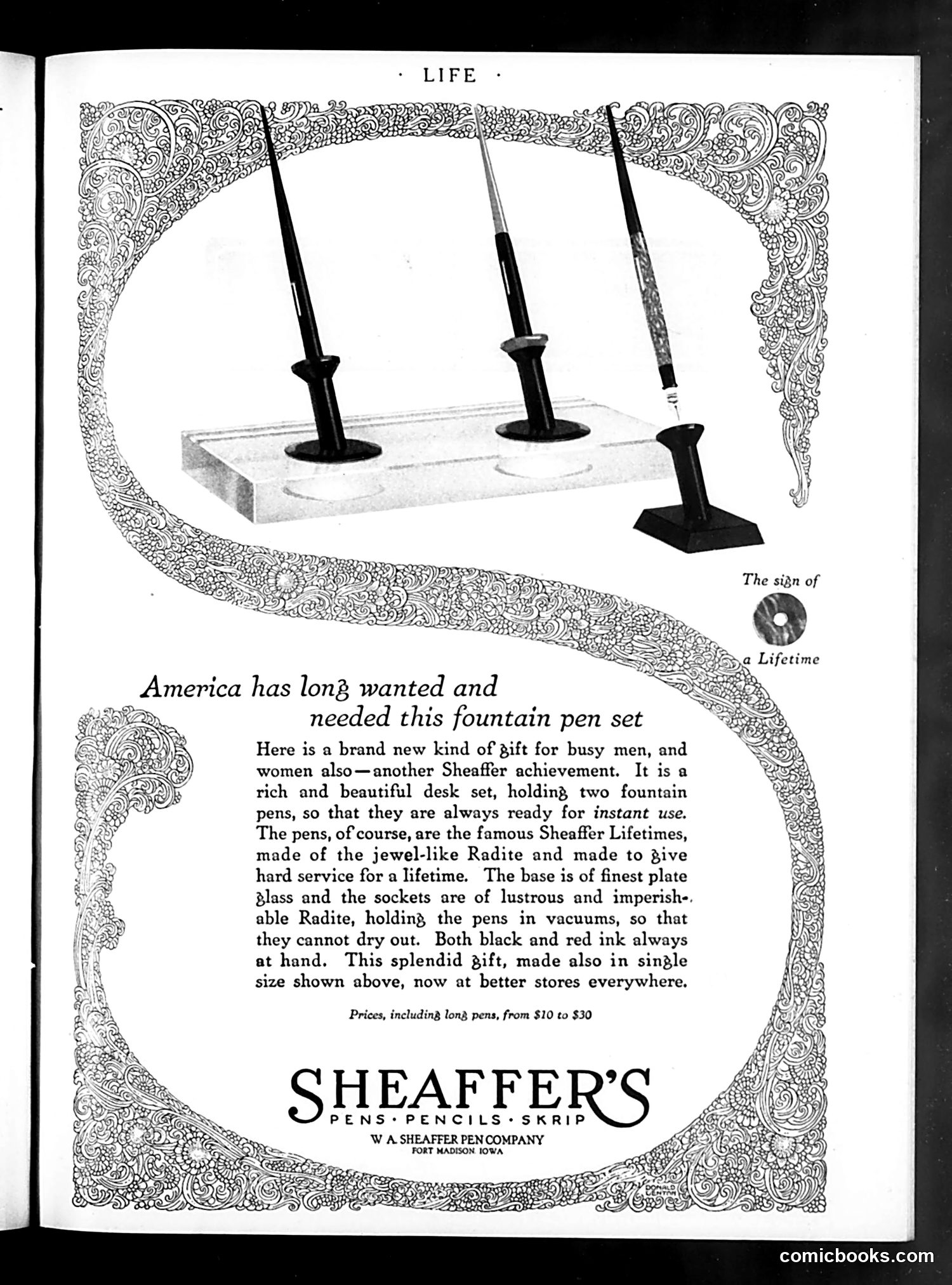
This is **not a political cartoon or satirical content**—it's a straightforward advertisement for Sheaffer fountain pen desk sets, occupying a full page in *Life* magazine. The ad promotes a luxury gift item: a desk set holding two Sheaffer Lifetime fountain pens with an ornate glass base and Radite (a material) sockets. The decorative baroque border frames the product photograph. The text targets "busy men, and women," emphasizing the pens' durability ("lifetime" warranty) and convenience (two pens always ready, in black and red ink). Pricing ranged from $10 to $30. The company was W.A. Sheaffer Pen Company, located in Fort Madison, Iowa. This represents typical early 20th-century lifestyle advertising aimed at professional, affluent consumers.
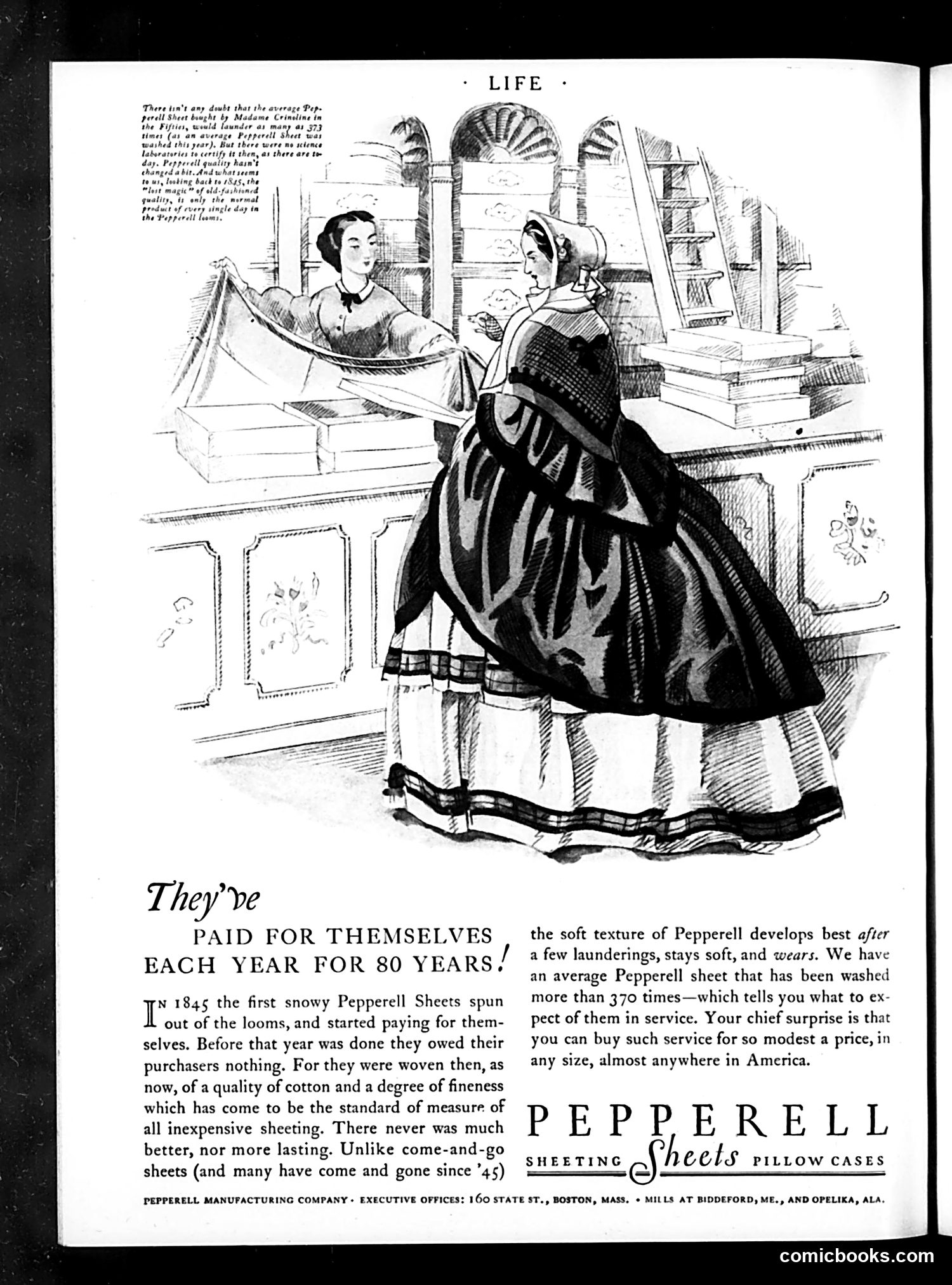
This page is primarily a **Pepperell Sheets advertisement**, not political satire. The illustration shows two women examining bedsheets in what appears to be a linen shop or home setting, with architectural details visible in the background. The ad's pitch centers on durability and value: Pepperell Sheets, first manufactured in 1845, supposedly "pay for themselves" over 80 years of use through superior quality and longevity. The company claims their sheets withstand over 370 washings while remaining soft and serviceable—unusual durability for inexpensive bedding. The advertisement emphasizes affordability and practicality for average American consumers, contrasting Pepperell's lasting quality against cheaper, short-lived competitors ("come-and-go sheets"). This is commercial messaging, not editorial content or political commentary.
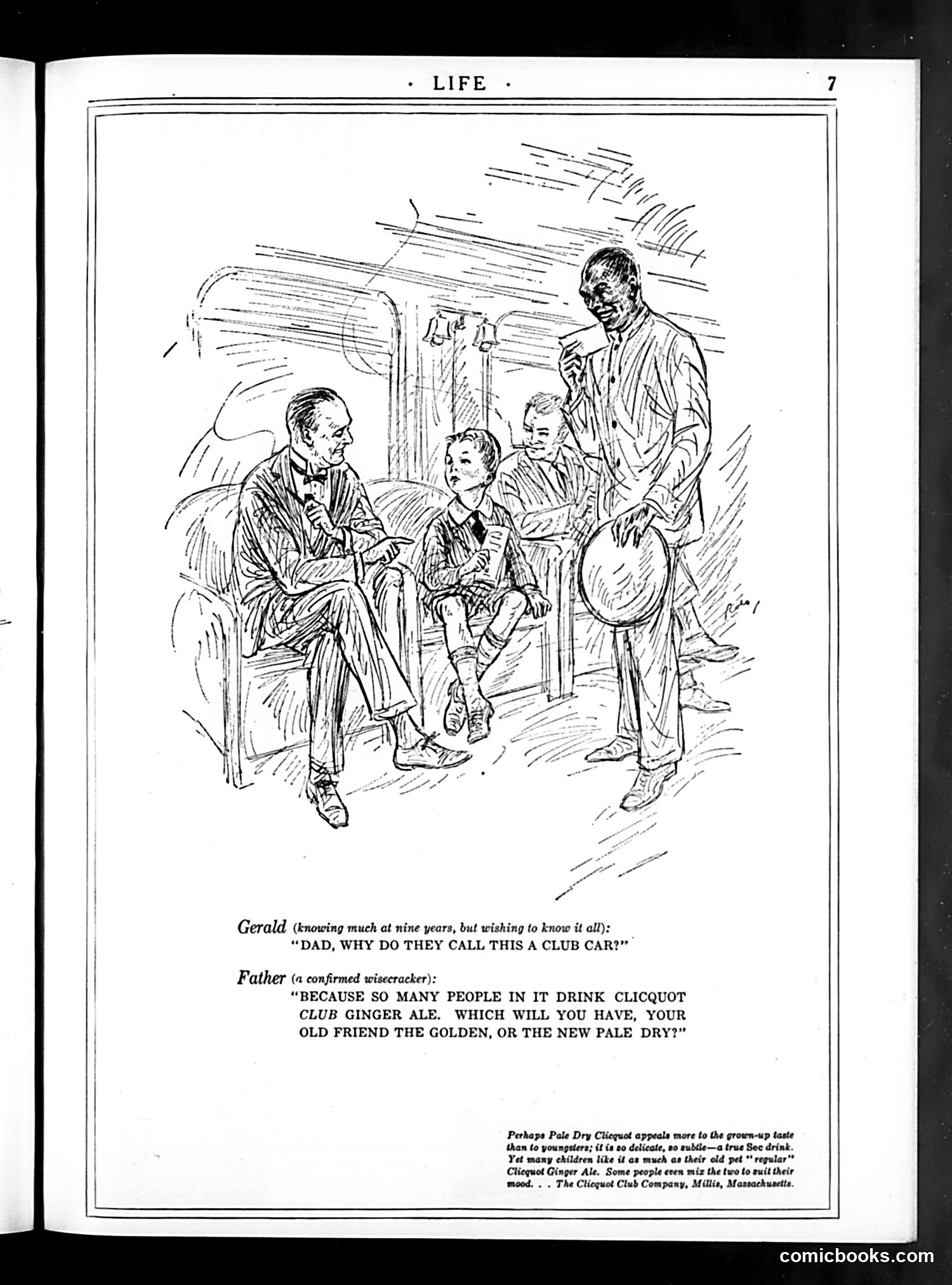
This is a humorous domestic scene rather than political satire. A young boy named Gerald asks his father why a drinking establishment is called a "club car." The father, identified as "a confirmed wisecracker," responds with a joke: many people in club cars drink Clicquot Club Ginger Ale, so they're called "club" cars because of the beverage's popularity. The humor relies on the father's deliberate misinterpretation of the question—Gerald clearly means railroad club cars, but the father pivots to make a pun about the ginger ale brand. This is actually an **advertisement** for Clicquot Club Company (Millis, Massachusetts) disguised as family humor. The small print beneath suggests the ginger ale appeals to both children and adults, positioning it as a wholesome beverage for families.
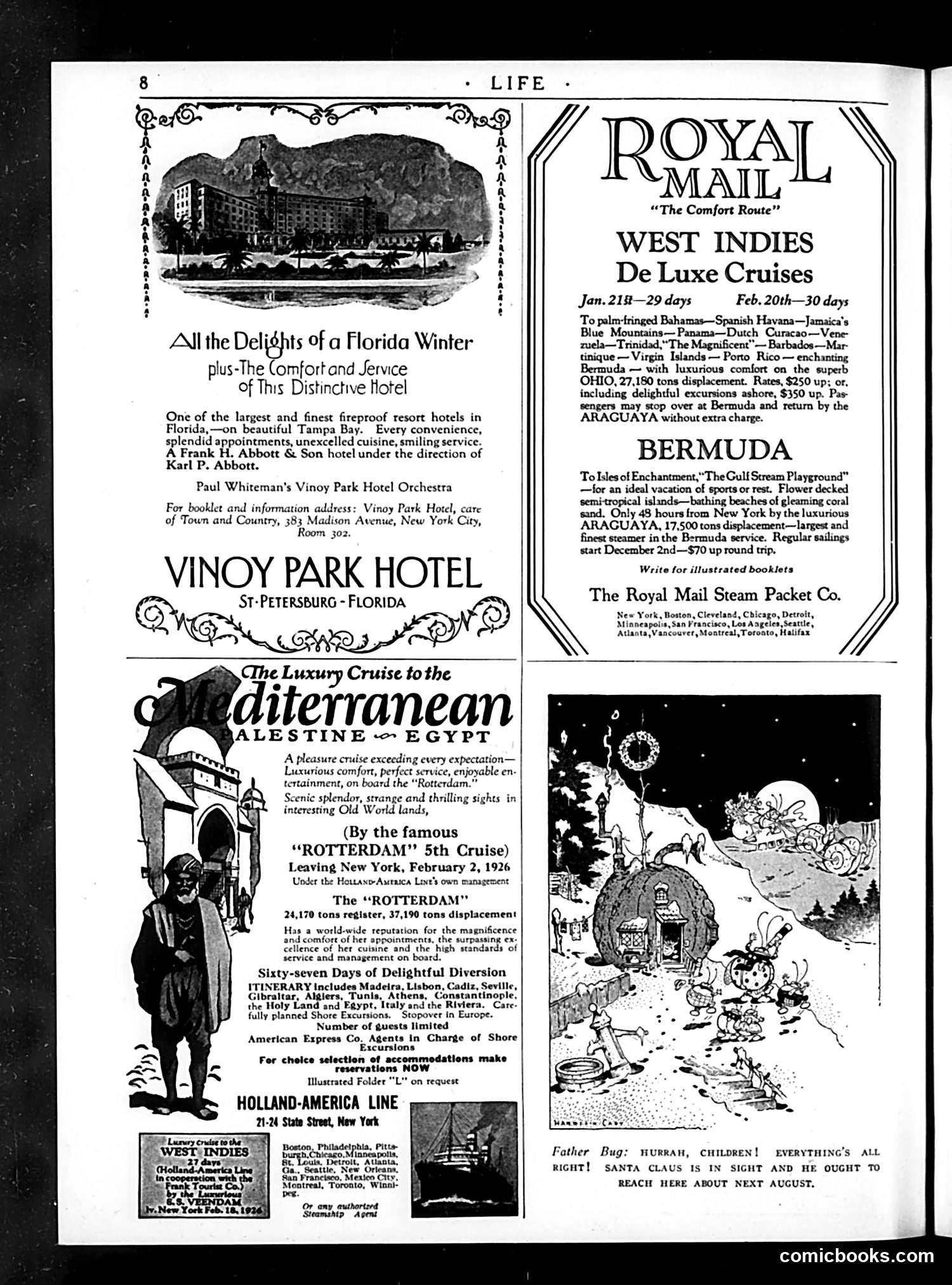
This page is **primarily advertising**, not political satire or comics. It contains four travel and hospitality advertisements from the 1920s: 1. **Vinoy Park Hotel** (St. Petersburg, Florida) — promoting winter leisure 2. **Royal Mail Steam Packet Co.** — cruise lines to the West Indies and Bermuda 3. **Holland-America Line** — Mediterranean cruises to Palestine and Egypt aboard the "Rotterdam" 4. **A children's cartoon** (bottom right) titled "Father Bug" — a whimsical illustration about Santa Claus visiting at the beach, unrelated to political content The page reflects 1920s leisure culture and the growth of accessible luxury travel for affluent Americans. The single cartoon is simply decorative entertainment, not satirical commentary.
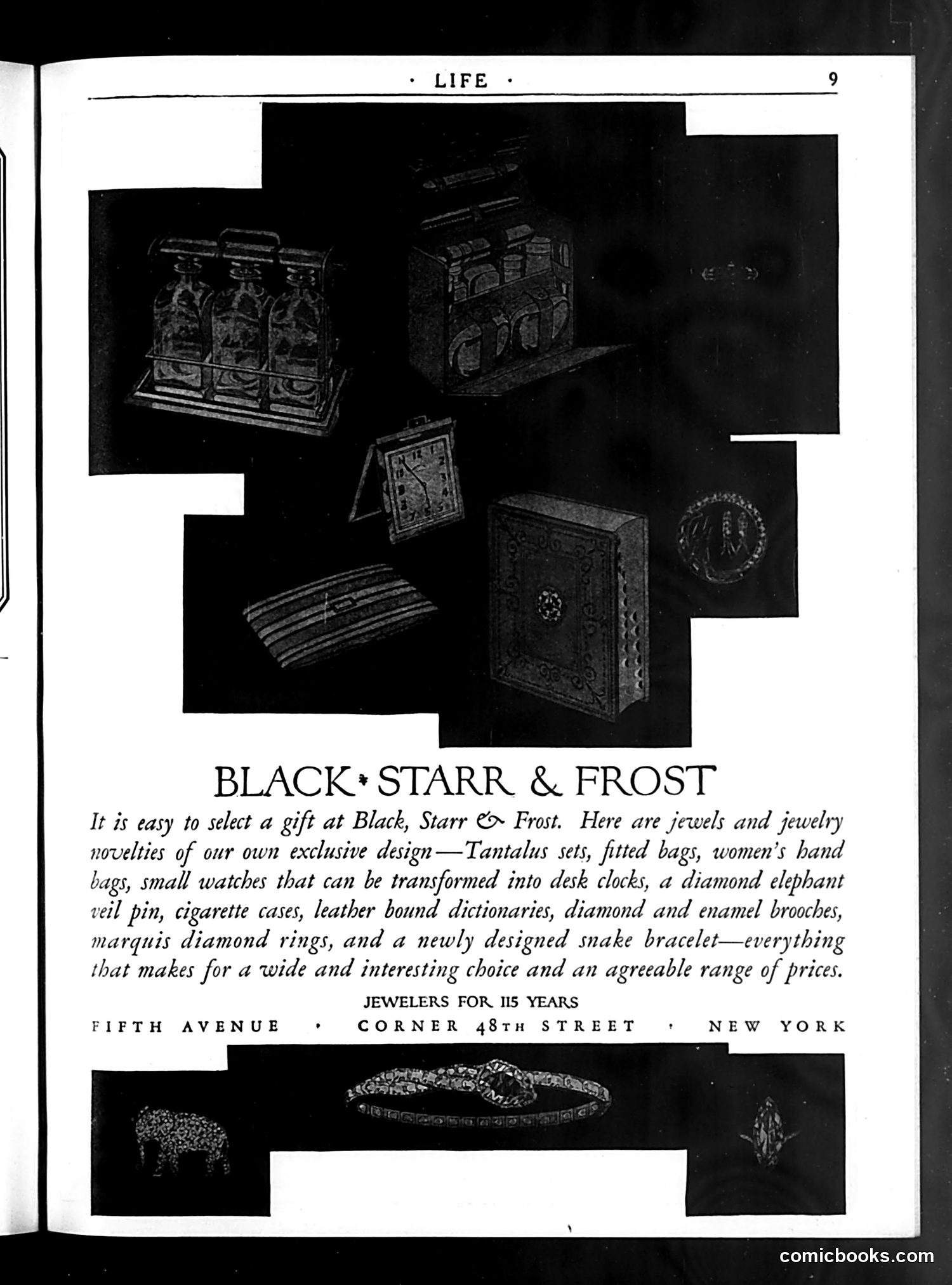
This is **not a cartoon or satirical content**, but rather a **full-page advertisement** for Black, Starr & Frost, a jewelry company located at Fifth Avenue and 48th Street in New York. The page displays photographs of luxury gift items the jeweler offers: decorative boxes, tantalus sets (liquor decanters), fitted bags, watches, cigarette cases, leather-bound dictionaries, brooches, rings, and bracelets. The ad emphasizes their "exclusive design" and notes they have been "jewelers for 115 years." The advertisement targets wealthy consumers seeking upscale gift options, highlighting the wide price range and variety available. There is no political satire or commentary present—this is purely commercial content from a vintage *Life* magazine issue.
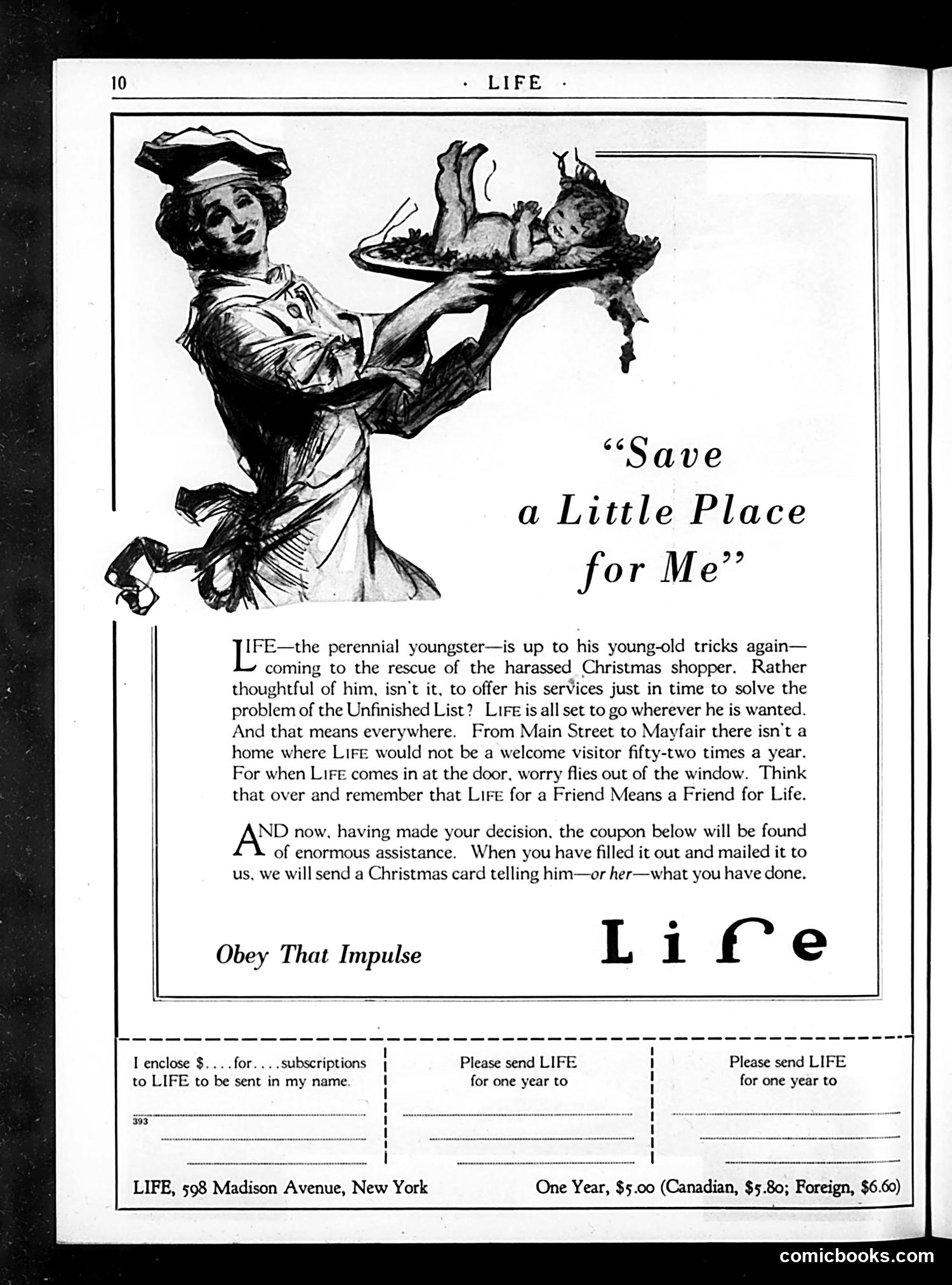
This is a **subscription advertisement** for *Life* magazine, not a political cartoon. The illustration shows a cheerful waiter or server carrying a platter with a roasted bird and a small cherub figure, accompanying the slogan "Save a Little Place for Me." The ad uses holiday sentiment to encourage gift subscriptions. The text plays on *Life*'s accessibility—available "from Main Street to Mayfair"—positioning the magazine as universally welcomed. It references an "Unfinished List," likely meaning gift-giving lists, and pitches subscriptions as a practical solution for holiday shoppers. The coupon system allowed purchasers to notify recipients via Christmas card. The pricing ($5.00 annually) and address (558 Madison Avenue, New York) are visible. This is straightforward commercial copy capitalizing on Christmas shopping season, not satire.
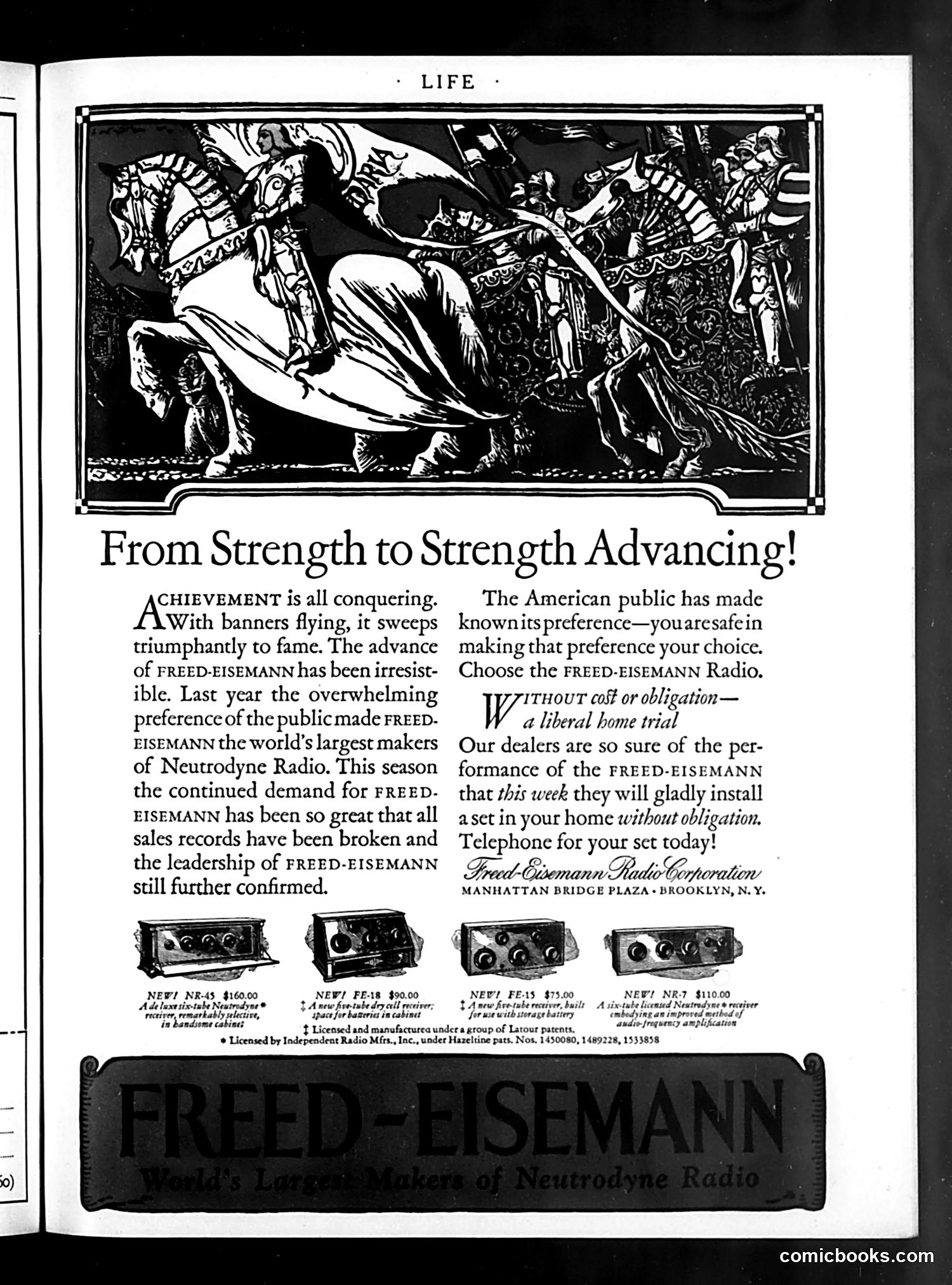
This is primarily a **Freed-Eisemann Radio advertisement**, not political satire. The page features a dramatic illustration at the top showing figures on horseback in medieval or classical style, with the headline "From Strength to Strength Advancing!" The ad claims Freed-Eisemann radios represent unstoppable market success—their "overwhelming preference" has made them "the world's largest makers of Neutrodyne Radio." It emphasizes the brand's continued dominance and offers dealers incentive for home installation trials. Four radio models are displayed with prices ranging from $25 to $160. **Note:** This appears to be a standard commercial advertisement rather than satirical content. Life magazine did publish both satire and ads; this page represents the advertising side of the publication.
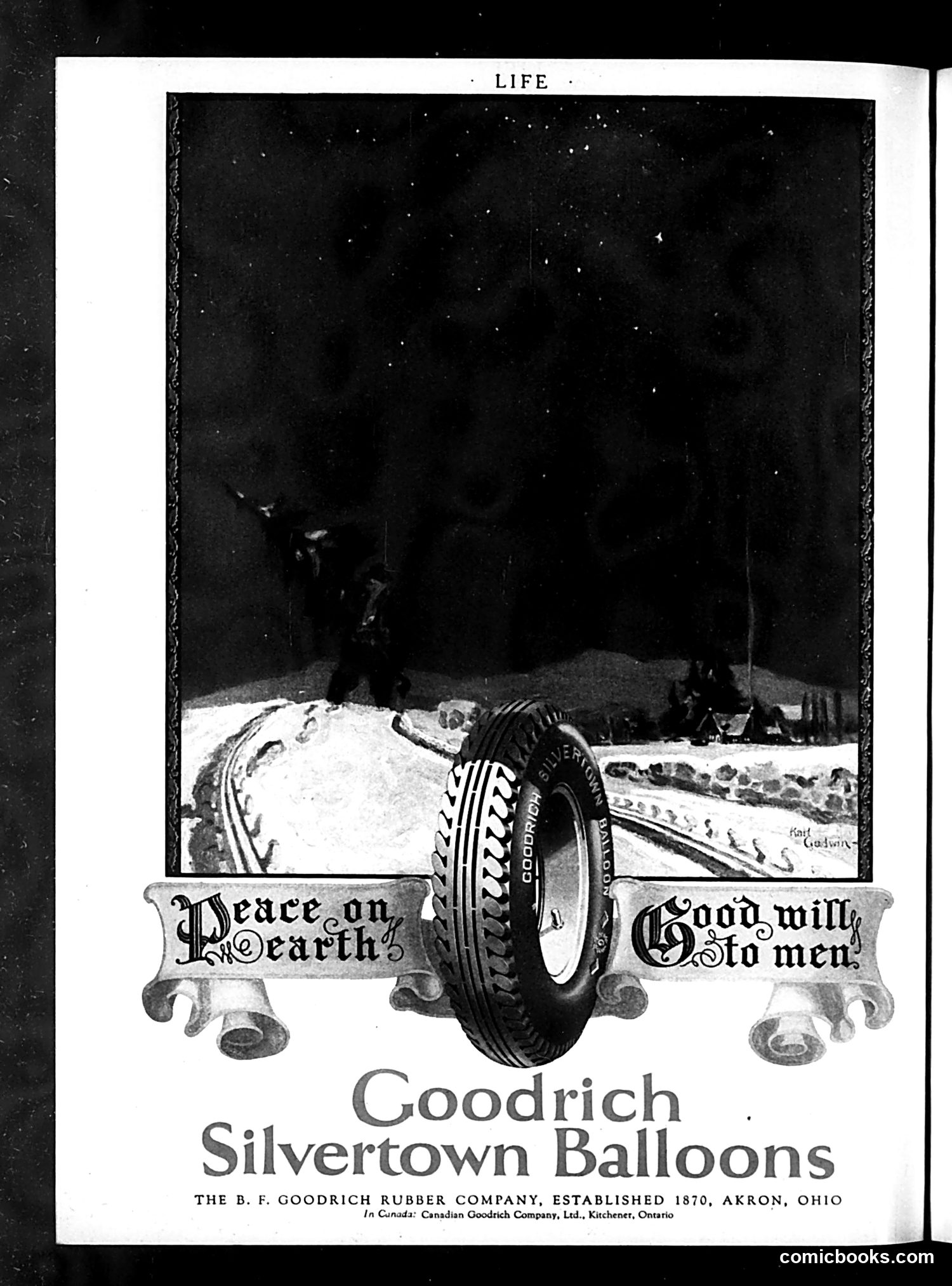
This is primarily a **Goodrich Silvertown Balloons tire advertisement** rather than political satire. The page appears in *Life* magazine and features a Goodrich tire prominently displayed. The imagery shows a nighttime scene with stars and what appears to be a nativity or religious scene in the background. The banner text reads "Peace on Earth" and "Good will to men"—Christmas/religious messaging. The advertisement leverages holiday sentiment and peace-themed iconography to market tires to consumers. By associating the product with peaceful, spiritual values during the Christmas season, Goodrich attempts to create positive brand associations. The company information notes establishments in Akron, Ohio and Kitchener, Ontario. This represents early 20th-century advertising strategy: combining commercial products with inspirational or sentimental messaging rather than focusing purely on product features.
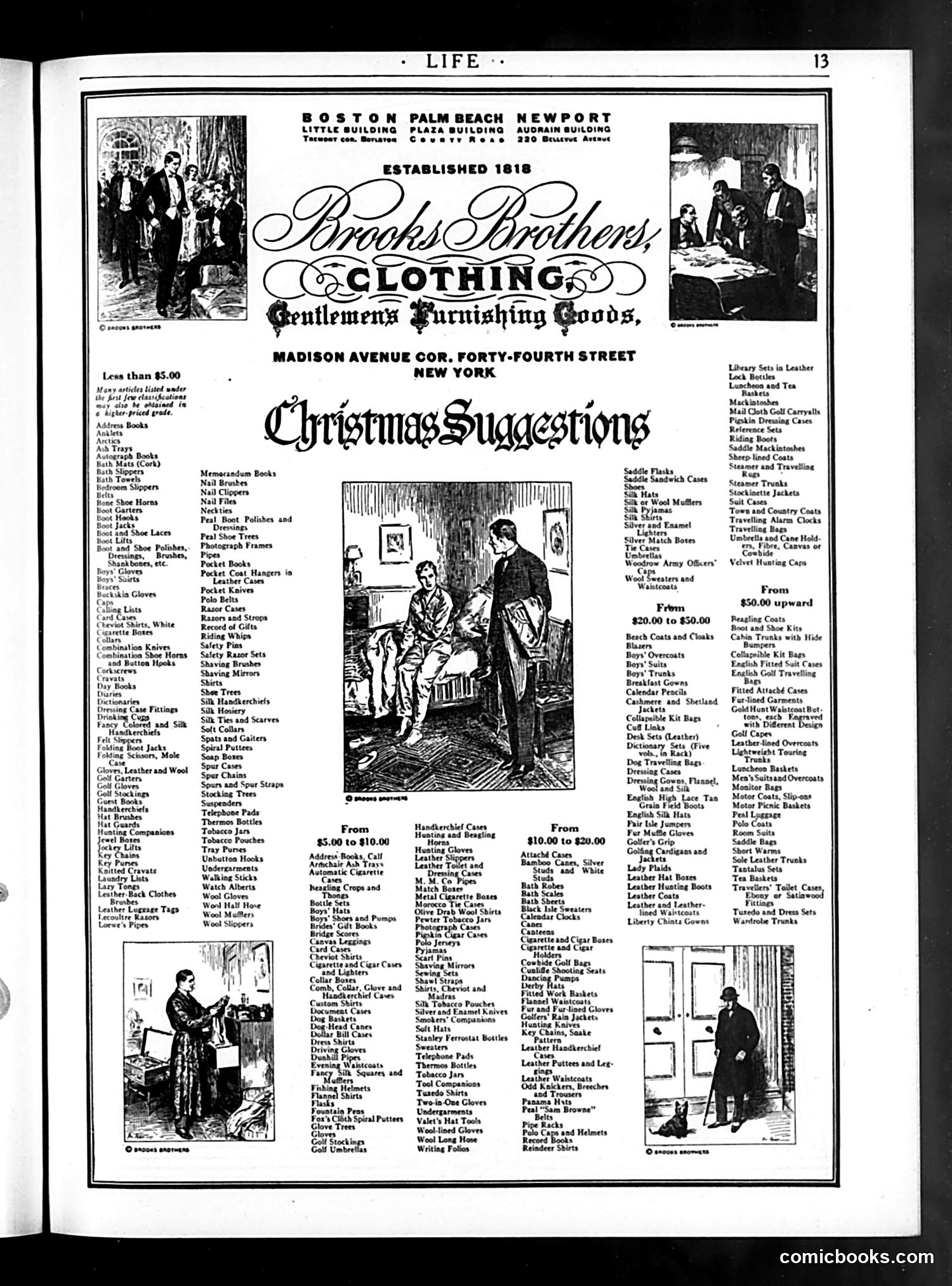
This is primarily a **Christmas shopping advertisement** for Brooks Brothers, the upscale clothing retailer, established 1818. The page presents gift suggestions organized by price point ($5-$10, $10-$20, $20-$50, and $50 upward). The three illustrated vignettes show gentlemen in various domestic settings—receiving gifts, shopping, and dressing—reflecting the store's positioning toward affluent male consumers. The extensive gift lists emphasize luxury items: leather goods, silk accessories, fine clothing, and accessories like smoking jackets and traveling cases. Rather than political satire, this represents **early twentieth-century consumer culture**, targeting wealthy men with sophisticated lifestyle goods. The imagery and catalog reflect period attitudes about masculine taste and holiday gift-giving among the upper classes.
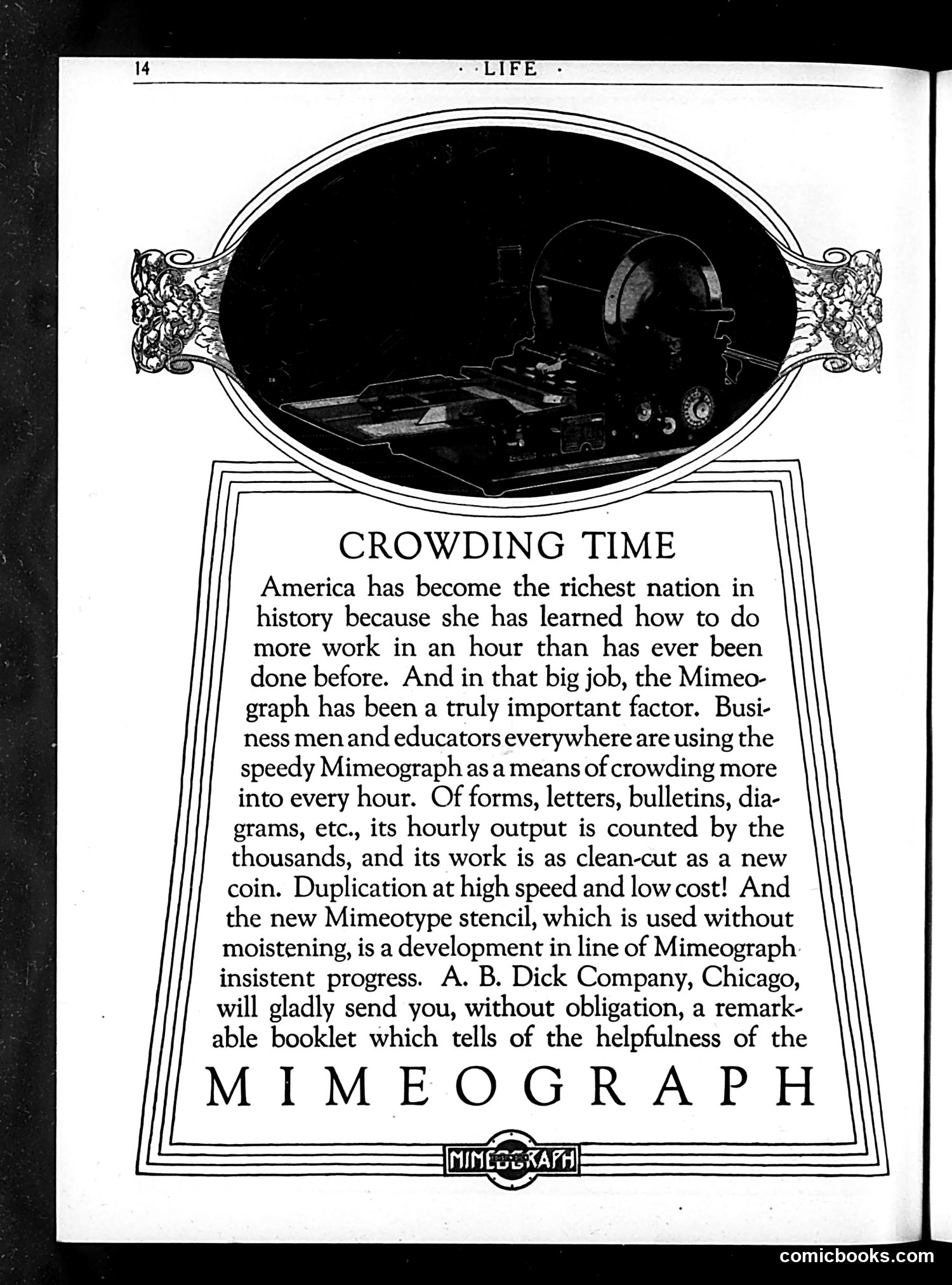
This is an **advertisement**, not editorial satire. The page promotes the Mimeograph machine, manufactured by A.B. Dick Company of Chicago. The ad's argument is straightforward: America's wealth derives from increased productivity—doing more work per hour. The Mimeograph enables this by rapidly duplicating documents (forms, letters, bulletins, diagrams) at low cost and high quality. The image shows the machine itself in profile. The ad emphasizes a new "Mimeotype stencil" requiring no moistening, presented as the latest in the company's "insistent progress." For modern readers: this represents early 20th-century office technology marketing, celebrating industrial efficiency as the driver of national prosperity—a common theme of the era.
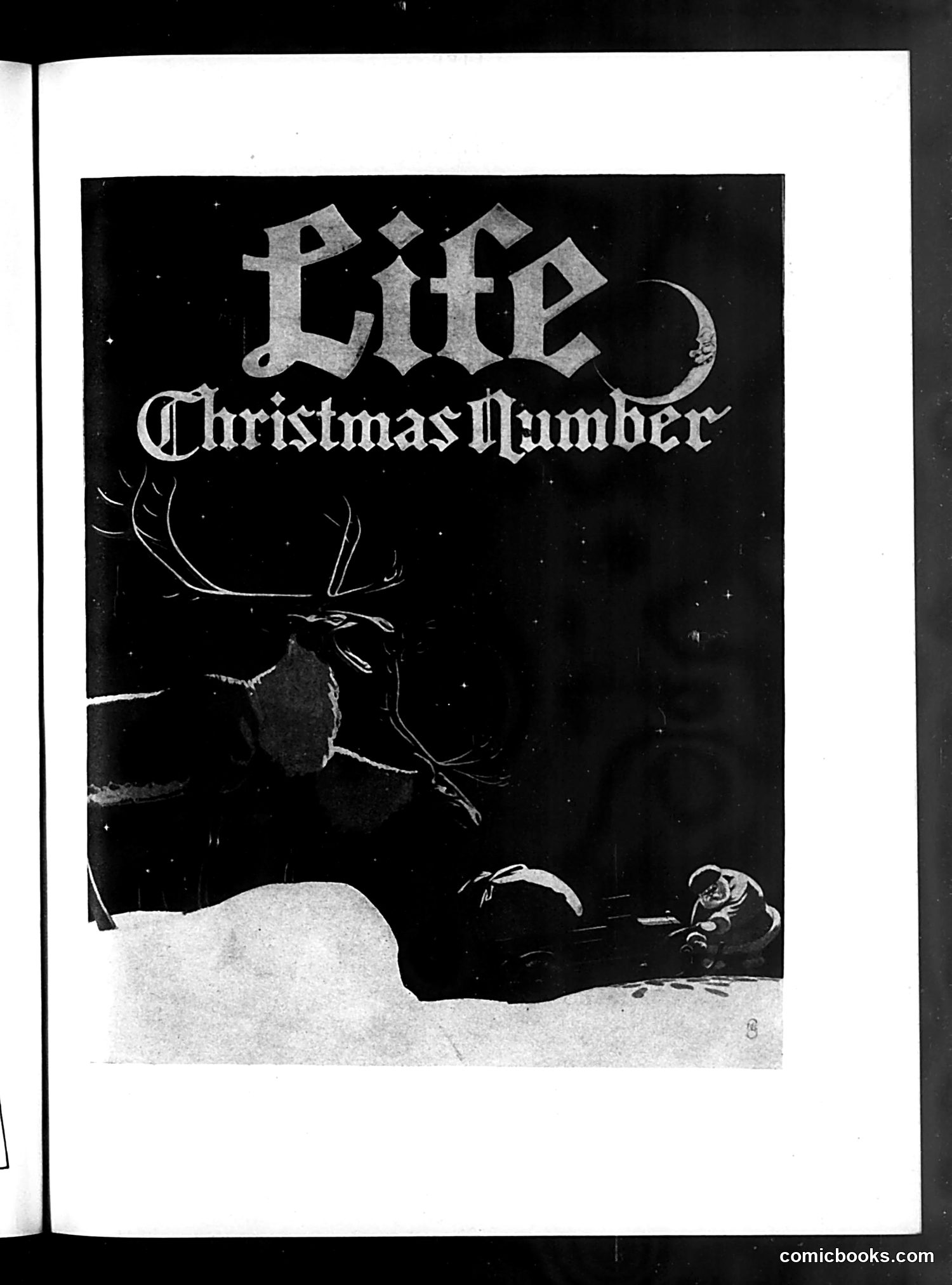
This is a **title/cover page** for Life magazine's Christmas issue, not a political cartoon. The design features Gothic lettering reading "Life Christmas Number" against a dark winter scene. The imagery depicts a **snowy nighttime setting** with what appears to be a reindeer with prominent antlers in the upper portion, and a figure (likely Santa Claus or a Christmas figure) resting in the snow below. A crescent moon hangs in the starlit sky. The aesthetic is **deliberately dark and somewhat melancholic** rather than cheerful—using stark black-and-white contrast and a gothic art style. This suggests an intentionally sophisticated or ironic take on Christmas celebration, typical of Life magazine's satirical approach to holiday themes. The exact satirical message requires additional context from the issue's contents.
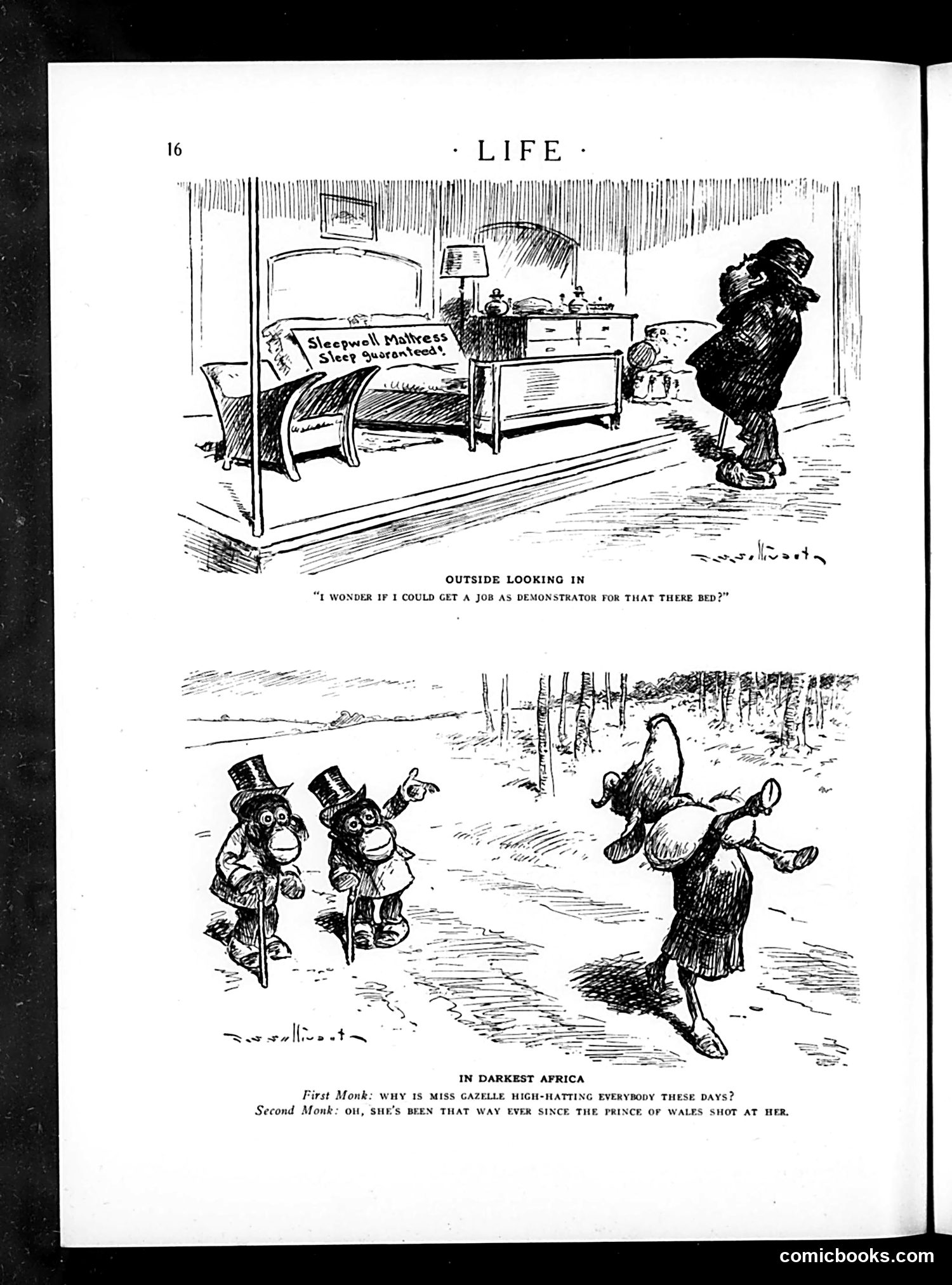
This page contains two unrelated satirical cartoons from *Life* magazine. **Top cartoon** ("Outside Looking In"): A poorly-dressed man gazes longingly at a bed advertised as a "Sleepwell Mattress" in a store window, expressing desire for employment as the mattress demonstrator—a commentary on economic hardship and unemployment, likely from the Depression era. **Bottom cartoon** ("In Darkest Africa"): Two monkeys in top hats discuss a third figure (depicted with racist caricature characteristics typical of early 20th-century imagery). The caption references "Miss Gazelle" being "high-hatting everybody" since "the Prince of Wales shot at her"—a gossipy social satire mixing animal characters with human society commentary, though the specific reference is unclear.
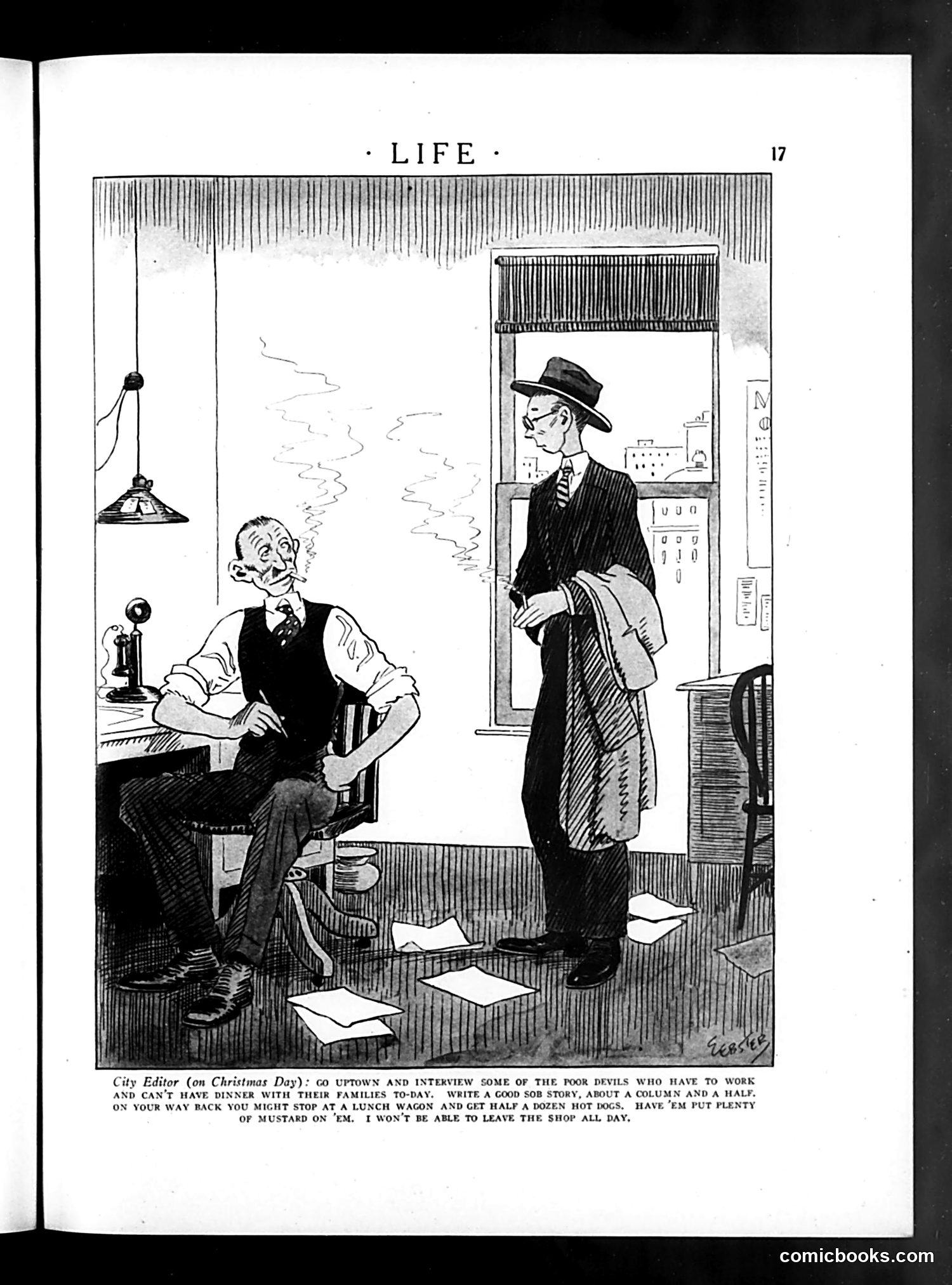
This cartoon satirizes a newspaper editor's Christmas Day assignment to his reporter. The editor (seated at desk) instructs the journalist to interview impoverished workers ("poor devils") who must labor on Christmas and cannot dine with their families. The editor wants a sympathetic "sob story" for publication—about one column's worth—to boost readership during the holiday. The satire targets journalistic exploitation: the editor cynically weaponizes human suffering for sales while offering minimal aid (suggesting the reporter buy hot dogs from a lunch wagon). The instruction "I won't be able to leave the shop all day" reveals the editor won't personally sacrifice, only profit from others' misery. This critiques both sensationalist journalism and the callous indifference of the wealthy toward working-class hardship during the holiday season.
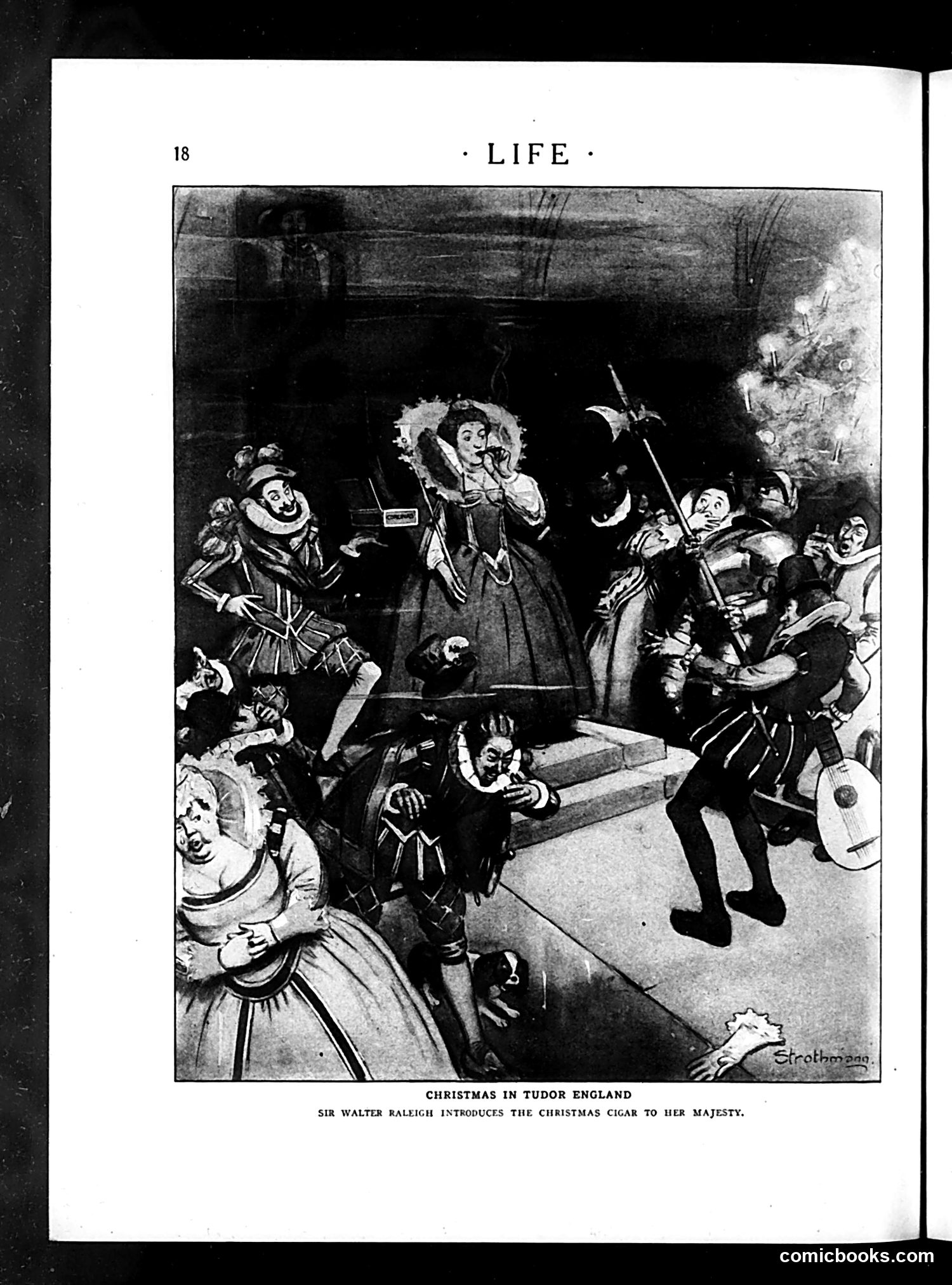
This satirical illustration depicts a fictional historical scene: Sir Walter Raleigh presenting tobacco to Queen Elizabeth I during Tudor England. The humor lies in the anachronism—cigars were unknown in Tudor times, yet the caption presents this as historical fact. The joke targets both historical ignorance and contemporary cigar culture. By attributing tobacco's introduction to the celebrated courtier Raleigh (who historically *did* promote New World goods), the cartoonist playfully "explains" why cigars became fashionable among the Elizabethan court. The elaborate period costumes and courtly setting enhance the absurdist comedy. This works as gentle satire of how historical narratives are constructed and how luxury goods become socially prestigious—Raleigh's endorsement supposedly made smoking respectable, just as celebrity endorsements drove consumption in Life magazine's era.
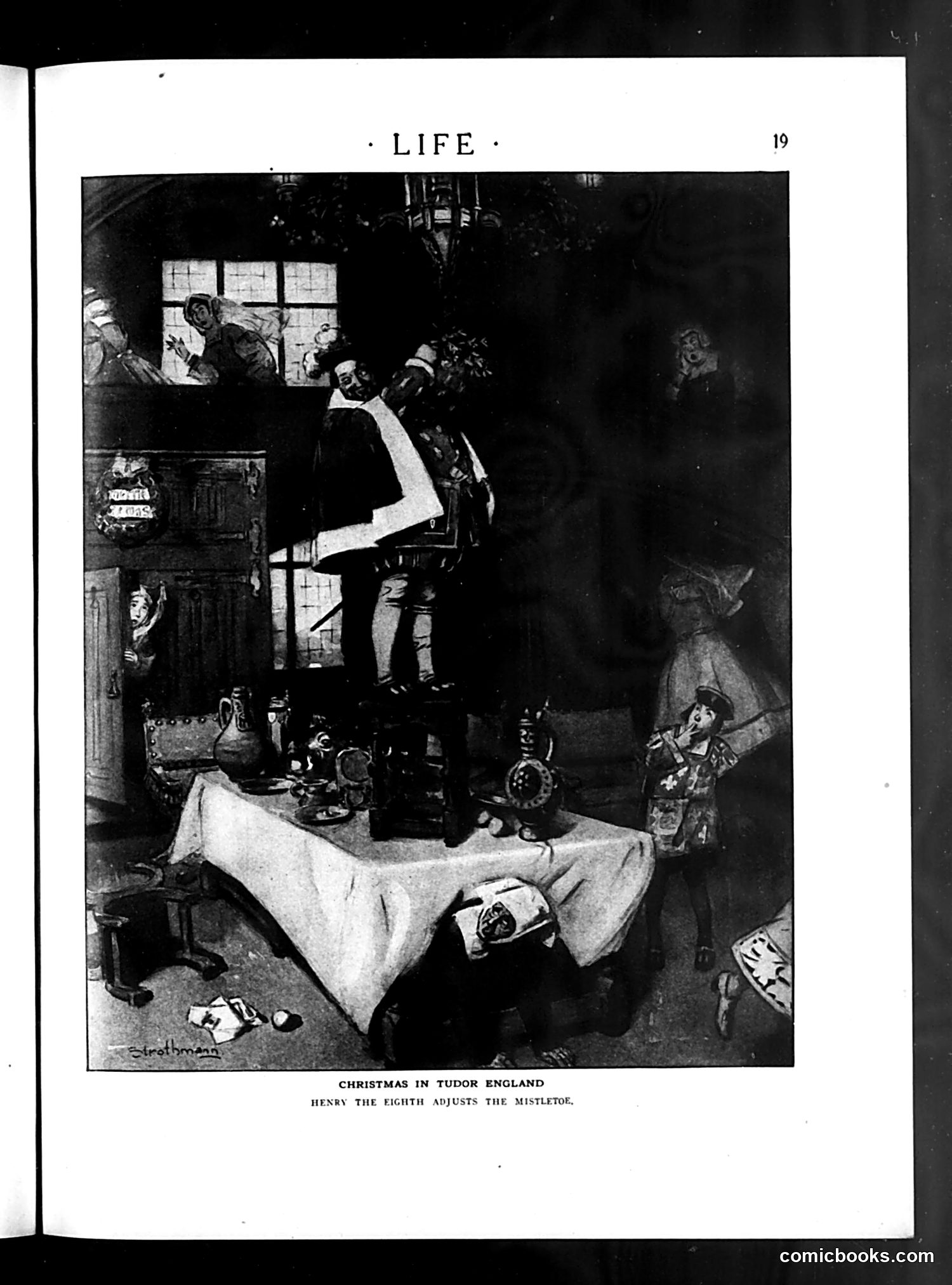
This satirical illustration depicts King Henry VIII adjusting mistletoe during a Christmas celebration. The scene is set in a Tudor-era interior with period details: a fireplace, latticed windows, and costumed courtiers. The humor targets Henry VIII's notorious marital history—he famously had six wives, executing or divorcing most of them. By showing him "adjusting the mistletoe" (associated with romantic kissing customs), the cartoonist satirizes his relentless pursuit of romantic/sexual encounters. The composition, with Henry positioned prominently among courtiers in what appears to be a festive but tense scene, suggests dark comedy about his dangerous courtship. This likely appeared in *Life* magazine during the early 20th century, treating historical figures as vehicles for social commentary on male behavior and power dynamics.
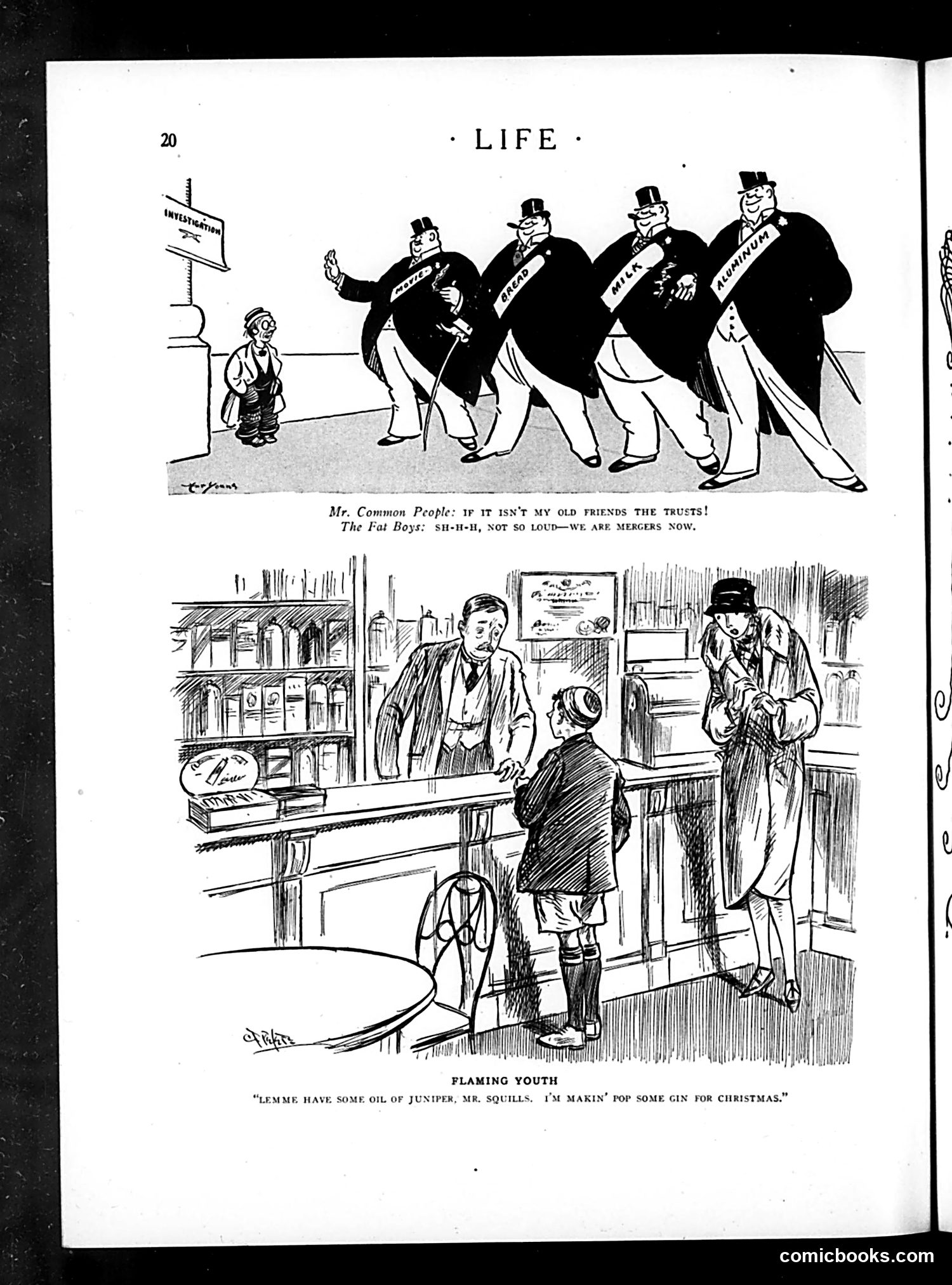
**Top cartoon:** "Mr. Common People" confronts four fat, top-hatted wealthy men wearing sashes labeled with trusts (monopolies). The fat boy warns that if these old friends (the trusts) don't unite, they'll become "mergers now"—satirizing how large corporations were consolidating power through mergers to maintain control. **Bottom cartoon:** "Flaming Youth" shows a young boy asking a pharmacist for gin ingredients (juniper oil), claiming he's making it for Christmas. This mocks Prohibition-era youth obtaining alcohol illegally through seemingly innocent requests. The humor targets both young people's lawlessness and adults' complicity in circumventing alcohol bans. Both cartoons critique social problems: unchecked corporate power and widespread Prohibition defiance.
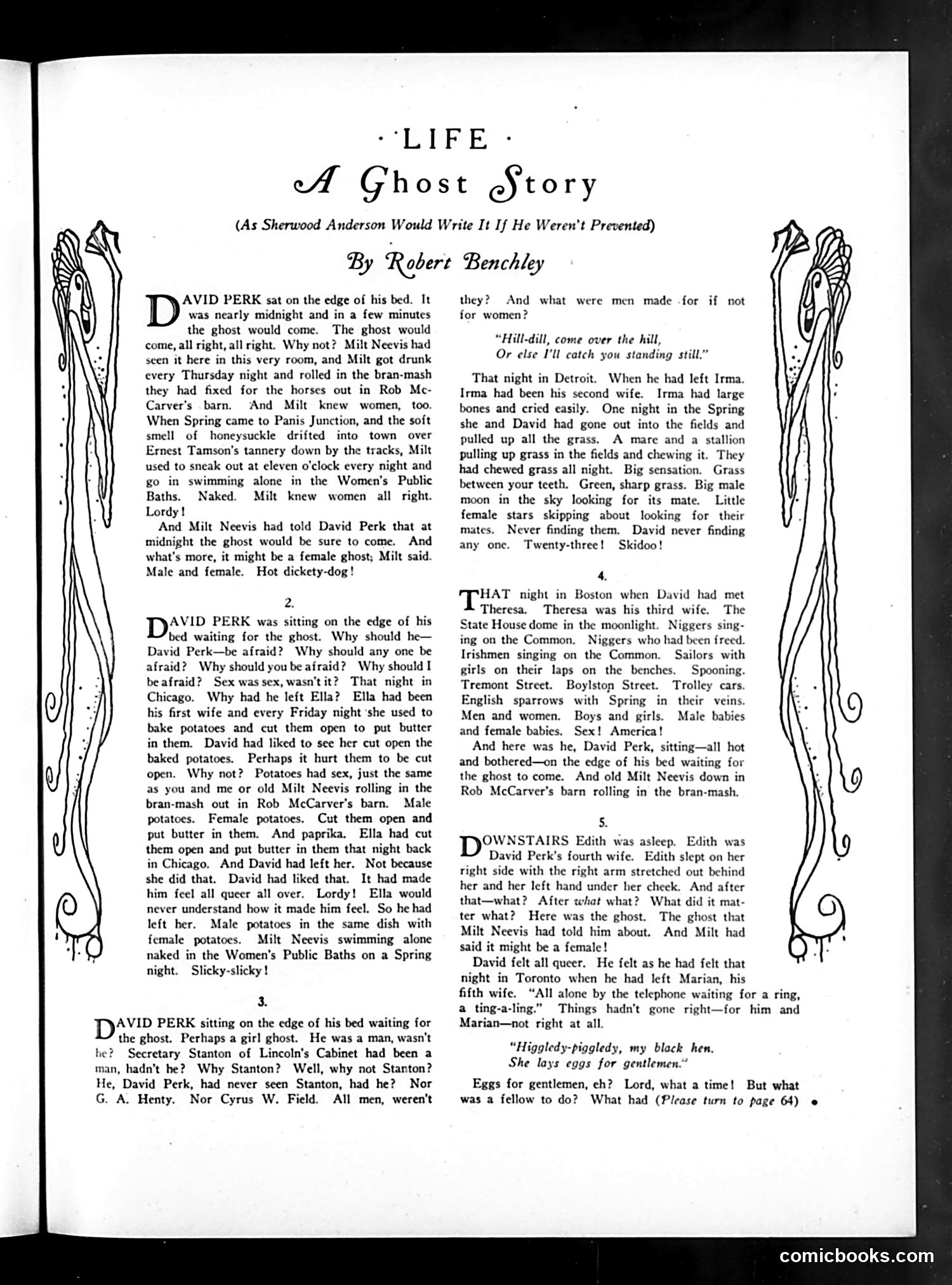
This is a **parody of Sherwood Anderson's literary style** by humorist Robert Benchley. Anderson was known for modernist short stories featuring stream-of-consciousness narration, rural American settings, and themes of repressed desire and existential wandering. Benchley satirizes Anderson by exaggerating his mannerisms: obsessive, digressive internal monologues; cryptic connections between unrelated details (potatoes, swimming, ghosts); pseudo-profound musings about sex and identity; and rambling references to obscure figures (Stanton, Henty, Field). The joke is that Anderson's supposedly deep philosophical explorations of human nature are absurdly pretentious—a man waiting for a ghost becomes an excuse for incoherent philosophizing about masculinity, his multiple wives, and random rural imagery. The subtitle "(As Sherwood Anderson Would Write It If He Weren't Prevented)" suggests Benchley is gently mocking what Anderson might produce if unleashed without editorial restraint.
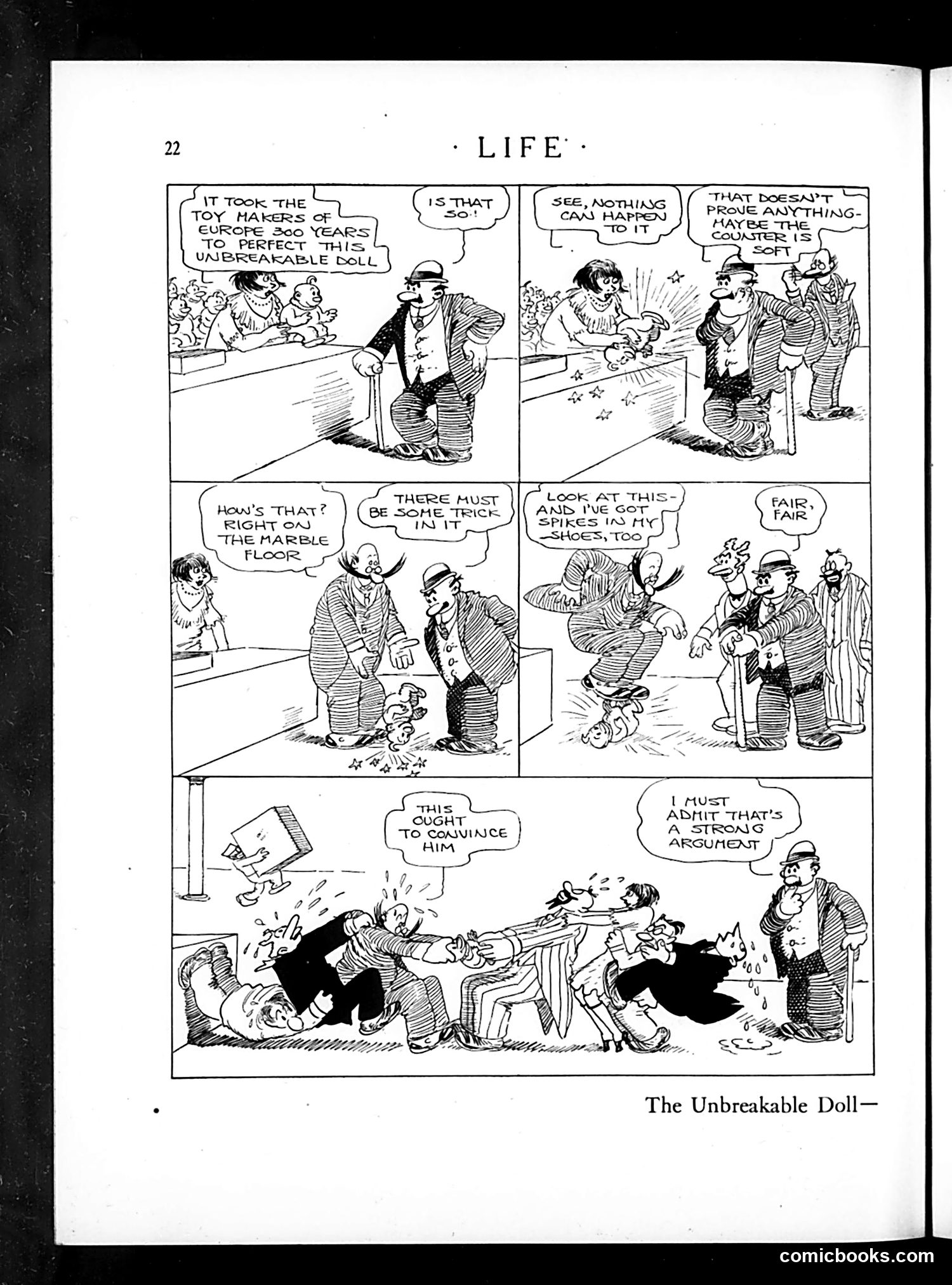
This comic satirizes European toy manufacturers' claims about an "unbreakable doll." The joke follows a classic pattern: toy sellers boast the doll survived 300 years of European attempts to break it. When challenged to prove this, they demonstrate various "tricks"—dropping it on marble floors, adding spikes to shoes—all ineffective. The humor escalates in the final panel, where rougher methods (physical violence depicted through action lines) finally *do* damage the doll. One character concedes "I must admit that's a strong argument"—acknowledging that brute force succeeded where clever tricks failed. The satire likely targets either European manufacturing claims or broader themes about durability and marketing exaggeration. The cartoon reflects early-twentieth-century consumer skepticism toward advertising hyperbole about product quality.
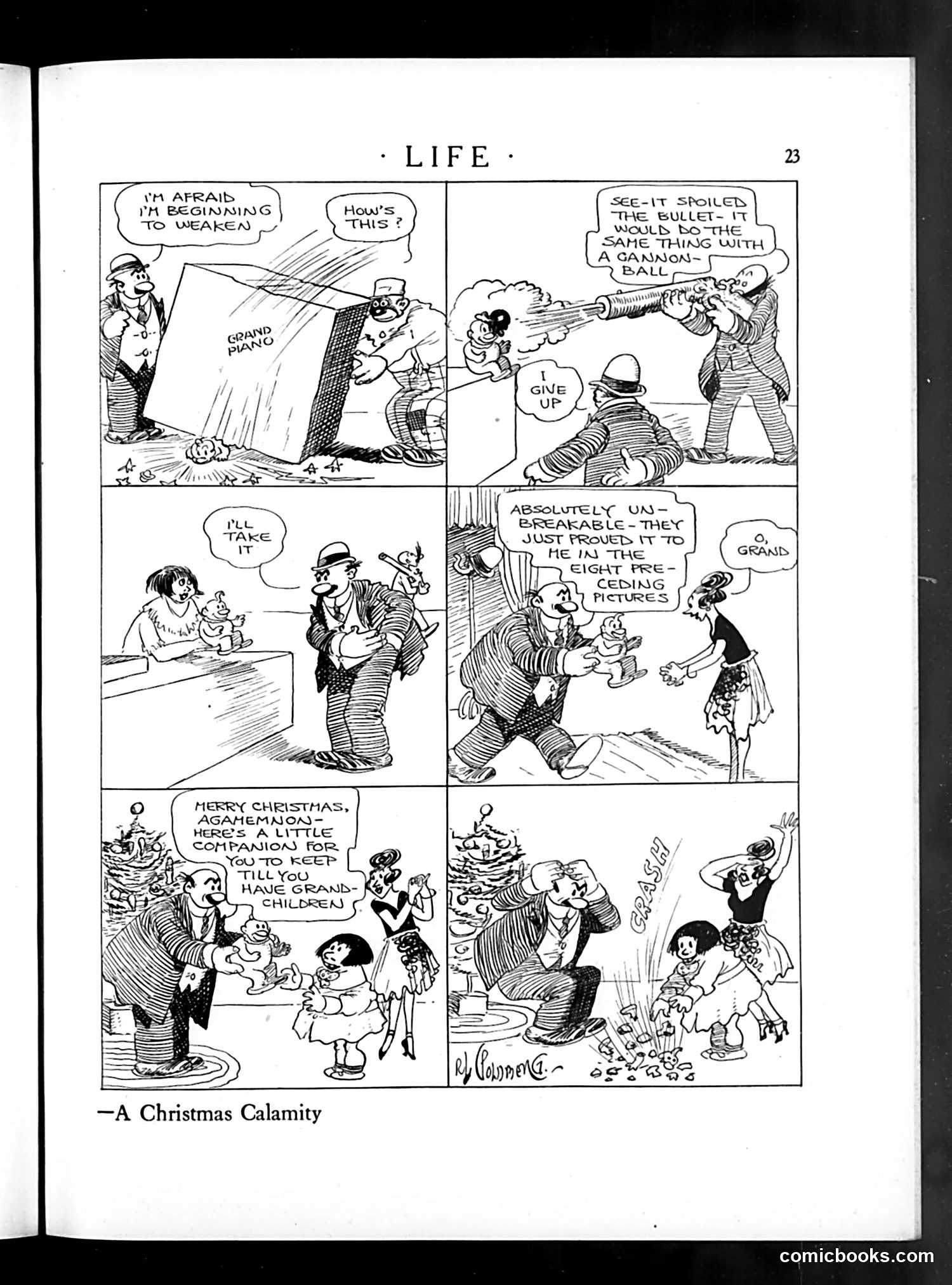
This comic satirizes the durability of children's toys through slapstick humor. A man demonstrates a supposedly "unbreakable" toy piano to a skeptical customer by dropping it repeatedly—each impact producing louder crashes. The punchline arrives when he gives it as a Christmas gift to his grandson "Agamemnon," only for the child to immediately destroy it anyway, proving the toy's fragility was inevitable despite the salesman's boasts. The humor targets both the exaggerated advertising claims of toy manufacturers and the destructive nature of children. The Greek name "Agamemnon" adds comedic pretension to an ordinary domestic scene. This reflects early-20th-century consumer culture anxieties about product quality and the gap between marketing promises and reality—themes that remain relevant today.
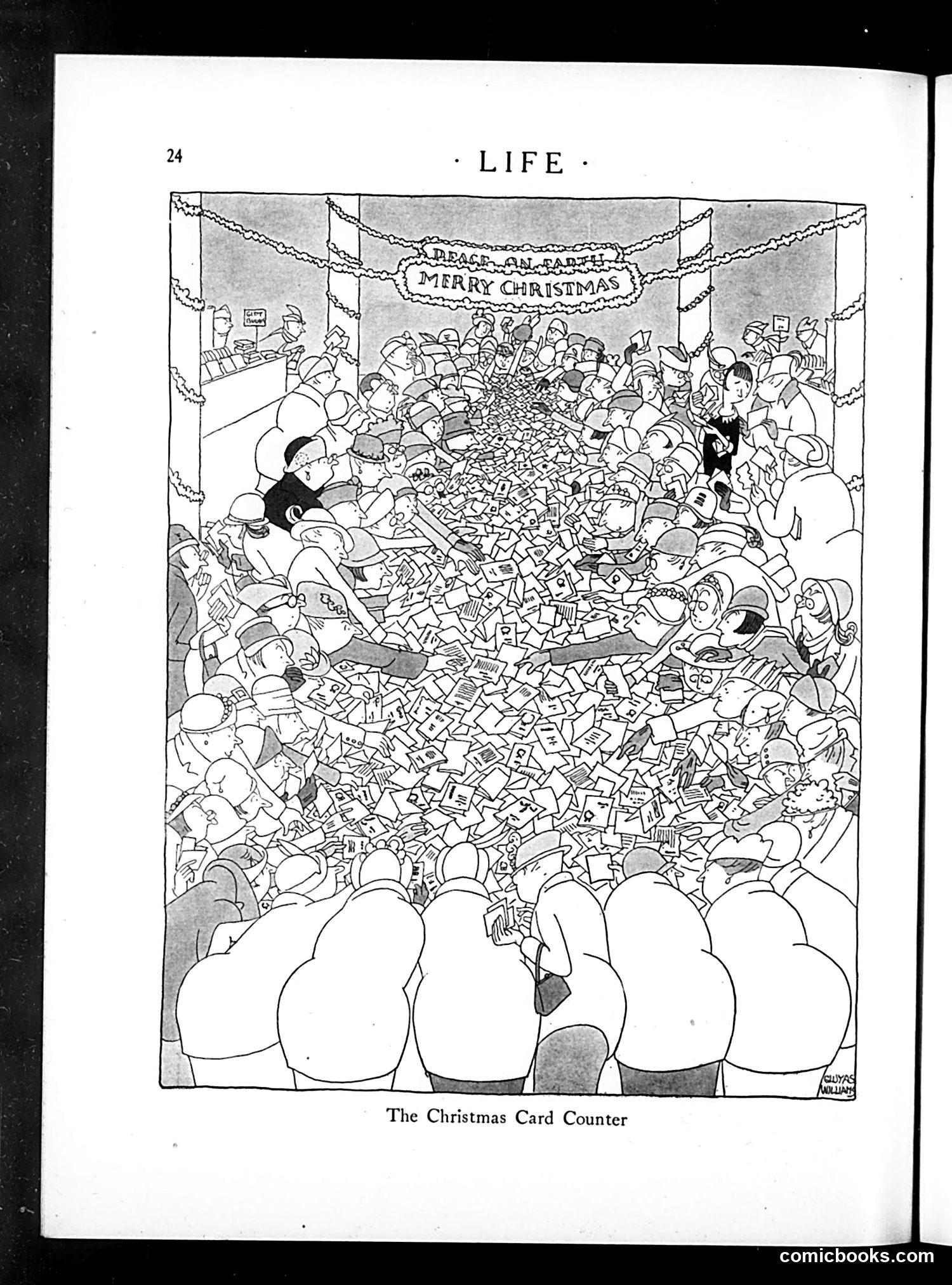
This satirical cartoon depicts a chaotic retail scene during the Christmas shopping season. A massive crowd of shoppers surges around a store counter labeled "The Christmas Card Counter," with packages and goods piling up everywhere. The banner overhead reads "Peace on Earth, Merry Christmas," creating ironic contrast with the frenzied, almost violent commercial scramble below. The satire targets the commercialization of Christmas and the contrast between the holiday's spiritual message of peace and the materialistic chaos of holiday shopping. The overwhelmed crowds, crushed merchandise, and general pandemonium mock how seasonal retail transforms into an undignified stampede. The cartoon critiques how consumer culture has overtaken the religious meaning of Christmas, reducing it to a commercial free-for-all where peace and goodwill are abandoned in pursuit of shopping deals.
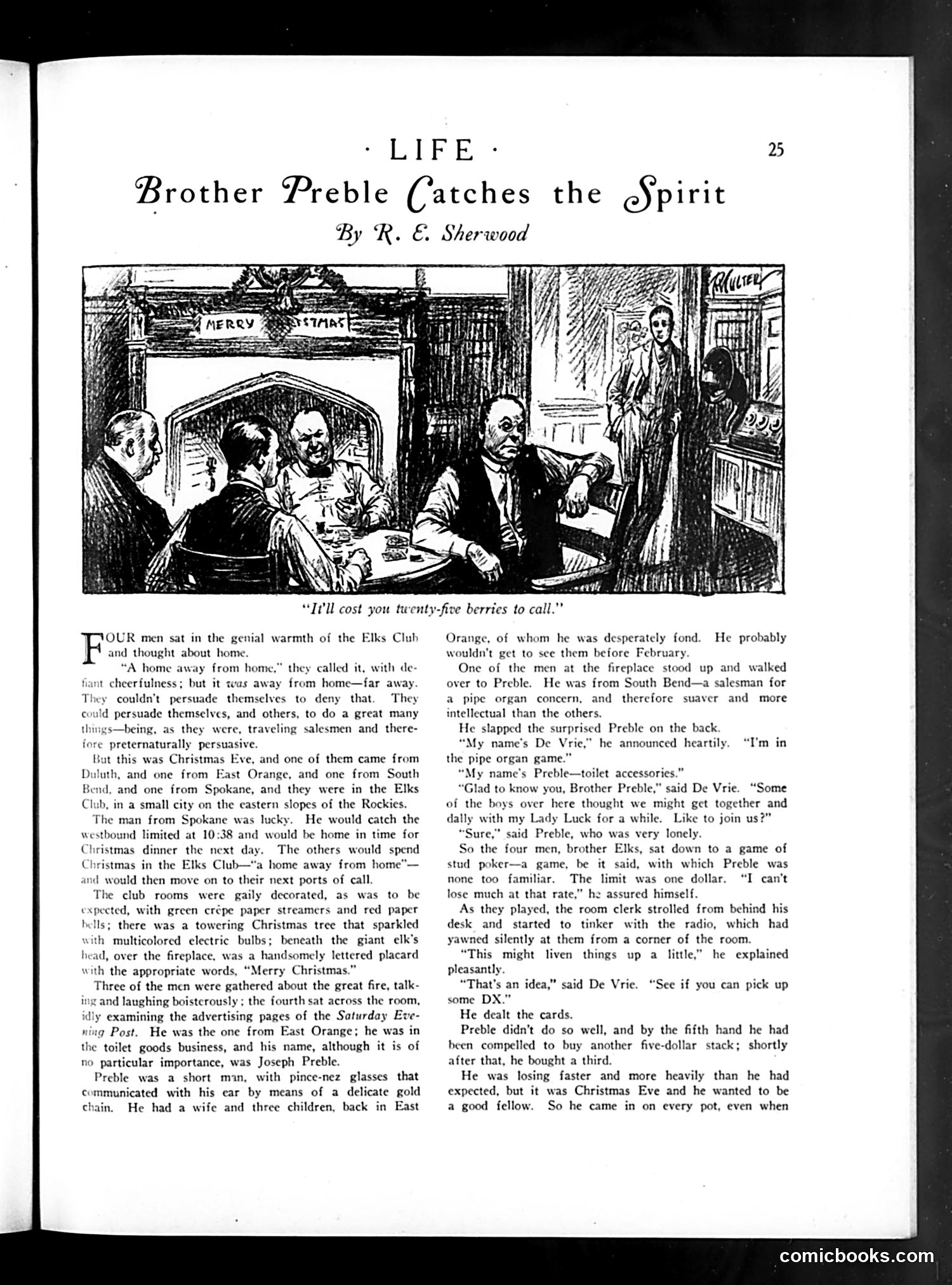
This is a short story illustration, not a political cartoon. It depicts four traveling salesmen—lonely on Christmas Eve—at an Elks Club in a Rocky Mountain town. One, Joseph Preble (from East Orange, in toilet goods), is a short man with pince-nez glasses separated from his wife and three children. The narrative shows Preble joining a poker game with the other men, including a more sophisticated pipe organ salesman named De Vrie. The illustration captures the moment when the radio is turned on, ostensibly to "liven things up." The story's title and the caption ("It'll cost you twenty-five berries to call") suggest the radio broadcast will become significant—possibly supernatural or spiritually meaningful given the story's title about "catching the spirit." The satire appears gentle: commenting on salesmen's loneliness during holidays and their performative cheerfulness despite displacement from home.
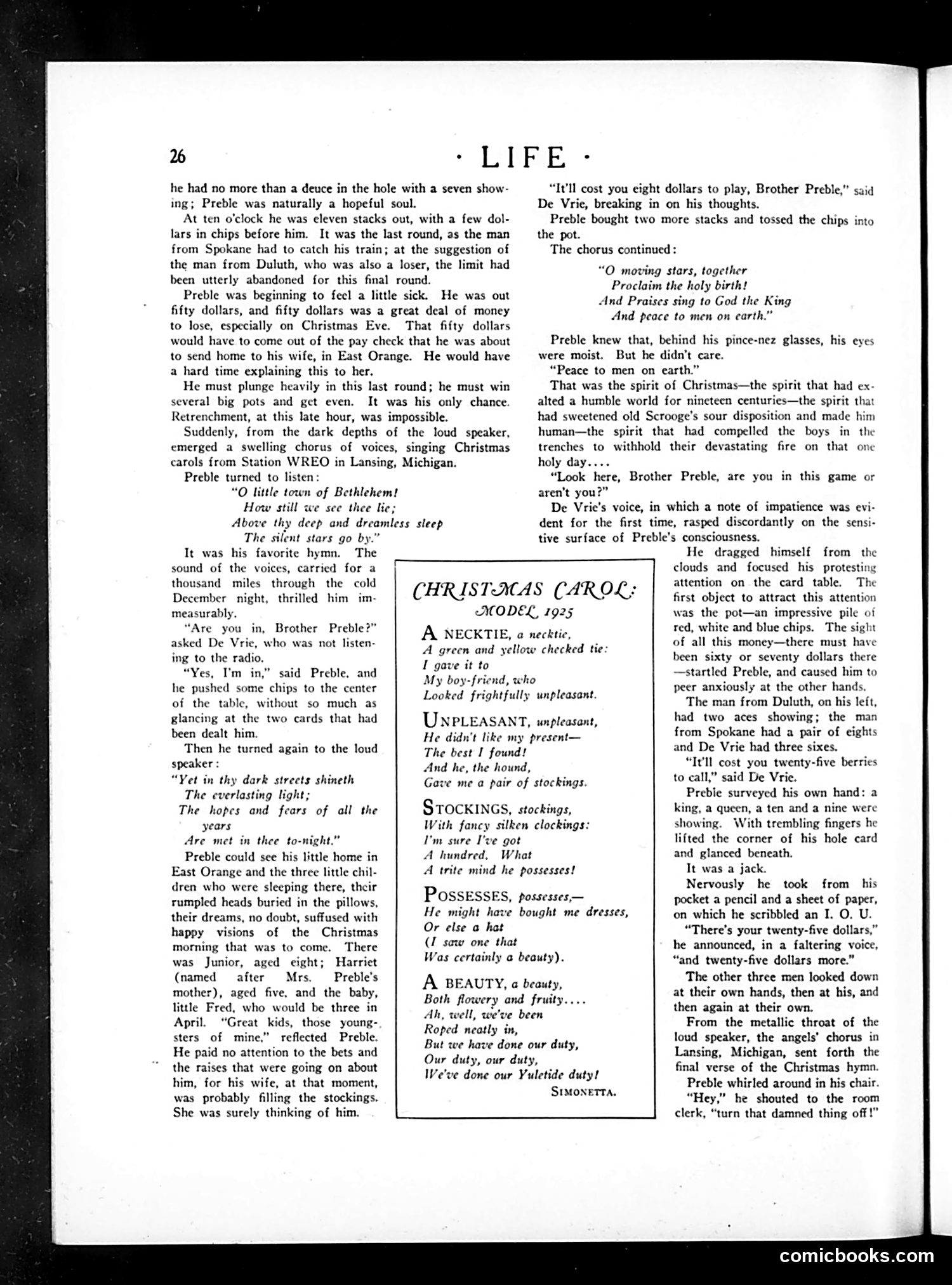
This page presents a short story about Brother Preble, a man gambling on Christmas Eve while hearing carols broadcast over the radio—a then-modern technology. The narrative contrasts his sacred duty (supporting his family in East Orange) with worldly temptation (the poker game). The satire targets 1920s materialism and spiritual hypocrisy. Despite hearing "Peace to men on earth," Preble abandons moral restraint, betting his family's money. His sentimentality about home and children coexists with reckless gambling—he doesn't even look at his cards. The boxed "Christmas Carol: Model 1925" parodies modern commercialism, reducing the carol tradition to complaints about unwanted consumer goods (a necktie). This mocks how 1920s consumer culture had commodified Christmas. The overall message: radio-age Americans are distracted by novelty and materialism, losing sight of genuine Christmas values despite constant reminders of them.
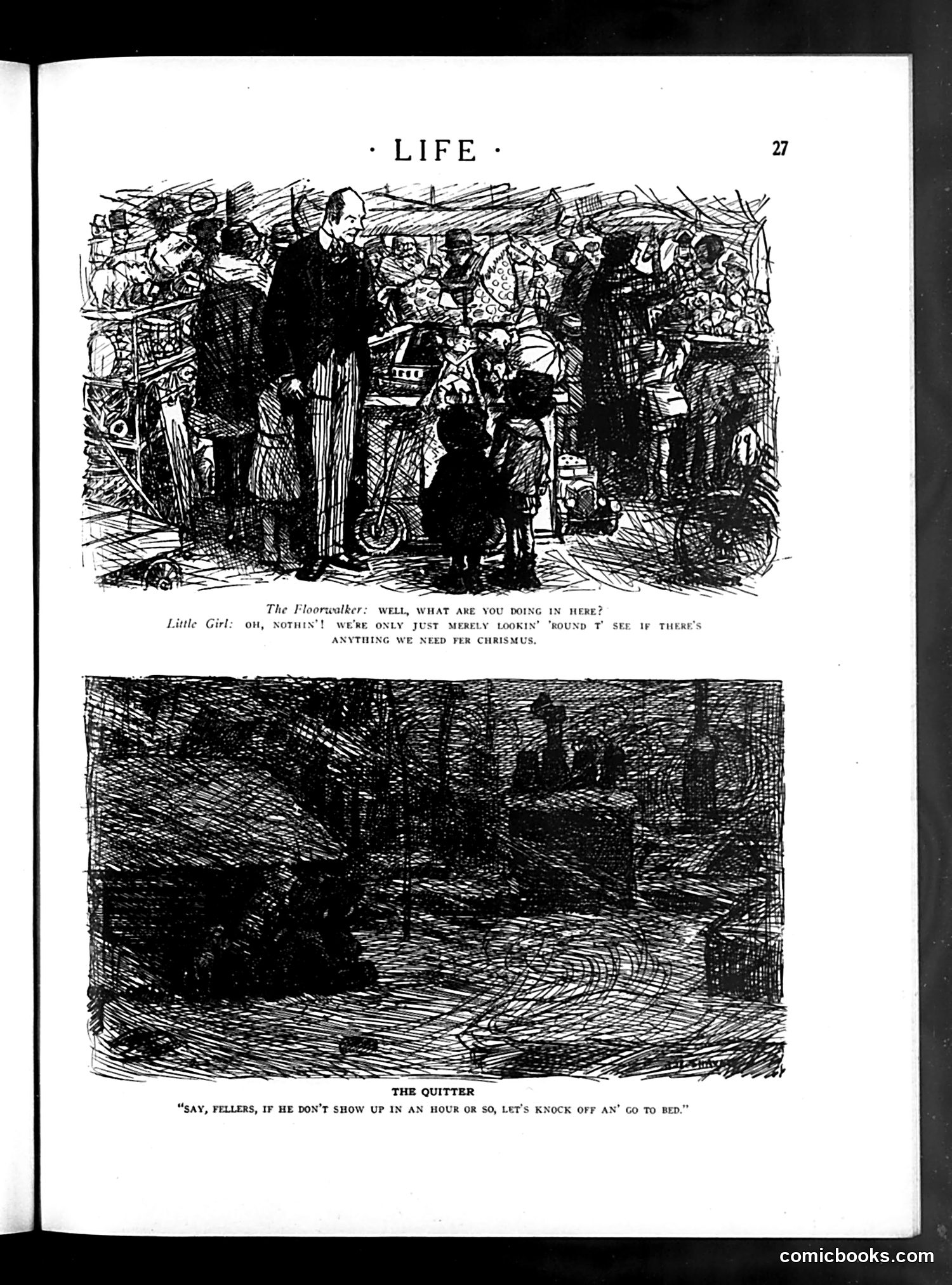
**Top cartoon ("The Floorwalker"):** A store employee confronts a child and companions browsing during the Christmas shopping season. The joke targets both working-class children who window-shop without buying and the officious retail staff who view them suspiciously. The child's response—that they're "only just merely lookin'"—captures the tension between consumer culture and poverty during the holiday season. **Bottom cartoon ("The Quitter"):** Workers in what appears to be an industrial or construction setting discuss abandoning their post if their supervisor doesn't arrive soon. The satire criticizes worker laziness and lack of commitment, or possibly management inefficiency. The crude sketch style and working-class dialect reflect Life's satirical commentary on American labor dynamics of the period.
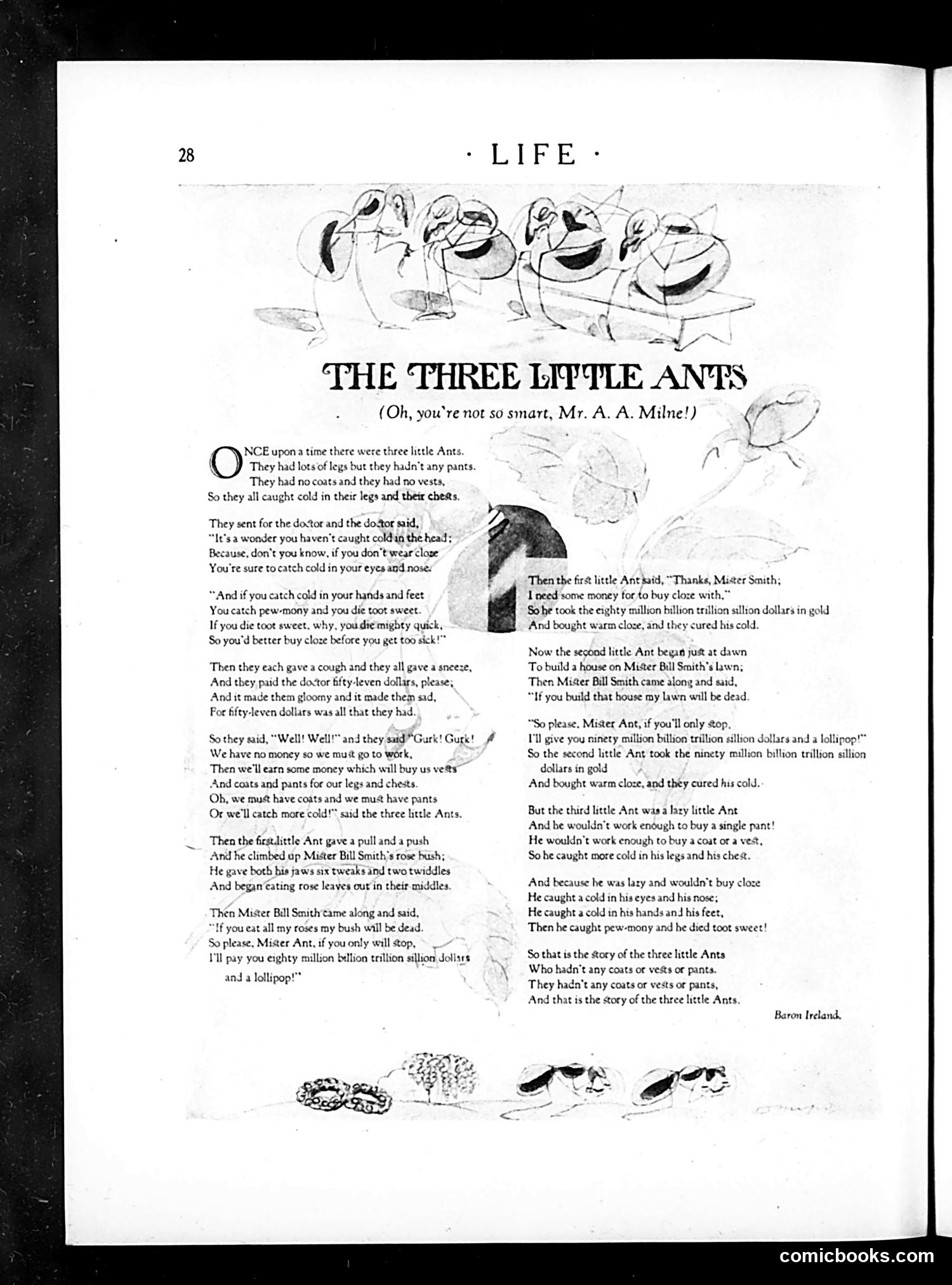
This is a satirical children's story by Baron Ireland that parodies A.A. Milne's famous tales (note the subtitle: "Oh, you're not so smart, Mr. A. A. Milne!"). The story mocks both Milne's writing style and contemporary American capitalism. Three ants catch cold from lacking clothes. Rather than the wholesome moral lessons of Milne's stories, this tale depicts naked capitalism: the ants earn enormous sums ("eighty million billion trillion sillion dollars") by destroying a man's property—eating his roses and building on his lawn—in exchange for payment. Two industrious ants buy warm clothes and survive; the lazy third ant refuses to work, catches pneumonia, and dies. The satire targets both sentimentalized children's literature and the American economic system's harsh inequalities—suggesting that survival depends entirely on commercial transaction and labor, with no room for idleness or failure.
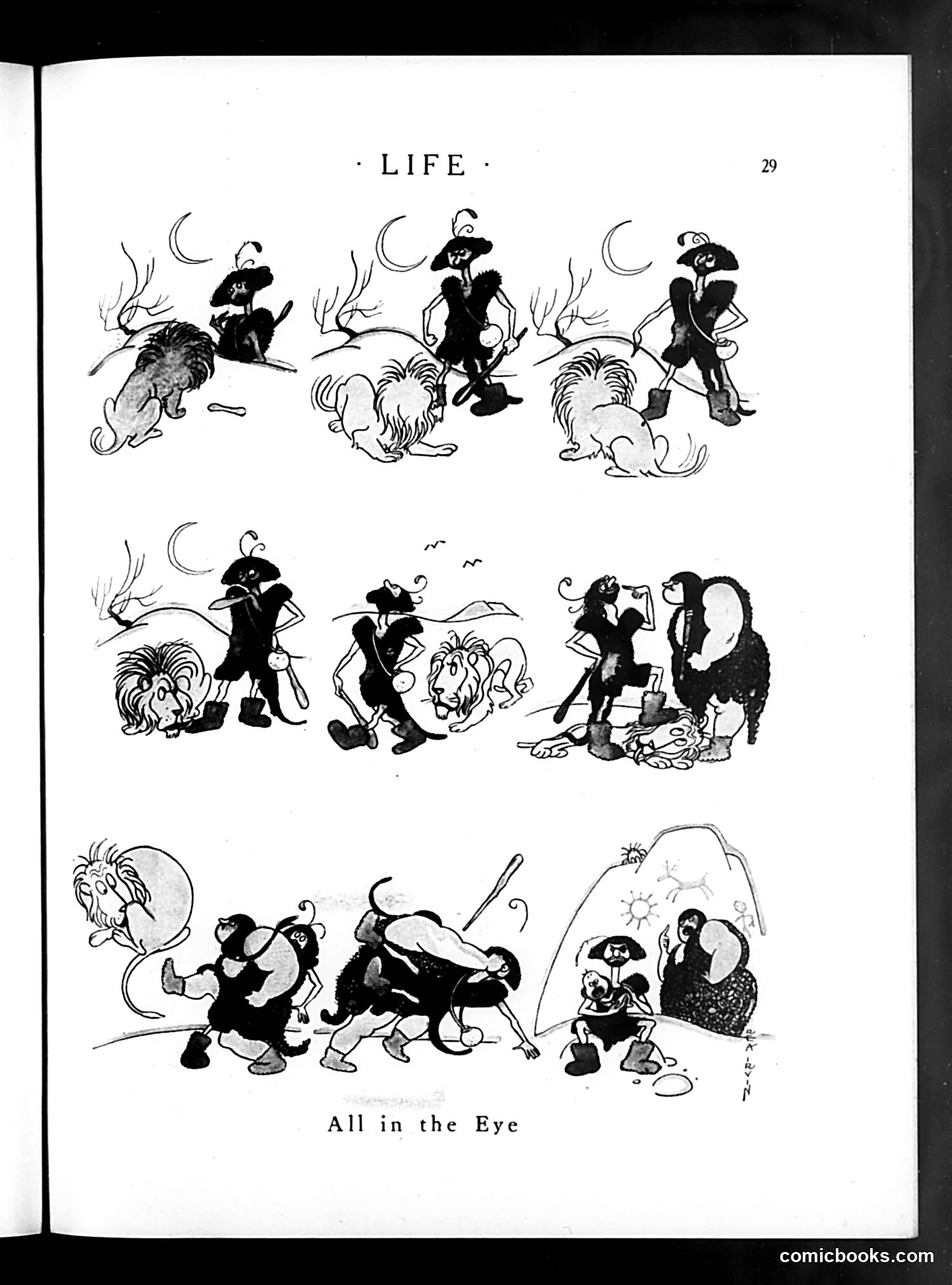
This page presents a series of satirical cartoon vignettes depicting anthropomorphic characters (appearing to be devils or imps with horns) in various scenarios with lions. The title "All in the Eye" suggests the central joke concerns perspective or perception. The cartoons appear to illustrate how the same situation—interactions between these horned figures and lions—can be interpreted differently depending on one's viewpoint or circumstances. In some panels the lions appear threatening; in others, the horned characters seem menacing. The varying nocturnal settings (indicated by crescent moons) and the characters' different reactions suggest commentary on how context, bias, or individual perspective shapes how we perceive the same events. Without publication date confirmation, the specific satirical target remains unclear, though the work exemplifies Life magazine's characteristic visual humor.
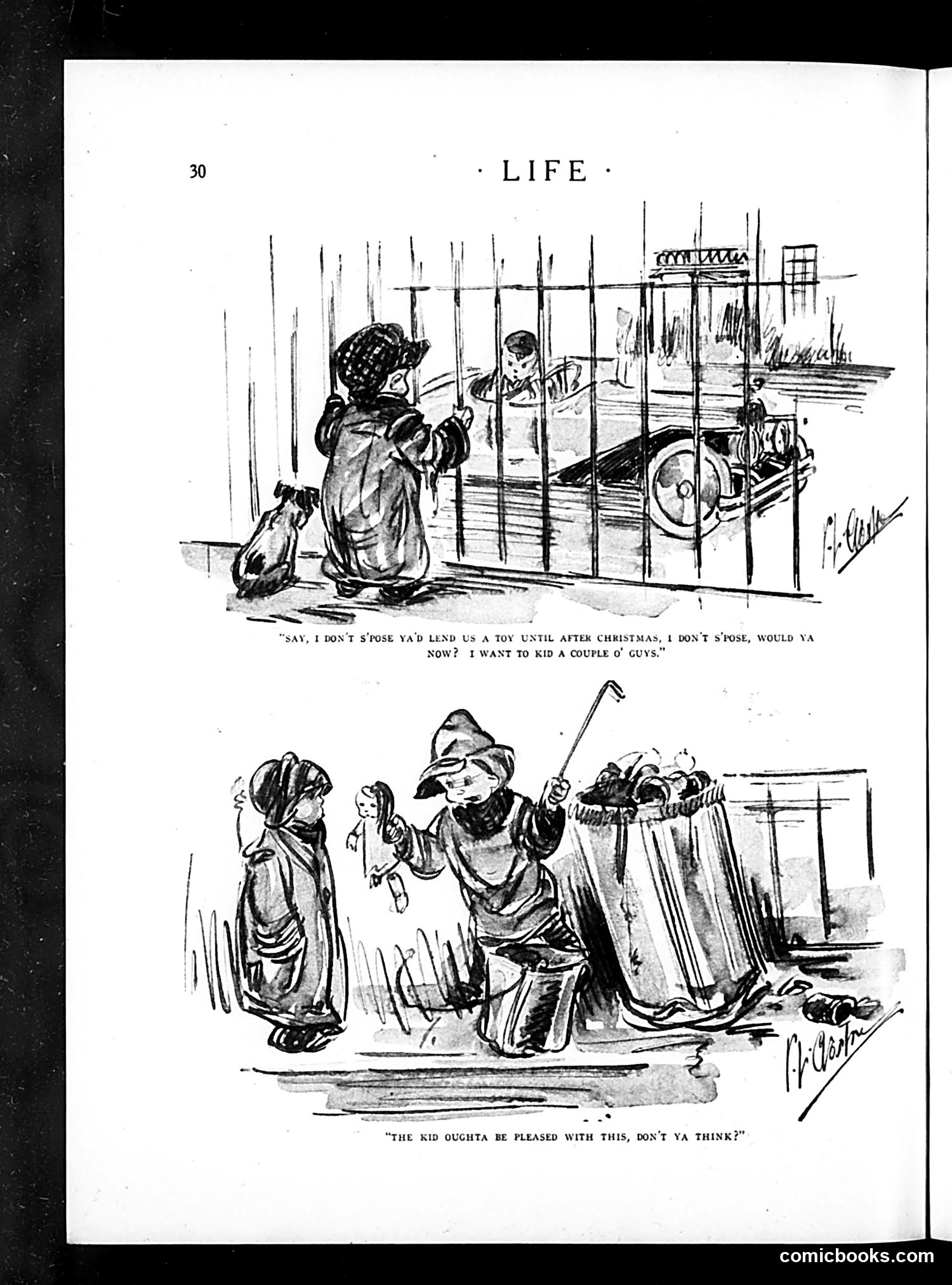
These two cartoon panels satirize Christmas gift-giving practices, likely from the early 20th century based on the style. The **top panel** shows a child at a fence asking another child to borrow a toy temporarily—suggesting poor families couldn't afford their own gifts. The **bottom panel** depicts an adult showing what appears to be homemade or makeshift toys (possibly dolls or simple objects) to another adult, asking if "the kid oughta be pleased with this." The satire targets **economic inequality and class disparities** during the Christmas season. While wealthy families gave expensive manufactured toys, poor families improvised with crude handmade substitutes or borrowed goods. The humor is dark, exposing how children's Christmas joy depended entirely on family wealth, not genuine gift-giving spirit.
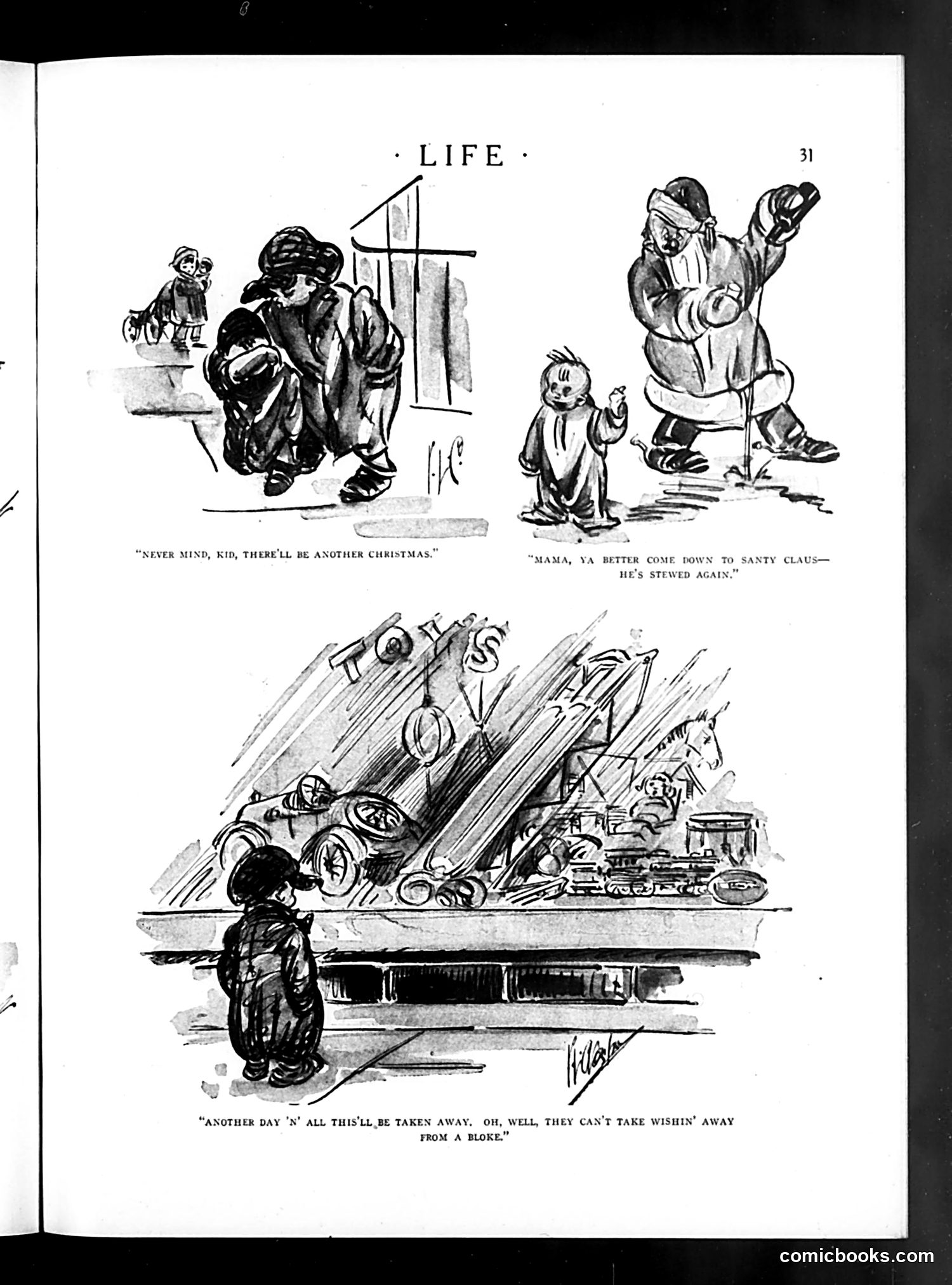
This page contains three separate satirical cartoons addressing poverty and childhood during economically hard times (likely the Great Depression era). The cartoons depict: 1. **Top left**: A mother and child at a church cross, with text suggesting another Christmas without gifts—dark commentary on poverty's persistence. 2. **Top right**: A drunk Santa Claus with a child, satirizing how poverty forces families to confront harsh realities even during holidays. 3. **Bottom**: A child gazing at a shop window display of toys he cannot afford, with the caption emphasizing that while material possessions can be lost, imagination and hope ("wishin'") cannot be taken away. The cartoons' point: even the poorest children retain their capacity for hope and desire, a bittersweet commentary on resilience amid deprivation. The humor is grim, targeting societal indifference to childhood poverty.
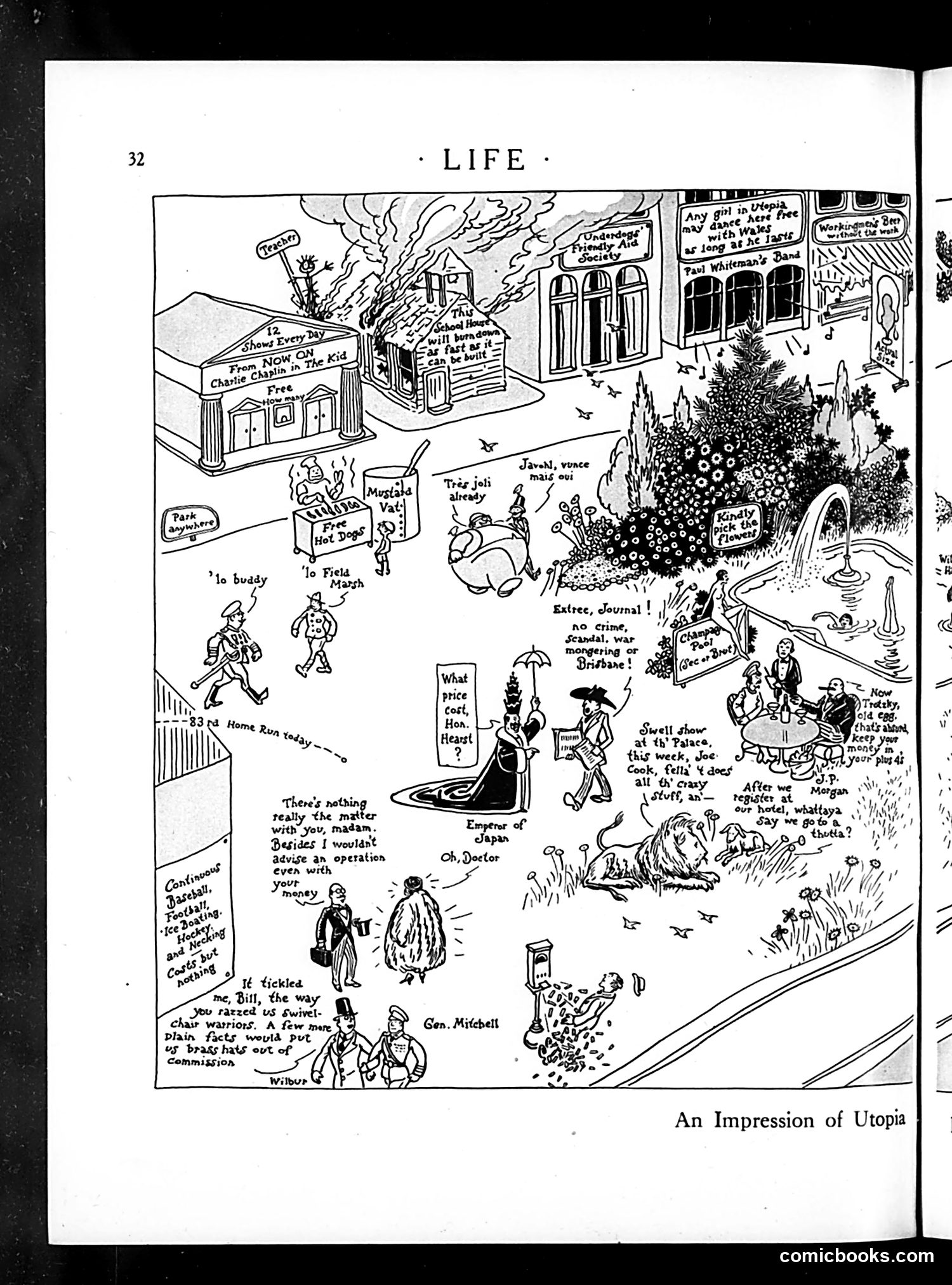
This satirical cartoon depicts an idealized Australian society free from crime, scandal, and war—labeled "Utopia." The scene shows everyday leisure activities: baseball, hot dogs, flowers, and casual socializing. The satire targets contemporary Australian politics and social issues. References to "Brisbane" (likely William MacPherson Brisbane or Queensland politics), "Emperor of Japan," and "Gen. Mitchell" suggest commentary on international tensions and military leadership. The dialogue mocks Australian optimism about avoiding global conflicts while depicting mundane domestic pleasures. The "swivel-chair warriors" reference appears to criticize armchair military strategists or politicians who direct wars without frontline experience. The overall message seems ironic: while Australians fantasize about a crime-free, conflict-free society, real political and military tensions threaten this utopian vision. It's commentary on the gap between Australian aspirations and geopolitical reality during what appears to be the early 20th century.
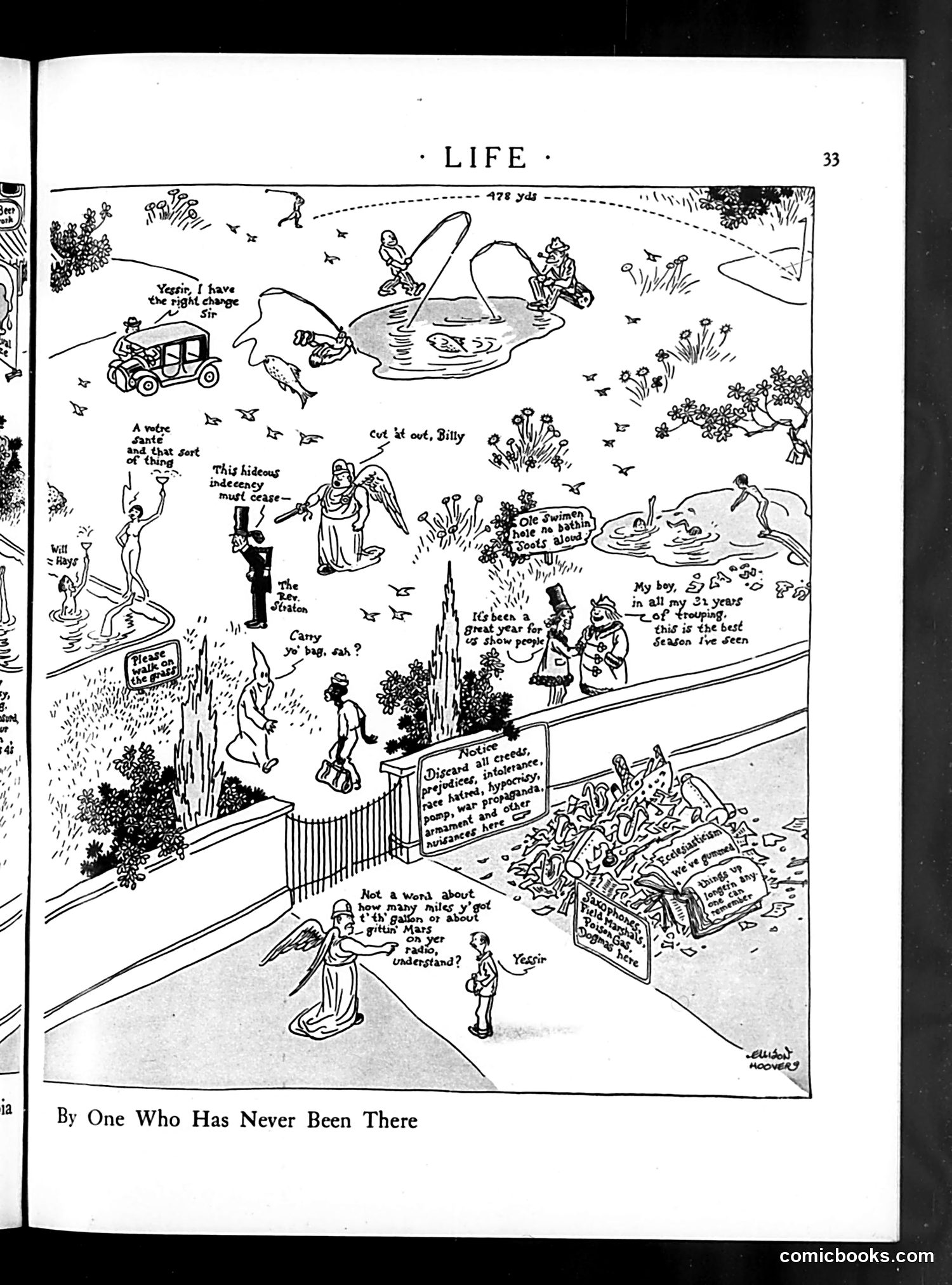
This is a satirical cartoon titled "By One Who Has Never Been There," mocking armchair travel commentary and speculation about places the author hasn't visited. The drawing depicts an imaginary afterlife or paradise populated with various figures, activities, and dialogue bubbles containing vacuous observations ("It's been a great year," "My boy, in all my years of trapping, this is the best season I've seen"). The satire targets people who confidently describe or judge places they've never experienced firsthand. The title is the key: the author is explicitly admitting their complete lack of authority while still offering elaborate descriptions and opinions—a common target of *Life* magazine's humor about pretension, armchair expertise, and social pretense in early 20th-century America.
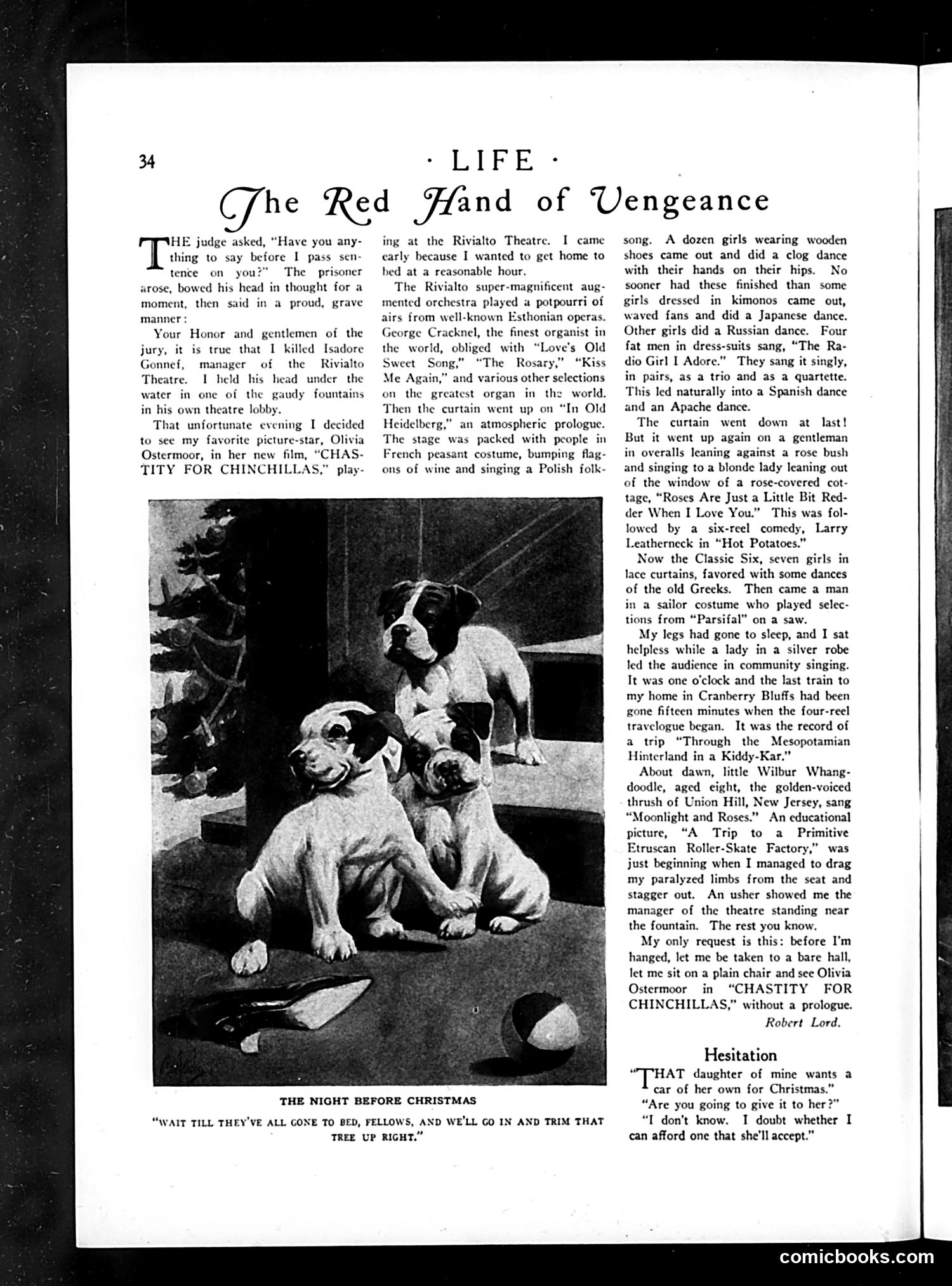
This is a satirical short story mocking the excessive theatrical prologues common in 1920s movie palaces. The narrator describes attending a film starring actress Olivia Ostermoor, but endures an absurdly lengthy pre-show spectacle: ethnic dance numbers, organ performances, comedy reels, a travelogue, and a child performer—all before the advertised feature finally begins around dawn. The joke: the theater manager's elaborate, wasteful entertainment padding drives the protagonist so mad he murders him by drowning in the lobby fountain. The satire critiques how movie palaces prioritized expensive, bloated entertainment over customers' reasonable expectations and sleep schedules. The accompanying illustration shows three bulldogs, captioned with a Christmas tree decoration reference—likely a separate humorous piece unrelated to the main story.
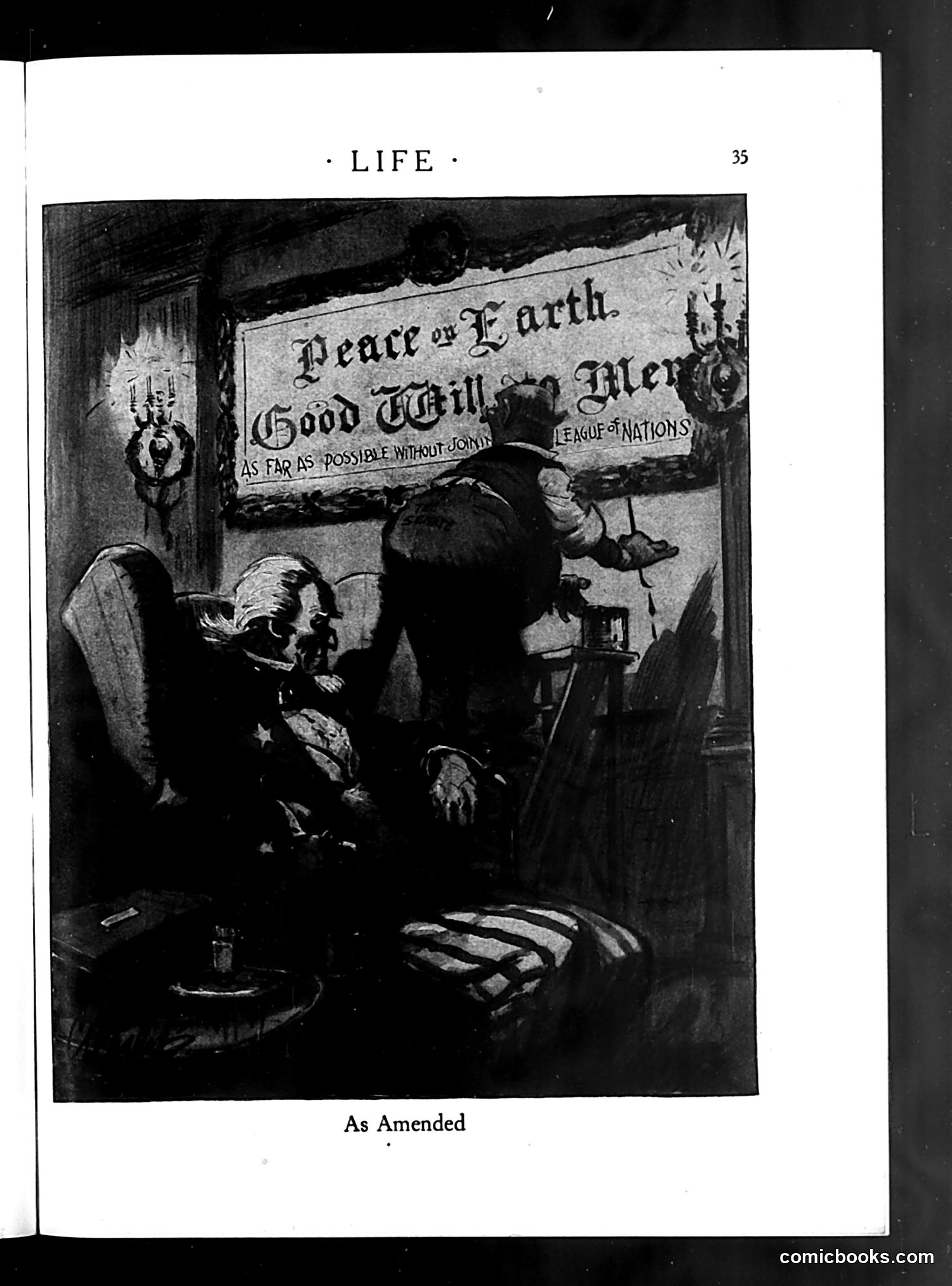
This political cartoon satirizes post-World War I peace negotiations. The banner reads "Peace on Earth, Good Will [toward] Men, As Far As Possible Without Joining [the] League of Nations" — a pointed critique of American isolationism. The figures appear to be politicians or diplomats in a meeting room, with one gesturing toward the amended banner. The satire mocks the contradiction between advocating for peace and goodwill while simultaneously rejecting the League of Nations, the international organization designed to prevent future wars. This likely references American reluctance to join the League (ultimately rejected by the U.S. Senate in 1920), suggesting that genuine peace efforts were being undermined by nationalist resistance to international cooperation.
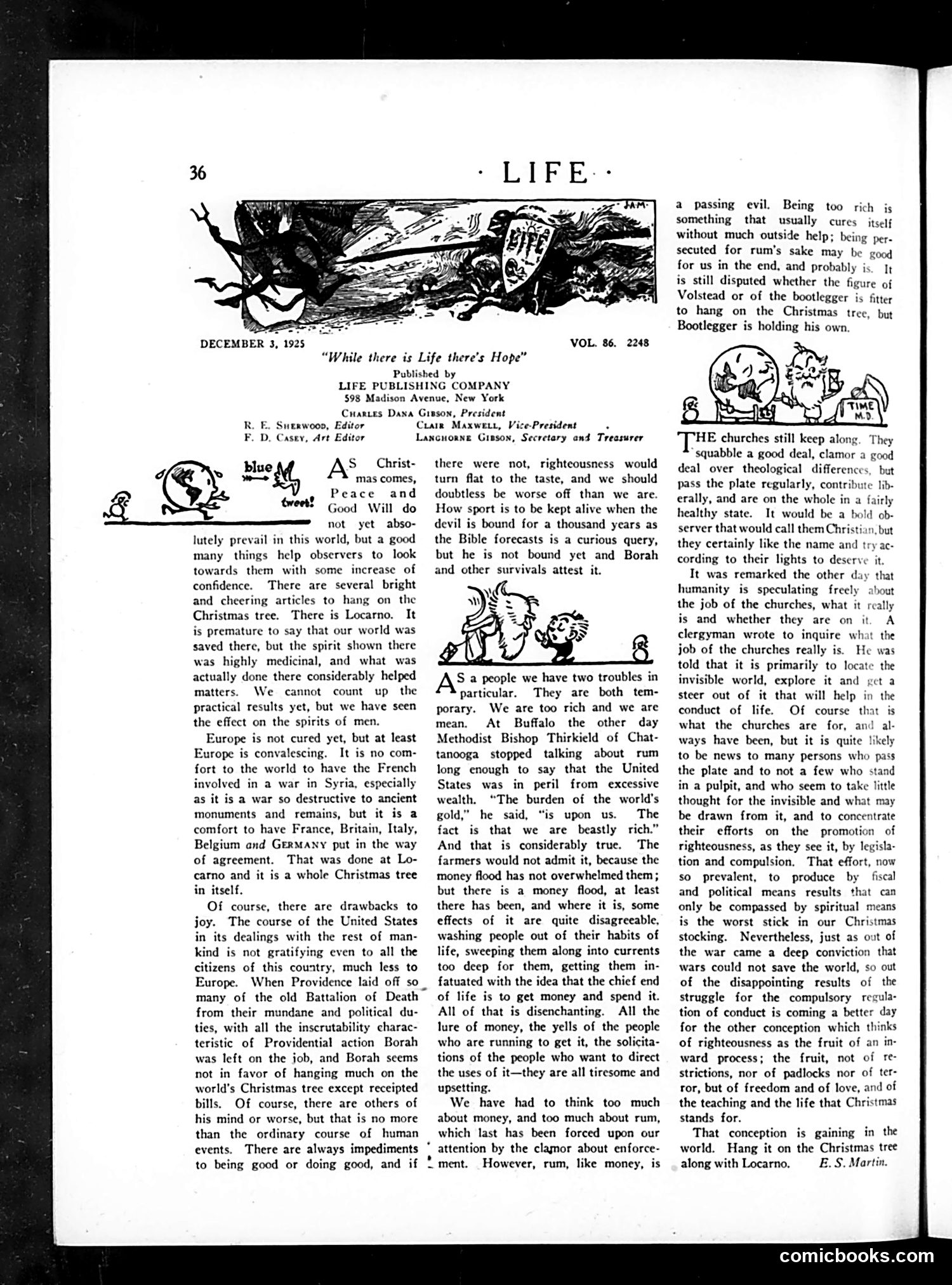
This editorial page discusses Christmas optimism amid contemporary challenges. The main text praises the Locarno Treaties (1925)—European peace agreements—as a "Christmas tree" of hope, while critiquing American isolationism and Senator William Borah, who opposed international cooperation and favored "receipted bills" over goodwill. The piece identifies two national problems: excessive wealth and Prohibition enforcement ("rum"). Bishop Thirkield of Chattanooga is quoted warning that America's riches endanger it morally. The author argues both issues are "temporary" and temporary evils are preferable to permanent ones—poverty and lawlessness would be worse. The small cartoons appear decorative, accompanying the seasonal theme. The overall message: America should embrace international peace efforts and recognize that material prosperity, while problematic, beats the alternatives.
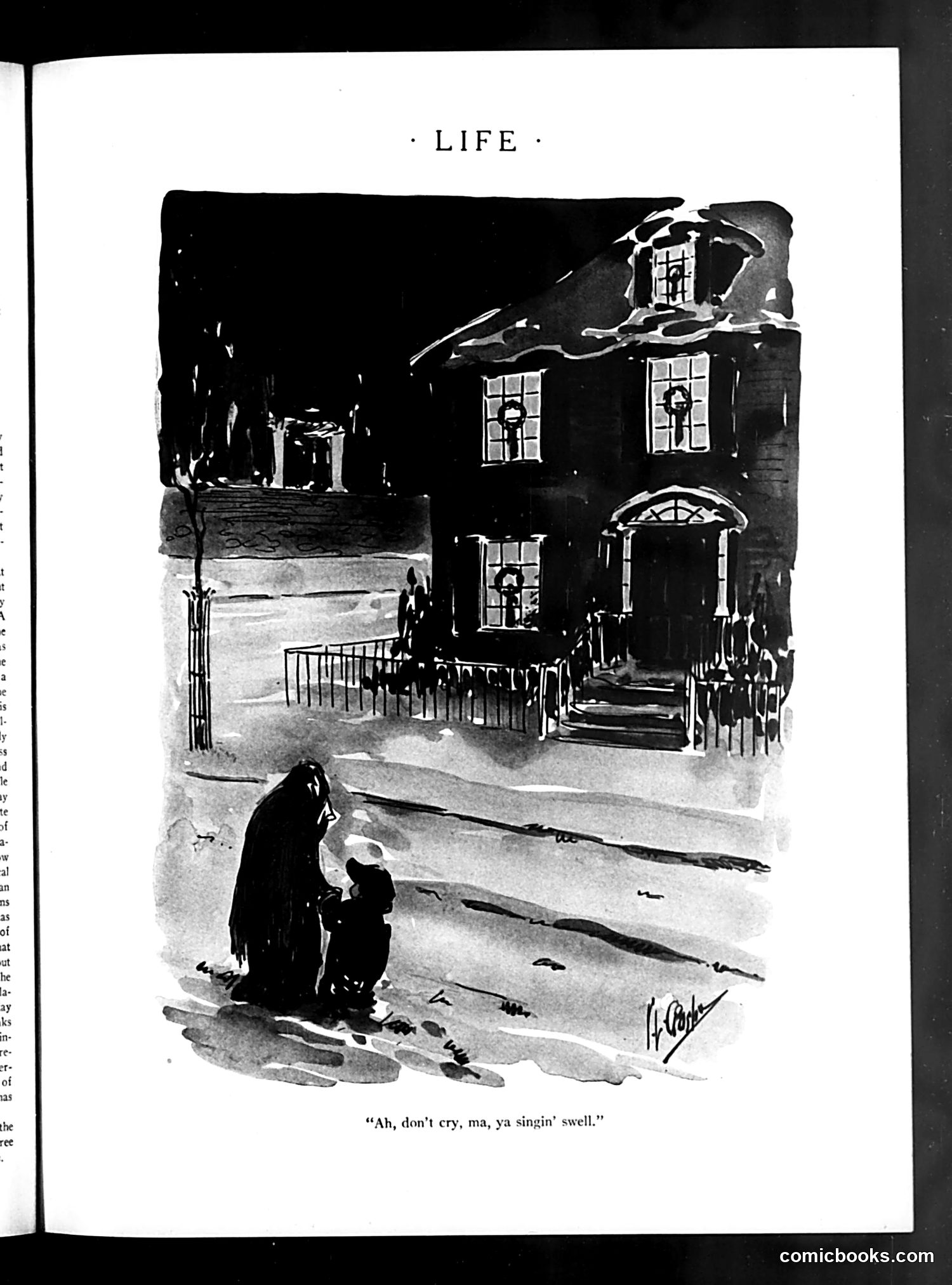
This is a single-panel cartoon from *Life* magazine's "Life" section, depicting a nighttime street scene. An adult figure (appears to be a mother) sits with a child in a dark, shabby urban street. A tenement building looms behind them with lit windows. The caption reads: "Ah, don't cry, ma, ya singin' swell." The satire appears to address urban poverty and working-class hardship—likely from the early-to-mid 20th century. The child's attempt to comfort the mother by complimenting her singing suggests they're street performers or busking for survival. The joke's bitter humor lies in the child's innocence contrasted with their obvious desperation: in bleak circumstances, modest talent becomes cause for encouragement. It critiques both poverty conditions and the resilience required to survive them.
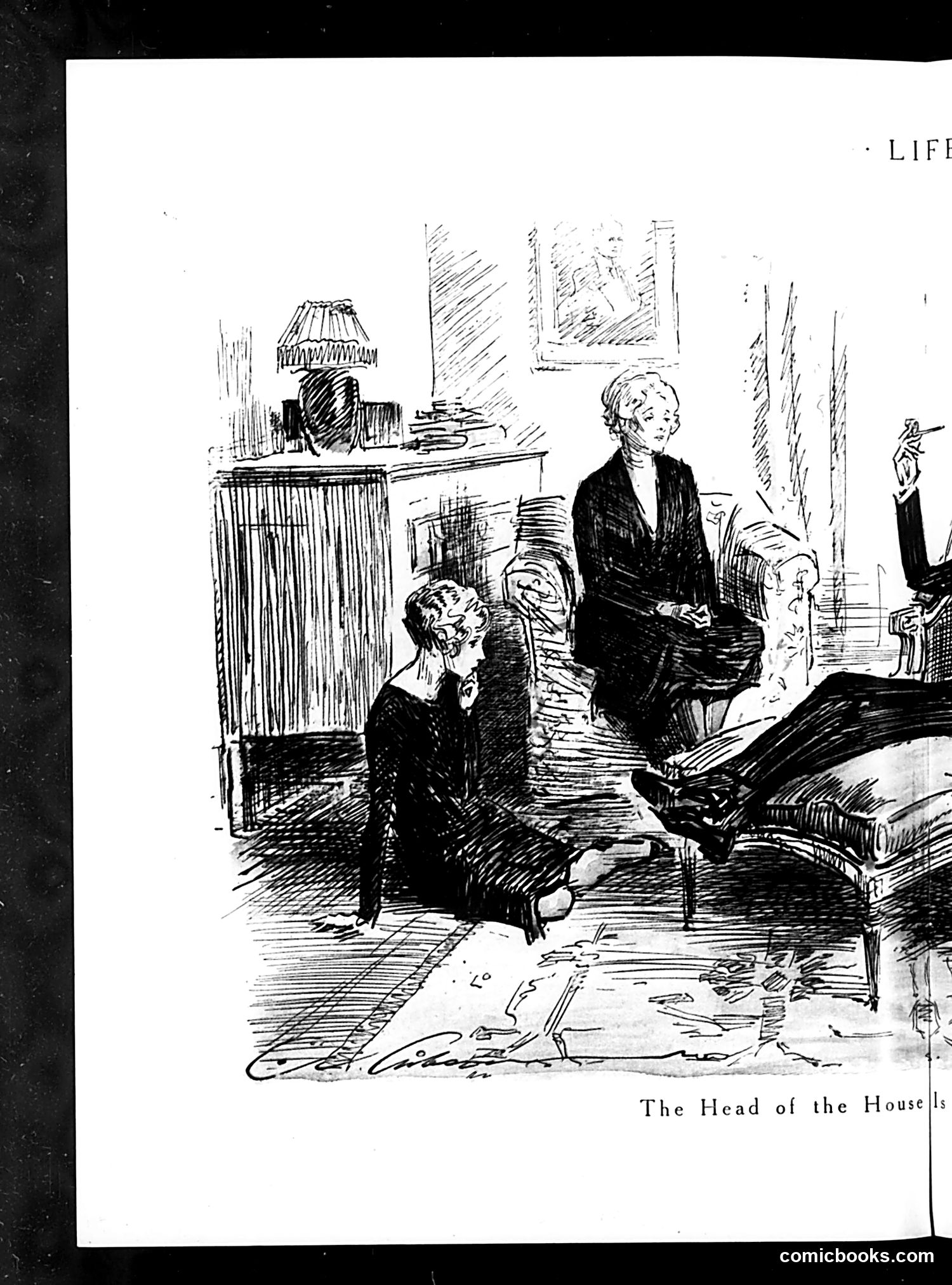
This sketch depicts a domestic scene with what appears to be a woman seated on the floor surrounded by scattered papers or documents, while a man sits in a chair above her. The title "The Head of the House" suggests satirical commentary on domestic hierarchy and authority within marriage. The composition—with the man positioned higher and the woman on the floor amid chaos—likely critiques either male dominance in households or, conversely, satirizes men's pretensions to authority while actual household management falls to women. The scattered papers suggest domestic accounting, bills, or household administration. Without clearer context about the specific historical moment, the exact satirical target remains uncertain, though the image evidently comments on gender roles and domestic power dynamics common to early 20th-century American humor.
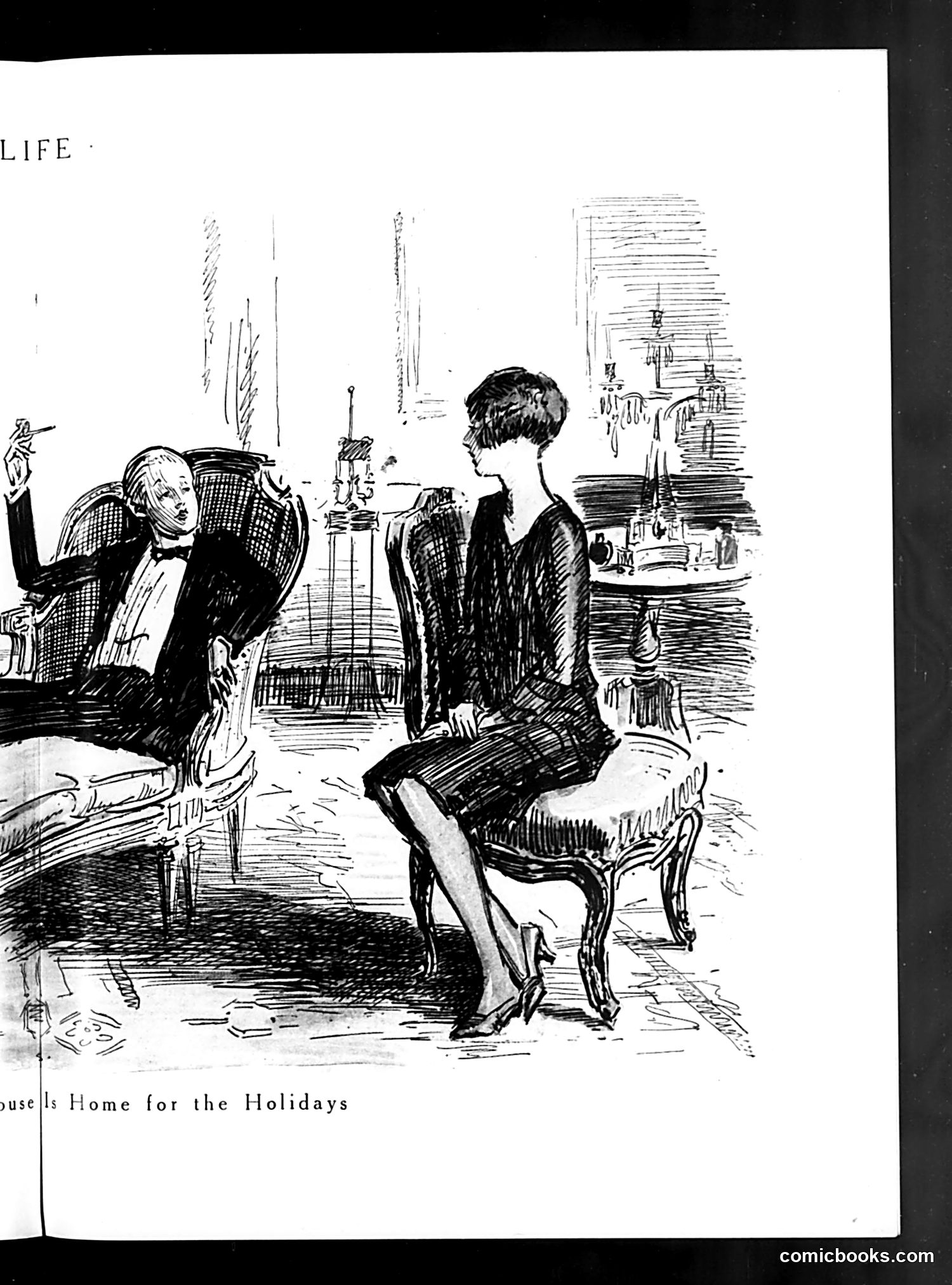
This is a satirical illustration from *Life* magazine showing an elegant interior scene. A man in formal attire sits in a comfortable chair, raising his hand in a celebratory gesture, while a woman in dark clothing sits across from him. The setting appears to be a well-appointed home with decorative elements visible in the background. The caption reads "**ouse Is Home for the Holidays**" (the beginning appears cut off, likely "A H..." or similar). The satire appears to mock the contrasting emotions or experiences of holiday homecoming—the man's exuberant, self-satisfied pose contrasts with the woman's more reserved, perhaps resigned demeanor. This likely satirizes gender dynamics during holiday gatherings or the experience of spouses/partners with differing enthusiasm levels about returning home for celebrations—a common subject of social humor in early-to-mid 20th century *Life* magazine satire.
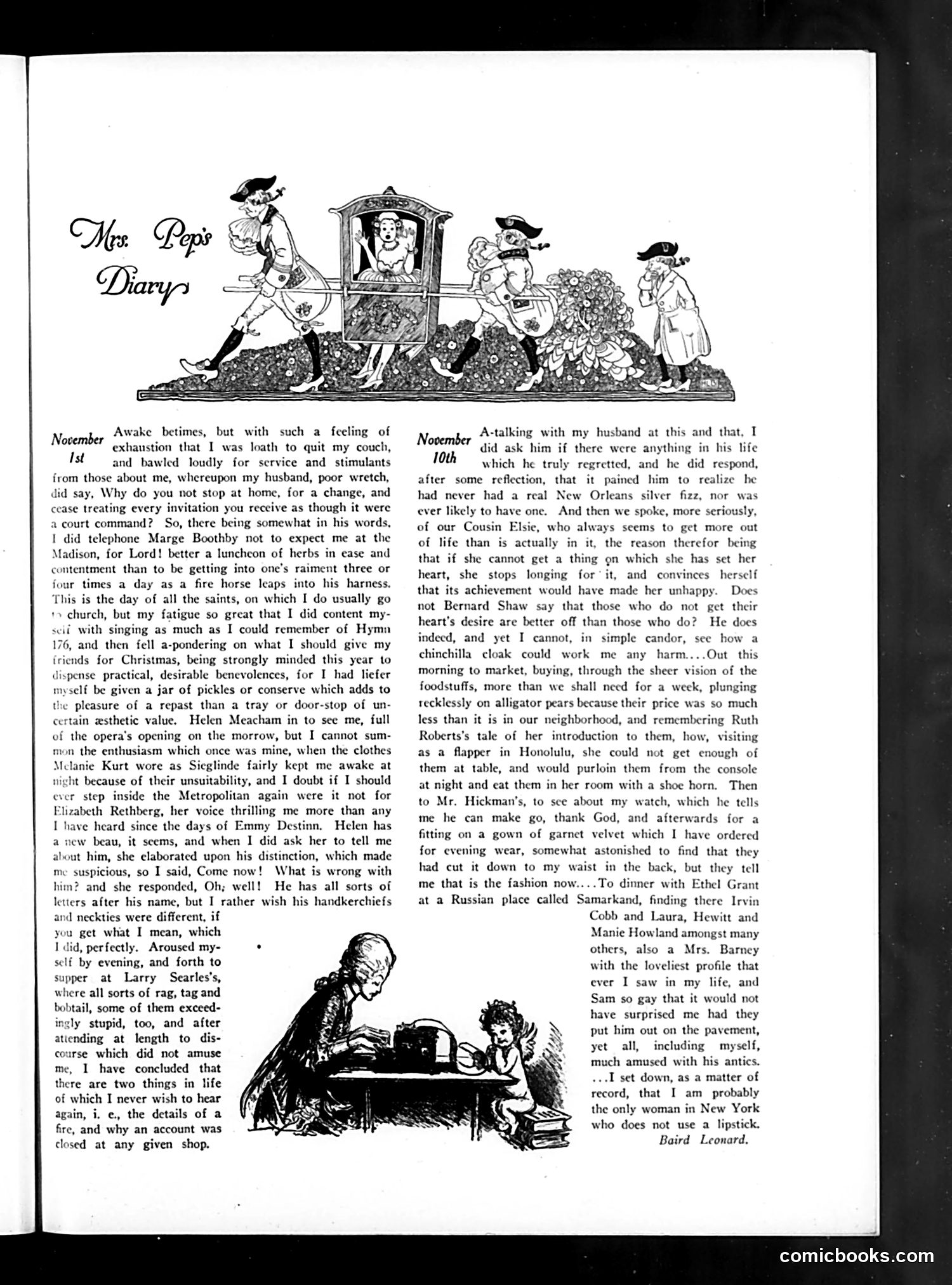
This page presents a satirical diary format mocking upper-class New York society women of the early 20th century. The illustration at top shows a woman being carried in a sedan chair by servants—a visual joke about the leisured lifestyle described. The entries parody the vapid concerns of wealthy socialites: complaining about social obligations, obsessing over opera singers and fashion, gossiping about acquaintances' romantic prospects, and recounting trivial shopping adventures. The humor targets the disconnect between these women's self-importance and the triviality of their actual concerns—fretting over whether a beau's neckties match his letters of distinction, or debating whether a chinchilla coat would truly make one happy. The diarist's claim to be "probably the only woman in New York who does not use a lipstick" suggests satire of evolving beauty standards and materialism among the affluent. Overall, this is gentle mockery of leisure-class pretension and women's consumer culture.
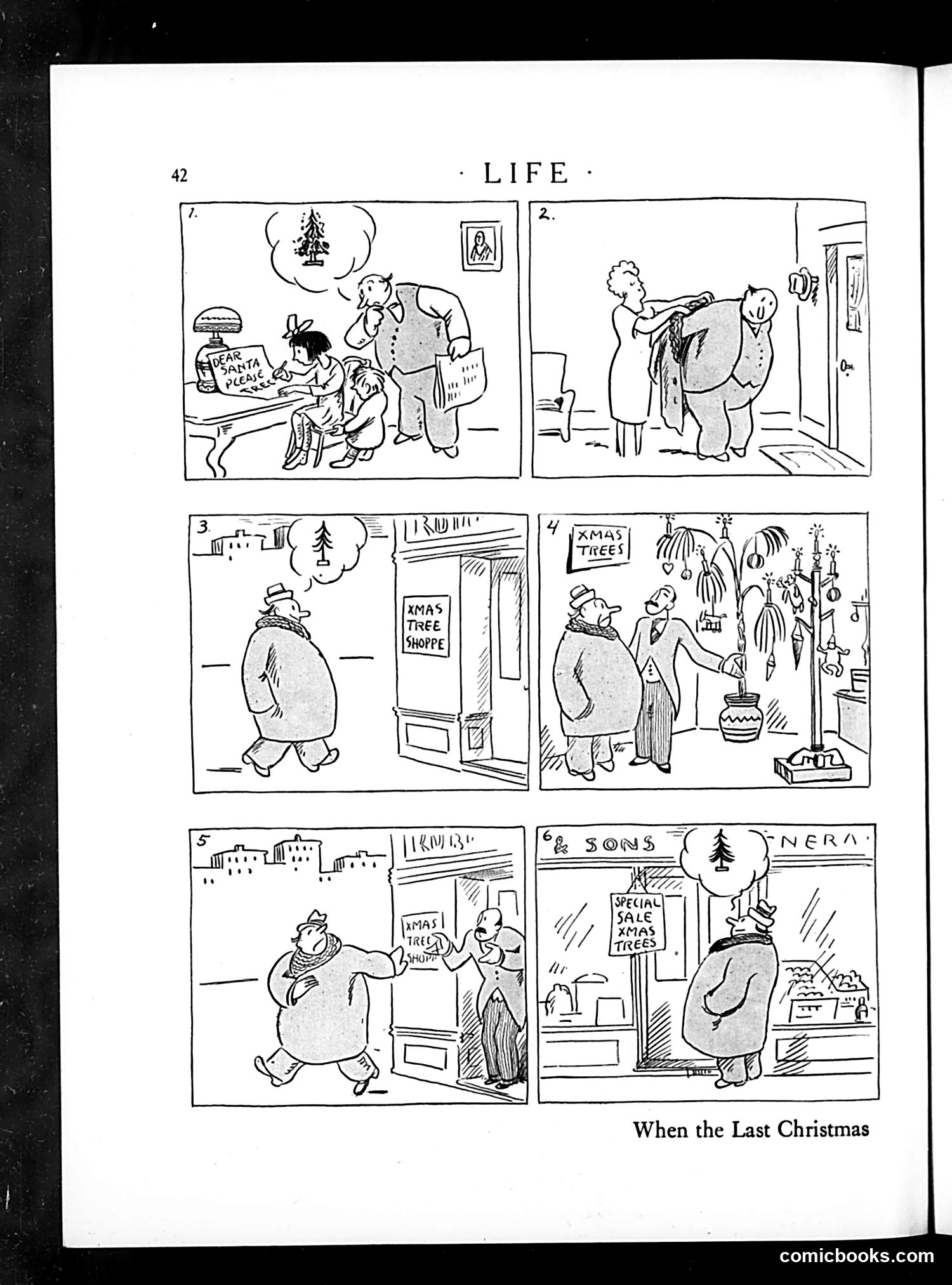
This six-panel comic strip depicts a man's Christmas shopping journey during what appears to be wartime scarcity. The narrative shows: 1. A man ordering from "Dear Santa" catalog 2. Him receiving an oversized garment (perhaps rationed clothing) 3. Him visiting a "Christmas Tree Shoppe" 4. Him selecting an artificial tree at the shop 5. Him purchasing from what appears to be a depleted storefront 6. Him observing a "Special Sale" at "Sons" store The title "When the Last Christmas" suggests commentary on consumer goods shortages, likely referencing World War II rationing and scarcity. The humor derives from the man's increasingly desperate attempts to find Christmas goods as supplies dwindle. The artificial tree and undersized/oversized merchandise imply compromises forced by wartime limitations on commercial goods.
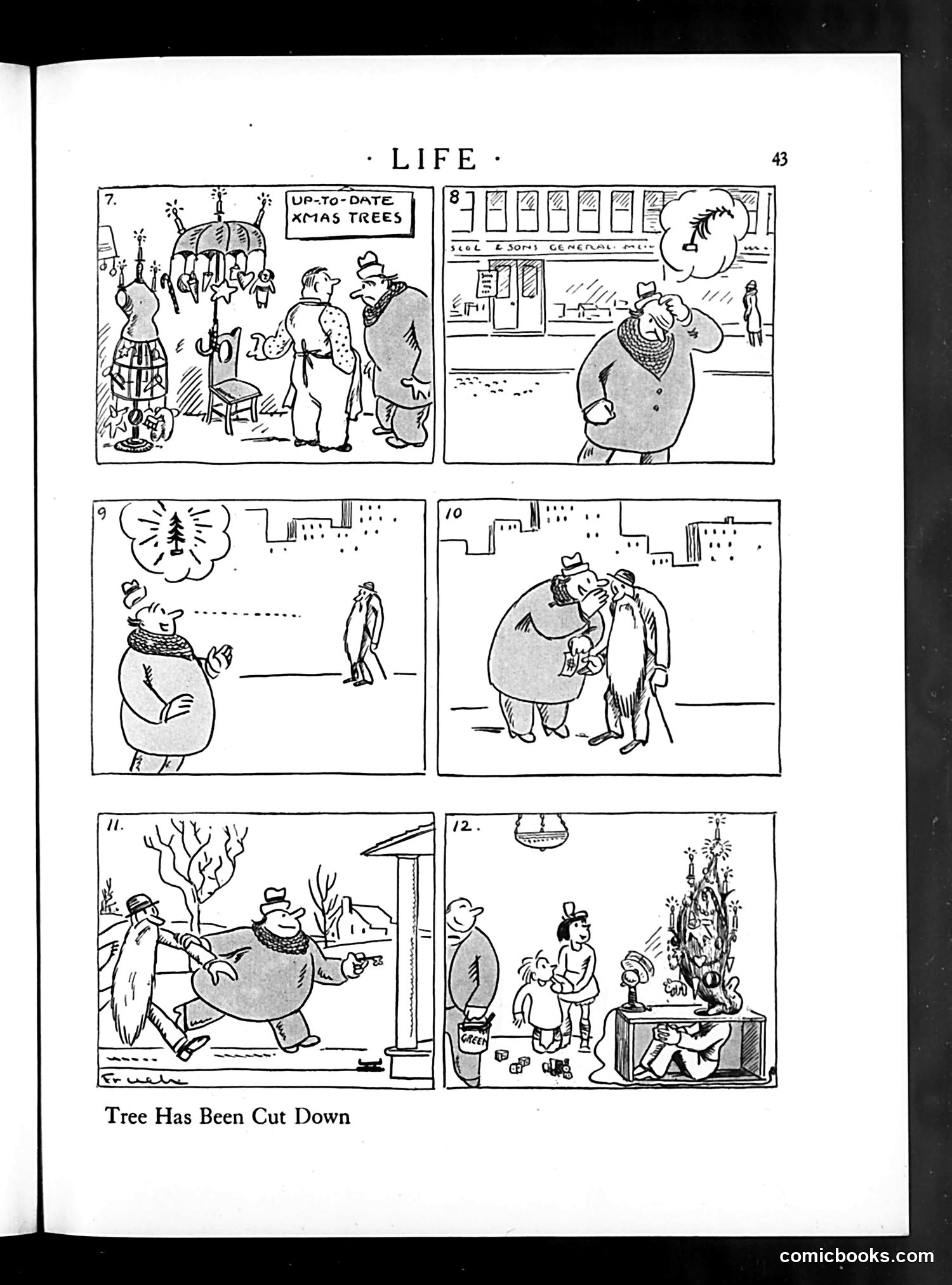
This six-panel satirical comic traces the commercialization of Christmas trees. Panel 7 shows a shop selling "Up-to-Date Xmas Trees"—artificial potted trees displayed indoors. Subsequent panels follow a portly businessman purchasing one, bringing it home to his family, and attempting to decorate it with children. The final panel reveals the joke's dark punchline: the "tree" is revealed to be an actual small evergreen planted in a box, which has now been cut down—defeating the purpose of the supposedly "modern" alternative to traditional tree-cutting. The satire critiques how commercialism and artificial "progress" don't actually solve environmental or practical problems; they merely disguise the same destructive practices under the guise of convenience and novelty. The irony is that the "up-to-date" solution still kills trees.
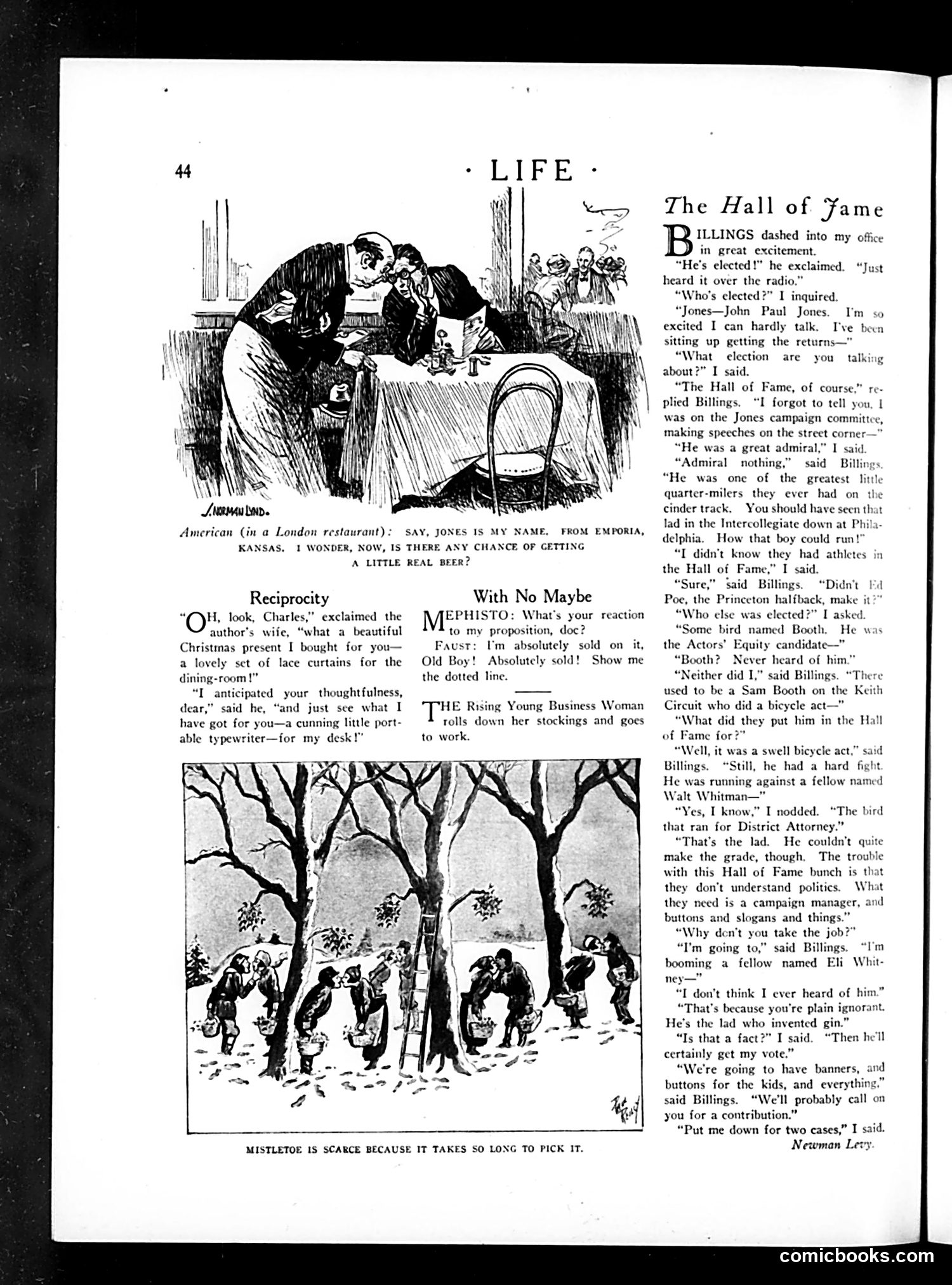
This page contains three satirical pieces mocking early 20th-century American life and politics. **"The Hall of Fame"** (main story by Newman Levy) is the centerpiece satire. It ridicules the newly-established Hall of Fame by having a character named Billings treat historical figures as if they were obscure athletes and entertainers elected through political campaigning. He confuses John Paul Jones (Revolutionary War admiral) with a quarter-miler runner, Edgar Allan Poe with a Princeton halfback, and Walt Whitman with a District Attorney candidate. The joke: Americans have reduced serious historical achievement to celebrity popularity contests decided by campaign managers, slogans, and contributions—treating greatness like a political election rather than genuine accomplishment. The smaller cartoons ("Reciprocity," "With No Maybe," "The Rising Young Business Woman," and the mistletoe panel) are brief humorous observations on gift-giving, business deals, changing women's fashion, and holiday logistics. The top cartoon depicts an American tourist in London asking for "real beer," suggesting Americans abroad have poor reputations.
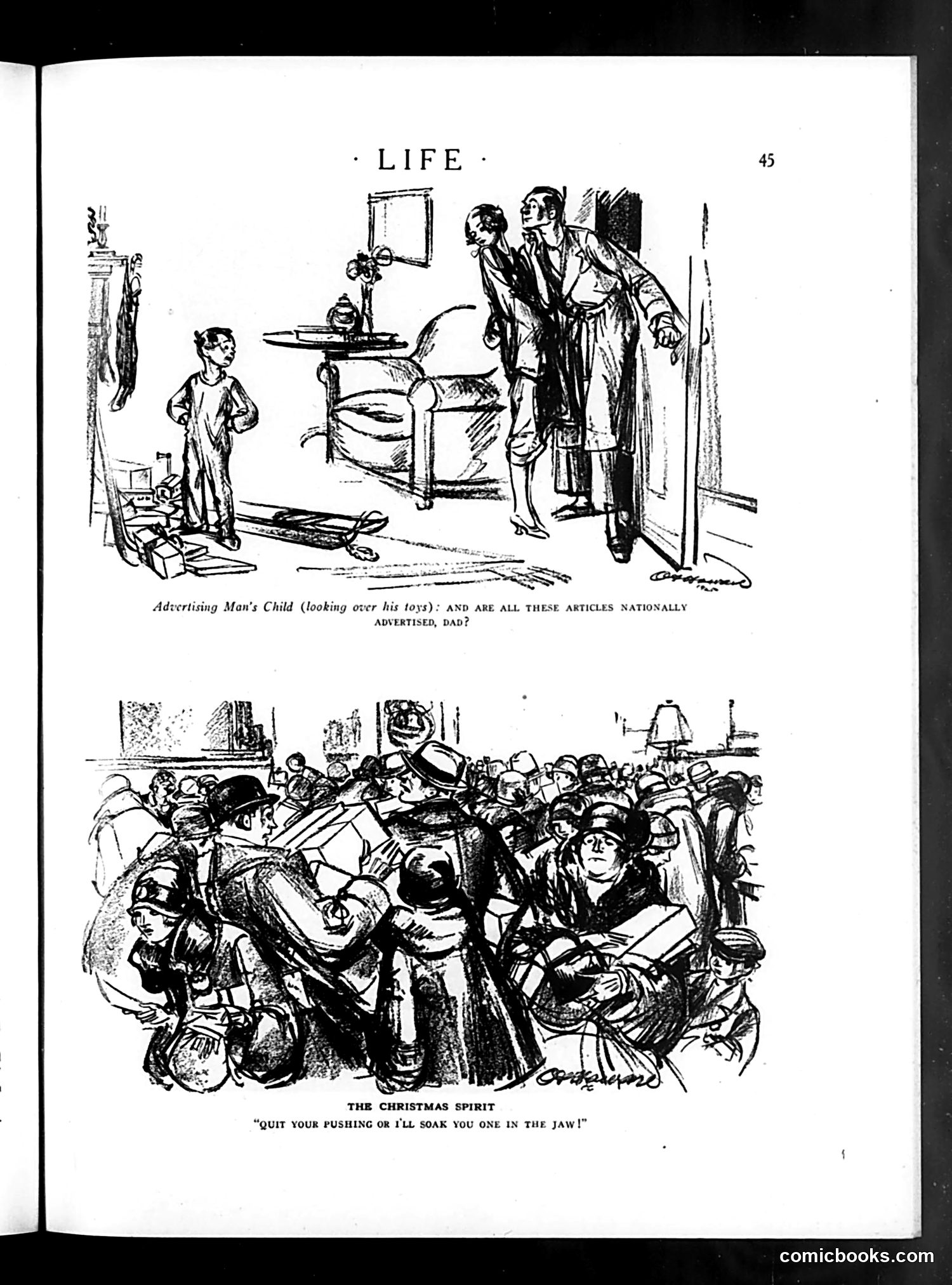
**Top cartoon:** Satirizes advertising to children. A father shows his son toys while asking if they're "nationally advertised" — implying parents buy products based on advertising rather than quality or suitability. The joke critiques how advertising manipulates consumer behavior, particularly regarding children's purchases. **Bottom cartoon:** Titled "The Christmas Spirit," shows a dense crowd of people shoving and fighting, with someone threatening violence ("I'll soak you one in the jaw!"). This is ironic social commentary: Christmas is supposedly about goodwill and charity, yet the cartoon depicts commercialized holiday shopping as brutal and violent. The masses fighting over goods mock the disconnect between Christmas's spiritual ideals and actual consumer behavior during the shopping season. Both cartoons critique American consumer culture and advertising's influence on holiday traditions.
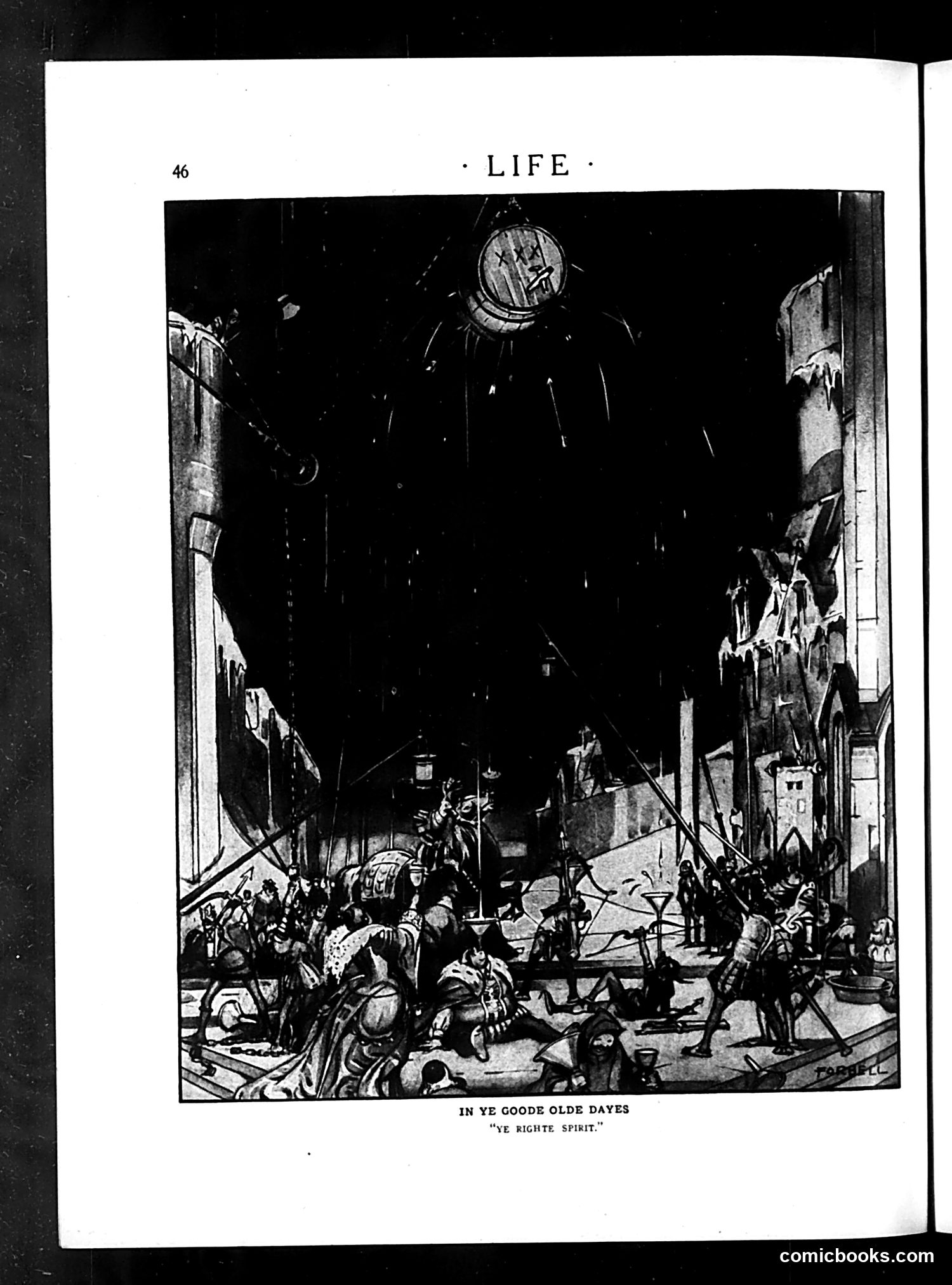
This is a satirical illustration titled "In Ye Goode Olde Dayes" with the subtitle "Ye Righte Spirit." The image depicts a chaotic medieval or historical street scene with numerous figures engaged in rowdy, violent behavior—fighting, drinking, and general mayhem beneath a large hanging lantern. The satire appears to critique nostalgia for "the good old days." By showing a historical period as actually brutal and disorderly rather than noble or refined, the cartoonist mocks those who idealize the past. The phrase "Ye Righte Spirit" seems ironically applied to this disorder, suggesting that romanticized views of history miss the actual messiness and violence of earlier eras. The artwork is signed "Cesare," likely the cartoonist's name. This was a common theme in early 20th-century satirical magazines—deflating sentimental historical fantasies with realistic depiction.
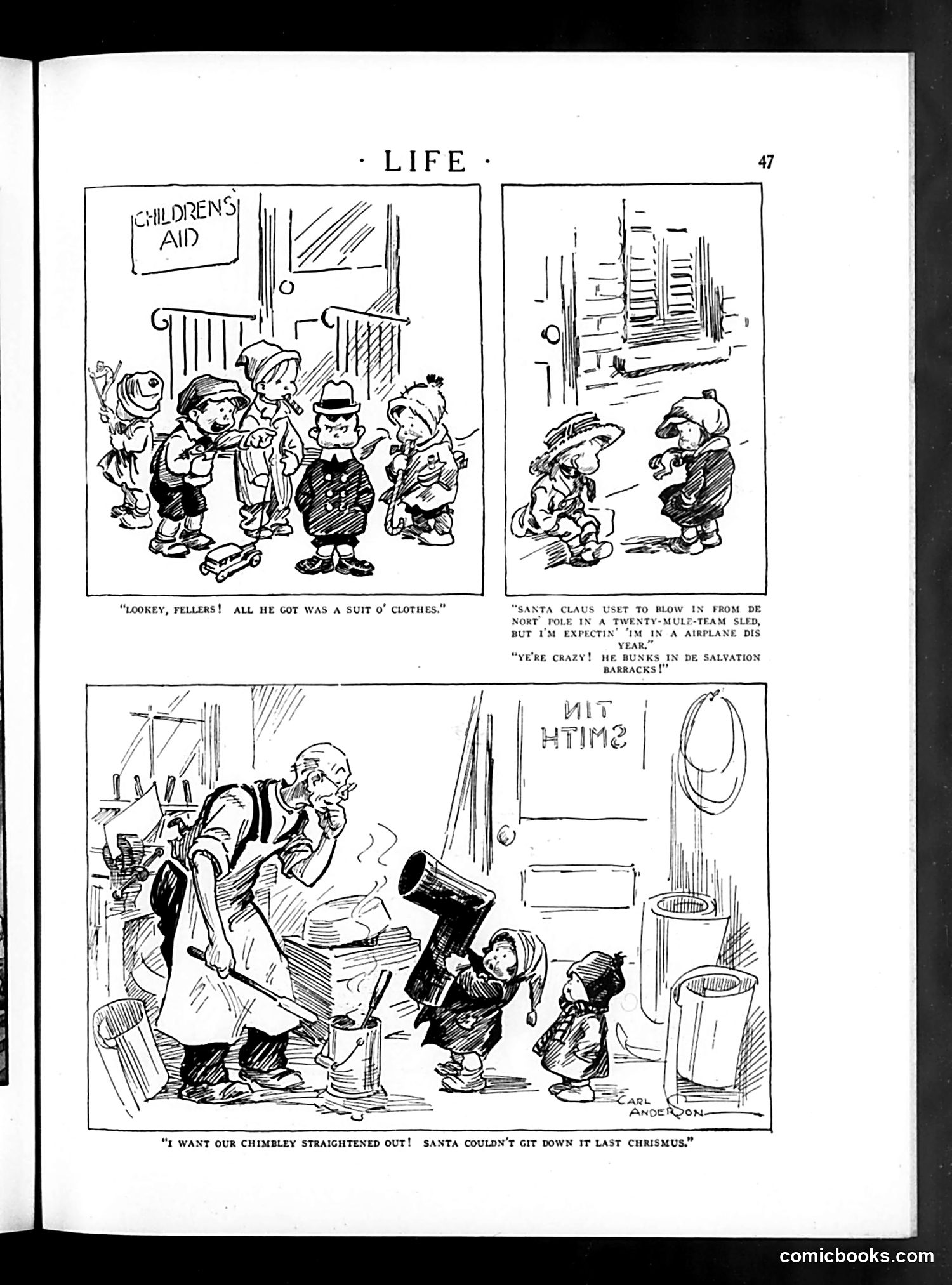
This page contains three Depression-era cartoons satirizing poverty and Christmas hardship: **Top left:** Children in ragged clothes at a "Children's Aid" station joke that one boy received only "a suit of clothes"—implying families were so destitute that basic clothing counted as generous charity. **Top right:** Two street urchins discuss Santa's modernization, suggesting he now arrives by airplane instead of sleigh and sleeps in "Salvation barracks" (homeless shelters) rather than the North Pole—mocking the era's widespread homelessness and charitable dependence. **Bottom:** A man tells children he wants his chimney straightened because "Santa couldn't git down it last Christmas"—implying his chimney was so damaged/deteriorated from neglect that even Santa couldn't deliver presents, darkly joking about working-class housing conditions. All three cartoons use child-focused humor to critique 1930s economic hardship and the inadequacy of charitable institutions.
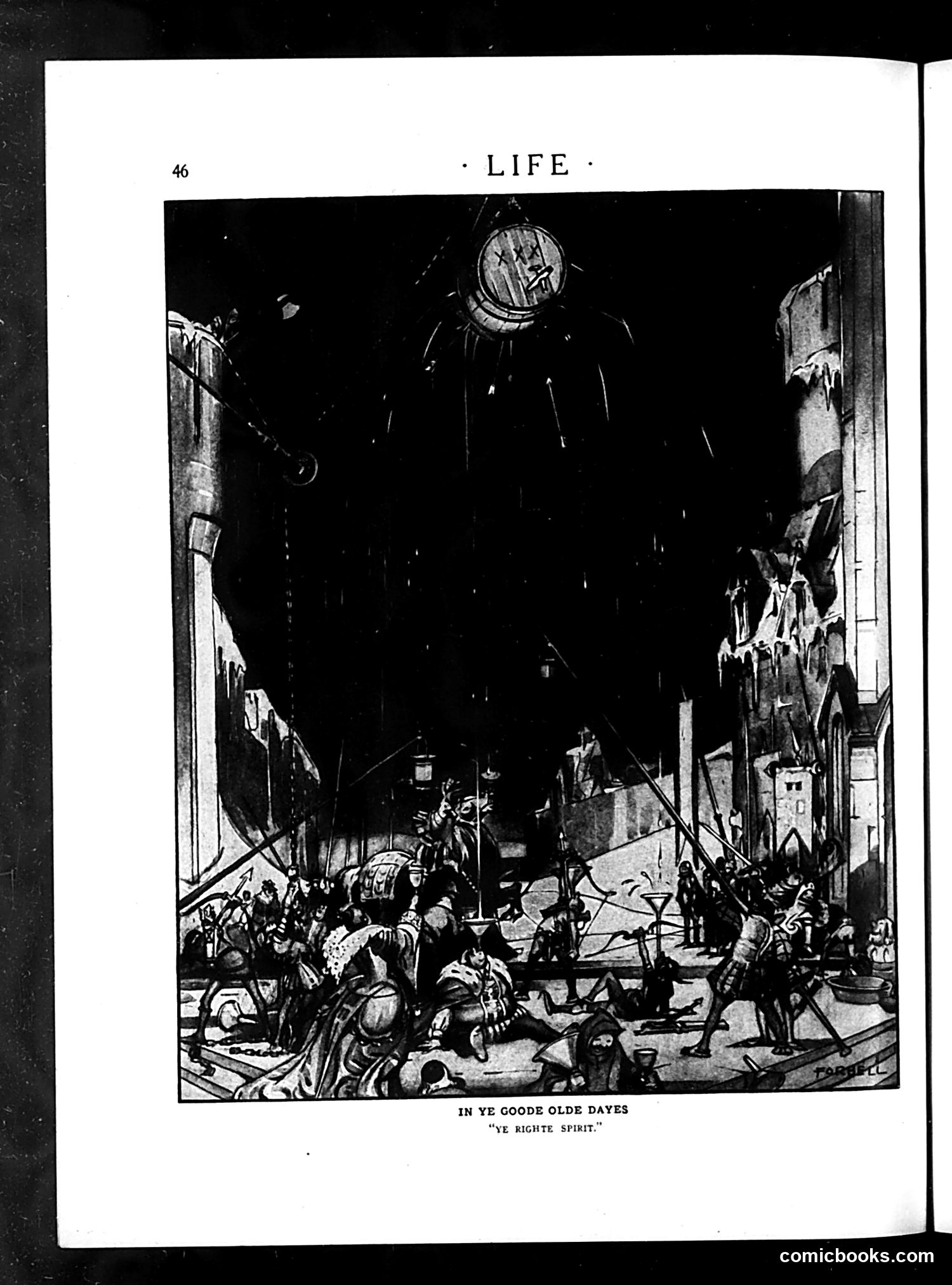
This satirical illustration depicts a medieval or Renaissance-era scene with a large glowing orb (possibly the moon or a supernatural element) looming over a crowded street. The caption "Ye Righte Spirit" suggests ironic commentary. The cartoon appears to mock nostalgia for "the good old days" by showing a chaotic, crowded scene with numerous figures engaged in various activities—suggesting disorder rather than an idealized past. The grotesque, detailed rendering style emphasizes the messy reality of historical life rather than romantic notions of it. Without the full magazine context or publication date visible, the exact political target remains unclear, but the satire seems directed at those who romanticize history while ignoring its actual conditions and complexities.
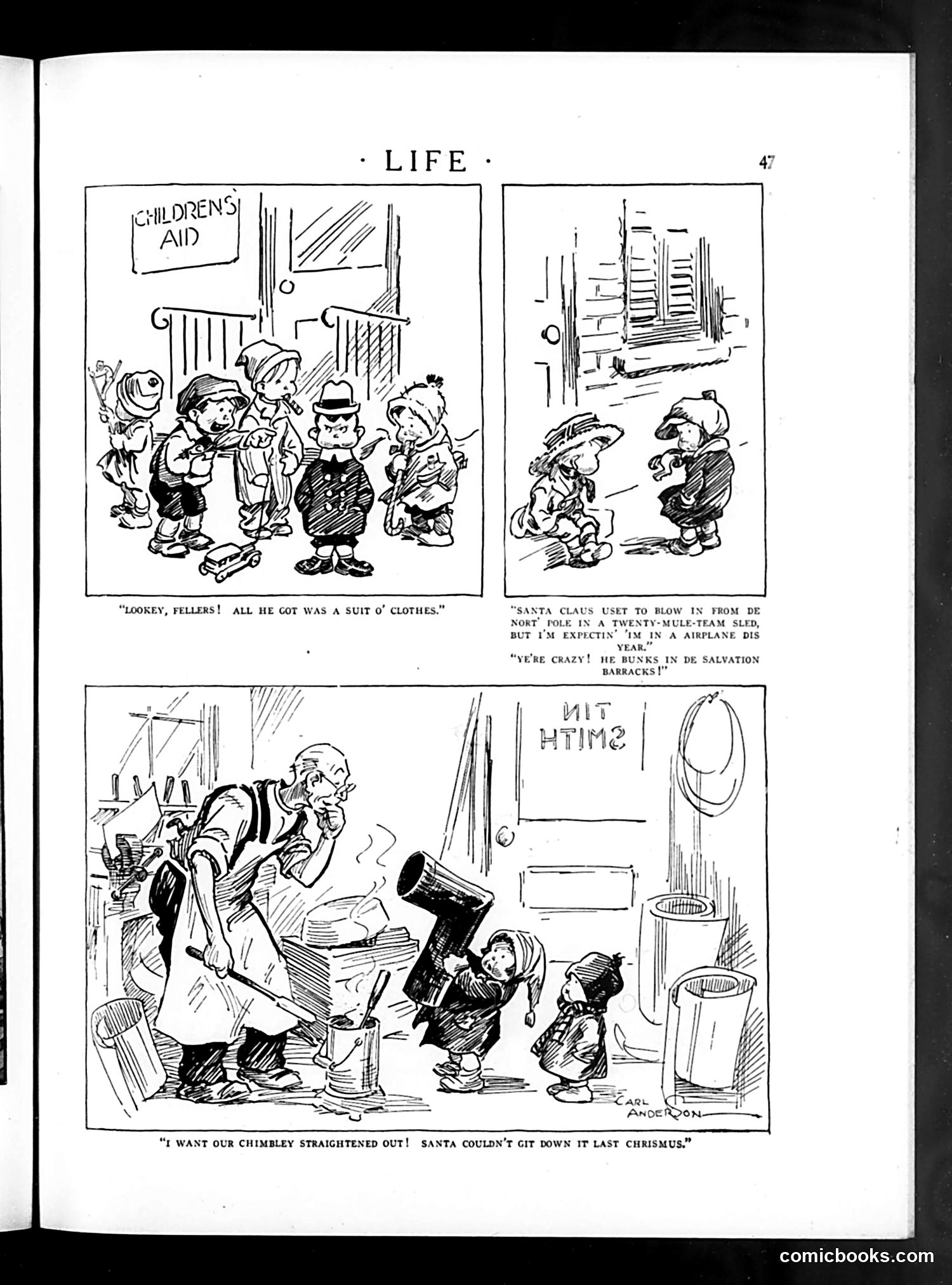
These three cartoons satirize modern changes to Christmas traditions among poor urban families, likely from the 1920s-30s based on the airplane reference and art style. **Top left:** Street urchins mock a child who received only clothes as a gift—suggesting poverty where even basic gifts were rare luxuries. **Top right:** Poor children discuss Santa arriving by airplane instead of traditional sleigh, reflecting technological modernization entering even impoverished communities' imaginations. **Bottom:** A man demands his chimney be straightened so Santa can enter, humorously acknowledging that Santa "couldn't get down it last Christmas"—implying either the chimney's poor condition or Santa's absence due to economic hardship. The satire targets how economic depression affected working-class families' ability to celebrate Christmas while contemporary technology promised progress. The dialect and caricatures reflect period stereotypes of urban poor, particularly immigrant communities.
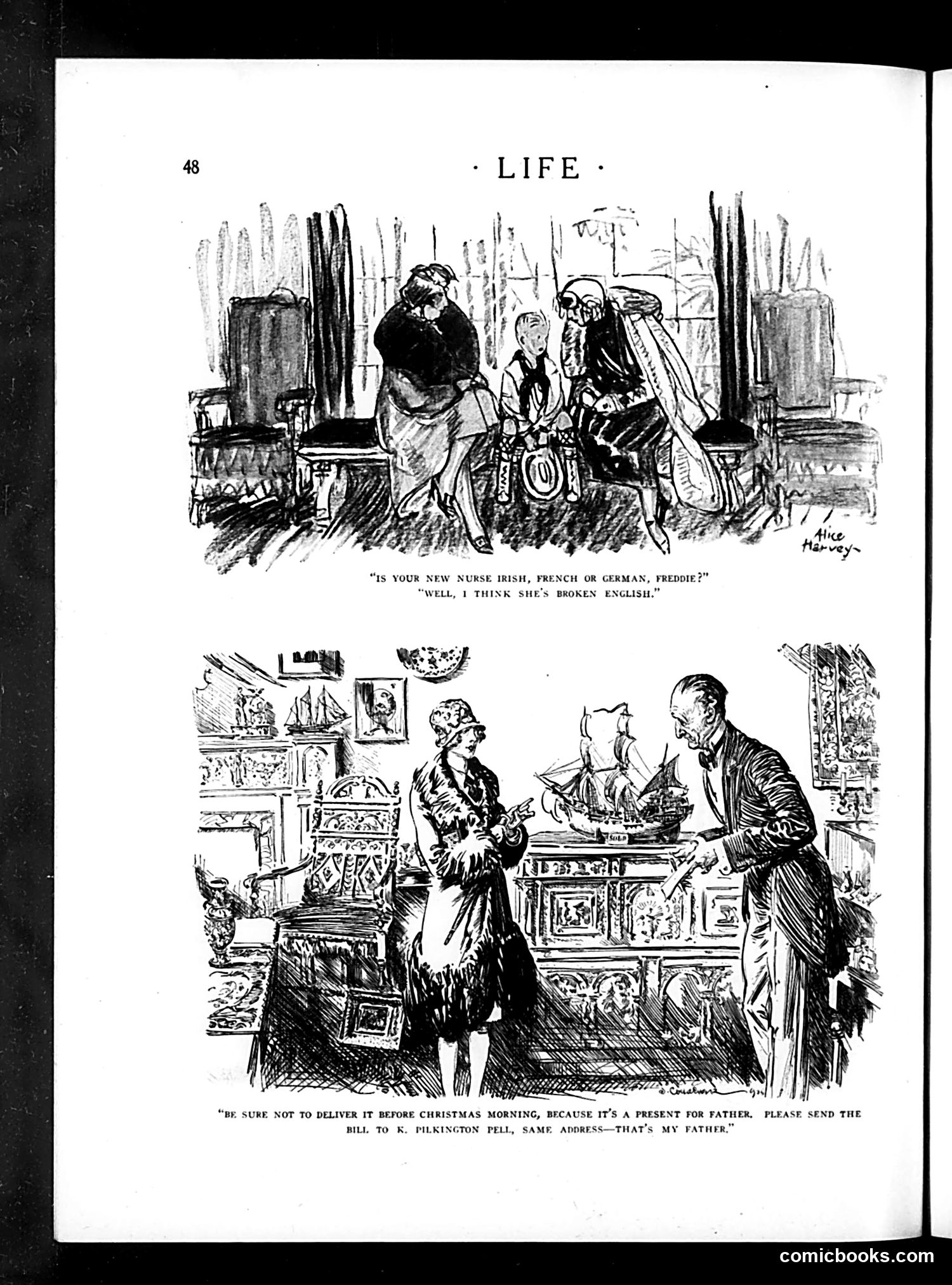
**Top cartoon:** A domestic humor joke about a new nurse's linguistic abilities. When asked her nationality, the response "broken English" is a pun—she speaks English poorly rather than being from a specific country. This reflects early 20th-century concerns about foreign domestic workers and their language skills. **Bottom cartoon:** A child instructs a shopkeeper to delay delivery of a Christmas present for his father until after Christmas morning, with the bill sent to "K. Pilkington Pell" at the same address—revealing the father will ultimately pay for his own gift. The satire mocks the pretense of gift-giving and family dynamics where fathers unknowingly fund their own presents, a commentary on domestic financial arrangements and children's schemes. Both reflect period middle-class anxieties about servants, commerce, and family relations.
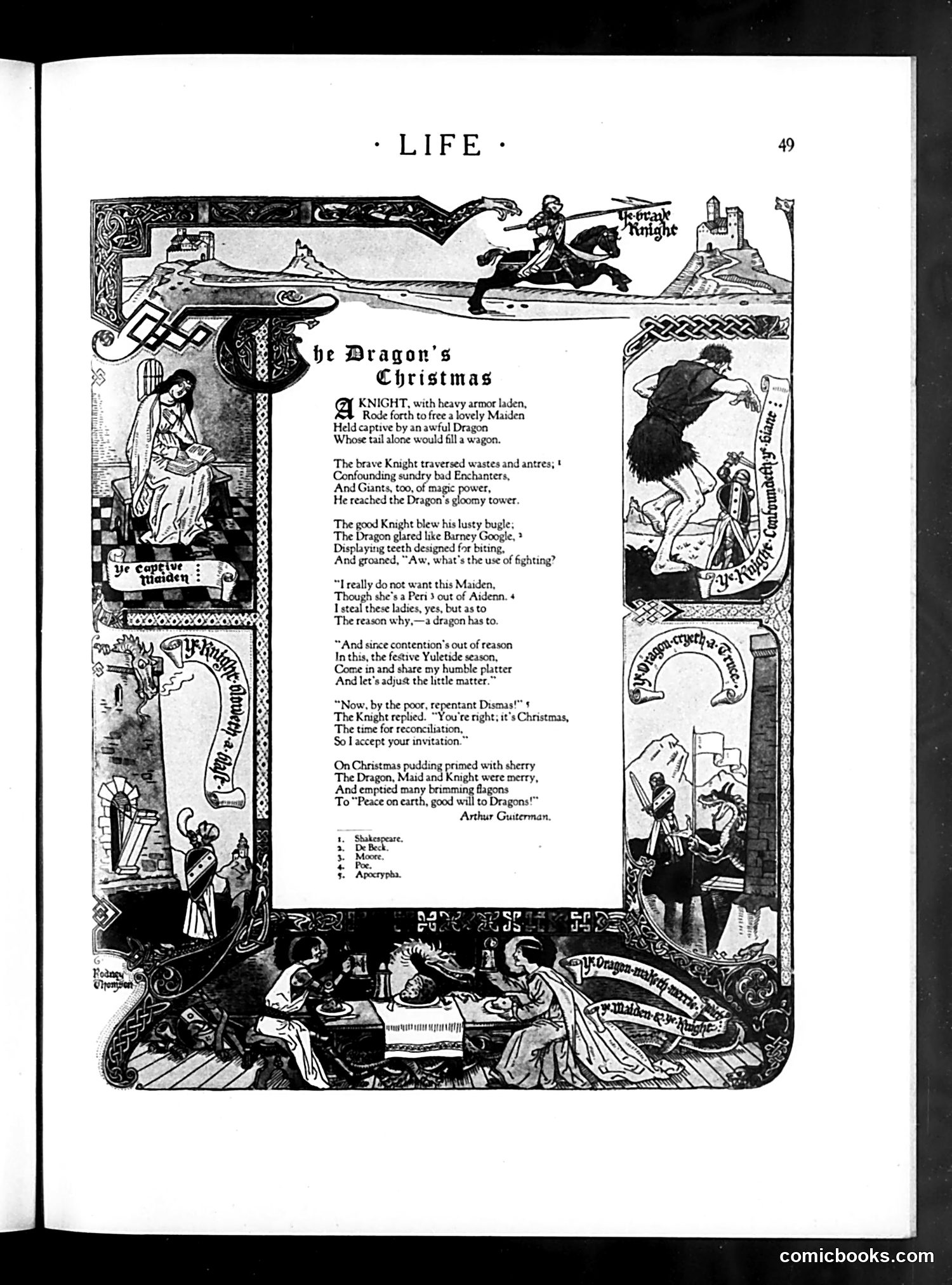
This is a humorous poem by Arthur Guiterman illustrated with decorative medieval-style artwork. It's a fairy-tale parody where a knight rescues a maiden from a dragon, but the confrontation becomes unexpectedly reconciliatory. The satire works through subverting expectations: instead of combat, the dragon—described as glaring "like Barney Google" (a popular comic strip character)—admits he captures maidens out of compulsion rather than malice. The knight, moved by the Christmas spirit, agrees to peace and celebration rather than slaying the beast. The joke is gentle social commentary on the futility of conflict. By invoking Christmas themes and even a repentant thief (Dismas, the "good thief" of Christian tradition), Guiterman suggests that the season's values—reconciliation and goodwill—should override conventional antagonism. The ending's toast "to Dragons" humorously elevates the monster to worthy company. This reflects early 20th-century satirical sensibilities: whimsical, literary, and promoting peace and understanding over violence.
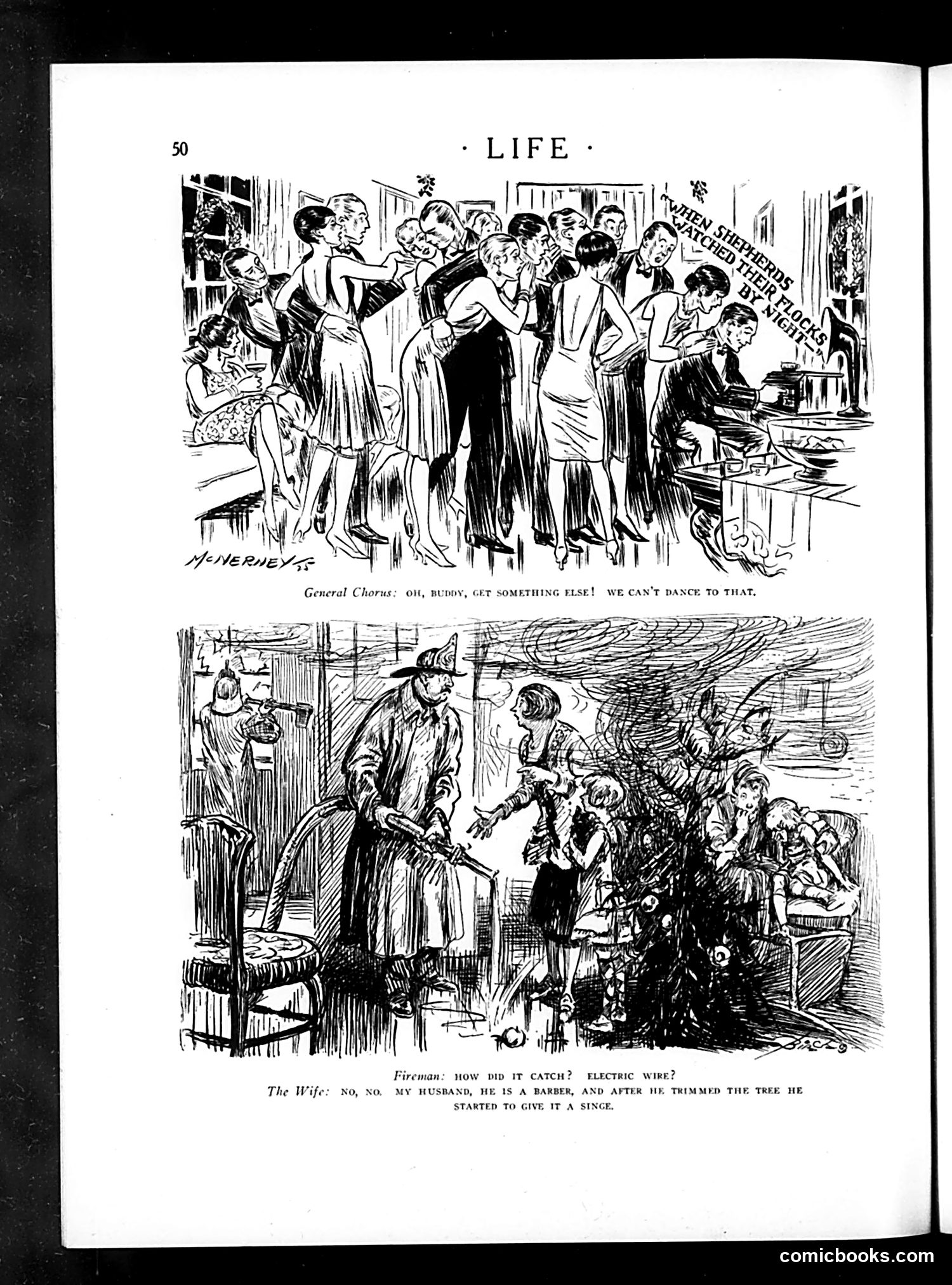
These two cartoons mock domestic situations through wordplay and visual humor. **Top cartoon**: A crowded party where the band's music is criticized—guests demand "something else" because they can't dance to the current tune. The satire targets either bad musicians or poor song selection at social gatherings. **Bottom cartoon**: A fireman discovers a Christmas tree on fire, initially suspecting an electrical wire caused it. The wife explains her barber husband, after trimming the tree, attempted to "singe" it—likely meaning to quickly dry or finish it with heat, a barber's technique applied inappropriately to evergreen branches. The joke ridicules the husband's misapplication of professional skills to domestic tasks, resulting in fire danger. Both cartoons use simple domestic scenarios to highlight human foolishness and miscommunication common to everyday life.
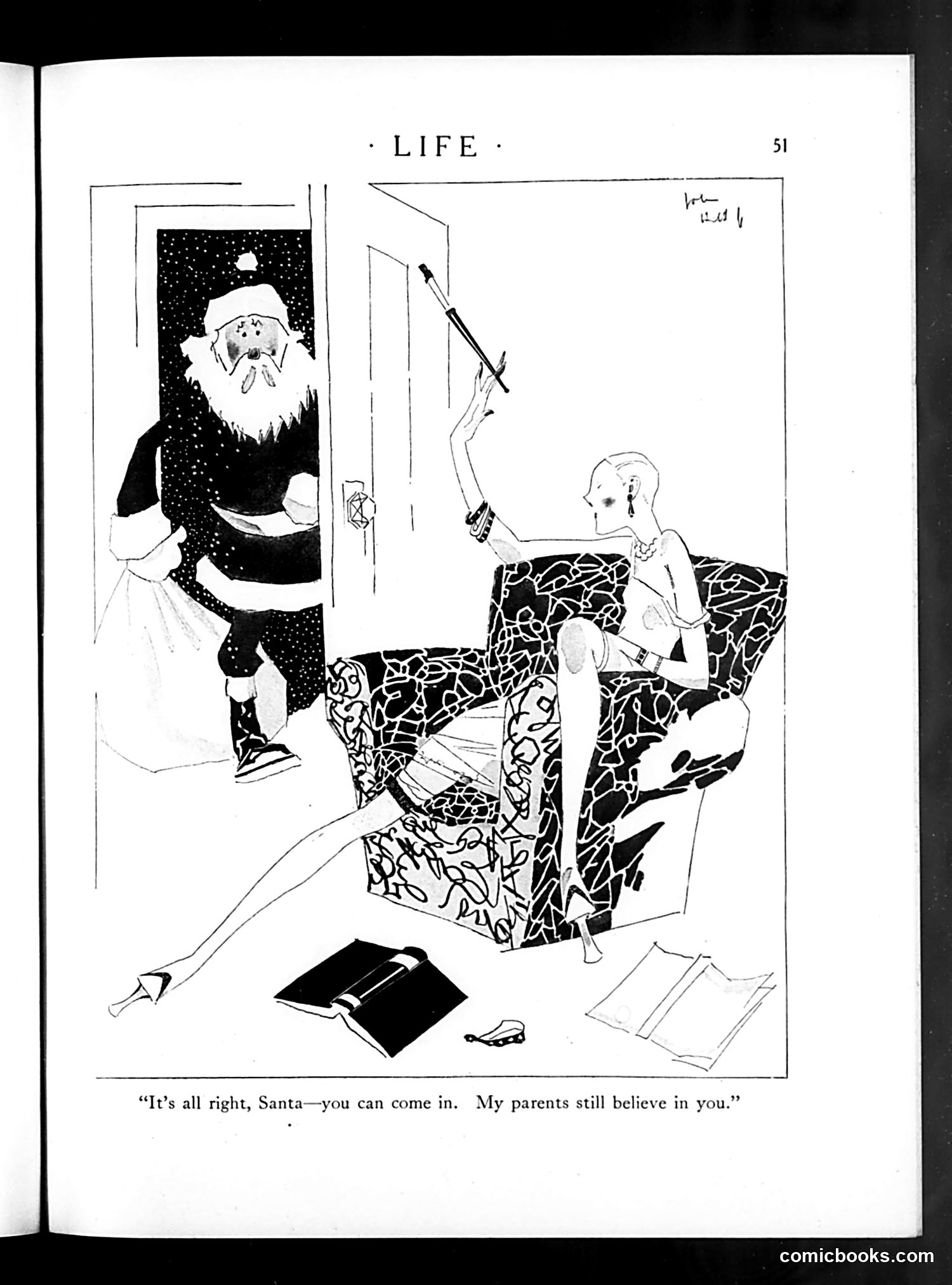
This single-panel cartoon satirizes modern parental skepticism about Santa Claus. A child (appearing to be a teenager or preteen) sits in a chair examining what appears to be building plans or documents, while inviting Santa through the doorway. The joke inverts the traditional dynamic: instead of parents pretending Santa exists *for* their children's benefit, this child suggests their *parents* are the ones who need Santa to be real—implying the parents are gullible or emotionally dependent on the myth. The scattered papers and casual demeanor suggest the child has moved beyond childhood credulity and now views their parents as the naive believers. It's a gentle mockery of adult wishful thinking and nostalgia.
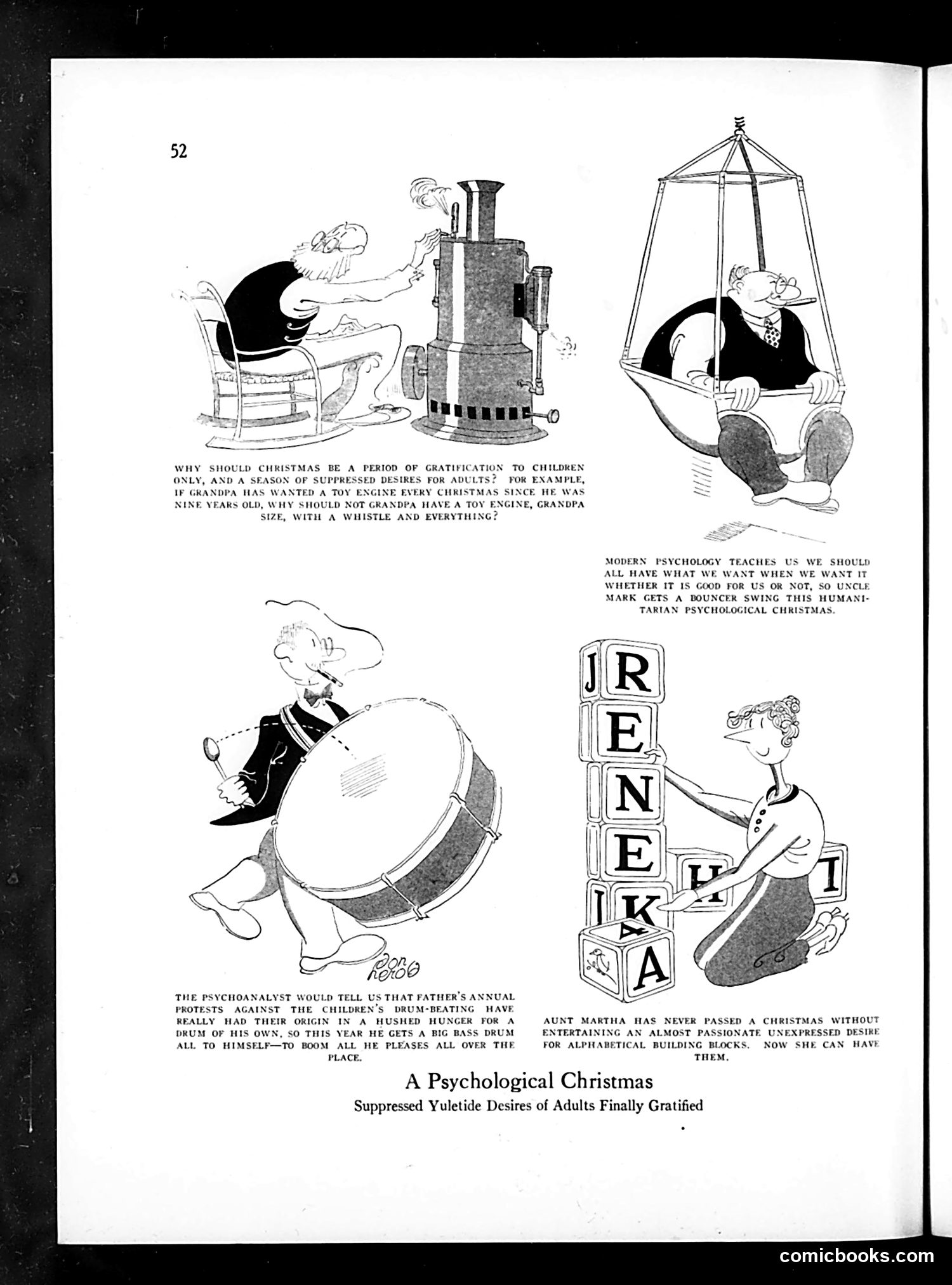
This satirical page mocks the influence of early 20th-century psychology and psychoanalysis on American culture. The cartoons humorously literalize Freudian ideas about repressed desires by depicting adults receiving the toys they secretly wanted as children. The joke: Modern psychology suggests adults should indulge suppressed wishes, so the cartoons show absurd outcomes—a grandfather with a toy engine, a father with a bass drum (supposedly compensating for childhood drum deprivation), and Aunt Martha with alphabet blocks. The satire targets two things: (1) the popular misapplication of psychological theory to justify adult selfishness at Christmas, and (2) the notion that satisfying every impulse equals psychological health. The exaggerated illustrations of grown people with toys undermine the seriousness of psychological claims, suggesting that blindly following such advice produces ridiculous results rather than genuine well-being.
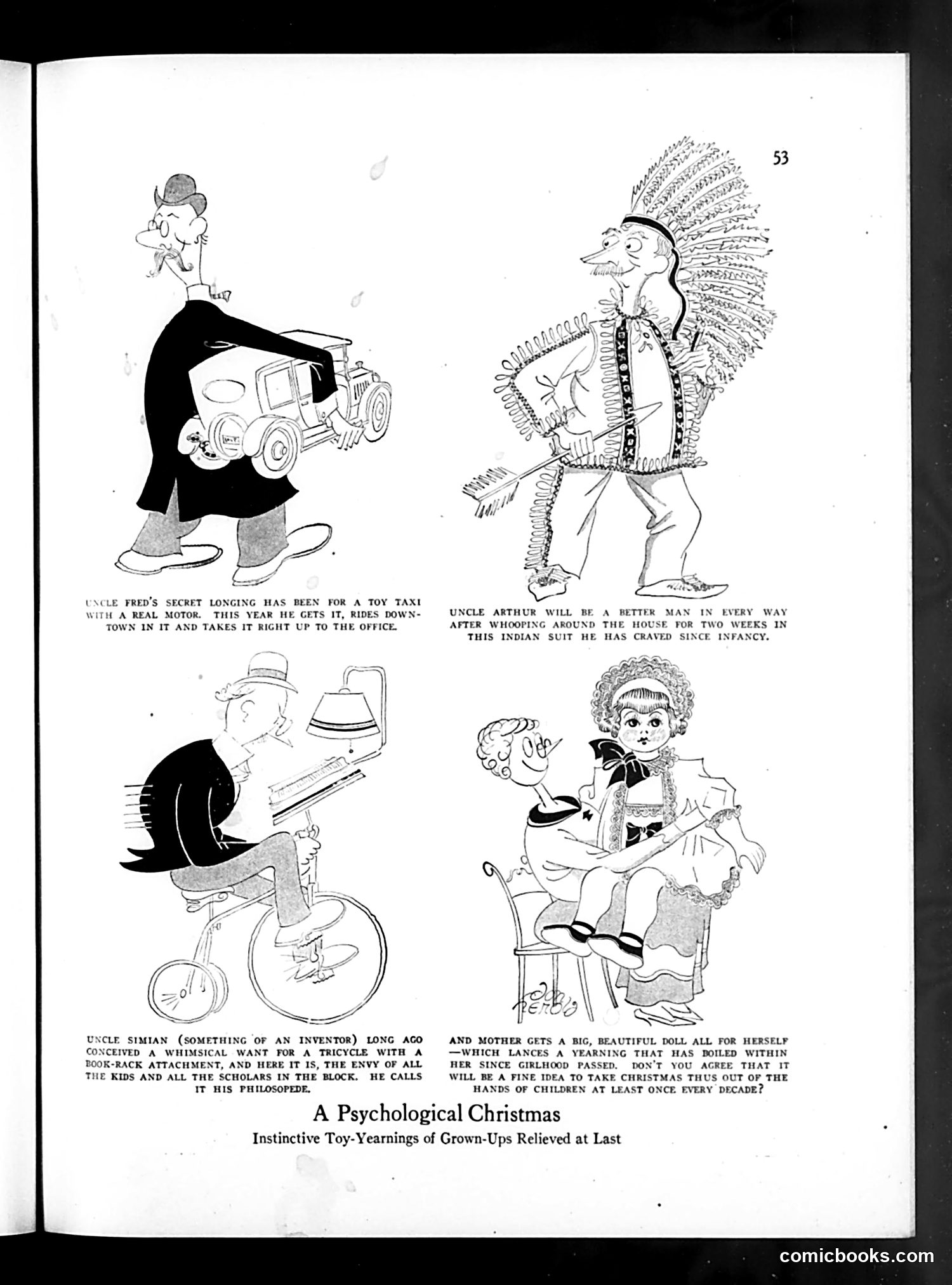
This satirical page mocks adult regression and unfulfilled childhood desires. Four illustrated vignettes show grown men and women indulging in toys they've secretly craved: - Uncle Fred obsesses over a motorized toy taxi, riding it downtown to his office - Uncle Arthur wears an Indian suit he's wanted since childhood, whooping around the house - Uncle Simian desires a tricycle with a book-rack (which he calls his "philosopede") - A mother finally gets a large doll she's wanted since girlhood The headline's ironic question—whether Christmas should be taken "out of the hands of children"—suggests these adults are childish and emotionally stunted. The satire critiques both adult materialism and the psychological theory (popular in the 1920s-30s) that adults should indulge repressed childhood impulses for mental health. The joke: that doing so makes them ridiculous, not healthy.
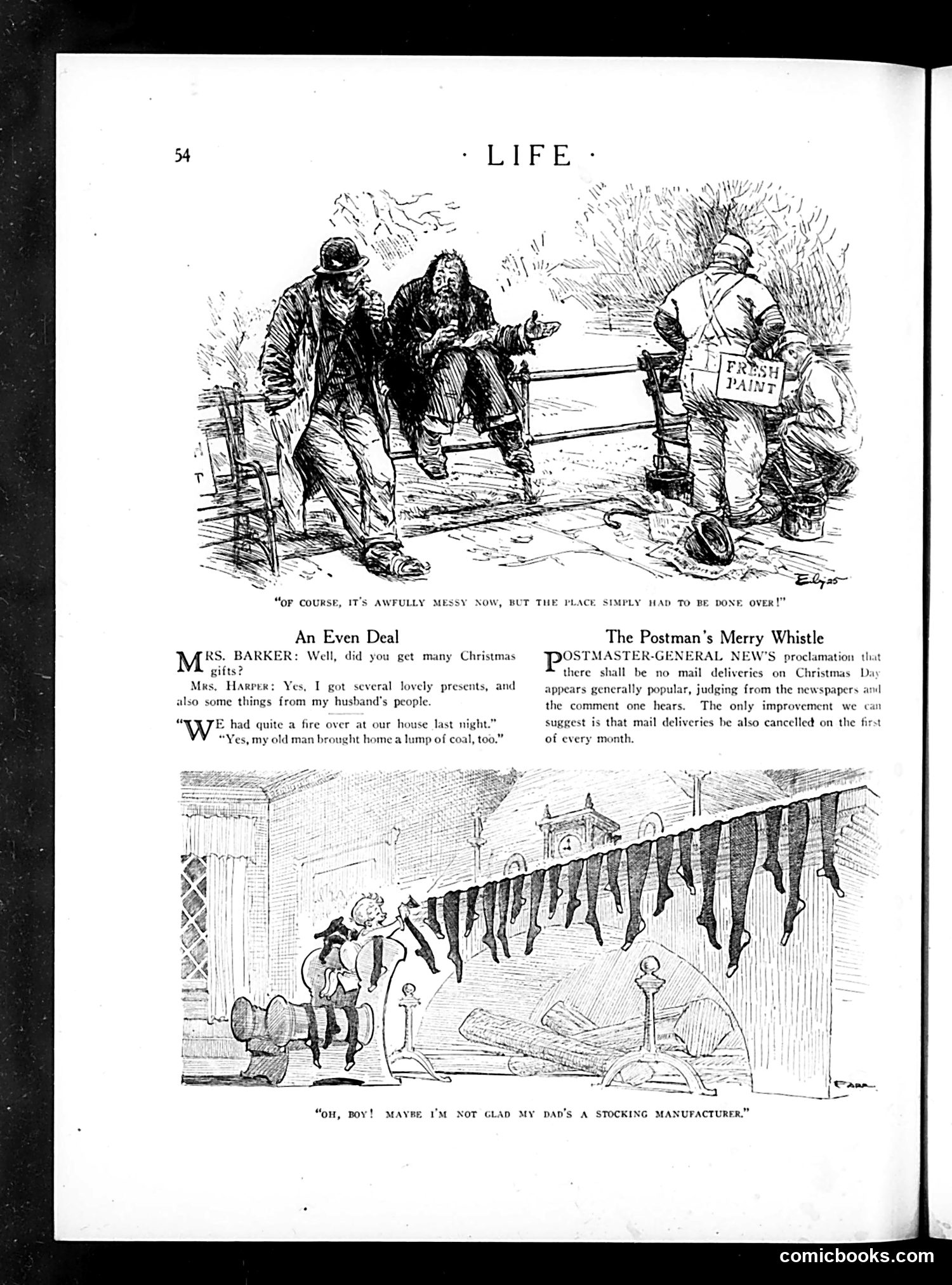
This page contains two satirical comic pieces: **"An Even Deal"** (top): A brief dialogue between Mrs. Barker and Harper about Christmas gifts. The joke plays on domestic economics—while Mrs. Barker received nice presents, her husband brought home coal, suggesting they're "even" because coal was a practical but unglamorous necessity during this era. **"The Postman's Merry Whistle"** (bottom): An illustrated cartoon mocking the Postmaster-General's announcement of no Christmas mail deliveries. The scene shows children with stockings hung to dry indoors, with the caption suggesting a boy is relieved his father isn't a stocking manufacturer—implying the family has no gifts to fill them. This satirizes how the postal cancellation affects holiday gift-giving and family expectations. Both pieces humorously comment on economic constraints during the holiday season.
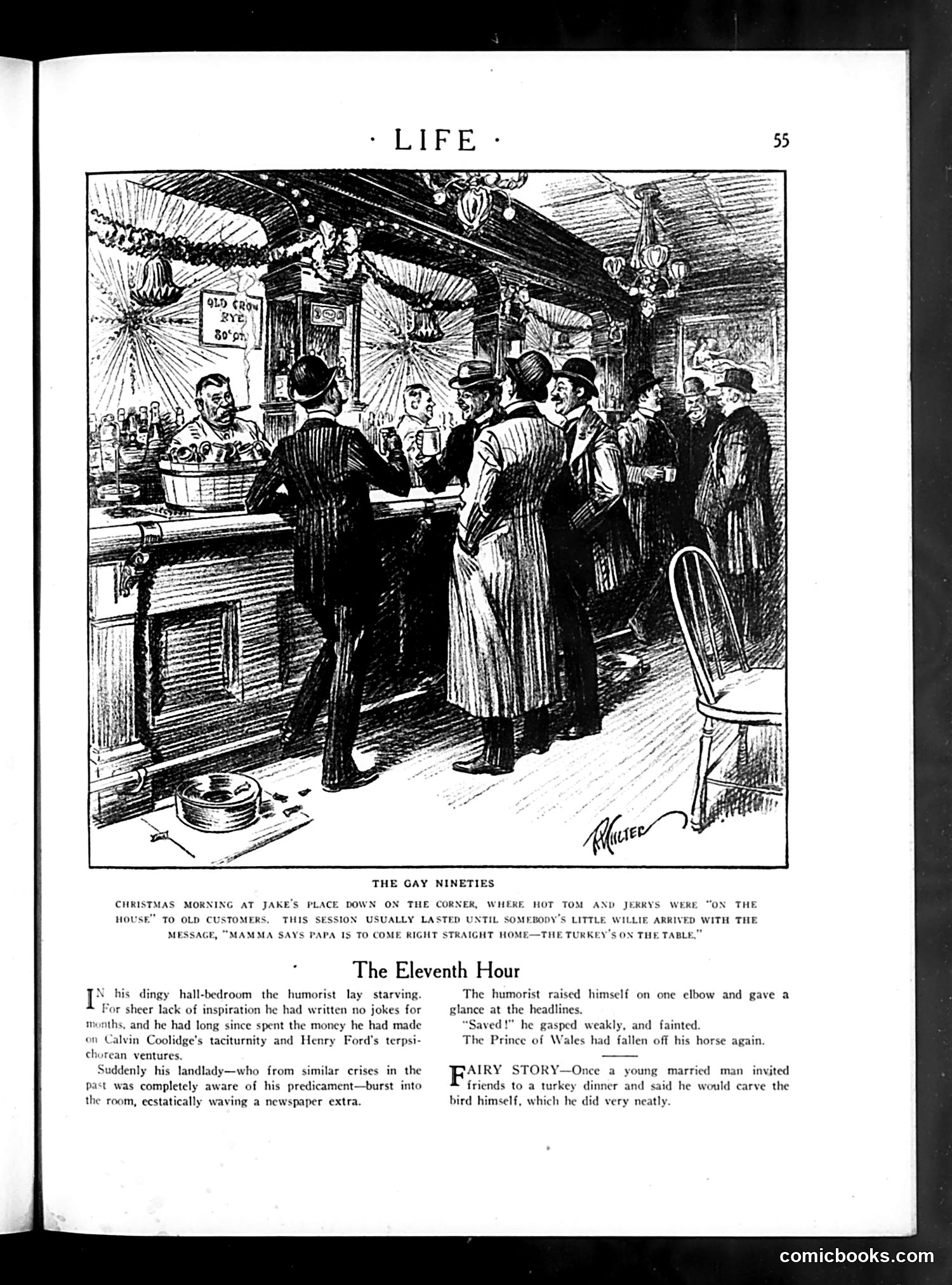
The top illustration satirizes **1890s bar culture**, depicting a saloon ("Jake's Place") where men drank complimentary hot toddies on Christmas morning. The scene mocks the era's casual drinking habits—men lingering at bars until summoned home by wives with messages about dinner ("the turkey's on the table"). It's nostalgic humor about old customs, labeled "The Gay Nineties" to evoke that decade's perceived permissiveness. Below, "The Eleventh Hour" presents two brief satirical pieces about contemporary figures. One mocks a struggling humorist who's lost inspiration writing about **Calvin Coolidge's** famous taciturnity and **Henry Ford's** eccentric dancing. The second is a quip about **the Prince of Wales** repeatedly falling from horses—likely referencing Edward, Prince of Wales (later Edward VIII), whose mishaps were tabloid fodder. The "Fairy Story" ending humorously praises someone for *not* bungling turkey carving—a mild joke about incompetence.
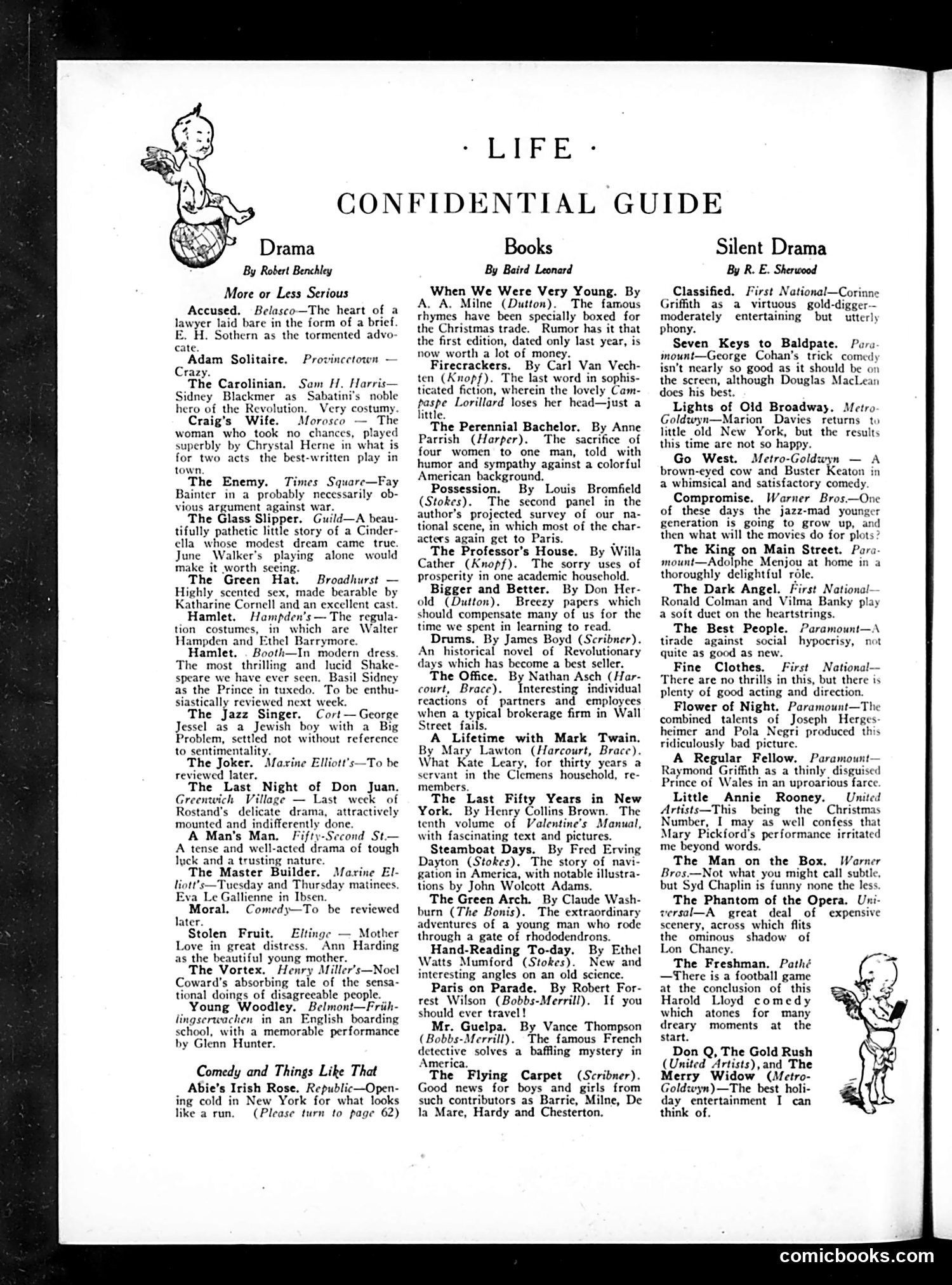
This page from *Life* magazine presents Robert Benchley's satirical theater and book reviews—a "confidential guide" offering his irreverent takes on contemporary Broadway productions and new publications. **The Theater Reviews** mock popular plays of the 1920s with Benchley's characteristic wit. He praises Basil Sidney's *Hamlet* in modern dress as "the most thrilling and lucid Shakespeare we have ever seen," while dismissing *The Green Hat* as merely "highly scented sex" redeemed only by Katharine Cornell's performance. His reviews balance genuine appreciation with sharp criticism. **The Book Section** covers recent releases, including A.A. Milne's *When We Were Very Young* (a children's classic) and works by literary figures like Willa Cather and James Boyd. **The Cartoon Figures** (left and right margins) appear to be decorative mascots typical of *Life*'s visual style—stylized cherubs or imps emphasizing the magazine's humorous tone. The overall purpose: provide sophisticated readers with Benchley's candid, entertainingly cynical assessments of what New York's cultural establishment was offering in the 1920s.
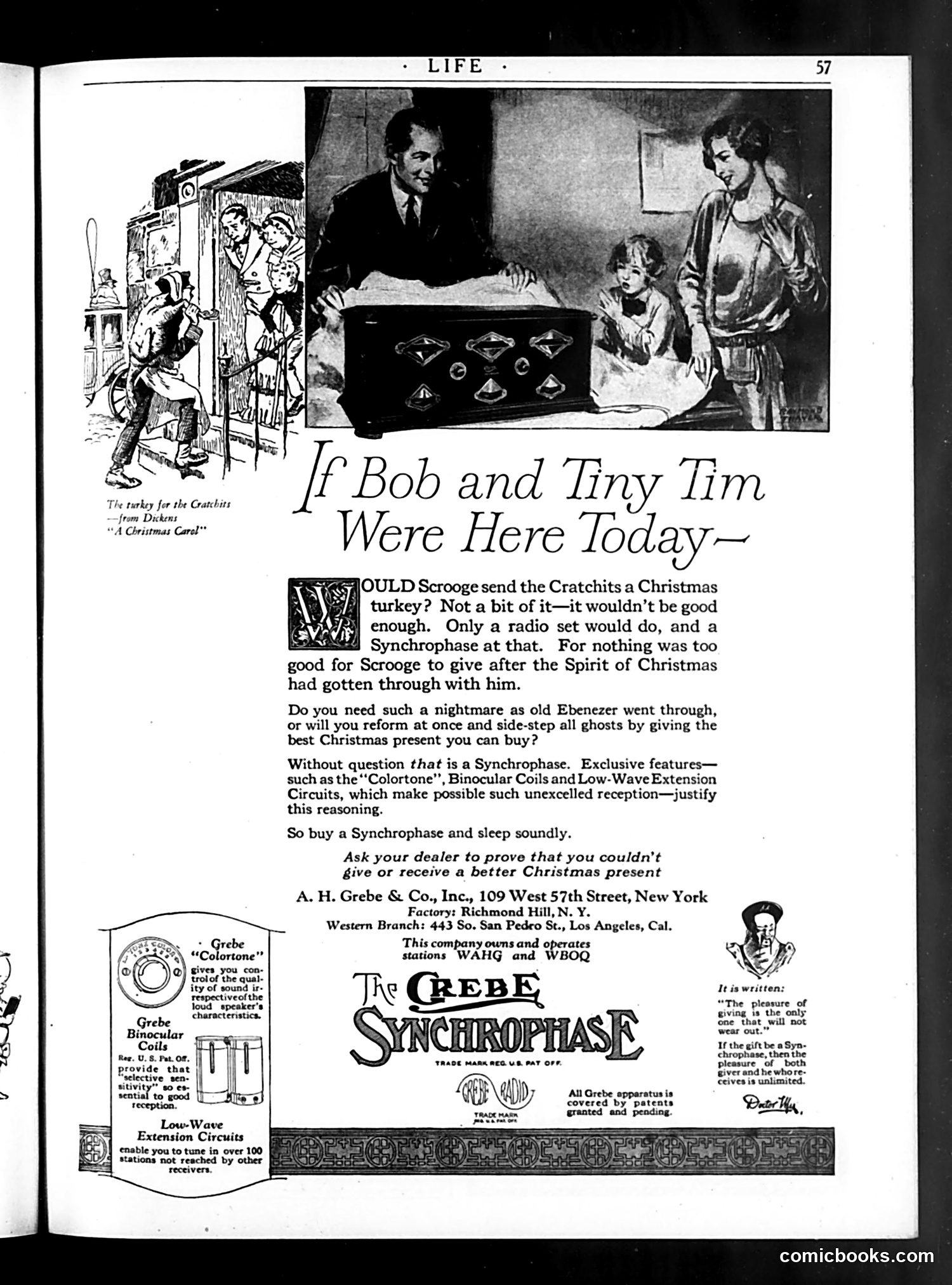
This is primarily a **Synchrophase radio advertisement** disguised as satirical content referencing Dickens's *A Christmas Carol*. The page uses the story of Scrooge to pitch radios as the ultimate Christmas gift. The setup is humorous: it suggests that if Scrooge were reformed today (implying modern times), he'd give the Cratchits a radio instead of a turkey—implying a radio is more valuable than traditional gifts. The photograph shows a man demonstrating the radio's display panel to a family, positioning the Synchrophase as a luxury item that brings families together and provides superior reception via features like "Colortone" and "Binocular Coils." The satire is gentle: it mocks consumerism by suggesting you should reform your character *by buying an expensive radio*—avoiding "nightmares" (implied: guilt, poor decisions) through this purchase. The Dickens reference elevates a commercial product pitch into cultural commentary about modern materialism replacing traditional values.
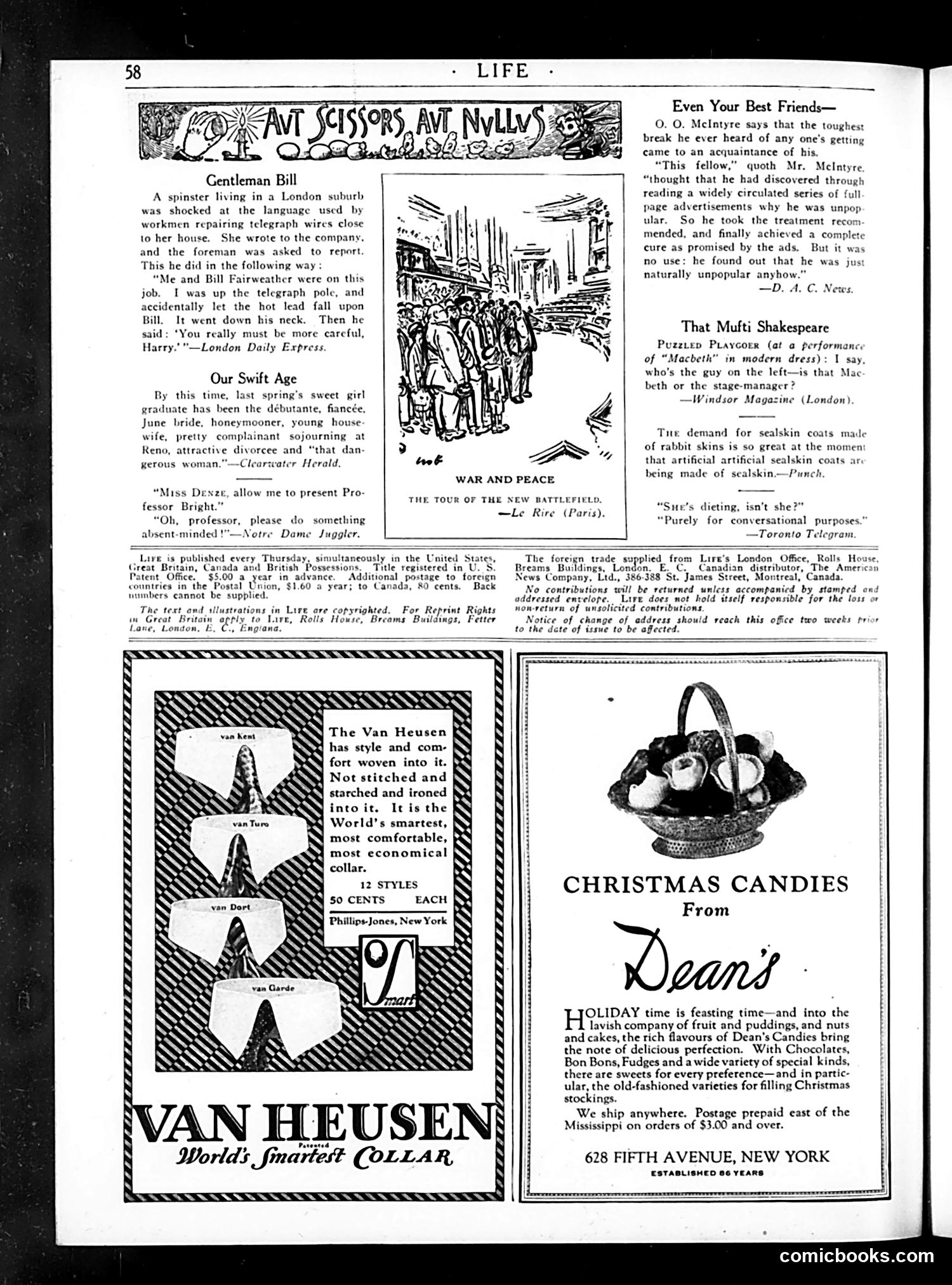
This page is primarily **advertising with brief humorous anecdotes** rather than political cartoons. The content includes: **Humor pieces**: Short, light jokes about modern life—a woman complaining about telegraph workers' language, a young woman's rapid life progression (debutante to divorcee in one season), and confusion at a modernized "Macbeth" performance. These satirize contemporary social trends like the "new woman," rapid social change, and theatrical experimentation. **One small illustration** shows a battlefield tour, captioned "War and Peace," likely referencing post-WWI tourism. **Advertisements** dominate: Van Heusen collars (with four style variations shown) and Dean's Christmas Candies occupy substantial space. The humor is gentle, domestic satire typical of 1920s Life magazine—poking fun at social conventions, female independence, and modern absurdities rather than serious political critique. The page reflects Jazz Age anxieties about rapid social change.
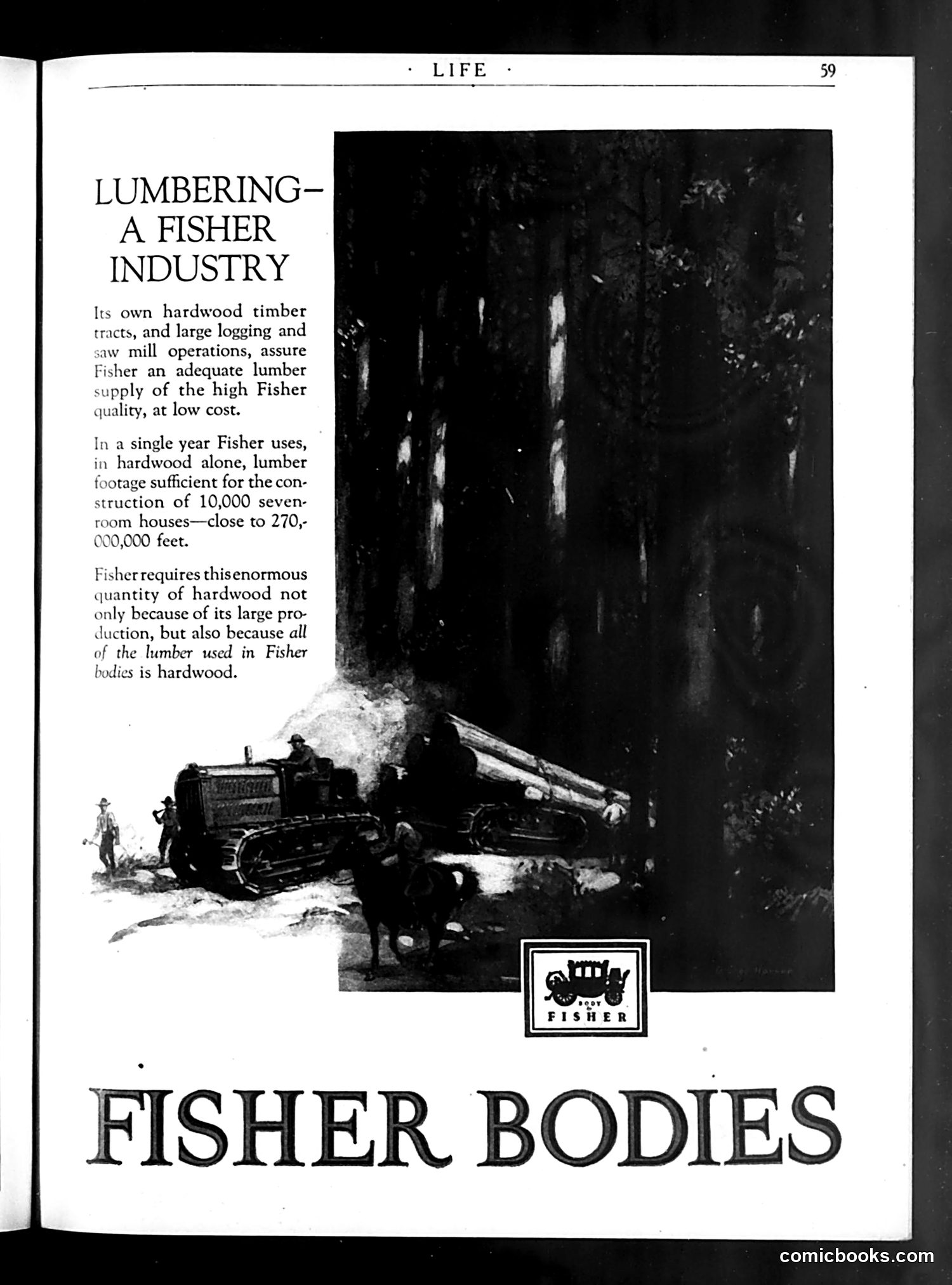
This is a **Fisher Bodies advertisement**, not satire or political commentary. Fisher Bodies was an automobile body manufacturer (later acquired by General Motors). The page promotes Fisher's vertical integration: the company owns timber tracts and logging operations to supply its own lumber needs. The text emphasizes Fisher's scale—using enough hardwood annually to build 10,000 seven-room houses (270 million feet of lumber). The image shows a steam-powered logging locomotive hauling massive tree logs, illustrating the industrial infrastructure behind automobile production. The advertisement argues this self-sufficiency ensures "high Fisher quality" at "low cost." For modern readers: this represents early 20th-century industrial consolidation, where manufacturers controlled raw material supply chains—a common practice before modern just-in-time manufacturing and supplier networks.
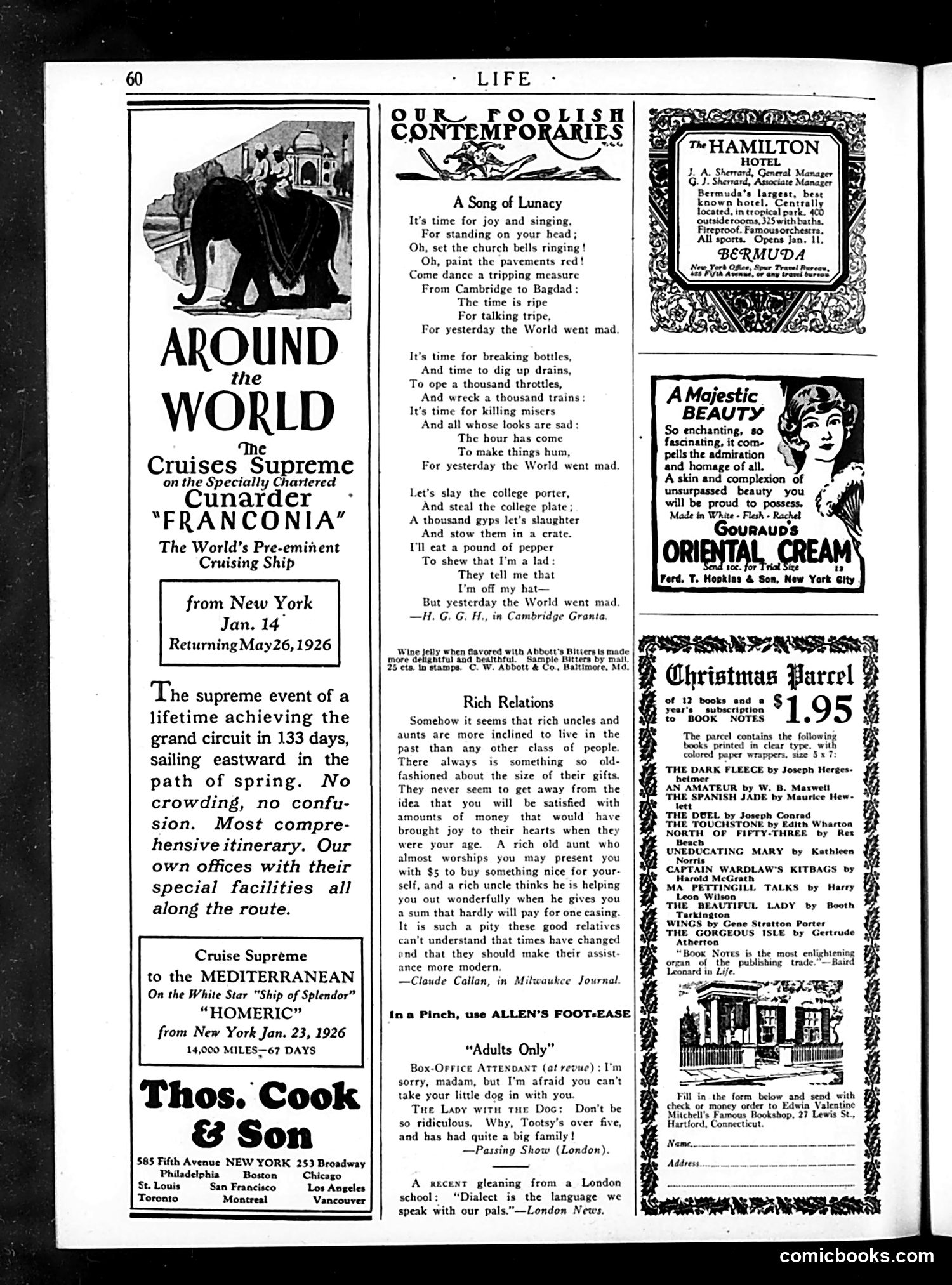
This is primarily an **advertising page** from Life magazine (circa 1926), featuring cruise ship promotions and product ads. The main content is a **humorous poem titled "A Song of Lunacy"** mocking post-WWI excess and moral breakdown. The poem sarcastically celebrates abandoning social norms—standing on your head, breaking bottles, wrecking trains, killing "misers," slaughtering animals—attributing this chaos to "yesterday the World went mad." This appears to reference the chaotic, hedonistic behavior of the 1920s Jazz Age, satirizing the era's perceived social decay and loss of Victorian propriety. The page also includes brief humor columns like **"Rich Relations"** (mocking wealthy relatives' outdated gift amounts) and **"Adults Only"** (a joke about someone trying to bring their dog to a theater). The rest consists of **cruise ship advertisements** (Cunard, White Star Line), hotel promotions (Hamilton Hotel, Bermuda), beauty products (Oriental Cream), and book subscription offers—typical magazine advertising of the period.
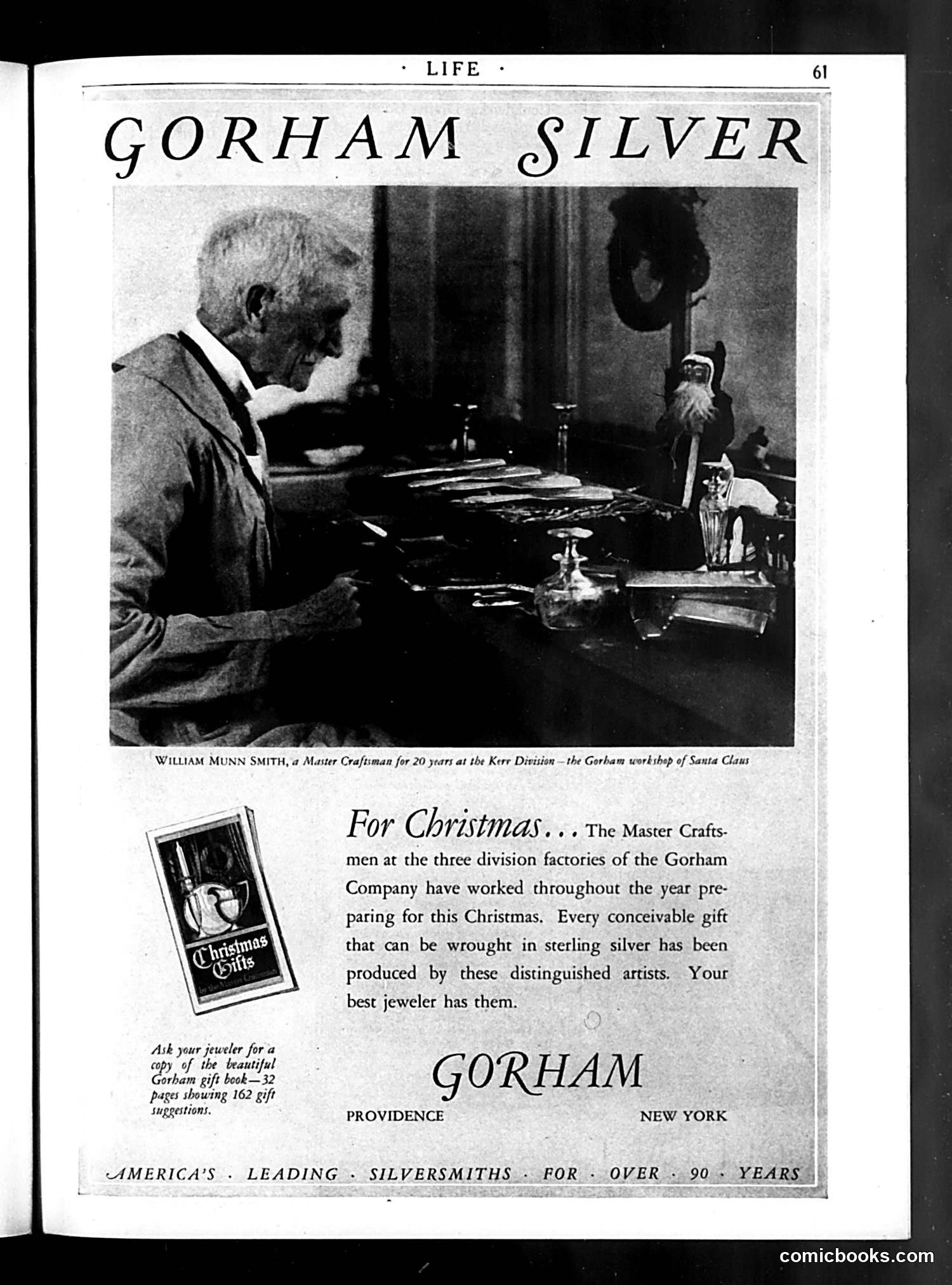
This page is **not a cartoon or satirical content** — it's a **vintage advertisement** for Gorham silverware, a major American manufacturer. The image shows William Munn Smith, identified as a "Master Craftsman" with 20 years at Gorham's Santa Clara factory, working at a desk. The ad promotes Gorham's sterling silver Christmas gifts, claiming their craftsmen have spent the year preparing holiday items. The text emphasizes Gorham's prestige ("distinguished artists," "America's Leading Silversmiths for over 90 years") and directs readers to jewelers for their gift catalog. This represents **early 20th-century advertising strategy**: using skilled workers as proof of quality and craftsmanship to sell luxury goods. The humanizing portrait of the artisan worker was meant to reassure consumers they were purchasing items made by respected professionals, not factory mass production.
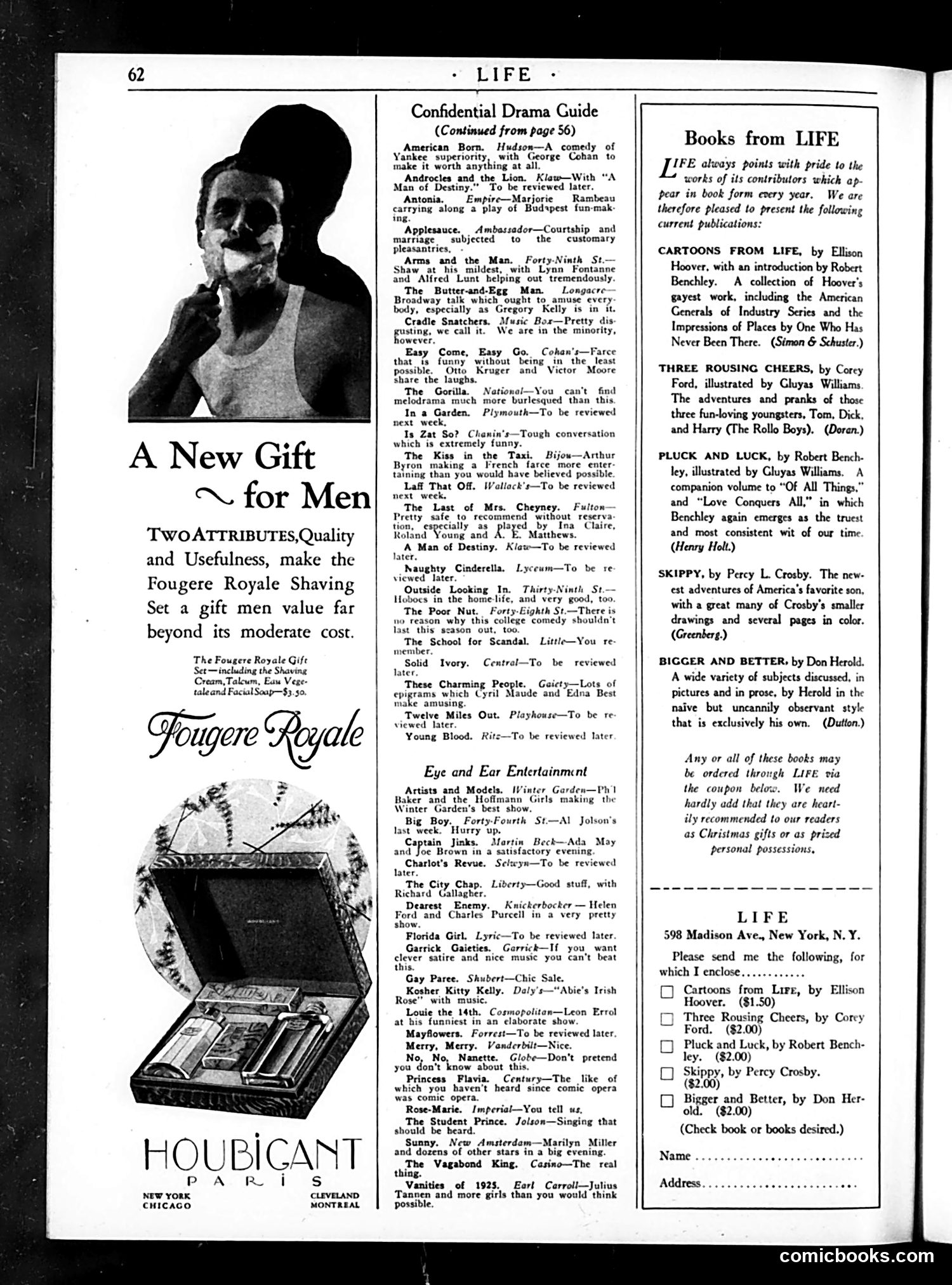
This page is primarily **advertising and entertainment listings**, not political satire. The dominant content is a Houbigant shaving set advertisement featuring a man's face in profile, promoting "Fougere Royale" grooming products as a gift for men—emphasizing quality and usefulness at moderate cost. The right side contains a "Confidential Drama Guide"—brief, witty reviews of Broadway theatrical productions then running in New York. These are entertaining capsule critiques (e.g., "Naughty Cinderella"—"To be reviewed later"), typical of Life magazine's satirical theater coverage. Below is a "Books from Life" section advertising collections recently published by the magazine, including cartoon compilations and humorous volumes. There is **no political cartoon or significant satire** on this page—it represents standard commercial and entertainment content from Life's interior pages.
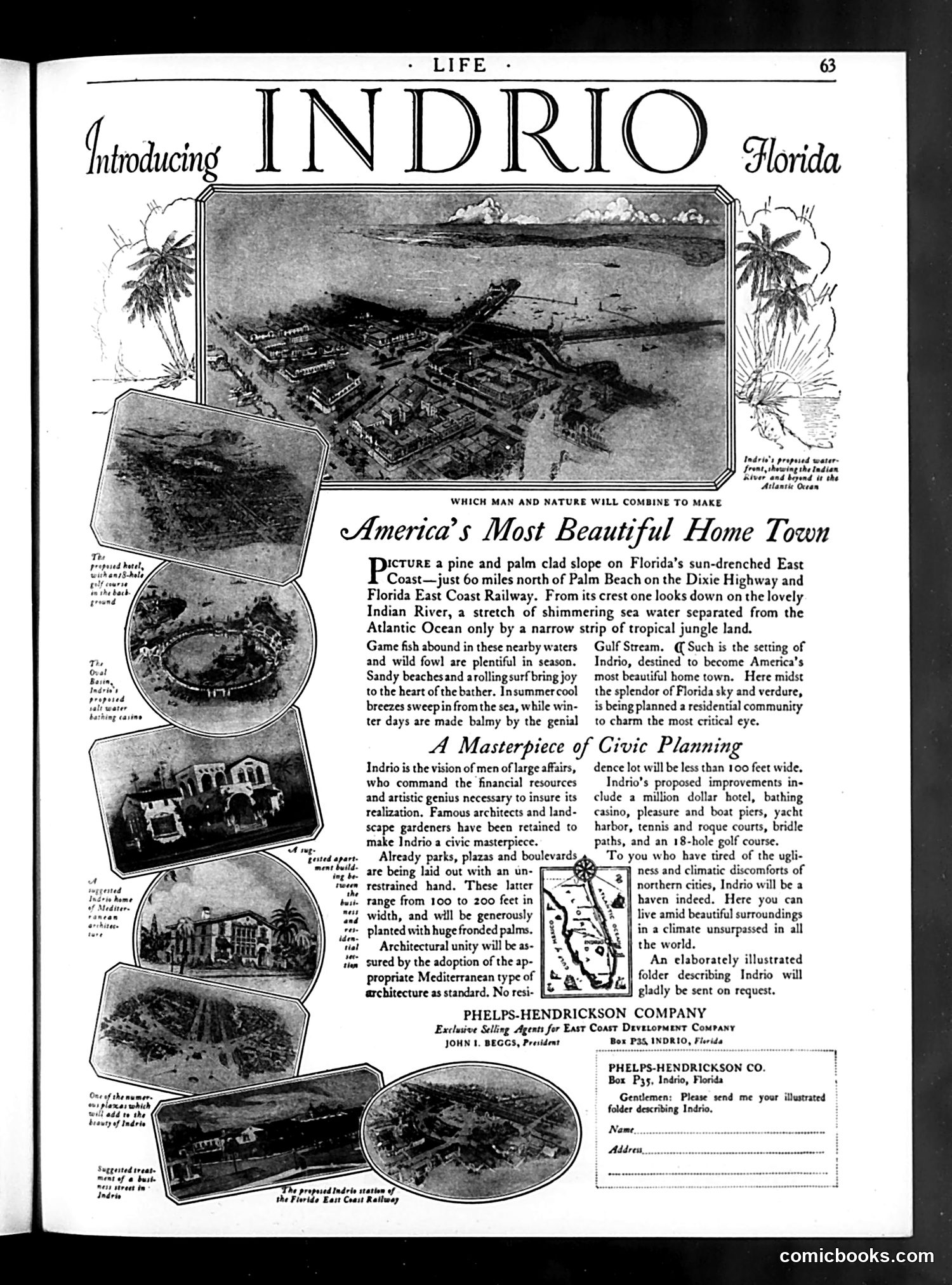
This is not satire—it's a **real estate advertisement**, likely from the 1920s Florida land boom. The page promotes "Indrio," a planned residential community 60 miles north of Palm Beach, marketing it as "America's Most Beautiful Home Town." The pitch emphasizes luxury amenities (golf course, yacht harbor, casino), Mediterranean-style architecture, and Florida's natural attractions (Indian River, sandy beaches, game fishing). Multiple photographs showcase the proposed development. For modern readers: this represents the speculative real estate fever that swept Florida during the 1920s, when developers marketed undeveloped land to wealthy northerners seeking escape from harsh winters. The grandiose language ("masterpiece of civic planning," "men of large affairs") and emphasis on climate were typical sales tactics of the era. The page's rhetorical question—"To you who have tired of the ugliness and climatic discomforts of northern cities"—directly targets affluent urban readers. A tear-off coupon invited inquiries.
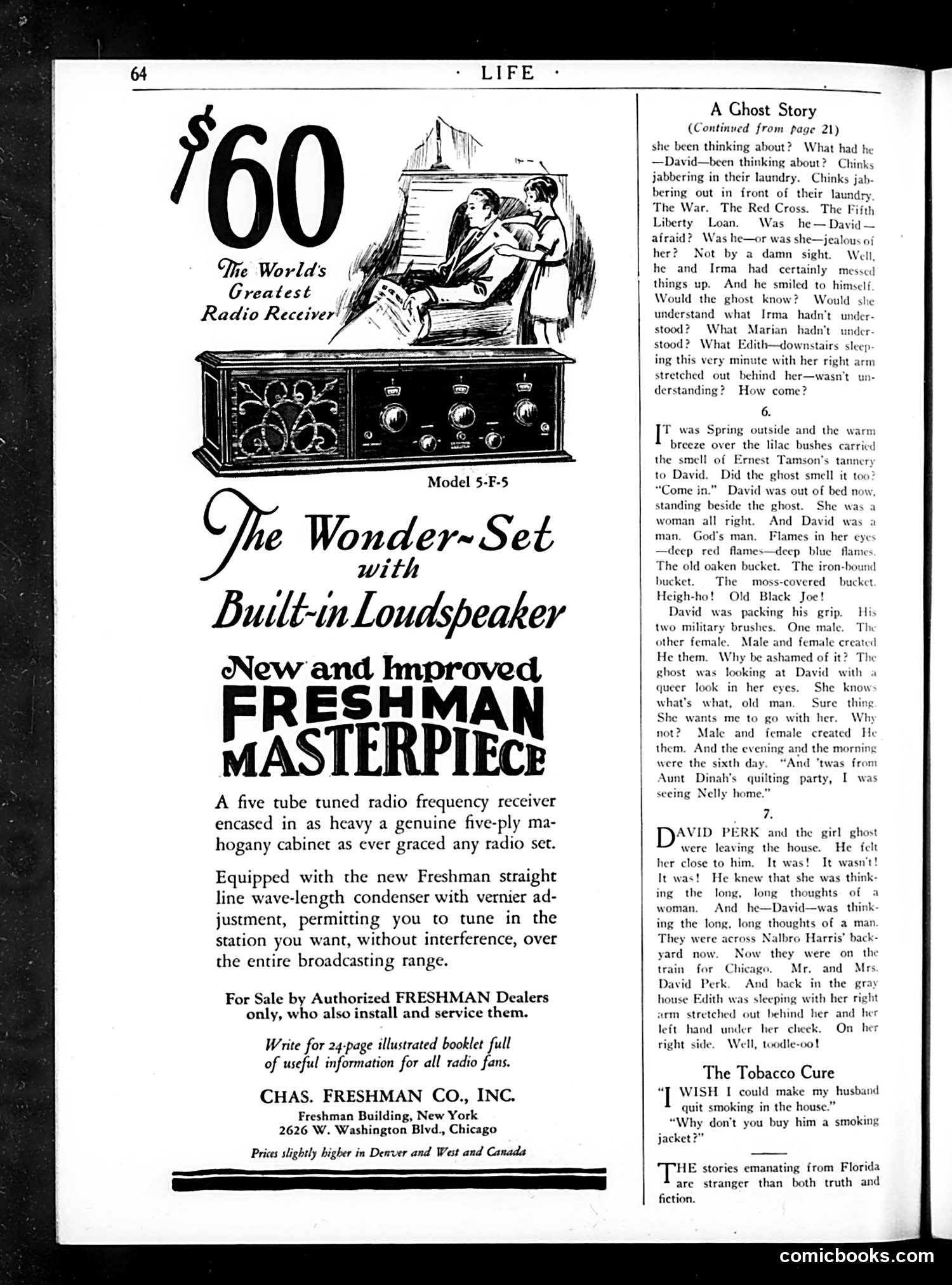
This page is primarily **advertising** for the Freshman Model 5-F-5 radio receiver, with the accompanying story text serving as filler content. The advertisement itself contains no political satire or caricature—it's a straightforward product pitch emphasizing the radio's technical capabilities ("five tube tuned radio frequency receiver," "built-in loudspeaker," mahogany cabinet). The story excerpt titled "A Ghost Story" (continued from page 21) appears to be a serialized fiction piece about a man named David Perk contemplating his romantic entanglements while encountering a female ghost. The narrative touches on WWI-era concerns (mentions of "The War," "Red Cross," "Fifth Liberty Loan"), but the story fragment lacks sufficient context to identify specific satirical intent or references. The small item at bottom—"The Tobacco Cure"—is a brief humorous advice column, not political commentary. **This is essentially an advertising page with minimal satirical content.**
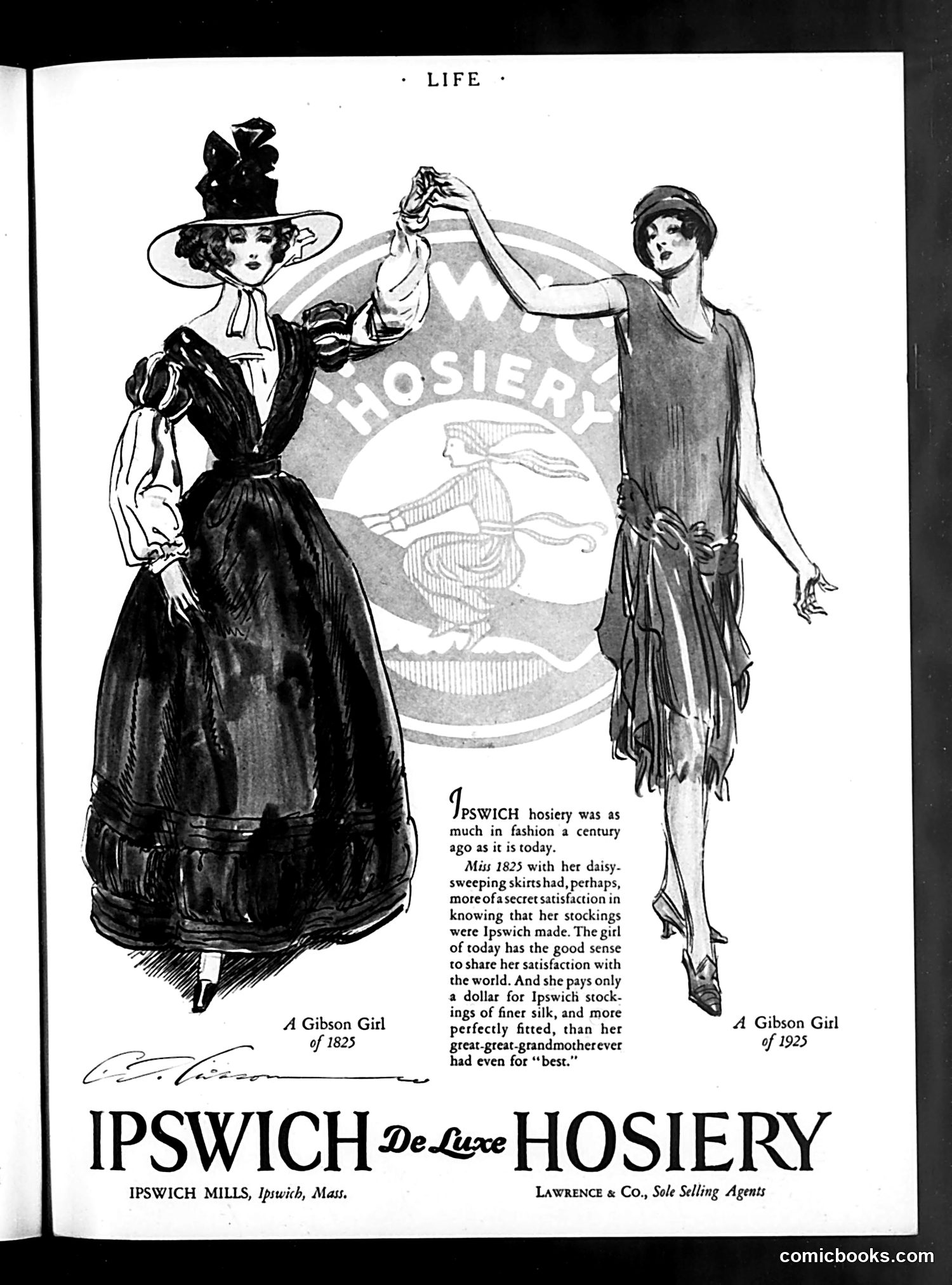
This is primarily a **product advertisement**, not political satire. It's a 1920s ad for Ipswich De Luxe Hosiery that uses a historical comparison for marketing purposes. The page contrasts two "Gibson Girls" (the popular idealized female figure of the era): one from 1825 in formal Victorian dress, one from 1925 in modern 1920s style. The ad's argument: quality hosiery has always mattered to fashionable women, but modern women are smarter—they publicly celebrate good stockings and pay only a dollar (versus presumably more expensive "best" stockings of a century prior). There's no political satire here. Instead, it's a **nostalgic marketing strategy** leveraging the Gibson Girl's cultural cachet to sell the product as both timelessly desirable and modernity-affordable. The humor is gentle and promotional rather than satirical.
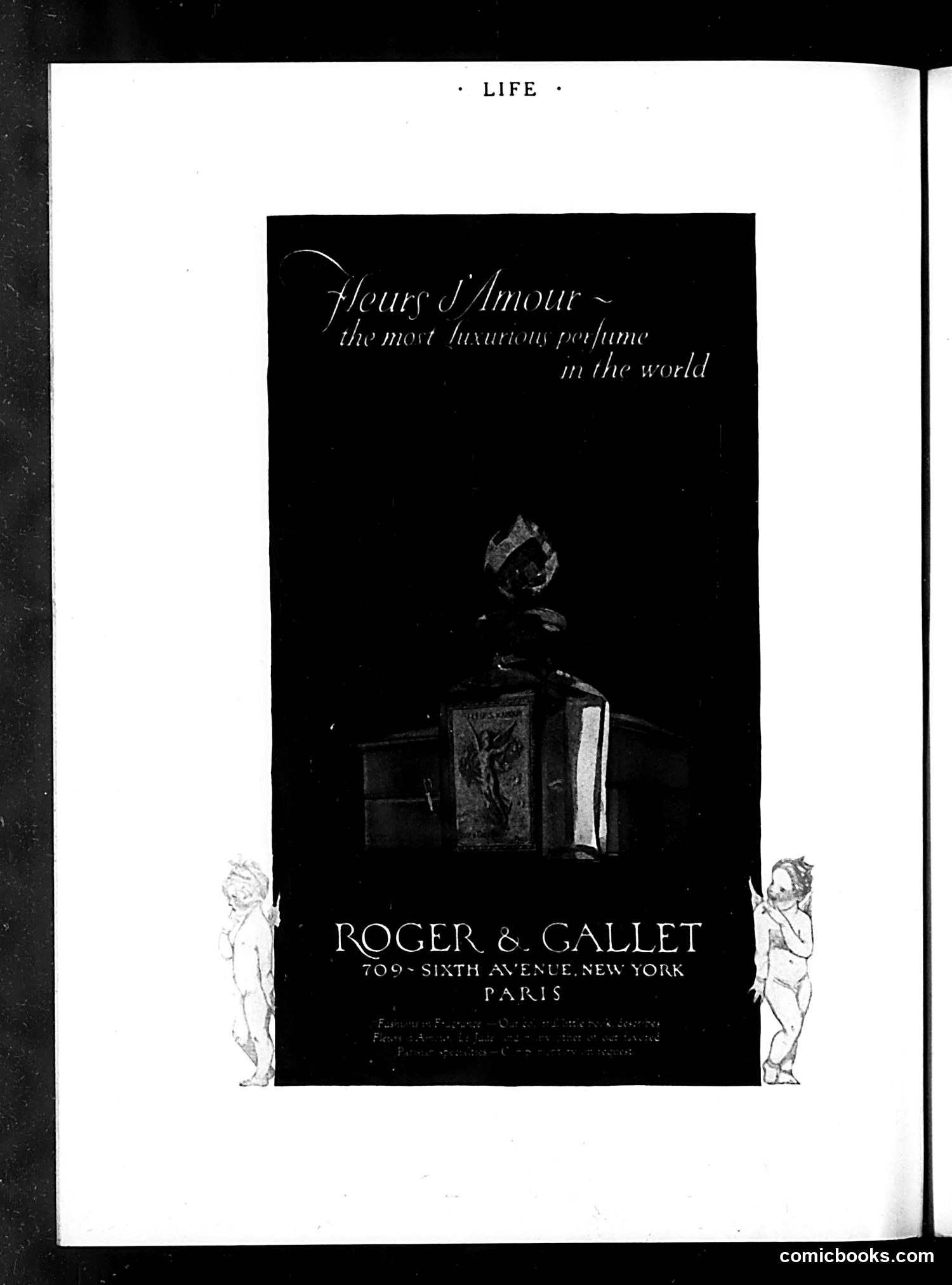
This is a **perfume advertisement**, not political satire. It appears in Life magazine promoting "Fleurs d'Amour" by Roger & Gallet, a French fragrance house with locations in New York and Paris. The ad features an ornate perfume bottle displayed against a black background, with decorative cherub figures flanking the sides—a common design element in luxury goods advertising of the early 20th century. The text claims it's "the most luxurious perfume in the world." The Art Deco styling and emphasis on French elegance and exclusivity reflect the period's marketing strategy: positioning French perfume as the height of sophistication for affluent American consumers. There is no satire or political commentary visible—this is straightforward luxury product promotion.
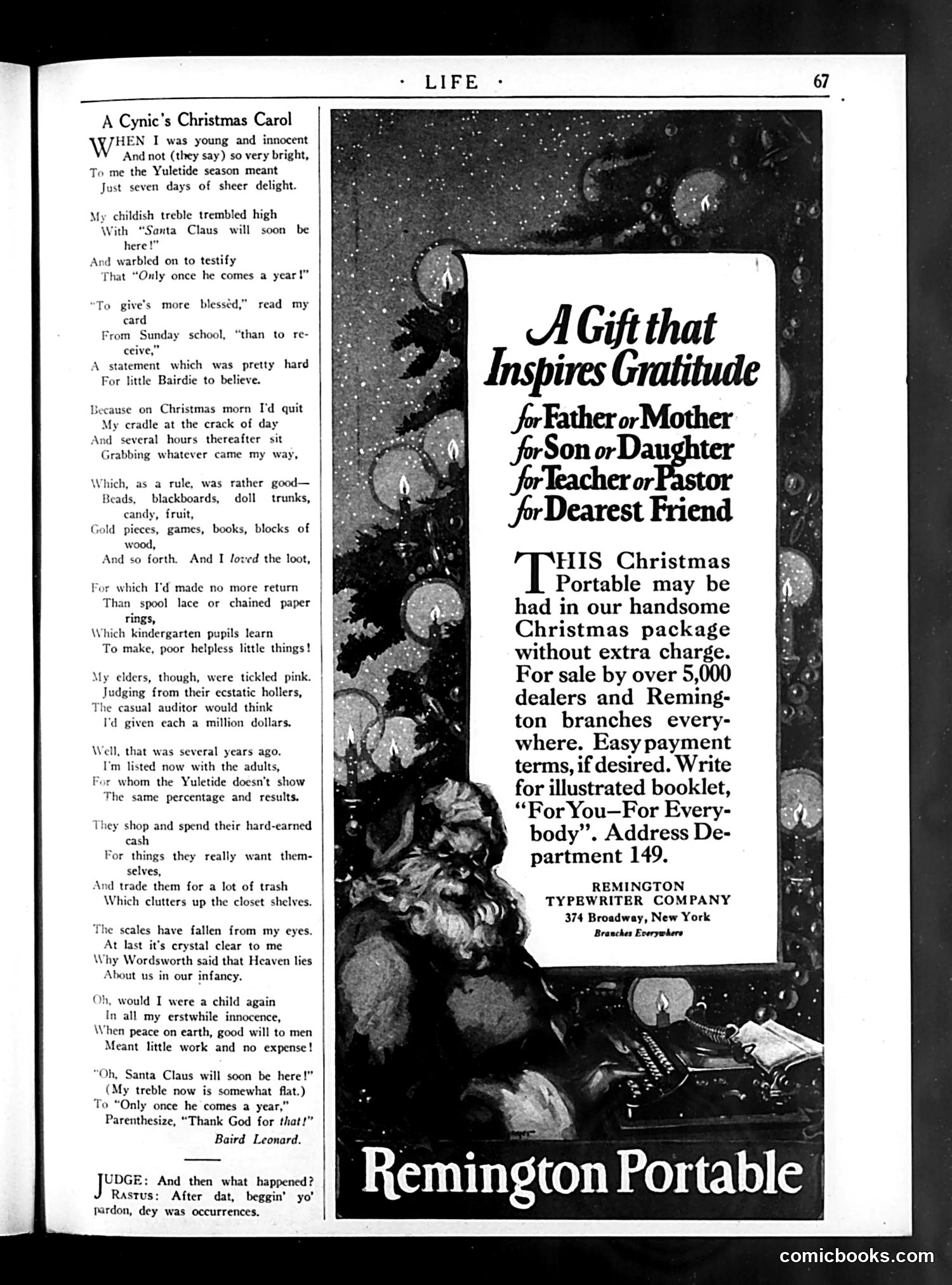
This page features a satirical poem by Baird Leonard contrasting childhood and adult Christmas experiences. The speaker nostalgically recalls youthful innocence—when Christmas meant genuine joy and receiving simple gifts (toys, candy, books) with gratitude and minimal reciprocal obligation. As an adult, the speaker observes that Christmas has become transactional drudgery: adults shop exhaustedly, exchange unwanted items that clutter closets, and experience the holiday as expense rather than joy. The poem's central satire critiques how commercialization and social obligation drain Christmas of meaning. The poem ends with the speaker now saying "Thank God" Santa comes only once yearly—inverting childhood excitement into weary relief. The page also contains a Remington typewriter advertisement positioned as a practical gift suggestion, somewhat ironically placed beside a poem lamenting materialistic Christmas excess.
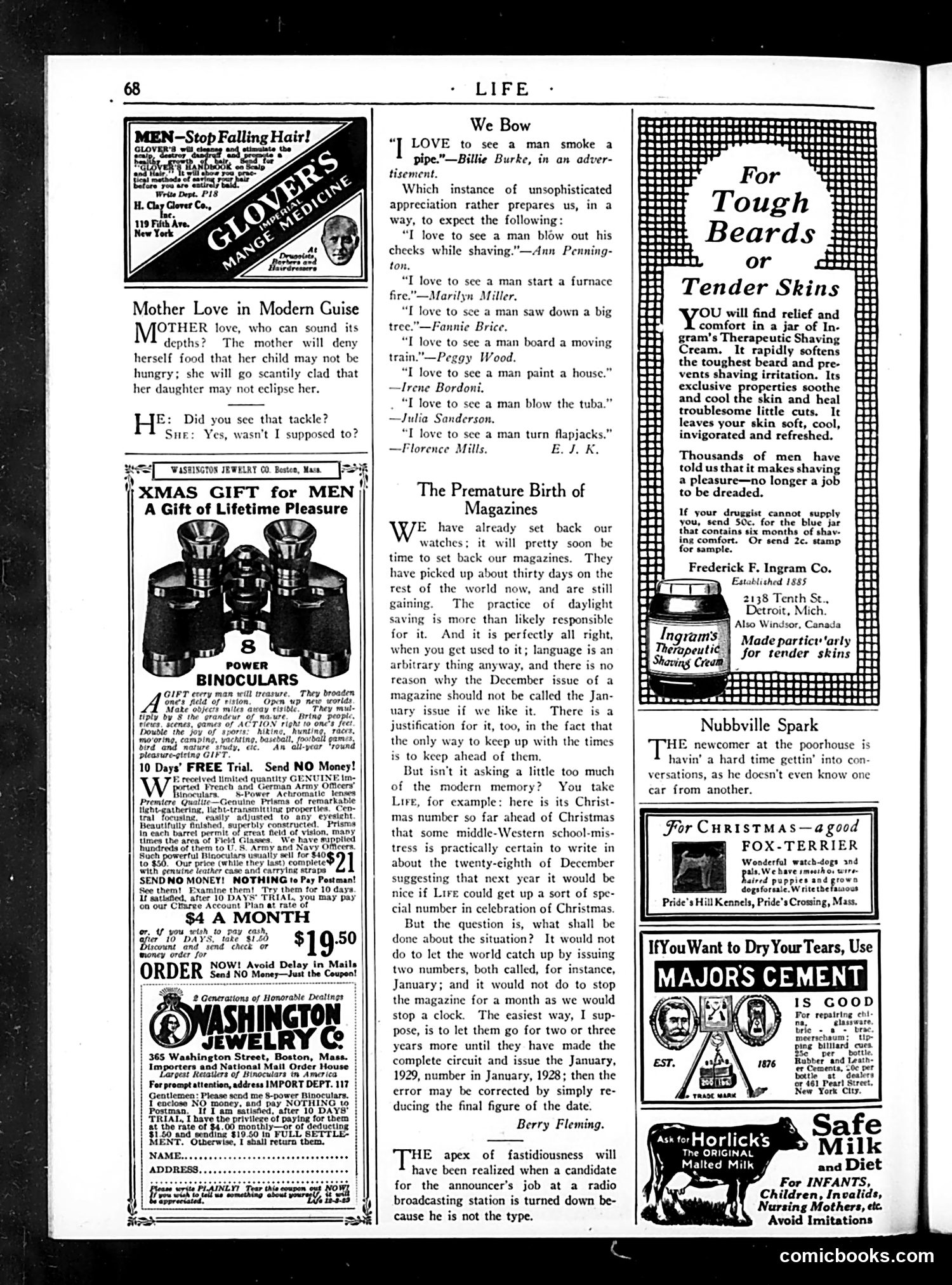
This page consists primarily of **advertisements and satirical commentary** rather than political cartoons. The main satire is "We Bow," which mocks celebrity endorsements. It begins with actress Billie Burke's quote praising men who smoke pipes, then extends this absurd logic to ridiculous extremes—praising men for mundane activities like "blow[ing] out his cheeks while shaving" or "turn[ing] flapjacks." The attributed celebrities (Marilyn Miller, Fannie Brice, Peggy Wood, etc.) are being satirized for endorsing trivial masculine behaviors, lampooning the era's emerging advertising culture where celebrities lent credibility to products. "The Premature Birth of Magazines" satirizes *Life* magazine's own practice of publishing issues far ahead of their calendar dates (Christmas issues in November, etc.), humorously suggesting this creates confusion for readers and could lead to complaints about missing holiday-timed content. The page also includes a brief, somewhat unclear joke about a "tackle" between characters Sue and He, and substantial product advertisements typical of 1920s magazines.
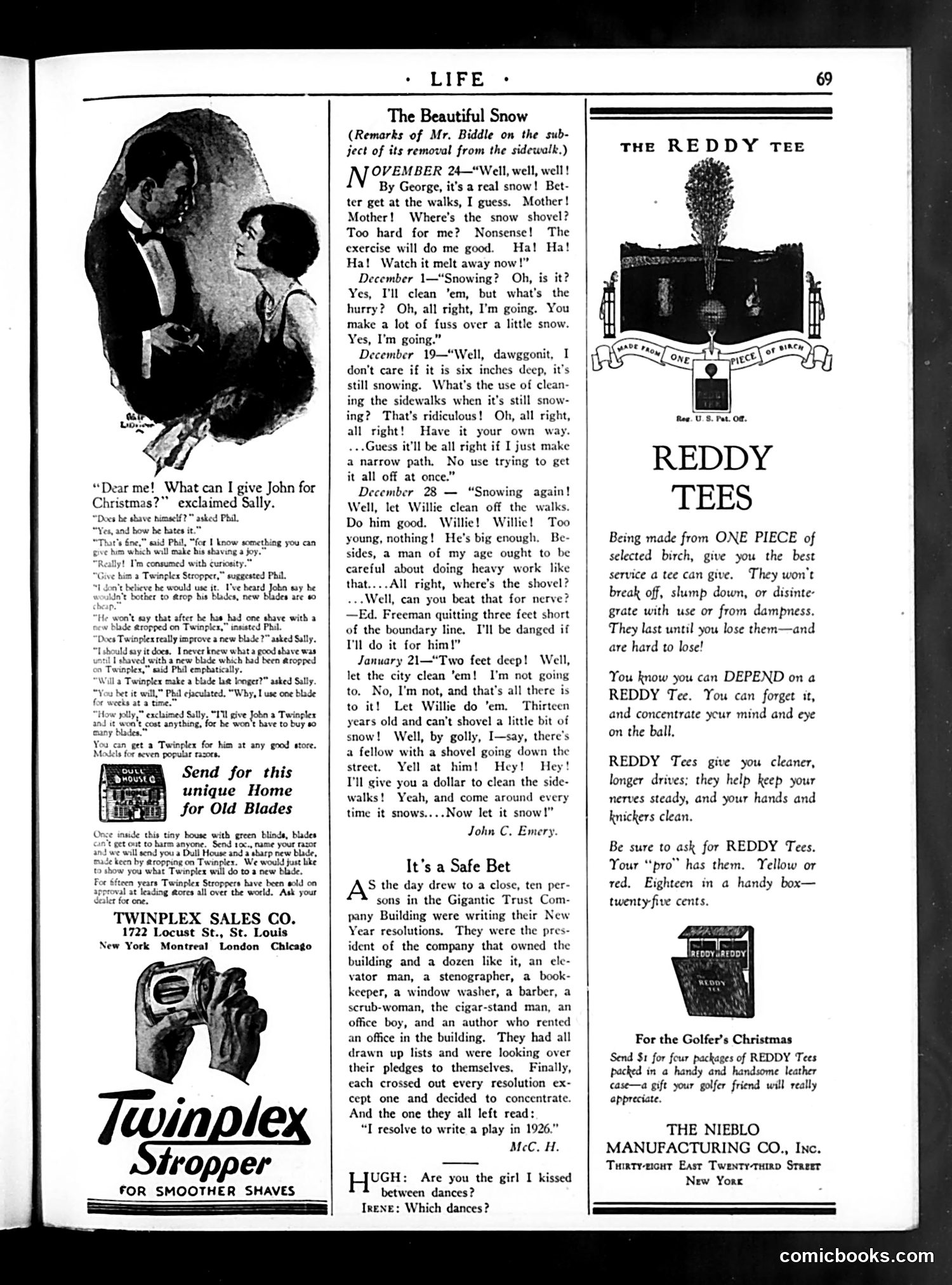
This is a satirical commentary on human nature and procrastination, not political satire. It depicts Mr. Biddle's changing attitudes toward snow removal on his sidewalk over two months. The joke tracks his shifting excuses: Initially eager ("the exercise will do me good"), he progressively becomes lazier and more irritable as snow continues falling. By January, he refuses responsibility entirely, even offering a stranger money to do the work—the very task he'd claimed would benefit him in November. The satire mocks how people make grand New Year's resolutions but quickly abandon them, and more broadly, how circumstances erode our initial good intentions. Biddle represents the common man whose determination weakens when faced with ongoing inconvenience. The piece suggests self-discipline is easier to declare than maintain.
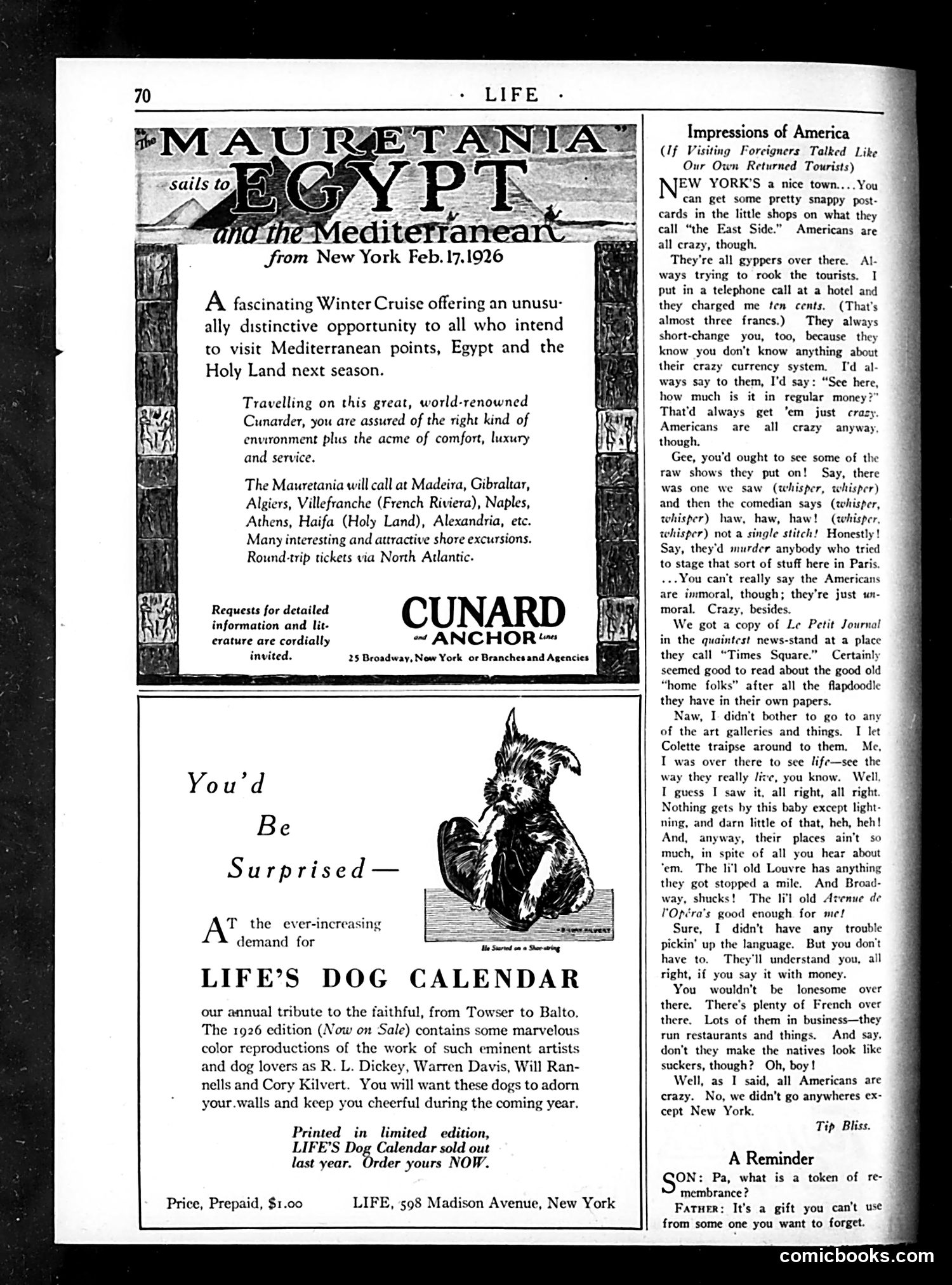
This page is primarily **advertising and filler content** rather than political satire. The main elements are: 1. **Mauretania cruise advertisement** - promoting a winter Mediterranean voyage departing from New York, typical luxury travel marketing of the 1920s. 2. **Life's Dog Calendar ad** - announcing the 1926 edition featuring artwork by named artists; a holiday gift product. 3. **"Impressions of America" essay** - satirizing American tourists returning from Europe. The humor relies on depicting Americans as loud, culturally ignorant, obsessed with money, and prone to boasting about morally questionable entertainment. The piece mocks Americans for being unable to appreciate fine art (dismissing the Louvre) while bragging about Broadway, and for assuming money solves all communication barriers abroad. This reflects 1920s post-WWI attitudes: Americans increasingly traveled overseas and returned as stereotypical "ugly Americans"—wealthy but unsophisticated, unable to truly appreciate European culture. The satire targets American provincial attitudes rather than politics.

I can see this is a page from Life magazine, but the image quality is too poor for me to discern specific cartoon content, text, or figures clearly enough to provide accurate interpretation. The page appears mostly dark with some faint patterns or designs visible, and while "comicbooks.com" appears at the bottom, I cannot reliably identify: - Any cartoon characters or caricatures - Political or social references - The satirical point or joke - Historical context To give you an accurate historical analysis rather than guessing, I would need either a higher-resolution image or the original source material. I apologize I cannot be more helpful with this particular scan.

I can see this is a very dark, low-contrast image from what appears to be a historical publication. The page is nearly entirely black with only faint outlines barely visible on the left edge and scattered small marks throughout. The only clearly legible text is "comicbooks.com" at the bottom right corner. Due to the extreme darkness and poor visibility, I cannot reliably identify any cartoon figures, caricatures, text content, or satirical elements that would allow me to explain the page's meaning to a modern reader. The image quality makes it impossible to discern specific political or social references with the accuracy this task requires. A higher-contrast or better-preserved version would be necessary for proper analysis.
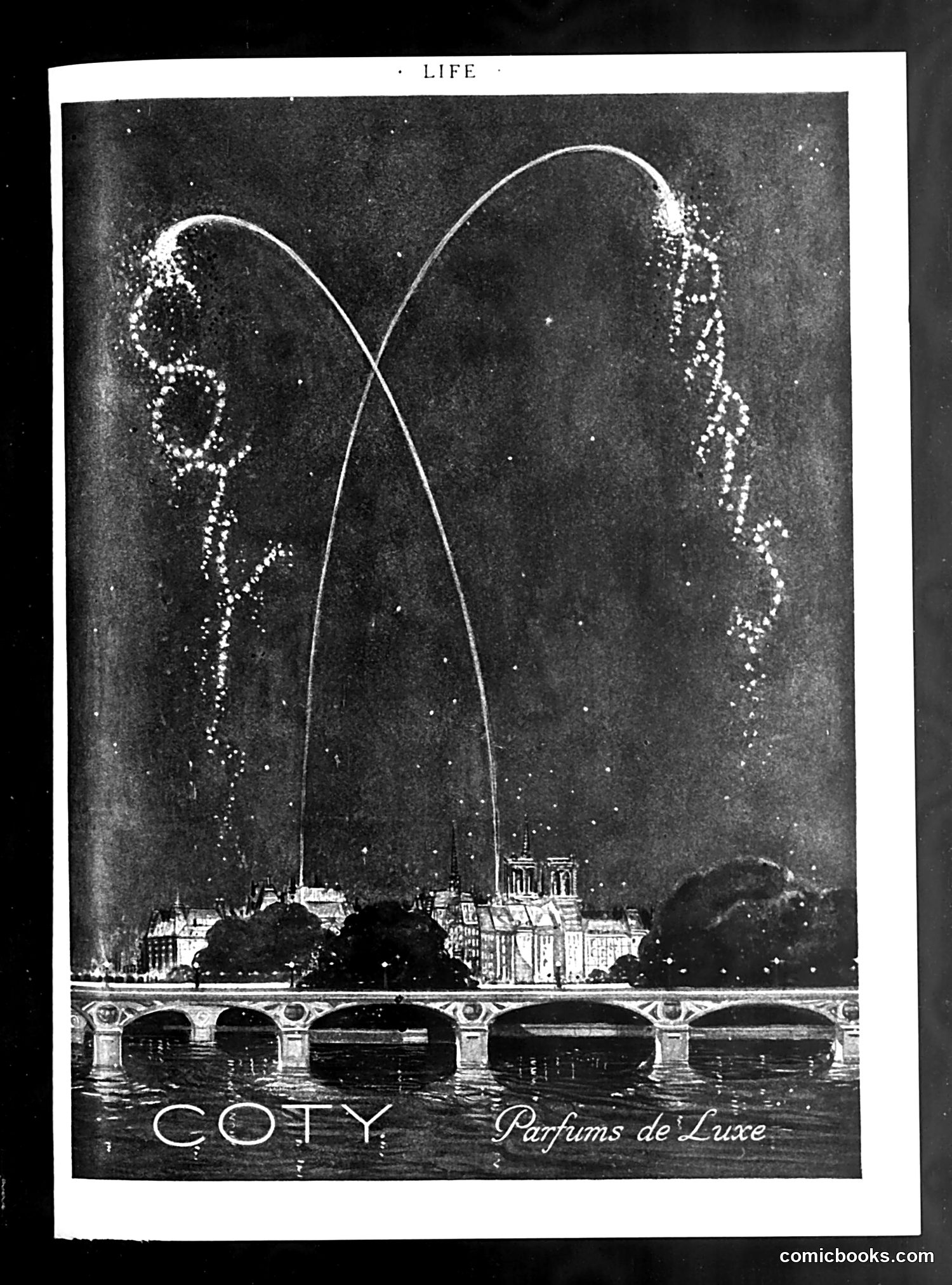
This is a luxury perfume advertisement for "Coty Parfums de Luxe," not political satire. The image depicts a romantic, Art Deco-style nighttime scene of Paris, featuring two elegant arcs of light (likely fireworks or fountain jets) crossing above Notre-Dame Cathedral and a classical bridge over the Seine River. The composition is deliberately dreamy and aspirational, emphasizing luxury and Continental sophistication. The advertisement associates the Coty perfume brand with Parisian elegance and romance—common marketing tactics for high-end cosmetics in this era. The dramatic lighting and architectural framing suggest refinement and exclusivity for the target audience of wealthy consumers.
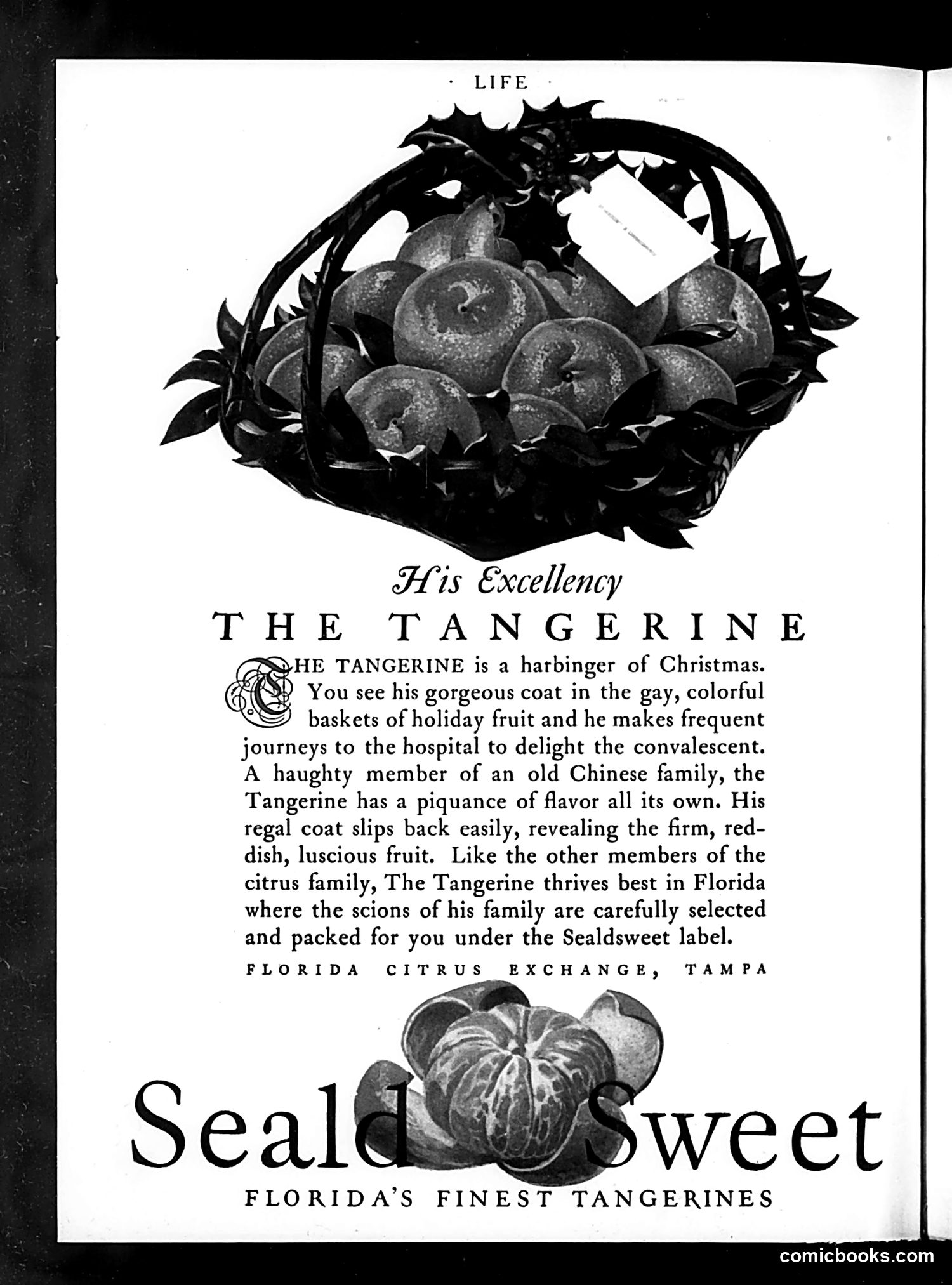
This is primarily a **fruit advertisement**, not political satire. It's a Life magazine ad for Sealdsweet tangerines from Florida Citrus Exchange (Tampa). The "His Excellency" framing playfully personifies the tangerine as a dignified Chinese nobleman—"a haughty member of an old Chinese family." This anthropomorphization was common in early-to-mid 20th century advertising. The text describes the fruit's appeal: easy-to-peel skin, firm red flesh, and suitability as a Christmas gift for hospital patients. The elaborate illustration of tangerines in a decorative basket reinforces the product's luxury positioning. The phrase about visiting hospitals "to delight the convalescent" reflects the practice of bringing fruit to sick people—presenting tangerines as thoughtful gifts. This reflects no deeper satire; it's straightforward product marketing using whimsical characterization and holiday association to encourage purchase.
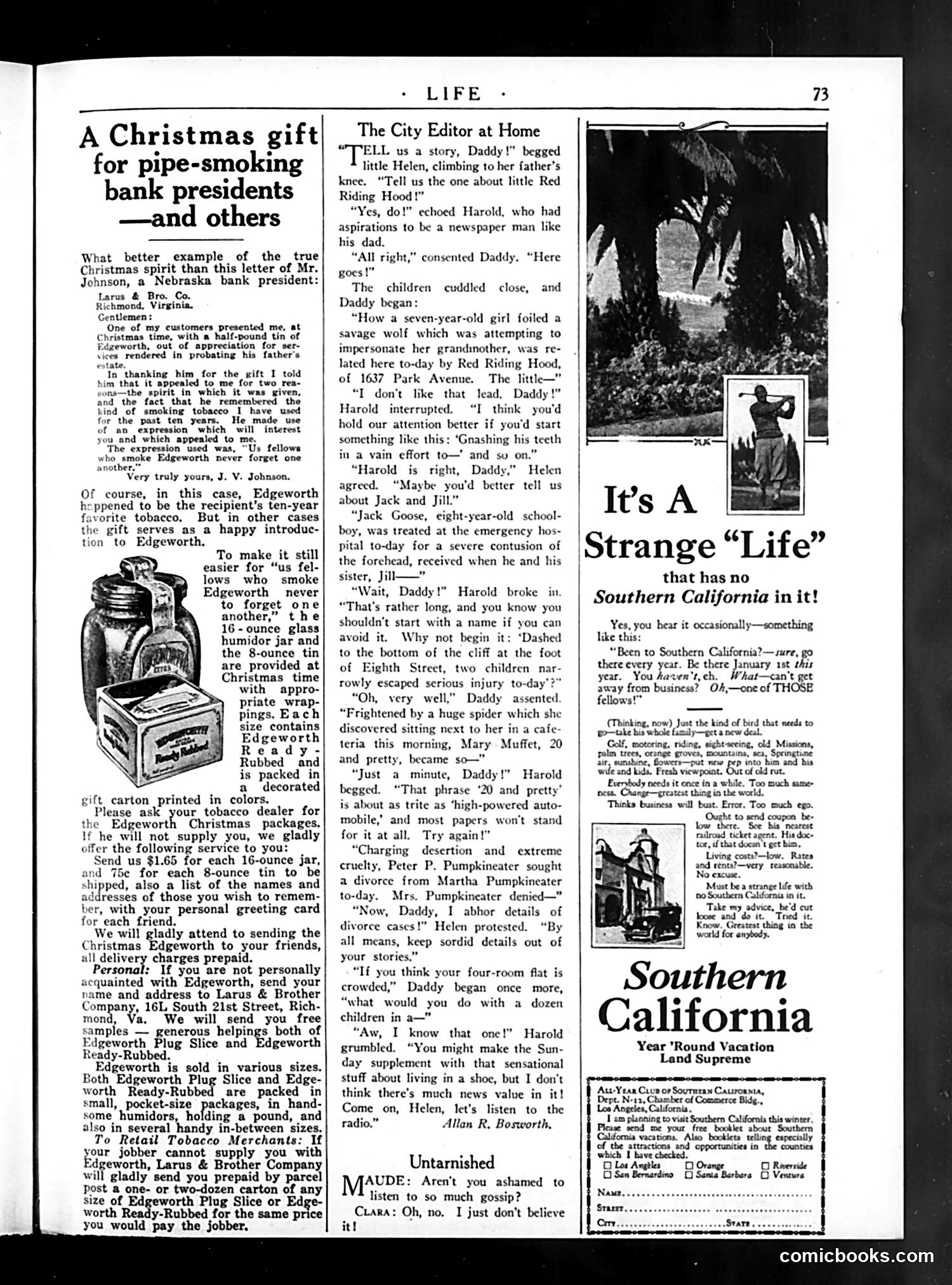
This satirical piece mocks the journalistic style of early 20th-century newspaper writing. A father attempts to tell his children classic fairy tales (Red Riding Hood, Jack and Jill), but his newspaper-editor children interrupt, demanding he rewrite the stories in sensationalist journalistic language. The humor lies in the contrast: innocent children's tales are transformed into crime reports with dramatic "leads" ("Gnashing his teeth in a vain effort to..."). Harold, who "had aspirations to be a newspaper man," critiques his father's storytelling as if editing copy, complaining the narrative lacks punch and proper journalistic structure. The satire targets contemporary newspaper conventions—overwrought headlines, sensationalism, and formulaic reporting that reduced human interest to clinical facts. By showing children parroting newspaper jargon, Life ridicules how pervasive and absurd these journalistic habits had become. The facing Edgeworth tobacco advertisement is unrelated product placement.
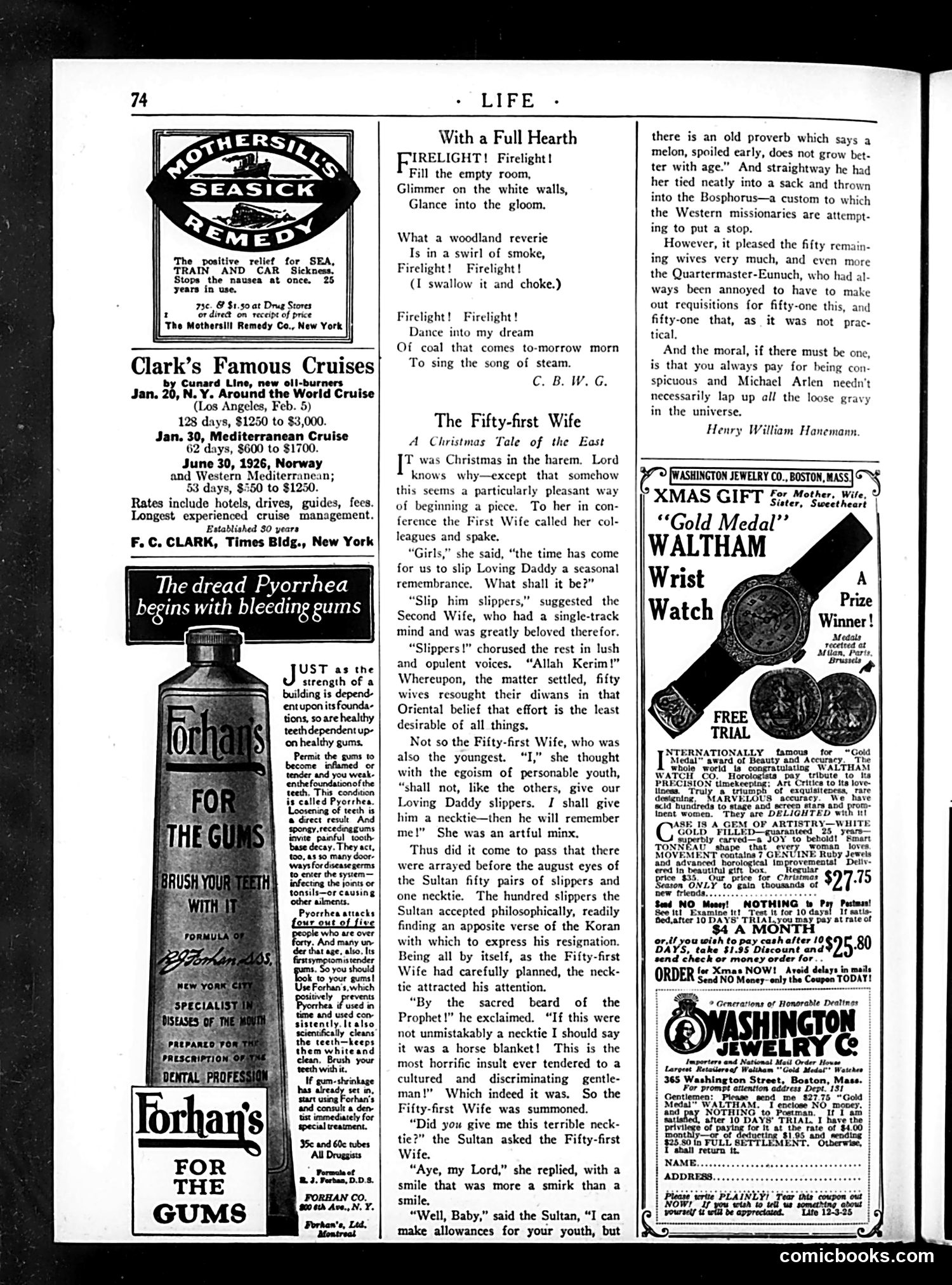
This page is primarily **advertising and light fiction**, not political satire. The content includes: **"The Fifty-first Wife"** — a humorous orientalist short story playing on Western stereotypes of harems. The joke is that the youngest wife, thinking herself clever, gives the Sultan a necktie instead of practical slippers like the other fifty wives. The Sultan, offended by what he considers a "horse blanket," has her thrown into the Bosphorus—a darkly comic punchline that treats violent punishment as casual humor. The story mocks both orientalism and feminine presumption. **Advertisements** dominate: Mothersill's seasickness remedy, Clark's cruise packages, Forhan's toothpaste (for pyorrhea), and Waltham watches. These reflect 1920s consumer culture. The satirical element is minimal—mainly the casual orientalism and the story's dark humor about a woman punished for her audacity. No specific political figures or events are referenced; it's period entertainment reflecting contemporary attitudes toward non-Western cultures.
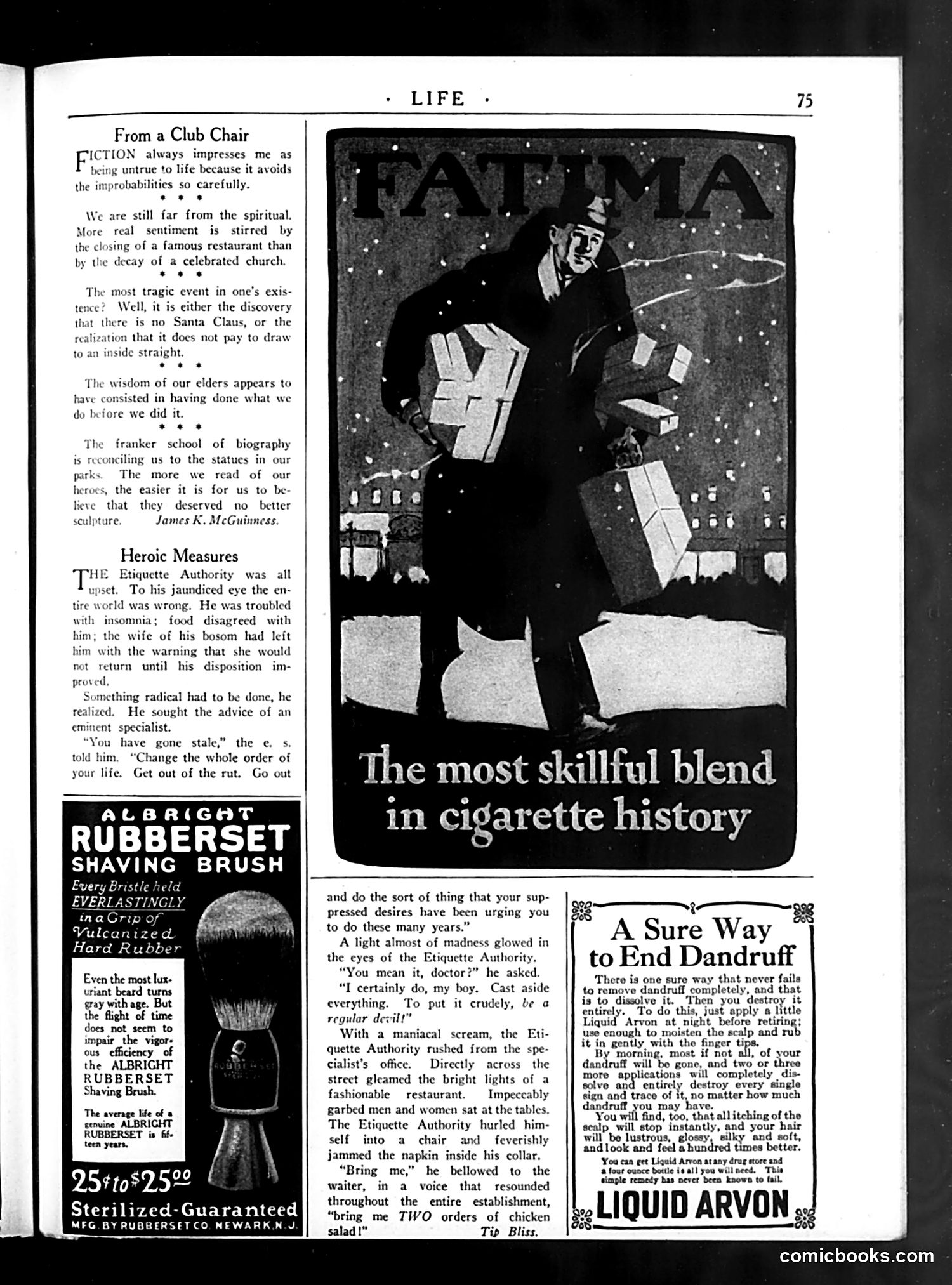
This page combines satirical commentary with period advertising. The main satirical piece, "Heroic Measures" by Tid Bliss, mocks the "Etiquette Authority"—a rigid, uptight character suffering modern malaise (insomnia, marital discord). A specialist prescribes radical life change: "be a regular devil!" The joke's punchline: the Authority's idea of rebellion is jammed napkin usage and loudly ordering *two* chicken salads at a fancy restaurant. This satirizes how even those attempting to break social conventions remain enslaved to etiquette's trivialities. The humor hinges on the gap between genuine transformation and superficial rule-breaking. The opening "From a Club Chair" section offers wry observations about how fiction avoids real life's improbabilities, and how mundane losses (restaurant closures) matter more emotionally than spiritual decline—reflective of 1920s-era cynicism. The page also contains period advertisements for Rubberset shaving brushes and Liquid Arvon dandruff treatment, typical of Life's revenue model.
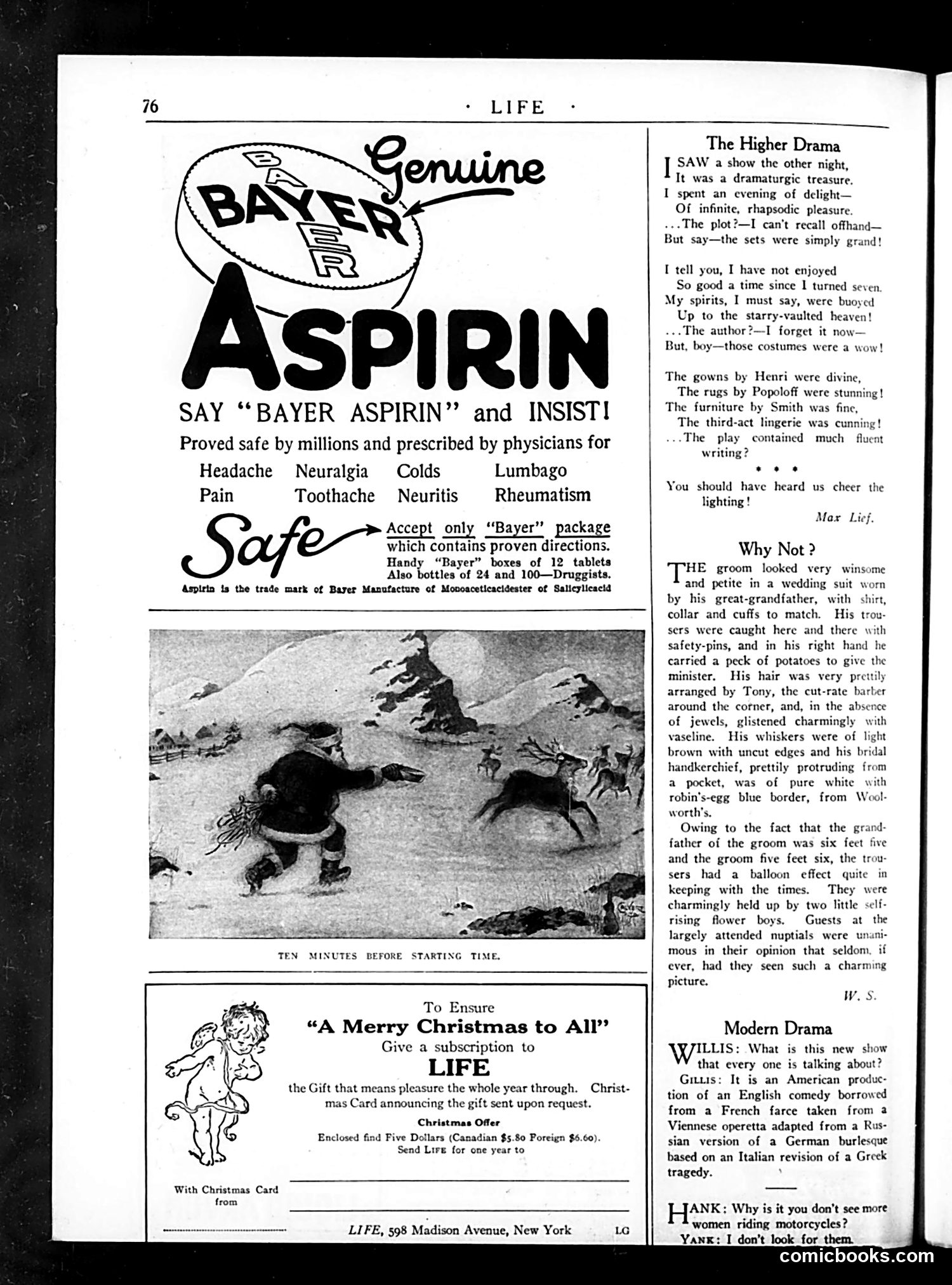
This page contains **advertising and satirical commentary**, not political cartoons per se. The **Bayer Aspirin advertisement** dominates the upper portion, emphasizing the brand name repeatedly—a response to patent challenges. The accompanying image of horses galloping appears designed to convey energy and vitality. The satirical **poems and humor pieces** mock contemporary theater culture: - "The Higher Drama" mocks theatergoers who praise spectacle (sets, costumes, lighting) while admitting they forgot the plot and author—satirizing shallow aesthetic appreciation. - "Why Not?" ridicules an absurdly costumed groom in ill-fitting inherited clothes held together with safety pins, suggesting either poverty or comedy in wedding preparations. - "Modern Drama" jokes about theatrical pedigree: an American show traced back through multiple European sources, suggesting lack of originality in contemporary theater. The humor targets **social pretension and consumerism** in the 1920s-30s era—audiences valuing appearances over substance, and art's derivative nature.
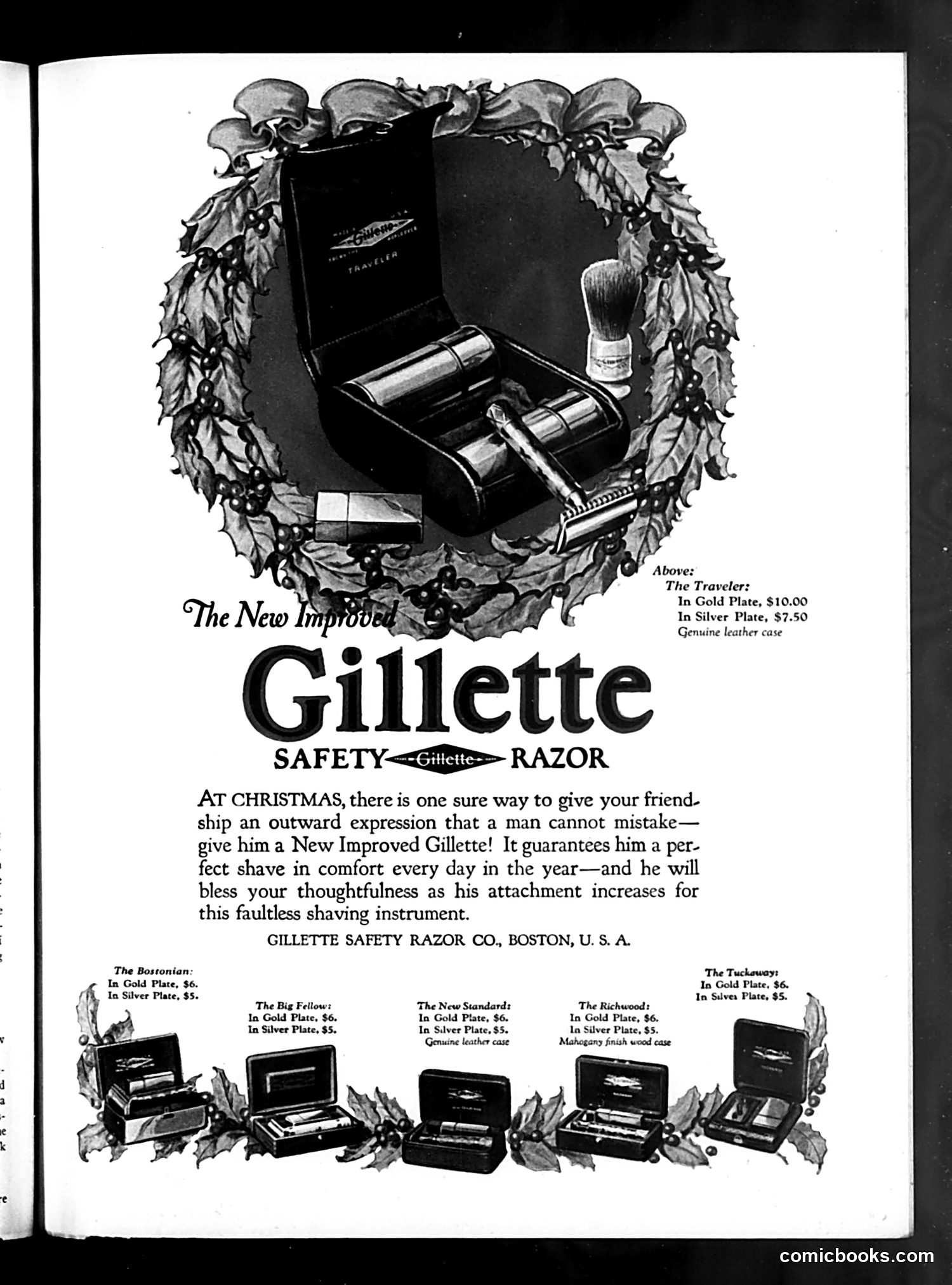
This is a **Gillette Safety Razor advertisement**, not a political cartoon. The page promotes various Gillette razor models as Christmas gifts for men. The decorative wreath framing "The Traveler" model at top is purely ornamental holiday imagery. The ad's rhetoric emphasizes masculine gift-giving: a razor supposedly expresses "friendship" clearly and will make the recipient grateful for years. This reflects early 20th-century marketing that positioned grooming tools as meaningful presents between men. The five models displayed below—The Bostonian, The Big Fellow, The New Standard, The Richwood, and The Tuckaway—are offered in varying price points ($5-$10) with options for gold or silver plating and different cases (leather, mahogany wood). The ad targets middle-class consumers seeking quality gifts. **Historical context**: Safety razors were relatively new technology then, making them desirable luxury items rather than everyday commodities.
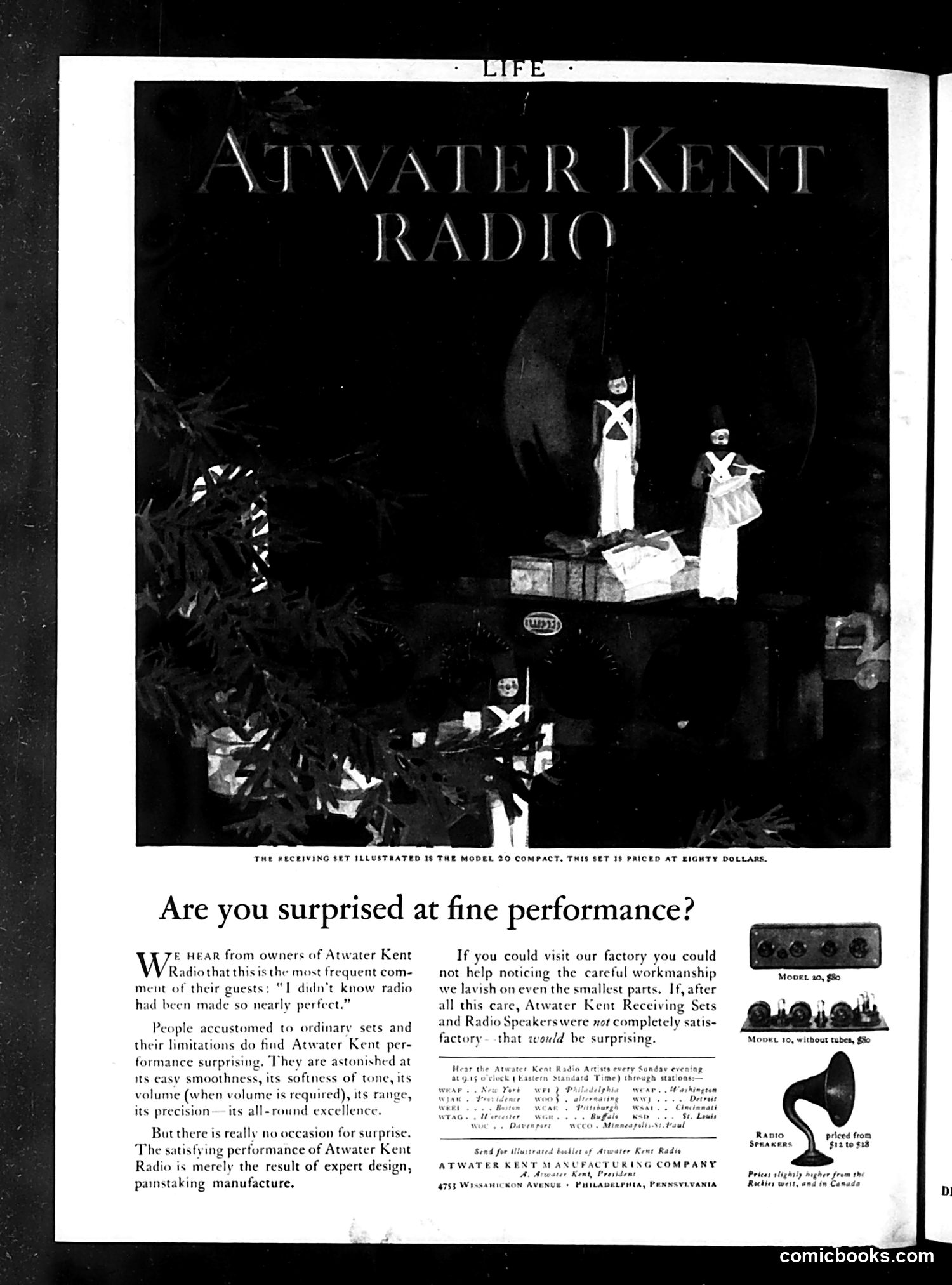
This is a **product advertisement**, not political satire. It promotes Atwater Kent radios, a major American manufacturer of the early radio era (likely 1920s based on styling and pricing). The image shows a theatrical scene with two figures in white robes operating radio equipment—a visual metaphor presenting radio ownership as sophisticated and almost ceremonial. The text emphasizes that buyers are "surprised" by the radio's superior performance, countering skepticism that early radio technology could deliver quality sound. The advertisement's strategy addresses consumer concerns about a still-novel technology by highlighting "expert design" and "painstaking manufacture." The price point ($80 for the compact model) situates this as a luxury consumer good. Small product images on the right show various receiver models and speakers at different price points. This represents early consumer marketing during radio's rapid adoption in American homes.