
Life, 1925-12-03 · page 23 of 84
Life — December 3, 1925 — page 23: what you’re looking at
What you’re looking at
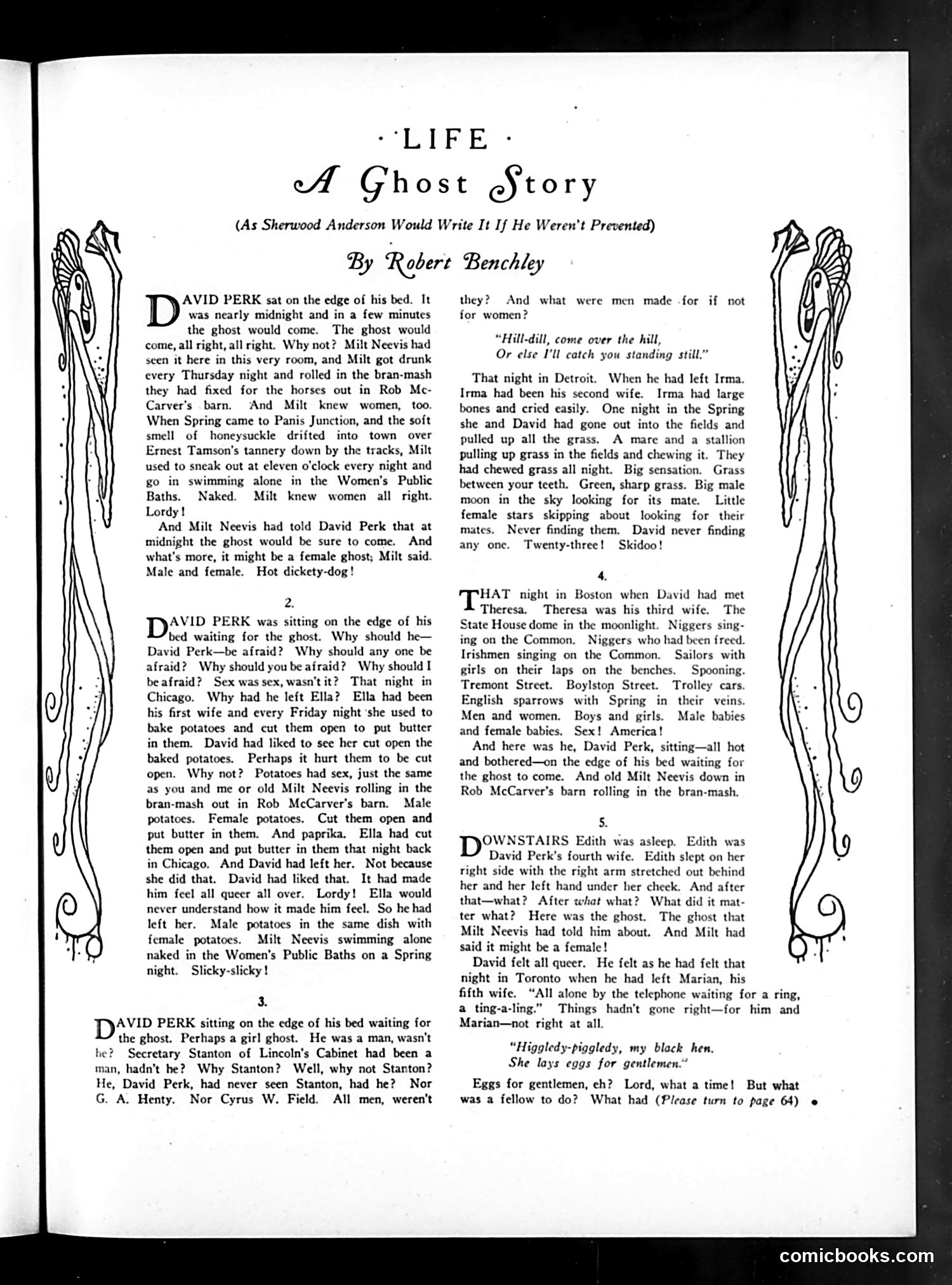
This is a **parody of Sherwood Anderson's literary style** by humorist Robert Benchley. Anderson was known for modernist short stories featuring stream-of-consciousness narration, rural American settings, and themes of repressed desire and existential wandering. Benchley satirizes Anderson by exaggerating his mannerisms: obsessive, digressive internal monologues; cryptic connections between unrelated details (potatoes, swimming, ghosts); pseudo-profound musings about sex and identity; and rambling references to obscure figures (Stanton, Henty, Field). The joke is that Anderson's supposedly deep philosophical explorations of human nature are absurdly pretentious—a man waiting for a ghost becomes an excuse for incoherent philosophizing about masculinity, his multiple wives, and random rural imagery. The subtitle "(As Sherwood Anderson Would Write It If He Weren't Prevented)" suggests Benchley is gently mocking what Anderson might produce if unleashed without editorial restraint.
📄 Transcribed text from this page (OCR, searchable)
Machine-transcribed from the original scan — historical spelling and the odd misread are preserved.
“LIFE: eA Ghost ejtory (As Sherwood Anderson Would Write It If He Weren't Prevented) By Robert Benchley Dr: PERK sat on the edge of his bed. It was nearly midnight and in a few minutes the ghost would come. The ghost would come, all right, all right. Why not? Milt Neevis had seen it here in this very room, and Milt got drunk every Thursday night and rolled in the bran-mash they had fixed for the horses out in Rob Mc- Carver's barn. And Milt knew women, too. When Spring came to Panis Junction, and the soft smell of honeysuckle drifted into town over Ernest Tamson’s tannery down by the tracks, Milt used to sneak out at eleven o'clock every night and go in swimming alone in the Women’s Public Baths. Naked. Milt knew women all right. Lordy! And Milt Neevis had told David Perk that at midnight the ghost would be sure to come. And what's more, it might be a female ghost; Milt said. Male and female. Hot dickety-dog! 2. AVID PERK was sitting on the edge of his bed waiting for the ghost. Why should he— David Perk—be afraid? Why should any one be afraid? Why should you be afraid? Why should I be afraid? Sex was sex, wasn't it? That night in Chicago. Why had he left Ella? Ella had been his first wife and every Friday night ‘she used to bake potatoes and cut them open to put butter in them. David had liked to see her cut open the baked potatoes. Perhaps it hurt them to be cut open. Why not? Potatoes had sex, just the same as you and me or old Milt Neevis rolling in the bran-mash out in Rob McCarver’s barn. Male potatoes. Female potatoes. Cut them open and put butter in them. And paprika. Ella had cut them open and put butter in them that night back in Chicago. And David had left her. Not because she did that. David had liked that. It had made him feel all queer all over. Lordy! Ella would never understand how it made him feel. So he had left her. Male potatoes in the same dish with female potatoes. Milt Neevis swimming alone naked in the Women’s Public Baths on a Spring night. Slicky-slicky! 3 Div2 PERK sitting on the edge of his bed waiting for the ghost. Perhaps a girl ghost. He was a man, wasn't he? Secretary Stanton of Lincoln’s Cabinet had been a man, hadn't he? Why Stanton? Well, why not Stanton? He, David Perk, had never seen Stanton, had he? Nor G. A. Henty. Nor Cyrus W. Field. All men, weren't they? And what were men made -for if not for women? “Hill-dill, come over the hill, Or else I'll catch you standing still.” That night in Detroit. When he had left Irma. Irma had been his second wife. Irma had large bones and cried easily. One night in the Spring she and David had gone out into the fields and pulled up all the grass. A mare and a stallion pulling up grass in the fields and chewing it. They had chewed grass all night. Big sensation. Grass between your teeth. Green, sharp grass. Big male moon in the sky looking for its mate. Little female stars skipping about looking for their mates. Never finding them. David never finding any one. Twenty-three! Skidoo! 4. Thr night in Boston when David had met Theresa. Theresa was his third wife. The State House dome in the moonlight. Niggers sing- ing on the Common, Niggers who had been freed. Irishmen singing on the Common. Sailors with girls on their laps on the benches. Spooning. Tremont Street. Boylston Street. Trolley cars. English sparrows with Spring in their veins. Men and women. Boys and girls. Male babies and female babies. Sex! America! And here was he, David Perk, sitting—all hot and bothered—on the edge of his bed waiting for the ghost to come. And old Milt Neevis down in Rob McCarver’s barn rolling in the bran-mash. 5. OWNSTAIRS Edith was asleep. Edith was David Perk’s fourth wife. ith slept on her right side with the right arm stretched out behind her and her left hand under her cheek. And after that—what? After what what? What did it mat- ter what? Here was the ghost. The ghost that Milt Neevis had told him about. And Milt had said it might be a female! David felt all queer. He felt as he had felt that night in Toronto when he had left Marian, his fifth wife. “All alone by the telephone waiting for a ring, a ting-a-ling.” Things hadn't gone right—for him and Marian—not right at all. “Higgledy-piggledy, my black hen. She lays eggs for gentlemen.” Eggs for gentlemen, eh? Lord, what a time! But what was a fellow to do? What had (Please turn to page 64) @ comicbooks.com