
Life, 1925-12-03 · page 60 of 84
Life — December 3, 1925 — page 60: what you’re looking at
What you’re looking at
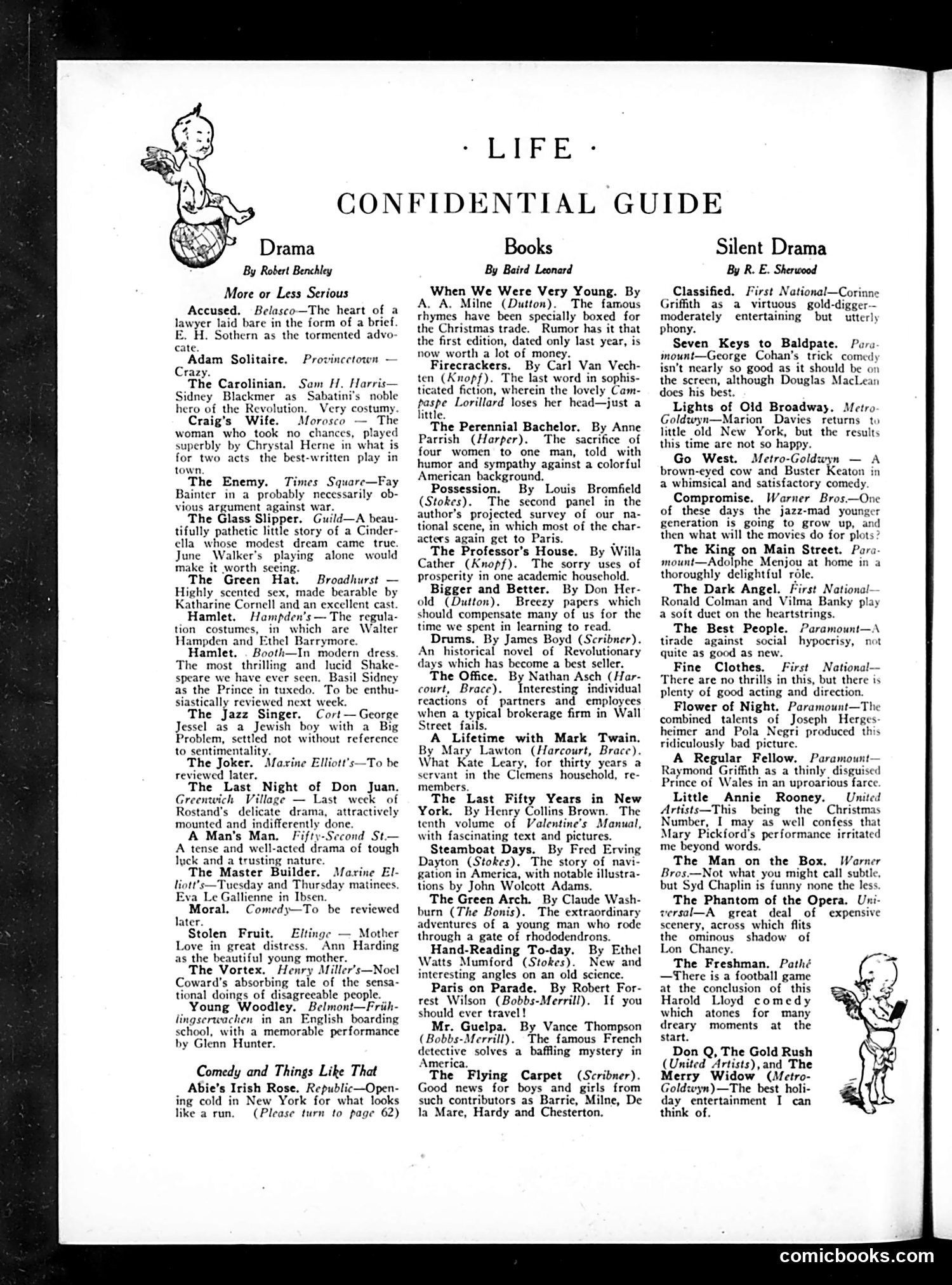
This page from *Life* magazine presents Robert Benchley's satirical theater and book reviews—a "confidential guide" offering his irreverent takes on contemporary Broadway productions and new publications. **The Theater Reviews** mock popular plays of the 1920s with Benchley's characteristic wit. He praises Basil Sidney's *Hamlet* in modern dress as "the most thrilling and lucid Shakespeare we have ever seen," while dismissing *The Green Hat* as merely "highly scented sex" redeemed only by Katharine Cornell's performance. His reviews balance genuine appreciation with sharp criticism. **The Book Section** covers recent releases, including A.A. Milne's *When We Were Very Young* (a children's classic) and works by literary figures like Willa Cather and James Boyd. **The Cartoon Figures** (left and right margins) appear to be decorative mascots typical of *Life*'s visual style—stylized cherubs or imps emphasizing the magazine's humorous tone. The overall purpose: provide sophisticated readers with Benchley's candid, entertainingly cynical assessments of what New York's cultural establishment was offering in the 1920s.
📄 Transcribed text from this page (OCR, searchable)
Machine-transcribed from the original scan — historical spelling and the odd misread are preserved.
* LE CONFIDENTIAL GUIDE By Robert Benchley More or Less Serious Accused. Belasco—The heart of a lawyer laid bare in the form of a brief E. H. Sothern as the tormented advo- cate. Adam Solitaire. Crazy. The Carolinian. Sam H. Harris— Sidney Blackmer as Sabatini’s noble hero of the Revolution. Very costumy. Craig’s Wife. Morosco — The woman who took no chances, played superbly by Chrystal Herne in what is for two acts the best-written play in town. The Enemy. Times Square—Fay Bainter in a probably necessarily ob- vious argument against war. The Glass Slipper. Guild—A beau- tifully pathetic little story of a Cinder- ella whose modest dream came true. June Walker's playing alone would make it worth seeing. The Green Hat. Broadhurst — Highly scented sex, made bearable by Katharine Cornell and an excellent cast. Hamlet. Hampden’s— The regula- tion costumes, in which are Walter Hampden and Ethel Barrymore. Hamlet. . Booth—In modern dress. The most thrilling and lucid Shake- speare we have ever seen. Basil Sidney as the Prince in tuxedo. To be enthu- siastically reviewed next week. The Jazz Singer. Cort— George Jessel as a Jewish boy with a Big Problem, scttled not without reference to sentimentality. The Joker. Maxine Elliott’s—To be reviewed later, The Last Night of Don Juan. Greenwich Village — Last week of Rostand’s delicate drama, attractively mounted and indifferently done. Man's Man. Fifty-Second St— A tense and well-acted drama of tough luck and a trusting nature. The Master Builder. Marine El- liott’s—Tuesday and Thursday matinees. Eva Le Gallienne in Ibsen. Moral. Comedy—To be reviewed later. Stolen Fruit. Eltinge —_ Mother Love in great distress. Ann Harding as the beautiful young mother. The Vortex. Henry Miller’s—Noel Coward's absorbing tale of the sensa- tional doings of disagreeable people. Young Woodley. Belmont—Friih- lingserwachen in an English boarding school, with a memorable performance by Glenn Hunter. Comedy and Things Like That Abie’s Irish Rose. Republic—Open- ing cold in New York for what looks like a run. (Please turn to page 62) Provincetown — Books By Baird Leonard When We Were Very Young. By A. A. Milne (Dutton). The famous rhymes have been specially boxed for the Christmas trade. Rumor has it that the first edition, dated only last year, is now worth a lot of money. Firecrackers, By Carl Van Vech- ten (Knopf). The last word in sophis- ticated fiction, wherein the lovely Cam- paspe Lorillard loses her head—just a little. The Perennial Bachelor. Parrish (Harper). The sacrifice of four women to one man, told with humor and sympathy against a colorful American background. Possession. By Louis Bromfield (Stokes). The second panel in the author’s projected survey of our na- tional scene, in which most of the char- acters again get to Paris. = The Professor's House. By Willa Cather (Knopf). The sorry uses of prosperity in one academic houschold. Bigger and Better. By Don Her- old (Dutton), Breezy papers which should compensate many of us for the time we spent in learning to read. Drums. By James Boyd (Scribner). An historical novel of Revolutionary days which has become a best seller. The Office. By Nathan Asch (Har- court, Brace). Interesting individual reactions of partners and employees when a typical brokerage firm in Wall Street_ fails. A_ Lifetime with Mark Twain. By Mary Lawton (Harcourt, Brace). What Kate Leary, for thirty years a servant in the Clemens household, re- members. The Last Fifty Years in New York. By Henry Collins Brown. The tenth volume of Valentine’s Manual, with fascinating text and pictures. Steamboat Days. By Fred Erving Dayton (Stokes). The story of navi- gation in America, with notable illustra- tions by John Wolcott Adams. The Green Arch. By Claude Wash- burn (The Bonis). The extraordinary adventures of a young man who rode through a gate of rhododendrons. Hand-Reading To-day. By Ethel Watts Mumford (Stokes). New and interesting angles on an old science. Paris on Parade. By Robert For- rest Wilson (Bobbs-Merrill). If you should ever travel! Mr. Guelpa. By Vance Thompson (Bobbs-Merrill), The famous French detective solves a baffling mystery in America. The Flying Carpet (Scribner). Good news for boys and girls from such contributors as Barrie, Milne, De la Mare, Hardy and Chesterton. By Anne Silent Drama By R. E. Sherwood Classified. First National—Corinne Griffith as a virtuous gold-digger— moderately entertaining but utterly phony. Seven Keys to Baldpate. Pura mount—George Cohan’s trick comedy isn’t nearly so good as it should be on the screen, although Douglas MacLean does his best. Lights of Oid Broadway. Metro Goldwyn—Marion Davies returns to little old New York, but the results this time are not so happy. Go West. Metro-Goldwyn — A brown-eyed cow and Buster Keaton in a whimsical and satisfactory comedy. Compromise. Warner Bros.—One of these days the jazz-mad younger generation is going to grow up, and then what will the movies do for plots? The King on Main Street. Para- mount—Adolphe Menjou at home in a thoroughly delightful role. The Dark Angel. First National- Ronald Colman and Vilma Banky play a soft duct on the heartstrings. The Best People. tirade against social quite as good as new. Fine Clothes. First National— There are no thrills in this, but there is plenty of good acting and direction. Flower of Night. Paramount—The combined talents of Joseph Herges heimer and Pola Negri produced this ridiculously bad picture. A Regular Fellow. Paramount— Raymond Griffith as a thinly disguised Prince of Wales in an uproarious farce. Little Annie Rooney. United Artists—This being the Christmas Number, I may as well confess that Mary Pickford’s performance irritated me beyond words. The Man on the Box. Warner Bros.—Not what you might call subtle, but Syd Chaplin is funny none the less The Phantom of the Opera. Uni- versal—A great deal of expensive scenery, across which flits the ominous shadow of Lon Chaney. The Freshman. Pathé —There is a football game at the conclusion of this Harold Lloyd comedy which atones for many dreary moments at the start. Don Q, The Gold Rush (United Artists), and The Merry Widow (Metro- Goldwyn)—The best holi- day entertainment I can think of. Paramount—A hypocrisy, not comicbooks.com